
Tag: efficiency

  • Beyond efficiency: Building procurement agility in higher education

    Beyond efficiency: Building procurement agility in higher education

    Higher education leaders face a constant balancing act. Shifting enrollment, tightening budgets, and rapidly evolving technology create pressure to stay nimble while maintaining operational excellence. In this environment, procurement teams are playing a new strategic role, moving beyond cost-cutting to become enablers of institutional agility.

    The most agile institutions understand that procurement agility isn’t just about faster purchasing. It means building systems that anticipate needs, optimize every dollar in real time, and empower campus-wide decision-making. When procurement teams can redirect spending toward emerging priorities while maintaining compliance and transparency, they create institutional resilience: the ability to respond confidently to whatever comes next.

    Closing higher ed’s agility gap

    Traditional procurement creates bottlenecks precisely when agility is needed most: lengthy approval cycles that delay critical purchases, fragmented systems that prevent comprehensive spend analysis, and limited visibility that leaves leaders making decisions without complete financial data.

    The stakes are significant. With 25% of operating budgets flowing through procurement—possibly more for institutions with extensive outsourcing—efficiency directly impacts your ability to respond quickly to changing circumstances.[1]

    There’s encouraging momentum, though. In a survey of nearly 3,500 procurement and organizational leaders, 24% of senior leaders identified “becoming more agile or resilient” as a priority above reducing spend (19%).[2] This signals growing recognition that adaptability drives long-term institutional success more than cost-cutting alone.

    Five pillars of agile procurement

    So how can institutions actually close this agility gap? Many procurement leaders are turning to technology solutions, and for good reason. The right tools can magnify agility across campus operations, but only when they address the right fundamentals. These five pillars provide a framework for building procurement systems that enhance rather than hinder institutional responsiveness:

    Unified systems: Consolidated purchasing transforms how campuses operate, improving user experience, spend transparency, and analytics. Administrators should be able to track campus-wide purchasing patterns, identify savings opportunities, and make data-driven decisions across all departments. When the University of Washington (UW) consolidated purchasing across its numerous academic departments through a single master account, it gained the visibility and simplified management that had previously been impossible.

    Streamlined interfaces: A centralized purchasing interface removes manual work and complexity, allowing staff to focus on higher-impact activities while maintaining oversight. Ray Hsu, executive director of procurement services at the University of Washington, explains: “Imagine you’re managing the drama department and your scene shop needs to find ten different things to outfit your next production. Imagine how many different sources you visit to find costumes, supplies, and other items for that use case. Centralize that.”

    Aligned purchasing: The right tools enable alignment with shifting institutional priorities—sustainability goals, minority-owned businesses, compliance requirements—through preferred vendor selection in a way that’s frictionless for buyers. Hsu describes how this works at UW: “When people search for items, they don’t even know they’re searching for a sustainable product. It just comes up in their search results, supporting our policy without them having to be mindful of it.”

    Smart comparison: Pricing, delivery, and vendor comparison mechanisms help buyers to easily identify their most cost-effective options without searching multiple sources or juggling spreadsheets. Time saved on research translates to faster response when priorities shift.

    Real-time monitoring: Proactive systems flag overspending or policy compliance issues before they become problems, giving administrators the breathing room to focus on strategic opportunities.

    Real-world impact

    The University of Washington example illustrates how these pillars work together in practice. Beyond the streamlined purchasing process described earlier, the transformation also revealed deeper lessons about building sustainable agility.

    When UW decided to modernize its procurement, it faced a familiar challenge: staff were already purchasing from multiple vendors without central oversight. Instead of changing staff behavior, the university introduced a centralized system that preserved the flexibility departments valued while adding the visibility and control the university needed.

    “There’s a saying, ‘I want an Amazon-like experience.’ We thought, let’s just go get the real thing and bring Amazon to our campus,” Hsu recalls.[3]

    The shift delivered more than operational efficiency. “With Amazon Business Analytics, I can visualize information on an intuitive dashboard and have a conversation with my boss: ‘Here’s how we’re doing at a glance,’” says Hsu. That visibility changes how procurement conversations happen, moving from reactive problem-solving to proactive strategic discussions.

    Perhaps most importantly, UW discovered that agility doesn’t require forcing behavior change. When the right systems build compliance and best practices into everyday workflows, adoption happens naturally. The drama department gets what it needs faster. Sustainability goals are met through preferred policies. And procurement leaders gain the strategic insights they need to guide institutional priorities.

    Building sustainable agility

    Building more agility into your procurement operations starts with a few key fundamentals:

    Start with visibility into spend. Understand where your money goes. With 25% of operating budgets spent on goods and services, visibility is essential for agile resource allocation.[4]

    Centralize for control. As Hsu notes, “Chances are your internal customers are already buying from Amazon in a decentralized and unmanaged fashion. My suggestion is to centralize that management into a unified system.”

    Simplify user experience. Make compliance and best practices seamless. “Make it easy so it’s not a conscious decision—just part of their everyday buying experience,” advises Hsu.

    Focus on consolidation. Look for opportunities to consolidate processes. Listen to solution providers who are experts in this area and implement their suggestions when they make sense to your organization, Hsu adds.

    Agility as an institutional advantage

    Agile procurement enables both resource optimization and faster response to opportunities. The goal isn’t just efficient purchasing, but procurement that enhances decision-making.

    When procurement teams can redirect resources quickly, spot savings in real time, and adhere to campus purchasing policies, they free their institutions to focus on mission and seize opportunities as they arise.

    Learn how your peers are using Amazon Business to build procurement agility: business.amazon.com/education

    Source link

  • The Link Between Greed and Efficiency

    The Link Between Greed and Efficiency

    In the mythology of American capitalism, “efficiency” is the magic word that justifies austerity for workers, rising tuition for students, and ever-expanding wealth for administrators, financiers, and institutional elites. It is framed as neutral, technocratic, and rational. In reality, efficiency in higher education has become inseparable from greed, functioning as a mask for extraction and consolidation.

    Universities and their sprawling medical centers have become some of the largest landowners and employers in the cities they inhabit. As Devarian Baldwin has shown, these institutions operate as urban empires, expanding aggressively into surrounding neighborhoods, raising housing costs, displacing long-time residents, and reshaping cities to suit institutional priorities. University medical centers, nominally nonprofit, consolidate smaller hospitals, close services deemed unprofitable, and charge some of the highest healthcare prices in the nation. These operations are justified as efficiency or economic development, yet they often destabilize the communities they claim to serve.

    Endowments, some exceeding fifty billion dollars at elite institutions, have become central to this dynamic. Managed like hedge funds, these pools of capital are heavily invested in private equity, venture capital, real estate, and derivatives. The financial logic of endowment management now shapes university priorities, shifting focus from public service and learning to capital accumulation, investor returns, and risk management. Efficiency is defined not by educational outcomes but by the growth of financial assets.

    This culture of extraction has been amplified by decades of government austerity. Public funding for higher education has steadily declined since the 1980s, forcing institutions to behave like corporations. At the same time, the aging Baby Boomer generation is creating unprecedented financial pressures on Social Security, Medicare, and healthcare systems, leaving public coffers stretched thin and reinforcing a winner-take-all national mentality. In this environment, universities compete fiercely for students, research dollars, donors, and prestige, producing conditions ripe for exploitation.

    Outsourcing has become a standard method to achieve “efficiency.” Universities frequently contract out food service, custodial work, IT, housing management, and security. Workers employed by these contractors often face lower wages, fewer benefits, and higher turnover, while administrators present these arrangements as cost-saving measures. Meanwhile, administrative layers within institutions continue to expand, creating a managerial class that oversees growth and strategy while teaching budgets shrink. As Marc Bousquet has argued, the corporate-style management model displaces faculty governance and treats students and staff as revenue streams rather than participants in a shared educational mission.

    The adjunctification of the faculty exemplifies efficiency as exploitation. Contingent instructors now teach the majority of classes in American higher education, earning poverty-level wages without benefits while juggling multiple teaching sites. Institutions call this “flexibility” and “cost containment,” but in reality it transfers value from instruction to administrative overhead, athletics, real estate, and financial operations, all while reducing the quality of education and undermining academic continuity.

    The rise of Online Program Managers, or OPMs, further illustrates the fusion of greed and efficiency. These companies design, manage, and market entire online degree programs, often taking forty to seventy percent of tuition revenue. While presented as efficiency partners, OPMs aggressively recruit students, inflate costs, and minimize academic oversight. Their business model mirrors the exploitative strategies of for-profit colleges, which pioneered high-cost, low-quality instruction combined with heavy marketing to capture federal loan dollars. The collapse of chains such as Corinthian, ITT, and EDMC left millions of borrowers with debt and no degree, yet the model persists inside nonprofit universities through OPMs and algorithm-driven online programs.

    “Robocolleges” represent the latest evolution of this trend. AI-driven instruction, predictive analytics, automated grading, and digital tutoring promise unprecedented efficiency, but they often replace human educators, reduce pedagogical oversight, exploit student data, and prioritize enrollment growth over educational quality. Efficiency here serves the financial bottom line rather than the learning or well-being of students.

    The result of these extractive practices is a national crisis of student debt, now exceeding one trillion dollars. Students borrow to cover skyrocketing tuition, outsourced services, underpaid instruction, and the costs of programs shaped by OPMs or automated platforms. Debt is not an accident of the system; it is the intended outcome, a mechanism for transferring public resources and student labor into private profit.

    The broader social context intensifies the problem. Higher education exists in a winner-take-all, financialized society, where resources flow upward and the majority of people are told to compete harder, work longer, and borrow more. Universities have internalized this ideology, acting as both symbols and engines of extraction. Efficiency, under this paradigm, is defined not by the effectiveness of teaching or research but by the expansion of institutional power, wealth, and influence.

    True efficiency would look very different. It would invest in educators rather than contractors, stabilize academic labor rather than exploit it, serve surrounding communities rather than displace them, expand learning opportunities rather than debt, and prioritize democratic governance over corporate-style hierarchy. Efficiency should measure how well institutions serve the public good, not how well they protect endowment returns, OPM profits, or administrative salaries.

    Until such a redefinition occurs, efficiency will remain one of the most powerful tools of extraction in American higher education, a rhetorical justification for greed disguised as rational management.


    Sources

    Devarian Baldwin, In the Shadow of the Ivory Tower

    Marc Bousquet, How the University Works

    Tressie McMillan Cottom, Lower Ed

    Christopher Newfield, The Great Mistake

    Sara Goldrick-Rab, Paying the Price

    Government reports on for-profit colleges, student debt, and OPMs

    Research on higher education financialization, outsourcing, and austerity policies

    Source link

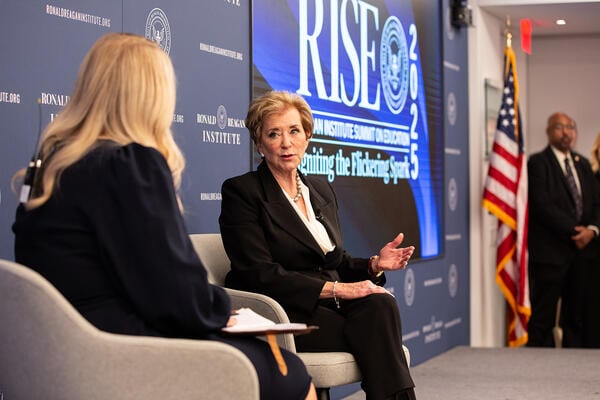
  • McMahon Calls for Improving Efficiency, Civilizing Discourse

    McMahon Calls for Improving Efficiency, Civilizing Discourse

    Connor McLaren for the Ronald Reagan Institute

    Washington, D.C.—Education Secretary Linda McMahon made clear at a series of policy summits this week that while she remains committed to one day shuttering her department, there’s still much work left to be done.

    “You don’t just shut off the lights and walk out the door if you are trying to return education to the states,” McMahon said at one event Wednesday, adding that offices like Civil Rights and Federal Student Aid can’t simply be eliminated. “Really, what we’re trying to do is to show how we can move different parts of the Department of Education to show that they can be more efficient operating in other agencies.”

    Throughout her remarks at both events—the Education Law and Policy Conference hosted by the Federalist Society and the Defense of Freedom Institute on Wednesday and the Reagan Institute Summit on Education on Thursday—the secretary stressed that a key way to test this concept is by moving workforce development programs to the Department of Labor.

    “Let’s be sure that we are not moving hastily, but that we are taking the right steps at the right pace for success,” McMahon told the Federalist Society audience. “And if we show that this is an incredibly efficient and effective way to manage these programs, it is my hope that Congress will look at that and approve these moves.”

    However, some advocates for students, institutional lobbyists, Democrats in Congress and left-leaning policy analysts have taken issue with the plan to move adult, career and technical education programs to the Labor Department, arguing that it’s illegal and will create more headaches for the providers who rely on the money.

    Regardless, the Trump administration is moving forward with its plans. ED signed an interagency agreement with the Department of Labor earlier this spring and has more recently moved many of its staff members to the DOL office. (Funding for the salaries of these employees and the programs they lead, however, will still come from the Education Department budget.)

    On Thursday at the Reagan Institute, McMahon noted that the combined staff is working on a new learning and employment report as well as a “skills wallet” that will help show employers what students have learned and students what employers are looking for.

    “It’s an exciting time in labor development in that country, but it’s a challenge and a real responsibility for us to not get stuck,” she said.

    Aside from career and technical education and some of her other priorities, such as cracking down on alleged campus antisemitism and racial preferencing, much of the conversation both days was centered around the recent shooting of conservative figurehead Charlie Kirk at Utah Valley University and how to prevent political violence on campus.

    McMahon was quick to describe the Turning Point USA president’s death as a travesty and to charge colleges with the responsibility of promoting more healthy civic discourse. At both events, she cited Kirk himself as a prime example of what such debate looks like, saying that while his approach was at times “aggressive,” he was always “very polite” and “civil.”

    “He wasn’t antagonistic, but he was challenging. And there’s a clever art to being able to do that,” she said. “I don’t think that we show our students how to do that enough.”

    Thursday, she denounced the faculty, staff and students who appeared to have been apathetic toward or allegedly celebrated Kirk’s death, building upon comments she made in a social media video earlier this week. But just as she suggested condemning certain individuals for crossing an “ethical line,” she added that “if you shut down the speech of one side to allow the freedom of speech for another, you’d have actually compromised the entire principle, and that we cannot have.”

    She closed on Thursday by urging educators to foster their students’ compassion.

    “We’ve lost a little of our humanity,” she said. “Let’s make sure we grab that back in peace and show it through leadership.”

    Source link

  • Operational Efficiency in Hospitals: Impact on Neonatal Nurses

    Operational Efficiency in Hospitals: Impact on Neonatal Nurses

    Home » Careers in Nursing » Operational Efficiency in U.S. Hospitals: Impact on Neonatal Nurses, Patient Safety, and Outcomes

    Operational efficiency in hospitals — the streamlining of staffing, workflows, and resource use — is essential to delivering safe and high-quality care. 

    Taryn M. Edwards, M.S.N., APRN, NNP-BC

    President, National Association of Neonatal Nurses

    At its core, operational efficiency helps reduce delays, minimize risks, and improve patient safety. Nowhere is this more critical than in neonatal intensive care units (NICUs), where even small disruptions can affect outcomes for the most fragile patients. From preventing infections to reducing medical errors, efficient operations are directly linked to patient safety and nurse effectiveness.

    In NICUs, nurse-to-patient ratios and timely task completion are directly tied to patient safety. Studies show that many U.S. NICUs regularly fall short of national staffing recommendations, particularly for high-acuity infants. These shortfalls are linked to increased infection rates and higher mortality among very low-birth-weight babies, some experiencing a nearly 40% greater risk of hospital-associated infections due to inadequate staffing.

    In such high-stakes environments, missed care isn’t just a workflow issue; it’s a safety hazard. Neonatal nurses manage hundreds of tasks per shift, including medication administration, monitoring, and family education. When units are understaffed or systems are inefficient, essential safety checks can be delayed or missed. In fact, up to 40% of NICU nurses report regularly omitting care tasks due to time constraints.

    Improving NICU care

    Efficient operational systems support safety in tangible ways. Structured communication protocols, such as standardized discharge checklists and safety huddles, reduce handoff errors and ensure continuity of care. One NICU improved its early discharge rate from just 9% to over 50% using such tools, enhancing caregiver readiness and parental satisfaction while decreasing length of stay.

    Work environments also matter. NICUs with strong professional nursing cultures and transparent data-sharing practices report fewer safety events and higher overall care quality. Nurses in these units are up to 80% less likely to report poor safety conditions, even when controlling for staffing levels.

    Finally, operational efficiency safeguards nurses themselves. By reducing unnecessary interruptions and missed tasks, it protects against burnout, a key contributor to turnover and medical error. Retaining experienced neonatal nurses is itself a vital safety strategy, ensuring continuity of care and institutional knowledge.

    Ultimately, operational efficiency is a foundation for patient safety, clinical excellence, and workforce sustainability. For neonatal nurses, it creates the conditions to provide thorough, attentive care. For the tiniest patients, it can mean shorter stays, fewer complications, and stronger chances for a healthy start.

    Source link

  • University of Iowa launches ‘proactive’ committee to hunt for revenue and boost efficiency

    University of Iowa launches ‘proactive’ committee to hunt for revenue and boost efficiency

    This audio is auto-generated. Please let us know if you have feedback.

    Dive Brief:

    • The University of Iowa has assembled a massive universitywide committee to explore new revenue opportunities and ways to boost efficiency, the public institution announced last week. 
    • Dubbed “Resparc” short for Revenue and Efficiencies Strategic Plan Action and Resource Committee — the group includes nearly 100 faculty, staff and officials from 35 units across the institution. 
    • Subcommittees will explore specific areas such as philanthropy, academic programs and financial operations. Those teams will develop proposals for increasing revenue and improving operations for Resparc’s leadership and ultimately for University of Iowa’s president and provost.

    Dive Insight:

    The university framed its new initiative as forward-looking, meant to ensure University of Iowa “maintains its strong financial trajectory for years to come,” rather than having to wrestle reactively with challenges as they happen. 

    “By launching this effort from a position of financial health, the university will be able to build upon its success at a time when higher education is navigating significant disruption, from the anticipated demographic enrollment cliff to a decline in public trust and growing financial constraints,” the university said in its announcement. 

    Iowa’s flagship university is growing. By fall 2024, its total faculty and staff had increased 5.1% year over year to 27,795 employees, while enrollment grew 2.4% to 32,199 students

    The university’s total assets and revenues have also been steadily rising in recent years. In fiscal 2024, its operating income — which does not include state appropriations, certain grants and contacts, investment income or gifts — stood at $36.8 million. The positive operating income stands in contrast to that of the many public universities with operating losses before those sources of revenue are factored in. 

    But University of Iowa officials acknowledged the challenges rippling across the higher ed landscape, including an anticipated decline in the traditional college-age population

    In Iowa specifically, the number of high school graduates is projected to decline by 4% from 2023 to 2041, according to the latest estimates from Western Interstate Commission for Higher Education. 

    University of Iowa has also seen its expenses jump along with the rest of the higher ed world, adding new financial constraints. Between fiscal years 2022 and 2024, its total operating expenses rose 15.7% to $5 billion. 

    The Trump administration’s aggressive moves to limit federal research funding could pose additional pressure. In 2024, University of Iowa brought in $315 million in federal research funding. The Trump administration has now terminated grants to the university worth roughly $14.3 million and having $9.7 million still left to be paid out, according to a Center for American Progress analysis of U.S. Department of the Treasury data. 

    Against that backdrop, many institutions — public and private — are cutting back spending and shrinking their employee base, both through layoffs and attrition. But University of Iowa officials say Resparc is different. 

    In a FAQ page, the university said the efficiency-seeking efforts are “a proactive planning effort, not a response to a budget crisis.” It states that the goal “is to find ways to work smarter, improve processes, reduce administrative burdens, and better leverage our collective resources and technology.”

    Resparc is led by Emily Campbell, associate vice president for operations and decision support, and Sara Sanders, dean of the university’s liberal arts and sciences college. 

    Campbell and engineering dean Ann McKenna oversee the initiative’s revenue teams, while Sanders and Peter Matthes, vice president for external relations and senior advisor to University of Iowa President Barbara Wilson, oversee the efficiency group.

    Source link

  • Podcast: Efficiency, EDI, speed | Wonkhe

    Podcast: Efficiency, EDI, speed | Wonkhe

    This week on the podcast we examine Universities UK’s efficiency and transformation taskforce report. What do shared back-office services, federation models and subject cold spots tell us about the sector’s financial pressures?

    Plus we discuss Research England’s new EDI action plan, and explore whether the UK’s rapid three-year degree model is harming student wellbeing and learning outcomes.

    With Rille Raaper, Associate Professor in Sociology of Higher Education at Durham University, Jess Lister, Director (Education) at Public First, Mack Marshall, Community and Policy Officer at Wonkhe SUs, and presented by Jim Dickinson, Associate Editor at Wonkhe.

    Our drop-out and pace miracle is harming students’ health and learning

    Universities UK’s new era of collaboration

    Fixing the potholes in postgraduate funding

    The spending review is a critical moment for UK science and innovation

    There are better politics, big ideas, and future trade-offs in Research England’s new EDI action plan

    Source link

  • How colleges can improve financial efficiency with accounting software

    How colleges can improve financial efficiency with accounting software

    Today’s higher education requires financial efficiency. Outdated accounting processes cause financial inefficiencies in 73% of higher education institutions, according to a 2024 EDUCAUSE analysis. Right software can fix that. Here are 7 benefits of utilizing the best college accounting software, backed by numbers, automation, and improved decision-making.


    Why College Accounting Systems Need Improvement

    College economics are more complicated than ever due to shifting enrollments, diversified revenue streams, and escalating operational expenditures. Reports confirm that up to 30% of administrative time is wasted on manual accounting, resulting in errors, lost income, and lost productivity. Automation for college accounting is no longer optional—it’s game-changing.


    How Colleges Can Improve Financial Efficiency with Accounting Software. 7 Advantages


    1. Usability—simplify complex financial processes

    Do you know 43% of institutions prioritize user-friendliness when purchasing accounting software? The finest solutions enable non-financial workers to manage accounts using intuitive dashboards, drag-and-drop features, and automated reporting.


    2. Flexibility and scalability—grow without financial limits

    Many institutions have 12% yearly enrollment fluctuations, making scalability important. The ideal software expands with your organization as you add programs and revenue streams. Cloud-based upgrades minimize downtime, ensuring operations.


    3. Custom reporting – faster data-driven decision making

    Real-time reporting, according to 67% of officials in higher education, greatly enhances financial decision-making. Imagine being able to instantly have thorough knowledge on grant distributions, operating expenses, and tuition rates, therefore enabling leadership to act on facts rather than speculation.


    4. Reliability – Bid farewell to mistakes and lost data.

    Errors in manual accounting can cost organizations up to 5% of their yearly budget, an intolerable loss. Reliable accounting systems guarantee accurate, real-time tracking of payments, debts, and financial projections. For better processes, it also easily interacts with other campus administration systems.


    5. Automate and synchronize data to reduce administrative tasks

    Accounting automation reduced administrative tasks by 40%. Colleges can distribute resources faster, speed up approvals, and eliminate human error-related income leakage with synchronized data across admissions and payroll systems.


    6. Security – Guard private financial information

    Given 63% of higher education institutions having attacked recently, financial security is not negotiable. Modern accounting systems guarantee that your financial documents are untouchable by illegal hands by means of role-based access, encrypted data storage, and automatic backups.


    7. Efficiency — Save time, cut costs, increase revenue

    Saving time makes money. Academic institutions with accounting automation collect fees 25% faster and spend 18% less. Monitoring finances on the go using mobile and cloud capabilities reduces overhead and improves transparency and cash flow.


    The Bottom Line

    Choice of college accounting software is about developing a smarter, faster, and more robust financial ecosystem, not just convenience. The appropriate software helps universities maximize financial efficiency and future-proof operations through automation, real-time analytics, and cost reductions.

    Has your college been trapped in outmoded accounting? We must embrace intelligent automation-powered financial efficiency. Contact team Creatrix Campus today! 

    Source link