Tag: Emergency

  • Increasing Awareness and Access to Emergency Aid

    Increasing Awareness and Access to Emergency Aid

    Many college students struggle to pay for college and living expenses, which can threaten their ability to remain enrolled and graduate.

    A 2025 Student Voice survey by Inside Higher Ed and Generation Lab found that 42 percent of students identified financial constraints as the biggest challenge to their academic success, followed by the need to work while attending school. This was particularly true for students over 25 and those attending a two-year or public institution.

    An unexpected cost can be detrimental to a student’s retention; one-third of Student Voice respondents indicated that an unplanned expense of $1,000 or less would threaten their ability to stay in college. A Trellis Strategies survey found that 56 percent of students would have trouble obtaining $500 in cash or credit to meet an unexpected expense.

    However, nearly two in three Student Voice respondents indicated they’re unsure whether their college offers emergency aid, and only 5 percent said they had access to emergency aid.

    During a session at Student Success US 2025, hosted last week by Inside Higher Ed and Times Higher Education in Atlanta, Georgia, Bryan Ashton, Trellis’s chief strategy and growth officer, outlined some of the challenges colleges and universities face in building awareness and capacity regarding emergency aid resources for students.

    What it is: Emergency aid can be administered in four different ways: a one-time disbursement, completion aid, emergency support resources and cash transfers, Ashton said.

    The first is the most traditional understanding of emergency aid, in which a student needs financial assistance to meet an unexpected cost such as a flat tire, medical bill or broken laptop.

    Completion aid is delivered most often to students a few credits shy of graduating to ensure they’re able to finish their credential, with the understanding that it provides incremental revenue to the institution.

    In some cases, institutions don’t provide funding directly to the student but help address financial insecurity through just-in-time resources, including housing vouchers or partnerships with social services.

    And, increasingly, emergency aid comes in the form of regular cash transfers. One example is for student caregivers or parenting students who may be paying for childcare. “We transfer an amount of money to them every month that isn’t necessarily for childcare, but it’s earmarked to help offset expenses related to increased cost of attendance that a student’s having [to pay],” Ashton explained.

    During the COVID-19 pandemic, many campuses distributed emergency aid to students using dollars from the Higher Education Emergency Relief Fund (HEERF), which proved largely successful in promoting student persistence.

    Analysis of HEERF distribution showed the dollars helped over 18 million students remain enrolled, with 90 percent of institutions crediting the funding for aiding at-risk students in making progress toward their degree. A review of HEERF distributions at Southern New Hampshire University found that students were statistically more likely to stay enrolled if they received HEERF dollars, compared to their peers who didn’t.

    Pandemic aid for colleges and universities has since ended, but many campuses continue to provide small grants to address students’ immediate financial needs, often relying on philanthropic donations.

    Best practices: Ashton offered some practical insights and takeaways for colleges and universities looking to improve their emergency aid practices on campus.

    • Create a clearly defined approval process. One of the challenges with HEERF was that colleges had various implementation models for how the money was dispersed, where it was housed and when students would become eligible for funds, Ashton said. As a result, some colleges dispersed aid within days of getting the funds, whereas others waited until the last second. Colleges should establish clear and consistent policies for fund distribution and eligibility to ensure maximum reach and impact, he said.
    • Build a support network. Staff should connect emergency aid to other available resources, which can create a more holistic look at student financial well-being. “It shouldn’t just be that the student gets $500 but it also should be, are we looking at that student for public benefit eligibility?” Ashton said. “Are we looking at that student for housing and security risks? Are we looking at other things that we can try to match and mirror as part of that process?” Creating a centralized physical hub on campus can be one way to do this.
    • Quickly disperse funds. If the student is in a true emergency, providing funding before they leave higher education should be a top priority. “We don’t want that student talking to two or three committees, regurgitating a story, reliving trauma … that they’re not waiting a week for someone to make the payment,” Ashton said. One way to do this is for the institution to directly pay the claim, such as for a healthcare cost.
    • Leverage student stories. HEERF established a clear precedent for the role emergency aid plays in student retention, and colleges and universities should amplify that fact to advance fundraising, Ashton said. “There’s a really strong narrative around the desire to keep that student in school.”
    • Empower faculty and staff. Student Voice data shows that a majority of college students are unaware of emergency aid resources available on campus. Increasing awareness among student-facing campus members, including faculty and staff, can help close this gap.


    Source link

  • When Emergency Departments Are Waiting Rooms, Patients Suffer

    When Emergency Departments Are Waiting Rooms, Patients Suffer

    Home » Careers in Nursing » When Emergency Departments Are Also Waiting Rooms, Patients and Providers Suffer

    Emergency department boarding — when stabilized patients wait hours or days for transfers to other departments — is a growing crisis.

    Ryan Oglesby, Ph.D., M.H.A., RN, CEN, CFRN, NEA-BC

    President, Emergency Nurses Association

    An elderly woman arrives in the emergency department with a fractured hip. Nurses and doctors assess and stabilize her, and the decision is made to admit her for additional treatment.

    The patient waits.

    An adolescent experiencing a mental health crisis arrives, is assessed and stabilized, but needs to be transferred to a psychiatric hospital for further care.

    The patient waits.

    Every day, patients in similar situations wait in emergency departments not equipped for extended inpatient-level care until they can be moved to a bed elsewhere in the hospital or to another facility.

    The Emergency Department Benchmark Alliance reports the median waiting time, called ED boarding, is approximately three hours. However, many patients wait much longer, sometimes days or even weeks, and the effects are far-reaching. It has a profound impact on emergency department resources and emergency nurses’ ability to provide safe, quality patient care. 

    Negatives for patients and providers

    When admitted patients remain in the emergency department (ED), nurses juggle inpatient-level care with acute emergencies, leading to heavier and more intense workloads. Although ED nurses are highly adaptable, adjustments to their care approach create further disruptions in what most nurses would already describe as the controlled chaos of the emergency department, where no patient can be turned away.

    Research has shown that admitted patients who board in the emergency department have longer overall length of stays and less-than-optimal outcomes compared to those who are not boarded. 

    Boarding can also exacerbate patient frustration and family concerns about wait times, emotions that often escalate into physical violence against healthcare workers.

    Over time, all of these factors increasingly lead emergency nurses to burn out, while the entire emergency care team’s efficiency and morale erode.

    Many departments adjust processes, staff roles, and use of space to better tend to their boarded patients, but these are not long-term solutions. Boarding is a whole-hospital challenge, not simply one for the emergency department to figure out.

    Recommendations for change

    In 2024, Emergency Nurses Association (ENA) representatives were among the contributors to the Agency for Healthcare Research and Quality summit. The event’s findings point to a need for a collaboration between hospital and health system CEOs and providers, as well as regulation and research to establish standards and best practices.

    ENA also supports passage of the federal Addressing Boarding and Crowding in the Emergency Department Act (H.R. 2936/S. 1974). The ABC-ED Act would provide opportunities for improving patient flow and hospital capacity by modernizing hospital bed tracking systems, implementing Medicare pilot programs to improve care transitions for those with acute psychiatric needs and the elderly, and evaluating best practices to more rapidly implement successful strategies that minimize boarding.

    Boarding is a problem affecting emergency departments, large and small, around the world, but the solutions need to involve decision-makers at the top of the hospital and healthcare systems, as well as front-line healthcare workers who see this crisis firsthand.

    Most importantly, those solutions must focus on doing everything to ensure each patient receives the absolute best care possible in ways that also protect the precious health and well-being of emergency nurses and all staff.

    Source link

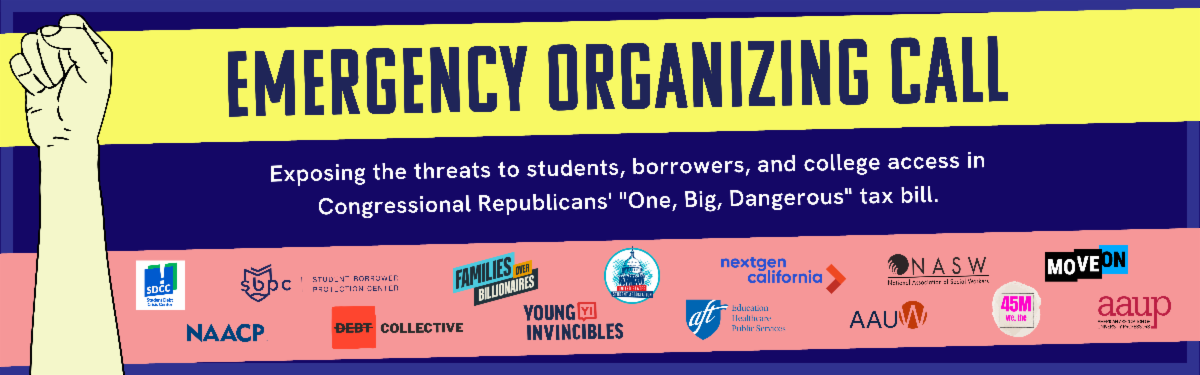
  • TOMORROW 7 PM ET—join our emergency organizing call! (Brandon Herrera, Student Borrower Protection Center)

    TOMORROW 7 PM ET—join our emergency organizing call! (Brandon Herrera, Student Borrower Protection Center)

    This bill threatens to gut $350 BILLION in critical education programs to deliver $4.5 TRILLION in tax cuts to billionaires. House Republicans’ plan to slash the Pell Grant and other financial aid programs and eliminate basic protections for students—this will only make college more expensive and force millions of working families with student debt further into the red.

    So far, we have nearly 1,000 (!) RSVPs from all over the country planning to take part in this call. We will hear from policymakers, movement leaders, and affected students and borrowers on how this bill will harm our communities and how you can get more involved to protect students and working families—NOT billionaires.

    You won’t want to miss this—make sure to RSVP below and clear your calendar for TOMORROW at 7PM ET.

    Source link

  • Empowering school staff with emergency response protocols

    Empowering school staff with emergency response protocols

    Key points:

    Safety response protocols are foundational to creating a culture of safety in schools. District leaders should adopt and implement response protocols that cover all types of emergencies. Schools should have building-level response protocols and protocols for incidents when first responders are needed. These practices are critical to keeping the community safe during emergencies.

    When staff members are empowered to participate in emergency planning and response, their sense of safety is improved. Unfortunately, many staff members do not feel safe at school.

    Thirty percent of K-12 staff think about their physical safety when at work every day, and 74 percent of K-12 staff said they do not feel supported by their employer to handle emergency situations at work.

    Staff disempowerment is a “central problem” when it comes to district emergency planning, said Dr. Gabriella Durán Blakey, superintendent of Albuquerque Public Schools: “What does safety mean for educators to really be able to feel safe in their classroom, to impact student achievement, the well-being of students? And how does that anxiety play with how the students feel in the classroom?”

    School leaders should implement response protocols that empower staff to understand and participate in emergency response using a two-tiered system of emergency response:

    • A building-level emergency planning and response team should develop an Emergency Operations Plan, which includes an emergency response protocol
    • Administrators should adopt protocols to follow when they need first responders to intervene

    For guidance on crafting emergency response protocols and plans, click here.

    Laura Ascione
    Latest posts by Laura Ascione (see all)

    Source link

  • Mellon Foundation Gives Humanities Councils Emergency Funds

    Mellon Foundation Gives Humanities Councils Emergency Funds

    The Mellon Foundation is giving $15 million in emergency funding to state humanities councils after the National Endowment for the Humanities eliminated $65 million in support for the councils, amid sweeping cuts to its grants and workforce, the foundation announced Tuesday.

    These councils, established by Congress in 1971, are nonprofits that support educational programming for the public, such as literacy initiatives, lectures, book fairs and cultural programs. The support will go toward all 56 state and jurisdictional humanities councils across the country in hopes of staving off possible deep cuts and closures. The foundation plans to allocate $2.8 million to challenge grants of up to $50,000 for each council, to be matched by other funders. And each council will received $200,000 in immediate operational support, The New York Times reported.

    Elizabeth Alexander, president of the Mellon Foundation, said in the announcement that while the emergency funds can’t cover the full extent of cuts, it’s a show of support.

    “At stake are both the operational integrity of organizations like museums, libraries, historical societies in every single state, as well as the mechanisms to participate in the cultural dynamism and exchange that is a fundamental part of American civic life,” Alexander said.

    Phoebe Stein, president of the Federation of State Humanities Councils, called the foundation funding a “lifeline.”

    “Mellon’s support allows us to not only preserve this vital network—it helps ensure that everyday Americans can thrive through lifelong learning, connection, and understanding of one another,” she said in the announcement.

    Source link

  • OSHA Emergency Temporary Standard and CMS Interim Final Rule on Vaccination Requirements Released – CUPA-HR

    OSHA Emergency Temporary Standard and CMS Interim Final Rule on Vaccination Requirements Released – CUPA-HR

    by CUPA-HR | November 4, 2021

    On November 4, the Department of Labor’s Occupational Safety and Health Administration (OSHA) and the Department of Health and Human Services’ Centers for Medicare & Medicaid Services (CMS) issued their highly anticipated Emergency Temporary Standard (ETS) and interim final rule (IFR) setting vaccination requirements for employers with 100 or more employees and healthcare workers, respectively. Under the new policies, covered employers with 100 or more employees, healthcare workers at facilities participating in Medicare or Medicaid, AND federal contractors requiring vaccinations under Executive Order 14042 (EO) will be required to be fully vaccinated — either two doses of Pfizer or Moderna, or one dose of Johnson & Johnson — by January 4, 2022.

    A Fact Sheet announcing the new vaccinations rules provides the following information on the OSHA ETS, CMS IFR and federal contractor vaccination requirements:

    OSHA Emergency Temporary Standard

    In lieu of full vaccination, the OSHA ETS for employers with 100 or more employees (covered employers) also offers the option for unvaccinated employees to produce a verified negative COVID-19 test to employers on at least a weekly basis. OSHA does clarify, however, that the ETS does NOT require employers to provide or pay for tests, but notes that employers may be required to pay for testing due to other laws or collective bargaining agreements.

    The ETS also establishes policies that require covered employers to provide paid time off (PTO) for their employees to get vaccinated and, if needed, sick leave to recover from side effects that keep them from working. Additionally, all covered employers will be required to ensure that unvaccinated employees wear a face mask in the workplace. While the testing and vaccination requirements will begin after January 4, the ETS states that covered employers must be in compliance with the PTO for vaccination and masking for unvaccinated workers requirements by December 5, 2021.

    Importantly, OSHA clarifies in the ETS that the rule will not apply to workplaces already covered by the CMS IFR, as well as the federal contractor vaccination requirement set forth by President Biden’s EO and the Safer Federal Workforce Task Force’s vaccination guidance.

    Healthcare Interim Final Rule

    According to CMS, the IFR requiring full vaccination of healthcare employees applies to employees regardless of whether their positions are clinical or non-clinical and includes employees, students, trainees and volunteers who work at a covered facility that receives federal funding from Medicare or Medicaid. It also includes individuals who provide treatment or other services for the facility under contract or other arrangements. Among the facility types covered by the IFR are hospitals, ambulatory surgery centers, dialysis facilities, home health agencies and long-term care facilities.

    Federal Contractor Vaccination Executive Order

    In an effort to streamline implementation of the vaccination requirements, the Biden administration is also announcing that the deadline for previously issued federal contractor vaccination requirements will be extended to January 4, 2022, setting one deadline across the three different vaccination policies. The vaccine requirement for federal contractor compliance was previously set for December 8, 2021.

    Additionally, as mentioned above, federal contractor employers who may otherwise fall under the OSHA ETS covered employer definition will not be required to follow the rules established under the ETS and must continue compliance with the vaccination guidance and requirements set forth by the EO and Safer Federal Workforce Task Force for federal contractors.

    State and Local Preemption

    Early reports of the rules also state that both the OSHA ETS and CMS IFR make it clear that their requirements “preempt any inconsistent state or local laws, including laws that ban or limit an employer’s authority to require vaccination, masks or testing.” More information is likely to follow.

    Additional information is likely to arise as we learn more from the actual text of the ETS and IFR. CUPA-HR will keep members apprised of all new information.


    Source link

  • White House Reviews OSHA’s COVID-19 Vaccination and Testing Emergency Temporary Standard – CUPA-HR

    White House Reviews OSHA’s COVID-19 Vaccination and Testing Emergency Temporary Standard – CUPA-HR

    by CUPA-HR | October 25, 2021

    On October 12, the U.S. Department of Labor Occupational Safety and Health Administration (OSHA) sent their COVID-19 Vaccination and Testing Emergency Temporary Standard Rulemaking (ETS) to the Office of Information and Regulatory Affairs (OIRA). OIRA is the White House office responsible for reviewing regulations and proposed regulations before they are publicly released.

    The ETS — which has not yet been made public — is expected to require private employers with 100 or more employees to “ensure their workforces are fully vaccinated or show a negative COVID-19 test twice a week” and provide paid time off for obtaining or recovering from the vaccination (additional details regarding what is known about the ETS can be found in this CUPA-HR blog).

    What is an ​Emergency Temporary Standard?

    While most federal agencies are required to provide public notice and seek comment prior to enacting new regulations, OSHA may bypass normal rulemaking and issue an ETS if doing so is necessary to protect workers from a “grave danger.” This allows OSHA to issue the ETS without any feedback from impacted stakeholders and require employers to immediately comply with the ETS upon its publication in the Federal Register.

    ​Office of Information and Regulatory Affairs Review

    OIRA is part of the executive office of the president and is required to review significant regulatory actions — those likely to have an annual effect on the economy of $100 million or more — before they are published in the Federal Register or otherwise issued to the public. As the ETS is determined to be “Economically Significant,” an OIRA review is triggered to ensure that it reflects the goals set forth in President Biden’s COVID-19 Plan and to ensure OSHA has carefully considered the benefits and costs of the ETS before it is issued.

    While draft documents under review are not available for public release, it is OIRA’s policy to meet with interested stakeholders to discuss issues on a rule under review. As of October 22, OIRA has convened 68 meetings with outside stakeholders on the ETS and has scheduled meetings through October 25. While CUPA-HR is aware many more additional pending meeting requests (including our own), OIRA has yet to schedule these, and may not. While OIRA review is limited to 90 days, there is no minimum period of review, and given the urgency associated with the ETS it could be issued as soon as this week.

    CUPA-HR will continue to monitor OIRA’s review process and be sure to inform our membership as soon as OIRA review concludes and OSHA issues the ETS.


    Source link

  • OSHA Provides Details on Upcoming COVID-19 Emergency Temporary Standard – CUPA-HR

    OSHA Provides Details on Upcoming COVID-19 Emergency Temporary Standard – CUPA-HR

    by CUPA-HR | September 14, 2021

    On September 9, President Biden released his COVID-19 Action Plan, which includes a six-pronged plan to combat COVID-19 through increased vaccinations, testing and other strategies. The plan will require employers with 100 or more employees to test nonvaccinated employees on a weekly basis. The White House also announced it will require vaccinations for those working for the federal government, federal contractors and establishments providing healthcare services that accept Medicare and Medicaid.

    The Biden administration is using different agencies to implement and enforce the different requirements. The Occupational Safety and Health Administration (OSHA) will require employers with 100 or more employees to test nonvaccinated employees on a weekly basis through an Emergency Temporary Standard (ETS). While OSHA has yet to release many specifics about the timing and the content of the ETS, the agency did release some information late last week.

    General Timeline of the ETS

    In a call last week with stakeholders, OSHA said it plans to publish the ETS in the Federal Register in the next few weeks, at which time the ETS will become effective immediately in states where OSHA has direct jurisdiction. The 22 states with OSHA-approved State Occupational Safety and Health Plans must adopt the ETS or a standard at least as protective within 30 days of OSHA publishing the ETS in the Federal Register.

    Because the ETS will be effective immediately once published in the Federal Register, stakeholders will not have the opportunity to provide input on the standard prior to its implementation. Instead, stakeholders may comment on the ETS after it is published in the Federal Register. OSHA will use those comments to shape the subsequent final rule that will replace the ETS, which OSHA plans to issue six months after the initial release of the ETS.

    Content and Policies of the ETS

    OSHA also said on the call that it will be working with other federal agencies to ensure the language included in the ETS is consistent with the vaccination mandates imposed on federal contractors through President Biden’s Executive Order. Additionally, OSHA clarified that it will consider the employers’ workforce and not just a single worksite in evaluating employers that meet the 100-employee threshold for coverage. The ETS testing and vaccination requirements are also not likely to extend to remote employees who are physically isolated from coworkers or customers.

    Consistent with the COVID-19 Action Plan, the ETS will also require employers to provide employees with paid time off (PTO) or allow employees to use existing PTO to obtain vaccinations and recover from post-vaccination side effects.

    Finally, OSHA reviewed several issues where it does not currently have an answer, but it intends to address in the ETS. These questions include who pays for the required employee testing and what level of vaccination is required under the ETS (i.e. one shot, two shots or even a booster shot). In addition to these questions, information on the procedures of how employers will verify vaccinations, tests and procedures for handling employees who refuse to get vaccinated or undergo routine testing will likely be addressed in the ETS.

    CUPA-HR will continue to monitor for any information on the upcoming ETS and keep members apprised of any additional policies or requirements likely to be included as OSHA continues to work towards implementation.


    Source link