Tag: Employees

  • Public Service Loan Forgiveness: Help Employees Achieve Their Financial Goals

    Public Service Loan Forgiveness: Help Employees Achieve Their Financial Goals

    by Julie Burrell | September 17, 2024

    The Public Service Loan Forgiveness (PSLF) program can offer significant financial relief to higher ed employees, but many don’t know they qualify for this benefit. PSLF is open to most full-time higher ed employees of nonprofit colleges and universities who have direct federal student loans.

    HR can spread the word to current employees and use loan forgiveness as part of a retention and recruitment strategy. The average amount of individual loan forgiveness under the PSLF is $70,000, which makes the PSLF an especially attractive benefit to potential employees.

    Here’s what you need to know about who qualifies for PSLF, how to offer a free webinar on PSLF to your employees, and what steps you can take to ensure eligible employees enroll.

    What is PSLF?

    Public Service Loan Forgiveness forgives the balance of direct federal student loans after 120 qualifying payments made by the borrower if they work for a qualifying employer (after October 1, 2007) and are under a qualifying repayment plan. It’s intended to reward and incentivize public service, like teaching, nonprofit work and work in the public sector. PSLF eligibility isn’t about what job an employee does or what their job description is; it’s about where they work.

    Who qualifies for PSLF?

    Full-time employees of a nonprofit organization or a federal, state, tribal, or local government are eligible. Full-time work is defined as 30 hours or more per week. That means most full-time higher ed employees are eligible for PSLF, including those who may work part time at your institution but are also employed at other qualifying jobs (as is the case with many adjuncts). But the PSLF only applies to direct federal student loans. Borrowers with other federal student loans may be able to consolidate them into a direct federal student loan.

    How do I ensure my institution counts as an eligible employer?

    Use the PSLF Help Tool, which will search the federal employer database. The help tool is also useful to recommend to employees since it’s a step-by-step guide through the enrollment process.

    Six Tips for Getting the Word Out

    1. Partner with Public Service Promise, a nonprofit, nonpartisan organization that offers free webinars led by experts.
    2. Encourage HR staff to apply for PSLF. With firsthand experience, you and your team will be able to speak knowledgeably about the process.
    3. Publicize PSLF as a benefit to your employees, especially those who may not know they can take advantage of this program, including adjuncts and non-exempt and part-time employees.
    4. Include information about PSLF on your benefits websites or portal.
    5. Consider appointing a knowledgeable point person on campus, like a financial aid officer, to help answer employee questions.
    6. Involve non-exempt, adjunct and part-time employees in outreach campaigns. Employees can meet the 30 hours per week requirement with more than one job. So if they have multiple jobs at multiple qualifying employers, employees can add those hours up. And the PSLF instructions include how to calculate hours worked by adjunct faculty. Payments do not need to be consecutive, so even adjuncts without summer appointments can still take advantage of PSLF and start to chip away at the 120 payments.


    Source link

  • Celebrating Pride Month: Spotlight on Transgender and Nonbinary Employees – CUPA-HR

    Celebrating Pride Month: Spotlight on Transgender and Nonbinary Employees – CUPA-HR

    by Julie Burrell | June 4, 2024

    June is Pride Month, dedicated to celebrating the richness and history of the LGBTQIA+ community. In addition to ensuring regulatory compliance, higher ed HR has an important role to play in creating a truly inclusive campus. A fundamental part of celebrating Pride is actively learning from and listening to this community, especially as the population of LGBTQIA+ employees continues to grow.

    This Pride, CUPA-HR is spotlighting the voices of transgender and nonbinary employees by offering resources to empower HR in improving culture, policies and procedures for this group. Even if significant institutional change is not something you’re in a position to initiate, individual actions can add up. In addition to learning from the below resources, you can network with your colleagues at other institutions to provide support, personally recognize national days of awareness or remembrance, and encourage allyship.

    Inclusion of Transgender and Nonbinary Employees in the Workplace: A Critical Conversation (Watch Now)

    In this webinar, recorded in May, Jon Humiston of Central Michigan University and Aaric Guerriero of the Froedtert Health System explore ways to celebrate and embrace transgender and nonbinary employees.

    They address frequently asked questions about transgender and nonbinary issues, including what terms are commonly used within the LGBTQIA+ community and what happens if you accidentally misgender someone. They also recommend best practices for inclusion, including:

    • Using gender-neutral language. For example, instead of “ladies and gentleman,” Jon suggests “amazing humans,” “everyone,” or “y’all.”
    • Changing paperwork and job descriptions if they mention just two gender pronouns — for example, he or she — to inclusive language like “they.”
    • Sharing your pronouns in your email signature and Zoom profile, so others feel comfortable doing the same.

    Gender-Inclusive HR Strategies: Are You on the Right Track? (Read Now)

    This blog post proposes a framework for higher ed HR practitioners to address their gender inclusion strategies. A checklist of questions will help you audit your efforts on campus, covering: policies and procedures (for example, do you have a name-in-use policy or chosen-name policy that is easy to access and navigate?); programmatic support (e.g., do you have LGBTQIA+ safe-zone training available for all employees?); and visibility (e.g., does your institution have a presence at local LGBTQIA+ pride events?). Reviewing these questions will help you identify gaps in your inclusion efforts.

    Gender Identity and Sexual Orientation in the Workplace (Explore the Toolkit)

    This Knowledge Center toolkit, while not specifically about trans and nonbinary employees, covers legal obligations under Title VII and Title IX and supplies applicable guidelines from the Equal Opportunity and Employment Commission and Office for Civil Rights. Best practices and example policies are also included — for example, on name changes in official forms.


    Source link

  • More Than Half of Financial Aid Employees Likely to Seek Other Employment Within the Next Year – CUPA-HR

    More Than Half of Financial Aid Employees Likely to Seek Other Employment Within the Next Year – CUPA-HR

    by CUPA-HR | May 13, 2024

    A majority of those who work in financial aid at the nation’s colleges and universities are job hunting, according to new research from CUPA-HR and the National Association of Student Financial Aid Administrators (NASFAA). What are they looking for? Better pay, opportunities to work remotely and a more flexible schedule.

    A new report examining pay, pay equity, staffing, representation and retention in the higher ed financial aid workforce outlines several findings from analyses of data of financial aid employees from CUPA-HR’s 2022-23 higher ed workforce surveys and the 2023 Higher Education Employee Retention Survey. Positions included in the analyses are chief student financial aid officers, deputy heads of financial aid and student financial aid counselors.

    The analyses found that more than half (56%) of financial aid employees are at least somewhat likely to seek other employment opportunities within the next 12 months, with 1 in 3 (33%) being likely or very likely to do so. Four in 5 (79%) rank a pay increase as one of the top three reasons they would seek other employment opportunities, while 3 in 5 (59%) rank an opportunity to work remotely as one of the top three reasons they would seek other employment opportunities. The desire for a flexible schedule is also ranked as a top reason for seeking other employment by nearly 2 in 5 (37%) financial aid employees.

    Other Findings

    • Institutions with the highest number of FAFSA applications have far more student financial aid counselors than institutions with the lowest number of FAFSA applications. At each increase in FAFSA application quartile, the median number of student financial aid counselors per institution doubles (or nearly doubles). Institutions with the greatest number of FAFSA applications on median have six more student financial aid counselors than institutions with the least number of FAFSA applications.
    • On median, institutions have four financial aid employees working in one of the three examined positions. Thirteen percent of institutions have a one-person financial aid office. Even the institutions that process the lowest number of FAFSA applications tend to have need for more than one person working in their office – over half of these institutions have at least three people in their financial aid office.
    • The representation of people of color declines as the level of financial aid position increases. The representation of people of color is almost two times higher among student financial aid counselors than among chief student financial aid officers. The representation of women overall among chief student financial aid officers is lower than the representation of women within the lower-level financial aid positions, but the difference is much smaller than the declines seen for people of color.
    • Pay equity is lower among chief student financial aid officers than among lower-level financial aid positions. Black women and Hispanic or Latino men are paid equitably within student financial aid counselor and deputy head of student financial aid positions, but not within the chief student financial aid officer position. At each increase in position level, White women’s pay relative to White men in the same position decreases. White women are paid equitably to White men in student financial aid counselor positions but are paid only 94 cents per $1 paid to White men in chief student financial aid officer positions.
    • Among financial aid employees, years in position is lowest among student financial aid counselors. Of all financial aid positions, student financial aid counselors have the highest concentration of people who have been in their position for fewer than two years (43%). Retention is better among deputy heads of student financial aid and chief student financial aid officers; one-third have been in their position for 10 years or longer.

    Read the full report, The Higher Education Financial Aid Workforce: Pay, Representation, Pay Equity, and Retention, and explore the interactive graphics.


    Source link

  • Pay Increases for Higher Ed Employees Sharply Improve, But Still Fall Short of Inflation Rate – CUPA-HR

    Pay Increases for Higher Ed Employees Sharply Improve, But Still Fall Short of Inflation Rate – CUPA-HR

    by CUPA-HR | April 3, 2023

    New research from CUPA-HR has found that although employees across the higher education workforce saw the most substantial pay raises in 2022-23 than in the past several years, they are still being paid less than they were in 2019-20 in inflation-adjusted dollars.

    Some of the key findings from an analysis of CUPA-HR’s higher ed workforce salary survey data from 2016 to 2023:

    • This academic year, raises for higher ed employees were the largest seen in the past seven years, and all position types (administrators, professionals, staff and faculty) received an increase of at least 1.11 percentage points compared to the previous year.
    • Tenure-track and non-tenure-track teaching faculty continue to receive the smallest pay increases of any higher ed employee category. In 2022-23, tenure-track faculty saw a median pay increase of 2.9 percent and non-tenure-track faculty saw an increase of 3.2 percent. Tenure-track faculty salary increases have not kept pace with inflation since at least 2015, and non-tenure-track salary increases last met or exceeded inflation in 2016-17, meaning full-time faculty in general continue to be paid less every year in inflation-adjusted dollars.
    • Staff, which is typically the lowest-paid category of higher ed employees, saw the biggest raises this academic year at 5.3 percent (up from 2.9 percent in 2021-22).

    Explore this data and more in CUPA-HR’s newest interactive graphic.

    CUPA-HR Research

    CUPA-HR is the recognized authority on compensation surveys for higher education, with its workforce surveys designed by higher ed HR professionals for higher ed HR professionals and other campus leaders. CUPA-HR has been collecting data on the higher ed workforce for more than 50 years, and we maintain one of the largest workforce databases in existence. CUPA-HR also publishes numerous research publications and interactive graphics highlighting trends and issues around higher ed workforce planning, pay equity, representation of women and racial/ethnic minorities and more. Learn more about CUPA-HR research.


    Source link

  • Kansas State University’s Braggin’ Wagon Offers a Unique Way to Recognize Campus Employees – CUPA-HR

    Kansas State University’s Braggin’ Wagon Offers a Unique Way to Recognize Campus Employees – CUPA-HR

    by CUPA-HR | October 19, 2022

    Think about a time you were recognized by a colleague for a job well done. Whether it was a grand gesture or a small act of recognition, chances are the personal shoutout put some pep in your step. Positive recognition in any form is a sure mood booster and helps move campus well-being in the right direction.

    In a recent CUPA-HR webinar, Refuel, Invest and Inspire Campus Well-Being, presenters from Kansas State University (K-State) shared a unique way of recognizing teams and departments on campus: the Braggin’ Wagon.

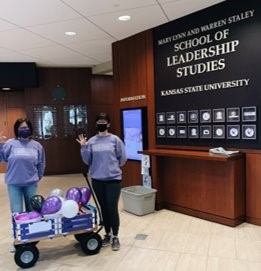
    The Braggin’ Wagon was developed by K-State’s Staley School of Leadership, which has a strong partnership with HR. The decorative travelling wagon is filled with treats, candy, small toys and other fun items for the receiving team to enjoy. Once the wagon is delivered to a department, it is up to that department to restock the wagon and deliver it to another department in order to keep the recognition going.
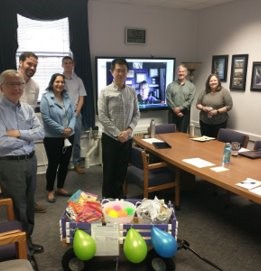
    This simple yet powerful way of recognizing campus employees serves a double purpose — it adds an element of fun to the work day for the team being recognized (who doesn’t love getting a surprise treat in the middle of a work day?), and it also gives the team passing on the wagon an opportunity to get out of the office for some exercise and take a mental break in the work day.

    When K-State resumed in-person work, it was important to put the emphasis on our employees and the solid work they were doing to make a difference. The Braggin’ Wagon was a way for departments to recognize other university partners who contributed to their work in a positive way,” says Shanna Legleiter, associate vice president of human capital services at K-State.

    With the Braggin’ Wagon as inspiration, what are some other creative ways HR can shine a spotlight on employees who work hard to keep campus operations running smoothly? Are there campus partnerships that can be formed to bring ideas for recognition to life? Don’t be afraid to think outside of the box when it comes to recognition opportunities!


    Source link

  • Time Is Running Out: Help Your Employees Navigate the Special PSLF Waiver – CUPA-HR

    Time Is Running Out: Help Your Employees Navigate the Special PSLF Waiver – CUPA-HR

    by CUPA-HR | August 24, 2022

    On Oct. 6, 2021, the U.S. Department of Education announced a change to the Public Service Loan Forgiveness (PSLF) program rules for a limited time as a result of the COVID-19 national emergency. Millions of non-profit and government employees have federal student loans and may now be eligible for loan forgiveness or additional credit through the limited PSLF waiver. But they need to act fast. The special waiver expires October 31, 2022.

    Here are several resources for HR professionals who want to get the word out to employees before the opportunity passes.

    Learn More and Get Tips for Educating Employees

    In June, CUPA-HR hosted the webinar, Helping Employees Understand and Navigate the Public Service Loan Forgiveness (PSLF) Program, where Department of Education representative Ashley Harrington shared details about the program and how HR can help guide employees through the necessary processes to achieve loan forgiveness. The recorded webinar is available for viewing any time.

    Explore the Department of Education’s Employer Toolkit

    The Department of Education’s PSLF waiver toolkit is a comprehensive resource that features a PSLF fact sheet, sample social media posts and email templates HR can use to spread the word to campus employees.

    Direct Employees to the Borrower Site

    For a clear explanation of the program and a simple step-by-step process to determine who is eligible for the program, direct employees to the Federal Student Aid website.


    Source link

  • More Than Half of College and University Employees Say They Are Likely to Look for Other Employment in the Near Future – CUPA-HR

    More Than Half of College and University Employees Say They Are Likely to Look for Other Employment in the Near Future – CUPA-HR

    by CUPA-HR | July 21, 2022

    New research from CUPA-HR shows that higher education institutions are in the midst of a talent crisis, as many staff, professionals and administrators are considering other employment opportunities due to dissatisfaction with their pay, their opportunities for advancement, their institutions’ remote and flex work policies, and more.

    The newly published research report, The CUPA-HR 2022 Higher Education Employee Retention Survey: Initial Results, provides an overview of what proportion of the higher ed workforce is at risk for leaving, why they’re considering leaving employment, and with which policies, work arrangements and benefits employees are satisfied or dissatisfied. The report includes several recommendations for addressing these issues.

    Data from 3,815 higher ed employees across 949 institutions and representing 15 departments/functional areas were analyzed for this report.

    Findings

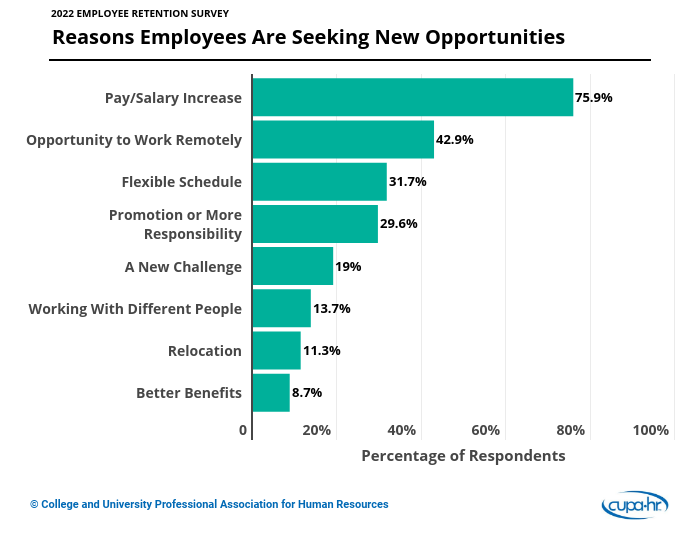
    Higher ed employees are looking for other jobs, mostly because they desire a pay increase. More than half (57%) of the higher ed workforce is at least somewhat likely to look for other employment opportunities in the next 12 months. The most common reason for seeking other employment (provided by three-fourths of those likely to look for another job) is an increase in pay. Other reasons are that they desire more remote work opportunities, a more flexible schedule, and a promotion or more responsibility.

    Higher ed institutions are not providing the remote work opportunities that employees want. Nearly three-fourths (71%) of employees report that most of their duties can be performed remotely, and 69% would prefer to have at least at least a partially remote work arrangement, yet 63% are working mostly or completely on-site.

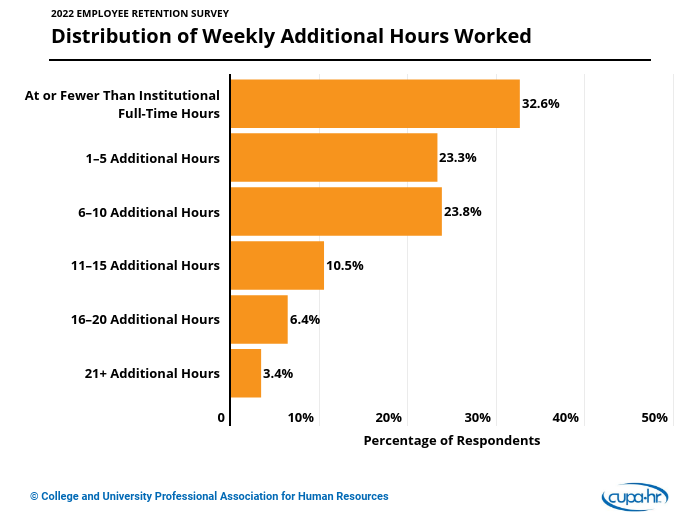
    Higher ed employees are working longer and harder than ever. Two-thirds (67%) of full-time staff typically work more hours each week than what is considered full-time. Nearly two-thirds (63%) have taken on additional responsibilities of other staff who have recently left, and nearly three-fourths (73%) have taken on additional responsibilities as a direct result of the pandemic.

    Higher ed employees have clear areas of satisfaction and dissatisfaction. Areas of satisfaction include benefits, relationship with supervisor, job duties, and feeling a sense of belonging. Areas of dissatisfaction include investment in career development, opportunities for advancement, fair pay, remote work policies and parental leave.

    Read the full report.


    Source link

  • Workplace Eye Wellness Month: How HR Can Help Employees With Low Vision or Vision Loss – CUPA-HR

    Workplace Eye Wellness Month: How HR Can Help Employees With Low Vision or Vision Loss – CUPA-HR

    by Jill Thompson | March 22, 2022

    Whether it was logging overtime behind laptops before work-from-home boundaries were put in place or turning to mobile phones and tablets for entertainment during lockdowns, many of us recognized the uptick in screen time during the height of the pandemic. Our eyes likely noticed the uptick too by feeling increasingly strained.

    March is Workplace Eye Wellness month, so we’re highlighting some tips from Prevent Blindness to help keep screen time in check and lessen eye strain at work and at home.

    • Screen time: Try to decrease the amount of time spent in front of screens and/or take frequent breaks to give your eyes a rest.
    • Use the 20-20-20 rule: Every 20 minutes, take a 20-second break and look at something 20 feet away.
    • Filters: Screen filters are available for smart phones, tablets and computer screens. They decrease the amount of blue light given off from these devices that could reach the retina in the eyes.
    • Anti-reflective lenses: Anti-reflective lenses reduce glare and increase contrast and also block blue light from the sun and digital devices.
    • Intraocular lens (IOL): After cataract surgery, the cloudy lens will be replaced with an intraocular lens (IOL). The lens naturally protects the eye from almost all ultraviolet light and some blue light. There are types of IOLs that can protect the eye and retina from blue light.

    Visit Prevent Blindness for more information and resources on eye and vision health.

    HR Perspective

    From the human resources perspective, HR practitioners can help employees who are experiencing vision loss or low vision. Employees experiencing a decrease in vision may have difficulty completing paperwork, reading standard-size print, discerning regular or colored font on computer screens, or locating the cursor, all of which impact productivity at work.

    In the Disability in the Workplace toolkit in CUPA-HR’s Knowledge Center, Mississippi State University’s HR guide offers plenty of creative low-tech and high-tech accommodations for employees with low vision:

    Low-tech accommodations:

    • Place tactile dots on controls on equipment, such as the telephone, a copier, the microwave in the breakroom, etc. so that an individual who is blind or visually impaired can determine which buttons perform different functions.
    • Place a braille sticker on an employee’s mail slot to identify it.
    • Increase or decrease lighting in an office or cubicle to increase visibility or reduce glare.
    • Cover a window to reduce glare.
    • Provide extra floor space in a cubicle to accommodate a guide dog.

    High-tech accommodations:

    • Implement screen reading or screen magnification software to allow an employee who is blind or has low vision to complete computer tasks.
    • Provide a larger monitor or dual monitors to allow an individual with low vision greater access to visual information.
    • Implement a braille display paired with the computer or an iPad or used independently to allow vision-impaired employees to take notes and recall information.
    • Provide a video magnifier to increase the size of print and enhance the contrast of printed materials.
    • Provide optical character recognition hardware or software to capture print information and translate it to audio output.

    To read the full guide and explore other disability inclusion examples from higher ed, visit the Disability in the Workplace toolkit (CUPA-HR members only resource).


    Source link