
Tag: employment

  • Labor and Employment Policy Updates — October 2022 – CUPA-HR

    Labor and Employment Policy Updates — October 2022 – CUPA-HR

    by CUPA-HR | October 22, 2022

    As the 2022 midterm election nears, Congress has turned its focus to campaigning and essentially halted legislative action until after the election. Despite the lack of activity from Congress, federal agencies have continued to push forward with anticipated regulatory actions in the labor and employment policy area. This blog post details some of the regulatory activity CUPA-HR is currently monitoring, as well as a stalled nomination for a top position at the Department of Labor (DOL).

    NLRB Joint Employer Rule

    On September 7, the National Labor Relations Board (NLRB) issued a notice of proposed rulemaking (NPRM) on the joint employer standard. Generally speaking, the NPRM proposes to expand joint employer status to entities with indirect or reserved control over essential terms and conditions of employment.

    The NPRM establishes joint employer status of two or more employers if they “share or co-determine those matters governing employees’ essential terms and conditions of employment,” such as wages, benefits and other compensation, work and scheduling, hiring and discharge, discipline, workplace health and safety, supervision, assignment and work rules. According to the NLRB’s press release, the Board “proposes to consider both direct evidence of control and evidence of reserved and/or indirect control over these essential terms and conditions of employment when analyzing joint-employer status.”

    Comments in response to the proposal were originally due November 7, but after stakeholders requested an extension to the filing deadline the Board extended the comment period to December 7.

    Independent Contractor Rule

    On October 13, the DOL published an NPRM to rescind the current method for determining independent contractor status under the Fair Labor Standards Act. The current test finalized by the Trump administration in 2021 has two core factors of control and investment with three additional factors (integration, skill and permanency) that are relevant only if those core factors are in disagreement. The Biden rule proposes a return to a “totality-of-the-circumstances analysis” of multiple factors in an economic reality test, including the following six factors, which are equally weighted with no core provisions:

    • The extent to which the work is integral to the employer’s business;
    • The worker’s opportunity for profit or loss depending on managerial skill;
    • The investments made by the worker and the employer;
    • The worker’s use of skill and initiative;
    • The permanency of the work relationship; and
    • The degree of control exercised or retained by the employer control.

    Comments in response to the NPRM are due November 28.

    Jessica Looman Nomination

    On September 13, the Senate Health, Education, Labor and Pensions (HELP) Committee held a hearing on the nomination of Jessica Looman to serve as Administrator of the DOL’s Wage and Hour Division (WHD). Looman was officially nominated for the position in July 2022, months after Biden’s previous nominee David Weil failed to receive 50 votes to clear the Senate floor and become the WHD Administrator.

    Looman has not yet had a committee vote to move her nomination to a full Senate floor vote. It is unclear when a Senate HELP vote will take place, but is likely to come after the election in November. Regardless of the timing on a vote, Looman continues to carry out the WHD’s rulemaking agenda in her current role as the Principal Deputy Administrator.

    CUPA-HR will keep members apprised of any updates relating to the rulemakings and nomination discussed above.

    Source link

  • More Than Half of College and University Employees Say They Are Likely to Look for Other Employment in the Near Future – CUPA-HR

    More Than Half of College and University Employees Say They Are Likely to Look for Other Employment in the Near Future – CUPA-HR

    by CUPA-HR | July 21, 2022

    New research from CUPA-HR shows that higher education institutions are in the midst of a talent crisis, as many staff, professionals and administrators are considering other employment opportunities due to dissatisfaction with their pay, their opportunities for advancement, their institutions’ remote and flex work policies, and more.

    The newly published research report, The CUPA-HR 2022 Higher Education Employee Retention Survey: Initial Results, provides an overview of what proportion of the higher ed workforce is at risk for leaving, why they’re considering leaving employment, and with which policies, work arrangements and benefits employees are satisfied or dissatisfied. The report includes several recommendations for addressing these issues.

    Data from 3,815 higher ed employees across 949 institutions and representing 15 departments/functional areas were analyzed for this report.

    Findings

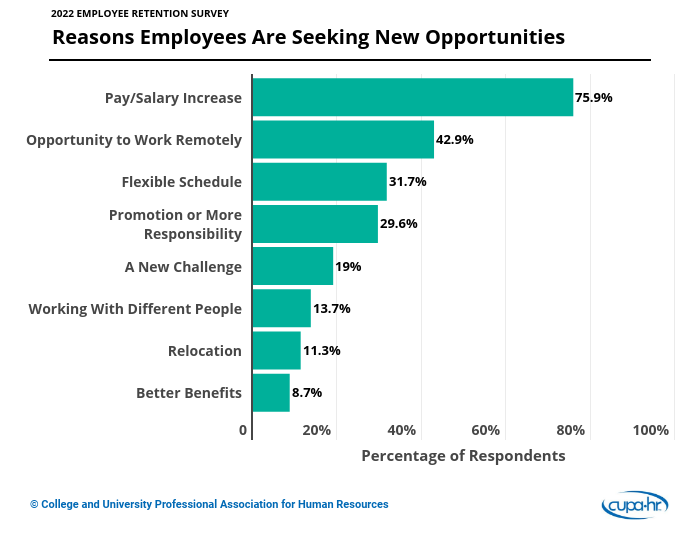
    Higher ed employees are looking for other jobs, mostly because they desire a pay increase. More than half (57%) of the higher ed workforce is at least somewhat likely to look for other employment opportunities in the next 12 months. The most common reason for seeking other employment (provided by three-fourths of those likely to look for another job) is an increase in pay. Other reasons are that they desire more remote work opportunities, a more flexible schedule, and a promotion or more responsibility.

    Higher ed institutions are not providing the remote work opportunities that employees want. Nearly three-fourths (71%) of employees report that most of their duties can be performed remotely, and 69% would prefer to have at least at least a partially remote work arrangement, yet 63% are working mostly or completely on-site.

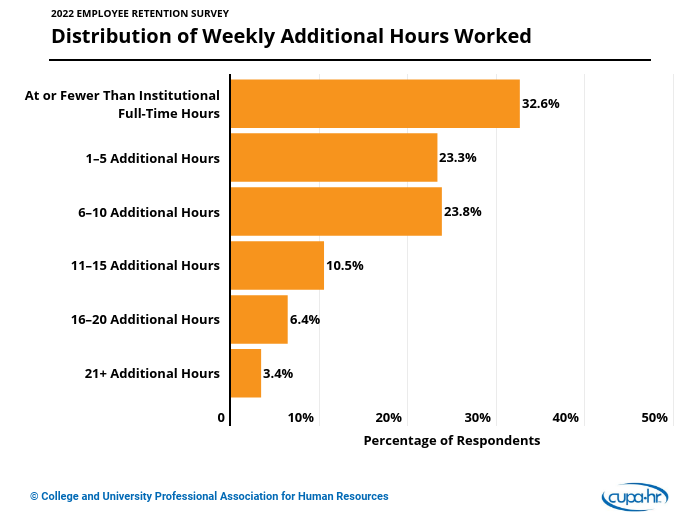
    Higher ed employees are working longer and harder than ever. Two-thirds (67%) of full-time staff typically work more hours each week than what is considered full-time. Nearly two-thirds (63%) have taken on additional responsibilities of other staff who have recently left, and nearly three-fourths (73%) have taken on additional responsibilities as a direct result of the pandemic.

    Higher ed employees have clear areas of satisfaction and dissatisfaction. Areas of satisfaction include benefits, relationship with supervisor, job duties, and feeling a sense of belonging. Areas of dissatisfaction include investment in career development, opportunities for advancement, fair pay, remote work policies and parental leave.

    Read the full report.


    Source link

  • DHS Issues Request for Public Comment on Form I-9 Employment Verification – CUPA-HR

    DHS Issues Request for Public Comment on Form I-9 Employment Verification – CUPA-HR

    by CUPA-HR | October 27, 2021

    On October 26, 2021, the Department of Homeland Security (DHS) issued a Request for Public Input (RPI) “seeking comments from employers, employer organizations, employee groups, and other members of the public on document examination practices for Form I-9, Employment Eligibility Verification.” 

    The RPI is the agency’s next step in determining whether the remote document examination flexibilities that have been in place since the beginning of the COVID-19 pandemic should be continued on a permanent basis. Comments are due on or before December 27, 2021.

    Background

    On March 20, 2020, DHS announced employer flexibility guidance to defer the physical presence requirements associated with Form I-9 for 60 days. The guidance allows for remote inspection of Form I-9 documents in situations where employees work exclusively in a remote setting due to COVID-19-related precautions. For employees who physically report to work at a company location on any regular, consistent or predictable basis, employers are required to use standard I-9 procedures.

    The guidance has been extended continuously throughout the pandemic. Issued on August 31, the latest extension to the flexibility guidance was granted through December 31, 2021, following advocacy efforts from CUPA-HR and other stakeholders who expressed a dire need for DHS to maintain the flexibility in light of surging cases of the delta variant.

    Request for Public Input

    The RPI includes a list of questions grouped into two categories: “Experiences with Pandemic-Related Document Examination Flexibilities” and “Considerations for Future Remote Document Examination Procedures.” As DHS considers winding down the flexibility guidance, the RPI will provide the department with important feedback from employers who have conducted remote inspection and “inform and improve DHS policies and processes” regarding “alternative options to physical document examination that offer an equivalent or higher level of security for identity and employment eligibility verification purposes” moving forward.

    The flexibility guidance has been instrumental to institutions of higher education during the pandemic. As such, CUPA-HR intends to engage our members and submit robust comments in response to the RPI. ​Look for more details and your chance to contribute your feedback in the coming weeks.


    Source link