
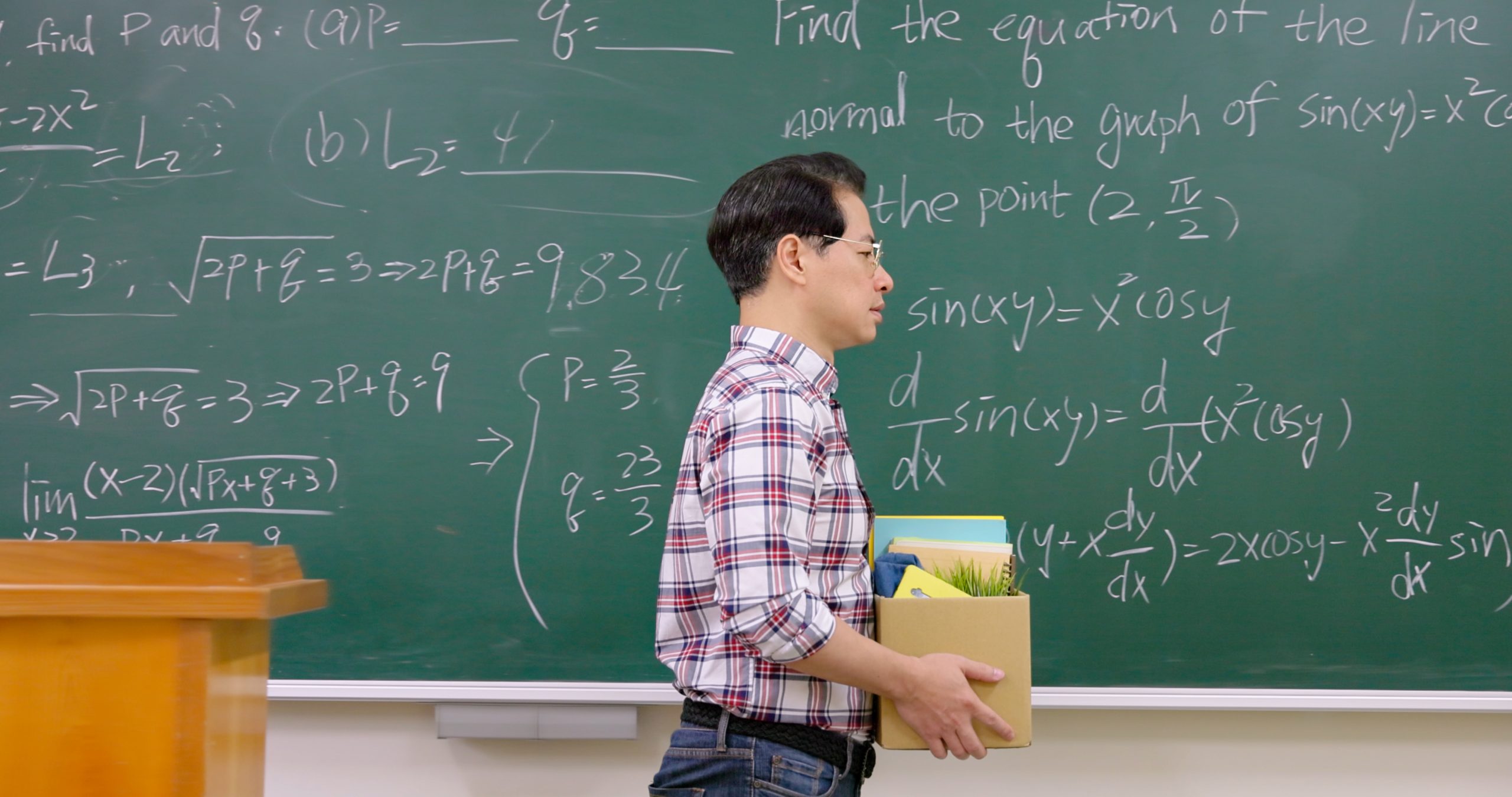
Paulina Cossette spent six years getting a doctoral degree with the goal of becoming a university professor. But it wasn’t long before she gave up on that path.
With higher education under political assault, and opportunities as well as job security diminished by enrollment declines, Cossette felt burnt out and disillusioned. So she quit her hard-won job as an assistant professor of American government at a small private college in Maryland and used the skills she’d learned to go into business for herself as a freelance copy editor.
Now Cossette is hearing from other newly minted Ph.D.s and tenured faculty who want out — so many, she’s expanded her business to help them leave academia, as she did.
Seemingly relentless attacks and funding cuts since the start of Donald Trump’s second presidential term have been “the straw that broke the camel’s back,” said Cossette, who left higher education on the eve of the pandemic, in 2019. “I’m hearing from a lot more people that it’s too much.”
An exodus appears to be under way of Ph.D.s and faculty generally, who are leaving academia in the face of political, financial and enrollment crises. It’s a trend federal data and other sources show began even before Trump returned to the White House.
On top of everything else affecting higher education, this is likely to reduce the quality of education for undergraduates, experts say.
Nearly 70 percent of people receiving doctorates were already leaving higher education for industry, government and other sectors, not including those without job offers or who opted to continue their studies, according to the most recent available figures from the National Science Foundation — up from fewer than 50 percent decades ago.
As for faculty, more than a third of provosts reported higher-than-usual turnover last year, in a survey by Hanover Research and the industry publication Inside Higher Ed. That was before the turmoil of this late winter and spring.
Related: Interested in innovations in higher education? Subscribe to our free biweekly higher education newsletter.
“People who can get out will get out,” said L. Maren Wood, director and CEO of the Center for Graduate Career Success, which works with doctoral and other graduate students at 69 colleges and universities to provide career help.
If the spree of general job-switching that followed Covid was dubbed “the Great Resignation,” Wood said, what she’s seeing now in higher education is “the Great Defection.”
Getting a Ph.D. is a traditional pipeline to an academic career. Now some of the brightest candidates — who have spent years doing cutting-edge research in their fields to prepare for faculty jobs — are leaving higher education or signing on with universities abroad, Wood said.
“It’s going to affect the quality of a student’s experience if they don’t get to study with those leading minds, who are going into private industry or to other countries,” she said.
“What’s the joke about those who can’t do, teach? You don’t want to be in a situation where the only people left in your classrooms are the ones who can’t do anything else.”
Related: So much for saving the planet. Climate careers, and many others, evaporate for class of 2025
Parents sending children to college in the fall should know that they’ll be taking classes “with a faculty member who is worried about his or her research funding and who doesn’t have the help of graduate student teaching assistants. And that’s really going to impact the quality of your student’s experience,” said Julia Kent, a vice president at the Council of Graduate Schools, who conducts research about Ph.D. career pathways.
“The quality of undergraduate education is at stake here,” Kent said.
Even Ph.D.s who want to work in academia are being thwarted.
During the Great Recession and the pandemic — two recent periods when there were few available faculty jobs — doctoral candidates could continue their studies until things got better, Wood said. This time, the Trump administration’s cuts to research funding have stripped many of that option.
“This is way worse” than those earlier crises, she said. “Doctoral students are in panic mode.”
Related: How Trump is changing higher education: The view from 4 campuses
The same deep federal cuts mean doctoral candidates in science, technology, engineering, math and other fields can’t complete the research they need to be eligible for what few academic jobs do become available.
“You’re basically knee-capping that younger generation, which undermines the intergenerational dynamism that takes place in higher education. And that trickles down into the classroom,” said Isaac Kamola, an associate professor of political science at Trinity College and head of the Center for the Defense of Academic Freedom at the American Association of University Professors, or AAUP.
Doctoral candidates early in their programs are questioning whether they should stay, said Wood. That could reduce the supply of future faculty. So will the fact that some universities have reduced the number of new Ph.D. candidates they will accept or have rescinded admission offers, citing federal budget cuts. Fewer prospective candidates are likely to apply, said Timothy Burke, a professor of history at Swarthmore College who has written about this topic.
“Our graduating students right now are thinking differently about what it means to start a doctorate,” Burke said.
Meanwhile, he said, “all the things that were dismaying to many faculty of long standing just feel worse. People who would have been totally content to stay put, whose prospects were good, who had good positions, who were more or less happy — now they’re thinking hard about whether there’s a future in this.”
That means undergraduates could experience fewer available classroom professors and teaching and graduate assistants or the “only tenuous presence of faculty who are thinking hard about going somewhere else,” he said. “There are going to be programs that are going to be shut. There are going to be departments running on fumes.”
The route to a university faculty job has always been hard. Finishing a doctoral degree takes a median of nearly six years, according to the American Academy of Arts and Sciences — nearly seven in the arts and humanities.
Doctoral students who manage to finish their programs have always had to fight for faculty positions, even before institutions announced cutbacks and hiring freezes.
Universities enroll far more doctoral candidates, to provide cheap labor as teaching and research assistants, than they will ever hire. The number of doctoral degrees awarded rose from 163,827 in 2010 to an estimated 207,000 this year, the National Center for Education Statistics says — a 26 percent increase, during a period in which the number of full-time faculty positions went up at less than half that rate.
With colleges and universities under stress, still more doctoral candidates now face the prospect of spending years “training for a career that isn’t actually available,” said Ashley Ruba, a Ph.D. who left higher education to work at Meta, where she builds virtual reality systems.
“If you told someone going to law school that they couldn’t get a job as a lawyer, I don’t think they’d do it,” said Ruba, who is also the founder of a career-coaching service for fellow Ph.D.s called After Academia.
People already in faculty jobs appear equally on edge. More than 1 in 3 said in a recent survey that they have less academic freedom than in the past; half said they worry about online harassment. And faculty salaries have been stagnant. Pay declined for the three years starting with the pandemic, when adjusted for inflation, the AAUP reports, and has still not recovered to pre-pandemic levels.
People with Ph.D.s can earn more outside academia — an average of 37 percent more, one study found. Employers value skills including active learning, critical thinking, problem-solving and resilience, which is “everything you learn in a doctoral program,” Ruba said.
The proportion of faculty considering leaving their jobs who are looking for work outside of academia has spiked. Before the pandemic, it was between 1 and 8 percent each year. Since then, it has been between 11 and 16 percent, according to R. Todd Benson, executive director and principal investigator at the Collaborative on Academic Careers in Higher Education at the Harvard Graduate School of Education, or COACHE. The figure comes from surveys conducted at 54 major universities and colleges.
Related: More women are landing construction jobs. Trump’s war on DEI could change that
A Facebook group of dissatisfied academics, called The Professor Is Out, has swelled to nearly 35,000 members. It was started by Karen Kelsky, a former anthropology professor who previously helped people get jobs in academia and now coaches them on how to leave it.
“It’s difficult to overcome the stereotype of a university professor, which is that they’re coddled, they’re overprivileged, they’re arrogant and just enjoying total job security that nobody else has,” said Kelsky, who also wrote “The Professor Is In: The Essential Guide to Turning Your Ph.D. Into a Job,” a second edition of which is due out this fall.
Today, “they are overworked. They’re grossly underpaid. They are being called the enemy. And they’re bailing on academia,” she said.
“Every time I talk to a tenured professor, they tell me how miserable they are and how desperate they are to get out,” said Kelsky. “And there’s no way this isn’t having real-life, tangible impacts on the quality of education students are getting.”
Contact writer Jon Marcus at 212-678-7556, [email protected] or jpm.82 on Signal.
This story about faculty and doctoral recipients leaving academia was produced by The Hechinger Report, a nonprofit, independent news organization focused on inequality and innovation in education. Sign up for our higher education newsletter. Listen to our higher education podcast.
