
Tag: Enables

  • How a Managed Meltdown Enables Unauthorized Asset Sales

    How a Managed Meltdown Enables Unauthorized Asset Sales

    The federal student loan portfolio, totaling roughly $1.6 to $1.7 trillion, is not merely an accounting entry. It is one of the largest consumer credit systems in the world and functions simultaneously as a public policy tool, a long-term revenue stream, a data infrastructure, and a political liability. It shapes who can access higher education, how risk is distributed across generations, and how the federal government exerts leverage over the postsecondary sector. Precisely because of its scale and visibility, the portfolio is uniquely vulnerable to narrative reframing.

    That vulnerability was not accidental. It was constructed over decades through a series of policy decisions that stripped borrowers of normal consumer protections while preserving the financial attractiveness of student debt as an asset. Chief among these decisions was the gradual removal of bankruptcy protections for student loans. By rendering student debt effectively nondischargeable except under the narrow and punitive “undue hardship” standard, lawmakers transformed education loans into a uniquely durable financial instrument. Unlike mortgages, credit cards, or medical debt, student loans could follow borrowers for life, enforced through wage garnishment, tax refund seizure, and Social Security offsets.

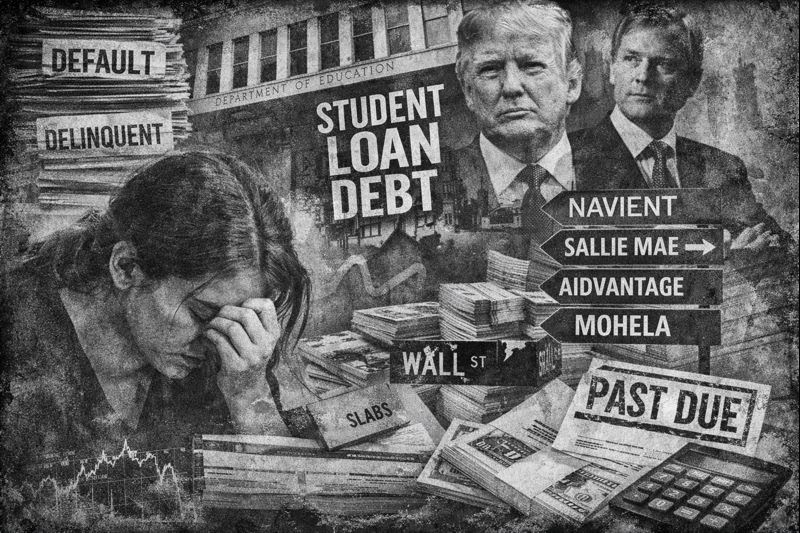
    This transformation made student loans exceptionally attractive for securitization. Student Loan Asset-Backed Securities, or SLABS, flourished precisely because the underlying loans were shielded from traditional credit risk. Investors could rely not on educational outcomes or borrower prosperity, but on the legal certainty that the debt would remain collectible. Even during economic downturns, SLABS were marketed as relatively stable instruments, insulated from the discharge risks that plagued other forms of consumer credit.

    Private banks once dominated this market. Sallie Mae, originally a government-sponsored enterprise, became a central player in both originating and securitizing student loans, while Navient emerged as a major servicer and asset manager. Yet as Higher Education Inquirer documented in early 2025, banks ultimately lost control of student lending. Rising defaults, public outrage, state enforcement actions, and mounting evidence of predatory practices made the sector politically radioactive. The federal government stepped in not as a reformer, but as a backstop, absorbing the portfolio and stabilizing a system private finance could no longer manage without reputational and regulatory risk.

    That history reveals a recurring pattern. When student lending fails in private hands, it becomes public. When the public system is allowed to fail, it becomes ripe for re-privatization.

    A portfolio does not need to collapse to be declared unmanageable. It only needs to appear dysfunctional enough to justify extraordinary intervention.

    The post-pandemic repayment restart, persistent servicing failures, legal challenges to income-driven repayment plans, and widespread borrower confusion have all contributed to a growing narrative of systemic breakdown. Servicers such as Maximus, operating under the Aidvantage brand, MOHELA, and others have struggled to process payments accurately, manage forgiveness programs, and provide reliable customer service. These failures are often framed as bureaucratic incompetence rather than as predictable consequences of outsourcing public functions to private contractors whose incentives are misaligned with borrower welfare.

    Navient’s exit from federal servicing did not mark a retreat from the student loan ecosystem so much as a repositioning, as it continued to benefit from private loan portfolios and legacy SLABS exposure. Sallie Mae, rebranded and fully privatized, remains deeply embedded in the private student loan market, which continues to rely on the same nondischargeability framework that props up federal lending.

    Crucially, these servicing failures cannot be separated from the earlier elimination of bankruptcy as a safety valve. In normal credit markets, distress is resolved through restructuring or discharge. In student lending, distress accumulates. Borrowers remain trapped, servicers remain paid, and policymakers are confronted with a swelling mass of unresolved debt that can be labeled a crisis at any politically convenient moment.

    Under pyrrhic defeat theory, such a crisis is not merely tolerated. It is useful.

    Once the federal portfolio is framed as broken beyond repair, the range of acceptable solutions expands. What would be politically impossible in a stable system becomes plausible in an emergency. Asset transfers, securitization of federal loans, expansion of SLABS-like instruments backed by government guarantees, or long-term conveyance of servicing and collection rights can be presented as pragmatic fixes rather than ideological choices.

    A Trump administration would be particularly well positioned to exploit this dynamic. Skeptical of debt relief, hostile to administrative governance, and ideologically aligned with privatization, such an administration could recast the portfolio as a failed public experiment inherited from predecessors. In that framing, selling or offloading the portfolio is not an abdication of responsibility but an act of fiscal discipline.

    Importantly, this need not take the form of an explicit, congressionally authorized sale. Risk can be shifted through securitization. Revenue streams can be monetized. Servicing authority can be extended indefinitely to private firms. Data control can migrate outside public oversight. Over time, these steps amount to de facto privatization, even if the loans remain nominally federal. The infrastructure, incentives, and profits move outward, while the political blame remains with the state.

    This is where earlier McKinsey & Company studies reenter the conversation. Long before the current turmoil, McKinsey analyses identified high servicing costs, fragmented contractor oversight, weak borrower segmentation, and low political returns on administrative complexity. While framed as efficiency critiques, these studies implicitly favored market-oriented restructuring. In a crisis environment, such recommendations become blueprints for divestment.

    The danger of a pyrrhic defeat strategy is that it delivers a short-term political win at the cost of long-term public capacity. Selling or functionally privatizing the student loan portfolio may improve fiscal optics, but it permanently weakens democratic control over higher education finance. Borrowers, already stripped of bankruptcy protections, lose what remains of public accountability. Policymakers lose leverage over tuition inflation and institutional behavior. The federal government relinquishes a powerful counter-cyclical tool. What remains is a debt regime optimized for extraction, enforced by servicers, securitized for investors, and detached from educational outcomes.

    The defeat is real. It is borne by students, families, and future generations. The victory belongs to those who acquire distressed public assets and those who benefit ideologically from shrinking the public sphere.

    Pyrrhic defeat theory reminds us that collapse is not always accidental. In the case of the federal student loan portfolio, what appears to be dysfunction or incompetence may instead be strategic surrender: a willingness to let a public system deteriorate so that it can be sold off, securitized, or outsourced under the banner of necessity. If that happens, it will not be remembered as a policy error, but as a deliberate transfer of public wealth and power—made possible by decades of legal engineering that began when bankruptcy protection was taken away and ended with student debt transformed into a permanent financial asset.


    Sources

    Higher Education Inquirer. “When Banks Lost Control of Student Loan Lending.” January 2025.

    https://www.highereducationinquirer.org/2025/01/when-banks-lost-control-of-student-loan.html

    U.S. Department of Education, Federal Student Aid. FY 2024 Annual Agency Performance Report. January 13, 2025.

    U.S. Department of Education, Federal Student Aid. Federal Student Loan Portfolio Data and Statistics, various years.

    Government Accountability Office. Student Loans: Key Weaknesses in Servicing and Oversight, multiple reports.

    Congressional Budget Office. The Federal Student Loan Portfolio: Budgetary Costs and Policy Options.

    U.S. Congress. Bankruptcy Abuse Prevention and Consumer Protection Act of 2005 and prior amendments affecting student loan dischargeability.

    Pardo, Rafael I., and Michelle R. Lacey. “The Real Student-Loan Scandal: Undue Hardship Discharge Litigation.” American Bankruptcy Law Journal.

    Financial Crisis Inquiry Commission materials on asset-backed securities and consumer credit markets.

    McKinsey & Company. Student Loan Servicing, Portfolio Optimization, and Risk Management Analyses, prepared for federal agencies and financial institutions, 2010s–early 2020s.

    Higher Education Inquirer archives on SLABS, servicers, privatization, deregulation, and student loan policy.

    Source link

  • How Software Interoperability Enables Truly Flexible Learning Environments

    How Software Interoperability Enables Truly Flexible Learning Environments

    Educational institutions are under increasing pressure to deliver adaptable learning experiences Yet many legacy systems weren’t built to work well enough together to support this.

    When tools don’t communicate or assessments won’t transfer between platforms, each new integration feels like a problem waiting to happen. As hybrid learning, digital access, and new assessment formats become the new norm, this disjointedness can delay change, increase IT issues, and disrupt the learner experience.

    Below, we uncover how solution interoperability solves these challenges, and how a standards-driven approach can help you build scalable, future-proof, flexible learning environments.

    Key Takeaways

    • Interoperability supports flexible learning environments across devices, platforms, and locations by ensuring all digital tools work together seamlessly.
    • Open standards—such as LTI, PCI, and the QTI standard—ensure system compatibility and reduce vendor lock-in.
    • Benefits of interoperability include scalability, reduced vendor dependency, consistency in user experience, and a future-proofed digital learning ecosystem.
    • To adopt interoperability, institutions should choose tools that adhere to 1EdTech standards, minimize proprietary integrations, and continue to monitor and improve once systems are in place.

    What Is Interoperability? 

    Interoperability is the ability of different systems, tools, and applications to work together and transfer data and content easily without custom fixes.

    For example, in an educational context, this could mean that a test created on one tool can be delivered on another.

    In short, interoperability allows your “digital ecosystem” to operate as a single, unified environment, rather than a mismatch of disconnected tools.

    What Interoperability Means in Modern Education

    When systems are interoperable, students and administrators can easily move between devices, platforms, and learning locations. In an increasingly hybrid educational context, this is necessary to future-proof education and learning.

    Similarly, institutions can pick and choose the tools they use, streamlining interchangeability without worrying about tiresome technical issues. As a result, this also lowers the strain on IT departments, who can spend a lot of time maintaining and fixing custom integrations.

    Overall, interoperability turns technology into an enabler of a high-quality, flexible learning environment by allowing users to enjoy a consistent experience, regardless of the device they’re using or their location.

    How Open Standards Enable Flexible Learning Environments

    Open standards are technical rules and specifications created by trusted organizations, such as 1EdTech, that help different tools work together and “speak the same language”—even if they’ve been developed by different companies. 

    Platforms designed around these standards are easier to integrate and evolve. This increases flexibility and ensures institutions can continue adopting new technologies without unnecessary disruption.

    Open standards therefore play a key role in supporting the interoperability of educational systems. Let’s take a closer look at some important examples.

    The QTI (Question and Test Interoperability) standard

    The QTI standard is a universal, 1EdTech–certified format for creating, sharing, and delivering assessment content. It defines a common structure for questions, response types, scoring rules, metadata, and test layouts so that items can move smoothly between different authoring tools, assessment platforms, and learning systems. 

    By standardizing how questions are described and exchanged, QTI eliminates the need to recreate items for each new platform, thus preserving instructional intent, reducing duplication of effort, and lowering long-term maintenance costs. 

    Educators and assessment providers can author content once and deploy it anywhere that supports the standard. QTI also supports accessibility, multimedia, and advanced interaction types, ensuring that modern assessments can be delivered consistently and equitably across systems. As a result, QTI forms the backbone of interoperable digital assessment ecosystems.

    Portable Custom Interaction (PCI)

    The PCI standard makes it possible to create advanced, interactive questions for online assessments that work across different testing systems using the QTI and APIP (Accessible Portable Item Protocol) standards. PCIs are a type of Technology Enhanced Item (TEI) that move beyond traditional question types and offer a better way of assessing 21st-century skills. 

    Complex question formats—such as virtual labs, drawing or annotation tasks, or simulations —are supported and all assets and data can be easily transferred between standards-based platforms seamlessly.

    Learning Tools Interoperability (LTI)

    Learning Tools Interoperability refers to a standard “plug-in system” for educational technology. It connects tools to learning management system (LMS) platforms—such as Moodle or Canvas—securely and quickly. 

    LTI also allows students to move easily between systems, encouraging a smoother user experience and enabling new apps or tools to be added easily.

    If LTI didn’t exist, each tool would need a custom-built integration, which could result in increased technical faults and glitches, causing more issues than it solves. As a result, LTI is ideal for institutions managing large technological ecosystems.

    Mathematical Markup Language (MathML)

    If written in plain text, complex mathematical symbols such as fractions and square roots can become corrupted when displayed on different devices or screen sizes. MathML is the solution, offering a standardized format for math notation that all platforms and systems can read and display correctly. Put simply: It’s the universal language of math for the internet.

    OpenID Connect (OIDC)

    OpenID Connect provides a “secure single sign-on” for all systems. This eliminates the need for multiple usernames and passwords, making sign-in easier and, in turn, saving both money and time that would otherwise be spent contacting help desks for password resets.

    Security issues are also reduced, as OIDC supports multi-factor authentication—such as 2FA or biometric security—helping to safeguard sensitive data.

    OneRoster

    OneRoster is a 1EdTech standard designed to simplify how schools and districts exchange class rosters, course information, enrollment data, and grades between their various learning systems. Without a common data format, institutions often rely on manual uploads or custom integrations that are time-consuming and prone to errors. 

    By providing a consistent, secure way to share student and classroom information, OneRoster ensures that learning platforms, SISs (Student Information Systems), and assessment tools always have the correct data—automatically and in real time. This reduces administrative workload, minimizes data mismatches, and accelerates the setup of new digital tools. 

    Because OneRoster is vendor-neutral and widely adopted, institutions gain the flexibility to choose from a broad ecosystem of applications without worrying about whether those tools can “talk to” their existing systems. In this way, OneRoster strengthens interoperability and contributes directly to more streamlined digital learning environments.

    Computer Adaptive Testing (CAT)

    Computer Adaptive Testing is an assessment approach in which the difficulty of each question adjusts dynamically based on a student’s performance. To make CAT possible across different platforms, systems must be able to exchange item data, scoring logic, metadata, and test results reliably and consistently. 

    The 1EdTech Computer Adaptive Testing standard provides a way to streamline interoperability between adaptive testing engines, item banks, and assessment delivery platforms, effectively eliminating the need for proprietary development. 

    When these systems share a common language, adaptive testing becomes more scalable and cost-effective for institutions. Schools can mix and match content providers, analytics tools, and test delivery systems while maintaining a seamless experience for students and educators. This flexibility ultimately supports richer, more personalized assessment strategies aligned to modern learning needs.

    Benefits of Interoperability for Educational Institutions

    Here are some of the main advantages for educational institutions that adopt interoperability.

    Multi-device and multi-context delivery

    Interoperability supports remote, hybrid, and in-person learning across multiple devices, without duplicating content or manually tweaking systems. As a result, students can expect the same smooth learning experience whether they’re using a tablet at home or working on a computer in the classroom. 

    Streamlined access through SSO

    When systems follow open standards, tools can be launched directly from platforms educators and students already know, such as their LMS, without extra passwords, unfamiliar portals, or confusing navigation. 

    Using standards like OpenID Connect (OIDC) and LTI, institutions can offer secure single sign-on, allowing test-takers to begin an exam with one click and administrators to manage access seamlessly. This reduces disruption, eliminates confusion, and minimizes support requests related to login issues, making the entire assessment experience smoother and more reliable.

    Supports diverse learners and SEND requirements

    When all tools and technologies work well together, learning is more consistent and adaptable. This is especially important for students with special educational needs and disabilities (SEND), who may rely on different devices or assistive technology more frequently. Interoperability ensures test-taker accommodations and accessibility settings “travel with them” across systems, reducing barriers to learning.

    Less involuntary lock-in

    Interoperability frees institutions from rigid, closed ecosystems, making it easier to adopt the right tools on their own terms. Because data and content can easily move between systems, there is less dependency on a single vendor and institutions are less vulnerable to price increases or limited feature sets.

    Better scalability
    As more students join, new tools are added, and programs inevitably grow, interoperable systems can scale with ease. There’s no need for costly custom integrations, and new apps can be added to existing workflows quickly and safely.

    Future-proofed infrastructure

    As technology advances, you might worry that your digital infrastructure may become outdated. However, interoperability ensures your systems remain compatible, even if new tools, formats, or devices emerge. 

    Less strain on IT departments

    Without the need for custom integrations to make your educational systems mesh, tools are much less likely to break. In turn, IT departments can focus on the important, bigger-picture tasks rather than constant troubleshooting. 

    How Institutions Can Adopt Interoperability Successfully

    To develop an interoperable technological landscape, institutions should adopt the following approach.

    Choose platforms built to connect easily with others

    Prioritize systems with a modern and demonstrable application programming interface (API) that aligns with industry-recognized open standards. These platforms are designed for flexibility, reducing the friction and cost often associated with integrating new tools into your existing stack.

    Require proof of adherence to 1EdTech standards

    Request that vendors supply proof of certification (e.g., LTI Advantage or the QTI standard) before adopting any new potential systems. This provides an independent guarantee that the tool is technically compliant and will operate reliably with your other standards-aligned systems. 

    Tools such as TAO—known for supporting QTI, PCI, LTI, OneRoster, MathML, and other open standards—show how a standards-first approach can make digital learning ecosystems more stable and adaptable.

    Avoid custom and proprietary integrations 

    Steer clear of custom fixes—such as rewriting formatting rules or using local plugins—as these are high-risk, require ongoing patching, and are highly likely to break every time systems update.

    Avoiding proprietary integrations—such as eBooks that only work on certain readers, or content libraries that only display inside a specific LMS—also helps reduce your reliance on a single vendor or its developers.

    Educate staff

    Interoperability is a cultural shift as much as a technical one. Thorough training and education for staff that focuses on why interoperability matters and how it supports adaptive and effective learning is key to ensuring successful compliance. 

    Test, monitor, and improve

    Implement rigorous testing of tools in a sandbox environment before going fully live. Once systems have been launched, continue to monitor their integrity and effectiveness, using analytics to confirm that all tools are working together seamlessly and reliably.

    By following these steps, you can build a strong, sustainable foundation for digital transformation.

    Conclusion

    Interoperability is fundamental in building flexible, modern, and future-proofed learning environments.

    When institutions use interoperable systems, they lay the foundations for a stronger digital ecosystem—without being constrained by outdated systems. By choosing tools that prioritize and follow 1EdTech-aligned standards, institutions can reduce vendor dependence, lower long-term costs, and create seamless, enjoyable experiences for both students and teachers.

    Learn more about interoperability assurances by reading our step-by-step guide, or find out more about TAO’s certification in open standards

    Get Started With an Interoperable Assessment Ecosystem

    As a standards-driven open platform, TAO gives you the flexibility to streamline operations and develop a future-proofed digital learning strategy—all without being locked in.

    Explore authoring tools that let you create rich, interactive items with ease, intuitive reporting features that turn assessment data into clear insights, and reliable delivery capabilities that support scalable testing across different devices and learning environments.

    If you want to evolve your digital assessment ecosystem, schedule a demo with TAO today and see what true interoperability looks like in practice.

    FAQs

    What is interoperability, and why is it important?

    Interoperability refers to different technology systems that can connect, share information, and work together easily without custom fixes. This makes tools easier to use, reduces technical problems, supports flexible learning across devices, and allows institutions to switch vendors without losing any content or data.

    What are flexible learning environments?

    Flexible learning environments are learning setups that allow students to learn anywhere, anytime, and on any device. This can include online, hybrid, self-paced, or on-the-go learning. Interoperability is a key component in providing this, as flexible learning environments work best when technology systems connect smoothly.

    What is an example of learning tools interoperability?

    A simple example of learning tools interoperability is connecting an external learning app—such as a quiz platform or digital textbook—to an LMS such as Canvas, Blackboard, or Moodle. For example, when a student uses a learning tool such as a quiz app via LTI, the score they earn in that tool is automatically sent back to the LMS and appears in the gradebook.


    Source link