
Tag: ended

  • An Oklahoma Teacher Took a Leap of Faith. She Ended Up Winning State Teacher of the Year – The 74

    An Oklahoma Teacher Took a Leap of Faith. She Ended Up Winning State Teacher of the Year – The 74


    Get stories like this delivered straight to your inbox. Sign up for The 74 Newsletter

    OKLAHOMA CITY — Those who knew Melissa Evon the best “laughed really hard” at the thought of her teaching family and consumer sciences, formerly known as home economics.

    By her own admission, the Elgin High School teacher is not the best cook. Her first attempt to sew ended with a broken sewing machine and her mother declaring, “You can buy your clothes from now on.”

    Still, Evon’s work in family and consumer sciences won her the 2025 Oklahoma Teacher of the Year award on Friday. Yes, her students practice cooking and sewing, but they also learn how to open a bank account, file taxes, apply for scholarships, register to vote and change a tire — lessons she said “get kids ready to be adults.”

    “Even though most of my career was (teaching) history, government and geography, the opportunity to teach those real life skills has just been a phenomenal experience,” Evon told Oklahoma Voice.

    After graduating from Mustang High School and Southwestern Oklahoma State University, Evon started her teaching career in 1992 at Elgin Public Schools just north of Lawton. She’s now entering her 27th year in education, a career that included stints in other states while her husband served in the Air Force and a break after her son was born.

    No matter the state, the grade level or the subject, “I’m convinced I teach the world’s greatest kids,” she said.

    Her family later returned to Oklahoma where Evon said she received a great education in public schools and was confident her son would, too.

    Over the course of her career, before and after leaving the state, she won Elgin Teacher of the Year three times, district Superintendent Nathaniel Meraz said.

    So, Meraz said he was “ecstatic” but not shocked that Evon won the award at the state level.

    “There would be nobody better than her,” Meraz said. “They may be as good as her. They may be up there with her. But she is in that company of the top teachers.”

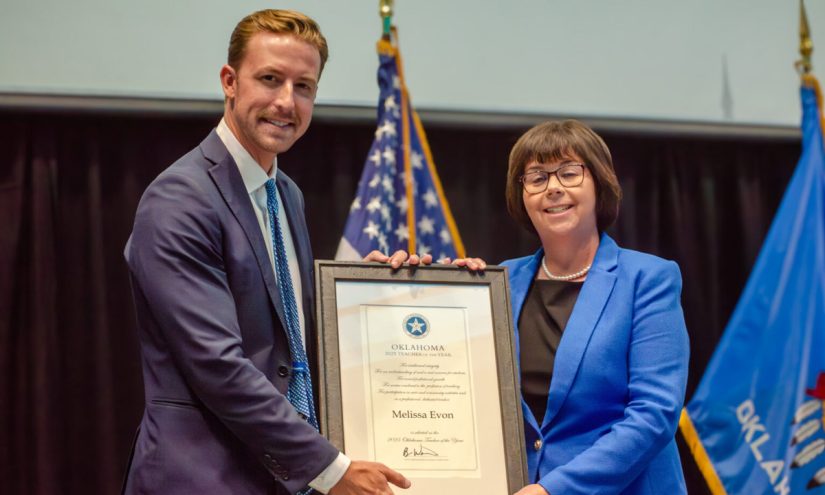
    Oklahoma Teacher of the Year Melissa Evon has won her district’s top teacher award three times. (Photo provided by the Oklahoma State Department of Education)

    Like all winners of Oklahoma Teacher of the Year, Evon will spend a year out of the classroom to travel the state as an ambassador of the teaching profession. She said her focus will be encouraging teachers to stay in education at a time when Oklahoma struggles to keep experienced educators in the classroom.

    Evon herself at times questioned whether to continue teaching, she said. In those moments, she drew upon mantras that are now the core of her Teacher of the Year platform: “See the light” by looking for the good in every day and “be the light for your kids.”

    She also told herself to “get out of the boat,” another way of saying “take a leap of faith.”

    Two years ago, she realized she needed a change if she were to stay in education. She wanted to return to the high-school level after years of teaching seventh-grade social studies.

    The only opening at the high school, though, was family and consumer sciences. Accepting the job was a “get out of the boat and take a leap of faith moment,” she said.

    “I think teachers have to be willing to do that when we get stuck,” Evon said. “Get out of the boat. Sometimes that’s changing your curriculum. Sometimes it might be more like what I did, changing what you teach. Maybe it’s changing grade levels, changing subjects, changing something you’ve always done, tweaking that idea.”

    Since then, she’s taught classes focused on interpersonal communication, parenting, financial literacy and career opportunities. She said her students are preparing to become adults, lead families and grow into productive citizens.

    And, sure, they learn cooking and sewing along the way.

    “I’m getting to teach those things, and I know that what I do matters,” Evon said. “They come back and tell me that.”

    Oklahoma Voice is part of States Newsroom, a nonprofit news network supported by grants and a coalition of donors as a 501c(3) public charity. Oklahoma Voice maintains editorial independence. Contact Editor Janelle Stecklein for questions: [email protected].


    Get stories like these delivered straight to your inbox. Sign up for The 74 Newsletter
    Source link

  • University of Michigan has ended private surveillance contracts but the chill on free speech remains

    University of Michigan has ended private surveillance contracts but the chill on free speech remains

    Clare Rigney is a rising second-year student at American University Washington College of Law and a FIRE summer intern.


    After a news story last week that the University of Michigan was paying private investigators to spy on pro-Palestinian student protesters, the school quickly ended its contracts with the surveillance firm.

    In case anyone is unaware, the year is 2025. Not 1984.

    Now the university says this Orwellian practice has ended, but the chill on student speech will likely remain for some time.

    On June 6, The Guardian reported on the story, citing multiple videos and student accounts of investigators cursing at students and threatening them. Between June 2023 and September 2024, U-M reportedly paid about $800,000 to the Detroit-based security company City Shield to carry out this surveillance instead of using the funds to increase the size of the campus police force. 

    Several of the targeted students were members of Students Allied for Freedom and Equality, the local chapter of the Students for Justice in Palestine, causing critics to accuse the school of targeting pro-Palestinian speech.

    One student, Josiah Walker, said he counted 30 people following him at different times on and off-campus. (As a precaution, he started parking his car off-campus.) On one occasion, Walker believed a man at a campus protest was following him. The man seemed to have a speech impairment, so Walker felt bad about that assumption. However, he later saw the same man speaking in a completely normal manner. When Walker confronted him, the man pretended Walker was trying to rob him.

    The whole incident was caught on camera.

    On the recording, Walker said, “The degree to which all these entities are willing to go to target me is amazing. Guys, this doesn’t make sense. What are you doing? Leave me alone.”

    To serve their proper function, universities must facilitate an open and collaborative learning environment as a marketplace of ideas. U-M ostensibly knows this, saying it values “an environment where all can participate, are invited to contribute, and have a sense of belonging.” 

    Surveillance and intimidation do not cultivate such an environment. U-M’s surveillance will make students want to look over their shoulders before seeking to use their right to free speech.

    The Supreme Court’s ruling in Healy v. James requires universities to uphold their students’ First Amendment rights. This extends even to students whose speech the university deems offensive or “antithetical” to the school’s goals. 

    In Healy, the Court emphasized the danger of an institution targeting a group of students as particularly dangerous based on their viewpoint, noting, “the precedents of this Court leave no room for the view that, because of the acknowledged need for order, First Amendment protections should apply with less force on college campuses than in the community at large.”

    Indeed, an important function of college is to allow students to broaden their horizons and meet different kinds of  people. And freedom of association allows them to seek out individuals whose beliefs align with theirs so that they can work toward a common goal. 

    Unfortunately, universities have used these chilling tactics against student political protestors for years. 

    Amid protests demanding sick pay for frontline workers, the University of Miami in 2020 used facial recognition technology to identify protestors. The university then hauled these students into meetings where they were forced to review Miami’s events policies.

    “The take-home message that we got was basically, We’re watching you,” Esteban Wood, one of the student protesters, later said. 

    When colleges and universities surveil students, they chill speech and promote distrust between student activists and the police meant to protect them.

    In 2018, Campus Safety Magazine revealed that the University of Virginia had contracted with a private service called Social Sentinel. This service used an algorithm to monitor students’ social media posts and, if it deemed it necessary, report them to the police.

    That same year, FIRE reported on a similar situation at the University of North Carolina. During protests over a confederate statue, a UNC campus police officer masqueraded as an approachable civilian named “Victor” in order to gain information from protesters and track their movements. Later, when students confronted “Victor” in a police uniform, he revealed himself as Officer Hector Bridges, explaining he had pretended to be sympathetic to their cause as a part of his “work.” 

    “I”m representing the university right now,” Bridges admitted on video.

    The UNC Police Department later released a statement saying the university had a practice of sending “plain clothes” officers to patrol the statue to purportedly “maintain student and public safety.”

    Chilling student speech in the name of undisclosed and unspecified safety is nothing new. But if it is serious about change, it couldn’t hurt for U-M to start with reviewing its own policies. According to its Division of Public Safety and Security, its role is to foster “a safe and secure environment” where students learn to “challenge the present.” Furthermore, U-M’s Standard Practice Guide section on freedom of speech states that when any non-university security forces are needed, they should know and follow these policies. 

    While it’s possible to imagine a circumstance where student surveillance might be necessary, colleges should keep in mind that courts have generally disfavored such efforts. For example, in White v. Davis, the Supreme Court of California rebuked the Los Angeles Police Department’s unconstitutional surveillance of UCLA students:

    The censorship of totalitarian regimes that so often condemns developments in art, science and politics is but a step removed from the inchoate surveillance of free discussion in the university; such intrusion stifles creativity and to a large degree shackles democracy.

    When colleges and universities surveil students, they chill speech and promote distrust between student activists and the police meant to protect them. That can be dangerous for both the students and the officers. Police investigations will be more difficult if the student body does not trust them enough to cooperate when needed. Students may be less likely to contact the police for legitimate violations. 

    Colleges and universities should empower their students to boldly state their beliefs. That’s simply not possible if they are also hiring outside agencies to spy on them. While we are glad the University of Michigan ended the practice, this case should serve as a reminder that such heavy-handed surveillance tactics have no place at American universities. 

    Source link