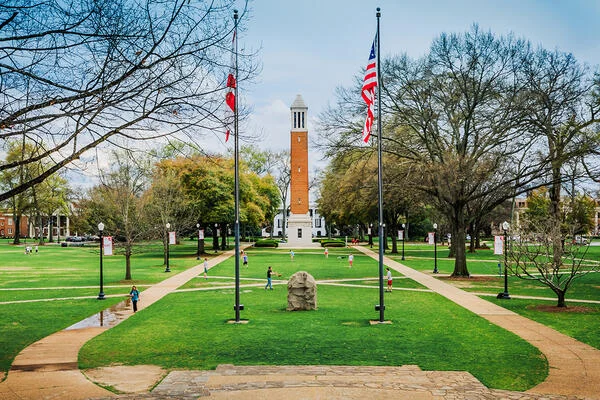
The University of Alabama has ended two student magazines, citing “legal obligations.”
Carmen K Sisson/iStock/Getty Images
The University of Alabama has ended publication of two student-run magazines, one focused on women and the other on Black students, in order to comply with legal obligations, officials say.
Local and student media reported that Steven Hood, the university’s vice president for student life, said that because the magazines target specific groups, they’re what the Department of Justice considers “unlawful proxies” for discrimination. Both publications received university funding.
The women’s magazine, [Alice], just celebrated its 10th anniversary last month, while Nineteen Fifty-Six, named after the year the first Black student enrolled in the university, says it was created in 2020. [Alice] managing editor Leslie Klein told Inside Higher Ed that university officials told her magazine’s editor in chief Monday that the magazines were being canceled because they’re identity-based.
“I think it is ridiculous,” Klein said. She said it seems like a decade of history is being “put down the drain.”
The university pointed to a July memo from Pam Bondi, in which the U.S. attorney general provided “non-binding best practices” to avoid “significant legal risks.” She wrote that “facially neutral criteria” that “function as proxies for protected characteristics” are illegal “if designed or applied” to intentionally advantage or disadvantage people based on race or sex.
But Bondi’s memo didn’t specifically say that a media outlet focusing on an audience it defines by race or sex is illegal. DOJ spokespeople didn’t respond to Inside Higher Ed’s questions Tuesday about whether the department considers the Alabama magazines unlawful.
Marie McMullan, student press counsel for the Foundation for Individual Rights and Expression, said in an email that the university’s “unlawful proxy” claim is “nonsense.”
“These publications have the First Amendment right to be free of viewpoint-based discrimination, but UA is explicitly citing their viewpoints to justify killing their publications,” McMullan said. “No federal antidiscrimination law authorizes the university to silence student media it dislikes.”
Mike Hiestand, senior legal counsel for the Student Press Law Center, said he knows of no other university that has used the memo to target a student publication. He said anyone is allowed to write for these magazines.
“A student publication is not a DEI program,” Hiestand said. He said the memo says “absolutely nothing about denying students the right to talk about topics that are important to them” and “I don’t know what the university is thinking here.”
“That looks a lot like viewpoint discrimination to me, which the Supreme Court has said repeatedly is off-limits,” he said.
The university didn’t provide Inside Higher Ed an interview Tuesday or answer multiple written questions. In an emailed statement, the university said the magazines’ editors and contributors “were informed of the decision to suspend the magazines effective immediately, with the Fall 2025 issue as the final issue.” It added that “staff hope to work with students to develop a new publication that features a variety of voices and perspectives to debut in the next academic year.”
“The University remains committed to supporting every member of our community and advancing our goals to welcome, serve, and help all succeed,” the university said. “In doing so, we must also comply with our legal obligations. This requires us to ensure all members of our community feel welcome to participate in programs that receive University funding from the Office of Student Media.”
This was Klein’s fourth year with [Alice]. “It really just breaks my heart,” she said.
Tionna Taite, who founded Nineteen Fifty-Six, said in a statement to The Alabama Reflector that both magazines are pivotal to the minority experience at the university.
“I am beyond disappointed in the regression UA has made since I created 1956 Magazine,” Taite said. “In 2020, UA made promises to be more diverse, inclusive and equitable. Five years later, I do not see any progress and their decision regarding both magazines confirms this.”
These magazines aren’t the first university student publications that administrators have curtailed in 2025. Purdue University said it would no longer distribute papers for The Purdue Exponent, an independent student newspaper, or allow it to use the word “Purdue” for commercial purposes. The university said it’s inconsistent with “freedom of expression, institutional neutrality and fairness to provide the services and accommodations” to “one media organization but not others.”
Indiana University also fired Director of Student Media Jim Rodenbush and canceled printing of the Indiana Daily Student newspaper before relenting and again allowing a print edition. Rodenbush remains separated from the university.