
Tag: enforce

  • Ind. B School to Enforce Grade Distribution for Skill Classes

    Ind. B School to Enforce Grade Distribution for Skill Classes

    Photo illustration by Justin Morrison/Inside Higher Ed | Ralf Geithe/iStock/Getty Images

    Some faculty members at the Indiana University Kelley School of Business have been instructed to eliminate grade rounding, remove the A-plus grade option and keep average section GPAs between 3.3 and 3.5 for the fall semester.

    The grading changes aim to “address grade inflation and promote rigor across our curriculum,” according to an email sent to faculty in the Communication, Professional and Computer Skills (CPS) department from business writing course coordinator Polly Graham, which was obtained by Inside Higher Ed. “During the COVID-19 pandemic, [CPS] grades elevated, and in recent years, grades have remained high. In recent semesters, some instructors have awarded 100% A’s in standard (i.e., non-honors) sections, and others have awarded extraordinary numbers of A+’s and incompletes,” the email said. 

    The new grading policy was sent to instructors in early August without faculty discussion or approval, according to a faculty member in the CPS department who asked to remain anonymous for fear of retribution. The department, which does not have its own governance or bylaws beyond what governs the business school writ large, is the only one in Kelley that is staffed entirely by lecturers who do not have tenure protections. So far, the new grading policies apply only to courses in the CPS department, the faculty member said.

    Instructors of standard, nonhonors courses must make the GPA of each section average between 3.3 and 3.5, and honors course GPA averages must fall within 0.2 points of the “section’s cumulative student GPA,” the email stated. Faculty members should not round up final grades “even if the student’s grade is very close to a higher letter grade,” and each instructor will complete two check-ins with CPS leadership—one before and one after midterms—after which “formative support will be provided to faculty as requested or needed.” It’s unclear what form the support will take, but the faculty member suspects it could be additional assistance from the chair on lesson plans or grading strategies.

    It’s not unusual for business schools to enforce a set grade distribution. At the University of Michigan’s Ross Business School, for instance, core class instructors must follow a distribution that allows 40 percent or fewer undergraduates to earn an A-minus or higher, 90 percent or fewer undergraduates to earn a B or higher, and at least 10 percent of undergraduates must earn between a B-minus and an F. Emory University’s Goizueta Business School also enforces a grade distribution, as does Columbia Business School.

    The Kelley School will also enforce an attendance policy for CPS classes this fall. Students will be allowed up to three absences without a grade penalty. After the fourth absence, they lose one-third of their final letter grade, and after five absences, they lose a full letter grade. Six absences will result in an automatic “failure due to non-attendance,” the email explained. The school will allow exceptions on a case-by-case basis.

    All Kelley students are required to take courses within the CPS department, including a business presentations class, a business writing course and three “Kelley Compass” classes that teach soft business skills such as team building, interviewing and conflict management. Like the lab time that accompanies physical science classes, CPS courses offer skills-based training that encourages mastery, the CPS faculty member told Inside Higher Ed. Faculty are concerned that the new GPA targets put an artificial limit on students’ success.

    A spokesperson for the Kelley School did not answer Inside Higher Ed’s questions about the grade recalibration and instead provided the following statement: “At Kelley, faculty design courses to be both rigorous and fair, while supporting student development and career preparation. Our longstanding priority is to ensure that grades reflect the quality of each student’s performance and that grade distribution is fair and consistent, including across multiple sections of the same course.”

    The statement language echoes what faculty have been instructed to tell students and parents who ask about the grading changes, according to the CPS faculty member.

    Indiana’s Kelley School has become more popular of late, and administrators appear to be tightening admissions standards in response. The school has fielded some 27,000 applications for approximately 2,000 spots in recent years, the faculty member said, though the Kelley spokesperson did not confirm or refute these numbers.

    In March, Kelley promoted Patrick E. Hopkins, an accounting professor who has worked at the business school since 1995, to dean. Just over two months later, on June 2, incoming Indiana University prebusiness students were notified that the minimum grade for automatic admission to the Kelley School would be raised from a B to a B-plus, starting with their cohort. Christopher Duff, the father of an incoming Indiana prebusiness student who plans to seek admission to Kelley, said the change was a “bait and switch.”

    “To be crystal clear, I have zero issues with the Kelley School of Business changing their admission criteria. I do, however, have a major issue in the timing of this change. We made our decision based on clearly stated information at the time of commitment. We jettisoned all other schools, offers and financial aid to pursue a degree from Indiana-Kelley,” Duff told Inside Higher Ed. “You want to change the criteria? Fine. Do so with the incoming class who will be aware to make an informed decision. We did not get that choice. It was made for us and when we complained—and we all did—we were essentially told to take it or leave it.”

    Duff said he met with Kelley’s undergraduate admissions director, Alex Bruce, in June to discuss the change, and in that meeting Bruce told him the school had overadmitted for the incoming class and received commitments from far more students than they anticipated.

    “I asked [Bruce] if the admission department was telling the academic departments to grade harder, to weed out even more students than prior years,” Duff said. “He assured me that admissions and academics are separate entities and have no control over each other. I do not believe anything he told me that day.”

    Source link

  • ‘New sheriff in town’: DOJ to enforce anti-trans Trump orders

    ‘New sheriff in town’: DOJ to enforce anti-trans Trump orders

    This audio is auto-generated. Please let us know if you have feedback.

    The Trump administration on Friday announced a major change in Title IX enforcement at schools and colleges, tapping the U.S. Department of Justice to help investigate and ultimately enforce the separation of transgender students from girls’ and women’s athletics teams and spaces in schools and colleges. 

    The Title IX Special Investigations Team shifts some civil rights investigations and enforcement from the U.S. Department of Education to the Department of Justice — both of which are a part of the newly minted unit.

    The move is part of a Trump administration effort to push through a backlog of complaints at the Education Department’s Office for Civil Rights. These investigations usually take months — sometimes years — to complete. The process typically includes interviews and other tools and ultimately ends in resolution agreements to bring schools into compliance.  

    Instead, the department will rely on a rapid resolution process to address sex discrimination complaints, framing the move as a way to protect cisgender girls and women, according to a Friday announcement. Rapid resolution is “an expedited case processing approach,” according to the Trump administration’s case processing manual, which was updated in January. 

    There are certain requirements before rapid resolution is an option, including having the complainant initiate the expedited process and having schools on board with that plan of action to resolve a complaint. The tool can be tapped when schools have already taken action to resolve the complaint on their own accord. It was used under the previous administration as well to address the increasing volume of complaints.

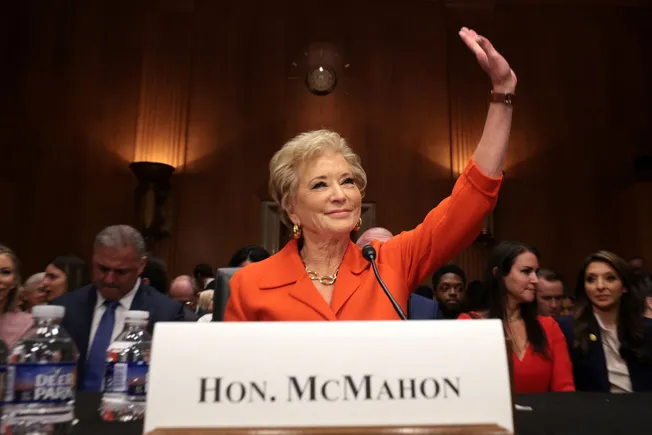
    OCR under this Administration has moved faster than it ever has, and the Title IX SIT will ensure even more rapid and consistent investigations,” U.S. Secretary of Education Linda McMahon said in Friday’s announcement. “To all the entities that continue to allow men to compete in women’s sports and use women’s intimate facilities: there’s a new sheriff in town. We will not allow you to get away with denying women’s civil rights any longer.”

    Attorney General Pamela Bondi said in an accompanying statement that “protecting women and women’s sports is a key priority” for the Department of Justice. The agency will “ take comprehensive action when women’s sports or spaces are threatened,” she continued. The administration has often used that language to separate transgender students from programs spaces aligning with their gender identities with blanket bans. 

    The department’s formal announcement that it is handing off Title IX enforcement to the Justice Department and joining forces on investigations comes after weeks of collaboration between the two agencies, confirming suspicions from education civil rights attorneys that DOJ involvement will be the new normal.

    It was also expected, considering that Education Department layoffs gutted half of OCR enforcement offices nationwide, and the department was already relying on the DOJ in the layoffs’ wake. 

    The Education Department already tapped the Justice Department in an investigation the Trump administration launched into the Maine Department of Education over the state’s transgender athlete policy.

    “Why would they continue to administratively enforce when they’re trying to put themselves out of jobs?” Kayleigh Baker, a Title IX attorney for TNG Consulting, an education civil rights consultant group, surmised late last month in wake of the Maine case. “And so I think leaning on DOJ makes sense.” 

    Prior to this administration, the DOJ was rarely called off the bench to enforce civil rights protections in schools, and its involvement was usually only reserved for complex and high-profile cases.

    Source link

  • ‘New sheriff in town’: DOJ to enforce anti-trans Trump orders

    ‘New sheriff in town’: DOJ to enforce anti-trans Trump orders

    This audio is auto-generated. Please let us know if you have feedback.

    The Trump administration on Friday announced a major change in Title IX enforcement at schools and colleges, tapping the U.S. Department of Justice to help investigate and ultimately enforce the separation of transgender students from girls’ and women’s athletics teams and spaces in schools and colleges. 

    The Title IX Special Investigations Team shifts some civil rights investigations and enforcement from the U.S. Department of Education to the Department of Justice — both of which are a part of the newly minted unit.

    The move is part of a Trump administration effort to push through a backlog of complaints at the Education Department’s Office for Civil Rights. These investigations usually take months — sometimes years — to complete. The process typically includes interviews and other tools and ultimately ends in resolution agreements to bring schools into compliance.  

    Instead, the department will rely on a rapid resolution process to address sex discrimination complaints, framing the move as a way to protect cisgender girls and women, according to a Friday announcement. Rapid resolution is “an expedited case processing approach,” according to the Trump administration’s case processing manual, which was updated in January. 

    There are certain requirements before rapid resolution is an option, including having the complainant initiate the expedited process and having schools on board with that plan of action to resolve a complaint. The tool can be tapped when schools have already taken action to resolve the complaint on their own accord. It was used under the previous administration as well to address the increasing volume of complaints.

    OCR under this Administration has moved faster than it ever has, and the Title IX SIT will ensure even more rapid and consistent investigations,” U.S. Secretary of Education Linda McMahon said in Friday’s announcement. “To all the entities that continue to allow men to compete in women’s sports and use women’s intimate facilities: there’s a new sheriff in town. We will not allow you to get away with denying women’s civil rights any longer.”

    Attorney General Pamela Bondi said in an accompanying statement that “protecting women and women’s sports is a key priority” for the Department of Justice. The agency will “ take comprehensive action when women’s sports or spaces are threatened,” she continued. The administration has often used that language to separate transgender students from programs spaces aligning with their gender identities with blanket bans. 

    The department’s formal announcement that it is handing off Title IX enforcement to the Justice Department and joining forces on investigations comes after weeks of collaboration between the two agencies, confirming suspicions from education civil rights attorneys that DOJ involvement will be the new normal.

    It was also expected, considering that Education Department layoffs gutted half of OCR enforcement offices nationwide, and the department was already relying on the DOJ in the layoffs’ wake. 

    The Education Department already tapped the Justice Department in an investigation the Trump administration launched into the Maine Department of Education over the state’s transgender athlete policy.

    “Why would they continue to administratively enforce when they’re trying to put themselves out of jobs?” Kayleigh Baker, a Title IX attorney for TNG Consulting, an education civil rights consultant group, surmised late last month in wake of the Maine case. “And so I think leaning on DOJ makes sense.” 

    Prior to this administration, the DOJ was rarely called off the bench to enforce civil rights protections in schools, and its involvement was usually only reserved for complex and high-profile cases.

    Source link

  • After FIRE lawsuit, California community colleges will not enforce DEI mandate in classroom

    After FIRE lawsuit, California community colleges will not enforce DEI mandate in classroom

    FRESNO, Feb. 10, 2025 — After a lawsuit from the Foundation for Individual Rights and Expression challenged regulations mandating the evaluation of professors based on their commitment to “diversity, equity, inclusion, and accessibility” (DEIA), the California Community Colleges system and a community college district attested in court that the regulations do not require community college professors to teach and endorse the state’s pro-DEIA views in the classroom.

    In March 2023, the California Community College system amended its tenure and employee review guidelines to “include diversity, equity, inclusion, and accessibility standards in the evaluation and tenure review of district employees.” The new regulations stated that faculty members “shall employ teaching, learning, and professional practices that reflect DEIA and anti-racist principles” and mandated they “promote and incorporate culturally affirming DEIA and anti-racist principles.”

    That August, FIRE filed suit against California Community Colleges and the State Center Community College District on behalf of six Fresno-area community college professors who oppose the highly politicized concepts of “DEIA” (more often called “DEI”) and “anti-racism” and thus did not want to incorporate them into their teaching.

    Forced to defend the regulations in court, the state chancellor and district quickly disclaimed any intention to use the state guidelines or the district’s faculty contract to police what professors teach in the classroom or to punish them for their criticism of DEI. 

    Specifically, the Chancellor’s Office “disavowed any intent or ability to take any action against Plaintiffs” for their classroom teaching. The district likewise confirmed that none of the plaintiffs’ “proposed future actions” for their courses violate the rules or the faculty contract. It added that plaintiffs are not “prohibited from presenting” their “viewpoints or perspectives in the classrooms” and will not “be disciplined, terminated, or otherwise punished for doing so.” 

    In particular, the Defendants denied they would punish Plaintiffs for any of their proposed speech, including “assigning certain literary works, such as Martin Luther King Jr.’s Letters from Birmingham Jail,” using “methodologies and course materials in their classroom” intended to encourage debate and discussion about the merits of DEI viewpoints, criticizing concepts like “anti-racism,” or supporting a color-blind approach to race in their self-evaluations. 

    On Jan. 28, U.S. District Judge Kirk E. Sherriff relied on those assurances to hold as a legal matter that because of the college officials’ disavowals, the professors had not suffered a harm sufficient to challenge the regulations’ constitutionality. In dismissing the lawsuit, Judge Sherriff emphasized that neither the DEI Rules nor the faculty contract “mandate what professors teach or how any DEIA principles should be implemented.”

    “FIRE filed suit to prevent California’s community colleges from evaluating our faculty clients on the basis of their classroom commitment to a political ideology, and that’s exactly the result we’ve achieved,” said FIRE attorney Daniel Ortner. “As a result of our suit, the state and the district promised a federal judge they won’t interfere with our clients’ academic freedom and free speech rights. The classroom is for discussion and exploration, not a top-down mandate about what ideas must take priority. We’ll make sure it stays that way.”

    “FIRE will be watching like a hawk to ensure that the state chancellor and district live up to their word,” said FIRE attorney Zach Silver. “If they force any professors to parrot the state’s DEI views, or punish them for criticizing the state’s position, we’ll be ready to stand up for their rights.”

    COURTESY PHOTOS OF PLAINTIFFS FOR MEDIA USE

    Despite unobjectionable-sounding labels, “diversity, equity, and inclusion” and “anti-racism” frameworks often encompass political topics and ideology that are contested and controversial. The glossary of DEI terms put out by California Community Colleges, for example, stated that “persons that say they are ‘not a racist’ are in denial,” while denouncing “colorblindness” as a concept for “perpetuat[ing] existing racial inequities.”

    DEI requirements are also highly controversial within academia. FIRE’s most recent faculty survey indicated that half of faculty think it is “rarely” or “never” justifiable for universities to make faculty candidates submit statements pledging commitment to DEI before being considered for a job (50%) or to be considered for tenure or promotion (52%).

    Since FIRE filed its lawsuit in 2023, many top universities and university systems have voluntarily moved away from mandatory DEI, including Harvard, the Massachusetts Institute of Technology, and the University of Arizona system. Most recently, the University of Michigan dropped the use of diversity statements in hiring and firing in December 2024 following a viral New York Times article that detailed how the school’s DEI practices stifled academic freedom and discourse at the school.

    FIRE sued on behalf of six professors, James Druley, David Richardson, Linda de Morales, and Loren Palsgaard of Madera Community College, Bill Blanken of Reedley College, and Michael Stannard of Clovis Community College. (Professors Stannard and Druley withdrew from the case in 2024 upon retiring from teaching.)

    “Wherever you stand on the debate over DEI, the important thing is there is a debate in the first place,” said Palsgaard. “I’m happy that thanks to our lawsuit, we know that debate will continue in California, both inside and outside the classroom.”


    The Foundation for Individual Rights and Expression (FIRE) is a nonpartisan, nonprofit organization dedicated to defending and sustaining the individual rights of all Americans to free speech and free thought — the most essential qualities of liberty. FIRE recognizes that colleges and universities play a vital role in preserving free thought within a free society. To this end, we place a special emphasis on defending the individual rights of students and faculty members on our nation’s campuses, including freedom of speech, freedom of association, due process, legal equality, religious liberty, and sanctity of conscience.

    CONTACT:

    Alex Griswold, Communications Campaign Manager, FIRE: 215-717-3473; [email protected]

    Source link

  • Education Department will enforce 2020 Title IX rule

    Education Department will enforce 2020 Title IX rule

    This audio is auto-generated. Please let us know if you have feedback.

    Dive Brief:

    • The U.S. Department of Education has told colleges and school districts they should follow the 2020 Title IX rule for investigating sex discrimination in schools, closing the chapter on a Biden administration rule that faced much legal turmoil. 
    • In a Friday “Dear Colleague” letter, Craig Trainor, acting assistant secretary for civil rights, said that under the 2020 rule, the interpretation of “sex” means being born male or female. 
    • The letter also clarified that any open Title IX investigations initiated under the 2024 Title IX Rule should be immediately reevaluated to comply with the requirements of the 2020 rule.

    Dive Insight:

    Trainor said the change is based on a federal judge’s decision in early January that struck down the 2024 rule as unconstitutional across the country. That Biden administration rule for the first time extended Title IX civil rights protections to LGBTQI+ students and employees at federally funded schools and colleges — including by prohibiting discrimination based on gender identity and sexual orientation

    Released in April 2024, the rule drew legal challenges, and courts blocked the regulations in at least 26 states.

    Trainor also stated that the 2024 rule conflicts with a Jan. 20 executive order from President Donald Trump that requires all federal agencies and departments to recognize just two sexes — male and female — when it comes to “sex-protective” laws. 

    “As a constitutional matter, the President’s interpretation of the law governs because he alone controls and supervises subordinate officers who exercise discretionary executive power on his behalf,” Trainor’s letter said.

    Supporters of the 2020 rule, developed under the first Trump administration, praised the letter.

    Chad Wolf, executive vice president of the America First Policy Institute, said that under the 2020 rule, women and girls were “unjustly and illegally” denied access to sex-segregated athletic opportunities and intimate spaces. Linda McMahon, President Trump’s nominee for U.S. education secretary, is chair of the board at AFPI. 

    “Female athletes were seriously injured competing against males, and many were forced to undress in front of males,” Wolf said in a statement. “It was a misguided policy that did real harm, and this new guidance puts an end to it.”

    But opponents to the 2020 rule voiced concern, saying it puts students at greater risk of harassment and discrimination.

    This is an incredibly disappointing decision that will leave many survivors of sexual violence, LGBTQ+ students, and pregnant and parenting students without the accommodations critical to their ability to learn and attend class safely,” said Emma Grasso Levine, senior manager of Title IX policy and programs at Know Your IX, in a statement. “Schools must step up to protect students in the absence of adequate federal guidance.”

    Source link

  • Education Department will enforce 2020 Title IX rule

    Education Department will enforce 2020 Title IX rule

    This audio is auto-generated. Please let us know if you have feedback.

    Dive Brief:

    • The U.S. Department of Education has told school districts and colleges they should follow the 2020 Title IX rule for investigating sex discrimination in schools, closing the chapter on a Biden administration rule that faced much legal turmoil. 
    • In a Friday “Dear Colleague” letter, Craig Trainor, acting assistant secretary for civil rights, said that under the 2020 rule, the interpretation of “sex” means being born male or female. 
    • The letter also clarified that any open Title IX investigations initiated under the 2024 Title IX Rule should be immediately reevaluated to comply with the requirements of the 2020 rule.

    Dive Insight:

    Trainor said the change is based on a federal judge’s decision in early January that struck down the 2024 rule as unconstitutional across the country. That Biden administration rule for the first time extended Title IX civil rights protections to LGBTQI+ students and employees at federally funded schools and colleges — including by prohibiting discrimination based on gender identity and sexual orientation

    Released in April 2024, the rule drew legal challenges, and courts blocked the regulations in at least 26 states.

    Trainor also stated that the 2024 rule conflicts with a Jan. 20 executive order from President Donald Trump that requires all federal agencies and departments to recognize just two sexes — male and female — when it comes to “sex-protective” laws. 

    “As a constitutional matter, the President’s interpretation of the law governs because he alone controls and supervises subordinate officers who exercise discretionary executive power on his behalf,” Trainor’s letter said.

    Supporters of the 2020 rule, developed under the first Trump administration, praised the letter.

    Chad Wolf, executive vice president of the America First Policy Institute, said that under the 2020 rule, women and girls were “unjustly and illegally” denied access to sex-segregated athletic opportunities and intimate spaces. Linda McMahon, President Trump’s nominee for U.S. education secretary, is chair of the board at AFPI. 

    “Female athletes were seriously injured competing against males, and many were forced to undress in front of males,” Wolf said in a statement. “It was a misguided policy that did real harm, and this new guidance puts an end to it.”

    But opponents to the 2020 rule voiced concern, saying it puts students at greater risk of harassment and discrimination.

    This is an incredibly disappointing decision that will leave many survivors of sexual violence, LGBTQ+ students, and pregnant and parenting students without the accommodations critical to their ability to learn and attend class safely,” said Emma Grasso Levine, senior manager of Title IX policy and programs at Know Your IX, in a statement. “Schools must step up to protect students in the absence of adequate federal guidance.”

    Source link