Streamlining school communication empowers all district stakeholders
The dos and don’ts of parent-educator communication
Female district leaders target back-to-school priorities
For more on school communication, visit eSN’s Educational Leadership hub
As technology trainers, we support teachers’ and administrators’ technology platform needs, training, and support in our district. We do in-class demos and share as much as we can with them, and we also send out a weekly newsletter. We coordinate a lot of different training sessions across our many different platforms, and support principals during staff meetings and on professional development days.
More News from eSchool News
Many math tasks involve reading, writing, speaking, and listening. These language demands can be particularly challenging for students whose primary language is not English.
As a career and technical education (CTE) instructor, I see firsthand how career-focused education provides students with the tools to transition smoothly from high school to college and careers.
In recent years, the rise of AI technologies and the increasing pressures placed on students have made academic dishonesty a growing concern. Students, especially in the middle and high school years, have more opportunities than ever to cheat using AI tools.
Math is a fundamental part of K-12 education, but students often face significant challenges in mastering increasingly challenging math concepts.
Throughout my education, I have always been frustrated by busy work–the kind of homework that felt like an obligatory exercise rather than a meaningful learning experience.
During the pandemic, thousands of school systems used emergency relief aid to buy laptops, Chromebooks, and other digital devices for students to use in remote learning.
Education today looks dramatically different from classrooms of just a decade ago. Interactive technologies and multimedia tools now replace traditional textbooks and lectures, creating more dynamic and engaging learning environments.
There is significant evidence of the connection between physical movement and learning. Some colleges and universities encourage using standing or treadmill desks while studying, as well as taking breaks to exercise.
This story was originally published by Chalkbeat. Sign up for their newsletters at ckbe.at/newsletters. In recent weeks, we’ve seen federal and state governments issue stop-work orders, withdraw contracts, and terminate…
English/language arts and science teachers were almost twice as likely to say they use AI tools compared to math teachers or elementary teachers of all subjects, according to a February 2025 survey from the RAND Corporation.
There are many approaches to designing an online course, and finding the right balance may depend on a variety of factors ranging from content topics to types of assessments. Students who opt for e-learning likely prefer it for the flexibility it affords, but that doesn’t mean they want to miss out on engaging with their classmates or instructor in a meaningful way. So, educators must continue to shift their thinking and go back to the basics to deliver their online course content in a way that creates a direct relationship with their students (Meyer, 2014). One way to incorporate human engagement is through a synchronous seminar—nothing beats live interaction—, where learners and educators can convene for a meaningful exchange.
Survey Says
Seminars are not new to the online environment, although for anyone who has taught in this environment there have been many iterations over the years as technology and curriculum have dramatically changed. So, after many years of teaching online courses, we firmly believe that a weekly one-hour seminar with our students is one of the most valuable aspects of the e-learning experience. However, to determine if our assessment was correct, we surveyed virtual instructors and students gathering both quantitative data and qualitative data. It was clear that while there were many differences in the presentation techniques, seminars were considered of great value to all.
Here are the four top take-aways from our survey.
First, students and faculty both felt that spending time in the seminar was most beneficial in helping students gain greater understanding of the material for that unit. Students were able to ask questions and get immediate answers or feedback, which was particularly satisfying and gave them confidence to move forward.
Second, students expressed the need for more connectivity through live seminars with fellow classmates and this concept mimics the physical classroom setting where students engage with one another. This also led to the point that instructors believed these virtual conversations helped build greater networking skills and they could see that in other areas of the asynchronous aspects of the course.
Third, instructors mentioned that they found better academic results from students participating in the weekly sessions, while students expressed that they felt more engaged in the course material which substantiated the reason they were more successful.
Fourth and finally, students and instructors shared that participating in live sessions resulted in having an attitude of greater interest and there was markedly more enthusiasm generated. Student and faculty behavior became more meaningful as they shared these personal emotions in the weekly session together.
Suggestions for Creating an Engaging Live Seminar
Reflecting on the survey responses, we noticed a direct relationship between how instructors presented their material, and the value students derived from participating in these one-hour, live sessions. We also have learned, through student feedback in our own courses, how to truly engage with a wide range of learning personalities, so we have come up with the top five suggestions for you to consider using in your presentations during online seminars.
This is not a lecture. Students do not want to be sermonized or given a one-hour soliloquy that doesn’t give them the opportunity to speak. They want live interaction that gives them the sense of being heard. So, give them audio and video permissions so they can see each other and build connections.
Poll questions and chat boxes. This follows clearly after the last one, in which students want engagement in conversation about the subject matter. Most platforms have a tool that allows you to ask students questions, and they can select answers in the form of polls with true/false, multiple choice or other response scales. You can also include what we call a “chat box” which is a specific titled slide that has an open-ended question and students are asked to brainstorm ideas or practice the topics being presented followed by the instructor offering a guided response from the textbook or reliable source that gives students some additional feedback on their thinking.
No black and white slides. Instructors should remember that they are meeting with many different students, so constructing a visual PowerPoint to go along with the audio is a great idea but be succinct and creative. Consider including 4-5 bullet points used as talking points and give each slide some pizazz by using color and graphics from which a natural conversation flows. Students may see something in the graphics or the points that might help to generate a deeper dive into the topic taking the group in a new and unexpected direction that can personalize the presentation.
Breakout rooms. This activity can take anywhere from a few minutes to even half of the class session. Give students the opportunity to connect in smaller groups, just like in the on-ground classes, giving them a topic to discuss and then bring back to the larger group. Change out your groups each week so students can engage with other classmates and visit each breakout room to build on that engagement.
Field trips. Take your students outside this live classroom. Perhaps you already share links for them to view short videos online, but have you considered going on a live visit? I once had a student in my food and beverage class who was actually in the kitchen at her restaurant during a seminar. She walked us through the kitchen and dining area with her webcam explaining the exact topics we were focusing on for that week. It was a spontaneous, yet memorable experience for everyone in the class. You might want to set up a guest speaker or visit in advance to test the technology, review the expectations and practice, so determine what works best for you and meet your university guidelines.
Remember, students not only want to connect with the subject matter, but most importantly to their classmates and instructors.
Why Adopt Some of These Practices
If you are not currently hosting weekly live seminars, consider the reasons and determine if you and your students could benefit from live sessions. Maybe surveying your department or simply asking informally about their opinion would give you and your colleagues some better guidance regarding reaction to the value of live seminars. Don’t you want your students to find greater value in your course?
If you do have synchronous learning in your course, perhaps some of these points will help to validate the work you are doing and if you are not using any of them, we hope you might consider experimenting in an upcoming session to investigate how they change the engagement in your classroom.
We have found that students who attend live seminars are more likely to reach out when they encounter life challenges or to ask further questions about assignments because they feel connected to us. We have also determined that the engaged student is more academically successful, and this supports retention efforts.
Whether you are new to online teaching or a seasoned instructor, we’d love to hear from you about your online seminar experience after trying out one or two of these practices. Feel free to email us with your results: Mimi Gough, [email protected] and Glenn Walton, [email protected]
Mimi Gough, MBA, MSED, Professor, Business and IT Department, Purdue University Global is a Certified Hospitality Educator (CHE) and course lead in Hospitality and Tourism Services and Hospitality Sustainability. She teaches undergraduate topics related to management, customer service and the tourism/hospitality industry. Gough began her teaching career in higher education in 1991 and facilitated the transition of ground campus courses to online courses in 2007. She has presented research and workshops on topics ranging from Marketing Destinations to Online Curriculum culminating with numerous publications in peer-reviewed journals since 2013.
Glenn L. Walton, MS, Professor, Business and IT Department, Purdue University Global teaches undergraduate courses in Management and Marketing. After working for a Fortune 500 company in advertising for over two decades, he began his higher education teaching career 15 years ago. He currently serves as a member of the university Futures Thinking & Innovation Team and has experience in teaching on ground, hybrid, and online courses.
References:
Meyer, K. A. (2014). Student engagement in online learning: What works and why. ASHE Higher Education Report, 40(6), 1–114. doi:10.1002/aehe.20018
Charlotte, NC —Discovery Education, the creators of essential K-12 learning solutions used in classrooms around the world, today announced a host of exciting product updates during a special virtual event led by the company’s Chief Product Officer Pete Weir. Based on feedback from the company’s school-based partners, these updates make teaching and learning even more relevant, engaging, and personalized for users of Discovery Education products.
Among the enhancements made to Discovery Education Experience, the essential companion for engaged K-12 classrooms that inspires teachers and motivates students, are: teachers and motivates students, are:
Improved Personalized Recommendations for Teachers: With thousands of resources in Experience, there is something for every classroom. The new Core Curriculum Complements feature in Experience automatically surfaces engaging resources handpicked to enhance school systems’ core curriculum, simplifying lesson planning and ensuring tight alignment with district priorities. Additionally, Experience now offers educators Personalized Content Recommendations. These content suggestions made to individual teachers are based on their unique profiles and preferences, or what is frequently used by other educators like them.
An Enhanced AI-Powered Assessment Tool: Originally launched in 2024, this tool is the first in a new suite of AI-powered teaching tools currently under development, and it empowers educators to create high-quality assessments using vetted resources right from within Experience. Educators can now more easily customize assessments according to reading level, question type, Bloom’s Taxonomy, and more – ensuring optimal learning experiences for students. Educators can also review and tailor the questions and, once ready, export those questions into a variety of formats.
A New Career Exploration Tool for All Discovery Education Experience Users: Career Connect – the award-winning tool that connects K-12 classrooms with real industry professionals – is now accessible to all Discovery Education Experience users. With this new feature, classrooms using Experience can directly connect to the professionals, innovations, and skills of today’s workforce. Furthermore, Experience is now delivering a variety of new career pathway resources, virtual field trips, and career profiles – building career awareness, inviting exploration, and helping students prepare for their future.
A newly enhanced Instructional Strategy Library: To elevate instruction and better support teachers, Discovery Education has enhanced its one-stop-spot for strategies supporting more engaging, efficient, and effective teaching. The improved Instructional Strategy Library streamlines the way educators find and use popular, research-backed instructional strategies and professional learning supports and provides connected model lessons and activities.
Also announced today were a host of improvements to DreamBox Math by Discovery Education. DreamBox Math offers adaptive, engaging, and scaffolded lessons that adjust in real time to personalize learning so that students can build confidence and skills at their own pace. Among the new improvements to DreamBox Math are:
Major Lesson Updates: Based on teacher feedback, Discovery Education’s expert curriculum team has updated DreamBox Math’s most popular lessons to make them easier for students to start, play, and complete successfully. Students will now encounter lessons with updated scaffolding, enhanced visuals, greater interactivity, and added context to ground mathematical concepts in the curriculum and the world they live in.
A New Look for Middle School: Middle school students will encounter a more vibrantly colored and upgraded user interface featuring a reorganized Lesson Chooser whose intuitive design makes it easy to identify teacher-assigned lessons from their personalized lesson options. Additional updates will follow throughout the year.
New Interactive Curriculum Guide: Discovery Education has strengthened the link between DreamBox Math and school systems’ core instruction with an Interactive Curriculum Guide. Educators can now explore the breadth and scope of DreamBox content by grade and standard to locate, preview, and play lessons, increasing familiarity with lessons, and enhancing targeted instruction. The DreamBox Math team will continue to make updates to standards and curriculum alignments throughout the year.
To watch a replay of today’s special event in its entirety, and to learn about additional updates to Discovery Education’s suite of K-12 solutions, visit this link.
“Discovery Education understands teachers’ sense of urgency about closing the achievement gaps highlighted by recent NAEP scores,” said Pete Weir, Discovery Education’s Chief Product Officer. “In response, we accelerated the development and deployment of what has traditionally been our ‘Back-to-School’ product enhancements. The stakes for our students have never been higher, and Discovery Education is dedicated to putting the highest-quality, most effective resources into teachers and students’ hands as soon as possible.”
eSchool Media staff cover education technology in all its aspects–from legislation and litigation, to best practices, to lessons learned and new products. First published in March of 1998 as a monthly print and digital newspaper, eSchool Media provides the news and information necessary to help K-20 decision-makers successfully use technology and innovation to transform schools and colleges and achieve their educational goals.
The Effect of Employer Understanding and Engagement on Non-Degree Credentials Report
Home >The Effect of Employer Understanding and Engagement on Non-Degree Credentials
HoMore than 500 employers share their perceptions
As the workforce evolves, many employers are considering the relevance and use of alternative credentials for upskilling or reskilling employees. This reimagining of workforce education provides an opportunity for higher ed leaders to partner with employers on microcredential programs that drive a funnel of enrollments.
Collegis teamed up with UPCEA to survey more than 500 employers about their perceptions of microcredentials and interest in partnering with colleges and universities on these non-degree programs.
Download the report to receive insights on:
What incentivizes employers to work with higher ed institutions
Employer valuation of alternative credentials
Employer use of alternative credentials in lieu of degrees in the hiring process
Facing challenges in enrollment, retention, or tech integration? Seeking growth in new markets? Our strategic insights pave a clear path for overcoming obstacles and driving success in higher education.
Unlock the transformative potential within your institution – partner with us to turn today’s roadblocks into tomorrow’s achievements. Let’s chat.
// START Analytics scripts //////////////////////////////////
function readCookie(name) {
name += ‘=’;
for (var ca = document.cookie.split(/;s*/), i = ca.length – 1; i >= 0; i–)
if (!ca[i].indexOf(name)) return ca[i].replace(name, ”);
}
function PrepareCookieForRead() {
var d = new Date();
d.setTime(d.getTime() + 1800000);
var expires = “expires=” + d.toGMTString();
document.cookie = “idSession=1; ” + expires + “; path=/”;
}
This past fall, Elon University in North Carolina offered students an opportunity to positively impact the campus community’s well-being through grant-funded projects.
The Andrew G. Bennett ’08 Student Wellness Innovation Grants recognized four student-led projects this winter, which will be implemented over the next year and beyond. The initiative supports student leadership in well-being work and also helps university leadership glean insight into what could impact student health and wellness.
How it works: Funds for the grant were previously endowed to support a safe ride program at the university, but the rise of ride-hailing apps has reduced the need for funding in that area, explains Anu Räisänen, director of HealthEU initiatives. University leaders worked with the donor to realign funds to spur innovation among students.
To be considered, the project had to align with HealthEU goals and address at least one of six dimensions of wellness—community, emotional, financial, physical, purpose and social.
The grant committee—chaired by Räisänen and supported by two graduate apprentices, a counselor and a professor of education—reviewed seven proposals this cycle. Each proposal was submitted by a student as an individual or as part of a group. Students were encouraged to find a department or student organization to co-sign the proposal to promote sustainability and continuation of efforts beyond the individual’s time at the university, Räisänen says.
Prior to submitting an application, students could opt to meet with Räisänen for a consultation to flesh out their idea, including brainstorming campus partners to support the effort after the individual graduates.
Applicants also provided a summary of how funding will be used and the intended impact on the community’s well-being.
The committee accepted and reviewed applications within Qualtrics, grading each proposal with a rubric that weighed feasibility, innovation and impact.
What’s next: Four proposals received $500 each in funding, the maximum amount available, including a puppy yoga event, an arts and crafts service initiative, a peer support program for nursing students, and renovation of the philosophy suite in the Spence Pavilion, an academic building on campus.
There was no one ideal project, and each grantee differed in terms of length of project and target population, Räisänen says.
This spring, students will submit an impact report describing the project status and the effects so far. Grant recipients will also present at HealthEU Day, which celebrates ongoing efforts to promote integrated wellness through fun events and education.
Students still enrolled will be asked to attend, and those who have graduated may provide a video discussing their project and the innovation fund.
“The goal is that students come and share their experience, like they would do with undergraduate research as well, and then we build that momentum” for student interest and engagement, Räisänen says. “The best way to get a message to students is word of mouth; you just need to find the right students to spread the word.”
In the future, Räisänen and her team are considering ways to provide larger grant awards to encourage students to think bigger about ways they could impact well-being on campus.
Seeking stories from campus leaders, faculty members and staff for our Student Success focus. Share here.
Brett is a working professional with a packed schedule, balancing career growth with personal responsibilities. He knows that advancing in his field requires new skills and credentials, but he needs a program that fits his life, one that is flexible, aligned with his career and worth the investment. Brett is just one example of Modern Learner, a growing population of students who prioritize efficiency, affordability and real-world outcomes in their education.
Higher education has undergone a decade of transformation, from evolving enrollment patterns to advancements in technology and changing student expectations. As the landscape continues evolves, so do the behaviors and preferences of students like Brett—giving rise to the Modern Learner.
EducationDynamics’ latest report, “Engaging the Modern Learner: The 2025 Report on the Preferences and Behaviors Shaping Higher Ed,” examines these emerging trends. For over a decade, we have tracked student behavior and preferences, adapting our research to reflect the evolving higher education environment. Previously known as the Online College Students Report, this study has expanded in scope to provide a more comprehensive understanding of Modern Learners and their needs.
Explore the most significant changes over the past ten years, key findings from our research and actionable strategies to help higher education leaders challenge the status quo and drive innovative outcomes.
How Have Student Behaviors and Preferences Changed in the Last Decade?
Student search, decision-making, and engagement behaviors have shifted significantly over the past decade. Strategies that once drove enrollment may no longer be as effective, requiring institutions to adapt. By examining these changes, we can identify emerging patterns that will shape the future of higher education.
Modern Learners Expect Immediate Admit Decisions
With greater access to information through technology, prospective students are making decisions faster than ever before. As a result, Modern Learners expect rapid responses from institutions. In 2015, 43% of fully online learners said that they would enroll at the first school that contacted them. By 2025, the urgency has increased significantly, with nearly 75% of online learners indicating that they would enroll in the first school that admits them. This shift underscores the growing need for institutions to streamline their admissions processes, ensuring quick response times and efficient decision-making to remain competitive in enrolling Modern Learners.
Search Initializes at the Brand Level
Student search behavior is another trend that has faced a significant shift in recent years, with more students starting their search by focusing on schools rather than specific programs.
Recent data reveals that 58% of respondents begin their search by considering schools first. This trend is even more pronounced among online learners, where approximately 60% prioritize finding a school before narrowing down their program options. Following school, the next most common search is subject area, with students increasingly exploring broader categories before selecting a specific program.
Given this shift, higher education marketing strategies need to reflect an approach that encompasses both promotion of programs and the institution itself. As prospective students often initiate their search with a school-focused mindset, schools must position their brand clearly to effectively engage and capture early interest, which will guide students towards relevant programs as they progress through the enrollment funnel.
AI Impacts Consideration Sets
The adoption of AI tools, such as website chatbots and on-demand engagement platforms, has grown steadily over the past decade. Recent data highlights notable increases in the use of chatbots. In 2015, only about 15% of online learners engaged with website chatbots or live chat agents. Now, in 2025, that number has more than doubled, reaching 30% of fully online students.
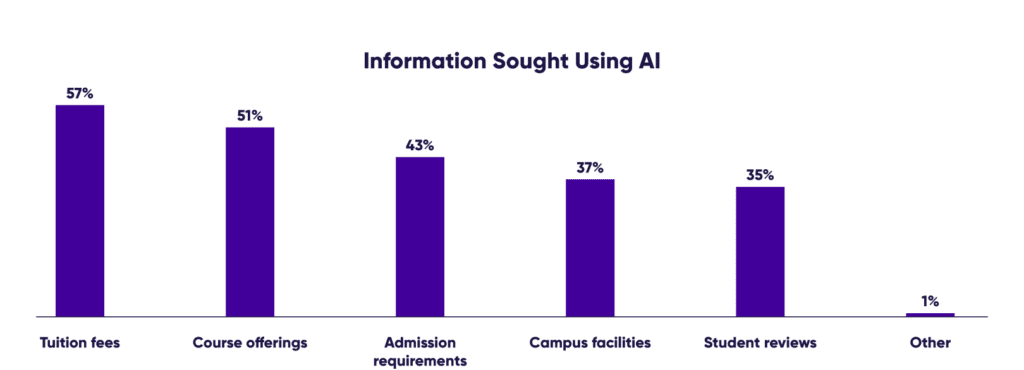
Moreover, students increasingly turn to AI tools like Search Generative Experience (SGE) for answers to critical questions about schools and their offerings, with 37% of Modern Learners using AI for information gathering. As students refine their consideration sets, AI-driven engagement tools provide timely and relevant information, making them a key touchpoint in the decision-making process. The growing reliance on these platforms calls for institutions to employ the use of informative and accessible AI tools to offer students seamless support throughout their research and decision-making processes.
Preference and Acceptance of Online Modality has Increased
It’s no secret that in the past decade, online education has not only gained traction but has become the preferred education modality for a growing population of students. In 2015, only 32% of fully online students believed their online education was better than their previous classroom study. However, that number has more than doubled for today’s respondents. 71% of online learners express a preference for online higher education experiences when compared to classroom education, indicating a fundamental change in student expectations and satisfaction with digital learning environments.
Engaging the Modern Learner
At EducationDynamics, our research continually seeks to understand the evolving needs of students. Through years of research and emerging insights from our 2025 survey, a clear picture of the Modern Learner has emerged—one defined by a focus on flexibility, career, and a desire for personalized education experiences. Modern Learners are not only looking to complete a degree, they also aim to shape their own learning journeys in ways that align with their personal and professional goals.
Shared Demands and Preferences
Despite their diverse backgrounds, Modern Learners share several key expectations. They prioritize affordability, flexible learning formats and responsive support. If their needs aren’t met, they will quickly seek alternative options. This shift in expectations means that institutions need to rethink how they attract, engage and support students. Meeting the Modern Learner where they are is no longer optional; it is essential for long-term success.
The Power of Brand & Reputation
A strong institutional brand plays a crucial role in the student decision-making process. As students begin their search with a school-focused mindset, a well-established reputation can be the deciding factor in where they apply. In fact, reputation ranked as the third most influential factor in application decisions, cited by 31% of students overall and 51% of traditional undergraduates, in our 2025 survey. To remain competitive, institutions must build a credible and respected brand that not only attracts prospective students but also reinforces trust and long-term value throughout their educational journey.
Value and Affordability
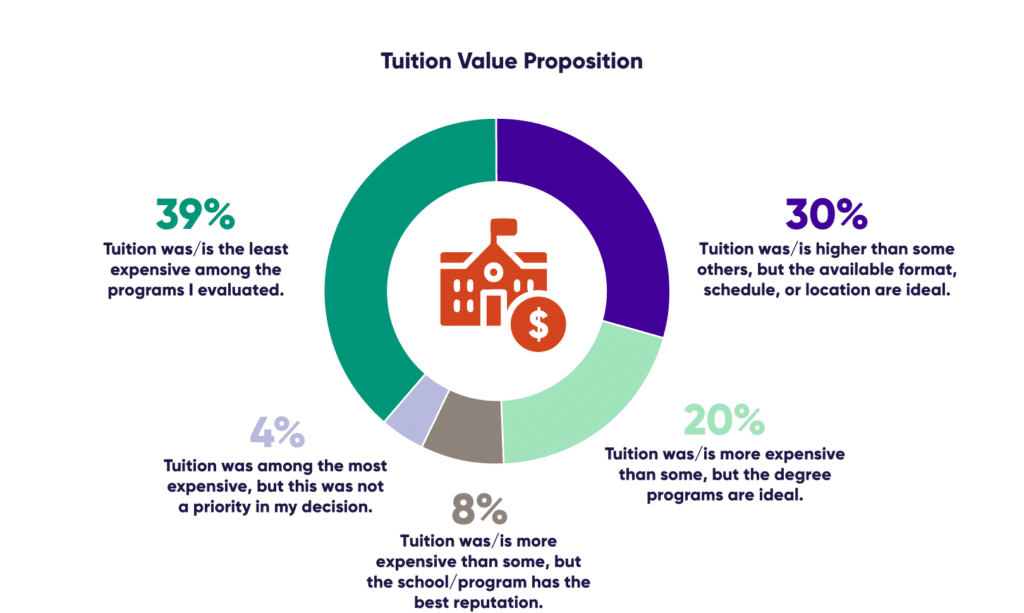
While cost is a significant consideration for Modern Learners, affordability alone doesn’t drive enrollment decisions. A well-rounded value proposition plays an equally important role. Our research shows that 46% of students cite tuition cost as a critical factor, but other factors like program relevance to careers, flexibility, and reputation also weigh heavily in their decision-making process.
Supporting students with financial literacy is crucial, as 38% of students identify it as a helpful resource during the enrollment process. By clearly communicating both affordability and long-term value such as career outcomes, program flexibility and personalized support, schools can resonate with the priorities of cost-conscious, value-driven Modern Learners.
The Importance of Career Focus
For Modern Learners, education is a direct pathway to career advancement. Regardless of age or background, they share a strong motivation to upskill quickly and gain credentials that lead to tangible career outcomes. This focus on career alignment is evident, with 20% of Modern Learners citing a program’s relevance to their career as a determining factor in their enrollment decision.
The Modern Learner Survey reveals that 76% of students feel their institution clearly outlines potential career paths related to their program. While this is positive, gaps remain. Traditional undergraduates are the most informed, with 84% receiving clear career guidance, compared to 73% of non-traditional students and 77% of graduate students. These gaps highlight the need for institutions to consistently communicate career values across all Modern Learner segments, ensuring they understand how their education supports their professional goals.
The Demand for Flexible Learning Models
Flexibility is no longer an educational preference; it is a necessity for Modern Learners. As today’s students move away from traditional classroom modalities and increasingly seek flexible environments, institutions must invest in program models that accommodate careers and family commitments.
When deciding where to apply, 31% of Modern Learners cited flexible course schedules as a key factor. This need is particularly evident among graduate students, who are more likely to be balancing family and work responsibilities. While 53% of respondents do not have children under 18 at home, a notable portion are managing family commitments in addition to their studies. Among fully online students, the number of children at home has increased by 15%, reinforcing the growing demand for learning models that complement busy schedules.
The Role of AI and Social Media
AI and social media play an increasingly important role in shaping student decisions. Social media is no longer merely an avenue for entertainment; it has evolved into a tool for student engagement and research throughout the entire decision-making process. With students interacting across multiple platforms daily, schools must harness these channels to stay visible and relevant as students progress through the consideration phase. To successfully leverage social media, marketing teams should prioritize creating dynamic, visually engaging experiences, particularly through video content, which resonates strongly with Modern Learners.
At the same time, AI enhances this by personalizing interactions and providing real-time insights into student preferences, helping institutions refine their marketing strategies. With the rise of generative AI tools, nearly 70% of Modern Learners now use AI in some capacity, including AI chatbots like ChatGPT, to assist their search for school information. Approximately 37% use these tools specifically to gather information about schools, with tuition fees (57%), course offerings (51%), and admission requirements (43%) being the most sought-after details. This highlights the opportunity for schools to integrate AI into their marketing strategies to provide comprehensive, accessible information that supports prospective students with their enrollment decision.
Modern Strategies to Engage the Modern Learner
As the needs and expectations of students continue to evolve, it’s important for institutions to adapt in ways that truly serve and support Modern Learners. Here are actionable steps to create a personalized, student-centered experience that fosters trust and drives success.
Embrace Data-Driven Decision Making: Modern Learners expect personalized experiences, and data is the key to delivering them. Through leveraging market research and insights, like those from the 2025 Modern Learner Report, institutions can better understand student preferences and behaviors. To turn those insights into action, invest in tools for data collection and analysis that allow for continuous improvement and refinement.
Build a Strong and Authentic Brand: A cohesive and authentic brand is integral to connecting with students. Focus on building a positive online experience that bolsters brand visibility, while garnering trust that your institution can provide timely and reliable information that students seek.
Prioritize Career Outcomes: Career outcomes are top of mind for students as they consider their educational investment. Make career pathways clear by showcasing programs, internship opportunities, alumni success stories and career counseling services to help students see the tangible benefits of their degree.
Create Flexible and Personalized Learning Pathways: Flexibility is essential for meeting the diverse needs of Modern Learners. Offer programs with adaptable schedules and learning formats, allowing students to choose a pathway that best aligns their lifestyle and goals.
Optimize the Digital Experience (Especially Websites and Al): An engaging digital experience is critical to attracting and retaining students. Through regular website updates and the integration of AI-powered tools to offer support, institutions can streamline the user experience to ensure a smooth journey from inquiry to enrollment.
Enhance Communication Speed: Modern Learners expect timely and informative responses and are quicker to make decisions than in years past. Adopt tools that provide real-time communication capabilities, such as chatbots or automated updates, to keep students engaged and informed throughout the enrollment process.
Develop a Dynamic Social Media Strategy: Social media is a powerful tool for building connections and increasing brand awareness among Modern Learners. With platforms like Instagram, TikTok, and YouTube playing a major role in their online engagement, video content is especially effective in capturing their attention. By understanding your audience’s media habits and aligning your content with platforms they use the most, you can deliver the right message at the right time, keeping your institution top of mind.
Don’t Forget About the Human Touch: While technology undoubtedly plays a significant role in modern times, students still seek personal connections. Ensure that students can engage with advisors, staff, or faculty to guide them through the enrollment process, while providing the support they need.
Aligning with Modern Learners: A New Era in Enrollment
In this evolving landscape, Modern Learners are placing greater emphasis on career relevance, affordability, and flexibility, demanding more from their education than ever before. The findings from the Modern Learner Survey underscore the importance of aligning educational programs with career paths, improving financial transparency, and providing tailored support to meet diverse needs. The time is now for higher education leaders to challenge outdated enrollment strategies that no longer resonate with today’s highly discerning, cost-conscious, and value-focused students.
To navigate these changes effectively, institutions must adopt innovative, data-driven strategies that speak directly to the Modern Learner’s priorities. For a deeper dive into these insights and actionable recommendations, explore the full “Engaging the Modern Learner” report today.
Since the adjustments to the Office for Students’ (OfS) Condition B3: Student outcomes, published continuation rates have dropped from 91.1% in 2022 to 89.5% in 2024 for full-time students on their first degree.
This drop is most evident for students in four key areas: (1) foundation year courses; (2) sub-contracted and franchised courses; (3) those with lower or unknown qualifications on entry; and (4) those studying particular subjects including Business and Management, and Computing.
Universities utilising student engagement analytics are bucking this downward trend. Yet, surprisingly, engagement analytics are not mentioned in either the evaluation report or the accompanying Theory of Change document.
Ignoring the impact of analytics is a mistake: universities with real-time actionable information on student engagement can effectively target those areas where risks to continuation are evident – whether at the programme or cohort level, or defined by protected characteristics or risks to equality of opportunity.
The [engagement analytics] data you see today is next year’s continuation data.
Dr Caroline Reid, former Associate Dean at the University of Bedfordshire
A more complete view of student learning
The digital footprints generated by students offer deep insights into their learning behaviours, enabling early interventions that maximise the opportunity for students to access the right support before any issues escalate. While data can never explain why a student is disengaging from their learning, it provides the starting point for a supportive outreach conversation. What happens thereafter would depend on what the conversation revealed – what kind of intervention would be most appropriate for the student? Examples include academic skills development, health and wellbeing support or financial help. The precise nature of the intervention would depend on the ecosystem of (typically) the professional services success and support expertise available within each institution.
Analysing engagement activity at the cohort level, alongside the consequent demand on student services teams, further enables universities to design cohort or institution-wide interventions to target increasingly stretched resources where and when they are needed most.
[With engagement analytics we have] a holistic view of student engagement … We have moved away from attendance at teaching as the sole measure of engagement and now take a broader view to enable us to target support and interventions.
Richard Stock, Academic Registrar, University of Essex
In 2018–19, 88% of students at the University of Essex identified as having low engagement at week six went on to withdraw by the end of the academic year. By 2021–22, this had reduced to approximately 20%. Staff reported more streamlined referral processes and effective targeted support thanks to engagement data.
Bucking the trend at Keele
The OfS continuation dashboard shows that the Integrated Foundation Year at Keele University sits 8% above the 80% threshold. Director of the Keele Foundation Year, Simon Rimmington, puts this down to how they are using student engagement data to support student success through early identification of risk.
The enhanced data analysis undertaken by Simon and colleagues demonstrates the importance of working with students to build the right kind of academically purposeful behaviours in those first few weeks at university.
Withdrawal rates decreased from 21% to 9% for new students in 2023–24.
The success rate of students repeating a year has improved by nearly 10%.
Empowering staff and students with better engagement insights has fostered a more supportive and proactive learning environment.
Moreover, by identifying students at risk of non-continuation, Keele has protected over £100K in fee income in their foundation year alone, which has been reinvested in student support services.
Teesside University, Nottingham Trent University (NTU) and the University of the West of England (UWE) all referred explicitly to engagement analytics in their successful provider statements for TEF 2023.
The Panel Statements for all three institutions identified the ‘very high rates of continuation’ as a ‘very high quality’ feature of their submissions.
Teesside’s learning environment was rated ‘outstanding’, based on their use of ‘a learner analytics system to make informed improvements’.
NTU cited learning analytics as the enabler for providing targeted support to students, with reduced withdrawals due to the resulting interventions.
UWE included ‘taking actions … to improve continuation and completion rates by proactively using learning analytics’ to evidence their approach.
The OfS continuation dashboard backs up these claims. Table 1 highlights data for areas of concern identified by the OfS. Other areas flagged as key drivers for HEIs are also included. There is no data on entry qualifications. All figures where data is available, apart from one[1], are significantly above the 80% threshold.
Table 1: Selected continuation figures (%) for OfS-identified areas of concern (taught, full-time first degree 2018–19 to 2021–22 entrants)
The Tees Valley is the second most deprived of 38 English Local Enterprise Partnership areas, with a high proportion of localities among the 10% most deprived nationally. The need to support student success within this context has strongly informed Teesside University’s Access and Participation Plan.
Engagement analytics, central to their data-led approach, ‘increases the visibility of students who need additional support with key staff members and facilitates seamless referrals and monitoring of individual student cases.’ Engagement data insights are integral to supporting students ‘on the cusp of academic failure or those with additional barriers to learning’.
The NTU student caller team reaches out to students identified by its engagement dashboard as being at risk. They acknowledge that the intervention isn’t a panacea, but the check-in calls are appreciated by most students.
Despite everything happening in the world, I wasn’t forgotten about or abandoned by the University. NTU student
By starting with the highest risk categories, NTU has been able to focus on those most likely to benefit from additional support. And even false positives are no bad thing – better to have contact and not need it, than need it and not have it.
What can we learn from these examples?
Continuation rates are under threat across the sector resulting from a combination of missed or disrupted learning through Covid, followed by a cost-of-living crisis necessitating the prioritisation of work over study.
In this messy world, data helps universities – equally challenged by rising costs and a fall in fee income – build good practice around student success activity that supports retention and continuation. These universities can take targeted action, whether individually, at cohort level or in terms of resource allocation, because they know what their real-time engagement data is showing.
All universities cited in this blog are users of the StREAM student engagement analytics platform available from Kortext. Find out more about how your university can use StREAM to support improvements in continuation.
[1] The Teesside University Integrated Foundation Year performs above the OfS-defined institutional benchmark value of 78.9%.
In undergraduate classrooms, instructors encounter a variety of students with diverse backgrounds and different personalities. Since discussion-based learning, both in-person and virtual, remains important, teachers should find ways to encourage student engagement in classroom activities and discussions. Student engagement is also critical to the success of students who are more self-directed and specialized, as it allows them to dive deeper into course material within their specialized areas of interest.
When more students are engaged, class conversations become richer, enhancing student learning. For instance, introverted students may have strong opinions and much to contribute but may hesitate to share during class. Students, whether introverted or not, might feel uncomfortable or uninterested in joining group discussions for various reasons. It is the instructor’s challenge to create a comfortable class environment. Not only will students benefit, but instructors can feel more at ease in their own classrooms.
Genuine connections between students are based on trust, which can be encouraged in several ways. Trust-building connections are fostered in an environment with instructor presence and constructive feedback. Students benefit from instructor buy-in, effort, and intention.
To boost classroom interaction and active participation, instructors can include proven strategies in their “teaching toolkit” to foster empathetic connections among their students. Here are some suggestions for your consideration:
Outline course guidelines clearly. Students need to understand what is expected of them in your course. If class participation standards are set from the beginning—with appropriate explanations regarding “why”—student buy-in should increase. After students understand course expectations, instructors should make every effort to give students timely and constructive feedback. Doing so keeps students accountable and reinforces the course guidelines.
Model reflective listening. When students participate in a class discussion, instructors should make eye contact, give full attention, and provide visual cues to show understanding. Taking a moment to paraphrase or ask clarifying questions shows engagement and listening on the instructor’s part.
Encourage reflective listening. Help reduce distractions when students speak. Invite students to validate each other’s responses. Brief instructor participation when students are having group discussions and modeling behavior you seek to encourage can go a long way.
Praise appropriately. Offer brief, genuine praise when students reflectively listen to each other and provide gentle reminders when appropriate.
Creatively introduce group discussions. Mix things up. Consider having students draw questions from a hat for discussion or assign a different group member to lead the discussion for each question. You may wish to time discussions or set goals so student groups stay focused and on task.
Use a variety of classroom activities, but don’t overdo it. Include a group discussion or short activity during every class period. Recognize that classroom activities are like seasoning on food—a little is great, but too much can be overwhelming. Classroom activities should drive home the purpose of the course material being covered. In-class activities can break up what may be perceived as monotony by students.
Encourage students to interact with new classmates. Student groups should rotate frequently to ensure that everyone has the opportunity to interact with different individuals. You may wish to randomly assign groups to mix students up.
Invite alternative views. Be sensitive to different perspectives and alternate points of view. Help students recognize that conflicts can be resolved without contention. Students don’t have to agree on a particular topic or point of view, but they do need to show respect to others. To help students and teachers better understand the importance of respecting different perspectives, share a mantra with your students, such as: “Seek to understand before seeking to be understood” to emphasize the value of listening and understanding others’ viewpoints before expressing one’s own views to foster a more respectful and open-minded classroom environment.
Use peer feedback grading. Learning to give constructive feedback is a skill students can learn with practice. Prompting from the instructor can go a long way when it comes to feedback. Making suggestions such as having students include pros and cons or commenting only on things that are in the student’s control may be helpful.
Share stories. Who doesn’t enjoy an interesting and relevant story? Stories help students remember information in a fun way. Collect stories that illustrate key principles and important points you’re trying to teach. Stories are relatable and can put listeners at ease.
Encourage students to share their own stories. Classrooms consist of diverse individuals with a multitude of different stories and perspectives. Sharing stories is an excellent way for students to learn more about the worldviews of others.
Use appropriate humor. Laughter creates connection. Including tasteful humor in activities and discussions can improve student buy-in and retention. An easy place to start could be to include a joke or riddle-of-the-week for your class to contemplate.
Invite student feedback. Make course consistency and fairness a priority. Students need to feel they are valuable and their opinions matter. After receiving excellent feedback, instructors should seriously consider making appropriate changes.
Recognize that potential pitfalls can also accompany increased student engagement. Classroom challenges may include:
Uneven participation or nonparticipation. Some students may attempt to dominate activities and discussions. In any group, some individuals will always be more talkative while others will be quieter.
Inconsistent results. No two student groups are ever the same. What works in one class may fail spectacularly in another. Stay flexible and be ready to move on if something isn’t working.
Time management. Activities may take longer than anticipated, so be conscious of the clock. Setting a timer can be helpful to keep everyone on task.
Student conflicts. Disagreements can lead to conflict, so it’s important to foster a culture of classroom respect to minimize conflict and prevent personal attacks.
Overwhelmed introverts. Some students may feel uncomfortable speaking and participating in group activities, but be patient and gently encourage their involvement.
Increased preparation time. Successful activities often need advance planning and materials, so keeping a list of activity and discussion ideas can help avoid last-minute scrambling.
While practice doesn’t necessarily make perfect, expect to have some less-than-perfect experiences as you adjust your teaching style to incorporate some of these techniques. Keep what works—jettison the rest. With forethought and practice, you can make your classrooms more open and inviting to your students.
Dr. Allie Hamstead DC is an Assistant Professor of Clinical Sciences at Sherman College of Chiropractic. She specializes in perinatal and pediatric care. She graduated from the University of South Carolina in 2007 and Sherman College in 2012. She is a practicing chiropractor in Simpsonville, South Carolina and mother to four daughters.
Kenneth L. Alford is a professor of Church History and Doctrine at Brigham Young University and a Colonel, U.S. Army (Retired). He has authored/edited 13 books and over 200 articles.
More than half of science teachers believe the most important value of science education is how it contributes to students’ curiosity, critical thinking, and creativity, according to a new report from LEGO Education. But are today’s students truly engaging with science education?
LEGO Education’s State of Classroom Engagement Report: Science Edition surveyed more than 6,000 global teachers, parents, students, and U.S. administrators to gather data that can offer insight to support educators as they strive to engage their students in science learning.
Science learning builds life skills students will use even if they do not pursue the science in college or as a career. It also increases student engagement and well-being, but here’s the catch: Students have to feel connected to the material in order to build these skills.
Just over half of global science teachers say their students are engaged in science, which points to a critical need to boost engagement in the subject, according to the report. Interestingly, students say they are more engaged in science than they are in school overall. Only one-third of teachers worldwide indicate that their students are engaged in the classroom. Schools could leverage students’ interest in science to build schoolwide engagement–a key factor tied to student well-being.
When students aren’t engaged in science, what’s behind that lack of engagement? Often, they’re intimidated before they even learn the material, and they assume the topics are too challenging. Students lose confidence before they even try. Of students who say science is their least-favorite topic, 45 percent say science is too hard and 37 percent say they are bad at science. What’s more, 77 percent of global teachers say they believe students struggle because of complex concepts and curricula, and they’re searching for for impactful resources that support every student’s success.
“If students think they’re not good at the subject or avoid it, we risk losing an entire generation of innovators and problem solvers,” said Victor Saeijs, president of LEGO Education, in the report.
How can educators reach students who struggle to engage with science? Hands-on science learning is the key to piquing student curiosity, prompting them to engage with learning material and build confidence as they explore science concepts. Sixty-two percent of science teachers say hands-on activities drive student engagement in science. Seventy-five percent of science teachers who do incorporate hands-on activities believe this approach leads to higher test scores and grades.
More students need access to hands-on science learning. Only 55 percent of students say they regularly get hands-on experiences–these experiences usually require extra time and resources to plan and execute. Eighty-two percent of science teachers say they need more ways to teach science with play and hands-on methods.
Having access to hands-on science learning experiences increases students’ confidence, giving them the boost they often need to tackle increasingly tough-to-learn concepts:
73 percent of students with access to hands-on learning opportunities report feeling confident in science
Just 52 percent of students who do not have access to hands-on learning report feeling confident in science
Hands-on experiences in science drive:
Learning outcomes: 71 percent of science teachers who incorporate hands-on, playful learning believe the methodology supports higher test scores and grades
Engagement for all learners: 84 percent of U.S. teachers and 87 percent of administrators think that hands-on experiences help all types of learners engage with science concepts
Love of science: 63 percent of students who love science credit their passion to regular hands-on experiences
Confidence: 79 percent of students who have hands-on science experiences are confident in the subject
Administrators and science teachers are short on time and need hands-on tools and resources to quickly engage students in learning:
59 percent of U.S. administrators and 54 percent of science teachers say they need more tools to engage students in science
Nearly one-third of U.S. students do not get hands-on science experiences.
Laura Ascione is the Editorial Director at eSchool Media. She is a graduate of the University of Maryland’s prestigious Philip Merrill College of Journalism.
Most of us have the experience of registering for a workshop only to discover that it is a lecture or (worse) an advertisement for the presenter. A genuine workshop aims to empower the participants such that they leave with new ideas and skills.
What follows are some suggested principles we have prepared for workshop facilitators that move beyond a “talkfest” to genuine learning.
Principle 1: Come early and “own” the learning space.
You need to give plenty of time to ensuring the room is arranged to facilitate quality discussion and learning. Make sure that all the technology is working. Greet people as they enter to let them know they are valued and welcome.
Principle 2: A workshop is not a lecture.
The word “workshop” implies that work will be done by the participants. This means the center of attention should be on the students doing work, not on the expert talking about their expertise. Many experts are bad at teaching workshops because they are used to lecturing. A lecture has the spotlight on the speaker, but a workshop has the spotlight on the students. Instead of crafting a message for people to listen to, a good workshop is designed to maximize participant engagement and give the participants the opportunity for guided instruction in doing things. Many workshops are born from lectures, which explains why those workshops are so ineffective and boring.
Principle 3: Small group work is ideal.
Good workshops involve discussion, and discussion is most fruitful in groups of 3-4 members. In smaller groups, every person has the opportunity to express an opinion, and it is far more difficult to remain silent and uninvolved. In groups of five or more, certain individuals will tend to monopolize the discussion, and it is possible for one or more members to remain uninvolved observers. Remember that the two keys to effective learning are involvement and application. Participants are more likely to become involved in a smaller group than in a larger group.
Principle 4: Think in units of three:
Explain: Walk the participants through a relatively small piece of information or skill, perhaps (as relevant) providing a model or example that participants can build from.
Exercise: Have everyone try to do that thing (while you wander around and help people one on one).
Debrief: Discuss the results of the experience: where people got stuck, and what things people learned, or realized they want to learn.
Principle 5: Less is More.
Don’t try to “cover the content”. Address one or two key issues and give time for participants to wrestle with a smaller amount of content but at a deeper level. The result is likely to be more profound and deep in learning.
Principle 6: Keep in mind that discussion takes time.
If you break the class into smaller groups, set a time limit and remind them about halfway through, to ensure that everyone has an opportunity to participate. This gives the group permission to ask anyone who is monopolizing the conversation to finish so that others may have a turn. As teacher/facilitator you should move around the groups, ensuring that they have understood the questions and are progressing through them at an appropriate pace. Your presence will communicate interest and concern, and greatly motivate the students to stay on task and engage with the material.
Principle 7: Carefully design discussion questions in advance.
The best questions need crafting and design. Ensure that every question is divergent and open. Seek to connect not only with the mind but with attitudes and actions.
Principle 8: Stay out of the center.
Participants are coming to learn, and they generally learn from others as much as they do from you. As a general rule you should not talk for more than 5-10 minutes before having the participants reflect and engage. In total the participants should be doing at least half the talking – and more. Facilitation is the name of the game.
Principle 9: Closure is important.
A time of reporting is valuable, but it needs five to ten minutes following the small-group work, and the class structure needs to be planned accordingly. It is generally best not to take extensive responses from each group, as this can become boring and counterproductive. A very effective procedure is to ask each group to contribute its single most important insight. Each insight should be a new contribution to the class reflections rather than the same repetitive information. Only when every group has had an opportunity to share one or two ideas do you solicit additional responses. Sharp and short reporting can give an almost electric dynamism to the feedback process.
Principle 10: Plan to be available after the workshop.
Oftentimes the most significant learning is one-on-one between you and a participant.
Perry Shaw EdD is honorary research associate at Morling College, Australia, and author of Transforming Theological Education.
Orbelina Eguizabal E. PhD is Professor of Christian Higher Education, PhD and EdD Programs in Educational Studies, Talbot School of Theology, Biola University.