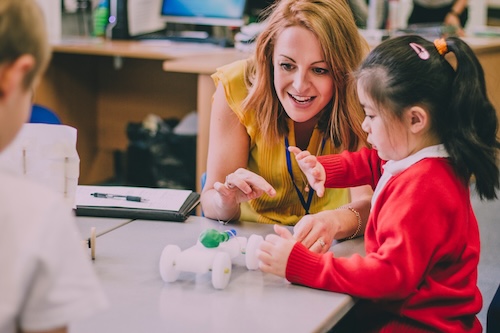
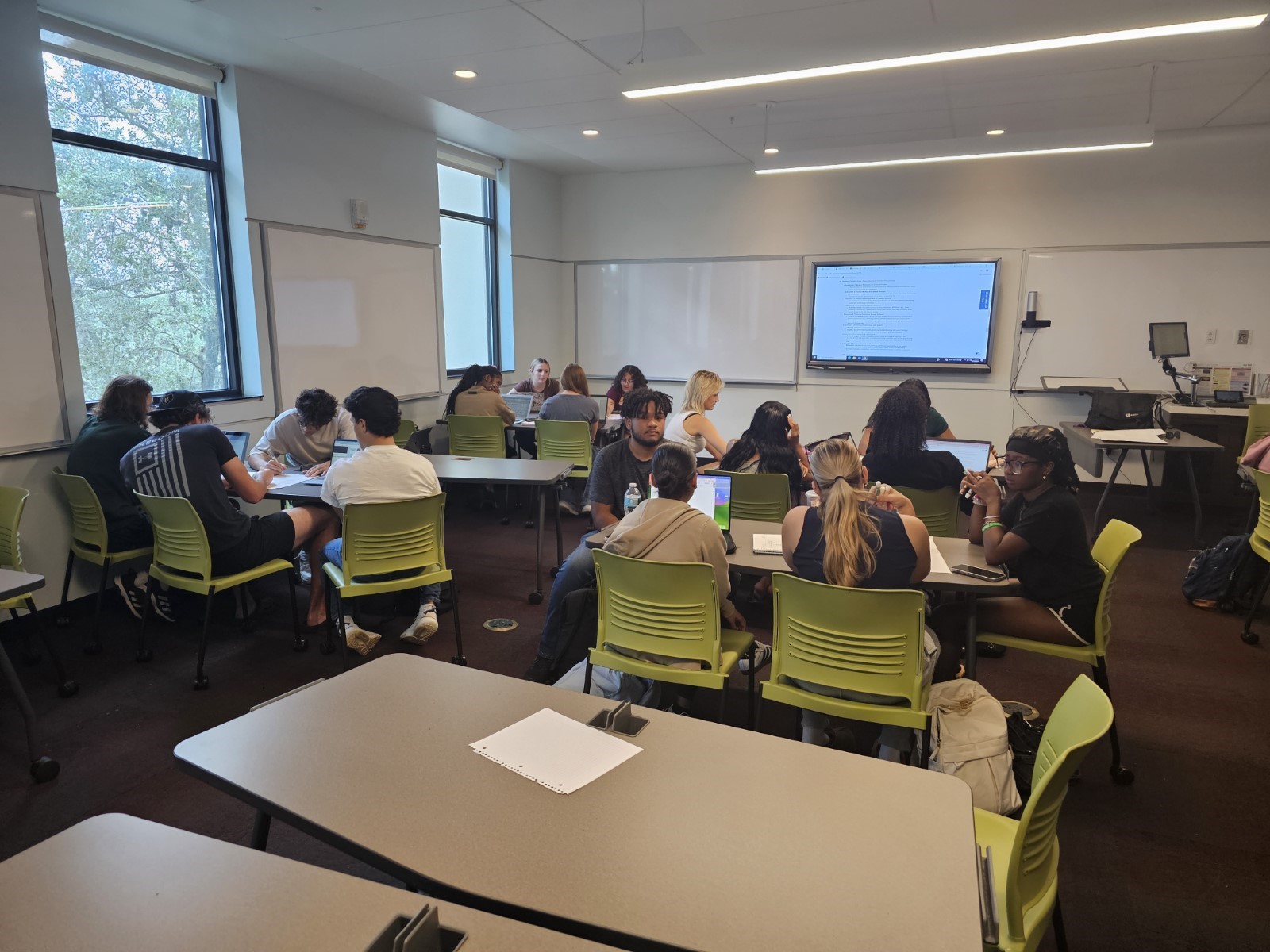
New elementary teachers who promote equity in science are proving highly effective at engaging students, no matter their background, a new University of Michigan study shows.
U-M researchers found that new educators are pioneering paths in science education by offering opportunities for scientific conversations, innovative learning strategies and encouraging children to become active participants in scientific exploration.
“When teachers are equipped to foster a more equitable and just learning environment in science, it not only enhances children’s understanding of scientific concepts but also empowers them to see themselves as scientists and to use science to address real-world issues that matter in their communities,” said Elizabeth Davis, a professor at U-M’s Marsal Family School of Education.
“Beginning teachers use a range of effective strategies to work toward more equitable science teaching. They vary in their emphasis on opportunity and access, representation and identification, expanding what counts as science and engaging children as change-makers using science to support a better world. This variation highlights the multiplicity of entry points into this challenging work and shows these teachers’ many strengths.”
The study, published in the General Proceedings of the 5th Annual Meeting of the International Society for the Learning Sciences 2025, also identified areas for growth: These teachers were less consistently likely to work to broaden what counts as science and to link science to social justice.
Davis and co-authors Jessica Bautista and Victoria Pérez Nifoussi said the study helps understand how different approaches to equity in science education can work together, potentially influencing future teacher training for improved K-12 science learning.
They emphasized the clear need for teacher educators and curriculum developers to provide more concrete examples and resources to help future teachers navigate complex, justice-oriented approaches to science.
“All children deserve to experience the joy and wonder of the natural world, yet science is taught far less often than language arts or math in elementary schools,” Davis said. “Furthermore, many students are marginalized in science, including girls, students of color, children with learning differences and queer or gender nonconforming children.”
Funding challenges impact long-term research
The study is part of the U-M ASSETS research, a four-year longitudinal project that began in September 2023. Although it was intended to run for four years, the project, funded by the National Science Foundation, was terminated in its 20th month, just shy of two years from its start.
“The termination of these NSF projects–focused on STEM education, and in particular equity in STEM education–is going to adversely affect science education and science for generations to come,” Davis said.
“We are seeking additional funds for this work. Regardless, we will continue to support the teachers who participate in this project and we’ll continue to collect and analyze data to the extent we’re able to do so.”
The team is now working on characterizing the participants’ first year of teaching to assess how their approaches to equitable and just elementary science teaching align with and differ from their approaches during teacher education.
Fernanda Pires, a Brazilian native, is a Lead Public Relations Representative at Michigan News, who covers the School of Education, student learning, coordinates media training and works with international communication. She holds a Master degree in Journalism/Broadcasting from Michigan State University and has more than 20 years of experience in communications. In Brazil, she worked for about 10 years as a broadcast reporter at Brazil’s national TV Globo and as a writer for the daily newspaper Correio Popular, in one of the largest cities in São Paulo State. She also worked as a public relations/corporate communications specialist for Brahma Brewing and Tilibra, the country’s leading manufacturer of school, office and time management stationery products.ᐧ
Latest posts by eSchool Media Contributors (see all)
During the height of the COVID-19 outbreak, teachers needed to become resourceful in how they delivered content to students. During this time, students experienced significant change and evolved into a more technologically-dependent group.
This sparked a period when online learning and digital resources gained substantial popularity, and one tool that helps students learn–while also feeling like a game instead of a lesson–is Gimkit.
I am an 8th-grade science teacher in a fairly large district, and I recognize the importance of these engaging and interactive resources to help students build knowledge and continue learning.
What is Gimkit?
To begin with, what is Gimkit? According to a tutorial, “Gimkit is an excellent game-based learning platform that combines fun and education, making it a highly engaging tool for both teachers and students. It works like a mashup of Kahoot and flash card platforms, but with several unique features that set it apart.
“Unlike other platforms, Gimkit allows students to earn virtual currency for every correct answer, which they can use to purchase power-ups, adding a competitive edge that keeps students motivated.”
Gimkit offers so much more than just a game-based learning experience for students–it can be used as an introduction to a lesson, as assigned homework, or as a tool for reviewing.
Building a Gimkit
From the teacher’s side of Gimkit, the platform makes it extremely easy to build lessons for the students to use. When you go to create a lesson, you are given many different options to help with the construction.
Jamie Keet explains: “After establishing your basic Kit information, you will then move onto the fun part–adding your questions! You will be given the option of adding a question, creating your Kit with Flashcards, continuing with KitCollab, adding from Gimkit’s Question Bank, or importing from Spreadsheet.”
Adding your questions is a great way to make sure your students are getting the exact information they have been provided in class, but some of the other options can help with a teacher’s time, which always seems to be scarce.
The option to add questions from the question bank allows teachers to view other created kits similar to their topic. With a few simple clicks, a teacher can add questions that meet the needs of their lesson.
Gimkit as data collection
Gimkit isn’t just a tool for students to gain knowledge and play games; it is also an excellent way for teachers to collect data on their students. As Amelia Bree observes:
“Gimkit reports explained show you both big pictures and small details. The look might change sometimes. But you will usually see:
Overall Class Performance: This shows the average right answers. It tells you the total questions answered. It also shows how long the game took. It’s a good first look at how everyone understood.
Individual Student Results: Click on each student’s name here. You see their personal game path. Their accuracy. Which questions did they get right or wrong? Sometimes, even how fast they answered.
Question Breakdown: This part is very powerful. It shows how everyone did on each question you asked. You see how many got it right. How many missed it? Sometimes, it shows common wrong answers for multiple-choice questions.”
Being able to see this data can help ensure that your students are not just completing the required steps to finish the task, but are also working towards mastering the materials within your class.
When examining the data, if you identify trends related to specific questions or concepts that students are struggling with, you have the opportunity to revisit and reteach these areas.
Conclusion
As you can see, Gimkit isn’t just a tool for students to play games and have fun in class; it is also an opportunity for students to gain knowledge in your lessons while potentially having some fun in the process. Teachers can make creating content for their classes much easier by utilizing some of the built-in features Gimkit provides.
They can collect the meaningful data needed to ensure students are making progress in the areas where they want them to.
School and other learning environments are often a safe place for students who have difficult home lives.
I know, I was one of those students. I take that knowledge into every classroom that I enter, and my understanding of student engagement and student experience are woven into my pedagogy of care and teaching to transgress.
I cannot, (and do not wish to!) separate my lived experience from my teaching. As someone who dropped out of the university that I now work at, I do have an interesting insight into building community and belonging into the curriculum.
As I wrote here with Lisa Anderson, we require a radical shift in how we consider the needs of students. I want every student in my classroom to experience it as a safe and welcoming space.
These are not buzzwords or trends, it is how I ensure that students are able to learn – I want them to be in the room. Teaching is a relational activity that requires commitment, experience, honing our craft and being willing to adapt.
The university sector is not in a good place, and as committed as I am to my research, it is teaching that brings me joy and new ideas every single time I enter the classroom. When we teach to transgress, it is for us as much as it is for the students.
The classroom reminds me of what is possible. Engaging strongly with the literature of the UK’s leading emergency and disaster planner, Lucy Easthope, I recognise the education will be impacted forever by the pandemic, and I want to play my part in the recovery.
Crime, justice and the sex industry
I lead the largest optional final year module in my department, with 215 registered students, based on my 23 years’ experience of the sex industry. It was a community of care that got me here, with colleagues from around the country (and globe!) sharing material and ideas with me when I launched this module in 2020. Collaboration and teaching go hand-in-hand and we must allow time for this.
The module is underpinned by my nonlinear pedagogy which I write about here. The design empowers students to have control over the direction and pace of their learning. All content is uploaded to our virtual learning environment Canvas in week one. There are weekly recorded lecture summaries, and 2-hour weekly workshops.
The content also includes a comprehensive library reading list, weekly reading folders, watch folder and collaborative tools.
This year the module is celebrating its fifth birthday and the student engagement is better than ever before. Here are some things that I have learned and that I am reflecting on.
A welcoming classroom and learning names
Where possible, I always enter the classroom ten minutes before class begins (this is definitely not always possible in a large and busy campus with extreme demands on estates and our time) to provide a prepared and calm setting for students to arrive. This is also helpful for me as a neurodiverse teacher.
I like to greet students as they arrive, and learn names wherever possible (photo class lists are your friend).This sets the tone for our warm and welcoming teaching community. It demonstrates the way in which we will invite peers to contribute and talk through the content. It may seem a small thing, but it makes a huge difference to teaching and learning.
Front-loaded prep
As a dyslexic I need to be prepared. This is a large module, and a busy teaching load. I spend the weeks before semester begins frontloading my prep so that I am ready to go. This involved re-recording the summary E lectures, updating workshop materials, sheets, reading folders, module guides, etc.
Visitors to my office are surprised to see a row of 12 piles along the floor- with each week’s content printed out, highlighted, and ready to go. I am always very grateful once semester starts that I took the time to do this. It creates a calm tone to classes that students explicitly comment on.
Lesson plans
This year I went old-school in multiple ways, including buying a hardback lesson planner, in which I mapped out the learning objectives for every workshop – mapping against learning outcomes for the module.
Physically mapping these out, with prompts, links to the readings and case studies, was something that students positively picked up on. This also ensured adaptability and that I was reflecting upon and updating my material. Students need calm and expert guidance; experienced teachers are key.
Workbooks
Acting on student feedback from the previous year, I designed a workbook that students can print out or use digitally. Students always make a lot of notes on this module, and the workbook helps them with organising those thoughts. In class, I was very pleased to see rows of pink workbooks looking back at me.
The workbook also includes space for questions, and learners can bring this to my student support hours. I have been learning a lot from school teachers, and recognising how much extra structure students need post-pandemic.
Learning through tempo
I made an active decision this year to experiment with the tempo of each workshop class, with differences even between some workshop groups. This was in response to student feedback who wanted some slower sessions in order to read in class, and more time to talk with their groups/peers.
This was music to my ears (pun absolutely intended) and it made me reflect on the pace and rhythm of my classes. I am a high-energy teacher and I like to pack a lot into classes, but stripping (pun not intended!) some of this back to create quieter time (for class reading) and slower sessions with more time for groups to talk, has been a game-changer. Students actively requesting some slower workshops so they could read together in class, was amazing to witness. Students reacted overwhelmingly positively to my ability to respond and adapt.
Learning through play
It is interesting in this post-disaster period of the pandemic to witness students enjoying, and requesting, playful activities in class. As I argue here, we need to build community into the curriculum to boost attendance.
Poster paper and felt tip pens might have attracted horrified faces a few years ago and a low uptake, but this year, every single “play” activity that I have offered has been taken up by almost every student. I always offer a range of engagement tools, with non-verbal options such as our collaborative google doc, padlet, and other online tools, and I offer the option for sheets, paper, pens etc.
A welcoming, hospitable classroom where students know they are being considered, pays dividends in engagement and mutual respect. Once students feel safe and able to take risks, no matter how low-stakes, they open up, and engage in difficult and complex debates.
One group activity looked at sexual entertainment venue closures using five different pieces of coloured card to map out key findings from two different journal articles, identify and apply concepts from earlier weeks in the module, examples of venue closures, and examples of campaign group discourse.
A “fun” activity that involves deep critical thinking and the ability to successfully weave together multiple forms of evidence to formulate a convincing argument. I then took a photo of the giant map we all created across the module. Every single student wanted to take part; students are actively seeking community and togetherness within the classroom.
The activity with foam stickers, which I thought students would resist, was the most popular activity of the semester (after the guided walk, below). Through the mechanism of light-hearted play, students successfully navigated a tricky and sensitive topic examining the harms, dangers and exploitation associated with online sex work. We ended up with students stickering their laptops, phones, their workbooks, and themselves! We cannot forget that these are all students of the pandemic, they missed out on so many opportunities to interact with peers. They are embracing every opportunity to connect with each other within timetabled sessions.
Guided walk
Another activity on the module (and the one that students most favourably comment on) is our guided walk of sexual entertainment venues in Liverpool city centre. I provide online material for accessibility purposes recognising that not all students can walk around the city, or may not wish to.
For students who attend, we map out the city in terms of gendered harm and risk, and I give a lecture inside of a sexual entertainment venue that opens exclusively for our class. This brings the Policing and Crime Act 2009 to life, and gives students a unique insight into what the key texts are discussing. It is also very much a community building exercise, with a large proportion of our module cohort in attendance. Learning outside of the classroom is very important for student engagement.
Scaffolding learning
I intentionally choose to layer texts: curating texts of various complexity, using tools such as padlet. Students choose what texts to access based on their own areas of interests and confidence, as they progressively build up skill and academic knowledge of the area. This ensures that the module is accessible to all students, with learners challenged at a point which feels appropriate for them.
It also means that students always have supported content to work with. In week ten, we looked at the media, and we returned to a key text from week eight, to apply three media myths from a journal article to three documentary clips. Using worksheets, the students demonstrated a sophisticated ability to apply a criminological concept to media sources.
Responding to ongoing feedback
Building a rapport with students through modelling a pedagogy of care and inclusion, equips students with the ability to provide feedback throughout the semester. Students appreciate the wealth of resources available from the beginning of semester, but others may feel overwhelmed with choice.
In rapid response to student feedback, I started to provide recommended readings in addition to the large selection. Students appreciated this speedy closing of the feedback loop, and being valued co-producers of the module approach. The student feedback for the module was the best yet.
Accessible assessment as the default position
With growing numbers of students experiencing health issues, it is good practice to think of accessibility as the default position, not an additional bolt-on. I am in favour of different modes of assessment that students can choose from, or developing an assessment that can be approached in different ways. I have written here about my letter assessment, inspired by the work of Katie Tonkiss. Students often feel worried about “academic writing”, and this assessment allows students to use the first person, and to use a more colloquial writing tone if desired. The students develop a nuanced, convincing and influential writing style, with the ability to hold conflicting and competing harms in tension.
Ultimately, it is about remembering that teaching is a huge privilege and blessing. We get to have an impact on so many people and play a part in shaping ideas and innovations of the future. I will never lose the gratitude for getting to do this job and remembering where I come from.
Our charter school, Westbrook Academy, has been serving middle and high school students in the South Los Angeles area for the past six years and stands as a beacon of opportunity for our community. With a student body comprising nearly 99 percent Black and Latinx individuals hailing from historically under-resourced communities, we confront the realities of poverty and the accompanying insecurities head-on.
Despite the odds, our 400 students consistently demonstrate remarkable resilience and a profound capacity for excellence. Our institution is supported by generous donors and funding sources. Operated and managed by the education nonprofit LA Promise Fund, which provides students with academic and enrichment opportunities that support our mission to spark passion, empower leadership, and prepare them for their chosen college and career paths.
At one point, our high school students were learning in a church because we didn’t have a traditional classroom set-up. We also lacked the equipment that a traditional high school might have. This changed when we moved into our forever home in South Gate, where an on-campus Empowerment Center serves as a modern, welcoming “student hub.”
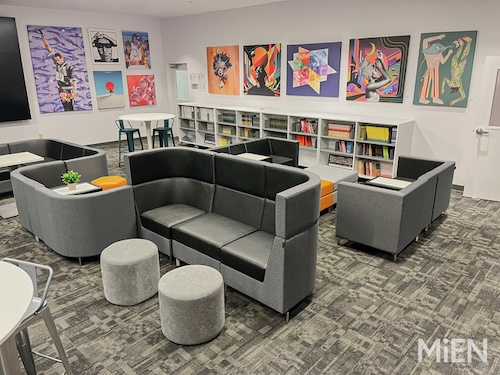
Designed and outfitted by MiEN and Meteor Education, the Empowerment Center is where kids go to hang out, collaborate, and/or participate in school club activities. The hub is also set up with two wellness rooms where students can go to debrief and disconnect from a long day or just the stresses of being a student. It’s there for the students’ use.
Here are the steps we took to create a space that consistently makes jaws drop and impresses parents who never thought their children would have access to such a warm, welcoming communal space on campus:
Add some flexibility into the process. Our original goal was to open the Empowerment Center’s doors in time for the 2023-24 school year, but getting it done the right way would require a bit more time. Our partners were willing to listen to us in terms of what we wanted to create, but within the realistic timelines. That was really cool.
Acknowledge the financial limitations. We largely relied on fundraising for this project and knew that some things just weren’t going to be realistic. To other schools in similar situations, I’d recommend staying flexible enough to hit the timelines and get all of the bases covered while keeping student needs in mind. We can have all the bells and whistles, but at the end of the day, if the car runs, the car runs. We know we can always add a new paint job later.
Get the right partners onboard early. As we went through the steps of designing the Empowerment Center, we learned a lot about architecture, planning, and construction. Through it all, having the right partners in its corner helped the school achieve its goals within budget and on time. It was really great to have our design and furniture partners sharing their best practices and other insights with us. We knew what we wanted to do, and a lot of the ideas came from our families and students. We just needed them to show us how we could get those ideas as close to reality as possible.
Make it personal. Special features we wanted in our Empowerment Center included a huge, interactive flatscreen TV that students, teachers, and guest speakers use to interact and work together. There’s also a large selection of donated books, the latest technology tools, and artwork that was personally selected by an art curation team. They were able to secure artists from the LA community to create and share visuals that our students are really familiar with. For example, some of the artwork spotlights female empowerment (i.e., with photos of authors like Octavia Butler) and the importance of acknowledging indigenous people. Everything in the hub is meant to spark curiosity.
Brace yourself for some jaw-dropping moments. At our ribbon-cutting ceremony last year, our parents’ jaws were on the floor. They just never thought these resources would be available to their kids. A lot of them grew with us being in the church and a co-located space, and then we asked them to trust us to deliver on our promise, and now we’re able to show that as the reward for supporting us. We feel really proud that our parents were just over the moon about it.
Hitting it out of the park
Reflecting on the process we put in place to get our modern student hub designed, built, and open for business, I can say that the end result is an engaging, collaborative space that can be used for hanging out, structured learning, or a little of both. I think we really hit the ball out of the park with this innovative space.
Student, teacher, and family feedback on the Empowerment Center has been extremely positive. Everyone loves it, and students are always excited to come and spend time in the modern, comfortable space that’s equipped with the technology and tools they need to be able to learn and engage.
Jade Stevens, LA Promise Fund and Westbrook Academy
Jade Stevens is the senior director of communications for the LA Promise Fund and Westbrook Academy in Los Angeles, CA.
Latest posts by eSchool Media Contributors (see all)
Virtual field trips have emerged as an engaging resource, offering students immersive experiences and allowing them to explore global landmarks, museums, and natural wonders without leaving their classrooms.
Virtual field trips connect students to places that, due to funding, geography, or other logistical challenges, they may not otherwise have a chance to visit or experience.
These trips promote active engagement, critical thinking, and cater to diverse learning styles. For instance, students can virtually visit the Great Wall of China or delve into the depths of the ocean, fostering a deeper understanding of subjects ranging from history to science.
If you’re looking for a new virtual field trip to bring to your classroom, here are a few to investigate:
Giant Panda Cam at the Smithsonian National Zoo: Watch Bao Li and Qing Bao–the two new Giant Pandas at Smithsonian’s National Zoo–as they explore their indoor and outdoor habitats at the David M. Rubenstein Family Giant Panda Habitat. The Giant Panda Cam is live from 7 a.m. to 7 p.m. ET daily. After 7 p.m., the cam feed will switch to a pre-recorded view of the last 12 hours.
The Superpower of Story: A Virtual Field Trip to Warner Bros. Studios: Students will go behind the scenes on an exclusive virtual field trip to DC Comics headquarters at Warner Bros. Studios in Burbank, California!.They’ll step into the world of legendary superheroes and blockbuster films, uncovering the secrets of how stories evolve from bold ideas to iconic comics to jaw-dropping live-action spectacles on the big screen. Along the way, they’ll hear from the creative minds who shape the DC Universe and get an insider’s look at the magic that brings their favorite characters to life.
Mount Vernon: Students can enter different buildings and click on highlighted items or areas for explanations about their significance or what they were used for.
Arctic Adventures: Polar Bears at Play Virtual Field Trip: Do polar bears play? The LEGO Group’s sustainability team, Polar Bears International, and Discovery Education travel to Churchill Manitoba and the Polar Frontier habitat at the Columbus Zoo and Aquarium in search of polar bears at play. Students will meet polar bears and play experts and uncover how arctic animals use play to learn just like humans, while inspiring students to use their voice to change their planet for the better.
The Manhattan Project: Join The National WWII Museum for a cross-country virtual expedition to discover the science, sites, and stories of the creation of the atomic bomb. Student reporters examine the revolutionary science of nuclear energy in the Museum’s exhibits and the race to produce an atomic weapon in complete secrecy.
The Anne Frank House in VR: Explore the hiding place of Anne Frank and her family in virtual reality using the Anne Frank House VR app. The app provides a very special view into the Secret Annex where Anne Frank and the seven other people hid during WWII. In the VR app, all of the rooms in the Secret Annex are furnished according to how it was when occupied by the group in hiding, between 1942 and 1944.
Night Navigators: Build for Bats Virtual Field Trip: Join Discovery Education, the LEGO Group’s Social Responsibility Team, and Bat Conservation International as we travel across Texas and Florida in search of bat habitats. Students will meet play experts as they explore how these nighttime pollinators use play to learn and discover the critical role of bats in protecting farmers’ crops from pests and what we can do to help bats thrive.
Laura Ascione is the Editorial Director at eSchool Media. She is a graduate of the University of Maryland’s prestigious Philip Merrill College of Journalism.
Two years ago, I was invited to deliver a course at a prestigious management school abroad. Though hesitant at first, I accepted the opportunity to do what turned out to be one of my most rewarding teaching experiences. I taught a group of students unlike any I had taught over the span of my long teaching experience in diverse settings and institutions.
The students portrayed an exceptional level of behavioral engagement. This surprised me since I had never seen them before, and I was new to them. I had not had the chance to establish any social or emotional bonds with them. I could see them taking their own notes during the lessons, never asking me for my slides, a common practice among other students I have taught. They would work on the assigned tasks in class and use their time efficiently. Assigned homework was always completed without me having to send them reminders. When I gave a break during a session, many would open books and read until the class resumed.
It happened that my class was interrupted by the New Year’s one-day holiday. I asked the class after the holiday to think of a new year’s resolution, and to my surprise, a handful of students said that they intended to increase the number of books they would read in the coming year.
At the end of my visit, I left those students and went back home to my regular educational setting. I found myself reflecting on my own recent experience. In my setting, most teachers I work with grapple with the challenge of engaging their students in their learning; thus, they work hard on providing students with incentives and support to stay on tasks, contribute to their groups, and complete their assigned work. I know that many of those teachers designed very good learning experiences and tried to accommodate their students’ needs, yet they did not observe the engagement they hoped for.
This contrast raised several questions:
What are we missing as educators when it comes to student engagement?
Are the challenges related to the curriculum, the school, or the larger context extending beyond the school to the home and society?
Is it the collective perception toward education a factor in fostering student engagement? Have educators and parents been able to help students understand the bigger meaning behind their school experiences and tasks?
Have we been able to help them make the connection between these tasks and their reality?
Has the system taken these into considerations when designing the educational curricula?
Talking about relating learning experiences to real life brings to my attention how this group of young management students integrated their academic knowledge with their online profiles. Many connected with me on LinkedIn, where I have been seeing them share deep reflections and insights from their studies. Although they are still in their early years of their university studies, they express their opinions and stand as though they are experts in their field. They report on activities they engage in related to what they study and reflect on what they encounter and experience. They provide bulleted lists of advice and practice. Reading their posts, I see these students already can foretell their placement in life after they graduate and are acting accordingly. This could be a reason why they embrace schoolwork and engage with it willingly.
I end with two incidents from my visit that resonate with me. For one of the assessments, I conducted an online, objective-type quiz, consisting mainly of multiple-choice questions. The class speed in which the students submitted their responses led me to think they had worked collectively on a WhatsApp group. When I raised this concern, one student who seemed offended assured me that they would not do such a thing. This claim was validated when I graded the final exam, a rigorous three-hour subjective type of exam. The class average was an impressive A.
The second incident was when I asked the class for feedback on my teaching, as I usually do towards the end of a semester. One student advised me: “Next time you teach here, be tougher on students. We are used to working hard, and we can handle it.” I had never heard of anything similar from a student; on the contrary I have students who often request reduced workload and extended deadlines.
Reflecting on this experience, I believe the following can be considered as main takeaways for educators:
Design meaningful learning experiences: The type of learning experiences we design for our students should relate to their realities and be meaningful and to where the students see themselves later in life
Recognize the multifaceted nature of engagement: Student engagement is not necessarily the product of the teacher’s efforts but a myriad of aspects including the curriculum, perceptions, school and culture.
Allow students’ voices: Listening to the students’ voices provides us with a lot of tips on how we can improve the learning experiences for them and attend to what they think they need help with.
Foster student accountability: There are ways to help students be accountable to their own actions and to behave responsibly towards their learning
Cultivate academic integrity: academic integrity can be achieved effortlessly when students are interested in what they do and understand the positive impact of their learning on their lives.
Amal Farhat has experience in teaching and instructional coaching at K-12 schools and higher education. She has worked in the private and public sectors. Her interests mainly pertain to the development of professional learning communities through positive, constructive interactions among stakeholders of an institution. In higher education, she taught in the Faculty of Letters and Humanities and Faculty of Education. Additionally, she works as a teaching and learning specialist supporting faculty members with their teaching practices. Amal holds a PhD in education from the Doctoral Institute at Lebanese University, a counseling in pedagogy diploma from St. Joseph University, and is CAEL (Certificate in Advanced Education Leadership) certified from Harvard Graduate School of Education.
Lumio by SMART Technologies, a cloud-based learning platform that enhances engagement on student devices, recently announced a new feature for its Spark plan. This new offering integrates AI Assist, an advanced tool designed to save teachers time and elevate student engagement through AI-generated quiz-based activities and assessments.
Designing effective quizzes takes time—especially when crafting well-balanced multiple-choice questions with plausible wrong answers to encourage critical thinking. AI Assist streamlines this process, generating high-quality quiz questions at defined levels in seconds so teachers can focus on engaging their students rather than spending time on quiz creation.
More News from eSchool News
HVAC projects to improve indoor air quality. Tutoring programs for struggling students. Tuition support for young people who want to become teachers in their home communities.
Almost 3 in 5 K-12 educators (55 percent) have positive perceptions about GenAI, despite concerns and perceived risks in its adoption, according to updated data from Cengage Group’s “AI in Education” research series.
Our school has built up its course offerings without having to add headcount. Along the way, we’ve also gained a reputation for having a wide selection of general and advanced courses for our growing student body.
When it comes to visual creativity, AI tools let students design posters, presentations, and digital artwork effortlessly. Students can turn their ideas into professional-quality visuals, sparking creativity and innovation.
Ensuring that girls feel supported and empowered in STEM from an early age can lead to more balanced workplaces, economic growth, and groundbreaking discoveries.
In my work with middle school students, I’ve seen how critical that period of development is to students’ future success. One area of focus in a middle schooler’s development is vocabulary acquisition.
For students, the mid-year stretch is a chance to assess their learning, refine their decision-making skills, and build momentum for the opportunities ahead.
Middle school marks the transition from late childhood to early adolescence. Developmental psychologist Erik Erikson describes the transition as a shift from the Industry vs. Inferiority stage into the Identity vs. Role Confusion stage.
Art has a unique power in the ESL classroom–a magic that bridges cultures, ignites imagination, and breathes life into language. For English Language Learners (ELLs), it’s more than an expressive outlet.
In the year 2025, no one should have to be convinced that protecting data privacy matters. For education institutions, it’s really that simple of a priority–and that complicated.
Charlotte, NC —Discovery Education, the creators of essential K-12 learning solutions used in classrooms around the world, today announced a host of exciting product updates during a special virtual event led by the company’s Chief Product Officer Pete Weir. Based on feedback from the company’s school-based partners, these updates make teaching and learning even more relevant, engaging, and personalized for users of Discovery Education products.
Among the enhancements made to Discovery Education Experience, the essential companion for engaged K-12 classrooms that inspires teachers and motivates students, are: teachers and motivates students, are:
Improved Personalized Recommendations for Teachers: With thousands of resources in Experience, there is something for every classroom. The new Core Curriculum Complements feature in Experience automatically surfaces engaging resources handpicked to enhance school systems’ core curriculum, simplifying lesson planning and ensuring tight alignment with district priorities. Additionally, Experience now offers educators Personalized Content Recommendations. These content suggestions made to individual teachers are based on their unique profiles and preferences, or what is frequently used by other educators like them.
An Enhanced AI-Powered Assessment Tool: Originally launched in 2024, this tool is the first in a new suite of AI-powered teaching tools currently under development, and it empowers educators to create high-quality assessments using vetted resources right from within Experience. Educators can now more easily customize assessments according to reading level, question type, Bloom’s Taxonomy, and more – ensuring optimal learning experiences for students. Educators can also review and tailor the questions and, once ready, export those questions into a variety of formats.
A New Career Exploration Tool for All Discovery Education Experience Users: Career Connect – the award-winning tool that connects K-12 classrooms with real industry professionals – is now accessible to all Discovery Education Experience users. With this new feature, classrooms using Experience can directly connect to the professionals, innovations, and skills of today’s workforce. Furthermore, Experience is now delivering a variety of new career pathway resources, virtual field trips, and career profiles – building career awareness, inviting exploration, and helping students prepare for their future.
A newly enhanced Instructional Strategy Library: To elevate instruction and better support teachers, Discovery Education has enhanced its one-stop-spot for strategies supporting more engaging, efficient, and effective teaching. The improved Instructional Strategy Library streamlines the way educators find and use popular, research-backed instructional strategies and professional learning supports and provides connected model lessons and activities.
Also announced today were a host of improvements to DreamBox Math by Discovery Education. DreamBox Math offers adaptive, engaging, and scaffolded lessons that adjust in real time to personalize learning so that students can build confidence and skills at their own pace. Among the new improvements to DreamBox Math are:
Major Lesson Updates: Based on teacher feedback, Discovery Education’s expert curriculum team has updated DreamBox Math’s most popular lessons to make them easier for students to start, play, and complete successfully. Students will now encounter lessons with updated scaffolding, enhanced visuals, greater interactivity, and added context to ground mathematical concepts in the curriculum and the world they live in.
A New Look for Middle School: Middle school students will encounter a more vibrantly colored and upgraded user interface featuring a reorganized Lesson Chooser whose intuitive design makes it easy to identify teacher-assigned lessons from their personalized lesson options. Additional updates will follow throughout the year.
New Interactive Curriculum Guide: Discovery Education has strengthened the link between DreamBox Math and school systems’ core instruction with an Interactive Curriculum Guide. Educators can now explore the breadth and scope of DreamBox content by grade and standard to locate, preview, and play lessons, increasing familiarity with lessons, and enhancing targeted instruction. The DreamBox Math team will continue to make updates to standards and curriculum alignments throughout the year.
To watch a replay of today’s special event in its entirety, and to learn about additional updates to Discovery Education’s suite of K-12 solutions, visit this link.
“Discovery Education understands teachers’ sense of urgency about closing the achievement gaps highlighted by recent NAEP scores,” said Pete Weir, Discovery Education’s Chief Product Officer. “In response, we accelerated the development and deployment of what has traditionally been our ‘Back-to-School’ product enhancements. The stakes for our students have never been higher, and Discovery Education is dedicated to putting the highest-quality, most effective resources into teachers and students’ hands as soon as possible.”
eSchool Media staff cover education technology in all its aspects–from legislation and litigation, to best practices, to lessons learned and new products. First published in March of 1998 as a monthly print and digital newspaper, eSchool Media provides the news and information necessary to help K-20 decision-makers successfully use technology and innovation to transform schools and colleges and achieve their educational goals.
The Collaborative for Academic, Social, and Emotional Learning (CASEL) recently announced that it has become the new steward of Engaging Schools’ extensive body of educational resources. With Engaging Schools set to close in early 2025 after more than four decades of impact, CASEL will ensure the organization’s valuable tools, books, and frameworks remain available to educators worldwide.
As part of this transition, CASEL is making these resources freely accessible to the public. Over time, CASEL will integrate elements of Engaging Schools’ work into several areas including the free Guide for Schoolwide SEL to further advance high-quality, evidence-based SEL implementation in schools and districts.
“For more than 40 years, Engaging Schools has helped educators create safe and supportive learning environments where students thrive,” said Aaliyah A. Samuel, president and CEO of CASEL. “We are honored to carry forward their legacy by making these resources widely available and embedding them into our work to create school communities that prioritize academic, social, and emotional development.”
Engaging Schools has long been recognized for its contributions to fostering inclusive school climates, strengthening restorative and equitable discipline, and advancing engaging teaching practices.
“We take immense pride in the lasting impact of Engaging Schools’ work,” said Larry Dieringer, Executive Director of Engaging Schools. “Though our organization’s chapter is closing, we are deeply grateful to CASEL for ensuring our resources continue to benefit educators and students for years to come.”
For more than 30 years, CASEL has been a trusted leader in advancing SEL through research, practice, and policy. By integrating Engaging Schools’ resources into its offerings, CASEL reaffirms its commitment to supporting educators with the tools they need to create engaging, inclusive, and academically rich learning environments.
Kevin is a forward-thinking media executive with more than 25 years of experience building brands and audiences online, in print, and face to face. He is an acclaimed writer, editor, and commentator covering the intersection of society and technology, especially education technology. You can reach Kevin at [email protected]
Co-Authored By Aaliyah Lee-Raji, Amadis Canizales, Amaiya Peterson, Andrew Stillwell, Anessa Mayorga, Aniyah Campbell, A’niyah Leather, Anna Fleeman, Brookelyn Vivas, Cassandra Mathieu, Christian Bennett, Clio Chatelain, Daniel Abernethy, Fatoumata Sow, India Davis, Isabella Maiello, Jazmine Collins, Jennifer Sanchez-Martinez, Joseph Stauffer, Karlee Howard, Kaylee Japak, Keanell Tonny, Kristian Isom, Leonardo Pisa, Mackenzie Lemus, Maddox Wreski, Madelyn Beasley, and Saverio Consolazio
In higher education, one of the greatest challenges is getting students not only engaged in learning but also excited about research. An equally pressing issue is navigating the increasing role of artificial intelligence (AI) in the teaching and learning space. This semester, I aimed to tackle both by teaching a psychology of wellness class that integrated the principles of positive psychology with the use of AI tools. During the two-week module on positive psychology, I wanted students to experience research and writing as positive and engaging activities. I floated the idea of co-authoring an article on student wellness from their perspective, incorporating the responsible use of AI, fostering a passion for research, and ensuring that the process was enjoyable.
Here is how the project unfolded:
Day 1: Setting the Stage for Collaborative Writing
The project began by gauging student interest in co-authoring an article on student wellness. I asked those who wanted front-facing credit and authorship acknowledgment to text me their consent and indicate if they would be comfortable with their photo(s) being included. Importantly, students had the option to opt-out at any time if they felt uncomfortable with the direction of the article. I was fortunate because a large majority of the students showed a genuine interest in this assignment.
To kick off the project, I used ChatGPT to generate an outline based on positive psychology as aligned with the textbook chapters and student-led ideas and topics. The students were then divided into groups, where each group received a dedicated workspace in our learning management system, D2L. Each group selected a predetermined subtopic to focus on, and I tasked them with using ChatGPT to generate 20 ideas on that subtopic. From those 20 ideas, the groups narrowed it down to three, which they discussed in detail, considering both research-based and personal experiences. Each group member took notes to guide the next stage of the project.
Day 2: Mind Mapping and Cross-Pollination of Ideas
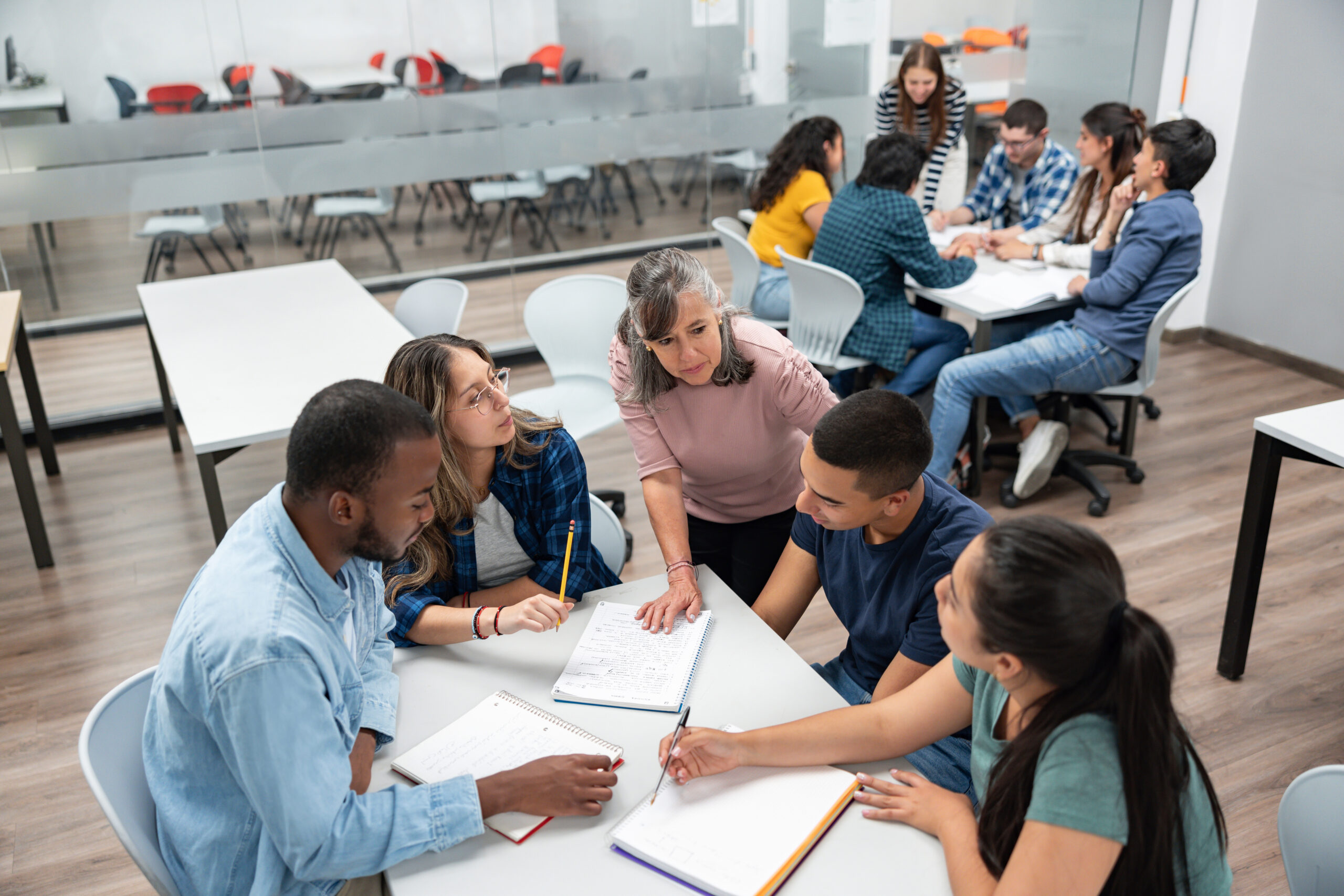
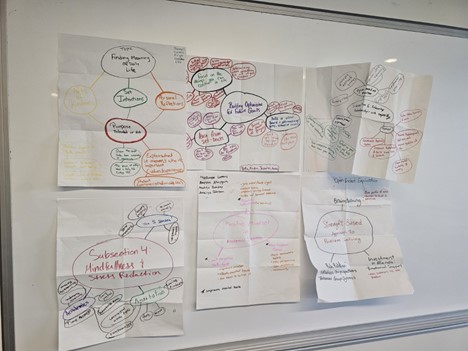
On the second day, students were given poster paper and markers to create mind maps of their ideas and help gain clarity on their discussions from the previous day. Each group placed their chosen topic at the center of the mind map and organized the associated ideas around it. The mind mapping exercise allowed students to visually connect their thoughts and discussions from day one.
One member from each group was nominated to circulate among the other groups, engaging in discussions about each team’s subsection of the article. This not only gave students a broader perspective on how their topics related to the overarching theme of student wellness but also facilitated the flow of information between teams. After gathering input from other teams, the group representative brought the new insights back to their original group, enhancing their understanding of their own topic and how it fit into the larger article. To ensure continuity, students took photos of their mind maps, which would later serve as guides for the writing process.
Day 3: Writing and Research Alignment
On the third day, each group was tasked with creating a document that contained a minimum of five references, with each group member responsible for contributing at least one reference. The document consisted of chunks of article drafts accompanied by their respective references. Students were asked to align these references with the ideas discussed during the earlier sessions and integrate them into their mind maps. Next, students took 15 minutes individually within a shared Google doc to write about their subsection, drawing from their mind maps and class discussions. This individual writing time allowed students to consolidate their thoughts and begin crafting their portion of the collaborative article.
Day 4: Ethical Use of AI in the Writing Process
The fourth day focused on ethical AI usage. We began with a discussion on how students had been using AI tools like ChatGPT and how they envisioned using any type of AI tools in the creation of this article. Together, we created an AI disclosure statement, agreeing on how AI would be used during the editing phase.
We explored specific AI prompts that could enhance their writing, including:
“Rephrase for clarity.”
“Organize this paragraph for the introduction, summary, or conclusion.”
“Give me a starting sentence for this paragraph.”
These prompts were designed to guide students in using AI as a tool to enhance clarity and organization rather than relying on it to write the content.
Day 5: Final Writing and Cohesive Editing
On the final day, students returned to their group documents and spent 15 minutes revising their sections. Afterward, they worked together to co-edit the document without the use of AI, striving to make the article more cohesive and polished. Finally, we revisited the agreed-upon AI prompts, and students were given the option to use AI only when they felt it was necessary for tasks like rephrasing sentences or organizing paragraphs.
The project culminated in a completed article on student wellness, co-authored by students and enhanced by responsible AI usage. The collaborative process not only demystified research and writing but also empowered students to see these activities as positive, engaging, and enjoyable experiences.
Takeaways From This Teaching Experience
The AI writing project was a valuable learning experience for the students, as it incorporated individual and collaborative learning elements alongside technology-based approaches. Reflecting on this experience, I have identified several key takeaways to carry forward into the new semester of teaching and learning.
The Importance of Throwback Learning Experience: Something Familiar Traditional tools like markers and poster boards remain essential in fostering cohesion, socialization, and competence-building. These activities encouraged students to engage in discussions and create visual representations of their ideas, which helped build their confidence and reinforce the collaborative process.
Starting With Original Ideas Matters Students benefited from discussing their ideas within the context of originality before integrating AI-generated content. Generative AI poses a potential threat to originality, emphasizing the need for human thought, discussion, and creativity to provide a benchmark for comparing the quality and intentionality of AI contributions.
Clear Parameters and Prompts Are Essential Defining the role of AI in the writing process was critical for success. Many students initially viewed AI as a tool for producing entire works. By discussing the parameters beforehand, it became clear that AI was to be used to supplement and enhance cohesion rather than replace the creative process.
The Importance of Prompt Development Students gained a growing understanding of the importance of crafting effective prompts for AI. Recognizing how prompts influence AI outputs is a crucial skill that was previously underdeveloped in many students. Moving forward, this skill will be vital as they navigate the intersection of human creativity and AI assistance.
Final Thoughts
Developing effective AI prompts is a pivotal skill that empowers students to use AI intentionally and meaningfully in their learning. A well-crafted prompt acts as the foundation for generating accurate, relevant, and cohesive responses, highlighting the importance of clarity, specificity, and purpose in the initial instructions given to the AI. By understanding how to formulate prompts, students can better harness the potential of AI to support their ideas, enhance their creativity, and improve the quality of their work without relying on AI to replace their original contributions.
This skill also encourages critical thinking, as students must evaluate the type of input needed to achieve a desired outcome, troubleshoot issues in responses, and refine their prompts for better results. Moreover, it aligns with the broader need for digital literacy in education, preparing students to interact responsibly and effectively with technology in academic, professional, and personal contexts.
Lastly, incorporating intentional AI use into teaching strategies ensures that students not only learn how to use these tools but also understand their limitations and ethical considerations. By balancing traditional methods, which foster originality and human connection, with innovative technologies like AI, educators can create a holistic learning environment that values both creativity and technological fluency. This balance will be crucial as AI continues to play an increasingly integral role in education and beyond.
Dr. Courtney Plotts’ students in class.A snapshot of the students’ work.
Special Note of Pride: I would like to note that this group of students worked on this project during class and completed this while two natural disasters accrued, power outages, remote and in person learning and did a great job considering the circumstances. I am so proud of each of them! We originally had bigger visions for the project but due to weather we had to make some changes to the plan!
Freshman College Students’ Advice to Peers for Health & Wellness in 2025
The new year always comes with the possibility of change and growth. As students, much of our growth focus is academics and learning-based. Being academically successful isn’t an easy task. Student wellbeing is an important factor in the learning process (Frazier & Doyle-Fosco, 2024). And for most of us, throwing ourselves into our studies and homework can come with negative side effects like burnout, stress, and decreased mood and motivation. But being successful doesn’t have to come at the risk of your mental health. In our view, academic success means more than good grades and knowledge. Although you may have gone through something last year, or are still going through it now, it doesn’t have to affect you in a negative way. There is so much more that goes into being successful. Success requires dedication, consistency, self-care, and a positive mindset. But for many of us a positive mind set is hard to come by.
The Collective Obstacle
The average age of our class is 19.7 years of age. We have lived with social media all of our lives. A lot of voices have imparted information. Some good, some not so good. The negativity that is readily accessible on social media can lead to negative self-talk. “Negative self-talk refers to your inner voice making critical, negative, or punishing comments. These are the pessimistic, mean-spirited, or unfairly critical thoughts that go through your head when you are making judgements about yourself” (Scott, 2023). Negative self-talk can be detrimental to your psychological well-being. It can really bring you down after you do it for too long. Negative self-talk can also induce stress, depression, and relationship problems. How you can start to believe the negative self-talk: you can start to believe negative self-talk after a while of you doing it. The more you start to tell yourself you can’t do something, the more you’ll start to believe it.
The effects of positive self-talk are the opposite of negative self-talk. It will improve your mental health, can reduce stress, lessen depression, and improve relationships. This not only impacts academics, but other aspects of life. To minimize negative self-talk, you can catch your inner critic when it’s happening and change your thinking to think more positive thoughts, remember that thoughts are not facts, contain your negativity, shift your perspective, think like a friend, or other trusted advisors.
Two Positive Ideas to Embrace in 2025
Two ideas to embrace in the new year that can jumpstart your positivity are evaluating how you think about failure and the control of your future. Failure is an inevitable part of life, but it is through our setbacks that we find opportunities for growth and success. How we respond to failure matters more than the failure itself, and cultivating a mindset of optimism is key to overcoming challenges (Hilppö & Stevens, 2020). Optimism, combined with grit—the perseverance and passion to achieve long-term goals—forms the foundation for a positive and resilient lifestyle. Together, these qualities enable us to turn obstacles into stepping stones and approach life’s difficulties with determination and hope. Think of failures as learning opportunities. Think about the knowledge you gain from hindsight when thinking about failure.
Additionally, understanding the distinction between what we can and cannot control is crucial for maintaining positivity and health (Pourhoseinzadeh, Gheibizadeh,& Moradikalboland, Cheraghian, 2017). Accepting that not everything is within our power allows us to shift our focus to areas where we can make a difference and grow from the experience. Remaining positive during challenging situations and remembering the aspects we can influence help us navigate adversity with a constructive mindset. It’s also important to respect that some factors are beyond our control and may happen for reasons we do not yet understand. By seeking to understand why certain things are outside our control, we can cultivate acceptance and use these moments as opportunities for reflection and personal growth.
The Importance of Health Communication in 2025
Healthy communication is critical to positive personal growth. Asking open-ended questions is important when engaging in meaningful communication because it ensures that there are no assumptions being made. One researcher found that assumptions “lead to consistent and unnecessary community failures” (Macrae, 2018, p.5). Additionally, healthy communication can build true connections among people and better understanding. Also, avoiding assumptions is a way to stay present in the moment allowing you to determine if there is genuine interest in the conversation. Most importantly, health aspects of communication like listening, reflecting, and pausing encourage new thinking and can develop new ideas just about anything.
In addition to healthy communication, think about sharing more of your experiences with peers. Starting from a place of curiosity and health, inquire about someone’s well-being. You can start with a simple phrase like “Are you ok?” Or be ready and willing to share your own personal experience when the time is right. Not only can this help someone else but sharing your story can also help you process what you have been through. Sharing and listening to each other’s experiences can show understanding and help you feel more willing to share now and in the future. Understanding and being present is a power combination for communication.
Lastly, remember that relationships are complex. Whether parental, academic, or personal, everyone has their relationships challenges. One tactic to strengthen relationships is humor. Remember to laugh and enjoy life and the people around you. Most people forget about light heartedness and humor, and how humor can help strengthen and resolve issues within a relationship. Humor can improve the quality of relationships by reducing the stress, tension, and anxiety of the people within the relationship. This effect can only occur if humor is used respectfully in relationships. When used right, humor also can create a more comfortable relationship with less anxiety and sadness for those in it. It’s ok to laugh—even in challenging times.
Summary
A positive mindset is the root of achieving any goal you put your mind to. As a collective voice, we hope the information we shared is valuable information. Our goal was to share meaningful information for your new year and new journey in 2025. As students, we fully understand the importance of mental health, especially because all of us experienced covid at some of the most challenging times of our lives. We hope this information helps you in the new year as much as it helped us learn and grow. Remember to stay happy, healthy, and safe in the new year and think positive!
Dr. Courtney Plotts is a Dynamic Keynote Speaker, Author, and Professor. Dr. Plotts is the National Chair of the Council For At-Risk Student Education and Professional Standards, the country’s only organization that provides standards for working with marginalized and nontraditional students in Kindergarten to College. Her role as National Chair includes training, consulting, and research. Her subject matter expertise has been used in a variety of book publications. Most recently “Small Teaching Online” By Flower Darby with James M. Lang published in June 2019. Dr. Plotts was recognized in 2017 by the California State Legislature for a bold commitment to change in education. She is currently in talks with higher education institutions to launch an institute that focuses on diversity and best practices in online teaching spaces to launch in 2021.
References
Frazier, T., & Doyle Fosco, S. L. (2024). Nurturing positive mental health and wellbeing in educational settings – the PRICES model. Frontiers in public health, 11, 1287532. https://doi.org/10.3389/fpubh.2023.12875
Hilppö, J., & Stevens, R. (2020). “Failure is just another try”: Re-framing failure in school through the FUSE studio approach. International Journal of Educational Research, 99, 101494. https://doi.org/10.1016/j.ijer.2019.101494
Macrae, C. (2018). When no news is bad news: Communication failures and the hidden assumptions that threaten safety. Journal of the Royal Society of Medicine, 111(1), 5–7. https://doi.org/10.1177/0141076817738503
Pourhoseinzadeh, M., Gheibizadeh, M., & Moradikalboland, M., Cheraghian, B. (2017). The Relationship between Health Locus of Control and Health Behaviors in Emergency Medicine Personnel. International journal of community based nursing and midwifery, 5(4), 397–407.