
Tag: engineers

  • Raising the Bar: A Graduate Design Engineer’s Path in Engineering

    Raising the Bar: A Graduate Design Engineer’s Path in Engineering

    • By Professor Lisa-Dionne Morris, Professor of Public & Industry Understanding of Capability Driven Design in the School of Mechanical Engineering, and Engagement Champion for the EPSRC EDI Hub+ at the University of Leeds.

    International Women in Engineering Day, Monday 23 June 2025, provides an essential platform to celebrate the contributions of women designers and engineers while also highlighting persistent gender disparities in the profession. In 2021, only 16.5% of engineers in the UK were women, a figure that underscores the continued need for structural reform and targeted support for women pursuing careers in STEM disciplines.

    Preparing the next generation of female international design engineers requires more than the delivery of technical content. It necessitates a systemic, institution-wide approach that equips graduates with the attributes, knowledge, resources, skills, and confidence to navigate a professional landscape that is rapidly changing and, in many cases, still being defined for future careers. The increasing global demand for roles in areas like sustainable product design, AI-integrated manufacturing, inclusive user interface systems, and human-centred engineering is underpinned by the foundational importance of STEM, making the empowerment of women designers and engineers in these fields crucial for driving innovation and achieving sustainable development goals. These emerging sectors demand not only technical competence but also a blend of creativity, emotional intelligence, and social awareness that diverse females in STEM demonstrate.

    Holistic Support: Design Engineering as Ecosystem

    The development of a graduate designer and engineer can be likened to nurturing a tree within a complex ecosystem. While academic performance remains important, the capacity to thrive in uncertain, transdisciplinary, and innovation-driven contexts depends upon institutional ecosystems that foster global awareness, adaptability, collaboration, and resilience.

    Universities play a vital role as critical enablers and a resource. This extends beyond curricula to the people, processes, and environments that scaffold student growth, from technical staff and personal tutors to administrative teams and peer mentors. The university must therefore shift its conceptualisation of employability from curriculum-contained instruction to community-wide responsibility.

    Barriers and Micro-inequities

    For female design and engineering graduates, these ecosystems are even more consequential. While overt discrimination may be declining, micro-barriers, such as imposter syndrome, limited visibility of role models, cultural dissonance and inaccessible resources, continue to affect women disproportionately. The intersectionality of race, disability, and socioeconomic status further compounds these challenges.

    Support mechanisms such as inclusive wellbeing services, financial assistance schemes, mentoring networks, and accessible technical environments serve as critical interventions. These do not merely reduce dropout risk; they transform educational experiences and enhance graduate outcomes.

    Beyond KSA: Towards the ACRES Model

    Traditional employability frameworks such as the KSA model (Knowledge, Skills, Abilities) focus primarily on individual traits. While helpful, such models risk overlooking the social, ethical, and emotional dimensions necessary for future engineering practice. In response, I propose the ACRES framework — a holistic model centred on:

    • A – Adaptability: Developing the capacity to respond flexibly to change
    • C – Collaboration: Cultivating skills in teamwork and interdisciplinary cooperation.
    • R – Resilience: Building psychological robustness through reflective learning
    • E – Empathy: Encouraging emotional intelligence through inclusive design challenges
    • S – Social Responsibility: Engaging students with ethical, civic, and sustainability issues.

    These attributes are more than ideals; they represent the design specifications for the modern engineer.

    Educational Practice in Action

    Design engineering programmes across the UK are embedding these competencies through interdisciplinary projects, challenge-based learning, studio-based learning, sustainability modules, and community-based partnerships. At the University of Leeds, in the Faculty of Engineering and Physical Sciences, for example, students engage in industry-informed design briefs, receive feedback from career mentors, and co-produce portfolios that reflect both technical ability and human-centred thinking.

    Such practices are not incidental, they are fundamental. The preparation of women designers and engineers is a collective act; it is the result of intentional, inclusive, and collaborative university cultures that nurture talent through both “seen and unseen” interventions.

    The university must function not only as a centre of instruction but as a dynamic support system, enabling intersectionality such as first-generation, women, disabled, and underrepresented female students to flourish in STEM to become graduates. When we invest in raising future-ready women designer and engineers, we are not merely producing graduates, we are shaping leaders, changemakers, and innovators for careers that, in many cases, are yet to be invented.

    Source link

  • Students Explore STEM with Engineers

    Students Explore STEM with Engineers

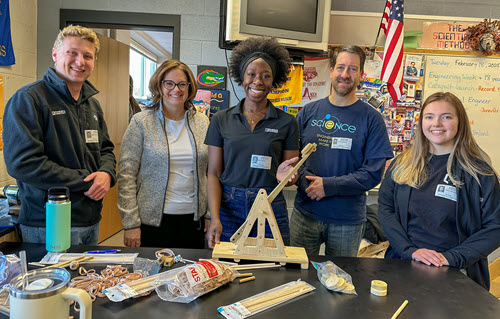
    Middletown, PA – Phoenix Contact engineers head back into the classroom this week to teach sixth-grade science class at Middletown Area Middle School in Middletown, Pa. The classes are part of Phoenix Contact’s National Engineers Week celebration.

    Phoenix Contact has worked with the school every February since 2007. The engineers lead hands-on lessons that make science fun. The goal is to inspire young people to consider careers in science, technology, engineering, and math (STEM).

    The lessons include:

    • Building catapults
    • Racing cookie tins down ramps
    • Building an electric motor
    • Learning about static electricity with the Van de Graaff generator

    “Our engineering team created this outreach program many years ago, and the partnership with Middletown Area School District has stood the test of time,” said Patty Marrero, interim vice president of human relations at Phoenix Contact. “National Engineers Week is a special time for them to share their passion for technology with students. It’s also our chance to thank our engineers for the creativity and innovations that drive our company forward.”

    About Phoenix Contact

    Phoenix Contact is a global market leader based in Germany. Since 1923, Phoenix Contact has created products to connect, distribute, and control power and data flows. Our products are found in nearly all industrial settings, but we have a strong focus on the energy, infrastructure, process, factory automation, and e-mobility markets. Sustainability and responsibility guide every action we take, and we’re proud to work with our customers to empower a smart and sustainable world for future generations. Our global network includes 22,000 employees in 100+ countries. Phoenix Contact USA has headquarters near Harrisburg, Pa., and employs more than 1,100 people across the U.S.

    For more information about Phoenix Contact or its products, visit www.phoenixcontact.com, call technical service at 800-322-3225, or email [email protected].

    eSchool News Staff
    Latest posts by eSchool News Staff (see all)

    Source link

  • More engineering applications don’t make for more engineers

    More engineering applications don’t make for more engineers

    The latest UCAS data (applications by the January ‘equal consideration’ deadline) suggests a 14 per cent increase in applications to engineering and technology courses.

    It’s the second double-digit surge in two years.

    Good news, right? Sadly, it’s mostly not.

    STEM swing

    The upsurge in interest in engineering can be seen as part of a “swing to STEM” (science, technology, engineering, and medicine).

    As higher education has shifted to a reliance on student debt for funding, many people suspect applicants have felt greater pressure to search for clear, transactional returns which, it may seem, are offered most explicitly by STEM – and, most particularly, by engineering, which is not just STEM, but vocational too.

    Certainly, there’s a keen labour market for more engineers. Engineering UK has suggested the shortfall is around 29,000 graduates every year. According to the British Chambers of Commerce, it’s pretty much the largest skills gap in the UK economy.

    Engineering is also a key driver of the growth that the government is so keen to stimulate, adding £645b to the UK – that’s nearly a whopping third of the entire value of the economy. And – unlike financial services, say – engineering is a powerhouse of regional development as it is spread remarkably evenly throughout the country.

    And it drives that other key government mission, opportunity. An engineering degree confers a higher and more equal graduate premium than almost any other discipline.

    The downside

    So with all these benefits, why is the increase in engineering applications not good news?

    The answer is because it reveals the extent of the lost opportunity: most of these extra potential engineers will be denied places to study, dashing their hopes and the hopes of the country.

    Last year’s rise in applications did not lead to a rise in the number of UK engineering students. Absolute student numbers have more or less stagnated since 2019.

    It used to be that the number of engineering applications broadly aligned with places because it was a highly regarded discipline with great outcomes that universities would expand if they felt they could. The limiting factor was the number of able students applying.

    Now that demand outstrips supply, universities cannot afford to expand the places because each additional UK engineering student represents an ever-growing financial loss.

    Engineering courses are among the most expensive to teach. There are long contact hours and expensive facilities and materials. The EPC estimates the average cost per undergraduate to be around £18,800 a year. Even allowing for top-up funding that is available to many engineering degrees on top of the basic fee income, that leaves an average loss of £7,591 per year.

    It used to be that the way to address such losses was to try to admit more students to spread the fixed costs over greater numbers. That did run the risk of lowering standards, but it made financial sense.

    Now, however, for most universities, the marginal cost of each additional student means that the losses don’t get spread more thinly – they just keep piling up.

    Cross-subsidy

    The only way out is to bring in ever more international students to directly subsidise home undergraduates.

    Although the UCAS data shows a glimmer of hope for recovering international demand, at undergraduate level, there are only a few universities that can make this work. Most universities, even if they could attract more international engineering students, would no longer use the extra income to expand engineering for home students, but rather to shore up the existing deficits of maintaining current levels.

    The UCAS data also show higher tariff institutions are the main beneficiaries of application increases at the expense of lower tariff institutions which, traditionally have a wider access intake.

    What this means is that the increased demand for engineering places will not lead to a rise in engineering student numbers, let alone in skilled engineers, but rather a narrowing of the access to engineering such that it becomes ever harder to get in without the highest grades.

    High prior attainment correlates closely with socioeconomic advantage and so, rather than engineering playing to its strength of driving social mobility, it will run the risk of becoming ever more privileged.

    What about apprenticeships?

    Not to worry, suggests Jamie Cater, head of employment and skills at trade body Make UK, a university degree is not the only option available for acquiring these skills and “the apprenticeship route remains highly valued by manufacturers”.

    That’s small comfort, I’m afraid. The availability of engineering higher apprenticeships suggests competition is even fiercer than it is for degrees and, without the safeguard of fair access regulation, the apprenticeship access track record is poor. (And don’t get me started on drop-outs.)

    This is why I haven’t unfurled the bunting at applicants’ rising enthusiasm for engineering.

    Of course, it is wonderful that so many young people recognise engineering as a fulfilling and forward-looking discipline. An estimated £150m has been spent the last decade trying to stimulate this growth and there are over 600 third sector organisations working in STEM outreach in schools. It would be nice to think this has not been wasted effort.

    But it’s hard to celebrate a young person’s ambition to be an engineer if it’s likely to be thwarted. Similarly, I struggle to summon enthusiasm about kids wanting to get rich as TikTok influencers. Indeed, it’s all the more tragic when the country actually does need more engineers.

    This is why the Engineering Professors’ Council has recently called on the government to plug the funding gap in engineering higher education (and HE more widely) in the forthcoming Comprehensive Spending Review.

    Asking for nearly a billion pounds may seem ambitious, but the ongoing failure to fill the engineering skills gap may well be costing the country far more – possibly, given the importance of engineering to GDP, more than the entire higher education budget.

    Johnny Rich is Chief Executive of the Engineering Professors’ Council, the representative body for UK Engineering academics.

    Source link