
Tag: England

  • Skills England has a new way to talk about skills, and the sector needs to listen

    Skills England has a new way to talk about skills, and the sector needs to listen

    Although on one level tertiary education policy has never been more concerned with skills, we’ve never really had a proper understanding of what skills actually are or how they fit together with either jobs or courses.

    While – as a select and very well-informed group of attendees at The Festival of Higher Education were delighted to learn – there are any number of conceptualisations of what a skill (or a group of skills) might be, matching skills needs to jobs or to courses has never been easy to do in a reliable way.

    To be a bit less abstract, if we want anyone to train our future workforce we need to know what we want them to be trained in. And, not only do we not know that because we can’t predict the future – we also don’t know that because we simply do not have the vocabulary or frameworks of understanding we need to pose the right questions. Employers and industries cannot talk to course providers and prospective employees about this stuff because each of these groups has spoken a different language.

    Until today!

    Into this ontological hellscape comes Skills England. The release of the UK Standard Skills Classification (UK-SSC) – alongside a wonderfully whizzy UK Skills Explorer tool – is, in a quiet way, the most significant thing to happen to the skills landscape in a generation: not least because, for the first time we are able to see it.

    Before this, the skills landscape was, (at best) uneven. SOC codes helped us understand occupational requirements for jobs, SIC codes helped us understand the kind of work that goes on in particular industries, and HECoS codes gave us an understanding of what areas particular courses of study cover. All of this was useful, but none of it really linked together and – as you’ve probably spotted – none of it talked about actual skills.

    So what is a “skill”? Well, it might be “a capability enabling the competent performance of a job-related activity”: an occupational skill. Or it could be a more generic competence, “a fundamental ability that contributes to the capability to carry out tasks associated with a specific job”: a core skill.

    Skills England has identified 3,343 occupational skills (within 22 domains, 106 areas, and 606 groups). Occupational skills combine with knowledge (4,926 of these are defined) and core skills (just 13) to give someone the capability to do one or more of 21,963 identified occupational tasks.

    UK-SSC levels diagram

    So what?

    The existence of these definitions should make it a lot easier to translate employer and industry needs, into opportunities that strategic government support, and an offer of courses that satisfies these needs.

    Let’s give an example. Imagine the government decides that any future transition away from carbon-based power requires batteries and electrical components, and notices that we have quite a lot of the rare-earth metals and other minerals that we need to make these somewhere under the ground in the UK. We need to get them out, and we need to train the people that can do that. And we currently only have one school of mining with a little over a hundred students.

    Because we can map the UK-SSC to Standard Industrial Classification (SIC) codes, we can very easily run up a list of the key skills we need to train people in.

    [Full screen]

    That way, when we get to specifying what the new mining schools we are going to open actually need to teach, and we get to working with industry to decide what skills they need to do all this mining we have an agreed list. A starting point, sure, but one that saves a lot of time.

    You will note that this is not just training people how to dig stuff up. There are research jobs, planning jobs, management jobs, and a fair few design jobs that need to be done. The bar chart aspect here gives us an indication as to how important each skill is to employers in this industry.

    From specification to commission

    So if we know what skills we need, how do we get people training in them? Or do we have people training in them already?

    UK-SSC also maps to HECoS codes, which are the language we use in higher education to think about subject areas. So, to continue our example, let’s think about analysing mineral deposits – helping us figure out where to start digging holes.

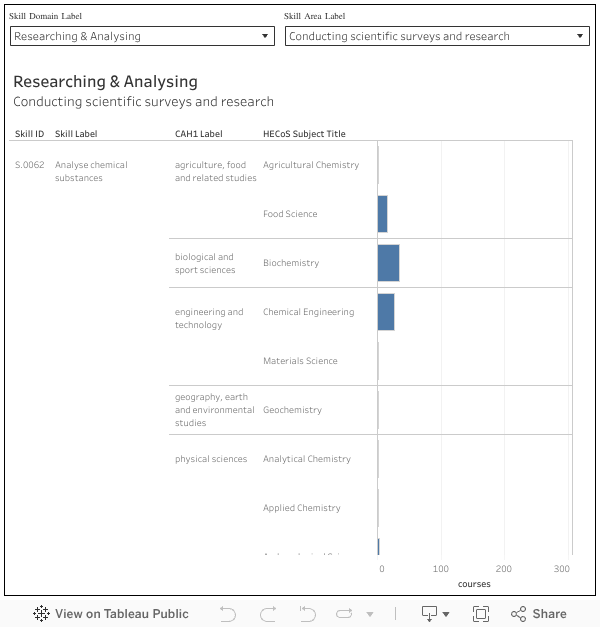
    “Analyse mineral deposits (S.0091)” is within the “researching & analysing” domain, and the “conducting scientific surveys and research” area. And we can use one of the mappings developed by Skills England to check out whether we have any courses in related subjects currently being offered in the UK higher education sector that might help.

    I’m sorry to say I’ve been messing around with the data behind Discover Uni again. This maps individual courses to HECoS codes – so it lets us see how many courses are in subject areas linked to the skill we are interested in.
    [Full screen]

    Setting the filters appropriately and scrolling down we can see that we are not well-served with educational opportunities in this space. There are 19 subject areas associated with this skill, and only a few have courses that are being tagged with them. Notably there are 14 courses in environmental geosciences, 8 in geology, and 3 in archeological sciences. Nobody (not even the Camborne School of Mines!) is tagging themselves with the specific engineering-related disciplines of minerals processing or quarrying.

    This neatly demonstrates that a linking vocabulary can only take us too far if subject coding (or any other kind of data collection) is done in a less-than-complete way. Using this very basic desk analysis we can see that there is probably a case for more specialist mining provision – and based on that we can suggest that there may be a cause for government investment. But it could equally demonstrate that tagging courses with HECoS code to power a course comparison website that hardly anyone looks at is not a way of generating a comprehensive picture of what is on offer.

    And this is just a starting point. We can drill down from these occupational skills into job tasks, knowledge concepts, and core skills from here – all of which would help us specify what we need to train people to do in detail fine enough to design and run a suitable course for them.

    So how has this been done?

    If you are imagining a bunch of very diligent and smart people at Skills England and the University of Warwick taking a bunch of pre-existing information and pulling together this vocabulary you are probably most of the way there. Starting from six existing sources a combination of expert input and large language models refined and deduplicated entries within:

    • A list of skills generated by (Skills England predecessor) the Institute for Apprenticeships and Technical Education
    • A list developed by the the Association of Graduate Careers Advisory Services
    • A list from the National Careers Service
    • A list from the Workforce Foresighting Hub in Innovate UK
    • And two international comparators – the European Skills, Competences, Qualifications, and Occupations (ESCO) level 4 skills, and the (US based) O*NET detailed work activities.

    A similar approach generated and tested all of the mappings and hierarchies that have been made available to download and play with.

    And core skills?

    As above there are just 13 of these, but these are assigned levels of proficiency in language that feels a lot like grade descriptors (note, these are not FHEQ levels but I bet somebody, somewhere, is thinking about a mapping).

    [Full screen]

    Each of these core skills also maps, to a greater or lesser extent, to each of the occupational skills – so our old friend “Analyse mineral deposits (S.0091)” requires level 4 “learning and investigating”, level 3 “planning and organising”, and level 2 “listening”.

    You can’t help but think that forward-looking course leaders will be incorporating these definitions into their learning outcomes in the years to come. Proficiency levels may also be coming to the occupational skills definitions, and there’s even an idea of creating basic curricula for benchmarking and general use.

    Skills for the future

    There’s an old XKCD cartoon about standards that has become a meme – and it highlights that just because someone has combined everyone’s needs into a single standard there is nothing to say anyone will actually use that one rather than whatever language they’ve been speaking for years.

    The UK-SSC attempts to avoid this in two ways. Firstly it maps to other vocabularies that people are already using in linked areas, and does so by design. And secondly it bears the imprinteur of the government, suggesting that at least one influential body will be using it every time it talks about skills.

    And there’s another aspect that helps drive adoption. It will iterate – based on job vacancy data, workforce foresight, feedback from employers, even via public community forums (Stack Exchange, Discord!). And the links to other vocabularies will iterate too. The plan is that this will happen on a five year cycle, but with a first update next year.

    Make no mistake, this is a major intervention in the skills landscape – and it has been done diligently and thoughtfully. If your job involves anything from designing courses to working with employers and local skills improvement plans, if you are a professional body, or working on subject benchmark statements, you need to get on board.


    Source link

  • Universities in England can’t ignore the curriculum (and students) that are coming

    Universities in England can’t ignore the curriculum (and students) that are coming

    What has schools policy got to do with higher education?

    The Westminster government has published Becky Francis’s Curriculum and Assessment Review, unveiling what Education Secretary Bridget Phillipson calls “landmark reforms” to the national curriculum.

    Interestingly, the revitalised curriculum is to be a “core part” of how the government will deliver the Prime Minister’s target of two-thirds of young people participating in higher-level learning by age 25.

    The review treats higher education as an explicit destination, not a distant afterthought.

    When it invents a new “third pathway” at level 3, it insists those V Levels must carry higher education credibility and be built so that young people can progress to degree-level study as well as work – hence Ofqual regulation and sector-standard-linked content. In other words, this isn’t a dead-end vocational cul-de-sac – it is designed to be read and trusted by admissions tutors.

    On T Levels, the panel recognises reality on the ground – many universities do already accept T Level learners – but says the acceptance landscape is messy, confusing and poorly signposted. Its answer is that government should keep working with providers and HEIs to promote understanding across the HE sector so applicants know which courses take T Levels and on what terms. The implication for universities is making recognition statements clearer, and aligning them with national guidance as it emerges.

    Why the anxiety about clarity? Because the authors kept bumping into learners who don’t grasp how subject and qualification choices at 16–19 play out later for university admission. That includes confusion introduced by new badge-sets like AAQs and TOQs. It turns out that if you design a landscape that looks like alphabet soup, you shouldn’t be surprised when applicants misread the signposts.

    Bacc to the future

    The EBacc gets a particular dressing-down. It’s true that taking an academic portfolio at GCSE correlates with applying to – and attending – university. But the review finds that EBacc combinations do not boost the chance of getting into the Russell Group, (although the only source for this is a paper from 2018, which doesn’t really come down conclusively against it), and that EBacc’s accountability pull has constrained subject choice in ways that squeeze arts and applied options. For HE, that means any lingering myth that EBacc equals elite-entry advantage gets killed off.

    There’s a financial edge to all this that the review politely doesn’t mention. When the previous government tried to defund BTECs, analysis showed the policy could strip £700 million in tuition fee income from the sector, with catastrophic effects for subjects like nursing, sport science, and computing – some facing 20 per cent recruitment losses. Those shortfalls would land heaviest on lower-tariff universities already wrestling with flat domestic recruitment and collapsing international numbers.

    The stakes for getting pathway reform right are existential for parts of the sector. If V Levels don’t recruit at scale, if T Level recognition remains patchy, and if the “simplification” just creates new barriers for disadvantaged students rather than removing old ones, some universities and programmes will struggle to recruit. The review’s optimism about legibility needs to meet reality – student choice is sticky, established qualifications have brand recognition, and centrally-planned qualification reform has a patchy track record. T Levels attracted just 6,750 students after £482 million of investment.

    As well as all of that, the panel seems super keen to stress the continuing strength of A levels as a pipeline, noting that in 2022/23 some eighty-two per cent of A level learners progressed to higher education by age 19. Whatever else changes, the academic route remains a robust feeder – and universities should expect the report’s other reforms to orbit around, not replace, that core.

    Crucially, the review refuses the tired binary that “vocational” equals “non-HE.” It records evidence that large applied or technical programmes can carry real weight with HE providers – precisely because they demonstrate breadth and depth in a way that can be benchmarked consistently across learners. If you run foundation years or applied degree routes, you are being invited to read these programmes seriously.

    It also acknowledges the contested evidence on outcomes for legacy qualifications like unreformed BTECs while still affirming their role in widening participation. The nuance matters – some qualifications have varied quality and mixed university performance data, yet for those who succeed in HE, BTECs and other AGQs have often been the bridge in. A credible vocational pathway that keeps that bridge open – while simplifying the current maze – is the intended fix.

    Are universities actually ready to make good on these promises? The sector has spent years documenting how BTEC students – despite “equivalent” tariff points – have systematically worse outcomes than A-level students. Arguably, the problem in some providers isn’t the qualification – it’s that first-year curricula and pedagogy remain stubbornly designed around A-level assumptions. Group projects, applied assessment, practical skills – the things BTEC students excel at – routinely get squeezed out in favour of essays and exams that privilege academic writing developed through A-levels.

    So when the review insists V Levels must “carry higher education credibility” and enable progression to degrees, the translation work required isn’t just clearer admissions statements – it’s a more fundamental rethink of how universities teach first-year students, assess them, and support their transition.

    Put together, the narrative runs something like this. Design V Levels to be legible to universities, clean up T Level recognition so applicants aren’t left guessing, stop pretending EBacc is a golden ticket to elite admission, and keep A levels stable, but value applied depth where it’s rigorous.

    And above all, help students understand how choices at 16–19 map to HE doors that open, or close, later.

    What (or who) is coming?

    There are some wider bits of note. The review has things to say about AI:

    …generative artificial intelligence has further heightened concerns around the authenticity of some forms of non-exam assessment… It is right, therefore, that exams remain the principal form of assessment.

    As such, it urges no expansion of written coursework and a subject-by-subject approach to non-exam assessment where it is the only valid way to assess what matters. It also tasks DfE and Ofqual to explore potential for innovation in on-screen assessment – particularly where this could further support accessibility for students with SEND – but cautions that evidence for wider rollout is thin and equity risks from the digital divide are real.

    Digital capability stops being taken-for-granted. Computing becomes the spine for digital literacy across all key stages, explicitly incorporating AI – what it is, what it can and can’t do – and broadening the GCSE so it reflects the full curriculum rather than a narrow slice of computer science. Other subjects are expected to reference digital application coherently, but the foundations live in Computing. Online safety and the social-emotional ethics of tech use sit in RSHE, while the “is this real?” critical discernment is anchored in Citizenship.

    The ambition is a cohort that can use technology safely and effectively, understands AI well enough to question it, and can interrogate digital content rather than drown in it.

    More broadly, English is recast so students study “the nature and expression of language” – including spoken language – and analyse multi-modal and so-called “ephemeral” texts. That builds media-literate readers and writers who can spot persuasion, evaluate sources, and switch register across platforms, backed by a Year 8 diagnostic to catch gaps early. Drama regains status as a vehicle for performance, confidence and talk.

    In parallel, an “oracy framework” is proposed to make speaking and listening progression explicit across primary and secondary – something schools say is currently fuzzy and inconsistently taught. The sector should expect clearer outcomes on expressing ideas, listening, turn-taking and audience awareness, with specific hooks in English and Citizenship.

    Citizenship is made statutory at primary with a defined core – financial literacy, democracy and government, law and rights, media literacy, climate and sustainability – and tightened at secondary for purpose, progression and specificity. The point is to guarantee exposure, not leave it to chance. If implemented properly, you’d expect clearer outcomes on budgeting and borrowing, evaluating claims and campaigns, understanding institutions and rights, and participating respectfully in debate.

    And climate education also steps out of the margins. Expect refreshed content in Geography and Science and an explicit sustainability lens in Design and Technology, with an eye on green skills and the realities of local, affordable fieldwork. The intent isn’t a new silo called “climate” – it’s to make the concepts visible, current and assessed where they logically belong.

    What’s next?

    If this all lands as intended – and that’s a big “if” given implementation timelines and school capacity – universities should expect a cohort that’s been taught to interrogate sources, question AI outputs, and articulate arguments aloud, not just on the page.

    Whether all of this survives contact with reality should be the sector’s real concern. The review’s timeline assumes schools can execute sweeping curriculum reform, embed new pathways, and deliver enhanced oracy and media literacy by 2028 – all while navigating funding pressures, teacher shortages, and the usual chaos of system change. That’s ambitious even in favourable conditions.

    And universities know from painful experience that when school reform stumbles, they inherit the mess. BTECs were supposed to be the accessible applied route, until differential outcomes data revealed the sector hadn’t actually adapted to teach those students effectively. The EBacc was positioned as the passport to elite universities, until evidence showed it just constrained subject choice without improving Russell Group entry. The Francis Review has laudable intentions – genuine pathways, informed choice, rigorous applied options – but intentions aren’t infrastructure.

    If the 2028 cohort arrives at university having been promised that V Levels are “trusted by admissions tutors” but finds patchy recognition, or discovers their oracy training doesn’t translate because seminars still privilege A-level-style discourse, the sector will be cleaning up another policy gap between aspiration and delivery. The review knows this risk exists – hence the repeated insistence on clarity, signposting, and sector cooperation.

    But cooperation requires capacity, and capacity requires resources neither schools nor universities currently have a box full of. Nevertheless, the intent is to send universities young people who can think critically, speak confidently, and navigate complexity.

    Source link

  • The Future of the New England Transfer Guarantee

    The Future of the New England Transfer Guarantee

    How does an initiative achieve sustainability beyond the life cycle of the grants that funded its implementation? This is the question that the transfer initiatives team at the New England Board of Higher Education (NEBHE) set out to answer earlier this month during a convening of higher education leaders from across the New England region.

    Background

    First launched in Connecticut, Massachusetts and Rhode Island in 2021 and scaled to Maine, New Hampshire and Vermont in 2024, the New England Transfer Guarantee is NEBHE’s landmark transfer initiative. Associate degree–holding community college graduates can transfer seamlessly to participating four-year schools in the same state with guaranteed admission, provided they meet a minimum GPA set by the receiving institution. There are no application fees or essay requirements for students transferring through this program. As of October 2025, there are 53 participating four-year institutions across all six New England states.

    Planning and implementation of this initiative in the six states mentioned above has been made possible through funding from the Arthur Vining Davis Foundations, the Davis Educational Foundation, the Lloyd G. Balfour Foundation and the Teagle Foundation.

    As was highlighted in a previous column and further contextualized in the longer-form “Third Annual Guarantee Enrollment Report,” students who have transferred through this initiative are performing well above the minimum GPA requirements receiving institutions set for their admission.

    Beyond that, guarantee students are retained at their transfer destination at an impressive rate of 94 percent. Analyzing this annual data has also revealed that many of the students that transfer through this initiative are from traditionally underserved backgrounds, with over 47 percent of students who have enrolled through the initiative being Pell Grant recipients.

    The Future of the New England Transfer Guarantee

    With the grant-funded phase of this work coming to an end in December 2025 (March 2026 for the grant from the Balfour Foundation), the time is ripe for creating a plan to sustain the guarantee for future generations of students. NEBHE gathered state higher education system leaders from across all six New England states for a hybrid meeting at the Eagle Mountain House in Jackson, N.H.

    Those who attended included individuals who lead public two- and four-year systems but also those who represent four-year independent colleges. The meeting was focused on determining NEBHE’s ongoing role in administering the guarantee beyond the life of the grant, and attendees discussed what kind of coalition-based governance structure would assure that the program adapted to future trends in the higher education landscape in a way that preserved its longevity for future generations of students.

    Attendees described how the initiative has improved transfer pathways and simplified the transfer landscape for students in their respective states. “I just want to say how much we appreciate it,” Nate Mackinnon, executive director of the Massachusetts Association of Community Colleges, told the group. “From the community college perspective, we’re constantly interested in making sure our students lose as few credits as possible on their pathway.”

    Other participants suggested incorporating artificial intelligence and credit for prior learning into the structure of the guarantee and offered examples of successful implementations of these ideas at their institutions.

    Next, the meeting’s facilitator engaged participants in a conversation regarding the roles required to sustain the initiative in the long term. In addition to collecting and analyzing student-level enrollment data on an annual basis, NEBHE has committed to continue to publish the annual enrollment report for the New England Transfer Guarantee.

    NEBHE will also continue to solicit any updates to the eligible programs that each four-year institution opens to guarantee students. Attendees recommended that NEBHE should engage the webmasters to whom they send such updates each year—to see what will be required for them to continue to keep these student portals up-to-date with information that community college students need to evaluate their transfer choices through the guarantee.

    Attendees also expressed an interest in NEBHE’s continued involvement in promoting the initiative to community college transfer advisers on a regular basis by integrating the guarantee into existing statewide meetings and events that focus on transfer. Additionally, attendees saw potential in partnering with third-party student success organizations to reach students and ensure that they are aware of all the options available to them when it comes to earning a baccalaureate credential.

    Next Steps

    While the convening succeeded in outlining system-level stakeholder priorities, there are still details that must be ironed out. Given each state’s unique higher education landscape, a one-size-fits-all model for community college transfer adviser engagement would be ineffective, highlighting the need for more nuanced state-by-state plans. Outreach to student success organizations to explore opportunities for collaboration is another option that the transfer initiatives team at NEBHE must fully explore in the coming months.

    There are questions that remain unanswered for the time being; however, this meeting affirmed that the region’s higher education leaders are committed to ensuring that the guarantee can continue to serve students for years to come.

    Rob Johnston is the senior program coordinator for transfer initiatives at the New England Board of Higher Education.

    Source link

  • Higher education policy: the lie of the land in England and Wales on the cusp of England’s post-16 white paper

    Higher education policy: the lie of the land in England and Wales on the cusp of England’s post-16 white paper

    • This speech was delivered by HEPI Director Nick Hillman at the University of Cardiff on Thursday, 16 October 2025.

    Introduction

    The other day, I was speaking to the University of Liverpool Council at the Ness Botanic Gardens on the Wirral, which as you know is four hours due north of here, pretty much on the Welsh / English border. I started my speech there by noting that I only exist because of the University of Liverpool, as my maternal grandparents met there in the early 1930s. Well, I also only exist because of the Welsh university system, as my parents met while they were students here in Wales in the early 1960s, just as my own children only exist because I met my wife in the early 1990s at university. 

    The fact that three generations of my family originally met while at university is a powerful reminder, at least to me, that higher education change lives. And at HEPI, we had another powerful reminder of that during our first event of this academic year, when – last month – we hosted the UK launch of the OECD’s Education at a Glance publication.

    Education at a Glance

    In case you have not come across it before, this is the most useful but worst titled publication on education that appears anywhere in the world each year. It is a vast 541-page compendium of comparative data that you need to pore over rather than glance at.

    This year’s OECD report had a particular focus on tertiary education. While we have become used to people beating up on the UK higher education sector, the OECD actually painted a picture of a very successful sector playing to its strengths. When you look in from the outside, it seems the UK’s higher education institutions are not so bad after all.

    For example, the OECD showed that, among the many developed countries covered in their report, the UK has:

    • higher than average participation in higher education;
    • lower than average graduate unemployment, irrespective of whether the individuals studied STEM, business or humanities; and
    • among the very highest undergraduate completion rates anywhere in the world, vying with Ireland for the top spot.

    I recognise the OECD is looking at averages for the UK as a whole and the position of Wales is not necessarily the same but, in general, the weaknesses the OECD found in were on the lack of good opportunities for people who do not succeed in education first time around.

    Specifically, the OECD found a profound problem among young men, a rising proportion of whom are classified as NEETs (Not in Employment, Education or Training). While the OECD use historic data for a year or two past, last week’s brand new NEET data for Wales confirms the depressing picture. Indeed, it was even more salutary, noting:

    The proportion of young people aged 16 to 24 in Wales who were not in employment, education or training (NEET) was 15.1% in the year ending June 2025, an increase of 3.6 percentage points over the year.

    The OECD additionally found that the UK has the biggest gap of all developed countries when it comes to the difference in earnings between low-skilled adults and those who leave school with A-Levels (or equivalent). This should perhaps worry Wales even more than the rest of the UK, given that Wales scores the worst for schoolchildren’s academic performance for any part of the UK. Indeed, Wales is the only part of the UK to perform worse than the OECD average in all three areas of Mathematics, Reading and Science.

    When it comes to funding of higher education, the OECD found the UK spends more than most other countries … but the shift to loan-based finance means direct government spending on each student in higher education is only half the OECD average and only half the amount spent ‘at primary to post-secondary non-tertiary levels’ ($13,000). Of course, the UK’s figures are distorted by England’s numbers because England is much larger than the other parts of the UK and has moved towards loans to a greater degree than Scotland, Wales or Northern Ireland. That is one reason why we have worked with London Economics and the Nuffield Foundation to look at the picture in each part of the UK separately.

    There are three profound differences. First, the Exchequer cost is lowest in England, which also has the highest per-student income for institutions. Scotland is at the other end of the scale, with the largest Exchequer cost but the lowest unit-of-resource for institutions. Wales is, as you may expect, somewhere in the middle, with an Exchequer cost and a per-student income for institutions that lies between those in England and Scotland. 

    There is a similar picture when we look – secondly – at the balance of who is paying the costs of higher education. In England, it is mainly former students via the loan system; in Scotland, it is entirely taxpayers (and then some). In Wales there is a more even split approaching 50:50 between the Exchequer and graduates, arguably reflecting the public and private benefits of higher education more accurately. There are probably lessons from Wales for the rest of the UK here, though seemingly not for Kemi Badenoch, who complained at the Conservative Party Conference last week that higher education in England still costs taxpayers too much.

    The third big difference is on student maintenance, where the system in Wales is more generous and more logical than those elsewhere in the UK. Each student gets more and the non-repayable grants are more generous in Wales than elsewhere – all undergraduates have at least a small grant whereas no one currently gets a grant in England, where grants were abolished in 2016. (Ministers promised the return of grants in England at the Labour Conference a fortnight ago, but only for some students on some courses, meaning it is likely to prove a mouse of an intervention and a very complicated one at that. It is certainly set to be nothing like the Welsh system.)

    Many people I know are fans of the system in Wales for the way that it tries to strike a balance. However, while there are certainly far worse systems even within the rest of the UK, I personally think the benefits of the Welsh system are sometimes oversold. For example, I think the structure of student support in Wales is excessively generous to students who come from wealthy households. In other words, it is not means tested enough, perhaps explaining the need for the recent cuts to postgraduate support.

    I have held this view consistently since the current Welsh funding system was introduced on the back of the Diamond review in 2018, but it has got me in trouble. After my concerns reached the front page of the Western Mail, I got not only an official rebuke from the Welsh Government but HEPI also received a formal complaint that came jointly from Universities Wales and NUS Wales. Rather than persuading me to change my view, I must admit this mainly had the effect of making me wonder if higher education debates in Wales are sometimes a little too cosy and stifled.

    Boys, Boys, Boys

    One other area where the OECD painted a less positive picture is on the differential educational performance of young men and young women. Women are more likely to obtain tertiary education across the developed world but the gap between men and women is bigger in the UK than elsewhere and has been growing while it has stayed the same on average across the OECD as a whole. According to the OECD:

    In the United Kingdom, they [women] accounted for 56% of first-time entrants in 2023, up from 55% in 2013. Across the OECD, women make up 54% of new entrants on average, the same share as in 2013.

    This is a convenient segue into some more of HEPI’s recent output because we have long worried about the educational performance of boys and young men and have published a number of papers on the topic over the years, with the most recent one appearing in March 2025. As Mary Curnock Cook wrote in the Foreword:

    Something has surely gone wrong with education if boys – in aggregate at least – do worse than girls at all stages of education from early years to higher education and beyond.

    Overall, out of every 100 female school leavers, 54 proceed to higher education by the age of 19; out of every 100 male school leavers, just 40 do so.

    Again, the problems are worse in Wales than elsewhere. Over half of Inner London school leavers eligible for Free School Meals reach higher education by the age of 19; it is hard to get directly comparable figures for Wales but it seems the numbers are less than half as much for FSM Welsh-domiciled school leavers. Overall, while the gap in school leavers’ entry rates to higher education between men and women is dire in England, it is even worse in Wales. In fact, the proportion of young men who make it to higher education in Wales is lower than in every other part of the UK. It has been a known problem for at least 20 years yet for whatever reason, and perhaps because of misplaced fears of seeming politically incorrect, it has not been addressed.

    Yet if male educational underachievement is not tackled, it seems certain that we will store up further societal problems for the future – including having more under-educated men veering towards the political extremes. Here, I note in passing the high polling of Reform for next year’s Senedd election. It is not rocket science to solve the boy problem, however, to take just one example, some schools following a ‘boy positive’ approach have managed to equalise their results for boys and girls and there is some great work underway in our own sector – for example, at Ulster University and the Arts University Bournemouth.

    What remains completely absent, however, is any concerted interest at a national and ministerial level – certainly at Westminster and as far as I can tell in the Senedd too. People who did not want to take the Black Lives Matter protests seriously a few years ago sought to deflect attention from them by saying ‘All Lives Matter’, as if that was ever in doubt. Similarly, when Ministers wish to deflect attention from the crisis in boys’ education they like to respond by saying things like ‘Opportunity should be available to all’, which is true but it papers over the specific challenges faced by young men.

    Our work on male underachievement sits alongside our work on the disadvantages faced by women, such as our reports on the substantial gender pay gap that remains in higher education as well as our other work on the overall gender pay gap among graduates. It also sits alongside a new HEPI report published just three months ago on the impact of menstruation on undergraduates’ attendance, academic engagement and wellbeing.

    This revealed 70% of female students report being unable to concentrate on their studies or assessments due to period pain and that female students miss an average of 10 study days per academic year due to menstrual symptoms. It also suggested that just 15% of universities have a specific menstruation policy and, for those that do, the policy relates solely to staff rather than students.

    So as I hope you can sense, the topics that tend to work best for HEPI are issues – like boys’ underperformance and the impact of menstruation on learning – that we should be speaking about more than we have done. Another area where that is true is public perceptions of higher education.

    Misperceptions

    A year ago, I had a drink with a neighbour who has a background in banking and two graduate children, meaning – in theory at least – that he knows the value of money and the value of education. However, when it came to universities, he expressed some typical rhetoric about them being too numerous, too big, too expensive and so on.

    I responded by telling him I was on the Board at the University of Manchester and asking him to guess that institution’s financial turnover. His reply was £30 million – which is between 40 and 50 times smaller than the actual number of c.£1.3 billion (and over 20 times smaller than Cardiff’s turnover). Once my hangover had subsided, I contacted Bobby Duffy of the King’s College Policy Institute, who is the UK’s greatest expert on misperceptions – that is, the difference between what is true and what we tend to believe is true. This led over a process of many months to a new research project on what the public think about higher education, which we and King’s College launched the results of last month.

    The findings are worth poring over in detail and we have brought hard copies of the work along for each you. Sone of the results particularly stand out.

    For example, we gave people a list of seven institutions: Manchester City, Manchester United, the University of Manchester, the University of Oxford, the Daily Mail, MoneySupermarket.com and Greggs bakery.

    When the public were asked about the relative financial size of these seven, the University of Oxford came fifth and the University of Manchester seventh, at the very bottom. More than half of respondents said they thought either Manchester City or Manchester United was the biggest in terms of their financial size; only 6% chose the right answer, the University of Oxford. The University of Manchester should be third in that list of seven by the way because, while it easily beats City and United in terms of its financial size, you might be surprised to know that Greggs has a turnover of £2 billion.

    Similarly, when we gave the public a list of five big industries – legal services, accountancy services, aircraft manufacturing, telecommunications and higher education – and asked them to say which is least important in terms of export revenues, higher education was the most popular option. That result could not be any more wrong because higher education actually brings in much more export income than each of the others.

    Let me share three other fascinating data points from the survey with you too:

    • people greatly overestimate the level of graduate regret about going to higher education – on average, the public guess 40% of graduates would opt not to go to university if they had their again, when the actual proportion of graduates who say this is only 8%;
    • on average, the public guess half (49%) of graduates say their university debt has negatively impacted their lives – in reality  only 16% of graduates feel this way; and
    • a majority of people, including a majority of Reform voters at the 2024 general election, have positive feelings about universities.

    Oversight and regulation

    Over the past decade, the oversight of tertiary education and research has been transformed in England, though not necessarily for the better. When I worked as a Special Adviser in Whitehall a dozen years ago, there was one Minister for Universities and Science who sat in one Government Department and who had oversight of one regulator that oversaw both teaching and research (known as the Higher Education Funding Council for England). But in recent years we have had different regulators, different Ministers and different Departments for the teaching and research functions of universities, meaning coordinated oversight has been missing.

    Moreover, while the Westminster Government has promised more ‘clarity and coherence’, the latest Machinery of Government changes have made the current situation even more of a dog’s dinner. The Minister for Skills, who has responsibility for higher education, now has one foot in the Department for Education and another in the Department for Work and Pensions, which has just taken on the responsibility for ‘skills’, while the Minister for Science has one foot in the Department for Science, Innovation and Technology and another in the Department for Energy Security and Net Zero. Split ministerial posts tend to be a recipe for chaos, as I saw close up during my own time in Whitehall.

    So while I know that the new Medr (the Commission for Tertiary Education and Research) here in Wales has had some teething challenges, on paper it makes a lot more sense than what England has. At one point, it was thought England’s long-awaited post-16 skills white paper was likely to be heavily influenced by Wales; given the latest reshuffle and associated changes, that now – perhaps regrettably – seems less likely.

    International students

    Finally, I want to end by touching on the issue of international students. The majority of the really big projects HEPI has undertaken over the past few years have focused on international students. Perhaps that is not surprising, given the OECD data I started with, which shows that, while there is one international student for every thirteen home students across the OECD as a whole, the ratio in the UK is completely different at 1:3.

    That helps to explain why we have calculated (more than once) the net economic benefits of international students to the UK. The latest iteration found a gross benefit of £41.9 billion for just one incoming cohort of students and a net benefit (after taking account of the impact on public services and so on) of £37.4 billion. We split up this total to reveal a number for each one of the 650 parliamentary constituencies across the UK, including Cardiff South and Penarth, which is the top-performing constituency in Wales and one where international students contribute significantly over £300 million a year.

    We have separately calculated the positive tax contributions of those former international students who stay in the UK to work after completing their studies, undertaken detailed studies on the Graduate Route visa and looked specifically at the experience of Chinese students in the UK. In addition, we produce each year a Soft-Power Index that looks at how many very senior world leaders have been educated to a higher level outside of their own home country. If they return home with fond memories of their time in the UK and a better understanding of our country, then this tends to bring real benefits. We will be launching the results for 2025 next week but last year’s Soft-Power Index, which is regularly quoted by Ministers, showed that, across the globe’s 195 countries, there were 58 serving world leaders who received some higher education in the UK, second only to the US.

    I am going to stop here because I started the speech on a positive – on the way higher education changes lives for the better. And despite all the numerous political, financial and geopolitical challenges facing higher education across the UK, the continuing immense soft-power benefits delivered by UK higher education institutions is another area where there is a huge amount of which we can be proud.

    Source link

  • What might be in the Post-16 Skills and Higher Education White Paper for England?

    What might be in the Post-16 Skills and Higher Education White Paper for England?

    • This HEPI Blog post was kindly authored by Huw Morris, Honorary Professor of Tertiary Education, IoE, UCL’s Faculty of Education and Society and Richard Watermeyer, Professor of Education, University of Bristol.

    Introduction

    It is a year since the Labour Government was elected with a commitment to produce a post-16 skills and higher education White Paper by Summer 2025. In this article, we look at how changes in the UK’s economy and politics since July 2024 have altered what is likely to be in this policy statement and what might happen despite it.

    What has happened over the last twelve months?

    Last September, the Minister of State for Skills, Jacqui Smith, drew attention to the enormous economic challenges and tough choices facing the Government, but stressed the administration’s commitment to a mission-led approach to create a new era of opportunity and economic growth within a fairer society for everyone. Two months later the Secretary of State for Education, Bridget Phillipson, wrote to vice chancellors outlining the Government’s expectation that universities will:

    • expand access and improve outcomes for disadvantaged students;
    • make a stronger contribution to economic growth;
    • play a greater civic role in local communities;
    • raise teaching standards; and
    • deliver sustained efficiency and reform.

    There were also subsequent calls for more effective higher education leadership, strong governance and a new business model for the sector. To support these changes, ministers provided an increase in the undergraduate home tuition fee of £285/year and an uplift to the maximum maintenance loan support of £414. For those concerned with institutional finances, this uplift in income was more than matched by higher costs due to increases in employers’ national insurance contributions, reductions in foundation year fees, withdrawal of level 7 apprenticeship funding and reduced capital allocations, among other things. To deal with these changes, most universities have sought to increase their international student recruitment and classroom-based home undergraduate students, as well as higher margin postgraduate provision. For some of the institutions denied these opportunities because of their market position the alternative has been to expand their franchise operations and transnational education and/or to reduce costs. As figure 1 illustrates, these changes in funding and activity have produced some significant changes in forecasts for the money flowing to colleges, independent training providers and universities.

    Figure 1: Funding and Orientation Matrix

    Looking at the balance between areas of activity which enhance prestige and those that support widening participation, when combined with those that are funded publicly or privately, reveals some big changes. The increase in undergraduate home student tuition fees has not been enough to stem the decline of overall funding from foundation years, postgraduate courses and research grants. The balance in government funding has shifted from these areas of activity towards schools, further education and apprenticeship provision. Meanwhile, although funding from private sources for international students taught in the UK and for transnational education overseas has expanded, UKRI funding for individual institutions has declined due to increases in the number of grant applications from a wider range of institutions and a larger number of researchers leading to a halving of the success rate compounded by changes to the treatment of what was and is now again EU research funding.

    Explaining the changes, it’s the economy!

    Despite Government Ministers’ declared ambitions for further and higher education last Autumn, the participation of students from lower socio-economic backgrounds has declined over the last three years as measured by the proportion who had previously received free school meals or were enrolled at a state school.

    While further and higher education institutions are only one part of the influences on economic growth, the annual rate of change in productivity is negative at minus 0.2 per cent and GDP has declined for two months. The main contributors to this poor performance have been low levels of business investment, persistent skills shortages and low rates of innovation among domestic companies.

    Meanwhile, the impact of universities and colleges on local communities has been a tale in two parts. The annual Higher Education / Business Community Interaction survey reveals small increases in business start-ups and spinouts as well as partnerships with small firms, but measures of the impact on local economies is more difficult to demonstrate. These issues are less pronounced with apprenticeship providers and further education colleges where local community engagements are key to engaging adult part-time learners.

    The bright spot in recent activity has been the maintenance of high teaching standards in universities as recorded by the National Student Satisfaction Survey (NSS) and the Postgraduate Taught Experience Surveys (PTES), where between three-quarters and four-fifths of respondents are happy with their courses. More students see university education as providing value for money than do not, but there is pressure on students’ costs of living. These pressures stand behind the two-thirds of university students who indicate that they are working 10 to 15 hours per week part-time to generate the money they need to live. One fifth of students report working for more than 20 hours per week in paid employment and over a third indicate their income-generating commitments have a negative impact on their studies. There is also evidence of heightened competition for graduate jobs and a decline in the so-called ‘graduate premium’. This has doubtlessly contributed to the recent finding that 35% of graduates and 52% of postgraduates indicated that, with the benefit of hindsight, they would have made different higher education choices. There is no comparable recent education and outcome data for apprentices and further education students because the Further Education Choices Learner Satisfaction Survey was scrapped in 2020, but recent increases in the number of young people Not in Employment, Education or Training (NEET) suggests all is not well.

    Anticipating the future, it’s the politics!

    The Government has fared poorly in opinion polls over the last twelve months due to concern about the cost of living, immigration and the state of public services. This has prompted challenges from the political right and left. This is not confined to questions about tax, immigration and public spending, it has also extended to concerns about the role of universities and support for other forms of post-16 education. Across the voting population, recent private opinion polling has revealed that just over half of the electorate are questioning, sceptical or openly hostile to the role of universities in their communities. University research as an area of activity is poorly understood and where there is an appreciation of this activity, it is not automatically seen as meeting real-world needs. Meanwhile, among the leadership of many major civic and corporate organisations, universities are seen as profit-driven and not working in the public interest. In short, there is a lack of an emotional and relational connection between universities, local communities and national leaders.

    It has been argued that university leaders need to respond to these adverse public perceptions by stating the virtues of higher education and research more clearly and advocating for universities more often. Pursuing this approach, it is argued, will open the door to greater trust, less regulation and improved funding. More recently, it has been argued that public opinion has changed to such an extent since the Covid pandemic that this approach will not work and there is now a need, quoting Robbie Burns, for university staff “to see ourselves as others see us”, before considering how best to respond. The priorities of these others are likely to become more visible over the summer months as they question the evidence of university contribution and those who champion the current arrangements in the wake of this year’s home and international student recruitment rounds.

    The Autumn party conference season begins with the Liberal Democrats in Bournemouth (20 to 23 September), Labour in Liverpool (27 to 1 October), the Green Party in Bournemouth (3 to 5 October) and the Conservatives in Manchester (5 to 8 October). In today’s world of multi-party politics and jostling to define the public policy agenda, it is also important to note that the Reform Party conference will take place in Birmingham (5 to 6 September). Meanwhile, “Your Party”, the new left-wing party led by Jeremy Corbyn and Zarah Sultana, has not given a formal indication of its plans for an inaugural conference, but it seems likely that there will be events in early Autumn..

    The conference season is normally a time when parties outline what is planned or hoped for in the future. Governments are not supposed to announce new initiatives outside of the House of Commons, and although they occasionally do, they are rebuked by the Speaker of the House of Commons, as the Secretary of State for Education and Chancellor of the Exchequer have found out in recent months. This year is likely to be more difficult than usual as pressures on the public purse raise questions about tax changes in the Autumn budget and raise the spectre of changes to expenditure plans to meet the Government’s spending rules and to provide for defence, health and welfare commitments.

    Any post-16 education announcements are likely to be especially difficult because of the competition with other parties. The Reform party has promised to eliminate interest on student loans and to extend loan repayment periods (a graduate tax in all but name), as well as removing student loans for medical and STEM students and writing off the loans of long-serving NHS workers. There are also proposals to invest more in apprenticeships and technical education with an increase in publicly funded training courses.

    Similar proposals were made by the Green Party in their 2024 General election manifesto with commitments echoing the 2019 Labour Party manifesto to scrap tuition fees, restore maintenance grants and increase investment in skills and lifelong learning. Meanwhile, for completeness, the Liberal Democrats pledged to improve financial support for disadvantaged students by reintroducing maintenance grants, in part modelled on the arrangements introduced by the Liberal Democrat minister, Kirsty Williams, while she oversaw higher education for the Welsh Government (2016-2021). These promises of increased spending on student maintenance are likely to be attractive to many young voters and particularly newly enfranchised 16–18-year-olds. These promises can also be made by parties that believe they are unlikely to find themselves in government in 2026. The problem for university leaders and staff with these proposals is that while they will help students, they won’t help institutions to pay their bills, except perhaps for students’ halls of residence.

    What could possibly go wrong?

    Increased strain on university finances and growing pressure on the public purse, combined with demands for improved student maintenance funding, create a difficult context if anything unexpected goes wrong with the income and expenditure of individual institutions. These challenges have been added to by the publication of nine major Government strategy and policy papers with implications for post-16 education and training.

    The five missions that the Government was elected to pursue have been added to by a plan for the NHS, an Immigration White Paper, five critical technologies, six milestones, seven chapters in the Get Britain Working white paper, the eight priority sectors in the industrial strategy white paper, the nine regions identified in the national infrastructure plan and 10 priority skills sectors identified by Skills England. All of these plans have local dimensions that are being developed with the 12 established Mayoral Strategic Authorities and 12 new regional bodies outlined in plans for devolution to 44 English regions which will combine with 38 Local Skills and Improvement Plans (LSIPs). The complexity associated with these arrangements means that there will, in practice, have to be some simplification.

    It is reassuring to see this energy and commitment to change, but it is also a cause of concern that it is not clear how the various plans and governance arrangements will join up within Whitehall and across the regions. This may not be a problem in the largest city regions of Greater Manchester, Liverpool, London, North East, West Midlands and West Yorkshire. However, it is likely to be more of an issue in the less developed Mayoral regions of Cambridgeshire and Peterborough, the East Midlands, Sheffield, South Yorkshire, Tees Valle and West of England, not to mention the other 22 yet to be reorganised regions of the UK covering 50% of the population.

    The challenges of developing joined-up plans are likely to become problems if the reputational and financial risks being experienced by cash-strapped colleges, independent training providers and universities materialise. Among universities 43% are currently forecasting a deficit and the most recent published figures for further education colleges in 2022/3 revealed a figure of 37%. As recent experience with the University of Dundee has illustrated, the short-term direct costs can exceed £100m, and the longer-term indirect costs are even greater. These additional costs are likely to be substantial as national regulators, regional officials and local providers wrestle with the challenge of developing the capacity, capability and courage needed to align provision with employer demand as well as student interest.

    With low economic growth, high inflation and challenges to reductions in government expenditure and without additional funding for student maintenance and living expenses, it is difficult to see how universities will widen participation for students from lower socio-economic backgrounds. Without more funding for courses in the areas of skill shortage that underpin the eight industrial sectors and the requirements of the NHS and National Infrastructure Plan, it is difficult to see how local skills needs will be met and the improvements in productivity and economic growth achieved. Teaching quality might be maintained by a lower-paid and increasingly casualised workforce, but will the efficiency and effectiveness of institutions improve without support for the local coordination and rationalisation of activity?

    What might be in the Post-16 and Higher Education White Paper?

    Now that the anticipated publication of the Post-16 and Higher Education White Paper has been delayed until the Autumn it seems likely that it will be timed to coincide with the Budget in November. This Indian Summer schedule is needed to gain some certainty about the future funding position and associated changes to tax and spending decisions. So, what might be in the White paper? At present the following five strands of activity seem most likely.

    Widening participation and progression

    Proposals for the development of regional education and skills pathways to support the introduction of the credit and modular funding arrangements that will be needed with the Lifelong Learning Entitlement in January 2027. Proposals for consultation on how institutions could be required to introduce bursary and scholarship arrangements if they fail to meet regionally agreed targets for widening participation and progression.

    International students

    Proposals for consultation on how the 6% international student levy will be used to pay for the upskilling of domestic learners, rebalancing of funding towards institutions that have not recruited international students and underwriting of the costs of structural adjustments.

    Local Skills and Productivity

    Outline of how Local Skills Improvement Plans will be developed by Skills England to ensure that Mayoral Strategic Authorities and other regional bodies have tools to influence education provision to respond to the 10 skills priorities and 5 critical technologies while meeting the needs of local employers and communities. This might include local independent careers, advice and guidance arrangements of the sort developed in Greater Manchester.

    Quality and Standards

    Announcement of the provisional findings from an internal review of the standards and regulations applied by the Office for Students including tightened controls over franchise and transnational education arrangements.

    Efficiency, effectiveness and exit

    Changes to Competition and Market Authority guidance on regional institutional cooperation. The introduction of an insolvency and regime for higher education institutions to parallel arrangements for further education colleges and independent apprenticeship providers. This to include formal mechanisms for restructuring loans or similar transitional finance arrangements.

    What is currently missing from these arrangements is a multi-year agreement on fees and funding or a plan for supporting English regions that are not part of the current plans for devolution. All major post-16 White papers in the past have included an explicit or tacit exchange of support for the UK economy locally and nationally with an agreement on longer-term funding and finance. To achieve this realistically in the future will require guidance on how regional and institutional leadership and governance will be aligned with national plans. The UK’s devolved governments and a few established Mayoral Strategic Authorities have mechanisms to bring colleges and universities together to discuss their plans and the opportunities for alignment. In many instances these arrangements span more than one MSA or its equivalent. Most of the other regions lack these arrangements and will need support to develop local officials, senior managers and governing bodies. Most importantly what should these groupings do if one or more institutions in their patch fail?

    There is little appetite among the UK’s political parties and government departments for an independent review of higher education because of concern about the time this would take and the loss of control it would entail. However, the risks associated with current economic constraints and political polarisation pose substantial risks for local communities and regional economies in general and for the students and staff in individual institutions in particular. The summer months provide a useful time to reflect on these challenges and to consider how genuinely transformational change can be led and managed within city regions and rural combined authorities. For universities, further education providers and independent training providers and their representatives, this should involve more than improving their public affairs and relations and should consider how local and regional forms of organisation can be developed.

    Source link

  • How Labour’s 10-year health plan for England joins up with higher education and research

    How Labour’s 10-year health plan for England joins up with higher education and research

    The government wants to reinvent the NHS (in England) through three radical shifts – hospital to community, analogue to digital, and sickness to prevention.

    Whether like the chief executive of the NHS you believe Labour’s 10-year health plan for England is about creating “energy and enthusiasm”, whether like the secretary of state you believe this is about building a NHS which is about “the future and a fairer Britain,” or whether across its 168 pages you find the government’s default to techno-optimism, AI will solve everything, one more dataset will fix public services, approach to governance to be somewhere between naive and unduly optimistic, it is clear that the NHS is expected to change and do so quickly.

    This is a plan that is as much about the reorganisation of the economy as it is about health. It is about how health services can get people into work, it is a guide to economic growth through innovation in life sciences, it is a lament for the skills needed and the skills not yet thought about for the future of the NHS.

    Elsewhere on the site, Jim Dickinson looks at the (lack of) implications for students as group with health needs – here we look at the implications for education, universities, and the wider knowledge economy.

    Workforce modelling

    One of the premises of the plan is that the 2023 Conservative long-term workforce plan was a mistake. The NHS clearly cannot go on as it currently is, and to facilitate this transformation a “very different kind of workforce strategy” is needed:

    Until 2023, [the NHS] had never published a long-term workforce plan. The one it did publish did little more than extrapolate from past trends into the future: concluding there was no alternative than continuation of our current care model, supported by an inexorable growth in headcount, mostly working in acute settings.

    A new workforce place is being put together, to appear “later this year” and taking a “decidedly different approach”:

    Instead of asking ‘how many staff do we need to maintain our current care model over the next 10 years?’, it will ask ‘given our reform plan, what workforce do we need, what should they do, where should they be deployed and what skills should they have?’

    The bottom line is that, therefore, “there will be fewer staff in the NHS in 2035 than projected by the 2023 workforce plan” – but these staff will have better conditions, better training, and “more exciting roles”.

    So one immediate question for universities in England is what this reduced staffing target means for recruitment onto medical, nursing and allied health degrees. Places have been expanding, and under previous plans were set to expand at growing rates in the coming years, including a doubling of medical school places by 2035. There were questions about how optimistic some of the objectives were – the National Audit Office last year criticised NHS England for not having assessed the feasibility of expanding places, in light of issues like attrition rates and the need to invest in clinical placement infrastructure.

    We won’t get a clear answer of what Labour is proposing until the new workforce plan emerges – especially as there is an accompanying aspiration in today’s plan to reduce the NHS’ dependence on international recruitment. But there are some clear directions of travel. Creating more apprenticeships gets a mention – though of course not at level 7 – but the key theme is a tight link between growing medical student numbers and widening participation:

    Expansion of medical school places will be targeted at medical schools with a proven track record of widening participation… The admissions process to medical school will be improved with better information, signposting and support for applicants, and more systematic use of contextual admissions.

    This is accompanied by endorsement of the Sutton Trust’s recent research into access disparities. And in one of those “holding universities to account” measures that everyone is so keen on, part of reinforcing this link will be done via work with the Department for Education to “publish data on the relevant background of university entrants, starting with medicine.” If you are thinking that we already did that – yes we did. The UK-wide HESA widening participation performance indicator was last published in 2022 – each regulator now has their own version (for example this from the Office for Students) which doesn’t quite do the same thing.

    Education and students

    Of course, creating more pathways into working in the NHS is one mechanism to grow its workforce. The other is to unblock current pathways that prevent people from getting into and getting on with their chosen careers in health.

    For example, there is a (somewhat tepid) commitment on student support: the plan commits to “explore options” on improving the financial support on offer to medical students from the lowest socioeconomic backgrounds.

    For nursing students, the offer is slimmer still – a focus on the “financial obstacles to learning”, including faster reimbursement of placement expenses, and tackling the time lag between completing a course and being able to start work. This latter measure will involve working with higher education institutions to revise the current approach to course completion confirmation, and is billed for September 2026. The Royal College of Nursing has suggested that these “modest” changes go nowhere near far enough.

    Nursing and midwifery attrition also comes under scrutiny – the government spots that reducing the rate of non-continuation by a percentage point would result in the equivalent of 300 more nurses and midwives joining the NHS each year. But rather than looking deeper at why this is a growing issue, the buck is handed over to education providers to “urgently address attrition rates.”

    Elsewhere the interventions into education provision are more substantial. There’s an already ongoing review of medical training for NHS staff, due to report imminently. On top of this, the plan sets out how the next three years will see an “overhaul” of education and training curricula, to “future-proof” the workforce. There’s lots of talk about faster changes to course content as and when needed, to reflect changes in how the NHS will operate. This comes with a warning:

    Where existing providers are unable to move at the right pace, we may look to different institutions to ensure that the education market is responsive to employer needs.

    Clinical placement tariffs for undergraduate and postgraduate medicine will be reformed – the plan suggests the tariff system currently “provides limited ability to target funding at training where it is most needed to modernise delivery,” and wants to do more in community settings and make better use of simulation. There will also be expansion of clinical educator capacity, though this will be “targeted” (which is often code for limited).

    And course lengths could fall – the plan promises to “work with higher education institutions and the professional regulators as they review course length in light of technological developments and a transition to lifelong rather than static training.” While this does not explicitly suggest shorter medical and nursing programmes – and a consequent growth in provision aimed at professionals – the preference is pretty obvious.

    On that last point every member of NHS staff will get their own “personalised career coaching and development plan” which will come alongside the development of “advanced practice models” for nurses (and all the other professional roles in the NHS: radiographers, pharmacists, and the like).

    Data and (wider) employment

    The plan stretches much wider than simply making commitments on training though and, as the plan makes clear, if the answer isn’t always going to be more money there has to be more efficiency.

    There’s a fascinating set of commitments linking health and work – one of those things that feel clunky and obvious until you note that “getting the long-term sick back into work” has just been a soundbite with punitive vibes until now.

    Of course, everything has a slightly cringeworthy name – so NHS Accelerators will support local NHS services to have an “impact on people’s work status”, something that may grow into specific and measurable outcomes linking to economic inactivity and unemployment and link in other local government partners. And health support in the traditional sense will link with wider holistic support (as set out in the Pathways to Work green paper) for people with disabilities.

    There’s also a set of commitments on understanding and supporting the mental health needs of young people – although the focus is on schools and colleges, there is an expectation that universities will play a part in a forthcoming National Youth Strategy (due from the Department of Culture, Media, and Sport “this summer”) which will cover support for “mental health, wellbeing, and the ability to develop positive social connections.”

    All these joined up services will need joined up data, so happy news, too, for those looking for wrap-around support in transitions between educational phases – there will be a single unique identifier for young people: the NHS number. And for fans of learner analytics, a similar approach (with a sprinkling of genomics) will “tell [the NHS] the likelihood of a person developing a condition before it occurs, support early detection of disease, and enable personalised prevention and treatment”.

    For some time, universities and other trusted partners have benefited from access to deidentified NHS healthcare administrative data via ADRUK – which has been used for everything from developing new medicine to understanding health policy. This will be joined by a new commercially-focused Health Data Research Service (HDRS) backed by the Wellcome Trust. This is not a new announcement, but the slant here is that it will support the private sector – and as such there will be efforts to “make sure the NHS receives a fair deal for providing access”, which could include a mix of access charges and equity stakes in new developments.

    Research, research, research

    In effect, the government’s proposals set out how improving the conditions, configurations, and coordination of the NHS workforce, and the information provided to them and their partners, can improve healthcare. The next challenge then is targeting the right kinds of information in the right places, and this depends on the quality of research the NHS can access, make use of, and produce.

    The health of the nation does not begin and end at the hospital door. As The King’s Fund points out, “we can’t duck the reality that we are an international outlier with stagnating life expectancy and with millions living many years of life in poor health.” The point of this plan is not only about making health services better but about narrowing health inequalities and using life sciences research to grow the economy.

    The plan talks about making up for a “lost decade” of life sciences research. In doing so, it cites an IPPR report (the author is now DHSC’s lead strategy advisor) which demonstrates that the global research spend on life sciences in the UK has reduced and that this has had an impact on life sciences GVA. Following this line of thought suggests that if the UK had maintained levels of investment the economy would have got bigger, people’s lives would have been better and because of the link between poverty and ill health, the NHS would be under less pressure.

    The issue with this citation is that the figures used are from 2011–16 and some of the remedies, like association to Horizon Europe, are things the UK has done. Though the plan makes clear that “the era of the NHS’ answer always being ‘more money, never reform’ is over,” it is in fact the case that the government has ploughed record levels of public money into R&D without fundamental reform to the research ecosystem. The premise that economic growth can be spurred by research and leads to better health outcomes is correct – but it isn’t necessary to reference research carried out in 2019 to make the case.

    This isn’t merely an annoyance – it speaks to a wider challenge within the plan which oscillates widely between the optimism that “all hospitals will be fully AI-enabled” within the next ten years (80 per cent of hospitals were still using pagers in 2023 despite their ban in 2019), and the obviously sensible commitment to establish Health Innovation Zones which will bring health partners within a devolved framework to experiment in service innovation.

    The fundamental challenge facing innovation within health is the diffusion of priorities. There are both a lot of things the NHS and life science researchers might focus their time on, and a lot of layers of bureaucracies that inhibit research. The plan attempts to organise research priorities around five “big bets” (read missions but not quite missions). These include the use of health data, the use of AI (again), personalised health, wearables, and the use of robots. One of the mechanisms for aligning resources will be:

    a new bidding process for new Global Institutes. Supported by NIHR funding, these institutes will be expected to marshal the assets of a place – industry, universities, the NHS – to drive genuine global leadership on research and translation.

    It’s very industrial strategy – the government is setting out big ideas with some incentives, and hoping the public and private sector follows.

    There are some more structural changes to research aside from the political rhetoric. Significantly, there is a proposal to change the funding approaches of the Medical Research Council and National Institute for Health and Care Research to pivot funding toward “prevention, detection and treatment of longterm conditions”. The hope is this approach will drive private investment. Again, like the industrial strategy, the rationale is that the state can be an enabling force for growing the economy.

    Ten years’ time

    The ten year plan, if it is to mean anything, has to be focused on delivering a different kind of health service. The fundamental shift is about moving toward personalised community orientated care. The concern is that the plan is light on delivery, which would tally with reports that a ninth chapter on delivery is missing all together.

    The NHS is stuck in a forever cycle of reform, failing to reform, entering crises, and then being bailed out from crises. The mechanisms to break the cycle includes changes to the workforce, new skills provision, using data differently, and reorientating life sciences research toward prevention and economic growth.

    The higher education sector, research institutes, and companies working in research are not only central to the new vision of a NHS but with the amount of investment placed on their capacity to bring change they are no less than the midwives of it. The government’s biggest bet is that it can grow the economy, improve people’s lives, and in doing so reduce pressure on public services. Its biggest risk is that it believes it can do this without fundamental reform to higher education or research as well.

    Source link

  • The world is sorting out the quality of transnational education, but where is England?

    The world is sorting out the quality of transnational education, but where is England?

    If you believe – as many do – that English higher education is among the best in the world, it can come as an unwelcome surprise to learn that in many ways it is not.

    As a nation that likes to promote the idea that our universities are globally excellent, it feels very odd to realise that the rest of the world is doing things rather better when it comes to quality assurance.

    And what’s particularly alarming about this is that the new state of the art is based on the systems and processes set up in England around two decades ago.

    Further afield

    The main bone of contention between OfS and the rest of the quality assurance world – and the reason why England is coloured in yellow rather than green on the infamous EQAR map – and the reason why QAA had to demit from England’s statutory Designated Quality Body role – is that the European Standards and Guidance (ESG) require a cyclical review of institutional quality processes and involve the opinions of students, while OfS wants things to be more vibes risk-based and feels quality assurance is far too important to get actual students involved.

    Harsh? Perhaps. In the design of its regulatory framework the OfS was aiming to reduce burden by focusing mainly on where there were clear issues with quality – with the enhancement end handled by the TEF and the student aspect handled by actual data on how they get on academically (the B3 measures of continuation, completion, and progression) and more generally (the National Student Survey). It has even been argued (unsuccessfully) in the past that as TEF is kind of cyclical if you squint a bit, and it does sort of involve students, that England is in fact ESG compliant.

    It’s not like OfS were deliberately setting out to ignore international norms, it was more that it was trying to address English HE’s historic dislike for lengthy external reviews of quality as it established a radically new system of regulation – and cyclical reviews with detailed requirements on student involvement were getting in the way of this. Obviously this was completely successful, as now nobody complains about regulatory burden and there are no concerns about the quality of education in any part of English higher education among students or other stakeholders.

    Those ESG international standards were first published in 2005,with the (most recent) 2015 revision adopted by ministers from 47 countries (including the UK). There is a revision underway led by the E4 group: the European Association for Quality Assurance in Higher Education (ENQA), ESU, EUA and EURASHE – fascinatingly, the directors of three out of four of these organisations are British. The ESG are the agreed official standards for higher education quality assurance within the Bologna process (remember that?) but are also influential further afield (as a reference point for similar standards in Africa, South East Asia, and Latin America. The pandemic knocked the process off kilter a bit, but a new ESG is coming in 2027, with a final text likely to be available in 2026.

    A lot of the work has already been done, not least via the ENQA-led and EU-funded QA-FIT project. The final report, from 2024, set out key considerations for a new ESG – it’s very much going to be a minor review of the standards themselves, but there is some interesting thinking about flexibility in quality assurance methodologies.

    The UK is not England

    International standards are reflected more clearly in other parts of the UK.

    Britain’s newest higher education regulator, Medr, continues to base higher education quality assurance on independent cyclical reviews involving peer review and student input, which reads across to widely accepted international standards (such as the ESG). Every registered provider will be assessed at least every five years, and new entrants will be assessed on entry. This sits alongside a parallel focus on teaching enhancement and a focus on student needs and student outcomes – plus a programme of triennial visits and annual returns to examine the state of provider governance.

    Over at the Scottish Funding Council the Tertiary Quality Enhancement Framework (TQEF) builds on the success of the enhancement themes that have underpinned Scottish higher education quality for the past 20 years. The TQEF again involves ESG-compliant cyclical independent review alongside annual quality assurance engagements with the regulator and an intelligent use of data. As in Wales, there are links across to the assessment of the quality of governance – but what sets TQEF apart is the continued focus on enhancement, looking not just for evidence of quality but evidence of a culture of improvement.

    Teaching quality and governance are also currently assessed by cyclical engagements in Northern Ireland. The (primarily desk-based) Annual Performance Review draws on existing data and peer review, alongside a governance return and engagement throughout the year, to give a single rating to each provider in the system. Where there are serious concerns an independent investigation (including a visit) is put in place. A consultation process to develop a new quality model for Northern Ireland is underway – the current approach simply continues the 2016 HEFCE approach (which was, ironically, originally hoped to cover England, Wales, and Northern Ireland while aligning to ESG).

    The case of TNE

    You could see this as a dull, doctrinal, dispute of the sort that higher education is riven with – you could, indeed, respond in the traditional way that English universities do in these kinds of discussions by putting your fingers in your ears and repeating the word “autonomy” in a silly voice. But the ESG is a big deal: it is near essential to demonstrate compliance if you want to get stuck into any transnational education or set up an international academic partnership.

    As more parts of the world are now demanding access to high quality higher education, it seems fair to assume that much of this will be delivered – in the country or online – by providers elsewhere. In England, we still have no meaningful way of assuring the quality of transnational education (something that we appear to be among the best in the world at expanding)? Indeed, we can’t even collect individualised student data about TNE.

    Almost by definition, regulation of TNE requires international cooperation and international knowledge – the quasi-colonial idea that if the originating university is in good standing then everything it does overseas is going to be fine is simply not an option. National systems of quality need to be receptive to collaboration and co-regulation as more and more cross-border provision is developed, in terms of rigor, comparability (to avoid unnecessary burden) and flexibility to meet local needs and concerns.

    Of course, concerns about the quality of transnational education are not unique to England. ENQA has been discussing the issue as a part of conversations around ESG – and there are plans to develop an international framework, with a specific project to develop this already underway (which involves our very own QAA). Beyond Europe, the International Network for Quality Assurance Agencies in Higher Education (INQAAHE – readers may recall that at great expense OfS is an associated member, and that the current chair is none other than the QAA’s Vicki Stott) works in partnership with UNESCO on cross-border provision.

    And it will be well worth keeping an eye on the forthcoming UNESCO second intergovernmental conference of state parties to the Global Convention on Higher Education later this month in Paris, which looks set to adopt provisions and guidance on TNE with a mind to developing a draft subsidiary text for adoptions. The UK government ratified the original convention, which at heart deals with the global recognition of qualifications, in 2022. That seems to be the limit of UK involvement – there’s been no signs that the UK government will even attend this meeting.

    TNE, of course, is just one example. There’s ongoing work about credit transfer, microcredentials, online learning, and all the other stuff that is on the English to-do pile. They’re all global problems and they will all need global (or at the very least, cross system) solutions.

    Plucky little England going it alone

    The mood music at OfS – as per some questions to Susan Lapworth at a recent conference – is that the quality regime is “nicely up and running”, with the various arms of activity (threshold assessment for degree awarding powers, registration, and university titles; the B conditions and associated investigations; and the Teaching Excellence Framework) finally and smoothly “coming together”.

    A blog post earlier this month from Head of Student Outcomes Graeme Rosenberg outlined more general thinking about bringing these strands into better alignment, while taking the opportunity to fix a few glaring issues (yes, our system of quality assurance probably should cover taught postgraduate provision – yes, we might need to think about actually visiting providers a bit more as the B3 investigations have demonstrated). On the inclusion of transnational education within this system, the regulator has “heard reservations” – which does not sound like the issue will be top of the list of priorities.

    To be clear, any movement at all on quality assurance is encouraging – the Industry and Regulators Committee report was scathing on the then-current state of affairs, and even though the Behan review solidified the sense that OfS would do this work itself it was not at all happy with the current fragmentary, poorly understood, and internationally isolated system.

    But this still keeps England a long way off the international pace. The ESG standards and the TNE guidance UNESCO eventually adopts won’t be perfect, but they will be the state of the art. And England – despite historic strengths – doesn’t even really have a seat at the table.

    Source link

  • Supreme Court rejects case over ‘Two genders’ shirt ban, threatening student speech across New England

    Supreme Court rejects case over ‘Two genders’ shirt ban, threatening student speech across New England

    The Supreme Court just declined to review a case that threatens freedom of speech for over a million students across New England. In thousands of public schools, administrators now have power to silence student speech they dislike.

    Last year, the First Circuit Court of Appeals significantly weakened student speech rights in L.M. v. Town of Middleborough. The case involved a Massachusetts middle schooler named Liam Morrison who was banned from class for wearing a shirt that read, “There are only two genders.” When he taped “CENSORED” over the original message, the school banned that, too.

    Morrison’s school encourages students to express the view that there are many genders, but when he offered a contrary view — the school silenced him. However, if schools want to teach gender identity to seventh graders, the law says they must tolerate dissenting views on the issue. As the Supreme Court famously held in Police Dept. of Chicago v. Mosley, “above all else, the First Amendment means that government has no power to restrict expression because of its message, its ideas, its subject matter, or its content.”

    The prohibition on viewpoint-based censorship is a cornerstone of our First Amendment. Without it, the concept of free speech loses much of its meaning. Yet when Morrison and his parents, represented by the Alliance Defending Freedom, brought suit against the school and the town of Middleborough for violating his freedom of speech, the First Circuit disregarded settled First Amendment law to uphold the school’s censorship. Specifically, the First Circuit misapplied the Supreme Court’s landmark 1969 student speech case Tinker v. Des Moines Independent Community School Dist., which established the baseline rule that students do not “shed their constitutional rights to freedom of speech or expression at the schoolhouse gate.”

    According to Tinker, schools cannot censor student speech absent evidence that doing so is “necessary” to avoid “material and substantial interference with schoolwork or discipline” or “invasion of the rights of others.” A few years ago, the Court reaffirmed the Tinker standard and emphasized that it’s a “demanding” one.

    But the First Circuit’s recent decision lowers that bar, replacing Tinker’s “substantial interference” test with a far more permissive one. Now, in thousands of public schools across Rhode Island, Massachusetts, New Hampshire, Maine, and Puerto Rico, student speech that is “reasonably interpreted” to “demean personal characteristics” and thus “reasonably forecasted to poison the educational atmosphere” can be censored even if it doesn’t target any particular student. 

    That isn’t just a bad ruling. It’s a dangerous one.

    It distorts Tinker’s long-established standard and gives school administrators enormous power to silence unpopular student opinions. In doing so, it elevates disagreement to the level of “disruption” — and permits those experiencing the “discomfort and unpleasantness that always accompany an unpopular viewpoint” to silence dissenters in ways that directly contradict Tinker.

    The Supreme Court could have reviewed the First Circuit’s problematic decision and put it to rest. Instead, it looked the other way, leaving the lower court’s decision to remain on the books.

    That is quite a blow to student speech rights. As the Supreme Court recently said in Mahanoy Area School District v. B.L., “America’s public schools are the nurseries of democracy.” 

    Unfortunately, the First Circuit’s decision sends a very different message — and the Supreme Court has failed to set the record straight. 

    Source link

  • This is what greater collaboration between further and higher education in England should look like

    This is what greater collaboration between further and higher education in England should look like

    With the UK government’s focus on opportunity as part of its mission-led approach, ensuring equitable access to higher-level skills development and training must be prioritised across all education sectors.

    To address skills shortages and support social mobility, high-quality, place-based solutions must be embedded within a cohesive tertiary landscape. College-based higher education plays a pivotal role in this system, not as a second-tier option, but as an essential component of the HE ecosystem.

    For the many people who cannot (or choose not) to leave their local area due to financial constraints, work or family commitments, higher education must remain a viable and accessible option. This means providing alternative, innovative pathways that allow individuals to develop higher level skills within their communities.

    Many institutions are committed to social justice, but existing policy structures, funding mechanisms and an emphasis on market competition between higher education institutions and further education colleges weakens local partnerships and impedes the development of inclusive pathways into higher education. Further education and higher education share a civic mission to deliver skills and education which drives social mobility and economic growth. To fulfil this mission, institutions must shift from competing for students and funding, to collaborating meaningfully to widen participation and create an inclusive HE system.

    Sharing knowledge

    Collaboration must extend beyond student recruitment strategies to include shared resources, further co-developed curricula and the integration of expertise between institutions. An example of this is the partnership between Loughborough University and Loughborough College, where both institutions work together to enhance provision rather than compete. This collaboration includes the sharing of facilities and staff expertise, ensuring delivery of high-quality education with clear progression routes, while successfully addressing regional skills needs.

    However, to be sustainable and effective partnerships must be structured equitably. Each institution must be valued and respected for its unique strengths and share a clearly defined ambition for learners. True partnership requires trust, ensuring that both HE and FE partners collaborate as equals, aligned to their strengths.

    Government policies must actively incentivise collaboration rather than perpetuate competition. This requires:

    • Revised funding models; rewarding collaboration instead of duplication of provision
    • Integrated quality assurance frameworks; streamlining oversight to prevent excessive bureaucracy and misaligned standards
    • Regional skills planning; aligning provision with workforce needs through engagement with combined authorities, local enterprise partnerships and other education providers including schools and multi-academy trusts.

    Further education colleges and higher education institutions have different but complementary knowledge and expertise. The government’s recent announcement to invest £600 million into construction training underscores its recognition that FE colleges are well placed to deliver high-quality technical education at scale. The plan to establish ten new technical excellence colleges builds on the success of institutes of technology, where FE institutions take the lead in delivering skills training, supported by higher education institutions and employers.By reinforcing the central role of FE colleges, the government is acknowledging their deep-rooted connections to local economies and their ability to respond flexibly to employer needs.

    It is this strong employer engagement that is crucial to a responsive tertiary system. FECs excel in building industry connections and adapting swiftly to workforce demands. Integrating HE institutions into these partnerships expands progression routes, ensuring access to technical training and advanced/professional qualifications. This is particularly critical in sectors facing acute skills shortages, such as digital technology, green industries and STEM. Joint curriculum development between FE and HE, informed by employer needs, ensures that students acquire both theoretical knowledge and the practical skills required in their chosen fields.

    Flexible pathways

    Ensuring accessible education also requires more flexible, modular learning pathways, particularly for adult learners balancing study with work and family. Colleges and universities alike are seeing an increase in students struggling with mental health challenges, which can impact attendance and academic performance. More comprehensive wrap-around student support, together with flexible and locally delivered learning plus adaptable timetables, are already helping to improve student retention and achievement in many further education colleges.

    However, rigid funding structures often restrict more flexible modular approaches to delivery. Effective funding adjustments are needed to support lifelong learning, allowing students to build qualifications, including sub degree provision progressively rather than committing learners to long-term study upfront.

    While collaboration is the logical and necessary path forward, inequitable funding remains a real barrier. Universities receive significantly higher per-student funding than colleges, despite the crucial role colleges play in delivering higher-level skills. Addressing this financial imbalance is essential if colleges are to deliver, sustain and expand high-quality Level 4 and 5 provision, particularly in sectors critical to economic growth.

    A more integrated tertiary system is needed, one that values the contributions of colleges, universities and other providers without unnecessary division. If done right, this will result in win/win for all students, employers and providers. This is not about merging the sectors but making collaboration the norm, underpinned by policy that prioritises partnership over competition and facilitates local, equitable access to high level skills and development.

    Debbie McVitty’s recent article on evolution vs. transformation in higher education is highly relevant to thinking through the future for place-based partnerships. While some advocate radical change, others prefer an evolutionary approach that builds on existing strengths. In FE and HE collaboration, enhancing partnerships, refining policies and expanding successful local models is more practical. This would enable more cost-effective delivery of skills and knowledge, while ensuring resources are not wasted on competition for students. Given the financial strain so many providers are currently under, this would be hugely beneficial.

    With genuine collaboration and more equitable funding, we can build a better-integrated, place-based higher education system that widens access and drives economic growth – advancing social mobility and regional prosperity.

    Source link

  • Degree Apprenticeships in England: What Can We Learn from the Experiences of Apprentices, Employers, and Education and Training Providers?

    Degree Apprenticeships in England: What Can We Learn from the Experiences of Apprentices, Employers, and Education and Training Providers?

    By Josh Patel, Researcher at the Edge Foundation.

    Degree Apprenticeships (DAs) were launched in 2015, as a novel work-based learning route to obtaining a degree. On their introduction, then Prime Minister David Cameron said they would ‘give people a great head start, combining a full degree with real practical skills gained from work and the financial security of a regular pay packet’. Since then, they have taken the higher education sector by storm. Their growth has been the key factor in the expansion of higher apprenticeships from 43,800 starts in 2015/16 to 273,700 in 2023/24, a rise from 4.8% to 35% of all apprenticeships. They have stimulated innovative models of delivery and new and productive relationships between employers and providers. Former Skills Minister Robert Halfon remarked that ‘Degree Apprenticeships’ were his ‘two favourite words in the English language’.

    DAs have, however, recently come under scrutiny. Concerns persist that the growth of DAs and their high cost – reported in the media as growing from 2% of the apprenticeship budget in 2017/18 to 21% in 2021 – might crowd out opportunities for young entrants to the workforce, as DAs are primarily taken by existing employees. The suitability of DAs as instruments to improve upward social mobility has been contested. Meanwhile, the government is drawing up plans to increase the flexibility of the Apprenticeship Levy through which Degree Apprenticeships can currently be funded, asking employers ‘to rebalance their funding for apprenticeships… to invest in younger workers’.

    Our report, ‘Degree Apprenticeships in England: What Can We Learn from the Experiences of Apprentices, Employers, and Education and Training Providers?’, written in collaboration with colleagues from the Universities of Bath, Huddersfield, and Oxford, was published on Tuesday and is a timely intervention into these discussions. Here, we present the evidence for some our policy recommendations, gathered from nearly 100 interviews with stakeholders including large employers and SMEs, providers, degree apprentices, and policymakers.

    Engaging employers

    The government needs to consider a more systematic approach that serves to rationalise the way that employers are supported to offer a wide range of work-based opportunities. As Edge has identified in other programmes, such as T Levels or plans to provide universal work experience through the government’s Youth Guarantee, DAs are restricted by the number of employers willing to engage. We repeatedly heard evidence of the difficulties ‘resource-poor’ employers had in engaging with the design of apprenticeship standards and participating fully in collaboration with providers. As one SME told us contributing to the design and development of a DA ‘doesn’t give me any benefit now, and I’m impatient’.

    The government needs to develop a coherent strategy for DAs with a particular focus on support for SMEs, including improved awareness of levy transfer schemes. Involvement in DAs is often based on being ‘in the know’ and contacts with providers and local authorities. In our ‘Learning from the past’ stream of work, we reviewed Education Business Partnerships, as an example of intermediary organisations, noting both their strengths and shortcomings, which could inform effective initiatives for supporting employers.

    Reducing complexity

    With the creation of Skills England, the government should take the opportunity to review and simplify the process of design, delivery and quality assurance for DAs, and ensure regulatory elements work together. DAs currently draw in a large number of bodies including the OfS, IfATE, regulatory bodies, professional bodies and Ofsted. Providers told us that this had created a complex landscape of ‘many masters’ where lines of accountability are blurred and innovation is stifled. Providers described ‘overregulation’ as limiting ‘our ability to go off-piste’, and while the process could be constructive, providers were unconvinced of its added value. ‘Does that add to the quality?’ one provider asked. ‘I don’t think it necessarily does’.

    Skills England’s remit includes shaping technical education to respond to skills needs, and its incorporation of IfATE has already begun. As a first exercise, it could review the regulatory requirements to remove any duplication and contradictions and then consult with the sector to devise a simpler, clearer mechanism for providers to report.

    Increasing flexibility

    These difficulties meant that, while we found examples of excellent integration of academic learning and the workplace, concerns persisted as to the vocational relevance and obsolescence of learning, particularly in fast-moving sectors such as IT and mental health provision. One employer involved in delivery said they told their apprentices: ‘we have to teach you this so you get through your apprenticeship, but actually in practice that is not the way it’s done any longer’.

    In other countries, such as the Netherlands, a proportion (up to 20-25%) of an apprenticeship standard is kept flexible to be agreed between the employer and provider so that it can take better account of the current and changing situation in that particular industry, location and employer – such flexibility could be piloted in the UK.

    …without compromise

    The government’s commitment to adapting the levy into a ‘Growth and Skills Levy’, offers opportunities to improve DA delivery. Diversification was not a major consideration for the majority of employers when recruiting, though we certainly did hear evidence from those with a strong sense of their social corporate responsibility. As one SME put it:

    there are too many people in the IT industry that are like me. So we’re talking middle-aged white guys. […] Now, DAs allow people who don’t necessarily, wouldn’t consider getting into this industry from a variety of backgrounds, creeds, colours…

    We recommended in our Flex Without Compromise report that the government should take a measured approach to levy reform to minimise the risk that a broadening of scope diminishes the opportunities available particularly for younger people and newer entrants to the labour market. It should consider modelling the impact of differentiating levy funding available for DAs by either or both age and staff status, and diversification of the workforce. This could be a powerful mechanism to encourage employers to focus DA opportunities on younger people and on new recruits but would need to be considered carefully to allow for continued expansion of DAs.

    These initiatives might help address existing challenges and enhance the efficacy of Degree Apprenticeships in fostering equitable access and meeting the needs of learners and employers.

    To find out more about Edge and to read the report in full, visit www.edge.co.uk

    Source link