
Tag: Enrollment

  • 10 Benefits of an Online Admissions and Enrollment System

    10 Benefits of an Online Admissions and Enrollment System

    Reading Time: 8 minutes

    As a school administrator or marketer, you’re likely already familiar with the challenges of traditional admissions processes: manual paperwork, miscommunication, long timelines, and a lack of transparency. 

    Implementing an online enrollment system can revolutionize your institution’s operations. It can help you create a seamless experience for prospective students while significantly easing administrative burdens.

    At Higher Education Marketing, we’ve spent years partnering with institutions to understand their unique needs. Our Student Portal is designed specifically for education providers like you, offering an all-in-one solution to streamline admissions and enhance the student journey. 

    Let’s explore ten benefits of adopting an online admissions and enrollment system and how HEM’s Student Portal can help you transform your processes. You’ll see how much value you can add to your student experience and how a sophisticated CRM can boost enrollment.

    Simplify student management and boost recruitment efficiency!

    Transform your student portal experience. Get a FREE HEM-SP demo today.

    Understanding Online Enrollment Systems

    What does an enrollment system do? An online admissions and enrollment system is a digital platform that streamlines student recruitment, application management, and enrollment. By moving these processes online, institutions can eliminate manual paperwork, reduce processing times, and improve the overall experience for students and staff. 

    These systems typically include customizable application forms, real-time tracking, automated communication tools, and integration with other institutional systems like CRMs and financial platforms. Now, let’s get to the good part–the many benefits of enrollment system tools. 

    Want to know what our Student Portal System can do for your school? Let’s connect

    A Brief Overview of the Enrollment Process

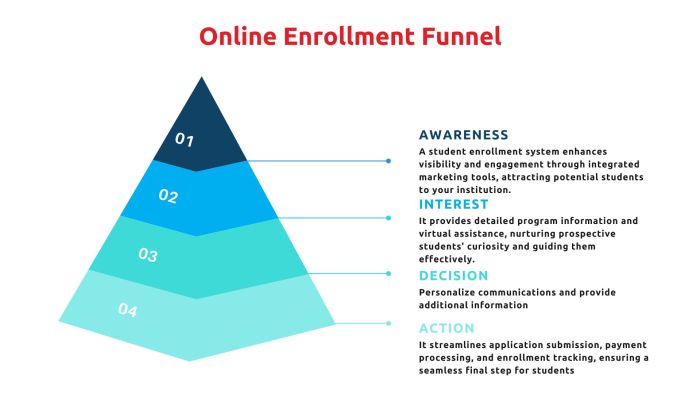
    To maximize the benefits of an online admissions and enrollment system, it’s important to understand the enrollment funnel. What is the process for enrollment? It’s a framework that outlines the four key stages prospective students go through when deciding to enroll at your institution. These include awareness, interest, decision, and action. 

    Awareness is the first stage, where students become familiar with your school through marketing efforts, social media, or word-of-mouth. During this phase, you aim to make a positive impression and highlight what sets your institution apart.

    Interest follows as students actively seek more information about your programs and offerings. At this stage, providing detailed program descriptions, virtual tours, and engaging content becomes crucial to capturing their attention.

    Decision is the third stage, where students weigh their options and determine if your institution aligns with their goals. Clear application processes, transparent cost estimates, and personalized communication can help sway their decision.

    Action is the final stage, where students commit by completing their application and enrollment. An intuitive and efficient online system, like HEM’s Student Portal, ensures this final step is seamless and stress-free, setting the tone for a positive student experience.
    HEM 1HEM 1

    Source: HEM

    1. Simplifying the Application Process

    An online admissions system allows you to simplify and accelerate the application process, providing a smoother experience for prospective students. Instead of requiring students to navigate complex paper forms or disjointed systems, you can offer them a centralized, user-friendly portal where they can complete their applications step-by-step.

    HEM’s Student Portal includes a customizable WYSIWYG (what you see is what you get) form builder, allowing you to tailor applications to your institution’s specific requirements. With options for e-signatures, document uploads, and guided prompts, your students can complete their applications quickly and confidently.

    For administrators, this streamlined process means less time spent tracking incomplete applications and more time focusing on strategic initiatives. You can view, manage, and update application statuses in real time, ensuring nothing slips through the cracks.

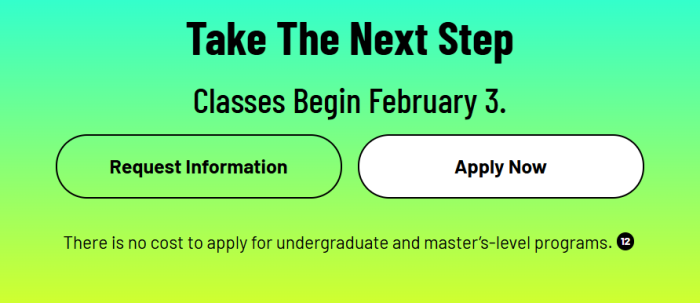
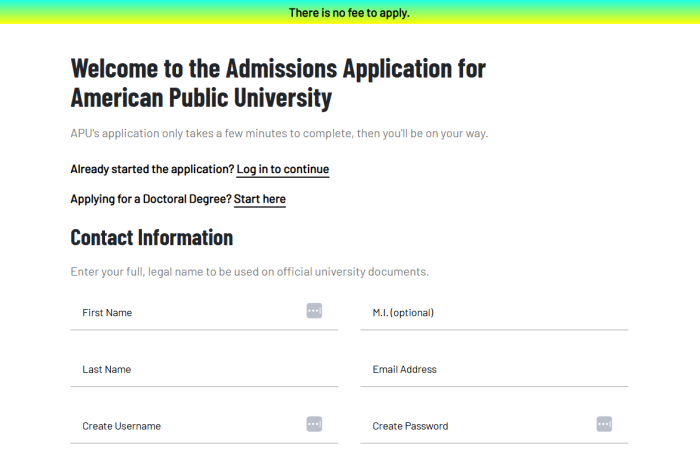
    Example: The key benefit of online enrollment systems regarding the student journey is convenience. Here, American Public University is the perfect example.
    HEM 2HEM 2

    At the click of a button, students can begin their applications.
    HEM 3HEM 3

    They are immediately led to a simple, free application form where they’ll provide vital information needed for the American Public University to determine whether admission into their program will be granted and allow them to track their journey. 

    Source: American Public University 

    2. Enhancing Recruitment Efforts

    With an online system, you can improve how you engage with prospective students from the beginning of their journey. HEM’s Student Portal integrates powerful marketing automation tools, allowing you to nurture leads with personalized communications at every stage of the admissions funnel. You can keep prospective students engaged and informed by sending timely emails, reminders, and updates, increasing their likelihood of completing enrollment.

    Furthermore, the system’s data insights enable you to identify trends in student inquiries, monitor which marketing campaigns are most effective, and adjust your strategies accordingly. This data-driven approach ensures your recruitment efforts are consistently targeted and impactful.

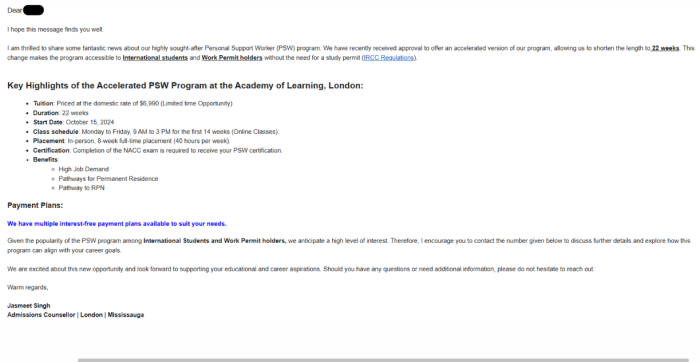
    Example: Once a prospect has filled out a contact form or inquired about a program, they should receive a personalized follow-up message that provides program details and prompts them to follow the next steps.

    Here, the Academy of Learning sends an automated email about its Accelerated PSW Program to a prospect who recently expressed interest. Our Student Portal integrates email and messaging services to facilitate and automate communication with prospects, a key part of the recruitment process.
    HEM 4HEM 4

    Source: Academy of Learning | Gmail

    3. Reducing Administrative Burden

    One of the most immediate benefits of implementing an online admissions and enrollment system is the reduction in administrative workload. Manual processes can be time-consuming and prone to errors, but with an online platform like HEM’s Student Portal, you can centralize all tasks in one intuitive interface. From managing inquiries to processing payments, every step is organized and automated.

    Staff members across departments can collaborate more effectively, ensuring seamless communication and reducing duplication of efforts. The result? A more efficient admissions team with more time to focus on higher-value tasks, such as building relationships with students and refining institutional strategies.

    4. Offering Real-Time Insights

    Making informed decisions is essential in a competitive education landscape, and real-time insights from your admissions system can give you a critical advantage. HEM’s Student Portal provides robust reporting and tracking tools, giving visibility into key metrics such as completed applications, outstanding payments, and enrollment trends.

    Imagine identifying bottlenecks in your process as they happen, enabling you to resolve issues before they escalate. With this level of visibility, you can forecast enrollment numbers more accurately, allocate resources efficiently, and continuously optimize your processes.

    Example: The Student Portal allows you to create comprehensive, updated CRM reports to track enrollment data. Find out what kind of requests are being made, what desired action has been taken, and what’s next.
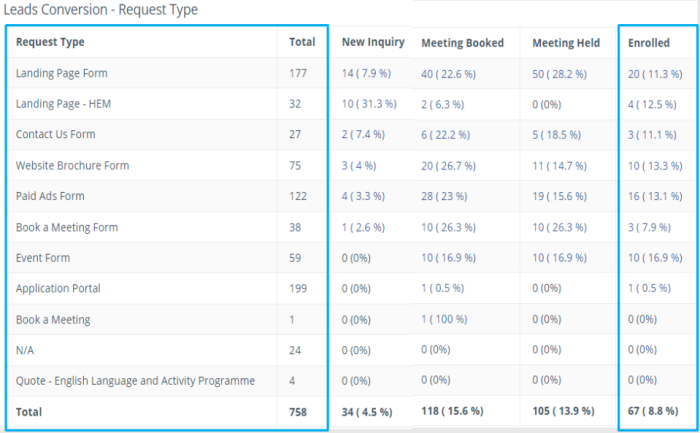
    HEM 5HEM 5

    Source: HEM

    5. Improving Communication and Transparency

    A common frustration for both students and staff in traditional admissions processes is a lack of clarity. With an online system, communication becomes seamless and transparent. Students can log into their portal anytime to check their application status, access important updates, and even chat with a virtual admissions assistant for guidance.

    HEM’s Student Portal goes a step further with its integrated communication tools. From automated notifications to direct messaging capabilities, the platform ensures that every student feels supported and informed throughout their journey. This transparency fosters trust and builds a stronger connection between students and your institution.

    6. Enhancing the Student Experience

    Your admissions process is often the first interaction prospective students have with your institution, making it crucial to leave a positive impression. An online admissions and enrollment system demonstrates that your school values convenience, efficiency, and modern technology, which resonate with today’s tech-savvy students.

    HEM’s Student Portal includes features like virtual admissions assistance and a quote builder, which allows students to estimate program costs upfront. These tools empower students with the information they need to make confident decisions, enhancing their overall experience and reinforcing their trust in your institution.

    Example: The Student Portal prioritizes a seamless experience for students, guiding them from step to step, making it easy to share important files, and providing a full picture of their enrollment journey.
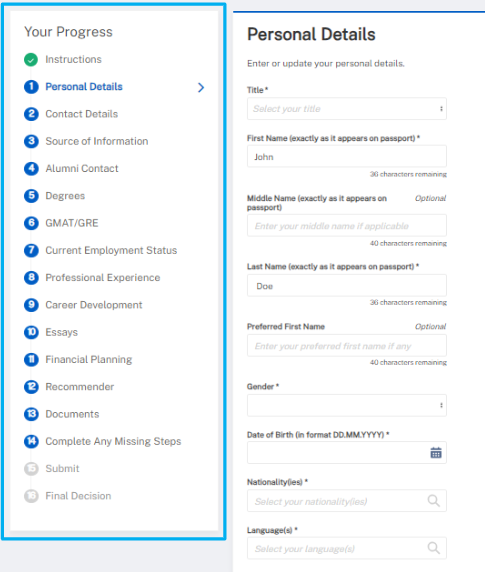
    HEM 6HEM 6

    Source: HEM

    7. Facilitating Financial Planning

    Financial concerns are one of the most significant barriers prospective students face when considering enrollment. You can address these concerns head-on by incorporating tools like HEM’s quote builder and seamless payment gateway integration. The quote builder provides students and their families with transparent cost estimates for tuition and fees, enabling them to plan their finances effectively.

    The payment gateway integration simplifies the payment process, allowing students to make secure transactions directly through the portal. You can also track real-time payment statuses, ensuring that financial records are always current.

    Example: Accademia Italiana Salerno utilizes our Student Portal’s Quote Builder feature, which provides students with a close estimate of their school expenses. Your students will appreciate being able to plan when making a significant investment in their education.
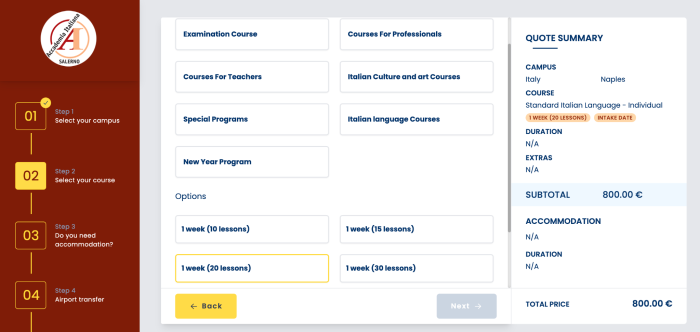
    HEM 7HEM 7

    Source: HEM

    8. Supporting Institutional Flexibility

    Every institution is unique, with its own set of requirements and processes. That’s why customization is essential in any online admissions system. HEM’s Student Portal offers a flexible framework that adapts to your needs, whether you’re managing applications for a university, language school, or K-12 provider.

    You can customize application forms, workflows, and communications to align with your institutional goals. This flexibility ensures that the system serves as a seamless extension of your team rather than a one-size-fits-all solution.

    9. Boosting Efficiency with Integrated Tools

    Efficiency is at the heart of any successful admissions process; integrated tools can make a significant difference. HEM’s Student Portal combines essential functionalities like CRM systems, marketing automation, and data analytics into one centralized platform. This integration eliminates the need for multiple disconnected systems, streamlining your operations and improving collaboration across departments.

    For example, marketing teams can use the portal to track campaign effectiveness, admissions staff can manage inquiries and applications, and financial teams can monitor payments—all within the same system. This level of integration enhances productivity and ensures that every team member has access to the information they need.

    10. Preparing for the Future

    As the education sector evolves, embracing technology is no longer optional but essential! Implementing an online admissions and enrollment system positions your institution as a forward-thinking leader ready to adapt to changing student expectations and market demands.

    HEM’s Student Portal is built with the future in mind, incorporating scalable features that grow with your institution. Whether you want to expand your programs, attract international students, or enhance your digital presence, the portal provides the tools you need to succeed.

    Why Choose HEM’s Student Portal?

    At Higher Education Marketing, we consider ourselves your partners in success. Benefit from the advantages of enrollment system technology, from simplifying application management to enhancing communication and providing real-time insights. Our platform empowers you to transform your admissions process. Request a demo today and discover how HEM’s Student Portal can help you achieve your institutional goals while creating a superior experience for students and staff.

    Simplify student management and boost recruitment efficiency!

    Transform your student portal experience. Get a FREE HEM-SP demo today.

    Frequently Asked Questions

    What does an enrollment system do?

    An online admissions and enrollment system is a digital platform that streamlines student recruitment, application management, and enrollment.

    What is the process for enrollment?

    It’s a framework that outlines the four key stages prospective students go through when deciding to enroll at your institution. These include awareness, interest, decision, and action.

    Source link

  • Inside the Minds of Grad Students: 5 Key Findings from Our Latest Study on Graduate Enrollment

    Inside the Minds of Grad Students: 5 Key Findings from Our Latest Study on Graduate Enrollment

    As a higher education leader, it’s no secret that you’re facing a fiercely competitive graduate enrollment landscape. You know as well as I do that understanding what prospective students want and how they behave isn’t just helpful – it’s crucial to your institution’s success. That’s why we teamed up with UPCEA to conduct a deep dive into today’s post-baccalaureate students, uncovering their unique needs, expectations, and wants.

    We’ve published those insights in our latest report to help colleges and universities fine-tune their graduate enrollment strategies and deliver real results. You can download the complete report here: “Building a Better Pipeline: Enrollment Funnel Needs and Perspectives from Potential Post-Baccalaureate Students“

    Our research focused on individuals who expressed at least some interest in pursuing advanced education, and this study sheds light on what matters most to potential graduate students—everything from program types and communication preferences to application expectations.

    As we dug into the data, some obvious themes emerged. Here are five key findings that can prepare your institution to stand out in this tight market and guide you in shaping strategies that resonate, engage, and deliver results.

    1. Graduate enrollment is a crowded market—and the stakes are high

    This is no surprise to those working in higher ed in recent years. Graduate enrollment is slowing, with just a 1.1% projected increase over the next five years. Adding to the challenge, 20% of institutions dominate 77% of the market. For everyone else, it’s a fierce battle for a shrinking pool of candidates. To win, you’ll need a sharp, focused approach.

    2. Online programs are the clear favorite

    Did you know that 71% of prospective students are “extremely” or “very” interested in fully online programs? Hybrid formats come in a close second, while traditional in-person options are struggling to keep pace. The data confirms that flexibility isn’t a trend—it’s a necessity.

    3. Program information is a make-or-break factor

    Here’s something we see far too often: quality programs losing prospective students simply because critical details—like tuition costs and course requirements—are buried or missing entirely from the school’s website. In fact, 62% of students indicated they would drop off early in their search for this exact reason.

    The fix? It’s simpler than you might think. By optimizing your program pages and doubling down on SEO, you can turn passive visitors into engaged prospects.

    4. Financial transparency builds trust

    Sticker shock is real. High application fees, vague cost information, and limited financial aid details are among the top reasons students abandon the application process late in the game. By addressing these concerns clearly and directly, you’re not just solving a problem, you’re building trust.

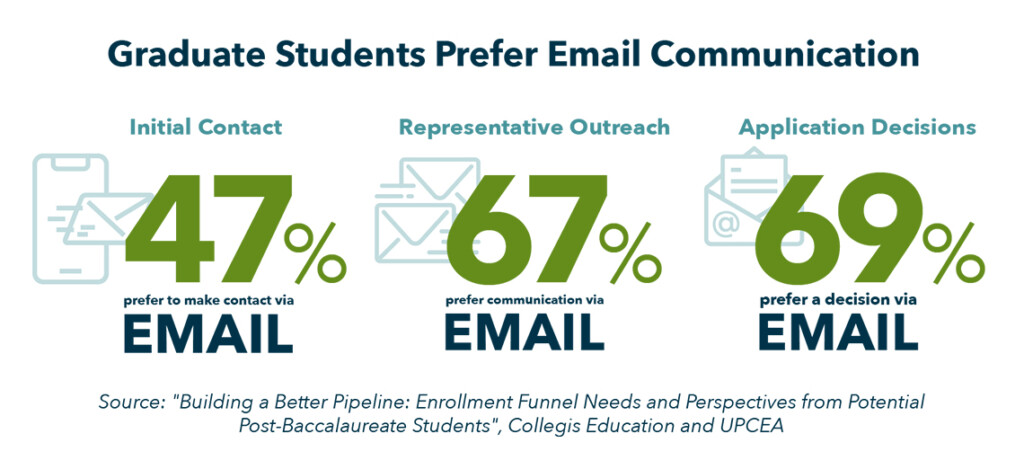
    When it comes to connecting with prospective graduate students, email reigns supreme. Whether it’s inquiring about programs (47%), application follow-ups (67%), or receiving application decisions (69%), email is the channel students trust the most.
    But here’s the catch: your emails have to be timely, personalized, and relevant in order to make an impact.

    The key to graduate enrollment success is just a click away

    The insights highlighted above are just the tip of the iceberg. Imagine what’s possible when you apply them to your graduate enrollment strategy.

    If you’re ready to refine your approach and stay ahead of the curve, we’ve got you covered. Our report dives deeper into the data and uncovers actionable insights, including:

    • Positioning your online and hybrid offerings to meet growing demand
    • Optimizing program pages to emphasize the information students value most
    • Communicating financial information proactively to convert candidates
    • Building email outreach strategies that build trust and keep students engaged

    Grab your complimentary copy of the report today, and let’s start building a better pipeline together!

    Your roadmap to winning in the competitive graduate market.

    Optimize Your Enrollment Funnel

    Get the latest data on graduate student enrollment trends. Download the full report now.

    Source link

  • Case Study: Florida Policy Opening Enrollment for At-Risk Students

    Case Study: Florida Policy Opening Enrollment for At-Risk Students

    Title: The Role of State Policy in Supporting Students Experiencing Homelessness and Former Foster Youth in Higher Education

    Authors: Carrie E. Henderson and Katie Grissom

    Source: The Urban Institute

    Paying for a college degree is already a difficult, complex process for many students involving a variety of sources of financial aid and payment. For students with a history of foster care or housing instability, this task becomes even more challenging given the lack of financial and social support they experience growing up.

    To properly support these students, policymakers and higher education administrators need to create educational environments that go beyond teaching and learning to prioritize access to essential resources and socioeconomic conditions that can provide stability in students’ lives. State policy can provide critical opportunities to open pathways for students and address the personal, emotional, and logistical challenges that students face. A new report from the Urban Institute explores how the Florida state legislature took steps to enhance access to postsecondary education for homeless students and former foster youth and how it affected higher education attainment.

    Key findings include:

    New state policies expanded tuition and fee exemptions: In 2022, the Florida legislature created policies that expanded the eligibility for tuition and fee exemptions to match the federal definition of homeless children and youth and include students who had been involved in shelter, dependency, or termination of parental rights proceedings.

    Increase in tuition and fee exemptions rose since implementation: The data Florida collected showed an upward trend in the use of the homelessness fee exemption in both the Florida College System (FCS) and the State University System (SUS) between 2021-22 and 2023-24. In the FCS in 2023-24, the number of exemptions increased by 103 percent since 2021-22, from 689 to 1,396. SUS institutions experienced more incremental growth, as homelessness exemptions increased from 344 in 2021-22 to 432 in 2023–24, a 26 percent increase.

    Tuition and fee exemptions can reduce the financial burden of postsecondary education, making it more affordable and attainable for students from disadvantaged backgrounds. However, policymakers considering exemptions and subsidies should include dedicated funding to help institutions of higher education implement these services effectively. Without additional funding, colleges and universities lack the supplemental resources to implement policies feasibly. Furthermore, policymakers should listen to and work with administrators to fund holistic wraparound services that impact students’ ability to enroll, persist, and succeed in higher education.

    To read the full report from the Urban Institute, click here.

    —Austin Freeman


    If you have any questions or comments about this blog post, please contact us.

    Source link

  • Enrollment Trending Upward After COVID-19

    Enrollment Trending Upward After COVID-19

    Title: Current Term Enrollment Estimates: Fall 2024

    Source: National Student Clearinghouse Research Center

    Total fall 2024 enrollment rose across multiple factors—including sector, selectivity, and urban-rural classification—bringing it closer to pre-pandemic levels, according to a new report from the National Student Clearinghouse Research Service. Compared to fall 2019, overall enrollment increased by 0.4 percent, and compared to fall 2023, it grew by 4.5 percent.

    Enrollment gains were particularly strong in associate programs (up 6.3 percent), bachelor’s programs (up 2.9 percent), master’s programs (up 3.3 percent), and doctoral programs (up 2.0 percent). Private for-profit four-year institutions saw the most significant increase in first-year enrollment, surging by 26.1 percent with more than 11,000 additional students. Public institutions also experienced notable growth, with primarily associate degree-granting baccalaureate institutions up 8.4 percent and public two-year institutions increasing by 6.8 percent.

    First-year enrollment overall grew by 5.5 percent, with the most significant gains among students from the lowest-income neighborhoods (up 9.4 percent). Enrollment increases were generally aligned with neighborhood income levels, with students from the highest-income areas seeing the smallest rise (3.6 percent).

    At Historically Black Colleges and Universities, enrollment increased at both the graduate (6.5 percent) and undergraduate (3.4 percent) levels. Meanwhile, public four-year institutions in rural areas experienced the largest enrollment growth (5.6 percent), while public two-year institutions saw the biggest increases in towns (7.9 percent). Urban areas continued to enroll the most students at public two-year institutions, surpassing 2.3 million.

    Patterns of growth varied across selectivity and sector. Less selective private nonprofit four-year institutions saw the most substantial gains (5.7 percent), with similar increases at less selective public four-year institutions (5.0 percent). Enrollment at highly selective institutions followed a different trend, rising at public four-year institutions (2.9 percent) but declining at private nonprofit institutions (-2.5 percent).

    Regionally, enrollment increased at similar rates in the Northeast, South, and West (4.7 percent each) and rose by 3.1 percent in the Midwest. Utah led the nation in enrollment growth (12.1 percent), while the District of Columbia (-1.9 percent), Vermont (-0.6 percent), and Nebraska (-0.4 percent) saw declines. Graduate enrollment patterns diverged in some areas, with notable decreases in Mississippi (-4.3 percent), Delaware (-3.9 percent), and Missouri (-3.4 percent).

    Fields of study also showed shifts, with undergraduate enrollment in health professions rising 8.3 percent—effectively reversing pandemic-related declines. Among the top 20 major fields, only two saw decreases: Liberal Arts and Sciences, General Studies, and Humanities (-3.1 percent) and English Language and Literature/Letters (-1.5 percent).

    This data provides an encouraging outlook for higher education. Understanding who is enrolling and where is essential for institutional planning and for ensuring equitable access to higher education.

    To explore the data, click here. For the methodology, click here.

    —Erica Swirsky


    If you have any questions or comments about this blog post, please contact us.

    Source link

  • How to Build a Dynamic Student Enrollment Plan That Thrives Amid Change

    How to Build a Dynamic Student Enrollment Plan That Thrives Amid Change

    Key Takeaways:

    • Evolving student enrollment strategies require proactive, data-informed approaches that adapt to demographic shifts, economic pressures, and market dynamics.
    • Real-time metrics and prescriptive analytics enable institutions to refine recruitment strategies, address challenges quickly, and optimize enrollment outcomes.
    • Flexible tools and predictive modeling help mitigate disruptions, align team efforts, and support personalized student engagement.
    • Continuous refinement ensures institutions can navigate uncertainties, maintain competitive student enrollment plans, and prepare for future challenges.

    Higher education is in constant flux, primarily driven by student demographic shifts, economic pressures, and rapid technological advancements. For institutions to stay competitive in this environment, student enrollment strategies must evolve. By embracing a consistent, data-informed, and adaptable enrollment management approach, institutions can navigate current and unforeseen uncertainties and meet their enrollment goals.

    A Forward-Looking Approach to Enrollment Strategies

    Traditional enrollment strategies often rely on rearview analyses, evaluating successes and missteps only at the end of an enrollment cycle. However, the dynamic nature of student recruitment today demands a more proactive approach. Institutions must adopt prescriptive analytics to “look through the windshield,” using real-time data to understand how current strategies are performing and make adjustments on the fly. This forward-thinking approach allows enrollment managers to:

    • Identify what is working and what needs refinement during the current recruitment cycle.
    • Test potential strategies against historical data to predict their effectiveness before implementation.
    • Address emerging challenges quickly, such as unexpected FAFSA delays or shifts in application behavior.
    • Develop broad tactics to adapt to changes throughout the enrollment cycle as well as adjust to shifting dynamics with individual students.

    Such adaptability requires not just access to the right data but also the tools and expertise to act on it effectively. The combination of robust technology platforms, such as Liaison’s predictive analytics tool Othot, and experienced partners who understand the nuances of higher education can make all the difference. By integrating analytics and expert guidance, institutions can respond to challenges with precision and agility.

    Data-Informed Metrics for Strategic Refinement

    To optimize their student enrollment plans, institutions must evaluate specific metrics at each stage of the recruitment process. This means aligning data evaluation with the student journey, focusing on key performance indicators (KPIs) that matter most at each stage:

    · Search phase | Metrics such as inquiry volume, lead conversion rates, and source effectiveness provide insight into initial interest in the institution and the success of outreach efforts.

    · Application phase | Metrics such as application volume, completion rates, and demographic trends help institutions understand the reach and appeal of their efforts.

    · Yield phase | Yield rates and admitted student feedback provide insights into how students perceive the institution’s value.

    · Enrollment phase | Deposit rates and engagement tracking reveal which admitted students are likely to matriculate, enabling targeted follow-ups.

    Different variables also emerge during the cycle that require immediate action. For example, when unexpected disruptions such as a sudden change in application deadlines or a major shift in funding policies occur, enrollment leaders must have the tools and knowledge to not only pivot their strategies to address the issues at hand but also effectively predict the results of those changing approaches in real-time. This requires a flexible data infrastructure that can accommodate real-time adjustments.

    Overcoming Challenges Through Continuous Adaptation

    Flexibility is a nonnegotiable trait for enrollment management teams. The new realities of a post-pandemic world, declining high school graduating classes, and a highly competitive marketplace are significantly challenging existing strategies. The pressure to meet enrollment goals often comes with internal changes—such as staff turnover or shifts in leadership priorities—and external pressures like economic downturns or new legislation.

    • Turnover and continuity | Staff turnover can disrupt institutional momentum, particularly when strategies are person-dependent rather than system-driven. Tools such as Othot provide consistency by embedding critical data insights and processes into the institution’s framework, reducing the impact of turnover and fostering a culture of data-informed decision-making.
    • Adapting to unexpected variables | Challenges like sudden changes in funding or board directives require immediate adjustments. By leveraging “what-if” scenario modeling, institutions can simulate the impact of potential changes and make informed decisions quickly.

    Strategies to Increase Student Enrollment

    Strategic flexibility can make the difference between hitting enrollment targets and falling short. Institutions can take several steps to continuously refine their strategies:

    1. Monitor trends in real-time | Stay ahead of shifts in student behavior by regularly reviewing metrics such as engagement rates, application trends, and deposit patterns.

    2. Incorporate scenario planning | Use predictive tools to simulate how changes in funding, messaging, or outreach might impact enrollment outcomes.

    3. Align collaboration across teams | Align data and strategy efforts across departments to create a unified approach to enrollment management.

    4. Personalize student engagement | Tailor communication based on individual student data, ensuring that messaging resonates with their unique needs and interests.

    By integrating these strategies into their student enrollment plans, institutions can adapt to changing circumstances while maintaining a steady focus on meeting their overall long-term enrollment goals.

    Staying Ahead in a Dynamic Environment

    Continuous refinement isn’t just about meeting immediate needs—it’s about preparing for the future. Institutions that embrace adaptability, leverage data strategically, and invest in both technology and expertise are better positioned to succeed in today’s competitive higher education market.

    Whether it’s managing the challenges of staff turnover, responding to external pressures, aligning all your enrollment tools at hand, or identifying the most effective ways to engage prospective students, institutions must prioritize flexibility and innovation.

    With Liaison’s advanced tools and expert partnership, institutions can confidently navigate the complexities of data-driven enrollment management and set the stage for sustained success. Contact us today to get started.


    About the Author

    Craig Cornell is the Vice President for Enrollment Strategy at Liaison. In that capacity, he oversees a team of enrollment strategists and brings best practices, consultation, and data trends to campuses across the country in all things enrollment management. Craig also serves as the dedicated resource to NASH (National Association of Higher Education Systems) and works closely with the higher education system that Liaison supports. Before joining Liaison in 2023, Craig served for over 30 years in multiple higher education executive enrollment management positions. During his tenure, the campuses he served often received national recognition for enrollment growth, effective financial aid leveraging, marketing enhancements, and innovative enrollment strategies.

    Source link

  • First-year student enrollment spiked 5.5% in fall 2024

    First-year student enrollment spiked 5.5% in fall 2024

    This audio is auto-generated. Please let us know if you have feedback.

    Dive Brief: 

    • Enrollment of first-year students grew 5.5% in fall 2024 compared to the year before, representing an increase of about 130,000 students, according to a final tally from the National Student Clearinghouse Research Center
    • The figure is a striking reversal from the clearinghouse’s preliminary findings in October, which erroneously reported a decline in first-year students. Earlier this month, the clearinghouse said the early data contained a research error and suspended its preliminary enrollment reports, which use different methodologies to determine first-year student counts than the research center’s reports on final enrollment figures. 
    • College enrollment overall grew 4.5% in fall 2024 compared to the year before, according to the final data, rebounding to levels seen before the coronavirus pandemic caused widespread declines. 

    Dive Insight: 

    The new data is promising for higher education institutions, many of which have weathered steep enrollment declines in the wake of the pandemic. 

    “It is encouraging to see the total number of postsecondary students rising above the pre-pandemic level for the first time this fall,” Doug Shapiro, the research center’s executive director, said in a Wednesday statement. 

    Undergraduate enrollment surged 4.7% this fall, representing an increase of about 716,000 students. Graduate enrollment likewise spiked 3.3%, representing an uptick of about 100,000 students. 

    All sectors enjoyed enrollment increases. For-profit, four-year institutions had the largest enrollment growth, with headcounts rising 7.5% in fall 2024 compared to the year before. Public two-year institutions and public primarily associate-degree granting baccalaureate institutions, or PABs, saw similar levels of growth — 5.8% and 6.3%, respectively. 

    Enrollment also increased at four-year nonprofits. Overall headcounts grew 3.8% at private colleges and 3.1% at public institutions. 

    Older students largely drove the growth in first-year students. Enrollment of first-year students from ages 21 to 24 surged 16.7% in fall 2024, while headcounts of students 25 and older spiked by a whopping 19.7%. 

    Enrollment of younger first-year students also increased, though the growth was more muted. 

    Headcounts of 18-year-old students grew 3.4%. However, this group of first-year students has still not recovered to pre-pandemic levels, Shapiro said in a statement.

    Similarly, enrollment of first-year students ages 19 to 20 increased 4.5%. 

    Two-year public colleges and public PABs enjoyed strong increases in their first-year student population, with 6.8% and 8.4% growth, respectively. However, for-profit, four-year colleges saw the largest increase, 26.1%, according to the new data. 

    Headcounts of first-year students also spiked at four-year nonprofits, rising 3.3% at public institutions and 2.8% at private colleges. 

    Shapiro addressed the research center’s methodological error during a call Wednesday with reporters. The erroneous preliminary report found that first-year enrollment had declined by 5% — over 10 percentage points lower than what the final data showed. 

    “I think our sensitivity to abnormally large changes was somewhat reduced because we had a host of kind of ready explanations for why we might be seeing these declines,” Shapiro said, citing issues with the federal student aid form, growing concerns with student debt and changes in the labor market.

    The research center staff has been investigating its other publications to see if the issue crept into them. 

    So far, they discovered that the flawed methodology also impacted a February 2024 report on transfer students. The clearinghouse will correct that data when it issues its next transfer report in February. 

    The research center previously announced that the error affected other reports in its “Stay Informed” series, which shares preliminary enrollment data. It has halted those reports — which launched at the height of the pandemic — until it vets a new methodology.

    Source link

  • This week in numbers: Clearinghouse retracts first-year enrollment data

    This week in numbers: Clearinghouse retracts first-year enrollment data

    We’re rounding up recent stories, including a methodology mea culpa and billions of dollars in discharged loan debt.

    Source link

  • Freshman enrollment up this fall; data error led to miscount

    Freshman enrollment up this fall; data error led to miscount

    Freshman enrollment did not decline this fall, as previously reported in the National Student Clearinghouse Research Center’s annual enrollment report in October. On Monday, the NSC acknowledged that a methodological error led to a major misrepresentation of first-year enrollment trends, and that first-year enrollment appears to have increased.

    The October report showed first-year enrollments fell by 5 percent, in what would have been the largest decline since the COVID-19 pandemic—and appeared to confirm fears that last year’s bungled rollout of a new federal aid form would curtail college access. Inside Higher Ed reported on that data across multiple articles, and it was featured prominently in major news outlets like The New York Times and The Washington Post.

    According to the clearinghouse, the error was a methodological one, caused by mislabeling many first-year students as dual-enrolled high school students. This also led to artificially inflated numbers on dual enrollment; the October report said the population of dually enrolled students grew by 7.2 percent.

    “The National Student Clearinghouse Research Center acknowledges the importance and significance of its role in providing accurate and reliable research to the higher education community,” Doug Shapiro, the center’s executive director, wrote in a statement. “We deeply regret this error and are conducting a thorough review to understand the root cause and implement measures to prevent such occurrences in the future.”

    On Jan. 23, the clearinghouse will release another annual enrollment report based on current term estimates that use different research methodologies.

    The Education Department had flagged a potential issue in the data this fall when its financial aid data showed a 5 percent increase in students receiving federal aid. In a statement, Under Secretary James Kvaal said the department was “encouraged and relieved” by the clearinghouse’s correction.

    Source link

  • Moving Beyond New Year’s Resolutions to Embrace a Multi-Year Enrollment Strategy 

    Moving Beyond New Year’s Resolutions to Embrace a Multi-Year Enrollment Strategy 


    Developing New Year’s resolutions for personal growth is something many of us do. Unfortunately, it is often a set-it and forget-it process that is simply reupped the following year. When done correctly, however, creating a resolution that is developed as a sustained, long-term strategy—and that is regularly returned to and adjusted as needed—seems to be the best way to meet our personal goals.  
     
    As enrollment managers, we all have pursued the first approach in our professional lives by evaluating last year’s successes and failures annually, making a few tweaks, and then seeing how it all works out again the following year. The truth of the matter is that this approach was relatively sustainable for a time. Simply buying more names, adjusting the aid-leveraging model annually, or a developing a wider marketing plan often could drive greater enrollments—mostly because those tactics generally were designed to “add more fuel to the fire.” As long as the applications continued to grow, annual tweaks could help to maintain the core enrollments as well as improve on the margins for many institutions.  


    The Need for More Effective Strategic Enrollment Strategies

    Unfortunately, outside of key private and public flagship institutions, headwinds have developed over the past decade that are affecting higher education enrollments in significant ways. Ultimately, they may lead to campus closures for some, and to campus financial distress for many. As outlined in a paper from the Federal Reserve Bank of Philadelphia, “Predicting College Closures and Financial Distress,” those pressures include:

    • Post-pandemic enrollment challenges from traditional students (decreasing 15% from 2010-2021).


    • Changes among adult learners (“The number of adult students over the age of 25 has fallen by nearly half since the Great Recession”).


    • Growing competition.


    • A lack of public support for higher education nationally. 

    The combination of all these factors has brought about the need for enrollment managers to develop a wider multi-year strategy that includes tools with the ability to enable deeper, more highly data-informed fine tuning throughout any given cycle. A one-size-fits-all approach to creating a nuanced strategy can no longer work in an environment of shrinking applications and increased competition. 


    Liaison’s Partnership Philosophy

    Liaison is uniquely positioned to assist with higher education institutions in a true partnership. With the technology, services, and consultative approach that we provide our partners throughout the nation, we can assist in developing a comprehensive enrollment approach unique to your campus—ranging from single-point to full-enrollment planning solutions that are uniquely tailored to your unique needs. Liaison’s partnership philosophy, technology solutions, and industry knowledge and insights can not only help strengthen your enrollment planning and goals for this year but also set you up for long-term enrollment success.  


    Craig Cornell is the Vice President for Enrollment Strategy at Liaison. In that capacity, he oversees a team of enrollment strategists and brings best practices, consultation, and data trends to campuses across the country in all things enrollment management. Craig also serves as the dedicated resource to NASH (National Association of Higher Education Systems) and works closely with the higher education system that Liaison supports. Before joining Liaison in 2023, Craig served for over 30 years in multiple higher education executive enrollment management positions. During his tenure, the campuses he served often received national recognition for enrollment growth, effective financial aid leveraging, marketing enhancements, and innovative enrollment strategies.

    Source link

  • 2025 Higher Education Trends: What to Watch & How You Can Plan

    2025 Higher Education Trends: What to Watch & How You Can Plan

    Higher education is experiencing transformative shifts as institutions respond to societal, economic, and technological changes. This year is set to bring new opportunities and challenges. We’re always keeping a pulse on the industry and where it’s headed so we can stay proactive and prepared –– ready to support our partners through whatever conditions they’re facing.

    10 most impactful higher ed trends for 2025

    To help institutions stay ahead, we asked our team of experts to share their predictions for this year’s most impactful trends in higher education. From AI and digital transformation to new enrollment strategies, these insights highlight what’s shaping the future of higher ed— and how institutions can adapt.

    1. Increased mergers and consolidations

    The pace of mergers and consolidations among smaller colleges is expected to accelerate in 2025, according to Collegis Education CEO Kim Fahey. With financial pressures and declining enrollment, many institutions will view mergers as a strategic alternative to closure. But these transitions are anything but simple.

    “Mergers involve unique technology requirements and complex data management challenges,” Fahey explains. Successfully integrating applications, systems, and hardware requires expert guidance. Higher ed leaders will look to partner with experienced organizations to help navigate these intricacies.

    2. Heightened focus on data privacy and security

    The information security landscape is becoming increasingly intricate. With 21 comprehensive state privacy laws, alongside European Union (EU) regulations, federal rules, and Title IV requirements, compliance challenges are mounting.

    “Smaller schools often lack the experience and qualifications to manage these threats,” notes Dr. Jason Nairn, CISSP, Collegis VP of Information Technology. Cyberattacks, like phishing and social engineering, are relentless. In 2025, institutions must prioritize more robust cybersecurity measures, leveraging external partnerships and security tools to protect sensitive data.

    3. Acceleration of digital transformation

    Cloud migration will take center stage as institutions transition away from outdated, on-campus systems. While many schools still rely on highly customized platforms, which limits their ability to adopt or migrate to more modern technology, the adaptability and scalability of cloud platforms are simply too compelling to ignore.

    Furthermore, technology infrastructures must be sufficiently modernized in order to capitalize on emerging tech innovations in AI and predictive analysis. This process can’t happen overnight –– it’s an evolution, according to Fahey.

    “Cloud migrations take 18+ months, so schools need to act now,” she emphasizes. An institution-wide commitment to digital transformation will not only modernize operations but also position institutions to stay competitive in an increasingly tech-driven environment.

    4. Adoption of shared services models

    Financial constraints will push smaller schools toward shared services and consortium models to access the technology and expertise they need at a manageable scale. These models allow institutions to pool resources and reduce costs but require significant change management, according to Jeff Certain, VP of Solution Development at Collegis.

    “This will require schools to standardize and make some concessions,” Certain explains. “This could pose a challenge, but they may not have an option.” Institutions must embrace these shifts to remain sustainable while navigating limited budgets.

    5. Growth in career-focused and flexible education

    Programs aligning with workforce needs will gain momentum in 2025. Alternative credentials like microcredentials and certificates will become more prominent, offering shorter, career-oriented pathways for learners.

    “Institutions will increasingly recognize and credit learning outside the classroom, exploring more direct pathways into the workforce,” predicts Dr. Tracy Chapman, Chief Academic Officer for Collegis. This reflects growing demand for flexible, career-focused education that meets student and employer expectations.

    6. Ed tech consolidation and market impact

    It is not just colleges and universities facing consolidation. Ed tech companies and services providers are also reshaping the landscape with their own mergers and acquisitions. While these changes may offer schools more comprehensive solutions, they may not necessarily align with institutional objectives.

    “Some recent acquisitions have led to poorer customer experiences,” Fahey observes. Institutions must carefully evaluate new partnerships to ensure they will deliver meaningful improvements.

    7. Higher Focus on Retention

    With the “enrollment cliff” looming, institutions must double down on maintaining their existing student base as a key to sustainability. Purposeful and cost-effective retention strategies will play a pivotal role in maintaining financial health, as retaining current students is often more cost-effective than recruiting new ones.

    “Retention strategies build stronger, more loyal communities,” says Patrick Green, VP of Enrollment Strategy. Forward-looking schools have perceived the importance of fostering a sense of belonging across the student lifecycle and are providing robust support networks that improve student persistence and satisfaction.

    8. Rise of value-focused marketing

    Students and families are increasingly demanding clear ROI from their education. As a result, institutions will need to demonstrate how their programs lead directly to employment and career advancement.

    “Building relationships with regional industries and showcasing job placement rates will be essential,” advises Tanya Pankratz, AVP of Marketing at Collegis. Marketing efforts will need to start highlighting tangible outcomes (e.g., alumni success stories, job placement rates, and employer partnerships) to win over prospective students.

    9. Expanded role of AI and emerging technologies

    AI and other emerging technologies will revolutionize higher education operations. From enrollment management and personalized marketing to virtual campus tours using augmented reality (AR) and virtual reality (VR), technology has the means to dramatically enhance the student experience –– or wreak technical havoc if data, platforms and tools are misaligned.

    “AI-driven tools make personalization more accessible, but the strategy remains critical,” notes Dan Antonson, AVP of Data and Analytics. Institutions must invest in data infrastructure to fully harness these advancements in order to build and maintain a competitive edge.

    10. Proliferation of strategic partnerships

    Higher ed institutions are increasingly recognizing that they don’t need to own the entire value chain. In 2025, strategic partnerships will play a more prominent role.

    “Institutions will double down on their core mission of education and seek out partners to support other critical functions,” Dr. Chapman explains. These partnerships provide access to technology, expertise, and resources, allowing schools to focus on what they do best — educating students.

    Opportunities on the horizon for higher ed

    As evident in this compilation of higher ed trends, the landscape is set for significant change in 2025 and beyond. Institutions that proactively address these trends will be well-positioned to navigate challenges and seize opportunities. By embracing digital transformation, fostering strategic partnerships, and adopting value-driven approaches, schools can ensure long-term success in an evolving marketplace.

    Excited about the opportunities that lie ahead? Collegis Education has the experience and expertise to guide you through any twists and turns you may face. We’ll help you stay on the leading edge instead of chasing trends. Connect with us and let’s start creating solutions together.

    Innovation Starts Here

    Higher ed is evolving — don’t get left behind. Explore how Collegis can help your institution thrive.

    Source link