Tag: Environmental

  • Empowering youth through environmental storytelling

    Empowering youth through environmental storytelling

    Through storytelling, we can bring climate-related data to life. Through storytelling, young people can use their voice and the voices of those around them to turn something complex, global and overwhelming, into something local, tangible and meaningful. Through storytelling, young people can help shift narratives and bring to the forefront stories of action and of hope.

    This is the idea behind the EYES climate storytelling curriculum.

    Now available on the eyesonclimate.org website, the curriculum is the culmination of the Empowering Youth through Environmental Storytelling project (EYES), an Erasmus+ co-funded project by News Decoder, The Environment and Human Rights Academy (TEHRA) and Young Educators European Association.

    The Climate Change 101 unit begins with the basics: human activities driving climate change and what temperature increase means for our planet. Students are tasked with producing an article that explains the topic to a younger audience.

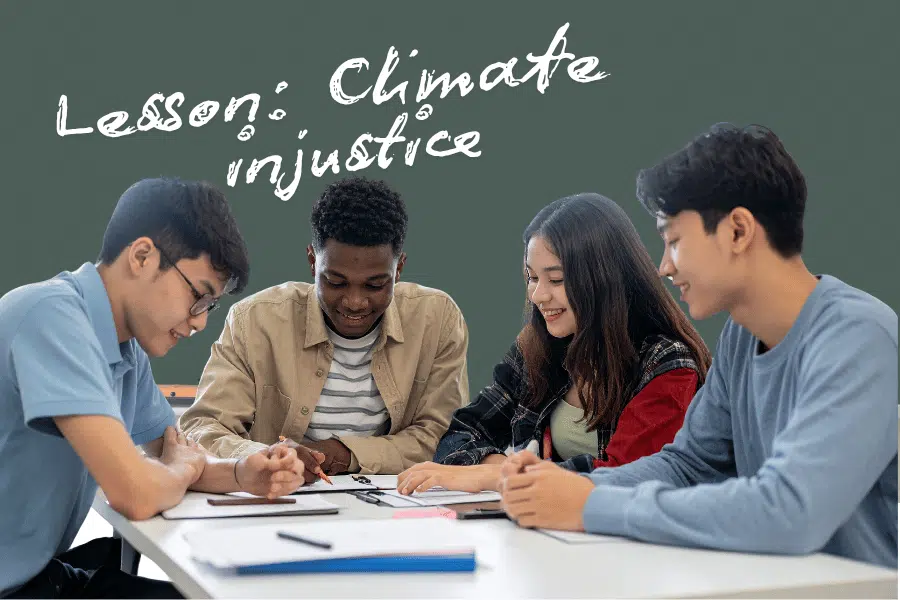
    A unit on Climate Injustice walks students through the uncomfortable reality that those causing climate change are suffering the least from its impacts. Those who have contributed the least? They tend to be in the grip of climate change.

    Human stories from a man-made disaster

    We know that learning about the devastations of the climate crisis can leave young people feeling anxious and angry. We also know from the teachers who piloted the EYES curriculum that it’s important to localise these topics.

    So in the Climate Injustice unit, students are tasked with finding a human story: someone to illustrate climate injustice at play in their local area or region.

    Hearing stories about people lets us understand the reality of an issue. Telling these stories gives young people a device for meaning-making and a platform for agency.

    In our Systemic Change unit, students learn about the interconnected mechanisms that keep our economy rooted in endless economic growth and fossil fuel use. They learn about the ‘deep’ leverage points for making change — the rules, the goals and the mindset of a system. They research case studies on commodity supply chains and form their questions into a story pitch.

    Our curriculum runs across school subjects for students between 15 and 18 years of age. Other units include: Tipping Points, Planetary Boundaries, Human–Nature Connection, The Carbon Budget, Doughnut Economics and a Climate Justice Case Study.

    Solutions are out there.

    In Systemic Solutions to the Climate Crisis, we showcase seven inspiring examples of climate solutions from around the world, from local projects such as community-owned solar panels in Mexico to the transition to renewables in Uruguay, to global movements such as recognising the rights of nature or degrowth in the Global North.

    Meaningful action can happen at any scale. By engaging with these case studies, students can see that stories of just and transformative systems change happen all around them.

    There are so many stories yet to be told, and that in itself is empowering.

    To bolster student projects, the curriculum includes units on journalism and storytelling: The Principles of Journalism, Fact Checking and Misinformation, Interviewing and How to Write a Pitch, Write an Article and Produce a Podcast.

    “Storytelling can turn young people into active users of climate knowledge, and even change makers,” said Andreea Pletea, The Environment and Human Rights Academy programme manager. “Students can even help shift dominant narratives by bringing to the surface systemic solutions to the environmental crises that also address inequalities.”

    Causes and systems

    Aside from storytelling, the main focus of the EYES curriculum is on systems thinking and climate injustice.

    “We invite learners to go upstream to the root causes of the crises we face, and question why, despite increasing awareness, meaningful action often lags behind,” Pletea said. “Seeing the big picture particularly through systems thinking and global justice can also help young people make sense of what’s going on in their own local context.”

    Pletea said that ultimately, the goal is to plant a seed. “That all of us, including young people, are more than consumers,” she said. “We are citizens with a voice and power to act and demand change, and especially when we come together.”

    The EYES project itself began as a seed. TEHRA and News Decoder came together to improve climate change education through storytelling, and created a set of materials that were piloted in multiple education contexts across Europe, Africa and Latin America.

    The seeds to stories

    In Slovenia, Kenya and Colombia, pilot students exchanged letters on their local experiences of climate change. In Kosovo, a Roma community of young people visualised their personal experience of climate change through art.

    At a summer camp in Belgium, students played climate change games, pulled apart the individual carbon footprint and were guided through a nature meditation. In Kenya, students visited the precious Karura national park and wrote stories about tipping points and the value of forests.

    The feedback from students and educators, including at a three-day educators workshop in Brussels in October, helped shape and restructure the curriculum. It evolved into a set of off-the-shelf resources that can be used by multiple teachers in one school or independently by learners.

    If you are an educator, we invite you to dive into climate change with your students and use the EYES curriculum. Students need to learn about the root causes of the climate crisis so that they know in which direction to head — in their future careers as much as in their personal set of values.

    Through storytelling, young people can engage with the reality that is climate change, both as authors and as listeners. Storytelling is the way we understand ourselves: why we act the way we do and how together we can solve the problems that humankind has caused.


    Questions to consider:

    1. How can storytelling can turn someone into an active user of climate knowledge?

    2. What types of climate activities did students in different countries do through the EYES lessons?

    3. What stories about climate change have you found interesting to read or hear about?


    Source link

  • Colleges build environmental lessons into degrees

    Colleges build environmental lessons into degrees

    by Olivia Sanchez, The Hechinger Report
    November 5, 2025

    LA JOLLA, Calif. — On a Thursday this fall, hundreds of students at the University of California, San Diego, were heading to classes that, at least on paper, seemed to have very little to do with their majors. 

    Hannah Jenny, an economics and math major, was on their way to a class on sustainable development. Angelica Pulido, a history major who aspires to work in the museum world, was getting ready for a course on gender and climate justice. Later that evening, others would show up for a lecture on economics of the environment, where they would learn how to calculate the answer to questions such as: “How many cents extra per gallon of gas are people willing to pay to protect seals from oil spills?”

    Although most of these students don’t aspire to careers in climate science or advocacy, the university is betting that it’s just as important for them to understand the science and societal implications of climate change as it is for them to understand literature and history, even if they’re not planning to become writers or historians. UCSD is perhaps the first major public university in the country to require all undergraduate students to take a class on climate change to earn their degree. 

    The requirement, which rolled out with first-year students last fall, came about because UCSD leaders believe students won’t be prepared for the workforce if they don’t understand climate change. Around the globe, global warming is already causing severe droughts, water scarcity, fires, rising sea levels, flooding, storms and declining biodiversity; leaders at UCSD argue every job will be affected. 

    And even as President Donald Trump dismisses climate change as a hoax and cancels funding for research on it, other colleges are also exploring how to ensure students are knowledgeable about the subject. Arizona State University began requiring that students take a class in sustainability last year, while San Francisco State University added a climate justice class requirement to begin this fall. 

    “You can’t avoid climate change,” said Amy Lerner, a professor in the urban planning department at UCSD. “You can’t escape it in the private sector. You can’t escape it in the public sector. It’s just everywhere.” Students, she said, must be made ready to engage with all of its likely consequences.

    Related: Want to read more about how climate change is shaping education? Subscribe to our free newsletter.

    UCSD, a public university that serves roughly 35,000 undergraduate students, is not demanding that everyone sign up for Climate Change 101. Instead, students can fulfill the requirement by taking any of more than 50 classes in at least 23 disciplines across the university, including sustainable development, the course Jenny is taking. 

    There’s also psychology of the climate crisis, religion and ecology, energy economics, and several classes in the environmental science and oceanography departments, among others. And leaders at the university are working to develop more classes that satisfy the requirement, including one on the life cycle of a computer.

    Bryan Alexander, an adjunct professor at Georgetown University and author of a book on higher education and the climate crisis, said that while colleges have long taught about climate change in classes related to ecology, climatology and environmental science, it’s only been in the last decade or so that he’s seen other disciplines tackle the topic. 

    Climate change, Alexander said, “is the new liberal arts” — and colleges should take it seriously. 

    K. Wayne Yang, a UCSD provost who served on the original group that advocated for the requirement, said every industry and career field will experience the effects of climate change in some way. Health care providers need to know how to treat people who have been exposed to extreme heat or wildfire smoke; psychologists need to understand climate anxiety; and café owners need to know how the price of coffee changes in response to droughts or other natural disasters in coffee-growing regions.  

    Jenny, the senior taking a class on sustainable development, is eager to get answers to a question that has, in their three years as an economics and mathematics major, become difficult not to ponder: How can economic growth be the silver bullet of societal change if it has so many negative consequences for the planet?

    “It’s definitely my hope that this is a class that will teach me something new about how to consider humanity’s path forward without destroying this earth, without destroying each other, without sacrificing quality of life for any person on this planet,” Jenny said. 

    Jenny isn’t subject to the requirement because they entered college before it rolled out. But they said they like the idea of encouraging students to step outside their comfort zones and fields of study and, in many cases, consider their future career paths in the context of the changing climate.

    Other students, like junior Pulido, don’t see a specific link between climate change and their future careers. Pulido, who has spent the last few years working in the visitors center at San Diego’s Balboa Park and aspires to work in museums, said she signed up for the gender and climate justice class simply because it sounded interesting to her. She believes climate change is important, and she’s hoping that taking this class will help give her a better idea of how its role in history and might play into her career.

    Related: How colleges can become ‘living labs’ for combating climate change  

    Colleges are taking different approaches to teaching their students about climate change, with some requiring a course in sustainability, a broad discipline that goes beyond the specific scientific phenomenon of climate change.

    At Arizona State, sustainability classes can cover anything about how human, social, economic, political and cultural choices affect human and environmental well-being generally, said Anne Jones, the university’s vice provost for undergraduate education.

    Dickinson and Goucher colleges have had such requirements since 2015 and 2007, respectively. 

    At San Francisco State University, leaders said they instead chose to require climate justice for all students, beginning with the class of 2029, because of the urgency of understanding how climate change affects communities differently. 

    Students need to understand broader systems of oppression and privilege so that they can address the unequal effects of climate change for “communities of color, low-income communities, global south communities and other marginalized communities,” said Autumn Thoyre, co-director of Climate HQ, the university’s center for climate education, research and action.

    Yang and other UCSD leaders believe that, despite the increased politicization of climate change under Trump, they’ve received little pushback on the new requirement because of the university’s reputation as a climate-concerned institution. (It descended from the Scripps Institution of Oceanography, initially founded in 1903.) But this model may not work as well on other campuses. 

    In communities where people’s livelihoods depend on activities that contribute to climate change, like coal mining or oil production, educators may have to modify their approach so as to not come off as offensive or threatening, said Jo Tavares, director of the California Center for Climate Change Education at West Los Angeles College. 

    “Messaging is so important, and education cannot be done in a way that just forces facts upon people,” Tavares said. 

    Related: One state mandates teaching about climate change in almost all subjects — even PE

    At UCSD, to meet the graduation requirement, a course must be at least 30 percent about climate change: For example, a class that meets twice a week for a 10-week term must have at least six of its 20 sessions be about climate change. And the course syllabus must address at least two of the following four categories: the scientific aspects; human and social dimensions; project-based learning; or solutions.

    The first time Lerner, the urban studies professor, applied for her sustainable development course to count toward the requirement, in July 2024, the committee told her she needed to better explain how the class addressed climate change. It wasn’t enough to simply have “sustainable” in the course name, committee members told her; she had to better articulate the role of climate change in sustainable development, a course she’s been teaching some version of for nearly 20 years. 

    Her students helped her go through the syllabus and identify all the points where she was teaching about how development contributes to climate change, even if she wasn’t explicitly putting those words to paper. After Lerner revised the descriptions of the class topics and made a few additions, the class was approved, she said. 

    On that fall Thursday, Lerner walked around her large glass-walled classroom while discussing development and globalization with the 65 undergraduate students in her sustainable development class. They covered how to balance equity, economy and environment in development, as well as various ways to measure the well-being of societies, including gross national income, food security, birthrate and infant mortality, happiness, fertility, education and lifespan. Lerner peppered her lecture with jokes and relatable examples, asking, for example, how many siblings students had before explaining the role of fertility and birth rate in a healthy society. (One student had 12, but the average was closer to two.)

    Lerner, who now chairs the committee that decides which classes meet the requirement, said most of her students come in with the understanding that climate change is caused by rising levels of carbon dioxide entering the atmosphere, and some have even used an online tool to calculate their own carbon footprints. Often, their education has been focused on the hard science aspect of climate change, but they haven’t learned about what society has experienced as a result of climate change, she said. 

    When she asks them what can be done about climate change, she said, “they’re deer in the headlights.”

    Related: Changing education could change the climate

    Across campus, economics professor Mark Jacobsen teaches a lecture class every Thursday night on the economics of the environment. It meets the climate change requirement, but it also covers a core economics idea, he said: achieving efficiency. 

    Jacobsen is teaching students the formulas and methods they’ll need to answer questions like whether it’s worth it to spend $1 billion now to build renewable energy sources to avoid $10 billion in natural disaster cleanup in 30 years.

    Though Jenny hasn’t taken Jacobsen’s class, this is exactly the type of dilemma they’re worried about. 

    Jenny, a public transit enthusiast so dedicated that they got a commercial driver’s license just to drive for Triton Transit, the campus bus system, said the requirement encourages students to face the climate crisis rather than shy away from it. 

    “It can be easy to kind of put your head down and be like, ‘That is too big for me to think about, and too scary,’” Jenny said. But it’s imperative, they added, that students be “forced to reckon with it and think about it and talk about it, to have that knowledge kind of swirling around in your head.” 

    Contact staff writer Olivia Sanchez at 212-678-8402 or [email protected]

    This story about climate literacy was produced by The Hechinger Report, a nonprofit, independent news organization focused on inequality and innovation in education. Sign up for our climate and education newsletter and for our higher education newsletter. Listen to our higher education podcast.

    This <a target=”_blank” href=”https://hechingerreport.org/climate-change-is-the-new-liberal-arts-colleges-build-environmental-lessons-into-degrees/”>article</a> first appeared on <a target=”_blank” href=”https://hechingerreport.org”>The Hechinger Report</a> and is republished here under a <a target=”_blank” href=”https://creativecommons.org/licenses/by-nc-nd/4.0/”>Creative Commons Attribution-NonCommercial-NoDerivatives 4.0 International License</a>.<img src=”https://i0.wp.com/hechingerreport.org/wp-content/uploads/2018/06/cropped-favicon.jpg?fit=150%2C150&amp;ssl=1″ style=”width:1em;height:1em;margin-left:10px;”>

    <img id=”republication-tracker-tool-source” src=”https://hechingerreport.org/?republication-pixel=true&post=113195&amp;ga4=G-03KPHXDF3H” style=”width:1px;height:1px;”><script> PARSELY = { autotrack: false, onload: function() { PARSELY.beacon.trackPageView({ url: “https://hechingerreport.org/climate-change-is-the-new-liberal-arts-colleges-build-environmental-lessons-into-degrees/”, urlref: window.location.href }); } } </script> <script id=”parsely-cfg” src=”//cdn.parsely.com/keys/hechingerreport.org/p.js”></script>

    Source link

  • The urgent need to facilitate environmental justice learning in HE institutions

    The urgent need to facilitate environmental justice learning in HE institutions

    by Sally Beckenham

    The crises we are facing globally, from climate change and climate change dispossession to drought and food insecurity, are intersecting social and environmental issues, which need to be recognized and addressed accordingly through integrated and holistic measures. This can only be achieved by eschewing the tendency of existing governance and economic systems to silo social and environmental problems, as if they are separate concerns that can be managed – and prioritised – hierarchically. Much of this requires a better understanding of environmental injustice – the ways in which poor, racialised, indigenous and other marginalized communities are overlooked and/or othered in this power hierarchy, such that they must face a disproportionate burden of environmental harm.

    This is happening with disconcerting regularity around the world, often going under the radar but sometimes making headlines, as for example in May this year, when institutionalised environmental racism in the U.S. manifested in the placement of a copper mine on land inhabited by and sacred to the Apache indigenous group (Sherman, 2025). With limited political power to challenge it they are left to face dispossession, loss of livelihood and physical and mental health ill-effects (Morton-Ninomiya et al, 2023). We have seen this making headlines closer to home recently too, with evidence suggesting that toxic air in the UK is killing 500 people a week and most affecting those in socioeconomically disadvantaged areas (Gregory, 2025). An environmental problem (such as air pollution) cannot be disentangled from its social causes and effects. Or to put it another way, violence done to the environment is violence done to a particular group of people.

    A transformative response to our global challenges that re-centres environmental justice will require a paradigm shift in the ways that we govern, construct our societies, build our communities, run our economies, design our technologies and engage with the non-human world. The role of higher education will be critical to even a modest move in this direction. This is because, as they are probably tired of hearing, this generation of students will shape our collective futures, so it matters that they are literate in the deep entanglement of environmental and social justice challenges. Moreover, as Stickney and Skilbeck caution, “it is inconceivable that we will meet drastic carbon reduction targets without massive coordinated efforts, involving policymakers and educators working in concert at all levels of our governments and education systems (Stickney and Skilbeck, 2020).

    In Ruth Irwin’s article ‘Climate Change and Education’ she alerts us to Heidegger’s treatise in Being and Time (1962) that the effectiveness of a tool’s readiness is ‘hidden’ – only revealed when it ceases to function. Climate might be viewed as a heretofore ‘hidden’ tool, in that it affords opportunities for human action; it has “smoothly enabled our existence without conscious consideration” (Irwin, 2019). Yet its dynamic quality is now an overt, striking, looming spectre threatening the existence of all life on earth; the ‘environment’ writ large is revealing itself through ecological and social breakdown, surfacing our essential reliance upon it as natural beings. Thus unless higher education is competent in dealing with the issues of environmental crisis at all of its registers – social, environmental, political and ecological – the institution of education will be unable to fulfil its fundamental task of knowledge transfer for what is a clear public good (Irwin, 2019). Put another way, “HEIs have a responsibility to develop their educational provision in ways that will support the social transformation needed to mitigate the worst effects of the environmental crisis.” (Owens et al, 2023).

    Indeed, HE requires a paradigm shift in itself given that these realities are unfolding alongside widespread scrutiny of higher education institutions; including about decolonising the academy (Jivraj, 2020; Mintz, 2021), free speech on university campuses and how they are preparing students to meet these pressing issues (Woodgates, 2025). To keep pace with these changes and meet such challenges, educators from across disciplines will need to commit to embedding environmental justice education more widely across programme curricula, session design and teaching practices. It must be recognised as a vital – rather than token – component of environmental education. Doing so fully and effectively also requires us to recognise that environmental justice education encompasses not only subject matter but pedagogical practice. This is the case for all academic disciplines – including those that might seem peripheral to the teaching of environmental issues.

    EJE in HE is a developing area of scholarship and field of study that has gathered pace only over the last decade. Much of the research to date has been focused on the US, where studies have shown that environmental justice remains marginal to or excluded from the curricular offerings of most environmental studies programmes – let alone those not directly related to environmental education (Garibay et al, 2016). A report by the North American Association for Environmental Education (NAAEE), which studied the policies of 230 public U.S. HE institutions and 36 state boards of higher education, found that only 6% of institutions with climate change content in their policies referred to climate justice issues and indigenous knowledge practices (MECCE Project & NAAEE, 2023). Other work has shown that STEM education has tended to frame questions around exploitation of natural resources or technological development as disconnected from social and economic inequalities, though this is starting to be challenged (Greenberg et al, 2024).

    Emerging research into EJ in HE encompasses pedagogical approaches (Rabe, 2024; Moore, 2024); classroom and teaching practices (Walsh et al, 2022; Cachelin & Nicolosi, 2022; D’Arcangelis & Sarathy, 2015), the relationship between sustainability and climate justice education (Haluza-DeLay, 2013; Kinol et al, 2023) and curriculum development (Garibay et al, 2016). In identifying what EJE looks like these studies foreground the importance of community-engaged learning (CEL), providing students with the opportunity to learn about a socio-environmental problem from those with lived experience; critical thinking with regards to positionality, power structures and (especially indigenous) knowledge systems, and a deep concern with place. These critical components are crucial because tackling an act or acts of environmental injustice against marginalised populations often cannot be achieved without addressing systemic power imbalances.

    What also links these studies is an acknowledgement of the complexity of EJE. It is a difficult subject and practice to grapple with for several reasons. Firstly, it means exposing students (and educators) to “an onslaught of bad news,” (Cachelin & Nicolosi, 2022) which can elicit feelings of hopelessness and helplessness, so it is little wonder that expressions of anxiety and alarm are growing within these cohorts (Wallace, Greenburg & Clark, 2020) and that needs to be borne in mind. Secondly EJE requires us to find a way to meaningfully connect with philosophical, discursive, historical and practical questions about power, ethics and the relationship between human beings and the natural environment, within the disciplinary parameters of a specific curricula. This means doing difficult work not only to change current systems and processes (Forsythe et al, 2023) but also to make transformative rather than piecemeal efforts. For example, this might mean actively absorbing students into a community partner’s work in an engaged rather than service-learning model, or moving beyond a simple ‘guest lecture’ format to invite more in-depth input into modules or programmes from a community partner.

    This is a challenge that we shouldn’t understate for many academics and institutions already coping with high workloads (Smith, 2023), stress (Kinman et al, 2019) and job insecurity across a beleaguered sector (The Independent, 2024; The Guardian, 2025). Through this emerging EJE scholarship literature, we are starting to see that, “promoting opportunities for HE educators to develop and enact critical and transformative environmental pedagogy… is a complex business mediated by a variety of (personal, material and social) factors. It involves negotiating conflict, and understanding and confronting entrenched structures of power, from the local and institutional to the national and global.” (Owens et al, 2023). 

    A third (though by no means final) challenge in teaching and learning EJ in higher education is in finding and making space for it in a landscape that is strongly oriented towards sustainability education. Although there is certainly overlap – for example to the extent that the liberal logic underpinning the latter also informs distributive justice – sustainability education has different intellectual and ideological origins to EJ scholarship. Both are valuable, but we should be questioning whether we can justify a lack of explicit EJ practice and framing simply because we are already having sustainability conversations, and instead find space for both. It can be easy to (inadvertently) depoliticise environmental education by avoiding the perceived messiness and complexity of justice in favour of the more technocratic and measurable ‘sustainability’ (Haluza-DeLay, 2013).

    My research seeks to develop a better understanding of the state of environmental justice education in the HE landscape, beginning by mapping its development in the UK. This will reveal the extent and means by which EJE is being incorporated across programme curricula, session design and teaching practices in the UK HE context. In doing so we can identify the intersections of EJE with other dominant pedagogies, including sustainability education and solutions-focused approaches. To pursue a provincialising agenda and avoid the parochial perspective that EJE is the preserve of HEIs in the global North, there is also much value in exploring what EJE looks like in HEIs in the global South, and where cross-cultural lessons can be shared. The questions we need to be asking are:

    • How is environmental justice being taught and learnt and where do we go from here?
    • How are educators overcoming the challenges involved in engaging with EJE?
    • What best practices could we champion?

    Sharing methods, strategies and pedagogical approaches for EJE cross-institutionally and cross-culturally will be a step towards helping us build a better collective, collaborative response to the urgency of our intersecting socio-environmental crises.

    Dr Sally Beckenham is Lecturer in Human Geography and Programme Lead and Admissions Tutor for the BA Human Geography & Environment in the Department of Environment & Geography, University of York. She is also Chair of the Teaching Development Pool and member of the Interdisciplinary Global Development Centre (IGDC). She is an interdisciplinary political geographer with degrees in Modern History, International Politics and International Relations, and welcomes collaboration. Email: [email protected] Bluesky: @sallybeckenham.bsky.social.

    Author: SRHE News Blog

    An international learned society, concerned with supporting research and researchers into Higher Education

    Source link

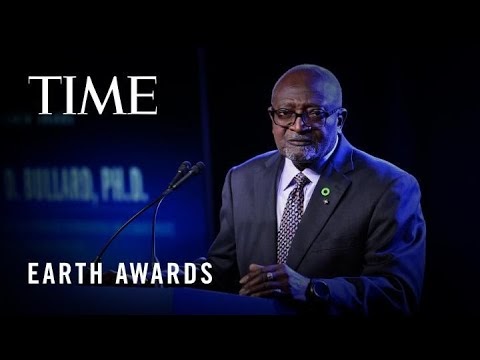
  • ‘Father of Environmental Justice’ Robert Bullard on the Work Behind a Movement (Time)

    ‘Father of Environmental Justice’ Robert Bullard on the Work Behind a Movement (Time)


    Higher Education Inquirer : ‘Father of Environmental Justice’ Robert Bullard on the Work Behind a Movement (Time)


    ‘Father of Environmental Justice’ Robert Bullard on the Work Behind a Movement (Time)


    “This
    isn’t happenstance,” remarked
    Gloria Walton, former TIME Earth Award
    honoree, on the environmental justice movement being recognized as a
    powerful force.

    “It is a reality created by the energy and love of frontline communities
    and grassroots organizations who have worked for decades,” Walton said,
    as she presented an Earth Award to the man known as the “Father of
    Environmental Justice,” Robert Bullard.

    Bullard, who was appointed to the White House Environmental Justice
    Advisory Council in 2021, spoke of the long fight he’s waged for
    environmental justice in his acceptance speech. He discussed the
    challenges that he faced in 1979, when he conducted a study in support
    of the landmark case Bean v. Southwestern Waste Management Corps.— the
    first lawsuit to challenge environmental racism in the United States.

    “I am a sociologist and my sociology has taught me that it is not enough
    to gather the data, do the science and write the books,” he said. “In
    order for us to solve this kind of crisis, we must do our science, we
    must gather our data, we must collect our facts, and we must marry those
    facts with action.”


    Source link