Tag: Era

  • Stop Marketing to Yesterday’s Students: A New Era for Higher Ed 

    Stop Marketing to Yesterday’s Students: A New Era for Higher Ed 

    Is your institution’s marketing truly reaching today’s students, or are you shouting into the void? Higher education marketing is undergoing a seismic shift. With rapid changes in student behavior, the rise of AI and mounting constraints on institutional funding, marketing leaders can no longer rely on yesterday’s strategies to meet today’s challenges. Student expectations have evolved. Budgets are tightening. And yet, many institutions are still using outdated strategies that fail to resonate with the Modern Learner.  

    To stay competitive, institutions must embrace the new era of higher education marketing—an era defined by personalized engagement, brand-building and data-driven decision-making. In a world where marketing dollars work must work harder than ever, rethinking your strategy is no longer optional. It is essential to long-term success.  

    Students no longer passively wait for information. They actively seek it across multiple channels, from social platforms to AI-powered search tools. Their behaviors are more self-directed than they were even a decade ago, and the expectations they bring to the table are shaped by instant access, transparency and digital convenience. Modern Learners want institutions that reflect their values and aspirations. As a result, branding plays an even more critical role in decision-making than ever before. Trust, authenticity, and alignment with personal identity all contribute to conversion. Meanwhile AI is accelerating these shifts by analyzing behavior in real time and delivering tailored experiences at scale.  

    These changes are not on the horizon—they are already here. Institutions that fail to adapt risk being left behind.  

    This evolution is shaping the standard of higher education marketing, and redefining what it takes to attract and engage Modern Learners. Today’s students are not yesterday’s prospects. They are savvy, value-driven and self-directed. Marketing strategies must evolve to meet them where they are—not where they used to be.  

    At EducationDynamics, we are not here to maintain the status quo; we are here to challenge it. We rethink, rebuild and drive your institution into a future where growth isn’t just a goal—it’s a guarantee. With solutions designed to empower, we are continually adapting to the evolving needs of our partners to equip them for long-term success.  

    Evolving Student Behavior: Implications for Higher Education Marketing 

    The Changing Search Journey 

    Today’s students are no longer waiting to be guided; they are leading the charge. With a strong sense of autonomy and purpose, Modern Learners navigate the enrollment journey on their own terms. Their decisions are shaped by what EducationDynamics identifies as the Three C’s: cost, convenience, and career outcomes. These components are central to a student’s decision to apply or enroll. The challenge for institutions is not just to deliver value, but to demonstrate that value clearly and quickly in the digital environments that students operate in.  

    The student search journey has undergone a fundamental shift. No longer do students begin with degree or program keywords. Instead, 58 percent of Modern Learners now initiate their search with specific school names, according to EducationDynamics’ 2025 Engaging the Modern Learner Report. If an institution is not top-of-mind, it is already at a disadvantage. 

    Compounding this shift, nearly 60 percent of education-related searches result in no clicks. Students are making faster decisions, often based on AI-generated overviews that appear directly within search results. Currently, 65 percent of education searches trigger these overviews. This marks the rise of zero-click search and the emergence of Generative Engine Optimization (GEO) as a critical strategy.  

    The message is clear: if your institution is not immediately visible and delivering value within the search experience, it risks being excluded from the student’s consideration entirely. 

    Search engines like Google are prioritizing quick, curated answers, reflecting broader shifts in how users engage with content. Education-related searches have become more intricate, with students asking detailed and personalized questions. They are no longer browsing—they are making decisions. A static, cumbersome website is not just outdated; it is actively repelling Modern Learners. Institutions must create digital experiences that are responsive, student-focused and seamlessly accessible across all digital touchpoints. A lack of dynamic, intuitive design is no longer an option; it’s a failure to meet Modern Learners’ expectations. 

    In today’s search environment, visibility alone is not enough. Institutions must deliver relevance, clarity and authenticity across channels that Modern Learners use.  Institutions that want to remain competitive must not only be present at the beginning of the search journey, but also deliver information with the speed, clarity and authenticity that Modern Learners expect. Those that rise to this challenge will earn attention and trust, while those that don’t will fall behind amid competition.  

    The Demand for Authentic and Engaging Content 

    If your institution’s content strategy still leads with rankings, tradition or campus accolades, it is missing the mark. Modern Learners are not making enrollment decisions based on institutional prestige alone. They are looking for evidence of belonging, support and authenticity. Colleges and universities must shift from promotional messaging to content that mirrors the lived experiences of their students. Modern Learners want to see real people, real stories and a real sense of community. 

    Video content, especially in short-form, is now one of the most powerful mediums for delivering the connection that Modern Learners seek. Today’s students are not flipping through text-heavy brochures or watching ten-minute promotional videos. They are forming impressions in literal seconds, with the rise of TikTok, Instagram Reels and YouTube Shorts. These channels are avenues where your institution’s brand can come to life, showcasing content that is concise, compelling and aligned with the pace of student attention. Highlighting faculty, student testimonials, campus culture and day-in-the-life content in thirty seconds or less can drive significantly more engagement than polished but impersonal campaigns.  

    Authenticity is not a trend—it is a requirement for building trust. User-generated content (UGC) plays a critical role in building credibility. When students and alumni share their own stories, they give prospective students a transparent view of your institution’s impact. An honest glimpse into campus life helps cultivate connections and bolster credibility in ways that other marketing mediums cannot achieve. 

    At the same time, social media is no longer just a place for amplification. Increasingly, it is becoming an integral steppingstone in the student research journey. Modern Learners actively use platforms like TikTok, Instagram and Facebook to evaluate how your institution aligns with their lives and goals. Marketing strategies must evolve to include social-first storytelling and platform-specific content that makes the institution feel approachable and relevant. 

    At EducationDynamics, we don’t just help institutions meet the demand; we empower them to exceed it. We deliver Creative Solutions that are not only strategic but deeply human. Our approach centers on compelling storytelling, a student-first mindset and content designed for the channels where prospective students are making key decisions. Whether through video, social campaigns or user-driven narratives, we equip colleges and universities to show up in ways that make real impact and drive measurable results. We help our partners shape the future, rather than follow it.  

    Key Shifts in Higher Education Digital Marketing

    Website Marketing Evolution 

    In today’s higher education environment, your website is not just an accessory to your digital strategy; it is the central nervous system of your brand, the engine behind your reputation and a key driver of student engagement and revenue. With deep expertise in enrollment marketing, our team of experts transforms websites into high-performing conversion machines. Through data-driven UX, advanced SEO, GEO and conversion strategies, we ensure your website continuously evolves to meet the changing demands of the industry. If your institution’s website isn’t delivering results, it’s not just underperforming—it’s limiting your growth potential. 

    To remain competitive, website marketing must shift from static, siloed approaches to dynamic, user-centric experiences. As student behavior changes and new digital platforms emerge, institutions must design websites that can withstand these digital disruptions and provide seamless navigation, personalized content and clear pathways to action.  

    Search engine algorithms are now more sophisticated and volatile, requiring deeper alignment with how students search and engage. Website optimization now requires more than traditional SEO tactics. It demands an integrated approach that combines content marketing, user journey optimization and brand amplification. A seamless student experience is essential, but so is a strategy that ensures your content reaches prospective students across multiple platforms.  

    The role of an institution’s website as the front door of your brand remains as vital as ever. However, the digital space has evolved beyond simply driving traffic through SEO. Today, success hinges on ensuring your content is discoverable across a wide range of digital channels, and understanding how that content is delivered to students within the search engine results pages (SERPs).   

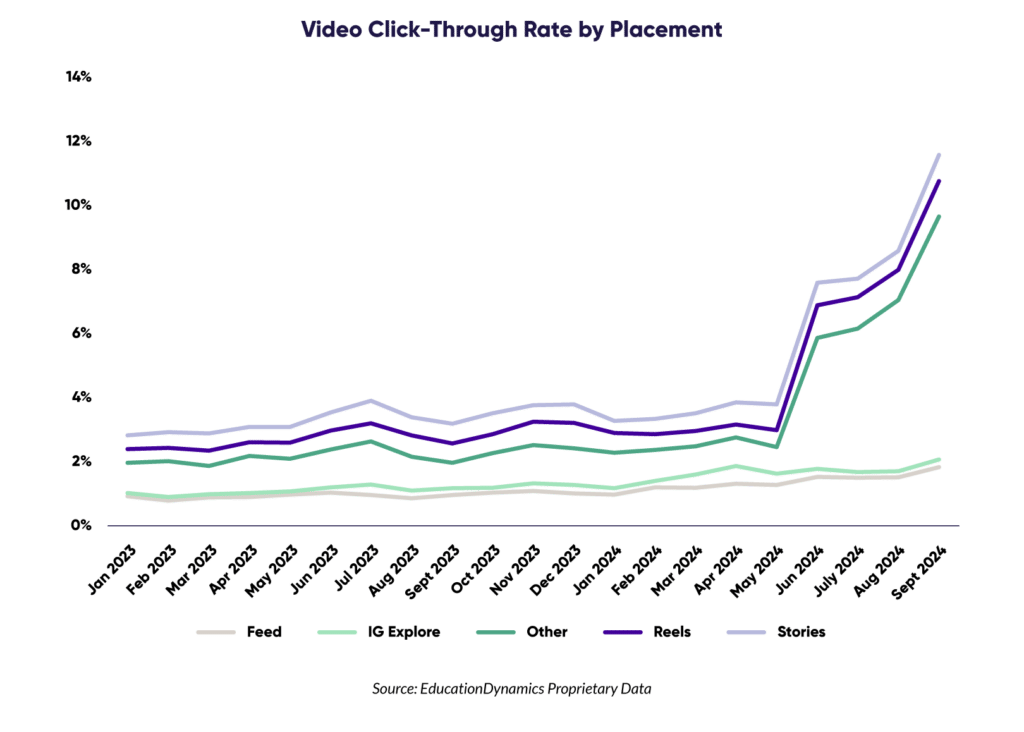
    AI has become a pivotal force in content discovery and visibility within SERPS. Visual shifts in the SERPs now prioritize rich media and first-person expertise, meaning your content must not only reflect relevance but also showcase real-world experiences to stay competitive. First-person expertise, such as student stories, faculty insights and user-generated content, is increasingly favored by search engines, underscoring the growing demand for authenticity. Rich media—images, videos and interactive elements—boost engagement and click-through rates. As visual content continues to dominate SERPs, your strategy must adapt to harness these trends effectively. 

    Looking to 2025 and beyond, SEO will demand a comprehensive, integrated approach that encompasses both on-site and off-site elements. Institutions that focus exclusively on on-page SEO or create content in isolation risk falling short of maximizing their potential. The most successful strategies will seamlessly connect content across multiple digital channels, driving not just visibility but also meaningful engagement. 

    Modern website optimization will be multi-faceted and multi-channel, anchored by four key components: 

    1. SEO: Search Engine Optimization will remain foundational, still being a critical part of driving organic traffic to your website but now must be paired with user-focused content creation. A strategic blend of blog posts, video content, graphics and articles will ensure that your website remains relevant and discoverable in a competitive search environment.  
    2. User Journey Optimization: Understanding the student journey is essential for converting traffic into applications. A data-driven approach that identifies usability roadblocks and tests the optimal path to conversion is key. A/B testing and ongoing adjustments will ensure that every touchpoint on your website drives students to take meaningful actions.  
    3. Brand Amplification: Strong content deserves to be seen. To achieve this, institutions must invest in amplifying their brand through content promotion, social media engagement, local profile optimization and PR. Engaging in user-driven discussions on forums and social media platforms will strengthen your brand’s visibility and credibility, allowing your message to reach broader audiences. 
    4. Content Marketing: The creation of high-quality content is a cornerstone of digital marketing. By producing content that directly speaks to student needs, you reinforce your institution’s position as a trusted authority. Strategic content creation is not just about filling your website but aligning content with student expectations and ongoing digital trends. 

    With these changes, institutions must take the driver’s seat in shaping their digital presence and optimizing web strategies. Meeting the moment requires a proactive approach to evolving digital trends, ensuring that your institution remains competitive, relevant and positioned for long-term success in an increasingly dynamic online environment. 

    The Transformation of Paid Media 

    The transformation of paid media has been just as significant as the evolution in organic search. With AI now playing a central role in optimization, marketers have had to rethink not only where they invest but how they manage campaigns. Gone are the days of manual bids and rigid keyword targeting. In what was once a highly controlled environment, advertisers would apply uniform bids across all matching search queries, rely on static text ads, and build campaigns around exact or phrase match keywords. These strategies offered precision but lacked adaptability and scalability.  

    Today, optimization is driven by automation, data and real-time decision-making. Smart bidding adjusts bids dynamically based on user behavior, intent and context. Responsive search ads tailor messaging to the user’s query, while improved broad match capabilities allow for more relevant and flexible reach. This shift demands a new approach, one away from managing structure and more on shaping signals for AI-based optimization. 

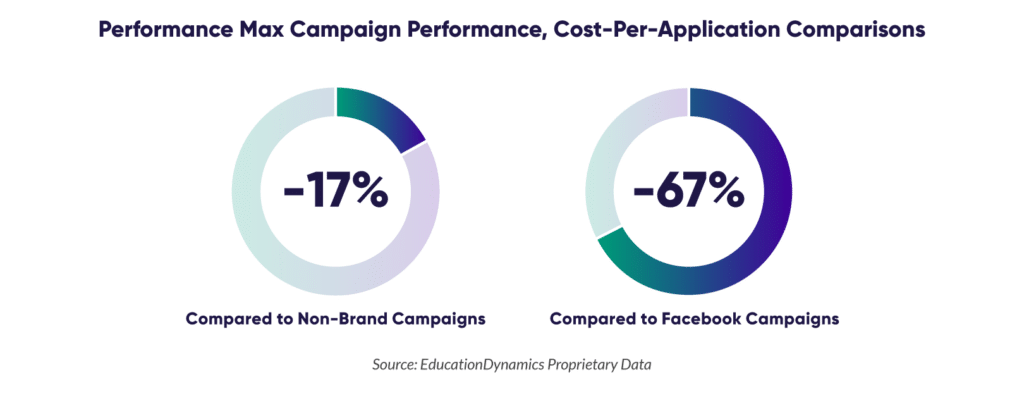
    Performance Max (PMax) campaigns exemplify this change. By consolidating efforts into a single campaign that spans Google’s full inventory, advertisers can let AI optimize toward specific outcomes. Institutions are increasingly shifting towards investments in branded PMax campaigns, using them to drive awareness and conversions across the funnel. Unlocking their full potential, however, requires consideration on inputs such as audience insights, quality creative and defined performance goals.  

    In this environment, marketers must shift their focus. Rather than managing granular campaign structures or keyword-level bids, success depends on a streamlined structure. Over-segmentation is now the enemy of AI—limiting data flow and stalling machine learning algorithms. Instead, consolidation, automation and audience-centric strategies are key to maximizing performance and achieving scale. The more robust your audience signals and creative assets, the more effectively AI can optimize for effective campaigns.  

    The Central Role of Brand in Modern Higher Education Marketing

    Brand as a Differentiator 

    In a competitive and crowded marketplace, brand is your most powerful differentiator. As enrollment pressures intensify and prospective students become more discerning, a clear and compelling brand narrative is not an accessory to success; it is essential for it. Yet many institutions struggle with perceived value leaving prospective students unsure of what truly sets them apart.  

    According to Hanover Research’s 2024 Trends in Higher Education report, 66% of Americans believe colleges are “stuck in the past” and no longer meet the needs of today’s students. This perception gap presents a unique opportunity for institutions to not just rebrand but redefine the role and relevance for higher education in the modern world. 

    Brand marketing plays a transformative role in addressing these challenges. Brand is not merely visual identity or taglines, it is about storytelling that resonates across platforms and inspires connection. With students engaging across an increasingly fragmented digital landscape, institutions must show up consistently across every touchpoint.  

    The emotional connection is especially important today, as higher education faces intense scrutiny from multiple forces. Amid ongoing conversations about cost, access and accountability, there is a pressing need for institutions to reshape the narrative. By investing in brand marketing, institutions can demonstrate their alignment with the needs of Modern Learners, reinforce their commitment to student outcomes and build trust in a time categorized by uncertainty.  

    Brand and reputation go hand in hand. One reflects your promise. The other reflects your proof. When balanced well, they shape a perception that drives enrollment, builds revenue and sustains long term success. 

    Today’s higher education marketers must engage students before they start their search. This requires delivering authentic content across channels that builds trust and awareness over time. The Modern Learner’s journey begins with emotion, not just information. Your brand must be visible, relatable, and memorable. 

    In an era marked by uncertainty and choice overload, institutions must lead with empathy, clarity, and purpose. Showcase a brand that resonates, builds confidence and drives action. 

    Balancing Brand and Performance Marketing 

    In higher education marketing, finding the right balance between brand and performance marketing channels is crucial for long-term success. Historically, higher education institutions have leaned heavily into performance marketing, driven by the immediate need for results like inquiries and applications. However, this strategy is becoming less sustainable in today’s dynamic and competitive landscape. While performance marketing continues to be essential for driving immediate conversions, it cannot be the sole focus. 

    Brand marketing plays an increasingly important role, especially in the upper funnel, where students are still in the process of exploring and considering their options. This phase of the student journey is more about building awareness, shaping perceptions and creating emotional connections, rather than expecting immediate results. Students are making life-changing decisions that require time, research and deep consideration, so brand-building efforts often take longer to produce tangible outcomes. 

    To navigate this, higher education marketers must strategically allocate resources across both brand and performance media. A suggested allocation might be 20-35% for brand marketing, including channels like Connected TV (CTV), OTT streaming video and audio, out-of-home (OOH) ads, display ads, and paid social. The remaining 65-80% can be allocated to performance marketing, focusing on paid search, paid social and website marketing. This balance allows for consistent brand presence while still driving immediate performance goals. 

    However, finding the right mix will depend on your institution’s unique needs and goals. There is no one-size-fits-all approach. It’s important to embrace a testing mentality when allocating your budget, understanding that this is a multi-year investment. Brand marketing’s impact often requires indirect measurement and time to mature, with a holistic cost per enrollment being a long-term goal. 

    By adopting a balanced approach and a willingness to test and iterate, institutions can achieve the right blend of short-term performance and long-term brand growth. 

    Adapting to Thrive in the New Era

    The higher ed landscape is evolving and so are your students. Marketing strategies that once worked are no longer enough. To succeed, leaders must challenge the status quo, evolve their higher education marketing strategies, and fully embrace the behaviors, tools and technologies that are shaping this new era. 

    Now is the time to invest in transformation. Whether that means rethinking your website, shifting your media mix or consolidating campaigns to improve performance, the path forward begins with taking action. 

    The transformation does not have to be navigated alone. A higher education marketing agency can be a vital partner in this evolution. At EducationDynamics, we bring together proprietary research, full-funnel strategy and decades of expertise to help institutions like yours grow with confidence.  

    Let’s shape the future together. Connect with an EDDY expert to assess your current strategies and identify new opportunities for growth.  

    The institutions that succeed will be the ones that are bold enough to evolve—strategically, creatively and with purpose. Now is your opportunity to lead that change.  
    Source link

  • Mentoring in an Era of Uncertainty for Higher Education

    Mentoring in an Era of Uncertainty for Higher Education

    More than half of college students believe professors should take on a mentoring role to support their career development, according to a 2024 Inside Higher Ed survey. And a 2023 report from the American Council on Education showed that informal and formal mentoring can broaden pathways to graduate education for students, particularly those from historically marginalized backgrounds.

    But few faculty members receive formal training on how to be an effective mentor while also balancing teaching, research and publishing responsibilities. That’s only getting more difficult as faculty navigate a changing—and increasingly uncertain—higher education landscape marked by intensifying political scrutiny, ever-shrinking budgets, increased workloads and fewer academic job prospects for their students.

    “The conditions for mentoring continue to deteriorate,” said Maria Wisdom, assistant vice provost for faculty advancement at Duke University. “At the same time, there’s never been a greater need for truly impactful mentoring, and I think there has never been a moment at which it’s clear that we need to learn to support people without having all the answers.”

    After a decade working as an English professor at Columbia College, Wisdom turned her focus to coaching early and midcareer faculty across disciplines. She also leads mentoring workshops for faculty looking to improve their mentorship of junior researchers, scholars and colleagues.

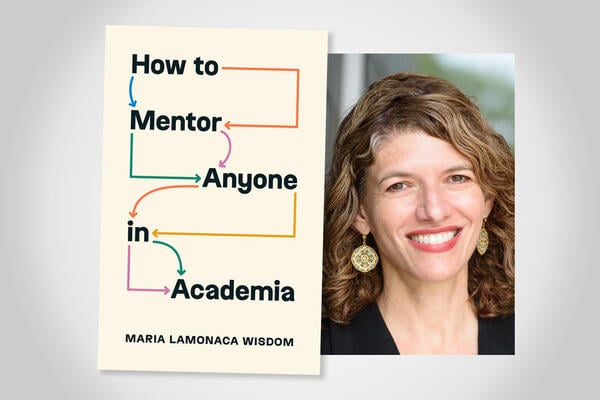
    Last month, she published How to Mentor Anyone in Academia (Princeton University Press), a practical guide aimed at demystifying what it means to be a mentor. Inside Higher Ed spoke with Wisdom about some of the advice she lays out in the book and how it may help mentors—and mentees—navigate the higher education sector’s uncertain future.

    This interview has been edited for length and clarity.

    Q: How did your experiences as a mentee and mentor shape your approach to mentoring?

    A: Looking back, the mentorship I received was only OK. Every now and then it was really helpful. But I can also think of multiple instances in my professional trajectory where things could have gone differently and better if I would have had more effective mentoring.

    Many years later, after I had left the professoriate, I was working at Duke—first as a graduate adviser and then as a certified coach, working first with grad students and then with faculty. It was through that professional training—which was a very different kind of training than what I received in my graduate education—that I was able to understand what it means to be a professional helper and how many different roles we can occupy when we’re professional helpers. And all of those roles overlap in some way with mentoring.

    That awareness helped me realize that the majority of faculty mentors just don’t have the time or bandwidth or resources to be thoughtful about those role distinctions and what it means to actually mentor somebody in a certain context at a certain time.

    Q: In the book you write about three different approaches to mentoring: mentoring with a heart, a backbone and like a coach. Can you describe the difference between those approaches and how mentors can employ all three?

    A: They’re all connected and they’re all important.

    All effective leaders need to have both backbone—which means firmness, rigor and consistency—and heart, which is empathy, understanding and kindness. A good leader balances these two things out at the same time, and rarely is a leader a natural in both areas.

    Maybe they aren’t good at giving feedback, don’t establish clear expectations at the outset of the relationship or don’t have a system of regular check-ins with their mentee. Those are all elements of backbone. Or maybe they’re not putting enough heart into it. They may set clear expectations and give regular feedback, but they’re kind of insensitive to the needs of the mentee, or they’re just not very empathetic, and so I think you need to have both.

    And that’s where coaching comes in. Coaching is a structured conversation, one in which you need to be fully present and empathetic. So that’s how I see coaching, marrying both aspects of backbone and heart.

    Q: What are some of the common misconceptions about what it takes to be an effective academic mentor? What does it take to be an effective mentor?

    A: There’s this prevailing assumption among many academics that mentoring is just something you naturally figure out how to do as you go along. Faculty either mentor the way they’ve been mentored, or they mentor in opposition to an ineffective way they were mentored. I also see too much of what I call mentor impostor syndrome in the academy, which is this faulty assumption that you can only mentor people in the same discipline as you or who follow the same career path as you.

    We tend to underestimate the power all of us have to be helpful to each other’s professional growth in ways that have nothing to do with disciplinary expertise. Those are things like active listening, cultivating empathy, basic coaching skills and doing more listening and active questioning than talking at somebody.

    We need to stop assuming that mentoring is something you’re born with and instead think of it as a set of skills, competencies and even an entire worldview that can help you be helpful to anyone. It’s not about pouring knowledge into an empty vessel. It’s about being a facilitator and creating the space to ask provocative questions that are going to help somebody remember just how talented and resourceful they are.

    Q: How does effective mentoring benefit students and higher education more broadly?

    A: Good mentorship is upending, to some extent, all these hierarchies we have in higher education, where professors are the fountain of all knowledge, holding all the power, and graduate students are more like apprentices or vessels to be filled with that knowledge. It’s charging mentees with a much greater responsibility for their own learning, growth and development.

    That may seem like a big burden to place on the shoulders of a mentee. But if a grad student learns during their degree program how to be reflective about their own professional needs, how to ask for help in a respectful and effective manner, and how to set clear goals and work toward them in small steps, they’re going to be set up for success for the rest of their career.

    Q: The higher education landscape is changing, with faculty jobs and funding becoming more scarce. How do these realities make mentoring more challenging?

    A: Often, people aren’t taking on mentoring roles because they simply feel like they don’t have enough time. Meetings are rushed, or maybe the mentor is distracted while mentees are in their office. And that’s just a microcosm of a larger deterioration of relationships across our society.

    Nobody in higher ed has the answers about what’s going to happen three months from now, let alone three years from now. But that doesn’t mean we just give up and stop supporting my junior faculty or my graduate students. We need to think about how we can help them learn and grow even in the midst of this type of environment. And that’s the kind of mentoring that my book is trying to encourage people to adopt.

    Q: How can mentors help students navigate the changing academic job market?

    A: In academia, we still tend to assume that not only are there academic jobs to be had, but that people will stay in the same career their entire 30- to 40-year career. For plenty of senior faculty, that has been their life experience, but we can’t assume anymore. Mentors aren’t doing their students any favors by preparing them for these linear, stable, nearly nonexistent career paths. Mentors need to think about how they can support people in being nimble and adaptable in the face of unpredictable change.

    We need to make our students comfortable with trying new things, taking risks, being proactive and building relationships. These are all things that will help them to weather change. Every now and then I’ll hear about a faculty member or adviser who didn’t want their student doing an internship because it had nothing to do with their dissertation and [would] make it take longer to finish the program; they see it as a distraction. But for some of those students, internships were the most valuable thing they did in graduate school, because it led directly to their first nonacademic job after graduation.

    Q: How can mentors support themselves and each other in trying to improve mentoring?

    A: Improving mentoring can’t just happen by improving one relationship at a time. We need to think about how to build cultures that support excellent, effective mentoring. Too often, mentoring is still practiced in isolation and faculty are shy to talk publicly about their mentoring experiences. That’s kind of silly, because I think you could have many faculty members in a single program all dealing with the same mentoring challenges. But because they never sit down to compare notes, they don’t even realize it.

    I talk in the book about the importance of chairs and associate deans normalizing conversations about faculty mentoring. Faculty members should ask themselves when the last time faculty, graduate student mentoring or new faculty mentoring was on the agenda over the past year.

    These conversations are rarely happening. There’s a need for mentoring mentors. And very often, they are your peers or somebody you consider a professional mentor. There’s a lot of strength in learning to build these informal networks of support.

    Mentor burnout is also a big problem. If you’re trying to mentor somebody and you’re showing up with dark circles under your eyes at every meeting, your mentee is going to assume that’s necessary for success in the academy. Faculty need to model wellness and self-care, not just in mentoring, but in just about every area of their lives.

    Q: Does your book offer any advice for mentees?

    A: Yes. This book actually grew out of a course that I taught for graduate students, which addressed how to get the most out of mentoring relationships.

    Most graduate students haven’t had the opportunity or the luxury to sit and think about what a good mentor is or how they’ll advocate to get better mentoring. At the end of every chapter, I have a little section called takeaways for mentees, including one section on how to accept and use feedback. There’s also another on how to build an informal mentoring network if you’re not getting enough from your formal mentors.

    I wrote this book for mentees as well as mentors.

    Source link

  • Faculty salaries grow but still lag pre-pandemic era

    Faculty salaries grow but still lag pre-pandemic era

    This audio is auto-generated. Please let us know if you have feedback.

    Full-time faculty salaries rose for the second year in a row, even after adjusting for inflation, according to preliminary compensation data from the American Association of University Professors. 

    Fall 2024 salaries rose an average of 3.8% year over year, though inflation brought that growth down to an increase of 0.9%, according to the study.

    Even with two years of gains, faculty compensation has not fully recovered from the pandemic period, which brought a 7.5% effective drop in salaries from 2019 to 2022, AAUP said.

    Faculty’s inflation-adjusted salaries are still climbing out of their pandemic dip

    Year over year growth in nominal and real salaries from academic years 2017-18 to 2024-25.

    During an era of constrained budgets for many institutions — with job and program cuts making headlines — institutions are under a countervailing pressure to invest in their people and infrastructure after years of belt-tightening. Some colleges have given employees raises even as they make budget cuts in other areas.

    Preliminary data from AAUP’s latest faculty study shows salaries making some headway even in an era of slashed budgets. Fall’s salary increases for full-time faculty followed an inflation-adjusted 0.4% increase in 2023. 

    Those of course are averages, and figures varied across rank and job types. Associate professors’ salaries, for example, typically grew at a faster clip in the 2024-25 academic year than professors or assistant professors while lecturers’ salaries rose faster than all of those positions, with growth over 6% at the doctoral and master’s level institutions, according to AAUP’s study. 

    The survey also found continued gender disparities for professor compensation, with men earning nearly $26,000 more than women at doctoral institutions and about $8,000 more at master’s institutions. 

    College and university presidents typically made around four times or more than the average faculty member across most institution types, according to the study. 

    Part-time faculty made an average of $4,093 per class section in the 2023-24 academic year. But their compensation “varied widely” depending on where they worked, AAUP said.

    At private nonprofits, a part-time faculty member could make an average of $1,950 per section teaching at associate-granting institutions compared to $6,481 at bachelor’s-degree colleges. 

    Maximum payments could run into the tens of thousands of dollars across institution types. Meanwhile, some part-time faculty could earn as little as $700 per section teaching at a public university. 

    Just over one-third of colleges, 34.4%, made retirement plan contributions for at least some part-time faculty, and fewer than one-third, 32.5%, contributed to insurance premiums for at least some part-timers.

    The AAUP analysis is based on surveys of more than 800 U.S. institutions, with data on roughly 370,000 full-time and 90,000 part-time faculty members

    CUPA-HR also found annual salary growth across much of the sector in the 2024-25 academic year. 

    After factoring in inflation of 2.7%, salaries went up 1.2% for administrators, 1% for professional staff, 1.1% for general staff and 0.5% for nontenure-track faculty, according to CUPA-HR. Real salaries for tenure-track faculty fell 0.1%.

    As with AAUP, CUPA-HR noted that higher education salaries still fell short of pre-pandemic levels despite growth. The largest gaps are in salaries for tenure-track faculty — paid 10.2% less than in the pre-pandemic era after adjusting for inflation — and non-tenure-track teaching faculty, who are paid 7.6% less.

    Source link

  • R&D spending brings the era of strategic ambiguity to an end

    R&D spending brings the era of strategic ambiguity to an end

    I was working with a university on how they communicate their research work.

    An academic remarked to me that they simply couldn’t understand why the university didn’t talk more about the leading work they were doing in defence research.

    At the time, I thought talking about research into the things that kill people would be an obvious and enormous error. I now think I may be wrong.

    Missiles have a PR problem. They are not the soft embrace of a civic university which wraps its arms around their places. They are not the technician helping to solve the pandemics and global disasters of our time. And they are not the lofty ideals of pushing forward the shared understanding of the human experience.

    Conducting research into defence is to acknowledge that universities are part of the unsavoury end of geo-politics too.

    Universities have generally followed the lead of the government on the international research front. This is to say universities work with people, even where they may disagree with them, if it furthers a common cause of research. In an era of sharpening geo-political divides, increased defence spending, and pressure on the moral mission of universities highlighted by what they choose or choose not to cut, this feels untenable.

    Strategic ambiguity is possible where the strategy is clear and the policy is not. The government has now made its spending policy for defence clear.

    Defence and its detractors

    There are plenty who have made the moral case against UK universities being involved in research into lethal weapons. Open Democracy carried out work in 2023 where they drew the line between weapons manufacturers, university research, and global conflicts, to make the case that

    “Responding to Freedom of Information requests, 44 universities told openDemocracy they had taken a combined total of at least £100m in funding and donations from eight of the biggest UK and US defence firms: RTX, Lockheed Martin, Boeing, Northrop Grumman, General Dynamics, BAE Systems and Rolls-Royce.

    All are listed in the top 100 arms and military services in the world, according to the Stockholm International Peace Research Institute.”

    And there are a constellation of left-wing blogs that have sought to make the same arguments. Novara Media, for example, have sought to bring to attention the links between university weapons research and the ongoing conflict in the Middle East. It is not that universities are undertaking research directly for difficult and despotic regimes and demagogues directly. It is that they are undertaking research with companies where their technologies may either be used directly, or through their dual applications, in the defence of nations and by extension the killing of people all over the world.

    This attention is likely only to grow as the government increases investment into defence technologies. The 2020 Spending Review committed to an extra £6bn of defence R&D over four years. In 2024, then Prime Minister Rishi Sunak promised a further uplift in defence spending with a significant proportion dedicated to R&D. Keir Starmer has now promised that defence spending will reach 2.5 per cent of GDP, with an ambition to reach 3 per cent, and further increases to R&D in defence.

    This includes a further £2.9bn of spending in the coming financial year compared to 2024–25. This is a big increase but in context BAE systems alone spent £1.45bn on R&D in 2022 as a combination of their own and government money.

    This presents a challenge for universities. The flows of R&D spending are increasingly toward defence but they have, collectively, not found the language which sets out the moral case for doing the work.

    Re-arm for Britain

    Today’s piece from Jess Lister makes it clear that a plurality of citizens in the UK are in favour of increased defence spending. A majority of the public also agree it would be better to invest in R&D in new defensive technologies. Of course, this presumes there is always a clear and practical difference between the use of weaponry for defensive and offensive purposes, and the reasons for research are as important as the actual mechanism through which research is deployed.

    There are the universities that undertake research which makes the country safer but isn’t directly involved in the business of lethality. The examples of universities building partnerships, engagements, projecting the UK across the world, making the UK a better place to live, are numerous. In an era of constrained funding and increasing concerns about defence spending, the ability for universities to talk about national safety, the tolerability of living in the UK, and national security, the freedom to live free from the threat of harm or death from a foreign power, may end up moving closer together. The decision to cut Oversees Development Assistance, funding used to promote social, economic, and welfare capacity, to fund defence spending is in this regard an absurd political decision in making the UK less safe on the one hand while making it, potentially, more secure on the other.

    And there is the business of the production of the UK’s defensive capabilities. There are a range of regulations which cover this work. In particular, the rules on dual use technologies which place extra restrictions on the exports of research that could have both civilian and military applications. There are specific cases which have come under scrutiny particularly under the use of technologies which could be used for drones. As a minimum, if universities are going to increasingly grow their R&D and defence budget they will need the internal capacity to navigate what has been a difficult and changing world.

    Narrative interventions

    Aside from the regulation there is a real narrative problem on defence research. There are generally three explanations used when a university is asked about defence research. The first is that we follow all of the rules. The second is that we work directly with companies and what companies choose to do beyond our due diligence isn’t within our control. And the third is that even where projects are within the rules we continually monitor them. The problem with all of these responses is that they are the minimum of procedural compliance not explanation of work.

    In his acceptance speech newly appointed Chancellor of the University of Oxford and once foreign secretary William Hague stated that

    We do not need to agree on everything, indeed we should not. I am pleased to say we do not need a foreign policy: we are not a country. Nor do we need a view on every daily occurrence: we are not a newspaper. The concern of a university is that opinions are reached on the basis of truth, reason and knowledge, which in turn requires thinking and speaking with freedom.

    This is the same William Hague who suggested in 2015 that

    In the 21st Century, foreign policy is no longer the preserve of governments speaking behind closed doors. It’s also about that web of connections between individuals, groups, companies and all kinds of organisations, on social media and international travel.

    The William Hague of 2015 is correct and the William Hague of 2024 is mostly wrong. The frustration with university work into defence isn’t because the public believe what they are doing is illegal – in fact the public support what they are doing. It is that universities are trying to pursue an amoral approach to defence (as in, without a moral position, as opposed to immoral or evil), which leaves them open to charges of hypocrisy.

    The reason for this is a refusal to commit to bright red lines. It would be totally legitimate for universities to state there are certain partners, certain countries, and certain contexts in which they will not work. It also would be totally legitimate for universities to say they work with anyone regardless of their politics, but universities have done neither.

    The one unilateral intervention in refusing to work with Russia was the morally correct step, and has of course opened up the charge of hypocrisy. The line seems to be that universities will work with foreign partners irrespective of what they do unless they are legally barred from doing so and/or said foreign partners undertake a full scale invasion of a neighbour.

    The age of strategic ambiguity is over because ambiguity cannot be funded, supported, or made consistent to a public who don’t always appreciate the value of universities. Universities are not a country but they are a global network that allows for the movement of people, ideas, and technologies. The basis on which these things are allowed to move is the moral mission of our era for universities.

    Source link

  • A new era for teachers as AI disrupts instruction

    A new era for teachers as AI disrupts instruction

    This story originally appeared on the Christensen Institute’s blog, and is reposted with permission.

    Key points:

    Picture your favorite teacher from your childhood. He or she may have been great at explaining things, energetic, affirming, funny, or had other wonderful attributes. I remember Mrs. Rider. She was smart and pretty, and showed she really believed in me.

    With this picture in mind that highlights the many wonderful teachers who typify the “sage on the stage” teacher role, you may wonder why Guide School (full disclosure: I’m the founder) prepares teachers and other adults to become “guides” instead of sages. Why not spend our efforts developing more wonderful sages like Mrs. Rider?

    The printing press provides a helpful analogy to answer that question.

    Over time, Disruptive Innovations change how things are conventionally done

    Before the invention of the printing press, books and written materials were primarily produced as handwritten manuscripts. Scribes, often monks or other church officials, painstakingly copied texts by hand using quill pens and special inks to illuminate and decorate each parchment.

    The printing press, invented by Johannes Gutenberg in the 15th century, revolutionized the production and sharing of written knowledge. It allowed for the mass production of books at a much faster rate and lower cost. In short, texts became accessible to a greater number of people.

    But it also meant disrupting the profession of scribes, who suddenly found their work had shifted. Some scribes found new opportunities as proofreaders or editors within the emerging print industry. Others continued to provide handwritten services for personal letters and legal documents. Additionally, a market remained for beautifully handcrafted manuscripts among wealthy patrons who valued calligraphy.

    There’s a parallel between the stories of scribes and conventional teachers. Just as the best scribes produced unique artistry in rare, individually commissioned works, the best teachers create rare but enviable classrooms with well-behaved, deeply motivated, impressively thriving students. Unfortunately, however, many people are left out of these ideal scenarios. Without the printing press, millions of people would have languished without access to printed materials. Without transforming the conventional classroom, millions of students today will continue to suffer from want of effective instruction. That’s because while the conventional system could develop more wonderful, conventional teachers like Mrs. Rider, doing so requires an investment of resources often unavailable to every student in every school across the world. All too often, only those who are lucky or whose families can pay receive the benefits of those investments. 

    Happily, the printing press’s disruption of scribing proved to be an irrefutable boon for the education of humanity. The printing press facilitated the growth of literacy, numeracy, and scientific knowledge by enabling the widespread distribution of printed materials with dependable accuracy and lower costs. It played a crucial role in the Renaissance, Reformation, and Scientific Revolution, allowing for the mass sharing of ideas at unprecedented speed and scale. By the end of the 15th century, millions of copies of thousands of book titles had been printed, marking a dramatic shift in the accessibility of knowledge.

    AI and its potential to disrupt conventional teaching

    Similarly, the rise of AI-powered, online apps for instruction is disrupting the teaching profession. It’s giving rise to a new wave of global knowledge distribution with increasingly dependable accuracy and precision, allowing for mass learning at unprecedented speed and scale.

    When the printing press arrived, the scribe profession did not disappear, but scribes did have to adapt to new roles as their industry changed. Similarly, many conventional teachers will need to adapt to a new role as their role of sage becomes disrupted. 

    Fortunately, this pivot presents a remarkable opportunity for teachers and society at large. For years, experts have identified that students do best when they have personal, individual tutelage to help them learn. Top-down, whole-class, monolithic instruction isn’t working for most students–and observant teachers know that. The shift from sage on the stage to guide on the side of each student is a welcome relief for teachers who see that the conventional approach is broken in that it leaves behind too many students and want a model that allows them to have the individual impact they hoped for when they entered the teaching profession.

    AI frees up teachers’ time to give more individual attention and students’ time for more than foundational knowledge attainment. The Flex blended-learning model, which pairs AI-powered apps with group discussions, real-world projects, individual coaching from guides, and other student experiences, attracts teachers who see its value and want its benefits. Rather than feeling replaced by computer-based instruction, these teachers feel attracted to a clear opportunity to shift their time spent on lectures and embrace the facilitation of a more student-driven learning design for their students.

    Guide School prepares adults who feel called to this new role. The guide profession is different from the conventional teaching profession. It requires different mindsets, skills, and dispositions. But for those well-suited to and trained for the role, it’s a profession with unprecedented opportunities to help youth worldwide develop knowledge and talents to a higher level than ever before.

    Latest posts by eSchool Media Contributors (see all)

    Source link

  • UK-Egypt mission sparks new era of higher education partnerships

    UK-Egypt mission sparks new era of higher education partnerships

    From 16-18 February 2025, a high-level delegation from the UK visited Egyptian universities: Ain Shams University, and European Universities in Egypt (EUE); with a planned visit to New Cairo Technological University, to explore possible collaborations between the two countries.

    “Over the course of three enriching days, the education team in Egypt led a higher education mission that was launched in the New Administrative Capital, under the patronage of the Minister of Higher Education through the Supreme Council of Universities and the Egyptian Bureau for Cultural and Educational Affairs in London in collaboration with the British Council in Egypt, and the support of the British Embassy,” Heba ElZein, director of education at the British Council in Egypt told The PIE.

    The delegation comprised representatives from prestigious UK universities, including Sheffield Hallam University, Loughborough University, the University of Essex, the University of East Anglia, the University of Exeter, and the University of Chester.

    Universities UK International representatives were also in attendance, with Anouf El-Daher, policy officer for Africa and Middle East at UUKi, presenting at the British Embassy in Cairo and British Council Egypt, highlighting the value of international collaboration and the potential for long-term, mutually beneficial, EU-Egypt education relationships.

    “Over three days, we visited higher education institutions across Egypt, gaining valuable insights into the local landscape and exploring opportunities for deeper collaboration. This mission allowed us to engage with key stakeholders, understand the evolving higher education landscape in Egypt, and witness the impact of UK-Egypt partnerships firsthand,” a LinkedIn post from UUKi read.

    Over the course of three enriching days, the education team in Egypt led a higher education mission that was launched in the New Administrative Capital
    Heba ElZein, British Council

    The mission offered numerous networking opportunities, as well as joint meetings for Egyptian universities wishing to cooperate and discuss opportunities with their British counterparts.

    The delegation’s primary focus was to foster academic exchange, establish international university branch campus opportunities, and strengthen research collaborations. One of the most significant outcomes of the visit was the signing of multiple Memorandums of Understanding (MoUs) between UK and Egyptian universities.

    During that high-profile participation, three MoUs were signed between the University of Essex and Ain Shams University, the University of East Anglia and Ain Shams University, and the University of Sheffield Hallam and the British University in Egypt.

    These agreements are expected to facilitate joint programs, faculty exchanges, and shared research initiatives in the coming years.

    Students in Egypt show a strong interest in TNE as the UK-affiliated programs offer tuition fees from £800 to £13,500, depending on the partnership model. And due to economic and currency challenges, Egyptians are increasingly likely to opt to study in Egypt on a TNE model, as well as inbound students to the country, primarily from Malaysia, Indonesia, Thailand, Nigeria, and Iraq.

    Thus, with a population of around 111 million, and a youthful median age of 24.3, Egypt leads the MENA region in TNE enrolments with 27,865 students in 2022-2023, making it the 5th largest UK TNE host country globally.

    Egypt has emerged as a leading host of UK transnational education students in the MENA region, and the UK remains Egypt’s largest partner in higher education.

    This delegation’s visit is part of a broader initiative to further deepen these ties and provide Egyptian students with greater access to high-quality British education.

    Source link

  • Community College Leader Dr. Walter Bumphus to Step Down After Transformative Era

    Community College Leader Dr. Walter Bumphus to Step Down After Transformative Era

    Dr. Walter G. BumphusAfter steering America’s community colleges through unprecedented challenges and opportunities, Dr. Walter G. Bumphus announced he will retire as president and CEO of the American Association of Community Colleges (AACC) at the end of 2025, capping a remarkable 15-year tenure that helped reshape higher education access nationwide.

    The announcement marks the end of a chapter for community colleges that saw dramatic shifts in workforce development, educational technology, and the role of two-year institutions in American society. Under Bumphus’s leadership, community colleges strengthened their position as essential providers of affordable education and workforce training, working closely with four presidential administrations to advance their mission.

    “When you look at the landscape of higher education today, you can see Dr. Bumphus’s influence everywhere,” said Dr. Sunita Cooke, who chairs AACC’s board of directors and serves as superintendent/president of MiraCosta College. “He understood that community colleges needed to be at the table for every major conversation about America’s future workforce and educational opportunities.”

    Bumphus’s career, spanning more than five decades, coincided with community colleges’ emergence as critical players in addressing skills gaps and workforce needs. His expertise led to appointments on several high-profile national committees, including the American Workforce Policy Advisory Board and the Department of Homeland Security’s Academic Advisory Council.

    Beyond his policy work, colleagues say Bumphus’s greatest legacy may be the network of educational leaders he helped develop. As the A. M. Aikin Regents Endowed Chair at The University of Texas at Austin, he mentored hundreds of administrators who went on to leadership positions at community colleges across the country.

    His achievements have been widely recognized, including receiving the ACCT Marie Y. Martin CEO of the Year Award and the 2021 Baldridge Foundation’s Award for Leadership Excellence in Education. In 2013, Bumphus was awarded the Diverse Champions award by Diverse: Issues In Higher Education. 

    But Bumphus maintains that the real measure of success lies in the millions of students who have benefited from community college education during his tenure.

    “Every time I meet a graduate who tells me how community college changed their life, I’m reminded of why this work matters so much,” Bumphus said in his retirement announcement. “These institutions are the backbone of opportunity in America, and I’m confident they’ll continue to evolve and serve students for generations to come.”

    His 15-year leadership of AACC stands as the second-longest in the organization’s history. As he prepares for retirement, Bumphus remains characteristically focused on the future: “The work of expanding educational opportunity never ends. I’m grateful to have played a part in it.”

    Source link

  • Liberty University in the Trump Era

    Liberty University in the Trump Era

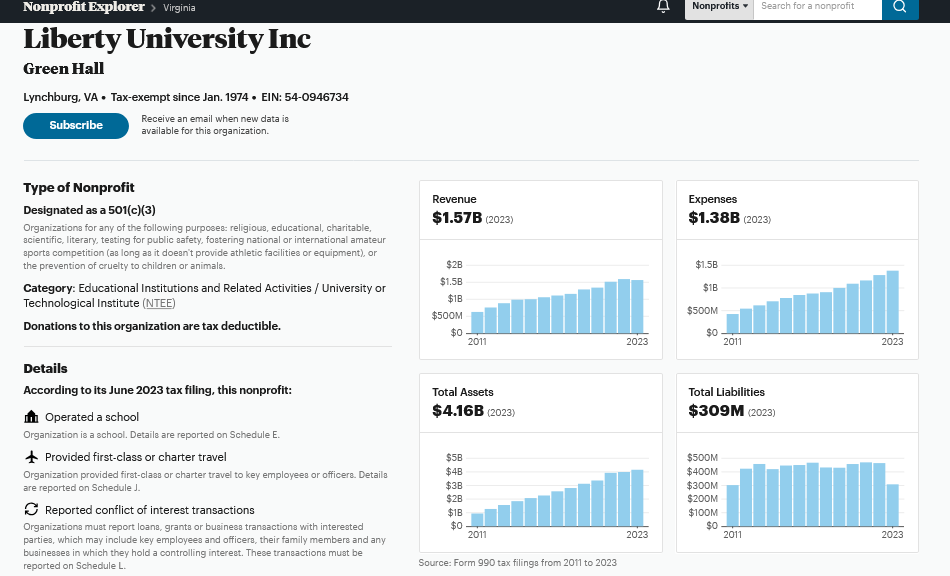
    Responding to changing demographics, beliefs, and norms, US religious colleges must reflect what’s popular and profitable: Christian evangelism, prosperity theology, contemporary technology, and international outreach. Like other areas of higher education, Christian higher education must focus on the realities of revenues, expenses, and politics, as well as religious dogma.  

    While a number of Christian colleges and seminaries close each year, and many more face lower enrollment and financial woes, one conservative Christian university stands out for robust enrollment, stellar finances, and political pull: Liberty University. There are other older schools, particularly Catholic schools with more wealth and prestige, but that’s changing. And it could be argued that those schools are religious in a historical sense rather than a contemporary sense.    

    Two Liberties

    Liberty University is an educational behemoth, and has the advantage of being a nonprofit school that uses proprietary marketing strategies. The brick-and-mortar school, with an enrollment of less than 20,000 students, is predominantly straight, white, and middle-class. The school also has a strict honor code called the Liberty Way, which prohibits activity that may be counter to conservative Christian beliefs.

    The growing campus includes a successful law school that serves as a pipeline to Christian businesses and conservative government. The Jesse Helms School of Government and the ban of a Young Democrats club reflect its conservative principles. Liberty also houses the Center for Creation Studies and Creation Hall, with a museum to promote a literal interpretation of the Christian Bible, to include the stories of God and the beginning of time, Adam and Eve, Noah and the Ark, and Moses and the Ten Commandments. 

    Liberty University Online (LUO), an international Christian robocollege with about 100,000 students, is more diverse in terms of age, race/ethnicity, nationality, and social class. Despite a lower than average graduation rate, the online school is thriving financially, and excess funds from the operation help fund the university’s growing infrastructure, amenities, and institutional wealth. Liberty spends millions on marketing and advertising online, using its campus as a backdrop. And those efforts result in manifold profits.  

    Liberty History

    Liberty University was founded in 1971 by Jerry Falwell Sr., a visionary in Christian marketing and promotion, who used technology the technology of the time–television–to gain adherents and funders. Fawell’s vision was not to create a new seminary, but to educate evangelical Christians to be part of the fabric of professional society, as lawyers, doctors, teachers, and engineers.

    Responding to the political and cultural winds, Falwell Sr. moved away from his segregationist roots as he built his church Liberty University. It was not easy going for Liberty in the early years, which had to rely on controversial supporters. The minister also used the abortion question, the homosexual question, and conservative Christian evangelism in Latin America and Africa to energize his flock and to create important political alliances during the Ronald Reagan era. Information about those years are available at the Jerry Falwell Library Archives.

    During the Reagan era and beyond, Falwell’s idea of a Moral Majority proposed that Church and State should not be divided, and those thoughts of a strong Christian theocracy have spread for more than four decades. 

    In March 2016, Jerry Falwell Jr. referred to presidential candidate Donald Trump as America’s King David. And under the first Trump Administration, the school gained favor from the President

    Under Donald Trump’s second term, Liberty University should be expecting to get closer to that goal of a Christian theocracy. For the moment, LU has the political power and the economic power that few other schools have to enjoy.

    Related links:

    Jerry Falwell Library Digital Archives 

    Dozens of Religious Schools Under Department of Education Heightened Cash Monitoring 

    Liberty University fined record $14 million for violating campus safety law (Washington Post) 

    How Liberty University Built a Billion Dollar Empire Online (NY Times) 

    Source link

  • Key Trends in the Era of the Modern Learner

    Key Trends in the Era of the Modern Learner

    We are at a pivotal point in higher education, the Era of the Modern Learner. This new era, shaped by evolving technology, changing cultural dynamics, and shifting student priorities, is revolutionizing how colleges and universities engage with students.

    Modern Learners are not who they used to be. They are:

    • Discerning, using data and online resources to thoroughly research programs and institutions.
    • Highly Informed and Goal-Oriented, demanding personalized experiences tailored to their specific needs.
    • Focused on ROI, seeking educational options that offer a clear return on investment and equip them with practical skills for future financial viability.

    To succeed in the Era of the Modern Learner, institutions must adapt and embrace a Unified Enrollment Approach that seamlessly integrates marketing and communications across the campus, ensuring a consistent brand message reaches all audiences. This means moving beyond traditional demographic-driven strategies and embracing the commonalities that bind today’s diverse student population as Modern Learners.

    The 2025 Marketing and Enrollment Management Benchmarks Report offers higher education leaders with the knowledge and insights needed to effectively navigate the landscape.

    Key Trends Impacting Higher Education Marketing and Enrollment Management

    The Rise of Stealth Applicants

    A growing number of students prefer to explore college options privately, submitting applications directly without engaging with admissions offices beforehand. This trend, known as stealth applying, presents a challenge for institutions to connect with these elusive prospects, requiring refined media spending strategies to justify investments and adapt to this evolving application behavior.

    Program Demand Shifts

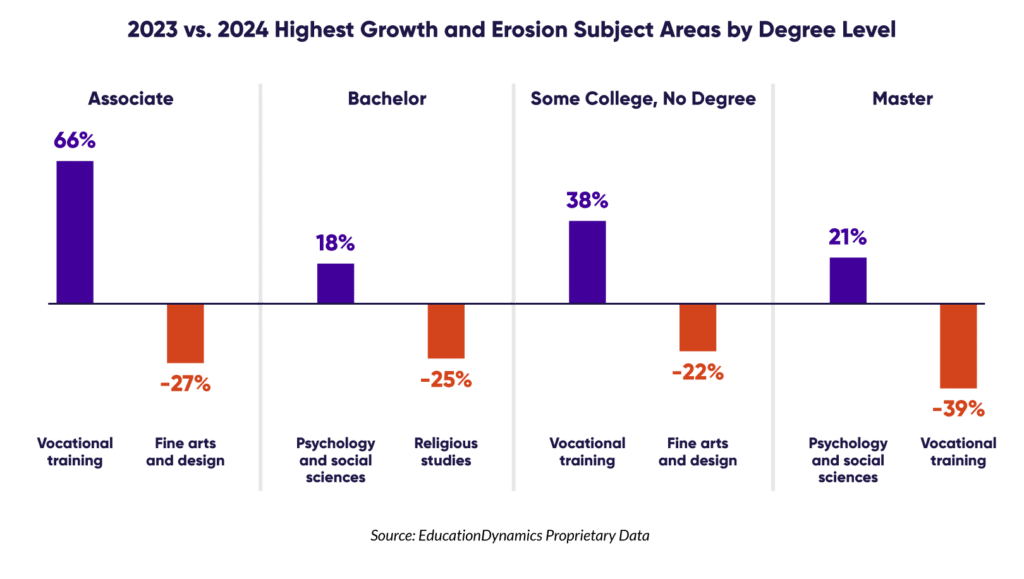
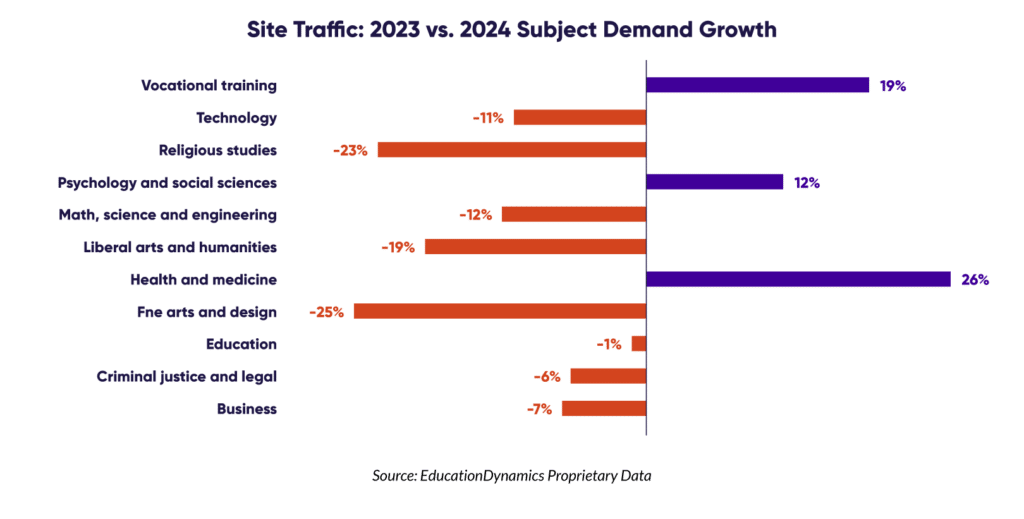
    Analysis of site traffic reveals significant shifts in program demand. Healthcare and vocational training programs are experiencing a surge in interest, reflecting a growing societal focus on healthcare careers and a shift towards practical skills and direct employment pathways. Conversely, traditional arts and humanities fields are facing declines, suggesting students are prioritizing fields perceived as more job ready.

    The Power of Organic Search

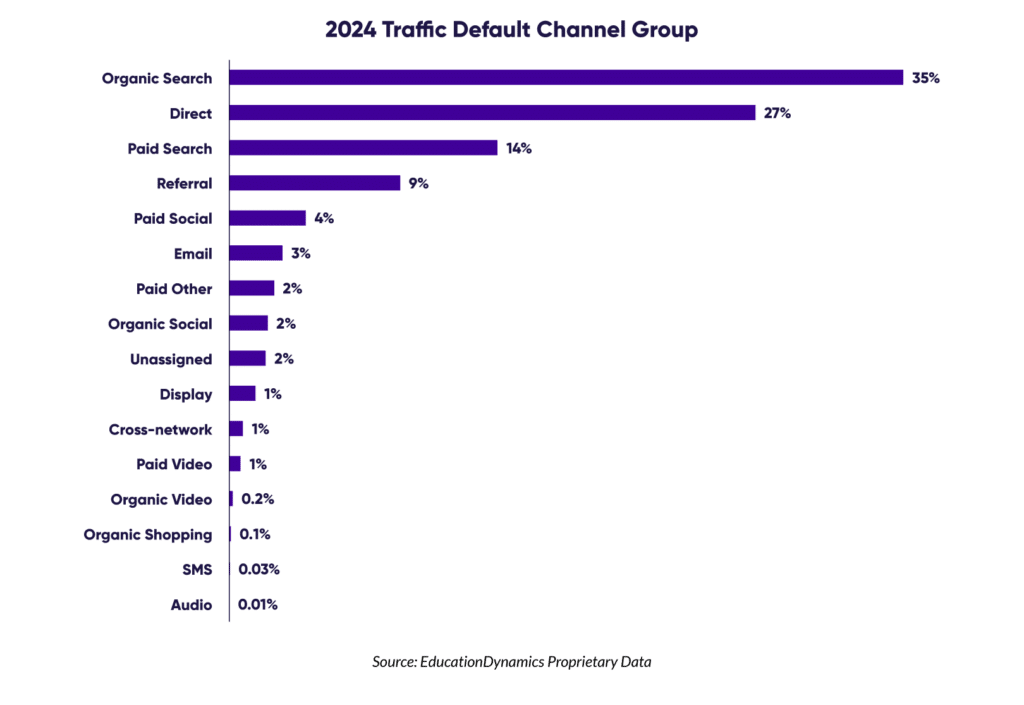
    Organic search remains a highly cost-effective way to attract prospective students, with over a third of all education website visits originating from organic search. Institutions need to prioritize website performance and optimize their online presence to capture this valuable traffic source.

    Digital Advertising Dominance

    Institutions are strategically increasing their investment in digital advertising, particularly across platforms like Google, social media, and mobile video. This shift reflects the Modern Learner’s digital-first consumption habits and the effectiveness of these channels in driving awareness and conversions.

    AI-Powered Personalization

    AI-powered tools, such as Google’s Performance Max, are transforming how institutions optimize advertising campaigns and personalize content delivery. These tools leverage machine learning to enhance ad performance across multiple Google channels, leading to more efficient and effective outreach.

    2025 Key Recommendations for Higher Ed Leaders

    • Break Down the Walls:
      Embrace a unified approach to enrollment that integrates marketing and communication strategies across the entire institution.
    • Be Transparent and Demonstrate Value:
      Prioritize transparency and demonstrate value, providing clear information about costs, program details, and career outcomes.
    • Go Digital or Go Home:
      Develop a robust digital marketing strategy, leveraging the power of organic search, paid advertising, and video content.
    • Leverage the Power of AI:
      Harness the power of AI, utilizing tools like Google Performance Max to optimize campaigns and personalize content delivery.
    • Stay Agile and Responsive:
      Continuously adapt to the evolving needs and preferences of the Modern Learner.

    By understanding these trends and proactively adapting strategies, higher education institutions can effectively engage Modern Learners, navigate the evolving landscape, and achieve enrollment success in 2025 and beyond.

    For a more in-depth analysis of the current higher education marketing and enrollment landscape, download our comprehensive Marketing and Enrollment Management report. It’s packed with EducationDynamics’ proprietary data, insights and actionable strategies to help you grow enrollment.

    EducationDynamics is dedicated to helping colleges and universities navigate these complex challenges. We offer proven solutions to help you implement these key recommendations and achieve your enrollment goals. Contact us today to learn how we can partner with you to reach the Modern Learner and thrive in the evolving higher education environment.

    Source link

  • The Evolution of the Traditional Admissions Funnel: Adapting to a New Era

    The Evolution of the Traditional Admissions Funnel: Adapting to a New Era

    The traditional admissions funnel has long served as a trusty blueprint for ushering prospective students from initial interest to enrollment. But times, they are a-changin’. Technological leaps, shifting student expectations, and newfangled marketing strategies have all conspired to transform this once-straightforward model. So, let’s dive into how the admissions funnel has evolved and what these changes spell out for colleges and universities.

    From Linear to Non-Linear Journeys

    Gone are the days of the straight-line path from prospect to enrollment. The old funnel—prospect, inquiry, application, admission, acceptance, enrollment—was neat and tidy. Today, the student journey is a lot more like a hopscotch game. Prospective students zigzag through stages, start an application, go back to gathering info, and flip-flop on decisions multiple times before finally enrolling. This behavior calls for admissions teams to be nimble and ready to pivot at a moment’s notice.

    The Digital Revolution

    The rise of digital tech has turned the admissions process on its head. Now, online platforms, social media, and virtual tours are the main highways for students discovering and engaging with colleges. Virtual events, webinars, and interactive content are must-haves to grab the attention of today’s digital-savvy students. To keep up, institutions need to master digital marketing and create a seamless online experience.

    Today’s students expect nothing less than personalized communication and experiences. With advanced data analytics, colleges can track student interactions and preferences, tailoring their outreach and engagement efforts. This means sending targeted messages, recommending specific programs, and offering personalized content that hits home with individual students. Such a personalized approach strengthens connections and boosts conversion rates.

    Increased Emphasis on Early Engagement

    Early engagement is now a cornerstone of the modern admissions funnel. Building relationships with prospective students well before the application stage is critical. This involves nurturing leads through meaningful interactions from as early as middle school. Colleges are investing in long-term outreach programs, summer camps, and pre-college initiatives to establish and maintain connections throughout the student journey.

    Focus on the Student Experience

    The student experience has become a pivotal factor in the admissions process. Prospective students are seeking more than academic offerings; they want institutions that align with their values, offer a supportive community, and provide opportunities for personal growth. Colleges need to showcase their unique campus cultures, highlight student success stories, and emphasize holistic support services to attract and retain students.

    Adapting to Changing Demographics

    Demographic shifts, like increasing diversity and the rise of non-traditional students, demand that colleges adapt their recruitment strategies. Institutions are developing more wide-ranging marketing campaigns and creating pathways for adult learners, transfer students, and international applicants. Understanding and addressing the unique needs of these diverse populations is crucial for staying competitive in today’s landscape.

    There you have it—the modern admissions funnel is a dynamic, digital, and personalized journey. Colleges and universities that embrace these changes and adapt their strategies will be the ones that thrive in this new era.

    We do NOT recruit and retain students when they understand us (the institution). We recruit and retain when students see we understand who they are.


    Mondy Brewer, Ph.D., brings over 30 years of diverse experience in higher education, having held key leadership positions in admissions, marketing communications, and student success. He has also served as an Assistant Professor of Leadership in Business. In addition to his consulting work specializing in enrollment management, he currently serves as AVP – Enrollment Strategy at Liaison. Dr. Brewer holds a Doctorate in Leadership with a focus on higher education administration. His doctoral research explored the engagement of first-generation college students, offering insights into the institutional support mechanisms that promote their success.

    Source link