Tag: Erasmus

  • Erasmus or Turing? Why it’s not an either-or

    Erasmus or Turing? Why it’s not an either-or

    Join HEPI Director Nick Hillman OBE and SUMS Consulting at 11am tomorrow (22nd January 2026) for a webinar based on the report ‘University Lands: Mapping Risks and Opportunities for the HE Sector’. Sign up for the webinar here. Read the blogs HEPI had published on the report here, here and here.

    This blog was kindly authored by Beverley Orr-Ewing, Consultant and Student Mobility Lead, Cormack Consulting Group, and Professor Sally Wheeler, Vice-Chancellor, Birkbeck, University of London.

    As the UK edges closer to a return to Erasmus+, attention is turning towards what this might mean for the Turing Scheme. For many universities, particularly those with deep European partnerships and strong Modern Language provision, the prospect of rejoining Erasmus is genuinely welcome. Politically, it is also an attractive signal – a step towards reversing some of the damage caused to relationships by Brexit and restoring a sense of connection with our European partners.

    Against that backdrop, our concern is less about a return to Erasmus itself, and more about the assumption that Erasmus can simply take on the role Turing currently plays. The real question, therefore, is not which scheme is better but what we will lose if Turing disappears.

    Different schemes, different problems

    Erasmus+ and Turing were created to address different policy challenges, at different moments in time and in very different political contexts. Erasmus+ emerged in the late 1980s as part of a broader project of European social integration, designed to support long-term cooperation through reciprocal partnerships between largely publicly funded higher education systems.

    By contrast, Turing, was designed in a post-Brexit landscape where the loss of Erasmus made a contraction in outward student mobility all but inevitable unless a new mechanism was put in place. From the outset, it placed greater emphasis on two areas Erasmus historically struggled with: widening participation and global reach. Turing was never intended to be a like-for-like replacement for Erasmus+, and treating it as such risks misunderstanding both its purpose and its value.

    What Turing has enabled

    A useful starting point is what Turing has enabled, and how it has reshaped and added value to student mobility.

    First, a genuinely global approach. The Turing Scheme has supported tens of thousands of UK students each year to undertake study and work placements overseas. In the 2023–24 funding round alone, nearly 23,000 higher-education students were supported, with placements spanning more than 160 countries worldwide. Alongside European destinations, the top host countries also show how non-European mobility has become central to Turing. In 2023–24, six of the ten most common higher-education destination countries were outside the EU (the United States, Australia, Canada, Japan, South Korea and China), and these non-EU destinations accounted for just over half of learners across the top ten.This reflects a shift away from a primarily Europe-centred model towards mobility that aligns more closely with student interests and the increasingly global outlook of UK higher education.

    Second, a more flexible, student-focused funding model. Turing places fewer structural requirements on the form mobility must take, allowing funding to follow the student rather than being shaped by institutional exchange frameworks. This has made it easier to support a wider range of mobility types, including short programmes, work placements and volunteering. While Erasmus also supports work and volunteering, Turing’s design has provided greater flexibility in contexts where traditional exchange models are difficult to sustain or risk excluding particular groups of students.

    Third, a clear priority around widening participation. From its inception, Turing was explicitly framed around improving access to mobility for students who have historically been less likely to participate. Funding outcomes for 2023–24 indicate that close to half of higher-education Turing participants were from under-represented or disadvantaged backgrounds, reflecting the scheme’s prioritisation of access. Its support for shorter, more flexible forms of mobility has been particularly important in widening participation, creating opportunities that are more manageable alongside work, family and financial commitments.

    This focus reflects purposeful choices shaped by both the diversity of today’s student body and the way UK universities now operate within a competitive global higher education environment.

    Equity and access

    The question, then, is how well Erasmus can sustain the broader patterns of participation that Turing has helped to establish. While Erasmus offers many strengths, its traditional models work best for students who are already well placed to participate – those who can commit to longer periods abroad, manage higher upfront costs and navigate study in another European language or academic system.

    Turing marked a deliberate shift away from that default. It was designed not just to increase the number of students going abroad, but to ensure that students from less financially secure backgrounds could access similar international opportunities to their peers. Removing it risks a return to mobility models that remain open in principle, but are easier to take up for students with greater financial flexibility and fewer competing pressures. If widening participation is to be meaningful, that risk requires careful consideration.

    Global breadth and strategic reach

    One of Erasmus’s greatest strengths is its stability secured in long term institutional partnerships, but the flexibility of Turing has enabled UK student mobility well beyond Europe at a time when global competition for talent, partnerships and influence is intensifying.

    Erasmus does allow some third-country mobility through KA171, but this remains capped and partnership-led, with limited flexibility and scale. If Erasmus were to become the sole mobility mechanism, the geographic frame and shape of UK student mobility would inevitably narrow, at a time when UK universities are being required to think more globally.

    A different operating environment

    There is also a more fundamental structural issue at play. UK universities increasingly operate within a funding and policy environment that differs markedly from that of many European counterparts. They are less directly publicly funded, more dependent on international engagement, and therefore more globally oriented in both strategy and outlook. For many institutions, this is not a matter of ambition alone but of long-term sustainability.

    Erasmus was designed to support publicly funded systems with strong regional integration. For EU member states, it also sits within a policy framework that they are able to shape and influence over time. Turing, by contrast, aligns more closely with the strategic reality of UK institutions, particularly those seeking to build sustainable engagement in growth regions such as India, Africa and Southeast Asia. In practice, universities were only beginning to realise how Turing could be used as a strategic lever alongside wider international priorities – removing it now risks cutting off that line of development just as it was starting to take shape.

    Disruption and uncertainty

    There is also a practical reality to consider. Over the past five years, universities have rebuilt systems, processes and partnerships around Turing. Removing it would create partnership instability, impose significant transition costs and erode institutional capacity at a point when resources are already under pressure.

    Alongside this sits a wider issue of political volatility. If student mobility funding is subject to repeated policy shifts, institutions are forced into short-term planning, designing programmes that may not survive the next change of government. That environment makes sustained investment, partnership-building and long-term student opportunity much harder to achieve.

    Design and delivery: what can be improved

    None of this is to deny that Turing has significant shortcomings. Late funding announcements, heavy administrative requirements and a lack of certainty of funding from one year to the next have created real challenges for institutions. They have not been able to embed Turing fully into long-term strategy.

    There are also limits that stem from Turing’s underlying design. Most notably, it does not provide funded reciprocal mobility unlike Erasmus, which embeds exchange as a core principle. Turing was deliberately constructed as an outward-only scheme. This has made it harder for institutions to sustain balanced international partnerships but reflects a conscious policy choice.

    Challenges around timing, administration and predictability are matters of delivery rather than principle. With clearer commitment, earlier confirmation of funding and greater multi-year certainty – drawing on the planning cycles familiar from Erasmus – many of these could be substantially mitigated. The experience of recent years suggests not that Turing lacks purpose, but that it has not yet been given the conditions it needs to thrive.

    A question of balance

    The most sustainable outcome is not a choice between Erasmus or Turing, but an approach that recognises the distinct value of both. Together, they support different dimensions of student mobility: European depth alongside global reach; long-standing partnerships alongside flexibility; stability alongside responsiveness.

    In a relatively short period of time, Turing has begun to reshape who participates in mobility, where students are able to go, and how international experience fits. It has opened doors to experiences previously beyond the reach of many students, supported more inclusive forms of participation and given UK institutions a tool that better reflects the global realities in which they operate. It would be a loss to see that progress curtailed.

    Rejoining Erasmus may be both desirable and beneficial. But allowing it to replace Turing entirely would mean stepping back from gains in widening participation and global engagement that align closely with the strategic direction of UK higher education and with the needs of students.


    Source link

  • Erasmus+, student loans, Rhineland study tour

    Erasmus+, student loans, Rhineland study tour

    This week on the podcast from Nijmegen on the SUs study tour the team discuss the return of the UK to Erasmus+. What steps can UK HE take to ensure that UK students take advantage of and get the benefits of mobility?

    Plus there’s a Private Members’ Bill on student loan timings, and the team share reflections on the associations, student leaders, curricula and food they’ve seen across Germany, France, Belgium, the Netherlands, Luxemburg and Switzerland.

    With Abi Taylor, President at Durham SU, Gary Hughes, CEO at Durham SU, Mack Marshall, Community and Policy Officer at Wonkhe and presented by Jim Dickinson, Associate Editor at Wonkhe.


    Re-associating with Erasmus+ is only the first step

    Student Finance (Review of Payment Schedules)

    Rhineland Study Tour blogs

    Source link

  • Europe’s universities say €40bn isn’t enough for Erasmus+ ambitions

    Europe’s universities say €40bn isn’t enough for Erasmus+ ambitions

    The European University Association (EUA), along with partners from across the European higher education sector are calling on policy makers to ensure an allocation of at least €60 billion for Erasmus+ in the EU’s next long-term budget.

    Currently, the proposed budget sits at €40.8 billion for the period 2028-2034 but campaigners argue that this amount is not enough to fund “ambitious actions” that have been proposed for the next generation of the program.

    EUA said that Europe now faces a “strategic choice” adding that “underinvestment in education would undermine the EU’s own political objectives”.

    EUA secretary general Amanda Crowfoot commented: “When all factors, including inflation and new priorities, are taken into account, the proposed Erasmus+ budget for 2028-2034 would at best allow the program to continue as it is.

    “However, it would not be able to fund enhanced and additional activities to underpin the Union of Skills and the European Education Area, as proposed by the European Commission.

    “This means that there will not be enough to pay for more inclusive learning mobility nor properly funded alliances, let alone for the new scholarships in strategy priority fields. Education can make an invaluable contribution to the EU’s competitiveness agenda, but this requires concerted investment,” she explained.

    In a joint letter by multiple partners – including the European Association for International Education, the German Academic Exchange Service (DAAD),  CESAER and many more – together representing thousands of higher education institutions, they make the case that Europe can only achieve its ambitions in education, skills and talent if Erasmus+ is “ambitiously resourced”.

    They note Erasmus+ is one of Europe’s “most tangible success stories” and that such a significant “contribution to citizens’ lives and to Europe’s future needs investment that matches its proven impact”.

    “For nearly 40 years, this popular flagship program has empowered millions of learners, strengthened institutional cooperation, deepened European integration and fostered global outreach,” the joint statement read.

    It went on to argue that in a time of “heightened geopolitical tensions” the program “delivers long-term returns in skills, employability, innovation capacity and civic engagement”.

    Education can make an invaluable contribution to the EU’s competitiveness agenda, but this requires concerted investment

    Amanda Crowfoot, EUA secretary general

    In December 2025, it was announced that the UK will rejoin Erasmus+ for the 2027/28 academic year, six years after leaving the scheme following Brexit.

    As the voice of European universities, EUA worked closely with its UK members to advocate for their return to Erasmus+.

    The agreement will mean UK students will be able to take part in the scheme without paying any extra fees from January 2027 and has been warmly welcomed by the international education sector. UK government modelling predicts that over 100,000 people in the UK could benefit from Erasmus+ within the first year of rejoining the scheme.

    At the time, Josep M. Garrell, president of EUA, said that by restoring bridges between UK and European universities, the decision will “support student and staff mobility, cooperation between universities (including through the European Universities alliances) and joint policy development.”

    The news prompted a wave of nostalgia across the sector as professionals, from the UK and elsewhere in Europe, reflected on the exchanges, encounters and opportunities that shaped their careers.

    Source link

  • stories that shaped the sector

    stories that shaped the sector

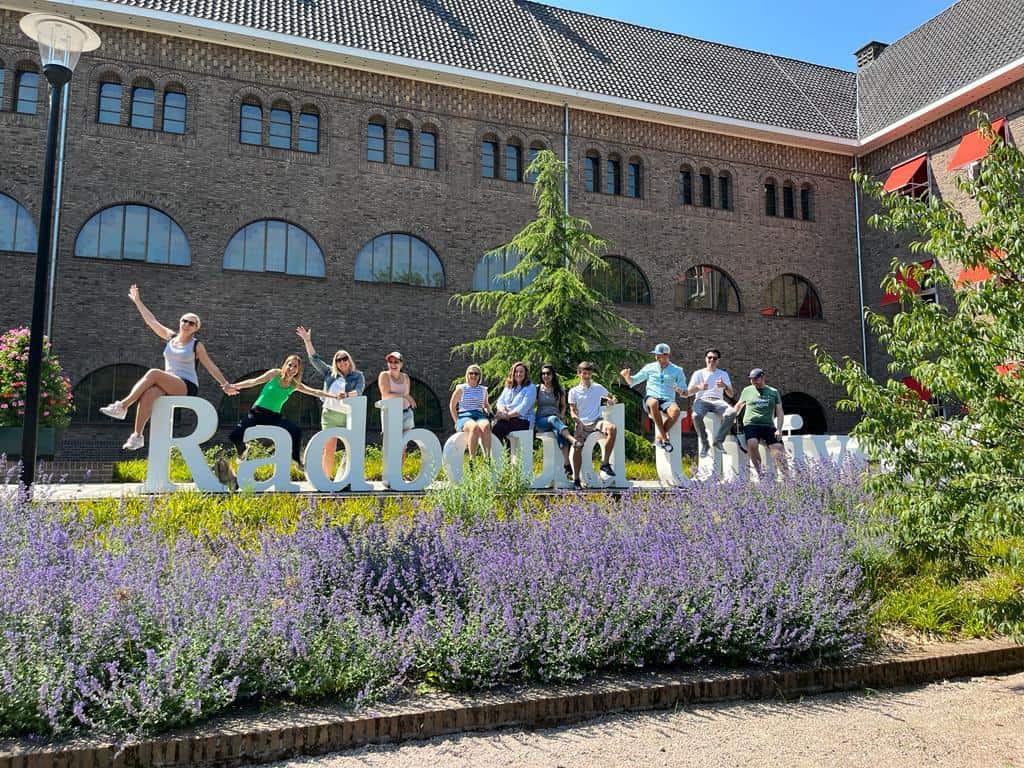
    It was August 2000 when Chloé Gorlei found herself at Nijmegen train station in the Netherlands, standing in the hot summer air and waiting for a minibus that would carry her to the international office at the University of Radboud.

    “There, I would sign the necessary paperwork and collect my bedroom pack; two towels, some bedding, and a single, unremarkable tea towel that somehow made the whole adventure feel suddenly real.”

    Gorlei, now head of international partnerships and student recruitment at Escape Studios, was the the first in her family to go to university, and had recently completed a two-year diploma in business and marketing and the University of Montpellier II in France.

    She describes her level of English at the time as “basic”, she didn’t know anyone in the country and was without a mobile phone. Despite these challenges, this was the start of a new chapter for her.

    “Not only did I meet people from all over the world, and learnt about new cultures, accents and habits, but I also lived in an unfamiliar place that would become home for ten months. Although culturally close to my country, I had to learn new codes, and even a new language.”

    “The university itself was very different to what I had known so far: going through economics books in English was a challenge! I was also not used to only having a few hours of lectures a week. Where I came from, we had lectures all day, five days a week,” she recalled.

    “This is Erasmus to me: experiences that shaped my future and friendships for life. It’s not all rosy, there are challenges, but it gives everyone, regardless of background or financial situation, a glimpse of what it means to be an international student. It opens your eyes to a world you might never have discovered otherwise,” said Gorlei.

    Photo: Chloé Gorlei

    In 2023, Gorlei reunited with some of her fellow Erasmus students in the Netherlands, describing it as “a wonderful chance to relive those moments, cycle the same lanes, and party in the same bars”.

    “It fills me with joy and hope that UK students will finally have this chance again, and that European students will discover the UK, an opportunity they might otherwise never have.”

    For Maria de la Pisa, deputy director international and head of international partnerships and relations at the University of Bristol, the UK’s reassociation to Erasmus+ is the early Christmas present she was hoping for.

    “I am incredibly excited to hear that the UK is going to rejoin the Erasmus+ program from 2027. This is wonderful news for the UK higher education sector and for all the thousands of UK and EU students who will be able to benefit from this transformative opportunity.”

    De la Pisa is proud to call herself an Erasmus scholar, having spent a year at the Univerity of Leicester, studying in a second language and quickly adapting to a very different academic approach compared to what she was used to in Spain.

    “I embraced British culture wholeheartedly,” she said.

    “That year was full of making international friends, travelling to as many corners of the UK as my budget allowed, and embracing the unexpected. I discovered fascinating traditions and celebrations which I had never even heard of before. It was a year of growth, adventure, and unforgettable experiences.”

    And it was that during this year that de la Pisa met her husband, who later went on to participate in an Erasmus exchange in Spain. The couple celebrated their 20th wedding anniversary in 2025.

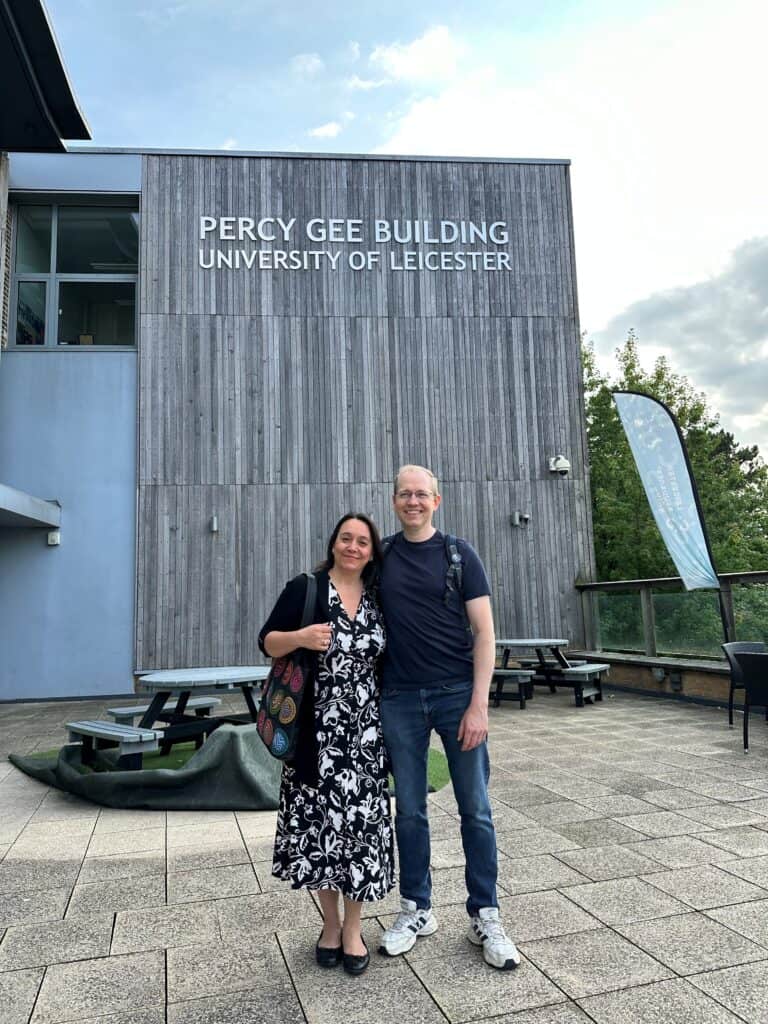
    The pair returned to the University of Leicester, 27 years later, to show their children where they first met – at an international student party in the Students’ Union (Percy Gee Building).

    Photo: Maria de la Pisa

    As de la Pisa’s son prepares to enter university next year, she said she is “delighted” that this opportunity will also be available to him and many other UK students.

    “Professionally, this incredible opportunity sparked an interest in working in international education and I have spent over two decades in the higher education sector motivated by a commitment to extend the same transformative opportunities I had to others.

    “For the sector, this is a huge win. It will strengthen collaboration with European partners, not only through student mobility but also through research, education, and cultural exchange. I hope this renewal also inspires a wider interest in language learning and the arts, areas that enrich society and reinforce global connections,” said de la Pisa.

    “Here’s to the next generation discovering the world, building friendships across borders, and shaping their futures. A big thank you to Universities UK International and all those who have tirelessly advocated for this change.”

    For Anne Marie Graham, chief executive of UKCISA, it is no exaggeration to say that Erasmus changed her life – both personally and professionally. Speaking to The PIE, she reflected on the transformative impact of the program and expressed her delight that young people in the UK will once again have access to the same life-shaping opportunities through Erasmus.

    “I didn’t know it at the time but I would have been a Widening Participation student. I was lucky enough to be funded for two Erasmus semesters – one in Granada, Spain and another in Clermont-Ferrand, France,” she told The PIE. She recalled her time in Granada with particular fondness, remembering it as it was before it became the global tourist destination it is today.

    “It was free to enter the Alhambra and I just used to go up on a Sunday afternoon with my book to sit and recover after a fun Saturday night out!”

    Photo: Anne Marie Graham

    “It was daunting at first, but loved being able to study alongside Spanish and French students, and create links with locals through university projects,” said Graham.

    “I was lucky to be able to immerse myself in many ways in Spain, and it was life-changing. It gave me self-confidence, language skills, intercultural competence and of course friends for life with students from other Uk universities, Spain, Italy, Sweden and the US. I’m very happy that these opportunities are returning to UK students.”

    The PIE‘s own Jacqui Jenkins also took a moment to reflect on her experience as an Erasmus student at weißensee academy of art berlin (then widely known as the East Berlin Art College).

    “Erasmus was genuinely life-changing for me – and, in many ways, probably the reason I’m still addicted to working in this wonderfully chaotic international education sector,” said Jenkins.

    I left the UK in 1997 as a Brit. I came back thinking much more like a global citizen

    Jacqui Jenkins, The PIE

    “Being dropped into a classroom with students from entirely different backgrounds changes how you see the world. Many of my peers had grown up in the former East Germany or the wider USSR and had experienced a very different schooling system and social reality. Those conversations – and that context – forced me to see everything through a different lens.

    “I left the UK in 1997 as a Brit. I came back thinking much more like a global citizen.”

    Source link

  • Re-associating with Erasmus+ is only the first step

    Re-associating with Erasmus+ is only the first step

    There was something very odd about the big Westminster government announcement on the UK rejoining Erasmus+.

    Pippa Crerar’s reporting in the Guardian on Tuesday night quoted “sources” claiming that there is expected to be an “international fee waiver” for EU students studying at UK universities under the scheme, meaning they would pay the equivalent of domestic fees that are capped at £9,535 a year.

    The piece added:

    In return, UK students would continue paying their standard domestic fees at their home university during their year studying in Europe as part of their UK degree courses. They would be eligible for a grant to help with the additional costs of living abroad.

    But hold on. That makes no sense. Not only would that break a fundamental Erasmus rule (you don’t pay fees to the host university), the arrangement as described would see £10,648 flowing into the UK university for doing very little for the student studying abroad.

    Meanwhile the European student coming to the UK would suddenly be forking out a lot more than most of them do at home.

    All of the material published on the announcement day merely said that UK students will pay “no more” than they do now – but what most of the media missed is that what they pay now is a fixed 15 per cent of the maximum fee to the UK university. “No more” than £1,598 or “no more” than £10,648?

    The Department for Education (DfE) – which has already announced that the maximum fee a UK university can levy on a student studying abroad will be that 15 per cent thing that’s been in place for a decade – referred me to the Cabinet Office. No reply was forthcoming there or via the EU, and UUK simply told me to contact the government. Weird.

    For the time being, let’s assume that Crerar’s “sources” were mixing up what might well be coming in the wider youth mobility deal – it does suggest that for students coming here (or going there) for a course outside of Erasmus+, students will pay the home fee rate in the host country, as they did pre-Brexit – which resurrects the “EU students pay £0, RUK students pay £9,535” issue in Scotland.

    The issue of fees will matter quite a bit when considering inward demand given fees are generally much lower and loan schemes to pay them less common. And from a UK student perspective, even 15 per cent of the max fee looks like a rip off. What are they getting for that?

    It’s a jolly holiday in Bari

    The political debate has been mainly focussed on the “middle class jolly” thing, which is not helped by half a billion flowing to HE for this looking very odd when there’s very little other money that students don’t take out a loan for flowing into the sector, at least on the teaching side.

    The government has pressed the breadth of opportunities for non-HE students, the widening participation aspects of the plus version of Erasmus, and the “bang for buck” on wider spending – but does look a little top heavy.

    Overall of course the cost should be covered by the raid on Plan 2 graduates in the Budget – suffering their second repayment threshold freeze in a decade. Let’s think of this as robbing Covid grads whose year abroad was on Youtube to pay students to have a proper one now.

    As I’ve noted on here before, Erasmus+ is not your granddad’s Erasmus. For higher education students there’s your core study periods of 2-12 months at partner institutions, as well as traineeships in workplaces abroad for 2-12 months, or a combo both within a mobility period.

    Doctoral students can access shorter “mobilities” of 5-30 days or longer periods of 2-12 months, with the option to include traineeships. School pupils can participate in group mobilities of 2-30 days accompanied by staff, individual short-term learning mobilities of 10-29 days, or long-term mobilities exceeding one month.

    FE students and apprentices can access group mobilities of 2-30 days, short-term placements of 10 days to 3 months (or from 2 days for disadvantaged students), long-term Erasmus Pro placements up to one year, and funding to attend skills competitions for 1-10 days. Adult education learners can spend up to one month learning, training or volunteering abroad.

    Young people can also join youth exchanges of 5-21 days for workshops and activities, access Discover EU rail passes at age 18, and participate in youth participation projects addressing civic and cultural issues.

    Mobility funding covers travel, living costs, course fees, visa costs, language preparation and organisational costs, with additional support for students with disabilities, additional learning needs and disadvantaged backgrounds.

    Universities and education institutions can access multiple partnership and mobility frameworks. Higher education institutions must first secure Erasmus Charter for Higher Education accreditation, then can participate in cooperation partnerships, Erasmus Mundus Joint Masters programmes, Alliances for Innovation, and capacity-building projects. And Jean Monnet actions support teaching and learning about EU policies in schools and universities.

    Staff can undertake teaching periods or training activities of 2-60 days, combining both if desired, with job shadowing and observation opportunities at partner institutions or enterprises.

    Schools can develop partnerships with other schools, access the eTwinning online collaboration platform, and send teachers for training courses of 2-10 days, job shadowing from 2 days to 2 months, or teaching assignments from 2 days to one year. VET providers can establish partnerships addressing Erasmus+ priorities and send staff for courses and training of 2-10 days, job shadowing of 2 days to 2 months, or teaching assignments of 2 days to one year. Adult education providers can develop partnership projects for innovative practices.

    Youth organisations can run Mobility Projects for Youth Workers lasting 3 months to 2 years, including seminars, training courses, networking events and study visits. Funding applications must be submitted through institutions either individually or via consortia, with some Key Action 2 and 3 activities managed directly by the European Education and Culture Executive Agency.

    The programme extends beyond formal education into youth work and sport as well. Youth workers can access professional development through mobility projects involving seminars, training courses, networking events, study visits and job shadowing abroad in projects involving at least two organisations from different countries. Sports coaches and grassroots sports staff can undertake job shadowing or observation periods of 2-14 days, or coaching and training assignments of 2 weeks to 2 months, with non-grassroots staff eligible if their work benefits grassroots sport.

    Not a fair swap

    The main moan about Erasmus always was that far more students came to study in the UK than vice versa, which Brexit types put down to our education system being better. I’m not so sure about that – there were clearly a range of other barriers in play, and a lot of European HE is now taught in English given wider non-EU internationalisation agendas as universities across the continent clock on to international fees as an income source.

    Here in 2025, however expensive student housing is across Europe, it’s almost always cheaper than here – and the “pent up demand” thing may well kick in, as well as the attractions of what was usually a “pass/fail” second year rather than their weird grind of grading everything that moves that we maintain in the UK.

    The decision in 2012 to allow universities to charge that 15 per cent came off the back of a report led by Colin Riordan, then VC at Cardiff on barriers to mobility. It said that the problem was mainly money and language, but those headline barriers were reinforced by a system that made mobility feel like an optional add-on for confident, well-off students rather than a normal, supported part of study.

    Costs and debt aversion sat alongside low language confidence, especially once pupils had already been funnelled into narrower choices at school. Then the university-level friction kicked in – tightly specified curricula, professional accreditation constraints (particularly in health and STEM), patchy recognition of overseas learning (itself a subset of the UK’s general failure to do credit transfer properly), and the sheer administrative grind of making exchanges work when support teams are small and incentives for academics and departments are thin.

    The report called for a coherent UK outward mobility strategy and an organising body to professionalise practice, coordinate messaging, and create a single, navigable portal of opportunities and support. It argued for sustainable funding beyond fragile pots, including sponsorship and philanthropy, and for mainstream student finance to travel with the learner (loan portability), backed by a clearer map of scholarships and bursaries so students were not left guessing.

    It called for curriculum redesign so mobility would fit more easily, and for consistent recognition and accreditation of the learning and skills gained abroad, with targeted work with professional bodies to unblock the hardest-to-move disciplines. It also pushed for a proper national data regime with agreed definitions, so the sector could understand participation patterns and equity gaps and stop flying blind.

    Alongside that, it recommended collaboration and shared services to reduce duplication and build capacity, more creative models than the traditional “extra year abroad”, and earlier intervention through schools and stronger language learning as national infrastructure. And it made a case for equality – if employers care about a global mindset more than the route, then UK-based “international” experiences were to be recognised too.

    A lot of that simply never materialised – although HEFCE was funded to do a supplement to support students on overseas exchange programmes, offering around £2,250 for full-year placements abroad. Albeit with a declining value per student over time, that actually survived in England until this academic year – only for it to be scrapped in Bridget Phillipson’s OfS allocation for 2025-26. Unsurprisingly, there’s no news on a resurrection to accompany today’s announcement.

    Widening access to mobility

    Later in the decade an EU-funded UUKi report on widening participation in mobility found that UK’s problem was never just “low participation” overall, but was patterned inequality with compounding effects. Students with overlapping disadvantages had even lower rates of participation.

    In 2015–16, students from higher socio-economic backgrounds were sixty-five per cent more likely to be outwardly mobile (2.5 per cent vs 1.5 per cent). BME students were 22.2 per cent of the cohort but only 17.6 per cent of outwardly mobile students. Care leavers sat at 1.0 per cent participation (below the 1.7 per cent sector average).

    Practical exposure to upfront costs, uncertainty, and the limits of support were all key, and those financial issues were felt more strongly among certain socio-economic groups. Students often financed mobility through loans, because grants did not cover all costs.

    Longer-term mobility was blocked by cost, responsibilities at home such as caring duties or paid work, and less flexibility in the length of degree programmes. So the barrier was structural. When the timetable didn’t not bend, only certain lives could travel.

    Students’ decisions were shaped by the type of information provided and the timing of it, with many saying earlier awareness helped. Academic staff mattered too, and academic buy-in was persuasive when students were considering mobility. If the message comes late, or from someone students do not trust, why would we expect take-up to widen?

    The report also flags negative assumptions and links these to culture shock and homesickness. It also noted that for some groups, families needed to know what to expect in terms of cost, culture, and impact on the degree. Outward mobility is often sold as a confidence booster. But whose confidence is being asked for upfront?

    Weak national signalling on widening participation in mobility was also a factor. It drew on European-level analysis that national targets that included widening participation signalled strong political commitment. Yet it noted the UK did not have a national target for mobility participation by underrepresented groups.

    To fix, university leaders were invited to shift from mobility-as-optional-extra to mobility-as-designed-and-funded pathway (our old friend “whole university approach”), targets were to be set to mirror the institution’s student body, delivery was to be hardwired through academic departments (including named coordinators and staff induction) rather than leaving it to an international office, and it wanted joined-up support with widening participation teams, disability services, careers and SUs, alongside clearer “no surprises” information and pre-departure preparation.

    No doubt that happened in some universities, but I’m also willing to stick my neck out and suggest that the report and its recommendations gathered digital dust in the way that so many reports of its ilk do. If nothing else, DfE should require outward mobility to show up in access and participation plans in England.

    The road ahead

    Here in 2025, I’d add in money and provision responsibility. The Riordon report tended to treat Erasmus as an intercalary extra year that extended a standard bachelor’s degree, warning that higher fees and debt could deter students from extending their degree to encompass a period of mobility”. That later report tended to treat an Erasmus “year” (or, more often in the case studies, a semester-length period) as part of the degree rather than some bolt-on “extra credit” activity.

    In the latter case, UK universities’ repeated lack of interest in student transfer (a duty in England that few observe with enthusiasm) is a signal of the problem – having three years of fees is financial lock in, so mobility becomes a financial loss. While I’d love to imagine that governing bodies will ever think about anything else (like purpose or the student interest), I’m also a realist.

    Generally, the lack of action on transfer, credit accumulation, mobility and any number of issues also reflects that unlike across the EU, we don’t seem much interested in framing anything as a student right, despite levying much higher fees than most of the continent. If ministers really want this to succeed, they should get a grip. A lifelong “entitlement” to loans with barely any rights over the education the loans buy remains the worst aspect of the UK’s “wooden legs, real feet” approach to HE policy.

    Meanwhile it’s always been the case that the regulatory position is up in the air – QA has often been “light” (assumed to be covered by Bologna processes) but things like harassment and sexual misconduct, or free speech, or any number of other areas where a student might assume at best equivalence or at least that someone’s thought about it back home (in exchange for their 15 per cent of the fee) have tended to be filed in the “too difficult to resolve” box.

    Without a proper strategy inside DfE, proper incentives (or targets) for universities and progress on stuff like credit transfer, the real danger is that a future government that is less interested in being anything other than little England mentality will look at similarly disappointing participation (either in volume or access terms) and just yank the reverse lever. I’d love to be wrong.

    Source link