
Tag: Establish

  • 5th Circuit Questions Whether 10 Commandments in Classrooms Establish a Religion – The 74

    5th Circuit Questions Whether 10 Commandments in Classrooms Establish a Religion – The 74


    Get stories like this delivered straight to your inbox. Sign up for The 74 Newsletter

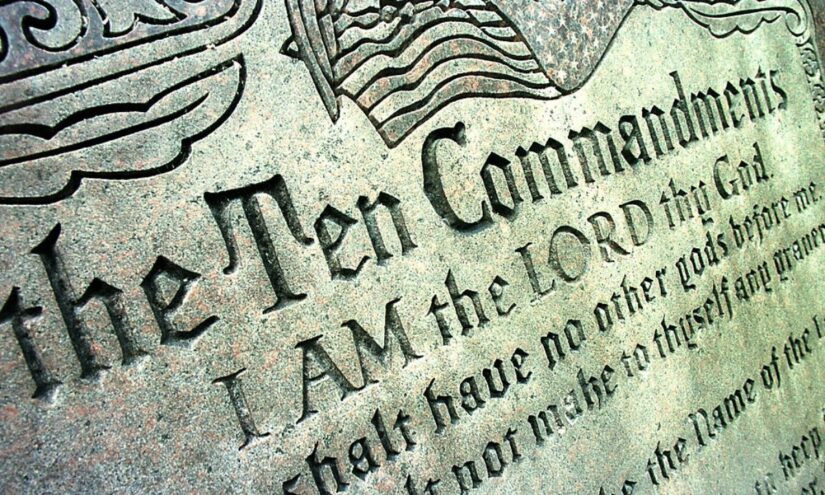
    The full panel of judges on the U.S. 5th Circuit Court of Appeals heard arguments Tuesday in a case that could require Louisiana public schools to feature posters with the Ten Commandments in every classroom.

    Attorney Liz Murrill sought a rehearing with all 17 judges from the 5th Circuit after a three-judge panel ruled in June that the 2024 state law requiring the displays was “plainly unconstitutional.” A group of parents of public school students had filed a lawsuit against the state to block the law, which includes the text of a Protestant version of the Ten Commandments, from being enforced.

    The case, Roake v. Brumley, could hinge on whether the law violates the First Amendment’s Establishment Clause, which prohibits governments from endorsing a specific religion. Whether a comparable law in Texas takes effect will likely depend on the outcome of the Louisiana case.

    The plaintiffs in the case are represented by the American Civil Liberties Union, Americans United for Separation of Church and State and the Freedom from Religion Foundation. Judges grilled their lawyers with questions about basing their arguments on the long-standing precedent from the case Stone v. Graham, a 1980 ruling from the U.S. Supreme Court that overturned a similar law in Kentucky. Justices decided then that the First Amendment bars public schools from posting the Ten Commandments in classrooms.

    Some 5th Circuit judges said they believe the Stone decision was effectively nullified because it relied on a precedent from the 1971 case Lemon v. Kurtzman, which the Supreme Court overturned in 2022. The so-called Lemon test has been applied for five decades to decide what amounts to a violation of the Establishment Clause.

    The 2022 case, Kennedy v. Bremerton, involved a Washington state high school football coach who was fired for praying at midfield after games and allowing students to join him. Joseph Kennedy got his job back after conservative justices prevailed in a 6-3 decision, saying the post game prayers do not amount to a school endorsement of Christianity.

    Attorneys for the plaintiffs told the 5th Circuit judges that the Kennedy decision might have overturned Lemon but did not nullify the Stone ruling. Still, some judges questioned how an 11-inch by 14-inch poster amounts to coercion of religious beliefs.

    In a news conference after the nearly two-hour hearing, Murrill expressed confidence in the state’s arguments but predicted the case is likely headed to the Supreme Court regardless of the 5th Circuit’s decision.

    “We believe that you can apply this law constitutionally,” Murrill said.

    Gov. Jeff Landry, who attended Tuesday’s hearing, called the Ten Commandments one of the nation’s foundational documents.

    “I think Americans are just tired of the hypocrisy,” Landry said. “I just think that it’s high time that we embrace what tradition and heritage is in this country, and I agree with the attorney general. I like our chances.”

    The Rev. Jeff Sims, one of the plaintiffs and a Presbyterian minister in Covington, issued a statement after the hearing saying he wants to be the one to decide on the religious education that his children receive.

    “I send my children to public school to learn math, English, science, art, and so much more — but not to be evangelized by the state into its chosen religion,” Sims said. “These religious displays send a message to my children and other students that people of some religious denominations are superior to others. This is religious favoritism and it’s not only dangerous, but runs counter to my Presbyterian values of inclusion and equality.”

    Louisiana Illuminator is part of States Newsroom, a nonprofit news network supported by grants and a coalition of donors as a 501c(3) public charity. Louisiana Illuminator maintains editorial independence. Contact Editor Greg LaRose for questions: [email protected].


    Did you use this article in your work?

    We’d love to hear how The 74’s reporting is helping educators, researchers, and policymakers. Tell us how

    Source link

  • HBCUs Establish Credit for Prior Learning Models

    HBCUs Establish Credit for Prior Learning Models

    Adult learners often come to higher education with a variety of skills and experiences that aren’t directly reflected in their academic transcripts. Credit for prior learning (CPL) is one way colleges and universities can recognize education outside of the classroom and expedite a student’s degree completion.

    An April 14 webinar hosted by the Council for Adult and Experiential Learning highlighted effective strategies for implementing credit for prior learning at four historically Black institutions: Elizabeth City State University, Atlanta Metropolitan State College, Morgan State University and Delaware State University.

    Campus leaders shared the value of CPL policies, described how they’ve collaborated with various stakeholders at their institutions and provided logistical details for making CPL accessible for students and manageable for faculty.

    Understanding the need: The administrators spoke of the importance of offering credit for prior learning to working adults seeking a credential.

    “What we realized is that if you really want to continue to grow your enrollment, high school graduates cannot be the only population you serve,” said Farrah Ward, provost and vice chancellor for academic affairs at Elizabeth City State University in North Carolina.

    One of the signature programs at her institution is a bachelor’s degree in aviation science. A significant number of students who enroll in the program already hold a private pilot’s license, but in the past they had to take repetitive courses to fulfill degree requirements. By offering CPL, the university is now able to recognize aviation students’ licenses and reduce redundancies in their course load.

    Gaining buy-in: Before launching CPL, leaders at Elizabeth City State held an event for faculty and staff to talk about how to better serve adult learners in all departments and areas of the student experience.

    The university also leveraged the expertise of various campus departments, including faculty, admissions professionals, military and veterans’ affairs staff, and student affairs leaders, Ward said.

    Partnering with faculty members is key to a successful CPL process, Ward said, and can mean rolling out CPL in small measures to ensure frameworks are supported by professors and aligned with the respective learning outcomes for the discipline.

    Atlanta Metropolitan State College has a CPL committee, which includes four faculty members to maintain the faculty voice in decision-making, said Kokila Ravi, director of online and specialized programs.

    State policy also drives the implementation of CPL. North Carolina uses a performance-based funding model, and Elizabeth City State is evaluated on how it increases the adult learner population on campus, tying CPL directly to institutional health and funding.

    Similarly, Maryland state law requires higher education institutions to offer some form of competency-based learning or credit for prior learning, said Nicole Westrick, assistant vice president and dean of Morgan State University’s College of Interdisciplinary and Continuing Studies.

    Creating early awareness: Alerting students of CPL opportunities is key, panelists said. “Most times [the admissions team] is the first point of contact, and when they are having those conversations with potential students, we let them know that CPL is an option,” said Rolanda Harris, director of adult and continuing education at Delaware State University.

    Elizabeth City State is piloting an adult learner orientation tailored toward students ages 25 and over this fall, Ward said, during which staff will specifically talk about CPL.

    Morgan State hosts intensive advising appointments with incoming students, in which advisers discuss CPL and the university’s transfer evaluation system.

    Easing access: College leaders also shared innovations their campuses have implemented to reduce barriers to access for learners interested in taking advantage of CPL.

    Morgan State offers students the option to enroll in a two-credit elective course to help them create a portfolio. “They participate in a peer review, practice their writing, preparing the portfolio, and when they’re finished, there’s a staff review of the portfolio to make sure that they’ve done a good job of aligning that prior learning experience with the learning outcomes from courses at Morgan State,” Westrick said.

    Morgan State also creates digital rubrics for faculty members reviewing the portfolio, “so that it eases the cognitive load for our faculty in finding what they’re looking for; it always follows the same format,” Westrick said.

    Some of the colleges offer a wide range of applications for CPL, requiring the students to earn a certain number of credits from the institution for their degree while allowing CPL to take the place of general education and major courses.

    Funding CPL: Morgan State received a $5,000 grant from the American Council on Education to standardize and scale CPL on campus. Atlanta Metropolitan State received a $25,000 grant from the Adult Learning Consortium and the University System of Georgia to kick-start the process.

    Some panelists said they charge a fee for portfolio assessment, for which the average student pays between $150 and $250. A few campus leaders said they provide a stipend to faculty for reviewing portfolios, while others offer the service pro bono.

    Being mission-minded: For institutions considering implementing CPL, Ward said it’s important to start somewhere, even if it seems daunting. In the same vein, remaining flexible and understanding that CPL policies may have to pivot is important, said Harris. “I would just say, ‘Stay open.’”

    Westrick said starting with the institutional mission in mind is critical, because that helps ground the process in understanding who will benefit from the policy and how it can make meaningful changes in their educational goals.

    Utilizing faculty champions to advertise the offering and encourage students to take advantage of CPL is another lesson to learn, Ravi said. “We are still struggling to get the word out and get students to know about it. That’s why we are relying heavily on our faculty to promote the process.”

    Get more content like this directly to your inbox. Subscribe here.

    Source link