This blog was kindly authored by Dr Louise Oldridge, Senior Lecturer at Nottingham Trent University (with research team Dr Maranda Ridgway, Dr David Dahill, Dr Ricky Gee, Dr Stefanos Nachmias, Dr Loyin Olotu-Umoren, Dr Jessie Pswarayi, Dr Sarah Smith, Natalie Selby-Shaw and Dr Rhianna Garrett).
Despite decades of progress in widening participation and diversifying student bodies, UK higher education still faces a stark reality: senior professional services roles remain overwhelmingly white.
Indeed, when the professional body for senior professional services staff (Association of Heads of University Administration – AHUA) embarked on work to ‘shift the dial’ on race, membership had less than 5% global majority colleagues.
While universities champion equality, diversity, and inclusion (EDI), and the sector has developed levers such as the Race Equality Charter (REC), the lived experiences of ethnically minoritised staff highlight systemic barriers that hinder career progression and perpetuate inequality.
A recent research project funded by AHUA and conducted by the Centre for People, Work & Organizational Practice at Nottingham Business School explored these challenges. Drawing on interviews, focus groups, and institutional data, the project studied the career barriers and enablers for ethnically minoritised professionals in senior roles.
The diversity gap in professional services leadership
University leadership teams have diversified in some areas, for instance among governors, students, and even vice-chancellors, but senior professional services remain largely homogenous.
Recruitment practices, opaque progression pathways, and institutional norms continue to privilege whiteness and middle-class values, leaving talented individuals from minoritised backgrounds sidelined.
With limited institutional data available for the study, it revealed that while representation among lower-grade professional services roles has improved, senior positions tell a different story.
Unlike academic colleagues, there is a stark shift in career management for professional services staff, with our research finding that many institutions are unequipped to track the career trajectories of professional service staff.
Lived experiences: authenticity, masking, and emotional labour
The qualitative insights from interviews and focus groups paint a vivid picture of what it means to navigate professional services as a person of colour. Participants spoke candidly about the emotional labour involved in “code-switching” (altering language, appearance, or behaviour to fit dominant norms) and “masking” aspects of identity to avoid judgment or exclusion.
One participant reflected: “I felt I had to disappear… to succeed, I needed to be someone else.” Others described being labelled as “diversity hires” or facing regular microaggressions that impacted confidence and wellbeing.
Intersectionality compounds these challenges. Participant responses indicated that race intersected with gender, class, disability, and caring responsibilities, creating layered barriers that are often invisible to policy-makers. Women of colour, for instance, reported being undermined due to both race and gender, while those with disabilities faced inflexibility and a lack of empathy.
Performative EDI and the need for structural change
In a blog on the REC for Advance HE, Patrick Johnson calls for institutions to make an authentic commitment to dismantling racial barriers for staff. Institutions can use data to expose disparities and perceptions of the operating culture and environment.
As Patrick notes, it is important that challenges are acknowledged openly and specific actions put in place in response.
That said, participants in this research questioned the depth of their organisation’s commitments. EDI initiatives were described as performative and focused on optics rather than outcomes. As one interviewee put it:
We talk about EDI when we’re going for awards, but it’s not part of our everyday practice.
This disconnect between rhetoric and reality highlights a critical gap: policies alone cannot dismantle systemic inequities.
Ultimately, what is needed is leadership from those in roles which can challenge the structural issue, redefine what it means to be ‘professional’, develop clear career pathways, transparent promotion processes, and accountability mechanisms that move beyond tick-box exercises. REC is a starting point for supporting this process, but cannot be seen either as a panacea or an end in itself.
Five pathways to change
The report offers a roadmap for transformation, organised into five thematic areas:
Structural reform and policy change Clarify career pathways for professional services staff, audit recruitment practices, embed accountability into EDI policies and ensure progression routes are transparent – such as providing an understanding of ‘typical’ career histories for leadership roles.
Representation and inclusion Increase diversity at senior levels through targeted development and sponsorship. Avoid tokenism by ensuring ethnically minoritised staff have meaningful influence, not just visibility. This could include clearer succession planning.
Development, support, and research Invest in mentoring, coaching, and executive development programmes tailored to professional services. This reflects both formal support staff networks and more informal collectives, alongside committing to longitudinal research to track progress. For example, creating an informal network of colleagues across the sector.
Cultural change and co-creation Move beyond compliance-driven EDI to authentic engagement. Challenge assumptions about professionalism and leadership, and co-create inclusive cultures with staff. This could mean redefining what institutions view as ‘professional(ism)’.
Sector-level collaboration and accountability Coordinate efforts across professional bodies, share best practice, and ensure transparent reporting. Diversity must be a collective responsibility, and could include sector-wide knowledge exchange, clear metrics and outcomes.
From awareness to action
The report calls for dismantling what research team member Rhianna Garrett describes as ‘the architecture of whiteness’, which underpins institutional norms. This means rethinking recruitment, valuing professional services as integral to university success, and creating spaces where ethnically minoritised staff can thrive without compromising their identity.
As one focus group participant put it:
We recognise there is an issue, but I don’t think we really understand what to do about it – and a big part of that is because things are so white.
For AHUA, and other sector professional service organisations, this report is a call for the sector to deliver systemic, sustained change. The question is not whether higher education can afford to prioritise diversity in professional services leadership; it is whether it can afford not to. It informs our next steps in a Theory of Change workshop to identify meaningful actions moving forward.
As Dr Andrew Young, Chief Operating Office, The London School of Economics and Political Science, and AHUA project sponsor states:
The evidence in this report should make all of us in higher education uncomfortable. Change will only happen when we stop celebrating statements of intent and start measuring outcomes.
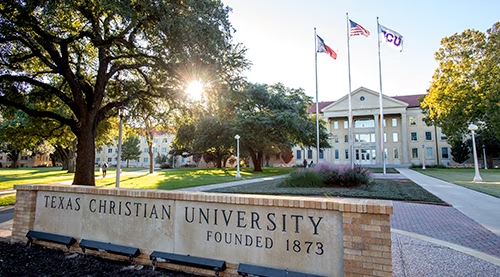
Texas Christian University Texas Christian University will shutter its women and gender studies department and comparative race and ethnic studies department at the end of this academic year, folding both programs into the English department in a move faculty members say reflects the institution’s response to political pressure.
The decision, announced earlier this month, comes as higher education institutions nationwide face mounting scrutiny over programs related to diversity, equity and inclusion—particularly those focusing on gender and race. TCU officials cited low enrollment as the primary rationale, though faculty members say the timing suggests otherwise.
Discussions about restructuring or renaming the departments began in February. Those conversations centered on how to address external pressure against anything perceived as related to DEI initiatives—pressure that has intensified since the Trump administration began efforts to eliminate such programs.
Faculty members report that university messaging has been inconsistent. Last spring, they were told the two departments would merge but could not include “race” or “gender” in the combined department’s name. By August, officials indicated the merged department could retain those terms. The October announcement revealed all three units would be absorbed into the English department, which will retain its original name.
University data shows undergraduate enrollment in both departments remains minimal this fall: two seniors are majoring in women and gender studies, while nine students major in comparative race and ethnic studies—five seniors, three juniors and one sophomore.
Women and gender studies at TCU traces its roots to 1979, when professors Jean Giles-Sims and Priscilla Tate began advocating for such a program. The university formally launched it in 1994. The comparative race and ethnic studies program emerged in 2017 amid student concerns about campus climate, with its founding director telling media the program would help foster cultural change and attract a more diverse student body.
In his email to English faculty, Provost Floyd Wormley Jr.said that the restructuring aims to “ensure a more efficient and effective use of faculty and administrative resources” while maintaining fiscal sustainability.
This story was originally published by CalMatters. Sign up for their newsletters.
This fall, every high school in California was supposed to offer ethnic studies — a one-semester class focused on the struggles and triumphs of marginalized communities.
But the class appears stalled, at least for now, after the state budget omitted funding for it and the increasingly polarized political climate dampened some districts’ appetite for anything that hints at controversy.
“Right now, it’s a mixed bag. Some school districts have already implemented the course, and some school districts are using the current circumstances as a rationale not to move forward,” said Albert Camarillo, a Stanford history professor and founder of the university’s Center for Comparative Studies in Race and Ethnicity. “But I’m hopeful. This fight has been going on for a long time.”
California passed the ethnic studies mandate in 2021, following years of debate and fine-tuning of curriculum. The class was meant to focus on the cultures and histories of African Americans, Asian Americans, Native Americans and Latinos, all of whom have faced oppression in California. The state’s curriculum also encourages schools to add additional lessons based on their student populations, such as Hmong or Armenian.
The course would have been required for high school graduation, beginning with the Class of 2030.
But the state never allotted money for the course, which meant the mandate hasn’t gone into effect. The Senate Appropriations Committee estimated that the cost to hire and train teachers and purchase textbooks and other materials would be $276 million. Some school districts have used their own money to train teachers and have started offering the class anyway.
Accusations of antisemitism
Meanwhile, fights have erupted across the state over who and who isn’t included in the curriculum. Some ethnic studies teachers incorporated lessons on the Gaza conflict and made other changes put forth by a group of educators and activists called the Liberated Ethnic Studies Model Curriculum Consortium. That’s led to accusations of antisemitism in dozens of school districts.
Antisemitism has been on the rise generally in California, not just in schools. Statewide, anti-Jewish hate crime rose 7.3% last year, according to the California Department of Justice. In Los Angeles County, hate crimes — including slurs— against Jewish people rose 91% last year, to the highest number ever recorded, according to the county’s Commission on Human Relations.
Those numbers in part prompted a pair of legislators to propose a bill addressing antisemitism in California public schools. Assembly Bill 715, which is now headed to Gov. Gavin Newsom, would beef up the discrimination complaint process in schools and create a statewide antisemitism coordinator to ensure schools comply. Another bill, which died, would have directly addressed antisemitism in ethnic studies classes by placing restrictions on curriculum.
‘On life support’
But the delays and public controversies have taken a toll. No one has tracked how many schools offer ethnic studies, or how many require it, but some say the momentum is lost.
“It’s already on life support and this could be one more arrow,” said Tab Berg, a political consultant based in the Sacramento area.
Berg has been a critic of ethnic studies, saying it’s divisive. A better way to encourage cultural understanding is to eliminate segregation in schools and ensure the existing social studies curriculum is comprehensive and accurate, he said. “We should absolutely find ways to help students appreciate and understand other cultures. But not in a way that leads to further polarization of the school community.”
Carol Kocivar, former head of the state PTA and a San Francisco-based education writer, also thinks the class may be stalled indefinitely.
“I think the people who supported ethnic studies didn’t realize they were opening a can of worms,” Kocivar said. “Until there’s an agreement on the ideological guardrails, I just don’t see it moving forward on a broad scale.”
Kocivar supports the ethnic studies curriculum generally, but thinks it should be woven into existing classes like English, history and foreign language. That would leave room in students’ schedules for electives while still ensuring they learn the histories of marginalized communities.
Schools moving ahead
In Orange County, nearly all high schools are offering ethnic studies as a stand-alone elective course or paired with a required class like English or history. Teachers use curriculum written by their districts with public input, drawn from the state’s recommended curriculum. They also have the option of adding lessons on Vietnamese, Hmong or Cambodian culture, reflecting the county’s ethnic makeup.
“The feedback has been overwhelmingly positive,” said Marika Manos, manager of history and social science for the Orange County Department of Education. “Students see themselves in the curriculum and in the broader story of America. … It’s a wonderful opportunity for them to get some joy in their day.”
A handful of districts are waiting to see if the state authorizes funding, but the rest have found their own money to hire and train teachers and purchase materials. There was some pushback against Santa Ana Unified when two Jewish civil rights groups sued, claiming the district’s ethnic studies courses contained antisemetic material. The district settled earlier this year and changed the course curriculum.
Polarized political climate
Camarillo, the Stanford professor, said the national political climate “no question” has had a significant effect on the ethnic studies rollout. Parents might have genuine concerns about what’s being taught, “but we’re also seeing the impact of extremist groups that are fomenting distrust in our schools.”
He pointed to book bans, attacks on “woke” curriculum and other so-called culture war issues playing out in schools nationwide.
But the fight over ethnic studies has been going on for decades, since the first student activists pushed for the course at San Francisco State in the 1960s, and he’s hopeful that the current obstacles, especially the fights over antisemitism, will eventually resolve.
“I hate to see what’s happening but I think there’s hope for a resolution,” he said. “Ethnic studies can help us understand and appreciate each other, communicate, make connections. I’ve seen it play out in the classroom and it’s a beautiful thing.”
‘A really special class’
In Oakland, Summer Johnson has been teaching ethnic studies for three years at Arise High School, a charter school in the Fruitvale district. She uses a combination of liberated ethnic studies and other curricula and her own lesson plans.
She covers topics like identity, stereotypes and bias; oppression and resistance; and cultural assets, or “the beautiful things in your community,” she said. They also learn the origins of the class itself, starting with the fight for ethnic studies at San Francisco State.
Students read articles and write papers, conduct research, do art projects and give oral presentations, discuss issues and take field trips. She pushes the students to “ask questions, be curious, have the tough conversations. This is the place for that.”
She’s had no complaints from parents, but sometimes at the beginning of the semester, students question the value of the class.
“When that happens, we have a discussion,” Johnson said. “By the end of the class, students learn about themselves and their classmates and learn to express their opinions. Overall students respond really well.”
Johnson, who has a social studies teaching credential, sought out training to teach ethnic studies and feels that’s critical for the course to be successful. Teachers need to know the material, but they also need to know how to facilitate sensitive conversations and encourage students to open up to their peers.
“It’s a really special class. I’d love to see it expand to all schools,” Johnson said. “The purpose is for students to have empathy for each other and knowledge of themselves and their communities. And that’s important.”
By mirroring gender pay gap reporting, which was made mandatory in 2018, the Equality (Race and Disability) Bill would introduce mandatory ethnicity and disability pay gap reporting for large employers with 250 or more employers.
Diving into the data, we were concerned to find that no progress has been made in reducing the median gross hourly pay gap for Black, African, Caribbean or Black British employees compared to white employees, remaining “consistent since 2012”. The disability pay gap is even more pronounced, at 12.7 per cent, having remained “relatively stable since 2014.” The lack of progress in closing these pay gaps is as concerning as the lack of awareness of the problem.
Conversely, the practice of gender pay gap reporting will have contributed to the gender pay gap declining by approximately a quarter among full-time employees over the past decade. Greater transparency helped build the foundations for positive transformation, creating a strategic imperative to root out systemic inequalities and leading to many employers developing, and proactively publishing, action plans to close the gap within their organisations.
In pursuing the noble aim of creating a more equal – and socially cohesive – society, the same focus must now be placed on tackling racial and disability inequalities. Economic inequalities between ethnic groups are an important contributor to social unrest.
The government should be supported in its proposed introduction of the Equality (Race and Disability) Bill and, speaking as vice chancellor of Birmingham City University (BCU), David would encourage fellow higher education leaders to join him in lending our public support to the government for this proposal.
There are two key reasons for higher education institutions publicising their ethnicity pay gaps in particular: to build trust with their internal community, and to strengthen authentically social cohesiveness in their local communities.
Building trust
BCU’s new strategy articulates a clear commitment to improve the diversity of our organisation at all levels and eradicate pay gaps. The first step in this will be to publish all our pay gaps with a clear plan to close them by 2030.
There are persistent racial inequalities in higher education. This is demonstrated most evidently in awarding gaps for ethnic minority students and Black students achieving a good honours degrees compared to white students, at 14.1 per cent and 21.6 per cent respectively in 2024. A lack of representation of ethnic minority staff in senior positions also conveys persistent inequities. Ethnic minorities now comprise one in three undergraduate students, but only one in four (20.2 per cent) of academic staff. Their representation is even lower among professors (15.1 per cent), senior managers (9.1 per cent) and executives (7 per cent).
The picture is more concerning in terms of Black representation in higher education. One in ten undergraduate students is Black (9.6 per cent), but only one in every roughly 27 academics share their ethnic identity. Only 1.6 per cent of all professors are black and 0.7 per cent of executives.
In contrast to the gender pay gap, information on the ethnicity pay gap in higher education is not routinely published. Combined with the lack of proportional representation of ethnic minority staff in senior positions, the lack of published data and strategy to tackle pay gaps has caused many staff to lose trust in institutional leadership and its commitment to tackle racial inequalities. The Equality (Race and Disability) Bill would bring parity with mandatory gender pay gap reporting and offer greater transparency to our communities.
Working effectively with our diverse local communities necessitates trust and the transparent reporting of systemic racial inequalities is paramount. For BCU, this means better reflecting and working in partnership with a community in which no ethnic group has a majority; the 2021 census identified that Birmingham’s population is more than twice as likely to come from an ethnic minority than the overall population in England. 51.4 per cent of people living in Birmingham are from an ethnic minority group, compared to a national average in England of 19 per cent. The data is much more profound for Ladywood, the constituency in which BCU’s city centre campus is based. Here, more than three in four (76.6 per cent) come from an ethnic minority, with the greater proportions of Asian (38.6 per cent) and Black (25.9 per cent) than White (23.4 per cent) citizens.
Birmingham’s “super-diversity” is seen as one of its biggest strengths, the city council opining that it stems from the city’s long-standing history for welcoming people from around the world. However, we must recognise that challenges persist, most notably in terms of engendering social harmony and tackling inequality. Those two challenges are interlinked: social harmony rests on our different racial and ethnic groups feeling valued and having trust in their local institutions providing equal opportunities and equitable outcomes, regardless of background.
Our 2030 strategy sets out a clear vision to be an exemplar anchor institution by 2030. This vision was co-created with representatives from our communities, who recognise and value the crucial role that universities like ours play in their locality. Our strategy explicitly recognises the responsibility we have in strengthening social cohesion in our home city of Birmingham.
From speaking with many vice chancellors, I know that we at BCU are not alone in championing our civic mission. Notwithstanding this, until we collective publish data on ethnicity pay gaps – alongside action plans to overcome these – our sector may find it difficult to build and sustain trust with our diverse internal and external communities. The Equality (Race and Disability) Bill offers a timely opportunity for our sector to demonstrate its commitment to racial justice.
My fellow vice-chancellors would do well in voicing their support through this government consultation.
From time to time, we here at FAN post op-eds on various timely issues. One such issue is who decides what is taught in public schools and what are the applicable constitutional restraints placed on attempts to restrict teachers’ educational objectives. A recent court ruling in Concerned Jewish Parents & Teachers of Los Angeles v. Liberated Ethnic Studies Model Curriculum Consortium, et al. (Cen. Dist., Nov. 30, 2024) places this issue in bold relief.
In the piece below,Stephen Rohde, a First Amendment authority, analyzes the case and the First Amendment issues raised in it.
News items and the Supreme Court’s docket follow the op-ed. – rklc
Stephen Rohde
An important recent court ruling rejected attempts by Jewish parents and teachers in the Los Angeles Unified School District to remove an ethnic studies curriculum they labelled “anti-Semitic” and “anti-Zionist.” On Nov. 30, 2024, a federal judge reaffirmed that a system of education “which discovers truth out of a multitude of tongues” must allow teachers and their students “to explore difficult and conflicting ideas.”
In his 49-page ruling, U.S. District Judge Fernando M. Olguin wrote: “[W]e must be careful not to curb intellectual freedom by imposing dogmatic restrictions that chill teachers from adopting the pedagogical methods they believe are most effective.” Moreover, he stressed that “teachers must be sensitive to students’ personal beliefs and take care not to abuse their positions of authority,” but they “must also be given leeway to challenge students to foster critical thinking skills and develop their analytical abilities” (citing C.F. ex rel. Farnan v. Capistrano Unified Sch. Dist. (9th. Cir., 2019)).
An international controversy
The lawsuit (filed by Lori Lowenthal Marcus and Robert Patrick Sticht) came in the midst of a national — and indeed international — debate surrounding who controls the telling of the complicated history of Israel and the Palestinians and how criticism of Israel and its policies is being attacked with epithets such as “anti-Semitism” and “anti-Zionism.” It was an unprecedented attempt to convince a federal court to force the second largest public school system in the United States to adopt a single, one-sided interpretation of the hotly-contested political, religious, legal, military, and cultural histories of Judaism (spanning thousands of years), Zionism (which emerged in the late nineteenth century), and the State of Israel (founded in 1948). And all of this has been marked throughout the years by an endless variety of shifting perspectives by Jews and non-Jews alike.
Lori Lowenthal Marcus (Plaintiff’s counsel)
Not incidentally, the ruling also represents a welcome rebuke to the efforts of Republican state legislators and conservative parent groups to restrict the teaching of comprehensive American and world history in public schools. This campaign includes attempts to ban books that examine racism, sexism, and LGBTQ issues as well as their efforts to eliminate programs that seek to ensure diversity, equity, and inclusion in American education.
The LAUSD lawsuit is part of a well-financed, well-resourced campaign in the United States and around the world to impose an official, dogmatic pro-Israel narrative not only on Israel’s current war in Gaza and the West Bank, but on its entire 76-year history, and to silence any contrary or pro-Palestinian perspectives in the name of fighting “anti-Semitism.”
Ominous nature of lawsuit
The ominous nature of the lawsuit can be seen in the breathtakingly overbroad injunction the plaintiffs had requested. Had it been granted, the injunction, as described in the plaintiffs’ own words, would have enlisted the powerful authority of a federal court to require the indoctrination of an entire school district, and all of its teachers and students, with false, misleading, highly-contested, and controversial claims, by prohibiting the following:
[A]ny language, in any teaching materials, asserting that Zionism is not a Jewish belief; denouncing the Jewish belief in the land of Israel as the land promised by God to the Jewish people, or the Jewish belief in Zionism, or asserting that the State of Israel, as the Nation-State of the Jewish people, is illegitimate, or asserting as a fact that the Jewish State is guilty of committing such horrific crimes against others as ethnic cleansing, land theft, apartheid or genocide, or that the Jewish people are not indigenous to the land of Israel or to the Middle East, or denying the State of Israel the right to self-defense; and/or denying the historical or religious connection between the Jewish people and the land of Israel.
Had this handful of parents and teachers succeeded, more than 24,000 LAUSD teachers would have been forced by court order to teach more than 565,000 students the single dogma that Zionism, a movement that emerged a little over a hundred years ago, is “a Jewish belief,” when in fact there is a wide diversity of views among Jews on the issue of Zionism.
In addition, if the injunction had been granted, all LAUSD teachers would have been banned by law from teaching or debating, for example, the fact that in Feb. 2022 Amnesty International issued a comprehensive 280-page investigative report entitled “Israel’s Apartheid Against Palestinians: Cruel System of Domination and Crime Against Humanity.”As its title indicates, this report “analysed Israel’s intent to create and maintain a system of oppression and domination over Palestinians and examined its key components: territorial fragmentation; segregation and control; dispossession of land and property; and denial of economic and social rights.” The report then concluded that “Israel imposes a system of oppression and domination against Palestinians across all areas under its control: in Israel and the OPT [Occupied Palestinian Territory], and against Palestinian refugees, in order to benefit Jewish Israelis,” which “amounts to apartheid as prohibited in international law.”
And if the plaintiffs had had their way, all LAUSD teachers would have been breaking the law if they taught that on Jan. 26, 2024, the United Nations International Court of Justice issued a detailed ruling, which found it “plausible” that Israel has committed “acts of genocide” that violated the Genocide Convention and ordered Israel to ensure that the IDF not commit any of the acts of genocide prohibited by the convention.
And all those teachers would have been prohibited from teaching that on Nov. 21, 2024, the International Criminal Court issued arrest warrants against Israeli Prime Minister Benjamin Netanyahu and Yoav Gallant, former Minister of Defence of Israel, accusing them of being “responsible for the war crimes of starvation as a method of warfare and of intentionally directing an attack against the civilian population; and the crimes against humanity of murder, persecution, and other inhumane acts from at least 8 October 2023 until at least 20 May 2024.”
The plaintiffs and their lawsuit
In May 2022 a group calling itself “Concerned Jewish Parents and Teachers of Los Angeles,” comprised of what the lawsuit called “Jewish, Zionist” teachers in the LAUSD and “Jewish, Zionist” parents of students in the LAUSD, sued the school district, the United Teachers of Los Angeles, its president Cecily Myart-Cruz, the Liberated Ethnic Studies Model Curriculum Consortium, the Consortium’s secretary Theresa Montaño, and Guadalupe Carrasco, its co-founder. The defendants were represented by Mark Kleiman.
As summarized by Judge Olguin, the plaintiffs claimed that the ethnic studies curriculum “denounces capitalism, the nuclear family, and the territorial integrity of the lower 48 states of the United States[,]” and is designed “to expunge the idea of Zionism, and the legitimacy of the existence of the State of Israel, from the public square[.]” They claimed that the challenged curriculum “seeks to make it unsafe and ultimately impossible for any person to express Zionist ideas or Zionist commitment in public in general and within LAUSD public schools in particular.”
In addition to taking issue with the content of the challenged curriculum, the plaintiffs decried the individual defendants’ support for the challenged curriculum. According to the plaintiffs: “Defendants are injecting their views into the LAUSD curriculum” and “disseminating [the challenged curriculum] to teachers throughout Los Angeles” under the authority of the LAUSD, and “at times through stealth[.]” Plaintiffs also alleged that the defendants supported or participated in workshops that “led teachers to bring the [challenged curriculum] to their own classrooms.”
It is noteworthy that the plaintiffs did acknowledge that the LAUSD “has the right to control the content of all Ethnic Studies classes taught in LAUSD schools” and specifically admitted that the LAUSD “has ultimate control over and responsibility for the use and public disclosure of any teaching materials in Los Angeles public schools other than those materials whose use is directed by the California State Board of Education.”
Mark Kleiman (Defense counsel)
The plaintiffs also conceded that the challenged curriculum had not been formally adopted by LAUSD, but nevertheless they claimed that they “are being harmed” and “will be harmed” by it. And they alleged that the challenged curriculum is being taught by at least two LAUSD teachers, one of whom is currently “using the LESMC including the discriminatory, hateful material on Israel at issue in this case.” Additionally, they alleged that defendant Cardona confirmed that “she is teaching from LESMC materials and would continue doing so in her LAUSD classroom.”
As for their legal claims, the plaintiffs alleged that the challenged curriculum is “discriminatory” and violates their rights under the Equal Protection Clauses of the U.S. Constitution and California Constitution, the Free Exercise Clause of the U.S. Constitution, Title VI of the Civil Rights Act, and California Education Code.
The court ruling
At the outset of his decision, Judge Olguin called the lawsuit “confusing” and noted that the complaint is “difficult to understand and contains a morass of largely irrelevant — and sometimes contradictory — allegations, few of which state with any degree of clarity precisely what plaintiffs believe defendants have done or, more importantly, how plaintiffs have been harmed.” He pointed out that the lack of clarity was particularly troubling given that this was the plaintiffs’ fourth attempt to allege a valid complaint.
The lack of standing issue
Addressing threshold procedural issues, Judge Olguin found that the plaintiffs did not have standing to bring the lawsuit in the first place and that their claims were not ripe for adjudication. He observed that the “essence of plaintiffs’ alleged injuries appears to be that they are aware of the challenged curriculum, disagree with it, and fear it will be adopted or used in LAUSD classrooms.” But he found “it is far from clear that learning about Israel and Palestine or encountering teaching materials with which one disagrees constitutes an injury, citing long-standing Supreme Court and appellate precedents.” And he found that neither the parent-plaintiffs nor the teacher-plaintiffs identified “any personal injury suffered by them as a consequence of the alleged constitutional error.” Plaintiffs may not “sue merely because their legal objection is accompanied by a strong moral, ideological, or policy objection to a [purported] government action.” In other words, “the individual plaintiffs’ potential exposure to ideas with which they disagree is insufficient to support standing.”
At its core, plaintiffs’ lawsuit sought to have the court “weigh in on whether instruction that may be critical of Zionism or Israel is antisemitic.” Judge Olguin recognized that courts do on occasion determine whether beliefs are religious in nature and whether they are sincerely held, but here, without a justiciable case or controversy that presented a cognizable, redressable injury, he could not — and would not — entertain “a generalized grievance.”
Throughout his decision, Judge Olguin relied heavily on the Ninth Circuit appellate decision in Monteiro v. Tempe Union School District(1998). In that case, a parent sued a school district, on behalf of her daughter and other Black students, over the high-school curriculum’s inclusion of certain literary works, such as The Adventures of Huckleberry Finn and A Rose for Emily. The plaintiff in that case argued that because these works contain racially derogatory terms, their inclusion in the curriculum violated the Black students’ rights under the Equal Protection Clause. The Ninth Circuit rejected this argument and held that “objections to curriculum assignments cannot form the basis of a viable Equal Protection claim, because curriculum decisions must remain the province of school authorities.” Absent an allegation of an underlying racist policy, “plaintiffs cannot challenge the assignment of material deemed to have educational value by school authorities.”
In Monteiro, no underlying racist policy was found. Similarly, in the LAUSD case, Judge Olguin found that the plaintiffs “do not allege the existence of an underlying racist policy; instead, they challenge unspecified portions of a hypothetical curricular offering.” Although the plaintiffs asserted that they were targeting a curriculum “infected from top to bottom with racism and bias[,]” they did not direct the court to any allegations that supported their assertion. Nor were there any allegations to support an inference of a discriminatory policy. Thus, the lawsuit was a direct attack on curricula, and under Monteiro, “absent evidence of unlawful intentional discrimination, parents are not entitled to bring Equal Protection claims challenging curriculum content.”
Failure to raise a free exercise claim
Judge Olguin also found that the plaintiffs failed to allege a violation of their right to the free exercise of religion. According to the Supreme Court, “a plaintiff may carry the burden of proving a free exercise violation in various ways, including by showing that a government entity has burdened his sincere religious practice pursuant to a policy that is not neutral or generally applicable.” But the courts have also held that “offensive content” that “does not penalize, interfere with, or otherwise burden religious exercise does not violate Free Exercise rights,” even where such content contains material that plaintiffs may find “offensive to their religious beliefs.”
In the LAUSD case, the plaintiffs did not allege that they “have somehow been prevented from practicing their faith, or that the parent-plaintiffs have been barred in any way from instructing their children at home.” In effect, the only hardship plaintiffs alleged was that the existence of the challenged curriculum — and its possible adoption — offended them. “But mere offense is insufficient to allege a burden on religious exercise,” stated Judge Olguin, citing court decisions holding that class materials offensive to Hindu or Muslim plaintiffs did not violate Free Exercise Clause. As Chief Judge Pierce Lively put it in a 1987 case: “[D]istinctions must be drawn between those governmental actions that actually interfere with the exercise of religion, and those that merely require or result in exposure to attitudes and outlooks at odds with perspective prompted by religion.”
It is important to note that Judge Olguin could have simply found that the plaintiffs lacked standing to bring the lawsuit and dismissed it entirely. Instead, he went on to explain that even if the plaintiffs had established standing, they could not overcome the “significant First Amendment” obstacles their complaint presented. Because the non-LAUSD defendants are private parties, their speech and conduct are protected by the First Amendment. The court “cannot enjoin private parties from expressing their views on what an ethnic studies curriculum should or should not contain, let alone from using any ‘elements’ of the challenged curriculum, because doing so would violate the First Amendment.”
Three First Amendment issues
Judge Olguin then explained in detail the various First Amendment violations that the plaintiffs’ requests raised:
First, plaintiffs “take issue with the non-District defendants’ forms of discussion, expression, and petitioning in relation to the challenged curriculum,” such as “various UTLA and Consortium activities, including funding, supporting, promoting, and hosting of workshops and events that discuss Palestine and Israel.” The plaintiffs sought to have the court impose restrictions on the non-District defendants’ protected speech by requesting an injunction “prohibiting all Defendants from using the elements of the LESMC at issue in this case . . . in any training sessions funded by public funds, or for which salary points are awarded by LAUSD.
Judge Olguin made it clear, however, that “the non-District defendants have a right to express their views about the curriculum under the First Amendment and to petition for curricular changes.” And he went even further: “[E]ven if teaching the challenged curriculum were unlawful, and the non-District defendants encouraged the material to be taught, the non-District defendants’ activities would be protected, as plaintiffs have not alleged incitement to imminent lawlessness action.”
Second, the plaintiffs had relied on the seminal 1969 Supreme Court decision in Brandenburg v. Ohio, arguing that the court may “prevent a speaker from counseling the commission of imminent lawless action [by LAUSD] when such counseling is likely to incite or produce such action.” But Judge Olguin found there were “no plausible allegations” in the complaint “to support such an assertion.” And in any event, “the assertion conflicts with plaintiffs’ contention that they, for example, ‘do not claim that UTLA is acting wrongfully by petitioning the government to include the challenged materials in the classroom, or to discuss with others what the curriculum should be or whether the law should be changed to allow Defendants to teach what they want.” Indeed, according to plaintiffs, “[t]here is no claim that it is illegal for UTLA to speak to teachers about Ethnic Studies and there is no request that this Court order UTLA to stop doing so.” Nor is there any claim “that the law is violated by Defendants’ conduct of seminars showing teachers how to teach [the challenged curriculum], and no relief is sought from the Court asking anyone to stop conducting such seminars.”
Third, plaintiffs specifically targeted “classroom expression by public school teachers, on the clock and paid for with public money” and asked the court to enjoin LAUSD teachers from teaching the challenged curriculum.
Judge Olguin held that “this request raises serious concerns about the First Amendment and principles of academic freedom.” Although high school teachers do not have freedom of speech to the full extent of the First Amendment, nonetheless according to Monteiro, there is no doubt that “allowing the judicial system to process complaints that seek to enjoin or attach civil liability to a school district’s assignment of” curricular material could have broader, potentially chilling effects on speech. In other words, “while teachers’ speech rights in the classroom may be reasonably abridged by their employers, such limitations are fundamentally different than speech restrictions imposed by a court at the behest of a group of private citizens.”
He added: “[S]tudents have a right to receive information and ‘lawsuits threatening to attach civil liability on the basis of the assignment of [curricular material] would severely restrict a student’s right to receive material that his school board or other educational authority determines to be of legitimate educational value,’” citing Monteiro.
Judge Olguin recognized that “determining the content of curricula is a complicated, important matter, and it is for this reason that school boards generally retain broad discretion in doing so.” He stressed that “teachers must have some discretion and academic freedom in implementing and teaching the curriculum,” because “teachers and students must always remain free to inquire, to study and to evaluate, to gain new maturity and understanding.” He also warned that “it would be of great concern for the educational project and for academic freedom if every offended party could sue every time they did not like a curriculum or the way it was taught.”
Teaching provocative and challenging ideas is painful but necessary
Citing a 1949 Supreme Court decision that recognized that “[s]peech is often provocative and challenging,” Judge Olguin recognized that while the plaintiffs clearly considered the challenged curriculum to be “provocative and challenging,” nonetheless, “our legal tradition recognizes the importance of speech and other expressive activity even when — perhaps especially when — it is uncomfortable or inconvenient.”
Consequently, Judge Olguin dismissed all of plaintiffs’ claims with prejudice, preventing them from filing a fifth amended complaint.
No doubt the Jewish parents and teachers who brought this lawsuit were deeply concerned that their children and students would be exposed to sharply different and indeed highly negative perspectives about the State of Israel and the nature and history of Zionism — perspectives that conflict with what may have been taught at home. But when it comes to public education in America, no particular group of parents or teachers can restrict the curriculum designed for all students based on their personal views or because they are offended by some aspect of the curriculum.
“At their best, public schools in the United States serve to produce a literate and informed citizenry imbued not only with knowledge but with a spirit of inquiry,” according to Jonathan Friedman, Director of Free Expression and Education at PEN America. “Diversity of thought has been the core of our pluralistic identity, and free expression — one of the central tenets of American democracy — is an essential value that ensures both the quality of our children’s education and the ability of our schools to prepare them to become engaged citizens in an increasingly complex world.”
Friedman went on to explain that while there is no question that “parents have a central role in guiding, supporting, nurturing, and educating their children,” the so-called “parents’ rights” movement seeks to elevate “individual parents’ beliefs or preferences over the rights of all other parents.” He also noted that in many parts of the country, “individual parents are demanding the removal of books from schools they find unfavorable.” But in the United States, “it has been an abiding principle of our democracy to side with free speech over those who wish to restrict it. The freedom to learn, the freedom to read, and the freedom to think are inextricably bound.”
“Preventing students from learning about the real world won’t protect them from it,” Friedman pointed out. Students “don’t deserve a chilled environment where teachers are unable to speak honestly for fear of upsetting any one parent.”
Thirty-three years ago, the American Association of University Professors reiterated its long-held view that the “freedom of thought and expression” upon which education is based “often inspires vigorous debate on those social, economic, and political issues that arouse the strongest passions. In the process, views will be expressed that may seem to many wrong, distasteful, or offensive. Such is the nature of freedom to sift and winnow ideas.”
The AAUP reminded us that on “a campus that is free and open, no idea can be banned or forbidden. No viewpoint or message may be deemed so hateful or disturbing that it may not be expressed.”
The debate over Israel, Zionism, and the Palestinians, like all debates on serious issues, will not be resolved by convincing courts to mandate the views of one side or to silence the voices of the other side. The debate must be a free and open discussion informed by a rigorous and unflinching examination of history that respects the human rights and dignity of everyone.
Sixth Circuit rules FCC lacked the authority to reinstate Net Neutrality rules
A federal appeals court struck down the Federal Communications Commission’s landmark net neutrality rules on Thursday, ending a nearly two-decade effort to regulate broadband internet providers as utilities.
The U.S. Court of Appeals for the Sixth Circuit, in Cincinnati, said the F.C.C. lacked the authority to reinstate rules that prevented broadband providers from slowing or blocking access to internet content. In its opinion, a three-judge panel pointed to a Supreme Court decision in June, known as Loper Bright, that overturned a 1984 legal precedent that gave deference to government agencies on regulations.
“Applying Loper Bright means we can end the F.C.C.’s vacillations,” the court ruled.
Levine and Schafer on ‘central meaning of the First Amendment’
Last month, Carson Holloway argued in Law & Liberty’s forum on New York Times v. Sullivan that the Supreme Court “owes it to the nation” to reconsider and ultimately overrule this defining First Amendment case. He has madethis argument in Law & Liberty before. He is mistaken.
Sullivan declared that the First Amendment has a “central meaning”: that citizens in a democracy have a right to criticize government officials without fear of ruin. The Court made this principle a reality by establishing the “actual malice” requirement. Before enforcing a damages judgment or sending a citizen to jail, courts going forward were to require clear and convincing proof that the alleged defamer of a public official published the defamatory statement knowing it was false or with a high degree of awareness of its probable falsity.
The rule has proven a potent protection for press freedom. But for Holloway, it is a modern invention that is not “based on the original understanding of the First Amendment.” We agree with Angel Eduardo that this argument is “at best . . . highly contested.” Having spent our careers defending press freedom (in the case of one of us, that includes two trips to the Supreme Court), we write to explain what exactly Holloway got wrong.
Initially, Holloway’s originalism argument is a red herring. The defamation tort is a creature of state law and the First Amendment at the Founding only imposed limits on the federal government. (It is noteworthy, though, that Madison viewed his unsuccessful amendment that would have prohibited state infringements on liberty of the press as more valuable than the First Amendment.) So it should be expected that there is no evidence that the Founding generation understood the First Amendment as a limit on state libel law. (Even so, Jefferson, perhaps anticipating the Sedition Act of 1798, thought the First Amendment ought to impose limits on libel.)
2024-2025 SCOTUS term: Free expression and related cases
Cases decided
Villarreal v. Alaniz(Petition granted. Judgment vacated and case remanded for further consideration in light of Gonzalez v. Trevino, 602 U. S. ___ (2024) (per curiam))
Murphy v. Schmitt (“The petition for a writ of certiorari is granted. The judgment is vacated, and the case is remanded to the United States Court of Appeals for the Eighth Circuit for further consideration in light of Gonzalez v. Trevino, 602 U. S. ___ (2024) (per curiam).”)
This article is part of First Amendment News, an editorially independent publication edited by Ronald K. L. Collins and hosted by FIRE as part of our mission to educate the public about First Amendment issues. The opinions expressed are those of the article’s author(s) and may not reflect the opinions of FIRE or Mr. Collins.