Tag: event

  • UC Berkeley TPUSA Event Protests Spark Arrests, DOJ Probe

    UC Berkeley TPUSA Event Protests Spark Arrests, DOJ Probe

    Justin Sullivan/Getty Images

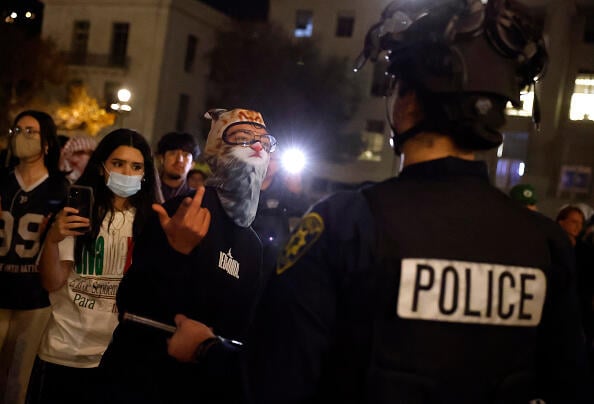
    Protests of a Turning Point USA event at the University of California, Berkeley, campus Monday sparked arrests and investigation announcements from top U.S. Department of Justice officials, who alleged “Antifa” involvement. The DOJ was already investigating the UC system over various allegations, and the Trump administration has demanded UCLA pay $1.2 billion and make other concessions.

    “Antifa is an existential threat to our nation,” Attorney General Pam Bondi posted on X Tuesday. “The violent riots at UC Berkeley last night are under full investigation by the FBI-led Joint Terrorism Task Force.”

    Harmeet K. Dhillon, the assistant attorney general supervising the DOJ’s Civil Rights Division, also said her division will investigate. “I see several issues of serious concern regarding campus and local security and Antifa’s ability to operate with impunity in CA,” she wrote on X.

    Dan Mogulof, a UC Berkeley spokesperson, told Inside Higher Ed Wednesday that there was only one reported incident of violence: A person with a ticket to the event was hit in the head by a glass bottle or jar thrown from a crowd of protesters. The victim was transported to Highland Hospital by ambulance but was “upright and conscious,” Mogulof said, adding that police are reviewing videos to see who might have thrown the object.

    In an incident that Mogulof said people mistakenly believed was connected to the protest, the City of Berkeley Police Department said its officers were monitoring the protest when they saw a fight between two men. Police determined one of them had stolen a chain from the other and the other was attempting to reclaim it, and the man who allegedly stole the chain was arrested on suspicion of robbery and battery resulting in injury.

    Mogulof also said campus police arrested two people for allegedly failing to comply with directions and, the night before the protest, arrested four students for alleged felony vandalism for trying to hang something on the historic Sather Gate. At the protest itself, Mogulof said, there were people who “self-identified as Antifa,” but he didn’t know whether they were part of an organized group.

    In a statement, the university said, “There is no place at UC Berkeley for attempts to use violence or intimidation to prevent lawful expression or chill free speech. The University is conducting a full investigation and intends to fully cooperate with and assist any federal investigations.”

    Source link

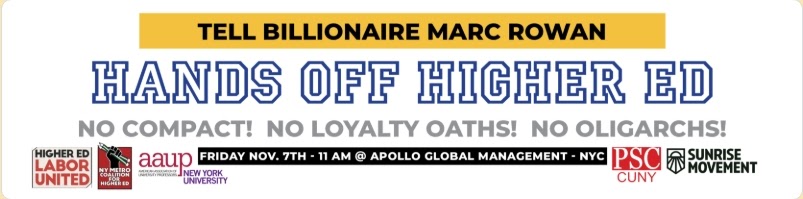
  • BORROWERS AGAINST APOLLO EVENT, FRIDAY NOVEMBER 7TH, NEW YORK CITY (HELU, AAUP, AFT)

    BORROWERS AGAINST APOLLO EVENT, FRIDAY NOVEMBER 7TH, NEW YORK CITY (HELU, AAUP, AFT)

    Higher Ed Unions, Student Unions, and For-Profit College Borrowers Unite Against Trump’s “Higher Education Compact”

    Several higher education unions, student unions, and former students of for-profit colleges are organizing in opposition to the Trump administration’s proposed “higher education compact”—a plan heavily shaped and promoted by private-equity billionaire Marc Rowan.

    Rowan, the CEO of Apollo Global Management, has played a central role in advancing this proposal. Apollo owns several predatory for-profit institutions, including the University of Phoenix, one of the most notorious offenders in the industry.

    In a recent New York Times op-ed, Rowan took public credit for the compact, writing:

    “The evidence is overwhelming: outrageous costs and prolonged indebtedness for students; poor outcomes, with too many students left unable to find meaningful work after graduating…”

    Yet, under Rowan’s leadership, the University of Phoenix has become the largest source of Borrower Defense claims of any for-profit school, with more than 100,000 pending applications as of July 2025. Borrower Defense is a federal protection that allows students to seek loan forgiveness if their school misled them or violated state or federal law.

    The University of Phoenix has faced multiple law enforcement investigations for deceptive recruiting tactics that targeted veterans, service members, and working adults nationwide. The school’s misconduct led to a $191 million settlement with the Federal Trade Commission for falsely claiming partnerships with major employers. More recently, the university attempted to portray itself as a public institution while seeking to sell to two states—both of which ultimately rejected the deal after public backlash.

    While Rowan’s personal fortune exceeds $7 billion, borrowers continue to shoulder crushing debt from degrees that delivered little to no value. His leadership has fueled a system that profits from student harm—and now, through this compact, he is setting his sights on reshaping major public universities.

    We refuse to stay silent. Borrowers, students, and educators are standing together to demand accountability and defend higher education from predatory perpetrators.

    Source link

  • Mizzou Calls Black 2 Class Event Example of “Discrimination”

    Mizzou Calls Black 2 Class Event Example of “Discrimination”

    For the second year in a row, a Black student group at the University of Missouri is facing pushback from administrators over their attempt to hold a back-to-school event with the word “Black” in the name.

    The Legion of Black Collegians, a long-standing Black student government at Mizzou, had planned to host the on-campus Black 2 Class Block Party this week, but the group said in a social media post Wednesday that university administrators had canceled it.

    A university spokesperson told Inside Higher Ed that Mizzou is “committed to fostering an environment free of unlawful discrimination,” and that the name of the event “suggested it was race exclusive.”

    Likewise, Mizzou President Mun Choi added in a statement that “when holding events using university facilities, student organizations must avoid excluding individuals based on race.”

    This follows a similar dispute last year, when the university changed the name of a similar LBC event from the Welcome Black BBQ to the Welcome Black and Gold BBQ, a nod to the university’s colors. This year, LBC declined to participate, letting university officials know in July.

    Student success experts and advocates for racial minority groups say the tension at Mizzou is just one example of an ongoing change in campus cultures nationwide. As various pieces of anti-DEI legislation take effect in red states and the Trump administration attempts to crack down on practices of so-called liberal indoctrination across the country, many students of color could lose access to vital hubs of cultural recognition, they say.

    “There’s no question that the political context, the messaging from this administration and the confluence of what’s happening at state levels are extremely influential for white universities, who are often public schools that take public money,” said Eric Duncan, a policy director with EdTrust. “We’re not surprised, but we’re disappointed in what’s happening to Black students at Missouri.”

    In addition to publicizing the cancellation, LBC also noted on Instagram that incidents of racism and hate speech on campus are on the rise and demanded that the institution schedule a town hall meeting within 60 days, publicly condemn racial harassment and send out an annual notification explaining the college’s antidiscrimination policies.

    “Let’s be clear,” the student group wrote. “These actions are a deliberate act of erasure … Recreational spaces for students of all identities are CRUCIAL.”

    Choi said the university “will not respond to demands.” A university spokesperson later told Inside Higher Ed that the university is “not aware of increased discrimination against Black students on campus.”

    Amaya Morgan, the current LBC president, said she met with Choi and other administrators to discuss the cancellation on Thursday afternoon—a meeting the university later said was confidential and declined to comment on.

    In an effort to avoid federal scrutiny, universities across the country have canceled events and closed diversity centers following Trump’s ban on race-based programming and activities. A federal judge recently struck down one such order from the Department of Education, but in many cases colleges have already complied. Some institutional leaders have indicated they have few good options except to keep their heads down.

    But for Morgan, the priority is for the university “to have our back.”

    “We know we can’t do anything about the block party now,” she said, adding that racially driven harassment must still be addressed. “Obviously what we’re doing to prevent discrimination right now is not working. So we’re asking, how can we work toward a solution? That is why those demands were listed out like that.”

    Colleges Put ‘a Lot at Stake’

    Decisions to close minority student centers, shut down ethnic group–based organizations and cancel culturally specific events are not new and started before Trump took office. News organizations and nonprofit groups have been tracking such actions, especially in Republican-led states, since the Supreme Court blocked the consideration of race in college admissions in 2023.

    For example, colleges in Utah closed cultural centers and the University of Iowa terminated LGBTQ+ and Latino living-learning communities. Mizzou axed its Inclusion, Diversity and Equity Division in summer 2024 along with certain race-based scholarships and first-year student success programs like the Mizzou Black Men’s and Women’s Initiatives.

    As a Black man who attended two predominantly white institutions, Duncan, of EdTrust, said that by shuttering these parts of campus life, universities are putting “a lot at stake.” For underrepresented students, many of whom are also first-generation, these programs are critical to retention and degree completion, adding that there’s evidence—anecdotal and data-based—to prove it.

    “When Black and brown students and different cultures step onto college campuses, a lot of times they’re looking for signals of inclusivity. ‘Is this a place that I belong?’” Duncan said. “Removing [these welcoming and affirming spaces] not just passively, but by coming out and saying, ‘We don’t support this,’ is a signal to people that maybe this is not a space of belonging for me.”

    Shaun Harper, a professor of education, public policy and business at the University of Southern California, echoed Duncan’s remarks. He pointed to a paper he published in 2013 that showed that it’s critical for Black students at predominantly white institutions to connect and teach one another how to navigate environments filled with microaggressions, racism and loneliness. Black student groups were key to this, the qualitative data showed.

    Harper added that just because something is run by a Black student organization doesn’t make it exclusive to other learners.

    “There’s never been a sign on the Black culture center door that says, ‘Blacks only.’ If white students, Asian students, Latino students and others, Indigenous students, wanted to come to those spaces, they were always welcome,” he said. “The reason why I’m so annoyed is that anybody who has ever attended [an event like Mizzou’s barbecue] knows that they are not discriminatory, divisive spaces. In fact, they’re spaces that are familial.”

    A History of Racial Tension

    As Mizzou’s LBC once again draws attention to what they call a lack of representation on campus, the university is also approaching the 10-year anniversary of protests that rocked the campus and made national headlines in November 2015.

    One student went on a hunger strike to draw attention to racism on campus, and other students camped out on the quad in solidarity. Eventually, the football team joined the efforts. The strike ended when two university leaders resigned on the same day.

    When Inside Higher Ed asked university administrators how they had addressed the campus climate since then, university spokesperson Christopher Ave said, “It is difficult to accurately measure the campus climate.” But he pointed to a record number of applications from prospective students, the increase in the percentage of underrepresented students and an improved retention rate on campus—all of which, he said, “illustrate that students want to attend and continue their education at the University of Missouri.”

    Ave added that calling off the block party doesn’t mean that the university also considers its Black cultural center or LBC as examples of discrimination.

    “This decision was based on the circumstances of this event, which was promoted with a name that suggested it was race exclusive and contrary to [federal civil rights law],” he said. “Each event or program must be considered on its own in context and the decision on this event does not dictate what will happen in any other circumstance.”

    Morgan from LBC declined to comment on whether they were seeking aid from outside groups to hold events like the block party off campus. The primary goal, she said, is to “protect the safety of Black students moving forward.”

    “I’ll be honest, I don’t have a very clear path forward, but I know that as a Legion, we will still continue to do whatever we can to make sure that students are heard and make sure that our identities are heard and seen,” she said. “As a Legion, we have existed for nearly 60 years. Excuse my language, but there’s absolutely no way in hell that we [will] go, especially not under my watch.”

    Source link

  • Mizzou Calls Black 2 Class Event Example of “Discrimination”

    Mizzou Calls Black 2 Class Event Example of “Discrimination”

    For the second year in a row, a Black student group at the University of Missouri is facing pushback from administrators over their attempt to hold a back-to-school event with the word “Black” in the name.

    The Legion of Black Collegians, a long-standing Black student government at Mizzou, had planned to host the on-campus Black 2 Class Block Party this week, but the group said in a social media post Wednesday that university administrators had canceled it.

    A university spokesperson told Inside Higher Ed that Mizzou is “committed to fostering an environment free of unlawful discrimination,” and that the name of the event “suggested it was race exclusive.”

    Likewise, Mizzou President Mun Choi added in a statement that “when holding events using university facilities, student organizations must avoid excluding individuals based on race.”

    This follows a similar dispute last year, when the university changed the name of a similar LBC event from the Welcome Black BBQ to the Welcome Black and Gold BBQ, a nod to the university’s colors. This year, LBC declined to participate, letting university officials know in July.

    Student success experts and advocates for racial minority groups say the tension at Mizzou is just one example of an ongoing change in campus cultures nationwide. As various pieces of anti-DEI legislation take effect in red states and the Trump administration attempts to crack down on practices of so-called liberal indoctrination across the country, many students of color could lose access to vital hubs of cultural recognition, they say.

    “There’s no question that the political context, the messaging from this administration and the confluence of what’s happening at state levels are extremely influential for white universities, who are often public schools that take public money,” said Eric Duncan, a policy director with EdTrust. “We’re not surprised, but we’re disappointed in what’s happening to Black students at Missouri.”

    In addition to publicizing the cancellation, LBC also noted on Instagram that incidents of racism and hate speech on campus are on the rise and demanded that the institution schedule a town hall meeting within 60 days, publicly condemn racial harassment and send out an annual notification explaining the college’s antidiscrimination policies.

    “Let’s be clear,” the student group wrote. “These actions are a deliberate act of erasure … Recreational spaces for students of all identities are CRUCIAL.”

    Choi said the university “will not respond to demands.” A university spokesperson later told Inside Higher Ed that the university is “not aware of increased discrimination against Black students on campus.”

    Amaya Morgan, the current LBC president, said she met with Choi and other administrators to discuss the cancellation on Thursday afternoon—a meeting the university later said was confidential and declined to comment on.

    In an effort to avoid federal scrutiny, universities across the country have canceled events and closed diversity centers following Trump’s ban on race-based programming and activities. A federal judge recently struck down one such order from the Department of Education, but in many cases colleges have already complied. Some institutional leaders have indicated they have few good options except to keep their heads down.

    But for Morgan, the priority is for the university “to have our back.”

    “We know we can’t do anything about the block party now,” she said, adding that racially driven harassment must still be addressed. “Obviously what we’re doing to prevent discrimination right now is not working. So we’re asking, how can we work toward a solution? That is why those demands were listed out like that.”

    Colleges Put ‘a Lot at Stake’

    Decisions to close minority student centers, shut down ethnic group–based organizations and cancel culturally specific events are not new and started before Trump took office. News organizations and nonprofit groups have been tracking such actions, especially in Republican-led states, since the Supreme Court blocked the consideration of race in college admissions in 2023.

    For example, colleges in Utah closed cultural centers and the University of Iowa terminated LGBTQ+ and Latino living-learning communities. Mizzou axed its Inclusion, Diversity and Equity Division in summer 2024 along with certain race-based scholarships and first-year student success programs like the Mizzou Black Men’s and Women’s Initiatives.

    As a Black man who attended two predominantly white institutions, Duncan, of EdTrust, said that by shuttering these parts of campus life, universities are putting “a lot at stake.” For underrepresented students, many of whom are also first-generation, these programs are critical to retention and degree completion, adding that there’s evidence—anecdotal and data-based—to prove it.

    “When Black and brown students and different cultures step onto college campuses, a lot of times they’re looking for signals of inclusivity. ‘Is this a place that I belong?’” Duncan said. “Removing [these welcoming and affirming spaces] not just passively, but by coming out and saying, ‘We don’t support this,’ is a signal to people that maybe this is not a space of belonging for me.”

    Shaun Harper, a professor of education, public policy and business at the University of Southern California, echoed Duncan’s remarks. He pointed to a paper he published in 2013 that showed that it’s critical for Black students at predominantly white institutions to connect and teach one another how to navigate environments filled with microaggressions, racism and loneliness. Black student groups were key to this, the qualitative data showed.

    Harper added that just because something is run by a Black student organization doesn’t make it exclusive to other learners.

    “There’s never been a sign on the Black culture center door that says, ‘Blacks only.’ If white students, Asian students, Latino students and others, Indigenous students, wanted to come to those spaces, they were always welcome,” he said. “The reason why I’m so annoyed is that anybody who has ever attended [an event like Mizzou’s barbecue] knows that they are not discriminatory, divisive spaces. In fact, they’re spaces that are familial.”

    A History of Racial Tension

    As Mizzou’s LBC once again draws attention to what they call a lack of representation on campus, the university is also approaching the 10-year anniversary of protests that rocked the campus and made national headlines in November 2015.

    One student went on a hunger strike to draw attention to racism on campus, and other students camped out on the quad in solidarity. Eventually, the football team joined the efforts. The strike ended when two university leaders resigned on the same day.

    When Inside Higher Ed asked university administrators how they had addressed the campus climate since then, university spokesperson Christopher Ave said, “It is difficult to accurately measure the campus climate.” But he pointed to a record number of applications from prospective students, the increase in the percentage of underrepresented students and an improved retention rate on campus—all of which, he said, “illustrate that students want to attend and continue their education at the University of Missouri.”

    Ave added that calling off the block party doesn’t mean that the university also considers its Black cultural center or LBC as examples of discrimination.

    “This decision was based on the circumstances of this event, which was promoted with a name that suggested it was race exclusive and contrary to [federal civil rights law],” he said. “Each event or program must be considered on its own in context and the decision on this event does not dictate what will happen in any other circumstance.”

    Morgan from LBC declined to comment on whether they were seeking aid from outside groups to hold events like the block party off campus. The primary goal, she said, is to “protect the safety of Black students moving forward.”

    “I’ll be honest, I don’t have a very clear path forward, but I know that as a Legion, we will still continue to do whatever we can to make sure that students are heard and make sure that our identities are heard and seen,” she said. “As a Legion, we have existed for nearly 60 years. Excuse my language, but there’s absolutely no way in hell that we [will] go, especially not under my watch.”



    Source link

  • UT Dallas bars FIRE from speaking at student event

    UT Dallas bars FIRE from speaking at student event

    UT Dallas is at war with its student journalists.

    After the longtime student newspaper The Mercury published unflattering coverage of the university’s response to pro-Palestinian protests on campus, administrators began a months-long campaign of retaliation. They fired the editor-in-chief, refused to pay journalists as agreed, and even took down articles on the Mercury website.

    And as everybody but a college administrator would expect, their efforts to keep the paper silent and the student body ignorant of the school’s misdeeds have only backfired.

    Undeterred, the student staff of The Mercury created The Retrograde, a wholly independent publication. But when the Retrograde tried to distribute its new issues around campus, administrators ripped out the newsstands that would be used to distribute it. That’s why FIRE went to campus, in person, to hand out copies of the paper and tell students about the school’s sordid efforts to quash student expression.

    FIRE and The Retrograde planned to hold an event the following day to celebrate the triumph of these student journalists over censorship. And Texas has a law requiring public universities to allow student groups to bring in guest speakers. So Gutierrez told the university he planned to bring FIRE Program Officer Dominic Coletti as a guest speaker. The administrators, resistant to allowing any critical speech on campus, told Gutierrez that only registered student organizations could invite guest speakers. And since UT Dallas has conveniently refused to recognize The Retrograde, Coletti could not speak on campus.

    FIRE then hand-delivered a second letter to administrators, explaining that UT Dallas’ policy ignores and violates state law. The university ignored that letter, too. So at the event, Gutierrez read the address Coletti had planned to give, detailing UT Dallas’s abuses and The Retrograde’s resilience.

    This absurd affair illustrates the malicious impact censorship can have on freedom of expression. UT Dallas administrators seem determined to continue on their lawless power trip, but they cannot silence the voices of the campus’ determined student journalists. And as everybody but a college administrator would expect, their efforts to keep the paper silent and the student body ignorant of the school’s misdeeds have only backfired.

    Now, more students know of the university’s dirty dealings than ever before. And they’re letting administrators know censorship should not be bigger in Texas. You can, too.

    Source link

  • One-day event creates institutional goals for student success

    One-day event creates institutional goals for student success

    Across higher education, identifying stakeholders who are engaging in similar initiatives or working toward mutual student success goals can be a challenge, and this is true at the institutional level as well.

    In a 2024 survey of student success professionals conducted by Inside Higher Ed and Hanover, over half (59 percent) of respondents said they believe their institution is very or extremely effective at making student success an institutional priority.

    Two administrators at DePaul University in Chicago created a one-day event on campus to unite practitioners and leaders who care about student success to identify common goals and challenges.

    “It’s so necessary … to think about the gathering of individuals, because it really elevates what was most important for us, which is student success being everyone’s job,” says Ashley Williams, director of student success initiatives.

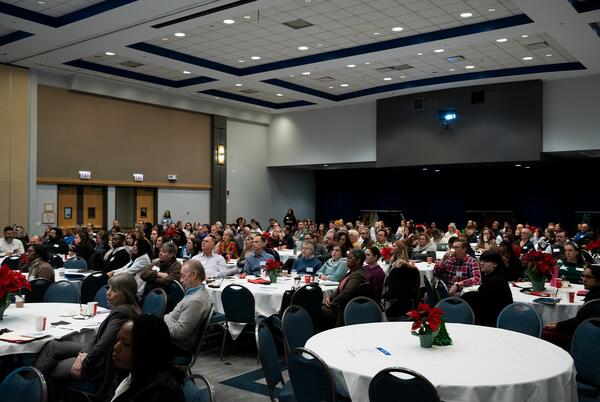
    Gathering together: The inaugural summit took place Dec. 3, 2024, with 350 staff, faculty members and administrators participating. The event featured outside experts, such as Monica Hall-Porter from the University of Texas at Austin as the keynote speaker, and the university president and provost addressed institutional goals for student success and closing achievement gaps.

    The goals for the summit, as outlined by organizers, included defining student success, determining how success is measured, fostering a coordinated culture for student success, charting a road map for enhancing student success and creating awareness of technology, systems and data relevant to student success, as well as sharing of best practices in place at the institution.

    The summit was titled Charting Student Success From Orientation Through Graduation, to reflect the student life cycle and how each practitioner contributes to student success. DePaul, as a Catholic institution, also frames student success through St. Vincent DePaul’s mission.

    Organizers were intentional about selecting individuals from various areas and disciplines across the university to drive creative and diverse conversations, says Michael Roberts, senior assistant dean for student success.

    DePaul’s summit united diverse professionals from a variety of areas and disciplines on campus.

    “I think folks can get … tunnel vision in trying to solve their problems and [trying] to cultivate expertise within their immediate or closest community,” Williams says. “We know there’s a lot of knowledge and strengths that exist across in the institution and in places you may not necessarily [be] thinking about in your day-to-day.”

    Unsiloing the institution and breaking organizational barriers allows for sharing resources, strengths, ideas and innovation through collaboration, Williams says.

    Putting it together: When creating the summit, Roberts and Williams prioritized institutional buy-in and ensuring their work was collaborative and not in competition with the work of others who engaged in student success spaces.

    The organizers engaged with others who were leaders in student success to contribute to planning and guide decision-making to ensure the event could execute goals in the ways they intended, Williams says.

    Partnerships also included identifying internal and external groups that could contribute resources and serve as sponsors to finance and run the event.

    One facet that was important to Roberts was not having the summit be a pep rally to gather enthusiasm, but something that could apply to faculty or staff members’ work directly. “Like, ‘this event is going to matter to me, and I’m going to be able to take something away from this and actually make use of it,’” he says.

    Looking ahead: The inaugural summit had a goal of 50 attendees, so reaching over 300 was a happy surprise, Roberts says. Attendees were a mix of faculty and staff, and feedback was overwhelmingly positive, Williams shares.

    Anecdotally, organizers heard that having a space to discuss topics and be exposed to other work happening across campus was valuable to attendees, as was building community with peers.

    “People felt informed; they walked away enlightened and kind of motivated, inspired to think about how they could lead, how they could pivot some of their work to better fit within a standard model of student success,” Williams says.

    In the future, organizers are looking to implement more programming that allows practitioners to participate in hands-on activities that allow them to engage in work directly.

    What’s being done at your institution to ensure administrators and practitioners in various areas are aware of and using data relevant to student success? Tell us about it.

    Source link

  • University of Hawai‘i dean sues law professor who criticized diversity event

    University of Hawai‘i dean sues law professor who criticized diversity event

    When the University of Hawai‘i at Manoa planned a Black History Month event in February 2023 that lacked any black facilitators, law professor Kenneth Lawson publicly challenged a dean about it at a faculty meeting. Nearly two years later, and shortly after clashing with administrators over their decision to doctor one of his class presentations,  Lawson suddenly must defend himself against a defamation lawsuit over his remarks — one filed by that same dean. 

    On Feb. 20, Lawson’s legal team filed an anti-SLAPP motion to dismiss the dean’s lawsuit, in which she alleged that Lawson’s heated arguments with her concerning the Black History Month event, as well as Lawson’s call to boycott the event, were defamatory. Lawson’s legal team argues that the defamation suit is “an attempt to chill and silence Professor Lawson’s constitutionally protected speech.” And the fact that it came fast on the heels of a curriculum dispute raises further questions of retaliation.

    2023: Lawson files First Amendment lawsuit against university following imbroglio over Black History Month event 

    The threats to Lawson’s expressive freedoms date to a faculty meeting back in February 2023, where he voiced vehement objections to a scheduled Black History Month event that was to feature a panel with no black facilitators. (Lawson is black.) 

    At the meeting, UH Dean Camille Nelson clashed with Lawson over the issue. Lawson claimed Nelson (who is also black) didn’t have sufficient experience in or understanding of the Civil Rights Movement. Nelson retorted that her experience as a black woman gave her perspective to understand racism, but that she did not want to litigate that issue during the meeting. In a follow-up email, Lawson accused Nelson of being “highly dismissive” of his objections, and a few days later, he called for a boycott of the panel via a university listserv. 

    Law professor challenges university after campus ‘shooting’ hypothetical changed in lesson plan

    News

    The University of Hawai’i violated academic freedom and set a dangerous precedent with unilateral revisions to a law professor’s presentation on a legal concept.


    Read More

    UH banned Lawson from campus and launched an investigation to determine whether he had created a “hostile work environment” for his colleagues. The university also issued no-contact orders barring Lawson from contacting certain administrators and restricting his use of university listservs. 

    Lawson, in turn, sued UH for violating his First Amendment rights to speak on a matter of public concern: racism and inclusion at the university. 

    The university eventually sanctioned Lawson for the February 2023 incident, requiring him to complete mandatory training and serve a one-month suspension without pay. Lawson returned to teaching in August of 2024, after completing the university’s sanctions under protest as his legal case proceeded.

    2025: Lawson becomes locked in conflict over academic freedom violations

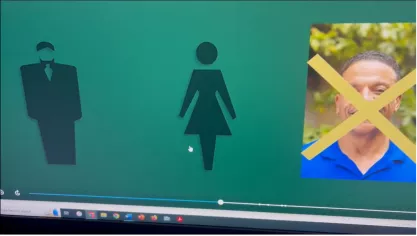
    Last month, we told readers about Lawson’s clash with the university over an in-class PowerPoint presentation. Last September, Lawson used a hypothetical involving himself and two deans — one of whom shoots at the other, misses, and hits Lawson accidentally — to teach his law students the legal concept of transferred intent. The accompanying slide included website portraits of himself and the two deans to illustrate the example. 

    When an anonymous student filed a complaint about the example, the university’s response to the complaint presented a master class in how to violate academic freedom. The university ordered Lawson to change the hypothetical because it could be “disturbing and harmful,” despite the fact that he had not violated any policy. When Lawson rightfully demurred, the university unilaterally changed Lawson’s slides, removing images of the two deans—but leaving Lawson as the victim of the shooting. (Why students would be less disturbed by a hypothetical that still depicted their professor as a shooting victim was not explained.)

    Slide with an image of law professor Ken Lawson alongside generic man/woman icons

    FIRE sent two letters to the university urging it to restore the hypothetical to its original state. We argued that unilaterally changing a faculty member’s teaching materials raised serious concerns about the university’s fealty to the basic tenets of academic freedom. Those tenets protect the right of faculty members to determine how best to teach their subjects. This freedom is even more important when those topics are complicated, difficult, or potentially upsetting to students. Going over Lawson’s head to change the hypothetical without his consent also raises serious concerns for future academic freedom issues. Would UH consistently bypass faculty rights to change instruction until the teaching satisfied administrators?

    UH dean files defamation lawsuit

    Shortly after Lawson filed his censorship grievance, and nearly two years after the case’s original filing, Nelson hit Lawson with a lawsuit of her own: She alleged that Lawson’s behavior at the meeting nearly two years earlier, and his subsequent email to the university listserv, had defamed her. 

    She suffered significant emotional distress and reputational harm, she says, because of Lawson’s alleged accusations of her of being a silent “Intellectual Negro.” 

    Yet defamation claims require proof that the targeted person made false statements of fact, not just heated statements of opinion. There is no way to read Lawson’s remarks as anything but opinion. Furthermore, the First Amendment offers a “wide latitude” for faculty members to express themselves “on political issues in vigorous, argumentative, unmeasured, and even distinctly unpleasant terms.” 

    Baseless SLAPP suits threaten the speech rights of all Americans

    News

    FIRE President Greg Lukianoff explains why we are defending Iowa pollster J. Ann Selzer against Donald Trump.


    Read More

    SLAPP lawsuits — strategic lawsuits against public participation — are often used to silence expression by bringing legal claims about others’ speech. Lawson’s legal team filed his anti-SLAPP motion seeking the dean’s suit’s dismissal on Feb. 20. 

    We hope this motion will give UH the sharp reminder it needs that faculty members have a right to speak on matters of public concern. Faculty members also have the right to determine how to approach their courses. And faculty members shouldn’t have to fear retaliation — in the university setting or in the court of law — for exercising their First Amendment rights.

    We’ll continue to keep readers apprised of Lawson’s battle against his university.

    Source link

  • After Trump DEI order, MSU cancels Lunar New Year event

    After Trump DEI order, MSU cancels Lunar New Year event

    A college within Michigan State University canceled a lunch celebrating the Lunar New Year in part because of President Trump’s recent executive orders cracking down on diversity, equity and inclusion in the federal government and elsewhere, the news site Bridge Michigan reported Thursday.

    The order, signed last week, doesn’t define DEI but calls on federal agencies to “combat illegal private-sector DEI preferences, mandates, policies, programs, and activities.” Colleges with endowments valued at $1 billion or more could be investigated for potentially violating the order, under the White House directive. Michigan State has a $4.4 billion endowment.

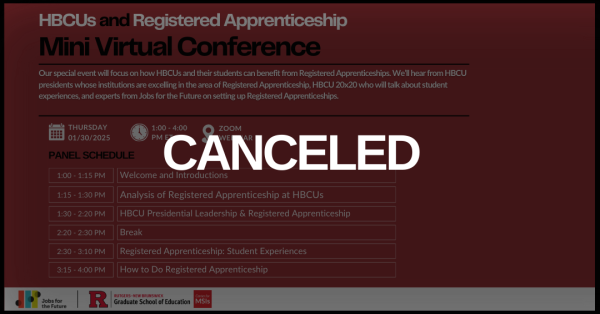
    A handful of colleges have taken down or reworked websites related to DEI since the order, while others have called off events. For instance, a conference at Rutgers University about registered apprenticeships and historically Black colleges and universities was canceled last week following the order. (Rutgers officials say calling off the conference wasn’t a university decision. Rather, it was canceled because the organizers, a group outside the university, received a stop work order from the Department of Labor.)

    Michigan State administrators told Bridge Michigan they canceled the lunch, which was scheduled for Jan. 29 and has been held four times before, after Chinese students “expressed concern about an event tied to one racial group.”

    The College of Communications Arts and Science was set to host the event. Lauren Gaines, the college’s Office of Diversity, Equity and Inclusion director, wrote in an email obtained by Bridge Michigan and the State News student paper that the cancellation was in response to concerns related to Trump’s immigration and DEI executive orders.

    “These actions have prompted feelings of uncertainty and hesitation about gathering for events that highlight cultural traditions and communities,” Gaines wrote. “We feel it is important to honor those concerns with sensitivity and care.”

    Heidi Hennink-Kaminski, the college’s dean, wrote in a follow-up email obtained by the news outlets that the decision was not “a statement of policy, but rather as an appropriate on-the-ground response given a very short decision window.”

    Michigan State officials did not respond to a request for comment by press time but confirmed after publication that staff at the college canceled the event, adding that other Lunar New Year events continue.

    Source link

  • Rutgers cancels HBCU event to align with Trump DEI orders

    Rutgers cancels HBCU event to align with Trump DEI orders

    The virtual mini-conference sponsored by Jobs for the Future was scheduled for Jan. 30.

    The Rutgers University Center for Minority Serving Institutions announced Thursday that it has canceled an upcoming virtual conference about registered apprenticeship programs as a result of President Trump’s executive orders targeting diversity, equity and inclusion initiatives.

    “We were very excited to bring the HBCUs and Registered Apprenticeship Mini-Conference to you next week,” said the email sent to registered attendees. “Unfortunately, due to President Trump’s Executive Orders … we have been asked to cease all work under the auspices of the Diversity, Equity, Inclusion, and Accessibility HUB at Jobs for the Future, which the U.S. Department of Labor funds.”

    Jobs for the Future, an organization focused on helping college and workforce leaders create equitable economic outcomes for students, runs a national innovation hub focused on improving access to registered apprenticeships for women, people of color and other underrepresented groups.

    Located in New Jersey, a blue state for more the 30 years, Rutgers has not faced pressure from state legislators to dismantle DEI. But the cancellation demonstrates the leverage and power the federal government can hold over colleges and universities by threatening to pull funding from programs that don’t comply with the president’s demands.

    It’s just the kind of reaction higher ed policy experts and DEI advocates predicted as a result of the Republican agenda.

    “That wariness and sort of pre-emptive compliance, even absent direct threats from the federal or state government, might be somewhat universal,” Brendan Cantwell, a professor of education at Michigan State University, told Inside Higher Ed.

    “These leaders will be worried about losing their federal funding, which is exactly what DEI opponents want,” added Shaun Harper, a professor of education, business and public policy; the founder of the University of Southern California’s Race and Equity Center; and an Inside Higher Ed opinion contributor.

    More cancellations are anticipated in the weeks and months to come as the Trump administration continues to issue executive orders. For instance, Trump’s growing team at the Department of Education announced a series of actions Thursday related to eliminating DEI.

    “The Department removed or archived hundreds of guidance documents, reports, and training materials that include mentions of DEI from its outward facing communication channels [and] put employees charged with leading DEI initiatives on paid administrative leave,” agency officials said in a news release. “These actions are in line with President Trump’s ongoing commitment to end illegal discrimination and wasteful spending across the federal government. They are the first step in reorienting the agency toward prioritizing meaningful learning ahead of divisive ideology in our schools.”

    Other actions the department has taken include:

    • Dissolving the department’s Diversity and Inclusion Council.
    • Terminating the Employee Engagement Diversity Equity Inclusion Accessibility Council within the Office for Civil Rights.
    • Canceling ongoing DEI training and service contracts that total over $2.6 million.
    • Withdrawing the department’s Equity Action Plan, which was released in 2023 to align with former president Joe Biden’s executive order to advance racial equity and support for underserved communities.

    Source link