Just over half of student loan borrowers consider themselves financially insecure, while about three-quarters said they had experienced an adverse financial event, like skipping a bill, in the past year, according to a survey from the Pew Charitable Trusts exploring the attitudes of student loan borrowers after federal student loan repayments restarted in October 2023 following a three-year pause. The survey was conducted in the summer of 2024.
Existing financial challenges are closely associated with struggles to repay student loans, the survey found. About 23 percent of respondents indicated they had missed some or all of their student loan payments since October 2023, but that number was higher among those who are financially insecure (34 percent) and those who had experienced a negative financial event (30 percent).
But paying off student loans isn’t just challenging for those facing other financial difficulties. Among all borrowers, 57 percent said they found it difficult to afford their loans, including 41 percent of those who said they do not consider themselves financially insecure. Over a third of borrowers also said they found repaying their student loans more stressful than paying their other bills.
The Education Department estimates that nearly 25 percent of borrowers have either defaulted on their loans or will default in the next several months. In May, the agency restarted collections on unpaid loans.
As colleges across the country cut staff, implement hiring freezes and slash budgets, fewer people could see higher education as a long-term career path, according to Kevin McClure, a professor of higher education and chair of the Department of Educational Leadership at the University of North Carolina at Wilmington.
In a recent episode of The Key, Inside Higher Ed’s news and analysis podcast, McClure told IHE editor in chief Sara Custer that in the current environment, demoralization is high among faculty and staff. “It’s just really difficult to do good work. There’s a significant amount of uncertainty, there is stress, there is trauma that people are still living through from COVID and the great resignation … and there is no doubt that the workforce in higher education is struggling,” he said.
“It’s not the case that across the board every institution is in this scenario …but every single institution is being cautious right now, and there is enough uncertainty and enough question about multiple revenue streams coming into institutions that there are cascading effects for working conditions.”
McClure said he’s concerned institutions are not doing a good enough job of articulating their values. This, he said, is what colleges should “double down” on to combat the demoralization he’s observed in current employees and to show future talent “what they’re all about.”
“In the current environment, I think we have seen some backsliding, some backtracking, some revisions of our websites—all of these signposts suggesting to people who work here that the things we stand for are actually maybe flexible and can be modified as the political winds blow.”
Let me tell you about Andrew, a motivated student who graduated high school early with impressive dual-enrollment credits. After attending a private college for a year and taking some time to work, he rekindled his educational ambitions at a community college. With approximately 30 credits remaining for his bachelor’s degree, he applied to an R-1 university, ready to complete his journey.
What should have been a seamless transition became an unexpected challenge. Despite submitting his transfer work in October and regularly checking in with his adviser, Andrew discovered in January—after classes had already begun—that he faced “at least three years of coursework” rather than the anticipated single year to graduation.
This isn’t a rare occurrence or some administrative anomaly. Rather, it is the norm for individuals who aren’t pursuing a four-year degree on the traditional timeline. Higher education talks endlessly about completion and student success while maintaining systems and policies that actively undermine these goals.
Andrew’s story represents a critical opportunity for higher education. While his family successfully advocated for a refund and found another institution that better recognized his prior learning, his experience highlights a fundamental challenge we must address collectively.
The Scale of the Challenge
We have 42 million Americans with some college credit but no degree. We have 200,000 military personnel transitioning to civilian life annually. We have an economy desperately needing upskilled workers. Yet higher education’s response to credit mobility remains anchored in outdated policies and processes that fail to serve today’s students, institutions or workforce needs.
Many institutions have made meaningful progress in supporting diverse student needs through childcare services, flexible scheduling and online options. These are important steps. Now we must extend this same commitment to the academic evaluation processes that directly impact students’ time to degree and financial investment.
The Disconnect
Transfer articulation agreements—where they have been struck—have created valuable pathways, but their implementation often lacks the consistency and transparency students deserve. When agreements include qualifying language without firm commitments, students can’t effectively plan their educational journeys or make informed financial decisions.
The contradiction is striking: We express concern about student debt and extended time to degree, questioning why students take 150 credits when they only need 120 to graduate. Meanwhile, our credit evaluation processes remain opaque, slow and often costly.
The current reality—where students frequently must apply, pay deposits or even enroll before understanding how their previous academic work will be valued—creates unnecessary barriers. We can do better—and, frankly, must. It’s like buying a car and finding out the price after you’ve signed the paperwork. In what other industry would this be acceptable?
The Opportunity
Consider the possibilities if we fully embraced credit mobility as a cornerstone of student success:
Students could make informed decisions about their educational pathways before committing financially.
Institutions could demonstrate their commitment to affordability by recognizing prior learning.
Graduation rates would improve as students avoid unnecessary course repetition.
The workforce would benefit from skilled professionals entering more quickly.
Addressing the Objections
The objections to credit mobility typically fall into three categories:
Faculty workload: Faculty are being asked to do more, and evaluating credits for prospective students can feel like an unnecessary burden. But what if more students could see that their learning had value, that their degree was within reach, that they didn’t have to retake classes they’ve already mastered? This shift in perspective could transform the evaluation process from a burden to an opportunity.
Lost revenue: The focus on enrollments often overshadows the reality that only 50 percent of students who start college actually finish within six years. What if our goal was to expand opportunities so more students could complete their degrees? What if students were taking classes that genuinely added to their experience and built their confidence rather than repeating content they’ve already learned?
Quality concerns: Quality is often cited as justification for delayed evaluation. In reality, transparent evaluation supports faculty’s desire to maintain academic standards. Clear processes allow for informed decisions and data collection that ensures the focus remains on student outcomes.
The AI Opportunity
The emergence of artificial intelligence presents a tremendous opportunity to enhance our credit-evaluation processes—addressing issues of time and cost while creating transparency for data analysis. A new study just released by AACRAO on the role of AI in credit mobility makes a compelling case as to why the technology could help unlock new ways of working. We can harness technology as a powerful tool to support faculty decision-making and administrative resource allocations. AI could:
Identify potential course equivalencies based on learning outcomes.
Highlight relevant information in transfer documentation.
Streamline evaluation processes, allowing human experts to focus on complex cases.
Provide leadership with insights into where credit mobility is operating effectively.
Identify areas needing additional resources or training.
With proper implementation and training, AI can become a tool to achieve our goals of access and completion at scale—reducing both the cost and timeline to graduation.
The Path Forward
If we truly believe in access and completion, then credit mobility must become a shared priority across higher education. This means:
Making course information, learning outcomes and sample syllabi readily accessible.
Expanding recognition of diverse learning experiences, including microcredentials, corporate training, internships and apprenticeships.
Establishing and honoring clear timelines for credit evaluation.
Eliminating financial barriers to credit assessment.
Providing updated articulation and equivalency tables in easy-to-find locations on admissions websites.
Andrew’s experience should be the exception, not the rule. Colleges and universities that embrace this challenge will not only better serve their students but will also position themselves for long-term sustainability in an increasingly competitive landscape. Those that resist change risk becoming irrelevant to the very students they aim to serve and perpetuating the cost and time-to-completion conundrum.
The Call to Action
The question before us isn’t whether credit mobility matters—it’s whether we have the collective will to make it a reality at scale, not just at a handful of institutions, but across systems and all institutions. We must recognize that our students are learning in new ways, on new timelines, and bringing knowledge that evolves faster than our curriculum. Our students deserve nothing less than our full commitment to recognizing their learning, regardless of where it occurred.
So I’ll ask: How committed are you to credit mobility at scale? Your answer says everything about how seriously you take college completion.
Jesse Boeding is the co-founder of Education Assessment System, an AI-powered platform mapping transfer, microcredentials and prior learning to an institution’s curriculum to enable decision-making and resourcing.
The Maine Legislature’s budget-writing committee voted last week in favor of ending the state’s free college program, to the great disappointment of community college leaders.
The move by Democrats on the Appropriations and Financial Affairs Committee contradicts Governor Janet Mills’s proposal earlier this year to make the program a permanent fixture. The free college program, which Mills initially put forward, went into effect in 2022 to support students affected by the pandemic. It originally covered two years of community college tuition for anyone who graduated high school between 2020 and 2023, after other forms of aid were applied. Though created with one-time funding, the program enjoyed strong bipartisan support and was extended in 2023 to include the Classes of 2024 and 2025. Students have a certain amount of time to enroll; for example, 2025 graduates have to start college no later than the 2027–28 academic year to take advantage of the program.
Since the program began, Maine’s community college enrollment has surged—enrollment of all degree-seeking students in the system jumped from 11,308 in 2022 to 14,278 in 2024. A total of 17,826 students have participated in the program since it started, according to data from the Maine Community College System. Many hoped, and expected, the program would continue.
But the Appropriations and Financial Affairs Committee’s proposal would give the community college system $20 million over two years to help current participants finish their studies before winding down the program for good, Maine Public Radio reported. The recommendation comes as Maine faces a lean budget year, with federal funding for the state hard to predict. President Donald Trump threatened to cut Maine’s federal funds after a tense exchange with Mills in February over his executive order barring transgender athletes from competing on the teams that match their gender identity.
Maine representative Michael Brennan said at the committee meeting last week, “We’ve had to make hard decisions about what we think we can afford and not afford,” though he called the free college program “tremendously successful.”
Senator Peggy Rotundo, co-chair of the Appropriations and Financial Affairs Committee, emphasized in a statement to Inside Higher Ed that state lawmakers are honoring their commitment to fund students who graduated in 2025 and expected to receive the program’s support. She implied the program could still be made permanent in the future.
“When considering what comes next, our focus is on ensuring this program’s long-term sustainability,” she wrote. “The Appropriations and Financial Affairs Committee is seeking additional data and evaluation from the community college system to inform a responsible, future-focused approach. In a tough budget year, we have a duty to balance expanding opportunity with fiscal responsibility—and that means looking ahead to build a durable model that can serve Maine students for years to come.”
The decision to nix the program isn’t set in stone—the state budget still needs to make its way through the state House and Senate and finally to the governor’s desk. But state legislators indicated they plan to wrap up the budget by today.
David Daigler, president of the Maine Community College System, wrote a letter to the system’s Board of Trustees on Saturday expressing “deep disappointment” over the committee’s vote. He told the board it’s “highly unlikely” there will be any major changes to funding for the free college program at this point.
“Ultimately, the committee’s vote reflects the state’s challenging financial situation, which made it hard to get support even though Free College is a very popular, effective program that directly benefits Maine families, students, and employers,” Daigler said in the letter. “You can be certain that we will build on the momentum of this program to emerge stronger, wiser, and re-dedicated to providing an affordable, accessible education to Mainers looking to improve their lives.”
In February, Daigler and community college staff members advocated for the program before the committee. Multiple students also spoke out in support, some arguing they wouldn’t have attended college without the program.
Brianna Michaud, a health-science student at Southern Maine Community College, told the budget-writing committee she considered not going to college because, despite her working two jobs, her family couldn’t afford it. Then she heard about the free college program.
“As a first-generation college student who’s entirely responsible for paying off their education, the Maine free college scholarship is the reason why I’m able to put my hard work and dedication toward fulfilling my purpose in life, which is to help others,” said Michaud, who plans on becoming a pediatric occupational therapist.
Payson Avery, a student representative at Southern Maine, said he graduated high school in 2020, during the height of the pandemic, and didn’t know what to do. He felt like his grades senior year didn’t show his potential. After two years, while working at a restaurant, he decided to take the state up on its free college offer. Now he has plans to attend the University of Maine at Farmington to major in education, he told the committee.
“Without this program, I’m not sure I would have been able to make it to this point,” he said.
A growing number of programs in higher education focus on student athletes’ mental health, recognizing that the pressures of competing in collegiate athletics, combined with academic challenges, financial concerns and team relationships, can negatively impact student well-being.
At the University of Richmond, the athletics department created a new program to emphasize holistic student well-being, taking into account the different dimensions of a student athlete’s identity and development.
Spider Performance, named after the university mascot, unites various stakeholders on campus to provide a seamless experience for student athletes, ensuring they’re properly equipped to tackle challenges on the field, in the classroom and out in the world beyond college.
“The athlete identity is a really special part of [students’ identities], but it’s not the only part, so making sure they are [considered] human beings first—even before they’re students, they’re humans first. Let’s examine and explore that identity,” said Lauren Wicklund, senior associate athletics director for leadership and student-athlete development.
How it works: The university hosts 17 varsity sports in NCAA Division I, which include approximately 400 student athletes. Richmond has established four pillars of the student athlete experience: athletic, academic, personal and professional achievement.
“The whole concept is to build champions for life,” said Wicklund, who oversees the program. “It’s not just about winning in sport; it’s about winning in the classroom, winning personally and then getting the skills and tools to win for the rest of your life.”
These pillars have driven programming in the athletics department for years, but their messaging and implementation created confusion.
Now, under Spider Performance, the contributions and collaborations of stakeholders who support student athletes are more visible and defined, clarifying the assistance given to the athletes and demonstrating the program’s value to recruits. The offices in Spider Performance include academic support, sports medicine, leadership, strength and conditioning, mental health, and well-being.
“It’s building a team around them,” Wicklund explained. “Rather than our student athlete thinking, ‘I have to go eat here, I have to do my homework here, I have to do my workout here,’ it’s, ‘No, we want you to win at everything you do, and how you do one thing is how you do everything.’”
Outside of the specific athletic teams, Wicklund and her staff collaborate with other campus entities including faculty members, career services and co-curricular supports.
Preparing for launch: Richmond facilitates a four-year development model for student athletes, starting with an orientation experience for first-year students that helps them understand their strengths and temperament, up to more career-focused programming for seniors.
Recognizing how busy students’ schedules get during their athletic season, the university has also created other high-impact learning experiences that are more flexible and adaptive. Students can engage in a career trek to meet alumni across the country, study abroad for a short period, participate in a service project or take a wellness course, all designed to fit into their already-packed schedules.
Part of the goal is to help each student feel confident discussing their experience as an athlete and how it contributes to their long-term goals. For instance, students might feel ill-equipped for a full-time job because they never had a 12-week internship, but university staff help them translate their experiences on the field or the court into skills applicable to a workplace environment, Wicklund said.
The university is also adapting financial literacy programming to include information on name, image and likeness rights for student athletes, covering not just budgeting, investing and financial literacy topics but also more specific information related to their teams.
Encouraging athletes to attend extra sessions can be a challenge, but the Spider Performance team aims to help students understand the value of the program and how it applies to their daily lives. The program also requires buy-in from other role models in students’ lives, including trainers, coaches and professors.
“We work really hard to customize fits to different programs so we’re speaking the same language as our coaches,” which helps create a unified message to students, Wicklund said.
If your student success program has a unique feature or twist, we’d like to know about it. Click here to submit.
Phillip Levine, an economics professor at Wellesley College, has been studying college financial aid and students’ higher ed spending habits for more than a decade. When his children first started applying to college about 15 years ago, he was amazed by how difficult it was to get a clear answer on how much it was really going to cost them—and he was a trained economist.
Imagine, he thought, how the average family felt reading through interminable webpages and offer letters explaining the detailed price breakdowns, differences in tuition and fees, added expected costs, and loans versus grants. Then he tried to imagine how parents who’d never gone to college might feel.
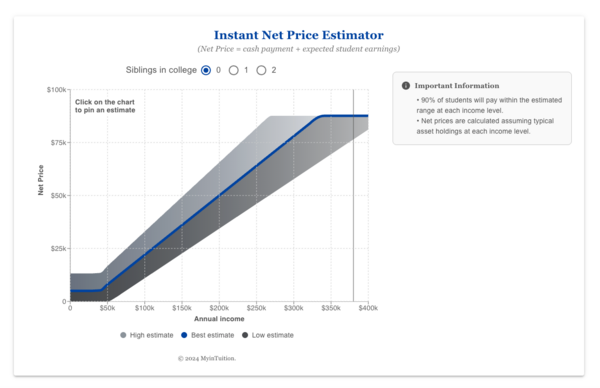
Since then, Levine has worked on a number of college cost transparency initiatives. His most recent project is the Instant Net Price Estimator, a streamlined digital tool that he hopes will make it easier for colleges to break through the noise and deliver a clear estimate to families.
As public skepticism about the value of a postsecondary degree grows and $100,000 sticker prices make front-page news, colleges are in the market for a simple way to let families know that their degrees can be affordable. Washington University in St. Louis became the first institution to adopt the tool and served as a kind of pilot program this application cycle. Interest from colleges has grown swiftly: This fall, an additional 19 institutions will introduce Levine’s calculator on their websites, and he anticipates that number will triple next academic year.
Levine spoke with Inside Higher Ed about his new tool, how low-income students get stuck in the financial aid “funnel” and how colleges can be better communicators in a time of widespread public distrust of higher ed. The conversation has been edited for length and clarity.
Q: Walk me through the genesis of this idea. What were you hoping to achieve?
A: I don’t think it’s a state secret that college pricing is complicated. If you go to any college website and look at the financial aid webpage, there’s tons of stuff there trying to explain how much they charge, but they overshoot it in terms of what people are looking for. You’re taking a high school kid and their family and giving them a Ph.D.-level course in financial aid. Not surprisingly, they don’t usually get it.
I think about the admissions process like a funnel: You give me a little information, I’ll give you a basic answer that’s pretty imprecise. You give me more information, I’ll give you a better answer that’s a little more precise. You can keep going down the process until eventually, you know, ultimately you fill out the FAFSA or the CSS Profile.
To maximize access, that funnel needs to have a very wide mouth at the top; in financial aid language, what that means is you need to communicate extremely quickly to as wide an audience as possible that college is not $100,000. It doesn’t even matter exactly what it is. But if you can’t get people off of the ledge at the $100,000 number—the mainstream media puts out stories all the time that college costs a million dollars a year, so their perception is that it’s extremely expensive. All you want them to do at the beginning stages is to be like, “Hey, maybe this is something I can afford.” Then you need to lead them through the rest of the funnel.
Phillip Levine
Ultimately, the financial aid process really is complicated because we have this concept of what a family can afford to pay, and there’s no right answer to that question, but we have all these complicated formulas that are trying to find it anyway. Over time, colleges have been trying to do a better job of getting past that point, just not very successfully. What I’ve been working on for the last 10 or 15 years is to make an easier entry point, and this tool is even higher up the funnel than what I’ve been working on in the past.
It takes three seconds to get a sense of what college is going to cost you, and in particular to get you over that hurdle that it’s probably not $100,000. My goal is within a matter of literally a few seconds to give people a sense that college is very unlikely to be as expensive as they fear. And then you can start having a more substantive conversation. Otherwise, you close the door on the poor kids, way before they’re into the process.
Q: Colleges have been trying to do this kind of thing on their own for a while. What makes your tool an improvement on institutional efforts?
A: Colleges understand that this is a problem. But to be quite honest, the only people who actually understand the way the financial aid system works are the people in the financial aid office, and they don’t speak English, so to speak. It’s an unbelievably complicated process, very complex, and now they have to explain it to a regular person, and they can’t do that. It’s not their fault; they try, they’re just not successful. There’s a handful of people in the admissions office who understand it, too, but not many. And once you get past those two audiences, nobody else at the college understands it, including the public affairs people.
I got started on this because when my kids were looking at colleges, I just wanted to know whether I was eligible for any financial aid, yeah. And I realized how unbelievably hard it was to figure it out. Back then [around 2010] it was actually impossible to figure out. Things have evolved a lot since then.
Q: Like you said, there are other tools out there now. What makes this one different?
A: I’m just trying to push it to the next stage of development. I’m an economist; I can speak geek as well as anyone. But as I started doing this, I’m learning more and more about how you sell a product, which is basically what you’re doing with college cost. I’m realizing how little time you have to communicate a message.
I’m in a weird position, because I’m doing the research on the pricing issues, and I’m developing the tools. It was in one of the Brookings [Institution] papers I wrote when these ideas were just kind of coming together and we were thinking about how you do the graphics. And it just kind of came together that we can visually display this information in a simulator, what I really refer to as a simple game. So I thought, if I can do it for a Brookings paper, why can’t I do this for a school or a family? And about that time, Washington University [in St. Louis] came to me looking for assistance on some other issues, and I pitched this to them, and they bought into it. So they paid for the development, and it’s been up and running there since December. If you go to most schools’ webpages, including my own, there’s stuff there, but you gotta read forever. And you know as well as I do that nobody reads that much anymore.
That’s what I’m trying to accomplish with this: just get the ball rolling with something that speaks to where students are.
A demo version of Levine’s Instant Net Price Estimator, which can be customized to fit colleges’ specific needs and profiles.
Screenshot from myintuition.org
Q: I assume the calculator doesn’t factor in things like merit aid?
A: You want it as simple as possible. So you just slide your input and it essentially just tells you what the average cost is going to be for you based on income, and tells you the range, which may be very broad. At Washington University, they don’t give a lot of merit aid, so, like, it would not be a big deal there, but at schools that do a lot of merit aid, that range could also include merit. They can factor that into the calculator.
But mainly, you just want the light bulb to go off of, “Oh, maybe I can afford this.” And then maybe they’re willing to go spend some time reading instead of getting scared off right from the start. Their initial instinct is, there’s no way I can afford to go to Washington University. And it’s the school’s job in terms of marketing to communicate to people. The problem, in my mind, is that the door is closed so early for so many people that you need to be able to just let them get through that first door in the process. There’s still a lot of hurdles you have to get through after that, yeah, but if you don’t make it through the first one, you don’t even approach any of the others.
Q: There’s been legislation introduced at the federal level and passed in many states to mandate that colleges take certain steps toward cost transparency. Do you think there’s a good understanding of what that takes among policymakers?
A: Clearly, policymakers have figured out that transparency is an issue, and they’re right. But their intentions are often better than their proposals. The net price calculator law [a federal law mandating institutions include a price calculator on their websites by 2011], for instance, was very well intended. But it’s easy to see the big picture problem; to then come up with a solution that actually works, you have to have a little bit more inside baseball. The net price calculator law is a perfect example. It was so well intended, they completely had the right idea, and they blew it. I obviously don’t know all of the details of all the different state laws, but I’ve seen proposals, and generally I look at them and go, right idea, wrong solution.
Q: Have there been any good policy solutions?
A:The College Cost Transparency Initiative. It’s much better if the schools can fix this problem on their own, because they know what they’re doing. It’s a tiny step, and you have to already apply and get accepted before you get your letter. And then it tells you, in a more clear way than it used to. It’s lower on the funnel, really at the bottom. But it’s a good step.
[Levine later clarified that he sat on the technical advisory committee for the CCTI.]
Q: Has there been a lot of interest in your instant price calculator from other colleges? And what kinds of colleges seem to be most invested in these transparency efforts?
A: Nineteen more colleges will roll it out in the fall. It’s a small range right now, from relatively wealthy to very wealthy. I think at the very high end of higher ed, the Ivies and such, where they have a lot of money to spend on financial aid, they’re trying to increase access in a very direct way. It is good for them to enroll more lower-income students from a public relations perspective. And I think every school wants to do the right thing. But as you stray from the very top of the spectrum, there’s also an interest in simply increasing enrollment, where they don’t want to be turning away students because they think they can’t afford it when they can. They’re just looking for more students, especially because there’s fewer kids. So the ability to open the door to as many kids as possible at this moment has appeal.
The Trump administration’s financial and political attacks on higher education, as well as more pressing problems across the sector, mean it’s unlikely U.S. colleges will prioritize sustainability work in the near future.
While seven Canadian universities—including Queen’s University, McMaster University and the University of Alberta—ranked in the global top 50, Arizona State University, ranked joint sixth, is the only U.S.-based institution to crack the top 50. Three highly ranked U.S. colleges fell out of the global top 50 this year: Michigan State University is now at joint 61st, Penn State at joint 64th and Florida International University at joint 71st.
Western Sydney University in Australia topped the global ranking for the fourth year in a row.
THE—Inside Higher Ed’s parent company—ranked the sustainability efforts of 2,526 universities from 130 countries; 52 institutions from across the U.S. participated in the 2025 ranking, down from 58 in 2024.
Since 2019, THE has evaluated the performance of thousands of higher education institutions across the globe on the U.N.’s 17 Sustainable Development Goals. Universities that want to participate in the rankings are required to submit information for SDG 17, Partnerships and Goals, and at least three other SDGs. How well an institution meets those goals is then evaluated across four broad categories: research, stewardship, outreach and teaching.
Phil Baty, chief global affairs officer for THE, described American universities’ “general lack of direct engagement with the SDGs” as “disappointing,” especially because the U.S. has some of the world’s strongest research universities. “I’d hope they can turn their greatest minds more overtly towards tackling the world’s most pressing and urgent challenges.”
Under Trump, SDGs May Be ‘More Risky’
Although the nation’s lackluster showing in the 2025 Impact Rankings is based on university data that predates the start of President Donald Trump’s second term, the administration’s attacks on the sector and political stances suggest the country’s higher education institutions may only face more barriers to becoming global sustainability leaders.
In March, the Trump administration denounced the SDGs, which the U.N. created in 2015 during President Barack Obama’s administration with the aim of reaching them by 2030. The second Trump administration has also pulled out of other international sustainability initiatives, including the Paris Agreement on climate change, and moved to cut billions in funding for scientific research and social programs—including many focused on reducing social inequities, addressing climate change and advancing diversity, equity and inclusion efforts.
Bryan Alexander, a scholar who studies the future of higher education and author of 2023’s Universities on Fire: Higher Education in the Age of Climate Crisis, wrote in an email to Inside Higher Ed that even before the Trump administration’s denouncement of the SDGs, they’d failed to gain much traction among U.S. universities.
“When I mention SDGs in academic settings, I usually see blank faces and have to explain what they are,” he wrote, attributing the indifference to a stronger focus on other, seemingly more pressing matters plaguing higher education, such as financial instability. “That sense of institutional urgency, heightened by a steady stream of campuses closing, merging, or cutting programs and staff, looms large. In that context, the SDG goals look like noble but not essential, nice-to-haves rather than imperatives.”
According to Alexander, other deterrents to the sector launching a widespread commitment to sustainable development include faculty burnout, scarce resources, anti-expert animus, doubts from faculty and administrators that their efforts will make a difference, and anxiety about associated political risks.
And he expects all those problems to persist, if not worsen, in the coming years as Trump continues his assault on universities and pro-sustainability initiatives. “The anti-DEI campaign strikes directly at several SDGs,” Alexander wrote. “It will be harder for academics to win external support for any such work, from doing research to offering new academic programs, overhauling a campus power system to replacing vehicles with electric vehicles. It will appear to be politically even more risky.”
However, he said there are some less risky actions U.S. institutions can take to be more sustainable.
“First, renewable energy, especially solar, is simply cheaper than fossil fuels. Switching a campus’ power supply just makes financial sense,” he said. “Second, traditional-age undergraduates are much more interested in climate change and sustainable development than their elders, which means they will tend to be eager to take classes and study in programs along those lines.”
Walking a Fine Line
ASU also tops the global ranking for SDG 14: Life Below Water, which means it’s at the forefront of developing strategies that support the health and sustainability of aquatic ecosystems.
It launched one of the nation’s first schools of sustainability nearly 20 years ago, and although its main campus is located in the Arizona desert, ASU launched the School of Ocean Futures in 2024. The school connects research and teaching facilities in the Pacific and Atlantic Oceans with research happening on its main campus in Tempe.
The school is one example of how universities can help to “restore balance within the global environment,” said Marc Campbell, ASU’s assistant vice president of sustainability and deputy chief sustainability officer.
“Fundamentally, the work of sustainability is about trying to be more efficient in the use of our resources and trying to protect what’s out there,” Campbell said. “A lot of people can support the foundational work of sustainability, but we need to unload some of the baggage that’s associated with the word and the discipline.”
Doing that, he said, will come from making a case for the economic and social value of investing in sustainable development initiatives.
“In any organization there are supporters and detractors. You have to figure out how to walk that fine line to get people supporting the greater good and recognizing what that is,” Campbell said.
“When we can do that more effectively across the board and build broader collaborative partnerships with other organizations that are focused on the same goals, then I think we can get past some of the [political] baggage.”
American higher education is on its back foot. As part of the Trump administration’s broader project of regime consolidation, universities are facing new and shockingly direct threats to their independence and academic freedom. And in the past few months, we’ve seen that reality start to sink in. Sometimes there is no more compromise to be had and the only way to stand on principle is to forthrightly say no. In the process, the academic community can reclaim fundamental values that had been eroding well before the present crisis.
This campaign to assert government control is bad for the academy, but it’s even worse for liberal democracy. Despite the political challenges facing higher ed, or rather, in light of those challenges, it’s critical that scholars, academic leaders and students reclaim what seems to have been forgotten —that the modern university is a living legacy of Enlightenment-era liberalism, the tradition that champions political liberty, constitutional constraints on power, freedom of thought and evidence-based reasoning.
Founding-era academic leaders understood, in concrete terms, that universities were cornerstone institutions of the fledgling American experiment. They took it as their duty to educate not royal subjects but politically free, self-governing citizens capable of managing complex matters of private, commercial and public life. They believed that liberty and intellectual agency were inextricably linked.
As Benjamin Rush, a prominent signer of the Declaration of Independence and founder of Dickinson College, observed, “Freedom can exist only in the society of knowledge. Without learning, men are incapable of knowing their rights, and where learning is confined to a few people, liberty can be neither equal nor universal.” In other words, right from the start, the ethos of American universities was bound up with the American ideal of liberal democracy.
To be clear, I am not suggesting that only liberal perspectives should be taught in institutions of higher learning. Far from it. Among liberalism’s most distinctive strengths is that it creates space for its own critics. But while individual scholars may explore and promote alternatives to constitutionally constrained liberal democracy, the institution itself must assertively defend the liberal rules of the game that make those critiques possible in the first place.
In other words, if universities are to have a future as cornerstone institutions of a free society, they must assert their role as caretakers of the liberal democratic project. My point is not that it would be nice if universities were to play this role. As my co-author Bradley Jackson and I have argued, “The future of higher education and the future of the liberal order are inextricably bound to one another. As goes one, so goes the other.”
As I take stock of the past decade, a few moments stick in my mind as emblematic of the current state in which higher education now finds itself. The first was in 2015, when a professor of mass media at the University of Missouri famously called for “some muscle” to prevent a student photojournalist from exercising his First Amendment rights to cover a public demonstration on the campus quad. At least one other Mizzou staff member assisted in the effort to intimidate the journalist.
The 2017 episode at Middlebury College, when students organized to shout down invited speaker Charles Murray, was another. Like so many others, I was shocked and angry that outsiders saw it as an opportunity to engage in political violence. But what broke my heart was the fact that students carefully prepared for the event not by marshaling their best arguments to counter Murray, but by crafting prescripted chants designed to shut down the open exchange of ideas. As a professor and provost, I cringed as I considered what these incidents said about the profession to which I was so passionately dedicated. And wasn’t it obvious that attacks on intellectual freedom would always, one way or another, end up harming the marginalized and those fighting for social justice? Somehow, we had lost the plot.
Perhaps the most cringe-inducing episode before this year’s events was in December 2023, when the presidents of Harvard University, the Massachusetts Institute of Technology and the University of Pennsylvania were summoned before a congressional committee to face allegations of antisemitism for not shutting down protests opposing Israel’s response to the Oct. 7 Hamas attack. I winced not just at the Inquisition-style interrogation and the lawyerly responses the witnesses offered. I cringed because, in their attempts to invoke First Amendment freedoms as their rationale, the presidents of three of our most prestigious institutions had zero credibility. Their allegiance to First Amendment principles read like an unconvincing foxhole conversion.
My point is not to relitigate these incidents. Rather, it is to suggest a pattern —and to provide context for why universities are so vulnerable to the Trump administration and state legislatures seeking to compel ideological compliance. When academic leaders, professors and students disregard the academy’s liberal foundations, we no longer have ground to stand upon when illiberal forces come to tear it all down. The weaponization of federal funding, deportation of students and scholars engaged in protected political speech, bans on “divisive concepts,” and threats of consent decrees— legal settlements that would place universities under long-term federal control—effectively strip universities of governance autonomy and set dangerous precedents for political interference in academic institutions.
Now faced with a truly existential crisis, many institutions are starting to fight back. Harvard has dug in its heels in the face of previously unthinkable threats, turning to the courts to protect its rights—fighting not just its blacklisting from federal research grants, but a flagrantly lawless attack on its tax-exempt status and an equally illegal attempt to revoke its certification to enroll international students on visas. In a response to the government through its lawyers, Harvard made clear its refusal to cave in no uncertain terms: “The university will not surrender its independence or relinquish its constitutional rights. Neither Harvard nor any other private university can allow itself to be taken over by the federal government.”
Harvard isn’t the only institution finding its courage. Georgetown University, when menaced by the interim federal prosecutor for Washington, D.C., correctly asserted, as a matter of both speech and religious freedom (as a Jesuit university), its right to determine its own faculty and curriculum. It’s not a matter of abstract principle. A member of Georgetown’s own faculty has been targeted for abduction and meritless deportation. Princeton University, as well, has aggressively pushed back.
Nor is the resistance limited to elite universities. As students are disappeared for speech displeasing the government, and as Trump’s overt censorship demands mount, smaller private colleges and state institutions have been sounding the alarm. In the process, they aren’t just defending their own self-interest, they are rallying civil society to resist incipient authoritarianism. Charles Murray’s work provides a compelling example of how the tit-for-tat cycle of illiberal escalation unfolds. At the U.S. Naval Academy in Annapolis, the office of Secretary of Defense Pete Hegseth ordered the removal of supposed “DEI” works. While The Bell Curve survived the purge, a pointed critique of Murray’s most controversial book did not.
The irony is hard to ignore. Upon entry into the Naval Academy, midshipmen swear an oath to defend the Constitution “against all enemies, foreign and domestic.” Shouldn’t we trust America’s future military leaders to exercise the very freedoms we’re asking them to defend with their lives? (Most of the books that were initially removed have since been returned to the Naval Academy’s shelves.)
Fortunately for civilian institutions, the courts are proving up to the task in pushing back. Tufts University student Rümeysa Öztürk was freed after several weeks in Immigration and Customs Enforcement custody, having been targeted for co-authoring an op-ed critical of the war in Gaza. That such a thing would happen in the United States is an unthinkable attack on free speech at its very core. Öztürk was incarcerated and threatened with expulsion not for protests, which can devolve into physical conflict and rule breaking, but simply for writing an opinion the government decided it disliked.
No liberal education—no liberal society—can endure under such a menacing shadow of state retaliation and suppression. We shouldn’t lose sight of the longer term, and the need to recommit ourselves to first principles. We must reinforce the principle of academic freedom as the constitutional order that governs a functioning university. Further, as we welcome new students and colleagues into the academy, we can’t leave it to chance that liberal values that privilege openness, curiosity, ingenuity and intellectual humility will take hold. We must be deliberate in our efforts to cultivate those values.
But an important, though less obvious, recommendation is one that won’t be easy to follow in a moment when our impulse is to defend the academy at all cost. Simply put, we must own our mistakes. If we are to refortify the liberal foundations of American higher education, we must proactively name the failures that have contributed to a permission structure that now accommodates illiberal and authoritarian reactionary forces. In some cases, that will mean replacing leaders who have tarnished their credibility with those who can better meet the moment.
To be clear, in owning our mistakes, we will not be currying favor with political elites on either side of the aisle. We will be speaking to and rebuilding trust with the public who support institutions of higher learning through their taxes and tuition payments. And we will be speaking to our own campus communities who seek principled leadership.
Taking full responsibility for the course correction will be good for the academy, as it will reset the path by which colleges and universities become sites of intellectual openness, challenge and discovery. But it will also be good for the future of our country. It will offer an example of how, after shifting away from its liberal foundations, a cornerstone institution of the American experiment can once again find its bearings, re-establish its independence and assertively take the lead in fortifying, in its most urgent hour, our system of constitutionally constrained liberal democracy.
Emily Chamlee-Wright is president of the Institute for Humane Studies at George Mason University and was previously provost and dean at Washington College.
Tulane University’s Freeman School of Business recently launched its first fully online M.B.A. program, marking a significant step in expanding its offerings for working professionals. As assistant dean at the Stewart Center for Professional and Executive Education, Ashley Francis plays a pivotal role in shaping and overseeing these programs. With a background in online learning and program development, she brings deep expertise in designing market-competitive programs that maintain Tulane’s unique academic experience.
I wanted to sit down with Ashley to learn more about the strategy behind launching an online M.B.A. at Tulane’s Freeman School of Business, how the program distinguishes itself in a competitive landscape and what universities should consider when developing online offerings.
Q: Why did Tulane’s Freeman School of Business decide to launch an online M.B.A. and how did you approach designing a program that stands out in an increasingly competitive market?
A: Tulane University’s Freeman School of Business launched its online M.B.A. program as part of a comprehensive strategy complementing the school’s portfolio of programs directed towards working professionals and meeting students where they are. It was conceptualized in response to both an evolving institutional culture and a clear demand for accessible, high-quality business education.
The COVID-19 pandemic further accelerated this momentum. With support from Dean Paulo Goes and our partnership with AllCampus, Tulane’s Freeman School of Business was able to build a rigorous and forward-thinking program.
What sets Freeman’s online M.B.A. apart is its commitment to academic excellence, flexibility and support. The curriculum is designed specifically for working professionals, offering the same tenured faculty who teach on campus—a rarity among online programs, which often rely on adjunct instructors. The program underwent a rigorous four-month development process to ensure that our curricula offered engaging, culturally rich courses. We specifically structured a program with reduced credits to help lower cost and time to completion.
The Freeman School’s online M.B.A. program is not only competitive but it’s also deeply student-centric. We offer unique, customized career support and access to tutoring services that not many other programs offer. While being competitive in the market was a top priority, ultimately the onus was on us to create a program that truly benefited students.
Q: When selecting an online program management partner, what key factors did Tulane’s Freeman School of Business consider? Why was working with an OPM important to you?
A: We went into the OPM selection process knowing the values and capabilities of working with an OPM and that this partnership style would set our online M.B.A. up for the most success. At their best, OPMs are sophisticated, passionate and willing to invest in the success of the program. At the same time, my previous experiences with OPMs had left me feeling wary and cautious when choosing our partner.
For the new online M.B.A. program, we ended up going with AllCampus, and they’ve absolutely met my high expectations. Tulane’s Freeman School of Business was seeking a true partner—one that would collaborate deeply, offer full transparency and share in the school’s mission for success and AllCampus has embraced those values fully.
My advice to other higher education leaders considering working with an OPM would be to build a relationship framed around mutual commitment and trust, with a shared goal of creating a standout program. Having a hands-on partnership allowed us to move quickly and tactfully when launching a high-quality program.
Q: Tulane University is deeply connected to the culture and identity of New Orleans. How does the online M.B.A. program incorporate that sense of place and community for students logging in from around the country?
A: Tulane’s Freeman online M.B.A. is infused with the spirit of New Orleans, bringing the city’s vibrancy and community-driven ethos into the virtual classroom. One of the core pillars of the program is “bringing the joy of New Orleans” to students—wherever they are. Rather than creating a hypercompetitive environment, the Freeman School fosters a sense of belonging and cultural richness, helping students feel the NOLA experience even if they never set foot on campus.
This is accomplished through course design, community engagement strategies and faculty involvement that reflect our university’s values and strengths. Our courses embed the city’s ethos and leverage our expertise in energy, supply chain, brand management and entrepreneurial resilience. Tulane’s brand affinity, loyal alumni network and supportive student services—such as a dedicated career management center and a financial aid adviser—all contribute to building a connected environment. The result is a program that not only educates but also inspires a lifelong connection to the Tulane community and the unique culture of New Orleans.
Robert F. Kennedy Jr., secretary of the Department of Health and Human Services, falsely said he named a doctor from George Washington University to a federal vaccine advisory board, reported News 4, the NBC affiliate in Washington, D.C.
Last Monday, Kennedy, who denies that vaccines are safe and effective and whose department has previously cited fake studies to support parts of its public health agenda, fired all 17 members of the federal Advisory Committee on Immunization Practices. By Wednesday, he posted on X that he had “repopulated” it with eight new members.
“The slate includes highly credentialed scientists, leading public-health experts, and some of America’s most accomplished physicians,” he wrote. “All of these individuals are committed to evidence-based medicine, gold-standard science, and common sense.”
On Monday, I took a major step towards restoring public trust in vaccines by reconstituting the Advisory Committee for Immunization Practices (ACIP). I retired the 17 current members of the committee. I’m now repopulating ACIP with the eight new members who will attend ACIP’s…
One of them, according to Kennedy, is Michael A. Ross, a clinical professor of obstetrics and gynecology at George Washington University and Virginia Commonwealth University, with a career spanning clinical medicine, research and public health policy.
But a GWU spokesperson told News 4 that Ross hasn’t taught there in eight years; a VCU spokesperson also said Ross hasn’t taught there for four years. Instead, Ross is listed as an operating partner for the private equity fund Havencrest, and his company bio says he “serves on the boards of multiple private healthcare companies.”
Kennedy’s post on X made no mention of Ross’s current involvement with the company.