Tag: Events

  • What’s in House Republicans’ Risk-Sharing Plan?

    What’s in House Republicans’ Risk-Sharing Plan?

    Under a new accountability measure recently proposed as part of a larger House budget bill, colleges would have to pay millions of dollars each year to reimburse the government for their students’ unpaid loans.

    The plan builds on an idea—known as risk-sharing—that lawmakers and policy analysts have been toying with since at least 2015. As the federal student loan portfolio grew, the goal was to require colleges to have some skin in the game and incentivize them to improve student outcomes.

    And while the concept has gained some bipartisan support in theory, higher education institutions have repeatedly argued that it is difficult to create a fair accountability system when many of the variables involved are out of an institution’s control and depend on the decisions of individual students and borrowers.

    So far, the higher ed lobby has successfully defeated proposed risk-sharing plans such as the one included in a Republican bill from the last Congress, known as the College Cost Reduction Act. But now, an almost identical proposal is back and at the heart of House Republicans’ plan to cut at least $330 billion from higher education programs over the next 10 years. The overall legislation, which aims to cut $1.5 trillion from the budget, could receive a vote on the House floor this week, though some lawmakers have threatened to block the measure amid concerns that it doesn’t include deeper cuts. Even if the bill fails, it serves as a marker of what House Republicans hope to accomplish moving forward.

    Many higher education policy experts warn that practically speaking, the latest risk-sharing plan relies on a complicated formula that’s essentially a black box. Released in late April, the proposal has not been tested enough to know its ramifications, they say, and the limited data available is inconclusive. Some analyses released by conservative groups say the program will be a financial boost for efficient public institutions and penalize bloated private ones. But one study conducted by a lobbying group suggests that public regional and minority-serving institutions that serve high populations of low-income students will get hit the hardest.

    “Fundamentally it’s an astonishing level of federal overreach to essentially lump in all institutions of higher education together—public, private, for-profit—and run a convoluted formula to determine winners and losers at the federal level and then redistribute funding,” said Craig Lindwarm, senior vice president of government affairs for the Association of Public and Land-grant Universities.

    Democratic politicians also argue that the purpose of the legislation is not truly to hold colleges accountable for student outcomes like graduation rates and income levels, but to crack down on what the government considers overly liberal institutions and fund President Donald Trump’s priorities.

    Even some conservative supporters acknowledge that it’s difficult to know the full scope of the bill’s potential impact this early. But they say risk-sharing is a necessary tool to penalize colleges that provide a poor return on investment and ensure the production of a well-prepared, financially stable workforce. They also suggest that the incentives such as additional grant funding to institutions that keep costs low and graduation rates high will offset the penalty for most public institutions.

    “With any policy change, we’re not going to be able to predict in advance 100 percent of how this is going to affect everyone, everywhere, all the time. But I don’t think that should be an excuse to not make policy changes,” said Preston Cooper, a senior fellow at the conservative think tank the American Enterprise Institute. “I still think the data we have gives us a general idea of which sorts of institutions would be affected and the magnitudes of the penalties involved.”

    So How Does It Work?

    The proposed risk-sharing plan would kick in for new loans starting in July 2027, said an aide for Republicans on the House Education and the Workforce Committee. That means colleges wouldn’t be penalized for disruptions to the student loan system that occurred during the pandemic or efforts during the Biden and Trump administrations to overhaul repayment.

    If we don’t even understand how this works, why the heck are we passing it? I mean, it’s a concept, but I don’t think it’s the concept that people think it is.”

    Jason Delisle, nonresident senior fellow at the Urban Institute

    And because borrowers don’t have to start paying back their loans until six months after they graduate or stop out, institutions likely won’t have to pay a penalty until 2029 or 2030 at the earliest, the aide added.

    But from then on, institutional payments would be calculated annually—major by major—for each new cohort of borrowers and would continue until they’ve paid off their loans. The amount per cohort could change from year to year, depending on factors such as borrower behavior, postgraduation earnings and college costs. But it’s expected to grow as more and more cohorts are added to the lump sum.

    Under the bill, the amount per cohort would be calculated using a three-part formula, which is largely unchanged from what Republicans proposed last Congress in the CCRA.

    The first step is to determine a college’s risk-sharing liability, which is how much each institution owes the government. To do that, the formula looks at the difference between how much students were supposed to repay during a given year and how much they actually did. The calculation takes into account the value of any missed or partial payments as well as any interest that the government waived or principal contributions it matched, the committee aide said. It does not, however, include debt waived through programs like Public Service Loan Forgiveness, which was a concern for institutions.

    This is the part of the formula that raises the most questions for institutions, as the mechanics of exactly how the risk-sharing liability is calculated are not clearly outlined in the legislation or in a CCRA database published by the education committee Republicans in 2024. And even if it were, much of the data needed to run the formula is not publicly accessible.

    “How the formula works is the million-dollar question, and something that we’ve been trying to work on for a year and a half,” one policy expert said. “It’s very complicated and relies on metrics that aren’t publicly available.”

    House committee aides counter that colleges have access to student borrower data via the National Student Loan Data System, which can be used to predict future risk-sharing payments. They also point to a recent Dear Colleague letter reminding colleges of their responsibility to monitor borrower payments.

    But even then, higher ed lobbyists say, it’s not clear who will be responsible for calculating the liability. If any part of that responsibility falls to campus financial aid administrators, higher ed groups say the plan will increase the administrative burden on colleges.

    “If I were a lobbyist, I would just say to all of my members, go to your congressman and say, ‘We don’t know what this does,’” said Jason Delisle, a policy analyst who has worked at think tanks across the political spectrum but is now based at Urban Institute where he’s a nonresident senior fellow. “If we don’t even understand how this works, why the heck are we passing it? I mean, it’s a concept, but I don’t think it’s the concept that people think it is.”

    Incentives to Lower Costs

    Once that risk-sharing liability is known, the next step in the formula is to figure out how much of that liability fee a college will have to pay. That’s done using what the legislation calls an earning-price ratio, which compares students’ earnings to the federal poverty line and college cost. A higher EPR means a lower final payment. For example, if an institution’s EPR is 0.3, or 30 percent, then it has to pay 70 percent of the original liability.

    To further offset the risk-sharing penalty, colleges can also qualify for a new pot of funding proposed in the bill called the PROMISE Grant, which is the third step of the formula. How much a college would get in PROMISE funding depends on the total value of Pell Grants received and the graduation rate of Pell-eligible students. This grant is funded by other colleges’ risk-sharing payments.

    Rep. Tim Walberg, a Michigan Republican and chair of the House Education and Workforce Committee, is leading the effort to cut billions from higher education programs.

    Bill Clark/CQ-Roll Call Inc. via Getty Images

    So, according to data from the House committee, the State Technical College of Missouri should get $3,230,130.50 in PROMISE grants. But the community college would have to pay $9,688, bringing its net gain down to $3,220,442.50. Washington University in St. Louis, however, would receive no PROMISE Grant funding and lose about $3.5 million. (The House Committee data only lists the final risk-sharing payment—not original liability values or EPRs.)

    In theory, this data demonstrates how the EPR and the PROMISE Grant are supposed to support colleges that serve low-income students, but many higher ed lobbyists are worried the program will actually do the opposite. That’s largely because colleges can only receive a PROMISE Grant if they agree to lock in tuition rates for each new freshman class. If they can keep tuition costs low, then their EPR scores will only be strong. Some lobbyists say that neither is a feasible option for public colleges and minority-serving institutions, which rely heavily on funding from the state.

    “It’s not a coincidence that some of our schools that would get hit the hardest are in states that invest very little in public higher education. Some of our schools in Pennsylvania and Arizona, for example, would fare extremely poorly, and it’s by and large because tuition levels are such a determinative component as it relates to the penalty assessment,” said MacGregor Obergfell, director of governmental affairs at APLU. “To think of what traditional conservative orthodoxy is, it seems pretty unusual that a conservative position is using the federal government to punish state institutions for decisions made by their states.”

    Reward or Penalty?

    Some higher ed groups also noted that much of the formula either depends on or fails to acknowledge factors outside of a college’s control. Much of this has to do with unpredictable borrower behavior, but there are other factors at play, too; for example, when calculating discounts with the EPR, the formula doesn’t account for differences in the cost of living from college to college.

    “Institutions in higher-cost areas are at more of a disadvantage than other institutions,” said Karen McCarthy, vice president of public policy and federal relations for the National Association of Student Financial Aid Administrators. “They have to charge higher prices to reflect higher costs of labor, maintaining facilities and all those types of things.”
    The burden of risk-sharing payments may be so high that colleges elect to opt out of the federal student loans program entirely, she added: “Ultimately it would have an impact on lower-income students who have a need both for a Pell Grant and a direct loan to help them meet their cost of attendance.”

    Of colleges that enrolled 70 percent or more low-income, Pell-eligible students, 96 percent would have to pay a risk-sharing penalty and 91 percent would lose money over all when PROMISE Grant is factored in, according to the American Council on Education’s analysis of the House data.

    The committee countered that finding with its own analysis of the data, sent to Inside Higher Ed, showing how colleges that enroll the highest share of low-income students should see about $99 more per student, while those that enroll the lowest share would lose about $66 per student.
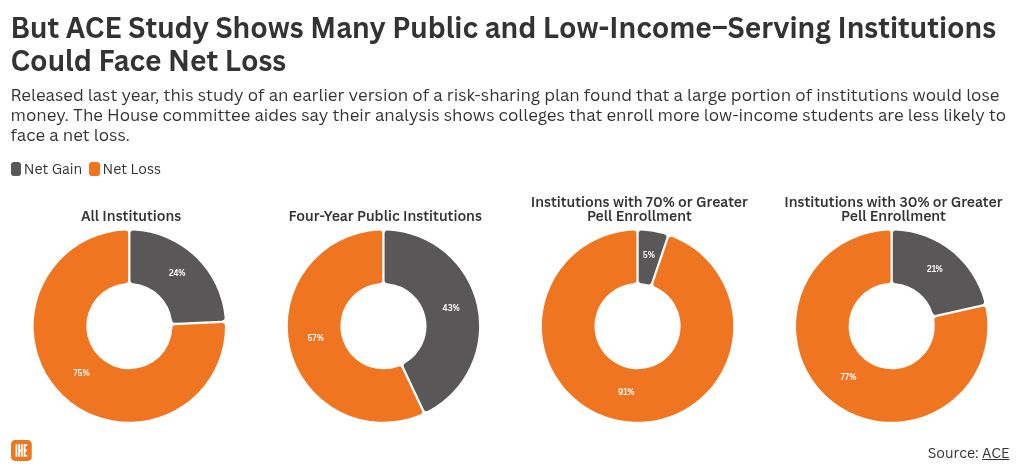
    The ACE analysis as well as the committee’s data are among the few studies that show the estimated impact of the previously proposed risk-sharing plan. None have been updated yet to reflect the latest iteration.

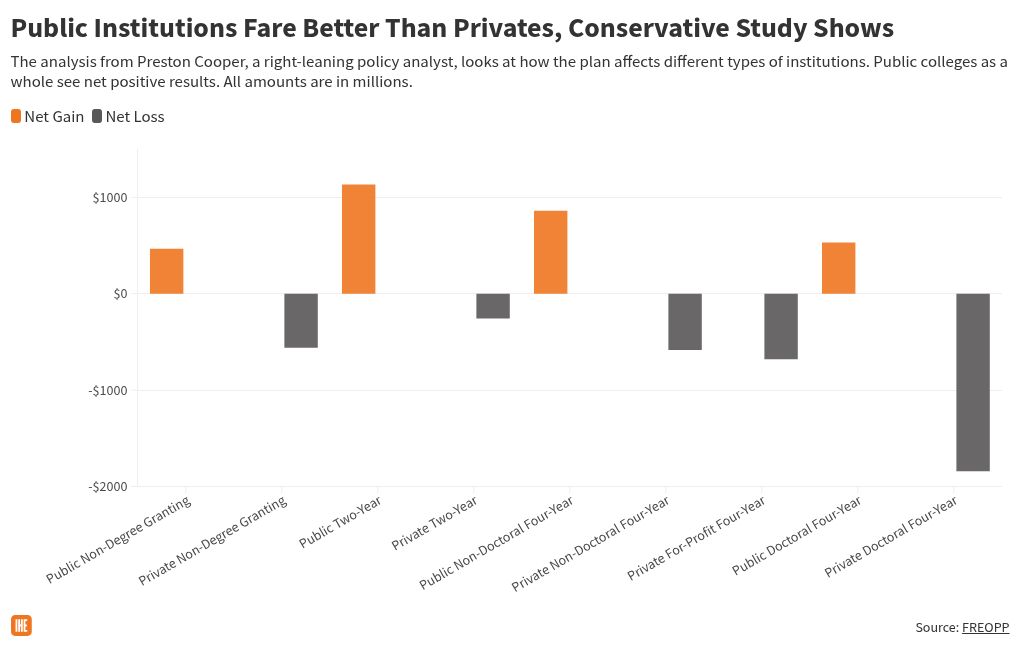
    Another analysis from Cooper, the AEI fellow, estimated that public institutions as a whole should get more money under the plan, but private nonprofits are expected to face a substantial penalty.
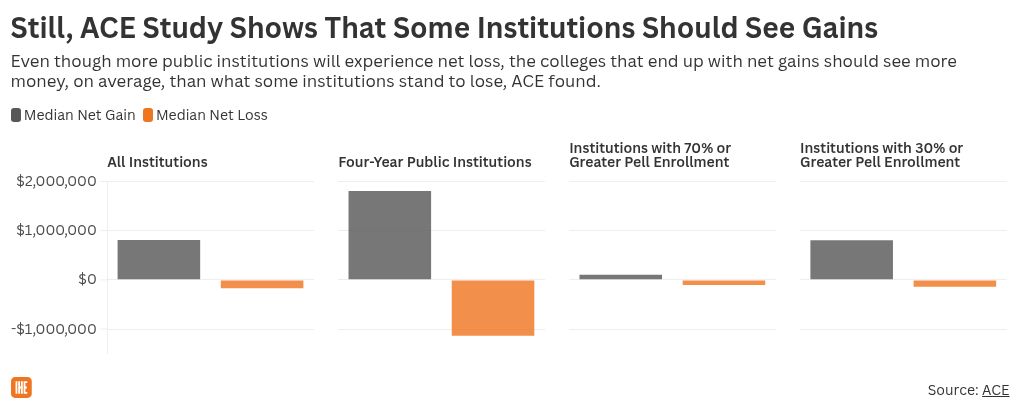
    Although critics point to how the plan would affect individual institutions, particularly small, underresourced schools, proponents argue that the focus should be on the impact to higher education over all, and that colleges can lower their costs to see a payoff.

    “Because the net gains are significantly larger, the sector as a whole sees a net gain even though more institutions have net losses,” Cooper said. “So, the upside for institutions here is that there are significant rewards available to those which can improve their outcomes.”

    At the end of the day, it’s all about how you choose to look at the data.

    “I would just like to see [the formula of risk-sharing] play out for a couple of hypothetical colleges based on data that has some bearing on reality,” said Delisle from Urban Institute. “And that’s a hard thing to come by right now.”

    Source link

  • Defense Department Caps Universities’ Indirect Cost Rates

    Defense Department Caps Universities’ Indirect Cost Rates

    The Department of Defense is planning to cap indirect cost reimbursement rates for higher education institutions at 15 percent, according to a May 14 memo signed by Secretary of Defense Pete Hegseth. 

    “The Department of Defense (DoD) is the steward of the most critical budget in the Federal Government—the budget that defends our Nation, equips our warfighters, and secures our future. That stewardship demands discipline. It demands accountability. And it demands that we say no to waste,” wrote Hegseth.

    The memo directs the DOD to develop the new policy within 21 days, marking the fourth federal agency—including the National Institutes of Health, the Department of Energy and the National Science Foundation—that has enacted a plan to cap indirect cost rates at 15 percent. For decades, universities have negotiated with the federal government to calculate bespoke indirect cost reimbursement rates to pay for research costs that support multiple grant-funded projects, such as facilities maintenance, specialized equipment and administrative personnel. (The paragraph has been updated.)

    Universities and their trade associations have already sued the NIH, DOE and NSF over these plans, arguing that capping indirect costs would hurt research production and compromise global competitiveness, all while violating multiple aspects of the Administrative Procedure Act, including bypassing congressional authority required to alter indirect cost rates. So far, federal judges have blocked indirect cost caps from taking effect at the NIH and DOE. The NSF agreed to pause the cap until June 13 in order to proceed to summary judgment, which is a way to resolve the case quickly without a full trial.

    Matt Owens, president of COGR, which represents research institutions, condemned the DOD’s newly announced plan. 

    “DOD research performed by universities is a force multiplier and has helped to make the U.S. military the most effective in the world. From GPS, stealth technology, advanced body armor, to precision guided missiles and night vision technology, university-based DOD research makes our military stronger,” Owens said in a statement. “A cut to DOD indirect cost reimbursements is a cut to national security. Less funding for research means less security for our nation.”

    Hegseth’s memo claimed that capping the Defense Department’s indirect cost rate for universities would “save up to $900 [million] per year on a go-forward basis,” while also claiming that the department’s “objective is not only to save money, but to repurpose those funds—toward applied innovation, operational capability, and strategic deterrence.” The NIH has also made similarly incompatible assertions. It touted on social media its indirect rate cap plan’s potential to save taxpayers more than $4 billion, while a lawyer for the NIH told a federal judge that the cut was simply a reallocation of funds. 

    The Defense Department’s plans “will not stop at new grants,” Hegseth wrote, adding that “meaningful savings can also be achieved by revisiting the terms of existing awards to institutions of higher education.” The memo directed the under secretary of defense for research and engineering to do the following within 30 days:

    • Initiate a departmentwide effort to renegotiate indirect cost rates on existing financial assistance awards to institutions of higher education. “Wherever cooperative, bilateral modification is possible, it shall be pursued.”
    • “Where bilateral agreement is not achieved, identify and recommend lawful paths to terminate and reissue the award under revised terms.”
    • “Complete renegotiations or terminations for all contracts by 180 days from the date of this memorandum.”

    Source link

  • Florida A&M Hires DeSantis Ally as President

    Florida A&M Hires DeSantis Ally as President

    Photo illustration by Justin Morrison/Inside Higher Ed | Jemal Countess/Getty Images for NOBCO | JHVEPhoto/iStock/Getty Images

    Following a contentious selection process, Florida A&M University hired a new president with no experience working in higher education but long-standing ties to Republican governor Ron DeSantis.

    Marva Johnson, a lobbyist for Charter Communications, faced sharp opposition from students and alumni, who dubbed her “MAGA Marva.” But despite questions about her lack of experience, Florida A&M’s board voted 8 to 4 in a Friday meeting to make her the next president.

    Johnson was also criticized by community members and board chair Kristin Harper for her salary demands, which included base pay of $750,000 plus performance bonuses. (Two other candidates requested compensation in the $500,000 range, while one other was negotiable.)

    Harper was one of the four trustees who voted against hiring Johnson.

    “In an age of merit-based hiring decisions, how can one justify settling for a candidate who does not meet all of the position criteria? Or turning a blind eye to exceptionally qualified candidates?” Harper asked.

    She added that FAMU community members “have been very clear” with their feedback.

    But other trustees emphasized Johnson’s experience in the political world. Jamal Brown, the Faculty Senate president, who sits on the board, argued that FAMU needed a president who has “access and political connections” to ensure the university’s financial success. In voting for Johnson, he argued that “this moment calls for someone who understands the systems that fund and govern us, because right now our survival depends on how we navigate those systems.”

    While Johnson has never worked in higher education in any capacity, she spent eight years on the Florida State Board of Education, including time as chair. During the hiring process, critics highlighted her lack of experience, as did some trustees who voted against her.

    Johnson beat out Donald Palm, executive vice president and chief operating officer of Florida A&M, who received four votes. Other candidates included Rondall Allen, provost and vice president for academic affairs at the University of Maryland Eastern Shore, and Gerald Hector, senior vice president for administration and finance at the University of Central Florida.

    Palm, the internal candidate, was overwhelmingly endorsed by FAMU’s alumni association.

    At a tense meet-and-greet with Johnson on Wednesday, the candidate assured the university community she was “not a Trojan horse” and promised she “would fight and win for FAMU.”

    However, critics have argued she failed to articulate a clear vision for the university.

    Additional drama accompanied the hire when the board cut Harper out of contract negotiations. While board chairs have traditionally negotiated the contract with incoming presidents at Florida A&M, trustees voted to delegate that responsibility to another member at Friday’s meeting.

    “I take personal offense at what is happening,” Harper said during that discussion.

    Another controversy arose earlier in the search amid speculation that Johnson was added to a list of three finalists at the last minute. Last month trustee Ernie Ellison called to restart the search, arguing, “There are too many clouds hanging over this process.” He stepped down earlier this month and was quickly replaced by a new DeSantis appointee, who then voted to hire Johnson.

    Johnson steps into the FAMU job, which is currently held by an interim, after Larry Robinson, who led the university from 2017 to 2024, resigned amid controversy over a fraudulent gift.

    Last spring Florida A&M announced at commencement that the university had received a $237 million donation from Greg Gerami, a relatively unknown businessman with no connection to the institution. Florida A&M appeared to ignore warning signs that Gerami had also pledged $95 million to Coastal Carolina University in 2020, despite having no ties to CCU other than previously dating an employee. Gerami walked that donation back due to what he viewed as disrespect by officials at Coastal Carolina. Gerami’s FAMU donation was later invalidated.

    Despite the opposition to her candidacy, Johnson fits the profile favored in recent years by the governing boards at Florida’s public institutions, which have emphasized nontraditional applicants. Johnson is one of multiple presidential hires with ties to DeSantis or the GOP since 2022, when the State Legislature passed a bill allowing universities to shield applicant identities until the end of the hiring process, breaking with a long-standing tradition of making those names public. State lawmakers recently proposed injecting more transparency into searches, but that effort failed.

    Other political hires include Ben Sasse, a former Republican U.S. senator from Nebraska, who had a short-lived presidency at the University of Florida; former Florida lieutenant governor Jeanette Nuñez at Florida International University; and former state lawmakers Adam Hasner at Florida Atlantic University and Richard Corcoran at New College of Florida, among several others. Former GOP lawmaker Ray Rodrigues was also hired to lead the State University System of Florida in 2022.

    The University of Florida is currently in the process of replacing Sasse with an interim appointed to the job after his abrupt departure. Sole finalist Santa Ono, a traditional academic who left the University of Michigan to take the Florida job, marks a reversal of course compared to recent hires. However, Ono’s candidacy has sparked criticism from some conservative power players.

    Source link

  • ICE Warns International Students of More SEVIS Terminations

    ICE Warns International Students of More SEVIS Terminations

    Immigration officials sent letters to international students on short-term work visas Thursday night, threatening to terminate their legal status in the Student Exchange and Visitor Information System and remove them from the country. The number of affected students is still unknown, but Inside Higher Ed can confirm at least 35.

    It’s the first sign that the Trump administration is resuming its campaign to deport student visa holders, weeks after restoring the statuses of thousands of students. ICE recently released an updated policy that significantly expands the agency’s authority to terminate students’ SEVIS status and pave the way for deportation proceedings. 

    This time, they’re targeting students on Optional Practical Training visas, or OPTs, which allow international postgraduates the opportunity to work in a field relevant to their study on a short-term extension. Students on OPT are allowed a total of 90 days of unemployment every 12 months before falling out of compliance. It’s still not known whether any of the affected students were on a special visa extension known as OPT for STEM, awarded to graduates in high-demand technology, science and engineering fields. 

    One international student adviser, who spoke with Inside Higher Ed on the condition of anonymity, said 28 of his institution’s students on OPT received the letter in the past day, and he expects that number will grow. 

    In a copy of one letter received by an international student and obtained by Inside Higher Ed, Immigration and Customs Enforcement warned those who have not reported employment status within 90 days of starting their OPT visa that they must do so in 15 days. If they don’t, the Student Exchange and Visitor Program “will set your SEVIS record to ‘terminated,’” the letter reads, which “may result in the initiation of immigration proceedings to remove you from the United States.”

    The letter is nearly identical to those sent by officials during the first Trump administration in 2020. The only difference: Back then, the Student Exchange and Visitor Program was the letter’s sole signatory. This time, ICE and the Department of Homeland Security are also named. 

    The 2020 letters were sent two years after officials issued an update to designated school officials informing them that the administration had begun a review of OPT students’ employment status to find noncompliant visa holders. But that notice also said SEVP would not automatically terminate students’ SEVIS status for going over the 90-day unemployment limit before notifying students. 

    It’s not clear whether immigration officials engaged in a review process before beginning to notify students of potential SEVIS terminations this week. Spokespeople for ICE and DHS did not respond to questions in time for publication. 

    It was also not immediately clear if OPT students’ SEVIS terminations would result in subsequent visa revocations, which are the purview of the State Department. A spokesperson for the State Department wrote in an email that they “cannot preview future visa-related decisions, which are made on a case-by-case basis, based on the individual facts relevant to the case,” and deferred other questions sent by Inside Higher Ed to DHS.

    In an internal communication sent to international student advisers and support specialists, NAFSA, an organization of international educators, urged college officials to regularly check the SEVIS database for notices of OPT students’ compliance with “accrued unemployment days” and to reach out to any students who are over the 90-day limit as soon as possible. 

    Immigration officials began systematically terminating thousands of students’ SEVIS statuses along with their visas in late March, an unprecedented move that threw international student support offices into chaos and left students scrambling to avoid deportation. 

    Last month, immigration officials restored the SEVIS statuses of more than 5,000 international students after losing dozens of court cases challenging the legality of efforts to revoke foreign students’ legal residency at a breakneck pace.

    The anonymous international student adviser said students on OPT often forget to report their employment details before the 90-day deadline. Many are distracted by graduations and finals well after they receive approval for the visa and forget, he said; in other cases, the lapse can be due to technical issues within SEVIS.

    Because of that, they’re often given some leeway, and he said he’s never seen or heard of a student having their SEVIS status terminated for not reporting employment details on time, including the last time these letters were sent in 2020. Then again, much of the Trump administration’s treatment of student visa holders is unprecedented, and he’s worried this could be a real danger for them.

    “There’s a lot of panic and uncertainty as our students are waiting to see what will happen, and we’re waiting to see if they’ll really go through with it,” he said. “I think this is the real deal.”

    Source link

  • U.S. Universities Eye Branch Campuses as Way to “Survive Trump”

    U.S. Universities Eye Branch Campuses as Way to “Survive Trump”

    Establishing branch campuses abroad—often used as a crisis mitigation strategy—could become more important for U.S. universities facing increasing threats at home, but scholars are divided on their likelihood of success.

    Illinois Institute of Technology has announced that it is to build a campus in Mumbai, while Georgetown University, one of six U.S. universities with satellite campuses in Doha, recently renewed its contract in Qatar’s Education City for another 10 years.

    Research-intensive colleges and universities in the U.S. are faced with “new and profound uncertainties” over future funding and the strength of their endowments under the Trump administration, said Geoff Harkness, formerly postdoctoral teaching fellow at Northwestern and Carnegie Mellon Universities’ Education City campuses.

    “This means that R-1 institutions will have to seek alternative sources of revenue, including partnering with nations in the Middle East. For Georgetown, which has a long-established branch campus at Education City, the renewal was a no-brainer in 2025.”

    It comes just a year after Texas A&M closed its campus in Education City, citing “instability” in the region. However, academics said the decision was more likely a reflection of growing pro-Israel politics in the U.S. and unease with Qatar’s role mediating for Hamas in the Gaza conflict.

    Harkness, now associate professor of sociology at Rhode Island College, said the Israel-Palestine conflict put Qatar in a difficult position but warned that Texas A&M could regret its decision to leave from a fiscal perspective.

    “The nation’s vast resources and relative political moderation make it an appealing partner for U.S. colleges and universities, particularly in light of current economic uncertainties.”

    Although not all partnerships are as lucrative as those with the Qatar Foundation, research by Jana Kleibert, professor for economic geography at the University of Hamburg, found that uncertainty around Brexit triggered U.K. universities to explore opening campuses in continental Europe—as Lancaster University did in Leipzig, Germany.

    “Branch campuses are often used as a crisis mitigation strategy by universities,” she said.

    “In this sense, it is no surprise to me that in situations of financial and geopolitical turbulence, branch campuses become more attractive to decision-makers at universities.”

    University leaders hope that overseas campuses can contribute financially to the well-being of the overall institution, either through direct transfers from these sites to the main institutions or through accessing a broader pool of students, said Kleibert.

    Recent figures show that U.S.-Chinese collaborative campuses have experienced record-breaking application numbers from both domestic and international students over the past few years.

    Illinois Tech began planning its Indian outpost long before President Trump’s unprecedented assault on the U.S. higher education system. But Nigel Healey, professor of international higher education at the University of Limerick, said Trump’s culture wars could increase the “push factors” toward overseas expansion in the future.

    “In the medium to long term, branch campuses may offer elite U.S. institutions an alternative way of maintaining their internationalization, accessing international talent and maintaining a global profile at a time when Trump is fostering a new national culture of xenophobia and isolationism,” he said.

    However, he warned that the risks of being pushed into a strategy by suddenly changing political winds is that poor, reactive decisions might be made.

    “The winds may change in the opposite direction, leaving the institution with a branch campus that is suddenly a white elephant.”

    Philip Altbach, professor emeritus at Boston College, agreed that there are significant risks in establishing branches overseas and that they are not a high priority for elite universities right now.

    “In the current situation of total instability in U.S. higher education due to the Trump administration, U.S. universities will not be thinking much about branch campuses but about their own survival.”

    Although partnering with many countries may be politically safe, he said universities are unlikely to want to risk making “controversial political moves in the current environment.”

    “Top U.S. universities are more interested in establishing research centers and joint programs overseas that can help their research and be a kind of embassy for recruiting students and researchers for the home campuses.”

    And Kevin Kinser, professor of education and head of the department of education policy studies at Pennsylvania State University, said overseas partners are not free from scrutiny from the White House.

    “The turmoil in the U.S. also includes scrutinizing foreign donations, contributions, collaborations and investments. Looking overseas does not create a safe haven for current federal attention.”

    As a result, he said, Texas A&M may have gotten ahead of the narrative on foreign activities by universities by quitting Education City when it did.

    Source link

  • Waivers Let Some N.C. Majors Keep “DEI” Requirements

    Waivers Let Some N.C. Majors Keep “DEI” Requirements

    Shortly after the second Trump administration began attacking higher education diversity initiatives, the University of North Carolina system ordered its 16 public universities to immediately stop requiring “course credits related to diversity, equity and inclusion.” The system was targeting DEI even before Trump retook office—the UNC Board of Governors repealed the system’s DEI policy a year ago—and its general counsel pointed to the federal government’s newly threatened funding cuts to justify this further step.

    But the system’s kibosh on DEI requirements came with caveats. Majors could continue requiring courses with diversity themes if university chancellors provided waivers.The system gave chancellors the final say on which major-specific courses would continue to be mandated, and chancellors said waivers were needed because state or national accreditation and licensure criteria require diversity education.

    “Approximately 95 percent of the programs identified for waivers at the chancellor level had accreditation and licensure requirements attached to them,” said David J. English, the system’s senior vice president for academic affairs, during a UNC board committee meeting this week. English said these programs are in counseling, education, nursing, psychology and social work.

    According to documents attached to this week’s board meeting agenda and previously reported by Raleigh’s News & Observer, dozens of courses will remain necessary for certain majors in the UNC system, which includes all four-year public universities in the state. Among them are Feminist Theory at UNC Asheville; Multicultural Counseling at UNC Charlotte; Social Work Policy and Restorative Justice at UNC Greensboro; Teaching Reading to Culturally Diverse Children at Fayetteville State University; Inclusion, Diversity and Equity in Agriculture at North Carolina A&T State University; and Diversity in Higher Education at North Carolina Central University.

    The UNC system is one example of universities across the country being asked to comply with vague statewide and national demands to excise DEI. Lacking detailed guidance, they’ve had to define that term for themselves as they seek to show compliance.

    The UNC system never defined for its component institutions what it meant by the verboten “course credits related to DEI.” The universities were left to determine for themselves what they should stop requiring; some administrations used keyword searches of course descriptions, looking for terms such as “cultural” to choose which courses to review.

    The Feb. 5 order from the system said universities’ general education requirements couldn’t include mandates for DEI-related courses at all. A few institutions, such as East Carolina University and UNC Asheville, responded by jettisoning broad diversity categories from their gen ed requirements. At UNC Chapel Hill, College of Arts and Sciences dean Jim White wrote that “Power, Difference, and Inequality”—a category within the gen ed curriculum there—“could be incorrectly read or understood to be ‘related’ to DEI,” so it was “streamlined” and is now called “Power and Society.”

    But when it came to specific majors’ mandates for DEI-related credits, the system let chancellors grant what it called “tailored waivers” to allow these requirements to continue.

    Appalachian State University’s acting provost initially asked the national Council on Social Work Education, which accredits social work programs, to waive accreditation standards that are specifically called “Anti-Racism, Diversity, Equity, and Inclusion.” But when the council refused, Appalachian State chancellor Heather Norris gave her university’s social work program a waiver to continue the education requirements.

    Halaevalu Fonongava’inga Ofahengaue Vakalahi, the Council on Social Work Education’s president and chief executive officer, told Inside Higher Ed in an email, “We do not issue waivers except in very limited circumstances as defined by our Educational Policy and Accreditation Standards. Those circumstances are not applicable in this case.

    “What we have done, and are continuing to do, is work with programs and institutions to ensure they are both meeting the appropriate standards for accreditation while also staying within the boundaries dictated by law,” Vakalahi wrote. “Social work is about healthy individuals, healthy families, and healthy communities. We value inclusion because we believe that social work is for everyone—no exceptions.”

    While the waiver documents released this week show course requirements that survived, they don’t specify whether universities dropped major-specific requirements—and if so, which ones—instead of having their chancellors grant waivers. Universities didn’t provide interviews this week to Inside Higher Ed for this article. But the fact that the system ordered statewide changes to curriculum rather than have the faculties of individual universities propose them has raised academic freedom and shared governance concerns.

    ‘Faculty Were Not Pleased’

    Wade Maki, chair of the UNC Faculty Assembly, said the faculty senates or councils of all 16 universities, plus the one specialized high school in the system, ratified a resolution calling the order to end DEI course requirements “an unnecessary and intolerable breach of the principle of academic freedom” that “deeply undermines” the system’s mission “to serve the people of our state.”

    Defending the place of faculty in setting curriculum, the resolution says, “Faculty, who are trained at the highest level of our disciplines, collaborate within our departments, universities and communities to design and lead programs—including defining the core curriculum and graduation requirements—to ensure our students’ growth and success.”

    While “faculty were not pleased” about the order, they stepped up to take part in the course review, Maki said. Because the system “did not prescribe how” to comply, “it was up to faculty and administrators to work together to determine what to do,” he said.

    “Each major had to look and say, ‘Do we think we’re at risk of being out of compliance here, and what’s the best course of action?’” he said.

    Herle McGowan, chair of North Carolina State University’s Faculty Senate, said her university dropped a general ed requirement in response to the system’s order—a requirement that had been created by faculty with student input.

    “The fact that it changed without consultation from faculty is definitely concerning to me,” McGowan said.

    She said she personally believes academic freedom rights should cover “the broader curriculum,” not just individual faculty teaching and research. Within majors, she said experts should agree on what students need to learn, and when it comes to gen ed, there should be “collaboration from faculty experts all across the university” in determining what students need to be good, well-rounded citizens prepared for life and work.

    Regardless of her own views on academic freedom, McGowan said, the fact that the system handed down such an order points to a need for constituents—from faculty to board members—to come to a consensus on what academic freedom means.

    Source link

  • Detained Georgetown Professor Released From ICE Custody

    Detained Georgetown Professor Released From ICE Custody

    Badar Khan Suri, a postdoctoral fellow and professor at Georgetown University, was released from a federal detention center in Texas on Wednesday after being held for two months.

    Suri, an Indian national, was arrested in March under government claims that he was a threat to U.S. interests and had close connections to a known or suspected terrorist. This week a federal judge in Virginia ordered Suri’s immediate release due to a lack of evidence to support such claims.

    Suri is one of about a dozen foreign nationals in the U.S. targeted by the Trump administration for pro-Palestinian activism, including Mahmoud Khalil, Mohsen Mahdawi, Rümeysa Öztürk and Momodou Taal. While Khalil remains in custody, Mahdawi was released on bail on April 30 and Öztürk was released from federal custody last week. Taal chose to leave the U.S. in April.

    Prior to his arrest, Suri had been in the U.S. for three years on a student visa and was teaching a course on minority rights in South Asia at Georgetown, according to The New York Times. Suri’s lawyers believe he was targeted because his father-in-law served as a political adviser to the Hamas-led government in Gaza in the early 2000s.

    Suri was apprehended outside his home in Rosslyn, Va., on March 15 and was moved among detention centers in Virginia, Louisiana and Texas. Suri described his treatment in the Prairieland Detention Center in Texas as subhuman, saying he was chained at the ankles, wrists and body.

    Other international academics are locked in legal battles with the federal government over challenges to their standing in the U.S.

    A University of Minnesota student, Dogukan Gunaydin, has been in ICE custody since March despite having his case overturned. Alireza Doroudi, who was a doctoral student at the University of Alabama, requested voluntary departure to avoid prolonged detention, according to his attorney. Columbia student Leqaa Kordia was arrested in March and remains in an immigration detention center in Texas.

    Source link

  • Lessons of the Fountain Pen (opinion)

    Lessons of the Fountain Pen (opinion)

    For the past two years, during the twilight of my academic career, I have become a devotee of the fountain pen, often pondering this seemingly retro act of putting pen to paper.

    Composing again by hand forced me to admit how often I succumb to the internet’s never-ending temptations. In the past, some of my best prose has come forth at 40,000 feet, while I was strapped in for a long flight—with no contact outside the streaking metal tube. But the wily digital devil never rests. Most jets now offer Wi-Fi, enticing you to check your email or the Yankees–Red Sox score as you cross the North Atlantic.

    My longing to write by hand, though, was undermined by largely illegible penmanship, a lifelong consequence of my naturally lefty self having been forced to write right-handed. No pen ever seemed to work for me, and I have tried most. Gel pens are the worst, producing a script that even I cannot decipher. Even so, during a research trip to Europe in fall 2022, where Wi-Fi was often unavailable, I found myself relying on a bound notebook during the day and my computer at night. The illegibility of my notes and journal entries made typing them out especially onerous and time-consuming, all the more so after I had returned home two months later. Then I remembered a fountain pen that my mother had gifted me so long ago—was it for my 50th birthday in 2005?—that its ink cartridges had dried up. A trip to Staples yielded a small pack, and I realized right away that there was enough friction between the nib and page to slow me down—enough for me to be able to decipher what I had written.

    Like most brainstorms, this one proved ephemeral. To write by hand and then enter text into a computer—with my mediocre keyboarding skills—was just too burdensome. Those who started their academic journeys during the typewriter era will remember with a whiff of despair those late-night, hours-long sessions spent typing the final draft. Correction tape, erasable bond, Wite-Out—my heart sinks just listing those essential tools from another era. If you want a taste of those times, just sample the acknowledgments in academic books or dissertations from the decades before computers, in which women, typically wives, are thanked for having typed the manuscript. The acknowledgements from Sacvan Bercovitch’s The American Jeremiad, which I just pulled from a shelf, reflect more rarefied academic circumstances, as the author notes the grant provided by the English Department at Columbia University “for the typing of the manuscript.”

    And then a light went off as I sat in my study, one that has changed my life as a writer. After struggling with incipient carpal tunnel syndrome a few years ago, I purchased voice recognition software. Dragon Naturally Speaking was powerful, especially if you spoke in complete phrases and sentences. My copy of the software is now old—it will not work with Windows 11—but proved a godsend with unexpected benefits. While dictating my notebook pages, I could hear the awkward sentences; I could conjure the better word on the spot, and I could detect those places where the tone needed adjusting. Sometimes inspiration would bless me and a new sentence or two would emerge like Athena.

    I’m no neo-Luddite longing to smash all computers, even when Windows or MS Word betray me, as they so often do. I recognize the realities and benefits of our digital age. But wielding a fountain pen these past two years has prompted me to wonder whether some challenges the humanities face regarding writing and reading might be overcome by heeding the pen’s simple lessons.

    The Importance of Touch

    For millennia the act of writing has been tactile. From Babylonian cuneiform on clay tablets to elaborate Medieval script on vellum and modern calligraphy on heavyweight wedding stationery, writing has always meant touching the surface, with words being physically imprinted as the pen journeys across. When I write well, my hands seldom leave the page. And when I stop to consider the right word or a more felicitous phrase, my pen often poises a mere quarter inch above, ready to strike.

    Compare this to composing on a laptop, where pauses can lead to disaster. Distractions fill your field of vision—apps, task bars, weather forecasts and seemingly never-ending notifications that another email has arrived or another appointment looms. When you grasp for the right combination of words, it’s all too easy to seek them beyond the screen, or, even worse, to succumb to the program suggesting what it believes should come next. And unless you are vigilant about shutting off endless features, the software will insist upon indicating that you just misspelled a word or used a questionable grammatical construction. Most of us then dutifully correct the “mistake,” only to lose the rhythm and even essence of our prose. More and more, the virtual page seems to be doing the writing.

    The Value of Tangibility

    We have all had the experience of composing and revising a document on a computer only to lose the effort because of a crash, a software freeze or a moment of forgetfulness in which we clicked “no” instead of “yes.” What might have seemed so real to us for an hour or more vanishes like a genie who returns to his bottle without granting our wish.

    When I compose by hand, my efforts are right in front of me. The crossed-out word—which turns out to be the right one—can still be recovered. The history of moving paragraphs, those arrows and circles that sometimes fill the page, are not lost as they would be in computer drafting. Even more satisfyingly tangible for me, however, is the physical evidence of my labors: the blue ink stains on my right hand, the ritual of refilling my pen from the bottle when I have gushed out a pool of words, the celebratory occasion when I empty a bottle of ink and need to open a new one. A similar mood of celebration arises when I fill the last page of my wide-ruled notebook and place it on the shelf next to its predecessors. Scrolling through thousands of documents and folders on my computer is certainly a humbling experience, as they represent the literal steps in a multidecade academic journey, but I regret not having found my fountain pen niche many years before. What a collection those notebooks would’ve been.

    The Pleasures of Portability

    Coinciding with my return to compositional roots has been my regular presence at a place where my words seem to flow so easily, the Hall Street Bakery in Grand Rapids. During my sabbatical, I was there at least five days a week and now continue to show up on nonteaching days. All I need is my notebook, a folder with ideas or drafts, a full pen and my regular—a large house coffee and a cranberry-almond scone—to set me up for a solid hour of writing. Conversations bubble from nearby tables, kids run around hopped up on sugar, drivers retrieve DoorDash orders—all set against the occasional counterpoint of the hissing espresso machine—and I am in my element. No need for Wi-Fi passwords or the elusive table next to an electrical outlet. I can walk across the room to speak with someone, order a refill, visit the men’s room—all without fearing that my laptop will disappear. And spilling coffee on my notebook or dropping it onto the floor is a minor inconvenience, not an expensive technological catastrophe. Traveling light, I can sweep up my possessions in an instant and head out the door.

    The Relevance to Reading

    In thinking about writing as a physical act that produces something you can hold, I recognized anew how relevant these same qualities are to reading. We seem today to be awash in words, yet paradoxically find ourselves in the midst of a reading crisis that extends from the youngest learners to those at America’s universities.

    An article by Rose Horowitch in The Atlantic, “The Elite College Students Who Can’t Read Books,” convinced me that my experience with the fountain pen might be relevant to the challenges she describes.

    Horowitch reports that students at elite colleges, who have already proven their ability to read complex texts, seem less and less able (or willing) to read long literary works. She mostly ascribes this to high schools emphasizing standardized tests, to teens distracted by smartphones and to college students who view their educations in strictly transactional terms, as means to specific, often exceedingly specific, ends—which seldom include pushing through Middlemarch.

    She may be right, but the teachers and faculty she interviewed offer little beyond assigning shorter texts: Kate Chopin’s The Awakening instead of Jane Austen’s Pride and Prejudice. Toni Morrison’s The Bluest Eye instead of Ralph Ellison’s Invisible Man. A book or two at most from The Iliad or Paradise Lost.

    Let me argue, though, that the very elements I associate with composing by hand—its tactile and tangible nature, its simple conveniences—should be drawn upon when encountering long, complex and sometimes life-changing texts. And that the cool distance of the digital interface works against these very qualities.

    Yes, I know it is possible to put all your books on a single device where you can search and annotate the texts. Even if you lose your Kindle, your digital library can be retrieved from the cloud. Yet the experience of reading on the screen tends to flatten all writing, making each screen much like any other, so that the unique feel and heft of Moby-Dick, for example, is lost, making Melville’s incandescent prose indistinguishable from any Substacker’s, and probably less visually enticing.

    Even if you can resist distraction on your laptop, you never get the sensory experience unique to each book: how it feels in your hands, how its page design pulls you in or pushes you away, how its very smell when brand-new or decades old can evoke its distinctive qualities, how the satisfying sound of turning pages reaches a crescendo when you get to the end and close the cover with a resonant thump. Like the angry slam of a telephone receiver, it’s a sound beyond our digital age. And it all leads to a final moment when you place the book on a shelf to stand as a tangible reminder of your ever-changing reading life—no internet connection required.

    The physical book, that container that our society, try as it might, cannot cast into the electronic darkness, will live on. At least I hope so. A recent visit to my university’s beautiful library leaves much room for doubt. In the popular Mary Idema Pew Library Learning and Information Commons—sorry, but that’s its official name, sans commas—hundreds of students gather at any given time. But to stroll through its busy floors soon makes this book lover feel like Diogenes in search of an honest man. My lamp has seldom shined upon a student with a physical book in hand; instead, they tap and scroll their way through reading assignments in much the same way they engage daily life.

    I see them as we share the bus that travels between our university’s two campuses, filling each moment with the small screens they find far more interesting than the passing world—the season’s first snowflakes, the glow cast upon the road as dusk approaches, the deer in a harvested cornfield who look up with more curiosity than my fellow travelers.

    With a sigh—and nod to the deer—I open my copy of Uncle Tom’s Cabin, touching its familiar pages with my ink-stained hands, and try to remember to text my wife that I’m on my way.

    After 37 years as a professor of English at Grand Valley State University, Rob Franciosi recently retired to devote his time to writing.

    Source link

  • Misinformation Course Teaches Ethics for Engineering Students

    Misinformation Course Teaches Ethics for Engineering Students

    Nearly three in four college students say they have somewhat high or very high media literacy skills (72 percent), according to a 2025 Student Voice survey by Inside Higher Ed and Generation Lab. Students are less likely to consider their peers media literate; three in five respondents said they have at least somewhat high levels of concern about the spread of misinformation among their classmates.

    When asked how colleges and universities could help improve students’ media literacy skills, a majority of Student Voice respondents indicated they want digital resources on increasing media literacy or media literacy–related content and training embedded into the curriculum.

    A recently developed course at the University of Southern California’s Viterbi School of Engineering teaches students information literacy principles to help them develop tools to mitigate the harms of online misinformation.

    The background: USC offers an interdisciplinary teaching grant that incentivizes cross-campus collaboration and innovative teaching practices. To be eligible for the grant, applications must include at least one full-time faculty member and faculty from more than one school or division. Each grantee receives up to $20,000 to compensate for applicants’ time and work.

    In 2023, Helen Choi, a faculty member at USC Viterbi, won the interdisciplinary teaching grant in collaboration with Cari Kaurloto, head of the science and engineering library at USC Libraries, to create a media literacy course specifically for engineering students.

    “By focusing on engineering students, we were able to integrate a component of the course that addresses a social issue from an engineering perspective in terms of technical know-how and the professional ethics,” Choi said, which helps students see the relevance of course content to their personal and professional lives.

    What’s the need: Students tend to receive most of their news and information on online platforms; Student Voice data found a majority of learners rely on social media for news content (72 percent), and about one in four engage with news apps or news aggregator websites (27 percent).

    Choi and Kaurloto’s course, titled Information Literacy: Navigating Digital Misinformation, builds academic research skills, teaches information literacy principles and breaks down the social issue of online misinformation.

    “Students examine ways they can navigate online information using their research skills, and then extend that knowledge by considering how they, as prospective engineers, can build technologies that mitigate the harms of online misinformation while enhancing the information literacy of users,” Choi explained.

    USC faculty aren’t the only ones noticing a need for more education around engagement with digital information; a growing number of colleges and universities are making students complete a digital literacy course as a graduation requirement.

    In the classroom: Choi and Kaurloto co-teach the course, which was first offered in this spring to a class of 25 students.

    The students learned to develop effective search strategies and critically examine sources, as well as ethical engineering principles and how to apply them in designing social media platforms, Kaurloto said. Choi and Kaurloto employed active learning pedagogies to give students hands-on and real-life applications including writing, speaking and collaborative coursework.

    One assignment the students completed was conducting library research to develop a thesis paragraph on an information literacy topic with a short, annotated bibliography. Students also presented their research to their peers, Kaurloto said.

    Learners also engaged in a group digital literacy project, designing a public service campaign that included helpful, research-backed ways to identify misinformation, Choi said. “They then had to launch that campaign on a social media platform, measure its impact, and present on their findings.” Projects ranged from infographics on Reddit to short-form videos on spotting AI-generated misinformation and images on TikTok and Instagram.

    The impact: Student feedback said they found the course helpful, with many upper-level learners saying they wished they had taken it sooner in their academic career because of the library research skills they gained. They also indicated the course content was applicable in daily life, such as when supporting family members “who students say have fallen down a few internet rabbit holes or who tend to believe everything they see online,” Choi said.

    Other librarians have taken note of the course as a model of how to teach information literacy, Choi said.

    “We’ve found that linking information literacy with specific disciplines like engineering can be helpful both in terms of building curricula that resonate with students but also for building professional partnerships among faculty,” Choi said. “Many faculty don’t know that university librarians are also experts in information literacy—but they should!”

    This fall, Choi and Kaurloto plan to offer two sections of the course with a cap of 24 students per section. Choi hopes to see more first- and second-year engineering students in the course so they can apply these principles to their program.

    If your student success program has a unique feature or twist, we’d like to know about it. Click here to submit.

    Source link

  • McMahon Sharpens Tone on Accreditation

    McMahon Sharpens Tone on Accreditation

    Education Secretary Linda McMahon has made clear in recent public statements that the current system of college accreditation needs to change.

    She’s accused current accreditors of hindering innovation and called for new actors to join the system. Her comments follow an executive order signed last month that targeted diversity, equity and inclusion standards in accreditation; made it easier for colleges to change accreditors; and opened the door for new entrants.

    Firing accreditors is one of the many promises—or threats—President Donald Trump made on the campaign trail as he accused such agencies of failing to hold universities accountable and vowed change. McMahon offered full-throated support for that vision this week, but her comments also raise questions about her understanding of the system she’s aiming to overhaul.

    McMahon Pushes Change

    McMahon criticized the American Bar Association and accreditors broadly in a recent interview with the conservative website PragerU, arguing that such agencies wield too much power and the marketplace would benefit from competition.

    (Contacted by Inside Higher Ed, ABA declined to comment.)

    Her remarks came in response to a question about why more universities aren’t opening. She noted that accreditation was a barrier to launching new institutions and argued that there is “a monopoly on accreditors,” singling out the ABA as the sole accrediting agency for law schools.

    “The president has said, ‘Nope, we need more competition,’” McMahon said.

    Since taking office in March, McMahon has said little about her vision for accreditation changes as she focused on other priorities such as laying off the department’s staff and targeting Columbia and Harvard Universities. But rethinking accreditation is expected to be a top priority for her agency, especially after Trump’s executive order.

    McMahon also argued accreditors have stifled innovation and implied that the accrediting system is still regional.

    “Universities in certain areas of the country can only use that accreditor that’s in that area, so the president is opening it up and he’s saying, ‘Nope, pick any accreditor that you want, anywhere in the country,’ so you’re not bound, then, by that geographical boundary—what’s working, what’s been thought of that you have to do, like, in the Northeast or the Southeast or whatever. That’s really, I think, going to change and open it up for more competition for universities to open as well,” McMahon said in the interview posted Wednesday.

    Regional accreditation was broken up in 2019 during the first Trump administration, and universities have not been bound to regional accreditors since the rules officially changed six years ago. Several institutions have either changed accreditors since then or are in the process of doing so.

    The University of Arizona, for example, jumped from the Higher Learning Commission to the WASC Senior College and University Commission, a move that was announced in 2022. Various Florida institutions are also in the process of decamping from their accreditor, though state officials complained last year that the Biden administration had slowed the process. The Trump administration has since released new guidance to make the process of switching easier.

    Robert Shireman, a senior fellow at the progressive Century Foundation and a member of the National Advisory Committee on Institutional Quality and Integrity, which advises the education secretary on accreditation, told Inside Higher Ed by email that McMahon’s talking points seem dated.

    “It does seem that Secretary McMahon is using some talking points from five or six years ago. The regions are history. That said, accreditation is a complicated and obscure topic, so I’m not surprised that it is taking a while for her to grasp it all while awaiting the confirmation of an undersecretary with more higher education policy experience,” Shireman wrote.

    McMahon also needled the ABA and accreditors broadly in a Wednesday appearance at the conservative Cato Institute in Washington, D.C., where she was featured in a conversation about shutting down the Department of Education. There she was asked about improving accreditation.

    “It’s a really big topic and a big issue right now. In fact, we are looking at expanding the number of accreditors in the Department of Education, which takes a couple of years,” McMahon said.

    She again called out the ABA for being “almost a monopoly” before zooming out broadly and repeating the claim from the PragerU interview that universities were tied to regional accreditors.

    “There are accreditors who are assigned to different regions of the country. So if you’re in Florida and you have an accreditor, that’s part of the Southeast, but you really don’t feel like you’re getting your fair shake from these accreditors, and they may be putting all kinds of demands on you that are not necessarily what are looked at by another group of accreditors, and so you’d like to change your accreditation group, you’re not allowed to do that,” McMahon said.

    Education Department officials offered some clarity Thursday in response to questions from Inside Higher Ed.

    “While accreditors are no longer regional, the pre-clearance requirement put in place by the Biden Administration made it almost impossible for institutions to change accreditors. The President’s EO and Secretary McMahon’s actions will bring additional competition and innovation to the marketplace,” an unidentified department spokesperson wrote by email.

    The spokesperson also included a link to McMahon’s comments on last month’s executive order.

    A New Accreditor?

    On the same day McMahon took shots at accreditors, the University of North Carolina system’s president made a surprise announcement that UNC is “exploring the idea” of establishing a new accrediting agency. That effort, he said in remarks at a UNC Board of Governors committee meeting, would be in conjunction with other public university systems, which he did not name.

    “There are frustrations with the cumbersome, expensive, time-consuming burden the current approach places on our campuses, especially smaller institutions that must dedicate significant resources to the process,” Peter Hans said Wednesday, as first reported by The News & Observer.

    The UNC system is considering a foray into the accreditation world following state legislation passed without debate in 2023 that would require public institutions in the state to change accreditors every cycle. Florida passed similar legislation in 2022 that mandated changing accreditors.

    Both North Carolina and Florida have legislatures with strong Republican majorities. The legislation in both states followed questions from the Southern Association of Colleges and Schools Commission on Colleges over shared governance and presidential hiring processes.

    Source link