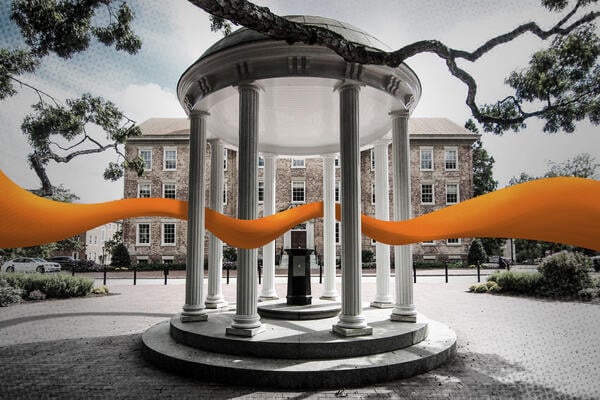
New York University will withhold the diploma of a student commencement speaker who used his speech Wednesday to condemn what he called “the atrocities currently happening in Palestine.”
According to a statement released by a university spokesperson after the speech, the student, Logan Rozos, “lied about the speech he was going to deliver and violated the commitment he made to comply with our rules.” The university is pursuing disciplinary actions and will withhold his diploma while that process proceeds.
“NYU is deeply sorry that the audience was subjected to these remarks and that this moment was stolen by someone who abused a privilege that was conferred upon him,” the statement continued.
Rozos spoke at the ceremony for the university’s Gallatin School of Individualized Study. He told the crowd he was “freaking out” about delivering the controversial speech, but that he felt a “moral and political” obligation to use the platform to speak out in support of Palestinians. Video of the speech shows graduates in caps and gowns clapping and cheering for Rozos and some giving him a standing ovation, though some boos and jeers can be heard off camera.
Establishing branch campuses abroad—often used as a crisis mitigation strategy—could become more important for U.S. universities facing increasing threats at home, but scholars are divided on their likelihood of success.
Research-intensive colleges and universities in the U.S. are faced with “new and profound uncertainties” over future funding and the strength of their endowments under the Trump administration, said Geoff Harkness, formerly postdoctoral teaching fellow at Northwestern and Carnegie Mellon Universities’ Education City campuses.
“This means that R-1 institutions will have to seek alternative sources of revenue, including partnering with nations in the Middle East. For Georgetown, which has a long-established branch campus at Education City, the renewal was a no-brainer in 2025.”
Harkness, now associate professor of sociology at Rhode Island College, said the Israel-Palestine conflict put Qatar in a difficult position but warned that Texas A&M could regret its decision to leave from a fiscal perspective.
“The nation’s vast resources and relative political moderation make it an appealing partner for U.S. colleges and universities, particularly in light of current economic uncertainties.”
“Branch campuses are often used as a crisis mitigation strategy by universities,” she said.
“In this sense, it is no surprise to me that in situations of financial and geopolitical turbulence, branch campuses become more attractive to decision-makers at universities.”
University leaders hope that overseas campuses can contribute financially to the well-being of the overall institution, either through direct transfers from these sites to the main institutions or through accessing a broader pool of students, said Kleibert.
Recent figures show that U.S.-Chinese collaborative campuses have experienced record-breaking application numbers from both domestic and international students over the past few years.
Illinois Tech began planning its Indian outpost long before President Trump’s unprecedented assault on the U.S. higher education system. But Nigel Healey, professor of international higher education at the University of Limerick, said Trump’s culture wars could increase the “push factors” toward overseas expansion in the future.
“In the medium to long term, branch campuses may offer elite U.S. institutions an alternative way of maintaining their internationalization, accessing international talent and maintaining a global profile at a time when Trump is fostering a new national culture of xenophobia and isolationism,” he said.
However, he warned that the risks of being pushed into a strategy by suddenly changing political winds is that poor, reactive decisions might be made.
“The winds may change in the opposite direction, leaving the institution with a branch campus that is suddenly a white elephant.”
Philip Altbach, professor emeritus at Boston College, agreed that there are significant risks in establishing branches overseas and that they are not a high priority for elite universities right now.
“In the current situation of total instability in U.S. higher education due to the Trump administration, U.S. universities will not be thinking much about branch campuses but about their own survival.”
Although partnering with many countries may be politically safe, he said universities are unlikely to want to risk making “controversial political moves in the current environment.”
“Top U.S. universities are more interested in establishing research centers and joint programs overseas that can help their research and be a kind of embassy for recruiting students and researchers for the home campuses.”
And Kevin Kinser, professor of education and head of the department of education policy studies at Pennsylvania State University, said overseas partners are not free from scrutiny from the White House.
“The turmoil in the U.S. also includes scrutinizing foreign donations, contributions, collaborations and investments. Looking overseas does not create a safe haven for current federal attention.”
As a result, he said, Texas A&M may have gotten ahead of the narrative on foreign activities by universities by quitting Education City when it did.
Shortly after the second Trump administration began attacking higher education diversity initiatives, the University of North Carolina system ordered its 16 public universities to immediately stop requiring “course credits related to diversity, equity and inclusion.” The system was targeting DEI even before Trump retook office—the UNC Board of Governors repealed the system’s DEI policy a year ago—and its general counsel pointed to the federal government’s newly threatened funding cuts to justify this further step.
But the system’s kibosh on DEI requirements came with caveats. Majors could continue requiring courses with diversity themes if university chancellors provided waivers.The system gave chancellors the final say on which major-specific courses would continue to be mandated, and chancellors said waivers were needed because state or national accreditation and licensure criteria require diversity education.
“Approximately 95 percent of the programs identified for waivers at the chancellor level had accreditation and licensure requirements attached to them,” said David J. English, the system’s senior vice president for academic affairs, during a UNC board committee meeting this week. English said these programs are in counseling, education, nursing, psychology and social work.
According to documents attached to this week’s board meeting agenda and previously reported by Raleigh’s News & Observer, dozens of courses will remain necessary for certain majors in the UNC system, which includes all four-year public universities in the state. Among them are Feminist Theory at UNC Asheville; Multicultural Counseling at UNC Charlotte; Social Work Policy and Restorative Justice at UNC Greensboro; Teaching Reading to Culturally Diverse Children at Fayetteville State University; Inclusion, Diversity and Equity in Agriculture at North Carolina A&T State University; and Diversity in Higher Education at North Carolina Central University.
The UNC system is one example of universities across the country being asked to comply with vague statewide and national demands to excise DEI. Lacking detailed guidance, they’ve had to define that term for themselves as they seek to show compliance.
The UNC system never defined for its component institutions what it meant by the verboten “course credits related to DEI.” The universities were left to determine for themselves what they should stop requiring; some administrations used keyword searches of course descriptions, looking for terms such as “cultural” to choose which courses to review.
The Feb. 5 order from the system said universities’ general education requirements couldn’t include mandates for DEI-related courses at all. A few institutions, such as East Carolina University and UNC Asheville, responded by jettisoning broad diversity categories from their gen ed requirements. At UNC Chapel Hill, College of Arts and Sciences dean Jim White wrote that “Power, Difference, and Inequality”—a category within the gen ed curriculum there—“could be incorrectly read or understood to be ‘related’ to DEI,” so it was “streamlined” and is now called “Power and Society.”
But when it came to specific majors’ mandates for DEI-related credits, the system let chancellors grant what it called “tailored waivers” to allow these requirements to continue.
Appalachian State University’s acting provost initially asked the national Council on Social Work Education, which accredits social work programs, to waive accreditation standards that are specifically called “Anti-Racism, Diversity, Equity, and Inclusion.” But when the council refused, Appalachian State chancellor Heather Norris gave her university’s social work program a waiver to continue the education requirements.
Halaevalu Fonongava’inga Ofahengaue Vakalahi, the Council on Social Work Education’s president and chief executive officer, told Inside Higher Ed in an email, “We do not issue waivers except in very limited circumstances as defined by our Educational Policy and Accreditation Standards. Those circumstances are not applicable in this case.
“What we have done, and are continuing to do, is work with programs and institutions to ensure they are both meeting the appropriate standards for accreditation while also staying within the boundaries dictated by law,” Vakalahi wrote. “Social work is about healthy individuals, healthy families, and healthy communities. We value inclusion because we believe that social work is for everyone—no exceptions.”
While the waiver documents released this week show course requirements that survived, they don’t specify whether universities dropped major-specific requirements—and if so, which ones—instead of having their chancellors grant waivers. Universities didn’t provide interviews this week to Inside Higher Ed for this article. But the fact that the system ordered statewide changes to curriculum rather than have the faculties of individual universities propose them has raised academic freedom and shared governance concerns.
‘Faculty Were Not Pleased’
Wade Maki, chair of the UNC Faculty Assembly, said the faculty senates or councils of all 16 universities, plus the one specialized high school in the system, ratified a resolution calling the order to end DEI course requirements “an unnecessary and intolerable breach of the principle of academic freedom” that “deeply undermines” the system’s mission “to serve the people of our state.”
Defending the place of faculty in setting curriculum, the resolution says, “Faculty, who are trained at the highest level of our disciplines, collaborate within our departments, universities and communities to design and lead programs—including defining the core curriculum and graduation requirements—to ensure our students’ growth and success.”
While “faculty were not pleased” about the order, they stepped up to take part in the course review, Maki said. Because the system “did not prescribe how” to comply, “it was up to faculty and administrators to work together to determine what to do,” he said.
“Each major had to look and say, ‘Do we think we’re at risk of being out of compliance here, and what’s the best course of action?’” he said.
Herle McGowan, chair of North Carolina State University’s Faculty Senate, said her university dropped a general ed requirement in response to the system’s order—a requirement that had been created by faculty with student input.
“The fact that it changed without consultation from faculty is definitely concerning to me,” McGowan said.
She said she personally believes academic freedom rights should cover “the broader curriculum,” not just individual faculty teaching and research. Within majors, she said experts should agree on what students need to learn, and when it comes to gen ed, there should be “collaboration from faculty experts all across the university” in determining what students need to be good, well-rounded citizens prepared for life and work.
Regardless of her own views on academic freedom, McGowan said, the fact that the system handed down such an order points to a need for constituents—from faculty to board members—to come to a consensus on what academic freedom means.
My 5-year-old recently told me it was unfair that her teacher makes her write from left to right “like everyone else.” She’s left-handed, and for her, it smudges the ink and feels awkward—while her right-handed friends have no problem. I affirmed her frustration. It is harder. But I also knew that was discomfort, not injustice.
If she told me her school never included stories with Black or Indian characters—her own identities—or skipped over Black history and Diwali while celebrating Halloween and Christmas, I’d respond differently. That’s not just about feelings. That’s curricular erasure—structural invisibility embedded in education.
Higher education is now facing a similar test of discernment. In recent weeks, the American Bar Association, under pressure from the Trump administration, suspended its DEI accreditation requirement for law schools. The University of Michigan shuttered its DEI programs. And Harvard University received a sweeping federal demand to dismantle its DEI programs, reorient admissions and hiring, and submit to ideological audits.
Harvard’s decision to reject the federal ultimatum—even at the cost of more than $2 billion in research funding—offers a rare but vital example of institutional clarity. Harvard said no to the false equivalence now dominating our public discourse: the notion that discomfort is the same as discrimination.
Critics claim that DEI efforts create an exclusionary climate and reflect a lack of “viewpoint diversity,” framing a commitment to racial equity as an ideological litmus test. But that framing ignores history, context and the actual purpose of DEI work, which at its best corrects for the unfairness of cumulative white advantages built into college admissions, curriculum and culture in higher education. It treats the discomfort that arises when racism is named as equivalent to structural exclusion. And then, under that pretense, the federal government now imposes its own litmus test—seeking to dismantle the very practices aimed at addressing structural harm.
Now that federal litmus test is extending into faculty hiring. The Equal Employment Opportunity Commission, under the Trump administration, has launched an investigation into whether Harvard’s hiring practices discriminate against white men and other traditionally overrepresented groups. Cloaked in the language of civil rights enforcement, the inquiry reflects a disturbing reversal: Efforts to address long-standing exclusion are being reframed as exclusion themselves. Rather than confronting the structural realities that have kept academia disproportionately white and male, this investigation uses claims of “reverse discrimination” to undermine the very mechanisms created to correct inequity. It’s a strategic misreading of fairness—one that turns tools of justice into instruments of suppression.
Similar to my daughter calling left-handed writing “unfair” because it invokes feelings of discomfort and victimization—despite the absence of structural exclusion—DEI’s powerful opponents manipulate the language of fairness to justify conformity and suppress interventions that respond to actual harm. “Race neutrality” is the legal fiction of our time, much like “separate but equal” was in another era. Both erase history in favor of surface-level parity and use the language of justice to obscure harm. We saw this logic in the Students for Fair Admissions ruling, which restricted race-conscious admissions. But as Justice Ketanji Brown Jackson wrote in her dissent, the deep racial disparities we see today were “created in the distant past, but have indisputably been passed down to the present day.” The issue isn’t too much talk about race—it’s our refusal to hear it.
Now, under the guise of neutrality, institutions are being pressured to abandon DEI work, censor curricula and silence student voices. And many institutions are acting as if this call is guided by law. But the SFFA decision didn’t ban DEI programming or prohibit race-based affinity spaces, racial climate assessments or the consideration of lived racial experiences in admissions essays.
This is interpretive overreach: stretching legal decisions out of fear. In doing so, institutions compromise not only their policies, but their principles. But there’s another path—what I call interpretive reimagination. It’s the ethical clarity to meet ambiguity with purpose, not retreat. To respond not only as a matter of compliance, but of mission. And this discernment—the ability to differentiate between discomfort and structural harm—is at the heart of racial literacy. It means recognizing that not every claim of unfairness is equal and that treating them as such can perpetuate injustice. That discernment is essential for educators and institutions.
What we’re witnessing is not just a policy shift. It’s a redefinition of fairness—one that casts efforts to name inequality as divisive, while branding ideological control as “viewpoint diversity.” That redefinition is being enforced not just through rhetoric, but through decrees, audits and intimidation. Harvard’s refusal matters—not because the institution is perfect, but because it disrupted the pattern. It reminded us that higher education still has choices. The contrast with Michigan and the ABA is instructive. When institutions comply pre-emptively, they legitimize coercion. They don’t just narrow the space for justice—they help close it.
Fairness, equity and justice are not settled ideas. They are contested. And higher education is not outside that contest—it is a primary site of it. To meet this moment with integrity, we must refuse the fantasy of neutrality, name systems of advantage and commit to teaching truth, even when that truth is inconvenient. The difference—between choosing caution or courage—will depend on whether we, as educators, can practice the kind of discernment that parents are called to every day. Because, ultimately, this isn’t just about legal compliance or institutional risk. It’s about whether the stories we tell about fairness will include all of us—or only those already at the center.
Uma Mazyck Jayakumar is an associate professor of higher education and policy at the University of California, Riverside. She served as an expert witness in SFFA v. UNC, and her research was cited in Justice Sonia Sotomayor’s dissenting opinion to the Supreme Court’s landmark affirmative action case.
The U.S. Department of Justice introduced the Americans With Disabilities Act final rule for digital accessibility in 2024, requiring public colleges and universities to follow Web Content Accessibility Guidelines for ensuring that online programs, services and activities are accessible. These laws require institutions to update inaccessible documents and ensure new content follows accessibility requirements.
A recent survey by Anthology found that faculty members feel they lack sufficient support and access to resources to create an accessible online classroom environment, and they have a general lack of awareness of new ADA requirements.
Anthology’s survey—which included responses from 2,058 instructors at two- and four-year colleges and universities across the U.S.—highlights a need for professional development and institutional resources to help faculty meet students’ needs.
Supporting student success: Expanding accessibility isn’t just mandated by law; it has powerful implications for student retention and graduation outcomes.
Approximately one in five college students has a disability, up 10 percentage points from the previous decade, according to 2024 data from the U.S. Government Accountability Office. A majority of those students have a behavioral or emotional disability, such as attention deficit disorder, or a mental, emotional or psychiatric condition.
While a growing number of students with disabilities are enrolling in higher education, they are less likely than their peers without a disability to earn a degree or credential, due in part to the lack of accessibility or accommodations on campus.
Survey says: Only 10 percent of faculty believe their institution provides “absolutely adequate” tools to support students with disabilities, and 22 percent say they consider accessibility when designing course materials.
Instructors are largely unaware of the ADA’s Web Content Accessibility Guidelines; one-third of survey respondents said they are “not at all” aware of the requirements, and 45 percent said they were aware but “unclear on the details.”
When asked about the barriers to making course content accessible, faculty members pointed to a lack of training (29 percent), lack of time (28 percent) and limited knowledge of available tools (27 percent) as the primary obstacles.
A lack of awareness among faculty members can hinder student use of supports as well. A 2023 survey found that only about half of college students are aware of accessibility and disability services, though 96 percent of college staff members said the resources are available.
In Anthology’s survey, 17 percent of instructors said they were unaware of what tools their institution provides to help students access coursework in different formats, and 30 percent said they were aware but didn’t share information with students.
Less experienced faculty members were more likely to say they haven’t considered accessibility or were unaware of ADA requirements; one-third of respondents with fewer than two years of teaching experience indicated they rarely or never consider accessibility when creating materials.
One in four faculty members indicated more training on best practices would help them make their digital content more accessible, as would having the time to update and review course materials.
Improving accessibility: Some colleges and universities are taking action to empower faculty members to increase accessibility in the classroom and beyond.
The University of North Dakota in spring 2023 created an assistive technology lab, which trains faculty and staff members to make course resources accessible. The lab, led by the university’s Teaching Transformation and Development Academy, offers access to tech tools such as Adobe Acrobat Pro and the screen-reader software Job Access with Speech, for course content development. Lab staff also teach universal design principles and conduct course reviews, as needed.
The State University of New York system created the SUNY Accessibility Advocates and Allies Faculty Fellowship program in January, designating 11 fellows from across the system to expand digital accessibility and universal design for learning practices at system colleges. Fellows will explore strategies to build a culture of access, share expertise and experience, connect with communities of practice, and design a plan to engage their campus community, among other responsibilities.
The University of Iowa built a new digital hub for accessibility-related resources and information, providing a one-stop shop for campus members looking for support. The university is also soliciting questions from users to build out a regularly updated FAQ section of the website. Iowa has a designated Accessibility Task Force with 10 subcommittees that address various applications of accessibility needs, including within athletics, communication, health care, student life and teaching.
Colorado State University has taken several steps to improve community compliance for accessibility, including offering free access to Siteimprove, a web-accessibility assessment tool that helps website developers and content managers meet accessibility standards and improve digital user experience. Siteimprove offers training resources to keep users engaged in best practices, as well as templates for creating content, according to CSU’s website. The university also has an accessibility framework to help faculty members bring electronic materials into compliance.
Get more content like this directly to your inbox. Subscribe here.
Developmental education reform has made significant strides in the past two decades, however, if the goal is equity, completion and lasting change in gateway courses, the work to reform developmental education isn’t done—not even close. Nationally, states have passed laws and higher education systems have issued mandates requiring the use of specific high-impact practices and restricting the offering of standalone remedial courses.
Institutions have redesigned placement systems to incorporate multiple measures and, with growing popularity, have begun using self-directed placement. Corequisite models, where students receive concurrent support for a gateway math or English course, have received increased attention and expansion. Using just-in-time content support and devoting time to student success techniques, corequisite courses have proven to support students’ retention rates.
While we know which practices are impactful, it is still common for them to be used alongside traditional approaches, such as stand-alone developmental courses and high-stakes placement tests. That is, these practices are not the default means of how students interact with gateway courses; they are an option. There are many reasons for this lack of scale, with skepticism from faculty being a common refrain from those in academic leadership.
Recent research reinforces what many of us in the trenches already know: Corequisite support is a powerful tool, but it is not the only solution to gateway course reform; it was never going to be. Without scaled and nuanced implementations, corequisite models are not enough on their own. Too often, states and institutions have pursued top-down solutions without sufficient attention to the people who impact scaled implementation the most: faculty.
In fact, reformers and leaders in higher education spaces may have overlooked the hardest and arguably most important part: the classroom. If gateway course reform is the goal, we have to shift from a mainly structural reform emphasis (e.g., pathways, corequisites and placement) to incorporating classroom reforms that impact curriculum, instruction and assessment. These changes are some of the most difficult ones to make but are also the ones that have shown to matter the most. Structural reform is essential, but so is reform in the space where learning occurs.
Why Early Reforms Didn’t Get Higher Education to a New Normal of Scale
Early corequisite reform efforts found initial momentum by engaging supportive policymakers and system leaders and by using clear levers for change such as legislation or funding changes. However, even where reforms have been adopted, outcomes have been mixed. Completion rates have increased in some states but remain below expectations set in goal initiatives, such as Illinois’s 60 by 25 and Tennessee’s Drive to 55. Despite a broad commitment to increasing equity in higher education, equity gaps by race, income and age persist. In states with strong shared governance structures or influential faculty unions, the pace of reform has been slower and more complex.
The common thread I’ve come to realize is this: Significant faculty cooperation and intentional faculty involvement are key to successful reforms at scale. I’ve seen this firsthand during my career in Illinois as a tenured math professor for many years who was also a union member and went on strike in 2015. Faculty have an incredible impact on students’ learning experience and outcomes; as such, faculty should be involved in the decision making that impacts them directly. However, in faculty-driven systems, the reality is that change is harder and takes longer. That doesn’t mean it’s impossible.
My company, Almy Education, has worked with dozens of institutions across governance models and states. We have learned that scaled reform comes from meaningfully working with faculty. While that work may be more challenging than going around faculty, it will allow an institution to get the roots of what can hold back a scaled implementation. We’ve found when we intentionally integrate faculty as part of the institutional conversation, we can achieve the following:
Decide what courses and materials to remove or shift away from, not only add new ones.
Choose how many courses and sections of stand-alone developmental courses will be retained, even if that may mean someone’s position at the institution changes.
Determine how the class schedule needs to evolve to better support student needs and outcomes.
Adjust student intake practices to the institution that have the greatest impact on outcomes, even if it means a shift in human and financial resources.
Prioritize use and maintenance of data tools so that ongoing decision making is well informed.
Set the expectation that academic and student affairs will continually work together to improve gateway course success, not in silos or temporarily during an initiative.
To reach scale, administrators, staff and faculty have to work together in an ongoing fashion as well as compromise for the greater good of student outcomes. We all have to own our roles in contributing to the aforementioned bulleted barriers when it comes to higher education reform. While usually unintended, they are barriers nonetheless. Reducing and removing these barriers to change often requires having hard conversations. The conversations are not always comfortable, but the results for students are worth it.
More students complete gateway math and English courses and establish course momentum when developmental education reform is implemented at scale and improved upon over time. Scaled reform allows for more students to complete two-year degrees and certificates and/or transfer to complete a four-year degree. Increased student completion results in well-prepared adults in the workforce, the outcome nearly everyone in higher education is working toward.
How to Effectively Integrate Faculty Into Your Reform Initiatives to Achieve Success at Scale
So how do administrators, staff and faculty work together on scaling gateway course reform, especially when resistance occurs? Many faculty are not resistant to reform; they are resistant to being handed a one-size-fits-all solution from someone who doesn’t understand their students, classrooms or institutional realities. Research has shown that there isn’t one particular way to implement reforms like corequisites that work the best; finding the best solution is a process that must include faculty in deliberate ways.
Faculty are also exhausted. The post-pandemic classroom is more demanding than ever, with student engagement seeming to be at an all-time low. Asking faculty to make massive changes without the support to do so can bring a reaction of resistance. Similarly, student affairs staff are also stretched thin with insufficient staffing and higher demands from students. They, too, need resources to make adjustments at scale that impact gateway course outcomes.
To minimize resistance and thoughtfully add support where it can have the most impact, there are tangible ways to assist faculty and staff with scaling implementation of gateway course reform at the institutional and classroom levels. In our work across two-year and four-year institutions, we’ve observed what works:
Custom strategies tailored to each institution’s context, culture and capacity based on best practice and its own data.
Embedded professional learning that supports both pedagogy and content that’s ongoing, not one-and-done.
Support for using backward design strategies with gateway curriculum and instruction from the perspective of student needs, career pathways and transfer goals.
Staffing and funding so that corequisites are paired with intentional support, providing not just more time, but better use of time.
Deliberate use of corequisites where they make sense, alongside better-designed stand-alone options for a small number of students who may need them.
Pathways that provide clarity to connect math courses to students’ actual goals and are implemented purposefully, not as an option.
Focus on throughput, not just pass rates, and disaggregated outcomes that can support equity work.
This next phase of gateway course reform requires the higher education industry to go deeper. We will have to face the structural barriers and the pedagogical ones. We must be willing to say the quiet parts out loud and have difficult conversations. We must be brave enough to make decisions and ultimately changes that work for the good of the students. Those changes should have broad support, but they may not make each individual at an institution content 100 percent of the time. Doing this work is not simple or easy. But it is necessary if we want real reform at scale that lasts.
Kathleen Almy is the CEO and founder of Almy Education, specializing in gateway course reform at scale.
Cash-strapped Bastyr University is selling its campus in Washington State in an effort to stabilize its shaky finances, which landed the institution on show cause status with its accreditor earlier this year.
Bastyr’s Board of Trustees approved a plan last week to list the campus for sale.
The Washington campus is located on 50-plus acres outside Seattle; the university also maintains a site in San Diego. Officials wrote on a frequently asked questions webpage that the “sale of the [Washington] campus will restore financial health to our university, allow continued movement forward with our strategic plan and is intended to positively impact our accreditation status.”
The FAQ page emphasized that selling the campus does not mean Bastyr is closing.
Rather, “Financial infusion makes the university more stable and allows us to better weather the fluctuations of the academic environment should a crisis occur,” officials wrote. They also noted Bastyr “cannot afford to maintain and modernize the main campus building” and that “the university occupies less than 50% of its space, but must fund 100% of campus upkeep.”
The FAQ indicated that either a full or partial sale of the campus is possible.
Despite the sale, a move will likely be years away; officials wrote on the FAQ page that Bastyr plans to lease the campus for “up to a few years to allow for a thoughtful and phased transition.”
Pennsylvania State University is weighing a plan to close seven of its 19 Commonwealth Campuses, which its governing board is expected to vote on in a virtual meeting Thursday.
The campuses proposed for closure are Dubois, Fayette, Mont Alto, New Kensington, Shenango, Wilkes-Barre and York. Altogether, those campuses enroll just under 3,200 students. Penn State York, which had 703 students last fall, has the largest enrollment among the seven.
If approved, the campuses will be shut down by the end of the spring 2027 semester.
“I believe the recommendation balances our need to adapt to the changing needs of Pennsylvania with compassion for those these decisions affect, both within Penn State and across the commonwealth, in part because of the two-year period before any campus would close. As we work through the next steps, we will be taking steps to support every student in any needed transition and, we will take every step to provide opportunities to faculty and staff to remain part of Penn State,” Bendapudi wrote in a statement shared with the proposal.
Penn State announced in February that it would consider closing some campuses due to declining enrollment. Officials reviewed 12 campuses for closure before settling on seven.
Perhaps you just haven’t had time to keep up with the advent of agentic AI. Or you simply didn’t realize that AI is not just a fad in higher education; rather, it is our best hope to survive the pervasive budget cuts and dropping enrollments. Or, perhaps based on your look at AI tools in 2023, you found them too unreliable and subject to hallucinations to take them seriously. Here’s hoping that this summer provides you a bit of time spread across the season to catch up with the technology and begin the fall term with the knowledge and experience to make AI the best professional assistant you have ever had.
Instead of facing a stack of projects and problems alone, you will have a Ph.D.-knowledge virtual assistant working at speeds far exceeding human thought:
“According to OpenAI, o3 earned a record-breaking score on the ARC-AGI visual reasoning benchmark, reaching 87.5 percent in high-compute testing—comparable to human performance at an 85 percent threshold. The model also scored 96.7 percent on the 2024 American Invitational Mathematics Exam, missing just one question, and reached 87.7 percent on GPQA Diamond, which contains graduate-level biology, physics, and chemistry questions.”
These assistants work 24-7, without vacation or holiday breaks. At the end of long day of work, you can pose complex problems to an advanced deep research model and it will conduct research, compose a detailed report, and prepare follow-up questions while you are eating dinner (I have experienced this myself; reading the results over dessert is so much more satisfying). I have also awakened in the early hours of a Sunday morning with a great idea to pursue for work. I tapped it in directly to one of the advanced models and awakened to a 20-plus-page report complete with comprehensive citations and suggestions for further research later that morning.
AI developers have made great strides in avoiding hallucinations and off-target results. Among the improvements are the utilization of retrieval-augmented generation, a natural-language processing technique that taps an expansive database to “enhance the context and accuracy of generated text.” Those who may have stopped using AI because of errors of the past will be surprised to see the far more consistent and accurate results of today. Despite these improvements, I continue to recommend that users submit nearly identical prompts to two or three of the leading models of AI. Although my motivation for that recommendation primarily is that you are likely to gain additional, useful information from the added results.
Today, most of the leading models provide multimodel features that can input, process and output various types of data beyond text, such as images, audio and video. This enables engaging the prompter via voice communication. It supports the generation of stunning images and rather brief video segments. Google’s Notebook LM tool accepts input documents and related media about which it can create a podcast, allow listeners to ask questions and get audio responses, create crossword puzzles based on your lecture notes, and even create virtual debates.
The tools I most commonly use are those from OpenAI, particularly o3; those from Google, particularly Gemini 2.0 Flash for general work and Gemini 2.5 Pro for detailed research; and Anthropic’s Claude 3.7 Sonnet. However, there are many more models available today that may better meet your needs or preferences. One of the projects I have been pursuing lately is tracking research, new treatments and other emerging information about a particular disease. I am using Gemini 2.5 Pro and ChatGPT o3, running updates every week. The results have been comprehensive and well cited. Notably, ChatGPT o3 noticed that I had been asking for reports every Tuesday and asked if I would like it to run the same prompt every Tuesday and email the results to me. Such an action could be considered elementary agentic AI, in which the tool can analyze needs, create a plan of action and with permissions take autonomous actions:
“Agentic AI is an AI system that acts autonomously, adapts in real time, and solves multi-step problems based on context and objectives. They are built of multiple AI agents that leverage large language models (LLMs) and complex reasoning. This enables them to have enhanced decision-making abilities and natural language understanding, facilitating more effective and intuitive user interactions.”
The power of AI agents is only beginning to be realized; 2025 has been dubbed the year of the agent. It is anticipated that millions of agents will be created by the end of the year. Their potential is enormous, reaching beyond the individual to take actions on behalf of a human.
So, how can you get on top of this AI trend this summer? Prompt engineering—asking questions in proper context, detail and format—is a good place to begin. You might consider enrolling in one of the many low-cost or free prompt engineering online classes. The Google Prompting Essentials course is $49 through Coursera. It takes just a few hours, and successful completion results in a certificate. There are also a number of YouTube videos that condense the contents of the microcourse. You may want to browse the Coursera catalog section on prompt engineering, which lists scores of classes from industry leaders, commercial vendors, colleges and universities that last from a few weeks to a few months in length. Many provide professional certificates.
I suggest you begin a course—many are self-paced—or one of the informal YouTube videos, then begin using the tools at every possible opportunity. Iterative prompting is the name of the game. Try reframing the prompt, providing additional information and including examples of what you are seeking for the tool to better understand your expectations.
Use your one or two chosen tools as often as possible. Ignore non-AI search tools for a while. You will notice that AI searching gets right to the best solutions rather than first listing the responses in order of those who paid for their place in the search response, as using Google to ask a question does.
Searching topics as they arise four or five times a day, refining each of those search prompts to better understand the capabilities of each tool, and searching across a wide variety of topics and disciplines will advance your expertise and comfort with AI. By the time classes begin in the fall, you will be prepared to save much time and effort by using AI. You will also be able to integrate AI into your daily routine, become more productive and share your expertise with your colleagues and students.
Higher education is designed to be a space for open inquiry and disagreement, but encouraging students to engage in constructive dialogue can be a challenge.
A January survey by the American Association of Colleges and Universities found that a majority of faculty believe they should intentionally invite student perspectives from all sides of an issue, and that they encourage mutually respectful disagreement among students in their courses.
Students, however, are less likely to say that they’re exercising these muscles. A 2022 survey by the Foundation for Individual Rights and Expression found that 63 percent of students felt too intimidated to share their ideas, opinions or beliefs in class because they were different than those of their peers. About 84 percent of respondents agreed that students need to be better educated on the value of free speech and the diversity of opinion on campus.
A course at the Joan B. Kroc School of Peace Studies at the University of San Diego pushed master’s students out of their comfort zone by engaging them in challenging and vulnerable conversations. The class, Crossing the Divide, taught by Sarah Federman, associate professor of conflict resolution, took nine students on a two-week trip across the southern U.S. in May 2024, starting in California and ending in Washington, D.C. Throughout the journey, students visited historic sites, interacted with strangers, discussed polarizing topics and learned to develop empathy across differences.
In this episode of Voices of Student Success, host Ashley Mowreader spoke with Federman to learn more about her class, the trip and some of the lessons she learned about engaging students in constructive dialogue.
An edited version of the podcast appears below.
Q: We are talking today about a course that you created that is designed to help students create connections during polarizing times. I wonder if you can back us up to the genesis of this course and where the idea originally came from.
Sarah Federman, associate professor of conflict resolution at the Joan B. Kroc School of Peace Studies, University of San Diego
A: Sure. So I had been working on a book about the French National Railways, its role in the Holocaust and how it tried to make amends. I won this Amtrak writing residency—which doesn’t exist anymore, which is a big tragedy; I hope they start it again.
I got to crisscross the United States on a train while editing the book. And I didn’t really get much editing done, because it was so much fun just seeing the country, binge-watching the country, talking to strangers, getting off at the stops. And I thought, oh, man, if I ever have a chance to teach—because I didn’t have a teaching job at that point—I was like, I want to pick everybody on the train. This would be the best classroom. So that’s where the idea came from.
Q: Why a train specifically? There are a lot of ways to get across the U.S., and our rail system isn’t the best compared to some other nations. Why was it so inspiring to use the train?
A: I don’t know if you’ve noticed how loud flights are. I put in my earplugs because it’s so loud, if you even wanted to talk to somebody—and you only have the person next to you. You’re trying to decide if you want to talk to this person for six hours or not. It’s much more closed, and you can’t see much for most of the flight, so that doesn’t really allow the kind of socialization and visibility, although you do get to see below you and the sense of what you’re flying over.
The car, you just have your road buddies, so maybe you’ll talk to people at a gas station or a restaurant or an electric charging station, but you can choose not to. But people who go on the train for these longer trips have chosen it for the experience, and so there’s an openness and an adventure attitude that makes people really friendly. So that’s why train.
Our trains are not fast. We don’t have high-speed trains, so you see the country kind of slowly, which is actually really nice. You roll by towns, and you get to think about the people. In France, you know, you go by so fast you can barely see anybody you know, because your eyes are like [darting].
Q:That’s awesome. Tell me about the course design when it came to building this and mapping out, literally, where you wanted students to go.
A: I actually hired a student to help me. We spent a year and a half planning this trip, because the trains stop at weird times—like, we really wanted to go to Yuma, for example, but the train arrived there at 3 a.m.; we’re not gonna arrive at 3 a.m. So we had to pick some of [the destinations] based on when the trains left, and also what we could do in these different sites and how different they would be, one from the other, and how different they would be for the students. Like, what would be the most different we could expose you to? So those were all the things we had in mind.
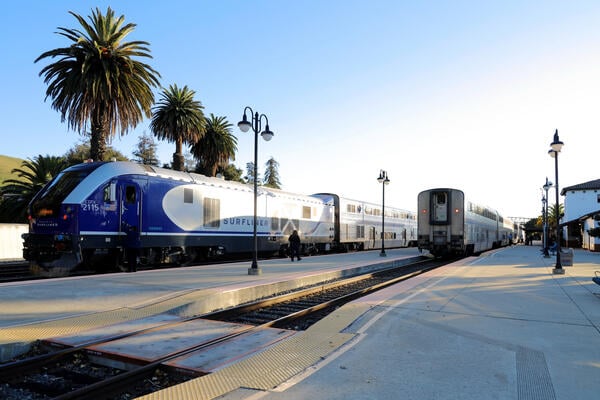
We started in San Diego, and we took a train up to Los Angeles—and that train is amazing. You just watch surfers and dolphins, all the way up to L.A., and then there were all these people on the train. So we talked to those strangers. And then L.A., Tucson, Houston, New Orleans, Birmingham, took a stop in Montgomery, and then D.C., where we ended in front of the Constitution and the Declaration of Independence [at the National Archives]. But in each of those stops, we [got] off and went to smaller places.
Q: When it came to preparing students to engage with others, what kinds of conversations were you hoping they had? Was there any sort of guidance on how to engage with other people?
A: [The students] were most nervous about talking to strangers. They’re like, “We’re gonna have to do what?” They were terrified.
I remember the first night we were in the L.A. train station getting ready for our first overnight train to Tucson, and like, that was just the nerves of, like, “Oh my god, oh my god. What are they gonna say?”
We read a really helpful book by Mónica Guzmán, [I Never Thought of It That Way] [that] talked about how to talk [and] why you want to talk across difference. It’s a cute book. It’s really accessible. There are some drawings in it and the students really connected with that.
Once they got over [the fear], it was really easy, but in a way, they almost needed the invitation to talk to strangers from me. I can tell you about some of the conversations, but that was the biggest fear.
One thing I’ll say is I knew that the strangers would enrich their lives, but I did not anticipate how much [the students] would enrich the other people on the train. I saw them lighting up other people. We’re nervous about how other people are gonna see us, but we also don’t realize the gift we are to other people.
Q: That’s really cool. I was also curious about the students. You took nine students in the spring of 2024. Were they from San Diego? Were they from everywhere? Was this a trip that was exposing them to new and different parts of the U.S.?
A: Great question, because I really was wondering that, too.
Some of the students had really traveled, but they hadn’t traveled in the U.S., in the same way, or they’d driven across maybe quickly. We had a few U.S. citizens, a Canadian, [all] different ages, like 22 to … we had some older folks.
It was a really nice mix, but again, people haven’t really seen our country in that way, or we’re just trying to get from point A to point B, we’re just trying to see what this country looks like. So I think for almost all of us [it was new]. I actually hadn’t been to half the stops.
Q: How was that for you, navigating those spaces for the first time alongside your students?
A: It was a good lesson. They were so great, so they rolled with it. But I was like, it would have been really helpful to know … I mean, they’re so competent, and we all figured things out, but I think it would have been [better] if I’d known the space better. Next time I’ll be able to get different speakers [to speak with students], knowing where we have more time, knowing distances.
But actually, I think in a way, it made me fresh, too, and it kept me open. Like, “OK, I’m the leader, in a sense, but we’re co-learning and co-creating this experience.”
Q: One of my favorite parts of student experiential learning is that reflection piece—getting students to sit down, maybe write about it or talk through those experiences. What was that reflection piece like?
A: I gave everyone a journal with a sticker for our class, and everyone had writing assignments. One student made this beautiful scrapbook; they took napkins from places and [wrote] all over.
Every morning on WhatsApp, I’d write the writing prompt of the day that would have them reflect upon where we’d been. Did they anticipate a place to be a particular way and then it wasn’t?
The most surprising outcome of the writing exercise for me was I asked them at the end to rate which cities they would want to live in, and for many students, Birmingham, Ala., ended up in the top two.
Q: Wow. Why was that?
A: I know, and you wouldn’t think that from students who are studying in San Diego on the coast. You’d think they’d want to be on the coast, maybe. But they thought [Birmingham] was super livable. They’d made all these great parks. It was affordable, it was relaxed, it had great arts, it had a university. And so they’re like, “I can live here.” And I know one of the stresses for younger people is like, “How can I afford to live in a place?” And they saw it, and they’re like, “I could live and thrive here.” And that helped me understand what was on their minds.
Q: We talk a lot about flyover states in travel, like, these are just places that you pass through. But I think having that intentionality to show students, Birmingham, Ala., actually has really cool things, and you’d never know unless you got off the train or got out of the car and looked at it. I hope it sparked a bit of adventure in these students, at least, to maybe explore areas that they wouldn’t typically.
A: I hope so, too, and really that they now are anchored in what they saw in these places, and so when they hear about them in the news, or this and that, they have their own experience as well, to anchor any other stories they’re hearing.
Q: I love that you mentioned media, or how we consume stories about places that are unfamiliar, because that was one of the goals [of the course]: to create empathy with people who might be different, demographically or in their living situation or their political views.
I know that was a big driver in this, creating conversations in a challenging time for our country. I wonder if you can talk about that growth, or that experience that you saw students having to step out of their own comfort zones and learn and empathize with others.
A: I think we wanted to get [experiences] and we will, next time, get even more experiences.
I took them to the 16th Street Baptist Church, which is the famous church where a bomb exploded during the civil rights movement and four little girls were killed. And then I was like, “Well, I think it’s Sunday, so we might as well go to church,” and some were like, “Oh my god, we’re not gonna do that,” like, terrified, “Oh my god.” This is a famous church. Let’s just, like, see what they have to offer, and see what they’re talking about.
We were so lucky. There was a really young pastor. He was like, 22, and we were sitting there in terror. And then it was like, “Oh, that was actually kind of interesting.” But that was a real out-of-your-comfort-zone [moment].
For example, there’s a lot of collective, understandable concern about climate change and the fossil fuel industry, and when you meet the people who are in the industry, they’re not evil people. Most of the people who work in it or work in offshoots of it, it’s where they grew up. This is what’s there. These are the jobs. And so you start to realize, “Oh, right, these are people who have a job or are raising a family,” and it helps to stop the deep othering. You can still be tough on the problem, but that idea of being soft on the people.
We had a guy [in the class] who was a marine. He’s a big guy, so he had the courage to go up to this other really big guy on the train. He was filled with tattoos and stuff, and they had a great conversation. The [stranger] apparently, trained with Mike Tyson or something. But he was like, “I was even nervous around this guy.”
We were really demographically different as a group. Like, we had gender differences, ethnic differences, so you got to see and be like, “Now, when you move through that space, what did you notice? What did you notice?” And that was fun, too. It wasn’t designed that way. It was just who signed up for the class, but that was fun to see. We made some surprising friends along the way.
Q: Do you have a favorite anecdote or interaction that you or a student had?
A: One of the nice things about the overnight train is that you have to eat meals with different people, with strangers. We met this couple, a doctor and her husband, and we got really chatty with them. One of the students said she spent the evening talking to this woman and just like, cried out, like all the things she’s worried about in the world. And she said, “This woman consoled me.” Her name is Consuelo. She’s like, “[Consuelo] helped me heal my heart in such a powerful way.”
And we then ran into them. We met them in Tucson, we ran into them in New Orleans on the street. We had this happy reunion, because we had all talked to them and benefited from them. And there’s some things, I don’t know if you’ve ever found this, but sometimes you can share more easily with a stranger. And so there were a lot of conversations, like the marine ended up learning how to make, like, essential oils and candles. I was like, given this little crystal from somebody. Students were up knitting with people, playing card games at night with strangers.
Of course, when there’s a lot of uncertainty, we close up, and fear makes us quiet, and then that just allows more fear, more distrust, and it’s a spiral. So we went with an intention to not do that. We wanted to enjoy each other, and we wanted to enjoy this country, and we really did. I mean, we had no problems with anybody, actually, on the whole trip. I mean, I don’t think we created any problems.
Oh, actually, we did have one sort of contentious conversation on the way to L.A. that was pretty funny …
Q: That’s pretty early in the trip to have it, too.
A: Yeah, I forget what I said, but she was, like, not having it. I think she was really against electric vehicles or something. I just didn’t expect it. So I was like, “Oh yeah, OK, yeah, no, it’s true. The batteries are a problem. I’m with you.”
Q: If you had to give advice or insight to somebody else who wants to do something similar, maybe not that long of a trip or that far across the country, but what really made the experience work? Is there anything you would do differently?
A: Great question, especially as I’m looking to plan one for next May. It definitely doesn’t have to be long, like, even a short trip—I mean, the longer trips, you have people who are touring and so they’re, like, more open—but I would have students sit next to different people and I would have the group be small enough that the students talk to different people.
I don’t know if listeners have heard of Bryan Stevenson, who wrote Just Mercy and created the Legacy of Slavery museum, but I just heard him give a talk in San Diego a couple weeks ago, and he was talking about the importance of being in proximity to the people who are having the experiences. The closer you can get students—we went to Homeboy Industries, which is the largest gang rehabilitation center in the world. It’s in L.A., and they got to talk to some of the people who were in that program, and the stories, like … I could never recreate that.
It’s doing that piece, getting them in proximity and creating opportunities for them to have one-on-one little conversations with them, like, “Hey, I had this question,” so I think that’s important.
I’m taking a bunch of students into prison in a couple weeks to also get in proximity to the people we don’t hear from. So I’d say a smaller group, be in proximity.
You can also have, like, for Homeboys, we [spoke with] somebody who was in recovery, but we also had a criminologist with us, so she could talk about the systems and he could talk about the lived experience. So it’s nice to have both.
Q: I think there can be a narrative that people writ large, but especially young people, do not want to engage with people that are different from them. And I wonder, just based on your experience with this trip, and then also some of this other work that you’re doing taking students into prisons, how we can combat that narrative and reaffirm that it is important to speak across differences, and that people are eager to learn how to do that?
A: I’m with you. I understand. I don’t love to dive right into difference. But I think the starting point is that we actually have a lot more in common than is different. Like, we focus on the difference, and that creates a lot of pain and separation.
I mean, I bet we’re all even close with people with whom we really disagree on certain things, but it just doesn’t come up, like we just talk about, you know, the Venn diagram, where we overlap, right? But there’s parts of us that don’t quite fit.
So you can always find connection really easily. You talk about the weather, you can complain about a train being late, or even something silly, and then just bond over that, and then just let it roll.
I think going headlong into difference is a hard place to start when there’s no trust in the relationship, and even when there is, you kind of want to edge your way around it. But I think we all need to learn it; I need to learn it, too. I’m better at it in some contexts than others, like when I’m surprised, like that woman [who opposed electric vehicles], I was like, “Wait, OK, hold on, I didn’t know I was gonna run into difference right here.” But it’s a practice, so I don’t know, maybe I teach what I most need to learn. So I’m learning it with the students. It’s a great process, and it’s just so great to be open about it.
But I think what we end up finding is that we have a lot more in common. Like, when you get under the top issues and, like, what do people care about? They want to feel safe. They want their families to be healthy. They want to be healthy. They want to feel prosperous. They want to enjoy what they’re doing. They want their kids to thrive. They want clean air—like, ultimately, under it all, are we really that different? I don’t know.
Q: That’s great. Higher education is doing its best to be more constructive when it comes to dialogue and embracing students with differences and teaching how to have productive conversations on campus. Because we’ve seen—I think, especially in the past year and a half—how escalations can happen on campus. So I like that this is a microcosm of, “Here’s how you take this [skill] out into the real world. Here’s how you practice. Here’s how you do it in a safe way with friends, and then go forth and do.”
A: Yeah. In class, I have students create role-plays about conflicts that they’re interested in, with lots of different perspectives. So students get to practice talking with people who have different views, but we’re all acting, and they get to try on different views. I think that’s good in the classroom, too, when you can’t get on a train right away, role-plays where students can experience difference when acting, and no one has to take responsibility for different viewpoints.
Q: It’s Jane Doe saying those things, not me, Ashley.
A: Exactly! “Jane said that, I dunno.”
Got Leads?
If you live in or have connections to places and spaces in the Southwest or Southern U.S. that hold cultural, national or personal significance that you think would be an interesting and educational stop for her class next spring, Federman said readers can email her.
Q: What’s next? You mentioned another trip coming up in May—what are you hoping and planning for?
A: Yeah! That’s gonna be the 250th anniversary of the country, so that’s going to be a very interesting time. We’ll still plan to do it in May. We’ll do a similar route, but I’m thinking of some different ways to do it that tie into those themes, glories and traumas of our 250-year history. I think that’s sort of the theme I’m gonna go with.
I definitely want to do more with talking to strangers. I want to go, if they’ll let us in, to like a pancake breakfast at a church, or some kind of county fair or a rodeo. We want to get into small-town things. We’re a small group, so we won’t be overwhelming, but just to really get a sense of a place.
Get more content like this directly to your inbox. Subscribe here.