Last week, an international student adviser at a small regional college logged on to a private forum for international enrollment and admissions professionals, seeking advice on “something strange” she’d noticed.
She had run a report on her Student Exchange and Visitor Information System database, where international student records are stored, after seeing troubling reports of foreign student deportations. When she got the results back, she found that a number of her students had had their legal residency status terminated without her knowledge.
This is the third installment in an Inside Higher Ed series on international students under Trump. Read the first and second here.
In the days since, nearly 100 other international student service professionals have piled onto the discussion thread to share similar stories: They trawled through SEVIS only to find unexpected visa revocations and had to quickly decide how to notify affected students.
Inside Higher Ed obtained access to the forum but is keeping it and the identity of the officials posting there anonymous to ensure the privacy of the participants.
Most of the officials on the forum reported an even more troubling detail: Students weren’t just having their visas revoked; they were losing their student status altogether.
When international students have their entry visas revoked, they almost always retain their legal residency status in SEVIS, according to immigration lawyers. They can stay in the country as long as they remain enrolled in courses and must reapply for a new visa if they leave. Now, as the Trump administration revokes hundreds of student visas each week, federal immigration officials also seem to be terminating students’ SEVIS status—paving the way for arrest and deportation.
One forum member asked how it was possible that Immigration and Customs Enforcement could alter SEVIS status on their own; they’d never seen it done before and thought it might be a mistake.
“I’m just wondering if we have any recourse to request corrections,” they wrote. “Trying to think creatively (and maybe desperately) at this point.”
University officials and immigration experts who spoke with Inside Higher Ed both on the record and on background echoed the concerns of the forum participants. They said the Trump administration is playing fast and loose with the visa system and that its tactics are severely limiting universities’ options to help students who may be targeted by ICE.
The officials on the forum said affected students were almost all Middle Eastern—Turkish, Kuwaiti, Saudi, Iranian—or from majority-Muslim countries like Malaysia, Indonesia and Bangladesh. Some said they’d received letters with unusually forceful wording, demanding they turn over student records under threat of federal investigation. Many fretted over how to advise affected students without running afoul of immigration authorities themselves.
They all worried about how best to protect students while adjusting to a visa system that appeared to be changing overnight into something unrecognizable.
“Most of us are not practicing immigration attorneys (and haven’t needed to be),” one university official wrote. “We’re in a strange new world where little from past practice seems to apply.”
‘Strange New World’
Some students have had their visas revoked due to criminal records, but many university officials report only minor infractions like traffic violations, some of them adjudicated years ago. Those without a criminal record are having their visas revoked largely under a specific clause in the Immigration and Nationality Act that gives the secretary of state personal power to determine if a student’s continued presence “would have potentially serious adverse foreign policy consequences.”
That 35-year-old clause has almost never been invoked until now. In an amicus brief supporting a lawsuit filed by detained Columbia graduate Mahmoud Khalil, a group of immigration lawyers says they scoured court records and legal documents for precedents of the foreign policy risk clause being used to revoke student visas. Out of 11.7 million cases, they found it had been used only 15 times before this year and had only resulted in deportation four times.
In an email to Inside Higher Ed, a State Department spokesperson confirmed that the “revocation of [a] student visa lead[s] to termination of their students status,” and that it’s up to ICE agents whether to notify universities of the change. They added that they don’t provide statistics on visa revocations, but that the “process is ongoing and the number of revocations is dynamic.”
“The State Department revokes visas every day in order to secure America’s borders and keep our communities safe—and will continue to do so,” the spokesperson wrote.
Clay Harmon, director of AIRC: The Association of International Enrollment Management, said he’s heard reports of abrupt visa revocations from members across the country, and that it’s disrupting international student service offices tasked with helping manage student visas.
“Folks in the visa system are already strapped to meet current mandates,” he said. “Adding this arbitrary element into what has always been a very well-regulated system causes an undue and unfair burden on institutions.”
Visa Vigilance
Many international student support officials said they’ve recently made a habit of checking SEVIS daily for new terminations, especially after last week’s ramping up in international student deportations blindsided some college officials.
When Tufts University doctoral student Rumeysa Ozturk was detained by ICE agents last week, not only were university officials unaware that her visa had been revoked, but her file in SEVIS still said she was “in good immigration standing,” according to a court motion filed by the university Wednesday night. Ozturk’s SEVIS file was only updated to reflect a termination of her status at 7:32 p.m., hours after she was abducted from the street outside her residence; university officials did not receive an email from ICE about the change in her status until 10:30 the next evening.
A spokesperson for Minnesota State University at Mankato, where a student was detained by ICE agents last Friday, told Inside Higher Ed Wednesday that they hadn’t received any communication from immigration officials about the student whatsoever. And at the University of Minnesota’s flagship campus, a computer system did not show that Turkish graduate student Dogukan Gunaydin’s visa was revoked until several hours after he was taken into custody, according to a lawsuit Gunaydin filed Sunday.
One university international affairs official, who asked to remain anonymous in order to speak freely about his experience, said he decided to check SEVIS last week after reading Secretary of State Marco Rubio’s announcement that the department had revoked 300 student visas last month. He was shocked to find that one of his students had not just their visa but also their legal status to remain in the country revoked, on the grounds they might be a foreign policy risk.
The official, who has been working in the field for more than 40 years, said he’d never seen immigration services revoke a student’s SEVIS status before.
“We usually check SEVIS once a semester … we don’t usually have to check statuses because we’re the ones who would change them,” the official said. “Now we are making a point to check thoroughly, every day. It’s the only way to protect our students.”
The student had not been notified of their status termination before the university reached out and “had absolutely no idea” what could have precipitated the decision. They hadn’t participated in any campus protests or written op-eds and were hardly politically active. The only criminal infraction they remembered was running a stoplight.
Stephen Yale-Loehr, a retired Cornell law professor who specializes in immigration law and student visas, said leaving university officials in the dark about changes to visa status “makes it difficult for colleges to advise their international students.”
“The system works on communication going both ways between immigration officials and institutions,” he said. “The government doing things in secret makes it hard for both students and universities to know whether they are complying.”
There’s a lot at stake in compliance for universities: The Trump administration has threatened to use the Student Exchange and Visitor Program, which normally investigates universities for visa fraud, to decertify colleges it believes have been harboring students they determine are threats to national security, according to an Axios report. Decertification would bar colleges from enrolling any international students at all.
Harmon of AIRC said the political weaponization of SEVP would be unprecedented.
“Their primary concern has been to verify that institutions are offering bona fide educational services and aren’t just diploma mills,” he said. “I’ve never heard of a fully accredited, reputable institution being subjected to some kind of investigation outside of the standard recertification process.”
One student adviser wrote on the forum that they received a letter from the Department of Homeland Security demanding a number of international students’ records and threatening to revoke the college’s visa certification “without any chance of appeal” if they did not provide the records within five business days. Another said they’d gotten the same letter, but their deadline was just three business days.
Some college officials say fear and caution make it hard to do all they can to help students.
“Having to be so careful around actually protecting the student’s physical safety just feels … not good enough, frankly,” one adviser wrote. “It’s just very painful to have to tread so lightly when there is so much more at stake for them.”
Scott Pollock, a veteran immigration lawyer who specializes in international educators and student visas, said that’s part of the Trump administration’s strategy.
“The administration has been sowing terror in the hearts of international students. Now that’s spreading to school officials as well,” he said. “It’s all part of this revenge-driven policy.”
Many more likely did the same without fanfare—including the anonymous university official’s student, who hopes to apply for re-entry as soon as they can.
“It was not an easy decision for the student, and it was not an easy decision for us to help them make,” the official said. “But they thought it would be the least risky thing to do and give them the greatest opportunity to finish their degree, which was their priority.”
“I really hope to see them back on campus in the fall.”
Additionally, the Trump administration has variously moved to cancel or suspend research contracts and grants at Columbia University, the University of Pennsylvania and most recently Princeton University as part of punitive actions tied to investigations of campus antisemitism or, in Penn’s case, the decision to allow a trans woman to compete on the women’s swim team three years ago. The administration also briefly froze (and then unfroze) United States Department of Agriculture funds for the University of Maine system after the state’s governor engaged in a tense exchange with President Trump at the White House.
Below, 16 researchers across nine different research areas who have had their federal grants terminated since the start of the Trump administration share just a few of the thousands of stories behind these cuts.
—Elizabeth Redden, opinion editor
Preventing Intimate Partner Violence
Prostock-Studio/iStock/Getty Images Plus
By Rebecca Fielding-Miller, Nicholas Metheny, Abigail Hatcher and Sarah Peitzmeier
Each year, more than 3,000 American women are murdered by their partners. Pregnancy and the postpartum period are high-risk periods for intimate partner violence (IPV), which is linked to negative maternal outcomes such as miscarriage, hemorrhage and postpartum depression. Perinatal IPV is also linked to worse infant health outcomes, such as preterm birth and low birth weight, and to adverse childhood experiences. This makes prevention of perinatal IPV crucial not just for the survivor but for the entire family.
Perinatal IPV and its cascade of negative outcomes are preventable—but only if we study the epidemiology and prevention of IPV as rigorously as we study hypertension or any other perinatal complication. A grant rescinded last month by the NIH would have trained a cohort of 12 early-career clinicians and researchers to learn how to study IPV as part of their ongoing research on pregnancy, birth and the postpartum period. We proposed training investigators working in diverse communities across the spectrum of America, with a commitment to including communities disproportionately impacted by IPV and maternal mortality, including Black and LGBTQ+ communities. To solve a problem with constrained resources, it is efficient to focus efforts on where the problem is most severe. While the termination letter named this targeting of training resources an “amorphous equity objective,” we call it a data-driven approach to rigorous science.
Training grants like this one help shift an entire field by giving young investigators the skills and knowledge to add a focus on IPV to their research for the next several decades. In addition to training these 12 young researchers, the grant would have also supported turning the mentorship curriculum we developed into an open-access online training for clinicians and researchers to access in perpetuity, multiplying the impact of the work to train even more investigators in the field. As with the approximately 700 other terminated NIH grants, cutting this work before our aims are realized but after significant costs have been incurred to establish the mentorship team and design the curriculum is the definition of government inefficiency and waste.
With this grant rescinded, none of the promised training will occur. Pregnant people and their babies from every community across America will continue to suffer, without the benefit of advances in the science of how we prevent these violence exposures. Our termination notice claims that the proposed trainings are “antithetical to the scientific inquiry, do nothing to expand our knowledge of living systems, provide low returns on investment, and ultimately do not enhance health, lengthen life, or reduce illness.” We could not disagree more. Anyone who has cared for a child or for the person who gave birth to them knows that preventing maternal and infant death and abuse should be a nonpartisan issue. The current administration is intent on making even this issue into “us” versus “them.” When it comes to public health, there is no such thing. American families deserve better.
Rebecca Fielding Miller is an associate professor of public health at the University of California, San Diego. Her research focuses on health disparities in infectious disease and gender-based violence.
Nicholas Metheny is an Atlanta-area scientist and registered nurse with clinical and research experience in the post-violence care of women and sexual and gender minority communities.
Abigail Hatcher is an associate professor at the University of North Carolina and University of the Witwatersrand, where she develops and tests health sector models for preventing violence in pregnancy.
Sarah Peitzmeier is an assistant professor at the University of Maryland School of Public Health who develops and tests interventions to prevent gender-based violence. She is also a practicing birth doula and victim advocate.
Is Work-Study Working?
Okrasyuk/iStock/Getty Images Plus
By Judith Scott-Clayton
On March 7, at 9:49 a.m., I received an email with “GRANT AWARD TERMINATION” in all caps in the subject line. Attached to the email was a letter, addressed to me as project director and referring to our Department of Education grant by its award number. The letter was generic, virtually identical to three other termination letters received that day at the Community College Research Center at Columbia University’s Teachers College, where I am affiliated. It did not mention our project title nor provide any project-specific details to explain why our project, as the email states, “is now inconsistent with, and no longer effectuates, the Department’s priorities.” A few hours later, I received a formal notification that the grant end date was that day: March 7, 2025.
The project—a collaboration with Adela Soliz of Vanderbilt University and Tom Brock of CCRC—was titled “Does Federal Work-Study Work for Students? Evidence From a Randomized Controlled Trial.” The Federal Work-Study (FWS) program was created in 1964 as part of the Economic Opportunity Act and covers up to 75 percent of the wages of college students working part-time in mostly on-campus jobs, with colleges paying the rest. In a typical year, the program provides more than $1 billion in support to more than 450,000 college students with financial need at more than 3,000 institutions all across the country. Several states also have their own similar programs.
Our study would be the first to rigorously evaluate the causal impact of the program on students’ enrollment, employment, persistence and degree completion. We were also conducting interviews, focus groups and surveys to understand how students find FWS jobs, what kinds of work they do, what resources institutions devote to running the program and how much it all costs to operate, all with the goal of ensuring the program is delivering the maximum impact for every single student that participates and for every dollar spent.
At the time of its cancellation, we were about four and a half years into a six-year project. We were right in the middle of randomizing what would be the final cohort of our study sample and fielding the final round of a student survey. This final year is especially important, because the early cohorts were heavily impacted by the pandemic. For the past three weeks, we have been scrambling to pull together any other resources we could find to preserve our options and avoid losing this final cohort of participants. We have also been scrambling to figure out how to continue to pay critical staff and doctoral students involved in the project until we can figure out the next steps.
As for the broader impact of the termination: The Federal Work-Study program itself will keep on going, at least for now; we just won’t know whether it works or not. We hypothesize that it may provide valuable work-based learning opportunities that keep students engaged and give them advantages in the labor market after college, but it’s possible that it distracts students from their studies and hurts their academic performance. We may think that it helps students to afford college, but perhaps the complexity of finding a specific job and navigating all the necessary paperwork reduces its value for the students that need help the most. The next time the program is up for debate, policymakers will be flying blind: Without actual evidence all we can do is speculate.
Since 1964, the FWS program has disbursed more than $95 billion in awards. In comparison, our grant was less than three-thousandths of 1 percent of that amount, and the amount remaining to finish our work and share our findings with the public was just a fraction of that. Our project was motivated by a desire to help policymakers ensure that every dollar invested in financial aid has the maximum possible impact for low-income students. So it is discouraging to learn, so close to the finish line, that this first-of-its-kind evaluation of a major federal program is “now inconsistent with, and no longer effectuates, the Department’s priorities.”
Judith Scott-Clayton is a professor of economics and education at Teachers College, Columbia University, in the Department of Education Policy and Social Analysis, where she directs the Economics and Education Program and teaches courses on the economics of education, labor economics and causal inference.
Democracy Research
AlexeyPushkin/iStock/Getty Images Plus
By Rob Blair, Jessica Gottlieb, Laura Paler and Julie Anne Weaver
We lost funding for the Democratic Erosion Consortium (DEC) as part of the federal government’s recent cancellation of foreign assistance grants. Directed by scholars at Brown University, the University of Houston and American University, DEC works to make academic research on democratic backsliding accessible to policymakers and practitioners seeking evidence-based strategies to defend democracy around the globe.
Originally launched in 2017 on a shoestring budget, DEC began as an effort to improve pedagogy on a troubling trend observable both abroad and at home: the strategic dismantling of democratic norms and institutions by elected leaders with autocratic ambitions. In 2022, in line with the U.S. government’s dual interests in democratic resilience and evidence-based policymaking, we received a grant from the State Department to expand DEC’s work.
The State Department’s investment enabled us to grow our reach beyond the classroom and into the policy arena. We drew on an expanding network of scholars to synthesize evidence on urgent questions—such as how to reduce the spread of misinformation and measure democratic decline. We also built out a novel event data set on democratic erosion and trained partners around the world to use it in their own work.
The immediate consequences are clear: several full- and part-time staff lost funding for their jobs. But the long-term damage is hard to quantify. It’s difficult to argue for the value of evidence-based policymaking in foreign aid when the entire category of foreign assistance has effectively been gutted. More than that, the partnerships we built between academics, practitioners and policymakers were yielding real-time insights and responses—a rare example of successful research-policy collaboration. That infrastructure is now gone.
And at a moment when democratic backsliding is accelerating in many parts of the world, the U.S. government is stepping away from efforts to understand and counter it. Ending this grant not only weakens the ability to monitor democratic erosion globally, it also reduces public awareness and understanding of a phenomenon that is increasingly visible in the U.S. itself.
With the federal policy audience for our work largely gone, we are refocusing our efforts on our other two core constituencies: students and academics. We continue to support instructors engaged in teaching our democratic erosion course and to improve the Democratic Erosion Event Dataset. And in response to growing concern about democratic backsliding in the U.S., we’re developing a more robust domestic data-collection effort, paired with public engagement.
Given intense partisan disagreement around what even constitutes democratic erosion, we are seeking to increase the credibility of new evidence by capturing partisan-diverse perspectives and applying our established comparative framework to U.S. events. We are hoping to continue this work, despite the loss of our federal grant, because the political reality in the U.S. and around the world tells us we need to be worried about democratic erosion now more than ever.
Rob Blair is the Arkadij Eisler Goldman Sachs Associate Professor of Political Science and International and Public Affairs at Brown University.
Jessica Gottlieb is an associate professor at the University of Houston’s Hobby School of Public Affairs.
Laura Paler is an associate professor in the Department of Government in the School of Public Affairs at American University.
Julie Anne Weaver is the research director of the Democratic Erosion Consortium and a lecturer on government at Harvard University.
COVID-19 and Related Immunology Research
peterschreiber.media/iStock/Getty Images Plus
By Matthew Woodruff
On March 24, 2020, I stood in a Biosafety Level 2+ facility at Emory University with six colleagues being taught best practices for working with the largely unknown pathogen, SARS-CoV-2. Other unknowns included where we would get masks (N95s were unavailable), risks of infection to our young kids at home and who would pay for the experiments needed to gain insight into the deadly new virus sweeping across the nation.
That last question was answered relatively quickly. Rapid investment by the first Trump administration’s NIH launched SeroNet, a five-year effort across 25 institutions to “expand the nation’s capacity for SARS-CoV-2 serologic testing on a population-level and advance research on the immune response to SARS-CoV-2 infection and COVID-19 vaccination among diverse and vulnerable populations.” We did just that. Over the coming years, taxpayer dollars funded more than 600 peer-reviewed publications, reflecting significant advances in disease pathology, treatment strategies, disease impact in immunocompromised patients, vaccine testing and more.
Our team at Emory led projects dedicated to understanding the balance between productive and pathogenic immunity in hopes of alleviating disease. We discovered why your immune system sometimes turns on itself in the throes of severe infection, uncovered similarities between the immune responses of chronically autoimmune patients and those who were seriously ill with COVID-19, and documented continued disturbances in patients with long COVID. Importantly, we learned that these responses weren’t unique to COVID-19 and were broadly relevant to human health.
In 2022, I started my own lab founded on those concepts. We have been optimistic that the work we are doing will ultimately serve the American people in our shared desire to live longer, healthier lives.
But over the past months, that optimism has dissipated. Ham-handed targeting of “DEI” awards leaves us unable to understand how diverse human populations might respond differently to infection or develop different kinds of chronic diseases. Mistrust of the same vaccine programs that have halted the spread of measles globally has left us unable to test next-generation vaccines that might provide broad protection against emerging viral strains. And then, on March 24, it was announced that the five-year commitment that the first Trump administration made to our work would no longer be honored. Our COVID-related funding through SeroNet would be halted, effective immediately.
Our fledgling program, a few months ago extremely promising, is now on life support. My lab has invested heavily with our time and limited resources, which are now running thin, into promising new areas of clinically relevant immunology that suddenly look like financial dead ends. The decision to halt entire fields of study in what was previously highly fertile scientific space is as damaging as it is unprecedented, and our lab is left with a business model that is now fundamentally broken.
Matthew Woodruff is an assistant professor of immunology at the Emory University Lowance Center for Human Immunology. His lab studies antibody responses in the context of infection, vaccination and autoimmune disease.
Training Tomorrow’s Biomedical Workforce
Unaihuiziphotography/iStock/Getty Images Plus
By Samantha Meenachand Ryan Poling-Skutvik
On March 21, the NIH terminated our training grant award, which supported the Enhancing Science, Technology, Engineering, and Math Education Diversity (ESTEEMED) program at the University of Rhode Island. The mission of URI ESTEEMED was to increase the preparation of undergraduate students—freshmen and sophomores—to conduct biomedical research, enabling them to succeed in advanced research in preparation to pursue a Ph.D. in STEM. Our ultimate goals were to provide students who were from groups underrepresented in STEM or from disadvantaged economic backgrounds with academic enrichment, research and soft skills development, and a sense of community. NIH claims that our award “no longer effectuates agency priorities” and that it involves “amorphous equity objectives, [that] are antithetical to the scientific inquiry.”
While the language in the termination email itself was derisive and political, the fallout from the loss of this award will be felt for years to come. The state of Rhode Island immediately lost $1.2 million in direct economic activity, and an important workforce development initiative will end, significantly reducing state and regional competitiveness in a growing technological field. Like many other states, Rhode Island has a pressing need for professionals trained in biotechnology, and recruiting people to Rhode Island has often proven to be challenging. This challenge is exemplified by the recent establishment of the Rhode Island Life Sciences Hub with a specific mandate to grow the biotechnology sector in the state.
By contrast, there is a large untapped pool of talent within Rhode Island, who are limited by access to education and training in large part due to the financial pressures families face. Our URI ESTEEMED program recruited talented students who likely would not have had the resources necessary to enter these careers. While NIH would like to argue that ESTEEMED was used to “support unlawful discrimination on the basis of race and other protected characteristics,” ESTEEMED trainees were selected through a rigorous and competitive application process, making these awards merit-based. Without the financial support of this program, many of our trainees would not have been able to attend URI or would not have had the opportunity to focus on research.
URI ESTEEMED in its current form will cease to exist at the end of this semester. We are still figuring out to what capacity we can continue to recruit and train students, but without NIH funds, training programs such as ESTEEMED will not be able to alleviate the many pressures these students face. The political decision to terminate this grant inflicts direct financial pain on some of the most promising students, and these effects will reverberate for years to come.
Samantha Meenach is a professor in the Department of Chemical, Biomolecular, and Materials Engineering at the University of Rhode Island.
Ryan Poling-Skutvik is an assistant professor in the Department of Chemical, Biomolecular, and Materials Engineering and the Department of Physics at the University of Rhode Island.
Alzheimer’s and Dementia Research for Diverse Populations
By Jason D. Flatt
Research funding for diverse populations impacted by Alzheimer’s disease and related dementias (ADRD) is currently being terminated by the U.S. federal government. These terminations are attributed to the premise that the research is incompatible with agency priorities. For instance, funding for studies including older transgender individuals, as well as lesbian, gay, bisexual, queer, intersex and other LGBTQIA+ identities, has been terminated. In addition, funding decisions have been rescinded, and grants have been pulled from scientific review. The National Institutes of Health has stated, “Research programs based on gender identity are often unscientific, have little identifiable return on investment, and do nothing to enhance the health of many Americans. Many such studies ignore, rather than seriously examine, biological realities. It is the policy of NIH not to prioritize these research programs.”
To date, around 700 NIH grants have been terminated, including many important studies on HIV/AIDS, cancer, COVID-19 and ADRD. Of these, about 25 have focused on ADRD. Personally, I have lost nearly $5 million in research funding from the NIH and the Department of Defense because my ADRD research includes transgender people. My research focuses on the needs of LGBTQIA+ and non-LGBTQIA+ older adults, particularly those affected by ADRD and Parkinson’s disease, as well as their caregivers and health-care providers. Some have suggested that we remove or rephrase “forbidden” language in future grants and/or exclude transgender people from our studies, but I will not do that. It is not pro-science and will not ensure that all people benefit from our research. The current and future termination of grants and contracts will have a significant impact on the health of older Americans, slow our innovation, limit our ability to provide care and impede progress in finding a cure.
I am working to raise awareness about these terminations and find ways to either reverse the decisions or secure alternative funding for this vital research. This includes speaking with the press, informing policymakers, generating visibility on social media alongside colleagues and peers, consulting with legal experts, and engaging with community members. I am also deeply concerned about the future of early-career scientists, who are essential in leading efforts to find cures for diseases affecting our communities, especially as the baby boomer generation ages. Many of the grants that have been terminated were early-career awards for newly minted doctoral researchers and faculty, diversity supplements for doctoral students, and competitive NIH predoctoral and postdoctoral fellowships.
In light of today’s sociopolitical climate, it is more important than ever for our civic, academic and research communities to unite in advocating for inclusion, standing up for diverse groups, including LGBTQIA+ communities, and ensuring that early-career scholars and the broader aging population have opportunities for potential cures, treatments and health care.
Jason D. Flatt is an associate professor at the University of Nevada, Las Vegas, School of Public Health, in the Department of Social and Behavioral Health.
I have spent the past year and a half as a postdoc researching the effects of Virginia’s Get a Skill, Get a Job, Get Ahead (G3) initiative, a tuition-free community college program implemented in 2021. Similar to most statewide free college programs, G3 is a last-dollar scholarship program for state residents attending one of Virginia’s 23 community colleges, though students who already receive the maximum Pell Grant and enroll full-time are eligible for an additional living stipend to support the costs of books, transit and other expenses frequently incurred while enrolled. Virginia implemented the program as a bipartisan pandemic-recovery strategy to reverse steep enrollment declines in community colleges and boost credential completion in five high-demand workforce areas: early childhood education, health care, information technology, manufacturing and skilled trades, and public safety.
Like so many other critical research projects in education, our Institute of Education Sciences funding was terminated by the Trump administration’s ongoing efforts to gut the Department of Education and publicly funded research at large. The abrupt termination of the grant, which supports researchers at both the University of Pennsylvania and the Community College Research Center at Columbia University’s Teachers College, is a depressing way to finish out my postdoc. The project is part of a larger IES grant that established the Accelerating Recovery in Community Colleges network, a group of research teams focused on strategies to improve community college enrollment and student success. The loss of funding means canceled conference presentations and convenings; it means planned collaborations with other research teams in the network will not happen. We simply cannot accomplish all the things we set out to do without the resources provided by the grant.
The grant termination is demoralizing on multiple levels. It funded my postdoc, which has been an invaluable experience in developing my skills as an education policy researcher. While my position was nearing its end regardless, the ongoing forced austerity on public-facing research portends a future where these types of opportunities are not available to later generations of scholars. And on a less personal note, canceling education research, especially toward the end of its life cycle, is extremely wasteful and inefficient. It hinders the completion of projects that public money has already been invested in and limits dissemination efforts that help to drive the overwhelmingly positive return on investment from these types of research projects.
This is a real shame in the case of our work on G3. Our findings and planned future research on the policy hold critical implications for policymakers and institutions in Virginia and across the US. States like Arkansas, Indiana and Kentucky have similarly implemented workforce-targeted free college initiatives. And given the heightened attention from policymakers on career and technical education in recent years, it is reasonable to think more states will follow suit. Our work on G3 is in service of improving community college student outcomes so that more students have the resources and opportunities to pursue meaningful careers and life trajectories. Without any federal funding, it will only be more difficult to uncover the best ways to go about achieving these ends.
Daniel Sparks is a postdoctoral researcher in economics and education at the University of Pennsylvania’s Graduate School of Education.
Training Pediatric Physician-Scientists
FluxFactory/e+/Getty Images
By Sallie Permar
The NIH made the abrupt decision last month to terminate the Pediatric Scientist Development Program (PSDP), a long-standing initiative that has trained generations of physician-scientists dedicated to advancing child health. This decision was made without an opportunity for resubmission or revision, and it appears to be linked to diversity, equity and inclusion requirements in our renewal application, components we were previously required to include and encouraged to expand by our reviewers, and that were later weaponized as justification for defunding.
For more than 40 years, the PSDP has served as a critical pipeline for training pediatric physician-scientists. Through rigorous mentorship, research training and career development, the PSDP has trained more than 270 pediatric physician-scientists, helping launch the careers of child health researchers who have made groundbreaking discoveries in areas such as childhood cancer, genetic disorders, autoimmunity and infectious diseases. At a time when pediatric research faces increasing challenges, this decision further weakens an already fragile infrastructure. It is not merely an administrative setback; it has immediate and far-reaching consequences that will be felt across academic institutions and the future of the health of children and the adults they become. Pediatric research is the highest yield of all medical research, providing lifetimes of health.
Without federal funding, our health as Americans faces several dire immediate and long-term impacts:
Loss of training opportunities and career uncertainty for pediatric researchers: The PSDP was on track to expand through deepening of our public-private institutional partnership funding model, due to increasing interest across states and pediatric specialties. We received a record high number of talented applicants this year. Now we are now forced to determine how many, if any, new trainees can be supported. Additionally, the program serves as the critical bridge between physician-scientists’ clinical training and their ability to secure independent research grants. With NIH funding cut, current trainees will face financial instability, and prospective trainees might be forced to abandon their research, and their career aspirations, altogether.
Weakening of the pediatric research pipeline: The PSDP has been a key factor in addressing the national shortage of pediatric physician-scientists. Without it, fewer pediatricians will enter research careers, exacerbating an already urgent pediatric workforce crisis at a time when children are presenting with more complex health needs.
Children’s health in jeopardy: Cutting PSDP funding halts critical research on chronic childhood diseases like genetic conditions, asthma and obesity, leaving millions of children without hope for better treatments or cures, directly reducing their chance for health and quality of life.
The PSDP’s termination is not just a loss for academic medicine, it is a direct threat to the future of pediatric research and children’s health. Pediatricians pursuing research careers already face significant challenges, including limited funding opportunities and lower salaries compared to other medical specialties. By eliminating the PSDP, the NIH has removed one of the most effective mechanisms for supporting these researchers at a critical stage in their careers.
We call on academic leaders, policymakers and child health advocates to take immediate action. The future of children’s health research depends on our ability to reverse this decision and ensure that pediatric physician-scientists continue to receive the training and support they need to advance medical discoveries for the next generation.
Sallie Permar is the Nancy C. Paduano Professor and Chair at Weill Cornell Medicine and pediatrician in chief at New York–Presbyterian/Weill Cornell Medical Center.
Global Development and Women’s Empowerment
By Denise L. Baer
On Monday, Jan. 27, I received an email from local project staff in Guatemala canceling that day’s key informant interview due to the “review of cooperation projects by the United States government” and the request to “suspend activities” until further notice. This was the first notice that the evaluation of the Legal Reform Fund (LRF) project that I was conducting had been paused—and, in effect, permanently canceled. After checking in with the project implementer, the American Bar Association’s Rule of Law Initiative (ABA-ROLI), I received formal notification of the pause later that same day.
LRF provided contextualized expert legal technical assistance and training to partnering government agencies, parliamentarians, judges, court staff and women entrepreneurs to improve women’s access to land, property rights and credit in Guatemala, Indonesia, Mexico and Timor-Leste. I had been working on the evaluation for about two months, with the intent to complete all initial staff interviews before the end of January and then move on to field data collection. The evaluation had been approved last December by the Department of State, with approval of the inception report coming from the department’s Office of Global Women’s Issues just a week earlier. While I’d been tracking the flurry of executive orders, I doubted that this project would violate the new “two-gender” policy—after all, it was funded through the Women’s Global Development and Prosperity (W-GDP) Initiative created by President Trump himself during his first administration in 2019 and championed by his daughter Ivanka with great fanfare. The initiative aimed to help 50 million women in developing countries realize their economic potential by 2025; the LRF project was only one of many funded by W-GDP initially and later continued by the Biden administration.
The LRF project ended December 2024. Was it effective and efficient? Were the planned outcomes achieved? We will never know. Since I was paid by ABA-ROLI for the work conducted to date before the pause, the primary cost of this discontinuance is not to me personally, but to the American people, who funded this project. The call for this evaluation and the approval of my proposal was born of the government’s desire for efficiency and to ensure funded initiatives were going according to plan. Indeed, the Government Accountability Office had identified a less-than-robust implementation framework in many early W-GDP projects, and this evaluation was intended to provide critical evidence of whether processes had improved.
Now we will never know how strong the evidence base is for supporting women entrepreneurs through this initiative. It is profoundly stunning that not only would the Trump administration stop work midstream for so many projects, but they would also stop evaluations of project work already completed—even for programs they themselves created and supported. How does funding a project and then shutting down the work of determining how effective that project was fight waste, fraud and abuse?
Denise L. Baer is a scholar-practitioner fellow at the Graduate School of Political Management at George Washington University.
As a student at Paul Smith’s College in New York, Andrew “AJ” Beaudoin was able to do what he loved: spend time outdoors with his young son.
Beaudoin, a disabled Army veteran who suffered post-traumatic stress disorder after leaving the military, found comfort in the great outdoors and guiding others through adventures in nature. After Beaudoin completed his bachelor’s degree, his passion for serving others and nature compelled him to start his own charter business, which he then transformed into a three-day boot camp for other veterans looking to become outdoor entrepreneurs.
This summer, Beaudoin will teach a longer version of his course to a group of up to 35 veterans on the Paul Smith’s campus. The program, Battlefish Academy, transforms veterans’ learned skills as service members into industry knowledge, giving them the confidence to become entrepreneurs, as well as credentials they can build into degrees.
The inspiration: When Beaudoin left the service, he was suffering from PTSD and recovering from a series of strokes. He couldn’t connect his work as a paratrooper to civilian life and felt overwhelmed by the world around him.
He enrolled in Paul Smith’s in 2014, pursuing a bachelor’s in environmental sciences with a concentration in fish and wildlife management. It was one of Beaudoin’s professors who first asked the veteran to lead an expedition to teach his children how to fish.
“I didn’t anticipate it becoming a financial venture for me,” Beaudoin said. “I just wanted to find peace in my heart.”
Beaudoin started his own business, Battle Fish Charters, as an outdoor guide, leading fishing trips for individuals, families and fellow veterans throughout the Adirondacks in 2017. In summer 2024, Beaudoin launched the boot camp, Battle Fish University (BFU), with a small group of veterans who flew to New York from states including Montana, South Carolina and Wyoming.
During BFU—which was sponsored by the Global Center for Social Entrepreneurship Network, the National Center for Veteran Ventures and Paul Smith’s College—students learned first aid, CPR and other requirements to achieve a guide license.
The longer program, Battlefish Academy, builds on the experience, guiding students through applying for and obtaining a license and a certificate.
How it works: The program is 15 credits, which includes a two-week outdoor guide training led by Beaudoin, the inaugural Battlefish Academy director.
In the classroom, students learn the principles of management, marketing and economics, as well as business systems and managerial accounting. They also gain insight into the recreation market in the U.S. and marketing strategies for how to advertise their business and services.
Then academy students spend 14 days learning in an 18-acre lot across the street from Paul Smith’s main campus, where Beaudoin shows them how to tie fishing lines, navigate the wilderness and manage the client experience.
AJ Beaudoin (right), the inaugural director of Battlefish Academy at Paul Smith’s College, leads individuals and groups on ice fishing trips through his business, Battle Fish Charters.
After completing the certificate, students can stack their credits for an associate or bachelor’s degree in relevant programs, including business, outdoor recreation and eco-psychology.
Participants’ tuition is fully covered by GI benefits, and the college is working with nearby bases to create a pipeline for integrating service members into the program upon their departure from the military.
What’s the need: Beaudoin sees an opportunity to connect veterans’ sense of wellness, community, mission and leadership through an outdoor recreation business.
“I feel like veterans lose their sense of purpose after the service, and that’s a big struggle for us,” Beaudoin said. “So maybe becoming a small business owner could help them.”
About 5 percent of all employer businesses in the U.S. are veteran-owned, with the greatest share related to professional, scientific or technical services, according to U.S. Census Bureau data.
Some veterans, like Beaudoin, leave the military feeling as though their skills don’t apply to civilian life, but Battle Fish helps reframe those ideas.
A Network of Support
In addition to the specialized veteran training of Battlefish Academy, Paul Smith’s College offers military-connected students with a physical Veteran Resource Center that can aid learner completion, with services such as mentorship, networking opportunities and other supports.
“I think that the veteran skill set translates so perfectly from leading a mission in Afghanistan to, ‘Now, I’m leading a family down the river,’” Beaudoin said. “I’m trying to keep them safe and I’m utilizing those same skills that I was trying to keep my soldiers safe with.”
Another benefit is the effect on personal wellness. Spending time outdoors is one way that groups support veterans experiencing PTSD, because it instills a sense of calm and peace.
“There’s so many organizations that take veterans fishing. I want to keep the veterans on the water all of the time,” Beaudoin said.
The program also has the power to connect like-minded veterans, building a network of support and community. During his first Battle Fish University experience, Beaudoin found that veterans share a natural affinity, and he hopes the academy will provide nontraditional learners a similar space to engage with peers.
What’s next: Battlefish Academy will launch this summer at Paul Smith’s with a capacity of 36 beds for the intensive experience.
Beaudoin hopes students leave the experience feeling more confident in starting their own business—and maybe interested in franchising his company, Battle Fish Charters, wherever they call home.
If your student success program has a unique feature or twist, we’d like to know about it. Click here to submit.
Two weeks ago Chris Buonocore, Alex Humphreys, Martin Kurzweil and Emily Tichenor (all of the nonprofit organization Ithaka, and part of the Articulation of Credit Transfer Project) posted in this blog the happy news that Transfer Explorer (a website, modeled after CUNY T-Rex, that shows everyone how prior learning experiences will count toward a college’s academic requirements) has been launched containing information from three South Carolina colleges. Information from dozens of additional colleges in Connecticut, New York, South Carolina and Washington will be added in the coming months.
Because this information is now public and usable, students and advisers will be able to make better plans for transfer, students will discover and choose transfer destinations that are a good fit for them, and institutions will be better able to align their programs and equivalencies to facilitate transfer. Transfer Explorer will also reduce the burden on students, advisers and admissions staff to locate and make sense of relevant information across disparate sources, allowing them to focus on higher-value tasks. The evidence from CUNY T-Rex suggests these benefits are already being realized in that context.
The advent of Transfer Explorer and other similar efforts to make transparent the rules on credit transfer and degree applicability raises an important question: Which policies and practices are desirable for institutions to have in place to make their credit mobility information public?
Let’s assume that a public website, such as Transfer Explorer, is available for displaying credit mobility information, and that an institution has the appropriate financial and staff resources to put its information on the website. Now what course credit and program requirement policies and practices must be in place, and which additional ones would be useful to have? This post describes some of these policies and practices.
Necessary Policies and Practices
Absolutely essential is that transfer credit rules stating how an institution will treat all types of prior learning experiences (e.g., course A at Institution X will count as equivalent to course B at Institution Y), as well as the program and degree requirements (for majors, concentrations, general education, etc.), must be systematically and consistently stored, recorded and updated in the institution’s software system(s), with the credit mobility website reflecting any changes in any of these rules and requirements in a timely manner. These practices are essential for the website to function as a trusted source of information.
There should be policies regarding who can change the transfer credit rules and degree requirements recorded in this software and under what conditions. This will reduce the likelihood of erratic, capricious or frequent changes, while ensuring that all students are subject to the same rules and requirements, without prejudice.
Any additional rules, requirements, restrictions or qualifications related to the conditions for granting credit for prior learning (such as a minimum grade in a prior course or a residency requirement at the destination college) should apply equally to all students and be explicitly and publicly stated. This ensures that all students have access to the same information, again promoting equitable treatment.
There should be administrative oversight of the above policies and practices, and that oversight should ideally be provided by people who would be unaffected by the rules’ consequences (i.e., conflicts of interest should be minimized). Oversight by people not acting in their own interest is necessary to ensure that policies and practices are appropriately instituted and maintained.
Additional Desirable Policies and Practices
It will be helpful to have policies regarding how course equivalencies for prior learning are decided in the first place—who decides and based on what information. This will promote efficient and effective decision-making regarding prior learning assessments.
There should also be specific, agreed-upon criteria for giving credit for prior learning. It has been effectively argued that transfer credit should be based entirely on learning outcomes, and not on, e.g., a course’s prerequisites, textbook or modality (in-person, online or hybrid); the degree the student may or may not have; the student’s major; etc. AACRAO’s recommended criterion for course equivalency is 70 percent “matching of content.” Such a policy ensures that credit for prior learning is based on only that—prior learning.
Any characteristics of prior learning, in addition to credits, that would satisfy an institution’s requirements, characteristics such as a course being writing intensive or including material on information literacy, should be recorded and considered for transfer. Students and those who support them need this information to be able to plan students’ complete academic trajectories.
An explicit appeals procedure that allows students to challenge transfer credit decisions can help in identifying errors and inadequacies in what is shown on the website, as well as promoting equitable treatment of all students (an example of the CUNY appeals procedure is here). Students can more effectively use such a procedure if the website keeps a record of when transfer credit rules and program and degree requirements have changed and how.
All courses from institutions accredited by what were formerly referred to as regional accreditors (along with, upon review, some other forms of prior learning) should be given at least elective credit. In addition to providing transfer students with predictable transfer credit, such a policy within the CUNY system greatly facilitated the establishment of CUNY T-Rex. For the courses of the 20 CUNY undergraduate colleges, developers had only to reflect on the website existing transfer credit rules (all 1.6 million of them); they did not have to determine what to do with courses that would receive no transfer credit.
Also highly desirable is that a student should be allowed to use any credit transfer rule in place at College B between when the student first matriculated in College A and subsequently transferred to College B (perhaps within a specified number of years since matriculation at College A). Such a policy is particularly useful for students who first matriculate at a community college and later transfer to a bachelor’s college within the same system. This policy would enable students and those who support them to plan a student’s entire academic trajectory.
Finally, in developing Transfer Explorer as well as CUNY T-Rex, the engineers had to first parse and deconstruct the colleges’ major and other requirements before programming them for the website. Many of the majors’ diagrams look like a tangled ball of yarn or a Super Bowl football play (diagrams that go way beyond just a sequence of major courses). Faculty and others may not realize how complex they are making requirements until they see them diagrammed. Such requirements can be very difficult to program and so should be simplified, if possible, as well as recorded in systematic, consistent ways.
Each of the preceding items is useful for constructing an excellent website that will show how an institution will treat a student’s prior learning. However, there are many additional benefits from these policies and practices. For example, concerning the last bullet, keeping the requirements of majors simple and straightforward will not only help the website’s programmers, but will make it easier for students and those who support them to understand and conform to a major’s requirements.
A basic principle of ACT, Transfer Explorer and CUNY T-Rex is that all of us in higher education benefit by obtaining good information and making it public. We hope that this blog post helps institutions do just that.
We thank the members of AACRAO, ACT, the Beyond Transfer Advisory Group, the Gates Foundation, Ithaka, the LEARN Commission and SOVA for ideas contributing to this blog post.
Alexandra W. Logue is professor emerita at the Center for Advanced Study in Education, Graduate Center, CUNY. From 2008 to 2014 she served as executive vice chancellor and university provost of the CUNY system, and she is a founder of CUNY T-Rex.
Chris Buonocore is the product manager of Transfer Explorer at Ithaka, as well as a founder and the former manager of CUNY T-Rex.
Christopher Vickery is professor emeritus of computer science at Queens College CUNY, as well as a founder and the creator of CUNY T-Rex.
Brittany Charlton (right), a plaintiff in the lawsuit and founding director of the LGBTQ Health Center of Excellence at Harvard University, has lost multiple NIH grants amid the Trump administration’s ideological overhaul of the agency.
Suzanne Kreiter/The Boston Globe/Getty Images
Individual university researchers, a public health advocacy organization and a union representing more than 120,000 higher education workers are suing the National Institutes of Health after the agency terminated more than $2.4 billion in grants it claims support “non-scientific” projects that “no longer” effectuate agency priorities.
“Plaintiffs and their members are facing the loss of jobs, staff, and income. Patients enrolled in NIH studies led by Plaintiffs face abrupt cancellations of treatment in which they have invested months of time with no explanation or plan for how to mitigate the harm,” according to a complaint of the lawsuit filed Wednesday afternoon. “As a result of Defendants’ Directives scientific advancement will be delayed, treatments will go undiscovered, human health will be compromised, and lives will be lost.”
It’s the latest in a mounting series of legal challenges against the Trump administration’s blitz of executive actions aimed at rooting out so-called gender ideology; diversity, equity and inclusion initiatives; and alleged waste, fraud and abuse of taxpayer funds. Some of those lawsuits have already resulted in federal judges ordering injunctions and restoration of canceled grants.
But this is one of the first to directly challenge the NIH’s grant cancellations; more legal challenges are expected.
The lawsuit was filed by the American Public Health Association; the United Automobile, Aerospace and Agricultural Implement Workers and NIH-funded medical researchers from Harvard University; the Universities of Michigan and New Mexico; and the Center for Science in the Public Interest, which have all lost their grants. The American Civil Liberties Union is representing the plaintiffs.
A NIH spokesperson said that the agency doesn’t comment on pending litigation.
‘Erosion of Scientific Freedom’
The plaintiffs want the Massachusetts district court to declare the actions of the NIH “unlawful,” restore funding for at least the plaintiffs’ terminated grants and prevent the agency “from terminating any grants based on allegedly no longer effectuating agency priorities, or withholding review of applications.”
The majority of the terminated grants focused on topics related to vaccine hesitancy, climate change, diversifying the biomedical research workforce, “countries of concern” (including China and South Africa), and the health of women, racial minorities and members of the LGBTQ+ community, according to the lawsuit.
One of the plaintiffs, Brittany Charlton, who is the founding director of Harvard University’s LGBTQ Health Center of Excellence, has had five NIH grants terminated since President Donald Trump took office in January and launched a crusade to root out so-called gender ideology and diversity, equity and inclusion initiatives.
Charlton said in an email to Inside Higher Ed that she’s lost nearly $6 million in NIH grants as a result of the agency’s directives, signifying “a potential end to my academic career.”
But her motivation for signing on to the lawsuit extends beyond concern for her own livelihood.
“This isn’t just a fight for my professional survival but a stand against the erosion of scientific freedom,” Charlton said. “[The grant cancellations set] a worrying precedent where scientific inquiry becomes vulnerable to political rhetoric. The concern here is not merely academic; it affects the very foundation of public health policy and the health of vulnerable communities.”
Another plaintiff, Katie Edwards, a social work professor at the University of Michigan who researches violence prevention in minority communities, has had six NIH grants pulled this year. And a third plaintiff, Nicole Maphis, a first-generation college student and postdoctoral fellow at the University of New Mexico’s School of Medicine who researches the link between alcohol use and Alzheimer’s, is no longer in consideration for an NIH grant designed to help underrepresented researchers become faculty members.
‘Arbitrary and Capricious’
The lawsuit argues that NIH didn’t have the authority to cancel those or any of the other grants the agency claims no longer effectuate agency priorities. That’s because the “no longer effectuates agency priorities” regulatory language the NIH has cited to justify its termination of particular grants won’t go into effect until October.
Additionally, canceling the grants disregards “Congress’s express mandate that NIH fund research to address health equity and health disparities, include diverse populations in its studies, improve efforts to study the health of gender and sexual minorities, and enhance diversity in the bio-medical research profession,” according to the complaint.
The lawsuit also says that the government violated numerous aspects of the Administrative Procedure Act—including a provision prohibiting agency action considered “arbitrary, capricious, an abuse of discretion, or otherwise not in accordance with law”—when it terminated the grants. It further asserts that the agency usurped Congress’s “exclusive power over federal spending” and violated the Fifth Amendment by offering “vague” justifications for terminating grants, including involvement with “transgender issues,” “DEI” or “amorphous equity objectives.”
“Defendants have failed to develop any guidelines, definitions, or explanations to avoid arbitrary and capricious decision-making in determining the parameters of the agency’s prohibitions against research with some connection to DEI, gender, and other topics that fail Defendants’ ideological conformity screen,” the suit alleges.
That leaves grantees “unsure, for example, which areas of study they can pursue, which populations they can focus on as study subjects, what they might argue to appeal grant terminations, and what the demographics of study participants must be” and “makes it impossible to determine how to reconfigure future research to stay within the bounds of NIH’s newest ‘priorities.’”
March brought layoffs, buyouts and the elimination of multiple academic programs as universities sought to plug budget holes wrought by sector challenges and state budget issues.
While many universities have announced hiring freezes and other moves due to the uncertainty of federal funding under Trump, the cuts below are not directly tied to the administration’s efforts to slash budgets and shrink the government. Instead, they are linked largely to dwindling enrollment or the loss of state funding.
University of Dayton
Officials at the private, Catholic research institution in Ohio announced cuts last month that affect 65 employees; 45 faculty members will not have their contracts renewed and 20 staff positions have been eliminated, The Dayton Daily News reported.
Affected employees will reportedly be offered severance packages.
Total cuts are projected to save the university $25 million over three years, the newspaper reported. Officials at the university said the moves were “focused on financial sustainability,” noting that while Dayton does not currently have a budget deficit, the change better positions it for the future.
Wagner College
The private liberal arts college in New York is looking to phase out as many as 21 programs in an effort to reverse recent enrollment declines, The Staten Island Advance reported.
The changes reportedly could affect up to 40 full-time faculty members.
Less popular academic programs—including anthropology, chemistry, English, history, math, modern languages, sociology, philosophy and physics—are among those that may be wound down. Officials told the newspaper that the process will be completed over the next 12 to 18 months.
Kent State University
Up to 30 administrative positions and nine majors are being eliminated at the public university in Ohio as part of a phased academic realignment that was approved by the board last month, WKYC reported. Kent State will also shrink the number of academic colleges from 10 to nine.
The changes are part of a phased plan to be completed in 2028.
The plans cites two goals: “First to strengthen academic affairs by reorganizing and realigning our academic units so that we are more cost efficient and therefore sustainable, and second, to ensure that we are providing the most in-demand, up-to-date and relevant academic programs and services for our learners,” executive vice president and provost Melody Tankersley said in an announcement last month following approval of the restructuring plan by Kent State’s board.
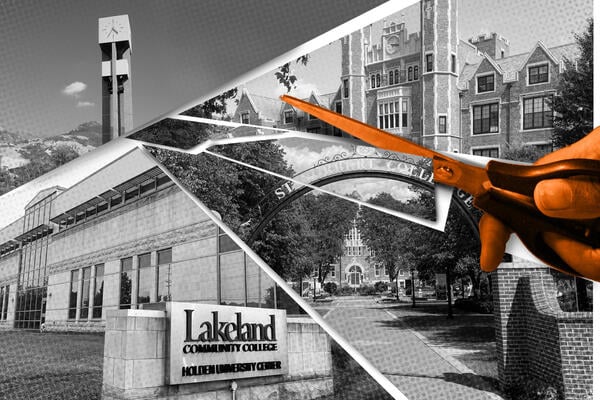
Lakeland Community College
Facing a $2 million budget deficit, the public two-year college in Ohio is laying off 10 faculty members and not replacing 14 professors set to retire, Ideastream Public Media reported.
Another eight faculty members who will retire next year will also not be replaced.
Between the cuts and retirements, Lakeland expects to save $2.3 million this year and another $800,000 next year. It will reinvest $225,000 in three faculty positions in manufacturing, welding and electrical engineering as it prioritizes workforce development.
Lakeland also plans to close an unspecified number of low-enrollment programs.
St. Norbert College
The private, Catholic college in Wisconsin announced plans last month to lay off 27 professors and cut more than a dozen programs to address its budget deficit, Wisconsin Public Radio reported.
Cuts will shave an estimated $5 million off the $12 million budget deficit. Of the 27 affected faculty members, 21 are set to lose their jobs in May, and the remaining six will be let go in 2026.
Averett University
Grappling with financial pressures, the small, private institution in Virginia announced plans last month to eliminate 15 jobs as part of cost-cutting measures, The Chatham Star-Tribune reported.
Additionally, Cardinal News reported this week that Averett listed its equestrian center for sale.
The university has navigated steep financial issues since last summer, when officials discovered a financial shortfall brought about by unauthorized withdrawals from the endowment by a former employee. While they said there was no evidence of embezzlement or misuse of the funds, the fiscal mismanagement prompted Averett to take a series of ongoing measures to fix its finances.
Oklahoma State University
Fallout continues at Oklahoma State, where the university laid off 12 Innovation Foundation employees after a recent audit uncovered financial missteps there, Oklahoma Voice reported.
Affected staffers will not receive severance but will remain employed through June 1.
In February, Oklahoma State president Kayse Shrum stepped down abruptly amid a review of improper transfers of legislatively appropriated funds. An audit later found that $41 million in state appropriations “were not properly restricted and in some instances were co-mingled with other funds” in violation of state laws and policies. In one instance, $11.5 million intended for other programs had been directed without board approval to OSU’s Innovation Foundation instead.
St. Joseph’s University
Officials offered buyouts to some faculty and staff last month as the private Jesuit university seeks to close a budget deficit following recent mergers, The Philadelphia Inquirer reported.
St. Joseph’s absorbed the University of the Sciences in 2022 and added Pennsylvania College of Health Sciences in 2023, which officials told the newspaper left them with a “small deficit.” President Cheryl McConnell did not specify a dollar figure in an interview with the Inquirer.
She added that there was no specific target number for buyouts, but when asked about potential layoffs, McConnell said it “depends on the nature of voluntary separation plan results.”
Utah State University
Voluntary buyouts are on the table and layoffs could be on the horizon at the public university following $17.3 million in budget cuts from the State Legislature, The Cache Valley Daily reported.
Those cuts were spread across two years, with the university taking a $12.5 million hit this year. However, USU could restore that money through the state’s strategic reinvestment initiative, which allows universities to regain funding if leaders can identify areas for cuts and shift resources toward strategic initiatives favored by the state.
Weber State University
Elsewhere in Utah, Weber State is also grappling with budget issues imposed by the state.
With anticipated budget cuts of $6.7 million due to the same strategic realignment initiative, Weber State is also offering voluntary separation incentives to employees, Deseret News reported. The university also plans to restructure some academic programs, including the College of Education.
Budget changes in Utah will also affect the other six state institutions, but not all have made their plans public yet.
I just returned from the UPCEA annual conference held in Denver. A record attendance of some 1,300 administrators, faculty and staff from member institutions gathered to share policies, practices, innovations and knowledge in advancing the mission of higher education in 2025. It was a thriving and exciting environment of energy and enthusiasm in seeking solutions to challenges that confront us today and into the future.
Recent policy shifts regarding the federal funding of grants provided by the institutes and foundations that support university research were on the minds of most who attended. These topics provided the undercurrent of discussions in many of the sessions. The spirit was one of supporting each other in advancing their initiatives despite the prospect of cuts in federal support. The confluence of the demographic enrollment cliff of college-bound students due to the drop in births during the previous recession of 2007–09 and additional promised cuts in funding from federal and many state sources created an environment for collaboration on solving shared challenges rivaled only by that of the COVID-19 pandemic.
A number of the sessions addressed innovations with cost savings, efficiencies and effectiveness gains that can be realized by thoughtfully introducing artificial intelligence into supporting many aspects of the higher education mission. The potential savings are significant if AI can take over duties of positions that become vacant or instances where staff are better utilized by shifting their efforts elsewhere.
Most Popular
By fall 2025, readily available AI tools will be able to serve in course development, delivery and assessment:
Adapt and update class materials with emerging concepts, societal situations and news context
Lead and assess class discussions—stimulate deeper thought and engagement
Assess course assignments with personalized recommendations to fill in the gaps in knowledge
Provide one-on-one counseling on academic matters and referrals for personal challenges
Create a summative assessment of course outcomes and initiate revisions for improvement
Generate a deep-thinking report for administrators and committees to consider
By this fall, readily available AI tools will be able to serve in curriculum development, marketing and student onboarding:
Survey specified fields for addition or expansion of degree and certificate programs
Recommend detailed curriculum for new programs and suggest tuition/fees
Create marketing plans after developing a report on demand and competitors in the program area
Develop, track, implement and adapt marketing budget
Prepare and support student advising to optimize retention and completion
Prepare updated and revised plans for spring 2026
By fall 2025, develop optimal staff allocation and review process:
Assess performance evaluations, recommend additional interviews as appropriate
Develop, refine and utilize departmental/college priority list to respond to revenue and enrollment trends for the year
Match staff skills with desired outcomes
Monitor productivity and accomplishments for each employee
Make recommendations for further efficiencies, having AI perform some tasks such as accounting and data analysis previously done by humans
Be responsive to employee aspirations and areas of greatest interest
Review and prepare updated and revised plans for spring 2026
These tasks and many more can be accomplished by AI tools that can be acquired at modest costs. Of course, they must be carefully reviewed by human administrators to ensure fairness and accuracy are maintained.
I learned from a number of those attending the UPCEA conference that, in these relatively early stages of AI implementation, many employees harbor fears of AI. Concerns center around human job security. While there are many tasks that AI can more efficiently and effectively perform than humans, most current jobs include aspects that are best performed by humans. So, in most cases, the use of AI will be in a role of augmentation of human work to make it more expedient and save time for other new tasks the human employees can best perform.
This presents the need for upskilling to enable human staff to make the efficiencies possible by learning to work best with AI. Interestingly, in most cases experts say this will not require computer coding or other such skills. Rather, this will require personnel to understand the capabilities of AI in order to tap these skills to advance the goals of the unit and university. Positions in which humans and AI are coworkers will require excellent communication skills, organizational skills, critical thinking and creative thinking. AI performs well at analytical, synthetical, predictive and creative tasks, among others. It is adept at taking on leadership and managerial roles that recognize the unit and institutional priorities as well as employee preferences and abilities.
How then can we best prepare our staff for optimizing their working relations with the new AI coworkers? I believe this begins with personal experience with AI tools. We all should become comfortable with conducting basic searches using a variety of chat bots. Learning to compose a proper prompt is the cornerstone of communicating with AI.
The next step is to use a handful of the readily available deep-research tools to generate a report on a topic that is relevant to the staff member’s work. Compare and contrast those reports for quality, accuracy and the substance of cited material. Perform the research iteratively to improve or refine results. This Medium post offers a good summary of leading deep-research engines and best applications, although it was released in February and may be dated due to the Gemini version 2.5 Pro released on March 26. This new version by Google is topping many of the current ratings charts.
In sum, we are facing changes of an unprecedented scale with the disruption of long-standing policies, funding sources and a shrinking incoming student pool. Fortunately, these changes are coming at the same time as AI is maturing into a dependable tool that can take on some of the slack that will come from not filling vacancies. However, to meet that need we must begin to provide training to our current and incoming employees to ensure that they can make the most of AI tools we will provide.
Together, through the collaborative support of UPCEA and other associations, we in higher education will endure these challenges as we did those posed by the COVID pandemic.
Wellesley College in Massachusetts has become the first U.S. institution to top $100,000 per year.
Jessica Rinaldi/The Boston Globe/Getty Images
Wellesley College appears to be the first higher ed institution in the nation to hit the $100,000 annual sticker price.
The cost to attend the all-women’s college this coming fall will be $100,541, as Boston Business Journal first reported. That includes direct costs of $92,440—which covers undergraduate tuition, housing, fees and meals—plus indirect costs, such as books, personal expenses, travel, transportation, and optional health insurance. Wellesley now appears to be the most expensive college in the country.
Various other universities have approached the six-figure mark for undergraduate tuition and indirect costs in recent years but managed to remain below it. When Inside Higher Ed explored this issue last year, it appeared that Vanderbilt University might be the first to cross the threshold, with estimated costs for undergraduate students in certain programs, such as engineering, hitting almost $98,000. Others at or over the $90,000 line include the University of Chicago, the University of Southern California, Washington University in St. Louis and Tufts University, and a handful of other highly selective, private institutions.
Wellesley spokesperson Stacey Schmeidel wrote in an email to Inside Higher Ed Tuesday that the college “meets 100% of the calculated need for all students” and is “committed to making a Wellesley education accessible to all.” Additionally, she noted that “loans are eliminated for students with total parent income less than $100,000 and calculated family contribution of less than $28,000. The average indebtedness of our 2023 graduates is $18,500, well below the national average.”
She added that indirect costs vary by student and “the majority” do not pay sticker price.
Schmeidel also wrote that more than 50 percent of students decline the optional health insurance, which, at $4,051, is the most expensive item on the list of indirect costs. Of those who do opt in, nearly half receive institutional grants to cover the entire cost, she noted.
Despite the potential sticker shock, Wellesley’s website plugs an education that is “more affordable than you think.” Wellesley has a financial aid budget of more than $84 million, according to its website.
That is also the case at many other well-endowed colleges where, regardless of the listed price, most students don’t pay the full amount. Tuition discounting has soared in recent years and remains well over 50 percent across the U.S. A recent study of 325 private nonprofit colleges conducted by the National Association of College and University Business Officers pegged the average tuition discount rate for first-time, full-time students at 56 percent, and 52 percent for all undergraduate students. Both numbers are all-time highs.
While public concerns about higher education have often focused on college costs, debt and the return on investment, Wellesley and its high-priced peers are outliers in terms of cost. A recent College Board analysis found that in the 2024–25 academic year, the average sticker price was $43,350 for private nonprofit four-year institutions, $30,780 for out-of-state students attending public universities, and $11,610 for in-state students at public universities.
Bryan Alexander, a senior scholar at Georgetown University who has been writing about college costs nearing the $100,000 mark since 2018, correctly predicted in 2023 that Wellesley would be one of the first institutions to reach six figures by the 2026–27 academic year.
Asked what he thought about his prediction coming to pass, Alexander responded with multiple questions.
“Will this pricing make the college more desirable, as a luxury good? Or will it drive away would-be students from sticker shock?” he wrote by email. “How many universities, scared of [the Trump administration], will make such a price hike to raise funds when grants are cut?”
He also pondered what it might mean for public perception, writing, “Wellesley is a small liberal arts college, but some universities are also playing this pricing game. Will [small liberal arts colleges] become seen as too pricey, or will all of higher ed get tarred with this brush?”
Momodou Taal, the Cornell University graduate student who said his institution effectively tried to deport him in the fall over his pro-Palestine activism, announced Monday he’s leaving the U.S. of his own accord under threat from the Trump administration.
“I have lost faith I could walk the streets without being abducted,” Taal wrote on X. He added that “we are facing a government that has no respect for the judiciary or for the rule of the law.”
On March 15, Taal, his professor and another Cornell Ph.D. student sued President Trump, the Department of Homeland Security and Homeland Security secretary Kristi Noem, challenging executive orders that empowered immigration officials to deport noncitizens they deem national security threats. Immigration officers have targeted multiple international students suspected of participating in pro-Palestine protests. Taal is a U.K. and Gambian citizen.
A few days after he sued, Immigration and Customs Enforcement agents visited Taal in what Homeland Security acknowledged “was an attempt to detain him,” he said in a court filing. The State Department had revoked Taal’s visa, according to the lawsuit.
Now his lawyers have dismissed the case. “Trump did not want me to have my day in court and sent ICE agents to my home,” Taal wrote on X.
In an email to Inside Higher Ed Tuesday, an unnamed “senior” Homeland Security official called it “a privilege to be granted a visa to live and study” in the U.S.
“When you advocate for violence and terrorism, that privilege should be revoked, and you should not be in this country,” the official said. “We are pleased to confirm that this Cornell University terrorist sympathizer heeded Secretary Noem’s advice to self-deport.”
When asked for specifics on when Taal sympathized with terrorism, Homeland Security pointed to where Taal referenced in his Monday post the “Zionist genocide,” and wrote, “Long live the student intifada!” In his post, Taal wrote that the “repression of Palestinian solidarity is now being used to wage a wholesale attack on any form of expression that challenges oppressive and exploitative relations in the US.”
Taal added, “If you have been led to think that your safety is only guaranteed by state kidnap, repression, deportation, the slaughter of children, and the suppression of the global majority, then let Gaza’s shards of glass be your mirror.”
More than 700 University of Washington research coordinators and consultants have unionized, joining already organized research scientists and engineers there to create a bargaining unit more than 2,000 members strong, the union announced.
UAW 4121 said in a news release Tuesday that research coordinators and consultants are largely health-care professionals focused on research.
“They are responsible for running clinical trials, liaising with patients and scientists, and ensuring that research results are grounded in rigorous science,” the release said. “Despite the critical role they play at the university, many report job insecurity, a lack of transparency around career advancement and workload, low compensation relative to cost of living, and more as their reasons for forming a union.”
“The University of Washington recognizes and respects the right of employees to organize,” university spokesperson Victor Balta wrote in an email to Inside Higher Ed. “UW values the research coordinators and consultants who help make vital work possible and we look forward to negotiating in good faith their inclusion into the existing UAW 4121 bargaining unit of research scientists and research engineers.”
Mike Sellars, executive director of Washington State’s Public Employment Relations Commission, said his agency certified the unionization of the research coordinators and consultants Thursday. Nearly 400 employees submitted cards in favor of unionizing. A union spokesperson said cards were collected over the past year.
Mike Miller, director of UAW Region 6, said in the news release, “As workers and workers rights’ are under assault by the Trump administration, it’s never been more important to have the rights and protections of a union.”