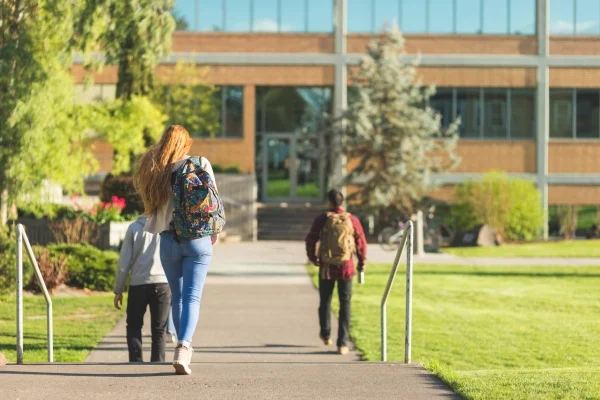
Colleges that help provide economic mobility for first-generation and low-income students are more likely to have recruitment and retention practices that focus on sense of belonging.
FatCamera/E+/Getty Images
As college students have become more diverse over the past few decades, a growing focus in education policy has centered on the university’s role in influencing their economic mobility.
New research from Public Agenda evaluates the promising practices colleges and universities employ to improve the earning potential of students from low-income families and provide a stronger return on investment, compared to other institutions.
The report outlines three primary themes across policies and practices to advance student success: involving families, creating supportive campus systems, and investing resources in low-income students.
Survey says: Two in five students said one of their main reasons for attending college is to increase their earnings potential, according to data from Inside Higher Ed’s 2025 Student Voice survey. The most popular response was “to pursue a specific career or profession,” followed by “to gain knowledge and skills.”
Students aged 25 and older were more likely to signal they enrolled to increase earnings potential (53 percent), as were students working full-time (48 percent) and those attending two-year colleges (44 percent), compared to their traditional-aged peers or four-year counterparts.
Methodology: Staff at Public Agenda traveled to 10 colleges or universities in Michigan, Texas and California in 2024 to conduct interviews with administrators, faculty and staff; they also held focus groups with students and alumni. In addition to the qualitative research, Public Agenda leveraged data from the Department of Education’s College Scorecard to evaluate trends in socioeconomic mobility by institution type and student persona.
The research: One of the overarching takeaways Public Agenda staff gleaned from their site visits was that the institutions most effective in boosting students’ economic mobility tended to value and respect student-facing staff and their perspectives on improving systems.
“Success at the institutions we studied depends on cultivating an environment in which everyone recognizes that the people who interact directly with students possess the most important information and have the clearest ideas about how to fix problems,” according to the report.
The evaluated colleges prioritized recruiting first-generation students and engaging with their families to help them understand the accessibility and value of higher education, because they were most likely to go straight into the workforce from high school, rather than consider college.
“When senior leaders and front-line staff at these institutions refer to ‘the competition,’ they are talking about the forces pulling students away from college—not about other colleges,” the report said.
It also noted that families and local schools are invited to campus for various events to establish familiarity and comfort with the institution. Offering resources in various languages or connecting families with bilingual staff can build trust and demonstrate commitment. Hiring staff who share identities with students, or are alumni themselves, can create a support system that helps first-gen and low-income students feel seen and understood.
“The baseline of shared experience functions as a lubricant, reducing friction in efforts to achieve commonality of purpose among everyone working at the institution,” according to the report.
Providing peer-to-peer resources and creating physical spaces on campus that engage learners can also establish a sense of belonging.
In addition to meeting tuition costs, colleges invested dollars in data systems that relieved staff of burdensome administrative duties and increased the number of academic advisers on campus to provide more personalized, one-on-one advice and encouragement for students.
Other trends: Researchers also underscored the role of financial stability in achieving socioeconomic mobility for low-income students. Financial obstacles and personal challenges are the top reasons students leave college.
Many low-income students work while enrolled, so creating opportunities for student employment on campus or connecting students to meaningful employment experiences can help them stay on track to graduate and develop career skills.
Get more content like this directly to your inbox. Subscribe here.
The last time we caught up with Suzanne Dove in September of 2024, she was serving as the assistant vice president, strategy and innovation at Bentley University. This past May, Suzanne started a new role as Chief Education Solutions Officer in the Center for Academic Innovation (CAI) at the University of Michigan (U-M). Now, a few months in her new role, I thought this would be a good time to check in with Suzanne.
Q1: Tell us about your new job. What does a Chief Education Solutions Office do? Where does your role fit in with CAI and U-M as a whole?
A: At the Center for Academic Innovation, my role as the inaugural Chief Education Solutions Officer (or CESO) is to open a new learning innovation horizon for the Center and help U-M achieve its next tier of educational impact. I do this by creating sustainable strategic partnerships that enable us to serve workforce and talent development needs of external organizations.
CAI has long been known for offering well-designed, U-M faculty-led online courses to millions of learners and thousands of organizations. This breadth gives us an advantage: Our teams have developed tacit knowledge as well as processes to stand up and scale successful programs ranging from MOOCs on platforms, like Coursera, to U-M online degree programs to innovative short-form offerings and integration of advanced technology into hybrid, online and residential learning.
With Michigan Online giving us even more flexibility, we can go further. We are positioned to partner directly with organizations that need high-quality workforce and talent development and offering features that both learning and development leaders and adult learners value, such as cohort-based learning, live sessions with U-M faculty, and customized content.
Like any new leadership role, a big part of my job is setting strategic priorities and putting the right operational structures in place. Equally important, if not more so, is building strong, collaborative relationships across three overlapping circles.
The first is CAI itself, a community of experts in online learning, project management, marketing, media production, ed tech and more who make it possible as I build the Education Solutions team to engage with external partners and craft relevant offerings that fit their needs. The second is leaders and faculty across U-M, many of whom are excited about expanding the university’s reach to nondegree learners and appreciate how our team brings market insights and industry relationships. The third circle is external organizations that are serious about upskilling their employees and are challenging the status quo around professional development and work-based learning. The partnerships I’m most energized by are those that challenge us to design innovative learning solutions that benefit learners, their organizations and the university. For a thriving workforce in a rapidly shifting landscape, we need to move boldly.
Right now, my day-to-day focus is on three things, in collaboration with other teams within CAI: building a strong partnership pipeline, making sure there’s a good fit between partners’ needs and CAI’s offerings, and ensuring we can deliver these solutions efficiently through Michigan Online. There’s a considerable operational component with any new endeavor and I’m really excited about that right now—it’s what gets me going in the morning! For example, how can we enhance traditional partnership development practices using generative AI? What new insights can we draw by digging into our existing data with an organizational lens? etc.
Q2: Knowing you for a good number of years now, I know that you’ve worked hard to develop as an academic innovation leader. What was it about this particular role at U-M that inspired you to make this big professional (and personal) move?
A: The University of Michigan’s Center for Academic Innovation (CAI) has earned a reputation as a national leader in shaping the future of lifelong learning. I could not imagine a better place to take this next step in my career. I feel grateful to have the support of my family and friends—they have been an invaluable source of encouragement and have been almost as excited as I am about the move! From the beginning of the interview process, I could tell that my new colleagues at CAI take organizational culture seriously and, as I have been onboarding, the CAI team has gone out of their way to extend a warm welcome, offering concrete guidance to help me succeed and just being incredibly helpful as I navigate the move to Ann Arbor.
I’ve always relished the challenges of sharpening an impactful idea, taking it from conception to development and experimentation to scale and sustainability. As I’ve settled into this role, I have found that CAI “on the inside” matches the external image I had formed before I joined the organization. I’m impressed by the strong leadership vision and strategic mindset of my colleagues on the Center’s senior leadership team as well as the interest in ideation and experimentation, the deep expertise and operational excellence at every level on the various teams that make up the Center.
Creating the CESO role came from a clear commitment to an idea that has taken root at many U.S. universities in the past several years: that higher education institutions should serve not just degree-seeking students but also workforce development demands of our regions and talent development needs of external organizations more broadly. Trouble is, universities tend to be decentralized, and it can be a struggle to coordinate across different units with overlapping missions. So, when it comes time to execute on this vision, success may occur in pockets, but scaled solutions can hover out of reach. I was energized by the opportunity to step into the CESO role at CAI, where scale and global reach are part of our core value proposition.
Q3: What career advice do you have for other non-faculty educators interested in growing into a leadership role? What skills, experiences and networks have been most valuable to you across your higher education career?
A: We already talked about the importance of mentors and sponsors in our last conversation, so I won’t repeat myself on that topic. Another important lesson is to tend your network. I know the term “networking” often carries a transactional connotation that can be off-putting to mission-driven folks who value community. But in fact, I think of the network of academic innovators I’ve been lucky enough to work with as a community or web, where the whole is greater than the sum of its parts. Here are a few strategies I’ve found helpful when investing in that network:
Is there a former colleague you’ve fallen out of touch with? Set a monthly or quarterly reminder to reach out to three people you’ve worked with in the past (holidays are a great opportunity to reach out and let someone know you’re thinking of them!). Share an article or a joke that reminded you of them, ask for their help in a small way and offer your help in return, ask about something important in their lives, or just let them know you thought of them.
Cross-functional committees or cross-institutional organizations or conferences can be a great way to meet people and hear perspectives you wouldn’t ordinarily encounter. Sometimes, a few people discover a mutual interest and want to continue the conversation outside the committee or conference. Can you make a move that will help make this happen? Maybe you offer to compile email addresses of those who’d like to continue the conversation, maybe you’re even willing to organize a few virtual meetings so the group can come together. These types of small but visible investments will be valued by your peers and help you build your network.
This year, two of my most treasured academic innovation colleagues passed away suddenly. They were two of the people I would call on to help me sharpen an idea, to offer support when I was feeling discouraged, or to share in the excitement of a successful experiment. I miss them every day, and it reminds me about the importance of community, not just for learners but for learning innovators. So I guess my best career advice today is, keep nurturing your network.
In the current climate, one might question whether academic accommodations are the most urgent avenue for discourse. Yet a pattern of uncontested opinion pieces in spaces like The Atlantic (the newly published “Accommodation Nation”), The Chronicle of Higher Education (“Are Colleges Getting Disability Accommodations All Wrong?), The Wall Street Journal (“Colleges Bend the Rules for More Students, Give Them Extra Help”) and, indeed, Inside Higher Ed itself (“How Accommodating Can (Should) I Be?”) speaks to the enduring cultural conflict around how the Americans With Disabilities Act and Section 504 of the Rehabilitation Act are actualized in higher education.
As members of the executive board of the Association on Higher Education and Disability (AHEAD) in Virginia—a professional organization for staff of disability service offices—It is our intention to define and defuse the recurring arguments of this specific “type” of opinion article, which for convenience we will call the “Do Colleges Over-Accommodate?” piece.
Setting the Table With Statistics
It is common to see these claims begin from an assumption that disability accommodations “are skyrocketing”—a claim that sensationalizes statistics. One author cites the large volume of accommodation letters sent by a university per semester. Such a claim is rooted in either misunderstanding or deliberate misrepresentation of accommodations. At any institution, the total count of all accommodation letters sent appears disproportionately large, because each student is enrolled in multiple courses.
A better accounting would come from data on the representation of disabled students within the institution. Recent National Center for Educational Statistics (NCES) data shows that among public, 4-year institutions, 10.1 percent of them report that students with disabilities make up 10 percent or more of their student population. This is an increase from the 1.5 percent of institutions in 2010–2011, but why is it shocking that disabled students also want to go to universities that their nondisabled peers attend?
The NCES data do suggest that disabled students are more likely to enroll in private institutions (more than 23 percent of private nonprofit colleges report that students with disabilities make up 10 percent or more of their student population). While this is supportive of a claim that students from privileged backgrounds have higher access to accommodations (and indeed, research supports this) it is telling that authors who put elite institutions in the spotlight are more focused on reducing accommodations available to these students than on increasing the support available to students at less elite institutions.
It is also important to view these figures in the context of the post-ADA era. The ADA is only 35 years old, and its amendments passed in 2008. Today’s students come from an environment where they are more likely to expect accessibility, which is reflected in these “skyrocketing”—or “breathtaking”—numbers.
Categorizing the Case Against Accommodations
In our review of the “Do Colleges Over-Accommodate” archetype, we saw a clear pattern of essential recurring arguments:
More rigid documentation standards are needed to “create equity.”
In these arguments, we see unfortunate parallels to other attacks on civil rights playing out in our public discourse. Each individual claim requires a full-throated counterargument—which we will provide below.
Claim: Accommodations Convey Advantage
This is the most prevalent claim within these articles, and we will spend the greatest effort defusing it. This claim suggests that all accommodations create advantages for students with disabilities—that we should fear for “fairness,” or that accommodations will compromise rigor. In this piece, the author asserts that additional testing time for students with disabilities “is as unfair to other students as a head start would be to other runners.”
This metaphor reveals a flawed assumption—that education is inherently a place of competition, with a fixed number of winners and losers. A zero-sum game. But universities are not limited in their capacity to provide degrees, nor is there a fixed number of A’s available.
Still, there is value in ensuring fairness. Disability services officers (DSOs) develop rigorouscriteria for assessing and analyzing cases where academic accommodations would “fundamentally alter” key aspects of courses. DSOs also seek to apply a measured approach to approval of accommodations, consistent with professional guidance. The purpose of accommodations—to return to the metaphor—is ensuring that students run in the same race.
Research such as this 2022 U.K.-based study, which found that accommodations in most cases “worked as intended and helped [with] leveling the playing field,” challenges this narrative further.
The work of DSOs relies on an interactiveprocess at the individual level. A student who is dyslexic may benefit from a dictation tool for writing essays in a way that another would not. A student who has Attention Deficit Hyperactivity Disorder may benefit from a quiet testing environment—but not all students with the same diagnosis would have the same needs. The individualized identification and selection of supports to address disability-specific barriers is the cornerstone of DSO work, and it is work that our offices conduct effectively.
Claim: Disabled Students ‘Game the System’
Running through these articles is an implicit—at times explicit—assumption that DSOs are either tricked by students and their medical providers into approving accommodations inappropriately, or that students deliberately misuse even appropriate accommodations. Implicitly, this assumption is communicated to readers through less-than-subtle reliance on words like “claim” for how students communicate their disability, rather than “disclose.” Explicitly, this line of argument appeals to scholarship debating the ways in which individual disabilities are defined.
Some of the most-cited sources in support of this claim are of questionable reliability. For example, this article from the Canadian Journal Psychological Injury and Law has been held as “sobering” evidence that DSOs are insufficiently rigorous in approving accommodations. In the study, researchers asked DSO staff if they would accommodate a fictitious prospective student based solely on what the researchers deemed insufficient documentation.
Setting aside gaps in context between Canada and the U.S., what a DSO professional would hypothetically do and what they would do when presented with a live student are different. Our professional guidelines encourage the use of self-report, triangulated with other forms of information. Without following a student through the interactive process, the authors project bias and incorrect assumptions onto the work of DSO professionals—just as asking a doctor to suggest treatment without an exam would likely produce similarly “sobering” results.
The inaccuracy of this claim is likely to be apparent to anyone involved in accommodations review. Moreover, some of the sources cited by proponents of this claim directly contradict it. For example, Ashley Yull’s 2015 article about the intersection of race class, and disability notes:
“Premising access to accommodations in post-secondary education on receipt of a psychiatric diagnosis magnifies the negative impact of childhood poverty.”
“SES [socioeconomic status] contributes to the experience of disadvantage for learning disabled students when they lack the financial means to obtain required diagnoses.”
It is no wonder that scholars would dispute that documentation is a lever for equity, given the staggering cost of psychological assessments. There is variance in the pricing of these assessments, but in some areas they can cost between $1,000 and $5,000. While some university-operated assessment centers can be less costly, they typically have very long waiting lists. Meanwhile, 1 in 5 dependent undergraduate students come from families below the poverty line—and nearly half of independent students (those without financial support from family) met this criterion.
Financial cost is not the only barrier to accessing rigorous documentation. Mental health providers experience significant demand, stretching wait times and disproportionately impacting rural and marginalized communities.
If DSOs demanded that each student claiming a learning disability or ADHD diagnosis supply such a document, accommodations would be unavailable to poorer students and to many students from rural areas. For all students, the provision of accommodations would be delayed. This is why those working as DSOs are often so willing to work with students when they can articulate an access barrier. To claim otherwise can be understood as either a statement of ignorance about disability services or, perhaps, as reflective of a desire for accommodation requests to diminish.
Conclusion
As we noted, our goal is to present a measured response to these opinion essays. Having done so, we will do our readers the service of stating our own view:
Disability services professionals are thoughtful and effective in discharging their responsibilities in the interactive process.
Disabled students belong on college campuses, and accommodations serve to enable access to higher education.
Accommodations level the playing field for students within environments that were built without considering their very existence.
Rigidity in the interactive process burdens the student, and these burdens disproportionately impact marginalized communities.
We encourage readers to draw their own conclusions—however, in doing so, we encourage you to listen to the voices of the disabled community, disability services professionals, and those with stakes and experience in navigating the accommodations process.
In the current climate, where we are asked to consider whether empathy might be a sin, and whether disability might be incongruent with merit in the workplace, it is important to uplift these voices. It is important to stand firm in the knowledge of the expertise and value of those in helping professions. It is important to affirm that all means all, and that includes students with disabilities.
Chris Parthemos and Martina Svyantek are the president-elect and president, respectively, of the Association on Higher Education and Disability in Virginia.
Anuja Uppuluri used to spend a lot of time scrolling social media apps dictated by algorithms designed to keep users glued to their screens no matter how mind-numbing the content.
“I always had something else that I could be doing or wanted to be doing, but I was choosing to watch TikTok videos for five hours,” said Uppuluri, who completed a bachelor’s degree in information systems at Carnegie Mellon University in May. “And then by the end of it I couldn’t remember anything that I had watched.”
Uppuluri, who now works as a machine learning engineer for Anthropic, sought to become more intentional about the information she consumes and has since scaled back her social media usage. Rather than scroll aimlessly, she wanted to fill her time digesting more research related to her career field, especially about the inner workings and implications of increasingly prevalent generative artificial intelligence tools.
She discovered all types of academic papers, articles and blog posts she wanted to read, but it wasn’t easy to keep organized. “I didn’t know where to put all of this stuff, because there’s no central location for it,” Uppuluri told Inside Higher Ed. “I started thinking about how I want to use my research and what I want to see from other people’s research.”
So Uppuluri developed Paper Trails, which she described as “Goodreads for academic papers” in an X post announcing the website’s launch last week. “I built it because I wanted a place where engaging with research felt fun, beautiful, and personal to you.”
Similar to the book-focused website Goodreads, Paper Trails is designed to help users discover new research and ideas, though it’s not powered by an AI algorithm. It’s a crowd-sourced platform where users can post links to papers from any field, peruse summaries of those papers, create shelves (public reading lists), and comment, review or rate papers.
In the week since its public debut, Paper Trails has grown its users from 10 to 2,200; the number of articles available on the site has increased from 20 to 3,100.
Inside Higher Ed spoke with Uppuluri to hear more about her vision for Paper Trails.
(This interview has been edited for length and clarity.)
Q: What sparked your interest in reading more academic research, especially about computer science and AI?
A: I always thought of a computer scientist as someone who writes code, builds infrastructure and makes sure systems are built to scale. But AI is blurring the line between research and engineering. Every new discovery that comes out of a large language model (LLM) lab is research-oriented.
Understanding why the technology is the way it is can be done by reading papers and understanding the research about large language models. These models are like black boxes—you can’t entirely understand what’s going on inside it—and that’s created all of the research subfields. For example, a subfield called interpretability is about trying to interpret what the models are doing. The more you do with these models, the more you have to read to understand how they work to gain context on how to build things better.
Q: How did your previous experiences reading and writing research papers inform the creation of Paper Trails?
A: A research paper to me used to mean something related to medicine, chemistry or biology. I didn’t understand or realize that it had a place in computer science until a few months before I wrote the only research paper I did in college. For that paper, I wrote the methodology and code, but my co-author, who was doing his Ph.D., helped me structure the paper, write the references and get it through the formatting process. It felt like a high barrier to entry for doing and reading research, which I associated with work instead of fun.
I thought having some type of casual thing like [Paper Trails] to organize research papers would maybe help me read more. But other existing websites I experimented with looked so dated and used software I had to learn. It looked complicated and didn’t seem fun. I also didn’t want to organize my research in a big Google Doc that has 50 links on it that I’m never going to touch again—that looks ugly.
So, I knew I could probably make my own site that looks nice and is easy to use.
At its core, Paper Trails is a tool to put papers and other reading material together in a way that’s pretty and fun. Sometimes that’s what you need to make something feel more like a hobby rather than more work you have to do.
Q: What went into developing the Paper Trails website and how does it work?
A: I coded most of it from scratch, with the exception of pasting in a few codes to fix some bugs.
When I first launched, there were only around 20 papers on the site. Now, there’s around 3,000 just from more people being on the site and adding the things that they want to read.
I chose not to mass import a bunch of stuff at the outset because if people look at it and it’s not something they’re interested in, it’s still there. It’s kind of cool to look at every single paper and know that it’s there because it’s something on someone else’s reading list.
Everything on the main page is organized by publication date. You can also use keywords to search or just click some buttons to see what people are logging. There is no personalized algorithm for users. While there isn’t anything necessarily wrong with a recommendation assistant, it’s also nice when there’s nothing telling you what to look at.
Q: What is the value of Paper Trails for its users?
A: There’s a lot of people who would like to get into research or just reading more. And if you want to spend your time in that way, having a tool to help you do it and encourage you to do makes it a lot easier to follow through on.
There’s also value coming from all the people that make it a collaborative thing. It allows people to explore, kind of like going down a Wikipedia rabbit hole. You can just keep clicking on random links and reading. You don’t know what you’re going to learn at the start of your session but, if you’re interested in it, you can read it.
Q: Now that people are showing interest, what are the next steps for Paper Trails?
A: I was thinking about sending it to some of my old professors, especially if they have Ph.D. students who may be interested in working on it.
There are even more elements that I could add that would improve the user experience. A lot of people have papers that are already saved on another site, so being able to bulk import would be helpful. Or allowing a few people to edit a shelf rather than just one person could make collaboration a little bit better. Or being able to clone somebody’s shelf so that another user can add some of their own stuff to it.
I don’t know exactly what growth looks like. But to me, success means the people using it are happy.
The statewide talent marketplaces should include credential registries, learning and employment records, and skills-based job description generators.
ATHVisions/E+/Getty Images
The Department of Education launched a new $15 million grant competition to promote the development of what it calls statewide “Talent Marketplaces,” or digital systems that track the credentials, employment records and skills of students and graduates.
“Talent Marketplaces give learners, earners, and employers a clearer way to validate skills, opening doors to stackable credentials and stronger recognition of prior learning and work experience,” Nick Moore, the acting assistant secretary for the Office of Career, Technical, and Adult Education said in a Friday news release about the program. “As we expand these systems, we open more pathways into good jobs, support broader participation in the workforce, and help strengthen our Nation’s economy.”
The announcement came just days after the House Education and Workforce Committee held a hearing about expanding access to similar Learning and Employment Records. The goal, according to Republicans in both Congress and the Education Department, is to help institutions better match talent to opportunity and expand access to career pathways with a positive return on investment.
In this first competition, the department will identify up to 10 award winners, each of whom will receive a portion of the $15 million as well as technical assistance in refining and implementing their development plans. It is unclear based on the news release where the funding for this program will come from.
The application will open in January, according to the release.
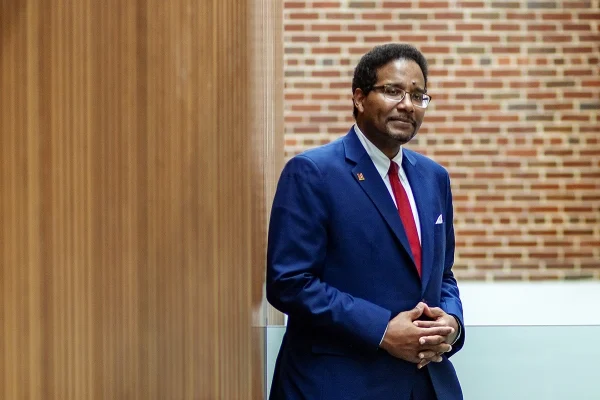
An investigation cleared Pines of academic misconduct.
University of Maryland, College Park
University of Maryland College Park President Darryll Pines did not commit academic misconduct, an investigation determined, clearing him of plagiarism allegations that emerged last September.
A joint investigation that involved both the campus and the University System of Maryland but was led by an outside law firm “found no evidence of misconduct on the part of President Pines,” according to an emailed announcement from College Park and system officials sent on Friday.
Last fall, Pines was accused of lifting 1,500 words from a tutorial website for a 5,000-word paper that he co-authored in 2002, and of later reusing that same text for a 2006 publication, according to the initial allegations against him that first broke in The Daily Wire, a conservative website.
Pines disputed the claims from the start, stating that they had no merit.
However, Joshua Altmann, who wrote the text that Pines was accused of lifting, told Inside Higher Ed last year that “I do consider it to be plagiarism, and not worthy of an academic.”
The investigation, which concluded after more than a year, included three rounds of external reviews and was extended to other articles Pines wrote. While it found no evidence of misconduct, investigators noted attribution errors in some works.
“The committee did determine that the two works highlighted last year contained select portions of text previously published by another author in the introductory sections. In a separate text, a discrepancy in assignment of authorship was made. However, President Pines was not found responsible for the inclusion of such text in any of the three works, nor was he found responsible for scholarly misconduct of any kind,” College Park and system officials announced last week.
Officials also expressed confidence in Pines’s leadership going forward.
About 40 percent of students participate in work-based learning, but access to such programs is not equitable.
Phynart Studio/Getty Images
A new report found that only one in five California college students were fully satisfied with the career guidance they received, with many saying the help often arrived too late.
The data, released by California Competes, comes as more than 80 percent of first-year college students say obtaining a better job is a very important reason they enrolled in college.
“There’s a real opportunity for higher ed to do better because students want more and there’s a lot of room for improvement,” said Su Jin Jez, chief executive officer of California Competes, a nonpartisan organization focused on research and policy to improve the state’s higher education and workforce development.
“It’s really critical, particularly as more first generation students, more low income students, and more students of color are going to college,” Jez said. “These students are more likely to not have professional networks in their homes and in their families, so they really need guidance from higher ed.”
The research, conducted in collaboration with the College Futures Foundation and Strada Education Foundation, analyzed data from more than 5,000 California college students and recent graduates who responded to the 2023 Strada-College Pulse survey, which examined employment outcomes, student access to quality coaching and work-based learning, and the alignment between postsecondary education and state job requirements.
By examining students’ experiences with career guidance and work-based learning, as well as their early career outcomes, the report found that many lack sufficient preparation for meaningful employment.
The research identified opportunities to strengthen college-to-career pathways and boost economic mobility.
Career Pathways Guidance
About 60 percent of students reported receiving some form of career guidance, and 50 percent said they received information about potential earnings in careers related to their academic programs before the end of their first year.
But only 20 percent reported feeling very satisfied with the career guidance they received.
When asked where they got their career advice, 66 percent said they received it from college faculty and staff, followed by 59 percent who said they relied on family and friends.
“Higher ed makes a lot of sense to be the ones to provide career guidance because they know better than other entities what skills students are learning,” Jez said. “They can help them connect to employers, particularly alumni networks, which are really powerful connectors.”
Work-Based Learning
About 40 percent of near-graduates participated in work-based learning, with internships being the most common type.
The report found that internship participation was associated with better early career outcomes for students, greater satisfaction with their education, and a stronger sense of return on their investment, compared with those who did not intern.
But access to work-based learning remains inequitable, with 50 percent reporting that course loads were too heavy and 48 percent saying they were uncertain about how to find opportunities.
“Colleges should integrate work-based learning into their programs of study, into majors, so that it becomes a real pathway and not just a privilege,” Jez said.
“It makes their heavy course load issue not as critical,” Jez said. “And then, similarly, it takes the burden off of students to find the internship because the university will have already identified the internships that make sense for the students based on their major.”
“They approach employers and think together about where a work-based learning opportunity fits well into their programs because it’s not something that has to be unique to every campus,” Jez said, adding that colleges collaborating on such efforts helps streamline the process for employers who are often approached by multiple institutions.
“Huge kudos to them for tackling this work that’s hard on your own, but even more challenging to do collaboratively,” Jez said.
Early Career Outcomes
The report also found that less than half of recent graduates are highly satisfied with their first job or their career progress.
“This is not a new issue, but I do think that just because it’s not new doesn’t make it not problematic,” Jez said. “I would love for higher ed institutions to really think about this early on.”
She noted that colleges should consider students’ early career outcomes even before they matriculate.
“I think a lot of people will say that higher ed isn’t vocational,” Jez said. “[But] it is the reason why people are going to college today and it has to help students make good transitions into work.”
Jez highlighted California’s recent establishment of the California Education Interagency Council, a statewide coordinating body aimed at breaking down silos between higher education and workforce development efforts.
“This is something we’ve advocated for,” Jez said, adding that the council will help set a strategic plan and address cross-sector issues.
“If we’re serious about strengthening the value of higher education, the first step is listening to students’ needs,” Jez said. “They know what they need and they know the struggle they’ve had.”
Get more content like this directly to your inbox. Subscribe here.
Under repeated threats to their funding, higher ed institutions began to rebrand or shut down cultural centers, Black student resource centers and LGBTQ+ and women’s programs. Many campus diversity officers lost their jobs or were shuffled off to other offices, barred from doing much of the work they were hired for. Some institutions scrapped celebrated traditions such as affinity graduations and campus residential communities geared toward students of certain racial or ethnic backgrounds. Some student groups, like Esperanza, lost university funding because of their identity-based missions.
In one recent example, the University of Alabama ended two student publications, one focused on women and the other on Black students, citing federal policy concerns. The University of Tennessee at Chattanooga shuttered its Women’s and Gender Equity Center, an LGBTQ center, its Office of Multicultural Affairs, and the Office of Student & Family Engagement, replacing them with a Center for Student Leadership, Engagement and Community. The changes have affected faculty and staff as well as students; earlier this fall, the University of Illinois System banned consideration of race, sex or country of origin not only in financial aid decisions but in hiring, tenure and promotion as well.
“It’s very sad to see a lot of universities fall to their knees,” Luna said. Higher ed institutions “are supposed to be the places where the exchange of ideas happen, where leaders are developed and where you’re just taught about how the world objectively is … It’s a very dangerous sign for the future.”
A Double Attack
State-level anti-DEI laws have proliferated for several years now, but diversity-related programs and services were dealt a double blow this year when Trump took office.
On Feb. 14, the Education Department’s Office for Civil Rights issued a Dear Colleague letter declaring race-conscious student programming and resources illegal, based on an expansive interpretation of the 2023 U.S. Supreme Court decision against considering race in admissions in Students for Fair Admissions vs. Harvard. It gave colleges and universities 14 days to eliminate such offerings or risk losing their federal funding. A month later, ED launched investigations into 51 colleges for ongoing DEI activity. Federal judges struck down the department’s anti-DEI guidance in April, pausing enforcement, but colleges nonetheless scrambled to review and scrub DEI language from their programs and offices or shutter them altogether.
Over the summer, the Department of Justice came out with a sweeping guidance memo declaring an even wider set of practices off-limits, including those that use “potentially unlawful proxies” for race, such as recruiting students from majority-minority geographic areas. In a series of contentious legal battles, the federal government pressured some universities to agree to settlements that included anti-DEI provisions, including bans on race-conscious programs and transgender athletes. For example, the University of Virginia, which the DOJ targeted for DEI practices, recently agreed to quash all DEI programming to maintain federal funding.
I am a person who still believes, and I will forever believe, that it is important to call it diversity, equity, inclusion, anti-racism.”
Shaun Harper, founder and chief research scientist at USC’s Race and Equity Center
All the while, federal agencies have slashed, frozen and stalled billions of dollars in research grants to universities, often for perceived ties to DEI concepts. More than 120 TRIO programs, which support disadvantaged students, also lost their federal funds over alleged DEI connections. And in September, the Education Department abruptly ended grants for many minority-serving institutions, calling such programs—used to fund supports like extra peer mentoring or streamlined STEM programming at colleges with burgeoning minority student populations—“discriminatory” and “unconstitutional.”
States, meanwhile, enacted an unprecedented number of new laws cracking down on DEI: 14 in 12 states, including Arkansas, Indiana, Iowa, Kentucky, New Hampshire, Mississippi, Ohio, Oklahoma, Tennessee, Texas, West Virginia and Wyoming. That’s double the number of states that passed anti-DEI laws last year.
A higher education consultant and lawyer in the Washington D.C. area, who asked to remain anonymous, said campus leaders are increasingly asking, “How do we keep ourselves off the radar? How do we avoid scrutiny from the federal government?” At the same time, they face “increasingly disgruntled and disappointed communities within who are saying, ‘We thought you cared about this issue’,” the source said. University leaders have come under “very real pressure.”
A ‘Loss of Momentum’
Diversity officers and scholars fear that this year’s seismic policy shifts and campus crackdowns on DEI will have ripple effects across academe and beyond.
Kaleb L. Briscoe, associate professor of educational leadership and policy studies at the University of Oklahoma, is concerned that some institutions have responded to DEI bans by limiting what’s taught in the classroom.
For example, Florida colleges removed hundreds of courses related to race, sex and gender from their general education requirement options. Classes at Texas A&M University that “advocate race or gender ideology, sexual orientation, or gender identity” now require approval from the university president. And other Texas universities have undertaken reviews of course syllabi and curricula for anything that runs afoul of state or federal DEI bans.
Curriculum changes that would normally “take years’ worth of processes” are sometimes happening quickly and without appropriate faculty input, Briscoe said. While proponents of DEI bans often call for viewpoint diversity, “by implementing these bans, you are taking away voices and taking away knowledge … which really counters what they are hoping to do.”
She also fears a “blue, red, purple divide of education,” where students have different levels of access to certain subject areas or perspectives depending on where they go to college.
“We are now going to see different people in different states learning and getting access to different things,” she said. “That is horrible because, knowledge-wise, we should be preparing our students to be productive citizens across difference.”
What we’re doing is reducing opportunities.”
Paulette Granberry Russell, president of the National Association of Diversity Officers in Higher Education
Shaun Harper, founder and chief research scientist at the University of Southern California’s Race and Equity Center, said he’s mourning a “loss of momentum” in improving the experiences and outcomes of underrepresented students, a movement that stretches back to the 1960s.
He recently visited a campus where “the Black cultural center still exists in name, but it has no staff. It has no programming. It’s just an empty room,” he said. Harper, who also serves as USC’s Clifford and Betty Allen Chair in Urban Leadership and Provost Professor of Education, Business and Public Policy, said he found a smattering of students still trying to use the space, sitting in the dark and talking. He remembers when the same center was “a light, bright, vibrant space that was rich with culture that had employees … who helped to make it a home away from home.”
To him, the darkened space was a symbol of what’s been lost.
DEI Professionals Under Fire
Harper said he’s been especially disheartened to see DEI professionals lose their jobs.
Institutions dismissed “good, innocent, hard-working people who were expert at bringing campus communities together across racial, religious, ideological and other important divides,” and who pushed for some widely-cared-about issues like pay equity for women and access for students with disabilities, he said. “The loss of those people has been catastrophic to higher education, to the students that they were serving and to those people’s careers.”
A former diversity professional at a public higher ed institution in the South told Inside Higher Ed that DEI officers were wrestling with the “trauma,” “shame” and “humiliation” of suffering such a forceful, nationwide rejection.
The ex-diversity officer, who asked to remain anonymous for fear of career repercussions, spent years working to make their institution a more welcoming place for students of color—and it worked, they said. Over their tenure, faculty diversity increased and the percentage of underrepresented students in the university’s entering class more than doubled.
But you wouldn’t know it from looking at the institution’s website, the former diversity officer said. It makes no mention of the diversity office, which was dissolved. The university stripped any evidence of its work, including videos of events and educational programs, data reports and online community platforms. Unlike many of their co-workers, the former diversity officer retained an unrelated position at the institution, but their former role feels like a “scarlet letter” on campus and in the job market, they said.
They worry not only for their colleagues but also for students and faculty members left unserved.
“I can tell you that students of color who had community, don’t,” they said. “They’re spitting on Black kids, they’re calling them the N-word, and kids don’t know where to go. They don’t know what office is going to support them.”
The former diversity professional believes DEI is officially “dead,” at least as a label.
But “the underlying work of creating welcoming, diverse, inclusive, supportive cultures on campus and communities is not dead,” they said. The “benefits of diversity, of inclusion, those are still there. It just can’t be called that.”
Students in Ann Arbor protested the University of Michigan’s decision last spring to close its DEI offices, putting up posters criticizing President Donald Trump and former UM President Santa Ono.
Bill Pugliano/Getty Images
DEI’s Murky Future
Harper argued that the work can’t really go on without using the term “DEI.” He believes replacement terms like “culture” and ”community” lack specificity in a way that makes them meaningless.
“It’s giving weak sauce,” he said. “I am a person who still believes, and I will forever believe, that it is important to call it diversity, equity, inclusion, anti-racism.” The same goes for “antisemitism, sexism, homophobia and transphobia. It’s important to call those things by their names.”
Whether DEI will continue in some form is an open question currently under debate by current and former DEI officers and researchers. Some retain their optimism; others argue it’s going to take years, even decades, for campus infrastructure to recover from the full extent of this year’s losses—if a comeback is even possible.
The DEI rollbacks mark a retreat from “60-plus years of effort to broaden access and address inequities,” said Paulette Granberry Russell, who’s stepping down as president of the National Association of Diversity Officers in Higher Education in January after five years at the helm. “So, do I see this work coming back? Bouncing back? No.”
Regardless of who wins the next election, she believes federal funding cuts and stymied DEI-related research will cause long-lasting damage. She’s spoken with scholars studying issues related to race and gender who have been doxed and threatened, and who fear continuing the work they’ve done for years.
“What we’re doing is reducing opportunities,” Granberry Russell said. “You’re not going to make that up in two, three, four years.”
But she’s not without hope. She emphasized that a “systems approach” to improving academic outcomes for students—making such work the entire university’s responsibility—could be the next phase of these efforts as diversity offices fade. Doing so would require leaders to express “their commitment, which at least at this point, requires a certain amount of courage, given the very heavy-handed … taking away of resources to bring colleges and universities into line,” she said.
A chief diversity officer who lost their job in a state with a DEI ban but now works in the same role at an east coast institution, said they’re doing a “post-mortem” on where DEI went wrong. They believe the DEI movement might have tried to accomplish too much too fast, without explaining the research behind the practices developed to boost student outcomes.
Practitioners introduced concepts “really new to people” and sometimes “began to cancel people quickly” who didn’t get it, said the CDO, who asked to remain anonymous. But “you can’t run a marathon with people who are not fit. You have to bring them up to where you want them to be. And that requires teaching. It requires patience.”
They noted that the field of DEI grew rapidly in the aftermath of the Black Lives Matter protests in 2020. Scholarship on improving campus climate flourished, and diversity professionals enjoyed a wide berth to try new strategies to close equity gaps. But it was short-lived. Less than a year into the CDO’s role at their previous institution, the anti-DEI movement gained traction in the state. An anti-DEI law ultimately passed, and the diversity office later closed for good.
“That great rebirth or Renaissance” was “like a star that just had its last final flash of wonder—and then the death began,” they said. “We didn’t know at the time that the star was shining brightly to die.”
They believe DEI could be on the brink of a new era, one that rectifies some of its past mistakes and garners more support. “My fear is that we won’t be given the opportunity to do so,” they said. But they’re confident diversity professionals won’t give up on the programs, practices and strategies they believe students need.
“Fear not. Rest up, my friends,” they said. “We will be back.”
The D.C.-based higher education consultant and lawyer believes DEI isn’t dead; it’s just shifting. Campus DEI work has never been unlawful, they argued, so colleges and universities simply need to emphasize that fact, not scale back their work. They encourage campus leaders to state explicitly that cultural centers and programs are open to all, and to train everyone on campus, including student group leaders, how to frame their programming that way—even though the programs didn’t discriminate in the first place.
“Many times, I’m just trying to remove language that I know is going to draw scrutiny and then trying to offer them a way to continue to live out their values,” they said. “There may be ways to thematically describe the intended purpose of a program without using an identity marker that really just is a lightning rod in this moment.”
They acknowledged that “this transition has been really painful” for all invested in diversity, equity and inclusion work.
“But I think people are resilient,” they said. “They’re evolving, and they’re trying to figure out a pathway to make the work of universal access and opportunity evergreen.”
We live in uncertain and unstable times. The job market is contracting due to economic uncertainty, political instability and the increase of AI-driven automation. In my role as a career adviser, I talk to many students and recent graduates who have faced a long and difficult job search. The words and phrases I hear most often in these conversations are “dejected,” “soul-crushing,” or “I feel like I am screaming into the void.” International students face an added challenge, with H-1B visas seeming out of reach as they become more difficult and expensive for employers to process.
All of this uncertainty can lead to feelings of helplessness and hopelessness. What I hear from students, and in particular our international community at Columbia University, is, “What is the point of applying to jobs if no one will hire me?” Such self-defeating thoughts can lead to inaction and feelings of despair. Yet hope is essential to the success of any job search. Having hope or optimism that something willwork out is central to achieving one’s goals.
It is likewise essential that a career coach or adviser have a hopeful, positive attitude. A recent article published by the IZA Institute of Labor Economics describes how when people who were unemployed for a long period of time worked with caseworkers who had “strong confidence in the potential of their clients to find employment,” the relationship led to an increase in the client’s motivation and resilience, and to improved earnings and employment outcomes over time. Thus, our outlook as advisers can impact the students we are working with, so we must manage our own feelings of hopelessness. I find myself returning to Jane Goodall’s The Book of Hope: A Survival Guide for Trying Times for inspiration.
Another source of inspiration I return to is a framework called Career Flow: A Hope-Centered Approach to Career Development, developed in 2011 by Spencer G. Niles, Norman E. Amundson and Roberta A. Neault. In the remainder of this article, I plan to provide career development professionals with an overview of this hope-based career development model and suggestions on how they can implement it to assist their students and graduates.
In the theory, “Career Flow” is an analogy that compares different types of experiences in one’s career to the flow of water. Anyone who has felt “underwater” at work can understand this metaphor. Finding “optimal” flow in a professional setting means that your skills and personality match the tasks and requirements of your role. Below, I outline suggested steps based on the model to help you implement a hope-based approach to career advising.
Step 1: Assessing and Establishing Hope
Start by letting the advisee tell their story and share the challenges that they face. Listen and reflect back what you are hearing. But also start to consider the person’s outlook and demeanor. Many of the people I talk to, including federal workers who were laid off or furloughed, exhibit signs of hope even though they understand the current challenges they are facing and express frustration and sometimes fear. I have been surprised and impressed by people’s resilience and willingness to pivot, which I make sure to point out. That helps them see the strength they are exhibiting even in a moment of crisis.
However, some people will present as mostly frustrated, with little hope. If you are talking to someone who seems particularly hopeless about their situation, it could be helpful to reflect that back to them. You might say, “What you just described to me seems like a very tough situation. I wonder if you might feel a sense of hopelessness?” Sometimes it just takes awareness for someone to realize that they need to shift their mindset. Validate their struggle, then help them reframe their point of view toward one that is more hopeful. For example, you could mention the Career Flow model that shows the positive benefits of having hope in a career search. If a student seems unwilling to shift, you might want to suggest that they seek extra support through family, friends or counseling services.
Step 2: Self-Reflection and Self-Clarity
Self-reflection and self-clarity are essential to any job search, including when it comes to establishing a hopeful approach. If someone is not clear about their own needs and values or has a lack of understanding of their situation and challenges, that person can struggle to succeed in their goals. Therefore, help them gain a greater sense of self-clarity by reflecting any key interests, skills and values you hear them describe in your conversation. At the same time, it is important to ask about possible challenges or obstacles to fully understand their situation and address hurdles standing in the way of their goals.
If a student seems hopeless about succeeding in their goals, advisers can bolster hope by asking about areas of strength or asking them to describe a time they felt they succeeded when faced with a difficult task. Reminding students of past successes and helping to celebrate these wins can increase their sense of agency and help them believe they can overcome future challenges.
Step 3: Visioning
An inherently hopeful exercise, visioning is the ability to brainstorm future possibilities and identify desired outcomes. Sometimes, I talk to a student who is so focused on one goal, such as finding an academic job or postdoc position, that they forget to consider other opportunities where they can apply their skills and expertise. When starting the visioning process, encourage advises to imagine multiple ways of reaching their desired goal. This is also known as “pathways thinking” and, in the Career Flow model, quantity is more important than quality. When an extensive list of possible career paths is identified, the advisee should use self-reflection and self-clarity to narrow their options by selecting a few paths that best align with their interests, skills and values. Pathways thinking also supports advisees in being both flexible and adaptable, traits that are incredibly important in any job search.
However, people who feel hopeless can sometimes lack the capability to consider other options. Help connect them to resources, such as career assessments like ImaginePhD, myIDP or O*Net, where they can gather information to explore different types of employment. Also, help them consider ways they can gain skills or experience through online courses, volunteering, on-campus work or internships.
Step 4: Goal Setting and Planning
Once a student has selected a few possible paths, then focus on setting specific, measurable, attainable, relevant and time-bound (SMART) goals. Students often set lofty or poorly defined goals such as, “I want to find a job.” Help them identify small, realistic steps they can take to achieve their main goal of employment. For example, suggest that they find a job they want to apply to and create a tailored résumé and cover letter for the role and then schedule another career advising session in two weeks to review the documents. Again, consider possible barriers to their goals and how they can overcome them.
Step 5: Implementing and Adapting
As students start to reach their incremental goals they will encounter either positive feedback (e.g. a request for an interview) or a lack of success (silence or rejection emails). As they gather more data, help them revise or relinquish possible paths that are no longer relevant or serving them. Sometimes, you will need to help them accept the fact that a goal might not be achieved. This process is known as radical acceptance, or giving in to your current reality. Help them see that finding employment during a period of uncertainty is difficult and can cause pain, but life can still be hopeful and joyful.
Another approach is to help students see what they have control over. We might not be able to control the economy, but we can control our actions and our outlook, and we can seek out help when we need it or find support in community with others. Overall, be there as a source of support, guidance and encouragement.
In conclusion, it can take substantial effort to choose to be hopeful in periods of uncertainty, but we must maintain hope even in the darkest of times. To quote C. R. Snyder, who writes about the psychology of hope, “in studying hope …, I observed the spectrum of human strength. This reminds me of the rainbow that frequently is used as a symbol of hope. A rainbow is a prism that sends shards of multicolored light in various directions. It lifts our spirits and makes us think of what is possible. Hope is the same—a personal rainbow of the mind.”
So, let us be a rainbow for those we work with and help them to let hope, rather than despair, lead the way.
Francesca Fanelli has 10 years of experience working with graduate-level students and is a licensed mental health counselor in the state of New York. She currently serves as senior associate director of graduate career development at Columbia University’s Graduate School of Arts and Sciences, where she specializes in career advising and event management.
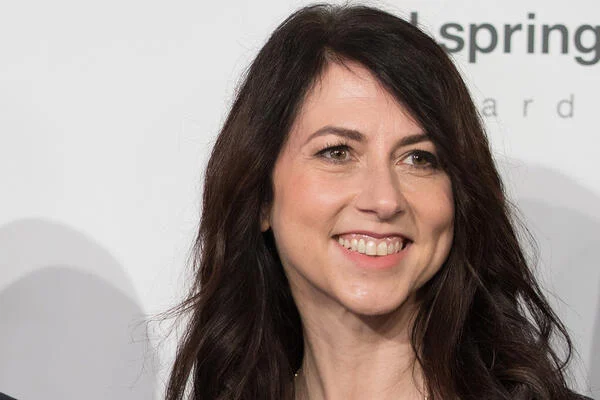
Philanthropist MacKenzie Scott gave more multimillion donations out to colleges.
picture alliance/Getty Images
Philanthropist MacKenzie Scott is at it again with another round of gifts.
Robeson Community College in North Carolina announced a $24 million gift from Scott on Thursday, the single largest contribution in the rural college’s history.
Robeson’s president, Melissa Singler, called the gift “a profound affirmation of our students, our faculty and staff, and the limitless potential of Robeson County.”
“Never before have we been given a gift of this magnitude that affords our team the time, space and freedom to think, dream and plan boldly,” Singler said in a news release.
Scott also gifted Carl Albert State College in Oklahoma $23 million. The college is working on a strategic plan for how to use the funds, focused on “sustainability, academic and career success, innovation, and community engagement,” according to an announcement last week. Connors State College, also in Oklahoma, celebrated a $15 million contribution from Scott, its largest gift ever.
Fond du Lac Tribal and Community College also announced a “multi-million dollar gift” last week, the largest unrestricted gift in its history, but didn’t specify the amount. The tribal college plans to use Scott’s funding to support scholarships and grants for native and non-native students.