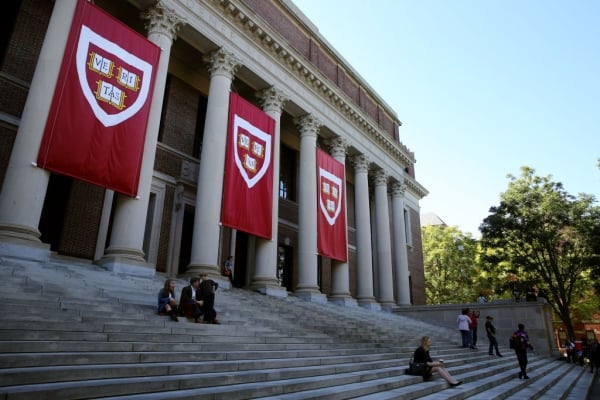
Harvard is the second Ivy League institution to be targeted by the Trump administration for how it handled alleged instances of antisemitism on campus.
Craig F. Walker/The Boston Globe via Getty Images
Harvard University is the latest higher education institution to be investigated by the Trump administration in response to its alleged mishandling of antisemitic harassment on campus. The institution will undergo a “comprehensive” analysis of nearly $9 billion in federal grants and contracts, according to a multi-agency news release.
The review, announced Monday afternoon, is part of ongoing efforts by the Justice Department’s Joint Task Force to Combat Anti-Semitism to tackle alleged antisemitic harassment on college campuses. The Departments of Education and Health and Human Services and the General Services Administration will carry out the investigation to “ensure the university is in compliance with federal regulations, including its civil rights responsibilities,” the news release said.
The task force said its review process for Harvard will be similar to the one it is currently carrying out at Columbia University.
“This initiative strengthens enforcement of President Trump’s Executive Order titled ‘Additional Measures to Combat Anti-Semitism,’” which “ensures that federally funded institutions uphold their legal and ethical responsibilities to prevent anti-Semitic harassment,” the news release said.
In a matter of weeks, the task force’s investigation into Columbia has upended the institution. It received a notification in early March that the government had launched a review into $54.1 million in federal contracts. Then, on March 7, the department retracted $400 million in grants and contracts, andon March 13 it sent the university a sweeping list of demands, calling for immediate compliance in order to regain the funding. Columbia agreed to nearly all of the demands a week later, but the administration has not reinstated the funds.
Shortly after announcing the decision to comply, the university’s interim president, Katrina Armstrong, resigned.
The administration has said it will now review more than $255.6 million in federal contracts and $8.7 billion in multiyear grant commitments at Harvard.
As with Columbia, the agencies will consider stop-work orders for any contracts the review identifies. But Harvard has also been ordered to submit a list of all federal contracts—both direct and through affiliates—that were not identified in the task force’s initial investigation.
Addressing the review in a letter to the Harvard community, President Alan M. Garber acknowledged that nearly $9 billion in research funding is at risk: “If this funding is stopped, it will halt life-saving research and imperil important scientific research and innovation.”
He said the institution had “devoted considerable effort” to addressing antisemitism on campus for the past 15 months, but added, “We still have work to do” and committed to working with the task force.
“We resolve to take the measures that will move Harvard and its vital mission forward while protecting our community and its academic freedom,” he said.
Critics have broadly opposed the Trump administration’s tactics, saying they are prime examples of using claims of antisemitism to justify “aggressive” executive overreach.
“What we’re seeing is an attempt to weaponize federal funding to punish schools that don’t align with their political views,” said Wesley Whistle, a project director at New America, a left-leaning think tank. “That kind of pressure stifles the free exchange of ideas—and that’s the whole point of higher education.”
Meanwhile, Education Secretary Linda McMahon said the university’s “failure to protect students on campus from antisemitic discrimination—all while promoting divisive ideologies over free inquiry—has put its reputation in serious jeopardy.
“Harvard can right these wrongs and restore itself to a campus dedicated to academic excellence and truth-seeking, where all students feel safe on its campus,” she said.
One of the most common questions I get from Ph.D. students and postdocs is “When should I begin my job search?” Most of the time, they are referring only to the application process—they are asking when they should start actually applying for jobs. While I generally recommend applying three to four months before you are available to start, the job search itself should begin much earlier. There is a lot of information and data that you need to gather in advance so that you are well positioned to recognize that a job is a good fit and make an informed decision with confidence.
I see a lot of similarities between the job search and the way you might approach committing to a large purchase such as that of a car or home: The more research and preparation you do, the more confident and informed you’ll be when the right opportunity comes along.
Like a house, a job needs to align with your values, interests and goals. However, compromise is inevitable. Just as home buyers must balance their wish list with budget constraints and market realities, job seekers must consider factors such as location, salary, job stability and growth potential. A strategic, long-term approach ensures that when the ideal opportunity presents itself, you can recognize it and act decisively.
That said, it’s important to recognize that in both job searching and home buying, there are many variables we can’t control. Many Ph.D. students and postdocs I speak with are understandably concerned about the uncertainty of the job market they’ll be entering into in light of federal employee layoffs and university hiring freezes. This is unfortunate but makes long-term, careful planning all the more important.
The House-Hunting Approach to Job Searching
When I was a postdoc, my husband and I wanted to buy our first home. Initially, I had a long list of must-haves: a safe neighborhood close to work, hardwood floors, a spacious updated kitchen, three bedrooms, two bathrooms, a fireplace, a deck, a two-car garage and a lush yard for gardening. We determined our budget and began our search.
For six months, we attended open houses and scoured online listings, refining our expectations along the way. We learned what features were common in our price range and which ones were unrealistic. We adjusted our priorities, and when we finally found the right home, even though it wasn’t exactly what we had first envisioned, we were confident in our decision because of the knowledge we had gained along the way.
The job search follows a similar process. The more job descriptions you analyze and the more people you talk to, the more attuned you become to industry norms, required skills and job value. This preparation allows you to confidently apply and evaluate offers, just as a seasoned home buyer recognizes a great deal when they see one.
To best position yourself for success, your job search should start long before you submit applications. Here’s a suggested timeline.
More Than One Year Out: Laying the Foundation
Identify your career interests: Before house hunting, you need a vision for your ideal home. Likewise, before applying for jobs, you need a clear sense of your desired career path. If you’re unsure, conduct informational interviews to learn from professionals in different fields. Ideally, these conversations would be taking place throughout your graduate and postdoctoral training. More about informational interviewing can be found at Live Career. Resources such as MyIDP (for the sciences) and ImaginePhD (for humanities and social sciences) can help you explore career options. Vanderbilt University’s “Beyond the Lab” video and podcast interview series explores a variety of biomedical career paths, and InterSECT Job Simulations offers job simulation exercises to help Ph.D.-level scientists and humanists learn about various career options. Finally, the Propelling Careers podcast is another resource I would recommend that provides valuable insights into career exploration topics and the entire job search process.
Build your professional presence: Just as no one starts house hunting without securing their financing and mortgage pre-approval, you shouldn’t enter the job market without your professional documents ready. A strong, polished application package is like a solid financial foundation—it ensures you’re taken seriously and can move quickly when the right opportunity appears.
Prepare your CV or résumé well in advance, tailoring it to the roles you’re considering. The National Institutes of Health Office of Intramural Training and Education has a great resource for these on their website. For jobs outside of academia, you will need a résumé, and this can take time to do well. Seek feedback from colleagues and career advisers to refine it. An up-to-date and well-crafted résumé also can be extremely valuable when you are conducting informational interviews to share with the professionals you meet; they will understand your background better, can provide feedback and may pass your document along to hiring managers.
Updating your LinkedIn profile is equally important—it serves as both your online résumé and a networking and research tool. A polished LinkedIn profile increases your visibility and credibility within your target industry.
One Year Out: Researching the Market
Track job postings: A year before you plan to transition, start monitoring job postings, just as you would start researching and looking at houses online and driving through neighborhoods. Save descriptions of roles that interest you and analyze them for common themes. This practice helps refine your job search keywords and informs the skills you should highlight on your résumé.
Identify skill gaps: By analyzing job descriptions early, you may discover missing skills that are crucial for your target roles. By recognizing this in advance, you can take online courses, join organizations or gain hands-on experience to strengthen your qualifications before applying.
Prepare for additional requirements: Depending on the field, you may be asked to share a writing sample or coding project. If you’ve been preparing throughout the year, you won’t be caught off guard.
Experiment with AI assistance: AI tools like ChatGPT can help analyze job descriptions to identify key themes and skills. They can also provide feedback on your résumé and help tailor application materials to specific roles.
Be open to exceptional opportunities: Occasionally, a job posting might appear that is a perfect fit—what I call a “Cinderella’s slipper” job. Even if it’s earlier than your planned timeline, consider applying or reaching out to someone in the organization. Expressing interest might open doors for a future opportunity.
Three to Four Months Out: Start Applying
Start submitting applications: At this stage, it’s time to actively apply for jobs while continuing to network. Informational interviews remain valuable, as many jobs are never publicly posted. Take this time to reach back out to the contacts you have made over the past year or so to let them know you are on the market.
Tailor your application materials: Customize your résumé and cover letter for each application, incorporating language from the job description to highlight your fit. If the application allows an optional cover letter, always include one—it may be the deciding factor between you and another equally qualified candidate.
Leverage networking for hidden opportunities: Identify organizations of interest and connect with employees to learn more. This proactive approach often leads to learning about openings before they’re publicly listed. We’ve all heard stories of people reaching out to homeowners with letters expressing interest in a house—even if it’s not for sale—hoping the owners might consider selling in the future.
Secure references: Consider who can provide strong recommendations. Reach out in advance to confirm their willingness to serve as references and keep them updated on your search.
Keep a job search log: Maintain a spreadsheet to track applications, including submission dates, job descriptions and tailored résumé and cover letter versions. This record will be invaluable when preparing for interviews and following up with employers.
Conclusion: Finding Your Dream Job
Job searching is a complex and important decision-making process, one that also has to remain flexible in light of changing market conditions and unique personal constraints. Just as home buyers don’t purchase the first house they see, job seekers shouldn’t rush into the first opportunity that arises. A strategic job search, like a well-planned home-buying journey, requires research, patience and flexibility. By starting early, refining your criteria, and actively engaging with your field, you’ll be well prepared when the right job—your “dream home” in the professional world—becomes available. With knowledge and preparation, you can confidently apply, interview and accept an offer, knowing you’ve found the right fit for this stage of your career.
Ashley Brady is assistant dean of biomedical career engagement and strategic partnerships and associate professor of medical education and administration at Vanderbilt University in the School of Medicine’s Biomedical Research, Education and Training Office of Career Development ASPIRE Program. She is also a member of the Graduate Career Consortium—an organization providing a national voice for graduate-level career and professional development leaders.
A survey of community colleges finds, across five states, Pell Grant recipients have lower success rates compared to their peers.
Eduard Figueres/iStock/Getty Images
Low-income students can experience a variety of barriers to success in college, and new data from the Richmond Federal Reserve points to gaps in success and completion among Pell Grant recipients at community colleges, compared to their peers.
An analysis of a 2024 survey of two-year public institutions in Maryland, North Carolina, South Carolina, Virginia and West Virginia identified a 13-percentage-point gap in success rates between Pell Grant recipients and those who do not receive the Pell Grant. Forty percent of Pell Grant students achieved at least one metric of success, versus 53 percent of non-Pell recipients.
Methodology
The 2024 Survey of Community College Outcomes includes data from five states—Maryland, North Carolina, South Carolina, Virginia and West Virginia—and 121 colleges. Data includes all degree- or certificate-seeking students enrolled during the 2019–20 academic year, including dual-enrollment students.
Around 34 percent of students included in the study received a Pell Grant while enrolled at a community college, (compared to the national average of 32 percent). Dual-enrollment students are not eligible for the Pell Grant.
The background: Pell Grant recipients, who are low-income students enrolled in a college or university in the U.S., are more often to be enrolled at public institutions, and the greatest share are from families who earn less than $20,000 annually.
Success, as defined by the Richmond Fed, means a degree- or certificate-seeking student at a community college completed one of the following over a four-year period following enrollment:
Earned an associate degree
Earned a diploma or credit-bearing certificate
Earned an industry- or employer- recognized licensure or credential
Transferred to a four-year institution prior to degree or award attainment
Persisted by completing at least 30 credit hours
Over all, Pell and non-Pell students completed an associate degree at similar rates (19 percent), but Pell students were less likely to transfer (10 percent of Pell versus 20 percent of non-Pell) or complete a credential (6 percent versus 7 percent).
Digging into the data: Researchers qualify that while there is a correlation between receiving a Pell Grant and graduation, that does not imply causation, or that receiving Pell Grant funding leads to lower outcomes.
“Students who qualify for and receive Pell Grant funding may have substantively different characteristics than non-Pell students—differences that could be driving the differences in outcomes,” wrote Laura Dawson Ullrich, director of the Community College Initiative at the Richmond Fed, in a blog post.
North Carolina was the only state with higher associate degree completion rates among Pell students, but this could be due to how the state classifies dual-enrollment students as degree-seeking and their ineligibility for the Pell Grant.
South Carolina had the highest transfer rate among Pell (19.3 percent) and non-Pell recipients (27 percent), which could be a result of Clemson University and the University of South Carolina’s bridge programs with community colleges, Ullrich wrote.
Low-income students are more likely to experience basic needs insecurity, which can hinder persistence and completion. The Richmond Fed plans to conduct more surveys focusing on wraparound student supports and how the existence of these resources may contribute to Pell Grant recipients’ success.
New College of Florida fired a Chinese adjunct instructor after he asked why he wasn’t being paid and officials replied that they had overlooked regulations prohibiting his employment, according to a Suncoast Searchlight investigation.
Kevin Wang—whose area of concentration was listed as Chinese Language and Culture on his now-deleted college directory page—told the nonprofit news outlet that he previously lost his professorship in China over criticizing Chinese leader Xi Jinping and the Chinese Communist Party. He’s seeking asylum and is allowed to work in the U.S., Searchlight reported.
But New College fired him March 12, citing a university regulation based on Florida’s “countries of concern” law, the outlet reported. This came two days after Wang inquired why he hadn’t been getting paychecks all semester, Searchlight wrote. New College didn’t return Inside Higher Ed’s requests for comment Friday.
Florida’s Legislature has passed multiplelaws limiting public colleges’ and universities’ relationships with listed “countries of concern,” such as China. The Searchlight story pointed to 2023’s Senate Bill 846, which—with exceptions—bars institutions from participating “in any agreement” with a “foreign principal.” The law defined foreign principals as “any person who is domiciled in a foreign country of concern and is not a citizen or lawful permanent resident of the United States.” The Florida Board of Governors followed up the law by releasing guidance, Searchlight reported.
Wang told the outlet, “I truly hope that such interference undermining academic freedom will not occur again in a place that claims to be a ‘beacon of democracy.’”
Katrina Armstrong took on the top position at Columbia after her predecessor, Minouche Shafik, stepped down amid backlash for her response to campus protests.
Sirin Samman/Columbia University
After agreeing to the Trump administration’s sweeping demands and then appearing to backtrack to faculty, Columbia’s interim president stepped down Friday night—a move that federal officials praised, though it may add to the upheaval at the Ivy League institution that’s facing criticism on multiple fronts, from the federal government to faculty to students.
Katrina Armstrong, who has served as the interim president since last August, is returning to her previous post leading the institution’s Irving Medical Center, according to the Friday announcement.
In a brief statement, she said it had been a “singular honor to lead Columbia University in this important and challenging time … But my heart is with science, and my passion is with healing. That is where I can best serve this University and our community moving forward.” Claire Shipman, a former broadcast journalist and a co-chair of Columbia’s Board of Trustees, will take over as acting president while the university begins a nationwide search for a permanent leader.
The leadership shake-up comes after weeks of turmoil at Columbia as the Trump administration has waged war against the Ivy League institution, stripping it of $400 million in federal contracts for what it calls Columbia’s “continued inaction in the face of persistent harassment” against Jewish students on campus. Trump’s antisemitism task force, which was formed by executive order in early February, then demanded the university implement a number of sweeping reforms, including restructuring its disciplinary process under the Office of the President, expanding the authority of its campus security force and placing its Middle East, South Asian and African Studies department into receivership.
The university announced a week ago that it would comply with the demands, to the frustration of critics who argued that the demands may be unlawful and that giving in to them undermines academic freedom and free speech. On CNN, Education Secretary Linda McMahon praised Armstrong, saying she had had productive conversations with the then-interim president and that Columbia was “on the right track” to having its funding restored.
But according to a transcript of a virtual meeting between Armstrong and faculty members obtained by Bari Weiss’s news outlet, The Free Press, Armstrong told faculty members that many of the changes the university had promised the antisemitism task force would not come to pass. She said there would be “no change” to masking and admissions policies, that the MESAAS department wouldn’t be placed into a receivership, and that the disciplinary process would not move under the Office of the President.
Armstrong seemingly denied those claims in a statement Tuesday, writing, “Let there be no confusion: I commit to seeing these changes implemented, with the full support of Columbia’s senior leadership team and the Board of Trustees … Any suggestion that these measures are illusory, or lack my personal support, is unequivocally false.”
Her sudden resignation was met with enthusiasm from the federal antisemitism task force, which appeared to imply in a statement released Friday night that her leadership would have impeded the task force’s ability to move toward a resolution with Columbia.
“The action taken by Columbia’s trustees today, especially in light of this week’s concerning revelation, is an important step toward advancing negotiations as set forth in the pre-conditional understanding reached last Friday between the University and the Task Force to Combat Anti-Semitism,” the statement read.
While many faculty had strongly opposed Columbia’s choice to give in to the Trump administration’s demands, Armstrong appeared to be generally well-liked among the faculty; in a recent Inside Higher Ed article, Michael Thaddeus, vice president of the campus’s American Association of University Professors chapter, said she was one of the most open leaders he had worked with in his time at Columbia.
Shipman, now the acting president, also praised Armstrong’s leadership in that article, calling her an “exceptional leader” who “came in to help us heal and get our campus in order” and who is skilled at working under “crisis conditions.”
But one AAUP leader noted in an email to Inside Higher Ed that, though he was personally surprised that Armstrong stepped down, it will do little to change the AAUP’s ongoing work to oppose Trump’s crusade against higher education.
“Katrina Armstrong’s resignation changes almost nothing,” wrote Marcel Agüeros, Columbia AAUP’s chapter secretary. “For the past two years, we have been advocating for a greater role for faculty in the decision-making processes of the university. That, and defending our university and all universities against unwanted and likely unlawful interference by the federal government, remains our North Star.”
The AAUP chapter at Columbia last week sued the Trump administration in an effort to restore the $400 million in funding. The lawsuit argues that the funding freeze was a “coercive tactic” that’s already caused irreparable damage.
Clare Shipman joined the Columbia board in 2013.
Shipman will be the third leader of Columbia in nine months; Armstrong took over the role when Minouche Shafik, who had led the New York institution for a little over a year, stepped down in August. Shafik resigned after backlash from both pro-Palestinian students and faculty and Republican lawmakers for how she handled pro-Palestinian encampments at Columbia. Shipman testified before Congress with Shafik last April at a hearing about antisemitism at Columbia.
“I assume this role with a clear understanding of the serious challenges before us and a steadfast commitment to act with urgency, integrity, and work with our faculty to advance our mission, implement needed reforms, protect our students, and uphold academic freedom and open inquiry,” Shipman said in a news release. “Columbia’s new permanent president, when that individual is selected, will conduct an appropriate review of the University’s leadership team and structure to ensure we are best positioned for the future.”
In a statement, Rep. Tim Walberg, the Michigan Republican who chairs the House Education and the Workforce Committee, warned, “Ms. Shipman, while we wish you all good success, we will be watching closely.”
The Department of Justice launched investigations into admissions practices at four California universities on Thursday night, accusing them of flouting the Supreme Court’s ruling banning affirmative action in Students for Fair Admissions v. Harvard and University of North Carolina at Chapel Hill.
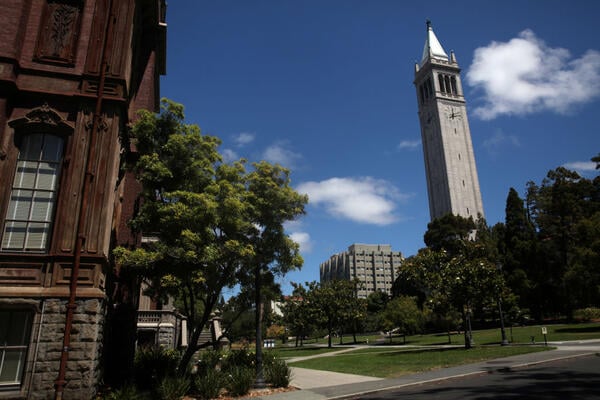
The “compliance reviews,” as the department called them, will target Stanford University and three University of California campuses: Berkeley, Los Angeles and Irvine.
In a statement announcing the investigations, the Justice Department wrote that the investigations are “just the beginning” of their efforts to “eliminate DEI” in college admissions.
“President Trump and I are dedicated to ending illegal discrimination and restoring merit-based opportunity across the country,” U.S. attorney general Pam Bondi wrote in the statement.
It’s unclear what prompted the investigations or what evidence the department has to support its suspicions of illegal racial preferences in admissions at the targeted institutions. Some affirmative action opponents have suggested that institutions that enrolled higher numbers of minority students last fall, the first class admitted after the Supreme Court decision, may have done so illegally.
Berkeley, UCLA and Irvine all reported upticks in the number of Black and Hispanic students enrolled in the Class of 2028 last fall: 45 percent of students who enrolled at a UC system campus this fall were underrepresented students of color, a 1.2 percent increase from 2023 and a record for the system.
Just hours before the DOJ announced its probe, the Department of Health and Human Services launched its own investigation into admissions practices at UCLA’s medical school, accusing it of illegally considering applicants’ race.
The UC system has been banned from considering race in admissions since 1996, when the state passed a referendum making the practice illegal at public institutions. That hasn’t stopped anti–affirmative action watchdogs from accusing the system of doing so secretly.
Last month, the newly formed public interest group Students Against Racial Discrimination filed a lawsuit accusing the system of practicing affirmative action behind closed doors, citing increases in Black and Hispanic enrollment at its most selective campuses, namely UCLA and Berkeley, and labeling recent admissions policies—like the decision in 2020 not to consider standardized test scores—proxies for affirmative action.
“Since Proposition 209 banned California’s public institutions from considering race in admissions, UC has implemented admissions practices to comply with it,” a UC spokesperson wrote in an email to Inside Higher Ed. “The UC undergraduate admissions application collects students’ race and ethnicity for statistical purposes only. This information is not shared with application reviewers and is not used for admissions.”
Stanford, unlike the UC schools, reported a marked decline in first-year underrepresented students last year, according to the university’s Common Data Set, released last month. Black enrollment at the university fell by nearly 50 percent, and Hispanic enrollment by 14.4 percent; meanwhile, white and Asian enrollment rose by 14.5 percent and 10 percent, respectively.
Luisa Rapport, Stanford’s director of media relations, said the university has not flouted the affirmative action ban, and that following the SFFA ruling, it “immediately engaged in a comprehensive and rigorous review to ensure compliance in our admissions processes.”
“We continue to be committed to fulfilling our obligations under the law, and we will respond to the department’s questions as it conducts this process,” she wrote in an email to Inside Higher Ed.
‘Just the Beginning’
Angel Pérez, president of the National Association for College Admission Counseling, said he’s heard “extraordinary concern” from admissions officers and deans in recent weeks that investigations could spread to their institutions. They don’t know how to prepare because “we have no idea what these compliance reviews even entail.”
What they do know, he said, is that investigations could throw their offices into chaos during the height of admissions season.
“These kinds of reviews are extremely disruptive. They’re also extremely expensive,” Pérez said. “There are some institutions that, you know, may not survive a compliance review given the legal costs.”
In an interview with Inside Higher Ed last month, Edward Blum, president of SFFA and the architect of the nationwide affirmative action ban, said he expected schools that reported higher enrollment of racial minorities in the fall to invoke legal scrutiny, both from the courts and the Trump administration. He said he believed a number of institutions could be “cheating” the SFFA ruling, including some that were not included in this first round of investigations: Yale, Duke and Princeton.
“So many of us are befuddled and concerned that in the first admissions cycle post-SFFA, schools that said getting rid of affirmative action would cause their minority admissions to plummet didn’t see that happen,” he said.
Some colleges are withholding demographic information about their incoming classes altogether. On Thursday, hours after the Justice Department probes were launched, Harvard admitted its Class of 2029 but did not release any information—including demographics, acceptance and yield rates, and geographic data—for the first time in more than 70 years.
In response to multiple questions from Inside Higher Ed about what the compliance reviews would entail or how the department plans to pursue its investigations into admissions offices, a Justice Department spokesperson referred to the initial statement announcing the investigations.
“No further comment,” he wrote via email.
There are some hints, though, as to what form a federal admissions investigation could take. In a December op-ed in The Washington Examiner outlining a plan that has reflected the Trump administration’s higher education agenda so far with uncanny accuracy, American Enterprise Institute fellow Max Eden suggested Bondi initiate “a never-ending compliance review” targeting Harvard University and others to enforce the SFFA ruling.
“She should assign Office of Civil Rights employees to the Harvard admissions office and direct the university to hold no admissions meeting without their physical presence,” Eden wrote. “The Office of Civil Rights should be copied on every email correspondence, and Harvard should be forced to provide a written rationale for every admissions decision to ensure nondiscrimination.”
For the four universities at the center of the investigations, this disruption could be especially pronounced right now, as colleges begin sending out acceptance letters and enter the busiest season for building their incoming classes.
“This could not come at a worse time. It is April; this is enrollment management season,” Pérez said. “For institutions to take the time, energy and resources to [respond to compliance reviews] means that they’re going to have a harder time enrolling their classes.”
‘Absurd’ Accusations
The Department of Justice is alleging that in the year and a half since the SFFA ruling, colleges have skirted the law by continuing to consider race in the admissions process. Those grounds make its targets particularly confusing, given that the University of California system hasn’t used affirmative action in admissions for nearly three decades.
In 1996, California voters passed Proposition 209, banning the practice at public colleges. In the application cycles immediately after, Black and Hispanic enrollment fell precipitously. Pérez said it took many years of experimenting with race-neutral admissions, financial aid and recruitment policies for UC campuses to bring Black and Hispanic enrollment back to their prior rates.
In the months following the SFFA decision, Pérez said college admissions professionals turned to California for lessons in how to maintain diversity without running afoul of the new law.
“Officials and admission professionals [at UC] have been helping other institutions across the United States comply with the Supreme Court decision,” he said. “They have actually served as leaders in this space. To accuse them of violating any law is absurd.”
Immigration and Customs Enforcement is detaining a Harvard Medical School research associate who’s a Russian native. One of Kseniia Petrova’s lawyers says the government is trying to deport her to Russia, where she faces possible arrest due to her “prior political activism and outspoken opposition to Russia’s invasion of Ukraine.”
Gregory Romanovsky, the lawyer, said in a statement that Petrova was trying to re-enter the U.S. on Feb. 16 at Boston’s Logan International Airport when a Customs and Border Protection officer discovered she “had not completed the required customs paperwork for a non-hazardous scientific sample she was bringing from an affiliated laboratory in France.”
“CBP was authorized to seize the item and issue a fine,” Romanovsky wrote. “Instead, they chose to cancel Ms. Petrova’s visa and detain her.”
Petrova remains in ICE custody in Louisiana. The Boston Globereported earlier on her detention.
Romanovsky wrote that “CBP improperly invoked their extensive immigration authority to impose a punishment grossly disproportionate to the situation. This overreach reflects broader concerns about the treatment of international scholars by U.S. immigration authorities.”
A spokesperson for the Department of Homeland Security, which includes ICE, told Inside Higher Ed in an email that Petrova was “detained after lying to federal officers about carrying biological substances into the country. A subsequent K9 inspection uncovered undeclared petri dishes, containers of unknown substances, and loose vials of embryonic frog cells, all without proper permits. Messages found on her phone revealed she planned to smuggle the materials through customs without declaring them. She knowingly broke the law and took deliberate steps to evade it.”
Harvard spokespeople didn’t provide an interview Friday about the situation or answer multiple emailed questions. In a brief email, the medical school’s media relations arm said, “We are monitoring this situation.”
Romanovsky has sued to restore Petrova’s visa.
“Ms. Petrova’s 1.5-month-long detention has caused significant disruption to both her professional and personal life,” Romanovsky said in his statement. “As a dedicated and highly respected researcher, her work is critical to scientific progress. We strongly urge ICE to release Ms. Petrova while her legal proceedings are ongoing.”
Immigration and Customs Enforcement has detained a University of Alabama doctoral student and Iranian native. A spokesperson told Inside Higher Ed in an email that the student “posed significant national security concerns” but didn’t clarify what those concerns were.
The Crimson White student newspaper and other media previously identified the student as Alireza Doroudi. As of Thursday evening, the ICE website listed Doroudi as in ICE custody but didn’t note where he was.
“ICE HSI [Homeland Security Investigations] made this arrest in accordance with the State Department’s revocation of Doroudi’s student visa,” a Department of Homeland Security spokesperson said in an email to Inside Higher Ed Thursday. The department, which includes ICE, didn’t provide an interview.
It’s unclear whether the detention is part of the Trump administration’s targeting of international students for alleged participation in pro-Palestinian protests, with immigration officers raiding their dorm rooms and revoking their visas.
The Crimson White said Doroudi was “reportedly arrested by ICE officers” at his home around 5 a.m. Tuesday. A statement from the university said the student, whom the university didn’t name, was detained off campus. The Crimson White also reported that—according to a message in a group chat including Iranian students—Doroudi’s visa was revoked six months after he came to the U.S., but the university’s International Student and Scholar Services arm said he could stay in the country as long as he maintained his student status.
The university didn’t provide Inside Higher Ed an interview Thursday or answer multiple written questions. Its emailed statement said, “Federal privacy laws limit what can be shared about an individual student.”
“International students studying at the University are valued members of the campus community, and International Student and Scholar Services is available to assist international students who have questions,” the statement said. “UA has and will continue to follow all immigration laws and cooperate with federal authorities.”
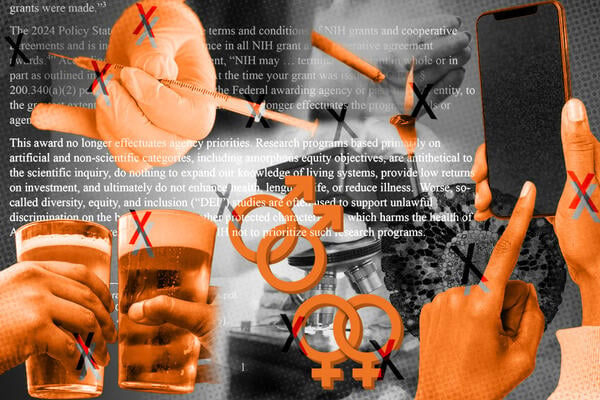
After months of uncertainty about the future of federally funded research, the National Institutes of Health this month started canceling grants it deemed “nonscientific.”
So far, that includes research into preventing HIV/AIDS; managing depressive symptoms in transgender, nonbinary and gender-diverse patients; intimate partner violence during pregnancy; and how cancer affects impoverished Americans.
In letters canceling the grants, the NIH said those and other research projects “no longer [effectuate] agency priorities.”
But the world’s largest funder of biomedical research didn’t stop there. The agency went on to tell researchers that “research programs based primarily on artificial and nonscientific categories, including amorphous equity objectives, are antithetical to the scientific inquiry, do nothing to expand our knowledge of living systems, provide low returns on investment, and ultimately do not enhance health, lengthen life, or reduce illness,” according to a March 18 letter sent to the University of Nebraska at Lincoln.
Katie Bogen, a Ph.D. student in the clinical psychology program at UNL, found out via the letter that NIH was canceling the $171,000 grant supporting her dissertation research. She was planning to explore the links between bisexual women’s disclosure of past sexual violence experience to a current romantic partner and subsequent symptoms, including traumatic stress, alcohol use and risk for violence revictimization within their current relationship. She started work on the project last May and was set to start data collection at the end of this month.
The NIH told Bogen and other researchers that “so-called diversity, equity, and inclusion studies are often used to support unlawful discrimination on the basis of race and other protected characteristics, which harms the health of Americans,” and that NIH policy moving forward won’t support such research programs.
“No corrective action is possible” for Bogen’s project, because “the premise of this award is incompatible with agency priorities, and no modification of the project could align the project with agency priorities.”
Last week, Bogen, who told Inside Higher Ed that she was inspired to pursue this topic because she herself is a bisexual woman with a trauma history, posted on TikTok about the termination letter.
Man this is actually very sad. Thinking about all the scientists today who are being told their scholarship isn’t important. It is. Your work matters. Let’s figure out how to move forward as a community of inquiry together.
She received thousands of comments and messages lamenting the loss of her work, with some characterizing the letter’s language as “appalling” and “horrifying.” Another commenter, who identified “as a bi femme who has survived the specific harm you’ve been studying,” told Bogen their “heart is broken” for her and other researchers “and all the folks who could be helped by the studies being defunded.”
Inside Higher Ed interviewed Bogen for more insight into her research and what the NIH’s abrupt cancellation of her and other projects means for public health and the future of scientific discovery.
(This interview has been edited for clarity and style.)
Q: What got you interested in researching intimate partner violence prevention for bisexual women? Why do you believe it’s an important line of scientific inquiry?
A: We know that bisexual women are at an elevated risk of experiencing intimate partner violence and sexual harm. We also know they have higher rates of post-traumatic stress disorder after these experiences compared to other people, and that they have greater and more problematic high-risk alcohol use afterwards. A key part of the process of meaning-making after the experience of violence is disclosure because of ambient bi-negativity. Bisexual people’s disclosure processes are often burdened by anti-bisexual prejudice.
For example, if you’re a bisexual woman who’s experienced violence at the hands of a woman partner, and you disclose that to a man partner that you’re seeing now, that man partner might say, “How much did she really hurt you?” If you’re a bisexual woman who’s now with a woman and you disclose violence perpetrated by a man, your woman partner might say something like, “This is what you get for dating men. We all know better than to date men.”
Katie Bogen is a fifth-year clinical psychology Ph.D. student at the University of Nebraska at Lincoln
So much of the disclosure research on sexual violence victims has been done with formal support providers like police or campus security or therapists, and then informal support providers like friends or parents or siblings. But very little research has documented the exposure process with intimate partners, which seems like a gap, given that intimate partners can then choose to sort of wield that insight or knowledge for good—or for harm.
I want to study how to intervene so that they don’t develop severe post-traumatic stress and problematic drinking. And this is particularly important because problem drinking is a risk factor for revictimization, and so bisexual women have all of these factors working against them that contribute to the cycle of revictimization and chronic victimization over their life span.
Q: Can you describe the process of applying for this NIH grant?
A: In 2022, I had just finished my second year of graduate school when a colleague of mine sent me a funding opportunity from the National Institute on Alcohol Abuse and Alcoholism that had a notice of special interest on the health of bisexual and bisexual-plus people.
We haven’t even been able to recruit our participants and I have none of the data.”
I worked very hard for a year on my application. It was the first grant I wrote as a [principal investigator]. I submitted to NIH, and a kind of miracle happened—I scored a 20 on this grant, which means my very first grant being written up as a PI got funded on the first round of peer review, which is almost unheard-of.
Q: How much of the project had you finished before receiving the termination notice?
A: I started work last May. I’ve hired and trained an entire lab of undergrads.
I’ve already done the literature reviews with the help of my undergraduate team and put together and tested the Qualtrics surveys. We set up backup safety measures in case the online surveys were infiltrated by bots or false respondents. The amount of literature I’ve read and the foundational conference presentations and analysis that I’ve run using other available data sets has been an immense labor.
It has been a productive 10 months. The things that this research has made possible for me—not only as a student and trainee, but as a scientist and as now a mentor helping to train the next generation of scholars—cannot be understated.
But we haven’t even been able to recruit our participants and I have none of the data. We were slated to begin data collection on March 31, and it’s a shame that will no longer happen.
Q: The NIH’s termination letter said your project is “antithetical to scientific inquiry” and “harms the health of Americans.” What was your reaction to that characterization of your work?
A: It hurts to hear that your work isn’t scientific. But it almost made me laugh because it’s so revelatory of the ignorance of folks in positions of power to claim that the work that I’m doing—that my colleagues are doing, that my mentors have taught me to do, that other folks in a field of doing—is ascientific and itself violence.
To me, the language in the letter is an example of DARVO, which is a rhetorical abuse tactic that stands for deny, attack, reverse victim and offender. They’re saying that what I’m doing isn’t scientific, and that they’re actually trying to uphold the standards of science, and by me focusing on these marginalized groups, I’m harming, quote unquote, real or regular Americans.
[The termination letter] almost made me laugh because it’s so revelatory of the ignorance of folks in positions of power to claim that the work that I’m doing … is ascientific and itself violence.”
Q: How does your work benefit society broadly?
A: Even if we take queerness out of the equation in this model, we are still garnering insight and understanding of the mechanism of post-traumatic stress, alcohol use and intimate partner violence for people in general. We’re getting a deeper understanding of how discussing sexual violence with a partner fundamentally changes that relationship, what is perceived as potentially acceptable in that relationship, norms of conflict within that relationship and sexual norms within that relationship.
Being able to investigate questions like this and enact scholarship like this could be a balm to some of the self-blame and shame that survivors are experiencing. And when research like this is able to reach health-care providers, public health improves, people become safer and we’re better able to protect folks from things like intimate partner violence, revictimization and sexual revictimization, which is endemic in our society.
Q: Given that this research grant was a central piece of your plan to complete your dissertation, how does its abrupt cancellation complicate your path toward degree completion?
A: I now have to work with my mentors to generate a new dissertation proposal and send it to my committee and get it reapproved, which means I have to access data sets at my institution that have either already been collected or that are safe from future rounds of cuts like this.
I believe I’m being intimidated [by the NIH] into taking the data that are already available, rather than collecting data with more specificity, which means the accurate data answering these research questions is tampered. I don’t necessarily want to go to a data set that was collected on, for example, masculinity and violence perpetration, and try and string together a similar enough model to pass the proxy of what I wanted. That’s poor scholarship.
It’s something a lot of scholars who are dealing with this crisis are facing now. How does that further marginalize the populations we’re aiming to serve if we’re trying to presume or assume that data on different populations? It creates this ethical and academic quandary.
Q: How might this termination affect your career in the long term?
A: I have a demonstrated record of receiving grant funding on my own, which is a difficult thing to demonstrate when you’re still a trainee or you’re still a student. It makes folks more competitive for postdocs, research-oriented internships or research jobs at bigger research institutions down the line. If I wanted to work at an academic hospital, it shows that I’ll be able to bring in grant funding.
But now I have this really sad line on my CV. I had to write several asterisks that the grant closed early, and I just have to hope that people who are reviewing my CV later know what that means—that the grant closed early, not because of my failure to complete the research, but because we have the infiltration of antiscientific thought in the federal government that forced a number of grants to close early.
It doesn’t stop at political science, psychology or even economics. It has legs and encroaches and creeps into biophysiological sciences and neuropsychology. It leaves no science safe.”
Q: How does your situation speak to any concerns you might have about the broader environment for science in this country right now?
A: We’re in this identity war moment, and it’s not based on anything but people’s own prejudice and bias and a sense of being victimized because they no longer have access to the power they used to. This is an attempt to recollect and to narrow who has that power, which has frightening implications across the board.
It doesn’t stop at political science, psychology or even economics. It has legs and encroaches and creeps into biophysiological sciences and neuropsychology. It leaves no science safe.
The Tufts student, Rumesya Ozturk, was abducted by plainclothes ICE agents on the street. At a press conference Thursday, U.S. secretary of state Marco Rubio said that any international student whose visa was revoked could be forcefully deported in such a manner.
“Once you’ve lost your visa, you’re no longer legally in the United States,” he said. “If you come to the U.S. as a visitor and create a ruckus for us, we don’t want it.”
Axios also reported that the administration has discussed using a small arm of the Immigration and Customs Enforcement office to strip colleges they deem to be “pro-Hamas” of their ability to enroll international students.
“You can have so many bad apples in one place that it leads to decertification of the school,” an unnamed White House official told Axios. “I don’t think we’re at that point yet. But it is not an empty threat.”
The Student and Exchange Visitor Program normally investigates student visa fraud and international student recruiting practices, sometimes withdrawing colleges’ certification to enroll foreign students if there’s evidence that students are primarily enrolling as a pretext to reside and work in the U.S. instead of earn a degree.
Now, the SEVP may be tasked with a very different mandate: punishing colleges that have been the site of large pro-Palestine protests.
“What you’re going to see in the not-too-distant future is the universities … not doing anything to stop these demonstrations in support of Hamas … we can stop approving student visas for them,” a senior Justice Department official told Axios. “That’s one of their biggest cash cows, foreign students. That’s a meaningful source of revenue.”