Tag: Events

  • Judge Orders Education Dept. to Restore Teacher Prep Grants

    Judge Orders Education Dept. to Restore Teacher Prep Grants

    A federal judge in Maryland this week ordered the U.S. Department of Education to reinstate numerous grants that support teacher-preparation programs.

    The department canceled the $600 million in grants last month as part of a wider effort to slash federal funding and eliminate programs that promote diversity, equity and inclusion. In response, the American Association of Colleges for Teacher Education, the National Center for Teacher Residencies and the Maryland Association of Colleges for Teacher Education challenged the cuts, arguing in a lawsuit that the grant terminations were illegal.

    On Monday, U.S District Judge Julie Rubin ordered the department to restore funding for the Supporting Effective Educator Development program, the Teacher Quality Partnership program and the Teacher and School Leader incentive program within five business days. That order comes after a federal judge last week directed the department to reinstate canceled grants in eight states.

    “We are thrilled that the court has ruled in favor of preserving funding for TQP, SEED, and TSL grants, which have a transformative impact on our nation’s education system,” AACTE president and CEO Cheryl Holcomb-McCoy said in a news release.

    The order also blocks the department from terminating any other TQP, SEED or TSL grant awards “in a manner this court has determined is likely unlawful as violative of the Administrative Procedure Act,” which instructs courts to “hold unlawful and set aside final agency actions” deemed “arbitrary, capricious, an abuse of discretion, or otherwise not in accordance with law.”

    The judge asked both the department and the plaintiffs to file a status report within seven business days showing compliance with the order.

    Source link

  • Results of Men’s March Madness Bracket Based on Academics

    Results of Men’s March Madness Bracket Based on Academics

    Michael Allio/Icon Sportswire/Getty Images

    No shame if you forgot National Collegiate Athletic Association’s Division I basketball championships were coming up—after all, this March has been filled with more than enough madness in higher ed, even without paying attention to basketball.

    Nonetheless, the biggest event in college sports kicks off this week. If you’ve been a little too concerned with the news cycle to fill out your bracket, we’re here to help. Every year since 2006, Inside Higher Ed has determined which teams would win in the men’s and women’s tournaments if the results were based on academic, rather than athletic, performance.

    To determine the winners, we used the NCAA’s key academic performance metric, known as the academic progress rate, for the 2022–23 academic year, the most recent data available. The academic progress rate measures student athlete retention and academic eligibility, though some outside experts have said the metric paints an imperfect picture of a program’s academic performance.

    (Full disclosure, we did use this metric to determine the winners of the First Four matchups, even though two of the four games will be determined before publication Wednesday morning.)

    If two colleges had the same APR, we used 2023–24 graduation success rate, the proportion of athletes who graduated within six years of entering an institution, as tiebreakers. If teams tied again, we turned to the team’s six-year federal graduation rates, which is a more inclusive metric.

    Luckily, none of the teams tied in all three categories. Still, there were a handful of nail-biting victories. For instance, the Clemson University Tigers tied the Liberty University Flames on both the academic progress and graduate success rates. But when looking at the overall graduation rate, Clemson won by one point. After besting the Flames in the Final Four, the Tigers beat out the University of Louisville to win the whole thing.


    Men's 2025 Academic Performance Bracket Fullscreen

    Now, the Inside Higher Ed bracket likely won’t win you any money. But there’s no bad time to celebrate the academic achievements of student athletes alongside their athletic prowess.

    Congrats, Clemson Tigers!


    Source link

  • Harvard Tuition-Free for Families With Incomes Up to $200K

    Harvard Tuition-Free for Families With Incomes Up to $200K

    Starting next academic year, Harvard will offer free tuition to students from households that earn $200,000 or less a year, according to a Monday announcement from university leaders.

    In addition, students with household incomes of $100,000 or less per year will attend Harvard for free, with the university covering not just tuition costs but food, housing, health insurance and travel expenses. Those students will also receive a $2,000 start-up grant in their first year and a $2,000 launch grant junior year to support their transitions to and from college.

    “Putting Harvard within financial reach for more individuals widens the array of backgrounds, experiences, and perspectives that all of our students encounter, fostering their intellectual and personal growth,” Harvard president Alan M. Garber said in the announcement. “By bringing people of outstanding promise together to learn with and from one another, we truly realize the tremendous potential of the University.”

    The changes make roughly 86 percent of American families eligible for Harvard financial aid, according to the announcement. The move comes at a time when the Ivy League institutions are under intense scrutiny from the Trump administration and lawmakers. Harvard joins a slew of other universities, including some highly selective institutions like the University of Pennsylvania and the Massachusetts Institute of Technology, that have unveiled expansive new financial aid plans.

    Source link

  • Why Every American Has a Stake in Columbia’s Fate (opinion)

    Why Every American Has a Stake in Columbia’s Fate (opinion)

    March 13 was a watershed day in the annals of American higher education and the history of America’s commitment to freedom and limited government. On that day, the Trump administration issued an edict telling Columbia University, a private institution, how to function.

    The people who founded the American republic must be turning over in their graves.

    Such a bold assertion of government power would be more familiar to people in many other nations. But in the United States, this is a shocking development and a warning of what is in store, not just for higher education, but for the entire country.

    What is happening at Columbia is an initial test of the Trump administration’s ambition to curb institutional autonomy, limit and punish dissent, and make life miserable for anyone who does not toe their line. That’s why each of us, whether or not we work in higher education, has a stake in Columbia University’s fate.

    Let’s face it: Universities are what people in the Departments of Defense or Homeland Security might call “soft targets.” Soft targets are easily accessible, relatively unprotected and therefore vulnerable to attack.

    A concerted, decades-long campaign against higher education by conservative critics, combined with excesses in universities’ quests to make themselves more inclusive and just, have eroded public support for and trust in America’s colleges and universities, which are now at historic lows.

    Public disdain for private, prestigious institutions like Columbia is high and growing. Critics call them snobbish, arrogant and out of touch.

    Some have even laid the blame for the rise of the MAGA movement on their doorstep.

    Like the successful, decades-long right-wing campaign to take over the courts in this country, which has wreaked havoc in the lives of ordinary Americans, the campaign against Columbia will, if similarly successful, prove costly well beyond that New York City campus.

    What is unfolding there is a testing ground for efforts in other sectors of American life.

    Acting in a high-handed and arbitrary manner in its dealings with Columbia paves the way for the government to carry out similar abuses of power elsewhere. Attacking academic freedom is a stalking horse for attacking freedom of speech and other freedoms.

    It is important to recall that Trump’s campaign against Columbia didn’t start on March 13. It began earlier with the cancellation of $400 million in federal grants and contracts and the move by Immigration and Customs Enforcement to arrest and detain Mahmoud Khalil, a green card holder and recent graduate who helped lead pro-Palestinian protests on campus.

    But the March 13 letter took it to new levels.

    The first thing to note about that letter was that it came from officials in the Departments of Education and Health and Human Services and the General Services Administration. They joined not only in asserting their right to intervene at Columbia under Titles VI and VII of the 1964 Civil Rights Act but to remind the university of the Trump administration’s power to cripple it financially.

    Title VI prohibits discrimination on the basis of race, color or national origin in programs and activities receiving federal financial assistance. Title VII makes it unlawful for employers to discriminate based on race, color, religion, sex or national origin.

    Since the act’s passage, it has been clear that alleged violators of Title VI must be afforded due process before federal funds can be withheld. That guarantees fairness and impartiality in investigations and ensures that enforcement actions will not be precipitous.

    The March 13 letter, with its demand for “immediate next steps that we regard as a precondition for formal negotiations regarding Columbia University’s continued financial relationship with the United States government,” is a chilling reminder of what happens when a government seeks to wield its formidable power without respecting the due process rights of those it targets.

    And if it gets away with practicing what one commentator calls “regulation by intimidation” at Columbia, the administration will be emboldened to do more of the same, and not just in higher education.

    The March 13 letter touches on matters colleges and universities routinely determine for themselves. For example, it demands that the university complete disciplinary proceedings against students who were involved in taking over a campus building last year and who participated in encampments in support of Palestinians. And it specifies that penalties of “expulsion or multi-year suspension” should be imposed.

    The same day it received the Trump administration’s letter, the university announced that it was expelling or suspending some students involved in the Hamilton Hall takeover and temporarily revoking the diplomas of other students who had since graduated.

    In addition, the March 13 letter directs Columbia to “Abolish the University Judicial Board (UJB) and … empower the Office of the President to suspend or expel students.”

    The intrusiveness of the letter extends to telling Columbia that it must ban the wearing of masks on campus and “formalize, adopt, and promulgate a definition of antisemitism” (it specifically cites the definition used in Trump’s Executive Order 13899). It even demands that Columbia’s Department of Middle East, South Asian and African Studies be put into “academic receivership” so that its faculty can no longer make hiring and curriculum decisions.

    That is the administration’s way of forcing the university to punish the department, some of whose faculty supported the encampment movement. Receivership means someone from outside the department would be appointed to make decisions for its faculty. It is a rarely used and nuclear response to departmental dysfunction.

    If Columbia were to do what the March 13 letter asks, it would be waving the white flag of surrender to any pretense that it will respect and protect academic freedom, the most prized and essential aspect of teaching and research in higher education. That would send a powerful and chilling signal about the administration’s ability to ensure freedom means the freedom to say and do what it prescribes.

    Taken together, the provisions in the March 13 letter amount to an effort to put the entire university into a kind of receivership. Beyond the world of higher education, receivership involves a court appointing “an independent ‘receiver’ or trustee to manage all aspects of a troubled company’s business. The company’s principals remain in place, but they have little authority over the company for the duration of the receivership.”

    The March 13 letter signals that intention when it calls for the development of a plan of “long-term structural reforms that will return Columbia to its original mission of innovative research and academic excellence.”

    “Innovation” and “excellence” are the watchwords for colleges and universities, businesses, artistic enterprises and individuals seeking to lead a free life. But since the founding of the republic, this country has been guided by the belief that the government would not be in the business of saying what could count as innovative and excellent in private life.

    If Americans stay on the sidelines as the current administration tries to bring Columbia to its knees, we will not only be damaging higher education, we will also be turning the founders’ vision of the relationship between the government and the people on its head.

    Austin Sarat is the William Nelson Cromwell Professor of Jurisprudence and Political Science at Amherst College.

    Source link

  • U of Delaware Business School Gifted a Historic $71.5M

    U of Delaware Business School Gifted a Historic $71.5M

    The University of Delaware has received a $71.5 million gift, the largest single donation in the university’s history, according to a news release Monday.

    The donation is from alumni Robert Siegfried Jr. and Kathleen (Horgan) Siegfried and will benefit the institution’s Alfred Lerner College of Business and Economics.

    As owners of the Siegfried Group LLP, an entrepreneurial leadership organization that advises financial executives, the couple have long been key donors to the university, but UD president Dennis Assanis said this gift in particular would be “transformative.”

    “The Siegfrieds’ generosity will significantly advance Lerner’s critical mission of preparing the next generation of leaders, change-makers and entrepreneurs to make an impact in the rapidly evolving world of business and economics,” Assanis said.

    UD plans to put the funding toward a state-of-the-art, student-centric learning space with modern classrooms, research and teaching labs, a student-run cafe, and an auditorium. The money will also be spent on developing a new Siegfried Institute for Leadership and Free Enterprise where students can develop as business leaders and study “the critical role [of] basic principles of limited government, rule of law, and free enterprise.”

    The university will commission the design process for Siegfried Hall this spring, with a goal of breaking ground within the next four years, the news release said.

    Source link

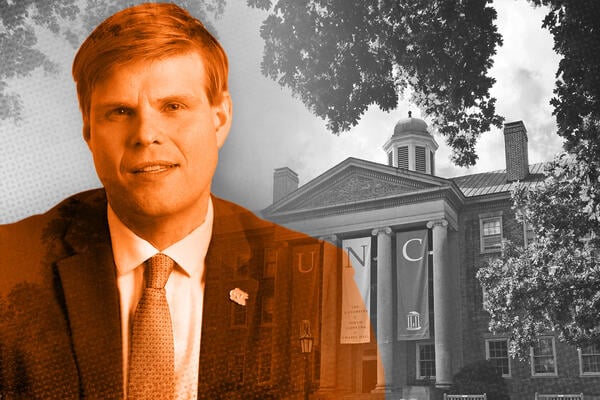
  • Resignations, Disagreements With Dean Roil UNC Civics School

    Resignations, Disagreements With Dean Roil UNC Civics School

    Multiple faculty members connected with the University of North Carolina at Chapel Hill’s controversial school that had been billed as promoting civil discourse have resigned from leadership roles, citing strong disagreements with the dean who appointed them.

    One such professor went so far as to call the School of Civic Life and Leadership an “unmitigated disaster.” The recent group of resignations adds to past departures by professors who said the school’s earlier focus had shifted and narrowed under Jed Atkins, its first permanent dean. Much of the current controversy centers on Atkins’s handling of searches for new faculty.

    Atkins, who ran Duke University’s Civil Discourse Project and chaired its classical studies department before moving to UNC a year ago, defended the hiring procedures in a statement to Inside Higher Ed. He didn’t provide an interview.

    The school’s birth was mired in controversy. It’s an example of the civil discourse centers—which critics have called conservative centers—that higher education leaders and Republican state lawmakers have been establishing at public universities. For more than two years, debate over the UNC school has been tinged by accusations that its supporters are motivated by conservative politics and its opponents by leftism.

    But the recent resignation letters from the school’s former supporters suggest disagreements that resist characterization as a simple left-right divide. The criticism of the faculty search procedures involves allegations that faculty input, including from the school’s search committee and advisory board members, was disregarded.

    The university’s media relations arm said that Chapel Hill policy requires four full professors to vote in faculty hirings. The advisory board contained such professors, who predated the school’s creation. But the Chapel Hill spokespeople said that in “all faculty appointment matters, the votes of faculty are advisory to the dean,” whose recommendation eventually goes to the universitywide appointments, promotion and tenure committee that advises the provost. The provost has hiring power, though the Chapel Hill Board of Trustees must approve awarding tenure.

    Inger S. B. Brodey, an English and comparative literature professor whom Atkins chose as one of two associate deans, kicked off the recent round of resignations. She wrote to Atkins on Feb. 28 that she still believes strongly in the school’s “original mission, which, as I understand it, includes an emphasis on civil discourse across difference, preparation for citizenship and fruitful lives through studying global great books, promoting scientific literacy and assembling a diverse faculty from many disciplines.”

    However, Brodey wrote, the school “has lost sight of its mission in all these areas and is unlikely to make the lasting positive impact that I and the other inaugural faculty had hoped for. For this and other reasons, I hereby resign as associate dean.”

    Inside Higher Ed obtained the email and other documents mentioned in this story from sources who were either anonymous or whose identities are known but who requested anonymity.

    In January, before that resignation email, Brodey sent Atkins a much longer message on why she was resigning from a faculty search committee. Brodey confirmed the authenticity of both emails to Inside Higher Ed.

    “While it may be within the dean’s power to intervene at every stage of the search and add/remove names, overruling the opinions of the committee, I have never seen this power executed outside of SCiLL,” wrote Brodey, using the school’s acronym. She serves in multiple departments of Chapel Hill.

    “I don’t have any confidence that the search committee will have any actual effect on the final roster of individuals hired,” she wrote. She also said, “I don’t think this list differs in any substantial way from the list of concerns David enumerated in our last meeting, when he resigned from the search.”

    That’s a reference to David Decosimo, SCiLL’s remaining associate dean. Asked for comment, Decosimo replied in an email, “I’m on parental leave this semester, so won’t comment at this time.”

    This faculty search, which began in the fall, wasn’t small. Atkins has said it resulted in eight offers to candidates. Brodey was even more critical of the process in an email to The Daily Tar Heel, which reported earlier on her resignation. She told the student newspaper that there were “improprieties, slander, vindictiveness and manipulation” surrounding the search.

    Dustin Sebell, a SCiLL professor who chaired the search committee (the three members were him, Brodey and Decosimo), disagreed with Brodey in an email. Sebell wrote that Atkins hadn’t overruled the committee.

    “You personally recorded the names of the 20 finalists on behalf of the search committee and emailed them to me,” Sebell wrote. He said, “The committee was fully aware that we had only 16 spots for on campus interviews … it was a mathematical certainty that the dean would exercise some discretion in the selection of finalists from our list.”

    On March 7, Jon Williams, a Chapel Hill economics professor, resigned from SCiLL’s advisory board in an email to Atkins, Chapel Hill chancellor Lee Roberts, provost Chris Clemens and vice provost for faculty affairs Giselle Corbie. Williams alleged that Atkins had ignored all advice and that he felt like he was “nothing more than one of four warm bodies to achieve the dean’s shadowed objectives.”

    “There is no need for an advisory board if the dean ignores any advice that isn’t simply confirmation,” Williams wrote. “More troubling, over the last six weeks, I’ve seen incivility and dysfunction, biased and unfair processes, a complete disregard for governance, and a willingness to deceive and misrepresent that is unlike anything I’ve witnessed in my 15 years in academia.”

    Williams ended with, “I cannot see how SCiLL will emerge from this troubled beginning without new leadership.” He declined an interview with Inside Higher Ed, writing in an email, “I will confirm that I resigned and that my concerns center around” Atkins.

    He wrote in his resignation email that he still appreciates “the need for a place on campus for students to learn how to critically evaluate and debate the most challenging and controversial topics. Simply put, I’m often in a tiny minority among faculty in my views and opinions, so I appreciate how difficult students may find it to engage in open discussion.”

    Three days after Williams’s resignation from the advisory board, Fabian Heitsch, a physics and astronomy professor, followed suit with his own email to Atkins, Roberts, Clemens and Corbie. Heitsch specifically mentioned issues with personnel decisions, but he didn’t provide many specifics or respond to Inside Higher Ed’s requests for comment.

    “In my year of service on the advisory board, I have witnessed its advice on personnel decisions being ignored on three separate occasions,” Heitsch wrote. He said, “It seems as if the advisory board is being used only as a formality instead of as a body of experience and strategy.”

    Heitsch said the advisory board “is to provide formal advice to the dean and director. As I understand it, formal advice is not limited to providing the votes to confirm leadership’s decisions.” He wrote that he still supports the school’s “original mission” and that he “will gladly continue to serve as a curricular fellow.”

    Not the First Resignations

    These weren’t the first Chapel Hill faculty who—having come to the university before the school’s creation—affiliated themselves with it only to then reduce their involvement or fully withdraw after Atkins’s appointment, citing a changed direction for the school. One who stepped back last year was Matthew Kotzen, Chapel Hill’s philosophy department chair.

    But the newer resignations have come alongside stronger denunciations—at least publicly. And Kotzen himself increased his past public criticism in a statement to Inside Higher Ed.

    “The original mission of SCiLL was to model and to teach essential skills related to productive engagement with democratic civic institutions, including respectful dialogue across ideological difference,” Kotzen wrote. “Unfortunately, it has become increasingly clear that Dean Atkins is committed to none of those values.”

    Kotzen said Atkins “has an extremely narrow conception of acceptable viewpoints and approaches and has demonstrated almost no openness to feedback from others on the faculty, including those that he himself selected for their role. Dean Atkins has fostered a dysfunctional anti-intellectual culture at SCiLL that rewards hostility, dishonesty and self-righteousness in the pursuit of his ideological and personal aims. That disqualifies him from holding any leadership position at UNC.”

    Atkins told Inside Higher Ed in an email that “the advisory committee’s function in faculty searches is to help assess the merits of our finalists and to cast an advisory vote on each finalist.” He wrote, “In SCiLL’s most recent national search, our faculty rigorously evaluated our applicants’ strengths and promise.”

    “Finalists traveled to campus from three continents, gave teaching demonstrations to students, presented on their research and engaged with our faculty in more informal settings,” Atkins said. “After these campus interviews, SCiLL’s tenure-line faculty met and voted on our finalists; they recommended a strong slate of candidates for appointment.”

    Danielle Charette James, a SCiLL assistant professor, told Inside Higher Ed in an email that “our process was highly collaborative, and the candidates who received offers earned overwhelming, and in some cases unanimous, support from SCiLL’s core faculty.”

    Chapel Hill’s media relations arm emailed a statement to Inside Higher Ed saying, “SCiLL’s faculty searches honored all university rules and procedures. Applicants were advanced on the basis of merit and fit with the advertised positions. We are looking forward to welcoming an outstanding group of new faculty to campus next fall.”

    ‘Dress Rehearsal’

    Back in January 2023, Chapel Hill’s Board of Trustees passed a resolution asking the campus administration to “accelerate its development of a School of Civic Life and Leadership.” Faculty said they were caught off guard because they didn’t know a whole school was in development. David Boliek, then chair of Chapel Hill’s board, called it an effort to “remedy” a shortage of “right-of-center views” on campus. Clemens, the provost and a self-described conservative, promoted the school.

    In the fall of 2023, the Republican-controlled State Legislature passed a law that required Chapel Hill to establish the school. The campus couldn’t back out even if it desired to. Clemens had the final say in hiring Atkins as dean, at least before the Chapel Hill board signed off.

    And despite the past faculty objections, current Chapel Hill professors, including Brodey, Kotzen and Williams, affiliated with the initiative.

    But faculty aren’t the only ones critiquing the recent faculty search. Clemens, who didn’t return requests for comment for this article, at one point ordered a stop to the faculty searches.

    In a January email to Atkins, Clemens said there were financial limitations. Instead of progressing toward hiring tenure-track faculty, Clemens said, “SCiLL should initially focus on hiring teaching track professors to support large enrollments in the general education curriculum.” So, he said, he was canceling the searches.

    The provost also seemingly referenced issues beyond budgets.

    “Your search committee and voting faculty for these searches is small; smaller even than the number of people you were authorized to hire,” Clemens wrote. “Moreover, some of them have just arrived in Chapel Hill. All new teams must learn to work together, and this ‘dress rehearsal’ has hopefully been a learning experience for all.”

    He then wrote, with original emphasis included, “I want to emphasize how important it is for a School of Civic Life and Leadership to serve as a model of civic life and civil discourse. Given the intense scrutiny and attention on this school, everything you do—including faculty searches—must be exemplary, both to give the candidates confidence in SCiLL and to give the rest of the university confidence in those you hire. I will address how we can fulfill those expectations for future searches in collaboration with SCiLL leadership and with HR.”

    Clemens sent that on a Friday. But by the following Monday, he said the searches were back on after Chancellor Roberts “committed sufficient funds.”

    The criticism of Atkins continues. On Monday, Atkins accepted Williams’s resignation and rebutted his critiques. Williams responded in an email by saying he resigned to protect his reputation, “because SCiLL is currently an unmitigated disaster.”

    He accused Atkins of “hiding behind accusations that wokeness has derailed your efforts,” something Williams called “absolutely ridiculous given that you completely lost the support of folks like myself that have spent a decade battling it on campus.”

    “It’s your failure alone,” Williams wrote. “Time to own it.”

    Source link

  • Publishers Adopt AI Tools to Bolster Research Integrity

    Publishers Adopt AI Tools to Bolster Research Integrity

    The perennial pressure to publish or perish is intense as ever for faculty trying to advance their careers in an exceedingly tight academic job market. On top of their teaching loads, faculty are expected to publish—and peer review—research findings, often receiving little to no compensation beyond the prestige and recognition of publishing in top journals.

    Some researchers have argued that such an environment incentivizes scholars to submit questionable work to journals—many have well-documented peer-review backlogs and inadequate resources to detect faulty information and academic misconduct. In 2024, more than 4,600 academic papers were retracted or otherwise flagged for review, according to the Retraction Watch database; during a six-week span last fall, one scientific journal published by Springer Nature retracted more than 200 articles.

    But the $19 billion academic publishing industry is increasingly turning to artificial intelligence to speed up production and, advocates say, enhance research quality. Since the start of the year, Wiley, Elsevier and Springer Nature have all announced the adoption of generative AI–powered tools or guidelines, including those designed to aid scientists in research, writing and peer review.

    “These AI tools can help us improve research integrity, quality, accurate citation, our ability to find new insights and connect the dots between new ideas, and ultimately push the human enterprise forward,” Josh Jarrett, senior vice president of AI growth at Wiley, told Inside Higher Ed earlier this month. “AI tools can also be used to generate content and potentially increase research integrity risk. That’s why we’ve invested so much in using these tools to stay ahead of that curve, looking for patterns and identifying things a single reviewer may not catch.”

    However, most scholars aren’t yet using AI for such a purpose. A recent survey by Wiley found that while the majority of researchers believe AI skills will be critical within two years, more than 60 percent said lack of guidelines and training keep them from using it in their work.

    In response, Wiley released new guidelines last week on “responsible and effective” uses of AI, aimed at deploying the technology to make the publishing process more efficient “while preserving the author’s authentic voice and expertise, maintaining reliable, trusted, and accurate content, safeguarding intellectual property and privacy, and meeting ethics and integrity best practices,” according to a news release.

    Last week, Elsevier also launched ScienceDirect AI, which extracts key findings from millions of peer-reviewed articles and books on ScienceDirect and generates “precise summaries” to alleviate researchers’ challenges of “information overload, a shortage of time and the need for more effective ways to enhance existing knowledge,” according to a news release.

    Both of those announcements followed Springer Nature’s January launch of an in-house AI-powered program designed to help editors and peer reviewers by automating editorial quality checks and alerting editors to potentially unsuitable manuscripts.

    “As the volume of research increases, we are excited to see how we can best use AI to support our authors, editors and peer reviewers, simplifying their ways of working whilst upholding quality,” Harsh Jegadeesan, Springer’s chief publishing officer, said in a news release. “By carefully introducing new ways of checking papers to enhance research integrity and support editorial decision-making we can help speed up everyday tasks for researchers, freeing them up to concentrate on what matters to them—conducting research.”

    ‘Obvious Financial Benefit’

    Academic publishing experts believe there are both advantages—and down sides—of involving AI in the notoriously slow peer-review process, which is plagued by a deficit of qualified reviewers willing and able to offer their unpaid labor to highly profitable publishers.

    If use of AI assistants becomes the norm for peer reviewers, “the volume problem would be immediately gone from the industry” while creating an “obvious financial benefit” for the publishing industry, said Sven Fund, managing director of the peer-review-expert network Reviewer Credits.

    But the implications AI has for research quality are more nuanced, especially as scientific research has become a target for conservative politicians and AI models could be—and may already be being—used to target terms or research lawmakers don’t like.

    “There are parts of peer review where a machine is definitely better than a human brain,” Fund said, pointing to low-intensity tasks such as translations, checking references and offering authors more thorough feedback as examples. “My concern would be that researchers writing and researching on whatever they want is getting limited by people reviewing material with the help of technical agents … That can become an element of censorship.”

    Aashi Chaturvedi, program officer for ethics and integrity at the American Society for Microbiology, said one of her biggest concerns about the introduction of AI into peer review and other aspects of the publishing process is maintaining human oversight.

    “Just as a machine might produce a perfectly uniform pie that lacks the soul of a handmade creation, AI reviews can appear wholesome but fail to capture the depth and novelty of the research,” she wrote in a recent article for ASM, which has developed its own generative AI guidelines for the numerous scientific journals it publishes. “In the end, while automation can enhance efficiency, it cannot replicate the artistry and intuition that come from years of dedicated practice.”

    But that doesn’t mean AI has no place in peer review, said Chaturvedi, who said in a recent interview that she “felt extra pressure to make sure that everything the author was reporting sounds doable” during her 17 years working as an academic peer reviewer in the pre-AI era. As the pace and complexity of scientific discovery keeps accelerating, she said AI can help alleviate some burden on both reviewers and the publishers “handling a large volume of submissions.”

    Chaturvedi cautioned, however, that introducing such technology across the academic publishing process should be transparent and come only after “rigorous” testing.

    “The large language models are only as good as the information you give them,” she said. “We are at a pivotal moment where AI can greatly enhance workflows, but you need careful and strategic planning … That’s the only way to get more successful and sustainable outcomes.”

    Not Equipped to Ensure Quality?

    Ivan Oransky, a medical researcher and co-founder of Retraction Watch, said, “Anything that can be done to filter out the junk that’s currently polluting the scientific literature is a good thing,” and “whether AI can do that effectively is a reasonable question.”

    But beyond that, the publishing industry’s embrace of AI in the name of improving research quality and clearing up peer-review backlogs belies a bigger problem predating the rise of powerful generative AI models.

    “The fact that publishers are now trumpeting the fact that they both are and need to be—according to them—using AI to fight paper mills and other bad actors is a bit of an admission they hadn’t been willing to make until recently: Their systems are not actually equipped to ensure quality,” Oransky said.

    “This is just more evidence that people are trying to shove far too much through the peer-review system,” he added. “That wouldn’t be a problem except for the fact that everybody’s either directly—or implicitly—encouraging terrible publish-or-perish incentives.”

    Source link

  • International Students Navigate Escalating Threats

    International Students Navigate Escalating Threats

    International students across the country are on edge after a week of arrests, deportations and escalating threats from the Trump administration.

    So far the administration’s sights have been set primarily on Columbia University in New York. On March 8, immigration officials arrested recent graduate Mahmoud Khalil, intending to strip him of his green card and deport him for his role in pro-Palestinian campus protests last year. Over the next week, Department of Homeland Security agents raided students’ dorm rooms, arresting one international student and prompting another to flee to Canada.

    Elora Mukherjee, a law professor at Columbia and director of its Immigrants’ Rights Clinic, said international students have been flocking to the clinic for guidance: on whether their visas could suddenly be revoked, or if they should avoid traveling, delete their social media accounts or move off campus to make it harder for immigration officials to find them.

    She said she’s never seen anything like it.

    “Our clinic has been inundated with requests for legal consultation,” she said. “There is a palpable sense of fear among international students on campus.”

    Mukherjee said she’s been trying to quell international students’ anxieties. But in the wake of what she called an “unprecedented assault on due process, First Amendment rights and basic human decency,” she isn’t sure how.

    “They are worried about what may happen to their student visas. They are concerned that they may not be able to complete their degree programs if they are targeted. They’re wondering how they can make changes to their daily life to reduce the risk,” she said. “I don’t know what I can reassure them of right now.”

    Chief among the threats facing international students is the equation of protest activity and other protected speech with “terrorist activity.” In an interview with The Free Press last Monday, an unnamed White House official said that protesting made Khalil a national security threat, justifying his deportation. That strategy, the official added, is the administration’s “blueprint” for deporting other international students.

    In a post on Truth Social last Tuesday, Trump said that Khalil’s arrest was “the first of many,” calling international student protesters “not students, [but] paid agitators.”

    “We will find, apprehend, and deport these terrorist sympathizers from our country—never to return again,” Trump wrote. “We expect every one of America’s Colleges and Universities to comply.”

    Stephen Yale-Loehr, a retired Cornell University law professor who specializes in immigration law and international students in particular, said ICE officials’ activity at Columbia is the administration’s opening salvo in a battle against two of its most frequently invoked bogeymen: higher education and immigrants.

    “This administration has declared war on immigrants broadly and international students specifically,” he said.

    That war is currently centered on Columbia but is likely to spread across higher ed. On Sunday, Secretary of State Marco Rubio told Face the Nation that the administration plans to continue arresting and deporting international student activists. He added that the government is reviewing and revoking more student visas “every day.”

    It’s not clear if the Trump administration’s argument will hold up in court. If it does, experts say it would give the executive nearly unchecked power to deport noncitizens for disfavored speech, and there’s likely to be a fierce legal battle over that question. But international students have very few legal protections, Yale-Loehr said, and the administration has ample leeway to justify deporting them.

    “International students have the same constitutional rights as citizens, but immigration statutes are very broad and there are many grounds for deportability that could trip you up, even as a green card holder,” Yale-Loehr said. One of those potential grounds, he said, is donating to an overseas charity that the State Department deems suspicious or linked to terrorist activity—as it’s done with many charities for Palestinian children and families affected by the destruction of Gaza.

    “It’s easy for someone to unintentionally or unknowingly violate our immigration laws that way and get put into the deportation process,” Yale-Loehr said.

    When asked whether Columbia would protect current students approached by ICE or detained on campus, a university spokesperson pointed to a statement from earlier this month and said students were encouraged to familiarize themselves with university protocol in such cases.

    “Columbia is committed to complying with all legal obligations and supporting our student body and campus community,” the statement reads. “We are also committed to the legal rights of our students and urge all members of the community to be respectful of those rights.”

    The Trump administration is also considering instituting a travel ban similar to the one implemented during his first administration—except greatly expanded, from seven countries to 43, according to an internal memo circulating among media outlets.

    Some college officials are urging students not to travel until the details of such a plan become clear. On Sunday, Brown University advised its international student community, and any noncitizen staff and faculty, to avoid leaving the country or even flying domestically over the upcoming spring break.

    “Potential changes in travel restrictions and travel bans, visa procedures and processing, re-entry requirements and other travel-related delays may affect travelers’ ability to return to the U.S. as planned,” executive vice president for planning and policy Russell Carey wrote in a campuswide email.

    Jill Allen Murray, deputy executive director for public policy at NAFSA, an association of educators advocating for international students in the U.S., decried the student arrests as authoritarian and said they would have consequences for global views on U.S. colleges.

    “We as a nation hold dear freedom of speech and the right to protest. These are the very values that draw students from around the world to our shores,” Murray wrote in an email to Inside Higher Ed. “Americans and international students alike will certainly view this as an alarming attempt to crack down on freedom of expression.”

    Mounting a Legal Challenge

    Mukherjee said that even for students with longtime visa status or green cards, there are no guarantees. Trump’s invocation of an obscure wartime powers act to justify deporting student protesters, she said, is a “dramatic escalation” in anti-immigrant policy. She’s been cautioning students against appearing at protests or participating in research and academic opportunities abroad.

    The Columbia students aren’t the first to face potential deportation over pro-Palestine protests. Momodou Taal, a British graduate student at Cornell, was suspended for his activism last fall, and a university official told him he may need to “depart the U.S.” if his F-1 visa was subsequently nullified.

    On Sunday Taal filed a lawsuit against the Trump administration challenging two executive orders that empower immigration officials to deport noncitizens whom they determine to be national security threats. He said that threat amounts to unconstitutional repression of free speech.

    “The First Amendment is explicit and clear and extremely lucid in that it’s not protection for citizens alone; it is protection for persons within this country,” Taal told Inside Higher Ed.

    Taal successfully avoided deportation last year, but since his name has been well publicized, he’s been anticipating a knock on his door from ICE for weeks. He said that’s partly why he chose to pursue a legal challenge: to use his own vulnerability to try to protect other international students.

    “I know a lot of people are afraid … and I have had that fear, certainly, that something will happen to me. But I fundamentally reject the idea of sitting and laying in that fear and doing nothing,” Taal said. “This level of oppression is meant to stop people from talking about Palestine. When free speech is attacked, that is not the time to retreat, but rather double down.”

    Taal’s lawsuit joins another challenge to the administration’s deportation strategy. Last week legal advocacy groups filed a petition against Khalil’s arrest, and a federal judge ordered that Khalil be kept in the country while he reviews the case.

    ‘Much Higher Anxiety’

    Even before immigration officials raided dorm rooms, international students, recruiters and the institutions that serve them were anxious about President Trump’s second term.

    Last fall, colleges urged international students who had left for winter break to return to the U.S. before Trump’s inauguration on Jan. 20, fearing a possible travel ban or student visa suspension. Professionals in international student recruiting tell Inside Higher Ed that the crackdown on foreign students has been gradual but is ramping up fast.

    William Brustein, former vice president for global strategy and international affairs at West Virginia University, spent decades in international student recruiting and support. He said that international students in the U.S. have grown increasingly worried in recent years about their freedom to express public opinions, what kind of research they can work on, even their physical safety. Khalil’s arrest, he said, validated and escalated those concerns.

    “It just reinforces the sense of caution they have about what they can say in class, what they can post online, even what they can say in the cafeteria or around campus if someone is listening,” Brustein said.

    Brustein added that colleges have slashed spending on their international support offices, hampering their ability to respond to students’ needs at moments of crisis.

    “Colleges have limited resources, and there’s only so much they can do to help,” he said.

    Free speech restrictions and ICE raids aren’t the only challenges facing international students in the U.S. The Trump administration has promised to clamp down on approvals for new student visas, and Congress recently passed the Laken Riley Act, significantly lowering the threshold for visa revocation.

    Yale-Loehr said that such policies are beginning to manifest at the border. He’s heard stories of students with clearly marked visas in their passports being pulled aside and held for further inspection in airports across the country, some of them turned away by ICE and forced to challenge the decision from abroad.

    “In the past, these students would never have been put into secondary inspection,” Yale-Loehr said.

    Mukherjee said that while international students faced some of the same issues with visa crackdowns and travel restrictions under the first Trump administration, there is no comparison to the repressive tactics currently on display.

    “I’ve never seen a moment where international students are so worried about what may happen to them if they speak out about injustices in our country and across the world,” she said. “It’s an unprecedented time.”

    Source link

  • Democrats Blast McMahon Over Education Department Cuts

    Democrats Blast McMahon Over Education Department Cuts

    Sen. Bernie Sanders, ranking member of the Senate committee that oversees education policy, and 37 Democrats blasted Education Secretary Linda McMahon in a letter Monday, expressing “outrage” and arguing that the “reckless” cuts to her department’s staff last week will be “nothing short of devastating” for America’s students, schools and communities.

    “At a time of massive income and wealth inequality, when 60 percent of people live paycheck to paycheck, millions of Americans cannot afford higher education, and 40 percent of our nation’s 4th graders and 33 percent of 8th graders read below basic proficiency, it is a national disgrace that the Trump Administration is attempting to illegally abolish the Department of Education and thus, undermine a high-quality education for our students,” Sanders wrote.

    The letter noted that less than 24 hours after the reduction was announced, the Free Application for Federal Student Aid temporarily shut down; Education Department workers responsible for fixing it had reportedly been fired.

    Education Department spokesperson Madi Biedermann told the Associated Press that the layoffs didn’t affect employees working on the FAFSA or student loan servicing.

    “They are strategic, internal-facing cuts that will not directly impact students and families,” Biedermann said.

    But top Democratic appropriators, including Sen. Patty Murray of Washington State and ranking member of the House committee Rep. Rosa DeLauro of Connecticut, disagreed. In their own letter Monday, they argued that the cuts would impact students’ daily lives and demanded to know how McMahon will uphold the law with a decimated staff.

    “Firing the people that ensure states, school districts, and institutions of higher education live up to their legal obligations is neither efficient nor accountable,” the lawmakers wrote. “The President’s disregard for appropriations and other laws and the need for stability and productivity in government creates an imperative for the Department to provide accurate, timely responses on its use and planned use of taxpayer resources provided by the laws passed by Congress.”

    Source link

  • Accelerated Business Degree Reduces Student Debt

    Accelerated Business Degree Reduces Student Debt

    As more students and parents consider the value of higher education and the cost of a four-year degree, interest has grown in three-year degree opportunities that allow students to complete their education in less time for a lower tuition rate.

    Westminster College in Pennsylvania launched a new Degree in Three program in the School of Business this year, allowing learners to graduate with 125 credits and shave a year off their time in undergraduate education. Additionally, the program pairs with the college’s master of business administration, so learners can complete two degrees in four years if they so choose.

    The background: There were a few catalysts for creating a formal three-year degree program, explains Robert Badowski, Westminster’s school of business chair. First, more students were coming in with credits from high school from AP or dual-enrollment programs, making their degree progress quicker. Second, more students and parents had noted the high cost of education and concerns about student debt.

    A May 2024 Student Voice survey by Inside Higher Ed and Generation Lab found seven in 10 respondents say higher education institutions in general charge too much for an undergraduate education.

    Westminster isn’t the only college facing pressure to get students to graduation sooner: Interest in formalized three-year degree programs has grown in recent years, and more institutions are looking to get in the game, even medical schools.

    At Westminster, the college had helped students shape their own schedules to graduate in three years rather than four, but a curriculum review and restructuring of elective courses has helped make this accessible to all students.

    What’s different: Westminster students can take up to 19 credit hours per semester and be considered full-time, but the business program offered primarily four-credit courses, making it difficult for students to max out their credit load.

    “You could take four classes, but if you took the fifth class, you were paying extra money, and most students don’t want to take on that burden, even if it was cutting off a year,” Badowski explains.

    Many three-year degree programs reduce the total number of credits students have to complete, but Westminster accelerated business students still complete at least 125 credits. To do so, faculty members reimagined their four-credit elective courses to be worth either one or two credits instead.

    Now, instead of engaging in a deep dive into an elective topic, students receive greater breadth in a variety of areas and are able to hit that 19-credit threshold exactly.

    “We had a meeting [with faculty members] as far as which courses made sense to do this with, and we found out in the process that a lot of [content] was stretched out purposefully just to be stretched out,” Badowski says. The process of removing content or packing it into seven or eight weeks, therefore, made more sense in many cases.

    The restructuring of elective courses is something that will benefit all business students, not just those participating in the accelerated degree program, giving them greater flexibility in scheduling.

    BOGO deal: In addition to removing costs associated with attending college, the Degree in Three program allows students to pair their undergraduate and graduate degrees in a four-year timeline.

    “We have a pretty neat deal that if students want to take one of their M.B.A. classes the last semester of their senior year, they can,” Badowski says. “We don’t charge for the M.B.A. course, so that gets them kind of jettisoned into the program.”

    The offering is particularly attractive to student athletes at the college, many of whom want to use all four years of eligibility.

    The price of an M.B.A. at Westminster is also around $10,000, so students spend less for a three-plus-one M.B.A. degree than four years in their undergraduate program, Badowski says.

    What’s next: Administrators are working on creating awareness of the offering among prospective students and particularly parents, who “are going to look at this and hopefully go, ‘I can help my kids save a year of tuition, maybe get them out of college a year faster,’” Badowski says.

    The college doesn’t have specific goals for enrollment, but Badowski would like to see 20 in the first year and consistent growth after that. “I’m hoping that people find it useful for them, [because] they’re still getting the same amount of credits. They’re taking the same classes as everybody else, it’s just faster.”

    Get more content like this directly to your inbox. Subscribe here.

    Source link