Tag: Events

  • Florida ends in-state tuition for undocumented students

    Florida ends in-state tuition for undocumented students

    Florida state lawmakers voted on Thursday to get rid of in-state tuition for undocumented students as part of a sweeping immigration bill, The Miami Herald reported.

    Previously, undocumented students who attended high school in the state for at least three consecutive years and enrolled in college within two years of graduating could receive a waiver to pay in-state tuition rates. Now their tuition costs will go up significantly, a particular challenge given that these students can’t receive federal student aid.

    Democratic lawmakers attempted to amend the bill so that undocumented students currently enrolled at public universities could pay in-state rates for the next four years, but the amendment failed in the state Senate.  

    “We wanted to repeal in-state tuition and focus on Floridians,” Governor Ron DeSantis said at a news conference Thursday.

    Source link

  • Education Department cancels $350M in contracts, grants

    Education Department cancels $350M in contracts, grants

    J. David Ake/Getty Images

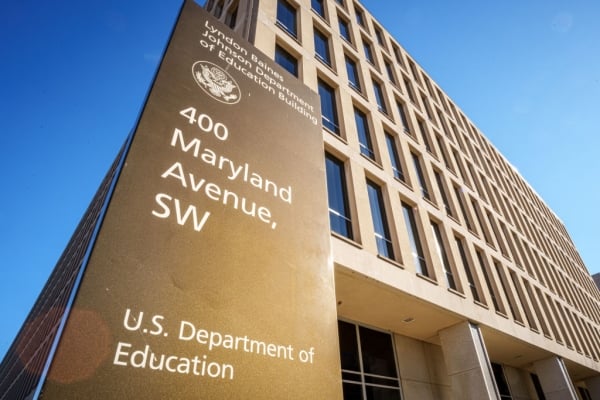
    The U.S. Education Department has canceled 10 contracts with Regional Educational Laboratories totaling $336 million and a further $33 million of grants to Equity Assistance Centers.

    The decision, announced Friday, appears to be another example of Elon Musk’s U.S. Department of Government Efficiency slashing the department’s activities and of anti–diversity, equity and inclusion activist Christopher Rufo’s continuing influence. The cuts also seem to part of the Trump administration’s crusade against programs that could be considered DEI-related, but it’s unclear what all the canceled contracts and grants were actually for.

    Regional Educational Laboratories, or RELs, have been around for more than a half century. Among other things, they contribute “research on how experiences within the nation’s education system differ by context and student group, thereby impacting outcomes,” according to the website of the Institute of Education Sciences, which administers the 10 RELs.

    On Feb. 10, the Trump administration said it canceled nearly $900 million in Institute of Education Sciences contracts. Then, on Thursday night—in a news release titled “U.S. Department of Education Cancels Additional $350 Million in Woke Spending”—the department announced the severing of the REL contracts.

    “Review of the contracts uncovered wasteful and ideologically driven spending not in the interest of students and taxpayers,” the department said. It said REL Midwest “has been advising schools in Ohio to undertake ‘equity audits’ and equity conversations.”

    But the release didn’t say how much REL Midwest was receiving for that work or further explain what the other canceled contracts were for. The department said in an email Friday that no further information was “cleared for release.”

    President Trump has said he plans to close the Education Department, but the release suggested that these contract cancellations might not be part of a permanent reduction in spending. “The department plans to enter into new contracts that will satisfy the statutory requirements, improve student learning and better serve school districts, state departments of education and other education stakeholders,” the release said.

    The release also said the department “terminated grants to four Equity Assistance Centers totaling $33 million, which supported divisive training in DEI, critical race theory and gender identity for state and local education agencies as well as school boards.” It didn’t hint at restoring this funding.

    The Equity Assistance Centers were originally referred to as the Desegregation Assistance Centers program, according to the Education Department, and help to ensure “that all students have equitable access to learning opportunities, regardless of their child’s race, sex, national origin, or religion.”

    On Thursday afternoon, Rufo, a senior fellow at the conservative Manhattan Institute, posted on X a few examples of what he had telegraphed as “a trove of insane videos, slides and documents from the Department of Education. The whole department functions like a Ponzi scheme for left-wing ideologies.”

    Then, roughly three hours before the department announced the cuts, he posted, “I’m hearing murmurs that the @DOGE team is following my posts about the Department of Education.” About an hour before the announcement, he posted that the department’s “DOGE team has terminated $350 million in federal contracts to the DOE’s ‘regional education laboratories’ and ‘equity assistance centers.’ We expose corruption on X, then DOGE wipes it out in D.C.”

    Rufo didn’t return requests for comment Friday. The Knowledge Alliance, a coalition advancing research that’s critical to solving education problems, said in a news release Friday that the REL contract cancellations continue “the unprecedented assault on learning and evaluation in the U.S. education system.”

    “RELs provide research and technical assistance that is tailored to specific states and communities, helping schools and districts tackle the most pressing challenges they face,” the Knowledge Alliance release said. “Working in close partnership with educators, school leaders and policymakers, RELs help design and implement approaches that meaningfully improve outcomes for everyone in our school communities.”

    Source link

  • OCR halts investigations, switches focus to Trump priorities

    OCR halts investigations, switches focus to Trump priorities

    The U.S. Department of Education’s Office for Civil Rights has paused the majority of its investigations, according to a new report from ProPublica, and shifted focus to new cases related to gender-neutral bathrooms, trans women athletes and alleged antisemitism and discrimination against white students.

    Those cases, in contrast with most historically taken on by OCR, were not launched in response to student complaints, but rather as a result of direct orders from President Donald Trump’s administration. OCR employees told ProPublica that they have been instructed to cancel meetings related to cases opened prior to Trump taking office and to avoid communicating with students, families and institutions involved in those cases.

    One OCR employee who spoke to ProPublica under the condition of anonymity said many of the cases they have been asked to stop investigating are urgent.

    “Many of these students are in crisis,” the employee said. “They are counting on some kind of intervention to get that student back in school and graduate or get accommodations.”

    About 12,000 complaints were under investigation at the end of former president Joe Biden’s term, including 6,000 related to discrimination against students with disabilities, 3,200 related to racial discrimination and 1,000 related to sexual assault or harassment, ProPublica’s analysis of OCR data found.

    Source link

  • Trump admin threatens to rescind federal funds over DEI

    Trump admin threatens to rescind federal funds over DEI

    The Education Department’s Office for Civil Rights declared all race-conscious student programming, resources and financial aid illegal over the weekend and threatened to investigate and rescind federal funding for any institution that does not comply within 14 days.

    In a Dear Colleague letter published late Friday night, acting assistant secretary for civil rights Craig Trainor outlined a sweeping interpretation of the Supreme Court’s 2023 ruling in Students for Fair Admissions v. Harvard, which struck down affirmative action. While the decision applied specifically to admissions, the Trump administration believes it extends to all race-conscious spending, activities and programming at colleges.

    “In recent years, American educational institutions have discriminated against students on the basis of race, including white and Asian students,” Trainor wrote. “These institutions’ embrace of pervasive and repugnant race-based preferences and other forms of racial discrimination have emanated throughout every facet of academia.”

    The letter mentions a wide range of university programs and policies that could be subject to an OCR investigation, including “hiring, promotion, compensation, financial aid, scholarships, prizes, administrative support, discipline, housing, graduation ceremonies, and all other aspects of student, academic, and campus life.”

    “Put simply, educational institutions may neither separate or segregate students based on race, nor distribute benefits or burdens based on race,” Trainor writes.

    Backlash to the letter came swiftly on Saturday from Democratic lawmakers, student advocates and academic freedom organizations.

    “This threat to rip away the federal funding our public K-12 schools and colleges receive flies in the face of the law,” Senator Patty Murray, Democrat of Washington, wrote in a statement Saturday. “While it’s anyone’s guess what falls under the Trump administration’s definition of ‘DEI,’ there is simply no authority or basis for Trump to impose such a mandate.”

    But most college leaders have, so far, remained silent.

    Brian Rosenberg, the former president of Macalester College and now a visiting professor of education at the Harvard Graduate School of Education, wrote in an email to Inside Higher Ed that the letter was “truly dystopian” and, if enforced, would upend decades of established programs and initiatives to improve success and access for marginalized students.

    “It goes well beyond the Supreme Court ruling on admissions and declares illegal a wide range of common practices,” he wrote. “In my career I’ve never seen language of this kind from any government agency in the United States.”

    The Dear Colleague letter also seeks to close multiple exceptions and potential gaps left open by the Supreme Court ruling on affirmative action and to lay the groundwork for investigating programs that “may appear neutral on their face” but that “a closer look reveals … are, in fact, motivated by racial considerations.”

    Chief Justice John Roberts wrote that colleges could legally consider a student’s racial identity as part of their experience as described in personal essays, but the OCR letter rejects that.

    “A school may not use students’ personal essays, writing samples, participation in extracurriculars, or other cues as a means of determining or predicting a student’s race and favoring or disfavoring such students,” Trainor wrote.

    Going even further beyond the scope of the SFFA decision, the letter forbids any race-neutral university policy that could conceivably be a proxy for racial consideration, including eliminating standardized test score requirements.

    It also addresses university-sanctioned programming and curricula that “teach students that certain racial groups bear unique moral burdens that others do not,” a practice that Trainor argues can “deny students the ability to participate fully in the life of a school.”

    The department will provide “additional legal guidance” for institutions in the coming days.

    That wide-reaching interpretation of the SFFA decision has been the subject of vigorous debate among lawmakers and college leaders, and in subsequent court battles ever since the ruling was handed down. Many experts assumed the full consequences of the vague ruling would be hammered out through further litigation, but with the Dear Colleague letter, the Trump administration is attempting to enforce its own reading of the law through the executive branch.

    Even Edward Blum, the president of Students for Fair Admissions, doesn’t believe the ruling on his case applies outside of admissions.

    “The SFFA opinion didn’t change the law for those policies [in internships and scholarships],” he told Inside Higher Ed a few days before the OCR letter was published. “But those policies have always been, in my opinion, outside of the scope of our civil rights law and actionable in court.”

    What Comes Next

    The department has never revoked a college or state higher education agency’s federal funding over Title VI violations. If the OCR follows through on its promises, it would be an unprecedented exercise of federal influence over university activities.

    The letter is likely to be challenged in court, but in the meantime it could have a ripple effect on colleges’ willingness to continue funding diversity programs and resources for underrepresented students.

    Adam Harris, a senior fellow at the left-leaning think tank New America, is looking at how colleges responded to DEI and affirmative action orders in red states like Florida, Missouri, Ohio and Texas for clues as to how higher education institutions nationwide might react to the letter.

    In Texas, colleges first renamed centers for marginalized students, then shuttered them after the state ordered it was not enough to comply with an anti-DEI law; they also froze or revised all race-based scholarships. In Missouri, after the attorney general issued an order saying the SFFA decision should apply to scholarships as well as admissions, the state university system systematically eliminated its race-conscious scholarships and cut ties with outside endowments that refused to change their eligibility requirements.

    “We’ve already seen the ways institutions have acquiesced to demands in ways that even go past what they’ve been told to do by the courts,” Harris said.

    The letter portrays the rise of DEI initiatives and race-conscious programming on college campuses as a modern civil rights crisis. Trainor compared the establishment of dormitories, facilities, cultural centers and even university-sanctioned graduation and matriculation ceremonies that are advertised as being exclusively or primarily for students of specific racial backgrounds to Jim Crow–era segregation.

    “In a shameful echo of a darker period in this country’s history, many American schools and universities even encourage segregation by race at graduation ceremonies and in dormitories and other facilities,” Trainor wrote.

    Harris, who studies the history of racial discrimination on college campuses, said he finds that statement deeply ironic and worrying.

    “A lot of these diversity programs and multicultural centers on campuses were founded as retention tools to help students who had been shut out of higher education in some of these institutions for centuries,” Harris said. “To penalize institutions for taking those steps to help students, that is actually very much an echo of the segregation era.”

    Source link

  • White House barring AP from press events violates the First Amendment

    White House barring AP from press events violates the First Amendment

    A widening gulf has opened between the Trump administration and the Associated Press. 

    Which gulf?

    Precisely.

    On Tuesday, the AP said the White House blocked one of its reporters from attending an event in the Oval Office because the outlet continues to use the name Gulf of Mexico in its reporting. This, despite President Donald Trump’s recent executive order renaming it the Gulf of America.

    After Trump signed that order, the AP announced it would continue referring to the gulf by its original name “while acknowledging the new name Trump has chosen.” It did so in part because the gulf borders other countries that don’t recognize the name change. (The AP did update its Stylebook to reflect Trump’s separate decision to revert the name of North America’s highest mountain, which President Obama changed to the native moniker Denali, to Mount McKinley because that “area lies solely in the United States.”)

    In a Wednesday briefing, Press Secretary Karoline Leavitt confirmed the AP’s allegations:

    I was very up front in my briefing on day one that if we feel that there are lies being pushed by outlets in this room, we are going to hold those lies accountable. And it is a fact that the body of water off the coast of Louisiana is called the Gulf of America.

    The standoff continues — and has escalated beyond Oval Office events. Last night, the White House blocked the AP from an open press conference featuring Trump and Indian Prime Minister Narendra Modi. 

    FIRE issued a statement condemning the administration’s actions, which have drawn criticism from press freedom groupspundits, and politicians across the political spectrum.

    In a letter to White House Chief of Staff Susie Wiles, AP Executive Editor Julie Pace called the administration’s actions “viewpoint discrimination based on a news organization’s editorial choices and a clear violation of the First Amendment.” 

    She’s right.

    To be sure, the First Amendment does not require the White House to open its doors to the media or hold press conferences. Nor does the president have to do a one-on-one interview with CNN just because he did one with Fox News. But court decisions spanning decades make clear that once the government grants media access, it has to play by constitutional rules. 

    That doesn’t mean the White House has to allow every reporter in the world into the Oval Office or briefing room. Space constraints obviously make that impossible, and not every journalist will manage to secure a press pass. But the reason for denying access matters. When the government shuts out journalists explicitly because it dislikes their reporting or political views, that violates the First Amendment.

    As one federal court proclaimed, “Neither the courts nor any other branch of the government can be allowed to affect the content or tenor of the news by choreographing which news organizations have access to relevant information.”

    And because denying press access involves the potential deprivation of First Amendment rights, any decision about who’s in or out must also satisfy due process. That means the government must establish clear, impartial criteria and procedures, and reporters must receive notice of why they were denied access and have a fair opportunity to challenge that decision.

    The AP — a major news agency that produces and distributes reports to thousands of newspapers, radio stations, and TV broadcasters around the world — has had long-standing access to the White House. It is now losing that access because its exercise of editorial discretion doesn’t align with the administration’s preferred messaging. 

    That’s viewpoint discrimination, and it’s unconstitutional.

    This isn’t the first time the White House has sent a journalist packing for reporting critically, asking tough questions, or failing to toe the government line. During Trump’s first term, the White House suspended CNN reporter Jim Acosta’s press pass after he interrogated the president about his views on immigration. After the network sued, a federal court ordered the administration to restore Acosta’s pass.

    But court decisions spanning decades make clear that once the government grants media access, it has to play by constitutional rules.

    Democratic administrations have also unacceptably targeted disfavored outlets for exclusion. The Obama administration tried to exclude Fox News from a press pool because of displeasure with its coverage. Obama’s deputy press secretary Josh Earnest said at the time, “We’ve demonstrated our willingness and ability to exclude Fox News from significant interviews.”

    Similar attacks on press freedom happen at all levels of government. In 2022, FIRE filed an amicus curiae — “friend of the court” — brief in a First Amendment lawsuit challenging vague and arbitrary press pass rules that Arizona elections officials used to block a Gateway Pundit journalist from press conferences. The officials didn’t like the conservative journalist’s political views or negative coverage, including his “inflammatory and/or accusatory language.” After the U.S. Court of Appeals for the Ninth Circuit initially ruled in favor of The Gateway Pundit, the outlet received a $175,000 settlement.

    The current spat over naming conventions for a body of water may seem trivial. But it sends a chilling message to all journalists that White House access hinges on whether the president approves of their reporting. Left unchecked, such a precedent opens the door to broader efforts to manipulate public discourse and undermine press freedom. What other “lies” might the Trump administration hold media outlets “accountable” for? Could scrutiny of its immigration policies, economic performance, or claims about election integrity be next?

    The characterization of the AP’s editorial style choice as a “lie” shows the danger of empowering the state to police mis- or disinformation. The Chinese government might say the same about anyone who calls a certain territory “Taiwan” instead of the “Republic of China” or “Chinese Taipei.” To a government official with a misinformation hammer, every deviation from official messaging looks like a nail. We saw enough misguided attempts to police “misinformation” during the Biden administration. Let’s leave that behind. 

    In an executive order signed the same day as the one renaming the gulf, Trump promised to “ensure that no Federal Government officer, employee, or agent engages in or facilitates any conduct that would unconstitutionally abridge the free speech of any American citizen.” That’s a good policy, and the administration should stick to it — the First Amendment requires no less.

    Any government attempt to control the flow of information strikes a blow at the First Amendment. A free press performs a vital democratic function — gathering, curating, and delivering information, which we can then evaluate for ourselves. Without the Fourth Estate acting as a crucial check on government power, we’ll know less about what our elected officials are up to, and face greater difficulty holding them accountable.

    The beauty of this country’s ideologically diverse media landscape is that if you distrust a particular source, countless others are available offering different information and perspectives. Preserving this rich information ecosystem demands constant vigilance against any threats to free speech and a free press, regardless of who the target is. The alternative — no matter what name you give it — is censorship.

    Source link

  • Researchers’ comfort, uses of AI vary by region, discipline

    Researchers’ comfort, uses of AI vary by region, discipline

    Most researchers are interested in using artificial intelligence in their work, and 69 percent believe AI skills will be critical within two years. However, more than 60 percent say a lack of guidelines and training present a barrier to their increased use of AI, according to a study the publishing giant Wiley released last week.

    The study asked nearly 5,000 researchers worldwide about how they currently use AI, and the findings revealed variations by geography, discipline and career phase.

    It found that 70 percent of researchers want clearer guidelines from publishers about acceptable uses of AI, and 69 percent want publishers to help them avoid potential pitfalls, errors and biases.

    Although the vast majority of researchers had either heard of or used Open AI’s ChatGPT, only about a third had heard of other popular tools, such as Google Gemini and Microsoft Copilot, and even fewer used them.

    And among those who do use AI, fewer than half use it for its top five uses, which include help with translation (40 percent), proofreading and editing scholarly papers for publication (38 percent), brainstorming/ideation (26 percent), reviewing large amounts of information (24 percent), and discovering the latest relevant research (24 percent).

    The study also found geographic variations in AI use.

    Researchers in China and Germany were most likely to have used AI to support their work—59 percent and 57 percent, respectively—compared to a global average of 45 percent. In the Americas, which includes the United States, only 40 percent of researchers surveyed said they have already used AI to conduct or write up research.

    Researchers also expressed differences in enthusiasm for adopting the tools now, depending on field and career phase.

    Among the early adopters of AI were researchers in computer science (44 percent), medicine (38 percent), corporate (42 percent) and health care (38 percent), as well as early-career researchers (39 percent). Business, economics and finance researchers (42 percent), and those in the academic sector (36 percent), wanted to keep pace with the average rate of use and adoption.

    Finally, researchers in the life sciences (38 percent), physical sciences (34 percent) and government sector (34 percent), as well as late-career researchers (34 percent), were more likely to take a more cautious approach and favor later adoption of AI.

    Source link

  • ACE strikes a fighting stance at annual conference

    ACE strikes a fighting stance at annual conference

    WASHINGTON, D.C.—Hundreds of higher ed leaders packed into the Kennedy Center for the annual American Council on Education conference this week, snapping photos of the large bust of the cultural center’s namesake, President John F. Kennedy, in the foyer. Some joked that it would soon be replaced by Donald Trump’s likeness, given the current president’s takeover of the Kennedy Center board, a move announced Wednesday.

    But it was Trump’s attempted takeover of higher education that was foremost on the minds of attendees.

    The Republican president, now in his second nonconsecutive term, dominated conference discussions as speakers grappled with how to interpret and respond to a vision for higher education that has been marked by cuts to research funding and personnel; the decimation of diversity, equity, and inclusion initiatives; and efforts to dismantle the U.S. Department of Education.

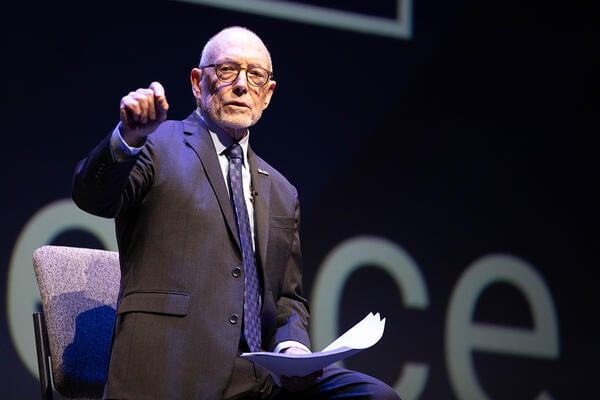
    “We’re under attack,” ACE president Ted Mitchell said in his opening remarks.

    He pointed to a flurry of executive orders and other recent actions that have caused “confusion and dismay” across the sector, as the Trump administration attempted to freeze federal funding and change research reimbursements, creating financial uncertainty for colleges.

    “These executive orders are an assault on American opportunity and leadership,” Mitchell said.

    He warned that such changes could destabilize higher education by undermining research, innovation, intellectual independence and autonomy.

    “The flurry of these threats [is] designed to cower us into silence,” he said.

    Mitchell also noted that ACE, along with other associations and several research universities, filed a lawsuit Monday against the National Institutes of Health for attempting to cap reimbursements for indirect research costs. While that lawsuit is pending, a federal judge has already prevented the cap, at least temporarily, in response to other litigation.

    In the face of such chaos and instability, Mitchell emphasized the importance of unity, urging conference goers to beware of attempts to sow discord among institutions. “We will only succeed if we stick together,” he said.

    He also pushed back on Trump’s attacks on diversity, equity and inclusion initiatives, which have already led some colleges and universities to scrub DEI language from websites, shutter offices and cancel events.

    “We can’t be apologetic of diversity. We just can’t,” Mitchell said.

    But even as he blasted some of Trump’s recent actions, he noted that ACE is also seeking common ground with the administration.

    “I continue to believe that there are important areas of policy where we can and must work with this administration. We will work to find those openings wherever we can,” Mitchell said.

    His remarks came a day after dozens of college presidents attended ACE’s inaugural Hill Day, where they met with congressional staff to learn and advocate for policy priorities.

    The Policy Outlook

    The notion of higher education being under siege was prevalent across numerous sessions, including in a Thursday policy update from Jon Fansmith, senior vice president of government relations and national engagement at ACE, who broke down recent actions and Republican priorities.

    Fansmith noted that Trump has sought to reshape higher education through a series of executive orders, investigations and attempts to defund and destabilize the sector.

    “We are not used to the wheels of government moving this quickly and impactfully,” he said.

    Despite the sense of alarm roiling the sector, Fansmith said “growing opposition” has emerged. In some cases, it’s been bipartisan, with congressional Republicans joining Democrats in expressing concern over how changes to federal funding or research dollars may harm their local institutions and employers.

    Additionally, Fansmith pointed out that the Trump administration has been sued repeatedly—at least 58 times, by his count—and that successful lawsuits have slowed the president’s rapid-fire attacks.

    Fansmith also noted that Trump’s nominees to lead the Department of Education, Linda McMahon as secretary and Nicholas Kent as under secretary, are more seasoned operators than other Trump World figures. McMahon’s Senate confirmation hearing took place Thursday.

    “She is not a firebrand; she is not the person who is going to blow things up,” Fansmith said, noting McMahon’s background as a longtime professional wrestling executive and prior head of the Small Business Association during Trump’s first term. But given Trump’s desire to dismantle or diminish the Education Department, McMahon “may be ordered to blow things up,” he said.

    Of Kent, a former for-profit college advocate and past staffer for Virginia governor Glenn Youngkin, Fansmith said he was “very passionate, deeply informed and highly intelligent.”

    Hope Amid the Challenges

    The conference also touched on a range of challenges beyond the turbulence of the Trump administration, including free speech, campus antisemitism, demographic changes and more.

    In a discussion Wednesday, Wesleyan University president Michael Roth weighed in on the state of free speech in higher education and questioned recent efforts by Trump to go after universities for alleged antisemitism, including threats of investigations and financial penalties.

    Roth, who is Jewish, acknowledged the existence of some antisemitism on college campuses, but argued that Trump’s efforts to address it were “disingenuous”—more of a cover for going after pro-Palestinian protesters who expressed concern about the bloodshed in Gaza.

    While he noted that college leaders need to be cautious, he advised them not to cower.

    “Not standing up for your mission in the long run won’t help your institution,” Roth said.

    In a panel Thursday on the challenge that shrinking demographics pose to higher education, experts noted enrollment pressures will continue as the number of high school graduates continues to decline. But rather than a demographic cliff, higher education will likely see a gentler slide, they said.

    Nathan Grawe, an economics professor at Carleton College, argued that the enrollment decline “won’t hit us all at once” but rather “little by little,” with incremental challenges year over year.

    Other panelists noted that workforce challenges won’t diminish along with the number of high school graduates, meaning that colleges will need to focus on enrolling and retaining more adult learners.

    For all the doom and gloom surrounding the policy discussions, the conference concluded on a high note. In his closing remarks, Freeman Hrabowski, an ACE Fellow and president emeritus of the University of Maryland Baltimore County, emphasized the importance of hope.

    He encouraged attendees to “use our heads and our hearts” to meet the moment, reflecting on his experience in 1963, when at the age of 12 he was jailed for participating in a civil rights march in Birmingham, Ala. Looking back more than 60 years later, Hrabowski said it was his faith and determination that helped him know then that “we would be OK.”

    He encouraged others to channel their own optimism amid turbulent times.

    “Don’t you dare allow the toxicity of some people to leave you hopeless,” Hrabowski said.

    Source link

  • Education Department lays off civil servants

    Education Department lays off civil servants

    The U.S. Department of Education laid off some civil servants on Wednesday, Politico reported, citing multiple people familiar with the matter. 

    It’s not yet clear how many employees were affected, but they worked for a range of offices within the department, from civil rights to federal student aid. Earlier that day, a federal judge approved the Trump administration’s plan to offer buyouts to vast swaths of the federal workforce. 

    The move is the latest personnel disruption at the agency. Earlier this month, dozens of employees were put on administrative leave after attending a diversity, equity and inclusion training during the first Trump administration.

    Many of the terminated department employees were still in their probationary period, according to Politico, meaning they’d been on the job for less than a year and lacked full civil service protections, though nonprobationary employees were also affected. On Thursday, the Associated Press reported that the Trump administration had ordered all federal agencies to terminate their probationary employees, part of a broader effort to reduce the federal workforce.

    Source link

  • Education Department mulls using AI chat bot for FAFSA help

    Education Department mulls using AI chat bot for FAFSA help

    The Education Department is considering terminating its contracts for thousands of call center employees hired to answer families’ questions about federal student aid, and may replace them with an artificial intelligence–powered chat bot, The New York Times reported Thursday.

    Elon Musk’s Department of Government Efficiency apparently suggested the move, the Times reported, as part of a broader effort to reduce federal spending—which has already led to dozens if not hundreds of layoffs at the Education Department and the cancellation of hundreds of millions of dollars in contracts at the Institute for Education Sciences.

    The call centers employ 1,625 people who answer more than 15,000 calls per day, according to an Education Department report. The department greatly increased staffing at their call centers after last year’s bungled launch of the new FAFSA led to an overwhelming influx of calls. 

    Last September, a Government Accountability Office investigation found that in the first five months of the rollout, three-quarters of calls went unanswered. Last summer, the department hired 700 new agents to staff the lines and had planned to add another 225 after the launch of the 2024–25 FAFSA in November.

    One of the helplines DOGE is closely scrutinizing, according to the Times, is operated by the consulting firm Accenture. Accenture also operates the studentaid.gov website, which houses the online platform for the Free Application for Federal Student Aid. The department’s contract with the firm expires Feb. 19. According to sources in the Education Department who spoke with Inside Higher Ed, the department is considering significant reductions to its Accenture contract ahead of its renewal.

    Source link

  • What legacy does Yale-NUS College leave in Singapore?

    What legacy does Yale-NUS College leave in Singapore?

    When Wee Yang Soh was considering his degree options, he felt his choices were limited. The Singaporean had been offered a place to study chemistry at the National University of Singapore (NUS), but he was wary of accepting.

    In his experience, school had felt like he was simply being “trained” to pass exams. “I didn’t want my university education to be like that,” he said. Soh liked the idea of liberal arts education but couldn’t afford the hefty tuition fees charged by the U.S. colleges offering those programs.

    So when, in 2011, NUS announced it would be opening a liberal arts college—the first of its kind in Singapore—in partnership with Yale University, Soh jumped at the chance to apply. He was part of the inaugural cohort of students enrolled at the college, graduating in 2017.

    Four years later, NUS suddenly declared that it would no longer be continuing the partnership, with plans to close the college once all existing students had graduated.

    While Yale-NUS College is not the only international partnership in Singapore that has come to an abrupt halt—having helped develop Singapore University of Technology and Design’s curriculum, the Massachusetts Institute of Technology was shown the door in 2017—it is among the most talked about. This unexpected announcement drew just as much attention, if not more, as the opening of the college had, with rumors swirling about the reasons for the decision.

    Today, as the college enters its final semester before shutting its doors for good, can liberal arts live on in Singapore? And are international partnerships off the table in a country increasingly embroiled in debates about national identity?

    Singapore’s government first began discussing the prospect of a liberal arts college in 2008. Policymakers saw the establishment of one as having multiple benefits—reducing the number of local students going abroad, diversifying pathways within the country’s higher education system and contributing to Singapore’s ambition to become an international education hub.

    So when Yale-NUS College opened in 2013, it seemed like the perfect fit. Unfortunately, this synergy didn’t last.

    “The context changed,” said Jason Tan, associate professor at Nanyang Technological University’s National Institute of Education. “For one thing, there’s no longer any official talk about establishing Singapore as an international education hub.”

    Although Singapore launched the Global Schoolhouse Project in 2002, an initiative that aimed to recruit 150,000 international students by 2015, by the mid-2010s, the numbers remained far below targets and talk of the scheme quieted as public debates around immigration heated up.

    Writing in the academic journal Daedalus in 2024, Pericles Lewis, the founding president of the college, suggested that things had gone a step further: “Singapore has not been immune to the forces of populism and nationalism that have affected most parts of the world,” he wrote.

    For a college in which international students represented about 40 percent of the student population, this was a problem.

    Throughout the college’s life, the governing party “showed itself to be highly sensitive to complaints about benefits reaped by foreigners, and to concerns of middle-class Singaporeans about the accessibility of higher education,” Lewis wrote.

    The institution also became central to debates about academic freedom in Singapore, with the last-minute cancellation of a course focused on protest generating backlash. To some, the college was a site of rare political activism and freedom in Singapore, which was both welcomed and feared, depending on your point of view.

    However, Linda Lim, professor emerita at the University of Michigan, argued that the college had little impact on the state of academic freedom in Singapore more widely.

    “From the beginning it was understood and even explicitly acknowledged that Yale-NUS College would practice and experience academic freedom only within the college walls and premises,” she said.

    “Yale may have flattered itself, or argued to mollify dubious faculty in New Haven, that Yale-NUS College would help advance academic freedom in Singapore—a naïve and neo-colonialist attitude.”

    Moreover, Soh believed claims of heightened student activism at the college were exaggerated, with intense media attention fueling public ire towards the institution.

    “From the first year, the Singaporean public and the government were already pretty afraid that politically motivated actions on campus would pose a problem for Singapore,” he said. “And they kept a very close eye on the college activities, to the point where it felt like a self-fulfilling prophecy.”

    At times, small incidents on campus, such as disagreements over new course curricula, made national news, he said. This “reinforced the idea that the students were political or dangerous and all of that stuff, when, really, everything that happened in college felt, at least to me, incredibly mundane and incredibly small and silly.”

    NUS College, a U.S.-style undergraduate honors college for NUS students, was established in 2022 in place of Yale-NUS College. While this new institution offers a residential experience, small class sizes and some shared curricula, it is a far cry from a traditional liberal arts college.

    Today in Singapore, “there’s more focus on interdisciplinary learning,” said Tan. “Across all of our universities, in one form or another, there’s this concern about future economic needs.

    “The future problems will require all those buzzwords—critical thinkers and flexible, adaptable people and people who possess this interdisciplinary pool of knowledge and so on.

    “That trend has pretty much superseded the excitement over having a liberal arts education for our undergrads.”

    For Lim, the closure of Yale-NUS College was a “cautionary tale” for international higher education institutions “who think they can be a beacon of light in authoritarian countries by collaborating with autocratic governments.”

    The college’s chief legacy, she continued, “is the quality of the students it educated and graduated.”

    Soh is currently undertaking a Ph.D. in the U.S. and credited the college and his professors for inspiring him to do so.

    “I hope to teach in the future as a professor,” he said. “I want my students to be able to treat education as not a stepping-stone to grades or to credentials, but as a way to reformulate how we think about and relate to this crazy world that we live in today.

    “I think the legacy lives on in me, but I can’t say that it lives on in Singapore or in NUS for sure. But I hope it does.”

    Source link