Tag: Events

  • UChicago Sells Off Research Center

    UChicago Sells Off Research Center

    The University of Chicago is selling a celebrated research center as the generously endowed university navigates layoffs and program cuts amid a heavy debt load, Financial Times reported Monday.

    UChicago is reportedly selling the Center for Research in Security Prices, founded in 1960, for $355 million to Morningstar, a research and investment firm also located in Chicago. The center, known as CRSP, developed a market database more than 65 years ago that “allowed investors to measure historic rates of return for U.S. stocks,” according to its website, which notes that its data has been used in more than 18,000 peer-reviewed studies and by hundreds of entities.

    CRSP formally became a limited liability company in 2020 but remained wholly owned by UChicago and maintained its affiliation with the university and the Booth School of Business.

    The sale comes as financial issues are adding up for the university. UChicago has borrowed heavily in recent years and seen substandard returns on its $10 billion endowment. University officials recently announced plans to pause admission to multiple Ph.D. programs and to cut 400 staff jobs as the private institution grapples with a debt load that has grown to $6 billion.

    UChicago is currently trying to shed $100 million in expenses.

    The Trump administration’s cancellation of dozens of federal grants in recent months has also hurt the university’s bottom line. UChicago president Paul Alivisatos wrote in late August that the “profound federal policy changes of the last eight months have created multiple and significant new uncertainties and strong downward pressure on our finances.”

    Source link

  • University of Maine Cancels Wind Power Summit

    University of Maine Cancels Wind Power Summit

    The University of Maine cancelled its annual summit on floating offshore wind power as federal support for renewable energy wanes, Maine Public reported.

    The university decided against holding the American Floating Offshore Wind Technical Summit, or AFLOAT, “in recognition of changing federal policies and priorities,” university spokesperson Samantha Warren said in a statement. The university’s Advanced Structures and Composites Center has hosted the summit since 2020.

    The state of Maine came out with an energy plan this year that includes offshore wind as a pivotal part of meeting renewable energy goals. But the Trump administration has shown opposition to such projects—the federal government suspended a $12.5 million grant to the University of Maine’s floating offshore wind power program this spring. The university nonetheless moved forward with the grant project, launching an experimental floating wind turbine a month later.

    The university has no plans at this time to revive AFLOAT in the future, Warren told Maine Public. But the university plans to hold private meetings with relevant parties, like industry, research and government leaders, “given growing interest in commercializing its cutting-edge technology, which has promising applications that advance the nation’s economy and security well beyond ocean energy.”

    Source link

  • The Em Dash Debate We Should Be Having (opinion)

    The Em Dash Debate We Should Be Having (opinion)

    It seems a day does not go by without seeing someone confidently assert on social media that an em dash is not an indicator of AI-written text. Those social media posts are in response to an ongoing debate about whether or not the em dash is a dead giveaway of writing produced by generative AI. Some writers and academics resent that their cherished em dash is getting a bad rap. As one writes, “You can take my em dash from my cold, dead hands.”

    As a writer who does not use AI, I understand the frustration with the recent em-dashes-are-a-sign-of-AI-use bandwagon. I certainly do not want to be accused of using AI whenever I use an em dash. And as an English composition instructor who wants students to write without using AI, I understand how easy it can be to latch on to a purported way of quickly identifying AI-generated writing.

    But rather than get angsty about it as a writer or accusatory as an instructor, I am choosing to view the current em dash–AI kerfuffle as serendipitous. AI might be new, but a controversy about em dash usage is not, and the current debate provides an opportunity to try and temper its overuse—again.

    A year before what is recognized as the birth of the World Wide Web, Robert Bringhurst, in The Elements of Typographic Style, took a shot across the bow at em dash usage. An em, in typesetting vernacular, is a square measurement where, as Bringhurst explains, “One em is a distance equal to the type size”: therefore “the em is a sliding measure.” In other words, an em is not a fixed horizontal length; it is a horizontal space proportional to the point size. So if someone is using 12-point type, then one em would be 12 points horizontally. Half of an em is called an en. So when using 12-point type, an en is six points horizontally.

    In post-typesetting days, Bringhurst recommends that spaced en dashes – like this – be used—instead of nonspaced em dashes like this—to set off phrases within a sentence. Although he did see valid uses for the em dash, such as for written dialogue, Bringhurst contends that “the em dash is the nineteenth-century standard” and “too long for use with the best text faces” in modern times. According to Bringhurst, just as we no longer put two spaces after a period at the end of a sentence (a holdover from typesetting and later typewriter days), the em dash “belongs to the padded and corseted aesthetic of Victorian typography.”

    While Bringhurst’s suggestion was to replace ungainly em dashes with en dashes to offset sentence interruptions, continuing debates over the em dash focus on limiting such interruptions in the first place.

    In 2011, Philip Corbett of The New York Times noted an increasing use of the em dash in newspaper articles. The problem? The em dash “can seem like a tic; worse yet, it can indicate a profusion of overstuffed and loosely constructed sentences, bulging with parenthetical additions and asides.”

    That same year, Noreen Malone, writing for Slate, demonstrated how the em dash “discourages truly efficient writing” and “disrupts the flow of a sentence.” Granted, a purpose of the em dash is to interrupt, but the problem was not just that people were interrupting their writing a lot, but that they were also using it in place of better-suited punctuation. Rather than figuring out the best punctuation to use for specific writing situations and purposes, people were using the em dash as the jack-of-all-trades but master of none. Would it be best to use a comma, semicolon, period or colon? Who cares? Just throw in the exotic em dash.

    Now, as a direct result of its overuse as a substitute for more apt punctuation and its ubiquity in the written material that became the training data for LLMs, it is no surprise that the em dash is frequently showing up in AI-generated writing. There is no indication, as far as I am aware, that AI is intentionally trying to wrest the em dash from those who use it ethically and responsibly. But AI is fortuitously forcing us to grapple with the cavalier use of the em dash across recent decades. So what can writers and teachers do about it?

    As writers, we have a roster of punctuation marks from which to draw upon for specific purposes, and our choices can bring better clarity to our writing and demonstrate writerly skill. As Andi Zeisler points out in “AI can’t have my em dash,” em dashes “don’t really need to be there,” “aren’t integral to sentence structure” and “are decidedly extra.” That does not mean that writers must lay down all their em dashes and surrender them to AI. But as writers, we should be connecting thoughts smoothly and taking care to use just the right punctuation for a specific purpose while resisting the allure of an em dash that might save us the expert work of choosing the precisely placed period, comma, parenthesis, semicolon or colon.

    As teachers, we should not automatically think a student used AI when we see an em dash. I reject the notion that em dashes are a telltale of AI-written text. Whenever I suspect that something I am reading was written by AI, it is due to the writing style, not the presence of an em dash. Regardless, whether its use is attributable to AI or simply disjointed or imprecise writing, the presence of an em dash provides an opportunity to teach students how to better connect their thoughts in their writing and more carefully consider when and how to use the best punctuation for different situations.

    Richard Mitchell (a.k.a. the Underground Grammarian) once wrote, about the word “input,” that “a word that means almost anything means almost nothing” and “no longer makes any useful distinction.” The same can be said about the em dash. It might be that the em dash is necessary in select situations, but in most others it is not.

    Brenda Thomas has worked in various roles in online higher education, including as an adjunct faculty member and instructional designer, at several colleges and universities since 2015.

    Source link

  • Government Shutdown Could Delay ED Rule Making

    Government Shutdown Could Delay ED Rule Making

    J. David Ake/Getty Images

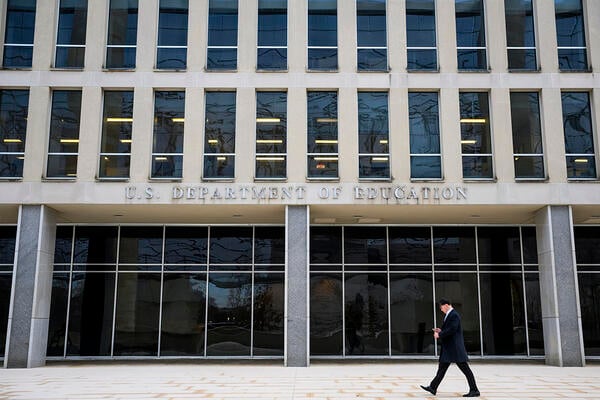
    If the government shuts down Wednesday, it’s not clear whether the Department of Education will be able to continue with the meetings it had planned to iron out a batch of regulatory changes this week.

    The advisory rule-making committee began its work Monday and was originally slated to continue through Friday. But at the start of Monday’s meeting, department officials noted that if the government runs out of funding Oct. 1, the remainder of the session would be delayed and the plan would be to resume virtually in two weeks. (This was consistent with a pending notice that was posted to the Federal Register in the morning.) 

    That all changed once again moments before Monday’s meeting ended when Jeffrey Andrade, the deputy assistant secretary for policy, planning and innovation, said the department was reconsidering its earlier statement and that the negotiated rule-making committee might be able to continue operating in person through the end of the week.

    “There is a possibility that we can work through this,” Andrade said, adding that he had just received word of the possibility himself. 

    The department is planning to furlough nearly 87 percent of its employees, according to its shutdown contingency plan. But officials are planning to keep employees who are working on the rule-making process on board as well as those working to implement Congress’s One Big Beautiful Bill Act, which passed in July.

    This rule-making session is focused on clarifying the details of new graduate loan caps and a consolidated version of the multiple existing income-driven repayment plans.

    Going into this week’s meetings, multiple higher education experts said that finalizing new regulations before the caps and repayment plans take effect July 1, 2026, would be difficult no matter what. A government shutdown, one added, could throw a wrench into the already tight timeline.

    “With such a crunched timeline for finishing the rules in the first place, this makes the department’s job much more challenging,” said Clare McCann, managing director of policy for the Postsecondary Education and Economics Research Center at American University. 

    One of this week’s rule-making committee members, who spoke with Inside Higher Ed on the condition of anonymity, said that while they were still uncertain how the rest of the week will play out, Andrade’s last-minute announcement gave them hope.

    “I’m not sure what to make of it and will be waiting for clearer answers in the morning,” the committee member said. “But I know the department is working hard to get as much done as possible.”  

    That said, if the session does end up moving online, it wouldn’t be too out of the ordinary for department staff members. All sessions prior to the start of the second Trump administration were held online since the COVID-19 pandemic broke out in 2020.

    The real challenge, McCann noted, would likely be having enough staff to facilitate the session, regardless of its modality. 

    “Certainly the department will be able to keep some of this moving, but they will undoubtedly also have some employees who are not considered essential and are furloughed during a shutdown,” McCann said. “It takes many people at the department to make a rule making happen, and so any loss of personnel is going to present a challenge, even if they’re able to keep some of the core team that’s involved.”

    Under the contingency plan, student aid distributions will not be paused and loan payments will still be due. The department will, however, pause civil rights investigations and cease grant-making activities, though current grantees will still be able to access funds awarded by Sept. 30.

    Source link

  • HHS Looks to Block Harvard From Federal Funds

    HHS Looks to Block Harvard From Federal Funds

    Joseph Prezioso/AFP/Getty Images

    The U.S. Department of Health and Human Services’ Office for Civil Rights announced Monday that it’s moving to cut off Harvard University’s eligibility to receive federal funding.

    The announcement comes amid a power struggle between Harvard and the White House. 

    While the Trump administration has accused Harvard of allowing antisemitism to run amok on campus—and the university has acknowledged concerns on the front—it has sought sweeping power over the institution and changes that go beyond addressing antisemitism. The HHS Office for Civil Rights previously found that Harvard violated Title VI of the Civil Rights Act of 1964, which bars discrimination based on race, color and national origin, and acted with “deliberate indifference toward discrimination and harassment against Jewish and Israeli students,” according to an HHS news release.

    Now HHS OCR has recommended cutting off federal funding to Harvard “to protect the public interest” through a suspension and debarment process operated by the HHS Office of the Assistant Secretary for Financial Resources. Suspension would be temporary and debarment would last “for a specified period as a final determination that an entity is not responsible enough to do business with the federal government because of the wrongdoing,” according to the agency. The move comes less than two weeks after the Education Department placed Harvard on heightened cash monitoring—a highly unusual move given the university’s significant resources.

    Harvard did not immediately respond to a request for comment Monday.

    “OCR’s referral of Harvard for formal administrative proceedings reflects OCR’s commitment to safeguard both taxpayer investments and the broader public interest,” HHS OCR director Paula M. Stannard said in a statement. “Congress has empowered federal agencies to pursue Title VI compliance through formal enforcement mechanisms, including the termination of funding or denial of future federal financial assistance, when voluntary compliance cannot be achieved.”

    Harvard has 20 days to request a hearing in front of an HHS administrative law judge, who will decide whether the university violated Title VI.

    Monday’s announcement is the latest salvo by the federal government after Harvard emerged initially victorious in a legal battle over more than $2 billion in frozen federal research funding. While a judge ruled that the Trump administration illegally froze funds granted to Harvard, the federal government has continued to pressure the private institution to make changes to disciplinary processes, admissions, hiring and more. Other Ivy League institutions, such as Columbia University and Brown University, have agreed to such deals, under federal scrutiny.

    Source link

  • ED Rule Making Will Move Online if Government Shuts Down

    ED Rule Making Will Move Online if Government Shuts Down

    Screenshot/Alexis Gravely

    The Education Department’s current rule-making session, in which committee members are determining how to implement new student loan policies, will be delayed by two weeks if Congress fails to pass legislation to keep the government open, Trump officials announced Monday morning.

    “There is the possibility—which seems to be growing by the hour—of a lapse in appropriations,” one department official said during the rule-making session’s commencement Monday. “Have no fear, however,” he added, “we do have a contingency plan for that.”

    The official, Jeffrey Andrade, deputy assistant secretary for policy, planning and innovation, went on to explain that if the government does shut down Oct. 1, the remainder of the session would take place online from Oct. 15 to 17. (The plans were also posted to the Federal Register on Monday.)

    Managing a virtual negotiated rule-making session, however, would be nothing new to the department staff, as all sessions prior to the start of the second Trump administration have been held online since the COVID-19 pandemic broke out in 2020.

    “Again, fingers crossed,” Andrade said. “But the oddsmakers, when I last checked, were in the high 60s in favor of them not passing a continuing resolution in time. So that’s a plan.”

    The department was already facing a tight timeline to negotiate the various regulatory changes, and some are worried that the two-week delay could further complicate the effort.

    “A government shutdown throws a wrench into the rule making,” said Clare McCann, managing director of policy for the Postsecondary Education and Economics Research Center at American University. “Even assuming a shutdown is over in two weeks, as the department hopes, almost all of the Education Department’s staff will be furloughed in the meantime and unable to continue working on the draft regulations. With such a crunched timeline for finishing the rules in the first place, this makes the department’s job much more challenging.”

    If the government were to shut down, about 87 percent of the Education Department’s nearly 2,500 employees would be furloughed, according to the agency’s contingency plan. The department is planning to keep on employees who are working on the rule-making process and to carry out other provisions in the One Big Beautiful Bill Act, which was signed into law over the summer.

    Student aid distributions will not be paused and loan payments will still be due, but the department will cease grant-making activities and pause civil rights investigations. Grantees, though, can still access funds awarded over the summer and before Sept. 30.

    Source link

  • The New Head of SACS Shares His Vision for the Accreditor

    The New Head of SACS Shares His Vision for the Accreditor

    After two decades with Belle Wheelan at the helm, the Southern Association of Colleges and Schools Commission on Colleges is under new leadership since she retired earlier this year.

    New SACS president Stephen Pruitt comes from the Southern Regional Education Board, which he led from 2018 until June, when he stepped down, before starting his current job in August. Pruitt previously served as the commissioner of education in Kentucky, worked for the Georgia Department of Education and taught both at the K–12 level and as an adjunct faculty member.

    Pruitt arrives at a time when accreditors are increasingly under fire from federal and state officials, who have accused such bodies—and SACSCOC specifically—of overstepping, and as the Trump administration aims to make it easier for new accreditors to enter the market. In a phone interview last week with Inside Higher Ed, Pruitt discussed how he intends to approach the job, his 100-day plan, the current landscape for accreditation and more.

    The interview has been edited for length and clarity.

    Q: First, what interested you in the job? What drew you to the accreditation world?

    A: I enjoyed my time at the Southern Regional Education Board. It was really a fantastic place to work and [has] great people, and we did a lot of good stuff there, but when the opportunity to move over to SACS came up, I had a desire to help shape policy that can improve how we see higher ed and hopefully improve aspects of higher ed. And it felt like the right avenue.

    Q: What’s it like to follow in the footsteps of Belle Wheelan, who was an institution unto herself?

    A: It helps that Belle is a good friend. I’ve known Belle for a good while now, so our transition has been a good one. She was our longest-serving president; she was there for 20 years, and I kept joking with her that her record was safe. I don’t see myself there for 21 years. But following her has been an absolute pleasure and honor to get to build on the things that she started, to realize that now’s a good time, because we also need to look to the future and see that the world and how we approach things in higher ed has to change.

    Q: How does one dive into a job like this? I imagine there’s so much to learn and take on.

    A: Part of my background was in accountability. Given, it was at the K–12 level, but there’s a lot of parallel there. Jumping into something like this, the No. 1 thing—whether it’s this or any other job, and I did the same thing when I was commissioner of education in Kentucky—you have to listen to people, learn the dynamics of accreditation, learn the current system. My staff will tell you that I ask probably a thousand questions a day, because I tend to get into the weeds so I can understand it. Every day I’m in a different office asking questions. But there was a month in the transition where I had no managerial responsibilities. I was able to take that month and get on calls with presidents, with liaisons, spend time with staff and spend a lot of time listening.

    Q: Did your predecessor give you any advice on how to approach the job?

    A: She did. I don’t know that I could sum it up in a single statement, but she gave me advice on different aspects. She gave me a list of things that she felt like I needed to address early, and some of the things you do see in the 100-day plan. She provided some ideas. But at the end of the day, the most poignant advice, probably, was that it’s important to listen to membership.

    Q: You announced a 100-day plan not long after you started. What’s in it?

    A: Our focus as we move forward is thinking about, how do we really need to respond and be flexible, to be able to manage things in this current year, this current environment, so that our institutions are both being held accountable appropriately, but also to be able to incentivize the behaviors that that we know [are] our best for students? … Students first, always, is our No. 1 pillar. Everything has to be about, is what we’re doing actually making the world better for our students?

    Second thing is we’ve got to have leadership and transparency. We want to make sure that everything we’re doing is aboveboard and transparent. We want to have some service with accountability … To me, it’s about walking alongside our institutions, working with our state agencies, so that we build a common vision of what we believe higher ed can be, and then we invest in that vision.

    We are going to have our own communications department, which we’ve never had. We are conducting a communication audit right now of the way we communicate with our members and the general public. Probably one of the big things that has the most impact is that we’re going to be doing a principles-of-accreditation review—in other words, a standards review. We’re going to be announcing and launching that in October … Arguably, right now, I think that we need to have a focus on streamlining our principles.

    [Reporter’s note: Full details of the First 100 Days Plan are available on the SACSCOC website.]

    Q: Does SACS plan to expand or do you want to keep membership numbers where they are?

    A: I think we’re going to continue to expand. Right now, I’m more focused on getting our house in order, so to speak. Like our sister organizations, we would prefer to not go out and recruit away from other places, but we also want to be available. We do have members that are international, and I think that we may see some potential expansion there when people come to us. But at the end of the day we’re going to be open for business. If there are other institutions out there that like what we’re doing, that like that we can offer value, then of course, we’ll be glad to bring them in.

    Q: SACS has been caught up in political headwinds in recent years and is often targeted by conservative politicians. Given the current political climate, does that concern you as you seek renewal of federal recognition later this year? What do you expect from that process?

    A: I’ve spent the last 20 years of my career working with state legislators and governors, and one thing that I hope people will see in the new SACSCOC is that we’re going to be completely free of ideology. We want to ensure that we’re fiercely nonpartisan and make sure that the things that are divisive in our country right now—and things that a lot of our legislatures and the [Trump] administration are saying are divisive—that we are stepping away from those things, and we’re focused on the business at hand. And that business at hand is ensuring quality for higher ed.

    So does it worry me? Not really, because I can’t control any of that. What I can control is doing our best to ensure that we are not going to be seen as an organization that pushes a particular doctrine or particular ideologies. One of the things that we are planning on doing is creating a legislative advisory council of legislators that will help us ensure that we are staying in the proper bounds of focusing in the right way to ensure that we don’t get crossways with any of those ideologies. I think they need to be part of the process. They’ve never really been part of the process here; I’m not sure if they are anywhere else. Legislators that we’re going to invite to the table will be representative of our states. We want to hear from them and hopefully let them help guide us in how to avoid some of the pitfalls that we’ve gotten caught up in in the past.

    Q: Related to conservative backlash, several state systems with universities accredited by SACS announced that they were getting into the accreditation business themselves with the launch of the Commission for Public Higher Education. How do you view the launch of CPHE?

    A: I personally have always believed that competition makes us better. My understanding is they are working to make sure that their mission is supporting public institutions, but that all of them are making it another option versus making it required. Again, it’s something that’s not in my control. I certainly hope that as we all go through affirmation with the U.S. Department of Education that we all are going through the same affirmation, and I believe we will. We’re going to be supportive of one another. From my side, I’m not going to speak ill of any of them.

    Q: Broadly speaking, given the political landscape, what do you see as the future of accreditation?

    A: I don’t know completely how to answer that. I get asked that question a lot. I don’t know where it goes, but—if I have, maybe not a crystal ball, but my magic wand—my hope is that what we do is we really focus on the things that are important around accreditation, which is improving our schools, providing an environment that students can go to that feels fully supported, that they have structures in place to help them get through to attainment.

    That attainment can be anything from a certificate through a doctorate degree, and it’s preparing students to go out into the workforce and to be productive members of society. And I think accreditation has a role to play in that. And it’s way more than counting library books or any of that. It is more about, how do we evaluate the progress that our institutions are making? And so my hope is that the future of accreditation is, frankly, where I believe we’re headed, and that is a place that believes in achievement, a place that believes in flexibility based on the size and mission of the institution, and a place that also provides opportunities for excellence.

    Q: What else would you want readers to know?

    A: Welcome to the new SACSCOC. We have an incredible foundation and great people who have led and worked in this organization, but we also are at a point that it’s time for us to look to the future. So for me, we are grounded in certain things—like peer review—that have been the hallmark and the gold standard of what’s happened in the past. But we also are in a new day and the way we want to approach the work, I hope people will look at us and [recognize our flexibility].

    And to reiterate some of your political questions earlier, states’ rights matter. We need to acknowledge that, and as an organization, we will acknowledge that. I think, historically, we’ve maybe dabbled in that more than we should. So we’re going to recognize state authority, the work that happens with our institutions at the state level, from governors all the way through boards of governors, through boards of higher ed. So that matters, and then we just want to make sure that we’re free of the ideologies that have created some of the divisiveness and some of the real angst and some of the slings and arrows that have come our way.

    Source link

  • Charlie Kirk: Hero of ‘Civil Discourse’ or Fount of Division?

    Charlie Kirk: Hero of ‘Civil Discourse’ or Fount of Division?

    Charlie Kirk: Hero of ‘Civil Discourse’ or Fount of Division?

    Ryan Quinn

    Mon, 09/29/2025 – 03:00 AM

    Pointing to the slain activist’s inflammatory statements about minority groups, some are pushing back—at their own peril—against the right’s framing of him as an emblem of quality discourse.

    Byline(s)

    Source link

  • In Defense of Distasteful Faculty Speech (opinion)

    In Defense of Distasteful Faculty Speech (opinion)

    Trent Nelson/The Salt Lake Tribune/Getty Images

    The assassination of Charlie Kirk was a tragedy that struck at the heart of American democracy. As the faculty adviser for Turning Point USA at Georgia College & State University, I took on that role despite significant ideological disagreements with the organization Kirk founded because I believe so fervently in the value of political discourse—even when that discourse makes us uncomfortable.

    Kirk and I disagreed on virtually every policy issue. His rhetoric often struck me as divisive, and his positions frequently ran counter to my own deeply held beliefs. Nevertheless, I advised the campus chapter of his organization because I passionately believe that universities must be places where competing ideas can clash, where students can hear from voices across the political spectrum and where the marketplace of ideas remains vibrant and open.

    The wave of faculty terminations sweeping across American institutions in response to Kirk’s death represents a dangerous moment for academic freedom and constitutional principles. Educators across the nation have been fired or suspended for social media posts that ranged from celebrating Kirk’s death to making pointed observations about the irony of his rhetoric regarding gun violence being an acceptable price to pay to maintain the Second Amendment. While these comments were often distasteful and insensitive, the rush to punish people for them reveals a troubling disregard for the First Amendment protections that should shield government employees—particularly university faculty—from exactly this kind of viewpoint-based retaliation.

    I’m not defending the wisdom or sensitivity of the statements made about Kirk by those being fired. In point of fact, I believe that most if not all were ill-timed, crude, callous and deeply hurtful to those mourning Kirk’s death. But constitutional principles protect speech that offends, disturbs and challenges our sensibilities.

    For example, in 1987, the Supreme Court decided Rankin v. McPherson in response to a government employee being fired after expressing hope that a potential future assassin would succeed in killing President Reagan. Even though this despicable comment was said in the immediate aftermath of an assassination attempt against the president, the court nevertheless held that it was protected speech. If such an extreme statement merits protection, surely the same is true for similar statements about Kirk in the wake of his assassination.

    The irony here is particularly acute. Conservative activists and politicians who claim to champion free speech principles are now leading coordinated campaigns to silence critics through organized pressure and doxing efforts. Meanwhile, university administrators—those who should be the staunchest defenders of academic freedom—are capitulating to political pressure rather than standing up for constitutional principles. The result is a chilling effect that extends far beyond these specific cases, sending a clear message to faculty everywhere that certain political viewpoints will no longer be tolerated.

    For public university professors like me, this represents an especially troubling erosion of academic freedom. The Supreme Court has long recognized that universities occupy a special place in our constitutional framework as centers of free inquiry and debate. The Pickering balancing test that governs government employee speech also typically weighs heavily in favor of faculty members discussing matters of public policy, precisely because such discourse is central to the university’s educational mission.

    We’re witnessing universities abandon their constitutional obligations to appease a political pressure campaign, one often led by Republican members of government. Universities and school districts are making hasty decisions based on social media pressure rather than carefully considering their legal duties and educational responsibilities. This institutional cowardice not only violates the constitutional rights of individual employees but also undermines the very principles that make American higher education a global leader in research and innovation.

    The legal precedent here is clear, and many of these terminations will likely be reversed through costly litigation. Even so, the damage to academic freedom and democratic discourse has already been done. The message being sent is that political speech—even on matters of clear public concern—can be punished if it offends the right people with sufficient political power.

    This is precisely the moment when our institutions must demonstrate courage in defending constitutional principles. University presidents, school board members and other educational leaders must resist the pressure to sacrifice employees on the altar of political expedience. They must remember that their obligation is not to popular opinion or political movements, but to the Constitution and the principles of free inquiry that make education possible.

    The death of Charlie Kirk was a senseless tragedy that robbed America of a young voice in our political discourse. But if we allow that tragedy to justify the systematic erosion of free speech protections, we will have compounded the damage immeasurably. The best way to honor Kirk’s memory is not through ideological purges, but by recommitting ourselves to the principles of free expression and open debate that he claimed to champion.

    Nicholas Creel is an associate professor of business law at Georgia College & State University and the faculty adviser to the campus chapter of Turning Point USA.

    Source link

  • MacKenzie Scott Donates $70M to UNCF

    MacKenzie Scott Donates $70M to UNCF

    Philanthropist MacKenzie Scott donated $70 million to the United Negro College Fund last week. The funds will be distributed to private historically Black colleges and universities that are UNCF members.

    The $70 million will be spread across 37 member institutions.

    Scott’s donation contributes to UNCF’s goal of raising $370 million (as part of a larger $1 billion capital campaign) for a pooled endowment to be split across its membership. UNCF plans to distribute $5 million to each member and work with universities to raise matching funds, in the hopes of “creating a $10 million stake per institution,” with annual distributions of 4 percent.

    “This extraordinary gift is a powerful vote of confidence in HBCUs and in the work of UNCF,” said Michael L. Lomax, president and CEO of UNCF, in a news release announcing the donation last week. “It provides a once-in-a-generation opportunity for our member institutions to build permanent assets that will support students and campuses for decades to come.”

    Scott’s donation follows a $10 million gift to UNCF in 2020. Scott, the ex-wife of Amazon founder Jeff Bezos, also donated heavily to HBCUs and tribal colleges in 2020, giving away tens of millions of dollars to individual institutions, many of which have historically been underfunded.

    Source link