Tag: Events

  • Law Firm Threatens Brown Climate Researchers

    Law Firm Threatens Brown Climate Researchers

    A law firm representing anti–wind energy groups is demanding that Brown University researchers retract findings linking those groups to the fossil fuel industry, The New York Times reported Monday. 

    The move comes weeks after Brown reached an agreement with the Trump administration. The government restored $510 million in frozen federal research grants after the university agreed to certain demands, including adopting the Trump administration’s definitions of male and female and turning over admissions data. 

    The Trump administration has halted or canceled thousands of other research grants across the country, including many focused on climate change.

    Marzulla Law LLC characterized the research published by Brown’s Climate and Development Lab as “false and injurious” in an Aug. 11 letter to Brown’s general counsel. It threatened to file complaints with Brown’s public and private funders, including the Energy Department, the National Science Foundation and the Mellon Foundation. 

    A university spokesperson did not comment specifically on the law firm’s demands but told the Times that it’s committed to maintaining academic freedom. 

    Brown researchers who authored a case study about Marzulla Law have written that the firm has “a history of advancing anti-environmental lawsuits and significant ties with the fossil fuel industry.” Researchers have also published findings accusing one of the firm’s clients—the nonprofit Green Oceans, which is trying to shut down the construction of a nearly complete $4 billion wind farm off the coast of Rhode Island—of being part of “a fossil-fuel-funded disinformation network.”

    On Friday, the Trump administration, which opposes the wind energy industry, halted the wind farm project without citing specific reasons. 

    Source link

  • 3 Questions for Senior Learning Designer Heather Hans

    3 Questions for Senior Learning Designer Heather Hans

    On Aug. 12, senior learning designer Heather Hans posted on LinkedIn,

    After 7 years of service with a great team, I’ve been laid off from Duke, like many of my colleagues. 

    I’m taking some time to consider what I want to do next. This includes any of my areas of expertise, from learning design and libraries to visual art and journalism. I’m also keeping my eye out for roles that combine my experience in new ways.

    If you have 5 minutes, could you please share this post, connect me with someone you think I should talk to, or share any relevant job openings?

    I’m looking for hybrid roles in the Triad and Triangle of NC and remote roles anywhere (willing to travel some, too).

    I saw Heather’s post, read all the supportive comments the post generated and had two questions: 1) Which university or organization will be smart and lucky enough to recruit Heather? 2) Would Heather be willing to share her story in this space for this community? 

    On my second question, Heather graciously agreed to participate in this Q&A.

    Q: Tell us about your professional and educational background. What are the projects, initiatives and services that you have contributed to and led? What are your superpowers that potential employers should know about?

    A: I’m an art major who worked in journalism for five years after college, doing writing and editing. Then I pursued my master’s in library and information studies and worked for several years as an academic librarian focused on teaching and learning. I moved into instructional design for online learning at UNC Chapel Hill and then worked at Duke University for seven years, most recently as a senior learning experience designer. 

    My recent accomplishments include: 

    • Establishing digital education strategies with five professional schools and developing certificate programs in UAS (Drones) Applications and Operations in Environmental Science, Church Administration and Human Resources, and Healthcare Leadership for Climate Science.
    • Leading continuous improvement initiatives to develop new or updated workflows, create standard operating procedures and update team roles and responsibilities.
    • Mentoring and coaching newer designers in project leadership and advanced learning design skills, like creating assessments and drafting course content.
    • Developing team AI guidelines that set expectations for how generative AI is used in course development work.

    My superpowers are empathy, strategy and creativity. I excel at building relationships, collaborating and coaching, whether that be to design an online course for the first time or to grow as a professional. I think analytically and strategically about work processes, projects and goals. I generate a lot of ideas, and I enjoy figuring out how to take an idea or vision and implement it successfully.

    Q: In thinking about your next role, what is the organizational culture and institutional priorities that you are looking for in determining the fit with your strengths and values?  

    A: As I look for roles, I keep going back to the idea of work being human-centered. Does the organization value its people and its impact more than its profits? Does it genuinely want to improve educational access for everyone? How has it shown that it keeps humans centered in discussions of technology and AI? Further, is it continuing to prioritize equity and inclusivity, and does it ask, “Who needs a seat at the table?” when embarking on new projects and initiatives?

    Like people, organizations are works in progress—ultimately, what I care about is follow-through. Do you set human-centered intentions and see them through? I want a workplace where leaders embrace empathy and difficult conversations while encouraging healthy collaboration and boundaries. Finally, I want a workplace where workers have agency to think deeply and creatively.

    Q: From your experience navigating the fallout of the federal attack on higher education, what advice do you have for all of us also dealing with job uncertainty and professional stress?  

    A: I’ve been asking everyone else this question! What I’ve learned so far is that we are a community of educators that is much bigger than any particular institution or organization. How can we help each other and continue to do the important work we care about? 

    I wasn’t expecting the outpouring of support I received, and it reminded me that it’s okay to reach out and ask for help. It also strengthened my resolve to help others when I can.

    Finally, remember that you are much more than your role and your organization–you can figure it out, and you contain multitudes that may end up surprising you.

    Source link

  • How to Make Career Connections for Online College Learners

    How to Make Career Connections for Online College Learners

    Assuring positive career outcomes for college students is a growing priority for institutions, policymakers and students themselves as they consider the value of higher education. A July report from the Center for Higher Education Policy and Practice at Southern New Hampshire University identifies opportunities for institutions to enhance career readiness for online learners and nontraditional students, a growing demographic within undergraduate populations.

    The report authors urge college leaders to consider the unique needs and circumstances of working and older students and to develop creative solutions to connect classroom and career learning.

    What’s the need: Most students attend college to improve their economic circumstances or to secure employment, according to the report.

    Risepoint’s Voice of the Online Learner survey for 2025 finds that majorities work full-time while pursuing a degree (75 percent), are enrolled in a program related to their current industry (78 percent) and are parents with children under the age of 18 (53 percent). The greatest share of students pay for college out of their income and savings (48 percent) or federal loans (41 percent).

    However, not every student will participate in a work-based learning experience, and nontraditional students often face the biggest barriers to participation.

    A 2024 Student Voice survey by Inside Higher Ed and Generation Lab found that 34 percent of respondents working more than 30 hours a week (n=1,106) said they have had no experience with the career center on their campus. Of that group, students 25 and older (n=501) were far more likely to say they hadn’t engaged with the career center (76 percent).

    As a result, the report advocates for flexible, workforce-aligned and embedded strategies to help older students prepare for careers and their lives after college.

    Making career connections: CHEPP defines “career connection strategies” as activities, services and experiences that help students select, prepare for and pursue a career path, according to the report. These strategies range from internships to informational interviews and career exploration events.

    One opportunity is workforce-aligned curriculum, which focuses on developing students’ skills and competencies in connection to future employment roles. Workforce-aligned curricula can be particularly beneficial for adult and working learners because it makes materials engaging and “keeps them from having to choose between pursuing a degree or work-relevant training,” the report authors wrote.

    For example, Calbright College in California, an online public community college, has 10 “durable skills”—such as critical thinking and collaboration—embedded into the curriculum with dedicated modules for each that award students badges upon completion. All academic programs include at least two of these modules in their curriculum.

    The authors also advocate for career exploration opportunities that are flexible and tailored to the individual, such as offering career advising alongside credit for prior learning assessments, remote job shadows and employer relations events.

    Making career services more accessible on campus should also be a top priority for administrators, because many adult learners do not take advantage of these supports, as highlighted in the Student Voice data.

    To accommodate these students, SNHU offers professional communication and career planning courses that focus on career development. Calbright College assigns each student a student success counselor who can address some career readiness and exploration topics and connect them with workshops offered by the career services team.

    Key elements: When considering traditional models of career preparation and readiness, the report encourages higher education practitioners and policymakers to determine how best to meet adult and nontraditional students where they are, including by:

    • Establishing authentic workforce opportunities that promote real-world professional development, such as having an assignment supervisor or participating in team meetings.
    • Respecting and validating learners’ existing skills from previous life experiences, including through credit for prior learning.
    • Offering paid opportunities, which allow students to forgo earnings from work in order to pursue new career experiences or development events.
    • Pairing advising with comprehensive supports to help students understand options, develop a plan and leverage existing skills.
    • Embedding career prep into existing commitments to limit the competing priorities students must balance and the number of hours they spend on career development outside the classroom.
    • Identifying clear goals for student learning, including the duties students will perform and outcomes from the experience.
    • Instituting good data practices to ensure continuous improvement and gauge employer and student satisfaction at the end of experiences.

    Do you have a career-focused intervention that might help others promote student success? Tell us about it.

    Source link

  • Public Ill. Universities Will Provide Medication Abortions

    Public Ill. Universities Will Provide Medication Abortions

    Public colleges and universities in Illinois will now be required by law to supply contraception and abortion medication in the student health center or pharmacy, according to Illinois Public Media.

    Democratic governor JB Pritzker signed HB 3709 into law Friday, requiring colleges to supply birth control and medication abortions starting this academic year. Only three other states—California, Massachusetts and New York—currently have similar laws.

    The law was inspired in part by a student referendum at the University of Illinois at Urbana-Champaign regarding whether the university health center should offer medication abortions. About three-quarters of the more than 6,000 undergraduates who voted were in favor of the idea, but the university didn’t implement the idea, saying it didn’t have the expertise to provide abortions.

    The governor also signed a bill increasing protections for abortion providers on the same day.

    Source link

  • University of Florida Hires Interim President

    University of Florida Hires Interim President

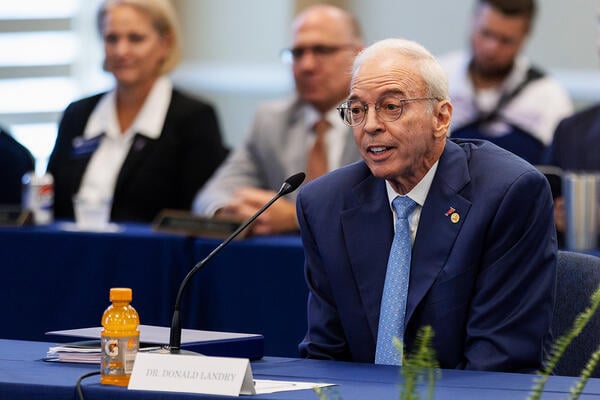
    After months of uncertainty over who will lead the University of Florida, the Board of Trustees tapped Donald Landry as interim president in a unanimous vote at a meeting Monday morning.

    Landry, chair emeritus of the Department of Medicine at Columbia University, will replace outgoing interim president Kent Fuchs, whose contract ends on Sept. 1. The appointment comes after the Florida Board of Governors rejected Santa Ono as UF’s next leader in June over his past support of diversity, equity and inclusion efforts, despite the university’s trustees approving the hire.

    Landry, who is currently president of the American Academy of Sciences and Letters, will officially step into the job on Sept. 1, pending successful contract negotiations. Details of Landry’s contract have not been released, but Ono was set to make about $3 million annually.

    The interim hire will still need to be approved by the state’s Board of Governors.

    UF’s New Leader

    In a public hourlong interview during Monday’s board meeting, Landry promised that UF would be “neutral” under his leadership. However, he added a caveat.

    “A neutral university, paradoxically, in this nation at the moment would be a conservative university. Not espousing conservative values, certainly not indoctrinating in conservatism,” Landry said. “We’d be neutral. We wouldn’t choose sides.”

    Landry also criticized Columbia faculty and administrators for failing to respond to concerns about antisemitism amid pro-Palestinian student protests last year. Last month the university reached a settlement with the federal government that included sweeping reforms to academic programs, speech and disciplinary policies, as well as a $221 million payout.

    “I saw things at Columbia that suggested an alignment between some faculty and students that I think encouraged the students to do things that were more reckless,” Landry told UF’s board.

    At another point, when asked about DEI, he said when it “first emerged it was a bit vague what it actually meant” but “by the time it crystallized it was clear [DEI] had gone too far.” Landry added that he was thankful the “government has intervened and returned us to a rational meritocracy.”

    Landry also cast himself as someone who resisted DEI at Columbia when it was “being implemented widely at every level, from the very top down to the smallest unit,” adding that “the Department of Medicine never wavered in its commitment to excellence” in his time there. Landry vowed to uphold state laws barring spending on DEI at Florida’s public institutions.

    A physician by training, Landry has degrees from Lafayette College, Harvard University and Columbia’s College of Physicians and Surgeons. In 2008, President George W. Bush awarded Landry the Presidential Citizens Medal for his work on stem cell research, which used embryos that did not survive in vitro fertilization. Bush lauded Landry as a man of science and faith, crediting his approach to stem cell research. Landry was also on the President’s Council on Bioethics during the Bush administration.

    Landry has also brought his scientific training to bear on other political debates. In early 2024, he filed a brief in a Supreme Court case in support of former Florida attorney general Ashley Moody and Texas attorney general Ken Paxton, who were sued by a technology trade group over laws passed in both states seeking to limit content moderation on social media platforms. Landry expressed concerns about censoring alternative perspectives, arguing that “the danger of censoring scientific dissent is painfully apparent from the conduct of social media platforms during the COVID-19 crisis,” which “reinforced prevailing opinion and allied government policy by suppressing dissent on a host of scientific questions.”

    SCOTUS ultimately remanded the case to the lower courts.

    Landry has also praised Jay Bhattacharya, director of the National Institutes of Health and an epidemiologist who was skeptical of the dangers of COVID-19 and prevention measures such as stay-at-home orders. Last year Landry said that Bhattacharya refused “to compromise his scientific findings,” thus risking “his own personal and professional self-interest, repeatedly, without hesitation, to take a stand for the public’s right to unrestricted scientific discussion and debate.”

    ‘A Great Selection’

    UF Board of Trustees chair Mori Hosseini emphasized Landry’s scientific background in a news release announcing the hire, stating the new interim president “has shown exceptional leadership in academia and beyond, building programs with innovation, energy and integrity.”

    Chris Rufo, the conservative anti-DEI activist who helped tank Ono’s chances at the UF presidency through an online campaign highlighting his past statements, praised the hire.

    “Dr. Landry is a principled leader who will reverse ideological capture and restore truth-seeking within the institution. Kudos to the UF board of trustees on a great selection,” Rufo wrote on social media.

    Alan Levine, a member of the Florida Board of Governors who voted against hiring Ono, also praised the selection in a post on X, calling Landry “an excellent choice” for the UF interim presidency.

    Landry is expected to serve as interim president while UF begins a national search for its next leader. The university has been without a permanent president since former Republican senator Ben Sasse of Nebraska abruptly resigned from the job shortly before a spending scandal emerged.

    Source link

  • GMU President Refuses to Apologize, Rejects OCR Findings

    GMU President Refuses to Apologize, Rejects OCR Findings

    Bill O’Leary/The Washington Post via Getty Images

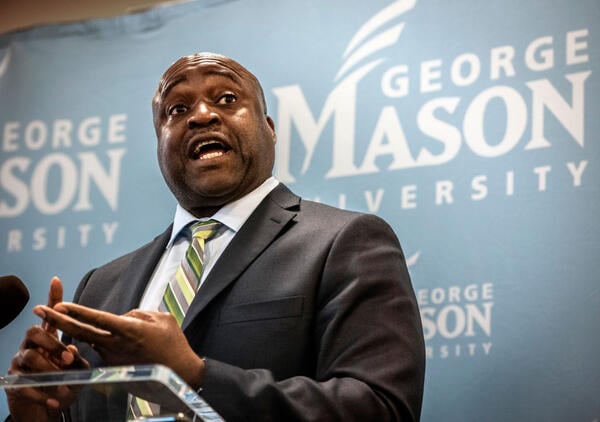
    George Mason University president Gregory Washington has rejected demands by the Department of Education’s Office for Civil Rights that he apologize for alleged discriminatory hiring practices, questioning the findings of an OCR investigation that accused him of implementing “unlawful DEI policies.”

    In a letter to GMU’s board Monday, Washington’s attorney, Douglas F. Gansler, alleged that OCR cut its fact-finding efforts short and only interviewed two university deans before reaching the conclusions the Department of Education published Friday. Gansler wrote that “OCR’s letter contains gross mischaracterizations of statements made by Dr. Washington and outright omissions” related to the university’s DEI practices.

    Gansler also accused OCR of selectively interpreting various remarks by Washington, the first Black president in GMU’s history.

    “To be clear, per OCR’s own findings, no job applicant has been discriminated against by GMU, nor has OCR attempted to name someone who has been discriminated against by GMU in any context. Therefore, it is a legal fiction for OCR to even assert or claim that there has been a Title VI or Title IX violation here,” Gansler wrote in a 10-page letter.

    ED has demanded changes at GMU and a personal apology from Washington.

    “In 2020, University President Gregory Washington called for expunging the so-called ‘racist vestiges’ from GMU’s campus,” Acting Assistant Secretary for Civil Rights Craig Trainor said in a statement released by the Department of Education last week. “Without a hint of self awareness, President Washington then waged a university-wide campaign to implement unlawful DEI policies that intentionally discriminate on the basis of race. You can’t make this up.”

    In his letter to the board, Gansler emphasized that under Washington’s leadership, GMU has complied with executive orders that cracked down on DEI programs and practices, pointing to recent changes such as the dissolution of GMU’s DEI office and restricting the use of diversity statements in hiring.

    “If the Board entertains OCR’s demand that Dr. Washington personally apologize for promoting unlawful discriminatory practices in hiring, promotion, and tenure processes, it will undermine GMU’s record of compliance. An apology will amount to an admission that the university did something unlawful, opening GMU and the Board up to legal liability for conduct that did not occur under the Board’s watch,” Gansler wrote. He added that admitting to such violations could bring about punitive action from other federal agencies, such as the Department of Justice.

    Washington’s rejection of an apology and dispute over the claims made by OCR comes shortly after speculation that GMU’s Board of Visitors—which includes numerous conservative political figures and activists appointed by Republican Virginia governor Glenn Youngkin—would fire him. Instead, the board gave Washington a raise after a lengthy closed-door meeting earlier this month that brought dozens of protesters out to show their support for the besieged president.

    Asked for a statement, GMU officials referred Inside Higher Ed to Gansler.

    ED did not immediately respond to a request for comment from Inside Higher Ed.

    Source link

  • Fewer Young People See Math Skills as Very Important in Work

    Fewer Young People See Math Skills as Very Important in Work

    Higher education stakeholders have noted that math anxiety can hold students back from pursuing some disciplines or major programs, but a new analysis from Gallup finds that young Americans over all place less importance on math skills compared to the general population.

    While over half of all Americans rate math skills as “very important” in their work (55 percent) and personal (63 percent) lives, only 38 percent of young people (ages 18 to 24) said math skills are very important in their work life and 37 percent in their personal life, according to a December survey of 5,100 U.S. adults.

    The survey highlights generational divisions in how math skills are perceived, with adults older than 55 most likely to see math as very important compared to younger adults, and Gen Z least likely to attribute value to math skills.

    To Sheila Tabanli, a mathematics professor at Rutgers University, the low ratings point to a lack of perceived connection between math skills and career development, despite the clear correlation she sees.

    Tabanli said it can be hard to convince many Gen Z and Alpha students that math content is necessary for their daily lives, in part because access to information is so convenient and they can perform calculations on their phones or online.

    “We need to transition from focusing too much on the concept, the domain, the content—which we do love as math people, otherwise we wouldn’t be doing it for a living—but students don’t see that connection [to employable skills],” Tabanli said.

    When asked how important math skills were for the majority of the U.S. workforce, 40 percent of young adults rated having math skills as very important—the lowest rating of nine skills evaluated, including reading, language, technology and leadership, according to Gallup.

    Young people also rated the importance of math skills for the general workforce, as compared to their own lives, the lowest of all age cohorts. Adults ages 55 to 64 (71 percent) and 65 and older (68 percent) were most likely to say math is a very important skill for the general workforce.

    Most career competencies that colleges and universities teach, such as those by the National Association for Colleges and Employers, focus on broader skills—including critical thinking, leadership, communication and teamwork—as essential for workplace success. Math can teach students how to solve problems and engage with difficult content, which Tabanli argues are just as important for an early-career professional.

    One reason a young adult might not rate math skills highly is because many students face undue math anxiety or a skepticism about their own ability to do math, falling into the belief that they’re not “math people,” Tabanli said.

    In response, Tabanli believes professors should help students apply computational skills to their daily lives or link content to other classes to encourage students to invest in their math learning. While this may be an additional step for a faculty member to take, Tabanli considers it a disservice to neglect this connection.

    Professors can also strive to make themselves and the content more human and approachable by sharing information about their lives, their careers and why they’re passionate about the subject, Tabanli said.

    Source link

  • Federal Grants for Area Studies and Foreign Language at Risk

    Federal Grants for Area Studies and Foreign Language at Risk

    For 67 years, the Department of Education has administered grants to universities to create centers devoted to foreign languages and area studies, a field focused on the study of the culture of a particular area or region. Now, those centers are under fire by the Trump administration, which has not released the funding the grantees expected to receive in July.

    The grants support what are known as National Resource Centers, which were originally developed as a national security tool to help the U.S. increase its international expertise in the midst of the Cold War and the aftermath of Soviet Union’s 1957 launch of Sputnik. Since then, their purpose has shifted with the times, now focusing not only on producing scholars but also on community outreach and collaboration with K–12 schools.

    The office responsible for administering the grants—International and Foreign Language Education—was dissolved and its entire staff laid off as part of the March reduction in force at the Department of Education. But it seemed IFLE’s programs, which were authorized under Title VI of the Higher Education Act of 1965, would live on; they were moved under the ED’s Office of Higher Education Programs, according to an internal communication shared with Inside Higher Ed at the time.

    Since then, funding has come through “in fits and starts,” Halina Goldberg, the director of Indiana University’s Robert F. Byrnes Russian and East European Institute (REEI), told Inside Higher Ed in an email, though ultimately, the center received all its promised funds for fiscal year 2024–25. REEI was part of the first cohort of NRCs and has been continuously funded by the program since then.

    But NRC directors, including Goldberg, are concerned the funds for the upcoming year—the final year of the program’s four-year cycle—may not come through, and that the Trump administration may be planning to demolish the program altogether. NRC leaders have received no notice from ED about whether or when the funds are coming, and some say their contacts at the department have expressed uncertainty about the program’s future.

    The funding cuts appear to be caused by the Office of Management and Budget; records show that the agency has not approved appropriations for programs formerly housed in IFLE, including the NRC program, as well as the Foreign Language and Area Studies fellowships, which fund scholarships and stipends for undergraduate and graduate students studying these disciplines. In total, about $85 million was appropriated for IFLE programs for FY 2025–26, including $60 million for NRCs and FLAS.

    “We’re just kind of in this holding pattern to learn whether our funds are going to be released or not. And there is some time pressure, because if that fiscal year 2025 funding is not allocated by Sept. 30, which is when the fiscal year, the government fiscal year ends, then it’s gone and we’re without funding,” said Kasia Szremski, associate director for the Center for Latin American and Caribbean Studies at the University of Illinois at Urbana-Champaign.

    A Discipline in Crisis

    NRC grant recipients worry about what the funding freeze and potential elimination of the program will mean for the disciplines of foreign language and area studies, which have already taken a beating in recent years; many colleges have eliminated such programs as cost-saving measures— including West Virginia University, which gutted nearly all of its language programs in 2023. More recently, the University of Chicago has paused admissions to all its humanities Ph.D. programs, including a slew of language programs, for the coming academic year.

    Emanuel Rota, a professor in the Department of French and Italian at Urbana-Champaign who leads the university’s European Union Center, said he was already worried about the future of area studies and foreign language education, but “now I’m terribly scared.”

    “I think this seems to be, at this point, slightly part of a trend to provincialize the United States in a way that is troubling for the future of this generation of students, who are, at this point, used to learning from other experiences around the world; knowing about ways of teaching, other ways of learning; establishing collaborations early on; and being able to be multicultural and multilinguistic like their peers around the world,” he said. “And all of a sudden they are told, ‘You only speak one language, you only know one culture and you only know your local environment, and you have to live with that.’”

    It also comes amid efforts to quash other forms of cultural education and intercultural exchange. OMB also recently cut funding from a number of State Department exchange programs, according to Mark Overmann, executive director of the Alliance for International Exchange, which represents organizations that administer such programs.

    Larger entities like the Fulbright program are being spared, he said, but the cuts include critical programming aiming at increasing STEM education access for girls around the world, fostering intercultural exchange with students in the Middle East, bolstering the study of foreign affairs in the U.S. and more.

    International students and immigration broadly are also being targeted by the Trump administration, which has recently revoked thousands of student visas and increased barriers for overseas students studying in the U.S.

    “I think international exchange programs, mobility, the presence of international students on our campuses have long been something that is supported in a bipartisan way, and that has been played out for decades in tangible ways,” Overmann said. “One would be increases in funding in both Democrat and Republican administrations, as well as Congresses. This is something we have seen transcend party lines and those across the political spectrum see that the mobility of our students, of our young professionals—both Americans going abroad and international students and professionals coming here—is something that supports our national security, our diplomatic interests, our influence around the world and our economy, down to very local levels.”

    This isn’t the first time Trump has targeted NRCs. In 2018, during his first administration, ED criticized a Middle Eastern studies consortium at Duke University and the University of North Carolina for delivering programs it alleged had “little or no relevance to Title VI.” The programs under scrutiny included a conference about “Love and Desire in Modern Iran” and another focused on film criticism in the Middle East.

    “It was probably a harbinger of what’s happening now,” said Brian Cwiek, a former IFLE program officer who lost his job when the office was dissolved. “I think that’s really where a lot of the same folks became intent on shutting down this same program.”

    Area studies funding is also singled out in Project 2025, an agenda developed by the conservative think tank the Heritage Foundation that the Trump administration is following closely.

    “Congress should wind down so-called ‘area studies’ programs at universities (Title VI of the HEA), which, although intended to serve American interests, sometimes fund programs that run counter to those interests,” Project 2025 reads. “In the meantime, the next Administration should promulgate a new regulation to require the Secretary of Education to allocate at least 40 percent of funding to international business programs that teach about free markets and economics and require institutions, faculty, and fellowship recipients to certify that they intend to further the stated statutory goals of serving American interests.”

    Outreach at Risk

    Although funding may still come through before the September cutoff date, some centers are already feeling the pressure.

    At the Mario Einaudi Center for International Studies at Cornell University, which is home to two National Resource Centers, Kathi Colen Peck was responsible for administering an NRC-funded program focused on providing faculty development to professors at community colleges in upstate New York. Although the center has funding sources outside of ED, the community college program was almost entirely funded by an NRC grant.

    The program involved bringing international speakers—a dance instructor from Benin, for example—to give workshops in community college classrooms, as well as administering a fellowship for community college professors to create curricular projects.

    Once it became clear this year’s funding wasn’t going to become available when expected, Peck was laid off and the partnerships with community colleges for the upcoming academic year had to be discontinued.

    “The intention of [the outreach program] is really to sort of bridge resources and help the community college faculty have connections to the area studies expertise at, for example, Cornell. They’re able to leverage resources at Cornell where they wouldn’t necessarily have access to that in any other circumstances,” she said. “It’s really about trying to help the community college faculty internationalize their curricula.”

    At other campuses, cultural events and educational programs that NRC leaders say are immensely valuable to their communities could be on the chopping block. Hilary V. Finchum-Sung, the executive director of the Association for Asian Studies, said that the University of Michigan’s Korean Studies center, for example, hosts a free Korean film series at an off-campus theater that is open to members of the public. It’s an opportunity for members of the Ann Arbor community to see a film they likely never would otherwise—and to glean something new about a culture that they might be unfamiliar with.

    On the flip side, NRC programs can sometimes give immigrants a rare chance to connect with their culture on American soil. Szremski, of UIUC’s Center for Latin American and Caribbean Studies, said the center has partnered with local libraries to hold a Latin American Story Time Program for about 15 years. At these events, they read children’s stories in English and Spanish, but also in other Latin American languages including Portuguese, Guaraní, Q’anjob’al, and Quechua.

    “This is particularly important in Champaign and Urbana, because even though we’re in central Illinois, we have a very large and very vibrant Latino community, many of whom are native speakers of Indigenous languages,” she said.

    Once, after a Latin American Story Time event, a library worker once told her, an older woman “came up to her in tears because she was a native Guaraní speaker and had never thought [she would] hear her native language again, really, now that she was living in the United States.”

    Cwiek noted that some faculty positions may also be at risk without NRC funding; though the grants usually cover only a small portion of a professor’s salary, that portion may be the difference that allows a college to offer certain world languages.

    Scholarship Uncertainty

    Students are also in imminent danger of losing scholarships due to the funding pause. Graduate students relying on Foreign Language and Area Studies Fellowships to fund their education in the new academic year still don’t know whether they will receive that money. Szremski said on Friday that one incoming fellow recently made the choice to withdraw from UIUC and instead study in Colombia for the upcoming academic year due to funding fears. With UIUC’s academic year beginning this week, others were forced to make the decision about whether to come to campus without knowing if they would receive the scholarships they’d been promised. Across the university’s NRCs, 53 students are awaiting FLAS funds.

    Other universities are in a similar position. At Cornell, 18 students will be impacted if the money doesn’t come through, according to Ellen Lust, the director of the Einaudi Center for International Studies and a government professor.

    These fellowships provide the cultural awareness, understanding and skills that the U.S. “has relied on to be a world leader. Students who benefited from NRC support have gone on to join the US Foreign Service, engage in international business, and educate new generations of global citizens. They have conducted international collaborations and research that that ultimately benefit Americans,” she wrote in an email to Inside Higher Ed.

    While the stipends allocated to undergraduate students are not as sizable as those for graduate students, Szremski said those recipients have told her they may have to take out private loans or start part-time jobs to fill the gap created by the missing FLAS money.

    The future of these grants remains unclear. The Senate’s appropriations bill maintains funding for IFLE programs, so even if the funding doesn’t come through this year, the program may be able to resume the following year.

    But if the NRC and FLAS programs are shuttered permanently, the effects will “be felt for generations to come,” wrote Lust.

    “Our current and future students are the foreign service officers, intelligence analysts and CEOs of the future,” she wrote. “Within a generation, US citizens will be ill-equipped to live, work and lead in a global world. They will be outmatched by those from other countries, who speak multiple languages, understand diverse cultures and have built relationships across borders. Ultimately, these policies weaken the US’ global position and will make America less secure and prosperous.”

    Source link

  • SCOTUS Ruling Has “Bleak Implications” for Researchers

    SCOTUS Ruling Has “Bleak Implications” for Researchers

    Photo illustration by Justin Morrison/Inside Higher Ed | SDI Productions/E+/Getty Images

    Hope is fading that federally funded researchers whose grants were terminated by the National Institutes of Health earlier this year will be able to resume their work as planned.

    On Thursday, the United States Supreme Court ruled 5 to 4 that any legal challenges to the grant terminations should be litigated in the Court of Federal Claims, not the federal district court system they’ve been moving through for months.

    It’s the latest twist in federally funded researchers’ legal fight to claw back nearly $800 million in medical research grants—though accounting for the multiyear grants that the NIH is refusing to fulfill puts that figure closer to $2 billion—the NIH terminated for running afoul of the Trump administration’s ideological priorities. Many of the grants funded programs that advanced diversity, equity and inclusion initiatives and research projects focused on topics such as LGBTQ+ health, vaccine hesitancy and racial disparities.

    Researchers sued the NIH in April and got a win in June when a federal district court judge in Massachusetts ordered the agency to reinstate the grants immediately. Although the NIH has since reinstated many of those grants, Scott Delaney, an epidemiologist at Harvard University and former lawyer who’s been tracking grant cancellations, told Inside Higher Ed that after Thursday’s ruling those reinstated grants will “almost certainly” be re-terminated. If that happens, “I don’t think they’ll get their money back.”

    That’s in part because the Supreme Court said researchers will have to re-file their lawsuits in federal claims court, which generally doesn’t have the power to issue injunctive relief that could keep grant money flowing during the litigation process. And it could take months or even years for the claims court to decide if researchers are owed damages.

    “Nobody has that kind of time. The nature of research is that you can’t just stop and restart it many months later,” said Delaney. “Folks have already had to do that once and many aren’t able to—they’ve had to lay off staff and lost contact with study participants. This additional delay probably renders the research unviable going forward.”

    Trump ‘Always Wins’

    Delaney is among numerous experts and advocates who say the decision is both a blow to the scientific research enterprise and the latest evidence that the Supreme Court is inclined to interpret the law to favor the Trump administration’s whims.

    “Make no mistake: This was a decision critical to the future of the nation, and the Supreme Court made the wrong choice,” the Association of American Medical Colleges said in a statement. “History will look upon these mass NIH research grant terminations with shame. The Court has turned a blind eye to this grievous attack on science and medicine, and we call upon Congress to take action to restore the rule of law at NIH.”

    Jeremy Berg, who served as director of the National Institute of General Medical Sciences from 2003 to 2011, said in an email to Inside Higher Ed that while “many (but not all) grants from the lawsuits that had been terminated have been reinstated at this point,” the big question the Supreme Court’s ruling raises now “is whether NIH will start to re-terminate them.”

    Although a 5-4 majority did agree on Thursday that the district can review NIH’s reasoning for the terminations and kept in place a court order blocking the guidance that prompted the cancellations, Berg said the mixed ruling is “potentially very damaging” because redirecting the case to a different court means “the stay blocking the required reinstatements could go into effect.”

    He added that Justice Ketanji Brown Jackson’s dissent sums up his interpretation of the ruling’s implications. “This is Calvinball jurisprudence with a twist,” Jackson wrote. “Calvinball has only one rule: There are no fixed rules. We seem to have two: That one, and this Administration always wins.”

    That’s how Samuel Bagenstos, a professor of law and public policy at the University of Michigan and former general counsel to the Department of Health and Human Services, interpreted the decision, too.

    “The message the courts sent yesterday is very strong that they are going to let the Trump administration shut down the grants right now and remit grantees to the really uncertain process of going to the Court of Federal Claims and potentially getting damages in the future,” he said in an interview with Inside Higher Ed Friday.

    “But that’s really cold comfort for the grantees,” Bagenstos added. “If they can’t get the grants restarted right now, they probably can’t continue their research projects, and the prospect of maybe getting damages in the future doesn’t keep those research projects alive. It’s a bad sign for the entire research community.”

    The NIH is far from the only federal agency that has canceled federal research grants that don’t align with the Trump administration’s ideologies. The National Science Foundation, the Education Department and the National Endowment for the Humanities are all facing legal challenges in federal district courts after freezing or canceling grants.

    And the Supreme Court’s ruling on the NIH’s terminations has implications for those cases, as well.

    “The message seems to be pretty clear that if you have an ongoing grant that’s been terminated and you want to go to court to keep the money flowing, you’re out of luck,” Bagenstos said. “It’s got very bleak implications for all researchers who are depending on continuing the flow of federal grants.”

    Source link

  • Federal Judge Rules in Favor of Religious Colleges in Minn.

    Federal Judge Rules in Favor of Religious Colleges in Minn.

    Religious colleges that require students to sign a faith statement cannot be shut out of a Minnesota program that funds the dual enrollment of high school students in the state’s public and private postsecondary institutions, a federal judge ruled Friday.

    U.S. District Judge Nancy Brasel’s ruling overturns a Minnesota law prohibiting Christian colleges that participate in the state’s 40-year-old Postsecondary Enrollment Options program from forcing students to pass a religious test. The state Education Department and LGBTQ+ advocates had sought such legislation for years on the grounds that faith statements discriminate against students who are not Christian, straight or cisgender. It finally passed in 2023, under a Democratic State Legislature.

    The families of several high school students seeking to earn credits at two Christian institutions in the state, Crown College and the University of Northwestern, then sued, arguing that the law violated their First Amendment right to religious freedom. The ban on faith statements was suspended while the legal battle played out.

    “This dispute requires the court to venture into the delicate constitutional interplay of religion and publicly-funded education,” Judge Brasel said in her 70-page ruling. “In doing so, the court heeds the Supreme Court’s instruction that the First Amendment gives special solicitude to the rights of religious organizations.”

    Brasel noted in her ruling that the two Christian colleges have received nearly $40 million to cover the costs of the PSEO program since the 2017–18 academic year; she wrote that the University of Northwestern admits about 70 percent of dual-enrollment applicants. Over all, some 60,000 high school students have benefited from PSEO, The Minneapolis Star Tribune noted.

    The Becket Fund for Religious Liberty, which represented the plaintiffs, applauded the decision.

    “Minnesota tried to cut off educational opportunities to thousands of high schoolers simply for their faith. That’s not just unlawful—it’s shameful,” said Becket senior counsel Diana Thomson, according to the Associated Press. “This ruling is a win for families who won’t be strong-armed into abandoning their beliefs, and a sharp warning to politicians who target them.”

    Source link