Tag: Events

  • How Public Attacks on Harvard Harm All of Higher Ed

    How Public Attacks on Harvard Harm All of Higher Ed

    The Trump administration has waged its war on higher education on the battlegrounds of social media, press releases and on-air interviews. Shrouded in vague terminology and questionable legal authority, the public attacks are a stark departure from the channels the federal government traditionally uses to issue guidance and policy changes.

    In March, we learned from the Department of Health and Human Services press office that it, along with the Department of Education and the General Services Administration, had started a comprehensive review of $54.1 million in federal contracts and $5 billion in federal grant commitments for Columbia University over alleged violations of Title VI of the Civil Rights Act. The next day, the president doubled down on social media, posting to the conservative site Truth Social, which he owns, that colleges and universities that allow “illegal protests” would be at risk of losing federal funding.

    In May, during an ongoing public battle with Harvard University, Education Secretary Linda McMahon announced in a letter posted to the social media platform X that the federal government would no longer give grants to the institution. The document aired a litany of grievances against the institution including allegedly adopting a remedial math program and hiring “failed” former mayors Bill De Blasio and Lori Lightfoot; it also took aim at the Harvard Corporation’s senior fellow Penny Pritzker for being a “Democrat operative.”

    The style and tone of communication goes beyond bombast and tells of a more coherent vision for the country, including higher education, according to Daniel Kreiss, the Edgar Thomas Cato Distinguished Professor in the Hussman School of Journalism and Media at the University of North Carolina at Chapel Hill and the faculty director and principal researcher of the UNC Center for Information, Technology, and Public Life. Issuing public threats, using pliable labels and making examples of individual colleges are tactics to control an autonomous sector and provoke widespread confusion, he said in an interview with Inside Higher Ed.

    Colleges have little recourse to fight the full force of the federal government—legally or through publicity, Kreiss said, but he urged institutions to invest more in their local communities and to recommit to their teaching missions. He also explained why Vice President JD Vance’s autobiography is a great teaching tool.

    (This interview has been edited for length and clarity.)

    Q: The way the administration is communicating with higher ed is unlike anything the sector has seen before. Public letters and social media posts now deliver news of investigations, funding freezes or threats of future action. What does that reveal about how the government is thinking about its relationship with higher ed?

    Daniel Kreiss

    UNC at Chapel Hill

    A: This is not the relationship, let’s say, between the U.S. government and research universities that prevailed from World War II on, when the government was collaborating with its research industries to make America stronger, militarily and economically. This is very much an adversarial relationship where the Trump administration is saying, “Universities and higher education broadly are making America weaker, and therefore we need to bring U.S. higher education to a heel in order to fit with our political vision for what America should be.” I think that some of the characteristics of the communication that you described is the strategy of policymaking through publicity, as well as the creation of a pervasive climate of uncertainty that is really directed by this core goal of theirs, which is control. In essence, what they want is for universities to fall in line behind the administration’s own vision and priorities for what the American agenda should be, which is one of a deeply reactionary, far-right coalition that is currently occupying all three branches of government.

    Q: Do you think the administration has a vision for higher education in particular?

    A: I think it’s a vision for America, and Trump has been remarkably clear on what that looks like. It’s an America defined pretty narrowly on racial, ethnic and religious terms. It’s an America that has a certain understanding of its history that aligns with those dominant religious, racial and ethnic groups. It’s an America that has doubled down on masculinity as its defining gender in terms of who should be in power and have power in public life. So when we talk about a vision for higher ed, it’s a higher ed that serves that.

    This is what you see in these very vague pronouncements about things like DEI. Anyone who educates or does research on anything that runs counter to that celebration of a very particularistic America is suspect and un-American. Higher ed is part of a whole set of knowledge-producing institutions in society—we can think about journalists and scientists, too— as being problematic because they serve accountability functions. They hold corporations responsible for things like polluting. They hold executives responsible for violations of democratic norms. Or, you know, they hold people in power accountable for not being good custodians of public trust. I think the administration wants to weaken that accountability function that can be played by universities because it undermines, ultimately, their ability to exercise power in the service of that larger vision of what they believe America should be.

    Q: You mentioned vague pronouncements about things like DEI. What conclusions do you draw from this tactic of sowing confusion and using unclear and undefined language?

    A: Ultimately, the end goal is control. They have a few tools to do so—legal means, regulatory means—and they have a lot of funding means to get institutions that are otherwise autonomous in civil society to comply with what they want them to do. But in the absence of those levers, what do you use? Well, you use publicity to get willing compliance or anticipatory compliance.

    This is really what’s key about the publicity piece, because every time they issue something on X or Truth Social or speak publicly about something, whether it’s a threat or making claims that a college is going to be investigated, they’re speaking to the sector as a whole. And publicity ensures that everyone in higher ed is going to have to be responsive to what they say, even if not publicly, but at least in internal decision-making.

    If nobody really knows what DEI is, what discrimination actually entails, what threats are actually real and legal, who will be investigated and how, that creates conditions where every single university administrator has to act in some anticipatory way in order to mitigate a perceived threat, or to escape scrutiny. That ultimately increases this control over universities because they’re acting in ways that might comply in some way and likely are going far beyond what the law will actually allow. We can understand this by looking at other countries, like Hungary, for example. Viktor Orbán has created enough of a climate of both outright control and uncertainty over funding that people comply with what he wants them to do. He’s weaponized this to his advantage

    The Supreme Court’s recent decisions have also played a role in this—in making it harder for [federal] judges to issue these broad injunctions. In essence, what they’re saying is that people are going to be anticipatory, interpreting whatever this public statement is in some way, and in the absence of any other guidance of what might be subject to judicial scrutiny or might be, let’s say, judicially suspect in itself, administrators are going to be making these decisions based on their own risk assessments.

    Q: Speaking of the courts, we’ve seen a flurry of lawsuits challenging the administration, so some final decisions will be made on these issues at some point. Will that clarity roll back some of the pre-emptive compliance you’re describing?

    A: Well the rub is the judicial process takes years. And administrators have to act now. And it’s in exactly that disconnect between that far-off time horizon of, “Oh, I’m sure our lawyers are telling us that this will likely get struck down” and in the meantime, you have to act on the basis of yearly budgets or what is in compliance with guidelines coming from the NIH or the NSF. All of those decisions have to be made in the moment, in a climate of uncertainty.

    So in that context, no, the legal resolution is so far off, and the strategy of how to get there is so deeply unclear, that I don’t think higher ed’s in a great place to pursue judicial remedies for these things.

    Q: We’ve got a number of examples of how institutions have responded to the administration—Harvard pushing back, Columbia and Penn conceding to demands, Jim Ryan resigning from the UVA presidency. Are universities at all prepared for how to handle this moment?

    A: There’s a lot going on there, right? The best public case that we have for resistance is Harvard, but even while Harvard is negotiating, the Trump administration is continuing to put a lot of public pressure on it, which gets back to that earlier point that they’re speaking far beyond Harvard, saying, “If you do this, you will come under the full weight of federal government scrutiny, and we’re willing to have this battle.”

    Universities are in a hard spot for a few reasons. One, collective action is really hard. Higher ed as a sector is deeply diversified, so the question is: Who’s in the best position to actually do that sort of fighting? The second is that every institution, no matter how large, is really complex. It’s hard to make a proactive case for anything, for just all of faculty, for example, let alone an entire university.

    That said, there are a few effective models that we can begin to pick out. Harvard’s choice to double down on making an easily understandable argument for the value of higher education is our best public communication strategy—really doubling down on how universities are an economic engine for communities, states and America itself. When we’re talking about advancing science and technology, early research into artificial intelligence, the development of the internet—that all comes from university-led research that was funded, in part, through federal subsidies and research dollars. That has made America the leading country in technology innovation. This is where we get into a big tent with people from the Republican coalition who are pro-business and pro-corporations that are built on the infrastructure that universities help put together. We train the employees that go work for Fortune 500 companies that position America’s global dominance in its corporate workforce. It’s not saying we do everything, but we do a lot of really great public value work. And somebody needs to make that argument, because if no one is doing it, why would the American public come to these answers themselves?

    Q: On the point about federally funded research at universities advancing technology innovation and the economy—is that argument lost on this administration?

    A: My educated guess of why universities are this particular target in this particular way is that this is political. It’s not about America’s economic growth or America’s technological advantage at the end of the day. This is foremost a political strategy of mobilizing a set of grievances and victimhoods that help to build and maintain a coalition. It’s this idea that Trump’s electoral coalition is being continually victimized by being less safe. That America is losing its culture, its language, its identity, etc., through immigration. This has been the dominant drumbeat since Trump announced his candidacy for president in advance of 2016.

    The other piece to this is the divide in the two parties between who has a college education and who doesn’t. This is a really important point that fuels the Republican Party’s coalition, and which is why attacks on higher ed, if we read them through the lens of publicity, are about identity work. [It’s] saying, “We are representing you people who never went to college against all these higher ed elites who don’t respect you, constantly denigrate America and who want us to be some cosmopolitan global force that’s going to undermine what makes America great.” That’s why, to me, it’s fundamentally political.

    Q: Can you say more about the education divide among voters? How can colleges address that?

    A: The New York Times did some great reporting maybe two years ago that gave universities social mobility scores. It was looking at which universities were the best vehicles of the American dream. One broad conclusion from that reporting was that a lot of universities are failing at this. Now, there’s all sorts of complicated reasons for that—income inequality generally, the finances of higher ed, etc.—but I think one thing that universities can very much do across the board is reinvest in opportunities for those who have the least amount of money or access to a college education.

    I’m somebody who spent some time at very elite institutions, and, you know, they don’t always have great relationships with the communities that exist right next to them. If we’re thinking about what a model would look like to win people back to see these great advancements and their ultimate value for the American people, it would involve just trying to extend it locally. How do we create more affordable housing in towns where universities are located? How can we help people in communities where there’s vast income inequalities between the university and its surrounding environments? How do we get our deep wells of expertise and knowledge out into the communities closest to us in a way that clearly demonstrates through action, not just words or abstract statistics, our real value in people’s lives?

    The last thing is that we need to reinvest in our teaching missions. Most professors I know care deeply about their students, but their time and attention is split in many different ways. We really need to restore commitment to that educational mission that we all have, at least for the very simple reason that students are the bridges to the communities that they represent. They’re our best messengers for what the value of this amazing institution of American higher education is. I have kids from all over the state, from all different walks of life—this idea is that what the university does is serve those students as well as their communities. The knowledge that students are bringing from those communities and the traditions that they are a part of flows into universities as much as knowledge is flowing out.

    Q: In the swirl of staffing cuts and hiring freezes in response to federal funding cuts, are you concerned about what it means for science communication, fact-checking and efforts to combat misinformation?

    A: At its best, science communication is scientists and social scientists making assessments based on the best available evidence that we have about a particular phenomenon in the world and society. We need people to play that function, because that’s the best evidence we have to make political decisions. We can have a range of possible political solutions to things as long as we’re safeguarding institutions that produce a set of public facts that we’re all sharing.

    But as you know, science is complicated. There are always going to be debates. And that’s good. But when social scientists or scientists have a general consensus about something, it is the outcome of a very antagonistic process. Maybe that speaks to something that we used to have a lot more conversations around—explaining the scientific process and how hard it is to produce a fact, and how many millions of dollars go into producing research that can produce something as reliable as a fact.

    We’re seeing this erosion of institutions that can serve the goals of public accountability, and it is deeply problematic for the field. So there’s going to be fewer people entering the field, because there’s less funding and fewer opportunities for them to do this work. The other thing is a lot of people make the choice not to go into doing disinformation-related research, in part, because it’s hard. We’ve seen doxing, death threats against researchers. It’s also the rhetoric, like when the vice president is calling somebody an “enemy of the people.” I taught JD Vance’s book to my undergraduates in 2017, and we had a great series of conversations about that book. I could have all sorts of differences with him, but I would never say JD Vance is an enemy of the people. It’s that deliberately inflammatory rhetoric that is exactly what a lot of researchers like myself are concerned about.

    Q: Do you still teach Hillbilly Elegy to your undergrads?

    A: That was a special one-off course, but I 100 percent would teach it again. It’s a great teaching tool and book, and I think it lays out a very particular and searing account of somebody’s upbringing while then prescribing a set of political responses that are thoughtful and can and should be debated in a classroom. It resonated with a lot of my students.

    Source link

  • State Lawmaker Asks HHS to Investigate Texas A&M

    State Lawmaker Asks HHS to Investigate Texas A&M

    Texas state representative Brian Harrison has asked the U.S. Department of Health and Human Services to investigate his alma mater, Texas A&M University, for allegedly engaging in “discriminatory” student recruiting practices, The Dallas Express reported.

    “In the state of Texas, government entities … should not be treating people differently based on anything other than merit,” Harrison told the outlet. “We have got to bring back a focus on meritocracy. And the president of Texas A&M brags about the fact that he’s doing it.”

    According to a May letter to HHS acting general counsel Brian Keveney that Harrison posted on X, Texas A&M president Mark Welsh had sent him a letter “admitting @TAMU is still engaged in DEI courses and discriminatory ‘targeted recruiting’ practices.”

    Welsh’s letter, which Harrison also included, criticizes the lawmaker for posting a video and other content online accusing the TAMU president of flouting the law.

    “Your comments accompanying the video imply that the university is doing something illegal by engaging in ‘targeted’ student recruitment efforts,” Welsh’s letter says. “You’ve also posted about student groups and academic courses, which, like recruiting activities, are specifically exempted in the bill. Since you voted in favor of the law, you must also be aware of those exemptions.”

    In his letter to Keveney, Harrison called Welsh’s defense—that Texas law does not explicitly ban targeted recruiting—“preposterous.” He asked HHS to “take any action[s] you or President Trump’s Task Force deem appropriate to ensure that Texas universities receiving federal funds are complying with the U.S. Constitution.”

    Harrison told The Dallas Express that HHS had received his letter and is “taking it and handling it appropriately.”

    Source link

  • SCOTUS Allows Mass Layoffs at Education Department

    SCOTUS Allows Mass Layoffs at Education Department

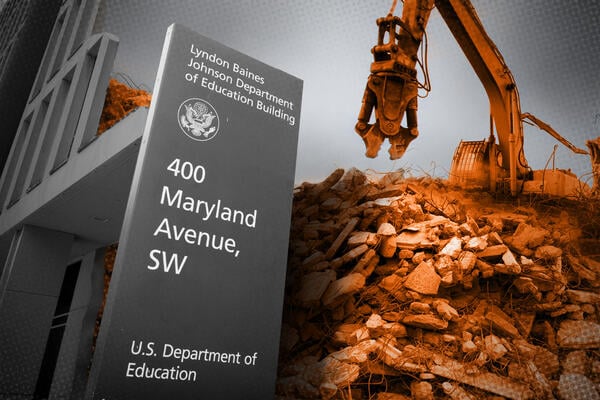
    Photo illustration by Justin Morrison/Inside Higher Ed | Tierney L. Cross/Getty Images | Matveev_Aleksandr and raweenuttapong/iStock/Getty Images

    The Supreme Court gave Education Secretary Linda McMahon the go-ahead Monday to proceed in firing half the department’s staff and transferring certain responsibilities to other agencies.

    The unsigned, one-paragraph order does not explain why a majority of justices decided to overturn a lower court injunction that an appeals court upheld. It did, however, explain that the injunction will remain blocked as lawsuits challenging mass layoffs at the department continue. The high court order represents a major step forward in President Donald Trump’s effort to dismantle the 45-year-old agency.

    “Today, the Supreme Court again confirmed the obvious: the President of the United States, as the head of the Executive Branch, has the ultimate authority to make decisions about staffing levels, administrative organization, and day-to-day operations of federal agencies,” McMahon said in a statement about the decision. The department will now “promote efficiency and accountability and to ensure resources are directed where they matter most—-to students, parents, and teachers.”

    The American Federation of Government Employees, the union representing the department’s staff, said the ruling was “deeply disappointing” and would allow the Trump administration to continue implementing an “anti-democratic” plan that is “misalign[ed] with the Constitution.” Sheria Smith, president of AFGE Local 252, added that just because McMahon can dismantle the department, that doesn’t mean she has to.

    “Let’s be clear,” Smith wrote, “despite this decision, the Department of Education has a choice—a choice to recommit to providing critical services for the American people and reject political agendas. The agency doesn’t have to move forward with this callous act of eliminating services and terminating dedicated workers.”

    The original ruling from a Maryland district judge required McMahon to reinstate more than 2,000 employees who were laid off in March. (As of July 8, 527 of those employees had already found other jobs.)

    Higher education policy advocates and laid-off staffers warned that the department was already struggling to keep up with the overload of civil rights complaints and financial aid applications. With half the workforce, they said, fulfilling those statutory duties would be nearly impossible.

    In addition to the layoffs, the lower court order prevented McMahon from carrying out Trump’s executive order to close the department to the “maximum extent appropriate and permitted by law.” Department officials later revealed in court filings that the order blocked a plan to send funding for career and technical education programs to the Department of Labor.

    The departments reached an agreement in May regarding the CTE programs, but neither said anything about it publicly. CTE advocates worry that putting Labor in charge of about $2.7 billion in grants could sow confusion and diminish the quality of these secondary and postsecondary career-prep programs. Others see the shift as the beginning of the end of the Education Department. Democrats in Congress have objected to the plan, which can now move forward.

    After news of the Supreme Court order dropped Monday, education policy experts sounded the alarm and took issue with the lack of explanation.

    “The president can’t close down ED by fiat but Congress and SCOTUS sure can facilitate it,” Dominique Baker, an associate professor of education and public policy at the University of Delaware, wrote on BlueSky.

    Daniel Collier, an assistant professor of higher education at the University of Memphis, also chimed in, asking, “Am I in the minority by believing that all SCOTUS rulings should have a well detailed and written rationale attached and there should be no exceptions?”

    The Supreme Court’s order included a scathing 18-page dissent from Justice Sonia Sotomayor. Justices Ketanji Brown Jackson and Elena Kagan joined in full. Sotomayor noted that the department plays “a vital role” in the nation’s education system by “safeguarding equal access” and allocating billions of dollars in federal funding. Knowing this, she added, “only Congress has the power to abolish the department.”

    “When the executive publicly announces its intent to break the law, and then executes on that promise, it is the judiciary’s duty to check that lawlessness, not expedite it,” Sotomayor wrote. “Two lower courts rose to the occasion, preliminarily enjoining the mass firings while the litigation remains ongoing. Rather than maintain the status quo, however, this court now intervenes, lifting the injunction and permitting the government to proceed with dismantling the department. That decision is indefensible.”

    Others, however, said the Supreme Court made the right call.

    “There is nothing unconstitutional about the executive branch trying to execute the law with fewer people, which is what the Trump administration is doing,” said Neal McCluskey, director of the Center for Educational Freedom at the Cato Institute, a libertarian think tank, who also contributed an opinion piece to Inside Higher Ed today. If the Trump administration wanted to eliminate the Department of Education unilaterally, he said, “It would have fired everyone. Not only did it not do that, but members of the administration have stated that it is ultimately Congress that must eliminate the department.”

    Source link

  • One Big Beautiful Bill Is Big Betrayal of Students (opinion)

    One Big Beautiful Bill Is Big Betrayal of Students (opinion)

    In late June, House Republicans aired a promotional video about their budget reconciliation bill, the One Big Beautiful Bill Act, claiming it will “make the American dream accessible to all Americans again.” That dream—that anyone in this country can achieve prosperity and success through hard work and determination—is what leads people to come to America and stay. It’s no wonder that politicians invoke this promise as part of the reason for needed change.

    Higher education has long been seen as one of the surest paths to economic security in America—it is one foundation that dream rests on. It feels consequential, therefore, that President Trump and congressional Republicans are looking to undercut this vision of the American dream. The One Big Beautiful Bill Act will reshape federal student aid in ways that transform access to higher education and shut everyday Americans out.

    Forthcoming nationally representative survey data from New America, a nonpartisan think tank, shows Americans are clear-eyed about what it really takes to keep the dream alive: an affordable higher education. But they see college falling further out of reach. Nearly nine out of 10 believe college cost is the biggest factor that prevents families from attending college. And three-quarters of Americans agree that the federal government should spend more tax dollars on educational opportunities after high school to make them more affordable, including majorities of both Republicans and Democrats.

    Americans also believe in accountability for this investment. They want a system that rewards effort, responsibility and outcomes—basic values that align with the American dream. Majorities from both parties say colleges and universities should lose access to taxpayer support if their students don’t earn more than a typical high school graduate or if they struggle to pay down their student loan debt.

    Once enacted, the new law will trim the Pell Grant program, making some middle-income families ineligible who used to qualify for small amounts of the Pell Grant. Federal student loans will look vastly different, with big cuts to graduate, parent and lifetime borrowing limits and less generous repayment options for borrowers who fall on hard times. These changes will close one door for many low- and moderate-income Americans, the one that leads to an affordable associate or bachelor’s degree. At the same time, by expanding Pell Grants to short-term job training programs, the law opens another door to very short credentials as few as eight weeks long with little oversight and consumer protection. Our research has shown time and again that these very short credentials will not deliver economic stability nor improve employment prospects.

    And while the law will take meaningful steps toward accountability and will cut off from federal loans associate, bachelor’s and graduate programs that fail to give students an earning boost, those measures exclude all undergraduate short-term certificate programs, which tend to have the worst outcomes. It will also allow programs to continue to operate, even if most of their students struggle to repay their loans.

    Over all, these changes amount to a massive cut of close to $300 billion in critical funds that ensure students have access to a quality education after high school. It will increase dropout risk (which we know is a major predictor of student loan default), and will push families toward private financing products with fewer consumer protections.

    While the president and congressional Republicans say these cuts are necessary under the auspices of extending tax cuts, improving fiscal responsibility and reforming higher education, the truth is this law will achieve none of this. It will add at least $3 trillion to our deficit by expanding tax cuts to wealthy Americans, all while stripping funding from critical programs everyday Americans rely on like Medicaid, SNAP and student aid. It does nothing to fix the underlying problems that drive college costs. It ignores targeted solutions that would promote affordability and expand accountability. That type of thoughtful reform would require bipartisan reauthorization of the Higher Education Act, which is more than a decade overdue.

    Despite what Republicans in Washington say about making the American dream accessible again, this law will only put it further out of reach. The changes will fall hard on all students trying to obtain education after high school—from welders to electricians, nurses, teachers and medical doctors. These are not “elites,” but core constituents. They are working adults, veterans and parents looking to make a better life for their children, hoping that the American dream is still achievable. Instead, they will find that their own government has abandoned them.

    In his inaugural address in January, President Trump said, “The American dream will soon be back and thriving like never before.” But, in truth, it is being suffocated. It’s too late to change this new law, but moving forward Congress and the Trump administration must center everyday Americans and act cautiously before making such seismic cuts. This is not a partisan issue, but a matter of national interest and prosperity. Failing to think about future legislation that makes meaningful student-centered reform to higher education will have political and generational consequences for years to come. It sends a message to future students that only familial wealth will bring college opportunities, and it won’t matter how much hard work they put in or determination they have.

    Rachel Fishman is the director of the higher education program at New America.

    Source link

  • The Importance of Early Career Planning (opinion)

    The Importance of Early Career Planning (opinion)

    It’s never too early, but it can be too late. This simple phrase has transformed our advising sessions with graduate students and postdocs, resonating deeply with those navigating the uncertain waters of career transitions. As career advising experts who have guided countless individuals through this journey, we have seen firsthand the power of early career planning and the pitfalls of procrastination.

    Today’s graduate students and postdocs are navigating more than just personal uncertainty. They are facing a rapidly shifting professional landscape influenced by political and societal forces beyond their control. The value of advanced degrees is being questioned in public discourse; funding cuts, hiring freezes and massive layoffs are affecting job prospects; and visa restrictions continue to impact international scholars. These trends are unsettling, but they underscore the same truth: Proactive, flexible career planning is necessary.

    The path from graduate school or a postdoctoral position to a fulfilling career is rarely a straight line. We understand; we both hold Ph.D.s and were postdocs ourselves. Yet, many students and early-career researchers delay thinking about their next steps, often until the pressure of impending graduation or the end of an appointment looms large. This delay can turn the exciting question of “What’s next?” into the anxiety-inducing “What now?”

    One common fear we encounter in our advising sessions is the fear of the unknown, and now more than ever, our best advice remains the same: Start sooner rather than later. When harnessed properly, this fear can become a powerful motivator for early career planning. If you build in time to explore your options, test possibilities and develop a flexible plan, you will be far better equipped to navigate unforeseen changes.

    Crucially, starting early does not mean locking yourself into one path. It means giving yourself enough time to adapt, explore and build a more informed and confident future, even if that future changes along the way.

    Your Hidden Advantage

    As graduate students or postdocs, you are in a unique position: You are essentially being paid to learn and become experts in your field. Beyond your specific area of study, you also have access to a wealth of resources at your research institutions designed to support your professional development. These resources include:

    • Career services: Do not wait until your final year to visit the career office. Start early and make regular appointments to discuss your evolving career goals and strategies. Career service professionals can help you save precious time and effort and remain advocates for you in your career-exploration journey. Many of us know exactly how you are feeling because we have been there, too!
    • Workshops and seminars: Attend professional and career-development workshops offered by your institution. These often cover crucial topics like résumé writing, interview preparation or networking strategies.
    • Alumni networks: Leverage your institution’s alumni network. Alumni can provide valuable insights into various career paths, and many are eager to help current graduate students and postdocs navigate the job search process.
    • Professional associations: Join relevant professional associations in your field. Many offer graduate students and postdocs memberships at reduced rates and provide access to job boards, conferences, networking events and leadership opportunities.
    • International student and scholar services: If you are on a visa, connect early with your institution’s international center. These offices can offer critical guidance on work authorization options, strategies for transitioning from an academic-sponsored visa to another type of professional visa (such as the H-1B visa) and long-term planning toward permanent residency. They can also connect you with immigration attorneys and employer resources to help you advocate for yourself throughout the process.

    Now is the time to take action. This month, schedule an appointment with your institution’s career services office (trust us, we are excited to meet and help you) and/or attend a networking event or workshop outside your immediate field of study.

    If your plan involves stepping beyond the academic landscape, do not underestimate the power of building your professional network, as referrals and recommendations play a growing role in hiring decisions. The relationships you build now, through informational interviews, mentorship and community engagement, can become invaluable sources of insight, opportunity and support throughout your career.

    The Perils of Procrastination

    Waiting until the final months of your program or position to begin your job search is a recipe for stress and missed opportunities. Early preparation not only reduces anxiety but also allows you to explore multiple career paths, build necessary skills and make meaningful connections.

    As career professionals, we see the impact of procrastination all the time: rushed applications, unclear goals, missed deadlines and tremendous stress. In our own career-exploration journey, we have been fortunate to experience the opposite. Our approach to prepare early opened doors to valuable opportunities and reduced the pressure to find just any job at the end of our postdoc. That contrast is a big reason why we now advocate so strongly for starting career planning before urgency sets in, even if you are still figuring out where you want to go.

    So what does early preparation look like?

    If you already have a strong idea of your next career step, whether it is to become faculty at a R-1 institution or secure an R&D position in industry, you should begin preparing at least a year before your intended transition. This gives you time to identify target roles, network meaningfully, develop your application materials and be ready when opportunities arise.

    If you are still unsure about what your next career step is, start your exploration journey as soon as possible. Identifying careers of interest, scheduling informational interviews, developing your professional network in the areas of interest and learning or building new skills take time. Remember that the earlier you begin, the more options you will be able to explore. Career planning is not just for people with a clear path—it is also how you find your path.

    Another critical reason to start early? Networking. Building professional relationships is one of the most powerful tools in your career exploration and job search tool kit, but it takes time. The best networking conversations happen when you are genuinely curious and not urgently seeking a job. If you wait until you are in crisis mode, panicked, pressed for time and desperate for a position, that energy can unintentionally seep into your conversations and make them less effective. By starting to connect with people well before you are actively applying for jobs, you can ask better questions, get clearer insights and build authentic relationships that may open doors later on.

    The International Perspective

    International graduate students and postdocs are navigating career planning under especially difficult circumstances. The experience of working and building a life in another country already comes with challenges, what with being far from home, managing complex visa systems and building support networks from scratch. With the current increasing political scrutiny, shifting immigration policies and rising uncertainty around international education, the pressure has only grown.

    We want to acknowledge that this is not just a logistical issue—it is also an emotional one. For many international scholars, the stress of career planning is compounded by fears about stability, belonging and being able to stay in the country to which you have contributed so much. These are not easy conversations, and they should not be faced alone.

    That is why early, informed and strategic planning is especially important. With the right tools, guidance and support system, you can better navigate the uncertainty and advocate for your future.

    • Use your resources. Connect early and often with your university’s international student or scholar office. They can clarify visa timelines, regulations and documentation requirements.
    • Get legal support. Consult with a qualified immigration attorney who can help you understand your options and advocate for you.
    • Network with intention. Seek out events, professional associations and communities that are welcoming to international scholars. These relationships can lead to valuable advice, referrals or even job opportunities.

    While visa policies and political rhetoric may be out of your control, the way you prepare and position yourself is not. Planning ahead can help you reduce uncertainty, take advantage of time-sensitive opportunities and build a support system to help you succeed wherever your career takes you.

    Know Your Path to Success

    Many students and postdocs have a clear vision of their desired career but lack understanding of how to get there. For example, many aspiring faculty underestimate how important it is to gain teaching experience or to have early conversations with their supervisor about which projects they can pursue independently for their future research statements. Similarly, those aiming for roles in industry or policy may overlook essential skills such as project management, stakeholder communication or regulatory knowledge until they begin applying and realize the gap.

    Career paths are often shaped by more than just qualifications. They are influenced by relationships, timing, self-awareness and luck, but especially by the ability to recognize and act on opportunities when they arise. That is why we often reference “planned happenstance,” a career-development theory by John Krumboltz, which encourages people to remain open-minded, take action and position themselves to benefit from unexpected opportunities. It is not about having a rigid plan, but about preparing enough that you can pivot with purpose.

    Here are three practical strategies to help you do just that:

    1. Conduct informational interviews: Speak with professionals in your target roles for invaluable insights into their day-to-day realities and career paths. Ask about those hidden requirements—the transferable skills and experiences crucial for success, but not necessarily listed in job descriptions. Use this knowledge to identify and address skill gaps early in your academic journey.
    2. Perform skill audits: Regularly assess your skills against job descriptions in your desired field and identify gaps you need to address through coursework, volunteer experiences or side projects.
    3. Seek mentorship: A good mentor can provide guidance, open doors and help you avoid common pitfalls in your career journey. Consider building a network of mentors rather than relying on a single person; different mentors can support different aspects of your professional growth. Your career services office is a great place to start!

    Early planning gives you the ability to shape your own narrative, develop key experiences intentionally and take advantage of unexpected opportunities. Do not wait to be ready to start; start now, and readiness will come.

    Start Here: A Career Planning Checklist

    Career planning does not have to be overwhelming. Small steps, taken consistently, can lead to powerful outcomes, whether you are in year one of a Ph.D. program or year four of a postdoc. Use this checklist to begin or re-energize your professional development journey.

    This month, try to:

    • Schedule a career advising appointment—even if you’re “just exploring.”
    • Attend one workshop or seminar outside of your research area.
    • Reach out to someone for an informational interview (a colleague, alum or speaker whose path interests you).
    • Identify one skill you want to build in the coming months and one way to begin (e.g., take a course, volunteer, shadow someone).
    • Join or re-engage with a professional association or community.

    By starting your career planning early, you are not just preparing for a job: You are laying the foundation for a fulfilling career. Small, consistent efforts can lead to significant results over time. The resources available to you as graduate students and postdocs are invaluable, but only effective if you use them. Do not wait for your future to happen; start building it today!

    Ellen Dobson, G.C.D.F., is the postdoctoral and graduate program manager at the Morgridge Institute for Research, where she leads professional and career-development programming for early-career researchers. Drawing on her experience as a Ph.D., postdoc and staff scientist, she is dedicated to helping graduate students and postdocs explore fulfilling career paths through supportive, practical guidance.

    Anne-Sophie Bohrer is the program manager for career and professional development in the Office of Postdoctoral Affairs at the University of Michigan. In this role, she leads the development of programs to support postdoctoral fellows from all disciplines.

    Source link

  • Who Benefits Most From New Admission Tactic? (opinion)

    Who Benefits Most From New Admission Tactic? (opinion)

    I am not currently on a 12-step program of any kind, but recently I felt the need to seek forgiveness for a transgression committed 50 years ago. This summer is the 50th anniversary of the release of Jaws, the movie that redefined the definition of blockbuster and made a whole generation think twice before stepping into the ocean for a quick dip.

    I took my little sister to see Jaws that summer, having already seen it. As big brothers do, I waited until the exact moment when the shark leaps out of the water while Roy Scheider is casually ladling chum into the ocean behind the boat and either grabbed or pinched her. All to make the movie-watching experience more realistic, of course.

    A recent article in The Washington Post explored why, despite three sequels, Jaws never became a money-making franchise in the way that Star Wars or the Marvel movies have. The obvious reason is that Steven Spielberg elected not to be involved after the original movie. Thus, while I find myself humming John Williams’s simple but ominous theme music every time I read the latest news, the only thing I remember from any of the other three movies is the tagline for Jaws 2: “Just when you thought it was safe to go back in the water.”

    I thought about that tagline from a college admission perspective last week when I learned that Cornell College (the one in Iowa, not the Ivy) has launched what is either an innovative financial aid initiative or a gimmick.

    As detailed by several other publications, Cornell College emailed 16,000 soon-to-be high school seniors in its inquiry pool. Nothing unusual about that. What was different about this email was that it included a link to a personalized estimated financial aid package. Sending out financial aid offers/estimates to students who haven’t applied for financial aid or admission is the new twist in what Cornell calls its “Save Your Seat” initiative.

    If you are wondering how Cornell was able to send an estimated aid package to students who haven’t completed a FAFSA, the college started by mining ZIP code data for its inquiry pool. The nine-digit ZIP+4 code in student addresses provides precise information about where they live and allows Cornell to guesstimate a family’s economic circumstances. It might therefore be more accurate to say that the estimated financial aid package is individualized rather than personalized, because there is an element of geographic or ZIP code profiling taking place. The ZIP+4 information is supplemented by aggregated data provided by College Raptor, the consulting firm engaged by Cornell, along with historical internal data on financial aid packages.

    There are some kinks to work out and questions to be considered, of course. How will Cornell factor in Pell Grants and other governmental financial aid? Will the college make up the difference if the student’s Student Aid Index turns out to be higher than Cornell’s estimate? Apparently Cornell did some testing using applicants from last year and found that the estimates were reliable in the vast majority of cases.

    The Save Your Seat financial aid package for every student includes a $33,000 National Academic Scholarship covering nearly half of Cornell’s list price. To guarantee access to the aid, Cornell is asking students to apply by the end of this month and submit an enrollment deposit by Sept. 1. As The Chronicle of Higher Education explains, “students who apply by the end of July and submit a deposit by September 1 are guaranteed to receive the $33,000 scholarship, plus any institutional need-based grants for which they might qualify, based on their estimate. They will also get first dibs on housing and first-year seminars. (Those who deposit by November 8 will get the same deal, minus the guaranteed need-based grants and priority registration for the seminars.)”

    So what should we make of Save Your Seat? Is Cornell College on to something, or is this another marketing gimmick intended to differentiate Cornell from the mass of small liberal arts colleges? (Its one-course-at-a-time curriculum already distinguishes it.)

    I applaud Cornell for trying to introduce some transparency about cost up front. We know that affordability is both a major concern and a major impediment for many families in considering colleges, and particularly private colleges. Having a way to estimate cost early in the college search rather than at the very end is potentially a huge step forward for college admission. Cornell’s initiative might be thought of as an updated version of the net price calculator, with someone else doing the calculations for you. Save Your Seat might also be seen as the next iteration in the direct admission movement.

    But let us stop for a moment to acknowledge that Cornell’s new initiative, while more transparent, isn’t truly transparent. It does nothing to illuminate the high-cost, high-discount model that higher education relies on.

    There are good reasons for that. There have been several colleges that have tried to lead a movement to reset tuition, substantially reducing their sticker price but also substantially reducing discounts. They learned two things. The first was that they were willing to lead, but other colleges were not willing to follow.

    The bigger issue is that they learned that families are more than happy to pay lower tuition but are not happy to lose their “merit” scholarships. As it turns out, merit scholarships are among the least transparent and most misunderstood contrivances in college admission—perhaps deliberately so.

    Just last week, I spoke with someone who was surprised that a nephew had been admitted to college and then shocked when he received a merit scholarship. That conversation brought to mind a phone call I had with the mother of one of my students years ago. The son was a good kid but not a strong student, and he had just received merit scholarships to two different colleges. I finally figured out that the point of her call was to ask what was wrong with the two colleges that were awarding her son merit scholarships.

    The $33,000 National Academic Scholarships offered to every Save Your Seat email recipient might be thought of as the higher education equivalent of Oprah’s “You get a merit scholarship! You get a merit scholarship!” Cornell is far from alone in giving a discount to most or all students, but the potential pickle in which it finds itself is a situation where it tells students they are not admitted after already telling them they have won a merit scholarship.

    That is far from the biggest ethical issue raised by the new plan. If the move toward greater financial aid transparency, at least in theory, is a positive step, asking students to apply by the end of July and deposit by September is anything but.

    When the National Association for College Admission Counseling was forced to abandon key aspects of its code of ethics as part of a consent decree with the antitrust division of the U.S. Department of Justice, there were fears that college admission might deteriorate into a lawless Wild West, with colleges coming up with new strategies and incentives to coerce vulnerable students into decisions they weren’t ready to make. Thankfully that hasn’t happened to the degree predicted.

    Cornell’s decision to tie the Save Your Seat financial offers to an earlier application and enrollment deadline represents another leap forward in the acceleration of the college admission process. Who thinks that’s a good idea for students? It ignores the fact that many high school counseling offices are closed during the summer and won’t be able to send transcripts (perhaps Cornell will use self-reported grades). It is also significantly earlier than the provision in the now-defunct NACAC Statement of Principles of Good Practice prohibiting an application deadline before Oct. 15. Just when you thought it was safe to go back in the water.

    It’s not clear to me why the earlier deadlines are necessary for the program to work. It’s clear that there are benefits for Cornell, but students should be allowed to choose where to go to college thoughtfully and freely, without coercion or manipulation. Whose seat is being saved here?

    Jim Jump recently retired after 33 years as the academic dean and director of college counseling at St. Christopher’s School in Richmond, Va. He previously served as an admissions officer, philosophy instructor and women’s basketball coach at the college level and is a past president of the National Association for College Admission Counseling. He is the 2024 recipient of NACAC’s John B. Muir Excellence in Media Award.

    Source link

  • Despite Reservations, Florida BOG Approves New Accreditor

    Despite Reservations, Florida BOG Approves New Accreditor

    The Florida Board of Governors voted Friday afternoon to create a controversial new accrediting agency, in coordination with five other state university systems. The decision came after about an hour of heated discussion between board members and the State University System of Florida’s chancellor regarding details of the plan.

    Chancellor Raymond Rodriguez argued that the new accreditor, called the Commission for Public Higher Education, would eliminate the bureaucracy that comes with existing accrediting agencies and focus specifically on the needs of public universities.

    “The Commission for Public Higher Education will offer an accreditation model that prioritizes academic excellence and student success while removing ideological bias and unnecessary financial burdens,” he said. “Through the CPHE, public colleges and universities across the country will have access to an accreditation process that is focused on quality, rooted in accountability and committed to continuous improvement.”

    But before voting in favor of the motion, board members repeatedly pushed back, arguing that the plans for starting an accreditor from scratch were half-baked. They raised a litany of questions about how the CPHE would work in practice.

    Some wanted to hash out the details of the would-be accreditor’s governance structure before voting. According to the CPHE business plan, the Florida governing board would incorporate the accreditor as a nonprofit in Florida and serve as its initial sole member, using a $4 million appropriation from the Florida Legislature for start-up costs. (Other systems are expected to put in similar amounts.) A board of directors, appointed by all the university systems, would be responsible for accrediting decisions and policies.

    But multiple BOG members worried that the roles of the governing board and board of directors were not clearly delineated.

    “With us as the sole member, it appears, or could appear, to stakeholders that the accreditor lacks independence from the institution being accredited,” said board member Kimberly Dunn.

    Alan Levine, vice chair of the Board of Governors, called for a clear “proverbial corporate veil” between the two in corporate documents.

    “Our role is not to govern or direct the activities of this body,” Levine said of CPHE. “It has to be independent or it won’t even be approvable by the Department of Education.”

    Board member Ken Jones pressed for greater detail on the governing board’s “fiduciary or governance obligation to this new entity.”

    “I’m in support of this … I really believe this is the right path,” he said. “I just want to be sure that we all go in, eyes wide-open, understanding what is our responsibility as a BOG? … We’re breaking new ground here, and we’re doing it for the right reasons. But I want to be sure that when the questions come—and I’m sure they certainly will—that we’ve got the right answers.”

    Members asked questions about the accreditor’s future cybersecurity and IT infrastructure, as well as its associated costs. Some asked whether accreditors have direct access to universities’ data systems and raised concerns about potential hacking and the board’s liability; they were given reassurance that colleges themselves report their data. Some board members also asked for budget projections of what CPHE would cost.

    “I have an internal, unofficial estimation around the funds and revenues, but nothing I’d be prepared and comfortable to put forward publicly,” said Rachel Kamoutsas, the system’s chief of staff and corporate secretary, who fielded questions about the initiative.

    The answers didn’t seem to fully satisfy the governing board.

    “I do think the chancellor and team have a lot of work to do to continue to educate this board, to be blunt,” said BOG chair Brian Lamb, “because a lot of the questions that we’re asking—forecast, IT, infrastructure, staffing—every last one of those are appropriate.”

    He emphasized to other board members, however, that voting in favor of the motion would jump-start the process of incorporating the new accreditor and provide seed money for it. But, he added, “not a penny is going anywhere until we have an agreed-upon document on how this money will be spent.”

    Accreditation expert Paul Gaston III, an emeritus trustees professor at Kent State University, raised similar questions in an interview with Inside Higher Ed.

    “The credibility of accreditation really is directly related to whether the public can accept it is an authoritative source of objective evaluation that is in the public interest,” he said. “And the question that I would ask as a member of the public is, how will an accreditor that is created by and that is answerable to the institutions being evaluated achieve that credibility?”

    Despite all the pushback, the BOG ultimately voted unanimously to approve the measure. Now CPHE can file for incorporation, establish its Board of Directors and set out on the multiyear process of securing recognition from the Department of Education.

    Source link

  • Rates of Admitted Students Who Are Black, Hispanic Have Decreased

    Rates of Admitted Students Who Are Black, Hispanic Have Decreased

    skynesher/E+/Getty Images

    In the wake of the Supreme Court’s 2023 decision to ban affirmative action in college admissions, no one knew exactly what the impact on Black and Hispanic enrollment might be going forward. In fall 2024, the numbers varied substantially by institution; Inside Higher Ed’s analysis of 31 institutions’ enrollment data showed massive drops in Black and Hispanic enrollment at some institutions and less drastic decreases—and even slight increases—at others.

    But enrollment data only tells part of the story. A new report from the Urban Institute, which uses data from 18 colleges and universities, highlights how the demographics of college applicants—and admits—shifted after the court’s decision in Students for Fair Admissions v. Harvard and the University of North Carolina at Chapel Hill. While the share of applicants who were Black or Hispanic increased from fall 2023 to fall 2024—by 0.47 and 0.65 percentage points, respectively—the portion who were admitted decreased.

    It marked the first time since at least 2018 that the share of admitted students who were Black had declined; Hispanic students hadn’t seen a drop since 2021, when the share of applicants also declined. White students’ share of applicants, admitted students and enrolled students has shrunk every year since 2018, a trend consistent with the declining number of white high school graduates (and of white Americans in general). White graduates are also the only group that consistently make up a larger percentage of admitted students than applicants.

    Jason Cohn, a higher education and workforce research associate for the Urban Institute and one of the report’s authors, said that these numbers shed more light on the impacts of affirmative action than enrollment figures alone.

    “We’ve seen a lot of enrollment numbers in news articles here and there since last fall. In some cases, they stay the same; in some cases, they change. But I think what these data are showing is that that’s not fully reflective of what might actually be happening,” he said. “One of the big takeaways for me is just how much can be hidden if you only look at the enrollment numbers and aren’t seeing what’s happening in the rest of the admissions pipeline.”

    For this study, the researchers partnered with two organizations, the Association of Undergraduate Education at Research Universities and the University of Southern California’s Center for Enrollment Research, Policy and Practice, to solicit data from a diverse group of 18 research universities (which they did not name). Although the sample is small, they said, it’s consistent with similar research conducted by the College Board, whose sample included about 60 institutions, indicating that the data is likely reflective of broader trends.

    It’s difficult to say definitively that the Supreme Court’s decision caused the decline in the share of admitted students from underrepresented backgrounds. That same class of high school seniors faced other barriers, including the lingering effects of the COVID-19 pandemic and delays and errors with the Free Application for Federal Student Aid. Bryan J. Cook, another author of the report and the Urban Institute’s director of higher education policy, noted that colleges in some states had begun rolling back diversity, equity and inclusion efforts at that time, including some programs aimed at recruiting students of color.

    “In this particular analysis, we’re not looking to isolate causation, but I think as we continue to look at this type of thing in future years, I think that’ll help us get a little closer,” Cohn said.

    But Robert Massa, a veteran enrollment professional, said he believes the shifts were likely caused in large part by the end of affirmative action.

    “I’m not at all surprised that Black students have increased their representation in the applicant pool and decreased their representation in the accepted pool, because universities are taking careful steps to make sure they don’t use race in and of itself as criteria in the admissions process,” he said.

    (Edward Blum, the president of SFFA, the anti–affirmative action nonprofit that was the plaintiff in the Supreme Court case, told Inside Higher Ed in an email that the organization has no opinion on the study.)

    The researchers plan to dig deeper into the data, analyzing other demographic information, including gender and family income, as well as academic variables such as the standardized test scores and grade point averages of the applicants and admitted students at these institutions.

    One possible hiccup for future research: The report also showed that post-SFFA, the share of applicants who chose not to identify their race increased, from 3.2 percent in 2023 to 5.1 percent in 2024. If that upward trend continues, Cohn said, it might make it “more difficult, over time, to unpack these trends and see who’s being served by the higher education system.”

    Source link

  • Satirical Essay on Restructuring Humanities (opinion)

    Satirical Essay on Restructuring Humanities (opinion)

    The administration at U of All People has suffered long enough with the underperforming School of Social Sciences and Humanities. Its various departments, programs and whatnot have grown arcane to the point where the students themselves no longer understand the difference between, say, philosophy and psychology, save that both begin with the letter p. And since many students no longer engage in reading or writing without the aid of AI, we should stop supporting distinct majors that encourage both. Consequently, we are restructuring the school to reflect the current dictates of academic administration.

     Here are some issues we have made up to justify the restructuring:

    • There has been a recent decrease in enrollment, or at least there ought to have been.
    • These are perilous times for the humanities, and smushing them together will help.
    • Merging departments will make the infrastructure more economical, particularly if we do away with pesky department offices and office staff.
    • Just saying the word “interdisciplinary” makes us feel connected to the 21st century.

    SSSH currently includes English, history, philosophy, religion, sociology, anthropology, modern languages, linguistics, political science, psychology, classics and several others that may have escaped our notice. However, we have hired a consultancy firm that can list them all. Already, the consultants have put together a PowerPoint presentation advising what they have inferred we want.

    The restructuring will feature programs such as philohistenglish-religiosophy (PHER), anthrosociopsychology (ASP) and perhaps two other smushes with better acronyms. The new, flexible majors may be grouped under the Program for (Somewhat Limited Freedom of) Speech, the Program for Global Awareness of What Trouble We’re In and the Program That Resembles a Grab Bag From a Kids’ Party. Instead of a bunch of quarrelsome department heads and a dean, a triumvirate of armed SSSH administrators will be responsible for keeping the peace.

    We have already polled the faculty and students in a metric calculated to prove our point: On a scale of one to 10, please rate how dissatisfied you are with the current setup, with one being “very” and 10 being “extremely.” The 12 respondents answered that they were very dissatisfied. Note that we are perfectly willing to listen to suggestions from the faculty and in fact have invited them all to attend a feedback session to take place yesterday at 3 a.m. in the Student Center Ballroom (bring your own flashlight!). However, we urge the faculty not to think outside the box we have placed them in while also being nimble when it comes to downsizing.

    During this process, the SSSH building itself, shabby compared to the shiny new STEM complex, will be restructured, possibly to a multilevel parking garage with spots reserved for U of All People administrators. It has also been suggested that the faculty themselves could use some restructuring, starting with their mouths, which can be sealed through a painless surgical procedure.

    Don’t think of it as a loss of autonomy and shared governance. Consider it a gain for this administration!

    David Galef is a professor of English and the creative writing program director at Montclair State University. His latest book is the novel Where I Went Wrong (Regal House, 2025).

    Source link

  • Student-Led Teaching Doesn’t Help Underprepared Students

    Student-Led Teaching Doesn’t Help Underprepared Students

    miodrag ignjatovic/E+/Getty Images


    Introductory STEM courses serve as a gatekeeper for students interested in majors or careers in STEM fields, and students from less privileged backgrounds are often less likely to succeed in those courses.

    As a result, researchers have explored what practices can make a difference in student outcomes in such courses, including creating sections with diverse student populations and offering grade forgiveness for students who performed poorly.

    A recent research article from the University of Texas at Austin examined the role peer instructors play in helping students from a variety of backgrounds. Researchers discovered that students who were enrolled in an interactive peer-led physics course section had worse learning outcomes and grades than their peers in a lecture section taught by an instructor. Students with lower SAT scores were also less likely to achieve a high grade in the student-taught class.

    The research: Historically, instructors teaching STEM courses have delivered content through lectures, with students taking a largely passive role, according to the paper. However, more active learning environments have been tied to higher student engagement and are largely preferred by learners. A May 2024 Student Voice survey by Inside Higher Ed found that 44 percent of respondents said an interactive lecture format helps them learn and retain information best, compared to 25 percent who selected traditional lectures.

    Interactive lectures can include instructors asking students questions throughout the class period or creating opportunities for them to reflect on course material, according to the paper. Peer instruction is touted as an effective means of flipped classroom teaching, requiring students to finish readings prior to class and reserving class time for interactive activities.

    While previous studies show the value of peer-led courses, much of that research focused on selective, private institutions, where students may have more similar backgrounds or levels of academic preparation, according to the authors of the new study.

    So researchers designed a study that would compare apples to apples: They looked at the outcomes for students learning physics in one course section taught by a professor versus one taught by fellow students to see which had a greater impact.

    The results: The paper analyzed the learning outcomes of two sections of students in an introductory mechanics course at a large public institution over three years. One section of the course was taught by a peer instructor, mostly in a small-group discussion format. The other section was taught by the professor using interactive lectures.

    Students completed identical homework and midterm exams on the same days and had the opportunity to attend identical tutoring sessions supported by teaching assistants.

    Though the course is designed for physics and astronomy majors, students from other majors participated as well. Each section had between 41 and 82 students, for a total of 367 students taking the course over three years.

    Not only did students in the peer-instruction section have lower grades, but students who had lower SAT scores from high school were less likely to demonstrate learning in fundamental concepts, as well as less likely to earn an A, compared to their peers with similar test scores taught by a professor. However, students with higher SAT scores made smaller gains (less dramatic grade increases or learning demonstrated) in the lecture section compared to students taught by peers, which researchers believe could mean that students with less academic preparation may benefit more from an instructor-led course, while their peers who had a high achievement history in high school could thrive more in a peer-led section.

    The analysis does not provide an explanation for why these differences exist, but researchers theorized that group work or peer dependency could result in some students being less knowledgeable about content matter because they trust others in the class to answer correctly. Creating postdiscussion follow-up questions can lessen this learning gap.

    We bet your colleague would like this article, too. Send them this link to subscribe to our newsletter on Student Success.

    Source link