In an era when learners move fluidly across institutions, credentials, work-based learning and military education, the path to a degree is rarely linear. One area of the transfer process where improvement is both possible and measurable is the time it takes to render an admissions decision.
Timely decisions support learners’ ability to register, engage in advising and complete financial aid processes. Faster admissions decisions can help institutions better align with the needs and expectations of today’s mobile learners.
While institutions have made significant progress in modernizing admissions operations and technology over the past decade, continued refinement is needed to align those improvements with learner-centered goals.
AACRAO’s recent report, “A Blueprint Toward a Learner-Centered Credit Mobility Ecosystem,” notes that “the core challenges for credit mobility are not primarily a lack of technology but rather structural and operational issues.” Manual processes persist even when electronic systems are available. Institutional fragmentation, policy complexity and data gaps create barriers that disproportionately affect mobile learners.
One improvement institutions can pursue today is tracking and improving the time it takes to render an admissions decision for transfer applicants. The assumption that they’ll wait belies the urgent, real-world demands faced by transfer students, many of whom are older, working, supporting families or juggling multiple institutions and life transitions. Delays in admission cut off timely access to advising, registration and financial aid packaging.
These are not administrative delays; they are missed opportunities for learner-centered service delivery.
The Challenge is not a competition. Instead, it is a national call for action, experimentation and transparency. Participants commit to measuring their own time to decision, identifying internal or systemic friction points and piloting solutions to reduce them. AACRAO will provide visibility, collaborate with NASH for technical support and showcase progress at the Assembly, its newly reimagined national convening on learning mobility.
Why Admissions Decision Speed Matters
In many cases, transfer students apply with urgency. They may be returning after a stop-out, seeking a more affordable or supportive environment, or adapting to major life changes. These students are often older, working, supporting families or managing housing and food insecurity. For them, extended decision timelines may limit access to advising, course registration and timely financial planning. Without an offer of admission, students cannot register, access advising, complete financial aid steps or make informed decisions about their futures.
Measuring and improving time-to-decision is one way institutions can demonstrate responsiveness. Institutions that prioritize transparency and timeliness in their transfer admissions process send a clear signal to the transfer community: you are welcome and we are ready.
Building on the Work of Learning Mobility
This Challenge builds on years of work by AACRAO to advance learning mobility—a learner-centered framework that recognizes the full range of educational experiences.
In a previous “Beyond Transfer” article, we emphasized that many failures of reform are failures of implementation. Too often, institutions adopt promising ideas—articulation agreements, credit frameworks, technology platforms—without addressing the operational bottlenecks that slow them down or dilute their impact. The admissions decision for transfer learners is one area where aligning process improvement with institutional values can yield measurable progress.
As the stewards of institutional systems, AACRAO members sit at the intersection of policy, technology, compliance and student support. They know how long decisions take. They know where the bottlenecks are. And they are well positioned to lead the change.
A Challenge Worth Taking Up
Addressing transfer admissions timelines is not a silver bullet. But it is a concrete, measurable starting point—one that institutions can act on today. And it may be one of the fastest ways to demonstrate that higher education is not only listening to learners but responding with urgency and care.
Learn more and express interest in joining the Challenge here.
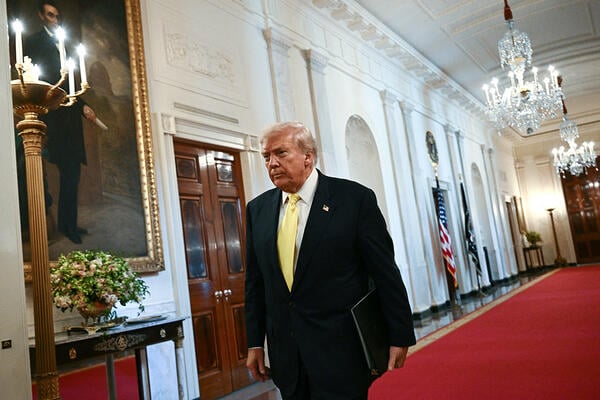
President Donald Trump issued an executive action Thursday directing colleges to prove they are not considering race in admissions.
Brendan Smialowski/AFP/Getty Images
President Donald Trump issued an executive action Thursday afternoon mandating colleges and universities submit data to verify that they are not unlawfully considering race in admissions decisions.
The order also requires the Department of Education to update the Integrated Postsecondary Education Data System to make its data more legible to students and parents and to “increase accuracy checks for data submitted by institutions through IPEDS,” penalizing them for late, incomplete or inaccurate data.
Opponents of race-conscious admissions have hailed the mandate as a victory for transparency in college admissions, but others in the sector have criticized its vague language and question who at the department is left to collect and analyze the data.
“American students and taxpayers deserve confidence in the fairness and integrity of our Nation’s institutions of higher education, including confidence that they are recruiting and training capable future doctors, engineers, scientists, and other critical workers vital to the next generations of American prosperity,” the order reads. “Race-based admissions practices are not only unfair, but also threaten our national security and well-being.”
It’s now up to the secretary of education, Linda McMahon, to determine what new admissions data institutions will be required to report. The administration’s demands of Columbia and Brown Universities in their negotiations to reinstate federal funding could indicate what the requirements will be. In its agreement with Brown, the government ordered the university to submit annual data “showing applicants, admitted students, and enrolled students broken down by race, color, grade point average, and performance on standardized tests.” Colleges will be expected to submit their admissions data for the 2025–26 academic year, according to the order.
What resources are in place to enforce the new requirements remains to be seen. Earlier this year the administration razed the staff at the Department of Education who historically collected and analyzed institutional data. Only three staff members remain in the National Center for Education Statistics, which operates IPEDS.
‘It’s Not Just as Easy as Collecting Data’
Since taking office, the Trump administration has launched a crusade against diversity, equity and inclusion in higher education, often using the Supreme Court’s 2023 ruling against race-conscious admissions as a weapon in the attacks.
Students for Fair Admissions, the anti–affirmative action advocacy group that was the plaintiff in the 2023 cases, called the action a “landmark step” toward transparency and accountability for students, parents and taxpayers.
“For too long, American colleges and universities have hidden behind opaque admissions practices that often rely on racial preferences to shape their incoming classes,” Edward Blum, SFFA president and longtime opponent of race-conscious admissions, said in a press release.
But college-equity advocates sounded the alarm, arguing that the order—which also claims that colleges have been using diversity and other “overt and hidden racial proxies” to continue race-conscious admissions post-SFFA—aims to intimidate colleges into recruiting fewer students of color.
“I will say something that my members in the higher education community cannot say. What the Trump administration is really saying is that you will be punished if you do not admit enough white students to your institution,” Angel B. Pérez, CEO of the National Association for College Admission Counseling, told Inside Higher Ed.
Like many of Trump’s other orders targeting DEI, that mandate relies on unclear terms and instructions. It does not define “racial proxies”—although a memo by the Department of Justice released last week provides examples—nor does it outline what data would prove an institution is or is not considering race in its admissions process.
In an interview with Inside Higher Ed, Paul Schroeder, the executive director of the Council of Professional Associations on Federal Statistics, questioned the government’s capacity to carry out the president’s order.
“Without NCES, who’s going to actually look at this data? Who’s going to understand this data? Are we going to have uniform reporting or is it going to be just a mess coming in from all these different colleges?” Schroeder said.
“It’s not just as easy as collecting data. It’s not just asking a couple questions about the race and ethnicity of those who were admitted versus those who applied. It’s a lot of work. It’s a lot of hours. It’s not going to be fast.”
Ages ago, in the 1970s Soviet Union, a Jewish stand-up comedian, Mikhail Zhvanetski, remarked in one of his skits that if you want to argue about the taste of coconuts (not available in the Soviet Union at that time), it’s better to talk to those who’ve actually tried them.
If you want to argue about antisemitism in academia, better ask those who have actually experienced it. Ask me.
I was 16 years old when I graduated from high school in Moscow in 1971. My ethnic heritage—Jewish—was written on my state ID by the authorities. I couldn’t change it. I applied to the “Moscow MIT”: Moscow Institute of Physics and Technology. I passed the entrance tests with flying colors: 18 points out of 20, higher than 85 percent of those admitted. I was denied entry. I knew why. The unwritten but strict quota was that Jews could make up no more than 2 percent of freshmen.
I did get my education, at another university less closely observed by the party authority. But six years later, looking for a job, I could not find one. In part, this was because institute directors knew they could be disciplined if they hired Jews who then applied to emigrate to Israel. I later learned that I was hired only when my future boss and close friend gave his word of honor that I would never try to emigrate.
Two years later, I applied for Ph.D. study at the renowned Lebedev Physical Institute of the Russian Academy of Sciences (home to seven Nobel laureates). It was common knowledge at that time that one of the officials at Lebedev who had to approve admissions was a notorious antisemite. My gentile adviser also knew that, made sure that the official would never see either my characteristically Jewish face or my state ID, and took over all paperwork communications himself under various pretexts. When I was officially admitted and walked into the official’s office, they looked like they were going to have a heart attack. This was antisemitism.
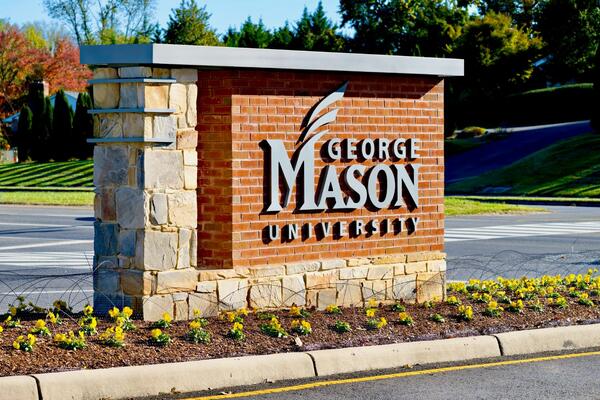
In 1994, 10 years after graduating, I moved to the United States, where, eventually, I devoted more than 20 years of service to the Naval Research Laboratory. Then, in 2019, I joined the faculty at George Mason University, one of the most ethnically diverse universities in the country. In my time here, I have never seen any sign of antisemitism, not a shred. I graduated a Muslim student, who—in his own words—felt honored to have me as his adviser (he even invited me to his sister’s wedding, which was restricted, due to the pandemic, to just 20 guests). I taught several more Muslim students and did research with some others. We openly discussed our religions, and I found these students to be good and compassionate listeners if I chose to share one or another story from my Jewish experience.
Now, however, the U.S. Department of Education is taking seriously a charge of “a pervasive hostile environment for Jewish students and faculty” at George Mason. This is as shocking to me (and to many of my Jewish colleagues at GMU) as hearing that I have broken two legs and never noticed it. In fact, during the trying months after Oct. 7 and amid growing pro-Palestinian protests on campuses, I often praised Mason president Gregory Washington’s handing of this sensitive issue. While paying full respect to respectful protests, freedom of speech and the First Amendment, he fully avoided disruption of the educational process and university business.
To this point, I can again dig into my experience under a totalitarian regime. When I came to America in 1994, I was fascinated by the famous case of Yates v. U.S., in which the Supreme Court issued a decision that offered a powerful contrast to Soviet rule. In that 1957 case, the court reversed the convictions of 14 Communist leaders in California who had been charged with advocating for the overthrow of the U.S. government by force. As Justice Black wrote, they “were tried upon the charge that they believe in and want to foist upon this country a different, and, to us, a despicable, form of authoritarian government in which voices criticizing the existing order are summarily silenced. I fear that the present type of prosecutions are more in line with the philosophy of authoritarian government than with that expressed by our First Amendment.”
To me, this case reflected a quintessential characteristic of American democracy: rephrasing Voltaire, “We may find your view despicable, but will defend to the death your right to say it.”
Though the details of the antisemitism complaint against George Mason have not been made public, it appears that Washington’s leadership is coming under attack based on just two cases involving three students; only one of those cases involved an alleged incident (vandalism) that occurred on campus. In both cases, the university administration, in collaboration with law enforcement, took immediate and harsh steps to resolve the situations: As Washington noted in a recent message to campus, the university was applauded by the Jewish Community Relations Council of Greater Washington for “deploying the full weight of the university’s security and disciplinary measures to prevent these students from perpetrating harm on campus.”
And these incidents are outliers. Just as three thieves who may be GMU students wouldn’t attest to “pervasive thievery” on campus, three students alleged to have violent anti-Israeli agendas do not constitute a “pervasive hostile environment for Jewish students and faculty.” On the contrary, I feel safer and more assured knowing that three miscreants out of a student body of 40,000 were immediately and efficiently dealt with.
What does make me feel uncomfortable—and what I do find antisemitic— is the implicit suggestion that I, an American Jew who does not have Israeli citizenship, must feel offended and defensive in the face of any criticism of any action of the Israeli government. I find such beliefs reprehensible, and they encroach on my freedom to have my own opinion about international affairs.
Gregory Washington is my president, and I am confident that he is doing an excellent job protecting all faculty and students, including Jews, from bigotry and harassment. It is false allegations of antisemitism on campus under the pretext of “defending” Jews like myself that really threatens my well-being as a GMU professor.
Igor Mazin is a professor of physics at George Mason University.
If we are lucky, if we get through this period with our democracy intact rather than sliding into a Hungary-like competitive authoritarianism (or worse), my hope is we will look back on the recent spate of capitulations of elite higher education institutions to the authoritarian regime with some mixture of disbelief and shame. I hope that individuals who I could but will not name, but who are easily identifiable as being central to these capitulations, are viewed harshly as people who failed to hold to important principles at a crucial time.
The alternative, that these people are either viewed as pragmatists or, more likely, forgotten, means we will have fallen so far from our ideals of a free nation built on free inquiry that whatever continues to exist will be unrecognizable as compared to today.
The editorial board for the Penn student paper, The Daily Pennsylvanian, put it plainly in responding to the deal their school struck with Trump, “Penn Descends Into Fascism.” They argue that Penn will be remembered as the school that “welcomed tyranny” “with open arms.”
As bad as it may be for Penn’s reputation, I hope lots of people agree, because if so, it means we have not yet normalized these extortionate practices.
I think these students are correct about what Penn has done. Our only hope is that this welcoming does not turn into a permanent stay. The actions of Penn and other institutions will make achieving this outcome significantly harder. When former Harvard president Larry Summers says, in reacting to Columbia’s capitulation to the authoritarian, that it was “the best day higher ed had in a year,” we should understand Summers is positioning higher ed as something other than an important part of our democratic institutions.
A major institution paying out extortion money in response to a nonmeritorious “investigation” and submitting to government surveillance of its policies is not a good day for higher ed.
The present constantly shapes the future, and even small adjustments now may have large impacts down the road, butterfly-effect style. It is a big problem that so many schools have bent the knee to Trump, but the problem can get bigger if more schools follow suit. Each individual act of resistance continues to matter.
One of these books, Universities in the Marketplace: The Commercialization of Higher Education, was written by Derek Bok, who served as Harvard’s president from 1971 to 1991, and then again from 2006 to 2007 as interim president following a faculty vote of no confidence in, wait for it … Larry Summers.
In Universities in the Marketplace, Bok recognizes that it seems as though, for the right price, everything in the modern university is for sale. By contemporary standards, Bok’s book seems a little quaint, as the practices he’s worrying about, such as institutions and professors reaping financial rewards from intersections with the growing knowledge economy—particularly around tech—has gone from a potentially questionable practice to almost de rigueur at elite institutions. But Bok argues, convincingly, that these compromises erode public trust in higher education.
Fast-forward to today, when preserving access to federal money no matter the cost to institutional independence is deemed by one of Bok’s successors as the high calling of institutional leaders, a sign of success.
While Bok could not have had the foresight to see his institution contemplating paying extortion money to an aspiring authoritarian president, his book all but predicts this outcome by showing that when money is involved, there is no principle. That this is true even for the wealthiest higher education institution of all time suggests no one is capable of resisting.
Or maybe it’s the opposite: Freedom’s just another word for nothing left to lose. Is it a coincidence that it seems as though corporate America and our most corporatized educational institutions are most vulnerable?
I do not think the battle over preserving some semblance of independent and free higher education is irretrievably lost, but it does seem possible that we already have some permanent casualties.
As student journalists at The Harvard Crimson report, Harvard, too, has already allowed government pressure to alter its programs, but those same journalists also suggest that, for now, the school is holding firm against paying the—let’s be frank—kind of bribe handed over by their Ivy League compatriots. The Crimson reports that stories about an impending $500 million payment were byproducts of strategic leaks from the Trump administration rather than trial balloons out of Harvard.
This is good news, because any act of resistance is, well … good news. Whatever relief Columbia, Brown and Penn have experienced by paying these tributes is inevitably temporary. Contra David Leonhardt of The New York Times, who decries Trump’s methods but does not wholly lament the changes the extortion schemes have wrought, there is no good way to cede power to Donald Trump.
Those who think there may be accommodations to be made better hope others continue to fight on their behalf, because failure to do will result in a world where Columbia, Brown, Penn and maybe even The New York Times will exist at the pleasure of the executive.
When we win, should I still be around, personally, I’m not going to let them forget this moment.
Instead of generating answers, Study Mode asks students questions about what they know.
Photo illustration by Justin Morrison/Inside Higher Ed | SDI Productions/E+/Getty Images
When classes resume this fall, college students will have access to yet another generative artificial intelligence tool marketed as a learning enhancement.
But instead of generating immediate answers, OpenAI’s new Study Mode for ChatGPT acts more like a tutor, firing off questions, hints, self-reflection prompts and quizzes that are tailored to the user and informed by their past chat history. While traditional large language models have raised academic integrity concerns, Study Mode is intended to provide a more active learning experience. It mimics the type of Socratic dialogue students may expect to encounter in a lecture hall and challenges them to draw on information they already know to form their own nuanced analyses of complex questions.
For example, when Inside Higher Ed asked the traditional version of ChatGPT which factors caused the United States Civil War, it immediately responded that the war had “several major causes, most of which revolved around slavery, states’ rights, and economic differences,” and gave more details about each before producing a five-paragraph essay on the topic. Asking Study Mode the same question, however, prompted it to give a brief overview before asking this question: “Would you say the war was fought because of slavery, or about something else like states’ rights or economics? There’s been debate over this, so I’d love to hear your view first. Then I’ll show you how historians analyze it today.”
Study Mode is similar to the Learning Mode that Anthropic launched for its chat bot Claude for Education back in April and the Guided Learning version of Gemini that Google unveiled Wednesday. OpenAI officials say they hope Study Mode will “support deeper learning” among college students.
While teaching and learning experts don’t believe such tools can replace the value faculty relationships and expertise offer students, Study Mode’s release highlights generative AI’s evolving possibilities—and limitations—as a teaching and learning aid. For students who choose to use it instead of asking a traditional LLM for answers, Study Mode offers an on-demand alternative to a human tutor, unbound by scheduling conflicts, payment or feedback delays.
But in an economy where generative AI’s ability to gather and regurgitate information is threatening the future of entry-level office jobs, students will need to understand what they’re trying to get out of their college coursework if they want Study Mode to deliver on its promise to foster deeper learning.
“Over all, it does represent a significant departure from how people are normally encouraged to use generative AI, given that the value proposition of this technology is largely couched in the concept of efficiency, speed and offloading things that are not as important,” said Trey Conatser, assistant provost for teaching and learning at the University of Kentucky and director of UK’s Center for the Enhancement of Teaching and Learning. “But Study Mode actually asks us to stick with it for it to work, take some time to sit with the friction of learning and be patient with the practice and feedback.”
Critical Thinking in Age of AI
The release of Study Mode comes nearly three years after the debut of ChatGPT—and the many other large language models that have followed—set off ongoing concerns among educators that college students’ increased reliance on traditional LLMs to write papers or solve math problems may erode their critical thinking skills.
There’s not yet a consensus on if generative AI helps or hurts critical thinking, but at least two studiespublished in the last year found that adults, including college students, who use LLMs to research and learn about a subject exhibited weaker reasoning and analytical skills. And those may be the exact types of skills the roughly two-thirds who are already using generative AI tools like ChatGPT will need to make Study Mode reach its full potential.
While ChatGPT’s Study Mode is programmed to query students rather than generate answers, the users themselves also need to be prepared to push the LLM to ask deeper, more nuanced questions. At least, that was Conatser’s experience when he tested out Study Mode over the weekend and asked it to help him study for a hypothetical quiz on Romantic poets from 1780 to 1820.
First, the LLM asked him more about his education level and the focus of the quiz. He told it that he’s a college junior whose quiz will focus on historical context and specified that he wanted help studying William Wordsworth’s poem “The Prelude.”
The following conversation, which Conatser shared with Inside Higher Ed, ensued:
Study Mode: Wordsworth described “The Prelude” as “a poem on the growth of my own mind.” What exact subtitle did he eventually attach to the poem that captures this idea?
(Give it a try, and we’ll check your answer before moving on.)
Conatser: That’s not so much what I will need to answer. It will be open book, but I will be asked to provide some interpretations to historical context and literary traditions.
After some more dialogue asking Study Mode to focus on historical context, it generated the following question:
Study Mode: “Bliss was it in that dawn to be alive …” Based on that word, “bliss,” what general emotion do you think he felt when he first encountered the early French Revolution—excitement, fear or apathy?
Conatser: That seems like an obvious question
Study Mode: Understood—let’s turn up the difficulty. In “The Prelude” (Book X), Wordsworth writes of “how in my heart a dreary weight / Fell, and I turned away …”—a moment that marks his break with the revolution he once celebrated.
Question (one step): Which single, headline-making event in France during 1793 does this passage point to, and why did that event feel like a betrayal of the revolution’s original ideals for many sympathetic British observers?
Although it took some prodding to get the LLM to ask the type of questions Conatser wanted to see, “I’m still in the driver’s seat with Study Mode,” he said. “That’s where students are going to need to be when they’re using it.”
Knowing when to push back against Study Mode when it’s not asking the types of questions that will help students master material will be key to helping them get the most out of its ability to foster critical thinking, Conatser said.
“If someone is going to be totally passive with Study Mode, it may not drive them to where they need to go and they’ll still need to be thinking about how they’re supposed to be studying, what kind of assessment they’re leading up to and what kinds of skills will be more important for that assessment,” he said. “If you don’t know what you don’t know, then you won’t be very effective at using these tools even if they have the types of guardrails that Study Mode has.”
And if a student isn’t motivated to use Study Mode to its full potential, they can prompt it to generate complete answers, just like a traditional LLM, according to Christian Carmody, a senior researcher at the Research Institute for Learning and Development, who also tested it out this week.
“For a current events assignment, I prompted Study Mode right away and told it, ‘Before we engage, I do not want your help with this or [to] encourage me to think through this. I do this on my own another time. I really just want the answers,’” Carmody recalled. “It did exactly that.”
The ability for students to easily manipulate Study Mode could add more pressure to colleges and universities that are facing growing skepticism from students about the value of degrees in the age of AI.
“Students should be able to think about why learning is valuable to them and why they should be able to engage with material in a way that’s challenging and force deep thinking,” he said. “Until a student has that mindset, I’m not confident that they are going to use this study and learning tool in the way it’s intended to be used.”
Credit for prior learning is one strategy colleges and states can employ to expedite adult learners’ progress toward their degrees and promote student success. Past research also shows that students who take advantage of CPL opportunities have higher employment rates and increased earnings after graduation.
But administering CPL can be a challenge, in part because of different departments’ and academic disciplines’ understanding and evaluation of prior experience.
In the most recent episode of Voices of Student Success, host Ashley Mowreader speaks with Colleen Sorensen, Utah Valley University’s director of CPL and student assessment services, about new state legislation requiring credit for prior learning opportunities for students and how her office supports instructors and learners navigating CPL.
An edited version of the podcast appears below.
Colleen Sorensen, director of credit for prior learning and student assessment services
Colleen Sorensen, Utah Valley University
Q: Can you introduce yourself, your work and your institution to our audience?
A: My name is Colleen Sorensen. I’ve been at Utah Valley University located in Orem, Utah, for about 31 years. We’re a pretty large institution; we’re actually the largest in the state of Utah. Our enrollment in fall 2024 was 46,809 students. Now, of that, about 45,000 were undergraduates, just under 1,000 were graduate students, and we actually have a pretty large number of concurrent enrollment students. About 16,000 of our students are working towards adding some college-level work while they’re still in high school, and we’re open enrollment. All of that together makes for a really interesting blend of individuals, from first-generation to returning students to nontraditional who all come together at Utah Valley.
I have the lucky pleasure of working with them in the space of credit for prior learning. I was officially made director [of CPL] in 2022; before that, I’ve been over all of testing services for the institution for about the last 25 years. So I’ve been a part of the credit for prior learning process with exam administration for challenge exams and CLEP and ACT and SAT and standardized assessments and professional licensure assessments. Now I get to work also in the space of making credit for prior learning, instead of it being just a department-run system, to taking that and scaling it and modeling it across the entire institution so that all of our academic departments have access to and support to develop credit for prior learning options.
Q: When you talk about this expansion and scaling of credit for prior learning across the institution, can you share more about how that looks and what that’s meant, in terms of where you started and now the vision moving forward?
A: When I started in this, we had a few areas that were already doing quite a bit of work in this space.
One of the things we value in the state of Utah is service, and so a lot of our students will stop out from college and go serve as missionaries across the world for 18 to 24 months.
During that time, they’re often learning a new language. Then they come back to UVU. Our language department recognized that years ago and put together a credit for prior learning process for those students to earn upwards of 16 credits of language [courses] if they can demonstrate [their skill] through a placement test and a course with a faculty member. If they pass that course, they’ll get up to 16 credits of 1000- to 2000-level language. So that’s been going on for a long time.
In 2019, there was legislation that was passed just before COVID that required all of the public higher ed institutions in the state of Utah to provide credit for prior learning options at a larger scale. So with the pandemic, that kind of put it on the back burner for a while, but in 2022 I started to pick this up as a new assignment.
At first, I met with different department chairs. I don’t know if it was just wrong timing with the pandemic, but it felt like a lot of doors closed to it at that time. But there were a few departments that were like, “Oh, I was one of those nontraditional students. I would like to see more opportunities in this space.”
And so slowly but surely, I started working with a few faculty, a few departments and started building sustainable systems of, how can we assess these students? Because each student is unique in what they bring as an adult learner. It’s not just like, “Let’s open this one program and as long as they have step one, two, three and four, they can award credit.” Each student needs to be looked at very uniquely. So I designed what I call a concierge approach to this process, where students can apply through our credit for prior learning website. We have a small team of students and part-timers and myself who are looking at what the student has provided. We’re prompting them with different things and then we’re reaching out within the academic community at UVU to look at possible matchups for credit for prior learning. So when we started, we only had a few departments that would engage with us, and now up to 75 percent of our academic departments are not just looking at but considering and awarding credit.
This year alone, we’ve awarded almost 6,000 credits to CPL over 1,500 courses. In just six months, we’ve saved students over $1.6 million in tuition. So that’s exciting to me.
Q: You bring up an interesting point with this division of responsibility between your office and then the faculty and the academic role in CPL. We want to ensure that students are actually meeting those learning outcomes and that the credits that we’re awarding them do reflect their experiences. But there can be some tension or a challenge point there when it comes to ensuring that there are these systems set up and making sure that every student is being recognized in the ways that reflect their abilities and their learning.
I wonder if you can talk about building that bridge between your office and these academic departments and how you opened up the conversation to make this a space that’s both trusting but also institutionalized.
A: What’s been really important is for me to establish [is] that I’m here to support academic departments and to ensure that the CPL policy that I’m the steward of is being met, but that the governance happens with the subject matter experts and the departments themselves.
Because the way that the school of business assesses prior learning is going to be very different than the way that dance or the botany lab assesses prior learning. I wanted to make sure that each department chair and subject matter expert understands that they’re in charge of deciding what we assess, how we assess it and when we assess it.
Some departments only look at 4000-level coursework for CPL. Others look at 1000- [and] 2000-level coursework. It’s not my job to tell them how to do that within their area. They’re the ones who know. My job is to support them with [questions such as:] Do we need to bring in a national expert in your area if the department is not feeling confident in doing this yourself? Or to bring in templates for them or trainings for them of how to assess their particular type of coursework?
That’s how I support them and then help them navigate through the whole process so that it’s not left to bureaucracy, red tape of sorts, just to support them all the way through.
Q: CPL can be a very confusing process for the student. Can you talk about how UVU seeks to support students as they navigate the process? One, in understanding that this is available to them and that you can recognize their prior learning, but also, what that process looks like and how they might feel navigating that situation.
A: Some departments have things really well established on their websites. Others do not. And so that’s why we have the CPL office and the CPL website. It’s a basic inquiry; it just asks a few questions to the student of, what are your academic goals? What do you think you might be eligible for and how much involvement do you want from us? Do they want a phone call from one of our CPL concierge support individuals, or do they just want to be sent on their way and take care of it themselves?
We really allow the student to gauge that, but we’re here to support them from inquiry all the way up until the credit is awarded. They can walk into our office, or they can contact us via the website and we’ll help them figure out any part of the process such as, do we just need to connect two individuals together? Do we have a faculty member who might be away and so their request has been sitting in a queue for longer than feels natural or normal to a college student? Or what is the natural process that the department has established?
Some departments will say that they’ll review inquiries during these windows of time and maybe the student didn’t catch that piece of information. We’ll reinforce that for the department to say, “Yes, you’re in the queue. It’s going to get reviewed during XYZ, so just hang tight and if you have any other questions, contact us again.”
We are there to support [students] all the way through. That’s the concierge aspect of it, and we found that to be really valuable, because there’s a lot of moving parts when it comes to credit for prior learning and creative solutions that we might not have thought of.
I’ll get three or four different areas together—I might get an associate dean, an adviser and two subject matter experts in a room together. I’m like, “OK, let’s look at this case. What can we do with what we know and what have we not thought of before? How do we best support the student in their academic goals while still keeping all of our academic rigor required?”
Q: I imagine you play the role of translator sometimes, too—helping the student understand what the department is asking and helping the department understand what the student wants to know—which can be a really needed role. It’s wonderful that you have yourself and your team to help draw those dots and connect the lines and make sure everybody’s working towards the same goal.
A: Yes. I’m setting up working with different departments on, “OK, if they do a challenge exam or they do a portfolio review, can they do a second [attempt]?” There are pros and cons to each, right? We want academic rigor, but also, depending on the area, it’s very contextual per level of course and program.
So for someone who’s going for a very high level of coursework [in CPL], is it a one-time [exam] or do you offer a retake, [giving them] one more time with some feedback, helping the student to be able to speak to the learning outcomes more clearly? I’ve seen departments do it both ways. Some will say, “No, they should either know it or they don’t, or they need to be in the classroom.”
The academic departments will go to their board of trustees and talk about it and have a good conversation of, “How much leeway do we want to give here?” Our policy states that you’re allowed up to one retake or not. Sometimes it works in the benefit [of the student] to have it be an all or nothing. And again, that’s very department and program specific. It’s not my job to tell them what it should or shouldn’t be; they know best.
Q: CPL can be very resource intensive, one, for the institution and the faculty or whoever is assessing the project, and sometimes there’s a fee associated for students. Can you talk about the labor, the time and the resources that go into this work and how you help coordinate that? And how is the institution investing in this work?
A: That is the hottest topic of conversation in this work. We’re a very large institution, the course load of our faculty— Adding this on top of it can feel significant in how much time it takes. This isn’t a quick grading process. To grade a portfolio, or to prepare for an oral interview or to write a challenge exam that needs to be updated on a regular basis, all of that takes faculty time.
At the moment, at our institution, there are small amounts of dollars involved that go back to the department who do the assessments and then the department decides whether they pool that money together or they pay out to their faculty. Often they’ll have a conversation among themselves of what’s the best usage of this and do a collaborative decision. Some it’s to pay the faculty; for others, it’s to help fund something that all of the faculty have agreed to.
Ideally, in our future, we would like to see more fees, smaller out of pocket, less than $100 fees, attached to credit for prior learning assessments. But we don’t have full consensus yet among all ofour leadership, and so that is still to be determined at our institution.
Q: Good luck with that conversation. It’s always fun to enter shared governance conversations, especially when we’re talking about student success and what’s gonna be best for the learner at the end of the day.
As we’re thinking about scaling and institutionalizing CPL across UVU, one thing I wanted to ask about is some of those processes that can be very easy. We’ve talked about language requirements and how students who have come from their missions—that’s a pretty set process and it’s pretty understood and simple to navigate for the student. Are there other processes that you’re looking at or working with departments to streamline how this works and what a student can expect?
A: There’s a few things that we’re doing to help this. One, we’re encouraging every department to have some real estate on their home page, on their website, of CPL options so that students can look very quickly if they’re shopping at two o’clock in the morning and don’t want to wait for a response from one of our team who tend to work more traditional hours. We want websites to be able to cater to that, as well as we want advising conversations to be able to cater to that.
We’re even asking faculty to put CPL options on their syllabi, so that if a student sits down on day one and they’re looking at this course and they’re looking at the topics, they’re looking at the learning outcomes, they’re like, “I already know this.” Wouldn’t it be great to also see, “And here’s a credit for prior learning option that you could challenge this,” that maybe they missed up until this point in advising or on the websites, or maybe they didn’t know to contact the CPL office? The syllabus is also another place of marketing as well as [traditional] marketing, which we attempt to do quite a bit of, that could help the student to recognize that there’s another option here.
Q: If you had to give advice to a peer working in a similar role at a different institution, are there any lessons you’ve learned or insights you would want to pass on in this work and the ways that you’ve been advancing this university goal?
A: Start small, but strategically. Like find a department or a faculty champion who has a clear use case, like a common industry certification or a workforce training pathway and then support them with some tools, some templates, some training. Don’t just tell them, “You got to figure this out.”
Center it on the student experience. Talk with your students, learn what they wish could have happened, because there’s so much that can be done, or that might already be being done. It’s just that this department may not understand what that department is doing.
Something that we did this year for the first time is we hosted a faculty summer institute. It’s a three-week commitment, but it’s one day of being together in person. Faculty had to apply for this, and there were four areas of focus—you needed to have a tangible asset at the end of this. One was to develop a CPL pathway. Another was to embed a credential into a program. Another was experiential learning, and the fourth was a continuing education credit process for those who have finished up and now they just want to add on.
We did offer a stipend to these individuals who were approved to come to this training. We spent the morning in education—we brought in Nan Travers, director of the Center for Leadership in Credential Learning from SUNY Empire State College, who is considered the fairy godmother of all credentialing. She was fabulous—to teach and train our faculty. Then we brought in a statewide person to discuss workforce alignment. Then we had a luncheon and we strategically placed all of the faculty into their area of focus. So seated at my table were faculty all focused on generating a credit for prior learning pathway. We had botany, biotech, psychology, computer science and business accounting. They’re all coming in from different schools within the institution.
We sat together at lunch and then we had an afternoon of working on the projects. So Nan was there, as the expert; she would come around to the tables and discuss things and answer questions. But these faculty got to interact with each other, with people outside of their standard focus, and they loved it. They said, at the end of the day, “I never get to do this. I never get to talk with faculty outside of my own area of focus.” They were passing phone numbers to each other. They were sharing their models and thinking and helping tweak each other’s.
It was such a fun, collaborative experience. And we have 11 new CPL pathways that came out of that one day, and then we gave them another three weeks to work on it. We plan to continue to do that summer after summer. We need funding from our administration to help pay the faculty to do that, but I will advocate to do that again and again. It was so successful.
Q: It’s almost like a CPL incubator, like how they have the student entrepreneurship programs, but for faculty to think about ways to be entrepreneurial in their own field.
A: Yeah and, you know, they said, “Thank you for thinking about me and my needs as the faculty member,” really taking care to be able to answer their questions and help them get over those mental blocks that they were experiencing of, “I don’t know how to address this or this or this.” We took care of all of that that day.
Q: It’s nice to just do it all in one day sometimes, too, right? It’s not an email chain. It’s not a series of meetings—like, we can all just sit in the same room and figure it out all in one go.
A: One thing we’re known for in Utah is we like soda with mix-ins. So we had a little beverage bar for them to go get drinks whenever they wanted, with a cute little mix-in to keep them energized and caffeinated all afternoon.
Q: That’s so fun. So as you’re thinking about this work, what are your goals for the upcoming year? Where do you want this program to go?
A: Yeah. There’s a couple things. One, I would like to get us from 75 percent of departments tapping into CPL to over 90 percent, for starters.
We’ve been hosting at UVU for the last three years a statewide conference. We brought in all the other USHE [Utah System of Higher Education] schools to just share best practices in credit for prior learning and ask things such as: How do we make this work? How do we track the data? How do we compare things and be more inclusive as a whole structure within the state of Utah and have less competition between schools? How do we be more collaborative in this process? So continuing to expand that conference is one thing.
I’m partnering with another school, Salt Lake Community College, starting this fall to do a once-a-month lunch and learn hourlong best practices over the phone. Covering, “Hey, what’s keeping you up at night? What are your headaches? How have you solved this?” Just allowing everyone to learn together, because we’re all pretty new, since this legislative mandate in 2019, of really bringing this into fruition. And how do we not reinvent the wheel, but just learn from each other?
Those are a few things, as well as, UVU launched a campuswide adult learner initiative in 2022, and it’s strategically housed within the provost suite. It’s focused on reimagining adult education over all. We’re focusing on student support and faculty support, as well as credit for prior learning. As I said earlier, kind of getting into the mind of the adult learner. I’d really like to see more conversation in the coming year, and my goal is to have conversations around this—could we do shorter-term classwork, or more hybrid classwork, where students are on campus? Because we find there’s great value in face-to-face, what if we’re only bringing them to campus once a week and we’re hybrid twice a week for courses? Can we offer more adult learner–friendly pedagogy? What does that look like and how can we accomplish that? So, I’d like to spend more time in that space in the coming year and really listening to students of what’s working and what’s not working.
Six months into his second term, President Donald Trump has forced changes at many of the nation’s wealthiest universities, some of which have shed hundreds of jobs amid federal funding issues and investigations.
While sector layoffs are so frequent that Inside Higher Ed has dedicated monthly coverage to rounding up such reductions, those actions are more common at small, cash-strapped colleges or state institutions reeling from budget cuts. But universities with multibillion-dollar endowments have been among those making the deepest cuts in the first half of 2025, often driven by freezes on federal funding that the Trump administration imposed with minimal notice.
Some universities have also cited the recently passed endowment tax increase as a factor in layoffs.
Altogether the layoffs show a sector bracing for a new reality where research funding can be suddenly yanked away with little to no explanation and international and graduate student enrollment, once considered a cash cow, is under threat—prompting institutions in even the highest financial stratosphere to cut costs as they navigate changing policies and a president sharply critical of the sector.
Here’s a look at how the nation’s wealthiest universities are adjusting staffing levels due to an uncertain federal policy environment, research funding issues and a flurry of legal actions from the Trump administration that have forced concessions from multiple well-resourced institutions.
Thousands Out at Johns Hopkins
The Trump administration’s cuts to the U.S. Agency for International Development hit Johns Hopkins University with $800 million in canceled funding, prompting the Baltimore-based institution to shut down numerous international programs and lay off 2,222 employees earlier this year.
The 2,222 job cuts are the deepest announced at any institution this year.
The layoffs, announced in March, span more than 40 countries. Of the jobs cut, 1,975 were located internationally, while another 247 were in the U.S., with the majority in Baltimore. JHU announced at the time that another 107 employees would be furloughed.
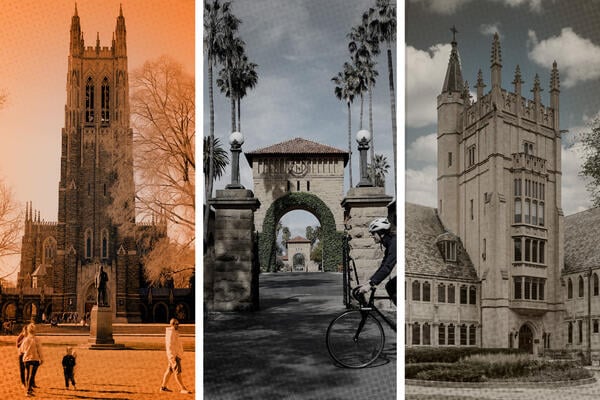
Duke University, which has an endowment recently valued at nearly $12 billion, made some of the deepest cuts of the year so far when officials announced in July that 599 employees had accepted buyouts. Another 250 faculty members are reportedly weighing buyout offers as well.
Following the first round of buyouts, university officials said layoffs will begin this month.
Duke officials announced the buyouts before the Trump administration froze $108 million in federal grants and contracts and opened investigations into alleged racial discrimination, accusing the university of emphasizing diversity over merit in hiring, admissions and other practices.
Deep Cuts at Northwestern
Earlier this year, the Trump administration abruptly froze $790 million in research funding for Northwestern University, reportedly with no explanation. That action occurred at about the same time that the federal government opened an investigation into alleged antisemitism on campus.
Northwestern, which has an endowment valued at more than $14 billion, responded by eliminating 425 jobs last month in an effort to shave 5 percent off of its staff budget. The move was preceded by a hiring freeze and other cost-cutting measures announced earlier this year.
President Michael Schill and other administrators wrote in a message to campus that the cuts were “in response to more than just the federal research funding freeze.” They also pointed to “rapidly rising healthcare expenses, litigation, labor contracts, employee benefits, compliance requirements and a suite of federal changes” that may harm international student enrollment.
The Ax Falls at Stanford
Stanford University plans to cut 363 jobs beginning this fall as part of an effort to shave $140 million off the general funds budget due to financial issues connected to federal policy changes.
Those cuts come after the university announced a hiring freeze in February.
Stanford has the fourth-largest endowment among U.S. universities, recently valued at $37.6 billion. But despite its deep pockets, the private research university is feeling the squeeze from the Trump administration, with officials writing in a state regulatory filing that the university anticipates “reductions in federal research funding” and an increase in endowment taxes.
Additionally, the U.S. Department of Justice launched an investigation into admissions practices at Stanford earlier this year, accusing the university of sidestepping a ban on affirmative action.
Nearly 180 Layoffs at Columbia
Few institutions have faced as much scrutiny from the federal government in recent years as Columbia University, which agreed to sweeping changes and yielded to demands from the Trump administration to overhaul admissions, disciplinary processes and academic programs. The university will also share admissions data and reduce the number of international students it accepts in an unprecedented agreement with the Trump administration that culminated in a $221 million settlement over allegations of antisemitism tied to pro-Palestinian campus protests.
Although the Trump administration will release some frozen research funds as a condition of the settlement, choking off federal dollars has already prompted cuts. Columbia announced in May that the university had laid off nearly 180 researchers amid its standoff with the federal government.
Columbia’s endowment was recently valued at $14.7 billion.
‘A Day of Loss’ at Boston U
Boston University announced plans last month to lay off 120 workers and eliminate another 120 vacant jobs.
Officials wrote in a letter to campus that “recent and ongoing federal actions and funding cuts are affecting our research enterprise as well as day-to-day operations” and creating “uncertainty” as BU grapples with inflation, declining graduate enrollment and other challenges.
“This is a day of loss for all of us,” officials wrote. “There is no way around this. We know our community may need time to adjust to these difficult changes. Yet, it is also a necessary step in ensuring our future.”
The University of Southern California cut 55 jobs last month, according to a state regulatory filing.
Officials announced in mid-July that layoffs were underway, though they did not specify the number of employees affected. USC also implemented a hiring freeze, halted merit-based pay raises, ended some vendor contracts and pulled back on discretionary spending and travel.
Interim president Beong-Soo Kim called the layoffs “painful” in a message to campus. He cited various financial concerns, including “significant shifts in federal support for our research, hospitals, and student financial aid” as well as potential declines in international enrollment.
“The ultimate impact of these changes is difficult to predict, but for a university of our scale, the potential annual revenue loss in federally sponsored research funding alone could be $300 million or more,” Kim wrote, adding these changes came on top of a pre-existing budget deficit.
USC’s endowment was recently valued at $8.1 billion.
Unspecified Cuts at Harvard
Harvard University, which is currently locked in a legal battle with the Trump administration over alleged antisemitism and other accusations, has also laid off employees this year. Harvard Magazine reports that multiple schools have reduced staff as a result of having federal research funds frozen.
However, Harvard has not released numbers and declined to provide an estimate to Inside Higher Ed. Union officials have said that layoffs could add up to hundreds of workers.
Harvard is the nation’s wealthiest university, with an endowment valued at nearly $52 billion.
Likely Layoffs at Brown
Following Columbia, Brown University struck a deal with the Trump administration last month, agreeing to certain changes in order to restore around $510 million in frozen research funding.
The federal government closed investigations into alleged antisemitism as part of the settlement. Brown also agreed to put $50 million over the course of a decade into workforce development in Rhode Island. Less than a week after the settlement, Brown officials announced that “some layoffs will be necessary” due to the “persisting financial impact of federal actions.”
Brown also enacted a hiring freeze in March, and nearly 350 jobs remain unfilled.
University officials wrote that they expected a $30 million hit to the 2026 fiscal year budget from the One Big Beautiful Bill Act, Trump’s far-reaching legislation that affected the sector in various ways, including increases to endowment taxes and limiting or eliminating some loan programs.
More than 100 colleges and universities have already signed up for Google’s new AI for Education Accelerator.
Phiwath Jittamas/iStock/Getty Images Plus
Google’s parent company announced Wednesday that it’s planning to spend $1 billion over the next three years to help colleges teach and train students about artificial intelligence.
Google is joining other AI companies, including OpenAI and Anthropic, in investing in AI training in higher education. All three companies have rolled out new tools aimed at supporting “deeper learning” among students and made their AI platforms available to certain students for free.
As of Wednesday, Google is making its AI Pro plan available for free to any student who is 18 years or older and lives in the United States or in Brazil, Indonesia, Japan or South Korea. That plan includes Google’s more advanced chat bot Gemini 2.5 Pro.
The $1 billion will go to “AI literacy programs, research funding and cloud computing resources,” according to the announcement. The company also is offering free AI training to every college student as part of its new Google AI for Education Accelerator. More than 100 public colleges have signed on already, the company said.
“Today’s students are the first true generation of ‘AI natives,’” Google CEO Sundar Pichai wrote. “They’ll use these models in ways none of us can predict, whether it’s learning things in new ways or creating new types of jobs we haven’t imagined yet. It’s still early days and there will be important questions ahead. That’s why we’re working with institutions across higher education to ensure student success.”
Forty percent of parents prefer their child attend a four-year college after high school.
Despite public skepticism about the value of a college degree, the majority of parents still want their kids to pursue more education after high school, according to a report from Gallup and the Lumina Foundation published today.
During the first two weeks of June, researchers surveyed more than 2,000 adults—including 554 parents of children under 18—about what they thought their own children or the children in their lives should do after high school. Though there was some variation depending on political party affiliation and level of educational attainment, three-quarters of parents over all say they want their children to continue their education.
“Even in this moment of skepticism around higher ed, the pull of college is still powerful for families,” Courtney Brown, Lumina’s vice president of impact and planning, told Inside Higher Ed. “The distinction is between their critiques of the system and their personal aspirations. They see there are some cracks in the system—that it’s not always affordable—and they want to make sure that if they’re going to pay for college that their child is going to see a return on investment.”
Parents had a clear preference for the type of institution their child should attend, with 40 percent of respondents indicating that their first choice would be a four-year university.
That aligns with robust data on the ROI of different degree types showing that people with bachelor’s degrees have far higher lifetime earnings and are half as likely to be unemployed than their peers with only a high school diploma.
However, not every family is convinced that a four-year degree is the best option for their child.
Another 19 percent of the parents surveyed by Gallup and Lumina said they’d prefer a two-year college and 16 percent a job training or certification program. Just 24 percent said they’d prefer their child forgo higher education altogether after high school and instead take a gap year (13 percent) join the military (5 percent) or immediately join the workforce (6 percent).
Differences in party affiliation also shaped which type of institution parents believe their kids should attend after high school. More than half (53 percent) of Democratic parents said they’d prefer their child go to a four-year college, while just a quarter of Republicans said the same; 21 percent of Republican parents said they’d prefer their child enroll at a two-year college after high school, and 22 percent said they’d prefer a job training or certificate program.
“Across the board, everyone believes you need more education after high school. But what we’re seeing now is Republicans wanting a quicker payoff for their education, and often a certification or a two-year degree leads directly to a job where they’re using those skills,” Brown said. “But that can be shortsighted when a job ends and a [worker] needs to get upskilled or reskilled.”
A four-year college education was also the preferred choice for parents with and without a college degree, though there was a considerable gap. While 58 percent of college graduates said a four-year program was their top choice for their child, only 30 percent of non–college graduates said the same.
“Parents still see that a four-year degree is the dream. It’s the degree that opens the most opportunity to getting paid more,” Brown said. “People that have gone to college see that it has paid off, whereas people who haven’t had that opportunity may feel closed out from and are uncertain that it’s going to lead to the money and jobs they’re looking for.”
The survey also asked adults without a child under 18 the same questions about what they would want a child they know—such as a nephew, niece, grandchild or family friend—to pursue after high school.
Similar to the parents surveyed, 32 percent of nonparents said they’d like to see the young people in their lives pursue a four-year degree, while 23 percent favored a two-year program and another 23 percent favored job training or a certificate program.
The University of Utah is cutting 81 offerings in response to state budget reductions and a new law.
Aaron M. Sprecher/Getty Images
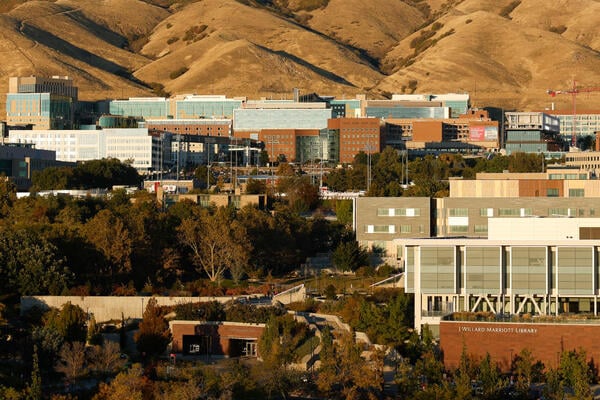
The University of Utah plans to eliminate 81 academic programs and minors—a step that administrators attribute to a new state law that called for “strategic reinvestment” after lawmakers slashed funding to public colleges and universities.
The Republican-controlled Utah Legislature passed House Bill 265 this spring. Lawmakers cut 10 percent of institutions’ state-funded instructional budgets, but the law said they could earn back the money by cutting programs and positions and instead funding “strategic reinvestment.” Institutions’ reinvestment plans must be based on enrollment, completion rates, job placement, wages, program-level costs and local and statewide workforce demands.
Other Utah universities detailed their planned cuts in the spring, but this is the first glimpse at how the state’s flagship will respond to the new law.
The planned cuts at the University of Utah include Ph.D.s in chemical physics, physiology, experimental pathology and in theater; master’s degrees in ballet, modern dance, marketing, audiology and applied mechanics; bachelor’s degrees in chemistry teaching, Russian teaching and German teaching; certificates in public administration, veterans’ studies and computational bioimaging; various minors; and more.
Richard Preiss, president of the university’s Academic Senate, said his body’s Executive Committee reviewed the list of programs. He said that, except for one that the committee persuaded the administration to remove from the list, none had graduated more than one student in the past eight years, according to the university’s data. But a university spokesperson said that “some had zero or one, but some had up to a dozen students. Our threshold to identify inactive or low-enrollment courses was 15.”
Preiss said that while theselection process was accelerated, faculty had enough time to give meaningful input.
“These were relatively easy cuts to make and they were relatively painless,” Preiss said. “I anticipate that more painful ones are on the horizon.”