
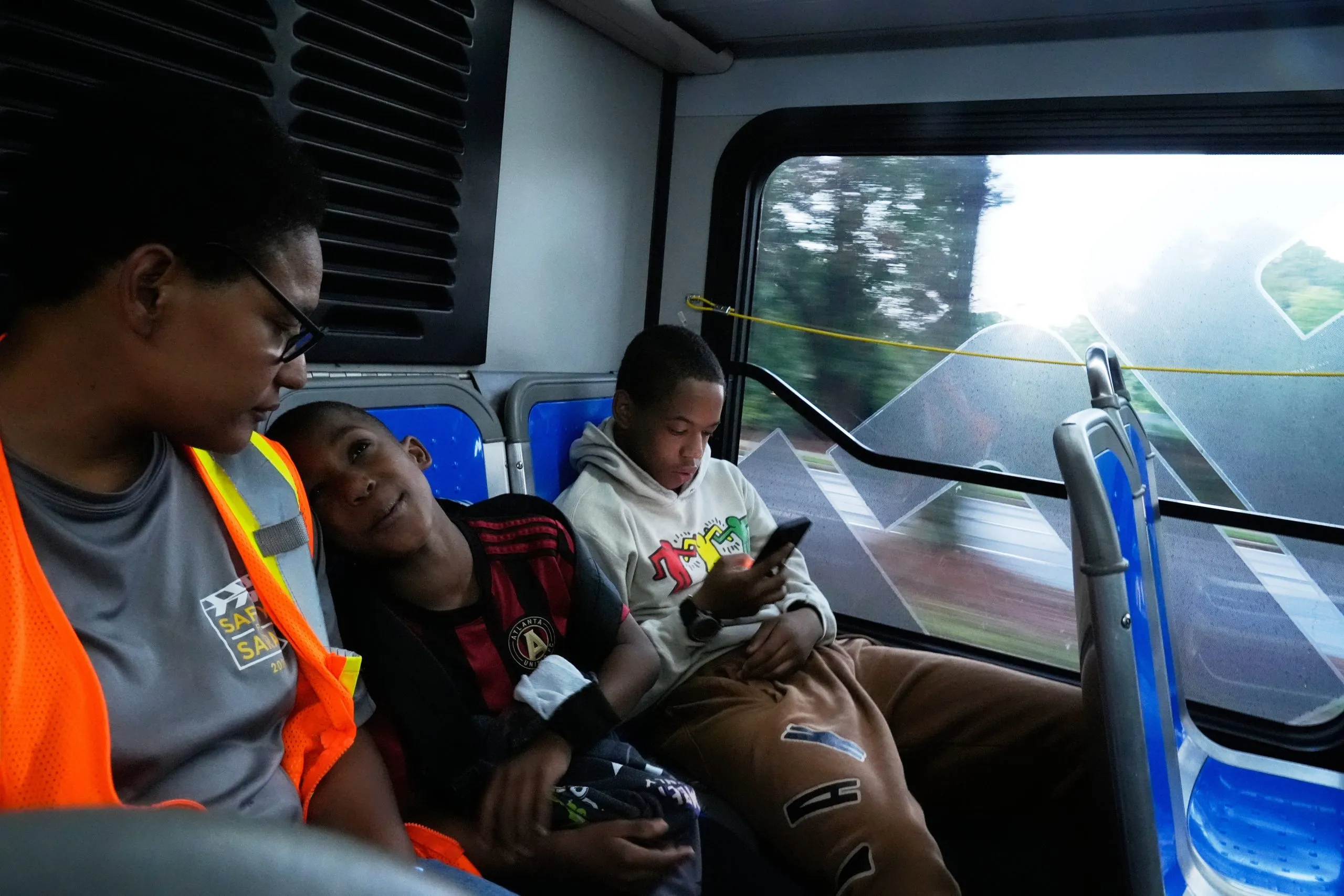
Tag: Eviction

  • Eviction sets single mom on a quest to keep her kids in their schools

    Eviction sets single mom on a quest to keep her kids in their schools

    by Bianca Vázquez Toness, The Hechinger Report
    November 18, 2025

    This story was produced by the Associated Press and reprinted with permission.

    ATLANTA — It was the worst summer in years. Sechita McNair’s family took no vacations. Her younger boys didn’t go to camp. Her van was repossessed, and her family nearly got evicted — again.

    But she accomplished the one thing she wanted most. A few weeks before school started, McNair, an out-of-work film industry veteran barely getting by driving for Uber, signed a lease in the right Atlanta neighborhood so her eldest son could stay at his high school.

    As she pulled up outside the school on the first day, Elias, 15, stepped onto the curb in his new basketball shoes and cargo pants. She inspected his face, noticed wax in his ears and grabbed a package of baby wipes from her rental car. She wasn’t about to let her eldest, with his young Denzel Washington looks, go to school looking “gross.”

    He grimaced and broke away.

    “No kiss? No hugs?” she called out.

    Elias waved and kept walking. Just ahead of him, at least for the moment, sat something his mother had fought relentlessly for: a better education.

    The link between where you live and where you learn

    Last year, McNair and her three kids were evicted from their beloved apartment in the rapidly gentrifying Old Fourth Ward neighborhood of Atlanta. Like many evicted families, they went from living in a school district that spends more money on students to one that spends less.

    Thanks to federal laws protecting homeless and evicted students, her kids were able to keep attending their Atlanta schools, even though the only housing available to them was in another county 40 minutes away. They also had the right to free transportation to those schools, but McNair says the district didn’t tell her about that until the school year ended. Their eligibility to remain in those schools expired at the end of last school year.

    Still wounded by the death of his father and multiple housing displacements, Elias failed two classes last year, his freshman year. Switching schools now, McNair fears, would jeopardize any chance he has of recovering his academic life. “I need this child to be stable,” she says.

    Related: Become a lifelong learner. Subscribe to our free weekly newsletter featuring the most important stories in education.

    With just one week before school started, McNair drove extra Uber hours, borrowed money, secured rental assistance and ignored concerns about the apartment to rent a three-bedroom in the Old Fourth Ward. At $2,200 a month, it was the only “semi-affordable” apartment in the rapidly gentrifying ward that would rent to a single mom with a fresh eviction on her record.

    On Zillow, the second-floor apartment, built in 2005, looked like a middle-class dream with its granite countertops, crown molding and polished wood floors. But up close, the apartment looked abused and held secrets McNair was only beginning to uncover.

    The first sign something was wrong came early. When she first toured the apartment, it felt rushed, like the agent didn’t want her to look too closely. Then, even as they told her she was accepted, the landlord and real estate agent wouldn’t send her a “welcome letter” laying out the agreement, the rent and deposit she would pay. It seemed like they didn’t want to put anything in writing.

    When the lease came, it was full of errors. She signed it anyway. “We’re back in the neighborhood!” she said. Elias could return to Midtown High School.

    But even in their triumph, no one in the family could relax. Too many things were uncertain. And it fell to McNair — and only McNair — to figure it out.

    The first day back

    Midtown is a high school so coveted that school administrators investigate student residency throughout the year to keep out kids from other parts of Atlanta and beyond. For McNair, the day Elias returned to the high school was a momentous one.

    “Freedom!” McNair declared after Elias disappeared into the building. Without child care over the summer, McNair had struggled to find time to work enough to make ends meet. Now that the kids were back in class, McNair could spend school hours making money and resolving some of the unsettled issues with her new apartment.

    McNair, the first person in her family to attend college, studied theater management. Her job rigging stage sets was lucrative until the writers’ and actors’ strike and other changes paralyzed the film industry in 2023. The scarcity of work on movie sets, combined with her tendency to take in family and non-family alike, wrecked her home economy.

    The family was evicted last fall when McNair fell behind on rent because of funeral expenses for her foster daughter. The teen girl died from an epileptic seizure while McNair and everyone else slept. Elias found her body.

    McNair attributes some of Elias’s lack of motivation at school to personal trauma. His father died after a heart attack in 2023, on the sidelines of Elias’s basketball practice.

    On his first day back at school this August, Elias appeared excited but tentative. He watched as the seniors swanned into school wearing gold cardboard crowns, a Midtown back-to-school tradition, and scanned the sidewalk for anyone familiar.

    If Elias had his way, his mom would homeschool him. She’s done it before. But now that he’s a teenager, it’s harder to get Elias to follow her instructions. As the only breadwinner supporting three kids and her disabled uncle, she has to work.

    Elias hid from the crowds and called up a friend: “Where you at?” The friend, another sophomore, was still en route. Over the phone, they compared outfits, traded gossip about who got a new hairdo or transferred. When Elias’s friend declared this would be the year he’d get a girlfriend, Elias laughed.

    When it was time to go in, Elias drifted toward the door with his head down as other students flooded past.

    The after-school pickup

    Hours later, he emerged. Despite everything McNair had done to help it go well — securing the apartment, even spending hundreds of dollars on new clothes for him — Elias slumped into the backseat when she picked him up after class.

    “School was so boring,” he said.

    “What happened?” McNair asked.

    “Nothing, bro. That was the problem,” Elias said. “I thought I was going to be happy when school started, since summer was so horrible.”

    Of all of the classes he was taking — geometry, gym, French, world history, environmental science — only gym interested him. He wished he could take art classes, he said. Elias has acted in some commercials and television programs, but chose a science and math concentration, hoping to study finance someday.

    After dinner at Chick-fil-A, the family visited the city library one block from their new apartment. While McNair spoke to the librarian, the boys explored the children’s section. Malachi, 6, watched a YouTube video on a library computer while Derrick, 7, flipped through a book. Elias sat in a corner, sharing video gaming tips with a stranger he met online.

    Related: Schools confront a new reality: They can’t count on federal money 

    “Those people are learning Japanese,” said McNair, pointing to a group of adults sitting around a cluster of tables. “And this library lets you check out museum passes. This is why we have to be back in the city. Resources!”

    McNair wants her children to go to well-resourced schools. Atlanta spends nearly $20,000 per student a year, $7,000 more than the district they moved to after the eviction. More money in schools means smaller classrooms and more psychologists, guidance counselors and other support.

    But McNair, who grew up in New Jersey near New York City, also sees opportunities in the wider city of Atlanta. She wants to use its libraries, e-scooters, bike paths, hospitals, rental assistance agencies, Buy Nothing groups and food pantries.

    “These are all resources that make it possible to raise a family when you don’t have support,” she said. “Wouldn’t anyone want that?”

    Support is hard to come by

    On the way home, the little boys fall asleep in the back seat. Elias asks, “So, is homeschooling off the table?”

    McNair doesn’t hesitate. “Heck yeah. I’m not homeschooling you,” she says lightly. “Do you see how much of a financial bind I’m in?”’

    McNair pulls into the driveway in Jonesboro, the suburb where the family landed after their eviction. Even though the family wants to live in Atlanta, their stuff is still here. It’s a neighborhood of brick colonials and manicured lawns. She realizes it’s the dream for some families, but not hers. “It’s a support desert.”

    As they get out of the car, Elias takes over as parent-in-charge. “Get all of your things,” he directs Malachi and Derrick, who scowl as Elias seems to relish bossing them around. “Pick up your car seats, your food, those markers. I don’t want to see anything left behind.” Elias would be responsible for making the boys burritos, showering them and putting them to sleep.

    McNair heads out to drive for Uber. That’s what is necessary to pay $450 a week to rent the car and earn enough to pay her rent and bills.

    But while McNair is out, she can’t monitor Elias. And a few days after he starts school, Elias’s all-night gaming habit has already drawn teachers’ attention.

    “I wanted to check in regarding Elias,” his geometry teacher writes during the first week of school. “He fell asleep multiple times during Geometry class this morning.”

    Elias had told the teacher he went to bed around 4 a.m. the night before. “I understand that there may be various reasons for this, and I’d love to work together to support Elias so he can stay focused and successful in class.”

    A few days later, McNair gets a similar email from his French teacher.

    That night, McNair drives around Atlanta, trying to pick up enough Uber trips to keep her account active. But she can’t stop thinking about the emails. “I should be home making sure Elias gets to bed on time,” she says, crying. “But I have to work. I’m the only one paying the bills.”

    Obstacles keep popping up

    Ever since McNair rented the Atlanta apartment, her bills had doubled. She wasn’t sure when she’d feel safe giving up the house she’d been renting in Clayton County, given the problems with the Atlanta apartment. For starters, she was not even sure it was safe to spend the night there.

    A week after school started in August, McNair dropped by the apartment to check whether the landlords had made repairs. At the very least, she wanted more smoke detectors.

    She also wanted them to replace the door, which looked like someone had forced it open with a crowbar. She wanted a working fridge and oven. She wanted them to secure the back door to the adjoining empty apartment, which appeared to be open and made her wonder if there were pests or even people squatting there.

    But on this day, her keys didn’t work.

    She called 911. Had her new landlords deliberately locked her out?

    When the police showed up outside the olive-green, Craftsman-style fourplex, McNair scrolled through her phone to find a copy of her lease. Then McNair and the officer eyed a man walking up to the property. “The building was sold in a short sale two weeks ago,” he told McNair. The police officer directed the man to give the new keys to McNair.

    Related: The new reality with universal school vouchers: Homeschoolers, marketing, pupil churn

    The next day, McNair started getting emails from an agent specializing in foreclosures, suggesting the new owners wanted McNair to leave. “The bank owns the property and now you are no longer a tenant of the previous owner,” she wrote. The new owner “might” offer relocation assistance if McNair agreed to leave.

    McNair consulted attorneys, who reassured her: It might be uncomfortable, but she could stay. She needed to try to pay rent, even if the new owner didn’t accept it.

    So McNair messaged the agent, asking where she should send the rent, and requested the company make necessary repairs. Eventually, the real estate agent stopped responding.

    Some problems go away, but others emerge

    Finally, McNair moved her kids and a few items from the Jonesboro house to the Atlanta apartment. She didn’t allow Elias to bring his video game console to Atlanta. He started going to bed around 11 p.m. most nights. But even as she solved that problem, others emerged.

    It was at Midtown’s back-to-school night in September that McNair learned Elias was behind in most of his classes. Some teachers said maybe Midtown wasn’t the right school for Elias.

    Perhaps they were right, McNair thought. She’d heard similar things before.

    Elias also didn’t want to go to school. He skipped one day, then another. McNair panicked. In Georgia, parents can be sent to jail for truancy when their kids miss five unexcused days.

    McNair started looking into a homeschooling program run by a mother she follows on Facebook. In the meantime, she emailed and called some Midtown staff for advice. She says she didn’t get a response. Finally, seven weeks after the family’s triumphant return to Midtown, McNair filed papers declaring her intention to homeschool Elias.

    It quickly proved challenging. Elias wouldn’t do any schoolwork when he was home alone. And when the homeschooling group met twice a week, she discovered, they required parents to pick up their children afterward instead of allowing them to take public transit or e-scooters. That was untenable.

    Elias wanted to stay at home and offered to take care of McNair’s uncle, who has dementia. “That was literally killing my soul the most,” said McNair. “That’s not a child’s job.”

    Hell, no, she told him — you only get one chance at high school.

    Then, one day, while she was loading the boys’ clothes into the washing machine at the Atlanta apartment, she received a call from an unknown Atlanta number. It was the woman who heads Atlanta Public Schools’ virtual program, telling her the roster was full.

    McNair asked the woman for her opinion on Elias’s situation. Maybe she should abandon the Atlanta apartment and enroll him in the Jonesboro high school.

    Let me stop you right there, the woman said. Is your son an athlete? If he transfers too many times, it can affect his ability to play basketball. And he’d probably lose credits and take longer to graduate. He needs to be in school — preferably Midtown — studying for midterms, she said. You need to put on your “big mama drawers” and take him back, she told McNair.

    The next day, Elias and his mother pulled up to Midtown. Outside the school, Elias asked if he had to go inside. Yes, she told him. This is your fault as much as it’s mine.

    Now, with Elias back in school every day, McNair can deliver food through Uber Eats without worrying about a police officer asking why her kid isn’t in school. If only she had pushed harder, sooner, for help with Elias, she thought. “I should have just gone down to the school and sat in their offices until they talked to me.”

    But it was easy for her to explain why she hadn’t. “I was running around doing so many other things just so we have a place to live, or taking care of my uncle, that I didn’t put enough of my energy there.”

    She wishes she could pay more attention to Elias. But so many things are pulling at her. And as fall marches toward winter, her struggle continues. After failing to keep up with the Jonesboro rent, she’s preparing to leave that house before the landlord sends people to haul her possessions to the curb.

    As an Uber driver, she has picked up a few traumatized mothers with their children after they got evicted. She helped them load the few things they could fit into her van. As they drove off, onlookers scavenged the leftovers.

    She has promised herself she’d never let that happen to her kids.

    Bianca Vázquez Toness is an Associated Press reporter who writes about the continuing impact of the pandemic on young people and their education.

    The Associated Press’ education coverage receives financial support from multiple private foundations. AP is solely responsible for all content. Find AP’s standards for working with philanthropies, a list of supporters and funded coverage areas at AP.org.

    This <a target=”_blank” href=”https://hechingerreport.org/she-wanted-to-keep-her-son-in-his-school-district-it-was-more-challenging-than-it-seemed/”>article</a> first appeared on <a target=”_blank” href=”https://hechingerreport.org”>The Hechinger Report</a> and is republished here under a <a target=”_blank” href=”https://creativecommons.org/licenses/by-nc-nd/4.0/”>Creative Commons Attribution-NonCommercial-NoDerivatives 4.0 International License</a>.<img src=”https://i0.wp.com/hechingerreport.org/wp-content/uploads/2018/06/cropped-favicon.jpg?fit=150%2C150&amp;ssl=1″ style=”width:1em;height:1em;margin-left:10px;”>

    <img id=”republication-tracker-tool-source” src=”https://hechingerreport.org/?republication-pixel=true&post=113392&amp;ga4=G-03KPHXDF3H” style=”width:1px;height:1px;”><script> PARSELY = { autotrack: false, onload: function() { PARSELY.beacon.trackPageView({ url: “https://hechingerreport.org/she-wanted-to-keep-her-son-in-his-school-district-it-was-more-challenging-than-it-seemed/”, urlref: window.location.href }); } } </script> <script id=”parsely-cfg” src=”//cdn.parsely.com/keys/hechingerreport.org/p.js”></script>


    Source link

  • Eviction Threats Impact Student Parent Success

    Eviction Threats Impact Student Parent Success

    An estimated one in five college students has dependents, and research shows that parenting students are more likely to experience basic needs insecurity in their pursuit of a degree. A 2024 survey by Trellis Strategies found that 6 percent of student parents self-identified as unhoused and 17 percent indicated some level of housing insecurity since they started college or during the 12 months leading up to the survey.

    A recent brief from New America and Princeton Eviction Lab tied the threat of eviction to negative student outcomes; student parents who face eviction are 23 percent less likely to complete a bachelor’s degree compared to their housing secure peers, and more likely to have lower quality of life, including higher mortality rates and lower earnings years later.

    In the most recent episode of Voices of Student Success, host Ashley Mowreader speaks with Edward Conroy, senior policy manager on higher education policy at New America, and Nick Graetz, assistant professor at the University of Minnesota in the department of sociology and the Institute for Social Research and Data Innovation, about how threats of eviction uniquely impact parents and the implications for generational education goals.

    An edited version of the podcast appears below.

    Inside Higher Ed: Just to get us started, can we get the 30,000-foot view? What is this brief? What were some of your findings? What did you all learn?

    Eddy Conroy, New America’s senior policy manager in the education policy program.

    Conroy: The overall goal here was to be able to look at parenting students—of which we know there are about 3 million in the country; it’s one in five undergrad students and another million grad students—if they’re threatened with an eviction, we thought it was pretty likely that’s going to have harmful effects on their chances of completing college. So wanted to see, what does that look like? How does that impact whether they graduate, whether they stay in college? What does it do to their income afterwards? What does it do to a bunch of different things that are pretty important when it comes to success in higher education? We’ll get more into detail, but we learned it was worse than perhaps either Nick or I thought the findings were going to be—and we didn’t think they were going to be great: The threat of eviction has just devastating consequences for parenting students’ chance of success in higher ed.

    Nick Graetz poses for a headshot against a verdant backdrop. Nick has short dark hair and is wearing a gray coat and red t-shirt

    Nick Graetz, assistant professor at the University of Minnesota in the department of sociology and the Institute for Social Research and Data Innovation.

    Graetz: Just a little background on how we got here from the data perspective. This is part of a larger collaboration that began with the U.S. Census Bureau maybe four years ago, with the goal of linking eviction records to other census administrative data to really understand who’s affected by eviction, because the records themselves only include names and addresses, not even things like age, race, sex, in terms of the actual data collected in court.

    One of our first big findings from that linkage was just the extent to which households with kids are at higher risk of eviction. Across the board, we find [eviction] filing rates are twice as high for groups that have kids. This work with Eddy and New America was a partnership to try to dig into different groups that have children—so, specifically, parenting students—and see what’s going on there.

    Inside Higher Ed: Something that I thought was interesting about this research—and I know this has to do with how evictions are filed, and the actual application of the eviction as well—but even the threat of an eviction had such a detrimental effect on completion rates.

    We talk a lot in higher ed about housing insecurity and students’ basic needs, and how, if they don’t have $500, they might not be able to persist, or they are at higher risk of stopping out. I wonder if we can talk about that dynamic of, maybe the student isn’t experiencing literal homelessness, but even the threat of eviction can totally jeopardize or derail their educational pursuit.

    Graetz: Part of it is a data consideration; we’re able to assess with a really high degree of accuracy the point at which we see someone in housing court across the country. It really varies how well we think we can capture the actual judgment rendered in housing court, but we use the threat of eviction, because that itself, based on prior work, has all these huge impacts, even if you’re ultimately able to stay in your home.

    Starting at the highest level, the constant stress of making rent or facing eviction is traumatic, especially for parents. There’s this expression, “the rent eats first,” and we know that tenants tend to sacrifice on issues like food and health care when they see budgets tighten. We know that rent-burdened households with children spend 57 percent less on health care, 17 percent less on food, and that’s driven by the threat of eviction; if you fall behind on rent, you need to prioritize that above everything else. It’s really easy to snowball into an eviction filing.

    The threat of eviction also compounds all sorts of other problems, especially material financial problems in lots of ways. Landlords file against the same tenants over and over again as a means of coercive rent collection, and we know that those fines and fees associated with just the filings can increase monthly housing costs up to 20 percent, and then also just having the mark of an eviction filing on your record, landlords use all sorts of tools to screen for those. It makes it harder to access new stable housing if you move—which can all have downstream impacts on things like finding a new job, finding new childcare, and so these things all kind of compound and accumulate over time.

    Inside Higher Ed: I think navigating that system must also be especially challenging for college students because of that time constraint, and again, student parents, even more so, because we know that there’s such a time poverty when it comes to raising children and having dependents.

    But we talk a lot about the hidden curriculum in higher education, and how it’s so hard to navigate even your institution and find everything you need. I can only imagine when you’re dealing with your landlord or housing court or all these other bureaucratic systems that are not always designed to be easy and user-friendly, that definitely compounds the stress and puts added pressure on this population.

    Conroy: About 90 percent of people who get taken to eviction court end up losing their case. Regardless of whether you can navigate [the system], your chances of winning are pretty low and there’s all kinds of stuff underlying that. Very few people in eviction court end up with representation. You’re generally talking about folks who are lower income, have less social and cultural capital … if you’re in that situation in the first place, the chances that you have a friend or family member you can call up and say, “Hey, who knows a good lawyer?” or even have the money to pay that person, are really low.

    Exactly to your point about time poverty, these things are a challenge for all students. But we know from lots of different pieces of research that parenting students’ pressures on their time are enormous. A vast majority are working full-time. They then have childcare and parenting responsibilities on top of that.

    That is a lot—as somebody who is a stepparent—that’s a lot to do, to have a full-time job and take care of your kids and occasionally have a little bit of a life yourself. Then, add in going to college at the same time. Everything that we see from other pieces of research on parenting students’ time constraints, they don’t have enough hours in the day when everything’s going reasonably well. You add in the stress of eviction or housing insecurity, and it is really easy to see how that is incredibly destabilizing immediately and very difficult to fight that kind of thing, because it takes a lot of time to deal with all those things. And you have to show up in court; there are all of these knock-on effects too. You’re showing up for court, that means that you have to take the day off work. You’re in a job that you don’t get days off, so you’ve lost a day of income. Like Nick was saying, these things snowball really quickly.

    Graetz: On the point about legal counsel and how tenants aren’t guaranteed representation in housing court. I think that’s one really important intervention at the university level: There are a lot of folks doing really incredible work offering free legal services to students. Those programs were one reason I was thinking, when I was trying to think of how big are these disparities we’re going to find, I was thinking of those programs as a place where tenants with kids in the general rental market don’t have access to that kind of thing, and virtually all of them are unrepresented. That’s another interesting intervention point that we could dig into more. It seems like it’s not a protective enough effect to really stop us from seeing such huge disparities here. But if universities could think about funding and investing in those programs more as a parenting student policy, as a retention policy, I think it could possibly have some really big impacts.

    Inside Higher Ed: Absolutely. As we’ve been talking about time poverty, one thing that came to mind is just the things that a student has to do during the 9 a.m. to 5 p.m. time period. Housing court isn’t open until 10 p.m., very rarely are institutions providing legal services after hours. And so, I think one intervention that would be interesting to see is just how expanded resources could also benefit student parents who don’t always have that 9-to-5 hour available when they have to take class and get the kids to child care and deal with their eviction notice, and go to the grocery store, whatever else it might be.

    I wonder if we can talk about some of the ways that institutions can have a role in supporting them with housing insecurity.

    Conroy: This was the first piece that New America had really done, at this intersection of housing issues and higher education. So, we were deliberately a little careful about what the policy solutions discussion looked like, because there are enough people in the world who will wade into new issue areas that they don’t know and make a bunch of suggestions without really understanding whether they’ve been tried before. So, we wanted to be deliberately careful.

    But I think one of the things that is really clear is these are not problems that institutions can solve on their own. So there was a big study that just came out, led by Rashida Crutchfield and a few other people in California, about work on California’s rapid rehousing investments.

    California at the state level, had invested, I think, over $30 million in that effort, and it showed really good outcomes. But it helped students at a small handful of universities in California. And when you’re talking about over 2 million students just in the California Community College system alone, $31 million seems like a lot of money. But when you start dividing that by, you know, tens of thousands or potentially hundreds of thousands of students, it’s not very much, very quickly.

    One of the really good quotes that came out of that was some senior administrator saying, “We simply can’t solve this at an institutional level by ourselves.” And I think it’s very clear from this data that parenting students have some unique vulnerabilities around housing insecurity and eviction—they’re having to pay more for housing, they need more housing than the average single student without kids, all of these things. Our financial aid system wasn’t designed to really support people with children. And so a big piece of this—and we’re starting to think about that now— is going to be institutions partnering and thinking through, how do we come to the table with our local housing authority? How do we come to the table with our city planning department and advocates for housing?

    Because everybody in America, unless you’re pretty well off, is experiencing challenges with housing. This is not an issue that’s unique to students. But in this case, parenting students are uniquely vulnerable to some of the challenges created there, so a lot of the solutions are going to be partnerships. There’s a role to play for emergency aid, for using it strategically to avoid students getting to the point of eviction. There’s a role for improved financial aid and doing a better job of communicating with students that they have these resources. I think, like Nick said, legal services, particularly if you’re an institution with a law school, is a great way to help, if you have a Student Legal Clinic. I think that’s actually a really great piece, but it’s going to be, almost certainly, a lot of partnership work with institutions. You run a food pantry, you can connect students to SNAP, you can do those kinds of things. Housing is a much bigger challenge, and it’s going to require working across different areas, for colleges and universities.

    Graetz: Ultimately, the universities investing in some of the emergency assistance stuff and legal services is, I think you can get a really big bang for your buck there, but it’s ultimately a band-aid solution to the broader housing crisis we’re all dealing with. And I think universities can be really powerful, important political actors in those conversations that have to be happening with state government and federal government to ease some of the major housing strain that families are facing.

    Conroy: One thing that actually just came to mind is the current administration has said it wants to explore the idea of limiting access to public housing, and especially housing choice vouchers —what’s previously been known as Section Eight housing vouchers—to two years. This isn’t official policy yet, but it’s been floated as an idea.

    One of the things we know is that, and as we see in this data, for a parenting student who was threatened with eviction five years post-enrollment, their family income was more than cut in half. If they were not threatened with eviction five years post-enrollment, [they had a] family income of $126,000 a year. That’s really good. That’s solidly middle class, like you’re doing pretty well.

    If you were threatened with eviction five years later, your family income was $59,000. That is an enormous difference. But it shows that if we help protect students at this really crucial point where they’re trying to get to a place that they no longer need to rely on any kind of public support, they’re probably going to do pretty well.

    But if you think about the two-year limit [on housing vouchers]: most parenting students don’t go to college full-time, it’s very rare. Even an associate degree, they’re very unlikely to complete it in two years. Obviously, there’s no way you’re completing a bachelor’s degree in two years.

    Those kinds of policy proposals would make this so much worse, when we know that if you help that student get to the finish line, the chances that they ever have to rely on public housing or other public benefits again, become so much lower.

    There are these really sort of backward policies that are penny-pinching to save a few cents now, but in the long run harm people and cost more money, or are just really ill-thought out approaches to public policy and housing policy.

    Citing Sources

    One study by the Lumina Foundation using 2012 data found that college graduates are 3.5 times less likely to be impoverished and five times less likely to be imprisoned or be in jail compared to non–college graduates. Lifetime government expenditures are 39 percent lower—$82,000 less—for college graduates than for Americans with only a high school degree.

    The study also found that the average bachelor’s degree recipient contributes $381,000 more in taxes than they use in government services and programs over their lifetime.

    Inside Higher Ed: We could definitely spend some time talking about the administration’s push for more children and encouraging family growth and things like that

    We see that student parents are so motivated to complete a degree, and we know adult learners are intrinsically motivated. They are much more likely to have strong goals [and] positive academic outcomes compared to their younger peers, but there are all these external factors that continue to hinder their degree progress. We’ve talked about time poverty, housing insecurity, lack of finances, the need to work, caregiving responsibilities for those who are caught in the [Sandwich] Generation between older parents and younger children or siblings as well. It’s such a complex issue , I wonder if we can just talk a little bit about why it’s so essential to do more than just provide academic support and to surround student parents with basic needs, with legal aid, with some of these other essential elements of being a student parent.

    Conroy: Like you said, academic outcomes for parenting students are actually pretty good. They, on average, have similar or even slightly better GPAs than their non-parent peers. But even under the best case scenario, taking eviction and everything else out of it, their chances of completing a bachelor’s degree in six years or an associate’s degree in three years are far lower than their non-parent peers.

    It is because of all of these other things that we’re talking about. Everything else being equal, if you take a parenting student and a non-parenting student and drop them in the same environment, the chances that the parenting student is going to get to the finish line are already diminished, unless you figure out other ways to support them.

    Priority registration is an enormous thing. I actually was just this week having dinner with a friend whose spouse just finished law school, but was at the same time working full-time. They have a young child, and he said the only way we were able to make this work is because Texas passed requirements that parenting students got priority registration, and his wife had first pick of classes, and that’s a family that has good financial resources.

    There are simple things like that; even priority registration for parenting students means they can figure out their work schedule. They can figure out childcare. That can be a big deal by itself, but if colleges figure out how to properly support the groups with the largest challenges, then that all trickles down.

    Universal design tells you that that will have good impacts for everybody else, but if colleges don’t do that, given demographic change … I’m not like somebody who thinks the world is going to collapse due to changes in the number of high school graduates, but it is going to have an impact. And we have this enormous pool of people in America who have some college but no degree or want to go back to college. New America just released our Varying Degrees report that we’ve done for years, and it shows, and it has shown again and again, Americans really value higher education. Folks who don’t have higher education are thinking about wanting to come back into it. The way that colleges will be able to smooth out some of those demographic change challenges is really thinking through carefully, how do we support groups like parenting students, where there’s also huge potential upside; if you move the needle 10 percent on your graduation rates for parenting students—because there the rates are so low right now—it has a really massive positive impact on your outcomes as an institution. And that’s important for funding, it’s important for recruitment, all of these things.

    Graetz: One point you brought up, Ashley, that I just wanted to build on a little bit, is the potential for really multi-generational impacts of investing in student parents.

    One thing we did in this work is think about how that goes both up and down the family tree. With the data linkage we’ve done, we’ve also connected the incomes of the parents of parenting students, so we could think of those as the grandparents of the children these folks are having while they’re enrolled.

    And we find that lower grandparent income at the time of parenting students enrolling is associated with much higher risk of eviction. I think the threat of eviction in college while you’re caring for your grandchild, you know that grandparent is going to be affected by that too. Because of some of the statistics you mentioned earlier, about how many parenting students can afford a $500 bill, a big part of that depends on familial wealth and where can you go to draw on that kind of emergency assistance?

    We know, of course, there are massive racial disparities in family wealth. So at the point of something like an eviction, that’s going to affect both up and down the family tree. It’s going to affect everybody who might be providing emergency support to that family member, potentially their child or who’s caring for their grandchild. But then it’s also going to affect the child; evictions, especially experienced early in life, have really traumatic long-term effects for children.

    Inside Higher Ed: That’s something that I wanted to talk about as well—the value of supporting student parents for the dependents’ sake. In higher education, we want all students to succeed and thrive, but we also know that being a continuing generation student, or having a parent who has a college degree or certificate, boosts your chances of completing a degree. And there’s, like you mentioned Nick, wellbeing and personal life experiences too, that are really tied to having basic needs and being supported as a young child. I wonder if we can talk a little bit about why this is important, not only for the student, but also for future generations and their education.

    Graetz: It’s hard to overstate the impacts that something like an eviction can have. In our previous work, looking at who’s affected by eviction the most, the rates are extremely high when you’re zero to five. So that’s because evictions target households with kids. Some of the most likely time of your life to be affected by an eviction is when you’re an infant, basically. And there’s a lot of literature on how this affects school outcomes, how this affects sort of regular developmental milestones. And I think it’s for tons of reasons; there’s the acute, traumatic effect of that eviction and this instability it causes, but then there’s just the downstream material consequences of that experience by the family for years and years later that are going to affect that child.

    Conroy: One thing to add on there is, we know that wealth and poverty in America are very sticky. Your chances of moving up in terms of income quintiles and things like that are not great, but higher education is one of the things that really makes it more likely that, if you came from a relatively low-income family, that you’re able to move into a higher income bracket and be more economically secure, all of those things and all of that for lots of reasons.

    We don’t have to get into every detail of it, but it has really good consequences for kids. It means that they’re more likely to go to a better-resourced school, they’re more likely to have good food on the table every day, all of these things.

    Also, Georgetown Center on Education and the Workforce estimates that 70 percent of jobs being created will require some kind of post–high school education moving forward. [It] doesn’t have to be a four-year degree, but there is an ever-decreasing number of jobs that don’t require training of some kind beyond high school. We help parenting students complete college, we know that once you get into a second-generation, third-generation college-going group, you’re not first-gen anymore, your chances of going to and succeeding in college go up because you have a parent to turn to to say, “Hey, you navigated this. How do I do that?”

    I see this with people in my family who are one of the only people in their community who went to college and they’re the community resource. It’s mom, dad, uncle, aunt, cousin. “Hey, talk to that person. They went to college; they succeeded. They’ll tell you what to do.” Those are very hard to measure, but the community network effects that happen over time and happen for kids in those families can be enormous.

    Inside Higher Ed: We talked a little bit about the lack of policy or practice implications directly named in the research brief that you both wrote. But I wonder if we can talk about the future of this work, or where you hope that the conversation continues to go as we think about supporting student parents in higher education who may be facing eviction or dealing with housing insecurity?

    Conroy: A couple of things that we’re working on that I can talk about. Nick and I have also, just in the past two weeks, been sort of figuring out, what can we do now to expand on this?

    One is we’re in the middle of trying to develop some work in conjunction with Nick and Eviction Lab, and then New America’s future of Land and Housing Program, to work in a small number of cities, to do some of the things I was talking about earlier in terms of partnerships and what could we do to think really carefully of bringing higher ed experts, institutions, housing advocates, the local public housing authority all together to the table to say, “Housing affordability is a general problem. It’s also a very specific problem for these groups of students. How could we work in collaboration to change some of those things?”

    That requires funding and all of those things. But we’re hoping to be able to do that as the “on the ground” piece at the same time as we build greater research evidence. We had seven states in this study, and, I can, Nick can talk better about, what were some of the ideas that we’re now starting to think about for what next stages, in terms of the evidence base, could look like?

    Graetz: We’re hoping to expand the coverage across the country of this linkage between all the census administrative records, this and the student records. I think that could give us more scope and general ability to generalize across student parents living in very different housing contexts.

    Then there’s just a bunch of other questions opened up by this initial work. Something I’m personally really interested in is the shifting ownership structure of student housing. A lot of times, we focus on trying to learn things by studying tenants, but it’s a lot harder to study landlords and owners and how those shifts can affect those risks being passed on to tenants in terms of things like eviction risk. I think that’s really interesting, especially in the student housing space and just the parts of a city’s housing stock that are primarily serving student populations. And then, we’re also really interested in doing more linkage to understand the relationship between various federal assistance programs and eviction risk among students and parenting students. That’s all, hopefully, stuff we can look forward to over the next year or two.

    Conroy: So, if anybody’s listening and have spare million dollars or two …

    Inside Higher Ed: I’ll write you a check later this afternoon.

    Conroy: I need to look at Inside Higher Ed jobs. I didn’t realize they paid that well.

    Inside Higher Ed: Well, you know …

    Get more content like this directly to your inbox. Subscribe here.

    Source link