Tag: Excellence

  • Reclaiming the narrative of educational excellence despite the decline of educational gain

    Reclaiming the narrative of educational excellence despite the decline of educational gain

    There was a time when enhancement was the sector’s watchword.

    Under the Higher Education Funding Council for England (HEFCE), concepts like educational gain captured the idea that universities should focus not only on assuring quality, but on improving it. Teaching enhancement funds, learning and teaching strategies, and collaborative initiatives flourished. Today, that language has all but disappeared. The conversation has shifted from enhancement to assurance, from curiosity to compliance. Educational gain has quietly declined, not as an idea, but as a priority.

    Educational gain was never a perfect concept. Like its cousin learning gain, it struggled to be measured in ways that were meaningful across disciplines, institutions, and student journeys. Yet its value lay less in what it measured than in what it symbolised. It represented a shared belief that higher education is about transformation: the development of knowledge, capability, and identity through the act of learning. It reminded us that the student experience was not reducible to outcomes, but highly personal, developmental, and distinctive.

    Shifting sands

    The shift from HEFCE to the Office for Students (OfS) marked more than a change of regulator; it signalled a change in the state’s philosophy, from partnership to performance management. The emphasis moved from enhancement to accountability. Where HEFCE invested in collaborative improvement, OfS measures and monitors. Where enhancement assumed trust in the professional judgement of universities and their staff, regulation presumes the need for assurance through metrics. This has shaped the sector’s language: risk, compliance, outcomes, baselines – all necessary, perhaps, but narrowing.

    The latest OfS proposals on revising the Teaching Excellence Framework mark a shift in their treatment of “educational gain.” Rather than developing new measures or asking institutions to present their own evidence of gain, OfS now proposes removing this element entirely, on the grounds that it produced inconsistent and non-comparable evidence. This change is significant: it signals a tighter focus on standardised outcomes indicators. Yet by narrowing the frame in this way, we risk losing sight of the broader educational gains that matter most to students, gains that are diverse, contextual, and resistant to capture through a uniform set of metrics. It speaks to a familiar truth: “not everything that counts can be counted, and not everything that can be counted counts”.

    And this narrowing has consequences. When national frameworks reduce quality to a narrow set of indicators, they risk erasing the very distinctiveness that defines higher education. Within a framework of uniform metrics, where does the space remain for difference, for innovation, for the unique forms of learning that make higher education a rich and diverse ecosystem? If we are all accountable to the same measures, it becomes even more important that we define for ourselves what excellence in education looks like, within disciplines, within institutions, and within the communities we serve.

    Engine room

    This is where the idea of enhancement again becomes critical. Enhancement is the engine of educational innovation: it drives new methods, new thinking, and the continuous improvement of the student experience. Without enhancement, innovation risks becoming ornamental: flashes of good practice without sustained institutional learning. The loss of “educational gain” as a guiding idea has coincided with a hollowing out of that enhancement mindset. We have become good at reporting quality, but less confident in building it.

    Reclaiming the narrative of excellence is, therefore, not simply about recognition and reward; it is about re-establishing the connection between excellence and enhancement. Excellence is what we value, enhancement is how we realise it. The Universitas 21 project Redefining Teaching Excellence in Research-Intensive Universities speaks directly to this need. It asks: if we are to value teaching as we do research, how do we define excellence on our own terms? What does excellence look like in an environment where metrics are shared but missions are not?

    For research-intensive universities in particular, this question matters. These institutions are often defined by their research outputs and global rankings, yet they also possess distinctive educational strengths: disciplinary depth, scholarly teaching, and research-informed curricula. Redefining teaching excellence means articulating those strengths clearly, and ensuring they are recognised, rewarded, and shared. It also means returning to the principle of enhancement: a commitment to continual improvement, collegial learning, and innovation grounded in scholarship.

    Compass point

    The challenge, and opportunity, for the sector is to rebuild the infrastructure that once supported enhancement. HEFCE-era initiatives, from the Subject Centres to the Higher Education Academy, created national and disciplinary communities of practice. They gave legitimacy to innovation and space for experimentation. The dismantling of that infrastructure has left many educators working in isolation, without the shared structures that once turned good teaching into collective progress. Reclaiming enhancement will require new forms of collaboration, cross-institutional, international, and interdisciplinary, that enable staff to learn from one another and build capacity for educational change.

    If educational gain as a metric was flawed, educational gain as an ambition is not. It reminds us that the purpose of higher education is not only to produce measurable outcomes but to foster human and intellectual development. It is about what students become, not just what they achieve. As generative AI reshapes how students learn and how knowledge itself is constructed, this broader conception of gain becomes more vital than ever. In this new context, enhancement is about helping students, and staff, to adapt, to grow, and to keep learning.

    So perhaps it is time to bring back “educational gain,” not as a measure, but as a mindset; a reminder that excellence in education cannot be mandated through policy or reduced to data. It must be defined and driven by universities themselves, through thoughtful design, collaborative enhancement, and continual renewal.

    Excellence is the destination, but enhancement is the journey. If we are serious about defining one, we must rediscover the other.

    Source link

  • Honoring Giving Day Excellence | The 2025 RNL Givey Winners

    Honoring Giving Day Excellence | The 2025 RNL Givey Winners

    Giving days have become a foundation for fundraising, helping institutions energize their donor base and create an incredible burst of philanthropic passion. As these days have evolved, so have the strategies institutions have used to amplify their efforts, rally donors around a theme, and gamify giving to take the results to the next level.

    To recognize the creativity and strategy of these programs, RNL created the Giveys, and annual award celebrating the most innovative and successful Giving Day campaigns. This year we are pleased to announce 28 winners among our ScaleFunder partners.

    The Giveys showcase a sampling of the outstanding work and unique approaches RNL’s many partners take to engage their communities and maximize their fundraising efforts. This year’s winners used pop culture-inspired themes and high-tech ambassador toolkits to bolster strategic support from the ScaleFunder and use of our easy-to-build platform to generate record-breaking fundraising events. Read about the winners and see their giving pages below, or watch our recent webinar where we unveiled the winning institutions.

    2025 RNL Giveys Winners & Highlights

    Category: Creative Giving Day Theme

    Missouri State Giving Day
    • Winner: University of Texas at Dallas
      • University of Texas at Dallas launched a fully integrated Taylor Swift-inspired campaign that spanned their logo, site text, graphics, and ambassador toolkit. The theme culminated in a fun, on-campus concert featuring a Taylor Swift impersonator and a selfie station.
    • Winner: Missouri State University
      • Missouri State won for their Taylor Swift-inspired theme that carried across their site’s banner image and ambassador materials, demonstrating a high-energy approach that resonated with their community

    Category: Omnichannel Engagement

    • Winner: Michigan Tech University
      • Michigan Tech University was recognized for their professional and unified omnichannel strategy. They utilized high-quality branding, student photos, and front-and-center dates across postcards, digital ads, and email to ensure the campaign was seen everywhere.

    Category: Creative Social Media

    • Winner: West Virginia University (WVU)
      • West Virginia University was celebrated for its use of creative social media challenges and contests, leveraging the Walls.io social media aggregator. Our favorites included a “Day of Giving Social Prop Challenge” tied to their save-the-date postcard, a “Country Roads Challenge” asking people to sing the John Denver song, and a “Pet Photo Challenge.”

    Category: Gamification Excellence

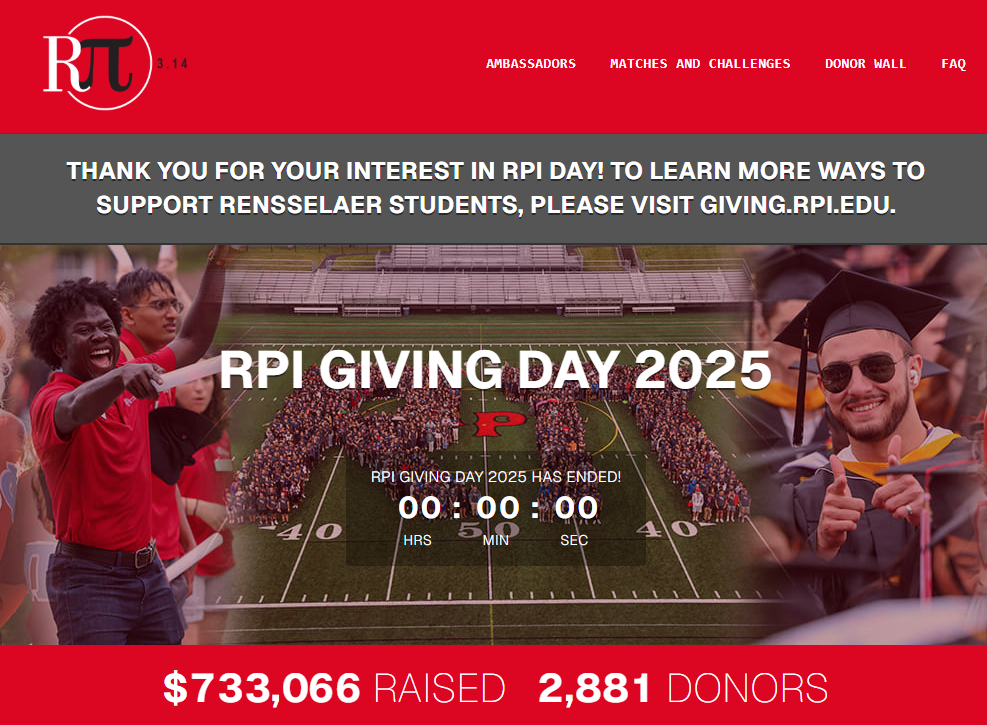
    RPI Giving DayRPI Giving Day
    • Winner: The University of Mississippi
      • The University of Mississippi team was honored for leaning into what makes them unique! They tied their campaign to the hearts of their donors by offering unique and personalized rewards such as a manufacturing excellence fire pit and a signed, personalized print from artist Marshall Ramsey.
    • Winner: Indiana State University
      • Indiana State was recognized for an excellent display of matches and challenges on their site, particularly the “New Donor Challenge.” This challenge targeted first-time donors, successfully using a major gift to be unlocked once a specific number of new donors gave.
    • Winner: Rensselaer Polytechnic Institute (RPI)
      • We applaud RPI for tying their gamification directly into their giving day date, March 14th (Pi Day). Challenges included goals like 3,142 laps around the armory and gifts of $3.14 or $31.42, along with highlighting pet posts for their president’s dog’s birthday party.
    • Winner: Montclair State University
      • Montclair State University was highlighted for their fun, relatable challenge that asked young alumni to “give up a coffee” and make a modest gift, then rewarded them with a coupon for a free coffee, encouraging repeat engagement.

    Category: Ambassador + Donor Engagement

    University of Oregon Giving DayUniversity of Oregon Giving Day
    • Winner: University of Oregon
      • The University of Oregon won for their “Ducks Give Day” campaign. They offered a free sticker pack for signing up as an ambassador and motivated participation in their “You+2” campaign, where ambassadors made a gift and secured two others to make a gift, then they earned an exclusive Oregon pin and pair of socks.
    • Winner: The University of Texas Health Science Center at Houston
      • UT Health Houston put together a Giving Day campaign toolkit to engage the ambassadors by providing professional, easy-to-use graphics and copy-and-paste sample messaging. The success of their campaign stemmed from understanding of their audience and a commitment to making it simple for people to spread the word and help them meet their goals.

    Category: On-Campus Engagement

    • Winner: University of Wisconsin-La Crosse
      • Celebrated for an excellent on-campus promotion strategy to generate awareness and engagement, which included free T-shirt giveaways, a kickoff pep rally, a voting contest for campus areas to receive funding, and a “Class Cab” golf cart.

    Category: Awesome Greek Organization

    • Winner: Kappa Alpha Theta
      • Kappa Alpha Theta was recognized for their well-designed and welcoming ScaleFunder site design, which featured animated graphics and powerful donor testimonials directly on the page, leaning into their core message of sisterhood and connection.

    Category: New Giving Day Partner

    University of DelawareUniversity of Delaware
    • Winner: University of Delaware
      • The University of Delaware was honored for their successful first “iHeartUD Giving Day,” demonstrating excellent branding and execution, especially after needing to change their Giving Day date. Their quick, professional communication and successful campaign showed great promise, and they were true experts at keeping their community in the loop about iHUD happenings.
    • Winner: California State University, Stanislaus
      • California State University, Stanislaus was recognized for a very strong entry, leveraging years of success with RNL’s crowdfunding platform for their first Giving Day. They created a unique theme, “1960 Minutes of Giving” (based on their founding year), and used a unique domain label: “stanforacause.”

    Category: Fall Giving Day

    • Winner: The University of Alabama
      • Featured for their recent “Clash of the Capstone” campaign, which pitted students against alumni in a competition to see who could bring in the greatest number of gifts, creating a fun, engaging way to host a second, focused giving day in the fall.
    • Winner: UC Berkeley
      • Recognized for the success of their second annual fall giving day, the “Oski’s Bearathon.” The campaign, which focuses on driving donations to student organizations, uses a fun, quirky theme and is a top example of how to successfully run multiple, distinct Giving Day campaigns in one year.

    Category: Frictionless Giving Experience

    • Winner: Butler University
      • Butler University was celebrated for proactively adding custom questions to their donation form to collect information vital for advancement services and athletics, streamlining the gift processing workflow for their campus partners.

    Category: Giving Day Video

    • Winner: University of Houston
      • The University of Houston created an engaging Giving Day campaign, which featured a video game theme. This included a fun, well-done video and the development of an actual playable game called “Shasta’s Birthday Dash,” accessible right on their Giving Day site. This gamified approach allowed participants to play, collect points by passing virtual campus landmarks, and track their scores on a visible leaderboard, making the celebration of their “years of excellence” a memorable and interactive experience.

    Category: Incentivized Giving

    • Winner: Northern Kentucky University
      • Northern Kentucky University developed highly effective donor incentives as part of their annual Giving Day campaign. These incentives included offering a choice of a long-sleeve T-shirt for any gift of $68 or more (honoring their founding year) and leveraging a partnership with AAA to enter all donors of any gift size into a drawing to win two round-trip Delta Airline ticket vouchers anywhere in the continental United States.

    Ready for a record-breaking giving day?

    RNL Giving Day Powered by ScaleFunder combines the most powerful giving day platform with strategic assessments, omnichannel marketing, and stewardship to make your giving day a major success and increase future giving.

    RNL Giving Day Powered by ScaleFunderRNL Giving Day Powered by ScaleFunder

    Category: Site Design

    • Winner: The University of Mary Washington
      • The University of Mary Washington earned recognition for their successful site refresh, which featured a custom-drawn campus wallpaper design for their Giving Day platform. Additionally, they leveraged a unique campus tradition, the “Devil Goat Challenge,” which pits even and odd class years against each other for additional challenge funds.
    • Winner: Ivy Tech Community College
      • Ivy Tech Community College Giving Day campaign prioritized team alignment across the entire organization and featured a visually fantastic site design. Their platform created a positive, celebratory atmosphere through its use of dynamic graphics and animation, including a banner with confetti dropping.
    • Winner: Tarleton State University
      • Tarleton State University created a professional and engaging Giving Day site that effectively showcased their branding, especially for the Texan Excellence Fund. Their use of vibrant giving area tiles that instantly captured attention and encouraged visitors to scroll and click through to learn about the different campus areas needing support.
    • Winner: Washington State University
      • Washington State University reached the outstanding milestone of their 10th annual Giving Day this year with their, “Cougs Give,” campaign. The university Giving Day site is well designed, featuring a “film noir” theme that used black and white imagery with a bold pop of red in their tile graphics, creating a memorable and visually sophisticated look that was carried throughout the entire campaign.

    Category: Multi-Campus Showcase

    • Winner: The University of Alaska
      • The University of Alaska leveraged an exceptional multi-campus showcase feature, which unified its various campus identities through the creative use of their mascots. Their campaign stood out with engaging features like mascots animating in and out of the banner images and a fun “hide and seek” challenge that visually highlighted each campus’s unique identity.

    Category: Athletics Giving Day

    • Winner: Virginia Tech University
      • Virginia Tech successfully hosted a second Giving Day specifically dedicated to their athletics, branded with the strong theme “Triumph Together.” This initiative united the university’s annual giving and athletics teams, serving as a powerful tool to generate engagement, secure great donor numbers, and cultivate loyal, all-around Virginia Tech fans.

    Category: Giving Tuesday

    • Winner: Northern Arizona University
      • Northern Arizona University was recognized for their cohesive and successful Giving Tuesday campaign that featured a fall theme and their “Lumberjacks” identity. Their strategy featured a beautiful site design and creative, engaging messaging, such as substituting “gifts” with “axe of kindness” and playful puns to reinforce the thematic branding and celebrate who they are.

    Category: Early Giving

    • Winner: Marshall University
      • Marshall University was recognized for their creative and effective use of early giving functionality on the ScaleFunder platform, which streamlined the donation process for both donors and staff. They simplified the experience by allowing gifts directly on the campaign site, customizing the donation button to say “Give Early,” and easily hiding the total aggregator and donor wall until the official launch to generate excitement.

    Category: Wild Card

    • Winner: Salem State University
      • Salem State University was recognized for enhancing their Giving Day with creative, multi-media engagement features promoted directly on their homepage, offering fun ways for their community to participate beyond just donating. These features included a high-energy “Viking Warrior Day hype up” Spotify playlist and a curated YouTube playlist offering various pre-recorded activities, such as an alumni-led morning yoga session and an evening meditation.

    Ready to have your award-winning Giving Day?

    These stories of record growth, community engagement, and frictionless giving celebrated at RNL’s 2025 Giveys highlights that with the right tools, consulting support, and strategic planning, any institution can host a successful and engaging digital fundraising campaign.

    Whether you’re looking to launch your first Giving Day, elevate your annual campaign, or start a new crowdfunding initiative, RNL’s ScaleFunder platform provides the technology, insights, and support to turn your vision into a fundraising victory.

    Contact us today to explore how RNL’s ScaleFunder can help you engage your donors, mobilize your ambassadors, and build a tradition of giving day excellence.

    Source link

  • Securing educational excellence may demand a new leadership compact

    Securing educational excellence may demand a new leadership compact

    When education leaders describe their institutions as being in “existential crisis” or on a “wartime footing,” you know that something important is happening.

    A new report, “Securing educational excellence in higher education at a time of change,” from Wonkhe and Advance HE, based on roundtable discussions with 11 institutional leaders, 15 principal fellows of Advance HE, and three student representatives held in March 2025, explores institutional interpretation of and responses to change, and asks what measures should be taken to secure educational excellence for what could be quite a different future.

    While institutions are understandably focused on managing their immediate pressures, with, in some cases, institutional survival at stake, sustainability means little without the long-term mission of inclusive, high-quality learning that prepares students for their future lives. While financial security would help, the changes higher education is navigating require a deeper consideration of how institutions make decisions, deploy expertise, and engage their communities.

    The report maps four critical tensions that leaders are navigating across the political, economic, social and technological domains: public trust versus sector autonomy; public good versus private return on investment; traditional academic community versus new student models; pace of technological change versus institutional capacity. A fifth tension emerges from this complex environment: a need for distributed leadership that allows for a deep knowledge of the issues versus clear lines of accountability for decisions. These tensions play out daily in everything that higher education institutions do.

    A wave of change

    In the political dimension, higher education is implicated in broader losses of confidence in institutions. Though not technically public services, universities occupy a distinctive position in British civic life: historically connected to the state, still partly publicly funded, yet operating with considerable autonomy. That hybrid status leaves higher education uniquely vulnerable to simultaneous public and policymaker scrutiny.

    Higher education institutions are not insulated from the broader political landscape. Student representatives in the research raised questions about institutional awareness: “Universities believe that students are exempt from the effects of public austerity…they believe we are creating a community of highly educated people, therefore they cannot fall for the tricks and stories that the media or certain political parties are trying to tell.”

    The economic tension is similarly complex. Universities are expected to deliver public benefits without reliable public funding, creating what one participant called a “competing interest” space where higher education struggles for resources against health and compulsory education. Meanwhile, students increasingly question whether their investment yields genuine value. “Students are being taught how to meet learning objectives, but they’re not being taught how to transfer the skills that they get during their time at university, or sometimes it feels like they’re not even being taught the skills that they need just by meeting the learning objectives,” one student representative observed.

    Principal fellows echoed some of this anxiety: “Students, particularly those from a widening participation background, can put generational money into getting an education which then doesn’t give them a job.” When the compact between investment and outcome seems to break down, trust may fracture, not just between students and institutions but also between society and the higher education project.

    Socially, traditional higher education campus communities are under pressure, with students increasingly time-poor, working to afford their studies, and many commuting rather than living on campus. Participants observed that many students approach higher education more transactionally – not necessarily because they’re mercenary, but possibly because they’re exhausted. As one principal fellow observed, “student” seems to have shifted from being a core identity to something people do alongside other things.

    Meanwhile, technology raises a host of strategic questions, not only in mustering the “right” response to generative AI but also in confronting how the pace of technological change reshapes the collective imaginary of how humans and machines interact in physical and digital spaces. This has implications for curriculum and pedagogy, equity and inclusion, and infrastructure and resources.

    Staff communities appear to have fractured, too. Professional services are “somewhere else in the university,” quick informal conversations have disappeared, and academics feel “fed up and tired and exhausted.” One principal fellow described what they saw as a vicious cycle: “We do not have communities in our universities anymore, and that then impacts the students as well…we don’t have engagement from the students. But also we don’t have engagement from the academics, because they’re in a mood all the time.”

    This fragmentation has strategic implications. When communities fragment, institutions may lose the collective capacity to sense problems, develop solutions, and sustain change. Everyone risks becoming reactive rather than proactive, protective rather than collaborative.

    Change as a capability

    Rather than seeking solutions or silver bullets, our conversations explored the institutional capabilities required to navigate these complex tensions and map out a sustainable way forward.

    One key insight emerging was about the diversity and richness of knowledge and expertise held within institutions that may not be routinely accessed in efforts to think about the future. Small executive teams may struggle to retain a grip on every aspect of the changing landscape or simply become bogged down in maintaining the day-to-day flow of decisions that keep institutions running. Under this kind of pressure, it might not be surprising that, as one principal fellow put it, “Leaders often talk too much and listen too little.”

    The report suggests leaders need to become curators of inclusive processes rather than authorities on every challenge. This would require the confidence to admit when situations are difficult and to seek help – a cultural shift that, if modelled from the top, could potentially reduce pressure on others to hide their struggles.

    Student representatives echoed this sense that efforts to consult or engage, if not well conceived, can sometimes be more alienating than empowering. One student leader suggested involving students in shaping the collective understanding of problems from the beginning, at which their experience and knowledge are most likely to make a meaningful contribution, rather than asking student representatives to comment on pre-developed expert solutions. The same principle could apply to higher education staff and stakeholders.

    There were also clear themes of the need for authenticity when professing an appetite for change and a pragmatic approach to resourcing it. Participants noted that institutions advertise for “innovators” and “change agents” but may not truly want them, or don’t adequately support them when they arrive. Change might require investment: stable contracts, professional development, and time for pedagogic innovation. “You can’t shift pedagogy if you don’t create time,” observed one principal fellow.

    In the technological domain, where there may be a belief that the issues are fundamentally about resourcing and retaining technical expertise, part of the question has to be about how technology reshapes staff and student experience and sustains or fragments human connection. One principal fellow observed that higher education’s “killer service” might be personal connection, not consumer-grade content production in an attention economy. However, delivering that would require investing in people, not just platforms.

    A question of purpose

    Among education leaders, there was a real recognition that higher education staff are “the most precious resource,” as one put it. Yet the changing landscape for higher education seems to be broadening the range of possible purposes for higher education, along with the range of stakeholders who feel entitled to a view about what educational excellence looks like.

    It is not hard to see how this changing dynamic can alienate academics working in disciplines who may perceive some of their core “knowledge stewardship” values and purposes as being under threat from political, economic, social, and technological changes in the external landscape driving different expectations of higher education.

    With an unknowable future, the answer is less about seeking certainties to cling to as about finding collective ways to navigate uncertainty. That might open up some uncomfortable propositions: that higher education’s purpose itself may need rearticulating; that trade-offs between competing goods must be explicitly managed; that excellent pedagogy might require resource investment even when budgets are tight; and that sustainable change may emerge more from dialogue than from executive decision-making.

    The full report repays careful reading, not just for its PEST analysis framework, which could help guide your own institutional conversations about change, but for the candour of participants grappling with genuine complexity. Higher education may face a “pivot point” – though the sector’s breadth, diversity, and expertise remain a considerable strength. Weathering the changes here right now and those on the horizon will depend to no small degree on institutional leadership capability to draw on that expertise to build a shared and collectively owned sense of educational excellence.

    This article is published in association with Advance HE. You can read and download the full Securing educational excellence at a time of change report here.

    Source link

  • ACUE and ACE Deepen Alliance, Marking Nearly a Decade of Transforming Faculty Development and Advancing Excellence in Higher Education

    ACUE and ACE Deepen Alliance, Marking Nearly a Decade of Transforming Faculty Development and Advancing Excellence in Higher Education

    ACE and the Association of College and University Educators (ACUE) have reaffirmed our long-standing collaboration to continue driving transformative change in faculty development and elevate teaching excellence across higher education. For more information about the updates to this nearly decade-long alliance, click here.

    To learn more and register for an Oct. 29 webinar that will feature ACE President Ted Mitchell and ACUE Chairman and CEO Andrew Hermalyn, click here.


    If you have any questions or comments about this blog post, please contact us.

    Source link

  • FIRE statement on the White House’s Compact for Academic Excellence in Higher Education

    FIRE statement on the White House’s Compact for Academic Excellence in Higher Education

    On Oct. 1, the Wall Street Journal reported that the White House is asking colleges to sign an agreement to secure preferential treatment for government funding. FIRE is working to obtain the full agreement, but initial reporting already indicates it raises threats to free speech and academic freedom.

    The following statement can be attributed to Tyler Coward, FIRE lead counsel for government affairs.

    Freedom thrives when the people, not bureaucrats, decide which ideas are worthy of discussion, debate, or support. 

    As FIRE has long argued, campus reform is necessary. But overreaching government coercion that tries to end-run around the First Amendment to impose an official orthodoxy is unacceptable. And the White House’s new Compact for Academic Excellence in Higher Education raises red flags.

    The compact includes troubling language, such as calling on institutions to eliminate departments deemed to “purposefully punish, belittle, and even spark violence against conservative ideas.” Let’s be clear: Speech that offends or criticizes political views is not violence. Conflating words with violence undermines both free speech and efforts to combat real threats.

    The compact also requires university employees to refrain from “actions or speech related to politics.” If the language merely barred high-ranking employees from engaging in partisan political activity on behalf of the university, it would reflect existing and generally permissible IRS restrictions. But the compact’s reported wording goes further by suggesting a blanket prohibition on all staff engaging in political speech. For public institutions, that is deeply problematic. Public university faculty have the First Amendment right to speak about politics in their teaching and scholarship. Outside of their official duties, faculty and non-faculty university employees retain full First Amendment rights to speak off-the-clock as private citizens on matters of public concern. Banning them from doing so would be flatly unconstitutional.

    A government that can reward colleges and universities for speech it favors today can punish them for speech it dislikes tomorrow. That’s not reform. That’s government-funded orthodoxy. 

    Source link

  • K12 Earns High Marks for Excellence in Online Public Education

    K12 Earns High Marks for Excellence in Online Public Education

    RESTON, Va.(GLOBE NEWSWIRE) — K12, a portfolio brand of Stride, Inc. has been recognized for its steadfast commitment to quality education. In a recent review by Cognia, a global nonprofit that accredits schools, K12 earned an impressive Index of Education Quality (IEQ) score of 327, well above the global average of 296. Cognia praised K12 for creating supportive environments where students are encouraged to learn and grow in ways that work best for them. 

    For over 25 years, K12 has been a pioneer in online public education, delivering flexible, high-quality learning experiences to families across the country. Having served more than 3 million students, K12 has helped shape the future of personalized learning. This long-standing presence in the field reflects a deep understanding of what families need from a modern education partner. The recent Cognia review further validates K12’s role as a trusted provider, recognizing the strength of its learning environments and its commitment to serving all students. 

    “What stood out in this review is how clearly our learning environments are working for students,” said Niyoka McCoy, Chief Learning Officer at Stride, Inc. “From personalized graduation plans to real-time feedback tools and expanded course options, the Cognia team saw what we see every day, which is students being supported in ways that help them grow, stay engaged, and take ownership of their learning.” 

    K12’s impact extends well beyond the virtual classroom. In 2025, the organization was honored with two Gold Stevie® Awards for Innovation in Education and recognized at the Digital Education Awards for its excellence in digital learning. These awards highlight K12’s continued leadership in delivering meaningful, future-focused education. What sets K12-powered online public schools apart is a curriculum that goes beyond the basics, offering students access to STEM, Advanced Placement, dual-credit, industry certifications, and gamified learning experiences. K12’s program is designed to spark curiosity, build confidence, and help students thrive in college, careers, and life. 

    Through student-centered instruction and personalized support, K12 is leading the way in modern education. As the learning landscape evolves, K12 adapts alongside it, meeting the needs of today’s students while shaping the future of education. 

    To learn more about K12 and its accredited programs, visit k12.com.

    About Stride, Inc.  

    Stride Inc. (LRN) is redefining lifelong learning with innovative, high-quality education solutions. Serving learners in primary, secondary, and postsecondary settings, Stride provides a wide range of services including K-12 education, career learning, professional skills training, and talent development. Stride reaches learners in all 50 states and over 100 countries. Learn more at Stridelearning.com.

    eSchool News Staff
    Latest posts by eSchool News Staff (see all)

    Source link

  • Breaking Barriers: Dr. Charles Lee Isbell Jr. Brings Vision for Inclusive Excellence to Illinois

    Breaking Barriers: Dr. Charles Lee Isbell Jr. Brings Vision for Inclusive Excellence to Illinois

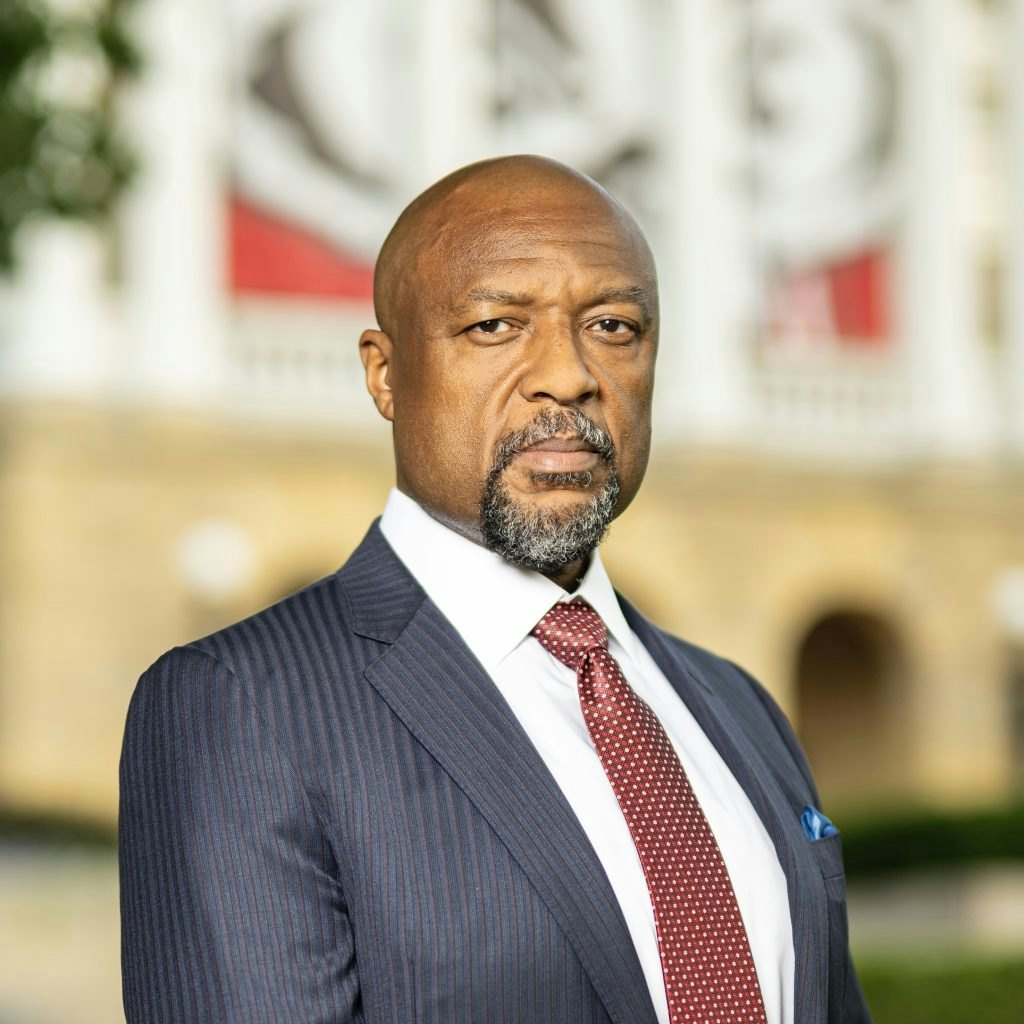
     Dr. Charles Lee Isbell Jr.In a move that signals both continuity and transformation in higher education leadership, Dr. Charles Lee Isbell Jr. has been named the 11th chancellor of the University of Illinois Urbana-Champaign, bringing with him a distinguished record of academic innovation and an unwavering commitment to expanding access in STEM fields.

    The appointment, announced by University of Illinois System President Tim Killeen, represents more than just a leadership transition. It marks the arrival of a scholar-administrator whose career has been defined by his efforts to democratize technology education and create pathways for underrepresented students in computing and artificial intelligence.

    Isbell, currently serving as provost at the University of Wisconsin-Madison, will formally assume his new role on August 1. The 56-year-old computer scientist brings more than two decades of experience in higher education leadership to one of the nation’s premier public research institutions.

    What sets Isbell apart in the landscape of academic leadership is his dual expertise in cutting-edge technology and social justice advocacy. As a Fellow of both the Association for the Advancement of Artificial Intelligence and the Association for Computing Machinery, his technical credentials are impeccable. Yet it’s his work as a nationally recognized advocate for broadening participation in STEM fields that may prove most transformative for Illinois.

    “His efforts to create more inclusive academic pathways have influenced national conversations on the importance of making a way for all to access, contribute to and benefit from technology education,” the university noted in announcing his appointment, highlighting work that has garnered attention from major national publications.

    This focus on inclusion comes at a critical time for higher education, as universities nationwide grapple with questions of access, affordability, and representation in rapidly evolving technological fields. Isbell’s approach has been to build bridges rather than barriers, recognizing that the future of computing depends on drawing talent from all corners of society.

    Isbell’s innovative approach to education was perhaps most visible during his tenure at the Georgia Institute of Technology, where he spent 20 years climbing the academic ranks. As dean of the College of Computing, he helped transform the program into one of the largest and most diverse computing programs in the nation—a testament to his ability to scale inclusive excellence.

    His most groundbreaking achievement at Georgia Tech was the launch of the university’s Online Master of Science in Computer Science program, the first of its kind offered at scale by a leading research university. The program broke new ground in making graduate-level computer science education accessible to students who might otherwise be excluded by geography, work schedules, or financial constraints.

    This innovation in educational delivery demonstrates Isbell’s understanding that true accessibility requires not just opening doors but reimagining how those doors function. The success of the Georgia Tech program has since influenced online graduate education across the country, proving that rigorous academic standards and broad accessibility need not be mutually exclusive.

     Killeen’s enthusiasm for Isbell’s appointment centers on his “clear, creative and inspiring vision for what public higher education can and should be.” 

    “He brings a deep understanding of not only technology and its fast-evolving, far-reaching impacts, but also the vast range of disciplines that are integral to any great university and our society,” Killeen noted, emphasizing Isbell’s appreciation for the interconnectedness of academic disciplines.

    This interdisciplinary perspective may prove crucial as Illinois faces the challenges common to public research universities: maintaining excellence while expanding access, securing adequate funding while controlling costs, and preparing students for a rapidly changing economy while preserving the liberal arts traditions that create engaged citizens.

    Isabell said that he is excited to take the helm of a university with more than 56,000 students and nearly 13,000 faculty and staff. 

    “It’s the honor of a lifetime to be appointed to the role of chancellor and I’m deeply grateful to President Killeen and the Board of Trustees,” Isbell said upon his appointment. “I’m energized by this chance to serve the citizens of Illinois and advance the mission of learning, discovery, engagement and economic development.”

    Source link

  • Between Excellence and Relevance: The Regional University Dilemma

    Between Excellence and Relevance: The Regional University Dilemma

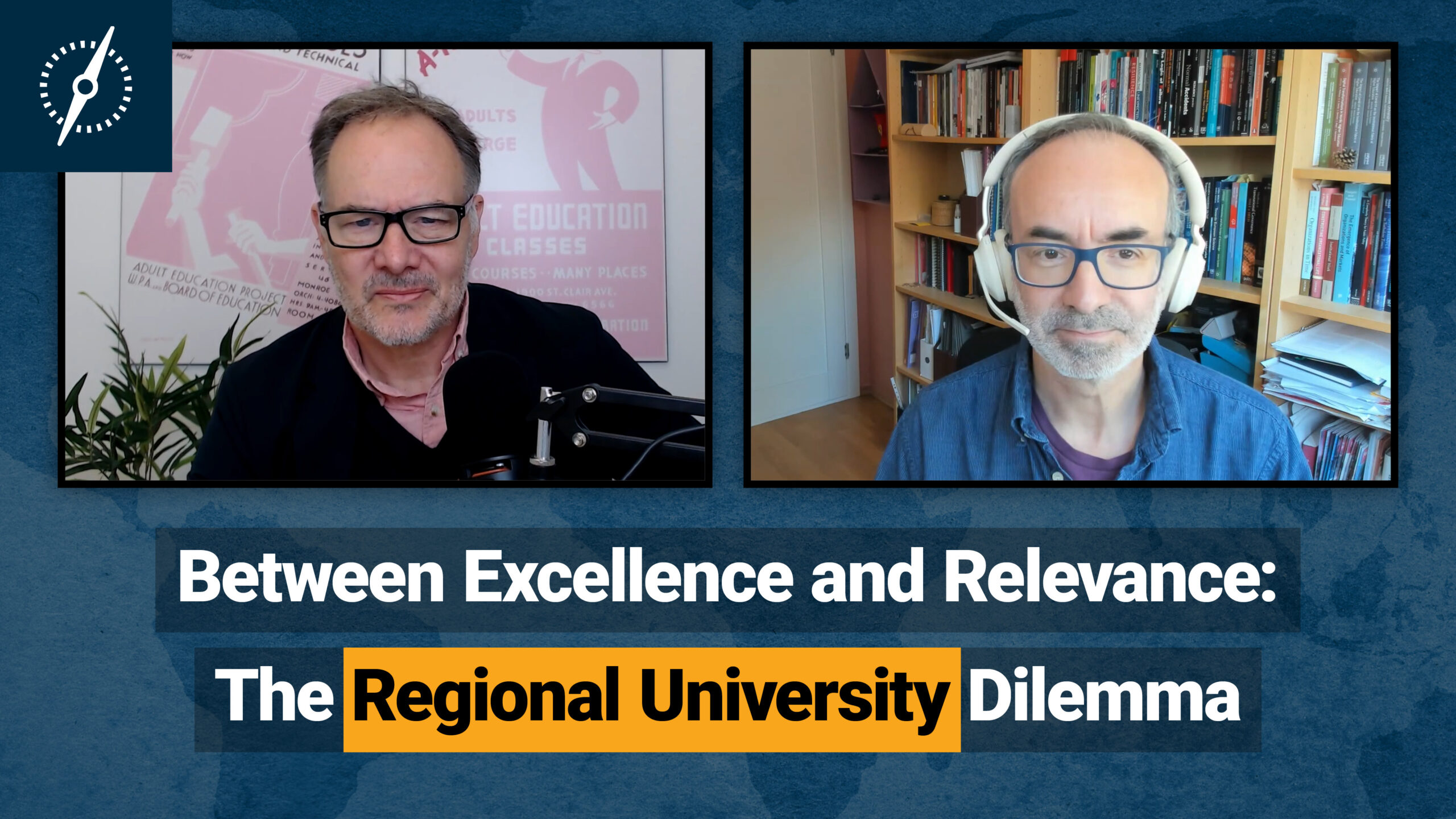
    Hi everyone.  I’m Alex Usher and this is The World of Higher Education podcast.

    Over the past few decades, Higher Education had taken on a number of new roles.  As we discussed with Ethan Schrum on this podcast over two years, in the years after World War II, universities became obsessed with showing how essential they were with solving society’s problems.  One of these problems – particularly as universities proliferated and started showing up in more and more distant locales – was regional economic development. 

    This was a tough problem to solve.  Universities are about the knowledge economy, and by and large the knowledge economy runs most smoothly in places with significant population density.  By definition, “regional” or “peripheral” institutions are in places that lack this essential quality.  So with whom can universities in this situation partner?  It takes two to tango – a university .  And more generally, what kinds of things can universities in peripheral regions that can do to improve the economic fortunes of the places they serve?

    Today my guest is Dr. Romulo Pinheiro.  He is a professor of public policy and administration at the University of Agder in Norway.  For years now, Romulo has been writing about how universities in different parts of Europe tackle this question.  In our interview today, we go back and forth a bit about how peripheral institutions differ from metropolitan ones, how regional and global ambitions get intertwined at these institutions and how institutional and disciplinary structures do and do not affect how a peripheral universities accomplish their mission.  As a wannabe-geographer, I found this discussion fascinating – pay attention to the bits where Romulo starts diving into the intricacies of how institutions and academics weave their global and local networks together into complicated webs, and – let me underline this bit – how these webs depend crucially on something pretty simple: trust. 

    But enough from me – let’s turn it over to Romulo.


    The World of Higher Education Podcast
    Episode 3.31 | Between Excellence and Relevance: The Regional University Dilemma

    Transcript

    Alex Usher (AU): Romulo, your work often centers around issues of universities and regional development. And I guess it’s been 40 or 50 years now that regional development has been seen as a role that higher education is supposed to play. But how does that development role differ between universities in dense urban areas and, you know, less dense rural areas? What’s the difference in the role they have to play?

    Rómulo Pinheiro (RP): Alex, for universities to be able to engage with different types of regional actors, there have to be competencies on the other side. Universities differ in terms of their competencies and skills—in terms of the depth and breadth of the types of programs they offer, the research groups, as well as the traditions of regional engagement. But they also differ in their localities, right?

    Usually, you have a situation where universities in peripheral regions are thinner institutions, and they’re located in thinner institutional environments. Meaning, they don’t have a lot of interlocutors with the same level of knowledge and skills. That already creates a disadvantage.

    So, should we see the symbiosis between universities and their regional settings? By and large, we see that strong institutions tend to be located in strong regional surroundings as well. Now, that’s not to say there aren’t cases of strong institutions in more peripheral settings. What the literature tells us is that, for the most part, these regions don’t have the absorptive capacity to absorb both the graduates and the knowledge that comes from these “thick” institutions.

    Johns Hopkins is a case in point in Baltimore. And in Europe, we have, for example, the University of Lund. There have been a few studies as well. So the knowledge generated by these institutions tends to go away from the region because there’s no regional capacity to absorb what comes out of the university.

    So, very different roles.

    AU: It seems to me there are two types of rural or peripheral institutions. Let me talk about one of them first, right? So, smaller peripheral institutions—I’m thinking, you know, universities maybe in northern Norway, right? A couple thousand students. They face tight budgets, limited research capacity, and more difficulty, I imagine, in attracting top talent. Maybe not in Norway, but in some countries that would be an issue. And yet, they’re often expected to play an outsized role in regional development. How do they manage that tension?

    RP:  That’s a great question—and indeed, many don’t, right? You’re absolutely right that we should move away from the idea of just “centers” and “periphery,” because there are also centers within the periphery. There are strong institutions in peripheral settings. In northern Norway, for example, we have the University of Tromsø, which is a comprehensive, research-intensive institution. And there are many smaller regional colleges across the Nordic region that don’t have that capacity.

    Traditionally, these institutions have catered more to the applied needs of regional actors. They didn’t have the research infrastructures, so they got involved in what we call “projects,” right? Smaller projects. And that, of course, has limitations.

    Other, bolder institutions try to collaborate—develop networks. What we see, for example, in Northern Europe is a situation where, due to mergers, the smaller institutions are becoming amalgamated into larger institutions. And that, of course, creates new possibilities and new conditions, but also new tensions and dilemmas.

    Because as institutions grow—and as you know, the larger the institution, the more globally oriented scientists you have—the less likely they are to be involved with regional issues, all things being equal, as economists like to say.

    But in the end, it also goes back to the idea of engagement at the academic level—the bottom-up, right? So this combination between… well, you can have all these great strategic plans and funding in place, but if academics themselves—what Burton Clark calls the academic heartland—don’t feel keen to be engaged with regional actors, you can’t pressure them.

    AU: I’m going to come back to that global dimension in a second. But let me counter with something here. I’m not convinced that the larger institutions are necessarily more global, but they are probably more oriented towards basic research, right? As you get bigger and bigger departments, they get deeper into basic research.

    And what’s the uptake of basic research in peripheral areas? I mean, it just seems to me that when you get past a certain institutional size or complexity, it gets very hard to actually even talk with local communities—because the capacity for generating research is much bigger than the receptor capacity for it.

    I remember one example, when we were doing some work in Africa. There was a small private university outside Lagos, and they had sequenced the Ebola virus. I asked, “Can you work with local industries?” And they said, “We can’t work with the local pharmaceutical industry, because in Africa the pharmaceutical industry is packaging and marketing.” Right? Those are the only two functions.

    So what happens when the science at a small regional institution outruns the receptor capacity of the local environment? Are there any good ways to manage that?

    RP: It goes back to the example I gave earlier. For the most part, that knowledge tends to go away—to other regions or other localities. This is the global dimension. But this goes back to the point you raised about the brokering role of universities. Universities—or university actors—have to engage in a process of translating those basic research findings into something that can be applied at the local level.

    So how do they do that? There are different mechanisms. You need professors who are engaged and able to facilitate the translation of more theoretical discussions into something more concrete.

    The role of students is fundamental here—an aspect that has been somewhat neglected in the literature. In the end, the most important boundary spanners are actually students who spend time back and forth between the university and the community. And then there’s the role of graduates—former students. They maintain networks with professors and others, so they play a very important role.

    But in the end, if the companies—public or private—don’t have a need for that knowledge, or if that knowledge is not relevant to them, then they won’t use it. There’s that tendency.

    So it’s also up to the universities to try to make that basic knowledge—if they are so inclined—relevant to local actors. In northern Norway, we have the case of Tromsø, which has been able to do this: bring excellence and relevance together. They focus, for example, on the Sámi dimension, Arctic fauna and flora, or cardiovascular diseases—taking aspects that are relevant to the region and developing excellence around those areas.

    And in the process, they develop institutional capacity, which helps them with strategic profiling in a globally competitive world.

    AU: You’re raising again that issue of global excellence versus regional relevance. I’m interested in that from the perspective of university strategy. What avenues do you have to make sure that your institution is actually balancing those two properly? You used Tromsø as an example—can you think of some others? And are there any commonalities between them?

    RP: Yeah. I mean, university leaders do have some tools at their disposal. As we know, most universities—particularly large ones—are very bottom-heavy institutions. Academics tend to have a lot of autonomy and are relatively independent in what they pursue.

    That being said, they also follow incentives, as rational actors. So there are things that strategic or university leaders can do to align those incentives—whether that’s through PhD student opportunities, sabbaticals, or other types of incentives to collaborate with regional actors.

    Beyond Tromsø, there are other examples I’ve worked on. Oulu is another case in point—in Finland. There’s a very interesting anecdote, going back to the importance of networks. One study asked actors in Oulu, in Northern Finland, “Who are your most important collaborators?” People at the university mentioned individuals from industry and local government.

    Then the same question was asked in another region—northern Sweden, in a place called Luleå—which wasn’t as regionally engaged. They asked, “Who are your most important collaborators?” Regional actors in the private sector mentioned other actors in the private sector. University academics mentioned other academics.

    Those are examples of disconnected networks—networks that are operating within their own silos. So, there has to be a sort of synergy effect, and the most successful regional institutions are able to achieve that.

    One interesting caveat: when you ask these institutions whether they see themselves as regional universities, most of them don’t like that label. They say, “We are, first and foremost, a university in the region—not a regional university.” There are some negative connotations associated with being too closely tied to locality.

    AU: What I’m hearing you say is that we have to pay attention to the incentives for professors within the university to engage locally and form those local partnerships. Are there specific institutional reforms that can achieve that? And presumably, disciplinary mix matters, right? There are different incentives and different possibilities for collaboration across disciplines. So how do you manage that engagement? How do you incentivize it effectively?

    RP: There’s been a long discussion within the field about what types of incentives work. And again, there’s no one-size-fits-all—this has to be tailored. Academics are incentivized in very different ways. But we do know that, for the most part, monetary incentives have a limited effect when compared to other professions.

    So it’s more about things like whether you can gain more autonomy, develop your research group, or set up a center. What we’re seeing now, for example, in the Nordic countries is an orchestrated effort by national and regional funding agencies to ensure that research applications require buy-in from regional actors.

    I can’t submit an application to the Norwegian Research Council or to Business Finland, for example, without having partners from the region or the nation—whether from the public or private sector. Those are structural mechanisms designed to ensure that, if academics want access to significant research funding and to grow their research teams, they need to bring on board those key external actors.

    The second aspect is the very strong emphasis over the past, say, seven to ten years—especially post-COVID—on co-creation and co-production of knowledge. Rather than involving regional actors only at the end of a research project, now there’s an effort to bring them in at the design stage.

    So, researchers will go into a project already with input from those actors, understanding key questions and issues of relevance. And then, throughout the project, they involve these actors through various mechanisms—workshops, feedback exercises, and so on—to ensure there’s a loop of engagement and input.

    It’s a much more egalitarian sort of ecosystem. Whether or not this is working is still an empirical question—we don’t yet know the full results. But at least those are the intentions.

    AU: Romulo, you talked about this interface between the global and the local, right? And the global part of that is usually about relations between academics in one part of the world and academics in another. That helps a local university—a university in a region—act as kind of a window on the world for that region. It brings them into contact with these global networks.

    What’s the right way to think about developing those networks effectively? I mean, I know in Europe right now we’ve got the European Universities Initiative. And I think a number of those alliances are meant to unite institutions with similar missions. A number of them look like alliances of universities and regions. Is this promising? Is this the right way forward? Or are these initiatives missing something?

    RP: Let me touch first on the issue of networks. Most of these networks emerge organically, and they’re very much linked to the relationships that academics have with other academics—or academics have with regional actors. Students can also play a role here—if they get employment locally, and of course, former students may become part of regional government or industry.

    The key element here is trust. This is not new—trust takes time to generate. I think it’s not easy, if you’re sitting in the director’s chair at a university, to articulate a clear strategy for how to develop trust among all these actors. You have to create the conditions.

    That might mean freeing up some resources, or identifying your most engaged academics—those most likely to involve students or work regionally—and then creating a kind of ecosystem to bring these people together. We used to say that the most important thing in regional engagement is having money for lunches and dinners—that’s where people get to know each other.

    When it comes to the second part of your question—strategic alliances—I’m a bit skeptical about the extent to which these will benefit the regional engagement agenda, to be honest. Even those alliances, like the one my own institution is part of—with a regional name and focus—tend to become very inward-oriented.

    I’ve got a number of publications coming out now with a colleague, where we argue that these alliances are primarily collaborative exercises meant to enable institutions to compete globally. And there’s a tendency—despite some efforts, like policy labs for students involving regional actors and regional questions—for other strategic imperatives, outside of the region and locality, to end up dictating institutional priorities.

    That’s my sense. But again, it’s an important empirical question. We’ll have to see in the future what the results actually are.

    AU: So, there’s been a tendency in North America—probably going back to World War II or maybe even a little before—to think about universities as fixers of social or economic problems. And you’ve cautioned against assuming that universities can act as fixers of regional challenges, especially in peripheral contexts in Europe.

    I guess this is a more recent assumption about institutions—maybe 30 or 40 years old instead of 60 or 70. Where do you think that expectation comes from? And what are the risks of leaning too heavily on it?

    RP: That caution also comes from my fieldwork. I remember when I was doing my PhD many years ago, I was in South Africa at Nelson Mandela Metropolitan University, speaking with the vice-chancellor there. And he told me:

    “Look, we are keen to play an active regional role, but we are not going to clean the streets just because the local government is failing to clean the streets. We don’t have the capacity to tackle crime just because the police lack the resources to do so.”

    He was very clear in saying that part of their job was to go into the community and educate people—not just about the possibilities, but also about the limitations that universities and academics face. It is not their role to solve the failures of market forces or government systems.

    There’s a tendency among some local officials to scapegoat the university—to say, “You’re not delivering,” because they’re not helping to tackle poverty or similar issues. That’s not to say universities don’t have an important role. But most of us in the field believe universities have primarily a facilitating role—a generative role—rather than acting as engines of regional development.

    Of course, in those peripheral regions where the university is the largest employer or the only knowledge institution, expectations tend to be that the university must play a disproportionate role. Often, it tries to do so—and in many cases, it succeeds. But in the majority of cases, the university is just one of many knowledge actors in a very complex ecosystem.

    AU: Your work has obvious ramifications for higher education leaders—but also for politicians, right? The ones who are funding these institutions. If there’s one concept or one conceptual insight from your work that you think those groups should take seriously—higher education leaders and politicians—what would it be? It might not be the same for both. They could be different for the different audiences.

    RP: As a traditional academic, let me give you two instead of one.

    The first one—and I’m not the only one saying this, but I think my work reinforces it—is that both universities and regions are complex entities. They are not monolithic, but they tend to be approached by both politicians and university managers as if they are simple, strategic actors. In reality, they have deep histories and institutionalized traditions, which are very difficult to change. So, any attempt to use strategic agency to move universities or regions in a particular direction should take that into account.

    The second aspect links to my recent work on resilience. Over time, we’ve seen that universities have an innate capacity to adapt to social change and play very different roles. The “third mission” of the university—regional development or societal impact—looked very different in the early 20th century than it does today. Yet, universities have managed to withstand and adjust to adversity while retaining a degree of function and identity.

    To do that, they need two important ingredients. One is autonomy—which is currently under threat, both in terms of procedural and substantive autonomy. The second is diversity. From resilience studies, we know that resilient institutions are diverse institutions. So when politicians or managers promote a “lean” approach—saying, “we have two research groups working on similar areas, let’s kill one or merge them”—they’re actually reducing diversity. And reducing diversity reduces an institution’s ability to withstand future adversity—whether it’s a pandemic, geopolitical conflict, or other disruptions. That may seem efficient in the short term, but it’s dangerous in the long term.

    That’s why universities have historically been able to adapt to changing societal conditions—they’ve had those two ingredients, which are now at risk.

    AU: So given that, what’s the future of university–community engagement in peripheral regions? Is there a trend we can expect over the next 10 years? Are institutions going to be able to deliver more fully on the needs of their regions—or will they find it more difficult?

    RP: Well, as you know, Alex, academics are very bad at predicting the future! But we can look to history to see how things have evolved.

    What we’ve seen is that the university’s “third mission”—whether framed as regional development, social impact, or engagement—has increasingly moved closer to the university’s core activities. Today, you could argue that social impact is central to the mission of any university. That might not be new in the U.S., but at least in Europe, it’s a more recent shift over the last 10 to 15 years.

    What I think is important—and colleagues like David Charles in the UK have also emphasized—is that we need to look at the challenges facing our societies: rising polarization, the spread of illiberal democracies, the post-truth society. We should be asking: what role can universities—particularly in peripheral regions—play in helping societies navigate this turbulent environment?

    As the quintessential knowledge institutions, universities have a very important role to play. They should perhaps be more active and assertive in defending the importance of knowledge, of truth. I’m currently involved in projects on regional green transitions, and there’s a broad consensus that universities play a vital role mediating relationships among regional actors with very different agendas.

    They still retain legitimacy. They haven’t been politicized to the extent that other institutions have. So they’re uniquely positioned to bring political and community actors together and help orchestrate collective agendas.

    But that takes time. It doesn’t always yield short-term results. So university leaders need to be willing to take risks. They need to allow academics to play roles that go beyond the traditional functions of teaching and research.

    So I think what we’re seeing is a rediscovery of the civic role of universities—at an important historical moment. A shift from discussions about interests and money to discussions about values and norms.

    AU: Romulo, thank you very much for joining us today.

    RP: Thank you very much, Alex.

    *This podcast transcript was generated using an AI transcription service with limited editing. Please forgive any errors made through this service. Please note, the views and opinions expressed in each episode are those of the individual contributors, and do not necessarily reflect those of the podcast host and team, or our sponsors.

    This episode is sponsored by KnowMeQ. ArchieCPL is the first AI-enabled tool that massively streamlines credit for prior learning evaluation. Toronto based KnowMeQ makes ethical AI tools that boost and bottom line, achieving new efficiencies in higher ed and workforce upskilling. 

    Source link

  • Clean energy TAFE Centre of Excellence to be built in Tas

    Clean energy TAFE Centre of Excellence to be built in Tas

    Mackintosh power station. A new centre of excellence will train Tasmania’s renewable energy workers of the future to build wind, solar, and hydro power infrastructure. Picture: Hydro Tasmania

    A new $27m Clean Energy Centre of Excellence will be established in Burnie, where students will be trained to help expedite the nation’s transition to net zero emissions.

    Please login below to view content or subscribe now.

    Membership Login

    Source link

  • Award-Winning Work in Higher Ed HR – 2022 HR Excellence Award and Higher Ed HR Rock Star Award – CUPA-HR

    Award-Winning Work in Higher Ed HR – 2022 HR Excellence Award and Higher Ed HR Rock Star Award – CUPA-HR

    by CUPA-HR | May 3, 2022

    From creating diversity efforts and development initiatives to leading change, human resources teams and HR practitioners across the country are doing great work every day.

    CUPA-HR’s regional Higher Education HR Awards program recognizes some of the best and brightest in higher ed HR and honors HR professionals who have given their time and talents to the association.

    Here are this year’s regional award recipients:

    HR Excellence Award

    Honoring transformative HR work in higher education and recognizing a team that has provided HR leadership resulting in significant and ongoing organizational change within its institution

    Office of Human Resources Management, Fordham University (Eastern Region)

    Fordham University’s office of human resources management has transformed from a primarily transaction-focused department to a strategic partner that is relied upon throughout the university. The department has demonstrated its strategic strength on multiple fronts including the management of the university’s COVID-19 shutdown and reopening, return-to-work policies, customer service, technology, communication with employees that resulted in increased engagement and trust, anti-bias training, professional development initiatives and the performance management process. Additionally, in keeping with and living Fordham’s Jesuit mission of Cura Personalis, “caring for the whole person,” the office developed and implemented programs to help employees maintain a healthy work-life balance. Some health and wellness services that were developed include back-up childcare support, on-site and virtual physical fitness classes, and behavioral health services, such as a registered dietician available to employees. In doing so, the HR team has distinguished itself as a trusted advisor to employees, managers and senior leaders alike.

    University Human Resources, Iowa State University (Midwest Region)

    In 2019, Iowa State University implemented a new financial management and human capital management system. In conjunction with the new system, finance and HR service delivery teams were developed, pulling distributed customer-facing finance and HR roles into two centralized teams. University human resources’ performance through this significant and ongoing organizational change has been positive for the entire campus community. The HR delivery model has led to increased consistency and standardization in delivery of services across the university. It has also created a more well-trained and cohesive team of professionals that work together up and down the chain to find creative solutions to HR challenges and opportunities. HR support for leaders across the institution has significantly improved through better access to accurate data, streamlined processes for workforce and position planning, compensation adjustments, support addressing low-preforming employees and behavioral issues, large-scale employee movement and reorganizations, and professional human capital consulting. The new HR delivery systems have resulted in a much more efficient, collaborative and cohesive HR unit that is better equipped to serve employees and supervisors. At the same time, employees and supervisors have benefitted from HR’s reliability, transparency, accountability and consistency in its efforts to support them.

    Talent and Culture Department, Broward College (Southern Region)

    Recognizing that HR alone cannot create culture but that it plays a critical role in ensuring the infrastructure is in place to support the cultural aspirations of an organization, the talent and culture department at Broward College has worked over the last several years to spearhead significant organizational change. Beginning in 2019, the university launched its three-year culture transformation plan. An integral step in the transformation process was the implementation of information-gathering discussions between the HR leadership team and employee groups comprised of administrators, faculty and professional technical staff, which provided substantive feedback on areas that needed the most attention. This organizational change, led by the talent and culture department, has resulted in more substantive collaboration; stronger relationships among faculty, staff and administrators; and greater trust and communication between employees and their supervisors. It has also served as a catalyst for innovative projects throughout the organization designed to maximize the experience of employees, students and the community. Some major initiative highlights include the creation of talent business partner roles, Leadership 360 Assessments, psychological safety workshops, employee resource groups, employee onboarding, and a leadership development program called BC LEAD that educates and empowers managers at all levels to rise to leadership excellence.

    HR Campus Climate Liaisons, The University of Texas Rio Grande Valley (Western Region)

    After implementing a strategic action planning process, led by an internal HR workgroup called Campus Climate Liaisons, The University of Texas Rio Grande Valley saw double-digit improvements in climate survey results within three years, all amid a pandemic. The liaison group consists of individuals from various HR areas, such as talent development, organizational development, employee wellness and employee relations/business partners. The group was trained to provide support to assigned departments with result-sharing, action-planning and ongoing progress-reporting. This method ensured that all departments received the same level of support and helped the HR team better track progress toward climate goals. It also helped empower all department leaders to have conversations about campus climate and department climate. The biggest improvements were seen in areas of faculty, administration and staff relations; senior leadership; and facilities. The campus climate liaison model has been so successful that it will continue to be used for future campus climate initiatives and to provide ongoing support to all departments.

    Higher Ed HR Rock Star Award

    This award recognizes an individual who is serving in the first five years of a higher education HR career who has already made a significant impact.

    Audrey Davis, Assistant Director of Personnel, Texas Tech University (Western Region)

    With her enthusiasm and inspirational demeanor, Audrey Davis has built strong and trusting relationships with each department she works with, not only within university student housing, but within each auxiliary services area at Texas Tech University. Since taking over the personnel team, Audrey has demonstrated continuous innovation and creative thinking, which has completely changed the way the student housing personnel team operates and provides services. After only two years in her role, she has identified and eliminated major gaps in the onboarding/offboarding processes. She has also developed a collaborative hiring system that allows hiring managers to communicate efficiently with the personnel team to discuss new hires, promotions and terminations. Audrey’s initiatives have resulted in university student housing being named a center for excellence for human resourcing by the assistant vice president for auxiliary services. Audrey continues to make a positive impact with her role and demonstrates her passion through advocacy, by fostering a welcoming work environment and by building confidence in her team to serve as a one-stop shop for personnel services.


    Source link