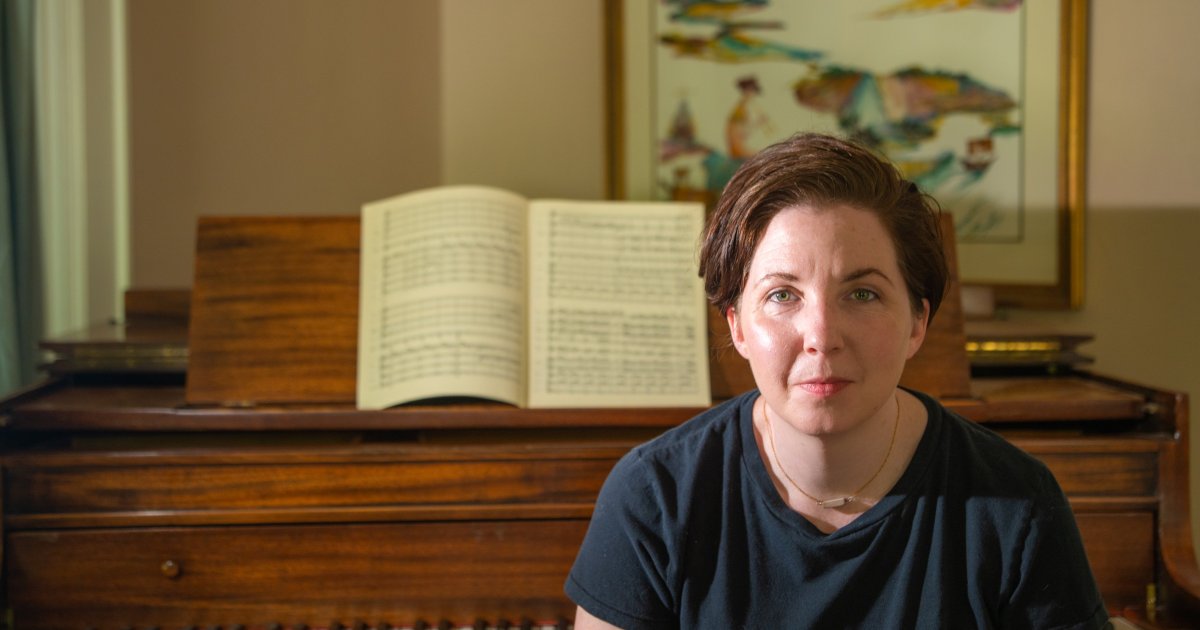
ROCHESTER, N.Y., Oct. 20, 2025 — A former doctoral conducting student at the Eastman School of Music who was silenced after reporting harassment by a faculty member is standing up for herself in the way she knows best — by conducting a classical music concert in support of free expression.
Rebecca Bryant Novak will conduct a volunteer orchestra at the Hochstein School of Music Performance Hall in Rochester, N.Y., on Thursday, Nov. 20, in a concert sponsored by the Foundation for Individual Rights and Expression, our first-ever classical music concert in support of free speech. The evening will feature Beethoven’s Fidelio Overture and selections from Shostakovich’s Symphony No. 5 — two works that faced censorial pressure in their own time and which emphasize the timeless connection between civil liberties and artistic expression.
The event will also feature internationally acclaimed violinist Lara St. John, praised by The New York Times as “a high-powered soloist.”
For Bryant Novak, who was expelled from the University of Rochester earlier this year after filing a complaint against one of her professors at Eastman, the evening will provide her not only with an opportunity to create wonderful music but to send a message to the school that she will not be intimidated into silence.
“All I’ve wanted since I came to Eastman was to become a conductor and share my appreciation for great music with others,” Bryant Novak said. “I’m looking forward to doing so this evening — while reminding Eastman that I’m not going away.”
Shortly into her first semester as a doctoral student in fall 2023, Bryant Novak complained about behavior by a professor who she said made sexist comments.
After a yearlong investigation, a panel of faculty and administrators agreed that the professor had indeed violated Rochester’s harassment policy and that Eastman’s Title IX coordinator had mishandled her complaint.
Despite all this, Eastman allowed the same school authorities to retain oversight of Bryant Novak’s academic trajectory — with one official telling her that the school restricted her performance times because of her complaint against the professor.
When Bryant Novak complained, Eastman did nothing. As a result of the alleged retaliation, Rochester opened a second investigation into Eastman’s mishandling of the situation in December 2024, and Bryant Novak publicly disclosed the university’s new investigation in a Substack article on Feb. 10.
Two weeks later, Eastman abruptly expelled Bryant Novak, citing a failure to make academic progress, even though the school never showed that she met that criteria. In doing so, the school ignored its written policy that calls for students to be given ample notice if they are in danger of falling short of academic standards.
FIRE is calling on Rochester President Sarah C. Mangelsdorf to immediately reinstate Bryant Novak and ensure that she is able to complete her doctorate under the oversight of Eastman faculty and officials who are not already subject to investigation for misconduct in her case. And we’re not alone. Over 800 members of the public have signed on to our Take Action campaign telling Mangelsdorf to heed the call.
In any case, Bryant Novak won’t be banished from the conductor’s podium. We hope to have you join us for “Outspoken: Music for Free Speech,” an evening championing the right to free expression — hers and yours.
The concert is free and open to the public. To attend, RSVP here to reserve your spot.
The Foundation for Individual Rights and Expression (FIRE) is a nonpartisan, nonprofit organization dedicated to defending and sustaining the individual rights of all Americans to free speech and free thought—the most essential qualities of liberty. FIRE educates Americans about the importance of these inalienable rights, promotes a culture of respect for these rights, and provides the means to preserve them.
CONTACT Karl de Vries, Director of Media Relations, FIRE: 215-717-3473; [email protected]
On stage, baton in hand, Rebecca Bryant Novak found her calling in the precarious. She says conducting an orchestra sometimes “feels like trying to do brain surgery on a conveyor belt. You don’t get to stop. You don’t get to pause and say, ‘Hold on, let me think.’” But that high-stakes intensity, the kind that crackles through a Brahms crescendo or explodes in a Mahler finale, is what drew her in. “I love that,” she says. “To conduct an orchestra once in your lifetime, much less dozens or hundreds of times, is just an enormous privilege.”
But behind the podium at the University of Rochester’s Eastman School of Music, one of the world’s premier conservatories, the peril Bryant Novak faced was not merely musical. In October 2023, she reported her doctoral program advisor and the director of orchestras, Neil Varon, for harassment. What followed, by her account and email correspondence describing the university’s own investigative findings, was a spiral of institutional dysfunction in which Eastman abandoned its own policies to retaliate against Bryant Novak for speaking out.
What began as a childhood dream — “I saved my babysitting money to buy tickets for me and my mom to go to St. Louis Symphony concerts,” she recalls — has now soured into a fight not merely for her academic degree but for her dignity, for institutional transparency, and for a measure of justice in an industry she loves.
A pianist by training, she fell for music director David Robertson’s conducting as a teenager in St. Louis, where she was captivated by his orchestra’s sound and force. “I loved the idea of being part of it,” she says. “As I look back at that person, she had no idea what she was getting into. But the draw was strong.”
Chasing the grueling dream of the podium was a particularly steep climb for a woman. “There have only been three women admitted to my program in over 20 years,” she says, referring to Varon’s conducting studio, which she estimates has accepted approximately 40 students during that time. “The resources are immense. So is the gender disparity. I mean, it’s extreme.”
Bryant Novak, a first-generation college graduate, said that upon arrival she felt “very much a fish out of water in the fancy music school scene.” Still, she was undeterred. “I said to myself, look, I won the audition. The orchestra voted, and I got an overwhelming orchestra vote. Everyone was thrilled about my being here.” She believed — naïvely, she now says — that the music would speak for itself. “Gender has nothing to do with this. My work stands on its own. So I was kind of in that mindset going in.”
Her optimism did not last.
I had jobs in this field before going back for my doctorate. I knew the scene. My actual experience is that staying silent doesn’t help you that much.
Bryant Novak claims that during one rehearsal, as she was conducting in front of about 60 students, Varon told her she was “Gibson impregnated,” a reference to her former teacher at the University of Cincinnati, Mark Gibson, with whom she had cut contact after completing her master’s degree. Bryant Novak’s history with Gibson was fraught with alleged maltreatment: she says she suffered “inappropriate behavior, including comments on [her] physical appearance” and “physical contact under the guise of instruction” that resulted in “lasting professional harm.”
Gibson and Varon were close professional contacts, and though Bryant Novak says Varon repeatedly noted Gibson’s problematic history and widely known reputation for abuse, she claims he “began referencing [her] history with Gibson as early as [her] audition.” According to Bryant Novak, Varon’s increasingly hostile and erratic behavior in class eventually forced her to end a conducting session with the orchestra, which typically lasted almost an hour, after just fifteen minutes.
In what she describes as a “damned if you do, damned if you don’t” calculation, Bryant Novak chose to report Varon. “I had jobs in this field before going back for my doctorate. I knew the scene,” she says. “There have been situations where I’ve stayed silent before, as in my master’s program studying with Mark Gibson. My actual experience is that staying silent doesn’t help you that much.”
Initially, she raised the alarm privately, requesting the administration limit her contact with Varon rather than filing a formal complaint. Her request was denied. Instead, Bryant Novak says Title IX coordinator John Hain suggested she transfer. “I remember asking, ‘How is that supposed to work?’ These programs are very competitive. They’re very small. It’s not like I’m getting my bachelor’s in history. How is this the solution? It was just not at all thought through.”
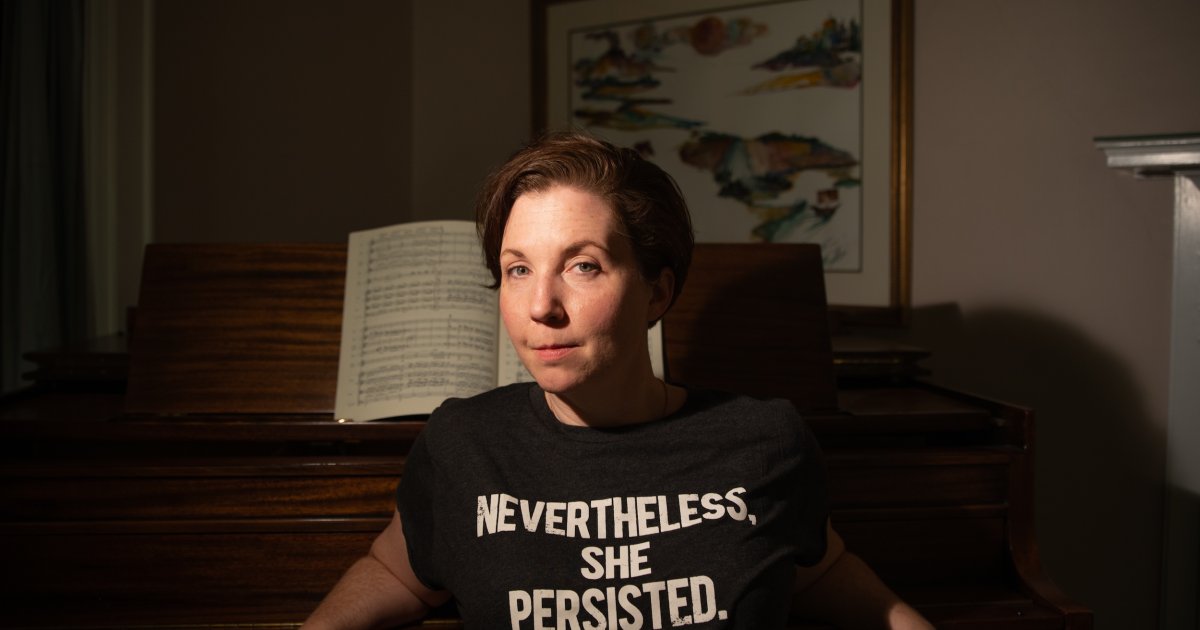
“I don’t think it’s an exaggeration to call it sabotage,” she said, after her final recital was stacked with outlandishly difficult material. (Smiley Photography)
“I got this whole lecture about how there’s no law against being a jerk. I’m like, ‘I’m aware of that.’” Worse, she adds, “They disclosed the report to [Varon]. They kind of wagged their finger at him and said ‘good luck’ to me. I was stunned.”
Faced with Eastman’s inaction, Bryant Novak used the only tool she had left — her voice. She wrote about the experience in a post on her Substack, The Queen of Wands, sharing conversations with administrators, naming names, and describing Eastman’s lack of support.
That’s when the retaliation began.
A senior administrator threatened her with a defamation lawsuit — the very same John Hain in charge of handling her Title IX complaint. Students who once applauded her presence grew cold. Some faculty offered quiet support but refused to speak publicly. “It got very bizarre,” she says. “Very, very weird.”
According to email correspondence between Rebecca and university officials, the University of Rochester — Eastman’s parent institution — conducted an investigation that concluded Varon had indeed violated their harassment policy and that Eastman had grossly mishandled her complaint. Despite this, rather than offering protection to Rebecca, Eastman remained intent on shielding its own faculty.
Tell Rochester to Stop Muzzling its Students
Take Action
Tell the University of Rochester: Reinstate Rebecca Bryant Novak, restore due process, and stop muzzling students into a culture of silence.
By the following semester, “there was some nastiness” from some of her fellow students in the orchestra. Her conducting opportunities were reduced. The faculty grew tight-lipped. She would walk into a room and people would stop talking. One tenured professor whispered to her that he’d written a letter of support but begged her not to tell anyone.
Meanwhile, Bryant Novak continued writing publicly about her experience on Substack. Her posts were measured, personal, and often devastating. Her first post, titled “My First Year at Eastman,” told the story of the initial incident and the process that ensued from her point of view. Another, titled “Cease and desist,” detailed John Hain’s defamation threat against her.
Then, however implausibly, things got worse.
In December 2024, the University of Rochester launched a second investigation, this time into Eastman’s continued mishandling of Bryant Novak’s complaint and the retaliation she alleged had taken place against her. That might seem like a reason to think things were finally looking up — except two weeks after Bryant Novak disclosed the second investigation in a Substack post, Eastman expelled her for a “lack of academic progress.”
According to Bryant Novak, this came despite Eastman’s prior confirmation that her academic plan and credits were sufficient in order to graduate. Worse, Eastman’s letter to Bryant Novak ended with a list of non-academic allegations: “misuse of University email systems,” “creating a hostile environment,” and “language that has been perceived as threatening violence.” All this was presented without detail or evidence. It was also described as not the actual cause of her dismissal, but worth “remark.” For her part, she sees it as a last-ditch attempt to discredit her. “The double standards were pretty intense,” she says. The school claimed there wasn’t much it could do to restrain Varon but, she says, “When it was time to expel me — boy, their hands were not tied.”
People assume we’ve moved past this stuff. But no, speech is still powerful. People are still afraid of it. And they’ll try to shut you up.
In a June 18 letter to the university, FIRE detailed how Eastman skipped every procedural safeguard required by their own academic progress policy: no warnings, no probation, no appeal. It doesn’t take a bloodhound to sniff out the pretext: just after Bryant Novak disclosed the second investigation on Substack, Eastman’s concerns about her suddenly became so acute that it bypassed the two-semester review process its own policy required before dismissal. FIRE lambasted the university for this egregious betrayal of due process and charged that the expulsion — taking place amidst baseless legal threats and conflicts of interest — was retaliation against Bryant Novak for speech Rochester’s policies protected.
Bryant Novak says it was Eastman itself that endangered her academic progress. After she reported his behavior, she says, “They let Neil [Varon] have control over my degree recital, which is the centerpiece of my degree. I mean, it was retaliatory. He put material on it that was outlandishly difficult — so much so that two guest faculty intervened and said, ‘This is not okay.’ One of them actually said directly to me, ‘That is a giant middle finger from him to you.’ I don’t think it’s an exaggeration to call it sabotage. They did ultimately change it, although you’re supposed to have up to a year to work on this. I was left with two months. And then they were trying to get me out the door. It was very, very clear they wanted me out in any way possible. They created a situation that was unsustainable.”
“There are consequences either way. There are consequences to yourself if you stay silent. There are consequences out in the world if you speak out.” (Smiley Photography)
The situation became so upsetting that she began seeing a university therapist. In her final semester, at the therapist’s request, she started going multiple times a week. “I was just kind of personally deteriorating,” Bryant Novak recalls. “I was honestly kind of having a breakdown.” She spent roughly a month working through her difficulties with her professors and her therapist, who was willing to offer the school documentation of her situation. In turn, Bryant Novak offered to submit that documentation to the school, but says that “a week later,” the school “responded with an expulsion letter.”
In the broader Eastman community, Bryant Novak was shunned by what she describes as a “cultish culture.” Online, including on FIRE’s own social mediaposts, her classmates have left comments smearing her reputation. Some think their interpersonal issues with Bryant Novak, or whatever shortcomings they see in her as a student or conductor, justify her expulsion.
But being unpopular does not cost you your rights. It does not strip you of due process protections. It does not neuter your expressive freedom.
Bryant Novak sees her case as part of a larger trend. This isn’t the first time Eastman has allegedly blacklisted a student for standing up against misconduct. And beyond its Rochester campus, other classical music artists have suffered similar fates for stepping forward. Bryant Novak has no illusions about the conservatoryculture she sees as responsible. “The culture’s awful. It just is,” she says. “Everybody knows it. But at the same time, the music is phenomenal.”
She references a case, documented in New York Magazine, in which an alleged rape victim and an ally were pushed out of the New York Philharmonic and bullied by their peers for speaking up while the accused perpetrators remained. “That story jolted me,” she says. “And now I’m living my own version of it. People assume we’ve moved past this stuff. But no, speech is still powerful. People are still afraid of it. And they’ll try to shut you up.”
Reflecting on it all, Rebecca says that though she is grateful for FIRE’s help, she found it hard to believe she needed it for something like this. “You know, I wasn’t in a Gaza protest. It wasn’t that. It was just saying: ‘Hey, harassment is bad. Can you stop?’ The fact that speaking out against harassment is controversial in this space? That says a lot.”
Still, Bryant Novak refuses to be silenced. In April, she submitted a 200-page complaint to the New York State Division of Human Rights under penalty of perjury. Believing sunlight is the best disinfectant, she is documenting everything and wants it all out in the open. “If there’s an online Neil Varon fan club,” she quips, “I think that’s good for us to know. Surface it all.”
As for her future? “I still want to conduct,” she says. “But more than that, I want a world where women can do this without fear.”
Pausing to think about it, she says, “There are consequences either way. There are consequences to yourself if you stay silent. There are consequences out in the world if you speak out. I prefer the consequences out in the world.”
During her first semester pursuing a doctorate in conducting at the University of Rochester’s Eastman School of Music, Rebecca Bryant Novak reported sexual harassment by Professor Neil Varon and asked that the school limit her contact with Varon. But Senior Associate Dean and Title IX Coordinator John Hain rejected her request. According to Bryant Novak, Hain said the school trusted Varon — because he’s faculty — and told her to consider transferring somewhere else.
In May 2024, Bryant Novak published their exchange on her Substack. Hain’s response? He threatened her with a defamation lawsuit.
So she reported Hain’s handling of the complaint to the university’s administration and, after a yearlong investigation, the university determined Varon had indeed violated its harassment policy — and that Eastman had badly mishandled Bryant Novak’s complaint.
Yet Eastman allowed Varon to retain oversight of Bryant Novak’s academic trajectory. It restricted her performance times, allowing her to avoid him but costing her conducting opportunities. When she protested, Eastman did nothing.
Running out of options, Bryant Novak once again escalated her complaint about Eastman’s alleged retaliation to the University of Rochester, Eastman’s parent institution. The university launched a second investigation of Eastman in December 2024.
In February, Bryant Novak wrote about it on her Substack. Days later, Eastman expelled her.
The school cited Bryant Novak’s supposed failure to make academic progress in its expulsion letter. Yet Eastman completely disregarded its own policy regarding academic progress reviews. Apparently, just days after she took her complaints public, Eastman’s alleged concerns about Bryant Novak suddenly became so acute that it felt it needed to just go ahead and entirely skip over the two-semester review process required by its own policies before dismissal.
Bryant Novak got no warning. No appeal. And the range of allegations Eastman cited for her expulsion didn’t even meet the criteria to put a student on warning status, let alone dismiss them. FIRE has plenty of experience in investigating cases, but one does not need to be Sherlock Holmes to figure out what was going on with Eastman and Bryant Novak.
Today, FIRE wrote a letter to the University of Rochester, urging it to reinstate Bryant Novak:
Eastman’s failure to follow its own policy in any respect, the temporal proximity of Bryant Novak’s dismissal to her public disclosure of Rochester’s investigation, and Eastman’s contentious history with Bryant Novak — including Hain’s lawsuit threat against Bryant Novak and the conflict of interest inherent in allowing Hain’s direct report, Ardizzone, to retain authority over Bryant Novak’s academic standing — all strongly suggest that Bryant Novak’s dismissal was retaliation for speech explicitly protected by Rochester policies.
The University of Rochester is a private institution, which means that unlike public universities, it is not a government actor obligated to uphold constitutional free speech rights. Nevertheless, it promises students protection for their speech — including protection from retaliation for complaining about harassment.
But no one protected Bryant Novak. When she spoke out about harassment, Eastman retaliated. When she protested the retaliation, Eastman expelled her. Let’s tell the University of Rochester to reinstate Bryant Novak and provide her the due process it promises all its students.
Eastman tried to make her story an example. Instead, it should be a rallying cry.
ROCHESTER, N.Y., June 18, 2025 — The Foundation for Individual Rights and Expression is urging the University of Rochester to reinstate an Eastman School of Music student who was expelled after blowing the whistle on a professor who sexually harassed her.
The case lays bare a university system that moved quickly to protect itself at the expense of a student’s right to voice criticisms — even though an internal investigation found the professor responsible for violating the harassment policy.
“There was no due process or hearing,” the student, Rebecca Bryant Novak, said. “The university’s administrators were more concerned about protecting the faculty than adhering to their own rules and addressing bad behavior. They basically tried to destroy my career beyond all comprehension.”
Shortly into her first semester as a Ph.D. student in fall 2023, Bryant Novak complained about abusive behavior by a professor who she said would scream at students and make lewd, sexist comments.
After a yearlong investigation, a panel of faculty and administrators agreed that the professor had indeed violated Rochester’s harassment policy and that Eastman’s Title IX coordinator had grossly mishandled her complaint.
Despite all this, Eastman allowed the same school authorities to retain oversight of Bryant Novak’s academic trajectory — with one official telling her that the school restricted her performance times because of her complaint against the professor.
When Bryant Novak complained, Eastman did nothing. As a result of the alleged retaliation, Rochester opened a second investigation into Eastman’s mishandling of the situation in December 2024, and Bryant Novak publicly disclosed the university’s new investigation in a Substack article on Feb. 10.
Tell Rochester to Stop Muzzling its Students
Take Action
Tell the University of Rochester: Reinstate Rebecca Bryant Novak, restore due process, and stop muzzling students into a culture of silence.
Two weeks later, Eastman abruptly expelled Bryant Novak, citing a failure to make academic progress. In doing so, the school ignored its written policy that calls for students to be given ample notice if they are in danger of falling short of academic standards.
“Rebecca’s expulsion smacks of retaliation for speech that is explicitly protected by the university’s policy,” FIRE Program Counsel Jessie Appleby said. “This is a profound violation of her free speech rights and sends a chilling message to every student at Eastman.”
FIRE is calling on university President Sarah C. Mangelsdorf to immediately reinstate Bryant Novak and ensure that she is able to complete her doctorate under the oversight of Eastman faculty and officials who are not already subject to investigation for misconduct in her case.
“I hope that by taking a stand here, I can help force Rochester to extend the kinds of protections to other students that were denied to me,” Bryant Novak said.
The Foundation for Individual Rights and Expression (FIRE) is a nonpartisan, nonprofit organization dedicated to defending and sustaining the individual rights of all Americans to free speech and free thought — the most essential qualities of liberty. FIRE educates Americans about the importance of these inalienable rights, promotes a culture of respect for these rights, and provides the means to preserve them.
CONTACT:
Karl de Vries, Director of Media Relations, FIRE: 215-717-3473; [email protected]