Tag: Experience

  • A change agenda for the commuter student experience

    A change agenda for the commuter student experience

    In February, we launched our commuter student series, seeking to uncover how universities are responding to the increasing numbers of commuter students – students who continue to live at home whilst studying, rather than relocating to attend university, in contrast to “traditional” residential students.

    We sought to increase the visibility of commuters and share best practice, responding to demand for thought leadership and evidence-based interventions, with the aim of influencing pedagogy, practice and policy, within institutions and nationally.

    The series also followed the inclusion of commuter students on the Office for Students’ Equality of Opportunity Risk Register in England as a distinct group who experience inequality of opportunity.

    In our final article we look back at the series, reflecting on key learnings, before looking forward, setting out a change agenda for commuters that will make higher education more accessible, attractive and available to all.

    Commuter students are everywhere yet invisible

    Commuter students are part of every UK university.

    The proportion of commuters varies by institution – research by Susan Kenyon using 2022 HESA data, shows a range from 12 to 85 per cent.

    As such commuters need to be counted and made visible, acknowledged in pedagogy, policy and processes and, where necessary, considered as communities at risk in Access and Participation Plans (APPs) in England.

    And despite being everywhere, commuters can often be invisible and underserved.

    Earlier in the series Val Yates and Carolyn Oulton discussed how to build an institutional agenda for change by making commuters visible. Their agenda was one where commuters are embedded across the institution. Commuters don’t interact only with their lecturers – supporting commuters lies with academics, across professional services and into teams like IT and sustainability.

    We explored the diverse definitions of commuters in APPs, which often makes measuring progress difficult. In supporting commuters, it’s important we know we’re talking about the same group of students. Expanded definitions have considered those who live locally, use transport, have the same term time and home address but also those who relocate but live further away due to cost and housing pressures.

    Commuters need to be visible to their institution first before making them visible to each other through access programmes, networks and student societies.

    Commuter students are valuable

    Our series also reveals the cultural, educational and social value of commuters to our learning community.

    Commuters are passionate, engaged and committed. They bring diverse perspectives, experience and expertise to the classroom. As Martin Lowe, Adrian Wright and Mark Wilding write, they “are not just students, they are employees, caregivers, and active members of their communities,” bringing skills such as time management and the ability to balance multiple responsibilities, alongside discipline and an internal motivation to learn that can inspire and influence other students.

    And as Emma Maslin highlighted, there is a tendency to see commuters from a deficit perspective, as a disadvantaged group, whose experience needs to be “fixed.”

    Our authors don’t deny the academic, financial and social difficulties of being a commuter in a world designed for residential students, particularly when, as Elise Thornton discusses, commuting is often a financial necessity, rather than an active choice.

    But the opportunity to attend university as a commuter student can allow students to maintain community, employment and relationships that they value, whilst learning.

    Articles by Molly Pemberton and Susan Preston emphasise how valuable commuter students are to the wider student community. Commuters are campaigning for changes in policy, practice and spaces that reshape the university experience and bring benefits to all students.

    A common theme running throughout the series is that changes made to pedagogy, policy and processes, which initially aim to create a more inclusive environment for commuter students, benefit all students. And a lot of the time, they’re changes driven by students themselves.

    In designing services and learning for commuters, we’ve seen Tom Perou discusses the universal benefits of podcasts, which provide bite-sized learning in an alternative format; Kulvinder Singh described the importance of enhancing belonging in the classroom; and Susan Kenyon and Flic Lindo stressed the importance of improving information on the “rules of the game” and demystifying the “hidden curriculum.”

    Commuters are in the city

    In the traditional residential model, students remain largely in their defined area. But commuter students are integrated into the wider fabric of communities.

    Finding out where commuters are is often a good first step. David Kernohan analysed HESA data to help us understand what constitutes a local student and if local students aren’t going to your provider, where are they going?

    It’s common that local authorities don’t know how many students live locally, have relocated or are registered to vote, all of which inhibits the design of services to meet students’ needs. In the context of transport providers, bus fares and transport routes often don’t serve commuters because they don’t first understand that population.

    Joel Dowson’s article takes this further, outlining how universities and their students’ unions can leverage the financial value of students to transport providers, in terms of revenue and potential gains from reduced road congestion. At the Greater Manchester Student Partnership they have been lobbying for an improved commuter student experience, influencing the affordability and availability of transport services, to the benefit of all students.

    A commuter change agenda

    The aim of this series was to empower everyone in HE, whatever their role, to have a better understanding of the needs of commuter students.

    And as our contributions have evidenced, work happens everywhere – in professional services, in the classroom, in regional advocacy and with students.

    When thinking about where the work starts, it might be at your desk. There’s four categories to our change agenda, drawing on contributions from authors across the series: in the classroom, at the institution, with students and in national policy.

    In the classroom

    Supporting commuters in the classroom is about making them feel seen and making them visible to each other. Active pedagogies develop belonging and on-commute learning options such as podcasts, pre-recorded lectures or flipped learning are examples of inclusive learning delivery. Creating a reason to attend and articulating the benefits to students is important to sustain engagement.

    At the institution

    Institutions need to count commuters, then research, listen and review policies to ensure they work for all students. Practical steps include things like student-centric timetabling, consistent and empathetic attendance policies, providing clear information to commuters on application and offering accommodation options so that students can engage beyond the classroom. Institutions have influence with local governments and transport authorities and can be an effective conduit for making the city more commuter student friendly. And institutions can work towards building institutional empathy so colleagues understand that a lack of engagement may not be laziness, it may be a delayed bus or a train fare hike.

    With students

    Many APP interventions included co-creating solutions with students rather than for them which is undoubtedly the best step forward. It was students who led the way to making a commuter student lounge at Leeds University through the sharing of university rooms, giving them ownership, space and agency. In any project, involving commuters beyond consultation leads to successful interventions and outcomes.

    On a national level

    Measuring progress is difficult with different and diverse definitions, the sector needs to start with a shared agreement of who this student group is and how to measure them.

    The engagement barriers universities face are often tied to the cost of living crisis. Transport fares are expensive, so commuters make tactical, tough decisions about when and how to engage. Responding to consultations and calls for evidence on key transport policy with commuters helps shift transport service design in favour of students. And institutions are key agents in making change on a national level – at Sheffield Hallam SU, it was their VC support that got students in the room with their mayor to discuss bus prices.

    Whether it’s student-centric timetables, creating a commuter student lounge or working with the local transport authority, individuals across institutions want to feel empowered to enhance the commuter student experience themselves. So as institutions better understand, count and make visible the commuter student experience, the next step is for the work to start. And small things make a difference, simply talking about commuters in the classroom helps build community. Students experience enough delays on public transport, they don’t want to see the same delays happening with support at their institutions.

    Since publication, John Blake, Director for Fair Access and Participation at the Office for Students told us:

    Commuter students can sometimes get forgotten in the discourse around higher education. Yet they make up a significant proportion of the student body at all institutions, and at some comprise over three quarters of students. That’s why I really welcome Wonkhe’s focus on this issue. This series has helped identify who commuter students are, the enormous amount they add to the institutions where they study, and the work institutions are doing to support commuter students to get the most from their studies. The OfS has included commuter students in our equality of opportunity risk register, and a number of institutions are working with these students to develop creative solutions to some of the challenges they might face to access and succeed in higher education.

    Thank you to all the contributors to the series, if you would like to discuss supporting commuters in more detail, please do reach out to Susan Kenyon.

    Click here to read the rest of our commuter student series.

    Source link

  • Why the student experience has never mattered more – Campus Review

    Why the student experience has never mattered more – Campus Review

    It’s more important than ever to focus on student experience. The Albanese Government’s recent re-election has given higher education institutions a clearer idea of what’s ahead.

    With the Australian Tertiary Education Commission set to begin operations on 1 July 2025, we can expect further action on the recommendations laid out in the Australian Universities Accord.

    At the same time, the shifting geopolitical landscape presents Australia with an opportunity to become an even more attractive destination for international students. Ongoing debates around enrolment caps could influence this, but the potential is there.

    Meanwhile, the rise of artificial intelligence (AI) has once again raised the bar for digital expectations. Students now expect their university experience to match the ease and responsiveness of tech giants like Amazon or Meta.

    Together, these forces are putting pressure on universities to rise to the occasion and deliver better educational experiences.

    The Universities Accord is changing the landscape

    The Australian Universities Accord, released in 2024, outlines a vision for a more educated workforce with more accessible and flexible learning pathways. A key goal is for 80 per cent of the workforce to hold a tertiary qualification by 2050, up from around 60 per cent today.

    The Accord also calls for doubling the number of placements, reducing inequality in access to higher education, and addressing growing skill shortages. It encourages more regional hubs and deeper integration between VET and university providers.

    To achieve this, universities will need to create more flexible, hybrid learning environments that accommodate students from all walks of life. Whether a student is studying remotely or regionally, they’ll expect full access to resources, a sense of community, and seamless transitions across providers.

    This is where digital experience becomes critical. If university and VET learning are to be integrated, will students navigate one central dashboard or juggle 10 separate platforms?

    Improving the student experience is essential to achieving the Accord’s vision. Without a seamless, supportive and accessible student journey, the ambitious goals of expanding participation, reducing inequality and building a highly skilled workforce simply won’t be met.

    Delivering on the Accord’s goals will mean strengthening digital infrastructure and taking a holistic view of how students interact with services, from enquiry and enrolment to study and graduation.

    Student experience can be Australia’s global edge

    Student experience is also a powerful competitive advantage. International education is one of Australia’s largest exports. Recent discussions around student caps have created uncertainty, but a stable government may help clear the path.

    With rising tensions in countries like the US, Australia is well-positioned to attract more students, as long as it can compete. And student experience is a key part of that value proposition.

    From easy access to support services to the ability access resources from anywhere in the world, the small things make a big difference. Admin should be smooth. Communication should be seamless. The better the student experience, the higher Australia’s competitive advantage becomes.

    AI has changed the rules of engagement

    The pandemic fast-tracked digital adoption across universities and the AI boom is driving another major shift. Students are now interacting daily with AI-powered tools that offer personalised, intelligent, and immediate support. They’ll expect the same from their institution. Think AI chatbots for self-service, automated timetables, study recommendations, and more intuitive platforms.

    The question for institutions is what their student experience actually looks like right now, and how quickly they can evolve it. Keeping up with the modern market demands continuous adaptation.

    This is a critical moment to evaluate the entire student journey and make intentional improvements. Institutions have a choice: steer the ship with purpose or risk being swept off course by rapid change. A strong, student-centred experience is the compass that will keep them on track.

    Turning complexity into connection: where to focus next

    From admissions to graduation, there are countless ways to improve the student journey. But right now, many institutions are held back by legacy systems, under-resourcing, and tighter budgets.

    A bigger and more immediate challenge is the number of disconnected systems in use. When platforms don’t talk to each other, students feel the impact. You can have the best AI chatbot in the world, but if it’s buried across five different logins, the value is lost.

    The good news is, these problems aren’t new and there are technologies designed to solve them. Digital experience platforms (DXPs) act as a bridge between systems, bringing them together into one simple, seamless interface. Whether it’s a student portal, public-facing website, or alumni platform, DXPs let institutions improve the student-facing experience without having to rebuild their entire backend systems.

    That means you can start by improving how students interact with your institution – such as by creating a modern student portal that centralises resources and streamlines communication, then updating older systems over time.

    Once the right digital foundations are in place, you can unlock the power of your data, using insights to deliver personalised, real-time communication that meets students where they are.

    Right now, there’s a real opportunity for institutions to lead. The policy environment is shifting, AI is changing expectations, and students are demanding more flexible and human experiences. Institutions that can simplify the complexity and focus on what matters to students won’t just keep up, they’ll set the standard.

    Liferay’s education portal solutions are designed to meet the unique needs of your institution, from online student portals to alumni networks and research collaboration platforms. Download our exclusive e-book, which explores how three Australian institutions leveraged Digital Experience Platforms (DXPs) here.

    Do you have an idea for a story?
    Email [email protected]

    Source link

  • The Harvard experience: could it happen here?

    The Harvard experience: could it happen here?

    by GR Evans

    On 1 May 2025 The Guardian headline read: ‘Trump administration exploits landmark civil rights act to fight universities’ diversity initiatives‘. What prevents a British King or Prime Minister from attempting to impose sanctions on universities?

    US higher education is exposed both to presidential and to state interference. Government powers to intervene in US HE reside in presidential control of federal funding, which may come with conditions. Trump cannot simply shut down the Department of Education by executive order but it seems he can direct that the Department’s grant- and loan-giving functions are taken on by another government department.

    As early as 2023 Donald Trump had said ‘We are going to choke off the money to schools that aid the Marxist assault on our American heritage and on Western civilization itself’. In response to campus protest he removed $400m of Columbia’s federal funding in March 2025 on the grounds that the University had failed to address the alleged ‘persistent harassment of Jewish students’. In April 2025 he gave orders to Ivy League universities, threatening withdrawal of funding if their teaching and research did not comply with Government policy as the President defined it and that their appointments should have regard to those expectations.

    On 8 April the Washington Examiner reported a planned attempt to counter such action by legislation, that is to prevent Trump’s directives taking effect by amending the Higher Education Act of 1965 ‘to prohibit political litmus tests in accreditation of institutions of higher education and for other purposes.  On 10 April the Chronicle of Higher Education foresaw an Executive Order.

    A letter to Harvard dated 11 April signed on behalf of the Department of Education and other federal agencies asserted that the United States had ‘invested in Harvard University’s operations’ because of ‘the value to the country’ of its work, but warned that ‘an investment is not an entitlement.’ This letter, if accepted, was to constitute ‘an agreement in principle’. Governance was to be ‘exclusively’ in the hands of those ‘tenured professors’ and ‘senior leadership’ who were ‘committed to the ‘changes indicated in this letter’. Its ‘hiring and related data’ and its student ‘admissions data’ were to be ‘shared with the federal Government’. International students ‘hostile to American values’ were not to be admitted and those already admitted  were to be reported to federal authorities. Policies on diversity, equity and inclusion were to end and student protest restricted.

    Harvard and other Ivy League Universities were indignant. Harvard in particular rode the headlines for some days, objecting to the Government demand that it immediately agree:

    to implement the Trump administration’s demands to overhaul the University’s governance and leadership, academic programs, admissions system, hiring process, and discipline system—with the promise of more demands to come

    and thus ‘overtly seek to impose on Harvard University political views and policy preferences advanced by the Trump administration and commit the University to punishing disfavored speech’. There were reports that US academics were seeking to escape to employment in Canada,  the UK or Europe.

    The American Association of Colleges and Universities(AACU), founded in 1915 as the Association of American Colleges, now has a wide-ranging  and international membership. It is a loose counterpart to the British Universities UK which also has a membership including an extensive range of higher education providers. The AACU issued a Call for Constructive Engagement on 22 April, 2025, but litigation was already in hand, with the President and Fellows of Harvard seeking declaratory and injunctive relief on 21 April. Harvard is listed as the plaintiff with a considerable list of defendants identified (paras 15-30). In its submission Harvard argued that:

    American institutions of higher learning have in common the essential freedom to determine, on academic grounds, whom to admit and what is taught, how, and by whom

    and that such ‘American institutions of higher learning’ were ‘essential to American prosperity’.

    It stressed alongstanding collaboration between universities such as Harvard and the federal government dating back to the Second World War’. It pointed to Harvard’s success in using federal funding to achieving significant research outcomes. The recent ‘broad attack of Government’ on ‘universities across America’, not only on Harvard and the other Ivy League Universities listed, had affected the ‘critical funding partnerships’ that made this invaluable research possible.

    This case was being brought because, it was argued, the Government had been using ‘the withholding of federal funding as leverage to gain control of academic decision making at Harvard’. Harvard cited the Government’s letter of 11 April as demanding governance reform and a ‘third-party’ audit ‘of the viewpoints of Harvard’s student body, faculty, and staff’, followed by the hiring of new Faculty and admission of students whose views were satisfactory to the Government. It had asserted that teaching should be ‘to the Government’s satisfaction as determined in the Government’s sole discretion’ and to that end Harvard  should ‘terminate or reform its academic “programs” to the Government’s liking’. The Government had since ‘launched multiple investigations and other actions against Harvard’.  

    The Government had ‘within hours of the Freeze Order ‘ended ‘$2.2 billion in multiyear grants and $60M in multiyear contract value to Harvard University’ and Harvard began receiving ‘stop work orders’. In order to bring a case against the Government it was essential for Harvard to establish that the Government’s action constituted a breach of public law. To that end it stated that the ‘Court has jurisdiction over Harvard’s claims’ because the University did not ‘seek money damages or an order mandating specific performance of any contract’, but:

    an order declaring unlawful and setting aside sweeping agency action taken in violation of Harvard’s constitutional rights under the First Amendment and its rights guaranteed by statute and regulation.

    Harvard stressed that even though it is a private university its research is federally funded ‘through a grant process administered by federal agencies’. It cited Title VI of the Civil Rights Act of 1964 which requires ‘a detailed and mandatory statutory framework’ of procedures to be followed. Harvard had its own procedures, added to or created in August, September and November 2024. Specifically in March 2025, Harvard released updated “Frequently Asked Questions” clarifying that both Jewish and Israeli identities are covered by the University’s Non-Discrimination Policy.

    Harvard explained that it had attempted ‘collaboration’ in the weeks following the government letter and the Federal Task Force’s press release announcing campus visits. It had sought to arrange a meeting on the campus and that was scheduled for late April 2025, yet on April 20 it was reported that the ‘Trump administration has grown so furious with Harvard University’ that ‘it is planning to pull an additional $1 billion of the school’s funding for health research.’

    Trump’s threatened sanctions concerned the future of Harvard’s funding. Harvard has endowments  of c$53 billion so any threat from Trump to reduce federal funding posed a limited risk to its future. However he made a further proposal on 18 April to remove Harvard’s exemption from Government tax on its income, which could have hit its normal operation harder.

    The US counterpart to HMRC is its Internal Revenue Service (IRS). The IRS may grant tax-exempt status to a charitable, religious, scientific or literary organization, on condition that it refrains from campaigning or seeking to modify legislation. However, the President is not permitted to direct the IRS to conduct an investigation or audit. To that extent the counterbalancing of executive, legislative and judicial powers in the US seems to be holding.

    Harvard was making its challenge at a time when the balance between the executive and the judiciary in the US had come into question in a number of cases where Trump’s executive orders sought to override the courts. It claimed that ‘the Freeze Order is part of a broader effort by the Government to punish Harvard for protecting its constitutional rights. … multiple news outlets have reported that the Internal Revenue Service is considering revoking its recognition of Harvard’s tax exempt status’. Representing 86 universities, the Presidents’ Alliance has filed an Amicus brief supporting the litigation.

    Harvard sought in its litigation to have the Freeze Order declared unconstitutional and also the ‘unconstitutional conditions’ sought to be imposed  in the April 3 and April 11 and any action taken under it so far, also banning any future orders in the same vein. It pleaded six Counts, first a violation of the First Amendment in that the letters had targeted the ‘academic content that Harvard professors “teach students”’. Count 2 was that ‘even if the prerequisites of review under the Administrative Procedure Act were not satisfied, federal courts have the “equitable power” to “enjoin unconstitutional actions by state and federal officers.”’ Count 3 was that Title VI does not permit wholesale freezing of a recipient’s federal financial assistance. Instead, it requires that a “refusal to grant or to continue assistance” be “limited in its effect to the particular program, or part thereof, in which . . . noncompliance has been so found.” Count 4 was the Government’s failure to ‘comply with their own regulations before freezing Harvard’s federal financial assistance’. Count 5 alleged that the action had been arbitrary and capricious and Count 6 that it had been ultra vires.

    At Indiana University a professor of Germanic studies was recently investigated under a state law after a student accused him of speech in support of Palestine.

    Could this happen in the UK?

    English higher education providers have their autonomy protected by the Higher Education and Research Act (2017)s.2 [HERA]. This legislation created the Office for Students, a non-departmental public body, whose nearest US counterpart is the Higher Learning Commission, an independent agency founded in 1895 which accredits higher education institutions. The University of Michigan, for example seeks, renewal of its accreditation from the Higher Learning Commission every ten years.

    The Office for Students is both regulator and funder, and distributes Government funding to higher education providers. This may take into account ‘particular policy areas and government priorities. Yet HERA outlaws any attempt by the OfS to impose the restrictions Trump sought to impose on the universities of the USA.  English higher education providers must be free:

    (i) to determine the content of particular courses and the manner in which they are taught, supervised and assessed,

    (ii) to determine the criteria for the selection, appointment and dismissal of academic staff and apply those criteria in particular cases, and

    (iii) to determine the criteria for the admission of students and apply those criteria in particular cases.

    Academic staff in England also enjoy ‘freedom within the law’:

    (i) to question and test received wisdom, and

    (ii) to put forward new ideas and controversial or unpopular opinions,

    without placing themselves in jeopardy of losing their jobs or privileges they may have at the providers.

    There is some Government oversight. In protecting ‘the institutional autonomy of English higher e providers’, the Office for Students is subject to the ‘guidance’ of the Secretary of State, though Government requirements are held off by the legislative fencing.  The guidance of a higher education provider by the Office for Students:

    must not relate to—

    (a) particular parts of courses of study,

    (b) the content of such courses,

    (c) the manner in which they are taught, supervised or assessed,

    (d) the criteria for the selection, appointment or dismissal of academic staff, or how they are applied, or

    (e) the criteria for the admission of students, or how they are applied.

    The legislation adds that:

    guidance framed by reference to a particular course of study must not guide the OfS to perform a function in a way which prohibits or requires the provision of a particular course of study.

    This seems to place universities safely out of reach of the kind of restrictions Trump sought to impose on Harvard and other Ivy League Universities, but the Office for Students is potentially able not only to set its Government funding levels but also affect its students’ access to loans from the Student Loans Company. That can certainly be at risk, for example in the case of the Oxford Business College, whose funding (via franchise arrangements) was blocked in April 2025 when it was found to have abused the student loan system by admitting unqualified students. (US accreditors do hold a lot of power, because universities must be accredited by a federally recognized agency in order to access federal student aid.)

    Access to Government funding through the OfS requires listing by the Office for Students on its Register as an approved provider. The Office for Students did not impose its Conditions of Registration on pre-existing universities before including them in 2018 on its first Register under HERA. It simply treated them as proven acceptable providers of higher education. Each university duly publishes an account of its compliance (eg at Oxford) with the requirements which enable it to remain on the Office for Students Register. What might happen if they were found not to have done so? Short of removal from its Register the OfS has been known to impose fines, notably of more than £500,000 in the recent case of the University of Sussex when it was alleged to have failed to follow its own procedures designed to protect academic freedom.

    Government oversight of the work of HE providers may overlap with or sit uneasily beside forms of ‘accreditation’ and ’qualification’. The accreditation of qualifications in the UK may be the responsibility of a number of ‘agencies’ external to HE providers, some of which are bodies offering professional qualifications. For example the Solicitors Regulation Authority keeps its own register of qualified solicitors. A university degree may not constitute a ‘qualification’ without the completion of further recognised study, some of which may be provided by the university itself, for example the Postgraduate Certificate in Education.

    An area of ‘accreditation’ undergoing significant reform and expansion in the UK covers ‘skills’, including  apprenticeships. Not all universities offer their own apprenticeships, though they may recognise some of those available from other providers at Levels 4 and 5. Nevertheless ‘skills’ are potentially at risk of Government intervention. At the beginning of March 2025, the House of Lords was debating whether  ‘skills’ might benefit from the establishment of a ‘new executive agency’.

    It was recognised that there would need to be a report from the Secretary of State  ‘containing draft proposals’ for an agency, ‘to be known as “Skills England”. Ian Sollom MPobjected that that that would represent ‘a significant centralising of power in the hands of the Secretary of State, without providing proper mechanisms for parliamentary oversight or accountability.’ A ‘statutory, departmental body would have more clout’, he argued.

    An Institute for Apprenticeships and Technical Education (IfATE) already existed, but it was concerned with qualifications up to Level 5, short of degree-level 6. ‘Skills England’ was intended to begin work in April 2025. ‘When Skills England calls, will anybody answer the phone?’ asked HEPI, pointing to ‘limited autonomy, complex cross-departmental coordination, tensions between national and local priorities, and competing objectives between foundational and higher-level skills need’. Its ‘cross-departmental working’ with Government was unclear.

    It looks as though some universities, at least, are safe from any initiative to interfere from above with the right to self-government and to determine what to teach and research. Harvard records a ‘revenue base’ of $65billion, with ‘federal funding ‘ as its largest source of support for research. The research income of Oxford, for example, is £778m, with commercial research income of £148m. That cannot compare with Harvard, but at least Oxford and some others will remain free to choose how to use that income for its academic purposes.

    This is a modified version of an article first published by the Oxford Magazine No 477 in May 2025, republished with the permission of the editor and author.

    SRHE member GR Evans is Emeritus Professor of Medieval Theology and Intellectual History in the University of Cambridge.

    Author: SRHE News Blog

    An international learned society, concerned with supporting research and researchers into Higher Education

    Source link

  • Meet the Students and Staff Shaping Your College Experience

    Meet the Students and Staff Shaping Your College Experience

    By knowing about and engaging with these key figures on campus, you can make the most of your college experience and set yourself up for success.

    Kate Lehman, Ph.D.

    Director, National Resource Center for the First-Year Experience and Students in Transition, University of South Carolina

    Katie Hopkins

    Associate Director for Faculty Development and Resources, University 101 Programs, University of South Carolina

    Congratulations! You’ve made it to your first day of classes! You are excited by the opportunities before you…and overwhelmed. Colleges and universities employ a host of staff and faculty whose primary role is to support your success. Part of your tuition and fees go to support these folks — you should use them! Meet the 10 people you need to maximize your college experience.

    Faculty, instructors, and teaching assistants (TAs)

    You’re surely familiar with the folks teaching your courses. Use office hours to get to know your instructors. Ask them how they got into their fields and why they love their work. You might be interested in a similar topic, land yourself a research opportunity, or find yourself a new mentor!

    Academic advisers

    Course registration should not be the last time you speak with your academic advisor! Academic advisers help anytime you are thinking about your course of study, whether you want to drop a class, change your major, add a minor, take a summer class, or figure out how to work a study abroad program into your plan. 

    Librarians

    Librarians have magical skills to make your classwork so much easier. Okay, it’s not really magic, but they can help you find awesome sources for class papers and teach you about technical resources like citation management software to make your work a lot easier!

    Student success and academic support staff

    Is chemistry or calculus stressing you out? Your institution has a student success center or a tutoring center to help. Our advice: Get help as soon as you start feeling overwhelmed. Don’t wait until you’re really behind!

    Financial aid team

    You have probably already received your financial aid package, but life happens. If your financial situation changes, the financial aid office is your first call. They might adjust your aid package and/or connect you to additional financial resources. 

    Health center and counseling center staff

    You probably know to go to the health center if you sprain an ankle or have a sinus infection, but the medical and counseling team can help with a lot more. If you are feeling overwhelmed or are struggling, schedule an appointment to gain access to counseling sessions, support groups, and workshops to help you feel your best (all things which are included in your tuition and fees). 

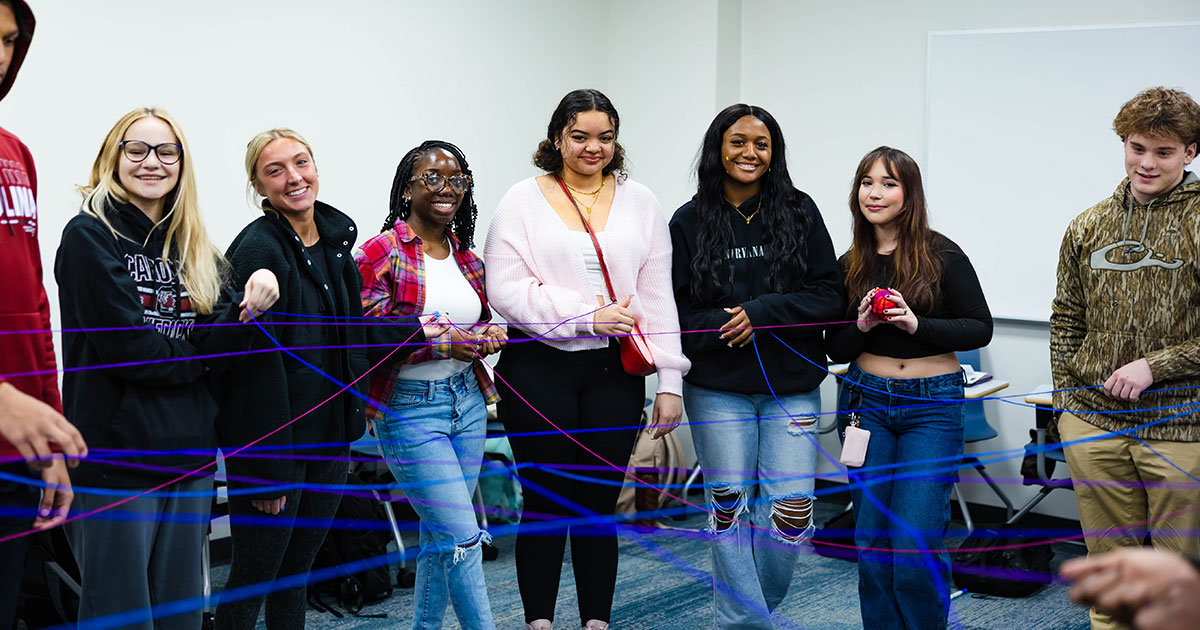
    First-year students at the University of South Carolina participate in a team-building activity in their first-year seminar course. | Photo by Logan White

    Career center staff

    Whether you have mapped out a career plan or have no clue what you want to do, your career center staff can help! It’s not just for seniors — career centers help with career exploration, internships, resume development, and interview skills. They might even be able to help you find an on-campus job so you can build career skills and start earning money while you’re a student. 

    Disability services staff

    If you received accommodations in high school, be sure to register with disability services on your campus, as those do not automatically roll over. These may be related to dietary restrictions, learning disabilities, or mental health conditions. They can work with you to ensure you have what you need to be successful! 

    Student activities and recreation services staff

    You didn’t just come to college to study and work, right? Join a student organization, attend fun events, play on an intramural sports team, or take a group exercise class! Besides having a good time, you’ll grow your leadership, teamwork, and communication skills and make friends.

    Friends and peer mentors

    Decades of research on college student success tell us that your fellow students, or your peers, are key to your success. Many of the campus offices employ student staff members, often called peer mentors. By getting involved on campus, you will make friends who support and encourage you. 

    The folks outlined here can help you get the most out of your college experience. Don’t ever hesitate to ask someone a question, introduce yourself, or try a new resource; it can only help! These amazing people will help find the opportunities that will shape your future. As you build connections with them, you will find friends and mentors to last a lifetime.

    Source link

  • What the experience of neurodivergent PhD students teaches us, and why it makes me angry

    What the experience of neurodivergent PhD students teaches us, and why it makes me angry

    by Inger Mewburn

    Recently, some colleagues and I released a paper about the experiences of neurodivergent PhD students. It’s a systematic review of the literature to date, which is currently under review, but available via pre-print here.

    Doing this paper was an exercise in mixed feelings. It was an absolute joy to work with my colleagues, who knew far more about this topic than me and taught me (finally!) how to do a proper systematic review using Covidence. Thanks Dr Diana TanDr Chris EdwardsAssociate Professor Kate SimpsonAssociate Professor Amanda A Webster and Professor Charlotte Brownlow (who got the band together in the first place).

    But reading each and every paper published about neurodivergent PhD students provoked strong feelings of rage and frustration. (These feelings only increased, with a tinge of fear added in, when I read of plans for the US health department to make a ‘list’ of autistic people?! Reading what is going on there is frankly terrifying – solidarity to all.) We all know what needs to be done to make research degrees more accessible. Make expectations explicit. Create flexible policies. Value diverse thinking styles. Implement Universal Design Principles… These suggestions appear in report after report, I’ve ranted on the blog here and here, yet real change remains frustratingly elusive. So why don’t these great ideas become reality? Here’s some thoughts on barriers that keep neurodivergent-friendly changes from taking hold.

    The myth of meritocracy

    Academia clings to the fiction that the current system rewards pure intellectual merit. Acknowledging the need for accessibility requires admitting that the playing field isn’t level. Many senior academics succeeded in the current system and genuinely believe “if I could do it, anyone can… if they work hard enough”. They are either 1) failing to recognise their neurotypical privilege, or 2) not acknowledging the cost of masking their own neurodivergence (I’ll get to this in a moment).

    I’ve talked to many academics about things we could do – like getting rid of the dissertation – but too many of us are secretly proud of our own trauma. The harshness of the PhD has been compared to a badge of honour that we wear proudly – and expect others to earn.

    Resource scarcity (real and perceived)

    Universities often respond to suggestions about increased accessibility measures with budget concerns. The vibe is often: “We’d love to offer more support, but who will pay for it?”. However, many accommodations (like flexible deadlines or allowing students to work remotely) cost little, or even nothing. Frequently, the real issue isn’t resources but priorities of the powerful. There’s no denying universities (in Australia, and elsewhere) are often cash strapped. The academic hunger games are real. However, in the fight for resources, power dynamics dictate who gets fed and who goes without.

    I wish we would just be honest about our choices – some people in universities still have huge travel budgets. The catering at some events is still pretty good. Some people seem to avoid every hiring freeze. There are consistent patterns in how resources are distributed. It’s the gaslighting that makes me angry. If we really want to, we can do most things. We have to want to do something about this.

    Administrative inertia

    Changing established processes in a university is like turning a battleship with a canoe paddle. Approval pathways are long and winding. For example, altering a single line in the research award rules at ANU requires approval from parliament (yes – the politicians actually have to get together and vote. Luckily we are not as dysfunctional in Australia as other places… yet). By the time a solution is implemented, the student who needed it has likely graduated – or dropped out. This creates a vicious cycle where the support staff, who see multiple generations of students suffer the same way, can get burned out and stop pushing for change.

    The individualisation of disability

    Universities tend to treat neurodivergence as an individual problem requiring individual accommodations rather than recognising systemic barriers. This puts the burden on students to disclose, request support, and advocate for themselves – precisely the executive function and communication challenges many neurodivergent students struggle with.

    It’s akin to building a university with only stairs, then offering individual students a piggyback ride instead of installing ramps. I’ve met plenty of people who simply get so exhausted they don’t bother applying for the accommodations they desperately need, and then end up dropping out anyway.

    Fear of lowering ‘standards’

    Perhaps the most insidious barrier is the mistaken belief that accommodations somehow “lower standards.” I’ve heard academics worrying that flexible deadlines will “give some students an unfair advantage” or that making expectations explicit somehow “spoon-feeds” students.

    The fear of “lowering standards” becomes even more puzzling when you look at how PhD requirements have inflated over time. Anyone who’s spent time in university archives knows that doctoral standards aren’t fixed – they’re constantly evolving. Pull a dissertation from the 1950s or 60s off the shelf and you’ll likely find something remarkably slim compared to today’s tomes. Many were essentially extended literature reviews with modest empirical components. Today, we expect multiple studies, theoretical innovations, methodological sophistication, and immediate publishability – all while completing within strict time limits on ever-shrinking funding.

    The standards haven’t just increased; they’ve multiplied. So when universities resist accommodations that might “compromise standards,” we should ask: which era’s standards are we protecting? Certainly not the ones under which most people supervising today had to meet. The irony is that by making the PhD more accessible to neurodivergent thinkers, we might actually be raising standards – allowing truly innovative minds to contribute rather than filtering them out through irrelevant barriers like arbitrary deadlines or neurotypical communication expectations. The real threat to academic standards isn’t accommodation – it’s the loss of brilliant, unconventional thinkers who could push knowledge boundaries in ways we haven’t yet imagined.

    Unexamined neurodiversity among supervisors

    Perhaps one of the most overlooked barriers is that many supervisors are themselves neurodivergent but don’t recognise it or acknowledge what’s going on with them! In fact, since starting this research, I’ve formed a private view that you almost can’t succeed in this profession without at least a little neurospicey.

    Academia tends to attract deep thinkers with intense focus on specific topics – traits often associated with autism (‘special interests’ anyone?). The contemporary university is constantly in crisis, which some people with ADHD can find provides the stimulation they need to get things done! Yet many supervisors have succeeded through decades of masking and compensating, often at great personal cost.

    The problem is not the neurodivergence or the supervisor – it’s how the unexamined neurodivergence becomes embedded in practice, underpinned by an expectation that their students should function exactly as they do, complete with the same struggles they’ve internalised as “normal.”

    I want to hold on to this idea for a moment, because maybe you recognise some of these supervisors:

    • The Hyperfocuser: Expects students to match their pattern of intense, extended work sessions. This supervisor regularly works through weekends on research “when inspiration strikes,” sending emails at 2am and expecting quick responses. They struggle to understand when students need breaks or maintain strict work boundaries, viewing it as “lack of passion.” Conveniently, they have ignored those couple of episodes of burn out, never considering their own work pattern might reflect ADHD or autistic hyper-focus, rather than superior work ethic.
    • The Process Pedant: Requires students to submit written work in highly specific formats with rigid attachment to particular reference styles, document formatting, and organisational structures. Gets disproportionately distressed by minor variations from their preferred system, focusing on these details over content, such that their feedback primarily addresses structural issues rather than ideas. I get more complaints about this than almost any other kind of supervision style – it’s so demoralising to be constantly corrected and not have someone genuinely engage with your work.
    • The Talker: Excels in spontaneous verbal feedback but rarely provides written comments. Expects students to take notes during rapid-fire conversational feedback, remembering all key points. They tend to tell you to do the same thing over and over, or forget what they have said and recommend something completely different next time. Can get mad when questioned over inconsistencies – suggesting you have a problem with listening. This supervisor never considers that their preference for verbal communication might reflect their own neurodivergent processing style, which isn’t universal. Couple this with a poor memory and the frustration of students reaches critical. (I confess, being a Talker is definitely my weakness as a supervisor – I warn my students in advance and make an effort to be open to criticism about it!).
    • The Context-Switching Avoider: Schedules all student meetings on a single day of the week, keeping other days “sacred” for uninterrupted research. Becomes noticeably agitated when asked to accommodate a meeting outside this structure, even for urgent matters. Instead of recognising their own need for predictable routines and difficulty with transitions (common in many forms of neurodivergence), they frame this as “proper time management” that students should always emulate. Students who have caring responsibilities suffer the most with this kind of inflexible relationship.
    • The Novelty-Chaser: Constantly introduces new theories, methodologies, or research directions in supervision meetings. Gets visibly excited about fresh perspectives and encourages students to incorporate them into already-developed projects. May send students a stream of articles or ideas completely tangential to their core research, expecting them to pivot accordingly. Never recognises that their difficulty maintaining focus on a single pathway to completion might reflect ADHD-related novelty-seeking. Students learn either 1) to chase butterflies and make little progress or 2) to nod politely at new suggestions while quietly continuing on their original track. The first kind of reaction can lead to a dangerous lack of progress, the second reaction can lead to real friction because, from the supervisor’s point of view, the student ‘never listens’. NO one is happy in these set ups, believe me.
    • The Theoretical Purist: Has devoted their career to a particular theoretical framework or methodology and expects all their students to work strictly within these boundaries. Dismisses alternative approaches as “methodologically unsound” or “lacking theoretical rigour” without substantive engagement. Becomes noticeably uncomfortable when students bring in cross-disciplinary perspectives, responding with increasingly rigid defences of their preferred approach. Fails to recognise their intense attachment to specific knowledge systems and resistance to integrating new perspectives may reflect autistic patterns of specialised interests, or even difficulty with cognitive flexibility. Students learn to frame all their ideas within the supervisor’s preferred language, even when doing so limits their research potential.

    Now that I know what I am looking for, I see these supervisory dynamics ALL THE TIME. Add in whatever dash of neuro-spiciness is going on with you and all kinds of misunderstandings and hurt feelings result … Again – the problem is not the neurodivergence of any one person – it’s the lack of self reflection, coupled with the power dynamics that can make things toxic.

    These barriers aren’t insurmountable, but honestly, after decades in this profession, I’m not holding my breath for institutional enlightenment. Universities move at the pace of bureaucracy after all.

    So what do we do? If you’re neurodivergent, find your people – that informal network who “get it” will save your sanity more than any official university policy. If you’re a supervisor, maybe take a good hard look at your own quirky work habits before deciding your student is “difficult.” And if you’re in university management, please, for the love of research, let’s work on not making neurodivergent students jump through flaming bureaucratic hoops to get basic support.

    The PhD doesn’t need to be a traumatic hazing ritual we inflict because “that’s how it was in my day.” It’s 2025. Time to admit that diverse brains make for better research. And for goodness sake, don’t put anyone on a damn list, ok?

    AI disclaimer: This post was developed with Claude from Anthropic because I’m so busy with the burning trash fire that is 2025 it would not have happened otherwise. I provided the concept, core ideas, detailed content, and personal viewpoint while Claude helped organise and refine the text. We iteratively revised the content together to ensure it maintained my voice and perspective. The final post represents my authentic thoughts and experiences, with Claude serving as an editorial assistant and sounding board.

    This blog was first published on Inger Mewburn’s  legendary website The Thesis Whisperer on 1 May 2025. It is reproduced with permission here.

    Professor Inger Mewburn is the Director of Researcher Development at The Australian National University where she oversees professional development workshops and programs for all ANU researchers. Aside from creating new posts on the Thesis Whisperer blog (www.thesiswhisperer.com), she writes scholarly papers and books about research education, with a special interest in post PhD employability, research communications and neurodivergence.

    Author: SRHE News Blog

    An international learned society, concerned with supporting research and researchers into Higher Education

    Source link

  • St. Catherine University Partners with Collegis Education to Advance Technology Strategy and Student Experience

    St. Catherine University Partners with Collegis Education to Advance Technology Strategy and Student Experience

    The strategic partnership will strengthen the University’s student-centered mission through agile technology, operational innovation, and a shared commitment to community.

    St. Paul, Minn. – (May 5, 2025) St. Catherine University (St. Kate’s) and Collegis Education announced today that they have entered into a strategic partnership to enhance the University’s delivery of IT services.

    The decision to seek external IT support was driven by the University’s growing need to accelerate progress on strategic technology initiatives that had slowed within the existing tech infrastructure. The University recognized the need for a partner with the expertise, agility, and shared mission to help build a more responsive, future-ready infrastructure.

    “We realized that the pace of change in technology—and the expectations of our students—were outpacing what our internal systems and structures could support,” said Latisha Dawson, Vice President of Human Resources and Project Lead. “Our institution is centered around student connection and academic excellence. But to uphold that mission, we needed a partner with the technical expertise and scalability to move faster, innovate more nimbly, and help us deliver a modern student experience. Collegis allows us to do just that, so we can spend less time managing systems and more time serving our students.”

    In this partnership, Collegis will provide day-to-day IT operational support, a dedicated Chief Information Officer (CIO), and technological infrastructure that supports the university’s forward progress on strategic projects, while upholding strong data governance and enabling real-time responsiveness.

    As part of the deal, St. Kate will gain access to Collegis Education’s Connected Core®, a secure, composable data platform powered by Google Cloud. As a tech-agnostic solution, Connected Core unifies siloed systems and data sets, enables real-time and actionable institutional intelligence, produces AI-powered data strategies, and delivers proven solutions that enhance recruitment, retention, operations, and student experiences — driving measurable impact across the entire student lifecycle.

    St. Kate’s selected Collegis following a thorough evaluation of potential partners. “A lot of vendors can fill a gap, but that’s not what we were looking for,” said Dawson. “We were looking for someone to meet us where we are, grow with us, and truly enable us to excel. The real differentiator with Collegis was the spirit of partnership, and beyond that, community. From the beginning, they didn’t feel like an outsider. The team has become part of our community, and  a part of helping us advance our mission.”

    “Collegis is honored to join the St. Kate’s community in a shared commitment to the future of higher education,” said Kim Fahey, President and CEO of Collegis Education. “We see technology not as an end but as an enabler, an extension of the institution’s mission to educate women to lead and influence. This partnership is about building agile systems that empower faculty, enrich the student experience, and keep the University ahead of what’s next.”

    The partnership also reflects St. Kate’s strategic priority to build a more nimble technology foundation that shortens the timeline between priority-setting and implementation. The transition enables the university to move away from legacy systems and toward a model that supports real-time innovation, strategic flexibility, and long-term sustainability.

    “Our partnership with Collegis is rooted in our values,” said Marcheta Evans, PhD, President of St. Catherine University. “It allows us to remain focused on our mission while bringing in trusted expertise to support the evolving needs of our students, faculty, and staff.”

    Dawson concludes, “We’ve always been guided by the principle of meeting the needs of the time. Embracing this next level of technology ensures we can continue nurturing the powerful, personal connection between our faculty and students, which is what makes us uniquely St. Kate’s.”

    About Collegis Education

    As a mission-oriented, tech-enabled services provider, Collegis Education partners with higher education institutions to help align operations to drive transformative impact across the entire student lifecycle. With over 25 years as an industry pioneer, Collegis has proven how to leverage data, technology, and talent to optimize institutions’ business processes that enhance the student experience. With the strategic expertise that rivals the leading consultancies, a full suite of proven service lines, including marketing, enrollment, retention, IT, and its world-class Connected Core® data platform, Collegis helps its partners enable impact and drive revenue, growth, and innovation. Learn more at CollegisEducation.com or via LinkedIn.

    About St. Catherine University

    Sustained by a legacy of visionary women, St. Catherine University educates women to lead and influence. We are a diverse community of learners dedicated to academic rigor, core Catholic values, and a heartfelt commitment to social justice. St. Kate’s offers degrees at all levels in the humanities, arts, sciences, healthcare, and business fields that engage women in uncovering positive ways of transforming the world. St. Kate’s students learn and discern wisely, and live and lead justly — all to power lives of meaning. Discover more at stkate.edu. 

    Media Contacts:

    Collegis Education

    Alyssa Miller

    [email protected]

    973-615-1292

    St. Catherine University

    Sarah Voigt

    [email protected]

    651-690-8756

    Source link

  • Student experience is becoming more transactional – but that doesn’t make it less meaningful

    Student experience is becoming more transactional – but that doesn’t make it less meaningful

    It seems that few can agree about what the future student experience will look like but there is a growing consensus that for the majority of higher education institutions (bar a few outliers) it will – and probably should – look different from today.

    For your institution, that might look like a question of curriculum – addressing student demand for practical skills, career competencies and civic values to be more robustly embedded in academic courses. It might be about the structure of delivery – with the Lifelong Learning Entitlement funding per credit model due to roll out in the next few years and the associated opportunity to flex how students access programmes of study and accrue credit. It might be a question of modality and responding to demands for flexibility in accessing learning materials remotely using technology.

    When you combine all these changes and trends you potentially arrive at a more fragmented and transient model of higher education, with students passing through campus or logging in remotely to pick up their higher education work alongside their other commitments. Academic community – at least in the traditional sense of the campus being the locus of daily activity for students and academics – already appears at risk, and some worry that there is a version of the future in which it is much-reduced or disappears altogether.

    Flexibility, not fragmentation

    With most higher education institutions facing difficult financial circumstances without any immediate prospect of external relief, the likelihood is that cost-saving measures reduce both the institutional capacity to provide wraparound services and the opportunities for the kind of human-to-human contact that shows up organically when everyone is co-located. Sam Sanders

    One of the challenges for higher education in the decade ahead will be how to sustain motivation and engagement, build connection and belonging, and support students’ wellbeing, while responding to that shifting pattern of how students practically encounter learning.

    The current model still relies on high-quality person to person interaction in classrooms, labs, on placement, in accessing services, and in extra-curricular activities. When you have enough of that kind of rich human interaction it’s possible to some extent to tolerate a degree of (for want of a better word) shonky-ness in students’ functional and administrative interactions with their institution.

    That’s not a reflection of the skills and professionalism of the staff who manage those interactions; it’s testament to the messiness of decades of technology systems procurement that has not kept up with the changing demands of higher education operational management. The amount of institutional resource devoted to maintaining and updating these systems, setting up workarounds when they don’t serve desired institutional processes, and extracting and translating data from them is no longer justifiable in the current environment.

    Lots of institutional leaders accept that change is coming. Many are leading significant transformation and reform programmes that respond to one or more of the changes noted above. But they are often trying – at some expense – to build a change agenda on top of a fragile foundational infrastructure. And this is where a change in mindset and culture will be needed to allow institutions to build the kind of student experiences that we think are likely to become dominant within the next decade.

    Don’t fear the transactional

    Maintaining quality when resources are constrained requires a deep appreciation of the “moments that matter” in student experience – those that will have lasting impact on students’ sense of academic identity and connection, and by association their success – and those that can be, essentially, transactional. Pete Moss

    If, as seems to be the case, the sector is moving towards a world in which students need a greater bulk of their interaction with their institution to be in that “transactional” bucket two things follow:

    One is that the meaningful bits of learning, teaching, academic support and student development have to be REALLY meaningful, enriching encounters for both students and the staff who are educating them – because it’s these moments that will bring the education experience to life and have a transformative effect on students. To some degree how each institution creates that sense of meaningfulness and where it chooses to focus its pedagogical efforts may act as a differentiator to guide student choice.

    The second is that the transactional bits have to REALLY work – at a baseline be low-friction, designed with the user in mind, and make the best possible use of technologies to support a more grab-and-go, self-service, accessible-anywhere model that can be scaled for a diverse student body with complicated lives.

    Transactional should not mean ‘one-size-fits-all’ – in fact careful investment in technology should mean that it is possible to build a more inclusive experience through adapting to students’ needs, whether that’s about deploying translation software, integrating assistive technologies, or natural language search functionality. Lizzie Falkowska

    Optimally, institutions will be seeking to get to the point where it is possible to track a student right from their first interaction with the institution all the way through becoming an alumnus – and be able to accommodate a student being several things at once, or moving “backwards” along that critical path as well as “forwards.” Having the data foundations in place to understand where a student is now, as well as where they have come from, and even where they want to get to, makes it possible to build a genuinely personalised experience.

    In this “transactional” domain, there is much less opportunity for strategic differentiation with competitor institutions – though there is a lot of opportunity for hygiene failure, if students who find their institution difficult to deal with decide to take their credits and port them elsewhere. Institutional staff, too, need to be able to quickly and easily conduct transactional business with the institution, so that their time is devoted as much as possible to the knowledge and student engagement work that is simply more important.

    Critically, the more that institutions adopt common core frameworks and processes in that transactional bucket of activity, the more efficient the whole sector can be, and the more value can be realised in the “meaningful” bucket. That means resisting the urge to tinker and adapt, letting go of the myth of exceptionalism, and embracing an “adopt not adapt” mindset.

    Fixing the foundations

    To get there, institutions need to go back to basics in the engine-room of the student experience – the student record system. The student system of 15-20 years ago was a completely internally focused statutory engine, existing for award board grids and HESA returns. Student records is now seen as a student-centric platform that happens to support other outputs and outcomes, both student-facing interactions, and management information that can drive decision-making about where resource input is generating the best returns.

    The breadth of things in the student experience that need to be supported has expanded rapidly, and will continue to need to be adapted. Right now, institutions need their student record system to be able to cope with feeding data into other platforms to allow (within institutional data ethics frameworks) useful reporting on things like usage and engagement patterns. Increasingly ubiquitous AI functionality in information search, student support, and analytics needs to be underpinned by high quality data or it will not realise any value when rolled out.

    Going further, as institutions start to explore opportunities for strategic collaboration, co-design of qualifications and pathways in response to regional skills demands, or start to diversify their portfolio to capture the benefits of the LLE funding model, moving toward a common data framework and standards will be a key enabler for new opportunities to emerge.

    The extent to which the sector is able to adopt a common set of standards and interoperability expectations for student records is the extent to which it can move forward collectively with establishing a high quality baseline for managing the bit of student experience that might be “transactional” in their function, but that will matter greatly as creating the foundations for the bits that really do create lasting value.

    This article is published in association with KPMG.

    Source link

  • What women experience in the university estates professions

    What women experience in the university estates professions

    I am as aware as anyone else of the reputation of AUDE (the Association of University Directors of Estates) for being something of a white male club.

    As the Executive Director of that club, I think the reputation is less and less true with every passing year, though of course I would say that. The association is very much on a journey on EDI issues, but we are doing more than you might imagine.

    Our small office team is undertaking ILM Level 4 training on managing equality and diversity. We are looking at inclusive design and have recently published a new guide to neurodiversity design and management. And we are looking more closely at the association membership itself to read between the lines of the demographic patterns available to us.

    What we found

    Our membership identity data is patchy: we’ve only been measuring this since 2022, and it isn’t compulsory for members to share. 47 per cent of those members we can measure are women. That starts to seem something like parity. But at the most senior level of membership, of those colleagues making it through to a director role, the proportion is more like one in six, significantly below the level in other professional services. We wanted to examine the barriers to women’s progress in estates, and did so in the recently published report Well the assumption is…: Conversations with women leaders in estates and facilities which is available to colleagues across the sector on the AUDE website.

    The report looks at the career experiences of women in estates – colleagues that are leading on the fabric and the development of your campuses today, vital to the successful and financially viable functioning of your institution. And it highlighted a very consistent set of obstacles, including the lack of a visible career path, the constantly undermining nature of casual sexism– anything but casual and at its worst deployed in abhorrent and confidence-wrecking verbal hand grenades – as well as issues around health, maternity and menopause, and more.

    Responses to the report

    It taps into the frustration of women telling us their stories and processes them into an emotive document that is quite unlike the tone of anything we’ve published before. I recommend a read. We’ve had several very consistent reactions to this work.

    The first is most common from women. “Yes”, they have told us, “This is the experience exactly. You haven’t missed anything out. I recognise these stories from my own life”. In private we’ve heard further stories, of things happening now, that would bring many of us to an abrupt and shocked halt, and more than reinforce every word of the report. I’ve spoken to many female members of AUDE, and it doesn’t take much work to uncover experience and attitudes that are damaging and have held us back, or acted as entirely unwelcome and unnecessary obstacles, including several in my own career which are referenced in the report.

    A second common reaction has been from male members of the association scrambling to get past the sheer embarrassment of having it spelt out to them how awful other men can be – in their teams, in their universities, now. This group includes colleagues doing great proactive things to quickly learn from the report and have fruitful conversations with others about what needs to improve. Those colleagues are swotting up on pay gap information, talking to HR about family friendly policy and blind recruitment processes. They are opening their eyes to the issues, seeking a greater level of understanding including within their own teams, challenging the status quo, and taking steps towards becoming EDI allies within their institutions.

    But we’ve also had a reaction which can best be expressed as – and in awareness of a very un-Wonkhe-like word coming up – “Why have AUDE been so arsey about this? AUDE have slightly embarrassed themselves here by being so visibly annoyed. What bad taste they’ve shown. We’re going to stay silent and dignified.”

    For me, it takes a particularly adept form of mental gymnastics to be more annoyed by the tone than by the message. Yes, with the help of the dictionary definition, we have been bad-tempered. Collecting and listening to our report participants’ stories as we did, bad-tempered is what we felt.

    Refreshing honesty

    The entire EDI agenda faces more of a pushback, right now, than for decades. Silence in the face of grotesque disadvantage may seem dignified to some. But to others it will seem altogether darker, a caving into the status quo that is impossible to justify. Many people can see the difference and have thanked us for calling out the unacceptable, and our “refreshing, real, human honesty”.

    Those women participating in the report’s production were immensely keen to give full credit to the many men who had acted as career mentors and role models. But such solidarity was far from the only experience. People don’t like being forced to confront difficult issues, but it is what we have asked of the AUDE membership with the publishing of this report. This is a difficult issue, and it is right under our noses. If (male) colleagues will not trust the take of our report, trust other things. Speak to the women in your family as your first port of call. Casually undermined at work by men without the experience or the understanding or the insight of the woman in the conversation? That’s the least of it. When was the last time you truly listened to some of the quieter voices in your institution? What would you hear if you did?

    What’s next?

    We fully acknowledge our shortcomings. The report, about women’s experiences, was commissioned by the man that leads our EDI group and written by the man that leads on the association’s comms. Not everyone will like that. We fully understand we haven’t dealt with intersectional experiences in an attempt to understand the differences that faith or disability or sexuality or ethnicity may add to the mix.

    From my perspective the association is late to the party so can hardly expect congratulations on finally arriving; our (construction) industry is behind the times; our colleagues (via a September 2024 benchmarking report on salary and conditions) tell us that the institutional stance on EDI is highly significant in their decision to stay in HE roles; and corporately, buy-in to EDI is expected of us at every level of seniority, and a gap in this area could rightly hamper our promotion prospects.

    Culture change takes a long time. We don’t want to be an obstacle but an enabler. This is exactly where we should be – learning, changing, and bringing others with us whenever we can. I’m proud the association is on this journey.

    Source link

  • Marine, geoscience, engineering students get hands-on experience aboard CSIRO ship

    Marine, geoscience, engineering students get hands-on experience aboard CSIRO ship

    CSIRO staff Dr Ben Arthur, Ian McRobert and
    Matt Kimber in front of the RV Investigator. Picture: Richard Jupe

    Students from 16 Australian universities set sail from Hobart on Saturday for a unique scientific adventure aimed at developing the country’s next generation of marine experts.

    Please login below to view content or subscribe now.

    Membership Login

    Source link

  • How AI is reshaping the learning experience

    How AI is reshaping the learning experience

    Since late 2022, generative AI has disrupted all levels of education, and higher education must adapt quickly to ensure that the integrity of qualifications is not compromised.

    New technologies can be disruptive and present challenges and opportunities. They influence how we work, interact with others, source information, and learn.

    Although artificial intelligence (AI) has been around for decades, generative AI has emerged as both a risk to traditional learning and an opportunity for students to use new technologies responsibly and ethically. Generative AI is disrupting all levels of education, and higher education must adapt quickly to ensure that the integrity of the qualifications awarded is not compromised.

    Recently, researchers examined policies and guidelines documents from 116 US universities on the use of GenAI. They found a lack of concern in these documents for ethics and privacy associated with using GenAI while encouraging its use by both staff and students. That is, intellectual property and student privacy seem to be an afterthought.

    The introduction of GenAI has added complexity to the detection of plagiarism, and some argue that using GenAI tools should not be deemed academic dishonesty because they enhance the learning experience and improve productivity. 

    In June 2024, the Tertiary Education Quality and Standards Agency (TEQSA) asked all registered higher education providers for action plans addressing the risk-generative AI in their courses. There was a 100 per cent response rate from providers to this request.

    TEQSA then analysed responses to develop resources to support the higher education sector and released Gen AI strategies for Australian higher education: Emerging practice in late November 2024[1]. This document is designed as a toolkit to assist higher education providers. The toolkit is structured into three key dimensions: Process, People and Practice. The toolkit notes that:

    There is no single form of assessment that can enable students to demonstrate achievement of all learning outcomes or support development of all appropriate uses of gen AI. Similarly, no single tool or technology can be deployed to guarantee assessment security (p43).

    Therefore, the higher education sector needs to be agile and adapt to the ubiquitous adoption of GenAI, so that we can adapt the learning experience so that students meet the learning outcomes of their course. This requires a significant shift for institutions and educators to achieve these objectives in a GenAI world.

    Ensuring equitable access to AI

    A key challenge for integrating GenAI in education is ensuring equitable access to AI-powered tools and resources for all students, regardless of their socio-economic background or geographical location. GenAI’s promise for student learning can only be achieved if students’ and staff’s access to GenAI tools is equitable, inclusive, and free from bias.

    TEQSA cautions that higher education institutions need to carefully consider the needs of diverse student populations and prioritise an inclusive and equitable educational environment when integrating GenAI in teaching, learning and assessment. This includes ensuring everyone recognises their responsibility to implement and engage in culturally safe practices.

    References

    Eden, C.A., Chisom, O.N. and Adeniyi, I.S., 2024. Integrating AI in education: Opportunities, challenges, and ethical considerations. Magna Scientia Advanced Research and Reviews, 10(2), pp.006-013.

    McDonald, N., Johri, A., Ali, A. and Hingle, A., 2024. Generative artificial intelligence in higher education: Evidence from an analysis of institutional policies and guidelines. arXiv preprint arXiv:2402.01659.

    Yusuf, A., Pervin, N. and Román-González, M., 2024. Generative AI and the future of higher education: a threat to academic integrity or reformation? Evidence from multicultural perspectives. International Journal of Educational Technology in Higher Education, 21(1), p.21.

    [1] Available from: https://www.teqsa.gov.au/sites/default/files/2024-11/Gen-AI-strategies-e…


    Hear more from A/Professor Yvette Blount and other education leaders at the Generative AI for Education Leaders Summit 2025 and gain access to cutting-edge insights and strategies that will put your institution ahead of the curve. Learn more.

    To access the detailed conference program, download the brochure here.

    Do you have an idea for a story?
    Email [email protected]

    Source link