Tag: Exploring

  • Exploring the motivation and satisfaction of higher education staff

    Exploring the motivation and satisfaction of higher education staff

    For all the criticisms leveled at the sector as a group of employers, the number of staff working in higher education keeps on growing.

    Understanding why they choose to work in higher education, what they value about their work, and how well the organisation they work for lives up to their expectations can help inform questions about what matters the most when resources are tight – pay and conditions are obviously important but people work in HE for a whole range of reasons, and not all of those expectations require resource to meet.

    In our summer staff survey we gathered nearly 5,000 responses on these topics from people who currently work in or around the sector. We don’t make any claims that this is a representative sample – we can’t say with certainty what the sector as a whole feels but comparing similar groups of staff (for example by contract type) with each other yields fascinating insights and points the way towards understanding this fundamental issue.

    For our motivation question bank we presented a range of possible motivations as follows:

    • Working in an organisation whose values I share
    • Opportunities for learning, development and professional growth
    • Working alongside and collaborating with like-minded colleagues
    • The generosity of the pay and benefits package
    • Having the autonomy to focus on the work that is important to me
    • Having a level of flexibility about where and when I work
    • My physical working environment and the resources I have access to within it
    • Receiving recognition for my hard work and contribution
    • Knowing the work I do makes a positive impact – on students, on the advancement of knowledge, on my community
    • Working in an organisation that I am confident is generally well run, and achieving its objectives
    • Having opportunities to engage in activities that enhance community connection eg networks, clubs and groups, volunteering, public lectures etc

    Then we asked people whether they felt each was an “important” motivation, and whether they were “happy” with their organisation’s performance against each one. A “yes” answer means that someone was happy, or agreed something was important.

    We’re not running any fancy statistics here, but our working assumption is that a difference of more than four percentage points between different groups is interesting and notable enough to report on. This would vary by the size of the groups in question.

    Two sectors?

    We don’t know for sure (it isn’t data that we collect via HESA for the population) but there’s as many professional and support services staff as there are academics. And the former are far more likely to have experience working outside higher education – from the responses to our staff survey we see that around 80 per cent of our professional and support staff had worked outside the sector, compared to 64 per cent of academics, though those numbers might be lower in both instances had we specifically excluded casual work such as temporary work while studying.

    The cliché of the unworldly professor in an ivory tower is clearly being left in the past – but the kinds of roles done by professional services staff are in demand right across the economy. On the face of it is far easier for them to find work elsewhere, and given the state of the sector, you’d assume this might be better paid.

    Given this, it was surprising to see that while 68.8 per cent of academic respondents cited pay and benefits packages as something that was important to them, nearly three quarters of professional and support staff found this area of the working experience important.

    In asking these kinds of questions you almost don’t expect people to say they are happy with their pay and benefits – so more than 40 per cent of our professional services respondents doing so is notable. After all, we hear enough from the various sector professional associations about the difficulty of recruiting and retaining skilled staff in a variety of key roles.

    [Full screen]

    Relative importance

    Of all the suggested motivations for working in higher education, only two were not selected as important by more than 80 per cent of respondents: pay and conditions (73.5 per cent) and having opportunities to engage in activities that enhance community connection (41.4 per cent) – the latter scoring significantly lower than every other suggestion.

    The three most important motivations selected were “knowing the work I do makes a positive impact” (87.5 per cent), “Working alongside and collaborating with like-minded colleagues” (86.9 per cent) and “Working in an organisation I am confident is generally well run” (84.5 per cent).

    Looking at the areas where there was the largest gap between those who said something was important to them and those that agreed they are happy with the extent they get to experience it in their working lives, by far the largest gap relates to confidence the organisation is run well and is achieving its objectives, only 31.7 per cent saying they are happy with this, a gap of 52.8 percentage points.

    The next highest gap relates to recognition: whereas 80.4 per cent of respondents said receiving recognition for their hard work and contribution was important, only 33.3 per cent said they were happy with this – a gap of 47.1 percentage points.

    The third highest gap was in opportunities for learning, development and professional growth: whereas 83 per cent of respondents said this was important, only 44.3 per cent said they were happy with this, a gap of 38.7 percentage points.

    Free as in freedom

    Academic respondents were far more likely to cite autonomy to focus on the work that is important to them as a key motivating factor (86.7 per cent), but the number is still high for other staff (79.6 per cent), whereas professional services staff (83.5 per cent) were slightly more likely than academics (79.9 per cent) to cite flexibility in when and where they work.

    Staff of all kinds are reasonably happy (c.65 per cent) with the levels of flexibility on offer. Clearly the experiences of Covid-19, and perhaps the drive for providers to rationalise estates – swapping offices for desks, or regular desks for hot desks – is also having an impact. You might expect that women would be more likely to value flexibility in working and you would be right – 84.8 per cent of women in our sample said this was important to them, compared to 76.5 per cent of men. However, similar proportions of men and women (around 65 per cent) reported being happy with the amount of flexibility on offer.

    In terms of autonomy – the ability that a member of staff has to focus on work that is important to them – a little under half of both academic and professional staff were happy with what was on offer. It is worth bearing in mind that autonomy is always limited in some way in any role; for example, marking and exam boards pretty much need to happen when they do.

    Value judgement

    Despite frequent accusations of cultural relativism, a strength of universities is their values. Intriguingly, 60 per cent of professional services staff by just 45 per cent of academics were happy with the way that this manifests – despite similar levels of importance (85.8 per cent for academics, 82.7 per cent for professional) being placed on sharing the values of the organisation one works for.

    If we think back to the idea that professional services staff would be more likely to work in other sectors, this does make sense. Values, and the sense of having a positive impact (86 per cent said this was important to them), are clearly going to be key motivations to work in a sector where perhaps pay and conditions don’t stack up.

    An amazing 90 per cent of academic staff said that knowing that the work they did has a positive impact (on students, the advancement of knowledge, and/or on their community) was important to them. But just 53 per cent of academics and of professional staff saw this in practice. To be fair, this was one of the best performing motivations in our survey – but it is interesting that staff are no longer seeing the good that higher education does, especially when it is becoming so important to make this case culturally and with the government.

    Recommend to others

    It’s easy to get disheartened when you think about the staffing needs of higher education providers and how they are met. Although academics are clamouring to work in the UK sector, it feels like the terms and conditions are worsening and newer staff – in particular – are getting a raw deal. With professional staff, the fact that many specialisms can get better paid work elsewhere has some wondering about the quality of the staff we are able to recruit.

    We asked all of our respondents whether they would recommend working in the sector to someone they cared about – and perhaps surprisingly three-quarters said “yes” or “maybe”. And there was very little difference between those making “yes”, “no”, or “maybe” on any of the motivation axes we discuss above (those who said “yes” were very marginally less likely to say pay and benefits were important to them).

    However those that were more likely to recommend the sector to others were significantly happier with every aspect we examined. In contrast more than 80 per cent of those who would not recommend working in the sector were not happy with the amount of recognition they got for their hard work and contribution, and more than 85 per cent felt that their organisation was not run well. Recommendation is generally considered a good proxy for job satisfaction, and this survey seems to bear that out.

    What people want to change

    We asked respondents to say more where they had identified a gap between something they consider to be important, but the degree to which they are happy with the extent they actually experience that.

    There were comments on workload and wellbeing, small-scale or systemic failures to offer recognition for achievement and, particularly from those in professional services, a desire for greater recognition, and development and/or progression opportunities. Some commented that the economic environment makes these asks more difficult.

    But in terms of messages for leaders there is a lot about communication and consultation – a sense that the people who work in the sector understand the financial problems the university faces but want to be told the truth about them and be constructive in helping to solve them.

    Clearer lines of communication and wider consultation on significant changes.

    Greater dialogue with leaders when major decisions are made which impact the way in which I can carry out my role and an opportunity to demonstrate my expertise to build trust in my decision making.

    Clear, transparent and timely sharing of strategy and the impact of the changes to come from the changes.

    Another challenge is on the perceived values driving strategy and tactics – there’s a sense that management decisions are perceived as being short term, and that it is financial expediency rather than an underlying (and shared) purpose that is informing decisions.

    There’s also commentary on issues around execution of strategy – the sense that while plans are spoken about they are not always put into practice or cascaded down the institution, or become snarled in bureaucracy.

    Greater consistency, both between faculties and also on strategic planning. At the moment there are so many different initiatives that, while we talk about working smarter, the opposite is actually the case.

    We need a clear strategy as to how we are going to get through the next couple of years which needs to be properly communicated. At the moment it feels like we are stuck in a vortex of chaos, with school level projects being put on hold whilst we wait for university level decisions, but the months go by and no meaningful direction or plan seems to be in place.

    Better delegation and direction from above, more collaboration across the institution as a whole but also with core departments where the work intercepts with others work, creating a network of colleagues in those core teams.

    A key takeaway is that the kind of organisational complexity in decision-making that has long been tolerated in higher education may not serve staff well when resources are stretched and bandwidth is low. Complexity may serve various legitimate organisational purposes but it can also cut staff off from understanding what’s happening, and what they personally need to do about it. It also creates a lack of consistency as multiple messages emerge from different quarters.

    But also, while we were specifically focused on areas for improvement, it’s worth adding that a good few comments gave a general thumbs up – their working environment was clearly motivating them in the right ways – and that shows that it can be done.

    The biggest risk of an exercise like this one is to suggest that where there is discontent or concern, that it is attributable to the wider environment, and not something that can be addressed or mitigated. While there’s clearly very little scope in most institutions to roll out shiny new initiatives, most comments suggest that some attention to hygiene factors – praise, involvement, honesty – could make a difference in sustaining staff motivation during these trying times.

    We’ll be picking up the conversation about sustaining higher education community during tough times at The Festival of Higher Education in November. It’s not too late to get your ticket – find out more here.


    Source link

  • Exploring a new standard for preparing students for the future of work

    Exploring a new standard for preparing students for the future of work

    Key points:

    According to the World Economic Forum’s Future of Jobs Report 2025, nearly 40 percent of workers’ core skills will change in just the next five years. As AI, automation, and global connectivity continue to reshape every industry, today’s students are stepping into a world where lifelong careers in a single field are increasingly rare.

    Rather than following a straight path, the most successful professionals tomorrow will be able to pivot, reinvent, and adapt again and again. That’s why the goal of education must also shift. Instead of preparing students for a fixed destination, we must prepare them to navigate change itself.

    At Rockingham County Schools (RCS), this belief is at the heart of our mission to ensure every student is “choice-ready.” Rather than just asking, “What job will this student have?” we’re asking, “Will they be ready to succeed in whatever path they choose now and 10 years from now?”

    Choice-ready is a mindset, not just a pathway

    Let’s start with a quick analogy: Not long ago, the NBA underwent a major transformation. For decades, basketball was largely a two-point game with teams focused on scoring inside the arc. But over time, the strategy shifted to where it is today: a three-point league, where teams that invest in long-range shooters open up the floor, score more efficiently, and consistently outperform those stuck in old models. The teams that adapted reshaped the game. The ones that didn’t have fallen behind.

    Education is facing a similar moment. If we prepare students for a narrow, outdated version of success that prepares them for one track, one career, or one outcome, we risk leaving them unprepared for a world that rewards agility, range, and innovation.

    At RCS, we take a global approach to education to avoid this. Being “choice-ready” means equipping students with the mindset and flexibility to pursue many possible futures, and a global approach expands that readiness by exposing them to a broader range of competencies and real-world situations. This exposure prepares them to navigate the variety of contexts they will encounter as professionals. Rather than locking them into a specific plan, it helps them develop the ability to shift when industries, interests, and opportunities change.

    The core competencies to embrace this mindset and flexibility include:

    • Creative and analytical thinking, which help solve new problems in new contexts
    • Empathy and collaboration, which are essential for dynamic teams and cross-sector work
    • Confidence and communication, which are built through student-led projects and real-world learning

    RCS also brings students into the conversation. They’re invited to shape their learning environment by giving their input on district policies around AI, cell phone use, and dress codes. This encourages engagement and ownership that helps them build the soft skills and self-direction that today’s workforce demands.

    The 4 E’s: A vision for holistic student readiness and flexibility

    To turn this philosophy into action, we developed a four-part framework to support every student’s readiness:

    1. Enlisted: Prepared for military service
    2. Enrolled: Ready for college or higher education
    3. Educated: Grounded in academic and life skills
    4. Entrepreneur: Equipped to create, innovate, and take initiative

    That fourth “E”–entrepreneur–is unique to RCS and especially powerful. It signals that students can create their opportunities rather than waiting for them. In one standout example, a student who began producing and selling digital sound files online explored both creative and commercial skill sets.

    These categories aren’t silos. A student might enlist, then enroll in college, then start a business. That’s the whole point: Choice-ready students can move fluidly from one path to another as their interests–and the world–evolve.

    The role of global education

    Global education is a framework that prepares students to understand the world, appreciate different perspectives, and engage with real-world issues across local and global contexts. It emphasizes transferable skills—such as adaptability, empathy, and critical thinking—that students need to thrive in an unpredictable future.

    At RCS, global education strengthens student readiness through:

    • Dual language immersion, which gives students a competitive edge in a multilingual, interconnected workforce
    • Cultural exposure, which builds resilience, empathy, and cross-cultural competence
    • Real-world learning, which connects academic content to relevant, global challenges

    These experiences prepare students to shift between roles, industries, and even countries with confidence.

    Redesigning career exploration: Early exposure and real skills

    Because we don’t know what future careers will be, we embed career exploration across K-12 to ensure students develop self-awareness and transferable skills early on.

    One of our best examples is the Paxton Patterson Labs in middle schools, where students explore real-world roles, such as practicing dental procedures on models rather than just watching videos.

    Through our career and technical education and innovation program at the high school level, students can:

    • Earn industry-recognized credentials.
    • Collaborate with local small business owners.
    • Graduate workforce-ready with the option to pursue higher education later.

    For students who need immediate income after graduation, RCS offers meaningful preparation that doesn’t close off future opportunities, keeping those doors open.

    And across the system, RCS tracks success by student engagement and ownership, both indicators that a learner is building confidence, agency, and readiness to adapt. This focus on student engagement and preparing students for the world postgraduation is already paying dividends. During the 2024-25 school year, RCS was able to increase the percentage of students scoring proficient on the ACT by more than 20 points to 44 percent. Additionally, RCS increased both the number of students who took AP exams and the number who received a passing score by 12 points to 48 percent.

    Preparing students for a moving target

    RCS knows that workforce readiness is a moving target. That’s why the district continues to evolve with it. Our ongoing focus areas include:

    • Helping graduates become lifelong learners who can retrain and reskill as needed
    • Raising awareness of AI’s influence on learning, creativity, and work
    • Expanding career exploration opportunities that prioritize transferable, human-centered skills

    We don’t know exactly what the future holds. We do know that students who can adapt, pivot, and move confidently from one career path to another will be the most prepared–because the most important outcome isn’t fitting students into today’s job market but preparing them to create value in tomorrow’s.

    At Rockingham County Schools, that’s what being “choice-ready” really means. It’s not about predicting the future. It’s about preparing students to thrive within it wherever it leads.

    Latest posts by eSchool Media Contributors (see all)

    Source link

  • Exploring the diversity of people the world over

    Exploring the diversity of people the world over

    At the age of 9, Hannah Choo found herself shuttled across the Pacific Ocean from California to Seongnam, South Korea. She found herself living in a city, about an hour from Seoul, where everything from language to climate was different.

    She’d grown up in sunny, suburban, slow-paced Pasadena in Southern California and wasn’t happy at first about the move.

    “When I first arrived, the honking of cars at night was so loud that I couldn’t fall asleep,” Choo said. 

    But now, seven years later, she realizes that the experience of living in two starkly different cities has given her a better understanding of people. And this is important because Choo wants to be a journalist. 

    She has joined News Decoder as a summer intern, bringing with her an interest in communities and how they collectivize and support themselves. 

    “Korea has made me look deeper into how people differ experientially, not just in terms of surface factors like race or ethnicity or where they’re from,” she said. “I think there’s a lot of diversity in Korea with what people go through in their lives.”

    Appreciating cultural differences

    The homogenous culture of South Korea gives Choo a strong sense of community and has helped her realise that people’s differences are not defined by where they come from.

    For News Decoder, Choo brings the perspective of a young person, which is valuable to an organization devoted to helping youth process global events and the confusing digital world that consumes them.

    Consider her work with Amina McCauley, who leads News Decoder’s EYES program — Empowering Youth Through Environmental Storytelling —  a two-year project to create a climate change curriculum that can be implemented in schools across the globe. 

    “Hannah has been helping me critique News Decoder’s climate journalism educational materials,” McCauley said. “As the EYES project enters its phase of dissemination, Hannah’s curiosity and understanding of depth is helping the curriculum to become stronger and more relevant for the young people of today.”

    McCauley said that Choo is thoughtful and critical, but that it is her way of interacting with others that is her best asset.

    “She brings me trust in future generations,” McCauley said. 

    Working with News Decoder

    Choo said she wanted to work with News Decoder because of the way it spotlights the human side of news, and how lives are impacted by everyday events. 

    “I feel like News Decoder aims to really empower students to not just write a story in general, but also how to incorporate their own voice into that while sticking with the rules of journalism,” Choo said.

    Choo will also help News Decoder bolster its social media. In the coming weeks, she will be working with News Decoder’s Program and Communication Manager Cathal O’Luanaigh on her own series of posts on News Decoder’s social media pages and working with its Educational News Director Marcy Burstiner on articles related to climate change, people and culture.

    Burstiner said that when Choo first came to News Decoder it was as if she knew exactly what was wanted of her. “She has a great instinct for news, for seeing the story that hasn’t been told and that needs to be told,” Burstiner said. “For News Decoder, South Korea is a country that has been underreported. I’m really looking forward to her stories.”

    Ultimately, Choo hopes to tell stories about people in many different places. 

    “I see myself travelling the world and visiting different communities and really hearing their stories, and being able to present it in a way that’s authentic to them,” she said. “And showing that to the rest of the world and allowing other people to also see all of these unique parts of a global culture that you never really get a spotlight on.” 

    Telling global stories

    What she has learned so far in her travels from California to South Korea is that there is great satisfaction in adapting to a new culture. 

    While there was no language barrier for Choo when she moved to Seongnam, having spoken Korean with her parents since she was a child, the noise and way of living there needed some getting used to. But what she at first found so different, she now finds comfort in. 

    Everything she needs outside of her apartment complex, which is wrapped by four different roads, is just a short subway, drive or walk away. And with community comes safety. 

    “I always tell people that you could leave your laptop on top of a coffee shop table and expect to find it there again an hour later,” Choo said. 

    There are still challenges. 

    Korean schools are hyper competitive and getting into a prestigious university is important. This means that in high school, students are so focused on getting good grades that their mental health often suffers.

    Young people prioritise studying for tests over sleep and a social life. They compare themselves to each other and base their self worth on academic performance. 

    “That creates pretty toxic dynamics between people,” she said. “Beating out the competition, I think, is a huge narrative here.”

    This also means that school and learning is centred on grades, so that critical thinking and interest is of much lower importance.

    “Studying in any school in Korea, even if international, means you’re still affected by the culture,” Choo said.

    Source link

  • Exploring the explosion in franchise and partnership activity

    Exploring the explosion in franchise and partnership activity

    There’s a clear need for more regulatory oversight of franchise and partnership teaching arrangements, but – as regulators are finding – there’s no easy way to track which students are being registered, taught, or physically located at which provider.

    Knowing where students study feels like a straightforward matter – indeed “where do HE students study” is one of the top level questions posed in HESA’s Student open data collection. If you click on that, it takes you to an up-to-date (2022-23 academic year) summary of student numbers by registering provider.

    But as we’ve learned from concerns raised by the Office for Students, the Student Loans Company, the National Audit Office, and (frankly) Wonkhe there is a bit more to it than that. And it is not currently possible to unpick this to show the number of students at each provider – for any given value of “at” other than registering – using public data. But we can do it for the number of courses.

    The forgotten open data set

    Yes – I’ve started the year abusing the Unistats open data release (it’s the only open data release that lets you find details of courses was the clue). And you sort of, kind of, can unpick some of these relationships using it. After a fashion.

    It is worth unpacking our terms a bit:

    • A student’s registration provider is the provider that returns that student as a part of their official data returns. If the registration provider has degree awarding powers, this is generally the provider that awards the qualification the student is working towards
    • A student’s teaching provider is the provider where a student is actually taught – in the instances where this is different to the registering provider this usually happens via a partnership arrangement of some sort.
    • A student’s location provider is the actual place a student is taught – usually, this is the same as a teaching provider, but not always – for example a “university centre” based at an FE college counts as the university in question doing the teaching, but the location would be the FE provider that hosts the centre.
    • We’ve also got to deal with the idea of an awarding provider, the place that actually awards the degree the student is working towards. In the main this is the same as the registering provider, but where the registering provider can’t award the degree in question it will be someone else by arrangement.

    How does this appear in Unistats? You are probably familiar with the notion of the UK Provider Reference Number (UKPRN): a unique identifier for educational settings. In the unistats data we get something called PUBUKPRN, which identifies where a course is primarily taught. We get something called UKPRN, which identifies where students on a given course are registered. And we get LOCUKPRN, which identifies the location a student is taught at – where this a location with its own UKPRN that is not the same as the PUBUKPRN.

    Limits to sector growth visualisation

    What’s missing – we don’t get a UKPRN for the awarding body. Not in public data. It is collected (OTHERINST) and used on the Discover Uni website but it is not published for me to mess with. Not yet, anyway.

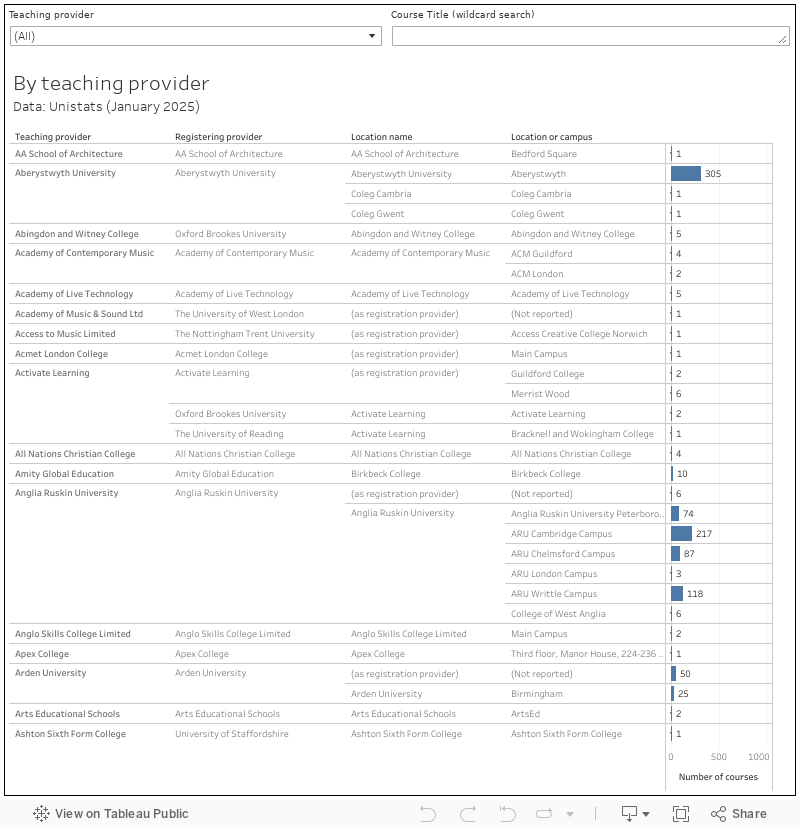
    So what I can show you is the number of courses at each combination of registering, teaching, and location provider. This shows instances where students may be registered at one provider but taught at another (your classic partnership arrangement), and the evolving practice of declaring unilateral branch campuses (where students are registered and taught at one provider, but located at a different one).

    That latter one explains the explosion of London “campuses” that area really an independent provider (that may cater to multiple institutions in a similar way). The whole thing gives some indication of where a given provider is involved in franchise/partnership activity – but only where this is shown on unistats.

    What I found

    First up – sorted by registering provider. You can filter by registering provider if you don’t want the whole list (whyever not?), and I’ve included a wildcard filter for course titles. This is instead of a subject filter – each course in unistats is meant to have a subject associated with it, but this tends not to happen for the kinds of courses we are interested in here:

    [Full screen]

    And the same thing, sorted (and searchable) by teaching provider:

    [Full screen]

    Many limitations, but a space to keep asking

    The limitations here are huge. What we really want is the number of students registered on each course – we can get this at various levels of aggregation but not reliably at a single course, single cohort level. HESA’s policy of rounding and aggregating to avoid identifying individual students (and of course the historic nature of much of the data presented on unistats) means that most of the information in the data set (entry qualification), NSS, graduate destinations is combined across multiple years and numerous related subjects.

    In the usual unistats fashion “courses” are a unique combination of qualification aim, title, and mode for each location. So the handful of remaining providers that do defined “joint” degrees (two or more subjects) look like they are spectacularly busy. And, as always, the overall quality of data isn’t brilliant so there will be stuff that doesn’t look right (pro tip: yes tell me, but also tell HESA).

    Here then, is a partial explanation as to why regulators and others have been slow to respond to the growth in franchise, partnership, and other joint provisions: almost by definition the novel things providers are up to don’t show up in data collection. That’s kind of the point.

    But is a simple list of available courses, where they are taught, what (and whose) awards they lead to, what subjects they cover, and how many students are on each too much to ask? It appears so.

    Source link