Tag: extends

  • International students benefit local economies, and this extends to those living and working there

    International students benefit local economies, and this extends to those living and working there

    Universities once again find themselves in the crosshairs of a political argument around migration.

    I suspect no one on these pages needs convincing of the benefits international students bring to the UK: the diversity and vibrancy they add to our campuses, the fees that help our finances add up so we can carry out research and teach home students, the wider economic impact they bring through their fees and their spending in the UK economy, and the long term soft power of goodwill and friendship that our international alumni generate.

    And there is plenty of public opinion research – for example from Public First and UUK in 2023, from King’s College London in 2024, and from British Future in 2025 – that shows that the British public supports international student migration, thinks it brings economic benefits, and doesn’t see cutting numbers as a priority.

    But we have to be clear that we are losing the political argument on the value of international students – as have our HE colleagues in Canada, Australia and the US in recent months.

    A local industry

    This is the case despite the hard facts we have about the positive impacts of international students, including the £42 billion aggregate (2021–22 numbers) annual economic benefit estimated by London Economics. But those facts may not be enough as the political climate changes; we need to be agile in responding to where the political debate is moving.

    For example, we understand that the aggregate economic impact of international students is not disputed within the government. But they are not convinced that positive impacts are felt at the local level. So what do these big, aggregate numbers mean for citizens at the local level? To address that question, the University of York commissioned some rapid work from Public First – building on the London Economics modelling – to show the benefits of international students at constituency level, both as an export industry, and in their impact on domestic living standards.

    The first part of this work was published a few weeks ago at the heart of the debate around the final stages of the immigration white paper. This showed that international higher education is one of our most important export industries. This was counterintuitive for many politicians – who generally think of exports as goods or services which we trade overseas. But in fact, every international student coming and living in the UK is an “export” – bringing in foreign currency and supporting our economy.

    Politicians rightly champion our other UK exports – our cars, our pharmaceuticals, our creative industries. But across the country, higher education is just as, if not more important. We showed that in 26 parliamentary constituencies around the country, higher education is the single largest export industry – and it is in the top three in a total of 102 constituencies, spread around the country. To put it another way, in many towns and cities, higher education is the car plant, or the steel mill, or the pharmaceuticals factory that drives local economies.

    We hear that this evidence of real local impact was significant within Whitehall, and contributed to seeing off some of the wider proposals for restricting student flows that could have been in the immigration white paper.

    Pounds in pockets

    The second half of this research, published today, takes on some of the critique we know has been advanced in government in recent months: that while students may bring economic value in some abstract, aggregate way at national level, there are costs that are felt locally in our towns and cities that reduce living standards.

    Our analysis comprehensively debunks that. Instead, we show that international students are net contributors to the taxpayer, and that at the local level they raise wages and living standards for domestic residents. We calculate that every worker in the UK has higher wages to the value of almost £500 a year purely as a result of international students’ economic contribution. And in more than 100 constituencies, the benefit is much larger, equating to more than two and a half weeks’ wages for the average worker.

    These local-level impacts are often well-recognised by MPs and councillors. They are not yet in national-level debate. So we will continue to make the case for the wider benefits of international students for our towns and cities as well as abstract national GDP figures.

    In addition, we need to push back against the misguided assumptions in the white paper that the proposed new international students levy would have only a minor impact on recruitment, and show in detail why the reduction in numbers would be large, and carry with it an economic loss that would go way beyond universities’ gates and into their local communities. We are pleased to be working alongside colleagues in the sector to do just that.

    In all this we need to recognise the politics of the moment. All governments are political. That is how they got there, and to be so isn’t wrong! We have a government focused at the moment on its electoral prospects, and many of its actions can be explained by a drive to keep its voting coalition together, especially with the insurgent threat of Reform, and especially on the highly politicised issue of migration.

    Universities are well advised to steer clear of party politics. As a vice chancellor, I work without fear or favour to support the needs of staff and students, but also the city and communities around York. But my academic background is as a political scientist so I’m a keen observer of how universities, migration, and their intersection have electoral significance. So, looking at the 100 constituencies we identify in our research which benefit the most from international students either as an export, or in rising domestic wages, it is noteworthy that over 80 per cent of those constituencies are currently held by Labour MPs, often by very narrow margins.

    In those and the many other constituencies where international students bring real, tangible economic benefits, it is important that local citizens and political representatives understand what is at stake when widely held public concerns about migration lead to the targeting a group – international students – who the public both think highly of, and who make a big contribution to local economies.
    Source link

  • Florida Dreamers Seek Tuition Relief as Legislative Session Extends

    Florida Dreamers Seek Tuition Relief as Legislative Session Extends

    AGaby Pachecos Florida lawmakers extend their legislative session through June 6, TheDream.US is intensifying calls for a provision that would allow approximately 6,000 undocumented students currently enrolled in Florida colleges and universities to complete their education at in-state tuition rates.

    The advocacy comes in response to the legislature’s earlier repeal of the in-state tuition waiver for undocumented students, which is set to take effect July 1, 2025. Without intervention, these students would face tuition increases of up to four times their current rates.

    “Florida’s state lawmakers now have another month to do the right thing for Dreamers and Florida’s future: ‘grandfather in’ the 6,000 Dreamers who will be forced out of college in July and instead allow them to finish their college degrees,” said Gaby Pacheco, Miami-based President and CEO of TheDream.US, the nation’s largest college and career success program for Dreamers.

    Pacheco highlighted the unfairness of changing tuition rates midstream for students who began their education under different financial expectations.

    “Among TheDream.US Scholars alone, there are more than 70 students in Florida who are less than one year from completing their degrees,” she noted.

    The organization has been actively mobilizing around this issue. In April, following the repeal announcement, TheDream.US organized a three-day “Freedom Ride for Tuition Fairness” journey from Miami to Tallahassee, with stops highlighting the importance of affordable higher education.

    This recent campaign builds on a similar effort in 2023 that successfully delayed the passage of the in-state tuition repeal until this year. One participant in that earlier campaign was Britney, a TheDream.US Scholar who recently graduated with a business marketing degree from University of Central Florida despite the uncertainty surrounding tuition policies.

    “We hope to celebrate more graduations like Britney’s after lawmakers add in new, grandfathering language in the coming weeks,” Pacheco said.

    Education advocates argue that allowing current students to complete their education at promised rates represents both a moral and practical consideration. A fact sheet released by TheDream.US notes that Florida has already invested in these students’ K-12 education and partial college education, making it economically sensible to ensure they can graduate and contribute to the state’s workforce and tax base.

    TheDream.US has provided more than 11,000 college scholarships to undocumented students attending nearly 80 partner colleges across 20 states and Washington, D.C. The organization recently released its 10-year impact report, “From Dreams to Destinations: A Decade of Immigrant Achievements and the Future Ahead,” documenting how increased access to higher education catalyzes social mobility and positive outcomes for Dreamers and their communities.

    The Florida legislature has until June 6 to consider amendments to the in-state tuition repeal that would protect currently enrolled students.

    Source link

  • Judge extends block on controversial NIH cuts

    Judge extends block on controversial NIH cuts

    A federal judge Friday extended a temporary block on the National Institutes of Health’s plan to slash funding for universities’ indirect research costs amid a legal battle over the policy change.

    The nationwide block, which U.S. District Judge Angel Kelley put in place Feb. 10 soon after a coalition of state attorneys general, research advocates and individual universities sued the agency, was set to expire Monday. But it will now remain in place until Kelley has time to consider the arguments the plaintiffs and NIH presented at a hearing Friday morning.

    It’s unclear when Kelley will rule. But after the two-hour hearing, she said she certainly “has a lot of work to do” to before making a decision.

    “This case is not about whether as a policy matter the administration can target waste, fraud and abuse,” Katherine Dirks, an attorney for the Massachusetts attorney general’s office, told the judge during the hearing. “It’s contrary to the regulations which govern how these costs are determined and how these payments are disbursed. If there were an intention on the administration’s part to change the mechanism by which those occur, there’s a process for it—a statutory process and a regulatory process. Neither of those were followed here.”

    But the NIH’s legal team said the agency has the right to unilaterally cap reimbursements for costs related to research—such as hazardous waste removal, facilities costs and patient safety—at 15 percent. 

    “This is not cutting down on grant funding,” said Brian Lea, a lawyer for the NIH, said at Friday’s hearing. “This is about changing the slices of the pie, which falls squarely within the executive’s discretion.”

    Counsel for the plaintiffs, however, argued that the policy is unlawful and, if it’s allowed to move forward during a protracted litigation process, will cause “irreparable harm” to university budgets, medical breakthroughs and the patients who may not be able to enroll in clinical trials as a result. 

    “A clinical trial is for a lot of people a last hope when there’s not an FDA–approved medicine that will treat their condition. Any minute that they’re not enrolled in that trial brings the risk of irreparable harm,” said Adam Unikowsky, an attorney for the plaintiffs. “Part of these institutions’ mission is serving these patients, and this cut will irreparably harm their ability to fulfill that mission.” 

    Since 1965, institutions have been able to periodically negotiate their reimbursement rates directly with the federal government; university rates average about  28 percent. However, rates can vary widely depending on factors such as geographic cost differences and the type of research, and some institutions receive indirect reimbursement rates of more than 50 percent of their direct grants. 

    Although the NIH argued in court that indirect costs are “difficult to oversee” as a justification for cutting them, the plaintiffs refuted that claim, pointing to a complex negotiation process and regular audit schedule that’s long been in place to ensure the funds are being used to support NIH research. 

    In fiscal year 2024, the NIH sent about $26 billion to more than 500 grant recipients connected to colleges—$7 billion of which went to indirect costs. 

    Saving or Reallocating $4B?

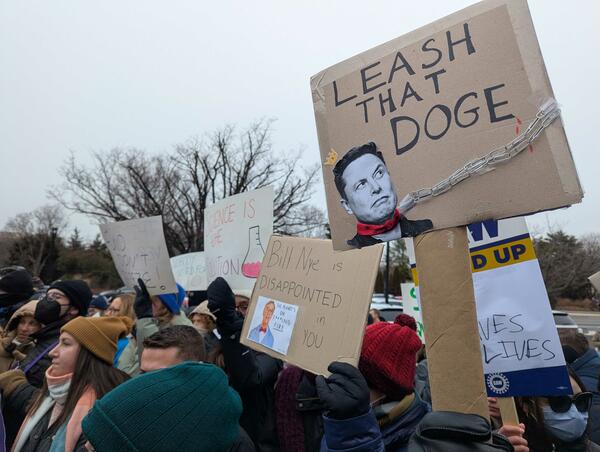
    This isn’t Trump’s first attempt to cap indirect costs, which Elon Musk—the unelected billionaire bureaucrat overseeing the newly created Department of Government Efficiency—recently characterized as a “rip-off” on X, the social media site he owns.  

    In 2017, Congress rebuked President Trump’s attempt to cap indirect costs, and it has written language into every appropriations bill since specifically prohibiting  “deviations” from negotiated rates. Given that, Kelley asked the Trump Administration’s legal team, how in his second term, Trump “can unilaterally slash these previously negotiated indirect cost rates which Congress prevented him from doing previously?” 

    “The money that is saved—it’s not being saved, it’s being reallocated—will be taken from indirect costs and filed into new grants that will be using the same funding formula,” said Lea, who told the judge he was using air quotes around the word saved. “The money is not being pocketed or being shipped somewhere else. It’s being applied back into other research in a way that best fits NIH and what will best serve the public’s health.”

    But Lea’s claims that the money will simply be reallocated contradicted the NIH’s own social media post from Feb. 7, which said the plan “will save more than $4B a year effective immediately,” and Kelley asked for an explanation.  

    In response, Lea said the NIH’s “tweet was at best sort of a misunderstanding of what the guidance does.” 

    The Department of Health and Human Services, which oversees the NIH, did not immediately respond to Inside Higher Ed’s request for comment on whether it plans to issue a widespread public correction on social media and its other platforms to clarify its policy and inform taxpayers that their plan to cap indirect costs is not intended to save them any money. As of Friday afternoon, the post was still up on X.

    Layoffs, Canceled Clinical Trials

    But Unikowsky, an attorney for the plaintiffs, said that funneling money away from indirect costs would still harm the nation’s esteemed scientific enterprise, which is grounded in university research. 

    “Indirect costs are real costs associated with doing research,” said Unikowsky, pointing to the California Institute of Technology as an example. The institute spent $200 million to build a state-of-the-art laboratory and is counting on indirect cost reimbursements from the NIH to help pay off the debt it incurred to construct it. 

    “There’s going to be a hole in Cal Tech’s research budget” and the “money is going to have to come from somewhere else,” Unikowsky added.

    Unikowsky also listed nine different institutions, including the Universities of Florida, Kansas and Oregon, that have said they will have to lay off skilled workers who support medical research, including nurses and technicians, if the cap goes into effect. 

    Lea, the lawyer for the Trump Administration, countered that destabilizing university budgets doesn’t amount to immediate and permanent harm warranting injunctive relief on the rate caps. 

    “That’s not an irreparable thing, or else every business that’s in a money pinch could just come in and get an injunction,” he said. “I understand that many institutions would prefer to use endowments and tuition for other purposes, but unless they’re barred from doing so—and the inability to do so would cause some non-monetary harm—that’s not irreparable harm.”

    Although Kelley gave no indication on when or how she plans to rule, some university leaders who listened to the hearing came away optimistic that she’ll favor the plaintiff’s arguments. 

    “We look forward to the judge’s ruling,” said Katherine Newman, provost at the University of California which is one of the universities suing the NIH. “[We] maintain our position that the Administration’s misguided attempt to cut vital NIH funding is not only arbitrary and capricious but will stifle lifesaving biomedical research, hobble U.S. economic competitiveness and ultimately jeopardize the health of Americans who depend on cutting-edge medical science and innovation.”

    Source link

  • NIH cuts remain on hold as judge extends temporary pause

    NIH cuts remain on hold as judge extends temporary pause

    This audio is auto-generated. Please let us know if you have feedback.

    A federal judge extended an emergency restraining order Friday against the National Institutes of Health, temporarily preventing the agency from making massive cuts to indirect research funding. 

    The restraining order bars NIH from implementing a 15% cap on indirect cost reimbursement and requires the agency to file regular status reports confirming disbursement of funds. U.S. District Judge Angel Kelley, a Biden appointee, is considering a more permanent injunction against NIH’s plan after nearly two hours of oral arguments Friday. 

    NIH unveiled the new policy earlier in February. Historically, institutions negotiate their own indirect cost reimbursement rates with the agency, with an average of 27% to 28%. The change was met swiftly with multiple lawsuits, including by higher education groups and 22 state attorneys general. The cases were considered together at the hearing Friday.

    Several universities have already frozen hiring and taken other budgetary measures amid the NIH funding uncertainty, despite Kelley’s initial pause on the funding cap. 

    The funding for indirect costs — also known as facilities and administrative, or F&A, costs — covers a wide array of staffing and infrastructure for research activity.

    “Indirect costs are the backbone of IHEs [institutions of higher education] research programs and cover everything from utilities to facilities and equipment maintenance to payroll for faculty and staff to compliance programs, hazardous waste disposal, and more,” 22 state attorneys general said in their original request for a temporary restraining order on NIH. “They quite literally keep the lights on.”

    Brian Lea, an attorney for NIH, said at Friday’s hearing that money saved by cutting and capping F&A funding would be “ploughed into” funding for research costs. However, in a Feb. 7 post from the agency on the social media site X, NIH said the funding cap “will save more than $4B a year effective immediately.” 

    Asked by Kelley about the post, Lea said that it was “at best a misunderstanding” of NIH’s guidance.

    Plaintiffs attorneys argued that the F&A cap violates federal laws and regulations, pointing out that Congress passed an appropriations bill during President Donald Trump’s first term that prohibits modifications to NIH’s indirect cost funding. 

    Lea maintained that NIH’s guidance was compliant with regulations and statutes and within the “broad discretionary power of the executive branch” to allocate funding. 

    Attorneys for the plaintiffs further argued that an injunction was necessary to prevent “immediate and irreparable” harm, pointing to numerous universities that have detailed how their research, budgets and infrastructure would suffer from the cap. An official at Yale University, for example, said in court papers that the NIH rate cap could threaten the viability of many of its ongoing clinical trials for medical research.

    “It is not hyperbole to say that, absent immediate injunctive relief, Plaintiff States’ IHEs will face catastrophic financial consequences, which could result in layoffs and furloughs, research program closures, financial defaults, and disruptions to clinical trials, potentially jeopardizing people’s lives and health,” the attorneys general said in their motion, filed earlier in February. 

    Lea questioned whether harms such as funding losses were irreparable, suggesting that they could be undone later through private funding or operational adjustments.

    As the case winds on, NIH has laid off more than 1,000 employees, according to press reports.

    Source link

  • DHS Extends I-9 Flexibility Guidance Through July 2023 – CUPA-HR

    DHS Extends I-9 Flexibility Guidance Through July 2023 – CUPA-HR

    by CUPA-HR | October 12, 2022

    On October 11, the Department of Homeland Security (DHS) announced a further extension of the flexibilities on Form I-9 compliance requirements that have been in place since the onset of the COVID-19 pandemic. The guidance was set to expire October 31, but has now been extended through July 31, 2023.

    The guidance will continue to allow for remote inspection of Form I-9 documents in situations where employees work exclusively in a remote setting due to COVID-19-related precautions. For employees who physically report to work at a company location on any regular, consistent or predictable basis, employers are required to use standard I-9 procedures.

    On August 18, the DHS published a Notice of Proposed Rulemaking which would create a framework under which the Secretary would be authorized to extend the flexibilities on a more permanent basis. Given the length of time the rulemaking process takes, CUPA-HR is grateful for the DHS’s extension of the Form I-9 flexibilities.


    Source link

  • DHS Extends I-9 Flexibility Guidance Through October – CUPA-HR

    DHS Extends I-9 Flexibility Guidance Through October – CUPA-HR

    by CUPA-HR | April 25, 2022

    On April 25, the Department of Homeland Security announced another extension of the Form I-9 compliance flexibilities that was initially granted in 2020. The guidance was set to expire on April 30 but has now been extended through October 31, 2022.

    The guidance will continue to allow for remote inspection of Form I-9 documents in situations where employees work exclusively in a remote setting due to COVID-19-related precautions. For employees who physically report to work at a company location on any regular, consistent or predictable basis, employers are required to use standard I-9 procedures.

    Last week, CUPA-HR and the American Council on Education (ACE) sent a letter to United States Citizenship and Immigration Services (USCIS) Director Ur Jaddou asking for this additional extension as colleges and universities continue to rely on such flexibilities during a period where institutions are facing worker shortages and a tight labor market that have caused institutions to turn to out-of-state professionals and faculty to fill open positions. Additionally, the letter noted that DHS is pursuing options to modernize the Form I-9 examination requirements through the formal rulemaking process, which may lead to a permanent option for remote inspection.

    CUPA-HR is once again grateful for DHS’s swift response and extension of the Form I-9 flexibilities. We will keep members apprised of any updates on both this guidance and future Form I-9 regulatory activity.


    Source link

  • DHS Extends I-9 Flexibility Guidance Another Four Months – CUPA-HR

    DHS Extends I-9 Flexibility Guidance Another Four Months – CUPA-HR

    by CUPA-HR | December 17, 2021

    On December 15, the Department of Homeland Security (DHS) announced a further extension of the flexibilities on Form I-9 compliance requirements that was initially granted last year. The guidance, which was slated to expire on December 31, 2021, has been extended through April 30, 2022.

    The guidance will continue to allow for remote inspection of Form I-9 documents in situations where employees work exclusively in a remote setting due to COVID-19-related precautions. For employees who physically report to work at a company location on any regular, consistent or predictable basis, employers are required to use standard I-9 procedures.

    Earlier this week, CUPA-HR and 11 other higher education associations sent a letter to United States Citizenship and Immigration Services (USCIS) Director Ur Jaddou asking for this additional extension in light of the uncertainty posed by the Omicron variant and encouraging DHS to announce the extension on or before December 17, 2021.

    CUPA-HR is grateful for DHS’s swift response and will be submitting comments in response to DHS’s Request for Public Input on document examination practices for Form I-9.


    Source link