As a learning designer in a centralized teaching and learning unit, it’s my job to explore new technologies, particularly AI. But I’ll admit, I didn’t jump right in. As Generative AI (GenAI, a subset of AI that can produce content, ideas, and data by learning from existing data and patterns) has become prevalent, so have a wide range of concerns about its usage: authenticity, critical thinking, bias, representation, plagiarism, and sustainability, to name a few.
For a while, I felt paralyzed. How am I supposed to make decisions about this emerging technology that I don’t fully understand? But scholars like Maha Bali reminded me that we need to engage with AI in order to discuss its implications and influence its outcomes. As leaders, educators, users, and creators, we have choices. So, here’s how I have been thinking through when and how I’m going to use GenAI in a way that aligns with my values.
I value originality.
I create original work as a learning designer, as well as personally as a writer and artist, and I don’t want GenAI to train on my work. If I use GenAI, I will use a proprietary tool from my university (e.g., CoPilot), a tool with a paid subscription (like ChatGPT Plus), or another tool that won’t use my work.
I value transparency.
Working in digital learning, I am a partner on academic content. I respect my instructors’ hard-earned expertise and original work, and I won’t use their work with GenAI tools without their permission. In addition, if instructors’ content appears on platforms that use GenAI, I will inform them where and how it is used. As GenAI use increases in our course development processes, I will discuss the advantages and disadvantages of using specific tools, and we will work together to decide whether and how GenAI will be applied.
I value collaboration.
I work with amazing instructors to create online courses and other digital learning experiences. With a team of experts, I guide instructors through the process of brainstorming, outlining, and developing academic materials that we organize into a guided, accessible experience. My teammates and I bring a broad range of skills to this complex work, and we collaborate to create unique and valuable learning experiences. GenAI can help us with parts of this process, but I won’t use GenAI to replace our work with material that lacks the rich human experience and expertise that informs effective teaching and learning.
I value scholarship.
Higher education centers on the exchange, synthesis, and development of ideas. We build on others’ work while crediting them for their contributions. We do this to support our arguments, demonstrate our scholarship, and contribute to an ongoing conversation. While I can use GenAI for research, I can’t depend on it to accurately quote or cite others. Therefore, I won’t assume what GenAI writes or cites is accurate, and I will do my own research. In addition, if I use AI in my work (or in collaborative work), I will cite it.
I value sustainability.
Estimates vary on how much energy GenAI uses, and it depends on what you’re using it for. We do know that simple text queries don’t use as much energy as generating images or video requires. Is it worth using GenAI to create an image of your dog as an astronaut, or a dress composed of hundreds of kittens? As much as I love cute animals, I will minimize using GenAI to create images or videos, particularly for nonessential tasks. Additionally, I will weigh the impact of saving significant time and energy on essential tasks against the potential sustainability costs.
I value critical thinking.
I don’t want the easy answer. I want the complexities, the nuance, the human experience that makes an article or study or creative work unique. I won’t rely on GenAI to create something simplistic, biased, or inaccurate. If I use GenAI, I will use it to generate ideas, answer simple questions, or create an initial outline or template. From there, I will edit and rewrite what it provides, checking for bias, representation, and accuracy. Further, I will advise instructors on how to guide their learners in taking a similar approach.
I’m far from an expert in GenAI, and it’s a moving target. But deciding how I will engage with it has given me some peace of mind in a chaotic, ever-changing world. My best wishes on your own AI journey.
Heather Hans, MLIS isa senior learning designer at Duke University. She is energized by learner-centered design, good UX, and expanding access. She enjoys travel, wildlife gardening, and pie.
Duke Learning Innovation & Lifetime Education. (2024, August 12). Generative AI and Teaching at Duke. Duke Learning Innovation & Lifetime Education. https://lile.duke.edu/ai-and-teaching-at-duke-2/
Belonging and mattering are crucial for creating educational environments where learners feel connected to their department and classmates (Hale et al., 2019). Student success has become a major outcome measure for many academic units(Accreditation Council for Occupational Therapy Education, 2005 and Commission on Accreditation in Physical Therapy Education, 2025). Researchers have found that learners’ sense of belonging enhances psychological flexibility, learner satisfaction, motivation, and professional identity, thereby increasing student success (Carter et al., 2023 and Tejero-Vidal et al., 2025). Measuring a learner’s perception of belonging can be challenging for educators. To support this effort, a social-ecological model has been developed to conceptualize the different layers that contribute to a learner’s sense of belonging(Johnson, 2022). The Departmental Sense of Belonging (DeSBI) tool specifically measures this sense within the context of department and peer relationships(Knekta et al., 2020).
I explored how an increased involvement in the belonging social-ecological model was associated with learners’ sense of belonging within their department. The goal was to help departments refine their model to enhance learners’ connection to faculty and peers, thereby increasing learners’ success. The hypothesis was that higher interactions in the social-ecological model would correlate with a higher sense of belonging. Sixty-eight learners from three allied health programs completed the survey, which found the results a statistically significant association between the learner’s involvement in the belonging social ecological model and a learner’s sense of belonging to a department.
Practical Application of the Belonging Social-Ecological Model
The study underscores the pivotal role of departmental culture and environment in shaping a learner’s sense of belonging. This is an essential consideration for departments when evaluating the factors provided to learners at each level of the belonging social ecological model.
Intrapersonal Level
Activities within the interpersonal level are journaling, professional development, and mental health practices. It is crucial for faculty to consider encouraging learners to journal at the end of a class session or to include journaling as a graded activity within their course. Supporting learners in building these habits helps foster psychological flexibility and self-awareness. This approach can also provide an opportunity strengthen the therapeutic alliance between individual faculty.
Interpersonal Level
Activities within this level include meals with classmates and faculty, physical activities, and social gatherings. Faculty should strongly consider whether their academic space provides the area for learners to study and have meals together. If your department lacks such space, advocating for one in or near your department should be a priority. If your academic unit has the gathering space, it will be important for faculty to evaluate if it will attract learners to use it effectively, or if learners will avoid the areas because of its set-up and location. Ensuring a dedicated space is not only available but actively used is a critical step for faculty when evaluating their effectiveness in fostering a sense of belonging within the department.
Additionally, faculty should encourage learners to spearhead the organization of social events outside the department so to strengthen connections between one another. With mentorship and engagement from faculty, learners will be empowered to create inclusive events that help all feel welcome.
Institutional Level
The institutional level considers what activities are offered by the university to the learners. Every university, regardless of its size, hosts various events each week for its learners. It is crucial for faculty to consider how their learners are engaging with university announcements about these events. Faculty should consider how the department reinforces these activities on its own announcement board. Should faculty hang signs near the department, or employ other creative strategies to ensure learners are fully informed about campus activities?
Community and Societal Level
The social ecological model is the community and society encompasses activities that extend beyond campus and occur within the community and at the society level. Each university is an integral part of the community in which it is located. Therefore, it is important for faculty to consider how learners are kept informed about the events occurring within the community they live. Ensuring the department highlights events, beyond the favorite coffee shop, restaurant, or activity spot, is crucial for fostering a sense of belonging. Considering each community offers unique experiences, making sure learners are aware of these activities is important. By combining the dissemination of institution activities with community events, faculty can address two domains with one strategic plan.
Physical and Virtual Space
Physical and virtual spaces are in the outer most layer in this social-ecological model and include the structure of class breaks, classroom setup, and online activities. Faculty should consider how physical and virtual learning environments impact social connections. For example, it is important for faculty to thoughtfully consider how breaks are structured – not just when they are given. Encouraging learners to leave the room for a short walk outside with peers, play a quick game of four-square, or throw a frisbee is beneficial, as it promotes learners to be active shift their mindset, and foster conversations beyond classroom content.
A final consideration involves the layout of the classroom. Is the classroom arranged traditionally with everyone facing forward, or can it be reorganized into pods or small groups, which will facilitate discussion during group projects? If the goal is to engage the entire room, can the seating be arranged into a large circle to allow learners to see each other’s body language while speaking? These small yet significant environmental factors can impact the learning environment and the sense of belonging for each learner in the room.
Conclusion
Increased engagement across all layers of the belonging social-ecological model significantly enhances the learners’ sense of connection and inclusion. This sense of belonging is not a peripheral benefit – it is foundational to learner motivation, participation, and overall success. Faculty play a key role in implementing thoughtful strategies that promote belonging at every level of the belonging social ecological model. In doing so, they help create a dynamic and inclusive learning community where every learner can thrive – leading to greater success and personal fulfillment in their learners’ academic journey.
Dustin Cox, PT, DPT, PhD, is an Associate Professor at Augusta University and a licensed physical therapist with advanced certifications in therapeutic treatment for Parkinson’s and lymphedema. He received his Doctor of Physical Therapy in 2011 and his Ph.D. in Health Sciences in 2023 from Northern Illinois University. Since 2016, Dustin has been dedicated to helping learners achieve their goals in becoming effective healthcare practitioners. Currently, Dustin teaches in a DPT program and clinically works with clients that are in the pediatric stage of life and clients with bleeding disorders.
Carter, B. M., Sumpter, D. F., and Thruston, W. (2023). Overcoming Marginalization by Creating a Sense of Belonging. Creative nursing, 29(4), 320–327. https://doi.org/10.1177/10784535231216464
Hale, A. J., Ricotta, D. N., Freed, J., Smith, C. C., and Huang, G. C. (2019). Adapting Maslow’s Hierarchy of Needs as a Framework for Resident Wellness. Teaching and learning in medicine, 31(1), 109–118. https://doi.org/10.1080/10401334.2018.1456928
Johnson, Royel. (2022). A socio-ecological perspective on sense of belonging among racially/ethnically minoritized college students: Implications for equity-minded practice and policy. New Directions for Higher Education, Spring 2022, pages 59 – 68. https://doi.org/10.1002/he.20427
Knekta, E., Chatzikyriakidou, K., and McCartney, M. (2020). Evaluation of a Questionnaire Measuring University Students’ Sense of Belonging to and Involvement in a Biology Department. CBE life sciences education, 19(3), ar27. https://doi.org/10.1187/cbe.19-09-0166
Tejero-Vidal, L. L., Pedregosa-Fauste, S., Majó-Rossell, A., García-Díaz, F., and Martínez-Rodríguez, L. (2025). Building nursing students’ professional identity through the ‘Design process’ methodology: A qualitative study. Nurse education in practice, 83, 104256. https://doi.org/10.1016/j.nepr.2025.104256
Halfway through the semester, it’s not uncommon to notice a shift in your students’ energy levels (Baghurst and Kelley, 2013; Kumari et al., 2021). The initial enthusiasm for learning a foreign language may wane as other courses with demanding assignments compete for their attention. Some students prioritize subjects they perceive as more directly tied to their major or career, while others simply feel the weight of mid-semester exhaustion. In the spring, the long winter months can add to this fatigue, making it even harder to keep students engaged (Rohan and Sigmon, 2000).
This is the moment when a language instructor must pivot, shifting the classroom dynamic to reignite curiosity and motivation. Although instructors strive to incorporate activities that cater to the five preferred learning styles (Felder and Henriques, 1995)—visual (learning through images and spatial understanding), auditory (learning through listening and discussion), reading/writing (learning through text-based interaction), kinesthetic (learning through movement and hands-on activities), and multimodal (a combination of multiple styles)—it is beneficial to intersperse these well-structured, and, after a while, predictable classes with activities that break the mold. Introducing something unexpected and different from the established classroom dynamics can reenergize students, foster creativity, and enhance their enthusiasm for learning.
Music, in particular, has long been an ally of instructors teaching a second language (L2)—a language learned after one’s native tongue—especially since the field transitioned toward a more communicative approach. Rooted in interaction and real-world application, the communicative approach prioritizes meaningful engagement over rote memorization, helping students develop fluency in natural, immersive ways. Research has consistently highlighted the benefits of music in L2 acquisition, from improving pronunciation and listening skills to enhancing vocabulary retention and cultural understanding (Degrave, 2019; Kumar et al. 2022; Nuessel and Marshall, 2008; Vidal and Nordgren, 2024).
Building on this tradition, the activity we will share here not only incorporates music but also integrates artificial intelligence, adding a new layer of engagement and critical thinking. By using AI as a tool in the learning process, students not only familiarize themselves with its capabilities but also develop the ability to critically evaluate the content it generates. This approach encourages them to reflect on language, meaning, and interpretation while engaging in text analysis, creative writing, public speaking, and gamification—all within an interactive, culturally rich framework.
Activity Description: Musical Challenge with ChatGPT: “Sing and Discover”
Objective:
Students will improve their listening comprehension and written production in Spanish by analyzing and recreating song lyrics with the help of ChatGPT. While the instructions are presented here in English, the activity should be conducted in the target language—whether Spanish or another language being taught.
Instructions:
1. Listen and Decode
Divide the class into groups of 2-3 students.
Choose a song in Spanish (e.g., La Llorona by Chavela Vargas, Oye Cómo Va by Tito Puente, Vivir Mi Vida by Marc Anthony).
Provide each group with an incomplete version of the lyrics with missing words.
Students listen to the song and fill in the blanks.
2. Interpret and Discuss
Within their groups, students analyze the song’s meaning.
They discuss what they think the lyrics convey, including emotions, themes, and any cultural references they recognize.
Each group shares their interpretation with the class.
What do you think the song is trying to communicate?
Which emotions or feelings do the lyrics evoke for you?
Can you identify any cultural references in the song? How do they shape its meaning?
How does the music (melody, rhythm, etc.) influence your interpretation of the lyrics?
3. Compare with ChatGPT
After forming their own analysis, students ask ChatGPT:
What do you think the song is trying to communicate?
Which emotions or feelings do the lyrics evoke for you?
They compare ChatGPT’s interpretation with their own ideas and discuss similarities or differences.
4.Create Your Own Verse
Each group writes a new verse that matches the song’s style and rhythm.
They may ask ChatGPT for assistance: “Help us write a new verse for this song in the same style.”
5. Perform and Sing
Each group presents their new verse to the class.
If they feel comfortable, they can sing it using the original melody.
It is beneficial for the professor to have a karaoke (instrumental) version of the song available so that students’ lyrics can be heard clearly.
Displaying the new lyrics on a monitor or projector allows other students to follow along and sing together, enhancing the collective experience.
6. Election – The Grammy Goes To Students vote for different categories, including:
Best Adaptation
Best Reflection
Best Performance
Best Attitude
Best Collaboration
7. Final Reflection
What was the most challenging part of understanding the lyrics?
How did ChatGPT help interpret the song?
What new words or expressions did you learn?
Final Thoughts: Music, AI, and Critical Thinking
A Musical Challenge with ChatGPT: “Sing and Discover” (Desafío Musical con ChatGPT: “Cantar y Descubrir”) is an activity I’ve found to be especially effective in my intermediate and advanced courses. I use it when students are feeling overwhelmed or distracted, often around midterms, as a way to help them relax and reconnect with the material. It serves as a refreshing break, allowing students to step away from the stress of assignments and refocus in a fun, interactive way. By incorporating music, creativity, and technology, we keep students present in the class, even when everything else seems to demand their attention.
Beyond offering a well-deserved pause, this activity sparks engaging discussions around language interpretation, cultural context, and the role of AI in education. As students compare their own interpretations of song lyrics with those generated by ChatGPT, they begin to recognize both the value and limitations of AI. These insights foster critical thinking, helping them to develop a more mature approach to technology and its impact on their learning.
Adding the karaoke element further enhances the experience, giving students a chance to perform their new verses and have fun while practicing their language skills. Displaying the lyrics on a screen makes the activity more inclusive, allowing everyone to follow along. To make it even more enjoyable, selecting songs that resonate with students’ tastes—whether it’s a classic like La Llorona or a contemporary hit from artists like Bad Bunny, Selena, Daddy Yankee, or Karol G—makes the activity feel more personal and engaging.
This activity isn’t just limited to the classroom. It’s a great addition to Spanish Clubs or special events, where students can bond over a shared love of music while practicing their language skills. After all, who doesn’t enjoy a good parody of their favorite song?
By blending language learning with music and technology, Desafío Musical con ChatGPT creates a dynamic, interactive environment that reinvigorates students and deepens their connection to both the language and the evolving role of AI. It turns moments of exhaustion into opportunities for creativity, cultural exploration, and renewed enthusiasm for learning.
Angela Rodriguez Mooney, PhD, is an assistant professor of Spanish and the Texas Women’s University.
References
Baghurst, Timothy, and Betty C. Kelley. “An examination of stress in college students over the course of a semester.” Health promotion practice 15, no. 3 (2014): 438-447.
Degrave, Pauline. “Music in the foreign language classroom: How and why.” Journal of language teaching and research 10, no. 3 (2019): 412-420.
Felder, Richard M., and Eunice R. Henriques. “Learning and teaching styles in foreign and second language education.” Foreign language annals 28, no. 1 (1995): 21-31.
Nuessel, Frank, and April D. Marshall. “Practices and principles for engaging the three communicative modes in Spanish through songs and music.” Hispania (2008): 139-146.
Kumar, Tribhuwan, Shamim Akhter, Mehrunnisa M. Yunus, and Atefeh Shamsy. “Use of music and songs as pedagogical tools in teaching english as foreign language contexts.” Education Research International 2022, no. 1 (2022): 1-9
Over the last two years, I’ve witnessed the rise in students’ use of generative AI as whole. Not surprisingly, more students are using generative AI to assist them in writing.
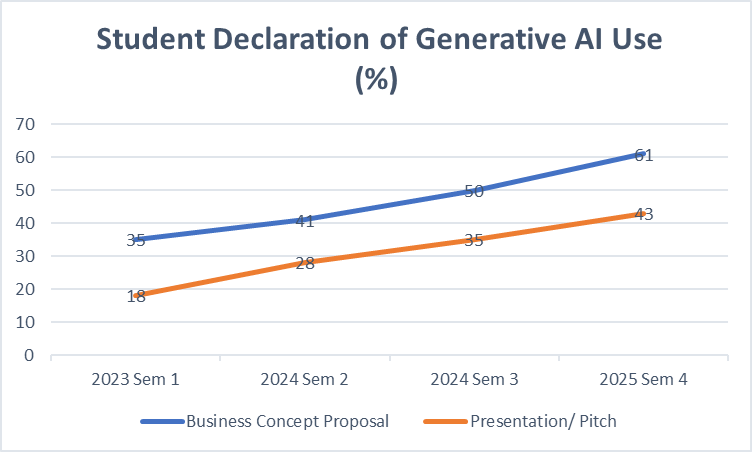
In an undergraduate business communication course that I oversee, the percentage of students who declared their use of generative AI for a writing assessment (i.e. business proposal) increased steadily over four semesters from 35% in 2023 to 61% in 2025. What’s more fascinating is the corresponding increase in the reported use of generative AI for their spoken assessment – their presentation (i.e. pitch) – from only 18% in 2023 to 43% in 2025.
*Note that there were about 350 students per semester and a total of about 1,400 students over four semesters/two years.
You may be wondering, how exactly are these students using generative AI for presentations?
They reported using generative AI to:
Create and edit visuals (e.g. images, prototypes/ mockups, logos)
Get inspiration for rhetorical devices (e.g. taglines, stories, alliterations)
Prepare for the Q&A (e.g. generate questions, review/structure answers)
Beyond verbal language,visuals are an important facet of communication and students need to be prepared for more multimodal communication tasks at the workplace (Brumberger, 2005). With digital media, there has been a shift in balance between words and images (Bolter, 2003) which can be seen in websites, reports and even manuals. A students’ ability to communicate in writing and speaking must now be complemented with a proficiency in visual language. Now, generative AI can reduce those barriers to creative visual expression (Ali et al., 2004).
For example, students on my business communication course use AI tools to create prototypes and mockups of their project ideas to complement their explanations. When they are unable to generate exactly what they need, they edit those images with traditional editing software or more recently, software with generative AI editing abilities such as Adobe firefly which allows users to select specific areas of an image and use “generative fill” to brainstorm and edit it without advanced technical skills. This and other AI text generators including Dall-e (Openart) and Midjourney have opened up possibilities for communicators to enhance their message using visuals.
Here are the AI Visual Tools students have reported using in their written and spoken assessment over two years:
What’s interesting from the list is not only an increase in the number of AI tools used but the type of tools used (1) for specific purposes like Logopony, for the creation of logos, Usegalileo, for app Interface designs, and Slidesgo, for the creation of slides, as well as AI tools (2) for editing such as Photoshop AI, Adobe Firefly, and Canva. Beyond that, we can see how students are using different tools from companies that are constantly evolving such as Canva with Magic Studio and Dream Lab, OpenAI who has integrated Dall-e into ChatGPT, as well as their latest offering, Sora, and even Google who now has Gemini Flash 2.0. Generative AI is also becoming more accessible on different platforms with the integration of Meta AI to WhatsApp, a cross-platform messaging app.
Ultimately, this list provides a glimpse of what some undergraduate business students are dabbling with and educators should consider trying them out. More importantly, we could guide students in thinking about the visuals and graphics that they ultimately use because not all graphics are equally effective (Mayer and Moreno 2003).
Some graphics are:
Decorative They are neutral and may enhance the aesthetics but is not interesting or directly relevant.
Seductive They may be highly interesting but may not be directly relevant and can distract the audience and cause their cognitive processing to focus on irrelevant material.
Instructive They are directly relevant to the topic (Sung and Maye, 2012).
However, it doesn’t mean that all visuals should be instructive because it depends on the goal of the communicator. For example, if the main goal is for enjoyment, then decorative visuals can enhance the aesthetics and seductive visuals can be so interesting that it leads to higher satisfaction, so we should remind students to be intentional in their use of visuals and AI tools. For example, AI tools tend to create visuals with a lot of extraneous details that may be distracting and lead to cognitive overload (Deleeuw and Mayer 2008) so students should refine their prompts by being more specific and precise (Hwang and Wu 2024) and they should be prepared to use editing software which can include other AI enhanced software like Adobe firefly and Imagen to achieve their final goal.
There are limitations to what AI can do at the moment.
It cannot be truly innovative because it learns from existing data.
It cannot fully understand subtle aspects like culture, values or emotional nuances (Hwang and Wu 2024).
But it can provide the stepping stone for students to visualize their ideas.
Let’s encourage our students to be aware of what they want to achieve when using AI tools and be proactive in selecting, rearranging, editing and refining the visuals to suit their purposes.
Aileen Wanli Lam is a Senior Lecturer and technology enthusiast at the National University of Singapore. She is fascinated by education technology and enjoys conversations about the latest industry developments. She is also passionate about professional communications, student engagement and educational leadership.
References
Ali, Safinah, Prerna Ravi, Randi Williams, Daniella DiPaola, and Cynthia Breazeal. “Constructing dreams using generative AI.” In Proceedings of the AAAI Conference on Artificial Intelligence, vol. 38, no. 21, pp. 23268-23275. 2024.
Bolter, Jay David. “Critical theory and the challenge of new media.” (2003).
Brumberger, Eva R. “Visual rhetoric in the curriculum: Pedagogy for a multimodal workplace.” Business Communication Quarterly 68, no. 3 (2005): 318-333.
DeLeeuw, Krista E., and Richard E. Mayer. “A comparison of three measures of cognitive load: Evidence for separable measures of intrinsic, extraneous, and germane load.” Journal of educational psychology 100, no. 1 (2008): 223.
Hwang, Younjung, and Yi Wu. “Methodology for Visual Communication Design Based on Generative AI.” International journal of advanced smart convergence 13, no. 3 (2024): 170-175.
Mayer, Richard E., and Roxana Moreno. “Nine ways to reduce cognitive load in multimedia learning.” Educational psychologist 38, no. 1 (2003): 43-52.
Sung, Eunmo, and Richard E. Mayer. “When graphics improve liking but not learning from online lessons.” Computers in human behavior 28, no. 5 (2012): 1618-1625.
I read Susan Blum’s Ungrading as a first-year graduate student and was immediately smitten. At the same time, COVID-19 forced many seasoned instructors to grapple with assessing their students, making alternative assessment more mainstream. My first attempt at alternative assessment didn’t go very well. I failed to appreciate the value of clear expectations and the inescapable necessity that my students needed to walk out of my class with a grade. I struggled to make my system transparent, to emphasize growth over perfection, and to implement a good rubric. For the next four years, I used Kevin Gannon’s grading contract to implement more structure and Barbara Schapiro’s ‘third space’ to reflect on what worked for me and my students. My system improved. Now, as a fifth-year graduate student approaching completion of my degree, I use contract grading. Each assignment has 1-10 points, with a total of 100 points. Each point corresponds to a specific objective and is graded complete/incomplete. In my more recent students’ evaluations, students say they are less stressed, they are more motivated, and they understand assignment expectations at the beginning of the semester.
My Journey in Alternative Grading: From Curiosity to Clarity
The first time I stood in front of 20 bored freshmen, all alone, teaching a course I had designed, also all alone, I was teaching a general education writing and speaking course at the University of Iowa. After using traditional grading the first semester, I turned to alternative assessment in the second. In brief, my students received a complete/incomplete grade for any given assignment and then a cumulative midterm and final grade. I wanted to deemphasize grading entirely, but in retrospect the flaws were glaring. Halfway through the semester, in the middle of class, a student burst out in confusion and frustration, “Where did my grade even come from?” What a good question. My first system failed to appreciate the value of clear expectations and the inescapable necessity that at the end of the day my students needed to walk out of my class with a grade.
As a first-year graduate student, I had read Susan Blum’s Ungrading and was immediately smitten. Blum (2020) argues that grades provide minimal feedback, they deemphasize learning, and what they actually measure is inconsistent (10-14). I came to alternative assessment alongside many other instructors as COVID-19 forced seasoned instructors to grapple with assessment policies. In 2021, a Faculty Learning Community formed at the University of Iowa to address assessment practices and, spurred on by their work, in 2023 the University changed their grading policy page to include alternative assessment (“Grades: Undergraduate Policies”).
During the next four years, I implemented Barbara Schapiro’s (2009) ‘third space,’ which takes into account what benefits both me and my students (423-439). I took a more structured approach, first using Kevin Gannon’s contract and Asao Inoue’s labor-based grading model and eventually designing my own contract. I struggled to make contract grading transparent, to emphasize growth over perfection, and to implement a good rubric. But the system improved. Now, as a fifth-year graduate student approaching completion of my degree, I use a blend of labor-based, or specifications, grading, and contract grading. In specifications grading “the instructor designates bundles of assignments that map to different letter grades” and in contract grading “each student signs a contract indicating what grade they plan to work towards” (“Alternative Approaches to Assessment”). In evaluations, students say they are less stressed, they are more motivated, and they understand assignment expectations better.
Despite the flaws in my first grading system, it taught me that I functioned better in a classroom when I use alternative assessment, and I have maintained some semblance of the complete/incomplete system ever since. Traditional grading felt too subjective, based on a sliding scale of bad, average, or great. As a TA, I even received rubrics with that language. As much as it was my job to teach students to write, I also felt the grading system disadvantaged those students who came in with subpar high school educations and less writing experience. I wanted to design a system that addressed those problems.
Gannon’s Contract Grading: A Transparent Framework
Kevin Gannon’s (2022) grading contract (see Figure 1) heavily influenced my third semester of teaching. In Gannon’s model, students begin with a B- and achieving, or failing to achieve, specific requirements raise or lower their grade. His system was easy to explain and students responded positively. When I introduced Gannon’s system, I used the word ‘labor’ a lot. In Asao Inoue’s (2022) labor-based grading model, he defines labor as “the engine that runs all learning. You can’t learn without laboring” (76). But, on my own, I doubted whether I could evaluate a student’s labor when it mostly took place outside of the classroom. I aimed, therefore, to bring the writing process further into the classroom, including proposals, drafts, and revisions. I especially wanted students to understand that the ‘final’ assignment was anything but. Usually written in one to three weeks (if not one to three days), ‘final’ assignments are first thoughts, or, if we’re lucky, second thoughts. Drafts and revisions help students embrace what Gannon (2020) calls “not-yetness,” the recognition that they are still learning and the goal is not perfection (146).
Figure 1:Gannon’s Contact System
Grade
Number of Non-Participation Days
Number of Late Assignments
Number of Ignored Assignments
B-minus
0-4
0-4
0
C-minus
5-6
5
1
D-minus
more than 6
6 or more
more than 1
Despite the overall success of the system, I had problems. Students were still demotivated by a lack of clear expectations. Because everything was graded complete/incomplete, three-sentence reading responses held the same weight as thousand-word essays, making it unclear how much time I expected them to spend on a given assignment. My assignments also didn’t have detailed enough rubrics and some students felt quality didn’t matter.
My Grading Design and Process
At this point, I started teaching general education in literature, which had different grading expectations. Needing to change my system anyway, I created a contract with 100 points, each assignment assigned 1-10 points (See supplementary materials). I like this system. I’m still using it two years later.But my first go-around had only middling success. The system seemed straightforward to me, but my students were confused, as nearly all of them pointed out in their evaluations. Although students understood what the assignments were, my rubrics were sparse – perceptive readers might notice this as a reoccurring problem.
So, here’s how I fixed it: On the first day of class, I explain my system and give everyone a copy of the contract, which I ask them to fill out with their desired grade. Being in physical contact with the contract helps them understand it better and immediately establish a goal for the semester. I explain the larger purpose of the contract, but I also boiled the system down to some simple numbers: if a student successfully completes all the main assignments and three revisions, they get an A.
And, at long last, I have a functioning rubric. I still grade each point complete/incomplete. For simple assignments like reading responses, where I just want students to get their thoughts down, it’s a simple question of “Did you do the assignment?” For more complicated assignments, I assign each point an objective, and each objective introduces a new skill or concept. For example, in an eight-point paper, I assign four points to close reading (See Figure 2). The objectives build from including close reading consistently in the paper to synthesizing the new skill they’re learning (close reading) with the class content (monster theory). The objectives become more difficult and the final objective requires the most subjective grading. But overall, the system allows the students to see whether they’re meeting requirements even before I’ve given them a grade, and the system highlights what skills or content they are struggling with.
Figure 2: Analysis Rubric
1 point
Close reading throughout the paper that addresses specific, quoted moments from your song
1 point
Close reading that makes an argument about why those specific moments are there throughout the paper
1 point
The paper addresses monstrosity as we have discussed it in class (i.e. have you told us what the monster is a metaphor for?
1 point
Analysis heavily relies throughout on an argument about monstrosity that goes beyond ‘monster as metaphor.’
Conclusion
I find alternative assessment highly effective. Even though I recently received the comment, “Never do contract grading again,” student evaluations are overwhelmingly positive and more often sound like, “So helpful, literally my favorite thing ever.” Stress reduction and increased motivation appear frequently in evaluations. But more than that, alternative assessment taught me how to be a teacher. Improving my grading system required me to create clearer rubrics, state the purpose of my lessons, design assignments that gave my students more agency, and provide more concrete methods of measuring participation. This meant a lot of big changes at once, but alternative assessment can be implemented in much smaller steps, like using it for one assignment or rewriting one rubric. Now that I have a good system, I’m working on those smaller steps, like making assignments more time effective and integrating revisions more effectively. Implementing alternative assessment was really hard, but I hope as more teachers take it up, there will be more resources for those who want to take the plunge.
Sarah Barringer is a graduate student at the University of Iowa. Her dissertation, “Transmasculine Narratives in Medieval Literature,” argues that transmasculine characters in medieval literature allowed medieval audiences to imagine a gender that comprised both feminine and masculine elements. She teaches general education in literature courses at the University of Iowa on monstrosity and identity.
Inoue, Asoa. Labor-Based Grading Contracts: Building Equity and Inclusion in the Compassionate Writing Classroom. University Press of Colorado, 2022.
Schapiro, Barbara. “Negotiating a Third Space in the Classroom.” Pedagogy: Critical Approaches to Teaching Literature, Language, Composition, and Culture 9, no. 3 (2009): 423-439.
After 13 years of testing higher-order active learning modalities in the classroom, collecting data, building a database, and analyzing student learning results in bi-annual principles of marketing classes, my colleague and I saw two important results emerge. First, all students, regardless of their SES (socio-economic status) standing, showed significantly higher levels of retained learning than the control group which used the time-honored lectures, basic active learning techniques, and case approaches. Secondly, of greater importance, lower-level SES students showed significantly higher retained learning than the general student population. In surveying the literature, significant results have been reported for all students, but not significantly higher than the norm for lower-level SES students.
In the beginning, we decided to build a database measuring what might work better than the currently accepted flipped classroom concept. This step was taken especially since it became more difficult for me over the years in the classroom to keep today’s device-driven students focused beyond 10 seconds or less on an assigned major concept for each of my fifty-minute classes. Retained learning was there but not at the expected levels. In the last 15-20 years as a college professor, especially in marketing and management courses, I have struggled to keep students’ attention, keep them engaged, and keep them on the desired path to improved retained learning of the important course concepts. Fortunately, the classic lecture format, “we speak-you listen”, was replaced years ago by variations of the flipped classroom—students read and studied course content on their own and came to class ready to discuss the major components and issues of what was being studied. However, in this environment, professors must also demonstrate how to apply major concepts to actual problems.
What are the Necessary Steps to Specifically Help SES Students?
We started with guidance from Jean Piaget’s Constructivist Learning Theory, “a process of constructing knowledge based on experience” which embraced active learning modalities as viable examples of the theory. In doing so, we were able to proceed to acceptable testing for TBL/PjBL (Task-Based Learning/Project-Based Learning), simulation, and TBL/PjBL aspects of active learning. With the promise of significantly improving student retained learning experiences, we proceeded to apply the processes to the major classroom concepts under study, connecting them to relevant, firsthand, rigorously applied applications. The best results came from the highest order TBL/PjBL combined modalities where teams chose their own community service projects,
How do you start this process? Some form of testing should be considered if such modalities have not been tried in the past. While our data collection was for entry level classes to a major, it is not recommended that you do that. For that class level, I recommend the simulation modality as offered by some of the major publishers. In addition, we found that problem-based learning, using specific real -world problems, did not work well in my classes as every semester had a different local problem supplied. I also realized that any single problem assignment for the semester in the PjBL format could not be stretched to cover all the semester’s major concepts in the discipline.
Here is a basic framework for using simulation or the TBL/PjBL combination in certain marketing, management, and other related business classes as examples:
1. Choose a Familiar Visualization
To start with, for any principles or like-named introductory classes in the major, regardless of how you introduce the higher order modalities, it is important that you choose a visualization for students to use in their application exercises. In marketing, I use a bookbag (backpack) because of the obvious student familiarity. In management, it might be a company. In sociology, it might be a defined demographic group. In picking a visualization, make sure students have experience with it as a necessary knowledge base on which to build their applications for greater retained learning. This step is essential in all forms of active learning, especially in the higher order modalities. Even though current generational students resist group work, I encouraged them to team up with a study partner (for experience) where they can help each other with content, application, and reporting (even though all submissions must be individual and not just copied from their partner).
If you do not have experience with simulation or TBL/PjBL, it is strongly recommended to test the various forms in a segment of the course, such as in the last four weeks. The easiest way to start this segment is to use a graded, flipped simulation where students apply the application outside of class in that timeframe, with you testing the applied learning results using one concept per week. The way I did this was to have each student submit a written weekly ¾ page minimum response showing how they applied that week’s concept. This will require extra work for you, but the results should be enlightening to your teaching success along with problem areas that should be addressed.
If you choose just simulation, McGraw Hill, for example, uses 8-10 application-based activities (called ABAs) for critical inclusion at set times throughout the semester. Because of the lack of student experience in a general business operation, I allowed three tries at each activity before posting a student’s grade. Two weeks before the end of the semester, I offered students extra credit if they ran the whole marketing process to sell backpacks. Anecdotally, adding TBL/PjBL modalities were too much for them to manage and there was too much group conflict. Thus, a month of individual response classes could be considered a capstone for the class. Now, with the introduction to generative AI, you will now need to review how to let the students use it as a source, just like Google or any other such media; however, be sure to have them quote their source along with properly noting with exact quotes for any AI content used as presented.
For your classes at upper levels such as marketing communications and consumer behavior, use the combined higher order active learning TBL/PjBL model. On the first day of class, define the visualization requirement; however, this will be different for each group as they choose their project. Next, in that same class period, note that they will be working in groups for their TBL/PjBL project with each formed group confirmed by you two weeks in. Define the group size as no more than four students; no less than two students if necessary (class size, resistance etc. may impact choices). Even if you have used or are familiar with higher order modalities in the classroom, you should review the most current literature on how and why components of cooperation must be included (which includes collaboration) and what constitutes an effective TBL/PjBL group. My colleague and I have found that TBL/PjBL projects worked better if developed, designed, and implemented by each student team and with our professorial guidance.
I suggest that you review the details on why the community service project is best, starting with Kuh, Kinzie, Schuh, and Whitt (2005) who first mentioned this approach and recognized its benefits, and Kuh (2008) who expanded on them. See also von Freymann and Cuffe (2020) for six reasons to choose community service projects. Our university has been quite pleased with the outcomes and publicity—along with a sizable donation to one of our schools as a thank you.
2. Form Intentional Teams and Track Achievement Data
Be sure to devise measurement methods for data collection from the start of class to record and compare lower-level SES student achievement versus non-lower-level SES student achievements. Allowing groups to form on their own may not allow for using all the aspects of higher-order cooperation. As an aside: Group composition is often the most difficult step in upper-level classes as many may have their friends in class and who they feel more comfortable working with. A class vote has not worked in the past, so you need to consider setting up the teams yourself guided by your experience with these students and their posted GPAs. You will get some pushbacks, but you should explain in class at the beginning of the semester why this will work better for everyone in the end.
3. Syllabus Inclusions
Syllabus inclusions—promise and provide proper guidance throughout the semester with individual teams outside of class. Also review situations and/or results in class that apply to all the groups’ efforts. Once decided, be sure to update your syllabus with the revised details of what’s expected, how to do it, and what graded parts will be needed.
From the beginning, it’s important to clearly explain in your syllabus how the process will be conducted and assessed, including the required written submissions and final presentation for all higher-order modality applications. For TBL/PjBL, part of the process should require a group response of what was found in the literature review. This will help support the plan recommendation in the final written document and presentation. (Students in the simulation classes should be assigned some individual concept research as well to help them get used to using other sources.) Due to the added student workload, the team research should be submitted by mid-semester for acceptance and separate grading by the professor. Each team member must submit three to five supporting articles with an assessment of how it will help the planning process.
Using the tenants of Constructivist Theory for support, explain to students how the theory should work for them and remind them throughout the course to focus on what they might know, can vicariously relate to, and what they have adapted to, as their base experience in learning the course core concepts as they are revealed by you throughout the semester.
Dr. von Freymann spent thirty years in advertising and marketing as a practitioner working with many companies from high tech to consumer products, national to local. Moving on, Jeff earned an MBA and DBA, each with a marketing emphasis and spent the later part of his career teaching, settling at Wingate University as an associate professor. Using his business experience, he was able to show students how the business process works and why it’s essential for them to be able to apply that learning after graduation.
Have you ever felt the weight of being overworked and underpaid? Do you find yourself questioning your value in your workplace? Are you contemplating exploring new employment opportunities in the near future? If these thoughts resonate, knowing you are not alone in this journey is important. Many of your peers share these concerns.
The CUPA-HR 2023 Higher Education Employee Retention Survey (ERS) is not just a study; it’s a comprehensive collection of your experiences and opinions. It gathered data from 4,783 higher education employees across 539 institutions, including administrators, professionals, and non-exempt staff from various departments. This survey is valuable for understanding the job satisfaction and retention challenges you and your peers face in higher education (Bichsel et al., 2023).
The 2023 survey asked questions in the following areas:
Likelihood of looking for other employment opportunities in the near future
Reasons for looking for other employment
Remote work policies and opportunities
Work performed beyond normal hours and duties (overwork)
Satisfaction with benefits
Well-being and satisfaction with the job environment
Retention incentives experienced in the past year
Challenges for supervisors
Demographic questions on gender, race/ethnicity, and age
Characteristics of the employee’s position (Bichsel et al., 2023)
The survey’s analyses provided critical insights into the proportion of our higher education workforce at risk of leaving, the reasons why employees are considering other job opportunities, and the underlying factors contributing to their desire to leave. These findings are crucial in addressing our shared concerns. (Bichsel et al., 2023)
The survey results are as follows: one-third (33%) of higher ed employees are very likely or likely to look for new employment opportunities in the next year, which is unchanged from last year. This indicates that retention remains a significant and urgent challenge in higher ed. The area with the most acute retention challenge is student affairs, where 39% of employees surveyed say they are likely or very likely to look for other employment opportunities within the next year (Bichsel et al., 2023)
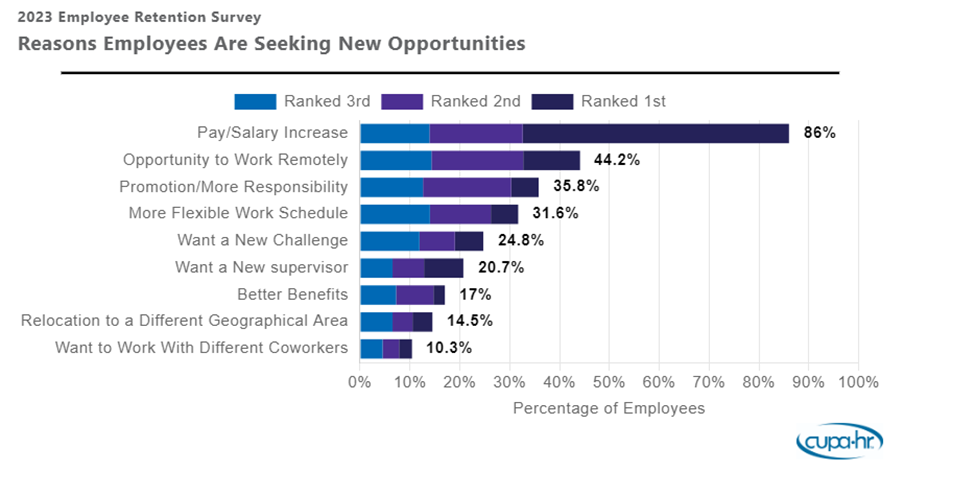
*A graph of reasons employees are seeking new opportunities was obtained from CUPA-HR’s 2023 survey data. (Bichsel et al., 2023)
A notable aspect of dissatisfaction revolves around their institution’s support for their professional growth. Almost half of employees (44%) express disagreement when asked whether they have opportunities for advancement at their institution, and around one-third (34%) disagree that their institution invests in their career development. Moreover, more than one-fourth of respondents (28%) disagree that their institution’s leaders show they care about their mental health and well-being. (Bichsel et al., 2023)
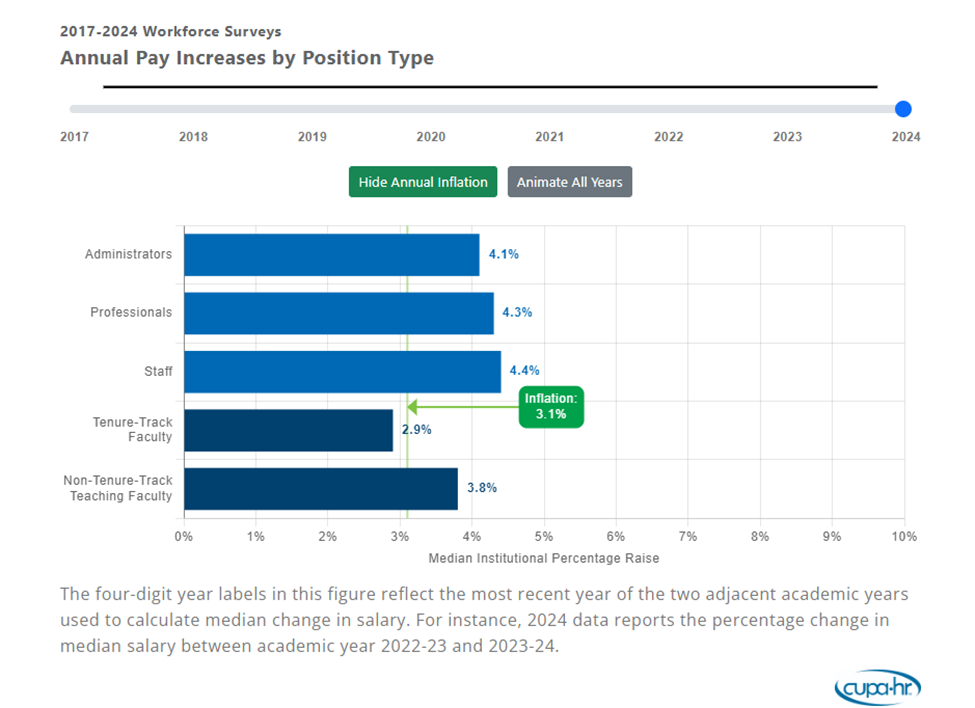
According to CUPA-HR research and key findings for 2023-2024, across higher education, employees are still paid less in inflation-adjusted dollars than in 2019-20 (pre-pandemic). (CUPA, 2024)
*A screenshot of a graph of Annual Pay Increases by Position Type was obtained from CUPA-HR research and key findings for 2023-2024. (CUPA, 2024)
In a well-run organization, these nuts and bolts that shape compensation are routinely checked and updated to stay competitive and achieve strategic goals. However, for many colleges, compensation practices have become the ‘deferred maintenance’ of the human resources world. This term refers to the practice of postponing necessary maintenance, often due to a need for more funds or resources. In the context of compensation, these practices must be regularly reviewed and updated, leading to issues such as stagnant salaries, late paychecks, inaccurate titles, and confusion over how pay is pegged to performance. (McClure, 2024)
Despite the availability of rich data backed by years of research, institutions are still mainly lagging in implementing standard-raised pay scales, resulting in higher attrition levels.
The survey’s findings are a call to action. Senior management and leadership must approach the situation holistically and use the data to implement a solution swiftly. This is crucial to prevent the loss of trained, qualified, and high-performing employees, a loss that higher educational institutions cannot afford!
Ranjitha Rao is the Budget/Financial Analyst Manager at the College of Nursing at Texas Woman’s University. She is dedicated to supporting academic and administrative goals through financial oversight. As an active member of the TWU Staff Council, she fosters a spirit of unified community among staff members and provides opportunities for their democratic representation. Through her involvement in the Staff Council, she promotes a positive and collaborative work environment and serves as a representative advisory member, presenting recommendations to university leadership. Ranjitha is also committed to fostering healthy workspaces, ensuring faculty, staff, and students thrive in a supportive and productive environment. Ranjitha holds a background in engineering and is currently a Ph.D. student focusing on leadership in higher education. She also holds a Master’s in Business Administration, with an emphasis in Accounting and Management. Additionally, as an adjunct, Ranjitha has taught first-year incoming classes, focusing on curriculum and strategic success, to help students transition smoothly into their academic journeys, along with accounting and healthcare administration classes for undergraduates. Ranjitha’s research interests include competency-based education, workforce development, leadership, management, and financial well-being in higher education.In her free time, Ranjitha enjoys exploring financial trends, participating in community events, and contributing to initiatives that promote financial literacy and education.
In recent years, higher education has witnessed a surge in conversations around student mental health. National surveys consistently report escalating rates of anxiety, depression, and loneliness among college students (American College Health Association 2023). Yet despite these growing concerns, faculty remain largely underprepared to intervene effectively. While staff in student affairs and counseling centers are often trained in mental health response and early intervention, faculty are frequently left out of these critical conversations. This divide has resulted in a persistent gap—both in knowledge and in action.
Studies show that students are more likely to exhibit early signs of distress in the classroom than in other campus spaces, making faculty key frontline responders (Lipson et al., 2022). However, faculty often report feeling ill-equipped or unsure about how to identify mental health concerns or refer students appropriately. A 2020 national survey of faculty found that only 51% felt confident in recognizing when a student might need help, and fewer than 30% had received any formal training (NASPA, 2020). In addition, given the other responsibilities to achieve tenure, it can be challenging to know how to prioritize a list of competing needs.
Despite the increase in mental health programming across universities, little has changed in how faculty are prepared to support students. Institutions often prioritize staff development in these areas, assuming counseling centers or student affairs teams will manage the bulk of mental health interventions. However, without better integration of faculty into institutional wellbeing strategies, students may continue to fall through the cracks.
Recognizing the Signs: What Faculty Can Do
Common signs of student distress—frequent absences, changes in participation, disorganized thinking, or emotional outbursts—often surface in classroom settings. While faculty are not expected to diagnose or treat mental health conditions, being able to recognize these red flags and respond appropriately can be lifesaving.
It is important for faculty to understand their role in the broader system of care: to notice, approach with compassion, and refer. The role does not include functioning as a therapist. Each faculty member has been socialized in their respective fields for several years. That training should not be set aside. Rather, learning how to refer students is vital. Still, the referral process can be opaque. Many faculty are unaware of what services are available, who to call, or what their responsibility is after making a referral. Closing this knowledge gap requires clear, accessible systems—and consistent faculty inclusion in mental health trainings and initiatives.
From Concern to Connection: The Power of Referral
Faculty can make a difference by normalizing help-seeking behavior and offering concrete pathways to support. A simple statement like, “I’ve noticed you seem a bit off lately—are you okay? If you’d like, I can help you find someone to talk to,” can build trust and remove stigma. Learning the language of how to intervene can help facilitate the appropriate connection to campus services. The goal is to get students connected to care in ways that faculty can provide.
The Divide Between Faculty and Staff
Staff members in counseling services and student affairs are trained in trauma-informed practices, crisis response, and developmental theory. Faculty, by contrast, are rarely required to learn these skills, even as they face growing demands to support student wellbeing.
This disconnect is structural, not personal. The division between academic and student affairs has long been a feature of higher education. Yet if we are to meet the holistic needs of students, institutions must actively dismantle these silos and build collaborative, cross-functional approaches to care. Faculty should be partners in designing wellbeing strategies, not peripheral to them.
Supporting Faculty Mental Health
It’s also essential to acknowledge that faculty are under pressure too. Burnout, compassion fatigue, and rising expectations in teaching and service can make it difficult to engage in additional emotional labor. Supporting student mental health cannot come at the expense of faculty wellbeing. It should also be noted that female presenting faculty are more likely to be approached by students to share about their mental health. Female presenting faculty may be carrying the additional stress of trying to help students in addition to their other duties.
Institutions must invest in faculty support systems—professional development, access to mental health resources, and workload adjustments—to ensure sustainable engagement. Training in student mental health should be framed not as an added burden, but as a shared responsibility that supports teaching, learning, and community resilience.
Toward a Culture of Care
UMBC is advancing a “Culture of CARE” that centers equity, resilience, and connection across the campus experience. For faculty, this means being empowered to recognize when students need help, equipped with tools to respond appropriately, and connected to a broader network of care. It also means ensuring that faculty themselves are cared for, supported, and not left to carry this burden alone.
As the Assistant Vice President for health and wellbeing, I enjoy assisting in bridging the divide between faculty and staff. By embedding mental health into the culture of higher education, we can create campuses where everyone—students and educators alike—can thrive.
Dr. Rae Chresfield is a higher education leader with over 15 years of experience in mental health, wellbeing, and student support. A first-generation college graduate, she began her academic journey at Coastal Carolina Community College and earned a B.S. in Behavioral Science from the University of Maryland University College, an M.A. in Mental Health and Wellness from NYU, and a Ph.D. in Counselor Education and Supervision from SUNY Buffalo.
Dr. Chresfield has held progressive leadership roles in higher education, including Director of Counseling Services, Associate Dean of Health and Wellness, and Assistant Professor. She currently serves as the inaugural Assistant Vice President for Health and Wellbeing at UMBC, where she leads strategic efforts to embed a holistic Culture of CARE across campus. Her work focuses on integrated service delivery and bridging the gap between mental health professionals and institutional leadership.
Widely known as “Dr. Rae,” she is recognized for her compassionate approach and commitment to student-centered systems that support wellbeing, equity, and resilience.
References
American College Health Association. 2023. National College Health Assessment: Spring 2023 Reference Group Data Report. Silver Spring, MD: ACHA.
Lipson, Sarah K., Laura H. Eisenberg, and Daniel Eisenberg. 2022. “Faculty and Mental Health: Knowledge, Confidence, and Responsibility.” Journal of American College Health 70(6): 1491–1500. https://doi.org/10.1080/07448481.2021.1909043.
NASPA. 2020. The Role of Faculty in Student Mental Health: Results of a National Survey. Washington, DC: NASPA Student Affairs Administrators in Higher Education.
Peer-to-peer conversations can help students to make connections with each other and course content. In a course that requires out-of-class reading, that conversation is highly reliant on students doing their part and completing the assigned reading. However, in recent semesters, students engaging in focused reading in which they annotate text is dwindling. There has been a noticeable decline in students’ engagement with course materials, evidenced by reduced annotations and superficial reading habits (Deale & Hyun, 2021; Mizrachi & Salaz, 2022). It seems as if a quick scan of one of the assigned pages is the best effort. Without adequate reading, students will be reluctant, or unable, to participate in class discussions and conversations for lack of understanding and fear of not ‘measuring-up’ to peers (Severe, E., Stalnaker, J., Hubbard, A., Hafen, C. H., & Bailey, E. G., 2024). Subsequently, instructor facilitated classroom conversations intended to enhance understanding of course content may stagnate and falter. Naturally, to maximize student engagement with course content, students must have a degree of self-awareness and desire to do the work assigned to meet the goal of understanding, and mastering, course content.
The frame of content engagement can look different based on course, instructor and level of student. In this case, engagement is on the ‘micro’ level as it offers ideas on what can happen before, during, and after class (Handelsman, M. M., Briggs, W. L., Sullivan, N., & Towler, 2005). While engagement can be observed in many forms, this piece focuses on transactional engagement in which students interact with each other and with the instructor (Zepke & Leach, 2010). As instructors, we can provide the tools to help students engage with content and meaningfully participate in conversation to develop a more robust understanding of coursework.
Course Context
I teach a required, writing-intensive course for students in their junior year of their undergraduate studies. In addition to a heavy writing component, there is also a heavy reading component. While students enjoy the subject matter, they are not terribly thrilled by the amount of reading they are expected to complete. Generally, students start the semester strong, by keeping up with reading, sharing key points and participating in organic content-based conversations. By week four, they hit a wall. There is a notable drop off in the reading and conversations. In an ongoing effort to support students, I altered the clarified expectations and gave more support to students, both in class and beyond.
Choices
Students are busy with layers of competing obligations including classes, work, university organizations and athletics that may impact their time to prepare for class. They may also feel underprepared for reading focused non-fiction, informational texts that require more attention than a casual fiction novel. Being mindful of some students’ sensitivity to what they perceive as inadequate skills, the strategies listed below were shared in class. The whole group presentation and in-class practice encouraged students to try all the tools and self-determine which was most helpful for the time and abilities.
Before Class
Students were introduced to three strategies to use to capture the key points of the assigned reading. The activities provide multiple entry points that allow students to utilize the tool right away.
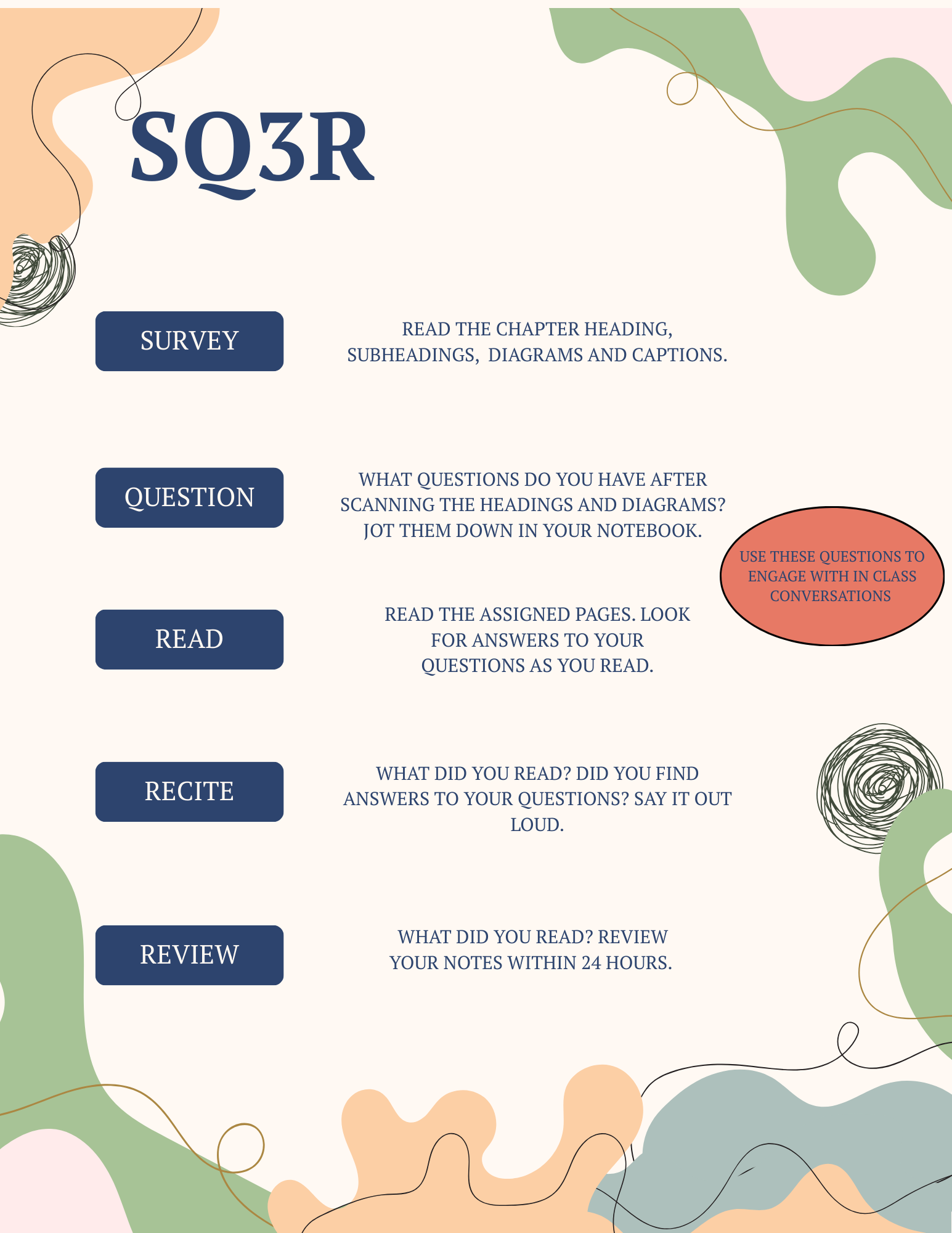
SQ3R. Although this is not a new strategy, I was surprised at how few students had experience working with it. Preparing to join classroom discussions requires intentional preparation. Some students may feel underprepared and think a simple scan of the assigned readings will enable them to join a conversation. While that may work on a superficial level, robust, and meaningful conversation requires proactive work. For students unsure of how to read for maximum understanding a review of the SQ3R strategy is helpful. After a class introduction to the strategy, all students are given a handout with the students so they can utilize as they see fit.
SQ3R
Launchpad. For some students, the formulaic nature of a guided strategy, like the SQ3R, may be too limiting. For the student that wants to prepare for in-class conversation, preparing and providing a few open-ended reading reflection questions (launchpad ideas) may be useful. The questions are intentional few in nature so students can focus on responding to one or two and reading to find solid text evidence to support responses.
Launchpad Example 1Launchpad Example 2
Sketchnoting. For students that best express their understanding visually, sketchnoting is a wonderful tool (Parks, 2022). Sketchnoting involves using images, words, and colors to make thinking visible on paper (or a device). When introduced in class as a worthwhile way to capture understating, students may be more likely to try the method rather than just trying to remember what they read.
Sketchnote
The First 10 Minutes of Class
Even with adequate preparation and readings, students get busy with other obligations between assigned coursework and class time. To help students feel prepared, the first 10 minutes (no more) of class is provided as a focused reflection.
Focused Reflection. During the 10-minute reflection, students may review their SQ3R notes, add to their reading reflections or sketchnotes. Students may also reread (or, for some, read) the assigned pages. For students that have done it all, they are tasked with doodle time. It’s not as unstructured as it seems.
Doodle Time. If a student is reluctant to participate in any of the focused reflections, they are given a doodle paper and three colored pencils. The expectation is to keep the pencils moving during the entire 10-minute period. Some students may start by drawing squiggles or lines, but they do transition into drawing sketches of things they’ve read. Once students believe there is no judgment on their artistic ability and that the focus time is really intended to help them think about the course content, they respond positively to the task. Some have even transitioned from doodling to sketchnoting because, as shared by one student, “it matches the way I think.”
By allowing this 10-minute period to capture thoughts, students have to ability to organize their thoughts and feel confident in their classroom conversation contributions. While it doesn’t level the field completely, and there are still students that do not read, those that do have shared they appreciate the time to refocus their attention on the coursework.
There are only two rules for focused reflection time. The rules are aimed at keeping the classroom distraction free.
No talking (to me or each other). The quiet period allows think-time for all students.
No devices. The device free period encourages students to independently think about the assigned readings without supporting- or competing- interests. Students are told candidly, I care about their input, not a generative AI summary of the reading.
Building a Safe Space for Conversations
Even with adequate preparation, sharing connections to coursework can be daunting. To support students in the process, a small to big approach is beneficial. First, students are assigned, by the instructor, into conversation corner groups. These groups are intentionally small to promote equitable opportunities to speak. With small classes, I create the groups and intentionally separate any groups of friends to provide opportunities for students to interact with others that may bring new perspectives to the conversation. For larger groups, a random group generator such as https://www.randomlists.com/team-generator can be used. After allowing small group conversation, the students are transitioned into whole group discussions in which they share understanding or respond to instructor posed questions as a group.
Getting the Conversation Going
Students may need help starting content-based conversations. Using a ‘fun’ tool engages students and allows all to have a chance to contribute.
Spinning Questions. Pickerwheel (https://pickerwheel.com) or Spin the Wheel (https://spinthewheel.io/#google_vignette) are sites that allow the instructor to enter questions into a spinning wheel. Students spin the wheel and respond to questions in small groups. Students can also create a discussion wheel in their instructor assigned small groups using the questions they created for their SQ3R notes.
Conversation Cards. The use of Conversation Cards can help students engage in focused conversation about course content. Students can either draw random card or review all cards and choose the one that is most appealing to them.
Conversation Card Example 1Conversation Card Example 2Conversation Card Example 3Conversation Card Example 4Conversation Card Example 5
Ending Class
Ending class with an individual account of progress toward mastering course content helps students self-determine their next steps.
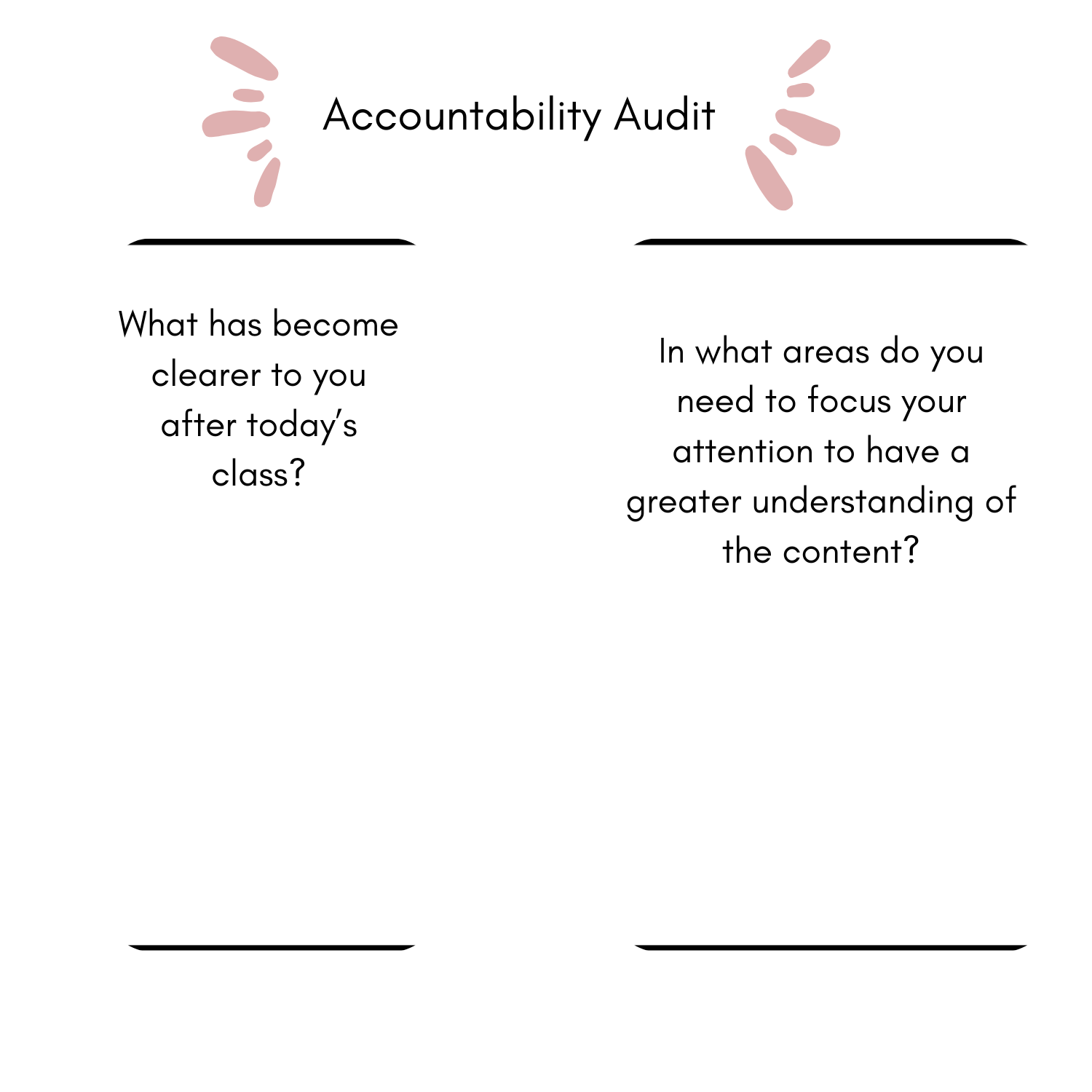
Accountability Audits. As a ticket out the door, students can complete an exit slip capturing their efforts for the day. Instructors may use the exit tickets as participation grades or as formative assessments to determine how students are understanding content. With larger courses, the instructor may elect to review a random sample of the work, telling students the work is about personal reflection and accountability. Exit slips may be handwritten or they may be done electronically.
Accountability Audit
One Last Word. Sometimes extra paper and written work just won’t work. An alternative is to ask individuals, or small groups of students, to suggest one word that sums up the main points of class. The main caveat is no word may be repeated. This one is fun, quick and pushes students to categorize their learning. Please consider a note of caution—this one can quickly turn into a small competition with individuals or groups trying to go first so “their” word is not shared by another group. Don’t worry—it’s all in good fun.
While engaging with content cannot be forced, finding tools that are interesting for students, focused enough for instructors to feel confident valuable class time is used productively and reinforces key points can make learning accessible to all.
Melissa Parks, PhD, is an associate professor of education at Stetson University in Deland, FL. Dr. Parks is an active member of the National Science Teaching Association (NSTA) and is currently a member of the NSTA Early Childhood- Elementary Science Teaching Committee. Her research interests include elementary pedagogies and environmental stewardship.
References
Deale, C. S., & Lee, S. H. (2021). To read or not to read? Exploring the reading habits of hospitality management students. Journal of Hospitality & Tourism Education, 34(1), 45–56. https://doi.org/10.1080/10963758.2020.1868317
Handelsman, M. M., Briggs, W. L., Sullivan, N., & Towler, A. (2005). A measure of college student course engagement. The Journal of Educational Research, 98(3), 184–192. https://doi.org/10.3200/JOER.98.3.184-192
Mizrachi, D., & Salaz, A. M. (2022). Reading format attitudes in the time of COVID. Journal of Academic Librarianship, 48(4), 102552. https://doi.org/10.1016/j.acalib.2022.102552
Parks, M. (2022). Drawing in college: Using sketchnoting to support student engagement. Faculty Focus. Magna Publications.
Severe, E., Stalnaker, J., Hubbard, A., Hafen, C. H., & Bailey, E. G. (2024). To participate or not to participate? A qualitative investigation of students’ complex motivations for verbal classroom participation. PloS one, 19(2), e0297771. https://doi.org/10.1371/journal.pone.0297771
Zepke, N., & Leach, L. (2010). Improving student engagement: Ten proposals for action. Active Learning in Higher Education, 11, 167-177. doi:10.1177/1469787410379680
How has the higher education faculty workforce changed over the past 20 years? What disciplines have emerged as frontrunners in hiring? What disciplines pay the most? What disciplines pay the least?
The disciplines of Health Professions and Business have experienced the most growth in number of faculty over the past 20 years. The number of faculty in Health Professions more than doubled from 2003-04 to 2023-24, and the number of Business faculty grew by 20.8% over the same period.
The disciplines of Theology, Liberal Arts and Humanities, and English Language/Literature are experiencing very little growth in terms of hiring new faculty. These disciplines also have high numbers of non-tenure-track faculty and are among the lowest-paying disciplines — all of which point to institutions’ divestment in these disciplines.
Business ranked among the top four highest-paid disciplines every year from 2003-04 to 2023-24 and has been the highest-paid discipline for the past nine years. In addition, Business saw the largest percentage increase in median salary across all disciplines, with an increase of 66.2% since 2003-04.
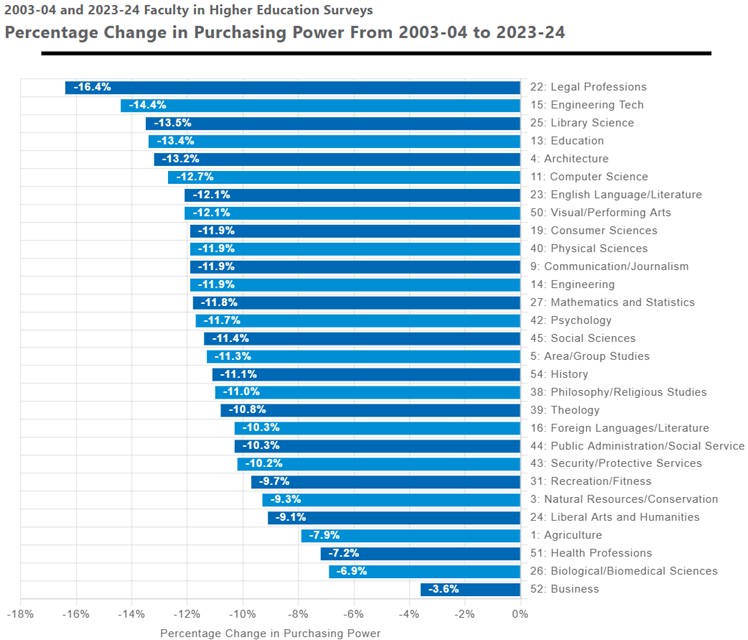
No discipline’s pay increases beat inflation. Although many disciplines appeared strong based on changes in size and salary over time, all disciplines reported median salaries in 2023-24 that were lower than inflation-adjusted salaries based on 2003-04 salary data. Overall, faculty in all disciplines have less purchasing power with their salaries in 2023-24 than they did in 2003-04.