Tag: Faculty

  • Florida’s Own DOGE Is Reviewing Faculty Research, Grants

    Florida’s Own DOGE Is Reviewing Faculty Research, Grants

    Elon Musk’s days with DOGE appear numbered—the unelected billionaire bureaucrat said Tuesday that his time spent leading the agency-gutting U.S. Department of Government Efficiency will “drop significantly” next month. As Tesla’s profits plummet, the world’s richest man faces opposition from both Trump administration officials and voters.

    DOGE’s legacy remains unclear. Lawsuits are challenging its attempted cuts, including at the U.S. Education Department. Musk seems to have scaled back his planned overall budget savings from $1 or $2 trillion to $150 billion, and it’s unclear whether DOGE will achieve even that.

    But something may outlive Musk’s DOGE: all the state iterations it has inspired, with legislators and governors borrowing or riffing off the name. Iowa’s Republican governor created the Iowa DOGE Task Force. Missouri’s GOP-controlled Legislature launched Government Efficiency Committees, calling them MODOGE on Musk’s X social media platform. Kansas lost the reference to the original doge meme when it went with COGE, for its Senate Committee on Government Efficiency.

    But, as with the federal version, the jokey names for these state offshoots may belie the serious impact they could have on governments and public employees—including state higher education institutions and faculty.

    To take perhaps the most glaring example, the sweeping requests from the Florida DOGE team, which is led by a former federal Department of Transportation inspector general, have alarmed scholars.

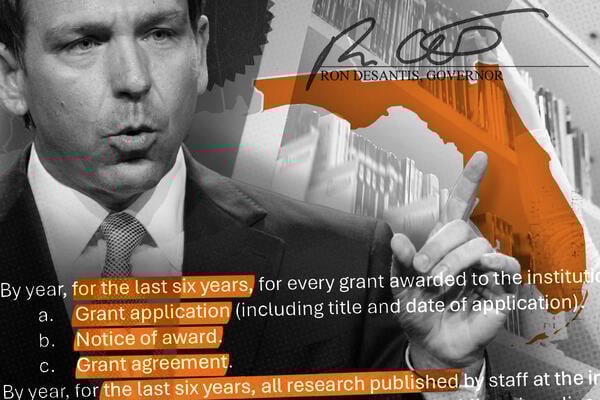
    Earlier this month, the Florida DOGE asked public college and university presidents to provide an account—by the end of last week—of “all research published by staff” over the last six years, including “Papers and drafts made available to the public or in online academic repositories for drafts, preprints, or similar materials.”

    “If not contained therein, author’s name, title, and position at the institution” must be provided, according to the letters the presidents received. The letters didn’t say what this and other requests were for.

    The Florida DOGE also requested information on all grants awarded to institutions over the last six years, asking for each institution’s policy on allocating grants “for purposes of indirect cost recovery, including procedures for calculation.” Further, it requested an account of “all filled and vacant positions held by any employee with a non-instructional role.”

    By the end of April, Florida’s public institutions must also provide the “Length of research associated” with each research publication, funding sources associated with the research and any “publications about the research” from the researcher or institution. In addition, the state DOGE is requesting funding sources for each institution’s noninstructional positions and the names of the nonstudent employees administering the grants.

    And that may not be the end of the DOGE demands. In a March 26 letter, the state DOGE team told college presidents that it will conduct site visits “to ensure full compliance” with the governor’s executive order that created it, “as well as existing Florida law.” It said it may in the future request various other information, including course descriptions, syllabi, “full detail” on campus centers and the required end of diversity, equity and inclusion activities.

    The requests so far from the Florida DOGE are the latest in a string of state actions that faculty say threaten to infringe on, or have already reduced, academic freedom. Dan Saunders, lead negotiator for the United Faculty of Florida union at Florida International University and a tenured associate professor of higher education, expressed concerns about what he called a “continuation of a chilling effect on faculty in terms of what we research and publish.”

    “The lack of any meaningful articulation as to why they’re looking for this data and what they’re going to do with it just adds to the suspicions that I think the state has earned from the faculty,” Saunders said. “It’s clear that this is part of a broader and multidimensional attack” on areas of scholarship such as women’s and gender studies—part of a “comprehensive assault” on the “independence of the university,” he said.

    “If Florida DOGE is following the patterns of the federal DOGE, then I think we can expect some radical oversimplifications of nuanced data and some cherry picking” of texts that an “unsophisticated AI will highlight,” he said. Noting how much research is published over six years, he questioned “how anyone is supposed to engage meaningfully” with that much information.

    David Simmons, president of the University of South Florida’s Faculty Senate and a tenured engineering professor, said many faculty are “reasonably” concerned that this request is part of an effort to target “certain ideas that are disfavored by certain politicians.” Simmons—who stressed that he’s not speaking on behalf of the Senate or his institution—said such targeting would be “fundamentally un-American and inconsistent with the mission of a public university.”

    “We hope that’s not happening. We hope this is just an inefficient effort to collect data,” Simmons said. He noted that much of the research information that the Florida DOGE is requesting is already publicly available on Google Scholar, an online database with profiles on faculty across the country.

    “Universities are being required to reproduce information that’s already freely available in some cases, and to do that they’re using considerable resources and manpower,” Simmons said. The initial two-week data request was “so large as to be nearly impossible” to fulfill, he added.

    A State University System of Florida spokesperson deferred comment to the DOGE team, which didn’t respond to Inside Higher Ed’s requests for an interview or provide answers to written questions Thursday. A spokesperson for the Florida Department of Education, which includes the Florida College System, deferred comment to Republican governor Ron DeSantis’s office, which responded via email but didn’t answer multiple written questions.

    “In alignment with previous announcements and correspondence with all 67 counties, 411 municipalities, and 40 academic institutions the Florida DOGE Task Force aims to eliminate wasteful spending and cut government bloat,” a DeSantis spokesperson wrote. “If waste or abuse is identified during our collaborative efforts with partnering agencies and institutions, each case will be handled accordingly.”

    ‘DOGE Before DOGE Was Cool’

    When Donald Trump returned to the White House in January and announced DOGE’s creation, he suggested it was an effort to cut the alleged waste his Democratic predecessor had allowed to fester. But DeSantis—who lost to Trump in the GOP presidential primary—launched his own DOGE in a state that he’s been leading for six years.

    “Florida was DOGE before DOGE was cool,” DeSantis posted on X Feb. 24. (His actions in higher education have, in many ways, presaged what Trump is now doing nationally.)

    So, perhaps not surprisingly, DeSantis’s executive order creating the Florida DOGE that day began by saying the state already has a “strong record of responsible fiscal management.” A list of rosy financial stats followed before DeSantis finally wrote, “Notwithstanding Florida’s history of prudent fiscal management relative to many states in the country, the State should nevertheless endeavor to explore opportunities for even better stewardship.”

    “The State of Florida should leverage cutting edge technology to identify further spending reductions and reforms in state agencies, university bureaucracies, and local governments,” DeSantis wrote, echoing, at least in language, the tech-focused approach of the federal DOGE.

    He established the DOGE team within the Executive Office of the Governor, tasking it in part to work with the statewide higher education agencies to “identify and eliminate unnecessary spending, programs, courses, staff, and any other inefficiencies,” including “identifying and returning unnecessary federal grant funding.” The executive order says state agencies must set up their own DOGE teams, which will identify grants “that are inconsistent with the policies of this State and should be returned to the American taxpayer in furtherance of the President’s DOGE efforts.”

    This executive order expires about a year from now. In an emailed statement, Teresa M. Hodge, the statewide United Faculty of Florida union president, said the request for faculty publication records “is not about transparency or accountability; it is about control.”

    “Our members should not be forced to defend their scholarship, or their silence, in a political witch hunt,” Hodge said. “We stand united in ensuring that Florida’s faculty are free to teach, conduct research, and to speak without fear of retaliation.”


    Source link

  • How You Can Habituate the Circular Model of Reflection: Before-Action, During-Action, After-Action, and Beyond-Action – Faculty Focus

    How You Can Habituate the Circular Model of Reflection: Before-Action, During-Action, After-Action, and Beyond-Action – Faculty Focus

    Source link

  • How You Can Habituate the Circular Model of Reflection: Before-Action, During-Action, After-Action, and Beyond-Action – Faculty Focus

    How You Can Habituate the Circular Model of Reflection: Before-Action, During-Action, After-Action, and Beyond-Action – Faculty Focus

    Source link

  • AI as an Educational Ally: Innovative Strategies for Classroom Integration – Faculty Focus

    AI as an Educational Ally: Innovative Strategies for Classroom Integration – Faculty Focus

    Source link

  • 5 High-Presence Teaching Tactics for Active Online Learning – Faculty Focus

    5 High-Presence Teaching Tactics for Active Online Learning – Faculty Focus

    Source link

  • 5 High-Presence Teaching Tactics for Active Online Learning – Faculty Focus

    5 High-Presence Teaching Tactics for Active Online Learning – Faculty Focus

    Source link

  • Two More Ways Faculty Are Using AI

    Two More Ways Faculty Are Using AI

    Reading Time: 3 minutes

    We recently shared three ways faculty are using generative AI (GenAI) to help them handle the more administrative aspects of their roles — gleaned from ongoing research that culminates in our annual Faces of Faculty report. This comprehensive report explores the professional landscape, challenges, and opportunities facing today’s higher education faculty. Over the past few years, we’ve learned that GenAI has enjoyed popularity among early adopting educators as: a tool for jumpstarting ideas and conversations with students; to help with differentiation of instruction for different learning levels and styles; and a tool for automating feedback. We’ve also learned that around half of instructors now hold a positive view of GenAI, up from just 28% in 2023, and we expect that the number is continuing to rise as more educators experiment with the tech.

    What are some other ways in which higher education faculty are using AI to lighten their professional loads? Here are two more use-cases we learned about: 

    GenAI to combat plagiarism and cheating

    Since GenAI arrived on the higher education scene in a meaningful way, faculty have been understandably frustrated by the ways in which students can use it to cheat and plagiarize the work of others. In fact, 82% of faculty in a recent report expressed concern about academic integrity and AI. An adjunct in Washington told us, “When students rely on AI instead of learning to write and study, they learn less. This is like giving kids a calculator before they know what it even means to add and subtract…” 

    Yet, we’re hearing from educators that a “fight fire with fire” approach can be really effective at combating plagiarism and cheating. Importantly, this involves having honest conversations with students about academic integrity and the value of original work and critical thinking. Many faculty are spending time explaining to students that while GenAI tools are often appealing as a quick fix, using them to cheat and plagiarize will only harm their chances of  academic success. Others are going beyond theory and integrating AI tools into their lessons; effectively asking students to use AI in an integral way, without sacrificing originality. 

    Some are taking it a step further, though, and are using AI to stay a step ahead of the cheaters by thinking as they do. Faculty are often cued into the possibility of plagiarism by virtue of essays and responses that contain verbatim key terms from prompt phrases, or by stilted and inauthentic word choice and syntax. Running a page of text through an AI detection tool can quickly flag which sentences, concepts or phrases have been “lifted” straight out of ChatGPT or other GenAI platforms. One article suggests that educators subtly obtain a baseline sample of each student’s authentic writing style and capabilities at the start of the term, so that any potential plagiarism becomes far more obvious. 

    A faculty member at Purdue summarized the nature of the plagiarism challenge in a blog post.  “I realized that 80-90% of the assignment I had created for my courses could now be readily answered by AI…We are now thinking about how we can make our courses both AI-amplified and AI-resilient.”  

    AI for routine administrative tasks 

    “Judicious use of AI tools will make many tasks less burdensome. Good AI results depend on detailed and well-crafted prompts.” – Instructor, North Carolina

    In 2023, over half (58%) of instructors reported wanting to use AI for administrative tasks. As the overall popularity of GenAI has risen among educators, we expect that more and more are also now using GenAI tools to lessen their admin burden. What does this look like, and how can faculty use AI to make professional life easier on the administrative side of things? 

    A few AI-powered tasks we heard about from survey respondents include:

    • Scheduling office hours or emails

    AI calendar features can help educators optimize their workday by scheduling time blocks that are based on patterns and urgency. It can also deploy automated responses to routine student queries based on certain words and phrases. This simple use-case allows educators to find better work-life balance, avoid scheduling conflicts, and divide their time and attention fairly among the students and situations that most require it.

    • Reviewing and refining recommendations, resumes and cover letters

    Asking AI to write a recommendation, resume or cover letter borders on the unethical, but using AI to review these documents and suggest enhancements seems like a smart use of time and technology, and one that can benefit students while saving educators time.

    • Building reading lists or providing additional learning resources

    While its results aren’t always perfect, GenAI pulls from a virtually infinite pool of resources to generate lists and recommendations for users. So, no matter how seasoned or well-read an educator may be, AI can offer a helpful starting point for suggesting comprehensive resources and reading material that can benefit students.


    Wondering how else AI can support you?

    Check out our part 1 article: Three Ways Faculty Are Using AI to Lighten Their Professional Load. It highlights three practical ways instructors are putting AI to work — helping them save time, streamline tasks and refocus on what matters most.


    Source link

  • This week in 5 numbers: Another year of growth for faculty salaries

    This week in 5 numbers: Another year of growth for faculty salaries

    The amount in federal grants the Trump administration froze for Harvard University this week. The move came after the Ivy League institution refused to comply with federal officials’ demands to, among other things, eliminate diversity initiatives, curtail the power of some faculty and audit the viewpoints of students and employees.

    Source link

  • Taking Grades (Stress) Out of Learning – Faculty Focus

    Taking Grades (Stress) Out of Learning – Faculty Focus

    Source link

  • Can Universities Still Diversify Faculty Hiring Under Trump?

    Can Universities Still Diversify Faculty Hiring Under Trump?

    Before Donald Trump retook office, advocates of a more demographically diverse U.S. professoriate were already criticizing existing hiring efforts as inadequate. One late-2022 paper in Nature Human Behaviour noted that, at recent rates, “higher education will never achieve demographic parity among tenure-track faculty.”

    One example of the disparity: As of November 2023, only 8 percent of U.S. assistant professors were Black, according to the College and University Professional Association for Human Resources. That’s significantly less than Black representation in the U.S. population, currently estimated by the Census to be 13.7 percent. And the CUPA-HR data showed that the Black share of tenure-track and tenured professors decreases as rank increases—only 5 percent of associate professors and 3.6 percent of full professors were Black. 

    Efforts that institutions have made to racially diversify their faculties drew political backlash well before Trump regained the White House, with activists, organizations and some faculty criticizing university hiring practices and state legislatures passing laws banning affirmative action and/or diversity, equity and inclusion initiatives. The goal of a more representative faculty slipped further out of reach starting on Inauguration Day, when Trump issued executive orders targeting DEI, including what he dubbed “illegal DEI discrimination.”

    His administration’s crusade has continued, including with a letter Friday demanding that Harvard University end all DEI initiatives, “implement merit-based hiring policies” and “cease all preferences based on race, color, religion, sex, or national origin throughout its hiring, promotion, compensation, and related practices.” (Harvard has refused to comply with Trump’s orders, which go far beyond hiring, and the federal government has frozen part of the university’s funding and threatened its tax-exempt status.)

    Given the current political situation—not just nationally, but also among the growing number of states with DEI and/or affirmative action restrictions—how can higher ed institutions continue to diversify their faculties?

    “I think that’s the question of the day: What’s lawful, what’s legal, what might subject an institution to investigation by the investigatory arms of the federal government?” said Paulette Granberry Russell, president and chief executive officer of the National Association of Diversity Officers in Higher Education, which is among the organizations suing over Trump’s anti-DEI executive orders.

    “Is it purposeful that this administration has chosen ambiguity?” Granberry Russell asked. “Or left [us] to guess what they intend by ‘illegal DEI’? Is diversifying our campuses on its face illegal DEI?”

    So far, the administration has not clarified where the line is. On Feb. 14, the U.S. Education Department published a Dear Colleague letter declaring that the department interprets the Supreme Court’s 2023 decision banning race-conscious admissions as applicable to other areas of higher ed, including hiring, promotion and compensation. That letter is facing legal challenges. The department later released a frequently-asked-questions document further explaining its position, but that guidance didn’t discuss hiring practices.

    In response to a request for an interview and written questions, Harrison Fields, special assistant to the president and principal deputy press secretary, wrote in an email to Inside Higher Ed, “President Trump is working to Make Higher Education Great Again by ending unchecked anti-Semitism and ensuring federal taxpayer dollars do not fund higher education institutions’ support for dangerous racial discrimination or racially motivated violence. Any institution violating Title VI is, by law, ineligible for federal funding.” (Title VI bans discrimination based on, among other things, shared ancestry, including antisemitism.)

    Madi Biedermann, deputy assistant secretary for communications at the U.S. Education Department, told Inside Higher Ed, “It is illegal to make decisions on the basis of race.”

    She said the department isn’t providing any additional guidance at this point beyond the text of the executive orders, the Dear Colleague letter, the FAQ, Title VI of the Civil Rights Act of 1964 and the 2023 Supreme Court ruling.

    Also, in an FAQ titled “What You Should Know About DEI-Related Discrimination at Work,” the U.S. Equal Employment Opportunity Commission writes that, under Title VII of the Civil Rights Act, DEI “practices may be unlawful if they involve an employer or other covered entity taking an employment action motivated—in whole or in part—by an employee’s or applicant’s race, sex, or another protected characteristic.” In addition, it says that Title VII’s protections aren’t just for minority groups.

    Adrianna Kezar, a professor of higher education and director of the Pullias Center for Higher Education at the University of Southern California, said in an email that there isn’t “universal understanding” across campuses of the current hiring rules.

    “In states like California (and others), affirmative action in hiring is illegal. In other states, it remains legal until the Trump dear colleague letter becomes the legal interpretation,” Kezar wrote. But she said some states “are already complying even though that has not become the law of the land.”

    “Right now, everything is still murky,” she added.

    Tres Cleveland, a partner at the Thompson Coburn law firm who represents higher education clients, said most of them are trying to stay “in the good graces of the Department of Education or other regulators, and it’s a challenge at this point.” Cleveland said the “rules of the road” are “changing almost daily.”

    Damani White-Lewis, an assistant professor at the University of Pennsylvania Graduate School of Education, said, “There’s genuinely no consensus” on what’s barred under the Trump administration with regard to hiring that wasn’t prohibited before.

    “I wanted to do a project of: If you asked, like, 10 different legal counsels, what sorts of answers would they come to and how did they make sense of them?” White-Lewis said. “Because that’s just how different folks are, and some are more conservative, some are a little more progressive on this issue.”

    For colleges and universities, faculty diversification isn’t just an end in itself; studies have found positive benefits for students. So, what can institutions do to continue diversifying faculties? Experts pointed to fundamentals such as active recruiting, structured hiring processes and more.

    Casting a Wide Net

    While Granberry Russell of NADOHE criticized the Trump administration’s “ambiguity,” she said that actively seeking a diverse applicant pool still seems acceptable. In recruitment, she said, “you’re not making a decision; you’re just saying, ‘Apply for this position.’”

    “There’s nothing, at least on its face, that would appear to prohibit recruitment efforts,” she said. (The Education Department has, however, targeted dozens of universities for allegedly supporting the PhD Project, which was accused of barring white or Asian prospective doctoral students from a recruitment conference.)

    Kezar, at the University of Southern California, wrote in an email that while recruitment strategies still seem to be a viable way to attract diverse candidates, “some of the approaches that people have been relying on, they don’t feel comfortable with because they are being targeted.”

    Granberry Russell echoed this concern, saying that, out of fear of investigations, “people are being very, very conservative in how they approach faculty searches.”

    Denise Sekaquaptewa, director of the University of Michigan’s ADVANCE Program, a faculty diversity initiative, wrote in an email that “approaches which may still be viable” include disseminating job announcements “to outlets where [they] may reach a wide range of excellent candidates.”

    White-Lewis, of the Penn Graduate School of Education, said there’s a “pervasive myth” that there aren’t enough graduate students of color to diversify faculties. He called it a “no-brainer” for institutions to invest in postdoctoral fellows and postdoctoral researchers—a stepping-stone to permanent faculty jobs.

    “That’s a very perceivably neutral avenue of thinking about how we can increase opportunities for postdoctoral funding—given their crucial nature within not just medicine but other STEM fields as well, where postdocs are more pervasive,” White-Lewis said. “And that gives everybody more opportunities to research, write and publish and become more competitive for faculty jobs.”

    He said he thinks postdoctoral programs “specifically devoted to minoritized hiring” will be difficult to continue. Multiple experts Inside Higher Ed interviewed suggested institutions should avoid saying in any faculty job advertisements that they’re specifically seeking to hire faculty of color or of a specific race.

    “The devil is all in the details with this,” said Scott Goldschmidt, another higher ed specialist partner at Thompson Coburn. He said institutions have to weigh the risks of litigation and administrative action, especially when it comes to public job ads.

    Goldschmidt said there are other hiring considerations that job ads could include that might lead to diverse hires, such as socioeconomic status and experience working with diverse populations. But he believes the Trump administration would also argue that such factors can’t be used as proxies for race. The hiring criteria should be narrowly tailored to the job, and the search and hiring process must be conducted in a race-neutral manner, Goldschmidt said.

    “It has to be a truly open process,” he said. “The conditions there can’t be there to kind of serve as a way to unlawfully discriminate.”

    White-Lewis suggested that faculty searches consider evaluating applicants’ experience with mentoring marginalized populations first. But that doesn’t mean their teaching and research records should be discounted.

    “It’s very difficult to be a mentor if you don’t have research funding, right?” he said. “And so these things go hand in hand. What I’m suggesting is to make the evaluation of mentoring capabilities noteworthy instead of it being subsidiary.”

    He also said that, when considering what positions to hire, administrators and faculty should think about how to align the department’s needs—in research, teaching and service—with areas where minoritized scholars are more represented.

    “It’s not always just going after Indigenous studies or ethnic studies or Africana studies, because that clumps diversity within a few departments, but psychology, English, sociology, arts, even biology in terms of health disparities,” White-Lewis said. “Health disparity searches have been the thing that have historically driven faculty diversity in the sciences, and it can still continue because health disparities still exist.”

    Some said using diversity statements in hiring is likely a no-go under the Trump administration, whose demands to Harvard included abolishing in hiring practices “all criteria, preferences, and practices” that “function as ideological litmus tests”—a common critique of diversity statements. Republican-controlled legislatures in multiple states have banned them.

    “They’re dead,” said Musa al-Gharbi, a research fellow at Heterodox Academy and an assistant professor in Stony Brook University’s School of Communication and Journalism. He noted that even the University of California system has stepped away from them.

    Furthermore, al-Gharbi said, “A lot of this stuff which is now rendered illegal … doesn’t really work well anyway. Some of the efforts that we take to promote diversity, equity and inclusion in higher ed actually create a hostile environment for the same people that we’re trying to include.”

    He said that people of color and people from lower-income backgrounds are more likely to be socially conservative and religious than people who are currently better represented in academe, adding that “some of these diversity challenges around viewpoint diversity and demographic diversity are actually intimately interrelated.”

    “But we also should nonetheless advocate for the goals of diversity and inclusion” and try to think up better alternatives, al-Gharbi said. Still, that’s hard when the Trump administration has basically “villainized,” “censored” and “demeaned” anything associated with DEI.

    “This isn’t a smart bomb,” he said. “It’s a chain saw.”

    Source link