Our most recent research into the working lives of faculty gave us some interesting takeaways about higher education’s relationship with AI. While every faculty member’s thoughts about AI differ and no two experiences are the same, the general trend we’ve seen is that faculty have moved from fear to acceptance. A good deal of faculty were initially concerned about AI’s arrival on campus. This concern was amplified by a perceived rise in AI-enabled cheating and plagiarism among students. Despite that, many faculty have come to accept that AI is here to stay. Some have developed working strategies to ensure that they and their students know the boundaries of AI usage in the classroom.
Early-adopting educators aren’t just navigating around AI. They have embraced and integrated it into their working lives. Some have learned to use AI tools to save time and make their working lives easier. In fact, over half of instructors reported that they wanted to use AI for administrative tasks and 10% were already doing so. (Find the highlights here.) As more faculty are seeing the potential in AI, that number has likely risen. So, in what ways are faculty already using AI to lighten the load of professional life? Here are three use-cases we learned about from education professionals:
AI to jumpstart ideas and conversations
“Give me a list of 10 German pop songs that contain irregular verbs.”
“Summarize the five most contentious legal battles happening in U.S. media law today.”
“Create a set of flashcards that review the diagnostic procedure and standard treatment protocol for asthma.”
The possibilities (and the prompts!) are endless. AI is well-placed to assist with idea generation, conversation-starters and lesson materials for educators on any topic. It’s worth noting that AI tends to prove most helpful as a starting point for teaching and learning fodder, rather than for providing fully-baked responses and ideas. Those who expect the latter may be disappointed, as the quality of AI results can vary widely depending on the topic. Educators can and should, of course, always be the final determinants and reviewers of the accuracy of anything shared in class.
AI to differentiate instruction
Faculty have told us that they spend a hefty proportion (around 28%) of their time on course preparation. Differentiating instruction for the various learning styles and levels in any given class constitutes a big part of that prep work. A particular lesson may land well with a struggling student, but might feel monotonous for an advanced student who has already mastered the material. To that end, some faculty are using AI to readily differentiate lesson plans. For example, an English literature instructor might enter a prompt like, “I need two versions of a lesson plan about ‘The Canterbury Tales;’ one for fluent English speakers and one for emergent English speakers.” This simple step can save faculty hours of manual lesson plan differentiation.
An instructor in Kansas shared with Cengage their plans to let AI help in this area, “I plan to use AI to evaluate students’ knowledge levels and learning abilities and create personalized training content. For example, AI will assess all the students at the beginning of the semester and divide them into ‘math-strong’ and ‘math-weak’ groups based on their mathematical aptitude, and then automatically assign math-related materials, readings and lecture notes to help the ‘math-weak’ students.”
When used in this way, AI can be a powerful tool that gives students of all backgrounds an equal edge in understanding and retaining difficult information.
AI to provide feedback
Reviewing the work of dozens or hundreds of students and finding common threads and weak spots is tedious work, and seems an obvious area for a little algorithmic assistance.
Again, faculty should remain in control of the feedback they provide to students. After all, students fully expect faculty members to review and critique their work authentically. However, using AI to more deeply understand areas where a student’s logic may be consistently flawed, or types of work on which they repeatedly make mistakes, can be a game-changer, both for educators and students.
An instructor in Iowa told Cengage, “I don’t want to automate my feedback completely, but having AI suggest areas of exigence in students’ work, or supply me with feedback options based on my own past feedback, could be useful.”
Some faculty may even choose to have students ask AI for feedback themselves as part of a critical thinking or review exercise. Ethan and Lilach Mollick of the Wharton School of the University of Pennsylvania share in an Harvard Business Publishing Education article, “Though AI-generated feedback cannot replicate the grounded knowledge that teachers have about their students, it can be given quickly and at scale and it can help students consider their work from an outside perspective. Students can then evaluate the feedback, decide what they want to incorporate, and continue to iterate on their drafts.”
AI is not a “fix-all” for the administrative side of higher education. However, many faculty members are gaining an advantage and getting some time back by using it as something of a virtual assistant.
Are you using AI in the classroom?
In a future piece, we’ll share 3 more ways in which faculty are using AI to make their working lives easier. In the meantime, you can fully explore our research here:
Supporting biology courses for non-majors involves addressing the diverse needs of students with little intrinsic motivation to study the subject. Many take these courses as part of general education, not personal interest, creating a challenge in maintaining engagement and fostering deeper understanding (Haak et al. 2011). Non-majors often struggle to connect course content to their lives, making it harder to see the subject’s value (Labrov and Singer, 2010). These students come from varied academic backgrounds, resulting in different levels of preparedness and confidence (Tobias 1990; Gormally and Heil 2022). Some may experience anxiety or feel science is irrelevant to their careers (Rice et al. 2013).
To address these challenges, educators must adopt approaches that make biology accessible and meaningful. By creating a learning environment tailored to various majors, addressing barriers, and demonstrating real-world applications, instructors can make the classroom “YOUnique.” Making the classroom “YOUnique” tailors the experience to individual needs, fostering belonging and showing biology’s relevance. This article explores how strategies—fostering engagement, connecting biology to real-world contexts, and to students’ majors—can support non-major biology students. These strategies will help students build confidence to apply biological knowledge in their careers.
1. Fostering Engagement in Non-Major Biology Students through a Studio Environment
Engaging students not inherently drawn to biology requires innovative teaching methods. Active learning strategies, where students actively engage in the learning process, promote participation and retention (Freeman et al. 2014). These include group discussions, hands-on experiments, problem-solving activities, and creative assessments that encourage critical thinking and peer collaboration.
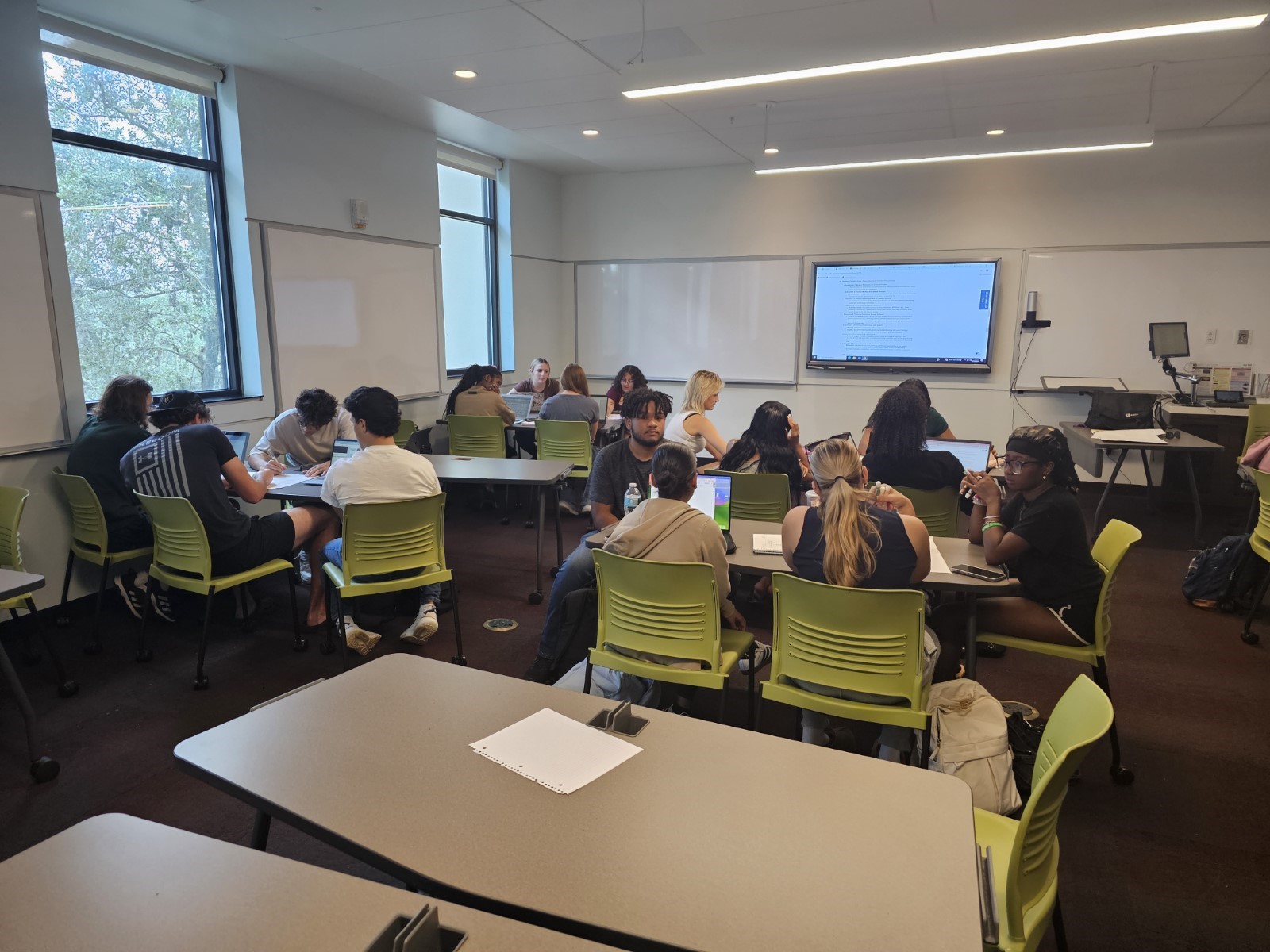
A case study of engagement is the studio-style introductory biology classroom at Kansas State University (Manhattan, KS, USA). This innovative teaching environment blends engaged lectures with hands-on, collaborative activities, with the instructor as a facilitator. The studio integrates lecture, lab, and group work in a flexible learning environment, allowing students to actively participate in problem-solving, discussions, and projects, and it supports diverse learning activities and styles. This approach fosters an interactive environment which is beneficial for student learning.
Here are some ways the studio-style classroom helps non-major biology students:
Active Learning: The classroom setup encourages active engagement, helping non-majors grasp complex biological concepts through hands-on experiences, computer tutorials, and group activities, rather than passive listening.
Collaborative Learning: Students work in small groups, promoting peer interaction and problem-solving, which supports non-majors who may feel less confident in their knowledge.
Integrated Learning: Combining lecture and lab time allows students to apply theoretical knowledge to practical experiments, helping solidify learning and making complex concepts more understandable.
Personalized Attention: The instructor can circulate among groups, providing targeted support and reassurance, which is especially beneficial for non-majors needing more guidance.
Flexible Space: The studio classroom’s flexibility to use various technology allows instructors to adapt teaching styles and activities, ensuring responsiveness to the diverse needs of non-major students.
2. Connecting Biology to Real-World Contexts
For non-majors, understanding how biology applies to everyday life is crucial for maintaining interest and motivation. Without a clear connection to their personal or professional lives, students may view biology as abstract or irrelevant. By demonstrating how biological principles impact their world, educators can foster greater engagement. When students recognize the value of what they are learning—whether through daily applications or career relevance—they are more likely to stay motivated, actively participate, and retain information.
A highly effective way to establish relevance is through interdisciplinary connections that show how biology extends beyond the classroom (Beers and Jensen 2009; Morales and Boulware 2020). Prior to the first day of class, there is a discussion board asking why biology is important to them, and instructors use the responses as an avenue to connect biology and their lives during a class discussion. For every class period, the instructor connects what they are learning to their lives. For instance, using a computer simulation called “Kansas feeds the world” students can explore how photosynthesis and cellular respiration (cell biology unit), along with energy and nutrient dynamics (ecology unit), interconnect with real world issues. In the genetics unit, students connect molecular genetics and biotechnology using an assignment where the students develop a biotechnology product and generate a print ad or video commercial. The ads are shared during class, showcasing how biological processes can drive innovations like medical devices and biofuels. Each unit follows a pattern of building basic knowledge followed by exploring implications and applications to people’s lives.
Another effective method is case-base active learning (Chaplin 2009; Dewi and Rahayu 2023). Presenting real-world scenarios, like infectious diseases or genetic testing, makes biology come alive. For example, the instructors use a readily available MMR vaccine autism case study to explore the process of science, and let students come to their own conclusions about vaccine efficacy.
Inviting guest speakers from diverse fields can help students see biology’s broad applications (D’Andrea and Mertens 2006; Marx et al. 2021). For example, we have graduate students presenting on the benefits of “long-term ecological research stations” (LTERs) such as the Konza Prairie Biological Center (Kansas, USA), or the Scientist Spotlights, which is biography about them and their research showing that biologists are real people. These speakers not only provide real-life examples but also inspire students to think critically about how biological knowledge could inform their own career aspirations. Hearing from professionals at the intersection of biology and their disciplines broadens students’ perspectives, reinforcing biology’s fundamental role in life and work.
3. Demonstrating Relevance to Students’ Majors
For non-majors, a significant barrier to success in biology is the perception that the subject lacks relevance to their lives or careers (Gormally and Hall 2022). Students in fields like business, art, or education may struggle to see how topics like cellular respiration or ecology apply to their goals, which can hinder motivation and engagement.
To address this challenge, educators must emphasize biology’s connections to different majors and to generate connections that have career relevance. Highlighting interdisciplinary applications, such as the role of biology in public health (communications majors), technology (computer science majors), or environmental policy (pollical science majors), can help students appreciate its broad impact. For example, a lesson on climate change might include discussions on the biological effects of carbon emissions, connecting the topic to social and economic issues like the displacement of communities due to rising sea levels and the economic costs of extreme weather events, such as hurricanes and wildfires.
Another effective approach is personalized assignments (Driessen et al. 2024). Personalized projects allow students to explore biology in ways that resonate with their own lives. One such assignment is a “Biology Connections” activity, where students reflect on how biological concepts connect to their major and career. For example, a business student might describe how ecological sustainability impacts corporate strategies, while an education major might reflect on the importance of understanding human development in teaching practices. This reflection promotes motivation, showing students that biology has practical applications in their daily lives and careers. These personalized assignments allow instructors to make biology “YOUnique”.
Conclusion
Supporting non-major biology students requires efforts to foster engagement, connect material to real-world contexts, and demonstrate relevance to different majors and backgrounds. Active learning, real-world connections, and ties to their major create a supportive environment where students thrive. By addressing unique challenges and interests, educators can empower non-majors to appreciate biology’s relevance and develop skills beyond the classroom. When students see content as meaningful and tied to their lives and careers, they are more likely to engage, retain knowledge, and apply it. This approach enhances understanding and equips them with critical thinking and problem-solving skills essential in any profession. By “Making the Classroom YOUnique,” educators can foster an environment where students feel valued, leading to greater motivation, academic achievement, and personal growth. A “YOUnique” approach helps students connect with the subject matter and realize their potential as learners in the biology classroom, regardless of their major.
Jack Sytsma is a doctoral graduate teaching assistant in the Division of Biology at Kansas State University. While his research is at the forefront of understanding how plants respond to climate, Jack is equally passionate about teaching. He finds great fulfillment in educating and mentoring undergraduate students, particularly in courses that bridge ecological principles with real-world applications. With aspirations of becoming a teaching professor in biology, Jack aims to inspire the next generation of scientists by fostering curiosity and a deeper understanding of the subject.
Robert ‘Robbie’ Bear is a Senior Biology Instructor in the Division of Biology at Kansas State University. Robbie started teaching 33 years ago as an undergraduate and ever since then he has synthesized his experiences on either side of the podium into his pedagogy of an inquiry-based student centered learning. He is currently teaching his dream course and finds happiness and purpose in people discovering the importance of Biology in their life. In the remaining years of his career, Robbie wants future educators (the Jack Sytsma’s) to have the foundational pedagogy that allows them to explore, grow, and succeed as teachers.
Eve S. McCulloch, PhD, is a teaching associate professor in the Division of Biology at Kansas State University. Eve has been teaching biology courses for 12 years, ranging from introductory to upper-level classes. Eve’s research background is in mammalogy, ecology, and conservation genetics. She is in her dream job, working to support undergraduate students both in and outside of the classroom. Eve is passionate about making the biological sciences accessible to students of all backgrounds and fields of interest, and promoting undergraduate student success while at university at beyond.
References
Armstrong, N., and S. M. Chang. “Teaching Non-Majors Biology: Pedagogical Challenges and Opportunities.” Journal of College Science Teaching (2007).
Beers, S. F., and M. Jensen. “Integrating Science and Literacy: Enhancing Understanding of Science Through Interdisciplinary Instruction.” Science Scope 32, no. 2 (2009): 20-27.
Brewer, C. A., and D. Smith. Vision and Change in Undergraduate Biology Education: A Call to Action (2011).
Chaplin, S. “Assessment of the Impact of Case Studies on Student Learning Gains in an Introductory Biology Course.” CBE—Life Sciences Education 8, no. 3 (2009): 297–306.
Cooper, K. M., et al. “The Impact of Active Learning on Retention of Non-Majors in Biology” (2019).
Cotner, S., S. Thompson, and R. Wright. “Do Biology Majors Really Differ from Non–STEM Majors?” CBE—Life Sciences Education 16, no. 3 (2017): ar48.
D’Andrea, M. L., and D. M. Mertens. “Creating Meaningful Connections: The Role of Guest Speakers in the Classroom.” Journal of College Science Teaching 35, no. 1 (2006): 40–45.
Dewi, C.A., and S. Rahayu. “Implementation of Case-Based Learning in Science Education: A Systematic Review” (2023).
Driessen, E. P., K. E. Walker, T. Hallman, A. Casper, S. L. Eddy, J. R. Schneider, and A. K. Lane. “‘It’s Been a Process’: A Multiple Case Study of Biology Instructor Efforts to Reform Their Sex and Gender Curriculum to be More Inclusive of Students with Queer Genders and Intersex Students.” CBE—Life Sciences Education 23, no. 4 (2024): ar51.
Freeman, S., et al. “Active Learning Increases Student Performance in Science, Engineering, and Mathematics.” Proceedings of the National Academy of Sciences 111, no. 23 (2014): 8410–8415.
Gormally, C., and A. Heil. “A Vision for University Biology Education for Non-Science Majors.” CBE—Life Sciences Education 21, no. 4 (2022): es5.
Haak, D. C., J. HilleRisLambers, E. Pitre, and S. Freeman. “Increased Structure and Active Learning Reduce the Achievement Gap in Introductory Biology.” Science 332, no. 6034 (2011): 1213-1216.
Labov, J. B., and S. R. Singer. “Community Colleges in the Evolving STEM Education Landscape” (2010).
Marx, M. A., R. L. Glaser, C. E. Moran, and K. P. Tucker. “A Creative Model for an Interdisciplinary Approach to Service-Learning.” Integrative and Comparative Biology 61, no. 3 (2021): 1028-1038.
Morales, E., and R. Boulware. “A Cross-Disciplinary Approach to Teaching Biology and Environmental Science: The Intersection of Biology and Policy.” Journal of College Science Teaching 49, no. 6 (2020): 40–47.
Rice, L., J. M. Barth, R. E. Guadagno, G. P. Smith, and D. M. McCallum. “The Role of Social Support in Students’ Perceived Abilities and Attitudes Toward Math and Science.” Journal of Youth and Adolescence 42, no. 7 (2013): 1028–1040.
Tobias, S. They’re Not Dumb, They’re Different: Stalking the Second Tier (1990).
I’ve tried a few different techniques for class discussions over the years, some that I’ve written about previously in Faculty Focus. In recent years, I’ve dialed in a 3-step process for discussion in my face-to-face classes, which has helped me create an engaged classroom climate. It’s Think-Pair-Share (TPS), with some upgrades.
I refined my TPS process after attending Jeremy Rentz’s workshop “Put Your Hammer Down” (detailed in the Best of the 2021 Teaching Professor Conference). His key idea was “The person doing the learning is the person doing the work.” I thought about how to get my students to do more “work” in my large lecture-based classes. Although I knew the active learning benefits of a technique like TPS, I struggled to implement it well. There were often too many awkward silences for TPS to be as engaging as I would have liked. After Jeremy’s workshop, I made some upgrades to TPS that invigorated it for students and for me.
Step #1: Think Upgrade: Discussion Bubbles
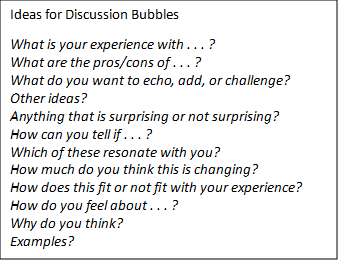
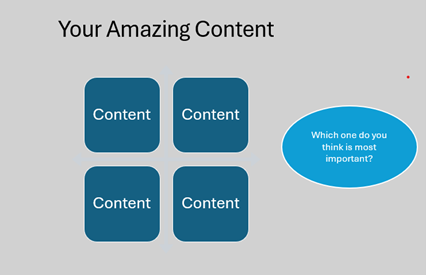
Instead of posing my discussion question after I’ve covered the content on my slide, I now put the question in a Discussion Bubble next to the content. Prior to implementing this, I would review the slide and then pose my question, either a specific one, or something general like “anyone have anything to add?” Then there would be the awkward silence while students think, and I would try to be chill. Having a Discussion Bubble primes students to think and be ready to share (in small or large groups) once I’m done reviewing the slide. It not only decreases the awkwardness (which seems to feed off itself), but it also increases small and large group discussion participation.
Sometimes these discussion bubbles include a polling question that I use to record and display students’ opinions (e.g., Do you prefer a, b, or c?). Students can then see that they are not alone in their views and are more confident to share their perspectives in Steps 2 and 3.
Step #2: Pair Upgrade: 1-Minute Timer
I give students one minute to talk with classmates about their thoughts on the discussion bubble or their answer to the polling question. On the very first day, I tell students that I will use my watch to set a 1-minute timer and that we’ll have a few of these in every class. I believe that these short, reliable segments help students feel safe and avoid too-lengthy, awkward small-talk. At the end of the one-minute paired discussion, I don’t check to see if they need more time as I have large classes, and the level of discussion is variable. In recent course surveys (classes of 90-175 students), about 70% of students wanted to keep these 1-minute discussions and only 13% wanted to change them (some were undecided). Further, about 44% of students agreed that these 1-minute discussions helped them feel more connected to their classmates (42% had mixed or neutral feelings) and 63% said they were comfortable sharing in class. So, it’s not perfect for everyone, but it’s benefiting many students. Also, I don’t have students pair off every time that I have a discussion bubble—sometimes I skip Step 2 and go straight to Step 3.
After Step 1 and maybe 2, I incentivize large group discussion with an extra credit point for sharing aloud. I’ve written previously about my Fired-Up and Ready to Discuss process, which involves giving students up to 1 point each class (and 3-5 points total for the semester) for sharing aloud. I have undergraduate teaching assistants present and poised to enter the student’s point into the gradebook as soon as they say their name and share (and if they forget, they can find the teaching assistants after class). It’s an immediate reward that encourages sharing in a large class. Only about ½ of students in my large classes share aloud and earn Fired-up Points, but in a class of 100 students, getting 50 to talk aloud is enough to create an engaging classroom climate. In recent surveys, 70% of the students want to keep Fired Up (and only about 10% want to change it).
This upgraded TPS not only helps students “do the work,” but it also makes for a fun and engaging class. It gives my lectures a predicable rhythm that creates psychological safety for student engagement. It also helps me stay confident and relaxed, which isomorphically encourages students to relax and take the risk to share their thoughts.
Dr. Ashley Harvey is a professor in the Department of Human Development and Family Studies at Colorado State University (CSU). Since 2007, she has taught more than 10,000 students across 15 different courses in over 150 undergraduate and graduate sections. Dr. Harvey has spoken at TEDx, is a licensed marriage and family therapist, and earlier in her career worked at the CSU Veterinary Teaching Hospital as a grief counselor and educator.
I’ve tried a few different techniques for class discussions over the years, some that I’ve written about previously in Faculty Focus. In recent years, I’ve dialed in a 3-step process for discussion in my face-to-face classes, which has helped me create an engaged classroom climate. It’s Think-Pair-Share (TPS), with some upgrades.
I refined my TPS process after attending Jeremy Rentz’s workshop “Put Your Hammer Down” (detailed in the Best of the 2021 Teaching Professor Conference). His key idea was “The person doing the learning is the person doing the work.” I thought about how to get my students to do more “work” in my large lecture-based classes. Although I knew the active learning benefits of a technique like TPS, I struggled to implement it well. There were often too many awkward silences for TPS to be as engaging as I would have liked. After Jeremy’s workshop, I made some upgrades to TPS that invigorated it for students and for me.
Step #1: Think Upgrade: Discussion Bubbles
Instead of posing my discussion question after I’ve covered the content on my slide, I now put the question in a Discussion Bubble next to the content. Prior to implementing this, I would review the slide and then pose my question, either a specific one, or something general like “anyone have anything to add?” Then there would be the awkward silence while students think, and I would try to be chill. Having a Discussion Bubble primes students to think and be ready to share (in small or large groups) once I’m done reviewing the slide. It not only decreases the awkwardness (which seems to feed off itself), but it also increases small and large group discussion participation.
Sometimes these discussion bubbles include a polling question that I use to record and display students’ opinions (e.g., Do you prefer a, b, or c?). Students can then see that they are not alone in their views and are more confident to share their perspectives in Steps 2 and 3.
Step #2: Pair Upgrade: 1-Minute Timer
I give students one minute to talk with classmates about their thoughts on the discussion bubble or their answer to the polling question. On the very first day, I tell students that I will use my watch to set a 1-minute timer and that we’ll have a few of these in every class. I believe that these short, reliable segments help students feel safe and avoid too-lengthy, awkward small-talk. At the end of the one-minute paired discussion, I don’t check to see if they need more time as I have large classes, and the level of discussion is variable. In recent course surveys (classes of 90-175 students), about 70% of students wanted to keep these 1-minute discussions and only 13% wanted to change them (some were undecided). Further, about 44% of students agreed that these 1-minute discussions helped them feel more connected to their classmates (42% had mixed or neutral feelings) and 63% said they were comfortable sharing in class. So, it’s not perfect for everyone, but it’s benefiting many students. Also, I don’t have students pair off every time that I have a discussion bubble—sometimes I skip Step 2 and go straight to Step 3.
After Step 1 and maybe 2, I incentivize large group discussion with an extra credit point for sharing aloud. I’ve written previously about my Fired-Up and Ready to Discuss process, which involves giving students up to 1 point each class (and 3-5 points total for the semester) for sharing aloud. I have undergraduate teaching assistants present and poised to enter the student’s point into the gradebook as soon as they say their name and share (and if they forget, they can find the teaching assistants after class). It’s an immediate reward that encourages sharing in a large class. Only about ½ of students in my large classes share aloud and earn Fired-up Points, but in a class of 100 students, getting 50 to talk aloud is enough to create an engaging classroom climate. In recent surveys, 70% of the students want to keep Fired Up (and only about 10% want to change it).
This upgraded TPS not only helps students “do the work,” but it also makes for a fun and engaging class. It gives my lectures a predicable rhythm that creates psychological safety for student engagement. It also helps me stay confident and relaxed, which isomorphically encourages students to relax and take the risk to share their thoughts.
Dr. Ashley Harvey is a professor in the Department of Human Development and Family Studies at Colorado State University (CSU). Since 2007, she has taught more than 10,000 students across 15 different courses in over 150 undergraduate and graduate sections. Dr. Harvey has spoken at TEDx, is a licensed marriage and family therapist, and earlier in her career worked at the CSU Veterinary Teaching Hospital as a grief counselor and educator.
Three years into the current Artificial Intelligence (AI) hype cycle, catalyzed by the release of ChatGPT in November 2022, AI continues to profoundly disrupt higher education. A recent survey of more than 300 university leaders affirms many of the concerns expressed in public discourse: the majority of students use generative AI while the majority of faculty do not; cheating has increased while AI detection tools remain unreliable; almost all institutions feel behind progress in some way. While we certainly share these concerns, we do remain relatively optimistic about one aspect of higher education: learning to write.
Generative AI tools such as ChatGPT can now produce polished, technically competent texts in seconds, challenging our traditional understanding of writing as a uniquely human process of creation, reflection, and learning. For many educators, this disruption raises questions about the role of writing in their disciplines. In our new book, How to Use Writing for Teaching and Learning, we argue that this disruption presents an opportunity rather than a threat. Notice from our book’s title that our focus is not necessarily on “how to teach writing.” For us, writing is not an end goal, which means our students do not necessarily learn to write for the sake of writing. Rather, we define writing as a method of inquiry that allows access to various discourse communities (e.g., an academic discipline), social worlds (e.g., the knowledge economy), and forms of knowledge (e.g., literature).
The true value of writing lies in the thinking it generates (pun intended)—prioritizing new information, triangulating it with other sources of information to uncover new insights, and analogizing the information to make sense of it from different perspectives. We call this process of prioritization, triangulation, and analogizing “concentric thinking,” as it involves making multiple layered connections, similar to how our brains develop schemas. We not only assign writing in order to teach our content, but students also use writing to explore connections between assigned texts, lived experiences, and other course content.
By reframing writing as a cognitive process rather than merely an outcome, AI’s existence compels us to integrate writing more intentionally into our courses, regardless of the discipline. Sure, AI might produce an A-quality essay in seconds, but we humans remain a curious species; writing, along with its equivalent reading, is the primary way we satisfy our information-seeking drive. AI not only presents a good excuse to use writing for teaching and learning, but it also demands it. After all, to use generative AI effectively, one must be able to clearly prompt the tool as well as critically read the output.
The other cause for hope is that we describe a pedagogical issue, something we can influence by the ways we design and teach courses. We have the agency and the ability to foster quality learning, especially in our current era. Below, we explore the three cognitive moves of concentric thinking—prioritization, translation, and analogy—and show how low stakes, informal writing assignments can leverage these moves to enhance teaching and learning in the AI era.
Concentric Thinking
At the core of our model are three interrelated cognitive moves that writing facilitates: prioritization, translation, and analogy. These moves align with the ways experts organize and apply knowledge in their fields.
Prioritize Information: Before students can write effectively, they must learn to identify and rank key ideas from their readings, lectures, or discussions. For instance, in a history course, an informal writing prompt might ask students to select the most significant event in a unit on the Civil Rights Movement and justify their choice. This exercise encourages students to engage critically with the material, distinguishing central ideas from supporting details.
Translate Understanding: Translation involves reframing complex concepts into accessible language. This step not only reinforces comprehension but also prepares students to communicate ideas effectively to diverse audiences. In a biology course, students might write a brief explanation of DNA replication as if they were explaining it to a high school student. By simplifying the concept, they deepen their own understanding.
Analogize Insights: Drawing connections between course material and real-world problems fosters higher-order thinking. For example, in a sociology course, students could write about how current debates on economic inequality mirror historical patterns of social stratification. Analogical thinking helps students see the broader relevance of their studies and prepares them to apply knowledge in new contexts.
These moves are recursive, building on one another as students progress from informal reflections to more formal assignments. By designing prompts that scaffold these moves, teachers can help students develop the habits of mind necessary for disciplinary expertise.
Low-Stakes Informal Writing in the Classoom
Informal writing assignments, also known as “writing-to-learn,” are versatile tools that can be adapted to any discipline. Here are a few examples of how concentric thinking can be fostered through writing tasks that focus more on learning than evaluation:
Pre-Class Reflections: Before class, students might write a short response prioritizing the most compelling argument from the assigned reading. These reflections can be used to structure class discussions, ensuring that students engage with the material in meaningful ways.
In-Class Exercises: During class, students could work in pairs to translate a challenging concept into simple terms, then share their explanations with the group. This collaborative exercise reinforces understanding while fostering communication skills.
Post-Class Applications: After a lecture, students might be tasked with writing a brief analogy connecting the day’s topic to a real-world issue. For example, in an environmental science course, students could relate concepts of ecosystem balance to urban planning challenges.
Such assignments require minimal grading and can be formatively assessed for students’ learning journeys. The focus remains on developing students’ critical thinking and cognitive flexibility rather than correctness or adherence to conventions.
Writing as a Lifelong Pathway Towards Expertise
In an era where AI-generated text can mimic expertise without truly embodying it, writing as concentric thinking offers an irreplaceable cognitive pathway for developing genuine mastery. Expertise, as cognitive science shows, is not about merely accumulating knowledge; it involves organizing and integrating information into deeply connected schemas that can be applied across contexts. Writing fosters this process by requiring students to prioritize significant ideas, translate complex concepts into accessible language, and analogize insights to new or interdisciplinary challenges.
The informal writing we assign act as low-stakes opportunities for students to engage in deliberate practice. These prompts scaffold the connections between prior knowledge and new content, providing essential practice in disciplinary thinking. Through iterative feedback—designed not only to identify gaps but to guide deeper reflection—students gradually shift from surface-level memorization to a nuanced understanding of course material. Formative feedback serves as a bridge, helping students navigate challenges and transform their understanding of difficult concepts.
Furthermore, the interplay between formative and summative assessments underscores the relevance of writing to developing expertise. When students revisit their informal writing during the organizational phase of a major assignment, they engage in an essential process of synthesizing their learning. By integrating informal writing with final assignments, teachers provide a cohesive learning arc that fosters not just task completion but a deep understanding of disciplinary methods and epistemologies.
AI may offer polished outputs, but it cannot replicate the intellectual journey students undertake as they engage with course content, assigned readings, and other learning experiences with writing as the vehicle. The metacognitive insights gained through concentric thinking—prioritizing, translating, and analogizing—equip students with a level of expertise that transcends what any AI can generate. These skills are not only critical for academic success but also for navigating the complex, information-saturated world beyond the classroom.
As educators, we hold the tools to design writing processes that cultivate authentic learning and expertise. By reframing writing as a dynamic scaffold for inquiry rather than a static product, we prepare our students to think critically, synthesize knowledge, and apply their learning in meaningful ways. In this, we not only preserve the value of writing in higher education but also ensure that our students emerge as confident, capably generative (pun once again intended) of new knowledge.
Suzanne Hudd is an Emeritus Professor of Sociology who also served as Director of the Writing Across the Curriculum program at Quinnipiac University.
Robert A. Smart is a former Dean of Arts & Sciences at QU, Professor Emeritus of English, and resident of the great state of Maine.
Andrew W. Delohery is the associate vice president of retention and academic success at Quinnipiac University, where he has also teaches courses in First Year Writing and the First-Year Seminar.
JT Torres is the Director of the Houston H. Harte Center for Teaching and Learning at Washington & Lee University.
It was a Friday evening when I saw a little ad on the bottom of my screen looking for online English instructors. I was in my second year of teaching on-ground at a local high school at the time, but I clicked on it and landed my first online position at ITT Technical Institute. I loved it and dreamed I could do it full-time one day—that was 22 years ago. I did my fair share of adjunct teaching before I landed a full-time position, which I’ve held for nearly a decade. In my 22 years of teaching online, I continue to learn new things about what it takes to thrive in the field.
1. Have a Unique Presence
If your picture or name was not attached to your online course, would your close colleagues be able to tell it was your classroom? If not, work on making your courses a place where your personality shines through your discussions, announcements, feedback, and daily interactions. Even if it’s just one thing, it can make you stand out and allow your students to remember you positively and even decades later. I use TikTok videos in my announcements to motivate students and in my discussions to add depth, and my students love it. I’m also highly spiritual, and students pick up on this right away through the questions I pose to them in our discussions, through the quotes I share, and through my interactions with them.
2. Be Real
Frank Kafka once said, “I was ashamed of myself when I realized life was a costume party, and I attended with my real face.” In a world that yearns for validation, often for things they are not, strive to be real. There is no shame in that. Your students will find the authenticity refreshing and see the classroom as a safe place to be themselves. When students receive you better, they are more likely to listen, communicate, inquire, and achieve.
3. Be in a Good Mood
Voltaire once said, “The most important decision you can make is to be in a good mood.” Creating a positive connection with students goes beyond just a strong first impression—it requires consistent pleasant interactions. If you have a rough day, approach the next one with a fresh, positive mindset. Even small gestures, like offering words of encouragement or simply asking how they’re doing, can have a meaningful impact on students, even if they seem unnoticed.
4. Start a Group Chat
Students want to feel like they belong. While social media has given the illusion that we are more connected, Americans face a loneliness epidemic (“America’s Loneliness Epidemic”). Giving students a space where they have a seat at the table will make them appreciate you and lead to stronger connections among everyone in the group. I like to share tips and tricks, resources, and other information that can benefit them. It’s a place where students can ask questions, share insights, and anything else they feel like sharing. This has made my courses more memorable and students often thank me for the opportunity.
5. Get to Know Your Dean
Regular one-on-ones with your dean will make you feel like you have the support you need to keep moving forward. I always look forward to the time I spend with my dean discussing ideas and getting her opinion on issues I’m facing in my classroom. Don’t underestimate how your dean can make you a better instructor.
6. Validate Feelings
Try to remember what it was like to be a student with questions or concerns. Students often have trepidation when it comes to approaching you. Be approachable and accessible so they have a chance to share their thoughts. While you may not agree with everything they are saying, they will appreciate that you validated their feelings.
7. Be Kind
Think of your favorite professor from your college days, the best doctor you ever had, or even a restaurant server whom you love to see. They all have one thing that makes us remember them fondly: Kindness. Strive to create a warm and welcoming environment that students can’t wait to be a part of and engage in. If maintaining a polite and pleasant tone feels challenging, consider using AI to help refine your language. Over time, it will become more natural, and the positive atmosphere it fosters will make it something you genuinely enjoy.
8. Accept the Present Moment
Spiritual teacher, Eckhart Tolle once said, “Whatever the present moment contains, accept it as if you had chosen it. Always work with it, not against it. Make it your friend and ally, not your enemy.” No matter how meticulously we plan, not everything will go as planned. What’s important is embracing reality and making the best of the situation. Whether it be a student arguing about a grade or new requirements put on faculty, avoid getting frustrated and find the silver lining in every situation. It may be a blessing you will look back on with a smile.
9. Use PTO
How many times have people said after a good vacation that they are ready to get back to work? The rest and relaxation will make you feel like a new person with a kinder and more generous attitude. Take time to unplug, and if you can’t, weave in activities that bring you joy into your weekly schedule.
10. Move Your Body
Move your body—walk, lift, run—anything to clear your mind. To stay fully present with your students each day and prevent burnout, prioritize your own well-being first. Find a movement that works for you and get consistent with it. The consistency of that will help you be more consistent with other good habits.
11. Remember Why
Years and decades of teaching will make you forget the “why” question. We often tell our students to think of why they embarked on the journey of higher education to help them excel and find higher levels of satisfaction, but we don’t often give this question serious consideration ourselves. The answer can bring us closer to loving what we do in the classroom.
What would you add to the list?
Dr. Noura Badawi has been teaching online for 22 years.
A University of Connecticut faculty member has been charged with first-degree larceny after allegedly using more than $58,000 of university and grant funds for personal expenses and travel, including a trip to Disney World, The Hartford Courant reported.
Sherry Lynn Zane, who is listed on the UConn website as a professor-in-residence of women’s, gender and sexuality studies, allegedly took 19 trips, “of which 17 were identified as potentially having unreported personal travel or lacking the sufficient documentation to support the purpose of business travel,” according to a report by UConn’s director of university compliance, Kimberly Hill.
The compliance office referred the case to UConn police after receiving an anonymous report about Zane’s travel, which allegedly included seven trips to Belfast, Ireland, where her daughter had recently moved. According to the report, she was reimbursed for some of the travel through a grant provided to UConn by the Mellon Foundation.
“Dr. Zane expensed trips where there were no actual planned business activities and then provided information or created documentation after the fact to justify the expenses incurred by the University,” the report said. “Dr. Zane also provided misleading or false information to the University on the travel request forms she submitted for the majority of these trips. In these circumstances, Dr. Zane’s actual activities while traveling were distinctly different and off-topic from the agreed-upon purpose.”
Zane remains on administrative leave pending the completion of the university’s disciplinary process.
As an industrial/organizational psychologist, work is always on my mind. Naturally, I am interested in understanding ways to make work better for others, but I also regularly apply research and theory to my own job. One long-standing approach to building better jobs is to make them more interesting for employees. Work that is interesting is inherently more motivating, more satisfying, and reduces turnover (Parker et al., 2017 for a summary).
The leading theory in job design is Job Characteristics Theory (JCT) (Hackman & Oldham, 1976). Specifically, JCT outlines that jobs facilitating 1) skill variety, 2) task identity, 3) task significance, 4) autonomy, and 5) feedback will be the most motivating and interesting. Importantly, building classes that contain these elements for both students and instructors can lead to benefits for all.
Below, I outline details about the five components and ideas for both students and instructors. As with all course design choices, these ideas are not required for success; you are welcome to choose what feels authentic to your style.
1. Skill Variety
Skill variety refers to jobs that require the use of several different skills or abilities. An example of a job that is low in skill variety is that of a typical manufacturing line. The same motion is used over and over again to perform the work. In a class, an example might be only having students submit a discussion board post for every assignment.
For students:
Allow for variety in the way students learn the information (e.g., reading, watching videos, discussing with peers).
Create a variety of activities and/or assessments such as an oral presentation, case study analysis, paper, or quiz. Where flexibility of how a project is completed can be given, encourage students to try something new or try a new technology to implement their idea.
Bloom’s taxonomy is also helpful here for allowing a variety of assessments and knowledge demonstration.
For instructors:
Consider what skills you currently would like to further develop and use your course to build accountability. For example, maybe there is a new software you’d like to learn. Have students also learn it in a course and you can work through skill development together.
Keep teaching fresh for yourself by incorporating different case studies, materials, videos, or guest speakers (when it makes sense!).
2. Task Identity
Task identity focuses on the ability to execute an entire project from start to finish. If a project requires each student to contribute something different and then put the pieces together, the project may be low on task identity as the individual members did not contribute to the entire process of the project.
For students:
Scaffolding naturally fits under task identity. Slowly build up knowledge and skills until students are able to fully engage in process or project from start to finish.
Occasionally zooming out and discussing how the topic fits within the entire semester, area of study, or career path can help students appreciate how what they are working on is part of a larger whole.
For instructors:
Reflect on your decision latitude to design your course from start to finish.
If you teach a course that fits within a large sequence, meeting with instructors to ensure the sequence makes sense. You are not beholden to conform to other’s choices, but building cohesion can benefit all involved.
If you have a TA for your course, considering ways to get them involved in whole processes (e.g., designing an assessment in addition to grading it).
3. Task Significance
Task significance facilitates finding meaning in one’s work. Specifically, task significance is high when a job has a clear impact on others. Teaching is inherently a job with high task significance, which is perhaps why many of us are drawn to it.
For students:
Connect class information to how it helps benefit others.
Create opportunities for students to interact with guest speakers, community members, or others who may benefit from their knowledge. A final project that supports a community group, for example, may be developed. Service learning is great here.
For instructors:
To help ensure you are having an impact, regularly and systematically collect information from students (e.g., surveys).
Track learning by measuring knowledge at the beginning and at the end of the semester. Inevitably so much growth occurs! Having evidence helps you see your impact, but also helps students appreciate how much they have grown too.
Create an inbox folder so save any and all positive emails you receive about your work.
Consider ways in which you can support new colleagues after you have settled into your position and have tips to share.
4. Autonomy
Autonomy is about the various ways in which individuals have a say in how, when, and where their work is completed. In the classroom, low autonomy might be a discussion board on a specific topic, under a specific word requirement that has to be completed in a short window of time.
For students:
Allow choices when it comes to topics, formats, or types of projects, as much as is reasonable.
Develop opportunities for students to become an expert within a specific area and then be responsible for sharing that expertise with peers.
For instructors:
Reflect on the various ways in which you have control over how to design and implement courses, select your courses, select the time you teach, and when you work on your class. For many instructors, autonomy is relatively high.
Develop your courses in a way that fit into the rest of your job duties. For example, remembering to execute the ability to schedule final paper due dates for a week that is different from conference deadlines.
Balance your autonomy with student autonomy. You can allow as much choice as you like, but make it make sense for you too.
5. Feedback
A high level of feedback is present when an individual is provided information about their performance in a clear and timely manner. Courses with multiple assessments throughout the semester that are scored with comments provide significant feedback.
For students:
Provide a rubric and include rubric comments to make it clear where students are doing well and where they still need work.
Provide summary-level feedback to the entire class.
Remind students to regularly access their grades and to review their feedback.
For instructors:
Provide ways for students to provide feedback to you throughout the semester through surveys, discussion, etc.
On end of semester evaluations, include open-ended questions directing them to share what went well about the course and what they would recommend changing next time. Framing questions this way can lead to more constructive feedback for you, rather than criticize.
Use assignments as feedback about how the material is landing with students. Re-visit topics or adjust as needed.
Conclusion
JCT provides five distinct areas instructors can focus on to evaluate opportunities to make their courses and their own work engaging and interesting. Adjusting these five levers can make the “job” of student as well as the job of instructor motivating and satisfying.
Of course, no theory is without limitations. One note is that individuals who have a high need for growth tend to benefit from this type of job design more than individuals who are not as concerned with growth. The original theory generally neglects social components, though more recent work has corrected that oversight (Humphrey et al., 2007; Oldham & Hackman, 2010). Finally, the limits of too much enrichment are not known. It is possible that maximizing all five components may produce a course that is more stressful than interesting. To combat any potential over-enrichment, instructors are advised to balance motivating course design with structure, routine, and clear expectations.
Overall, job design provides five clear areas to consider enhancing in your course design, both to the benefit of your job as instructor, and the ‘job’ of students as learners.
Sarina Maneotis, PhD is currently a teaching assistant professor at Kansas State University where she oversees K-State’s applied Master’s in Industrial and Organizational Psychology (MIOP) program. Prior to joining K-State in 2020, she worked in industry, advising on a variety of safety, leadership, and human resource data analysis projects. She earned her undergraduate degree in psychology at Colorado State University and her PhD in Industrial/Organizational Psychology at Pennsylvania State University. Her research focuses broadly on intersections of employee performance, wellbeing, and motivation. She is passionate about developing teaching practices that help students hone skills for translating research findings for organizational purposes and use scientific inquiry within the real-world parameters of organizations. She recently received K-State’s 2023 Global Campus Excellence in Online Teaching Award in recognition for her teaching practices.
References
Hackman, J. R., & Oldham, G. R. (1976). Motivation through the design of work: Test of a theory. Organizational behavior and human performance, 16(2), 250-279.
Humphrey, S. E., Nahrgang, J. D., & Morgeson, F. P. (2007). Integrating motivational, social, and contextual work design features: A meta-analytic summary and theoretical extension of the work design literature. Journal of Applied Psychology, 92(5), 1332-1356.
Oldham, G. R., & Hackman, J. R. (2010). Not what it was and not what it will be: the future of job design research. Journal of Organizational Behavior, 31, 463-479.
Parker, S. K., Morgeson, F. P., & Johns, G. (2017). One hundred years of work design research: Looking back and looking forward. Journal of Applied Psychology, 102(3), 403-420.
Ever wonder why students don’t read the syllabus, despite the time and effort we put into creating it? It serves as a contract between instructors and students (Eberly, Newton, & Wiggins, 2001), outlining the entire semester’s expectations, assignments, and deadlines. Yet, many students simply aren’t motivated to read it. They often find syllabi overwhelming, unengaging, or even unreadable. In many classes, professors go over the syllabus during the first week (Richmond, 2016), so frequently that students have dubbed it “syllabus week” — not exactly the most exciting start to a semester! Students often form impressions about their courses within the first few minutes of class (Roberto, 2021). Simply standing in front of the room and reading through the syllabus page by page isn’t the most engaging way to showcase what your class has to offer.
What if there were more effective ways to get students to not only read it, but to actively engage with it? Many students skip over it because learning management systems (LMS) like Canvas, Blackboard, and D2L now contain everything they need in one place. Yet, as instructors, we still rely on the syllabus to provide a clear roadmap for the semester.
So, how can we make it more engaging? Below are some strategies to encourage students not only to read the syllabus but to enjoy exploring what your class has to offer and what to expect throughout the semester. Here are five effective strategies to encourage students to engage with your syllabus. While some involve additional technology, leveraging these tools can enhance the experience and make the syllabus more interactive.
Use Notebook LM to create a podcast of your syllabus. Professors can use Notebook LM to generate a podcast version of their syllabus by uploading your syllabus and allow the AI to summarize and structure the content into an engaging audio format. This makes the syllabus more accessible and interactive for students.
Do polling questions using apps like PollEverywhere, Mentimeter and my favorite, Slido, to create interactive quizzes about key syllabus details. By turning the syllabus into a fun, live Q&A session, students engage actively while reinforcing important information about course policies, deadlines, and expectations in an engaging and memorable way.
Think-Pair-Share. Ask students to reflect on the following questions: How does this syllabus compare to others you’ve had? What strengths stand out to you? What challenges do you anticipate after reading it? Have them write down their thoughts individually, then pair up to discuss their responses. Finally, bring the class together for a group discussion, allowing you to clarify any questions or concerns as students share their insights. This activity not only helps students engage with the syllabus but also fosters a sense of community on the first day by encouraging interaction and shared understanding.
Have students annotate the syllabus. Have students annotate the syllabus—a great suggestion from an X post by Remi Kalir. In pairs or small groups, students will review the syllabus together, adding annotations that include clarifying questions, opinions on assignments and readings, and responses to course policies. Using a shared document like Google Docs allows everyone to see and engage with each other’s comments in real time. Another tool to use could be Perusall as the annotation tool. This not only helps students actively engage with the syllabus but also serves as a valuable community-building activity on the first day. The professor can then review the comments to address questions and provide further clarification.
Syllabus Station. In this community-building activity, students will work in groups to identify three key takeaways from the syllabus. At a designated syllabus station in a gallery walk, each group will review a hard copy of the syllabus, discuss its most important points, and write their top three on a large post-it poster. As groups rotate through the stations, they will add their insights to the poster, creating a collaborative summary of essential course information. This interactive approach encourages engagement with the syllabus while fostering teamwork. (I wrote an article on this in Faculty Focus, highlighting different first-day stations I use in class. Begin the Semester with Classroom Community Building Activities to Increase Student Engagement)
Many of these strategies align with community-building activities that foster a supportive and engaging classroom environment, encouraging student participation and a sense of belonging (Ricevuto & McLaughlin, 2022). By implementing one of these approaches, you not only help students engage with the syllabus but also strengthen classroom connections—creating a win-win situation.
Additionally, many of these techniques can be adapted for online courses with slight modifications. In an online setting, these techniques can be easily adapted:
Annotation activities can be done using collaborative tools like Hypothesis or Perusall, where students can highlight and comment directly on the syllabus.
Polling questions using Slido, PollEverywhere, or Mentimeter can be embedded in a live session or asynchronously in a discussion board.
Gallery walk-style activities can be recreated using shared Google Docs, Padlet boards, or discussion forums where students contribute key syllabus takeaways.
Podcast versions of the syllabus can be recorded using Notebook LM, making it more accessible for students who prefer audio content.
By making small adjustments, these interactive techniques can work just as effectively in an online environment, ensuring that students engage with the syllabus while also building a sense of community within the virtual classroom.
By using these interactive strategies, you can transform the syllabus from a passive document into an engaging, community-building tool. Whether through annotation activities, polling questions, collaborative discussions, or creative formats like podcasts, these approaches help students actively engage with course expectations while fostering a sense of connection with their peers. When students feel involved from the start, they are more likely to participate, ask questions, and take ownership of their learning. Creating a welcoming and interactive syllabus experience not only ensures students understand the course structure but also sets the tone for a supportive and engaging classroom environment—both in-person and online.
Dr. Joanne Ricevuto is the Assistant Vice President for Instructional Success, overseeing faculty programming at her institution and leading professional development workshops on key topics in higher education. She also serves as the managing editor for the Office of Instructional Success website. With over 20 years of experience in higher education, she has taught as a professor of early childhood education and has authored numerous articles on virtual learning and student engagement. She is also the co-author of Engaging Virtual Environments: Creative Ideas and Online Tools to Promote Student Interaction, Participation, and Active Learning.
References
Elberly, M. B., Newton, S. E., & Wiggins, R. A. (2001). The syllabus as a tool for learner-centered learning. The Journal of General Education, 50, 56–74.
Ricevuto, J. & McLaughlin, L. (2022). Engaging virtual environments: Creative ideas and online tools to promote student interaction, participation, and active learning. Stylus Publishing.
Richmond A. S. (2016). Constructing a learner-centered syllabus: One professor’s journey. IDEA paper #60. IDEA Center, Inc.
Roberto, M. (2021, April 9). Engaging students on the first day and every day: 7 strategies for connecting in the classroom. Harvard Business Publishing Education.
Co-Authored By Aaliyah Lee-Raji, Amadis Canizales, Amaiya Peterson, Andrew Stillwell, Anessa Mayorga, Aniyah Campbell, A’niyah Leather, Anna Fleeman, Brookelyn Vivas, Cassandra Mathieu, Christian Bennett, Clio Chatelain, Daniel Abernethy, Fatoumata Sow, India Davis, Isabella Maiello, Jazmine Collins, Jennifer Sanchez-Martinez, Joseph Stauffer, Karlee Howard, Kaylee Japak, Keanell Tonny, Kristian Isom, Leonardo Pisa, Mackenzie Lemus, Maddox Wreski, Madelyn Beasley, and Saverio Consolazio
In higher education, one of the greatest challenges is getting students not only engaged in learning but also excited about research. An equally pressing issue is navigating the increasing role of artificial intelligence (AI) in the teaching and learning space. This semester, I aimed to tackle both by teaching a psychology of wellness class that integrated the principles of positive psychology with the use of AI tools. During the two-week module on positive psychology, I wanted students to experience research and writing as positive and engaging activities. I floated the idea of co-authoring an article on student wellness from their perspective, incorporating the responsible use of AI, fostering a passion for research, and ensuring that the process was enjoyable.
Here is how the project unfolded:
Day 1: Setting the Stage for Collaborative Writing
The project began by gauging student interest in co-authoring an article on student wellness. I asked those who wanted front-facing credit and authorship acknowledgment to text me their consent and indicate if they would be comfortable with their photo(s) being included. Importantly, students had the option to opt-out at any time if they felt uncomfortable with the direction of the article. I was fortunate because a large majority of the students showed a genuine interest in this assignment.
To kick off the project, I used ChatGPT to generate an outline based on positive psychology as aligned with the textbook chapters and student-led ideas and topics. The students were then divided into groups, where each group received a dedicated workspace in our learning management system, D2L. Each group selected a predetermined subtopic to focus on, and I tasked them with using ChatGPT to generate 20 ideas on that subtopic. From those 20 ideas, the groups narrowed it down to three, which they discussed in detail, considering both research-based and personal experiences. Each group member took notes to guide the next stage of the project.
Day 2: Mind Mapping and Cross-Pollination of Ideas
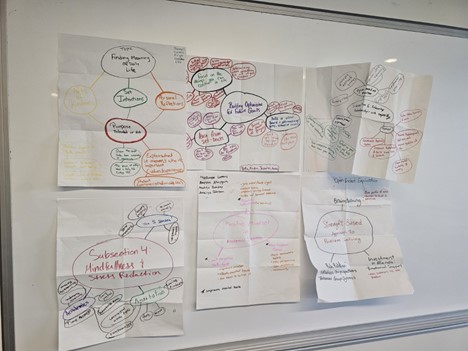
On the second day, students were given poster paper and markers to create mind maps of their ideas and help gain clarity on their discussions from the previous day. Each group placed their chosen topic at the center of the mind map and organized the associated ideas around it. The mind mapping exercise allowed students to visually connect their thoughts and discussions from day one.
One member from each group was nominated to circulate among the other groups, engaging in discussions about each team’s subsection of the article. This not only gave students a broader perspective on how their topics related to the overarching theme of student wellness but also facilitated the flow of information between teams. After gathering input from other teams, the group representative brought the new insights back to their original group, enhancing their understanding of their own topic and how it fit into the larger article. To ensure continuity, students took photos of their mind maps, which would later serve as guides for the writing process.
Day 3: Writing and Research Alignment
On the third day, each group was tasked with creating a document that contained a minimum of five references, with each group member responsible for contributing at least one reference. The document consisted of chunks of article drafts accompanied by their respective references. Students were asked to align these references with the ideas discussed during the earlier sessions and integrate them into their mind maps. Next, students took 15 minutes individually within a shared Google doc to write about their subsection, drawing from their mind maps and class discussions. This individual writing time allowed students to consolidate their thoughts and begin crafting their portion of the collaborative article.
Day 4: Ethical Use of AI in the Writing Process
The fourth day focused on ethical AI usage. We began with a discussion on how students had been using AI tools like ChatGPT and how they envisioned using any type of AI tools in the creation of this article. Together, we created an AI disclosure statement, agreeing on how AI would be used during the editing phase.
We explored specific AI prompts that could enhance their writing, including:
“Rephrase for clarity.”
“Organize this paragraph for the introduction, summary, or conclusion.”
“Give me a starting sentence for this paragraph.”
These prompts were designed to guide students in using AI as a tool to enhance clarity and organization rather than relying on it to write the content.
Day 5: Final Writing and Cohesive Editing
On the final day, students returned to their group documents and spent 15 minutes revising their sections. Afterward, they worked together to co-edit the document without the use of AI, striving to make the article more cohesive and polished. Finally, we revisited the agreed-upon AI prompts, and students were given the option to use AI only when they felt it was necessary for tasks like rephrasing sentences or organizing paragraphs.
The project culminated in a completed article on student wellness, co-authored by students and enhanced by responsible AI usage. The collaborative process not only demystified research and writing but also empowered students to see these activities as positive, engaging, and enjoyable experiences.
Takeaways From This Teaching Experience
The AI writing project was a valuable learning experience for the students, as it incorporated individual and collaborative learning elements alongside technology-based approaches. Reflecting on this experience, I have identified several key takeaways to carry forward into the new semester of teaching and learning.
The Importance of Throwback Learning Experience: Something Familiar Traditional tools like markers and poster boards remain essential in fostering cohesion, socialization, and competence-building. These activities encouraged students to engage in discussions and create visual representations of their ideas, which helped build their confidence and reinforce the collaborative process.
Starting With Original Ideas Matters Students benefited from discussing their ideas within the context of originality before integrating AI-generated content. Generative AI poses a potential threat to originality, emphasizing the need for human thought, discussion, and creativity to provide a benchmark for comparing the quality and intentionality of AI contributions.
Clear Parameters and Prompts Are Essential Defining the role of AI in the writing process was critical for success. Many students initially viewed AI as a tool for producing entire works. By discussing the parameters beforehand, it became clear that AI was to be used to supplement and enhance cohesion rather than replace the creative process.
The Importance of Prompt Development Students gained a growing understanding of the importance of crafting effective prompts for AI. Recognizing how prompts influence AI outputs is a crucial skill that was previously underdeveloped in many students. Moving forward, this skill will be vital as they navigate the intersection of human creativity and AI assistance.
Final Thoughts
Developing effective AI prompts is a pivotal skill that empowers students to use AI intentionally and meaningfully in their learning. A well-crafted prompt acts as the foundation for generating accurate, relevant, and cohesive responses, highlighting the importance of clarity, specificity, and purpose in the initial instructions given to the AI. By understanding how to formulate prompts, students can better harness the potential of AI to support their ideas, enhance their creativity, and improve the quality of their work without relying on AI to replace their original contributions.
This skill also encourages critical thinking, as students must evaluate the type of input needed to achieve a desired outcome, troubleshoot issues in responses, and refine their prompts for better results. Moreover, it aligns with the broader need for digital literacy in education, preparing students to interact responsibly and effectively with technology in academic, professional, and personal contexts.
Lastly, incorporating intentional AI use into teaching strategies ensures that students not only learn how to use these tools but also understand their limitations and ethical considerations. By balancing traditional methods, which foster originality and human connection, with innovative technologies like AI, educators can create a holistic learning environment that values both creativity and technological fluency. This balance will be crucial as AI continues to play an increasingly integral role in education and beyond.
Dr. Courtney Plotts’ students in class.A snapshot of the students’ work.
Special Note of Pride: I would like to note that this group of students worked on this project during class and completed this while two natural disasters accrued, power outages, remote and in person learning and did a great job considering the circumstances. I am so proud of each of them! We originally had bigger visions for the project but due to weather we had to make some changes to the plan!
Freshman College Students’ Advice to Peers for Health & Wellness in 2025
The new year always comes with the possibility of change and growth. As students, much of our growth focus is academics and learning-based. Being academically successful isn’t an easy task. Student wellbeing is an important factor in the learning process (Frazier & Doyle-Fosco, 2024). And for most of us, throwing ourselves into our studies and homework can come with negative side effects like burnout, stress, and decreased mood and motivation. But being successful doesn’t have to come at the risk of your mental health. In our view, academic success means more than good grades and knowledge. Although you may have gone through something last year, or are still going through it now, it doesn’t have to affect you in a negative way. There is so much more that goes into being successful. Success requires dedication, consistency, self-care, and a positive mindset. But for many of us a positive mind set is hard to come by.
The Collective Obstacle
The average age of our class is 19.7 years of age. We have lived with social media all of our lives. A lot of voices have imparted information. Some good, some not so good. The negativity that is readily accessible on social media can lead to negative self-talk. “Negative self-talk refers to your inner voice making critical, negative, or punishing comments. These are the pessimistic, mean-spirited, or unfairly critical thoughts that go through your head when you are making judgements about yourself” (Scott, 2023). Negative self-talk can be detrimental to your psychological well-being. It can really bring you down after you do it for too long. Negative self-talk can also induce stress, depression, and relationship problems. How you can start to believe the negative self-talk: you can start to believe negative self-talk after a while of you doing it. The more you start to tell yourself you can’t do something, the more you’ll start to believe it.
The effects of positive self-talk are the opposite of negative self-talk. It will improve your mental health, can reduce stress, lessen depression, and improve relationships. This not only impacts academics, but other aspects of life. To minimize negative self-talk, you can catch your inner critic when it’s happening and change your thinking to think more positive thoughts, remember that thoughts are not facts, contain your negativity, shift your perspective, think like a friend, or other trusted advisors.
Two Positive Ideas to Embrace in 2025
Two ideas to embrace in the new year that can jumpstart your positivity are evaluating how you think about failure and the control of your future. Failure is an inevitable part of life, but it is through our setbacks that we find opportunities for growth and success. How we respond to failure matters more than the failure itself, and cultivating a mindset of optimism is key to overcoming challenges (Hilppö & Stevens, 2020). Optimism, combined with grit—the perseverance and passion to achieve long-term goals—forms the foundation for a positive and resilient lifestyle. Together, these qualities enable us to turn obstacles into stepping stones and approach life’s difficulties with determination and hope. Think of failures as learning opportunities. Think about the knowledge you gain from hindsight when thinking about failure.
Additionally, understanding the distinction between what we can and cannot control is crucial for maintaining positivity and health (Pourhoseinzadeh, Gheibizadeh,& Moradikalboland, Cheraghian, 2017). Accepting that not everything is within our power allows us to shift our focus to areas where we can make a difference and grow from the experience. Remaining positive during challenging situations and remembering the aspects we can influence help us navigate adversity with a constructive mindset. It’s also important to respect that some factors are beyond our control and may happen for reasons we do not yet understand. By seeking to understand why certain things are outside our control, we can cultivate acceptance and use these moments as opportunities for reflection and personal growth.
The Importance of Health Communication in 2025
Healthy communication is critical to positive personal growth. Asking open-ended questions is important when engaging in meaningful communication because it ensures that there are no assumptions being made. One researcher found that assumptions “lead to consistent and unnecessary community failures” (Macrae, 2018, p.5). Additionally, healthy communication can build true connections among people and better understanding. Also, avoiding assumptions is a way to stay present in the moment allowing you to determine if there is genuine interest in the conversation. Most importantly, health aspects of communication like listening, reflecting, and pausing encourage new thinking and can develop new ideas just about anything.
In addition to healthy communication, think about sharing more of your experiences with peers. Starting from a place of curiosity and health, inquire about someone’s well-being. You can start with a simple phrase like “Are you ok?” Or be ready and willing to share your own personal experience when the time is right. Not only can this help someone else but sharing your story can also help you process what you have been through. Sharing and listening to each other’s experiences can show understanding and help you feel more willing to share now and in the future. Understanding and being present is a power combination for communication.
Lastly, remember that relationships are complex. Whether parental, academic, or personal, everyone has their relationships challenges. One tactic to strengthen relationships is humor. Remember to laugh and enjoy life and the people around you. Most people forget about light heartedness and humor, and how humor can help strengthen and resolve issues within a relationship. Humor can improve the quality of relationships by reducing the stress, tension, and anxiety of the people within the relationship. This effect can only occur if humor is used respectfully in relationships. When used right, humor also can create a more comfortable relationship with less anxiety and sadness for those in it. It’s ok to laugh—even in challenging times.
Summary
A positive mindset is the root of achieving any goal you put your mind to. As a collective voice, we hope the information we shared is valuable information. Our goal was to share meaningful information for your new year and new journey in 2025. As students, we fully understand the importance of mental health, especially because all of us experienced covid at some of the most challenging times of our lives. We hope this information helps you in the new year as much as it helped us learn and grow. Remember to stay happy, healthy, and safe in the new year and think positive!
Dr. Courtney Plotts is a Dynamic Keynote Speaker, Author, and Professor. Dr. Plotts is the National Chair of the Council For At-Risk Student Education and Professional Standards, the country’s only organization that provides standards for working with marginalized and nontraditional students in Kindergarten to College. Her role as National Chair includes training, consulting, and research. Her subject matter expertise has been used in a variety of book publications. Most recently “Small Teaching Online” By Flower Darby with James M. Lang published in June 2019. Dr. Plotts was recognized in 2017 by the California State Legislature for a bold commitment to change in education. She is currently in talks with higher education institutions to launch an institute that focuses on diversity and best practices in online teaching spaces to launch in 2021.
References
Frazier, T., & Doyle Fosco, S. L. (2024). Nurturing positive mental health and wellbeing in educational settings – the PRICES model. Frontiers in public health, 11, 1287532. https://doi.org/10.3389/fpubh.2023.12875
Hilppö, J., & Stevens, R. (2020). “Failure is just another try”: Re-framing failure in school through the FUSE studio approach. International Journal of Educational Research, 99, 101494. https://doi.org/10.1016/j.ijer.2019.101494
Macrae, C. (2018). When no news is bad news: Communication failures and the hidden assumptions that threaten safety. Journal of the Royal Society of Medicine, 111(1), 5–7. https://doi.org/10.1177/0141076817738503
Pourhoseinzadeh, M., Gheibizadeh, M., & Moradikalboland, M., Cheraghian, B. (2017). The Relationship between Health Locus of Control and Health Behaviors in Emergency Medicine Personnel. International journal of community based nursing and midwifery, 5(4), 397–407.