Tag: failing

  • Thousands of Qualified Community College Students Failing to Transfer to CSU, New Report Finds

    Thousands of Qualified Community College Students Failing to Transfer to CSU, New Report Finds

    More than 32,000 California community college students who earned transfer degrees never applied to California State University despite guaranteed admission, according to a new report that highlights critical gaps in the state’s higher education pipeline.

    Marisol Cuellar MejiaThe Public Policy Institute of California study reveals that 21 percent of Associate Degree for Transfer recipients between 2018-19 and 2022-23 failed to apply to CSU. Most concerning, more than half of these students — 32,500 individuals — appear to have abandoned their pursuit of a bachelor’s degree altogether.

    The findings come as California races to meet an ambitious goal of 40 percent baccalaureate completion among working-age residents by 2030, a target that depends heavily on improving transfer rates from community colleges. 

    “When the transfer pathway works, it works,” said Marisol Cuellar Mejia, co-author of the report. “The challenge lies in ensuring that more California community college students are able to get to the point of applying.”

    The report identifies another significant loss point: nearly 63,000 students who were admitted to CSU but chose not to enroll never appeared at any four-year institution. This group represents what researchers call “the most immediate opportunity for enrollment gains” at the state university system.

    Despite these gaps, the study found high success rates for students who complete the transfer process. Among community college applicants to CSU, 92 percent are eventually admitted to at least one campus, and 76 percent of fall 2020 transfer students graduated by spring 2024. Transfer applications and enrollment remain below pre-pandemic levels.  Fall 2024 saw 50,259 new transfer students enroll at CSU, a 6 percent increase from the prior year but still 17 percent below the 2020 peak of 60,529 students. Applications are down 16.4 percent from 2020 levels.

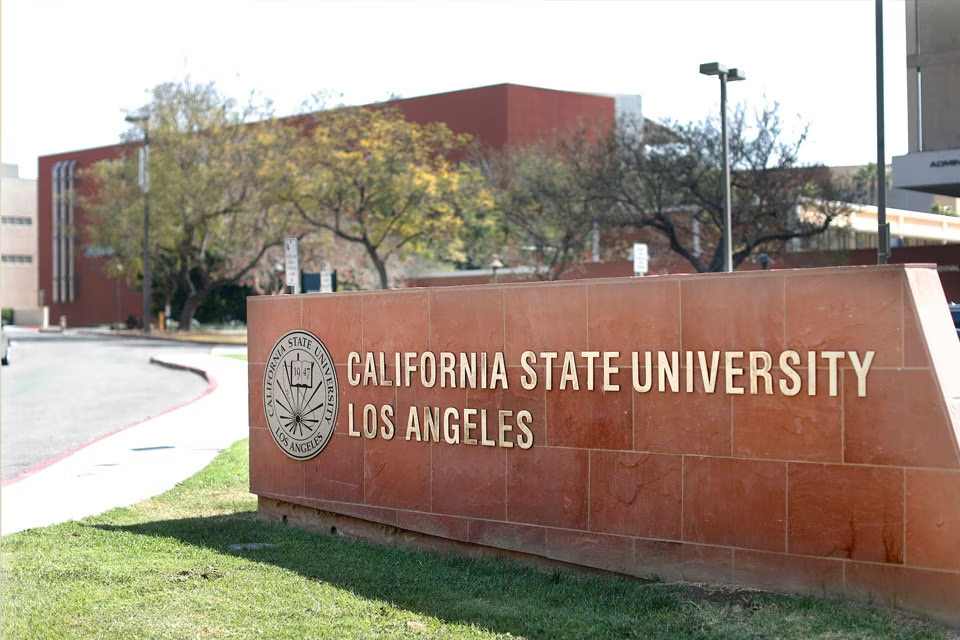
    The decline has not affected campuses equally. San Diego State, Cal State Los Angeles, and San Francisco State continued enrollment drops through fall 2024, with the latter two campuses seeing transfer enrollment more than 30 percent below 2020 peaks. 

    Meanwhile, five campuses — Fresno State, Fullerton, Sonoma State, Monterey Bay, and Chico State — have surpassed their 2020 transfer enrollment numbers. The report notes that CSU is the leading destination for California community college transfers, receiving about 58 percent of students who successfully transfer to four-year institutions. Another 17 percent transfer to University of California campuses, while 25 percent go to private or out-of-state schools.

    The study found that the typical CSU applicant spends nine terms enrolled in the community college system before applying. However, students who reach key academic milestones during their first year can apply sooner. Three in ten applicants apply in more than one term, and almost half of these students had all applications denied initially but were admitted later. Among admitted students, 69 percent chose to enroll at CSU.

    The California Community Colleges system serves more than 2.1 million students, with most expressing intent to transfer. However, only one in five actually transfers within four years of initial enrollment, meaning even modest improvements could substantially boost four-year college enrollment statewide.

    CSU recently committed to increasing transfer enrollment by 15 percent over the next three years as part of its systemwide strategic plan. The move comes as high school graduate numbers are expected to plateau or decline, limiting the pool of first-time freshmen and making community college transfers increasingly important for maintaining enrollment.

    Source link

  • Graduate apprenticeships are failing to scale in Scotland – here’s why

    Graduate apprenticeships are failing to scale in Scotland – here’s why

    This HEPI blog was authored by Elaine Jackson, Lecturer in Business and Management at the University of the West of Scotland.

    Imagine earning a full salary while studying for your degree, graduating debt-free, and having a guaranteed job at the end. This isn’t fantasy, it’s exactly what graduate apprenticeships offer. Yet these programmes represent just 8% of Scotland’s university intake, despite employers desperately needing skilled workers in the very sectors where apprenticeships thrive.

    The story of what’s possible starts with people like Donna. Through her graduate apprenticeship with a Local Authority, she delivered a project that secured £280,000 in funding and earned recognition as a nominee for the 2025 Convention of Scottish Local Authorities (COSLA) excellence awards. Her success demonstrates the transformative potential of combining work and study but it also highlights a troubling question: if graduate apprenticeships work so well, why aren’t there more of them?

    Graduate apprenticeships (GAs), also known as Degree Apprenticeships (DAs) in the UK, represent a specific model of work-based learning where the apprentice is an employee who is simultaneously studying for a full undergraduate or master’s degree. These programmes typically last three to six years, with apprentices spending approximately 20% of their time studying and 80% working.

    The scale challenge reveals a deeper problem

    The numbers reveal a stark reality. Since these programmes launched in 2017, only 37,000 Scots have enrolled in Foundation and Graduate Apprenticeships combined across all years combined. To put that in perspective, 16,340 Scottish 18-year-olds accepted traditional university places in just 2024 alone. Graduate apprenticeships are growing alongside regular university degrees, offering an alternative pathway rather than replacing traditional routes, but they’re growing far too slowly.

    This slow growth becomes even more puzzling when we consider the demand. Skills Development Scotland reports that social work faces a 9.3% vacancy rate, while engineering, digital technology, healthcare, and business management show similar patterns of unmet need. These are exactly the sectors where graduate apprenticeships are proving most successful, yet only 1,378 new opportunities are projected for 2024-25 across all Scottish universities.

    So, what would realistic growth look like? Based on current university capacity, documented employer partnerships, and persistent skills shortages, Scotland could reasonably support 2,000-2,500 new apprentices each year, nearly doubling current numbers. This figure accounts for genuine employer capacity to provide meaningful workplace learning, not just any company willing to take on apprentices. It represents growth that the system could absorb without compromising quality.

    But three fundamental barriers prevent this expansion from happening and understanding them reveals why good intentions alone aren’t enough to scale successful programmes.

    Why growth remains elusive: Three critical barriers

    The first barrier is financial, and it’s more complex than simply needing more money. Graduate apprenticeships cost significantly more to deliver than traditional degrees, yet they’re funded as if they were the same thing. Think about how a typical university lecture works: one professor teaches 200 students in a hall, students complete assignments independently, and most learning happens through individual study. Now consider how apprenticeships work: Glasgow Caledonian University provides one-to-one mentoring and three-way liaison between each student, their employer, and university staff throughout the entire programme. Class sizes on these programmes are typically 15-35 students, not 200, and every apprentice needs dedicated support to balance work and study successfully.

    This intensive approach works, apprentices like Donna achieve remarkable outcomes. But it is expensive. Evidence from England’s apprenticeship system shows funding ranges from £1,500 to £27,000 depending on complexity, with degree-level programmes requiring the higher amounts. Yet Scottish universities, already facing a £4,000 to £7,000 funding gap per student, receive the same amount whether they’re delivering a large lecture or providing intensive one-to-one support. This creates a perverse incentive: the better the apprenticeship programme, the more money the university loses.

    The second barrier involves employer readiness, and here Scotland faces a fundamental difference from countries where apprenticeships work at scale. In Germany and Switzerland, companies must meet standardised quality criteria before they can take on apprentices. They need qualified supervisors, structured learning programmes, and formal assessment processes. This ensures every apprentice receives genuine training, not just a work placement.

    Scotland takes a different approach: any employer can participate without meeting specific training standards. While this sounds more flexible, it creates wildly inconsistent experiences. Some employers, like those partnering with the University of the West of Scotland, provide excellent mentoring and career development. Others treat apprentices more like temporary staff, offering limited learning opportunities. This inconsistency doesn’t just harm individual apprentices, it undermines confidence in the entire system, making other employers hesitant to participate and students uncertain about programme quality.

    The third barrier is bureaucratic complexity that would frustrate even the most determined institutions. Universities wanting to create new apprenticeship programmes must navigate approval processes across Skills Development Scotland, degree-awarding bodies, and professional accreditation requirements. The Scottish Funding Council’s guidance spans multiple pages covering compliance requirements across 14 different subject areas. When universities are already struggling financially, investing scarce resources in complex approval processes for programmes that may not even cover their costs becomes increasingly difficult to justify.

    These barriers explain why graduate apprenticeships remain promising but small-scale, despite clear demand from both employers and students. Early evidence suggests positive retention outcomes among graduate apprentice cohorts, though comprehensive longitudinal data is still emerging given the programmes’ recent introduction. This contrasts with broader patterns where Scotland faces challenges retaining skilled graduates, particularly in STEM fields where migration to other regions for career opportunities remains a persistent concern.

    The investment case

    The solutions are straightforward, though not simple to implement. First, funding must reflect delivery reality. Universities need premium funding of 125-135% of standard degree rates to cover the intensive support that makes apprenticeships effective. Given that Scottish universities already receive £2,020 less per student than English institutions, this investment would address both general underfunding and apprenticeship-specific costs.

    Second, Scotland should build employer capacity systematically rather than simply recruiting more participants. This means developing quality standards for workplace learning, supporting successful employers to mentor others, and focusing on sustainable growth rather than rapid expansion that compromises quality.

    Third, approval processes need streamlining. Rather than navigating multiple agencies with overlapping requirements, universities should face consolidated processes that maintain quality while reducing bureaucratic barriers to innovation.

    The investment required, approximately £20-35 million annually to reach 2,000-2,500 starts, is significant but justified. Graduate apprenticeships address multiple policy priorities simultaneously: reducing student debt, developing skills where shortages are most acute, and retaining talent in Scotland rather than losing graduates to other regions.

    Funding viability: A realistic investment in Scotland’s economic future

    The question of funding viability deserves a data-driven response. The proposed £20-35 million annual investment represents just 0.03-0.06% of Scotland’s £59.7 billion public budget—smaller than typical annual budget variations. Scotland already invests £185 million annually in apprenticeships, making this 11-19% increase both modest and strategically targeted.

    A phased expansion demonstrates fiscal responsibility while addressing urgent skills gaps. Starting with £15 million (expanding from 1,200 to 1,500 graduate apprentices), scaling to £25 million by year three (2,000 apprentices), and reaching £35 million by year five (2,500 apprentices) aligns expansion with demonstrated employer capacity while allowing quality oversight.

    This investment timeline is economically viable because Scotland’s economy is projected to achieve 1.7% growth by 2027. Based on Scottish Fiscal Commission projections of economic growth averaging 1.5% over the implementation period, the apprenticeship investment would represent less than 1% of projected economic expansion—a sustainable allocation that directly addresses the 9.3% vacancy rate in social work and similar shortages across engineering and digital sectors.

    International benchmarking supports this scale. England’s apprenticeship system spends £1,500-27,000 per apprentice depending on complexity, with degree-level programmes requiring higher investments. Scotland’s proposed £14,000-20,000 per graduate apprentice (including university premium funding) sits within this proven range while delivering superior outcomes through integrated workplace learning.

    The return on investment is compelling: each graduate apprentice avoids approximately £15,000 in student debt compared to the Scottish average, while earning during their studies and contributing immediately to productivity. Graduate apprentices also avoid the debt burden that affects traditional students, providing a genuine alternative to debt-financed higher education.

    Rather than adopting loan models that would undermine the fundamental “earn while learning” proposition, Scotland should view this as infrastructure investment—comparable to the £150 million being invested in offshore wind manufacturing. Both create sustainable employment, address skills shortages, and position Scotland competitively in growth sectors. Analysis of successful apprenticeship systems consistently shows that sustainable models rely on public investment rather than employer or student financing.

    The choice is strategic, not fiscal. Scotland can afford this investment; the question is whether it can afford not to make it when facing documented skills shortages in sectors critical to economic growth and the net-zero transition.

    Conclusion

    The choice facing Scottish policymakers is ultimately about ambition and fiscal realism. The evidence shows what works, the economic case is compelling, and the investment is demonstrably affordable through phased implementation. Scotland can accept that graduate apprenticeships remain a valuable but limited option, or it can make a modest, strategic investment to unlock their transformative potential for addressing skills shortages and retaining talent. Now it’s time to scale what works.


    Source link

  • Higher Education on the Frontlines of a Failing State

    Higher Education on the Frontlines of a Failing State

    Universities have long been bastions of freedom, democracy, and truth. Today, they find themselves operating in a nation where these ideals are increasingly under siege—not by foreign adversaries, but by policies emanating from the highest levels of government.

    The Department of War: A Symbolic Shift with Real Consequences

    On September 5, 2025, President Donald Trump signed an executive order rebranding the U.S. Department of Defense as the “Department of War,” aiming to restore the title used prior to 1949. This move, while symbolic, reflects a broader ideological shift towards an aggressive, militaristic stance. Defense Secretary Pete Hegseth, appointed in January 2025, has been a vocal proponent of this change, asserting that the new name conveys a stronger message of readiness and resolve. 

    Critics argue that this rebranding prioritizes optics over substance, with concerns over potential high costs and effectiveness. Pentagon officials acknowledged the financial burden but have yet to release precise cost estimates. 

    Economic Instability and Global Alienation

    Domestically, the administration’s economic policies have led to rising unemployment, inflation, and slowing job growth. A recent weak jobs report showing a gain of only 22,000 jobs prompted Democrats to criticize President Trump’s handling of the economy, linking these issues to his tariffs and other controversial actions. 

    Internationally, Trump’s policies have strained relationships with key allies. Countries like Japan, South Korea, and several European nations have expressed concerns over U.S. trade practices and foreign policy decisions, leading to a reevaluation of longstanding alliances. 

    Authoritarian Alliances and Human Rights Concerns

    The administration’s foreign policy has also seen a shift towards aligning with authoritarian leaders. Leaked draft reports indicate plans to eliminate or downplay accounts of prisoner abuse, corruption, and LGBTQ+ discrimination in countries like El Salvador, Israel, and Russia, raising concerns about the U.S.’s commitment to human rights. 

    Immigration Policies and Humanitarian Impact

    On the domestic front, the administration’s immigration policies have led to the deportation of hundreds of thousands of individuals, including those with Temporary Protected Status. Critics argue that these actions undermine the nation’s moral authority and have a devastating impact on affected families. 

    The Role of Higher Education

    In this turbulent landscape, higher education institutions find themselves at a crossroads. Universities are traditionally places where freedom, democracy, and truth are upheld and taught. However, as the nation drifts away from these principles, universities are increasingly tasked with defending them.

    Faculty and students are stepping into roles as defenders of civic values, ethical scholarship, and truth-telling. But without robust support from government and society, universities alone cannot sustain the principles of freedom and democracy that once underpinned the nation.

    The current moment is a test: Can American higher education continue to serve as a bastion of truth and civic responsibility in an era where the country’s own policies increasingly contradict those ideals? Or will universities be compelled to adapt to a world where freedom, democracy, and truth are optional, not foundational?

    The stakes could not be higher.


    Sources:

    Source link

  • A decade after ‘Charlie Hebdo’ killings, we are still failing blasphemers

    A decade after ‘Charlie Hebdo’ killings, we are still failing blasphemers

    One decade ago this week, two gunmen entered the offices of satirical French magazine Charlie Hebdo and opened fire, killing cartoonists, journalists, and security personnel as part of coordinated terror attacks that would ultimately claim 17 lives. The attack on the magazine — which is now commemorating the 10th anniversary with a God cartoon contest — was likely due to its cartoons of the Prophet Muhammad.

    In the immediate aftermath, proverbial battle lines were drawn around the contentious magazine and the legal and social rules around what we can, without punishment or retribution, say about religious symbols, holy figures, and their believers. 

    Some quickly marched under the banner of “Je suis Charlie,” while others staked out more censorial ground, arguing that Charlie Hebdo’s staff shared some of the blame for the tragedy they suffered. Mocking people’s most deeply held beliefs rarely comes without a cost, the argument went, and there is a balancing act between preserving the right to speak and protecting the feelings of religious believers. 

    This is a deeply dangerous and misguided attitude but, amidst the shifting legal and moral boundaries since 2015, the advocates of limiting our right to religious dissent are gaining ground. As the months and years have passed since the killings, countries around the world have veered perilously closer to torching hard fought victories for the freedom of conscience and the right to criticize, even harshly or crudely, the religious powers who preside over our prayers and, sometimes, our politics.


    WATCH VIDEO: Don’t bring a knife to a word fight!

    Dozens of countries, from Poland to Italy to Saudi Arabia to Bangladesh, maintain blasphemy laws, and six of them still threaten accused blasphemers with the death penalty. Even if the state is not willing to kill, its subjects may be. In places like Pakistan or Nigeria, an accusation alone can inspire deadly mob violence. Police in Pakistan sometimes even assign themselves the role of executioner without waiting for a judge or jury. 

    While the situation remains grim in nations that have long enforced these laws, it’s also worsened in countries and institutions that generally promise better protections for free expression. 

    Some responsibility rests at the feet of the United Nations Human Rights Council, which took a distinctly anti-human rights position in 2023 in response to a series of controversial Quran burnings earlier that year. In a 28-12 vote, the council passed a resolution encouraging nations to “address, prevent and prosecute acts and advocacy of religious hatred” (emphasis added). The 57-nation Organization of Islamic Cooperation followed that with a resolution urging punishment of online speech lambasting religious “institutions, holy books and religious symbols” and “the immediate cessation, and criminalization” of Quran desecrations. 

    If the higher powers wish to punish their mortal critics and needlers, so be it. The powers-that-be here on earth don’t need to carry out the sentence for them.

    Months after these resolutions, blasphemy law supporters notched a surprising victory: Denmark’s parliament, weary of the controversy caused by Quran burnings in the region, passed a law criminalizing the public desecration of “a writing with significant religious significance for a religious community or an object that appears as such.” And just weeks ago, UK Member of Parliament Tahir Ali pressed Prime Minister Keir Starmer to introduce “measures to prohibit the desecration of all religious texts and the prophets of the Abrahamic religions.” 

    These initiatives are usually cloaked with flowery language about the need to protect feelings, minimize harm, and better society, but make no mistake: These are blasphemy laws that allow governments to set the terms of how politely and civilly their citizens are allowed to express disagreement with beliefs that carry immense philosophical and often direct political power.

    Even here in the United States, with our strong protections for the right to believe or not, we are still plagued by these challenges. A handful of states still keep blasphemy laws on the books, even if they go unenforced. Michigan’s criminal code, for example, warns that people who “blaspheme the holy name of God, by cursing or contumeliously reproaching God, shall be guilty of a misdemeanor.” The Satanic Temple regularly faces efforts by local officials to censor their displays. And when they do manage to obtain permission to express themselves alongside other groups’ religious symbols, their displays are vandalized

    We’ve seen these questions bloom on American college campuses, too. Within months after the almost-deadly attack on Salman Rushdie, Minnesota’s Hamline College rid itself of an instructor who respectfully, and with advance warning, displayed a medieval portrait of the Prophet Muhammad in class. Then at nearby Macalester College, administrators covered up an Iranian-American artist’s feminist art exhibition about gender, politics, and religion “to prevent unintentional or non-consensual viewing.”

    From Denmark to the United Nations to the UK, we are forgetting the lessons from the Charlie Hebdo attacks — if we ever really learned them at all.

    Police killings worsen crisis of mob violence against Pakistan’s blasphemers

    Blog

    Plenty of free speech news out of Europe, the sedition crackdown in Hong Kong, efforts to control discussion of foreign governments in Canada and the U.S.


    Read More

    It is not the role of the government to set civility rules for the way we express our opinions about the major faiths that, in some parts of the world, are as much political powers as religious ones. 

    You cannot act against the holy book burner or the impertinent cartoonist without also targeting vocal victims of abuse in the Catholic Church, protesters against forced hijab laws, or critics of the secretive Church of Scientology. But in our eagerness to expediently paper over discomfort, anger, and occasional high-profile controversies provoked by blasphemous expression, we’re sacrificing the rights of dissenters around the world who speak out against very real religious and political oppression. 

    The feelings of religious believers cannot be used as a shield to protect religious and political authorities from their dissenters. If the higher powers wish to punish their mortal critics and needlers, so be it. The powers-that-be here on earth don’t need to carry out the sentence for them.

    Source link