The topic for this lesson is fake news. Jarche instructs us that there are four primary types of fake news and he asks us to find an example of each type. I don’t normally post overtly political content here on my blog, but when it comes to the topic of fake news, it seemed easier to focus on politics than teaching and learning.
Propaganda – Ideas, facts, or allegations spread deliberately to further one’s cause or to damage an opposing cause.” – Merriam WebsterExample – Snopes shares 12 times AI generated or doctored content was shared by Trump or the White House. These examples seem to fit under propaganda, since they attempt to influencing people’s attitudes and beliefs. Though that also sounds like disinformation to me and I’m still not clear I know the difference.
Disinformation – “False information deliberately and often covertly spread (as by the planting of rumors) in order to influence public opinion or obscure the truth.” – Merriam WebsterExample – Trump states that there is no inflation in the US. There are some who say that Trump’s specific type of lying falls under the category of bullshit, as defined by Harry Frankfurt in his book, On Bullshit. Either way, it feels like shooting fish in a barrel to find examples of disinformation from this administration.
Conspiracy theory – “Persist for a long time even when there is no decisive evidence for them… Based on a variety of thinking patterns that are known to be unreliable tools for tracking reality.” – The Conspiracy Theory Handbook, by Lewandowski + CookExample – Ok. So this isn’t a genuine conspiracy, rather it was satirical from the start. But given how I feel after finding those examples of propaganda and disinformation, I needed a little break. The “birds aren’t real” satirical conspiracy scratches a certain itch for me, as someone who enjoys learning about birds.
Clickbait – “Text or a thumbnail that is designed to attract attention and to entice users to follow (“click”) that link and view, read, stream or listen to the linked piece of online content, being typically deceptive, sensationalized, or otherwise misleading… A defining characteristic of clickbait is misrepresentation in the enticement presented to the user to manipulate them to click onto a link.” – WikipediaExample – Bryan Tyler Cohen is rather notorious for using clickbait YouTube video titles on his main channel. I saw a video of him explaining that he knows they are frustrating to people, but that they really generate far more views, in his testing. He even created an alternate channel (Bryan Tyler Cohen News) with more toned down titles, which he suggests can be better to send to people who may be on a different side of the issues than him, politically.
My Muddiest Point
I’m having a hard time distinguishing between disinformation and propaganda. Jarche shared a quote from researcher Renée DiResta, who would prefer our focus be on the word propaganda, as it is more descriptive of the problem at hand.
Q. Why do you prefer the word “propaganda” to “misinformation”?
A. Misinformation implies that the problem is one of facts, and it’s never been a problem of facts. It’s a problem of people wanting to receive information that makes them feel comfortable and happy. Anti-vaccine messages don’t appeal to facts, but to the identity of the recipient. They’re saying: “If you are a person on the right, you should not trust these vaccines.” It’s very much tied to political identity. Misinformation implies that if you were to say that Robert F. Kennedy Jr. is an absolute clown who knows absolutely nothing about vaccines or their relationship to autism, and that this has been researched to ad nauseam by scientists, if it were a problem of misinformation, you would assume that people would say, “Oh, here’s the accurate information, so I’m going to change my mind.” But that’s not the case. It’s a topic of identity, of beliefs, and that’s why propaganda is a more appropriate term.
But I’m still not entirely clear I can distinguish propaganda from disinformation at this time.
Handling Conspiracy Theories with Students
I have such a hard time navigating conspiracy theories with students who take business ethics with me. We have a whole section of the class where they learn how to use Mike Caulfield’s SIFT framework to fact check the articles they read about business ethics related news stories throughout our semester together. I’ve found it is practically useless to ask them the question from Mike’s mini course about if they or someone they’re close to has ever believed in a conspiracy theory before.
There’s so much of one’s identity that gets wrapped up in what we believe. Generally, they don’t view these beliefs as conspiracies if they or their loved ones believe in them.
At first glance, Southeastern Michigan University’s website looks like it represents a real institution.
Smiling students in graduation regalia embrace, diplomas in hand, in the video on the front page. A chat bot pops up to ask, “How can I help you?” Southeastern Michigan’s website touts the university’s scholarships, array of accredited academic programs, award-winning faculty, 75 percent graduation rate and “vibrant campus life.”
But littered throughout the website are signs that something is off about Southeastern Michigan.
Blurry backgrounds and distorted limbs hint at the use of generative artificial intelligence. Some images seem likely to fool the untrained eye, while others—like a basketball player with veins bulging from his angular arms—could have been ripped from a poorly illustrated comic book. Meanwhile, paragraphs of text contain repetitive, grandiose and nonspecific language, characteristic of a chat bot’s writing.
In reality, the university is as fake as some of the content on its website. And it’s part of a much larger scam fueled in part by the rise of generative AI.
Some of the images on Southeastern Michigan University website appeared to be AI-generated.
“It took me a while to realize it wasn’t an actual institution,” said Aaron Ament, president of the National Student Legal Defense Network and a lawyer who has investigated for-profit colleges that have defrauded students. “For the average person who’s looking for a program, you could easily see how people would think it’s a real institution.”
Michigan attorney general Dana Nessel warned consumers about Southeastern Michigan University in an alert last week, following a complaint from Eastern Michigan University to her office about the fraudulent website using deceptive practices in an effort to scam students.
Southeastern Michigan is one of nearly 40 fake university sites that Inside Higher Ed recently uncovered, which appear to have been developed with or supplemented by AI. The sites seem to be part of a network, based on the use of identical language, the repetition of images and other design similarities. And many of these fake colleges also have a presence on social media sites, including LinkedIn, Instagram and Facebook.
An Inside Higher Ed analysis also turned up dozens of websites for nonexistent accreditors and a fake U.S. Department of Education website. They all contain at least some AI-generated images and design templates similar to the college websites’, including many that list those fake accreditors—and link to their websites—to give an air of legitimacy. The Education Department is also investigating the scam.
But the network uncovered by Inside Higher Ed reveals how the rise of generative AI is making it faster and easier for scammers to repackage an old ruse and deploy it on a much larger scale.
“This lowers the transaction costs for making a scam site,” said Jose Marichal, a professor of political science at California Lutheran University who studies how algorithms and AI are restructuring social and political institutions. “If I wanted to do this [before generative AI], it would have taken me a week, maybe a month, to put all this together. Now, it would take me a matter of hours.”
AI Increases Scammers’ Reach
The technology is also making it harder for consumers to immediately recognize fraudulent websites like Southeastern Michigan’s and dozens of other similar scam college websites Inside Higher Ed identified.
Large language models—which can immediately generate text and images like those populating the scam college websites—are becoming more sophisticated at mimicking human-created content by the day. For example, last week OpenAI released GPT-5, the latest version of ChatGPT, advertising it as its “smartest, fastest, most useful model yet,” capable of putting “expert-level intelligence in everyone’s hands.”
While suspicious, Marichal couldn’t say for certain if the fraudulent college websites were created using generative AI. But Junfeng Yang, a computer science professor at Columbia University who helped develop a novel tool that can discern whether text was generated by an LLM, had one of his graduate students peruse Southeastern Michigan’s website. “It appears that the [university’s] engineering page is AI generated,” he said in an email.
“A year ago, if you tried to do this, you may have had some bugs to work out,” Marichal said of the scam college websites. “Now, we’re getting to a place where you could keep spitting these out and it doesn’t cost much to host it. If you make 100 of them, you increase your yield. Instead of casting one fishing line, you cast 20, upping your chances of catching fish.”
‘Didn’t Seem Legit’
One prospective student who was looking for a business degree program almost got hooked by Southeastern Michigan’s con, according to Walter Kraft, a spokesperson for Eastern Michigan University, which is a real, accredited institution in Ypsilanti.
The fake Southeastern Michigan University prompted a complaint to the state attorney general from Eastern Michigan University, which has accused it of deceptive practices.
Source: Inside Higher Ed
“He came across an institution named Southeastern Michigan University, and it looked legit to him,” Kraft said. “So he contacted them and received a phone call telling him that his total tuition would be, like, $31,000, but he would receive a 90 percent scholarship and would only have to pay $3,100.”
The fake university asked the would-be student to provide documents for his scholarship application, but he never followed up. Two days later, he got a call from a number spoofing Eastern Michigan’s admissions office number, and the person on the other line told him he got the scholarship, despite never receiving any of his documentation.
After that, he received an admissions offer on letterhead that looked similar to Eastern Michigan’s, which raised his suspicions.
“He could sense that it didn’t seem legit, didn’t seem right, and questioned it,” recalled Kraft, who said two or three other people have reported similar concerns about Southeastern Michigan’s website, though he’s not aware of anyone who has fallen for the scam.
A spokesperson with the Michigan attorney general’s office said the office had “not received complaints from any potential students losing money in connection to these websites” but had contacted officials in two other states about similar schemes and referred concerns to the Federal Trade Commission.
But that doesn’t mean other people haven’t been scammed—or won’t in the future. As of Wednesday, the website was still live.
“That’s problematic, because until somebody finds out who’s responsible and takes that site down, other prospective students could be victimized,” Kraft said. “We certainly don’t want that to happen.”
Universities Push Back
While Eastern Michigan went to the state attorney general, other universities that have encountered similar websites have sought recourse with the World Intellectual Property Organization, a group that mediates domain disputes.
George Washington and New York Universities, as well as the University of Houston system, have all filed successful complaints to challenge websites using their trademarks or a similar name and URL. Those complaints shed more light on the scheme, which appears to date to at least 2021, per archived copies of the websites that were taken down. In its filing, GWU pointed to Kenneth Stone, a person the university believed to be connected to the scheme through a company called Domain Lance, a forwarding service that allows users to redirect URLs.
(NYU did not name a specific individual in its WIPO complaint, which noted that “little is known of the respondent” and indicated the domain owner provided a contact address in Panama. However, another version of that website—New York University of Business and Technology—with a slightly different URL has already emerged.)
The University of Houston system also named Stone in a complaint filed in December, along with William Morocco and Cole Brad as the people believed to be behind the website. The filing suggests that Stone is in Panama, while the other two are in the U.S. In its second complaint, filed in May, Houston pointed to websites in Panama. Despite winning the domain dispute, another version of the contested website has since emerged.
Houston’s complaints indicated that multiple fake college websites were created last year. Three of the websites flagged by Houston were registered between July and October of 2024, and another followed early this year. The fake accreditor websites mentioned in Houston’s complaint were all registered on May 10 of last year, according to the WIPO filing.
Houston University of Texas is one of nearly 40 fake college websites uncovered by Inside Higher Ed.
Source: Inside Higher Ed
Inside Higher Ed contacted two of the individuals it believed to be the persons referenced in the complaint based on a review of public records and LinkedIn profiles, but neither responded. A review of public records, including website registration information, suggests all three individuals are in the U.S., though the fake university websites are hosted on servers located overseas.
An Inside Higher Ed reporter also had conversations with individuals operating the chat service on three different websites connected to the network. After a reporter requested admissions info through Southeastern Michigan’s chat service, a woman called to talk him through the process.
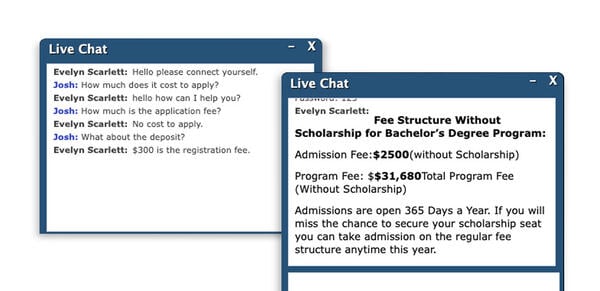
Over a nearly half-hour conversation, the operator—a woman with a heavy accent—explained the tuition and fees, gave the reporter a password to a demo version of its student portal, and pressed hard for a $300 “registration fee.” When the reporter pushed back on the cost, she offered to lower it to $199 and stressed the importance of signing up while seats were available.
A chat operator at Southeastern Michigan University offered insights into the scheme.
Justin Morrison/Josh Moody
But when the reporter questioned the legitimacy of the operation, telling her it appeared to be a scam, she said, “I will suggest you contact the Department of Education, not me” and hung up.
Contacted by Inside Higher Ed, a Department of Education spokesperson wrote by email that “the department is currently investigating these malign activities and will work with the appropriate authorities to prevent predatory action toward our nation’s students.”
Sector Responses
Universities with similar names to fake college websites encouraged consumers to take steps to protect themselves from scams.
“Students have many affordable, high-quality education options among North Carolina’s public universities. It’s a shame that bad actors are creating fake university websites to prey on students who want to pursue their dreams of a college degree,” Andy Wallace, a spokesperson for the University of North Carolina system, wrote while encouraging people to report the sites.
University of Houston spokesperson Shawn Lindsey wrote by email that UH “continuously monitor[s] for threats, including false or misleading websites and domain names, and use[s] a variety of tools to support this vigilance” and noted UH’s legal team has acted on offending sites.
The Council for Higher Education Accreditation also condemned the rise of fraudulent college and accreditor websites designed to mimic legitimate institutions in an emailed statement.
“Accreditation is meant to assure quality and integrity in higher education—not to be misused as a tool for fraud,” CHEA president Nasser H. Paydar wrote. “These fake accreditors prey on the trust of students and the public, and we are committed to exposing and stopping them.”
But experts warn if these websites aren’t shut down—or similar ones continue to crop up—it could further weaken the public’s trust in higher education in an era marked by politicized attempts to discredit legitimate universities as overpriced and biased.
“People may not know what’s a real university and what isn’t, so they just throw their hands up and say, ‘Universities are too expensive anyway,’” said Marichal, the algorithm expert. “When people don’t know what’s true or false anymore, they’re less inclined to trust any of it.”
The Department of Health and Human Services cited fake publications in a report on children’s health issues issued last week, The New York Times reported.
The Make America Healthy Again Commission claims its report—which blamed chronic disease in children on ultraprocessed foods, pesticides, lack of physical activity and excessive use of prescription drugs, including antidepressants—was produced with a “clear, evidence-based foundation.”
However, some of the researchers it cited said they didn’t write the papers the report attributed to them.
In one example, the report cited a paper on the link between mental health and substance use in adolescents by Katherine Keyes, an epidemiology professor at Columbia University. But Keyes told the Times that she didn’t write the paper. And no paper by the title cited—written by anyone—appears to exist at all.
The report cited another paper about psychiatric medications and advertising that was allegedly published in 2009 in The Journal of Child and Adolescent Psychopharmacology by “Findling, R. L., et al.” But the Times confirmed that Robert L. Findling, who is a psychiatry professor at the University of Virginia, did not author the paper.
The newspaper also found numerous other instances of mischaracterized or inaccurate summaries of research papers.
After both the Times and NOTUS reported on the false citations Thursday, the White House promptly updated the report with corrections. In response to questions from reporters about whether generative artificial intelligence—which is notorious for “hallucinating” information and failing to provide accurate citations—was used to produce the errant report, Emily Hilliard, a spokesperson for HHS, did not provide an answer.
Instead, she characterized the false citations as “minor citation and formatting errors,” according to the Times, and doubled down on the report’s “substance” as “a historic and transformative assessment by the federal government to understand the chronic-disease epidemic afflicting our nation’s children.”
A North Carolina woman will face up to 20 years in prison after admitting that she scammed the Department of Education out of $5 million in financial aid, USA Today reported.
Cynthia Denise Melvin pleaded guilty Wednesday to conspiring with dozens of “straw students” through an elaborate, seven-year scheme, federal court records show. Melvin applied to colleges on the students’ behalf, submitted the Free Application for Federal Student Aid for them, and even went so far as to impersonate the students so it appeared they were attending class and completing assignments, according to charging documents. All the while, she pocketed any leftover aid dollars, giving a small portion to the individuals she was impersonating.
Melvin was charged with conspiracy to commit wire fraud. In addition to her time in prison, she will face three years of supervised release and be required to pay a $250,000 fine, as well as restitution.
The scam is among the biggest “straw student” schemes in years, according to a USA Today review of Department of Justice news announcements.