Tag: Fall

  • 150K fewer international students this fall? That’s what one analysis predicts.

    150K fewer international students this fall? That’s what one analysis predicts.

    This audio is auto-generated. Please let us know if you have feedback.

    Dive Brief:

    • International enrollment at U.S. colleges could drop by as much as 150,000 students this fall unless the federal government ramps up its issuing of visas this summer, according to recent projections from NAFSA: Association of International Educators. 
    • The financial consequences could be severe. A 30% to 40% decline in new foreign students would lead to a 15% overall drop in international enrollment and, with it, a potential loss of $7 billion in revenue for colleges and 60,000 higher education jobs, NAFSA estimated. 
    • The organization attributed the projected decline to various Trump administration actions, including travel bans and an earlier suspension of visa interviews. NAFSA called on Congress to direct the State Department to expedite processing for student visas. 

    Dive Insight:

    Preliminary data from early this year suggested “flat to modest growth” in international student enrollment, but NASFA pointed to policy changes that could alter the landscape ahead.

    Since President Donald Trump retook office this year, many in the higher education world have worried international enrollment would decline in response to his policies and the perceptions abroad about America and how welcoming it will be to foreign students. 

    His administration has indeed taken an aggressive stance on admitting students from outside the U.S. In June, Trump signed an executive order banning travel from 12 countries and imposing restrictions on seven others. And the president has recently considered bans on 36 more countries

    Also in June, the State Department announced expanded screening that included surveillance of social media posts for applicants of F, M and J nonimmigrant visas. 

    That followed an announcement in May from Secretary of State Marco Rubio that the U.S. would move to “aggressively revoke” visas for Chinese students. Trump later appeared to walk back that stance on social media, adding more confusion as to the administration’s actual policy.

    NAFSA pointed to reports of limited to no visa review appointments for prospective international students in India, China, Nigeria and Japan. The organization noted that India and China send the most international students to the U.S., while Nigeria and Japan are the seventh and 13th leading home countries, respectively. 

    On top of those moves, the administration has demonstrated interest in using international student enrollment as leverage against institutions and activists in Trump’s crosshairs. 

    Through various directives, for example,Trump and his government have tried to bar Harvard from enrolling international students in the administration’s ongoing feud with the university. Each of those efforts have been temporarily blocked in court. Had they not been, the consequences for Harvard would likely be dire. In the 2024-25 academic year, the Ivy League university’s roughly 6,800 foreign students made up 27.2% of its student body.  

    Earlier this year, the administration also moved to deny visas for pro-Palestinian protestors

    A July report from analysts with Moody’s ratings services pointed to the potential financial fallout for colleges from declines in international enrollment. They noted that foreign students tend to pay full tuition and fees, heightening the potential revenue impact. 

    A stress test by the analysts found that for 130 colleges they rate, a 20% drop in international enrollment would translate into a 0.5 percentage-point hit to their earnings margin before taxes, interest, depreciation and amortization. For 18 colleges, EBITDA margin loss would be 2 to 8 points. Those with already low margins could face “significant financial stress,” the analysts said.

    Source link

  • Visa Processing Delays Could Cost U.S. Universities $7 Billion and 60,000 Jobs This Fall

    Visa Processing Delays Could Cost U.S. Universities $7 Billion and 60,000 Jobs This Fall

    Recent disruptions to student visa processing could trigger a 30-40% decline in new international student enrollment this fall, potentially costing the U.S. economy $7 billion and more than 60,000 jobs, according to a new analysis by NAFSA: Association of International Educators and JB International.

    The preliminary projections, based on SEVIS and State Department data, paint a stark picture for higher education institutions that have come to rely heavily on international students for both revenue and academic diversity. The analysis predicts an overall 15% drop in international enrollment for the 2025-26 academic year, which would reverse years of steady growth in this critical sector.

    “This analysis, the first to calculate the potential economic impact of fewer international students on cities and towns across the country, should serve as a clarion call to the State Department that it must act,” said Dr. Fanta Aw, executive director and CEO of NAFSA. “The immediate economic losses projected here are just the tip of the iceberg.”

    The projected decline stems from a confluence of policy changes and administrative challenges that have created significant barriers for prospective international students:

    Visa Interview Suspension: Between May 27 and June 18, 2025, student visa interviews were paused during the peak issuance season—precisely when students needed to secure visas for fall enrollment. When interviews resumed on June 18, consulates received a directive to implement new social media vetting protocols within five days, but with minimal guidance.

    Appointment Bottlenecks: Reports indicate limited or no visa appointment availability in key countries including India, China, Nigeria, and Japan. India and China alone represent the top two sources of international students to the United States, while Nigeria ranks seventh and Japan 13th among sending countries.

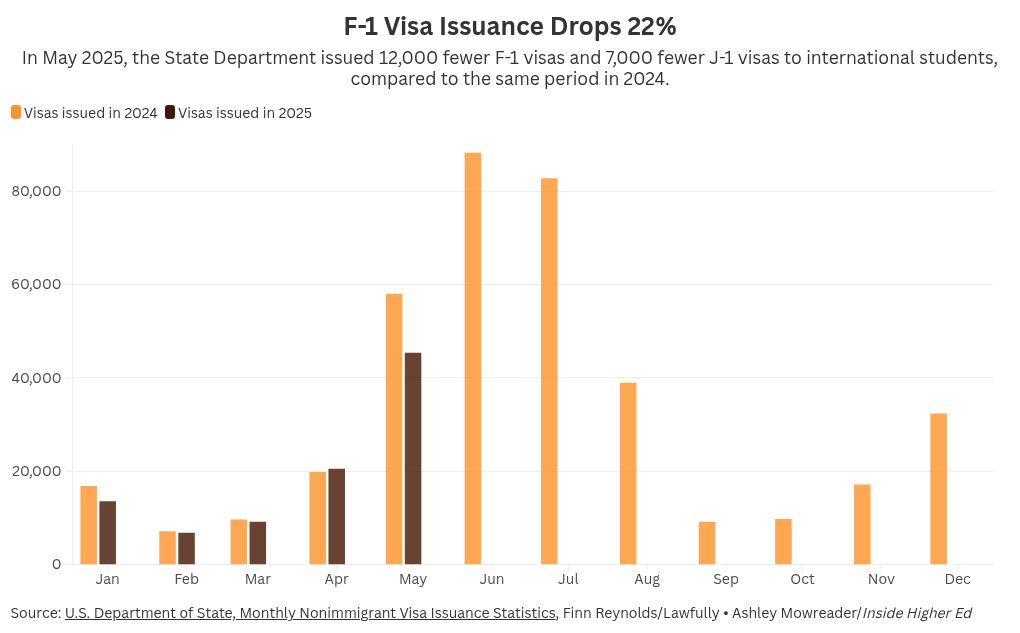
    Declining Visa Issuance: F-1 student visa issuance dropped 12% from January to April 2025 and plummeted 22% in May 2025 compared to the same period in 2024. While June 2025 data has not been published, the analysis suggests a possible 80-90% decrease based on the identified disruptions.

    Travel Restrictions: A June 4, 2025 executive order imposed restrictions on nationals from 19 countries, with reports suggesting another 36 countries could be added. These restrictions alone threaten $3 billion in annual economic contributions and more than 25,000 American jobs.

    The economic implications extend far beyond university campuses. International students contributed $46.1 billion to the U.S. economy in 2024-25 and supported nearly 400,000 jobs across various sectors including housing, dining, retail, and transportation.

    The projected 15% enrollment decline would reduce international student economic contributions to $39.2 billion in 2025-26, down from an expected $46.1 billion. This represents not just a loss to individual institutions, but to entire communities that have built economic ecosystems around international education.

    “Without significant recovery in visa issuance in July and August, up to 150,000 fewer students may arrive this fall,” the report warns, highlighting the narrow window remaining for policy corrections.

    Beyond immediate economic impacts, education leaders worry about long-term consequences for American higher education’s global competitiveness. International students contribute to research innovation, provide diverse perspectives in classrooms, and often remain in the United States after graduation, filling critical roles in STEM fields and other high-demand sectors.

    The timing is particularly concerning given increased competition from other English-speaking countries like Canada, Australia, and the United Kingdom, which have positioned themselves as more welcoming alternatives for international students.

    To mitigate what NAFSA calls a “devastating outcome,” the organization is urging Congress to direct the State Department to take two immediate actions:

    1. Provide expedited visa appointments and processing for all F-1 and M-1 students and J-1 exchange visitor visa applicants
    2. Exempt F and M students as well as J exchange visitors from current travel restrictions affecting nationals from 19 countries, while maintaining required background checks and vetting

    The report argues that these policy changes could help institutions avoid the projected enrollment cliff and preserve the economic benefits that international students bring to American communities.

    For institutions planning fall enrollment, the report suggests the need for contingency planning and advocacy efforts to address visa processing challenges. With the traditional summer months representing the final opportunity for students to secure visas for fall enrollment, time is running short for policy interventions.


    Source link

  • What the Fall of Rome Tells Us About the American Oligarchy

    What the Fall of Rome Tells Us About the American Oligarchy

    There are tax farmers squeezing a province dry. There are soldiers fighting for the emperor’s baton. And then there are a few who dread the empire’s fall and dream of the old republic.

    This is not just the story of ancient Rome. It’s also an apt metaphor for the state of contemporary America—a late-stage empire defined by extreme inequality, militarization, and a governing class that clings to power while the social fabric unravels.

    In Rome, the Senate once stood as the heart of the Republic, composed of elite Patrician families who wielded enormous religious, political, and economic influence. But as historian and economist Michael Hudson writes in The Collapse of Antiquity, these elites became entrenched creditors and landlords, a rentier class unwilling to compromise or adapt. They refused debt cancellation, land redistribution, or any reforms that might curb their power—transforming what was once a dynamic, if imperfect, republic into a brittle and parasitic empire.

    This refusal to evolve created an unsustainable system. Wealth concentrated in fewer hands. Small farmers and urban workers were crushed under debts. The rural economy collapsed as latifundia (large estates) displaced independent farmers. Military commanders, frustrated with elite gridlock, seized power for themselves. And the Senate, once a genuine force of governance, became a ceremonial shell. What followed was a long descent: civil wars, authoritarianism, economic stagnation, and eventually the re-feudalization of the West.

    Hudson’s view is clear: the Roman Senate and elite, by prioritizing their creditor rights over the common good, destroyed the economic base that sustained the Empire. In their greed and rigidity, they ensured the fall they feared.

    Now consider the United States. Like Rome, America has become dominated by a professional ruling class: oligarchs, financiers, tenured politicians, credentialed technocrats, and think-tank warriors. Institutions of higher education, once engines of democratic possibility, have increasingly become training grounds for this elite. And like the Roman Senate, they are largely unaccountable—privatizing gains, socializing losses, and suppressing reform.

    Just as Roman tax farmers drained the provinces, today’s student loan servicers, for-profit colleges, and hedge fund–backed housing firms squeeze the public to fund private empires. Just as Roman generals became emperors, today’s billionaires and media moguls wield near-sovereign power over public discourse, elections, and foreign policy. And just as the Roman elite clung to legal fictions while society crumbled, our ruling class insists the republic is healthy—even as inequality soars, infrastructure decays, and democratic norms erode.

    There are still those who long for a return to the “old republic”—to a time when education was a public good, when civic virtue mattered, and when government sought the common welfare. But those voices are increasingly drowned out in a landscape of imperial spectacle, culture wars, and managed decline.

    Hudson reminds us that ancient societies that survived economic collapse—like those in Mesopotamia—did so by recognizing the need for periodic resets. They canceled debts. They redistributed land. They prioritized stability over elite entrenchment. Rome—and perhaps America—refused to learn those lessons.

    In this moment of crisis, the choice is stark: will we continue down the path of empire, ruled by debt and extraction? Or will we recover some measure of republic, with institutions that serve people, not just capital?

    One thing is certain: empires fall. But their people don’t have to fall with them—if they choose to resist.

    Sources:

    • Michael Hudson, The Collapse of Antiquity: Greece and Rome as Civilization’s Oligarchic Turning Point, 2023

    • Mary Beard, SPQR: A History of Ancient Rome, 2015

    • Edward Gibbon, The Decline and Fall of the Roman Empire, 1776–1789

    • Kyle Harper, The Fate of Rome: Climate, Disease, and the End of an Empire, 2017

    • Higher Education Inquirer, ongoing coverage on student debt and elite university structures

    • U.S. Department of Education, data on student debt and institutional concentration of resources

    Source link

  • Australian universities fall in world rankings – Campus Review

    Australian universities fall in world rankings – Campus Review

    Rankings

    Two universities made the top 20 and six made the top 50, as Asian unis push to improve

    Just under 70 per cent of Australian universities have dropped compared to last year in the latest QS World University Rankings released on Thursday.

    Please login below to view content or subscribe now.

    Membership Login

    Source link

  • Don’t Fall for Trump’s Trade School Trojan Horse (opinion)

    Don’t Fall for Trump’s Trade School Trojan Horse (opinion)

    In one of his all-too-frequent rants on Truth Social last month, President Trump posted, “I am considering taking Three Billion Dollars of Grant Money away from a very antisemitic Harvard, and giving it to TRADE SCHOOLS all across our land.” It’s a transparent and cynical ploy: pit one segment of the education community against another—rich Harvard versus poor “trade schools”—and watch the divisions take hold. But make no mistake: This strategy only works if institutions, elite or otherwise, fall for the bait.

    We’re not sure what the president means by “trade schools” but suspect he’s referring to the nation’s 1,000-plus community and technical colleges— institutions that educate about a third of all U.S. undergraduates. We’ve both spent our careers making the case for greater investment in these colleges, including through the Project on Workforce, the cross-Harvard initiative we helped found six years ago to forge better pathways between education and good jobs.

    (And for the record: Trump’s accusation that Harvard is “very antisemitic” rings hollow coming from the man who hosted a Holocaust-denying white nationalist at Mar-a-Lago. It’s certainly unrecognizable to us—two Jews who, between us, have spent more than 40 years as Harvard students, staff and faculty.)

    If Trump actually cared about funding “trade schools,” he would start by telling congressional leaders to strip the provision in his so-called Big Beautiful Bill that raises the credit-hour threshold for Pell Grant eligibility. Community colleges serve the bulk of low-income students, and most of them have to work while in school. This proposed change proffered by the House, which was not included in the Senate version of the reconciliation bill, could cut off aid for 400,000 students a year and force many to drop out.

    But the threat isn’t just in proposed legislation: Community colleges are already the targets of Trump’s politically motivated grant cancellations. For example, just last month, his administration revoked awards from six Tech Hubs, created by bipartisan legislation to boost innovation, job creation and national security. These included projects in Alabama, where a community college would expand biotech training; in Idaho, where a community college planned to train aerospace workers; and in Vermont, where a community college was preparing a new semiconductor workforce.

    And the cuts don’t stop there. If the president was really serious about supporting the U.S. skilled technical workforce, he would expand, not gut, programs like the National Science Foundation’s Advanced Technological Education initiative, which has provided $1.5 billion to more than 500 community and technical colleges to develop cutting-edge training in fields like advanced manufacturing and robotics. Instead, his budget proposes cutting NSF by 55 percent, including deep reductions to education and workforce programs. The president’s budget also proposes eliminating all Perkins Act funding for community colleges (approximately $400 million), limiting the funding to middle and high schools and thereby cutting off a key source of federal support for technical training beyond secondary school.

    If by “trade schools” Trump means education for trades jobs, his hostility toward immigrants undermines the very students he claims to support. Eight percent of community college students are not U.S. citizens, with much higher shares on some campuses. They are just as vital to America’s future as the researchers in Harvard’s labs. In 2024, immigrants made up more than 30 percent of construction trades workers and 20 percent of U.S. manufacturing workers. Closing America’s doors won’t just harm colleges: It will weaken our ability to build, make and compete.

    Last week, we joined more than 12,000 Harvard alumni in signing an amicus brief to pledge our commitment to defend not only Harvard but the broader higher education enterprise from the Trump administration’s bullying attacks. Over the past month, we also spoke with community college leaders from around the country whose work we profiled in our 2023 book, America’s Hidden Economic Engines. Without exception, these leaders expressed deep concern, understanding that if Harvard, with all of its resources, could be forced to bend to the will of a tyrannical government, what chance would less resourced institutions have to defend academic freedom and maintain independence from governmental intrusion?

    If elite universities and community and technical colleges stand together, we can defend not just education, but democracy itself. Challenging as it will be for Harvard to weather this unprecedented assault on its independence, and that of higher education, it has no choice but to stand firm. Unlike many more vulnerable victims of Trump’s bullying—immigrants, civil servants, USAID grantees, the trans community—Harvard has the resources to fight back. Ultimately its rights, along with the rights of others targeted, will likely be vindicated by the courts. But in the interim, a lot of needless damage will be done to the lives of affected people and institutions. Most Americans may not speak often of such abstractions as academic freedom, due process and the fate of democracy. But they know a bully when they see one.

    Rachel Lipson, a co-founder of the Harvard Project on Workforce, was a senior adviser on workforce at the CHIPS Program Office at the U.S. Department of Commerce. She recently returned to Harvard Kennedy School as a research fellow.

    Robert Schwartz is a professor of practice emeritus at Harvard Graduate School of Education. Before joining the Harvard faculty in 1996, he had a long career in education and government.

    Source link

  • Do transgender student athletics fall under DOGE Subcommittee jurisdiction?

    Do transgender student athletics fall under DOGE Subcommittee jurisdiction?

    This audio is auto-generated. Please let us know if you have feedback.

    Do transgender student athletes’ involvement in girls’ and women’s sports — an issue that has recently jeopardized schools’ federal funding — fall under government efficiency and oversight? That question starkly divided lawmakers among party lines in a nearly 4-hour hearing on Wednesday held by the Delivering on Government Efficiency Subcommittee, a newly-formed subcommittee of the House Committee on Oversight and Accountability. 

    The DOGE Subcommittee hearing — meant to discuss the politically charged issue of Title IX and transgender student rights that has taken center stage under the Trump administration — quickly deteriorated to repeated gavel-banging, a motion to adjourn the meeting, disagreement over the committee’s purpose, arguments over lawmakers’ allotted speaking times, and discussions of differences in male and female elbow-joint anatomy and muscle mass. 

    The subcommittee was created to oversee “federal civil service, including compensation, classification, and benefits; federal property disposal; government reorganizations and operations, including transparency, performance, grants management, and accounting measures generally,” according to the Committee on Oversight and Government Reform’s rule book. 

    Witnesses included two cisgender female athletes advocating for athletic teams without transgender students, the chair for the USA Fencing Board of Directors, and the CEO of National Women’s Law Center, a nonprofit organization that advocates for LGBTQ+ rights.

    Republican lawmakers, who have called for less federal oversight of education and a return of that power to the states, said the hearing was necessary because it related to Title IX, a federal law meant to prohibit sex discrimination in federally funded education programs. 

    “It’s an important issue that biological men stay out of women’s sports,” said Rep. Marjorie Taylor Greene, chair of the committee and Republican from Georgia. 

    Rep. William Timmons, R-S.C., said the hearing was meant to “shine a light not only on the integrity of women’s sports,” but also on how institutions like USA Fencing and others may be misusing their authority to “push controversial policies that violate basic human rights and disregard their Congressionally-authorized mission.”

    “This is what happens when you allow God to be pushed out of everything,” added Rep. Eli Crane, R-Ariz. 

    Democratic lawmakers at the hearing, however, said it was a waste of the subcommittee’s time and did not fall under the body’s jurisdiction, which instead includes issues like proposed cuts across the government. 

    “This subcommittee could be focusing on the layoffs that President Trump has executed: over 200,000 firings of federal employees,” said Rep. Stephen Lynch, D-Mass. “That does affect the efficiency of our government programs.” 

    Rep. Robert Garcia, D-Calif., concurred, saying the subcommittee has “never really talked about government efficiency or any serious legislative work,” and that he was “surprised that this subcommittee is not apparently in charge of policing women’s sports.” 

    Witnesses at a DOGE Subcommittee hearing raise their hands in oath

    Stephanie Turner, left, a fencer who refused to compete against a transgender athlete, and Payton McNabb, right, a former North Carolina high school volleyball player injured by a transgender opponent, are sworn in during the hearing held by the Delivering on Government Efficiency Subcommittee at the U.S. Capitol on May 7, 2025, in Washington, D.C.

    Kayla Bartkowski/Getty Images via Getty Images


    DOGE impacts on K-12

    The DOGE Subcommittee is among the latest in a series of efforts by the Trump administration and Republicans to cut back on what they say are instances of abuse, fraud and waste in the government. Its formation is an extension of similar efforts conducted by the Department of Government Efficiency, also referred to as DOGE. 

    Those efforts have had major implications for the K-12 sector in recent months, including gutting the Education Department by laying off more than 1,300 employees, closing or significantly reducing its offices, canceling grants entirely or retracting grant competitions, and proposing a 15% cut to the department’s funding. 

    The reduction in expenses from DOGE’s efforts is also expected to put a strain on K-12 finances, according to a Moody’s report released in April. 

    Among DOGE cuts were seven of the Education Department’s 12 local offices for the Office for Civil Rights, leaving schools with reduced oversight of civil rights compliance. Those offices were in charge of investigating allegations of Title IX violations — the subject of the hearing Wednesday — for half of states. 

    Source link

  • What happens when tyrants fall from power?

    What happens when tyrants fall from power?

    “The despot is dead. Long live … er, who?“

    Unlike kings or queens, dictators and autocrats find it helpful not to have a clear successor or rival who might soften their hold on power.

    Much as that iron-fisted ruler may be loathed, their abrupt departure from the throne can bring significant risk of subsequent turmoil. They have created a system that puts them alone at the centre of power.

    The White House in March was very quick to deny that President Joe Biden was pressing for regime change when he said that his Russian counterpart, Vladimir Putin, should not remain in power.

    There is no shortage of countries in recent decades where fallen autocrats have left a power vacuum all too quickly filled by chancers, thugs and weird ideologues, or simply some drab toady of the old regime.

    Covering tyranny

    As a reporter, it was impossible for me not to get caught up in the excitement after popular unrest had driven out yet another long-serving despot in power so long that they had forgotten who was serving whom. It really is exhilarating.

    During a long career as a journalist, I reported in a number of countries where autocratic, often staggeringly corrupt, leaders were forced unwillingly out of office. Sometimes, I’ve been there at the moment, more often to report on the aftermath.

    The first time was just over 30 years ago in Bangladesh, whose military dictator Hussain Ershad had lost power in the face of mass protests. And in a rarity for the impoverished country, whose relatively short period of independence had been marked by violence and assassinations, the leader’s downfall had been almost bloodless.

    By the time I arrived in Dhaka, crowds were cheerfully marching through the capital’s streets. The two people who would dominate Bangladeshi politics until today — the widow of one assassinated leader and the daughter of another — were happily giving interviews to visiting journalists, promising a new era for their country.

    Since then, Bangladesh’s economy has indeed grown. But the country’s politics remain plagued by autocratic leadership, corruption and a drawn-out feud between those two women.

    The lingering influence of despotism

    In the Philippines, a reporter colleague liked to tell stories about joining a crowd streaming through the Malacanang presidential palace, vacant after President Ferdinand Marcos and his wife Imelda fled the country in the face of a People’s Power revolt in 1986 following more than 20 years of rule marked by excess and rampant graft.

    This month, their son was elected president with little to offer by way of a platform beyond the promise of a return to those “halcyon days” when his parents were in charge some four decades earlier.

    In neighbouring Indonesia, the family of President Suharto, who led another Southeast Asian kleptocracy into near financial ruin until he was forced to step down in 1998 after more than 32 years of iron rule, continues to try to get back into politics. Suharto’s downfall came with mass protests, violence and fears the giant archipelago would split apart. The country has largely recovered, but some of the elites established during the Suharto years remain a powerful influence.

    Later, I was involved in reporting on the “colour” revolutions of former Soviet states, including Georgia and Ukraine. In both cases, infectious enthusiasm for change and the end of the old regimes did not take all that long to sour.

    The leader of the 2003 Georgian revolution, Mikheil Saakashvili, eventually fled into exile. He is now back in his country where he was jailed on charges of abuse of power.

    Sidelining of opposition

    Ukraine struggled to find a competent leader after casting aside the old guard from the Soviet era with its Orange Revolution, which began the following year.

    Paradoxically, and very unexpectedly, it has taken this year’s Russia’s invasion of Ukraine to reveal a leader of commanding stature in President Volodymyr Zelenskiy, a former comedian.

    In many of these countries and others ruled by long-serving autocracies, the incentive is for leaders to crush any emerging threat to their hold on power. Rising political stars are sidelined, opponents are exiled, jailed or killed and domestic news coverage is limited to the official line.

    And Russia? Rumours abound that Putin, ever tightening his control during more than 20 years in power, is seriously ill or even faces a coup. As with the likes of Suharto or Marcos, Putin took office when his country was lurching through economic crisis. He was a bit dull. Unlike his predecessor, Boris Yeltsin, Putin didn’t make a habit of rolling up drunk.

    He was smart, focused on the economy, not in thrall to Russia’s plundering oligarchs and able to bring stability to the lives of ordinary Russians exhausted and disoriented by the collapse of the Soviet Union. He became hugely popular.

    But there was a sense that his inner circle didn’t quite trust that popularity. By most accounts, Putin would easily have won a second term in the 2004 presidential election. But the Kremlin could not resist making sure the deck was stacked in his favour. He won 71.9% of the vote.

    What would Russia be like post-Putin

    Putin has run the country ever since, either as president or prime minister. Such is the state’s grip on Russian media that it is not really possible to be sure how popular Putin may be now. One recent poll suggested his star, which had started to look a bit faded, has brightened considerably since the invasion of Ukraine.

    His government is clearly in no mood to put that popularity up for too much public scrutiny, throttling the remaining independent Russian media and introducing a law to hand long prison terms to those who openly oppose the war on Ukraine.

    Prominent Russians who might credibly challenge Putin’s grip on the country live abroad, are in prison or dead. His most recent serious opponent, Alexei Navalny, is looking at years in a Russian prison. It isn’t all that clear, either, whether the bulk of Russians would prefer Navalny as their next leader.

    If Putin is no longer in office for whatever reason, who would be in the running to replace him?

    It seems very unlikely that the current political elite would readily allow a reformer to sweep them from power. Quite possibly, the average Russian — sympathetic to the view that the West has for years been treating their country with contempt — would prefer stability, a job and some international prestige.

    When Russia faced revolution more than a century ago, an estimated 10 million people died after the autocrat Tsar Nicholas II was removed from power.

    Perhaps that’s why Biden officials were so quick to rule out regime change. Better the devil you know than the devil you don’t.


    Questions to consider:

    • If you were working for local media in Moscow, how would you write about the war in Ukraine?

    Do you think your country’s mainstream media can be relied on to be factual in reporting? Why?

    • If the current leader of your nation loses power, how peaceful do you think the aftermath will be?


    Correction: The editor’s note at the top of the story was changed to correct the date the article was originally published.

    Source link

  • Most Higher Ed Employees Received Raises This Year, but Salaries Still Fall Short of Pre-Pandemic Pay

    Most Higher Ed Employees Received Raises This Year, but Salaries Still Fall Short of Pre-Pandemic Pay

    by CUPA-HR | April 8, 2025

    New research from CUPA-HR shows that median pay increases for most higher education employees in 2024-25 remained strong, although they have dropped from the historically high increases seen in the previous two years. And although raises this past year for most employees outpaced inflation, they are still being paid less than they were in 2019-20 in inflation-adjusted dollars.

    The largest gap between pre-pandemic inflation-adjusted salaries and current salaries is for tenure-track faculty (who are paid 10.2% less), followed by non-tenure-track teaching faculty (paid 7.6% less). The smallest gap is for staff (paid 2.8% less).

    Some of the other key findings from an analysis of CUPA-HR’s higher ed workforce salary survey data from 2016-17 to 2024-25:

    • Staff employees continued to receive some of the highest pay increases compared to other workforce areas.
    • Non-tenure-track teaching faculty received a 3.2% salary increase, which is lower than last year’s high but still among the largest increases seen in recent years.
    • For the third consecutive year, tenure-track faculty received the lowest salary increase of all employee categories (2.6%). Across the nine years of data analyzed, tenure-track faculty salaries have not once exceeded the rate of inflation. This essentially means that — in real dollars — they have received salary decreases for the past decade.

    Explore this data and more in CUPA-HR’s newest interactive graphic.


    Source link

  • Canadian study permit approvals fall far below cap targets

    Canadian study permit approvals fall far below cap targets

    Canadian study permit approvals are on track to fall by 45% in 2024, rather than the 35% planned reduction of last year’s controversial international student caps, new IRCC data analysed by ApplyBoard has revealed.  

    “The caps’ impact was significantly underestimated,” ApplyBoard founder Meti Basiri told The PIE News. “Rapidly introduced policy changes created confusion and had an immense impact on student sentiment and institutional operations.  

    “While aiming to manage student numbers, these changes failed to account for the perspectives of students, and their importance to Canada’s future economy and communities,” he continued.  

    The report reveals the far-reaching impact of Canada’s study permit caps, which were announced in January 2024 and followed by a tumultuous year of policy changes that expanded restrictions and set new rules for post-graduate work permit eligibility, among other changes.  

    For the first 10 months of 2024, Canada’s study permit approval rate hovered just above 50%, resulting in an estimated maximum of 280,000 approvals from K-12 to postgraduate levels. This represents the lowest number of approvals in a non-pandemic year since 2019. 

    Source: IRCC. Disclaimer: Data for 2021-Oct 2024 is sourced from IRCC. Full-year 2024 figures are estimates extrapolated from Jan-Oct 2024 and full-year 2021-2023 IRCC data. Projections may be subject to change based on changing conditions and source data.

    “Even from the early days of the caps, decreased student interest outpaced government estimates,” noted the report, with stakeholders highlighting the reputational damage to Canada as a study destination.  

    “Approvals for capped programs fell by 60%, but even cap-exempt programs declined by 27%. Major source countries like India, Nigeria, and Nepal saw over 50% declines, showing how policies have disrupted demand across all study levels,” said Basiri.  

    Following major PGWP and study permit changes announced by the IRCC in September 2024, four out of five international student counsellors surveyed by ApplyBoard agreed that Canada’s caps had made it a less desirable study destination. 

    Though stakeholders across Canada recognised the need to address fraud and student housing issues, many had urged the federal government to wait until the impact of the initial caps was clear before going ahead with seemingly endless policy changes.  

    At the CBIE conference in November 2024, immigration minister Marc Miller said he “profoundly disagreed” with the prevailing sector view that the caps and subsequent PGWP and permanent residency restrictions had been an “overcorrection”.

    Post-secondary programs, which were the primary focus of the 2024 caps, were hit hardest by the restrictions, with new international enrolments at colleges estimated to have dropped by 60% as a result of the policies.  

    While Canada’s largest source destinations saw major declines, the caps were not felt evenly across sending countries. Senegal, Guinea and Vietnam maintained year-over-year growth, signalling potential sources of diversity for Canada’s cap era.   

    The report also highlighted Ghana’s potential as a source destination, where approval ratings – though declining from last year – remain 175% higher than figures from 2022. 

    Rapidly introduced policy changes created confusion and had an immense impact on student sentiment

    Meti Basiri, ApplyBoard

    The significant drop in study permit approvals was felt across all provinces, but Ontario – which accounted for over half of all study permit approvals in 2023 – and Nova Scotia have seen the largest impact, falling by 55% and 54.5% respectively.

    Notably, the number of study permits processed by the IRCC dropped by a projected 35% in 2024, in line with the government’s targets, but approval rates have not kept pace.

    When setting last year’s targets, minister Miller only had the power to limit the number of applications processed by the IRCC, not the number of study permits that are approved.  

    The initial target of 360,000 approved study permits was based on an estimated approval rate of 60%, resulting in a 605,000 cap on the number of applications processed. 

    Following new policies such as the inclusion of postgraduate programs in the 2025 cap, Basiri said he anticipated that study permit approvals would remain below pre-cap levels.  

    “While overall student numbers may align with IRCC’s targets, the broader impact on institutional readiness and Canada’s reputation will be key areas to watch in 2025,” he added.  

    Source link