Tag: Fall

  • First-year student enrollment spiked 5.5% in fall 2024

    First-year student enrollment spiked 5.5% in fall 2024

    This audio is auto-generated. Please let us know if you have feedback.

    Dive Brief: 

    • Enrollment of first-year students grew 5.5% in fall 2024 compared to the year before, representing an increase of about 130,000 students, according to a final tally from the National Student Clearinghouse Research Center
    • The figure is a striking reversal from the clearinghouse’s preliminary findings in October, which erroneously reported a decline in first-year students. Earlier this month, the clearinghouse said the early data contained a research error and suspended its preliminary enrollment reports, which use different methodologies to determine first-year student counts than the research center’s reports on final enrollment figures. 
    • College enrollment overall grew 4.5% in fall 2024 compared to the year before, according to the final data, rebounding to levels seen before the coronavirus pandemic caused widespread declines. 

    Dive Insight: 

    The new data is promising for higher education institutions, many of which have weathered steep enrollment declines in the wake of the pandemic. 

    “It is encouraging to see the total number of postsecondary students rising above the pre-pandemic level for the first time this fall,” Doug Shapiro, the research center’s executive director, said in a Wednesday statement. 

    Undergraduate enrollment surged 4.7% this fall, representing an increase of about 716,000 students. Graduate enrollment likewise spiked 3.3%, representing an uptick of about 100,000 students. 

    All sectors enjoyed enrollment increases. For-profit, four-year institutions had the largest enrollment growth, with headcounts rising 7.5% in fall 2024 compared to the year before. Public two-year institutions and public primarily associate-degree granting baccalaureate institutions, or PABs, saw similar levels of growth — 5.8% and 6.3%, respectively. 

    Enrollment also increased at four-year nonprofits. Overall headcounts grew 3.8% at private colleges and 3.1% at public institutions. 

    Older students largely drove the growth in first-year students. Enrollment of first-year students from ages 21 to 24 surged 16.7% in fall 2024, while headcounts of students 25 and older spiked by a whopping 19.7%. 

    Enrollment of younger first-year students also increased, though the growth was more muted. 

    Headcounts of 18-year-old students grew 3.4%. However, this group of first-year students has still not recovered to pre-pandemic levels, Shapiro said in a statement.

    Similarly, enrollment of first-year students ages 19 to 20 increased 4.5%. 

    Two-year public colleges and public PABs enjoyed strong increases in their first-year student population, with 6.8% and 8.4% growth, respectively. However, for-profit, four-year colleges saw the largest increase, 26.1%, according to the new data. 

    Headcounts of first-year students also spiked at four-year nonprofits, rising 3.3% at public institutions and 2.8% at private colleges. 

    Shapiro addressed the research center’s methodological error during a call Wednesday with reporters. The erroneous preliminary report found that first-year enrollment had declined by 5% — over 10 percentage points lower than what the final data showed. 

    “I think our sensitivity to abnormally large changes was somewhat reduced because we had a host of kind of ready explanations for why we might be seeing these declines,” Shapiro said, citing issues with the federal student aid form, growing concerns with student debt and changes in the labor market.

    The research center staff has been investigating its other publications to see if the issue crept into them. 

    So far, they discovered that the flawed methodology also impacted a February 2024 report on transfer students. The clearinghouse will correct that data when it issues its next transfer report in February. 

    The research center previously announced that the error affected other reports in its “Stay Informed” series, which shares preliminary enrollment data. It has halted those reports — which launched at the height of the pandemic — until it vets a new methodology.

    Source link

  • Freshman enrollment up this fall; data error led to miscount

    Freshman enrollment up this fall; data error led to miscount

    Freshman enrollment did not decline this fall, as previously reported in the National Student Clearinghouse Research Center’s annual enrollment report in October. On Monday, the NSC acknowledged that a methodological error led to a major misrepresentation of first-year enrollment trends, and that first-year enrollment appears to have increased.

    The October report showed first-year enrollments fell by 5 percent, in what would have been the largest decline since the COVID-19 pandemic—and appeared to confirm fears that last year’s bungled rollout of a new federal aid form would curtail college access. Inside Higher Ed reported on that data across multiple articles, and it was featured prominently in major news outlets like The New York Times and The Washington Post.

    According to the clearinghouse, the error was a methodological one, caused by mislabeling many first-year students as dual-enrolled high school students. This also led to artificially inflated numbers on dual enrollment; the October report said the population of dually enrolled students grew by 7.2 percent.

    “The National Student Clearinghouse Research Center acknowledges the importance and significance of its role in providing accurate and reliable research to the higher education community,” Doug Shapiro, the center’s executive director, wrote in a statement. “We deeply regret this error and are conducting a thorough review to understand the root cause and implement measures to prevent such occurrences in the future.”

    On Jan. 23, the clearinghouse will release another annual enrollment report based on current term estimates that use different research methodologies.

    The Education Department had flagged a potential issue in the data this fall when its financial aid data showed a 5 percent increase in students receiving federal aid. In a statement, Under Secretary James Kvaal said the department was “encouraged and relieved” by the clearinghouse’s correction.

    Source link

  • Fall and Rise | HESA

    Fall and Rise | HESA

    Fall and Rise

    The question I am getting more often than any other these days is: “what are you hearing about cuts at colleges and universities?” And my answer for the most part has been: “damned if I know.”

    The reason for my confusion is that publicly available details are few and far between. The HESA Towers team has been scouring the public record for details on institutional budget announcements; by our count, only 34 universities or colleges have so far announced anything concrete about their 25-26 budget plans and/or any planned cuts as a result of changing international student numbers. It’s possible more have been announced internally but just not caught the notice of the local press; we’ll be doing a lot more digging over the next couple of weeks. My guess is that many institutions are trying to avoid bad headlines by simply not going public about any plans to cut…but of course in the process, they are making it harder to convey to the public the magnitude of the downsizing being forced on the sector.

    (This is a really interesting version of the Tragedy of the Commons!).

    Some additional problems with the data: such information as one can glean from public sources is often skimpy and inconsistent: sometimes you get a figure for “loss of anticipated revenue,” sometimes you get a “projected deficit” (which sometimes is for 24-25, and other times for 25-26, and whether the figure is for operating budget or total budget take a bit of digging). Sometimes the numbers of programs being cut are announced but the identity of the programs is secret. Often you see that there will be budget cuts of $X million but there is no clarity about where those cuts will come from or the timeframe for the return to budget balance. In terms of job “cuts” as near as we can tell only five institutions have announced specific numbers for layoffs which have actually so far occurred, for a total of 214 lost jobs. You may have seen higher estimates from other sources, but these seem to include data on jobs which “will be affected” and it’s not 100% clear how many of these are permanent jobs which will be eliminated vs. permanent posts which will not be filled, or contract jobs which will not be renewed. All of these nuances may sound petty, but it’s really hard to get meaningful numbers unless you get this stuff right.

    The story of how universities and colleges deal with the sudden loss of international student income (and the long-term consequences of provincial disinvestment) is the biggest and most consequential story in Canadian postsecondary education this century. How we deal with this collectively will shape the sector for over a decade, maybe even out to 2050. The HESA Towers team is working hard to document what is happening and help the sector make sense of fast-moving events and respond appropriately. So today I want to tell you about two initiatives we’re launching.

    The first is a Retrenchment Watch, which will follow developments in institutional cutbacks not just in Canada, but around the world (albeit with a particular focus on the anglosphere). Higher education probably hit peak public funding around the globe over a decade ago, but what we’re now seeing is an actual contraction of the sector as a whole, happening via an un-coordinated set of decisions made by individual institutions according to local imperatives. Understanding how this is happening is of great importance, not just for posterity but for present-day decision makers. And we’ll be making this information freely available to all via Retrenchment Watch.

    For the moment, the Retrenchment Watch is extremely bare bones, but we’ll be filling it out very quickly over the next few weeks, with the Canadian institutions first. If you want regular updates on who is cutting what as well as some basic pattern analysis, please fill out this form, and we’ll get you signed up to our newsletter so you’re always up-to-date.

    The second is what we are calling “The Recovery Project.” We know that institutional leaders aren’t just thinking about surviving cuts, they’re also thinking about how to position their organizations to thrive in the aftermath. To help them, we’re launching a subscription research project looking at universities and colleges around the world who have faced serious financial sustainability problems over the past three decades and examining how they turned their fortunes around. In a crisis, there’s no time to re-invent the wheel: with this research institutions can understand better what works, when and why. By spreading the cost of research collectively across many institutions, we can offer this premium product—which involves monthly reports and webinar sessions for all members—at a huge discount to individual schools (and if your school is a member of the University Vice-President’s Network, we’ll be offering an even bigger discount).

    If you’re interested in joining this project, my colleague Tiffany MacLennan has been working to bring this information together. Email her at [email protected] and we’ll get back to you ASAP with a prospectus.

    There’s no disguising how the sector is taking a beating right now. It will recover. The only question is how quickly, and which institutions will be at the forefront.

    Source link

  • Overtime and Title IX Final Rules Targeted for Early 2024 Release in Fall Regulatory Agenda – CUPA-HR

    Overtime and Title IX Final Rules Targeted for Early 2024 Release in Fall Regulatory Agenda – CUPA-HR

    by CUPA-HR | December 12, 2023

    On December 6, the Biden administration released the Fall 2023 Unified Agenda of Regulatory and Deregulatory Actions, providing the public with an update on the regulatory and deregulatory activities under development across approximately 67 federal departments, agencies and commissions. This release is the second and final regulatory agenda for 2023, and it sets target dates for upcoming regulatory actions mainly for the first half of 2024.

    CUPA-HR has highlighted the following items from the Fall 2023 Regulatory Agenda for members to be aware of as we enter the new year. As a reminder, these target dates are not a guarantee, but they provide insight into when we can possibly expect the regulations to be published. CUPA-HR’s government relations team will continue to monitor for any updates on the following regulations and others that may impact the higher education space.

    Department of Labor

    Wage and Hour Division — Defining and Delimiting the Exemptions for Executive, Administrative, Professional, Outside Sales, and Computer Employees

    According to the Fall 2023 Regulatory Agenda, the Department of Labor (DOL)’s Wage and Hour Division (WHD) has targeted April 2024 for release of the final rule to update the Fair Labor Standards Act’s overtime pay regulations. The final rule seeks to increase the minimum salary threshold required for white-collar professionals to maintain exempt status under the FLSA.

    On September 8, WHD released a Notice of Proposed Rulemaking (NPRM) to update the salary threshold. The NPRM increases the minimum salary threshold from its current level of $35,568 per year ($684 per week) to $60,209 annually ($1,158 per week), which amounts to a nearly 70% increase.* Additionally, WHD proposes to automatically increase the salary level every three years by tying the threshold to the 35th percentile of full-time salaried wages in the lowest wage census region. DOL indicated in the proposed rule that it is considering implementing an effective date in the final rule that could come as soon as 60 days after the final rule is published to the public.

    CUPA-HR was joined by 49 other higher education associations in submitting comments in response to the NPRM. In our comments, we raised concerns with the timing of this increase, the size of the proposed increase, the implementation of automatic updates, and the timeline for regulatory compliance that WHD anticipates. Our comments were informed by a CUPA-HR member survey, in which over 300 members provided feedback on their concerns with and thoughts about the proposal. For ongoing updates, visit CUPA-HR’s FLSA Overtime page.

    Wage and Hour Division — Employee or Independent Contractor Classification under the Fair Labor Standards Act

    The Fall 2023 Regulatory Agenda indicates that WHD anticipated releasing the FLSA independent contractor rule in November 2023. The final rule has been at the White House Office of Information and Regulatory Affairs (OIRA) for review since September 28, 2023, and once the agency finishes its review, the rule will be published.

    On October 13, 2022, the DOL published an NPRM to rescind the current method for determining independent contractor status under the FLSA. The current test, finalized by the Trump administration in 2021, has two core factors of control and investment with three additional factors (integration, skill and permanency) that are relevant only if those core factors are in disagreement. The Biden rule proposes a return to a “totality-of-the-circumstances analysis” of multiple factors in an economic reality test, including the following six factors, which are equally weighted with no core provisions:

    • The extent to which the work is integral to the employer’s business.
    • The worker’s opportunity for profit or loss depending on managerial skill.
    • The investments made by the worker and the employer.
    • The worker’s use of skill and initiative.
    • The permanency of the work relationship.
    • The degree of control exercised or retained by the employer.

    Employment and Training Administration — Revising Schedule A to Include Updating Occupations in Science, Technology, Engineering, and Mathematics (STEM)

    The regulatory agenda indicates that DOL’s Employment and Training Administration (ETA) aimed to issue a Request for Information (RFI) in November 2023. According to the notice in the agenda, ETA is seeking input from the public “on whether Schedule A serves as an effective tool for addressing current labor shortages, and how the Department may create a timely, coherent and transparent methodology for identifying STEM occupations that are experiencing labor shortages in keeping with its requirements under the Immigration and Nationality Act … to ensure the employment of foreign nationals does not displace U.S. workers or adversely affect their wages and working conditions.”

    The RFI was sent to OIRA for review before publication on November 11, 2023, and will likely be released to the public soon.

    Equal Employment Opportunity Commission

    Regulations to Implement the Pregnant Workers Fairness Act

    In December 2023, the Equal Employment Opportunity Commission (EEOC) plans to issue a final rule to implement the Pregnant Workers Fairness Act (PWFA). The rule will create a framework for the EEOC on how to enforce protections granted to pregnant workers under the PWFA. For a detailed analysis of the proposed rule on implementing the PWFA, please see CUPA-HR’s blog post.

    In December 2022, the PWFA was signed into law through the Consolidated Appropriations Act of 2023. The law establishes employer obligations to provide reasonable accommodations to pregnant employees so long as such accommodations do not cause an undue hardship on the business, and makes it unlawful to take adverse action against a qualified employee requesting or using such reasonable accommodations. The requirements of the law apply only to businesses with 15 or more employees.

    Unlike the other regulations with target dates, the PWFA final rule has a statutory deadline for publication, which is December 29, 2023. Given this upcoming deadline, we will likely see the EEOC publish this rule soon.

    Department of Education

    Office for Civil Rights — Nondiscrimination on the Basis of Sex in Education Programs or Activities Receiving Federal Financial Assistance

    According to the regulatory agenda, the Department of Education (ED) anticipates releasing the highly anticipated Title IX final rule in March 2024. The rulemaking would finalize the June 2022 NPRM to roll back and replace the Trump administration’s 2020 regulations while simultaneously expanding protections against sex-based discrimination to cover sexual orientation, gender identity, and pregnancy or related conditions.

    CUPA-HR filed comments in September 2022 in response to the NPRM. In our comments, we brought attention to the possible impact the proposed regulations could have on how higher education institutions address employment discrimination.

    The new March target deadline marks the third time ED has delayed the issuance of the Title IX final rule. The rule was originally targeted for release in May 2023, but ED subsequently pushed the target date back to October 2023 via a blog post, when it became clear that the department would not meet the May timeline. Since ED missed the October timeline, they have faced increased pressure from Congressional Democrats and other advocacy groups to publish the final rule as soon as possible. While it’s not a guarantee ED will be able to publish the final rule in March 2024, the increased pressure will certainly motivate the department to move quickly.

    CUPA-HR plans to hold a webinar to inform members of the final rule’s new requirements once the final rule has been published. Details to come.

    Office for Civil Rights — Nondiscrimination on the Basis of Sex in Education Programs or Activities Receiving Federal Financial Assistance: Sex-Related Eligibility Criteria for Male and Female Athletic Teams

    Similar to the Title IX final rule above, ED plans to issue a final rule on student eligibility in athletic programs under Title IX in March 2024. The rule would finalize the NPRM that was released by the department in April 2023.

    Under the NPRM, schools that receive federal funding would not be permitted to adopt or apply a “one-size-fits-all” ban on transgender students participating on teams consistent with their gender identity. Instead, the proposal allows schools the flexibility to develop team eligibility criteria that serve important educational objectives, such as fairness in competition and preventing sports-related injuries. The department further explains that the eligibility criteria must take into account the sport, level of competition, and grade or education level of students participating, and the criteria would have to minimize harm to students whose opportunity to participate on a team consistent with their gender identity would be limited or denied.

    The NPRM received over 150,000 comments addressing support for and concerns with the proposal. ED must review all comments before issuing a final rule to implement these regulations, which is the likely cause of delay for both this rulemaking and the broader Title IX final rule.

    Department of Homeland Security

    U.S. Citizenship and Immigration Services — Modernizing H-1B Requirements and Oversight and Providing Flexibility in the F-1 Program

    On October 23, the Department of Homeland Security’s U.S. Citizenship and Immigration Services (USCIS) issued a proposed rule that aims to improve the H-1B program by simplifying the application process, increasing the program’s efficiency, offering more advantages and flexibilities to both petitioners and beneficiaries, and strengthening the program’s integrity measures.

    Prompted by challenges with the H-1B visa lottery, USCIS has prioritized a proposed rule to address the system’s integrity. The proposed rule is aimed at strengthening the lottery registration process and preventing fraud, and it makes critical revisions to underlying H-1B regulations. For a detailed summary of what the H-1B proposal includes, see CUPA-HR’s blog post.

    The NPRM is open for public comment until December 22, 2023. The Fall 2023 Regulatory Agenda included the regulations, but it did not provide a timeline for issuing the final rule, likely because the comment period is still open for the NPRM.

    U.S. Citizenship and Immigration Services — Fee Schedule and Changes to Certain Other Immigration Benefit Request Requirements

    In April 2024, USCIS anticipates issuing a final rule to adjust the fees charged by the agency for immigration and naturalization benefit requests.

    USCIS published an NPRM on this issue in January 2023. The comprehensive proposal has implications for both employment-based and family-based filings, but certain provisions would have significant impacts for higher education employers. Specifically, the proposed rule includes a provision to fund the Asylum Program with employer petition fees, which would be a $600 fee paid by any employers who file either a Form I-129, Petition for a Nonimmigrant Worker, or Form I-140, Immigrant Petition for Alien Worker. Additionally, the proposed rule seeks to increase almost all employment-based and employment-based “adjacent” filing fees. For more information on the details of this proposed rule, see CUPA-HR’s blog post.

    On March 13, 2023, CUPA-HR joined the American Council on Education’s comments in response to the NPRM. The comments address higher ed-specific concerns with the proposal to increase fees for immigration and naturalization benefit requests, including concerns about the impact the increased fees will have on international scholars and institutions’ ability to hire nonimmigrant workers, including H-1B workers.

    U.S. Citizenship and Immigration Services — Petition for Immigrant Worker Reforms

    The regulatory agenda shows that USCIS plans to issue an NPRM in August 2024 that will “amend its regulations governing employment-based immigrant petitions in the first, second and third preference classifications.” According to the posting, the proposed rule would “codify current policy guidance and implement administrative decisions regarding successorship-in-interest and ability to pay; update provisions governing extraordinary ability and outstanding professors and researchers; modernize outdated provisions for individuals of extraordinary ability and outstanding professors and researchers; … implement reforms to ensure the integrity of the I-140 program; and correct errors and omissions.”

    U.S. Citizenship and Immigration Services — Modernizing Regulations Governing Nonimmigrant Workers

    In October 2024, USCIS plans to issue an NPRM to update employment authorization rules for dependent spouses of certain nonimmigrants and to increase flexibilities for nonimmigrant workers. CUPA-HR plans to monitor for any updates to this rule as it may apply to H-1B or other relevant nonimmigrant visas used by institutions.

    Department of State

    Pilot Program to Resume Renewal of H-1B Nonimmigrant Visas in the United States for Certain Qualified Noncitizens

    In February 2024, the Department of State plans to begin a pilot program to “resume domestic visa renewal for qualified H-1B nonimmigrant visa applicants who meet certain requirements.” The department will issue a notice in the Federal Register that will describe pilot program participation requirements and will provide “information on how those falling within the bounds of the pilot program may apply for domestic visa renewal.” The pilot program has been at OIRA since October 17, meaning the pilot notice could be published sooner than anticipated.


    * The discrepancy between our figure of $60,209 and the DOL’s preamble figure of $55,068 arises from DOL’s own projections based on anticipated wage growth. The DOL’s proposed rule is rooted in 2022 data (yielding the $55,068 figure), but a footnote in the NPRM confirms that the salary threshold will definitely change by the time the final rule is issued to reflect the most recent data. Our comments, aiming to respond to the most probable salary threshold at the time a final rule is released, references the DOL’s projected figure for Q1 2024, which is $60,209. We do not believe DOL will be able to issue a final rule before Q1 2024, so we are incorporating this projected figure into our response to the NPRM. In essence, our goal is to provide members with a clearer picture of the likely salary figure when the final rule comes into play.


    Source link

  • Pay Increases for Higher Ed Employees Sharply Improve, But Still Fall Short of Inflation Rate – CUPA-HR

    Pay Increases for Higher Ed Employees Sharply Improve, But Still Fall Short of Inflation Rate – CUPA-HR

    by CUPA-HR | April 3, 2023

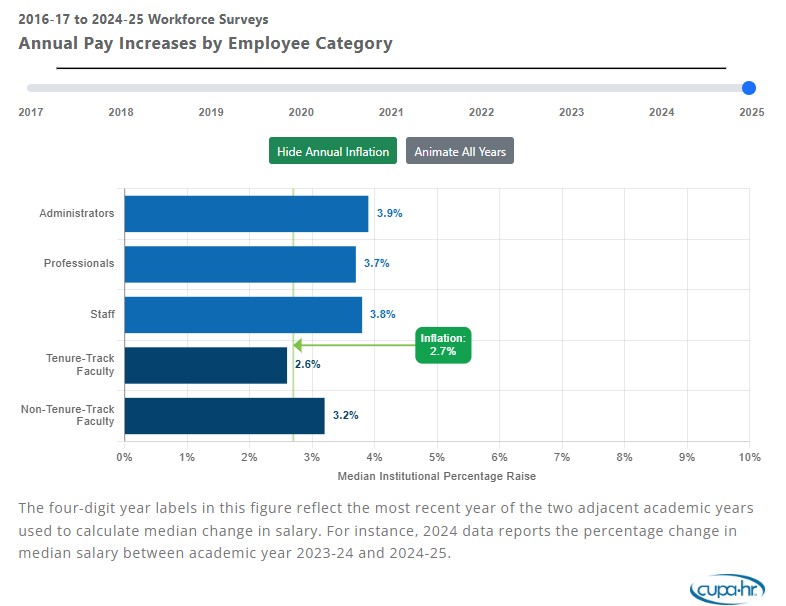
    New research from CUPA-HR has found that although employees across the higher education workforce saw the most substantial pay raises in 2022-23 than in the past several years, they are still being paid less than they were in 2019-20 in inflation-adjusted dollars.

    Some of the key findings from an analysis of CUPA-HR’s higher ed workforce salary survey data from 2016 to 2023:

    • This academic year, raises for higher ed employees were the largest seen in the past seven years, and all position types (administrators, professionals, staff and faculty) received an increase of at least 1.11 percentage points compared to the previous year.
    • Tenure-track and non-tenure-track teaching faculty continue to receive the smallest pay increases of any higher ed employee category. In 2022-23, tenure-track faculty saw a median pay increase of 2.9 percent and non-tenure-track faculty saw an increase of 3.2 percent. Tenure-track faculty salary increases have not kept pace with inflation since at least 2015, and non-tenure-track salary increases last met or exceeded inflation in 2016-17, meaning full-time faculty in general continue to be paid less every year in inflation-adjusted dollars.
    • Staff, which is typically the lowest-paid category of higher ed employees, saw the biggest raises this academic year at 5.3 percent (up from 2.9 percent in 2021-22).

    Explore this data and more in CUPA-HR’s newest interactive graphic.

    CUPA-HR Research

    CUPA-HR is the recognized authority on compensation surveys for higher education, with its workforce surveys designed by higher ed HR professionals for higher ed HR professionals and other campus leaders. CUPA-HR has been collecting data on the higher ed workforce for more than 50 years, and we maintain one of the largest workforce databases in existence. CUPA-HR also publishes numerous research publications and interactive graphics highlighting trends and issues around higher ed workforce planning, pay equity, representation of women and racial/ethnic minorities and more. Learn more about CUPA-HR research.


    Source link

  • Fall 2022 Regulatory Agenda Targets Release Dates for DOL’s Overtime Proposal and Final Title IX Rule – CUPA-HR

    Fall 2022 Regulatory Agenda Targets Release Dates for DOL’s Overtime Proposal and Final Title IX Rule – CUPA-HR

    by CUPA-HR | January 10, 2023

    On January 4, 2023, the Biden administration released the anticipated Fall 2022 Unified Agenda of Regulatory and Deregulatory Actions (Regulatory Agenda), providing the public with a detailed glimpse into the regulatory and deregulatory activities under development across approximately 67 federal departments, agencies and commissions. Agendas are generally released in the fall and spring and set target dates for each agency and sub-agency’s regulatory actions for the coming year.

    After completing a thorough review of the items included in the Regulatory Agenda, CUPA-HR put together the following list of significant proposed actions for members.

    Department of Labor

    Wage and Hour Division — Defining and Delimiting the Exemptions for Executive, Administrative, Professional, Outside Sales and Computer Employees

    According to the Regulatory Agenda, the Department of Labor (DOL)’s Wage and Hour Division (WHD) is now planning to release a Notice of Proposed Rulemaking (NPRM) to address changes to the Fair Labor Standards Act (FLSA)’s overtime pay requirements in May 2023. The WHD first announced their intention to move forward with the NPRM in the Fall 2021 Regulatory Agenda, stating its goal “to update the salary level requirement of the section 13(a)(1) exemption [under the FLSA].”

    As a refresher, changes to overtime pay requirements have been implemented through regulations under both the Obama and Trump administrations. In May 2016, the Obama administration’s DOL issued a final rule increasing the salary threshold from $23,660 to $47,476 per year and imposed automatic updates to the threshold every three years. However, court challenges prevented the rule from taking effect and it was permanently enjoined in September 2017. After the Trump administration started the rulemaking process anew, the DOL issued a new final rule in September 2019 raising the minimum salary level required for exemption from $23,660 annually to $35,568 annually. This final rule went into effect January 1, 2020 and remains in effect today.

    Since the regulation’s reintroduction in the Fall 2021 Regulatory Agenda, CUPA-HR has participated in several DOL listening sessions and has sent letters to the DOL expressing concerns with the timing of the rulemaking. Specifically, our concerns highlight the ongoing challenges of the COVID-19 pandemic and the continued reliance on hybrid and remote work, a historically tight labor market in the U.S. and the effects of inflation on the workforce.

    Wage and Hour Division — Employee or Independent Contractor Classification Under the Fair Labor Standards Act

    In May 2023, the WHD anticipates issuing a final rule to amend the current method for determining independent contractor status for workers.

    On October 13, 2022, the DOL published an NPRM to rescind the current method for determining independent contractor status under the FLSA. The current test finalized by the Trump administration in 2021 has two core factors of control and investment with three additional factors (integration, skill and permanency) that are relevant only if those core factors are in disagreement. The Biden rule proposes a return to a “totality-of-the-circumstances analysis” of multiple factors in an economic reality test, including the following six factors, which are equally weighted with no core provisions:

    • the extent to which the work is integral to the employer’s business;
    • the worker’s opportunity for profit or loss depending on managerial skill;
    • the investments made by the worker and the employer;
    • the worker’s use of skill and initiative;
    • the permanency of the work relationship; and
    • the degree of control exercised or retained by the employer control.

    Employment and Training Administration — Strengthening Wage Protections for the Temporary and Permanent Employment of Certain Aliens in the United States 

    In September 2023, the DOL’s Employment and Training Administration (ETA) plans to issue an NPRM to establish “a new wage methodology for setting prevailing wage levels for H-1B/H-1B1/E-3 and PERM programs consistent with the requirements of the Immigration and Nationality Act.” The proposal will likely amend the Trump administration’s final rule that was scheduled to take effect on November 14, 2022, but was subsequently vacated by a federal court in June 2021. The new proposal will take into consideration the feedback it received in response to a Request for Information (RFI) on data and methods for determining prevailing wage levels “to ensure fair wages and strengthen protections for foreign and U.S. workers.”

    CUPA-HR filed comments in opposition to the Trump administration’s regulations on the issue and in response to the Biden administration’s RFI.

    National Labor Relations Board

    Joint Employer

    In August 2023, the National Labor Relations Board (NLRB) plans to release its anticipated final rule to amend “the standard for determining whether two employers, as defined under the National Labor Relations Act (NLRA), are a joint employer under the NLRA.”

    On September 7, 2022, the NLRB issued an NPRM on the joint employer standard. The NPRM establishes joint employer status of two or more employers if they “share or co-determine those matters governing employees’ essential terms and conditions of employment,” such as wages, benefits and other compensation, work and scheduling, hiring and discharge, discipline, workplace health and safety, supervision and assignment and work rules. According to the NLRB’s press release, the Board “proposes to consider both direct evidence of control and evidence of reserved and/or indirect control over these essential terms and conditions of employment when analyzing joint-employer status.”

    Department of Education

    Office for Civil Rights — Nondiscrimination on the Basis of Sex in Education Programs or Activities Receiving Federal Financial Assistance 

    In May 2023, the Department of Education’s Office for Civil Rights (OCR) plans to release its highly anticipated Title IX final rule. The rulemaking would finalize the June 2022 NPRM to rollback and replace the Trump administration’s 2020 regulations, specifically with respect to its grievance procedures, while simultaneously expanding protections against sex-based discrimination to cover sexual orientation, gender identity and pregnancy or related conditions.

    CUPA-HR filed comments in September 2022 in response to the NPRM. In our comments, we tried to bring attention to the possible impact the proposed regulations could have on how higher education institutions address employment discrimination. The Department of Education received over 200,000 comments in response to the NPRM, which they must review prior to issuing a final rule to implement their changes.

    In addition to the Title IX rulemaking, the OCR also announced its intention to issue an NPRM to address Title IX protections as it relates to athletics programs at educational institutions. The Department of Education announced its intention to pursue a separate rulemaking to address transgender students participation in athletic programs at institutions of higher education and such protections afforded to them under Title IX after the topic was frequently discussed in the media and in Congress in 2022. According to the Regulatory Agenda, the NPRM was set to be released in December 2022, but it has not yet been released.

    Department of Homeland Security

    U.S. Immigration and Customs Enforcement — Optional Alternative to the Physical Examination Associated With Employment Eligibility Verification (Form I-9) 

    According to the Regulatory Agenda, the Department of Homeland Security (DHS) plans to issue a final rule in May 2023 that would finalize the agency’s proposed rule aiming to “revise employment eligibility verification regulations to allow the Secretary to authorize alternative document examination procedures in certain circumstances or with respect to certain employers.”

    On August 18, 2022, the DHS published its NPRM on optional alternative examination practices for employers when reviewing an individual’s identity and employment authorization documents required by the Form I-9, Employment Eligibility Verification. If finalized, the proposed rulemaking would create a framework under which the Secretary of Homeland Security could allow alternative options for verifying those documents, such as reviewing the documents via video, fax, or email rather than directly allowing employers and agents to use such alternative examination options. According to the NPRM, the Secretary would be authorized to implement the alternative examination options in a pilot program if they determine such procedures would offer an equivalent level of security, as a temporary measure to address a public health emergency declared by the Secretary of Health and Human Services, or a national emergency declared by the President.

    CUPA-HR filed comments in response to the DHS NPRM in October 2022. The comments were supportive of the Department moving forward with the NPRM, but cautioned against requiring secondary, in-person review of I-9 documents after virtual inspection and once an employee is in-person on a regular and consistent basis; issuing training for document detection and/or anti-discrimination training that may be offered at a high cost without proper vetting, and requiring institutions to be enrolled in E-Verify to participate in the alternative options.

    U.S. Citizenship and Immigration Services — Modernizing H-1B Requirements and Oversight and Providing Flexibility in the F-1 Program

    In October 2023, the DHS’s United States Citizenship and Immigration Services (USCIS) plans to release an NPRM to “amend its regulations governing H-1B specialty occupation workers and F-1 students who are the beneficiaries of timely filed H-1B cap-subject petitions.” The NPRM will specifically propose to “revise the regulations relating to ‘employer-employee relationship’ and provide flexibility for start-up entrepreneurs; implement new requirements and guidelines for site visits including in connection with petitions filed by H-1B dependent employers whose basic business information cannot be validated through commercially available data; provide flexibility on the employment start date listed on the petition (in limited circumstances); address ‘cap-gap’ issues; bolster the H-1B registration process to reduce the possibility of misuse and fraud in the H-1B registration system, and clarify the requirement that an amended or new petition be filed where there are material changes, including by streamlining notification requirements relating to certain worksite changes, among other provisions.”

    Department of Agriculture

    Agriculture Acquisition Regulation: Internal Policy and Procedural Updates and Technical Changes

    In May 2023, the Department of Agriculture (USDA) plans to re-propose an NPRM that was previously issued in February 2022 and included controversial provisions that would require federal contractors on projects procured by the agency to certify their compliance with dozens of federal and state labor laws and executive orders.

    In the February NPRM, the USDA provided only 32 days for stakeholder comment submissions on the proposal. CUPA-HR filed an extension request with the department asking for an additional 90 days to “evaluate the NPRM’s impact on [members’] research missions and collect the information needed in order to provide thoughtful and accurate input to the USDA,” as well as official comments that were pulled from 2012 comments CUPA-HR submitted with the Society for Human Resource Management (SHRM).

    While it is unclear whether the May NPRM will include the blacklisting language again, the abstract of the re-proposal states that “the new proposed rule would be responsive to the comments received on our February 2022 proposal.”


    Source link

  • Biden Administration Releases Fall 2021 Regulatory Agenda – CUPA-HR

    Biden Administration Releases Fall 2021 Regulatory Agenda – CUPA-HR

    by CUPA-HR | January 10, 2022

    On December 10, the Biden administration issued the Fall 2021 Unified Agenda of Regulatory and Deregulatory Actions (Regulatory Agenda), providing the public with insights on what various federal agencies expect to work on in terms of regulatory activity in the near- and long-term.

    In an effort to keep members apprised of upcoming noteworthy regulatory actions, CUPA-HR has read through the Regulatory Agenda and has flagged the following proposed activity:

    Department of Labor

    Wage and Hour Division — Defining and Delimiting the Exemptions for Executive, Administrative, Professional, Outside Sales and Computer Employees

    In April 2022, the Department of Labor (DOL)’s Wage and Hour Division plans to issue a Notice of Proposed Rulemaking (NPRM) addressing overtime pay requirements for certain “white-collar” employees, including executive, administrative, and professional employees, currently exempt from the requirements under the Fair Labor Standards Act (FLSA). According to the Regulatory Agenda, one of the goals of the NPRM would be “to update the salary level requirement of the section 13(a)(1) exemption [under the FLSA].”

    Changes to overtime pay requirements have been implemented through regulations under both the Obama and Trump administrations. In May 2016, the Obama administration’s DOL issued a final rule increasing the salary threshold from $23,660 to $47,476 per year and imposed automatic updates to the threshold every three years. However, court challenges prevented the rule from taking effect and it was permanently enjoined in September 2017. After the Trump administration started the rulemaking process anew, in September 2019, DOL issued a new final rule raising the minimum salary level required for exemption from $23,660 annually to $35,568 annually. This final rule went into effect January 1, 2020, and it remains in effect today.

    DOL’s Statement of Regulatory Priorities, a component of the fall Regulatory Agenda that presents additional information about the most significant regulatory activities planned for the coming year, states that this proposed update will “ensure that middle class jobs pay middle class wages, extending important overtime pay protections to millions of workers and raising their pay.”  Given this statement, it is likely that we will see the Biden administration’s DOL attempt to increase the salary level in the NPRM to something closer to the Obama administration’s proposed level, if not higher.

    Employment and Training Administration — Strengthening Wage Protections for the Temporary and Permanent Employment of Certain Aliens in the United States

    In March 2022, DOL’s Employment and Training Administration (ETA) plans to issue a NPRM to establish “a new wage methodology for setting prevailing wage levels for H-1B/H-1B1/E-3 and PERM programs consistent with the requirements of the Immigration and Nationality Act.” The proposal will likely amend the Trump administration’s final rule that was scheduled to take effect on November 14, 2022, but was subsequently vacated by a federal court in June 2021. The new proposal, which is included in the Department’s Statement of Regulatory Priorities will take into consideration the feedback it received in response to a Request for Information (RFI) on data and methods for determining prevailing wage levels “to ensure fair wages and strengthen protections for foreign and U.S. workers”.

    CUPA-HR filed comments in opposition to the Trump administration’s regulations on the issue and in response to the Biden administration’s RFI.

    Occupational Safety and Health Administration — Improve Tracking of Workplace Injuries and Illnesses

    According to the Regulatory Agenda, the Biden administration’s Occupational Safety and Health Administration (OSHA) plans to release a NPRM to restore provisions of the May 2016 “Improve Tracking of Workplace Injuries and Illnesses” final rule. The Regulatory Agenda set December 2021 as the target date for release, but as of early January, the regulation is still pending review at the Office of Information and Regulatory Affairs.

    The proposal seeks “to amend [OSHA’s] recordkeeping regulation to restore the requirement to electronically submit to OSHA information from the OSHA Form 300 (Log of Work-Related Injuries and Illnesses) and OSHA Form 301 (Injury and Illness Incident Report) for establishments that meet certain size and industry criteria.” In the Regulatory Agenda, OSHA notes that the current regulations only require electronic submissions from the OSHA Form 300A (Summary of Work-Related Injuries and Illnesses), as the Trump administration’s 2019 final rule rescinded the requirements to electronically submit the OSHA Form 300 and OSHA Form 301.

    National Labor Relations Board

    Joint Employer

    In February 2022, the National Labor Relations Board (NLRB) is planning to release a NPRM to potentially amend the standard determining when two employers may be considered joint employers under the National Labor Relations Act. The new standard will revise the 2020 Trump Administration’s final rule, which reversed the Obama-era NLRB decision in the 2015 Browning-Ferris Industries case and established that an entity can only be a joint employer if it actually exercises control over the essential terms and conditions of another employer’s employees. While details of the Democratic-majority NLRB’s NPRM on joint employer status are up in the air, we would expect them to revise the current standard to look something more like the Obama-era decision.

    Department of Education

    Office for Civil Rights — Nondiscrimination on the Basis of Sex in Education Programs or Activities Receiving Federal Financial Assistance

    In April 2022, the Department of Education is planning to release a NPRM to amend the “regulations implementing Title IX (…) consistent with the priorities of the Biden-Harris administration,” such as the priorities set forth in Executive Order (EO) 13988, “Preventing and Combating Discrimination on the Basis of Gender Identity and Sexual Orientation” and EO 14021, “Guaranteeing an Educational Environment Free from Discrimination on the Basis of Sex, Including Sexual Orientation and Gender Identity.” This NPRM will revise the amendments the Trump administration made through the 2020 Title IX final rule.

    The Department of Education highlighted this new rulemaking in their Statement of Regulatory Priorities. The addition of the rulemaking to the priorities document and the accelerated expected release date of April 2022 from May 2022 as stated in the Spring 2021 Regulatory Agenda indicate that the agency is likely considering this as one of the top regulatory priorities above other proposed actions.

    Department of Homeland Security

    USCIS — Modernizing H-1B Requirements and Oversight and Providing Flexibility in the F-1 Program

    According to the Regulatory Agenda, the Department of Homeland Security (DHS)’s United States Citizenship and Immigration Services (USCIS) plans to release a NPRM in May 2022 to “amend its regulations governing H-1B specialty occupation workers and F-1 students who are the beneficiaries of timely filed H-1B cap-subject petitions.” The NPRM will specifically propose to “revise the regulations relating to ‘employer-employee relationship’ and provide flexibility for start-up entrepreneurs; implement new requirements and guidelines for site visits including in connection with petitions filed by H-1B dependent employers whose basic business information cannot be validated through commercially available data; provide flexibility on the employment start date listed on the petition (in limited circumstances); address “cap-gap” issues; bolster the H-1B registration process to reduce the possibility of misuse and fraud in the H-1B registration system; and clarify the requirement that an amended or new petition be filed where there are material changes, including by streamlining notification requirements relating to certain worksite changes, among other provisions.”

    ICE — Optional Alternative to the Physical Examination Associated With Employment Eligibility Verification (Form I-9)

    According to the Regulatory Agenda, DHS is planning to issue a NPRM in June 2022 to “revise employment eligibility verification regulations to allow the Secretary to authorize alternative document examination procedures in certain circumstances or with respect to certain employers.”

    Since the outset of the COVID-19 pandemic, DHS has provided temporary flexibility in the Form I-9 verification process to allow for remote inspection of Form I-9 documents in situations where employees work exclusively in a remote setting due to COVID-19-related precautions. While that guidance is only temporary, DHS issued a Request for Public Input (RPI) on October 26, 2021 to determine whether those flexibilities should be kept in place permanently. It is possible that DHS will use that feedback to develop and implement this NPRM.

    CUPA-HR has engaged with DHS on the Form I-9 flexibilities through the pandemic. In December, CUPA-HR sent a letter to DHS requesting the Form I-9 flexibilities be extended past December 31, 2021. DHS announced soon after that the flexibilities would be extended until April 30, 2022. Additionally, CUPA-HR submitted comments in response to the RPI based on a recent survey detailing members’ experiences with the Form I-9 verification process flexibilities.

    CUPA-HR will keep members apprised of these proposed regulations and others as they are introduced in the coming year.


    Source link