Get stories like this delivered straight to your inbox. Sign up for The 74 Newsletter
When a white teacher at Decatur High School used the n-word in class in 2022, students walked out and marched in protest. But Reyes Le wanted to do more.
Until he graduated from the Atlanta-area school this year, he co-led its equity team. He organized walking tours devoted to Decatur’s history as a thriving community of freed slaves after the Civil War. Stops included a statue of civil rights leader John Lewis, which replaced a Confederate monument, and a historical marker recognizing the site where Rev. Martin Luther King, Jr. was jailed for driving with an out-of-state license.
But Le feared his efforts would collapse in the face of the Trump administration’s crackdown on diversity, equity and inclusion. An existing state law against “divisive concepts” meant students already had to get parent permission to go on the tour. Then the district threw out two non-discrimination policies April 15.
“I felt that the work we were doing wouldn’t be approved going into the future,” Le said.
Decatur got snared by the U.S. Department of Education’s threat to pull millions of dollars in federal funding from states and districts that employed DEI policies. In response, several organizations sued the department, calling its guidance vague and in violation of constitutional provisions that favor local control. Within weeks, three federal judges, including one Trump appointee, blocked Education Secretary Linda McMahon from enforcing the directives, and Decatur promptly reinstated its policies.
The reversal offers a glimpse into the courts’ role in thwarting — or at least slowing down — the Trump education juggernaut. States, districts, unions, civil rights groups and parents sued McMahon, and multiple courts agreed the department skirted the law in slashing funding and staff. But some observers say the administration is playing a long game and may view such losses as temporary setbacks.
“The administration’s plan is to push on multiple fronts to test the boundaries of what they can get away with,” said Jeffrey Henig, a professor emeritus of political science and education at Teachers College, Columbia University. “Cut personnel, but if needed, add them back later. What’s gained? Possible intimidation of ‘deep state’ employees and a chance to hire people that will be ‘a better fit.’ ”
A recent example of boundary testing: The administration withheld nearly $7 billion for education the president already approved in March.
But the move is practically lifted from the pages of Project 2025, the right-wing blueprint for Trump’s second term. In that document, Russ Vought, now Trump’s director of the Office of Management and Budget, argues that presidents must “handcuff the bureaucracy” and that the Constitution never intended for the White House to spend everything Congress appropriated.
The administration blames Democrats for playing the courts. White House Deputy Chief of Staff Stephen Miller accused “radical rogue judges” of getting in the president’s way.
The end result is often administrative chaos, leaving many districts unable to make routine purchases and displaced staff unsure whether to move on with their lives.
While the outcome in the lower courts has been mixed, the Supreme Court — which has looked favorably on much of Trump’s agenda — is expected any day to weigh in on the president’s biggest prize: whether McMahon can permanently cut half the department’s staff.
In that case, 21 Democratic attorneys general and a Massachusetts school district sued to prevent the administration from taking a giant step toward eliminating the department.
“Everything about defunding and dismantling by the administration is in judicial limbo,” said Neal McCluskey, director of the libertarian Cato Institute’s Center for Educational Freedom. As a supporter of eliminating the department, he lamented the slow pace of change. “If the Supreme Court allows mass layoffs, though, I would expect more energy to return to shrinking the department.”
The odds of that increased last week when the court ruled that mass firings at other agencies could remain in effect as the parties argue the case in the lower courts.
While the lawsuits over the Education Department are separate, Johnathan Smith, chief of staff and general counsel at the National Center for Youth Law, said the ruling is “clearly not a good sign.” His case, filed in May, focuses on cuts specifically to the department’s Office for Civil Rights, but the argument is essentially the same: The administration overstepped its authority when it gutted the department without congressional approval.
Solicitor General John Sauer, in his brief to the Supreme Court, said the states had no grounds to sue and called any fears the department couldn’t make do with a smaller staff merely “speculative.”
Even if the Supreme Court rules in McMahon’s favor, its opinion won’t affect previous rulings and other lawsuits in progress against the department.
Here’s where some of those key legal battles stand:
COVID relief funds
McMahon stunned states in late March when she said they would no longer receive more than $2 billion in reimbursements for COVID-related expenses. States would have to make a fresh case for how their costs related to the pandemic, even though the department had already approved extensions for construction projects, summer learning and tutoring.
On June 3, a federal judge in Maryland blocked McMahon from pulling the funds.
Despite the judicial order, not all states have been paid.
The Maryland Department of Education still had more than $400 million to spend. Cherie Duvall-Jones, a spokeswoman, said the agency hasn’t received any reimbursements even though it provided the “necessary documentation and information” federal officials requested.
The cancellation forced Baltimore City schools to dip into a reserve account to avoid disrupting tutoring and summer school programs.
Madison Biedermann, a spokeswoman for the department, declined to comment on why it had yet to pay Maryland or how much the department has distributed to other states since June.
Mass firings
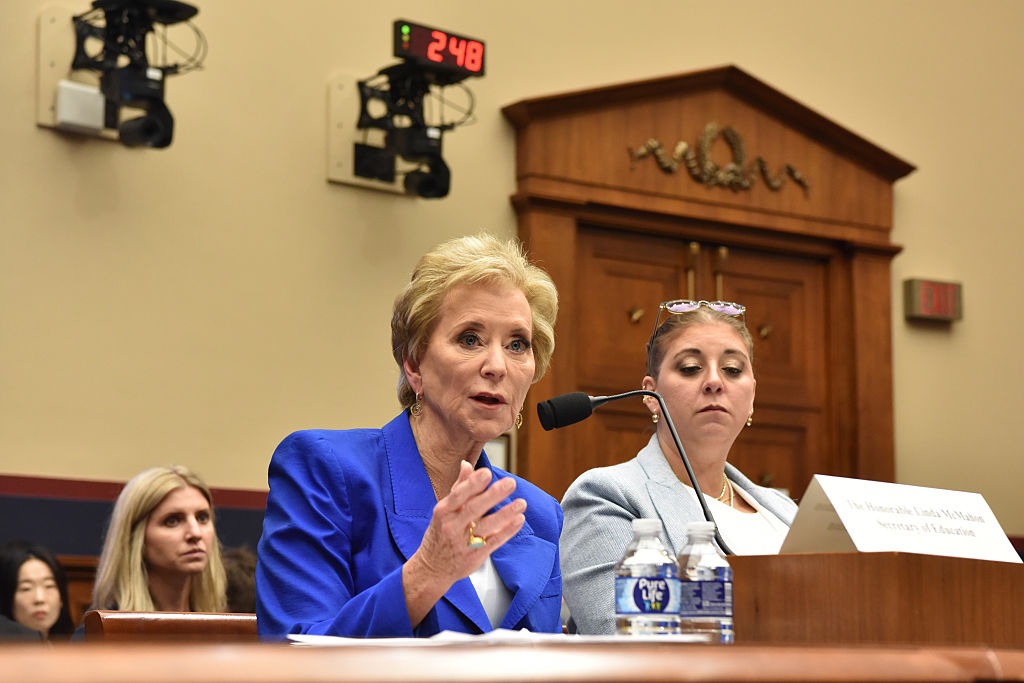
In the administration’s push to wind down the department, McMahon admits she still needs staff to complete what she calls her “final mission.” On May 21, she told a House appropriations subcommittee that she had rehired 74 people. Biedermann wouldn’t say whether that figure has grown, and referred a reporter to the hearing video.
“You hope that you’re just cutting fat,” McMahon testified. “Sometimes you cut a little in the muscle.”
The next day, a federal district court ordered her to also reinstate the more than 1,300 employees she fired in March, about half of the department’s workforce. Updating the court on progress, Chief of Staff Rachel Oglesby said in a July 8 filing that she’s still reviewing survey responses from laid off staffers and figuring out where they would work if they return.
But some call the department’s efforts to bring back employees lackluster, perhaps because it’s pinning its hopes on a victory before the Supreme Court.
“This is a court that’s been fairly aggressive in overturning lower court decisions,” said Smith, with the National Center for Youth Law.
His group’s lawsuit is one of two challenging cuts to the Office for Civil Rights, which lost nearly 250 staffers and seven regional offices. They argue the cuts have left the department unable to thoroughly investigate complaints. Of the 5,164 civil rights complaints since March, OCR has dismissed 3,625, Oglesby reported.
In a case brought by the Victim Rights Law Center, a Massachusetts-based advocacy organization, a federal district court judge ordered McMahon to reinstate OCR employees.
Even if the case is not reversed on appeal, there’s another potential problem: Not all former staffers are eager to return.
“I have applied for other jobs, but I’d prefer to have certainty about my employment with OCR before making a transition,” said Andy Artz, who was a supervising attorney in OCR’s New York City office until the layoffs. “I feel committed to the mission of the agency and I’d like to be part of maintaining it if reinstated.”
DEI
An aspect of that mission, nurtured under the Biden administration, was to discourage discipline policies that result in higher suspension and expulsion rates for minority students. A 2023 memo warned that discrimination in discipline could have “devastating long-term consequences on students and their future opportunities.”
But according to the department’s Feb. 14 guidance, efforts to reduce those gaps or raise achievement among Black and Hispanic students could fall under its definition of “impermissible” DEI practices. Officials demanded that states sign a form certifying compliance with their interpretation of the law. On April 24, three federal courts ruled that for now, the department can’t pull funding from states that didn’t sign. The department also had to temporarily shut down a website designed to gather public complaints about DEI practices.
The cases, which McMahon has asked the courts to dismiss, will continue through the summer. In court records, the administration’s lawyers say the groups’ arguments are weak and that districts like Decatur simply overreacted. In an example cited in a complaint brought by the NAACP, the Waterloo Community School District in Iowa responded to the federal guidance by pulling out of a statewide “read-In” for Black History Month. About 3,500 first graders were expected to participate in the virtual event featuring Black authors and illustrators.
The department said the move reflected a misunderstanding of the guidance. “Withdrawing all its students from the read-In event appears to have been a drastic overreaction by the school district and disconnected from a plain reading of the … documents,” the department said.
Desegregation
The administration’s DEI crackdown has left many schools confused about how to teach seminal issues of American history such as the Civil Rights era.
It was the Civil Rights Act of 1964 that established “desegregation centers” across the country to help districts implement court-ordered integration.
In 2022, the Biden administration awarded $33 million in grants to what are now called equity assistance centers. But Trump’s department views such work as inseparable from DEI. When it cancelled funding to the centers, it described them as “woke” and “divisive.”
Judge Paul Friedman of the U.S. District Court for the District of Columbia, a Clinton appointee, disagreed. He blocked McMahon from pulling roughly $4 million from the Southern Education Foundation, which houses Equity Assistance Center-South and helped finance Brown v. Board of Education over 70 years ago. His order referenced President Dwight Eisenhower and southern judges who took the ruling seriously.
“They could hardly have imagined that some future presidential administration would hinder efforts by organizations like SEF — based on some misguided understanding of ‘diversity, equity, and inclusion’ — to fulfill Brown’s constitutional promise to students across the country to eradicate the practice of racial segregation.”
He said the center is likely to win its argument that canceling the grant was “arbitrary and capricious.”
Raymond Pierce, Southern Education Foundation president and CEO, said when he applied for the grant to run one of the centers, he emphasized its historical significance.
“My family is from Mississippi, so I remember seeing a ‘colored’ entrance sign on the back of the building as we pulled into my mother’s hometown for the holidays,” Pierce said.
Trump’s Justice Department aims to dismiss many of the remaining 130 desegregation orders across the South. Harmeet Dhillon, assistant attorney general for civil rights, has said the orders force districts to spend money on monitoring and data collection and that it’s time to “let people off the hook” for past discrimination.
But Eshé Collins, director of Equity Assistance Center-South, said the centers are vital because their services are free to districts.
“Some of these cases haven’t had any movement,” she said. “Districts are like ‘Well, we can’t afford to do this work.’ That’s why the equity assistance center is so key.”
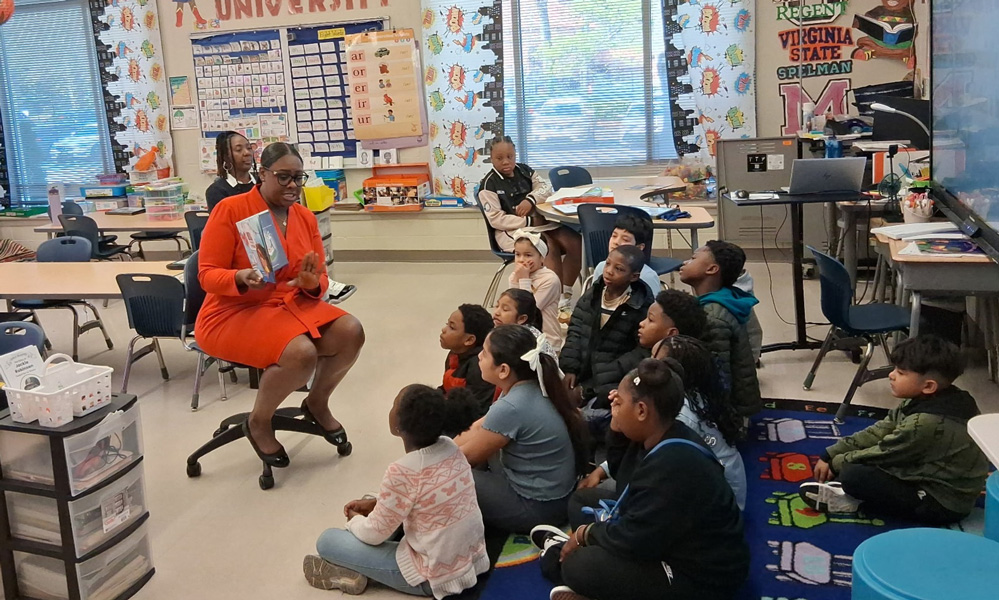
Her center, for example, works with the Fayette County schools in Tennessee to recruit more Black teachers and ensure minority students get an equal chance to enroll in advanced classes. The system is still under a desegregation order from 1965, but is on track to meet the terms set by the court next year, Collins said. A week after Friedman issued the injunction in the foundation’s case, Ruth Ryder, the department’s deputy assistant secretary for policy and programs, told Collins she could once again access funds and her work resumed.
Research
As they entered the Department of Education in early February, one of the first moves made by staffers of the Department of Government Efficiency was to terminate nearly $900 million in research contracts awarded through the Institute for Education Sciences. Three lawsuits say the cuts seriously hinder efforts to conduct high-quality research on schools and students.
Kevin Gee from the University of California, Davis, was among those hit. He was in the middle of producing a practice guide for the nation on chronic absenteeism, which continues to exceed pre-pandemic levels in all states. In a recent report, the American Enterprise Institute’s Nat Malkus said the pandemic “took this crisis to unprecedented levels” that “warrant urgent and sustained attention.” Last year’s rate stood at nearly 24% nationally — still well above the 15% before the pandemic.
Gee was eager to fully grasp the impact of the pandemic on K-3 students. Even though young children didn’t experience school closures, many missed out on preschool and have shown delays in social and academic skills.
Westat, the contractor for the project, employed 350 staffers to collect data from more than 860 schools and conduct interviews with children about their experiences. But DOGE halted the data collection midstream — after the department had already invested about $44 million of a $100 million contract.
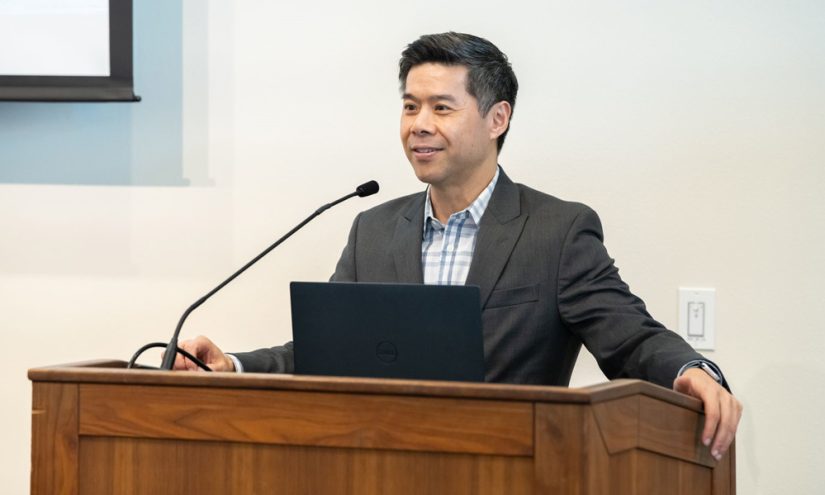
“The data would’ve helped us understand, for the first time, the educational well-being of our nation’s earliest learners on a nationwide scale in the aftermath of the pandemic,” he said.
The department has no plans to resurrect the project, according to a June court filing. But there are other signs it is walking back some of DOGE’s original cuts. For example, it intends to reissue contracts for regional education labs, which work with districts and states on school improvement.
“It feels like the legal pressure has succeeded, in the sense that the Department of Education is starting up some of this stuff again,” said Cara Jackson, a past president of the Association for Education Finance and Policy, which filed one of the lawsuits. “I think … there’s somebody at the department who is going through the legislation and saying, ‘Oh, we actually do need to do this.’ ”
Mental health grants
Amid the legal machinations, even some Republicans are losing patience with McMahon’s moves to freeze spending Congress already appropriated.
In April, she terminated $1 billion in mental health grants approved as part of a 2022 law that followed the mass school shooting in Uvalde, Texas. The department told grantees, without elaboration, that the funding no longer aligns with the administration’s policy of “prioritizing merit, fairness and excellence in education” and undermines “the students these programs are intended to help.”
The secretary told Oregon Democratic Sen. Jeff Merkley in June that she would “rebid” the grants, but some schools don’t want to wait. Silver Consolidated Schools in New Mexico, which lost $6 million when the grant was discontinued, sued her on June 20th. Sixteen Democrat-led states filed a second suit later that month.
The funds, according to Silver Consolidated’s complaint, allowed it to hire seven mental health professionals and contract with two outside counseling organizations. With the extra resources, the district saw bullying reports decline by 30% and suspensions drop by a third, according to the district’s complaint. Almost 500 students used a mental health app funded by the grant.
A judge has yet to rule in either case, but Republican Rep. Brian Fitzpatrick of Pennsylvania and other members of a bipartisan task force are holding McMahon to her word that she’ll open a new competition for the funds.
“These funds were never intended to be a theoretical exercise — they were designed to confront an urgent crisis affecting millions of children,” Fitzpatrick said in a statement. “With youth mental health challenges at an all-time high, any disruption or diversion of resources threatens to reverse hard-won progress and leave communities without critical supports.”
Get stories like these delivered straight to your inbox. Sign up for The 74 Newsletter