Tag: fears
-
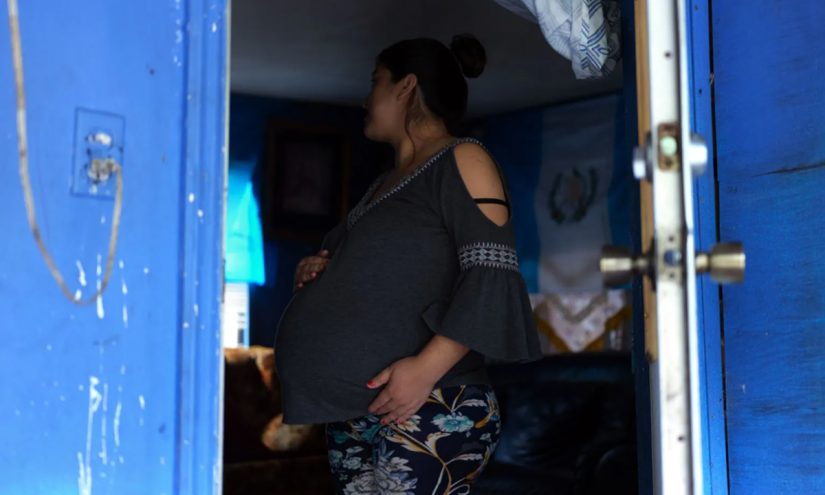
ICE Fears Put Pregnant Immigrants and Their Babies at Risk – The 74
In the lead up to her son’s birth, Jacqueline made plans to call 911 for an ambulance to pick her up from her North Florida home and transport her to a hospital about an hour away.
The second-time mom and Guatemalan immigrant, who has lived in the country for a decade, would have relied on her husband to drive her to the hospital. But a few months ago he was deported, leaving Jacqueline and her daughter without the family’s primary source of income, transportation and support.
One morning in March, Jacqueline said, her partner was pulled over on his way to work when law enforcement officials discovered he didn’t have a valid driver’s license. Jacqueline’s pregnancy was in its early stages. Her husband fought his case from detention for three months before U.S. Immigration and Customs Enforcement (ICE) removed him to Guatemala.
“He was deported and I was left behind, thinking, ‘What am I going to do?’” said Jacqueline, who requested that her last name not be published because she lacks permanent legal status. The couple shares an 8-year-old daughter who was born in, and is a citizen of, the United States.
This summer, as she entered the later stages of this pregnancy amid the Trump administration’s turbocharged immigration enforcement, Jacqueline found herself so fearful of being detained that she avoided leaving her home. Her husband’s car sits in the driveway, but there are no signs of him in the small room Jacqueline shares with her daughter. His belongings — tools, clothes, even personal photos — are with him in Guatemala. The only family pictures Jacqueline has are on her phone.
Her partner was the family’s main provider, rotating between picking strawberries or watermelon and packing pine needles for mulch, depending on the season.
Jacqueline struggled to get the most basic items to welcome a baby: Someone gifted her a used carseat and crib, which sit in the packed room along with onesies and other clothing items she’s collected inside a large plastic bag. She’s hoping that a federal assistance program will cover the cost of formula. A baby tub is still on her list.
Medical care in her rural area has been possible only because a small nonprofit organization nearby that provides prenatal care services offered to pay for Ubers so she could continue regular check-ups. Even if she wasn’t behind the wheel, Jacqueline says that just the act of leaving her home feels risky since her husband’s deportation.
“Things got really complicated. He paid our rent — he paid for everything,” she said. “Now, I’m always worried.”
At her home in North Florida, Jacqueline looks at a photo of her husband and daughter on her phone. The only family pictures she has are on her phone; her husband’s belongings — tools, clothes, even personal photos — are with him in Guatemala. (Michelle Bruzzese for The 19th) Medical care and support essential to a healthy pregnancy have become harder for people like Jacqueline to obtain following President Donald Trump’s inauguration. Many patients — nervous about encountering immigration officials if they leave their homes, drive on public roads or visit a medical clinic — are skipping virtually all of their pregnancy-related health care. Some are opting to give birth at home with the help of midwives because of the possible presence of ICE at hospitals.
Across the country, medical providers who serve immigrant communities said fewer patients are coming in for prenatal or other pregnancy-related care. As a result, patients are experiencing dangerous complications, advocates and health care providers told The 19th.
“Fear of ICE is pushing my patients and their families away from the very systems meant to protect their health and their pregnancies,” said Dr. Josie Urbina, an OB-GYN in San Francisco.
In January, Trump rescinded a federal policy that protected designated areas including hospitals, health clinics and doctors’ offices from immigration raids. ICE has recently targeted patients in hospital maternity wards and on their way home from prenatal visits.
A majority of Americans believe ICE should not be carrying out immigration enforcement at health centers. A new poll from The 19th and SurveyMonkey conducted in mid-September found that most Americans don’t think ICE should be allowed to detain immigrants at hospitals, their workplace, domestic violence shelters, schools or churches.
Women are more likely to oppose enforcement in these spaces than men. More than two-thirds of women said ICE shouldn’t be allowed to detain immigrants in hospital settings.
Enforcement is only expected to grow as the administration works to meet its ambitious deportation goals. The federal government is pouring more than $170 billion over the next four years into expanding immigration enforcement, the result of Trump’s signature tax-and-spending bill. About $45 billion has been directed to expanding detention facilities; $29.9 billion is to increase ICE activity.
That expansion could put even more births at risk. Approximately 250,000 babies are born every year to immigrants without permanent legal status. Already, research has shown these immigrants, who have higher uninsured rates, are less likely to seek prenatal care and are at risk of worse birth outcomes.
Major medical groups, including the American College of Obstetrics and Gynecologists, World Health Organization and the Centers for Disease Control and Prevention (CDC) recommend regular prenatal and postpartum care as a key tool to combat pregnancy-related death and infant mortality.
According to the federal Office of Women’s Health, infants born to parents who received no prenatal care are three times more likely to have a low birth weight and five times more likely to die than those born to parents who received regular care.
A CDC analysis published last year found infant mortality rates went up the later families began prenatal care: 4.54 deaths per 100,000 live births for families whose prenatal care began in the first trimester, compared with 10.75 in families whose prenatal care began in the third trimester or who did not receive any at all.
“A lot of patients aren’t going to get help,” said Yenny James, the founder and CEO of Paradigm Doulas in the Dallas-Fort Worth metro.
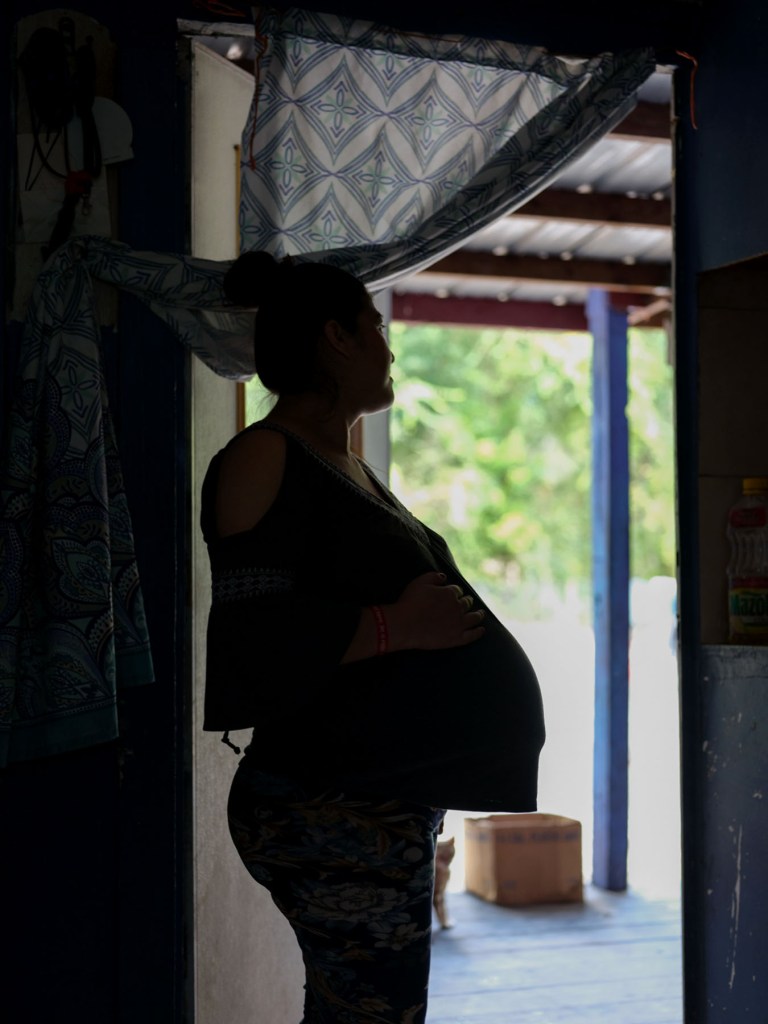
After her husband’s deportation, Jacqueline became so fearful of being detained that she avoided leaving her home. “He was deported and I was left behind, thinking, ‘What am I going to do?’” she said. (Michelle Bruzzese for The 19th) James said she’s seeing an increasing number of emergency cesarean sections because of untreated gestational diabetes, or preeclampsia — a deadly pregnancy complication — that went unnoticed because of lacking prenatal care.
In Denver, OB-GYN Dr. Rebecca Cohen has delivered multiple babies this year for women who have told her that, because they fear endangering themselves or their families, they have received no prenatal care. Several have given birth to babies with fatal fetal anomalies that were never diagnosed because the women did not receive prenatal ultrasounds.
“They were willing to forgo care — their own health care — but to find out that something was devastatingly wrong with their child is when they feel like maybe they should have risked it,” Cohen said. “There’s a sound of a mother’s wail that anybody who has worked labor and delivery has known, and it will haunt you for the rest of your life. To hear that when it could have been prevented, it is just absolutely devastating.”
Early in her pregnancy, Jacqueline received free care at a local clinic. Shortly after her husband’s detention, she called the office to let them know she likely wouldn’t make her next appointment.
“I told them that I probably wouldn’t be able to make my appointments anymore, well, because I’m really afraid given what happened to my husband. And they offered to help,” she said.
Jacqueline and the nonprofit clinic worked out an arrangement: The day of her appointments, someone at the clinic called an Uber to her home, paid for by the clinic, and let her know when it would arrive so she could be ready.
Many people in her small town have come to rely on a single person who does have a valid driver’s license for transportation. That driver recently brought Jacqueline to an appointment with the local office that manages the Special Supplemental Nutrition Program for Women, Infants and Children (WIC), which she is relying on for baby formula and food. There were no guarantees that this driver would be available to take her in whenever she goes into labor.
The Biden administration directed ICE not to detain, arrest or take into custody pregnant, postpartum or breastfeeding people simply for breaking immigration laws, except under “exceptional circumstances.” The Trump administration has not formally reversed that policy. But despite the directive, reports from across the country confirm that ICE has detained numerous pregnant immigrants since Trump took office.
James said that until the Biden guidance is formally rescinded, she will continue to encourage pregnant immigrants to print it out and carry it with them.
“I told my doulas — have them print out this ICE directive, have them keep it with them, so that they know and these agents know that we know our rights, our clients know their rights,” James said.
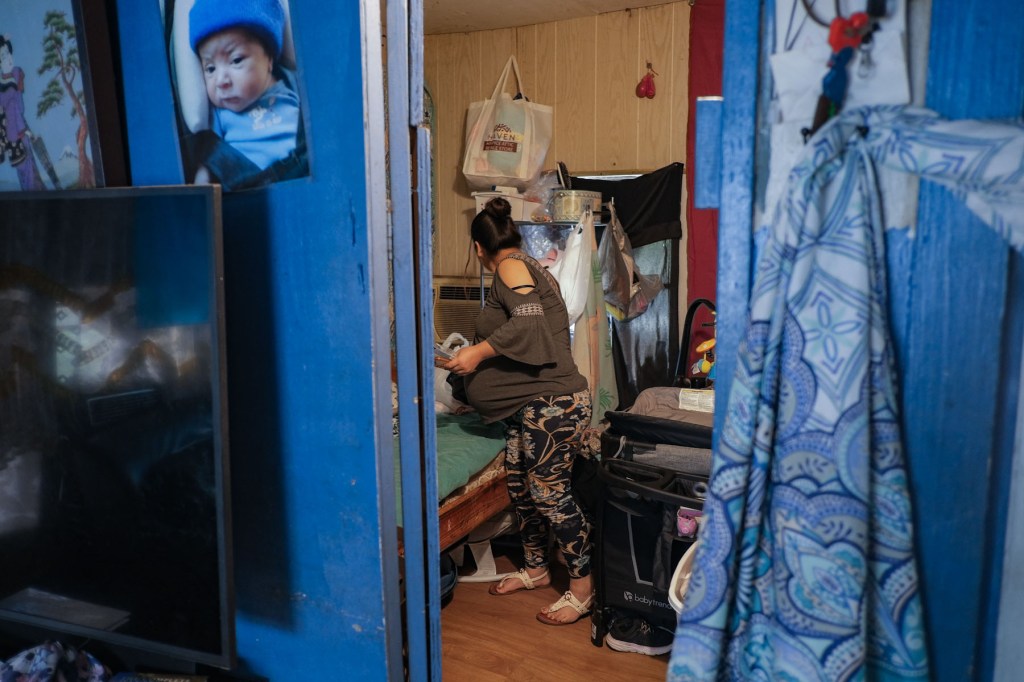
Jacqueline prepares for the birth of her second child in the room she shares with her daughter. Someone gifted her a used car seat and crib, which sit among the few items she’s collected inside a plastic bag to welcome the baby. (Michelle Bruzzese for The 19th) It’s unclear exactly how many pregnant immigrants are being detained by ICE, or have been arrested by the agency. A May report from the office of Democratic Sen. Dick Durbin found 14 pregnant women in a single Louisiana detention facility at the time of staff’s visit.
Another report out of the office of Democratic Sen. Jon Ossoff published in late July found 14 credible reports of mistreatment of pregnant women in immigrant detention. The report cited an anonymous agency official who said they saw pregnant women sleeping on floors in overcrowded intake cells. The partner of a pregnant woman in federal custody said that she bled for days before she was taken to a hospital, where she miscarried alone. A pregnant detainee who spoke to Ossoff’s office said she repeatedly asked for medical attention and was told to “just drink water.” The office received several reports of clients waiting weeks to see a doctor, and that sometimes scheduled appointments were canceled. ICE has disputed the report.
“Pregnant women receive regular prenatal visits, mental health services, nutritional support, and accommodations aligned with community standards of care. Detention of pregnant women is rare and has elevated oversight and review. No pregnant woman has been forced to sleep on the floor,” ICE said in a statement posted on their website.
ICE did not respond to a request for comment.
Fear of being detained is a major contributor of stress for pregnant immigrants. Research shows that even when pregnant patients do receive medical care, prenatal stress puts many at greater risk of complicated births and poor outcomes, including premature birth and low infant birth weight. Babies born after an immigration raid are at a 24 percent higher risk of low birth weight, according to one study.
Monica, 38, is expecting her fourth child in November. The Tucson resident, who requested that her last name not be published out of fear of being detained, has lived in the United States for two decades but has no legal immigration status.
This pregnancy has been unlike the others, she said: While Monica has continued with her prenatal care appointments, her anxiety levels about her immigration situation have colored her experience. Her other children, who are in their teens, are U.S. citizens but grappling with the stress of their parents’ situation. Her husband also doesn’t have authorization to live in the country.
“We try to be out and about much less, and to take precautions,” she said. “Whenever we do leave the house, we have it in the back of our minds.”
Monica said she has seen reports of ICE being allowed inside hospitals, and she is worried about facing immigration officers while or following her birth. Her plan is to have her partner and a group of friends at the hospital to make sure she’s never alone.
“My biggest fear is going to the hospital,” she said.
Stress like Monica’s makes pregnancy more dangerous.
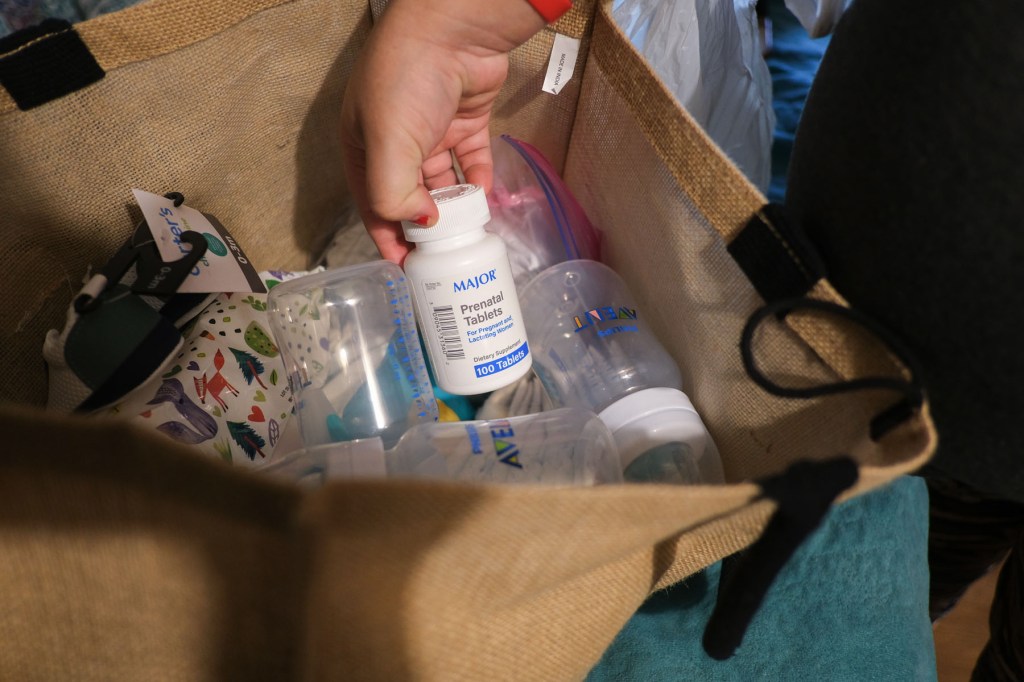
Jacqueline holds a bottle of prenatal vitamins at her home in North Florida. A small nonprofit clinic nearby has been paying for Ubers so she can continue her prenatal check-ups. (Michelle Bruzzese for The 19th) “In our hospital, every doctor I’ve talked to — and these are doctors that have been there 20 years — all are saying these past six months they’ve seen worse obstetrics outcomes than ever in their career,” Dr. Parker Duncan Diaz, a family physician in Santa Rosa, California, whose clinic mostly cares for Latinx patients. That’s included more preterm labor and more pregnant patients with severe hypertension.
“I don’t know what’s causing it, but my bias is that it is the impact of this horribly toxic stress environment,” he added, specifically noting the stress caused by the threat of immigration enforcement.
In recent months, Dr. Caitlin Bernard, an Indiana-based OB-GYN, has seen a number of pregnant patients seeking emergency attention who have not received any prenatal health care. One was 31 weeks, approaching the end of her pregnancy. Another was more than 20 weeks pregnant when she came to Bernard’s office, having developed complications from a molar pregnancy — a rare condition that means a healthy birth is impossible and that without early treatment can result in vaginal bleeding, thyroid problems and even cancer.
“Anytime you’re not able to access that early prenatal care, we do see complications with that,” she said. “And many of these things can absolutely be life-threatening for both the moms and the babies.”
Dr. Daisy Leon-Martinez, a maternal-fetal medicine specialist in San Francisco, said she now regularly cares for patients in her labor and delivery ward who have been transferred to her hospital because of newly developed pregnancy complications. These are often their first doctors’ visits since becoming pregnant. Many of those patients have told her that they did not want to seek prenatal care for fear of encountering immigration officials.
During regular visits, she added, she has advised people with pregnancy complications that they would be best served by a hospital stay — only to be told that her patients no longer feel safe going to the hospital.
The current enforcement environment is challenging immigrant advocates, who are continuing to encourage immigrants to seek appropriate medical care while acknowledging that doing so is increasingly risky.
Lupe Rodríguez, the executive director of the National Latina Institute for Reproductive Justice, said her organization is urging pregnant immigrants to seek the health care that they need, and to be proactive about making plans for themselves and their families in the event that they are detained.
“We can’t know for certain about any given [health care center] whether or not it’s going to be safe. One of the things that we’ve been seeing is leadership at some of these health centers — big hospitals and clinics — have said that they will provide the kind of protection that folks need, that they don’t want folks to be afraid of care,” Rodriguez said.
While those statements signal the intentions of a hospital’s leadership, Rodriguez said, “we still know that there are individuals within some of those care centers that are part of the reporting mechanism or are intimidating people.”

Outside her home in North Florida, Jacqueline sits in a red chair as a chicken wanders nearby. (Michelle Bruzzese for The 19th) Jacqueline approached the last days of her pregnancy hopeful that the place she had chosen — a large university hospital that workers at her local clinic recommended — would be a safe place for her to give birth.
One night at the end of September, when labor pains grew too intense, she called for an ambulance and made it to the hospital. When she got there, she asked her providers if there were any ICE agents near the building. She had heard of a man at a local hospital being detained after having surgery. They told her there were none they were aware of.
She went on to deliver her baby under general anesthesia after a long, difficult labor. “I didn’t even hear him cry when they pulled him out,” she said. Her only relative left in the area was taking care of her daughter, so she recovered alone at the hospital for five days before heading home in an Uber that a social worker procured for her and her son.
“If my husband was here, he would have been there with me at the hospital,” Jacqueline said while recovering at home. “He would be here taking care of me, of us. I wouldn’t be worried about the things I still want to get for the baby.”
This story was originally reported by Mel Leonor Barclay and Shefali Luthra of The 19th. Meet Mel and Shefali and read more of their reporting on gender, politics and policy.

Get stories like these delivered straight to your inbox. Sign up for The 74 Newsletter
-

Charlie Kirk Killing Feeds Fears for Higher Ed’s Future
Wednesday saw a moment without precedent in recent history: A college speaker shot to death on a campus during an event. That fact alone would’ve escalated growing concerns about the future of free speech and civil discourse at colleges and universities.
But this speaker was Charlie Kirk, a prominent ally of a U.S. president who was already crusading against higher ed. Kirk, a national political figure in his own right, was one of the foremost conservative critics of intolerance for right-wing views in higher ed and the founder and leader of Turning Point USA, a nationwide organization of conservative campus groups that aided the president’s re-election. Kirk even spoke at Trump’s January inauguration.
He was known for goading students on campuses to “prove me wrong,” posting the resulting clips online, appearing in conservative media to denounce higher ed, spreading his views further on his own podcast and using his organization’s online presence and on-the-ground staff to target left-leaning faculty.
“College is a scam,” Kirk, who dropped out of Harper College in Illinois, wrote in a 2022 Fox News op-ed, in which he urged most students not to go.
“Universities are indoctrination zones where free speech is crushed,” he wrote. “Radical students and faculty coerce and persecute their nonconforming peers through ‘cancel culture’ and threats … I firmly believe that most—if not all—the destructive ideas that are now eating away at the foundation of American society originated on college campuses.”
His death at Utah Valley University could put more pressure on higher ed at a time when colleges and universities have already been excoriated and targeted by the right. Faculty and those who criticize higher ed as being insufficiently open to civil debate between different viewpoints are worried that free expression will further erode.
“This is an epic moment for the future of higher ed,” said John Tomasi, president of Heterodox Academy. “For the issue of free speech, there’s been nothing quite like this ever before.”
Tomasi, whose organization promotes “viewpoint diversity” and “constructive disagreement” on campuses, noted both Kirk’s national stature and his association with campus free expression. He was the kind of person that conservatives had long argued wasn’t welcome on campuses.
“This is an attack on a magnitude that we have not previously seen,” he said. He said national attention on campus cultures intensified when Congress in late 2023 started calling university presidents into televised hearings regarding alleged campus antisemitism. Now, that “white-hot spotlight” is even hotter.
“This is a killing of a person who exemplifies the struggles of viewpoint diversity on college campuses … in the act of speaking on a college campus,” Tomasi said.
Multiple college presidents have issued statements condemning the shooting. Michael Roth of Wesleyan University, a vocal critic of Trump’s targeting of higher ed, wrote that “those who choose violence destroy the possibility of learning and meaning. Mr. Kirk’s murder on a college campus is an assault on all of us in education.” University of California system president James B. Milliken wrote, “This wasn’t just an attack on an individual; it was an attack on the very freedoms we as a nation hold dear.”
Some universities have also acted swiftly to punish employees who appeared to celebrate or make light of Kirk’s death in online comments.
I think it marks a breakdown of the culture of free speech.”
—Lindsie Rank, director of campus rights advocacy at FIRE
The killer has yet to be apprehended, their motive is unknown and the FBI is offering up to $100,000 for information. But in a video from the Oval Office Wednesday evening, President Trump called Kirk’s killing a “heinous assassination” of a “martyr for truth and freedom” and a “dark moment for America.” He said, “There’s never been anyone who was so respected by youth,” whom Kirk brought into the political process “better than anybody ever.”
“Charlie was a patriot, who devoted his life to the cause of open debate and the country that he loved so much,” Trump said, adding that Kirk “traveled the nation, joyfully engaging with everyone interested in good-faith debate.”
Kirk in the Oval Office Andrew Harnik/Getty Images
But the president—who has demanded an undefined viewpoint diversity from universities while threatening them with sweeping federal funding cuts—didn’t go on to defend all free speech, which includes even hate speech. He denounced the “radical left,” saying that “violence and murder are the tragic consequence of demonizing those with whom you disagree day after day, year after year.”
“Those on the radical left have compared wonderful Americans like Charlie to Nazis and the world’s worst mass murderers and criminals,” Trump said. “This kind of rhetoric is directly responsible for the terrorism that we’re seeing in our country today, and it must stop right now.” (His speech didn’t mention the 2022 attack on former House speaker Nancy Pelosi’s husband, Paul, or the killings earlier this year of Democratic former Minnesota House speaker Melissa Hortman and her husband, Mark.)
Trump isn’t the only person calling it an assassination. Free speech advocates have called past shoutdowns of campus speakers the “heckler’s veto.” Lindsie Rank, director of campus rights advocacy at the Foundation for Individual Rights and Expression, called this an “assassin’s veto.”
“Regardless of how one feels about Charlie Kirk’s viewpoints, his tactics, his background, assassination cannot be a response to disagreement in a civilized society,” Rank said. “That’s the whole purpose of free speech: that we have a better way to engage in discourse across differences to settle disagreements.”
“I think there’s a lot of faculty thinking, ‘Is it going to be me, and maybe instead of a video, it’s a rifle?’”
—Isaac Kamola, director of the AAUP Center for the Defense of Academic Freedom
Rank said free speech allows people “to exchange words instead of bullets.” She said what happens on campus is never isolated to campus and raised concern about a feedback loop.
“Our society has started to accept violence as an appropriate response to viewpoints that folks disagree with,” Rank said. “I think it marks a breakdown of the culture of free speech.”
Isaac Kamola, director of the American Association of University Professors’ Center for the Defense of Academic Freedom and an associate political science professor at Trinity College in Connecticut, is among the fierce critics of Kirk’s tactics. While Trump called the “radical left’s” rhetoric dangerous, Kamola said Kirk’s was.
“He literally wrote the book titled Campus Battlefield,” Kamola noted. “He built a career out of treating higher education as a war zone … and treating professors and students that he disagreed with as enemies that posed an existential threat to America … That being said, when actual violence—physical violence and murder—come to college campuses, that ratchets things up to an even more dangerous degree.”
Kamola added that, “without knowing who the gunman is,” Trump is already saying “he’s going to use this as an opportunity to punish the left, and I think that’s really scary.” (Kirk’s final post on X to his over 5.4 million followers said it was “100% necessary to politicize the senseless murder” of a Ukrainian woman in Charlotte, N.C., last month.)
Kamola pointed to Turning Point USA’s own Professor Watchlist and Texas A&M University’s firing of a professor earlier this week after a student filmed herself challenging the legality of teaching about gender identity in a children’s literature class. He said the killing could now leave faculty to think, “Is there going to be retaliation for this assassination?”
“I think there’s a lot of faculty thinking, ‘Is it going to be me, and maybe instead of a video, it’s a rifle?’” he said.
Another Turning Point
Trump redefined conservatism, attracting new adherents. Kirk appeared to do the same for conservative students across the nation, adding them to the MAGA movement.
Amy Binder, SNF Agora Professor of Sociology at Johns Hopkins University, said she’s studied conservative campus activism for decades. She said Kirk “kind of burst on the scene right around the time” Trump won his first term in office.
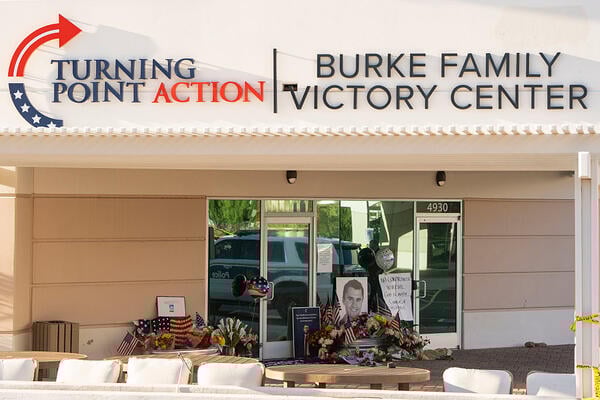
Vigils to remember Kirk have popped up at college campuses and at the Turning Point USA headquarters in Arizona.
Rebecca Noble/Getty Images
Binder, co-author of Becoming Right: How Campuses Shape Young Conservatives and The Channels of Student Activism, said Kirk’s Turning Point group attracted students who initially weren’t sure they were Republicans and weren’t attracted to the College Republicans chapters that traditionally mobilized students.
“Their complaint about College Republicans was that it was too establishment, it was kind of fusty, stale, too focused on getting people elected,” Binder said of these students. She said Turning Point told them that “you are part of a liberal, left campus and you are mistreated here and you need to come out of the closet and declare that you’re conservative in a big, broad way—and we’ll help you do that with really splashy events and really splashy speakers.”
“All of the incentive structure there was to go big, go confrontational,” she said. Kirk exemplified that in his sparring matches with left-leaning students on campuses.
Binder said, “Kirk was really excellent at cross-branding,” frequently appearing on Fox News, recording videos for the conservative education video website PragerU and more.
“Over time, Kirk was really involved with the Trump family, and with MAGA under Trump,” Binder said. “And he really became an ambassador for that—not only to young people, but to others as well … He was really crossing over into other age brackets and he just kind of became a face—or the face—of energized, youthful conservatism.”
Turning Point sought to elect conservatives to student governments by providing funding. It broadcast online the names of faculty it considered too left-leaning or intolerant of conservative views and marshaled voters for Trump during his re-election campaigns.
“He became the face of young Republicans and probably helped Trump win Arizona, maybe Wisconsin, maybe Michigan, with his get-out-the-vote” in 2024, Binder said. She said he “might have been predicted to have a political career in the future. He’s charismatic, he’s good-looking, he has a perfect family, he’s obviously had success.”

Charlie Kirk was speaking at Utah Valley University on Sept. 10 to kick off his American Comeback Tour when he was shot and killed.
Trent Nelson/The Salt Lake Tribune/Getty Images
But now, Kirk is dead. While Binder said there will continue to be a “very robust right ecosystem of organizations that seek mobilized students on campus,” it’s unclear what Turning Point’s future will be.
“Is there a power vacuum, is there a succession plan, what does that look like? I certainly don’t know,” she said. Turning Point didn’t respond to Inside Higher Ed’s request for an interview Thursday.
As for how his death could impact campus free expression, Binder said, “It’s really, really horrible on just all of the fronts, and in the wrong hands, something like this could shut down speech.”
Rank, from FIRE, said that while the shooter’s motive is unknown, the effect that violence can have on free expression isn’t. She said it can not only create a chilling effect within people, but it also can cause higher ed institutions to clamp down on speech to prevent violence.
“If an administration comes in and prevents controversial speaking engagements, then you’re creating a situation where the violence wins and that just causes free speech to deteriorate even further,” Rank said. She said that would not only be wrong, but “it would be a strange way to honor his legacy.”
-
College president fears that federal education cuts will derail the promise of student parents, student military veterans and first-gen students
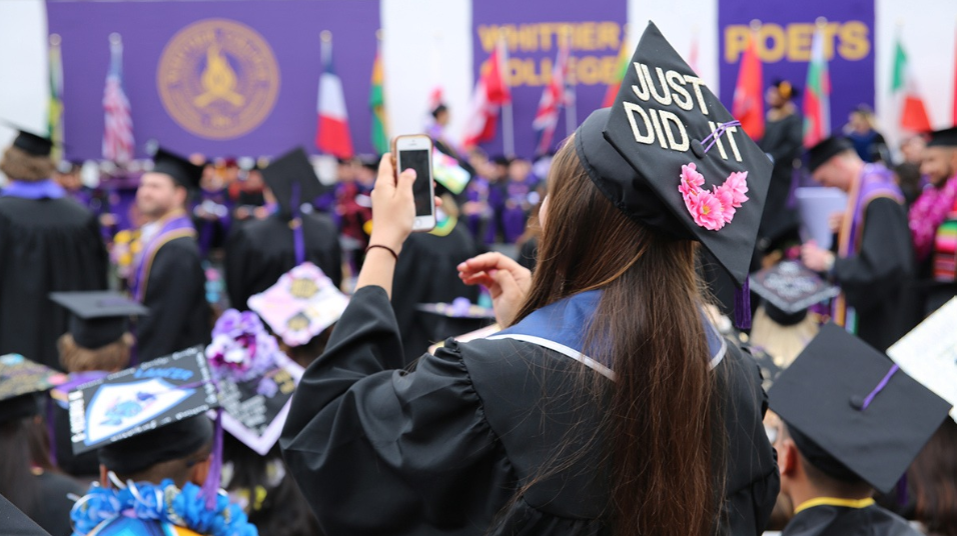
As a college president, I see the promise of higher education fulfilled every day. Many students at my institution, Whittier College, are the first in their families to attend a university. Some are parents or military veterans who have already served in the workforce and are returning to school to gain new skills, widen their perspectives and improve their job prospects.
These students are the future of our communities. We will rely on them to fill critical roles in health care, education, science, entrepreneurship and public service. They are also the students who stand to lose the most under the proposed fiscal year 2026 federal budget, and those who were already bracing for impact from the “One Big Beautiful Bill” cuts, including to the health care coverage many of them count on.
The drive with which these extraordinary students — both traditionally college-aged and older — pursue their degrees, often while juggling caregiving commitments or other responsibilities, never fails to inspire me.
Related: Interested in innovations in higher education? Subscribe to our free biweekly higher education newsletter.
We do not yet know the precise contours of the spending provisions Congress will consider once funding from a continuing resolution expires at the end of September. Yet we expect they will take their cues from the president’s proposed budget, which slashes support for students and parents and especially hammers those already struggling to improve their lives by earning a college degree, with cuts to education, health and housing that could take effect as early as October 1.
That budget would mean lowering the maximum Pell Grant award from $7,395 to $5,710, reversing a decade of progress. For the nearly half of Whittier students who received Pell Grants last year, this rollback would profoundly jeopardize their chances of finishing school.
So would the proposal to severely restrict Federal Work-Study, which supports a third of Whittier students according to our most recent internal analysis, and to eliminate the Supplemental Educational Opportunity Grant, which more than 16 percent of our student body relies upon. In addition, this budget would impose a cap on Direct PLUS Loans for Parents, which would impact roughly 60 percent of our parent borrowers. It would also do away with the Direct PLUS Loans for Graduates program.
These programs are lifelines, not just for our students but for students all across the country. They fuel social mobility and prosperity by making education a force for advancement through personal work ethic rather than a way to rack up debt.
If enacted, these proposed cuts would gut the support system that has enabled millions of low-income students to earn a college degree.
Higher education is a bridge. To cross it and achieve their full potential, students from all walks of life must have access to the support and resources colleges provide, whether through partnerships with local high schools or with professional gateway programs in engineering, accounting, business, nursing, physical therapy and more. Yet, to access these invaluable programs, they must be enrolled. How will they reach such heights if they suddenly can’t afford to advance their studies?
The harm I’ve described doesn’t stop with cuts to financial aid, loans and services. Proposed reductions also target research funding for NASA, NIH and the National Science Foundation. One frozen NASA grant has already led to the loss of paid student research fellowships at Whittier, a setback not just in dollars but in momentum for students building real-world skills, networks and résumés.
These research opportunities often enable talented first-generation students to connect their classroom learning to career pathways, opening the door to graduate school, lab technician roles and futures in STEM fields. We’ve seen how federal funding has supported student projects in everything from climate data analysis to environmental health.
Stripping away support for hands-on research undermines the federal government’s own calls for colleges like ours to better prepare students for the workforce by dismantling the very mechanisms that make such preparation possible.
It’s particularly disheartening that these changes will disproportionately hurt those students who are working the hardest to achieve their objectives, who have done everything right and have the most to lose from this lack of investment in the future.
The preservation and strengthening of Pell, Work-Study, Supplemental Educational Opportunity grants and federal loan programs is not a partisan issue. It is a moral and economic imperative for a nation that has long been proud to be a land of opportunity.
Let’s build a system for strivers that opens doors instead of slamming them shut.
Let’s recommit to higher education as a public good. Today’s students are willing to work hard to deserve our continuing belief in them.
Kristine E. Dillon is the president of Whittier College in California.
Contact the opinion editor at [email protected].
This story about education cuts was produced by The Hechinger Report, a nonprofit, independent news organization focused on inequality and innovation in education. Sign up for Hechinger’s weekly newsletter.
-

Careers services can help students avoid making decisions based on AI fears
How students use AI tools to improve their chances of landing a job has been central to the debate around AI and career advice and guidance. But there has been little discussion about AI’s impact on students’ decision making about which jobs and sectors they might enter.
Jisc has recently published two studies that shine light on this area. Prospects at Jisc’s Early Careers Survey is an annual report that charts the career aspirations and experiences of more than 4,000 students and graduates over the previous 12 months. For the first time, the survey’s dominant theme was the normalisation of the use of AI tools and the influence that discourse around AI is having on career decision making. And the impact of AI on employability was also a major concern of Jisc’s Student Perceptions of AI Report 2025, based on in-depth discussions with over 170 students across FE and HE.
Nerves jangling
The rapid advancements in AI raise concerns about its long-term impact, the jobs it might affect, and the skills needed to compete in a jobs market shaped by AI. These uncertainties can leave students and graduates feeling anxious and unsure about their future career prospects.
Important career decisions are already being made based on perceptions of how AI may change work. The Early Careers Survey found that one in ten students had already changed their career path because of AI.
Plans were mainly altered because students feared that their chosen career was at risk of automation, anticipating fewer roles in certain areas and some jobs becoming phased out entirely. Areas such as coding, graphic design, legal, data science, film and art were frequently mentioned, with creative jobs seen as more likely to become obsolete.
However, it is important not to carried away on a wave of pessimism. Respondents were also pivoting to future-proof their careers. Many students see huge potential in AI, opting for careers that make use of the new technology or those that AI has helped create.
But whether students see AI as an opportunity or a threat, the role of university careers and employability teams is the same in both cases. How do we support students in making informed decisions that are right for them?
From static to electricity
In today’s AI-driven landscape, careers services must evolve to meet a new kind of uncertainty. Unlike previous transitions, students now face automation anxiety, career paralysis, and fears of job displacement. This demands a shift away from static, one-size-fits-all advice toward more personalised, future-focused guidance.
What’s different is the speed and complexity of change. Students are not only reacting to perceived risks but also actively exploring AI-enhanced roles. Careers practitioners should respond by embedding AI literacy, encouraging critical evaluation of AI-generated advice, and collaborating with employers to help students understand the evolving world of work.
Equity must remain central. Not all students have equal access to digital tools or confidence in using them. Guidance must be inclusive, accessible, and responsive to diverse needs and aspirations.
Calls to action should involve supporting students in developing adaptability, digital fluency, and human-centred skills like creativity and communication. Promote exploration over avoidance, and values-based decision-making over fear, helping students align career choices with what matters most to them.
Ultimately, careers professionals are not here to predict the future, but to empower all students and early career professionals to shape it with confidence, curiosity, and resilience.
On the balance beam
This isn’t the first time that university employability teams have had to support students through change, anxiety, uncertainty or even decision paralysis when it comes to career planning, but the driver is certainly new. Through this uncertainty and transition, students and graduates need guidance from everyone who supports them, in education and the workplace.
Collaborating with industry leaders and employers is key to ensuring students understand the AI-enhanced labour market, the way work is changing and that relevant skills are developed. Embedding AI literacy in the curriculum helps students develop familiarity and understand the opportunities as well as limitations. Jisc has launched an AI Literacy Curriculum for Teaching and Learning Staff to support this process.
And promoting a balanced approach to career research and planning is important. The Early Careers Survey found almost a fifth of respondents are using generative AI tools like ChatGPT and Microsoft Copilot as a source of careers advice, and the majority (84 per cent) found them helpful.
While careers and employability staff welcome the greater reach and impact AI enables, particularly in challenging times for the HE sector, colleagues at an AGCAS event were clear to emphasise the continued necessity for human connection, describing AI as “augmenting our service, not replacing it.”
We need to ensure that students understand how to use AI tools effectively, spot when the information provided is outdated or incorrect, and combine them with other resources to ensure they get a balanced and fully rounded picture.
Face-to-face interaction – with educators, employers and careers professionals – provides context and personalised feedback and discussion. A focus on developing essential human skills such as creativity, critical thinking and communication remains central to learning. After all, AI doesn’t just stand for artificial intelligence. It also means authentic interaction, the foundation upon which the employability experience is built.
Guiding students through AI-driven change requires balanced, informed career planning. Careers services should embed AI literacy, collaborate with employers, and increase face-to-face support that builds human skills like creativity and communication. Less emphasis should be placed on one-size-fits-all advice and static labour market forecasting. Instead, the focus should be on active, student-centred approaches. Authentic interaction remains key to helping students navigate uncertainty with confidence and clarity.
-

Deportation Fears Push Some New York Immigrant Students to Virtual Learning – The 74
As President Donald Trump has ramped up deportations, some immigrant students across New York have been too afraid to attend class in person. In response, some school districts have turned to virtual learning, a move the state’s Education Department is sanctioning, officials revealed last week.
“I will tell you in the sense of a crisis, we do have some districts right now … that are taking advantage and providing virtual instruction to our children who are afraid to go to school,” Associate Education Commissioner Elisa Alvarez told state officials at May’s Board of Regents meeting.
Alvarez shared with the board a memo the state Education Department issued in March clarifying that districts have the flexibility to offer online instruction to “students who may be unable or averse to attending school, including during times of political uncertainty.”
The memo further specified schools can tap online learning for immigrant and migrant students “who may be affected and reluctant to attend school in person due to concerns about their personal safety and security.”
Alvarez didn’t disclose how many or which districts were using the approach and for how many students. A state Education Department spokesperson did not respond to follow-up questions.
New York City public schools already have virtual options available and aren’t doing anything different for immigrant students fearful of attending school, a spokesperson for the city’s Education Department said.
Still, the disclosure from state officials highlights the ongoing fears some immigrant students are facing four months into the Trump administration and raises fresh questions about how their school experiences are being affected.
Shortly after taking office, Trump rescinded longstanding guidance barring federal immigration agents from making arrests at “sensitive locations” including schools.
Migrant families staying in New York City shelters expressed acute fears during the week after Trump’s inauguration in January and stayed out of school in large numbers, likely contributing to lower citywide attendance rates that week (though Mayor Eric Adams later downplayed the attendance woes). Some city educators said they’ve seen attendance for immigrant students rebound since that first week.
City policy prohibits federal law enforcement agents, including Immigration and Customs Enforcement, from entering schools without a warrant signed by a judge, and Education Department officials have trained school staff on detailed protocols for how to respond.
At the state level, the Attorney General’s office and Education Department issued joint guidance in March reiterating that state and federal law both compel districts to only permit federal law enforcement to enter schools under very limited circumstances.
Many school leaders have worked hard to communicate those policies and reassure anxious families. And immigration enforcement inside of schools has remained rare.
But some high-profile raids have targeted school-age children, including one in the upstate New York hometown of Trump border czar Tom Homan that swept up three students in the local public schools, sparking fear and outrage. And there have been reports across the country of parents detained by immigration agents right outside schools during drop-off time.
Under those circumstances, virtual learning could give schools a way to keep up some connection with students or families who might otherwise completely disengage.
But some New York City educators said they’re still working hard to convince fearful immigrant students to come to school in person, noting that virtual learning was especially challenging for English language learners during the COVID pandemic.
Lara Evangelista, the executive director of the Internationals Network, which oversees 17 public schools in the five boroughs catering exclusively to newly arrived immigrant students, said none of her schools have made the “purposeful choice” to engage fearful students through virtual learning.
“Virtual learning for [English Learners] was really challenging during COVID,” she said.
Alan Cheng, the superintendent who oversees the international schools as well as the city’s dedicated virtual schools, said he hasn’t seen any significant changes in enrollment or interest in online learning due to fear of in-person attendance among immigrant students.
And while virtual learning might be able to offer a version of the academic experience of in-person school, it’s harder for it to replicate some of the other services that schools provide families.
“Our schools serve much more than just the academic environment,” Cheng said. “They are really community schools, they provide health care, they provide plenty of other resources.”
This story was originally published by Chalkbeat. Chalkbeat is a nonprofit news site covering educational change in public schools. Sign up for their newsletters at ckbe.at/newsletters.
Get stories like these delivered straight to your inbox. Sign up for The 74 Newsletter
-

Higher ed’s hopes and fears as Trump retakes the reins
As Donald Trump returns to the White House on this Martin Luther King Jr. Day—with a GOP Congress behind him, a vice president who’s called universities “the enemy” and a WWE powerhouse tapped as his education secretary—it’s fair to say that the only certainty for U.S. higher education is uncertainty.
Trump’s attention to the sector during his first term was fleeting. He didn’t make higher ed a central issue in his protracted campaign for re-election, either, although he did call for axing the Education Department, firing accreditors, deporting campus protesters, eliminating DEI programs and launching a national online university.
His conservative allies have plenty of plans at the ready. Project 2025 has called for radical reform to reduce the federal role in higher ed and hand power to the states. GOP members of Congress will be eager to pass pent-up bills they couldn’t get through in the past four years—some welcome by many in higher ed, others stirring broad alarm.
And while Republicans are raring to reform higher ed, the sector limps into Trump Part II in a weakened state, scarred from plummeting trust in the value of a college education as well as scalding political rhetoric, congressional probes into campus antisemitism, state laws banning DEI programs and dictating curriculum changes, and the politicization of boards and presidencies—not to mention the imminent arrival of the long-dreaded demographic cliff.
It might sound like a grim state of affairs. But the priorities of the new administration and Congress—and how they might affect colleges and universities for both good and ill—are anybody’s guess at this point. So is their ability, or political will, to pass and implement sweeping reforms.
Not everyone is guessing, though. This is academia, after all—experts know things, or at least have highly educated guesses. So we asked a range of prominent leaders and scholars to identify their highest hope and greatest fear for the sector in the second Trump administration. No consensus emerges—again, after all, this is academia. But their collective insights shed some unexpected light on both the challenges and opportunities Trump’s second four years may present.
Some of their fears might not surprise you. But some of their hopes probably will. The responses have been edited for clarity and concision.
Paulette Granberry Russell
President of the National Association of Diversity Officers in Higher Education
My highest hope is that the administration respects and upholds the autonomy of higher education institutions and does not attempt to undermine them further.
We have witnessed continual attacks by the states on institutional autonomy, academic freedom and free speech. I hope that federal policy will not extend these attacks through the elimination of critical departments, drastic changes via executive orders or significant reductions in funding to the Departments of Education, Justice and Health and Human Services—agencies whose resources and policies underpin equity, inclusion and access. For institutional leaders, courage and consistency in prioritizing equity, access and opportunity will be crucial to preserving the transformative mission of higher education.
My greatest worry is that inclusive strategies and interventions, many catalyzed by landmark legislation like the Civil Rights Act of 1964 and Title IX in 1972, will stall—or worse, regress. Federal policy modeled after restrictive state-level legislation would disproportionately harm individuals and communities that have historically faced discrimination. Efforts to dismantle programs aimed at achieving more equitable outcomes—programs that have yielded measurable benefits for generations—would erode the progress made in expanding access and success for underrepresented students. The implications of such rollbacks would extend beyond higher education institutions, threatening the broader economy and society. Diverse, equitable campuses don’t just benefit individual students; they create a pipeline of leaders and innovators essential for a competitive global workforce.

Miriam Feldblum
Executive director of the Presidents’ Alliance on Higher Education and Immigration
In the coming years, there will undoubtedly be harsh immigration and border policies, increased deportations and some restricted opportunities to stay and work in the U.S. for those with temporary or fragile immigration statuses. Yet my greatest hope is that we recognize, solidify and even expand real opportunities to find common ground, including ways for higher ed institutions and campuses to support these students and other campus members. President Trump recently said that he wants to work to find a way for Dreamers to stay and keep contributing. He has also suggested giving green cards to international student graduates and said he supports H-1B visas. Higher ed leaders and institutions should seize these opportunities for common ground.
My greatest fear, meanwhile, is that America squanders the potential of Dreamers, immigrant-origin and international students through restrictive policies. The U.S. is facing an immense talent imperative to sustain our global economic competitiveness, drive innovation, fill workforce shortages and produce a trained and dedicated workforce. Higher education institutions are essential to meeting these challenges. And immigrant-origin students—including Dreamers and refugees, and other first- and second-generation immigrant students—along with international students make up over a third of all students in higher education. The loss of this talent due to misguided immigration policies, fear and targeted enforcement actions would be self-defeating for our nation’s future.
Barbara Snyder
President of the Association of American Universities
President Trump has repeatedly said he wants to make America great and keep us ahead of China and other competitor nations. I am optimistic that he will support policies and investments that ensure the United States continues to be the world’s leader in scientific research. The president and Congress can secure that position by both increasing our public investments in cutting-edge research and by promoting policies that make it easy for the world’s best and brightest technological and scientific minds to study, work and stay here and advance U.S. innovation and economic growth.
My single greatest fear would be that some might try to convince the president to pull back these investments in America’s greatness and close ourselves off from the global talent and knowledge that has helped make our country great. I hope that he and Congress will resist that shortsightedness and will choose to recommit our country to the government-university research partnership that has made us the world’s strongest and most prosperous country.
Jeremy Young
Director of state and higher education policy at PEN America
Over the past four years, a group of lawmakers and conservative think tanks have waged merciless war on free expression in the higher education sector. Fifteen states have passed laws that censor ideas on college and university campuses, and the new federal administration seems poised to expand this ideological war on higher education into new arenas: weaponizing federal research funding, Title VI enforcement and accreditation to restrict ideas on campus while engaging in endless bullying and jawboning of university leaders to force “voluntary” closures of diversity offices and academic programs.
My fear is that the new administration will carry forward this destructive playbook, actively suppressing politically disfavored viewpoints on campus and destroying the ideological autonomy of higher education institutions. But my hope is that it will step back from the abyss. Scientific discovery, cultural creation, the fostering of critical thinking skills employers seek in new graduates and the promotion of democratic pluralism among the rising generation—these outcomes are only possible if colleges and universities remain places where all ideas are open for debate, not just those the government agrees with.
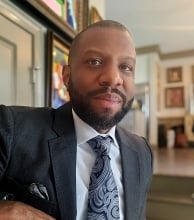
Ivory Toldson
Howard University professor, editor in chief of The Journal of Negro Education and former executive director of the White House Initiative on Historically Black Colleges and Universities
Under a second Trump administration, my highest hope is for the continued growth and expansion of HBCUs. These institutions have historically enjoyed bipartisan support, and even Project 2025 acknowledges the importance of providing federal support to historically Black and tribal colleges. Compared to many of the highest-ranked predominantly white institutions (PWIs), HBCUs enroll a higher percentage of U.S. citizens, which may shield them from challenges associated with more restrictive immigration policies. Moreover, as race-conscious admissions policies are rolled back, HBCUs could play a critical role in supporting Black students who may be denied opportunities at PWIs, further solidifying their importance in U.S. higher education.
My greatest worry lies in the challenges to diversity, equity and inclusion programs, which could leave Black students at PWIs with fewer resources to address persistent issues of equity, access and institutional racism. Without these programs, Black students may face increased racial hostilities with fewer protections and support systems. Additionally, efforts to weaken or eliminate the Education Department could severely threaten funding for lower-income students, particularly through federal student aid programs. Combined with growing anti–higher education attitudes, these threats could place colleges and universities under heightened scrutiny, hurt enrollment and jeopardize the future of higher education as a whole.
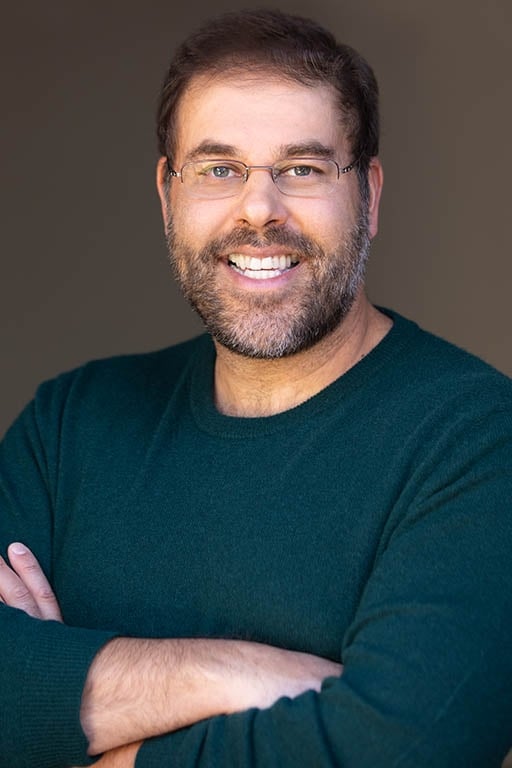
Jeremi Suri
Mack Brown Distinguished Chair for Leadership in Global Affairs and professor of public affairs and history, University of Texas at Austin
Republican politicians love to attack the elitism of higher education, even as they leverage their own elite pedigrees for money and power. Republicans do not really want to destroy higher education; they want to own it for themselves. I expect that the next four years will make this clear and open a wider discussion about who should have access to higher education and how we can broaden it for those who feel left out. So far, Republicans have relied on attacking DEI and “woke” culture, but what do they want to replace it with on college campuses? They cannot go back to the white male–only institutions of the early 20th century. As Republicans are forced to articulate a coherent vision for access in higher education, I expect a more open and useful conversation that will bring us back to discussing diversity and affordability—not largely in terms of race and gender, but in terms of class and geography and family history. This will still be a difficult discussion, but one that might be more substantive, complex and even useful.
Republican politicians have also promoted a new “civics” agenda in higher education, based on an unproven claim that universities have abandoned the subject matter. The push for civics has meant more traditionalism and patriotism, less creativity and criticism. But that is a difficult agenda to take very far. If Republicans want universities to study more Madison, Jefferson and Lincoln, how can they avoid more (not less) study of pluralism, separation of church and state, and civil rights—the core issues for these most traditional historical figures? Republican advocacy for civics education must grapple with the complex questions that many Republicans wish to avoid. A serious discussion of civics in higher education will make this clear in coming years, and it will force these programs to widen their agenda or retreat into niche enclaves on campus. Most donors will prefer the former, which might build bridges with ecumenical faculty and students.
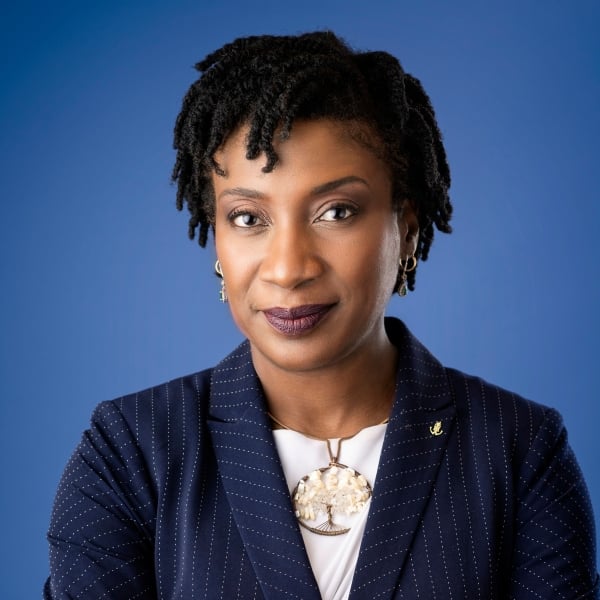
Nicole Smith
Chief economist at Georgetown University’s Center on Education and the Workforce
My single highest hope is for a renewed focus on workforce development and career readiness. Amid growing debates about the value of higher education, they have remained key priorities on the Trump platform. This focus presents opportunities for higher ed institutions to continue to innovate and expand programs that align closely with labor market demands. Vocational training, apprenticeship programs and technical education have been central to Trump’s agenda, providing a foundation for colleges and universities to build stronger partnerships with industries. This can drive innovation in areas such as competency-based learning, stackable credentials and enhanced internship opportunities. By equipping students with practical skills and clear career trajectories, higher education can continue to reinforce its role as a key driver of economic mobility—a topic sure to be on the minds of leaders in this new administration.
My greatest worry for the sector? Poorer outcomes for historically marginalized students, with no way to record it. Federal support for diversity, equity and inclusion initiatives, as well as academic research, is likely to be withdrawn entirely under the Trump administration. Efforts to defund or restrict DEI programs—particularly in public institutions—may intensify. These restrictions could also lead to the politicization of academic research, with areas like intergenerational mobility in education and income, gender equity and any evaluations by race or ethnicity potentially seeing funding reductions or shifts in priority. Such changes risk creating substantial obstacles for institutions committed to fostering inclusive environments and conducting research that addresses critical societal issues. For Black professionals in higher education, this presents a dual challenge: preserving DEI efforts in the face of external resistance while defending academic freedom in a climate increasingly marked by skepticism and distrust of research.

Sherene Seikaly
Associate professor at UC Santa Barbara and facilitator of the Faculty for Justice in Palestine network
My highest hope is that the Trump administration does not engage in repression, securitization, censorship and attenuation of higher education. My greatest worry is that the Trump administration will escalate the repression of social movements on campus, and in particular the movement standing with Palestinian liberation and political rights.
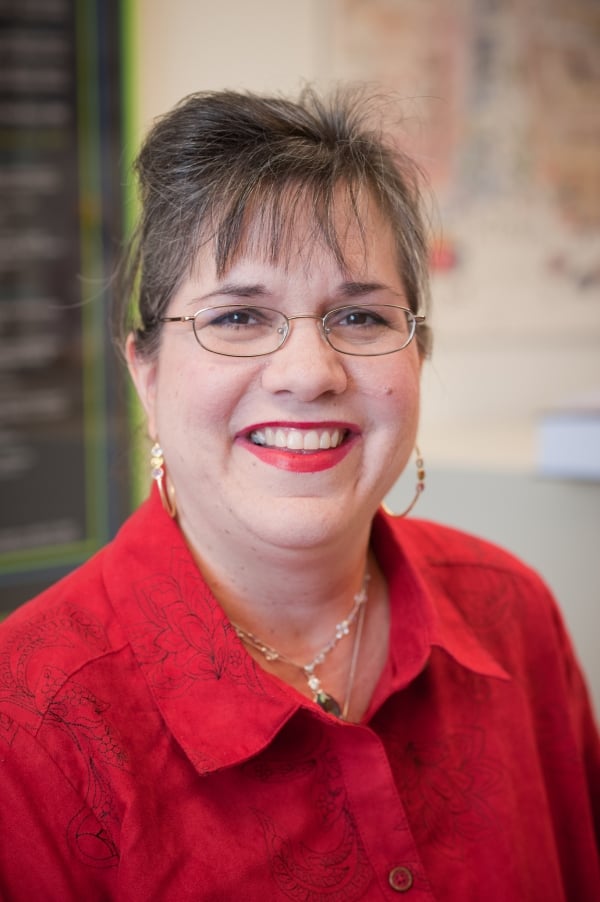
Miriam Elman
Executive director of the Academic Engagement Network
With alarming incidents of antisemitism occurring on campuses nationwide and beleaguered Jewish students increasingly reporting that they’re being harassed, bullied and marginalized, Donald Trump’s return to the White House is likely to result in better days ahead. Trump has already warned universities to expect a tougher stance from his administration, including the possible loss of accreditation and federal support, if they fail to address the rising level of antisemitism in their institutions. Under Trump, we may actually see several universities that are deemed in violation of civil rights law get their federal funds fully or partially cut off for not taking antisemitic bigotry and harassment seriously. This will be consequential not only for the affected schools, but will send a strong signal to other universities that antisemitism won’t be tolerated.
Tougher OCR [Office for Civil Rights] settlements are very likely coming down the pike, which is what many Jewish students, faculty and staff are hoping for. But we should be worried that at many schools there soon may no longer be adequate staffing to effectively address and combat antisemitism. With a second Trump administration, a Republican Congress and new Education Department leadership, we’ll see more diversity programs shuttered. For the Jewish community on campus, that’s going to mean a mixed bag. After all, it’s hard to see how antisemitism awareness training and educational programming will be rolled out if the staff needed to organize and facilitate these programs no longer have their jobs. To be sure, some poor DEI trainings exacerbate divisions and have done a terrible disservice to Jews on campus. Done well, though, these programs can benefit Jewish and all campus communities.

Kenneth Stern
Director of the Bard Center for the Study of Hate
I worry about a political attack on higher education and its effect on students and the ability of faculty to teach. Are students who are refugees from places like Syria, Ukraine, Afghanistan and elsewhere going to face deportation? Are we going to see 18-year-olds deported because of how they view the war in Gaza? Will administrators, fearing overly aggressive Title VI cases, opt to suppress speech and academic freedom? No university should tolerate students being harassed or intimidated or bullied. But I fear that the new Congress and administration are going to draw lines not around actual safety but emotional safety, punishing universities that allow demonstrations with political expressions that some detest.
Vice President–elect JD Vance said that, as in Victor Orbán’s Hungary, the U.S. should give universities “a choice between survival or taking a much less biased approach to teaching.” Funding and endowments may be targeted after Jan. 20, and scholars teaching contentious subjects may be in the crosshairs. Sixty-eight years ago, the Supreme Court in Sweezy v. New Hampshire rejected a legal attack against a Marxist professor, upholding the importance of academic freedom. I don’t like some of what’s being taught today, either, but the remedy is certainly not government-imposed rules on what to think or teach.

Ted Mitchell
President of the American Council on Education and U.S. under secretary of education from 2014 to 2017
We’re encouraged by the emphasis the incoming Trump administration and the new Congress have placed on issues such as transparency and accountability related to student outcomes. This isn’t new, and it isn’t partisan, but meaningful change is long overdue. Finding the right balance between ensuring students have access to postsecondary education while creating meaningful consequences for programs that aren’t serving their students well isn’t easy. But there are a number of thoughtful proposals being discussed that we hope will lead to a real solution in the next two years. As I said in an open letter to President-elect Trump earlier this month, our overriding goal is to provide more opportunity for all Americans.
Given the enormous list of competing priorities a new administration juggles, my biggest worry is that in attempting to pay for major spending cuts and pass tax legislation, the administration and Congress will do the shortsighted thing and enact policies like cuts to student financial aid and research funding—all of which would hurt students, keep them from reaching their full potential and hamper our nation’s economy and security.
Jim Blew
Co-founder of the Defense Freedom Institute and assistant secretary of planning, evaluation and policy development for the Education Department from 2017 to 2020
I am optimistic that in the wake of the Biden-Harris administration’s management of FAFSA and the student loan portfolio, the incoming administration and Congress will agree on how to fix the broken Office of Federal Student Aid. That will require a new approach, perhaps located outside the department, that shields FSA’s operations from partisan agendas and changes the damaging incentives inherent to a performance-based organization that isn’t held accountable for financial performance. During those talks, I hope they can also align on policy reforms that will help all students access post–high school opportunities for a wide range of high-value career paths.
I’m worried that higher education institutions will misread the moment and try to stonewall efforts to hold them accountable when their students don’t get a good return on their investments or don’t repay their federal loans. If the higher ed lobby isn’t sincerely at the table, there’s a high risk that the resulting policy solutions will be less workable, or unworkable. There’s already a growing sentiment that the student loan portfolio has become a weapon of partisan politics. I wouldn’t test Congress’s patience, or there might be a severe reduction in the use of federal taxpayer funds to help our students afford postsecondary education.
Greg Lukianoff
President and CEO of the Foundation for Individual Rights and Expression
My highest hope during the second Trump administration is for Congress to pass a bill that defines student-on-student harassment consistently with the speech-protective definition set forth by the U.S. Supreme Court in Davis v. Monroe County Board of Education. Campus speech codes, however well intentioned, are routinely used to punish just about any speech that someone on campus doesn’t like. Until a federal judge vacated the Biden administration Title IX rules, the Education Department was forcing schools to use an unconstitutional definition of student-on-student harassment in both the Title IX and Title VI contexts. Properly applied, the Davis standard ensures that institutions protect students against actual discriminatory behavior as opposed to punishing students who merely express controversial viewpoints.
My greatest fear also involves possible legislation. Last Congress, the House of Representatives passed the unconstitutional Antisemitism Awareness Act. While antisemitic harassment is a serious problem on campuses, the AAA’s examples of antisemitism include statements critical of the state of Israel, which is core political speech protected by the First Amendment. Rather than resurrect the AAA, members of Congress can craft constitutional legislation that would address antisemitism on campuses by prohibiting harassment based on religion, confirming that federal law forbids discrimination based on ethnic stereotypes and codifying the Supreme Court’s definition of discriminatory harassment.

David Hoag
President of the Council for Christian Colleges & Universities
We aspire to a higher education system that is more affordable, more accessible and more focused on the lifelong value of higher education, particularly within Christian institutions. In 2025, the CCCU hopes that the incoming administration recognizes the invaluable role of faith-based colleges in the United States. These institutions provide educational opportunities and enhance community engagement to the benefit of the entire nation. I am concerned that the current approach seeks to measure higher education through purely transactional, financial metrics, overlooking the holistic value of a liberal arts degree.
Walter Kimbrough
Interim president, Talladega College
My single highest hope is narrow. I hope that the Trump administration will continue to support the bipartisan HBCU fly-in each year in Washington, D.C., started in 2017 by Republicans. HBCUs are one of the few issues that receive overwhelming bipartisan support, and we hope that support continues not just with the meetings, but increased Title III and infrastructure funding, along with Pell Grant growth.
My greatest worry is broad. The attacks on the Department of Education overwhelmingly focus on K-12. But there would be significant harm done to college students and families if some of the proposed changes to the department actually take place. Instead of viewing higher education as the enemy, there is an opportunity to push higher education with resources to be more active in solving the nation’s problems.
Robert Eitel
Co-founder of the Defense of Freedom Institute, senior counselor to the secretary of education from 2017 to 2020 and deputy general counsel from 2005 to 2009
It’s time to bring reason and sanity back to Title IX. In defiance of the law’s text, structure and history, the Biden administration sought to leverage the law to institutionalize gender ideology in schools, colleges and universities. With the 2024 Title IX regulations vacated by a judge in December, I am hopeful that a [Linda] McMahon Education Department will not only vigorously investigate violations of the 2020 Title IX regulations but also take steps to safeguard women’s and girls’ athletics and facilities in educational institutions that receive federal funds.
While expectations are high for the second Trump Education Department, my greatest fear is that the pace of Senate confirmations of crucial subcabinet positions will be too slow. Although the secretary sets the goals, expectations, pace and tone, it is in the principal offices run by assistant secretaries where the nitty-gritty work of policy development, rule making and grants management occurs. Long-term vacancies in these offices would severely disrupt the president’s education agenda.
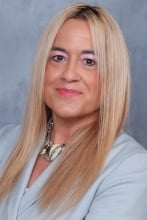
Heather Perfetti
President of the Middle States Commission on Higher Education
We face an opportunity to bridge perspectives around critical federal policy in ways that advance important dialogue for the benefit of our students, our communities and our global status while ensuring that any regulatory shifts contain a return on investment.
Federal policy, however, must not inhibit higher education activities in ways that are misaligned with the needs of students or the realities of the shifts in the sector. The increasingly diverse student population faces challenges requiring institutions to honor the many individualized approaches that we know help students achieve success along their academic journey. Policies that lack flexibility and diminish innovative approaches will stray from the recognition that institutions hold unique spaces within their communities and are driven by distinct missions. Misaligned policies, however, will make the sector’s challenges more pronounced. Ensuring a deep understanding of today’s accreditation and working with us accreditors will be critical to inform federal policy, as accreditation remains one of the most powerful levers available for influencing change and assuring value in higher education.
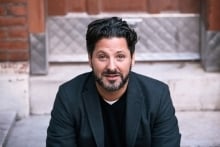
Todd Wolfson
President of the American Association of University Professors
We are deeply concerned that the bombastic rhetoric coming from politicians and propagandists will be used as justification to ramp up political interference and censorship in higher education and deepen the ongoing crisis of declining academic freedom, ballooning student debt and access to education for working-class Americans. Without a thriving, inclusive higher education system that serves the public good, the majority of Americans will be excluded from meaningful participation in our democracy and this country will move backward.
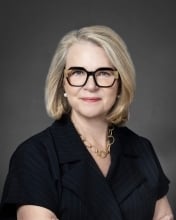
Margaret Spellings
President and CEO of the Bipartisan Policy Center, secretary of education from 2005 to 2009
We are falling short. Many are questioning the value of a college degree. Too many families find higher education out of reach. And our workforce faces a skills mismatch, with more than one million unfilled job openings. No one is questioning that there is room for improvement in higher education. BPC has launched a Commission on the American Workforce, which will convene during 2025 and draft a bipartisan strategy for Congress to nurture talent, expand opportunity and invest in our workforce.
My highest hope is that we can make the future recommendations from our commission a reality as Congress looks at the Higher Education Act, Workforce Innovation and Opportunity Act and Perkins CTE Act.
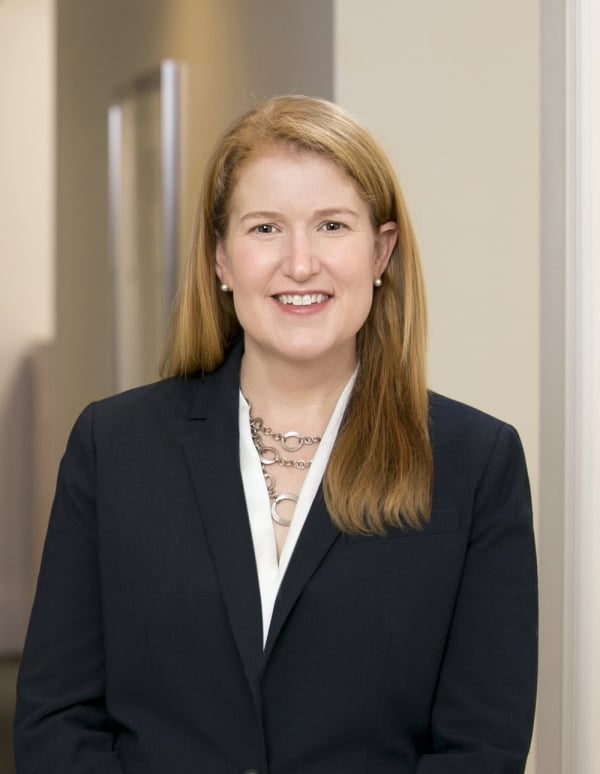
Brigid Harrington
Higher ed attorney
My highest hope for higher ed over the next four years is that colleges and universities will focus on the tangible benefits of education and tailor their approach to the current American workforce. What does that mean in 2025? Definitely more affordable options. Probably more remote and flexible options. More than likely addressing the needs of students who are not on a traditional post–high school path to a bachelor’s degree.
My greatest worry is that colleges will forget their educational mission in the midst of unprecedented pressure from Congress and the executive branch to bow to politics. Higher education has always been a bastion of the free exchange of ideas, and that should not change. Our students and affiliates are not wallflowers and should be encouraged to engage in robust debate of the issues and to not devolve those discussions into speech that is harassing or, frankly, uneducated.