Tag: #featured

  • New Food Security Threats 5 Years After COVID-Era Effort to Feed All Kids – The 74

    New Food Security Threats 5 Years After COVID-Era Effort to Feed All Kids – The 74

    A multi-pronged attack on food aid by Republican lawmakers could mean more of the nation’s children will go hungry — both at home and at school.

    The U.S. Department of Agriculture recently cut two federal programs that provided roughly $1 billion in funding for the purchase of food by schools and food banks. 

    And the Community Eligibility Provision, which reimburses tens of thousands of schools that provide free breakfast and lunch to all students, may tighten its requirements, potentially pushing some 12 million kids out of the program.

    These moves come at the same time the House Republican budget plan calls for deep cuts to the Supplemental Nutrition Assistance Program, or SNAP. The program fed more than 42 million low-income people per month nationwide in 2023. In 2022, 40% were younger than 18.  

    This recent shift reflects a stark reversal of earlier, nationwide efforts to keep families fed during the pandemic. Many districts, such as Baltimore, organized grab-and-go meals sites days after schools were shuttered in March 2020 with no identification or personal information required. Those initiatives led to the nation’s food insecurity rate dropping to a 20-year low when it reached 10.2% in 2021, down from a 14.9% high a decade earlier, according to the USDA.

    It has since crept back up to 13.5% and now, five years after schools utilized USDA waivers to deliver meals in innovative ways, they are bracing for what could be massive cuts from the federal government.
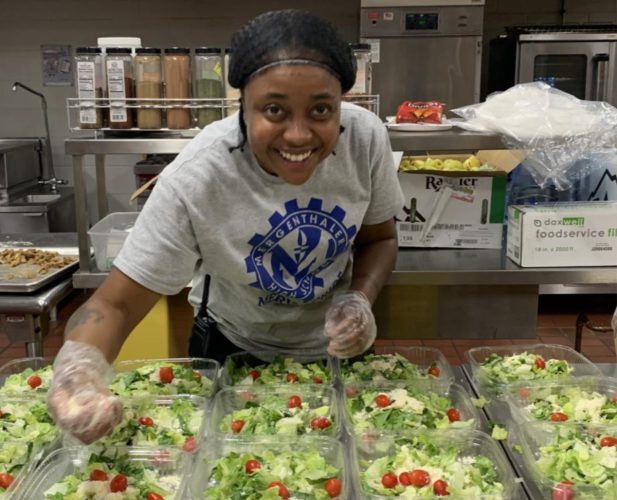
    Latoya Roberson, manager at Mergenthaler Vocational-Technical High School in Baltimore (Baltimore City Public Schools) 

    Elizabeth A. Marchetta, executive director of food and nutrition services for Baltimore City Public Schools, said 31 campuses — serving 19,000 children — would lose out on free breakfast and lunch if the Community Eligibility Provision changes go through. They are among 393 schools and 251,318 children statewide who would be shut out. 

    “It would be devastating,” Marchetta said. “These are critical funds. If we are not being reimbursed for all of the meals we’re serving … the money has to come from somewhere else in the school district, so that is really not great.”
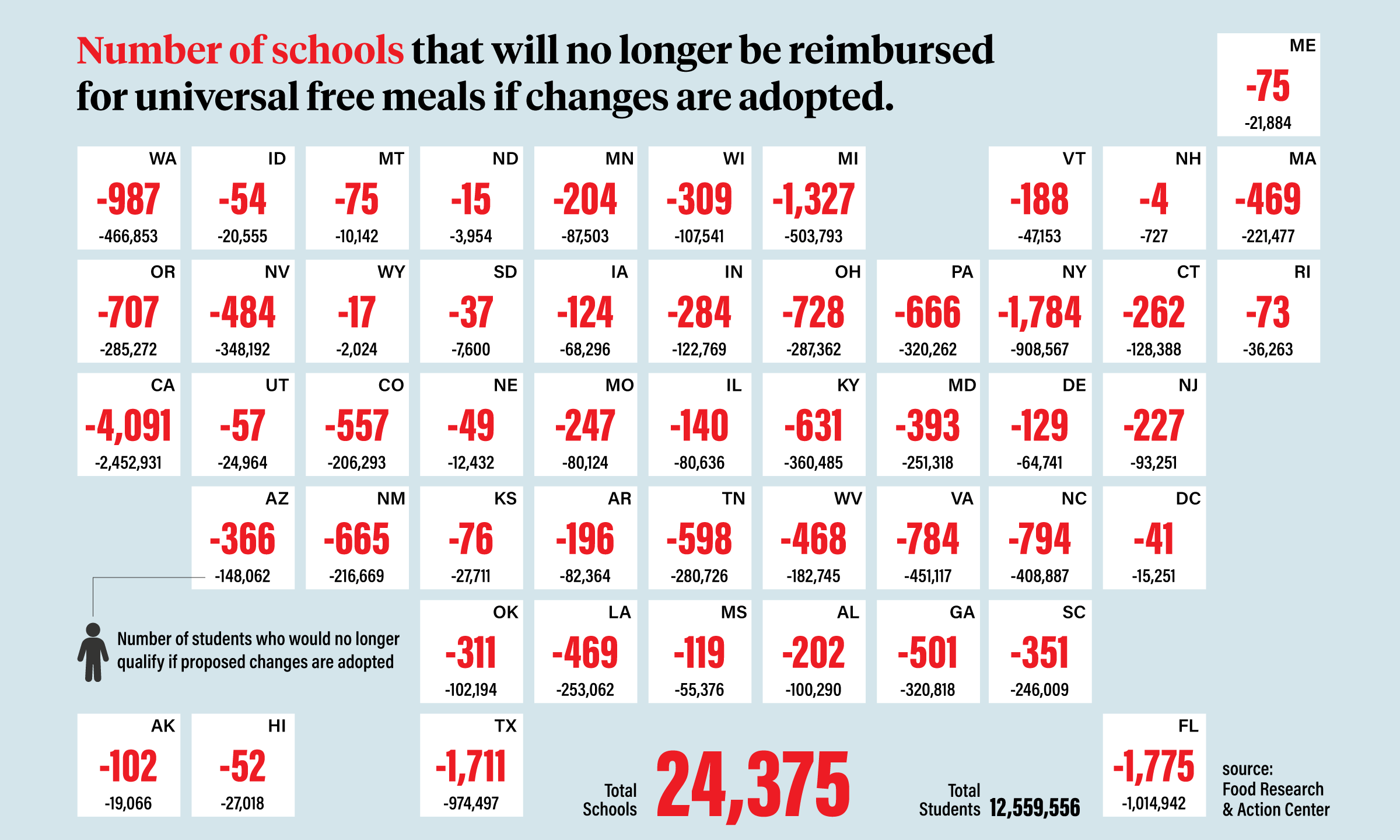
    Nearly 48,000 schools in more than 7,700 districts benefited from the Community Eligibility Provision in the 2023-24 school year. The program reimburses schools that provide universal free meals based on the percentage of their students who automatically qualify for free and reduced-price lunch because their families receive other types of assistance, like SNAP. 

    In 2023, after the COVID-era policy ended where any student could receive a free school meal regardless of income, President Biden lowered the percentage of high-need students required for a school to qualify from 40% to 25%, greatly expanding participation. 

    House GOP Budget Committee Chairman Jodey Arrington now seeks to raise the rate to 60%. The budget proposal would also require all students applying for free and reduced-price meals to submit documentation verifying their family income.

    School meal debt, a barometer of food insecurity among students, is already on the rise. It will almost certainly increase if universal school meals disappear for students whose families make too much to qualify for free and reduced-price lunch but too little to afford to buy meals at school. At the same time, kids who are eligible for free and reduced-price meals could lose that benefit if the required paperwork becomes harder. 

    In the fall of 2023, across 808 school districts, the median amount of school meal debt was $5,495. By the fall of 2024, that amount reached $6,900 across 766 districts, a 25% increase, according to the School Nutrition Association.

    It was just $2,000 a decade earlier. A trio of Democratic senators is pushing to erase the $262 million annual debt total, with Pennsylvania Sen. John Fetterman saying in 2023, “‘School lunch debt’ is a term so absurd that it shouldn’t even exist. That’s why I’m proud to introduce this bill to cancel the nation’s student meal debt and stop humiliating kids and penalizing hunger.”

    Research shows students benefit mightily from free meals: those who attend schools that adopted the Community Eligibility Provision saw lower rates of obesity compared to those who did not. Free in-school meals are also credited for boosting attendance among low-income children, improving classroom behavior and lowering suspensions.

    Joel Berg, CEO of Hunger Free America. 

    Joel Berg, the CEO of Hunger Free America, said further cuts will greatly harm the poorest students. 

    “Over the last few years, things have gone from bad to worse,” he said. “We were all raised seeing Frank Capra movies, where, in the end everything works out. But that’s not how the real world works. In the real world, when the economy gets a cold, poor people get cancer.”

    Hunger Free America found the number of Americans who didn’t have enough to eat over two one-week periods increased by 55.2% between August-September 2021 and August-September 2024. The states with the highest rates of food insecure children were Texas at 23.8%, Oklahoma at 23.2% and Nebraska at 22.6%. Georgia and Arkansas both came in at 22.4%. 

    The USDA slashed the $660 million Local Food for Schools Cooperative Agreement Program for 2025 — it allowed states to purchase local foods, including fresh fruits and vegetables, for distribution to schools and child care institutions — and $500 million from the Local Food Purchase Assistance Cooperative Agreement Program, which supported food banks nationwide. 

    Diane Pratt-Heavner, director of media relations for the School Nutrition Association, said that as families struggle with the high cost of groceries, the government should be doing more — not less — to bolster school meals and other food aid programs. 

    “We’re urging Congress not only to protect the federal Community Eligibility Provision, but to expand it,” Pratt-Heavner said. “Ideally, all students should have access to free school breakfast and lunch as part of their education.” 

    SNAP benefits stood at $4.80 per person per day through 2020 before jumping to more than $6 per person per day after they were adjusted for rising food and other costs. Even then, the higher amount was not enough to cover the cost of a moderately priced meal in most locations. 

    Republicans in Congress seek to cut the program by $230 billion over the next nine years, possibly by returning to the pre-pandemic allotment of $4.80 and/or expanding work-related requirements, said Salaam Bhatti, SNAP director at the Food Research & Action Center

    Another possibility, he said, is that SNAP costs could be pushed onto states — including those that can’t afford them. 

    “This would be an unfunded mandate,” Bhatti said. “States would have to take away from their discretionary spending to offset the cost and if it is not a mandate, then states in rural America and in the South that don’t have the budgets just won’t do it.” 

    Food-related funding decreases come as the child tax credit, created to help parents offset the cost of raising children, is also facing uncertainty, said Megan Curran, the director of policy at the Center on Poverty and Social Policy at Columbia University.

    The American Rescue Plan increased the amount of the child tax credit from $2,000 to $3,600 for qualifying children under age 6, and $3,000 for those under age 18. Many taxpayers received monthly advance payments in the second half of 2021, instead of waiting until tax filing season to receive the full benefits. The move cut child poverty nearly in half. The expanded child tax credit was allowed to lapse post-pandemic and now even the $2,000 credit could revert back to just $1,000

    All food-related and tax benefit cuts — plus the unknowns of Trump-era tariffs — will leave some Americans particularly vulnerable, Curran said. 

    “It’s shaping up to be a very precarious time for families,” she said, “especially families with children.”


    Get stories like these delivered straight to your inbox. Sign up for The 74 Newsletter


    Source link

  • Losing homeschool data Losing homeschool statistics

    Losing homeschool data Losing homeschool statistics

    The Trump administration says one of its primary goals in education is to expand school choice and put power back in the hands of parents. Yet it has killed the main way to track one of the most rapidly growing options — learning at home. 

    The Education Department began counting the number of homeschooled children in 1999, when fewer than 2 percent of students were educated this way. Homeschooling rose by 50 percent in the first decade of the 2000s and then leveled off at around 3 percent

    The most recent survey of families took place in 2023, and it would have been the first indication of the growth of homeschooling since the pandemic. The data collection was nearly finished and ready to be released to the public, but in February, Elon Musk’s Department of Government Efficiency (DOGE) terminated the contract for this data collection, which is part of the National Household Education Survey, along with 88 other education contracts. Then in March, the federal statisticians who oversee the data collection and could review the final figures were fired along with almost everyone else at the National Center for Education Statistics (NCES). As things stand now, this federal homeschool data is unlikely to ever be released. 

    Related: Our free weekly newsletter alerts you to what research says about schools and classrooms.

    “Work on these data files has stopped and there are no current plans for that work to continue,” said a spokesman for the American Institutes for Research, a nonprofit research organization that had held the contract to collect and analyze the data before DOGE canceled it. 

    The loss of this data upset both avid supporters and watchdogs of school choice, particularly now that some states are expanding their Education Savings Account (ESA) programs to transfer public funds directly to families who homeschool their children. Angela Watson, a prominent Johns Hopkins University researcher who runs the Homeschool Research Lab, called it a “massive loss.” Robert Maranto, a professor in the department of education reform at the University of Arkansas, said that in the past, the federal statistics have helped “dispel some of the myths” that homeschooling is “overwhelmingly white,” when, in fact, a more diverse population is learning this way. Maranto also serves as the editor of the Journal of School Choice. The most recent issue was devoted to homeschooling and about half the articles in it cited NCES reports, he said. 

    “There is a certain irony that a pro-school choice administration would cut objective data that might help increase acceptance of homeschooling,” said Maranto. 

    Related: Chaos and confusion as the statistics arm of the Education Department is reduced to a skeletal staff of 3

    It is unclear what will happen to the unreleased 2023 homeschooling data or if the Education Department will ever collect homeschool statistics in the future. 

    In response to questions about the fate of the homeschooling data, Education Department spokeswoman Madison Biedermann said that its research arm, the Institute of Education Sciences, is in possession of the data and that it is “reviewing how all its contractual activities can best be used to meet its statutory obligations.”

    Last September, the Education Department released some preliminary statistics from the 2023 survey. It noted a small increase in traditional homeschooling since 2019 but a large increase in the number of students who were enrolled in an online virtual school and learning from home full time. Together, more than 5 percent of U.S. students were learning at home in one of these two ways. Fewer than 4 percent were learning at home in 2019. 

    Source: National Center for Education Statistics, September 2024 media briefing slide.

    Researchers were keen to dig into the data to understand the different flavors of homeschooling, from online courses to microschools, which are tiny schools that often operate in private homes or places of worship. Researchers also want to understand why more parents are opting for homeschooling and which subjects they are directly teaching their children, all questions that are included in the parent survey conducted by the Education Department. 

    Related: Tracking Trump: His actions on education

    Tracking homeschooling is notoriously difficult. Families who choose this option can be distrustful of government, but this was one of the few surveys that homeschool advocates cited to document the growth in their numbers and they advised the writers of the federal survey on how to phrase questions. 

    Beginning in 2020, the U.S. Census Bureau also began collecting some data on homeschooling, but those statistics cannot be directly compared with the Education Department data and without a historical record, the census data is less useful, researchers said. It is also unclear if this census data will continue. Some states collect data on homeschooling, but researchers said they do it in different ways, making it impossible to compare homeschooling across states.

    Patrick Wolf, a professor of education policy who studies school choice at the University of Arkansas, was also dismayed by the loss of the Education Department’s statistics. 

    “A federal government agency has been collecting national statistics on education since 1867,” he said. “State and local policy makers and practitioners will be severely challenged in doing their work if they don’t have good data from the feds regarding public schooling, private schooling, and homeschooling. Sending education authority to the states only will work well if the federal government continues to collect and publish comprehensive data on schooling. Otherwise, state and local officials are being asked to fly blind.”

    Contact staff writer Jill Barshay at 212-678-3595, jillbarshay.35 on Signal, or [email protected].

    This story about homeschool statistics was written by Jill Barshay and produced by The Hechinger Report, a nonprofit, independent news organization focused on inequality and innovation in education. Sign up for Proof Points and other Hechinger newsletters.

    The Hechinger Report provides in-depth, fact-based, unbiased reporting on education that is free to all readers. But that doesn’t mean it’s free to produce. Our work keeps educators and the public informed about pressing issues at schools and on campuses throughout the country. We tell the whole story, even when the details are inconvenient. Help us keep doing that.

    Join us today.

    Source link

  • The Enrollment Cliff Is Here and Now What?  

    The Enrollment Cliff Is Here and Now What?  

    Higher education is facing a pivotal moment. Institutions across the country are bracing for a significant decline in enrollment—a phenomenon widely known as the Enrollment Cliff. This looming challenge is not a distant threat but a present reality. According to EducationDynamics’ 2025 Landscape of Higher Education report, 29% of Americans perceive the cost of education as unjustifiable, raising concerns about affordability and value. At the same time, the last several years have been marked by year-over-year enrollment declines, with freshman enrollment declining by 1.5% overall in fall 2022, including a 5.6% drop at highly selective institutions.  These continued losses signal a diminishing undergraduate pipeline, making it increasingly difficult for colleges to recover pre-pandemic enrollment levels. 

    Colleges and universities that rely on traditional enrollment strategies find themselves at risk as the pool of prospective students shrinks.  

    The question is no longer whether institutions will be impacted but rather how they will adapt. Understanding and engaging the Modern Learner is critical to developing sustainable enrollment strategies. Institutions that recognize this shift and align their marketing, recruitment and engagement strategies accordingly will be the ones that thrive in the changing landscape.  

    What Caused the Enrollment Cliff?

    The Enrollment Cliff stems from a variety of factors, including demographic and behavioral changes. Declining birth rates in the early 2000s have resulted in fewer high school graduates, meaning a smaller population of traditional college-aged students. At the same time, the percentage of high school graduates choosing to enroll in college has been significantly decreasing, with 9% choosing not to pursue college after completing high school. Amid this environment, the value of a degree has also been increasingly questioned. Rising tuition costs, skepticism about degree value, and the rise in alternative pathways have all contributed to this shift.

    For decades, institutions have relied on a steady pipeline of high school graduates to sustain enrollment. However, this model is no longer sustainable. Institutions must rethink their recruitment strategies and expand their focus beyond the traditional student demographic to remain competitive in an increasingly uncertain landscape.

    Why is College Enrollment Declining?

    While the Enrollment Cliff is primarily driven by demographic trends, the decline in college enrollment is also influenced by shifting student priorities and perceptions of higher education. Economic uncertainties, rising concerns about student debt, and the growing number of alternative credentials have made prospective students more hesitant about pursuing a four-year degree. As we discussed in our previous blog article, Seeing Past the Enrollment Cliff of 2025, this shift is compounded by the growing demand for more flexible, career-oriented education options, alongside the growing belief among students that the cost of a traditional college education is increasingly unjustifiable. 

    Despite overall enrollment projections remaining flat throughout 2030, this stagnation masks a critical shift—the student population is becoming more diverse in age and educational backgrounds. Non-traditional students—working adults, career changers, and life-long learners—are now a growing factor in higher education. Institutions that fail to recognize and adapt to these changing dynamics are falling behind.   

    Additionally, the financial health of many colleges and universities is increasingly at stake. Since 2019, institutional risk levels have risen, signaling heightened financial pressures due to enrollment declines. As tuition revenue declines, schools must find innovative ways to attract and retain students.  

    Who is the New College Student? It’s the Modern Learner.

    To combat the Enrollment Cliff, institutions must first understand who they are trying to reach—the Modern Learner.  

    The Modern Learner is not bound by traditional academic pathways. They prioritize flexibility and accessibility, seeking educational experiences that align with career objectives, financial constraints, and personal commitments. Modern Learners are the architects of their own educational journeys, emphasizing cost, convenience, and career outcomes as their primary decision-factors.  

    Modern Learners expect institutions to meet them where they are—whether that means offering online and hybrid courses, providing transparent career-aligned curriculums, or delivering personalized learning experiences. The assumption that age determines learning modality is outdated. Today, students of all backgrounds demand control over how, when, and where they learn. 

    Institutions that recognize these evolving preferences and tailor their offerings accordingly will be best positioned to sustain and grow their enrollment in coming years.  

    How to Combat the Enrollment Cliff with a Unified Strategy

    Higher education professionals can effectively navigate the enrollment cliff, but success in this new landscape necessitates intentional strategic adjustments. Higher education professionals must adopt a unified enrollment and marketing strategy that directly addresses the evolving preferences of Modern Learners. A nonunified approach will not be sufficient; institutions need an integrated strategy that builds brand strength, prioritizes engagement and delivers tailored messaging at critical moments to impact student decision-making

    Build a Strong Brand and Reputation

    A strong institutional brand is essential for long-terms sustainability. More than just a marketing tool, a well-defined brand communicates an institution’s value proposition and helps establish trust with prospective students. A compelling brand differentiates an institution from its competitors, making it easier to attract and retain students. 

    Data from the 2025 Modern Learner report underscores the importance of brand on enrollment decisions, with 58% of students initiating their search by looking for schools first, not programs. Institutions that effectively position themselves as student-centered, outcome-focused and accessible will gain a competitive advantage.  

    Focus on Engagement and Personalization 

    Understanding Modern Learners is only the first step. Engaging them effectively is what is truly critical. Institutions must shift from broad, one-size-fits all marketing approaches to highly personalized engagement strategies. Modern Learners want to feel valued. Their perception of higher education is influenced by their interactions with an institution, from the first website visit to ongoing conversations with admissions personnel. Research from the Modern Learner Report reveals that only one-third of Modern Learners are considered active promoters when it comes to their educational experience. This highlights a significant opportunity to innovate engagement strategies and approach outreach with a student-oriented mindset, as institutions that prioritize personalized communication and meaningful interactions can foster stronger connections, increase student satisfaction, and ultimately drive enrollment and retention.  

    Deliver the Right Message at the Right Time in the Right Place

    Modern Learners move quickly through the decision-making process. Institutions must ensure their messaging is consistent, compelling, and delivered at the right time. A cohesive communication strategy is essential for guiding students through their enrollment journey. 

    Data from the Modern Learner Report illustrates how rapidly prospective students compile a shortlist of schools. Once they identify potential institutions, they make application decisions swiftly. Across both undergraduate and graduate Modern Learners, most students take fewer than three weeks between building a consideration set and making their initial inquiries. Notably, 20% of undergraduate Modern Learners complete this process within just one week. While this trend holds across most Modern Learner segments, traditional undergraduate students tend to take longer, with 34% waiting one to months before making inquiries. Colleges and universities that provide timely, relevant, and persuasive messaging will have a stronger chance of converting interest into enrollment by remaining top of mind.  

    Will Higher Education Survive?

    The Enrollment Cliff is not merely a challenge; it is a catalyst for change. While institutions that fail to adapt may struggle, those that embrace change will find opportunities for growth and innovation.  

    The future of higher education belongs to institutions that recognize the needs of the Modern Learner and evolve accordingly. Those that prioritize flexibility, career alignment, and student-centric engagement will not just endure the Enrollment Cliff—they will turn it into an opportunity for strategic transformation. 

    At EducationDynamics, we aim to be a trusted partner in your journey. By leveraging data-driven insights, personalized marketing and strategic enrollment management, we help you build stronger connections with prospective students, strengthen institutional reputation, and drive sustainable revenue growth. Together, we can navigate these changes and create lasting impact.  

    The Enrollment Cliff is here. The time to act is now. Partner with EducationDynamics to create a unified enrollment and communication strategy that will position your institution for long-term success. 

    Source link

  • Community colleges are providing new opportunities for learning on the job in logging and oystering

    Community colleges are providing new opportunities for learning on the job in logging and oystering

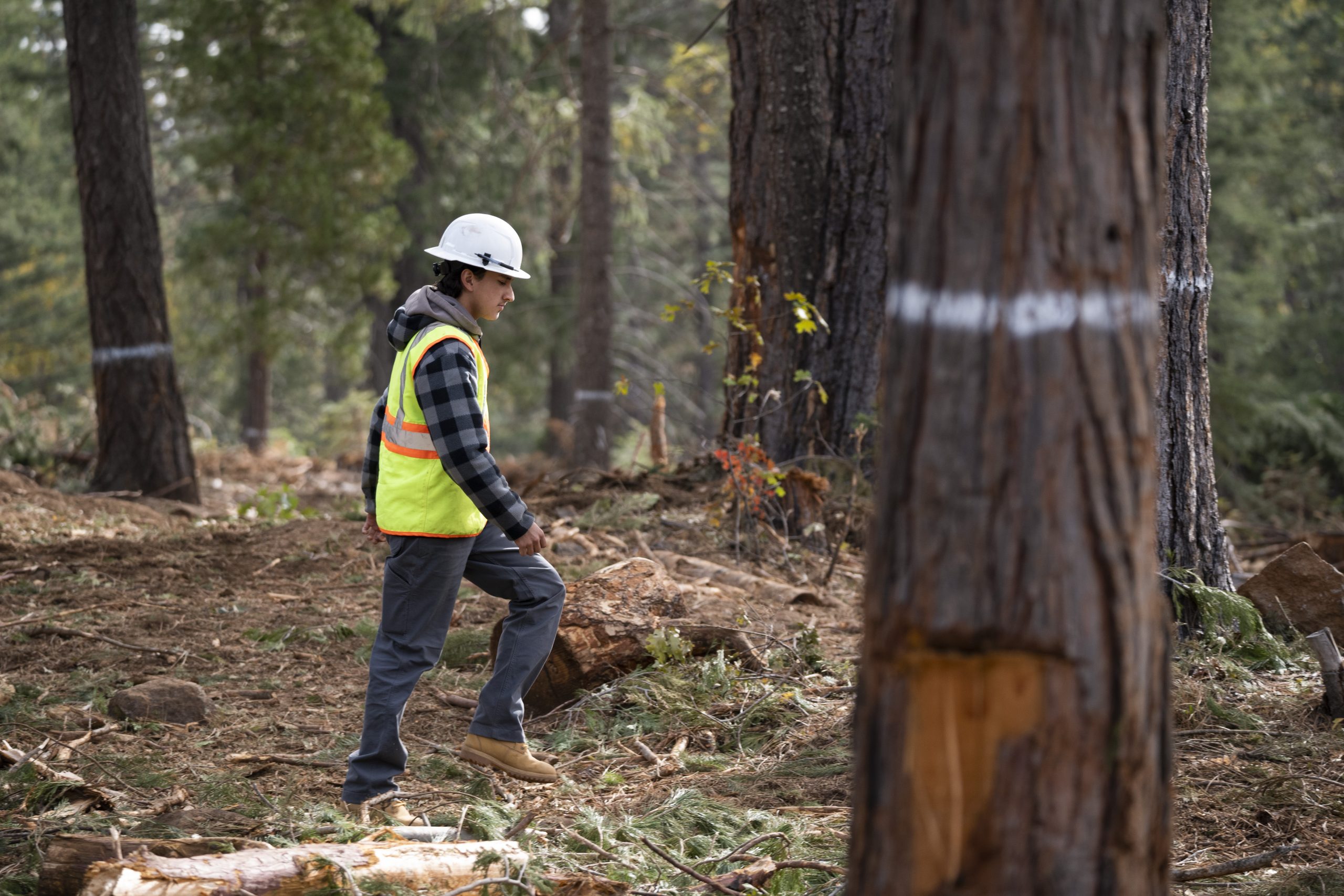
    SHINGLETOWN, Calif. — On a cold morning in October, the sun shone weakly through tall sugar pines and cedars in Shingletown, a small Northern California outpost whose name is a reminder of its history as a logging camp in the 1800s. Up a gravel road banked with iron-rich red soil, Dylan Knight took a break from stacking logs.

    Knight is one of 10 student loggers at Shasta College training to operate the heavy equipment required for modern-day logging: processors to remove limbs from logs that have just been cut, skidders to pull logs out of the cutting site, loaders to stack and sort the logs by species and masticators to mulch up debris.

    For centuries, logging was a seasonal, learn-on-the-job trade passed down from father to son. But as climate change and innovations in the industry have changed logging into a year-round business, there aren’t always enough workers to fill jobs.

    “Our workforce was dying,” said Delbert Gannon, owner of Creekside Logging. “You couldn’t even pick from the bottom of the barrel. It was affecting our production and our ability to haul logs. We felt we had to do something.”

    Related: Interested in innovations in higher education? Subscribe to our free biweekly higher education newsletter.

    Around the country, community colleges are stepping in to run apprenticeship programs for heritage industries, such as logging and aquaculture, which are too small to run. These partnerships help colleges expand the workforce development programs central to their mission. The partnerships also help keep small businesses in small industries alive by managing state and federal grants and providing the equipment, courses and staff to train workers.

    As industries go, logging is small, and it’s struggling. In 2023 there were only about 50,000 logging jobs in the U.S., but the number of logging companies has been on the decline for several years. Most loggers are over 50, according to industry data, and older generations are retiring, contributing to more than 6,000 vacant positions every year on average. The median annual salary for loggers is about $50,000.

    Student logger Bryce Shannon operates a wood chipper at a logging site as part of his instruction at Shasta College in Redding, Calif. Credit: Minh Connors for The Hechinger Report

    Retirements have hit Creekside Logging hard. In 2018 Gannon’s company had jobs to do, and the machines to do them, but nobody to do the work. He reached out to Shasta College, which offers certificates and degrees in forestry and heavy equipment operation, to see if there might be a student who could help.

    That conversation led to a formal partnership between the college and 19 timber companies to create a pre-apprenticeship course in Heavy Equipment Logging Operations. Soon after, they formed the California Registered Apprenticeship Forest Training program. Shasta College used $3.5 million in grant funds to buy the equipment pre-apprentices use.

    Related: Apprenticeships are a trending alternative to college but theres a hitch

    Logging instruction takes place on land owned by Sierra Pacific Industries lumber company — which does not employ its own loggers and so relies on companies like Creekside Lumber to fell and transport logs to mills.

    Each semester, 10 student loggers like Knight take the pre-apprenticeship course at Shasta College. Nearly all are hired upon completion. Once employed, they continue their work as apprentices in the forest training program, which Shasta College runs in partnership with employers like Gannon. State apprenticeship funds help employers offset the cost of training new workers, as well as the lost productivity of on-the-job mentors.

    For Creekside Logging — a 22-person company — working with Shasta College makes participation in the apprenticeship program possible.Gannon’s company often trained new loggers, only to have them back out of the job months later. It can cost tens of thousands of dollars to train a new worker, and Creekside couldn’t afford to keep taking the financial risk. Now Gannon has a steady flow of committed employees, trained at the college rather than on his payroll. Workers who complete the pre-apprenticeship know what they’re getting into — working outdoors in the cold all day, driving big machines and cutting down trees.

    Workers who complete the apprenticeship, Gannon said, are generally looking for a career and not just a seasonal job.

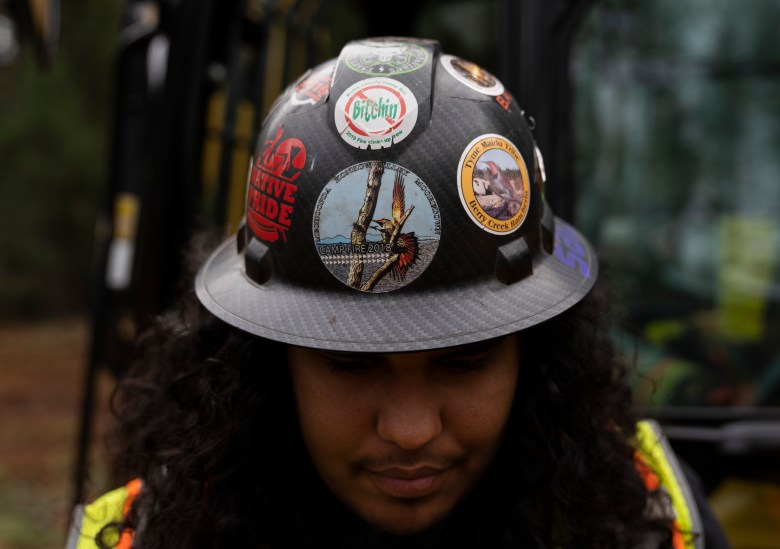
    Talon Gramps-Green, a student logger at Shasta College in Redding, Calif., shows off stickers on his safety helmet. Credit: Minh Connors for The Hechinger Report

    “You get folks that are going to show up every day,” Gannon said. “They got to test drive the career and know they like heavy equipment. They want to work in the woods. The college has solved that for us.”

    Apprentices benefit too. Workers who didn’t grow up around a trade can try it out, which for some means tracking down an elusive pathway into the work. Kyra Lierly grew up in Redding, about 30 miles west of Shingletown, and previously worked for the California Department of Forestry as a firefighter. She’s used to hard work, but when she looked into getting a job as a logger she couldn’t find a way in. Some companies had no office phone or website, she says. Jobs were given out casually, by word of mouth.

    “A lot of logging outfits are sketchy, and I wanted to work somewhere safe,” said Lierly, 25. She worked as an apprentice with Creekside Lumber but is taking a break while she completes an internship at Sierra Pacific Industries, a lumber producer, and gets a certificate in natural resources at Shasta College.

    “The apprenticeship made forestry less intimidating because the college isn’t going to partner with any company that isn’t reputable,” Lierly said.

    Related: In spite of a growing shortage in male-dominated vocations, women still aren’t showing up

    Apprenticeships, with their combination of hands-on and classroom learning, are found in many union halls but, until now, was not known to be common practice in the forested sites of logging crews.

    State and federally registered apprenticeships have gained popularity in recent years as training tools in health care, cybersecurity and telecommunications.

    Federal funding grew steadily from $145 million in 2018 to more than $244 million  during the last years of the Biden administration. That money was used to support apprenticeships in traditional building trades as well as industries that don’t traditionally offer registered apprenticeships, including teaching and nursing.

    The investment aims to address the shortage of skilled workers. The number of working adults in the U.S. doesn’t align with the number of skilled jobs, a disparity that is only slowly recovering after the pandemic.

    Labor shortages hit especially hard in rural areas, where trades like logging have an outsized impact on their local economies. For regional heritage trades like logging, just a few apprentices can make the difference between staying in business and shutting down.

    Lucas Licea, a student logger at Shasta College in Redding, Calif., operates a loader. Credit: Minh Connors for The Hechinger Report

    “There’s a common misconception of registered apprentices that they’re only in the building trades when most are in a variety of sectors,” said Manny Lamarre, who served as deputy assistant secretary for employment and training with the Labor Department during the Biden administration. More than 5,000 new occupations have registered with the department to offer apprenticeships since 2021, he said. “We can specifically support unique small occupations in rural communities where a lot of people are retiring.”

    Education Secretary Linda McMahon, who was confirmed earlier this month, said in her confirmation hearing that she supports apprenticeships. But ongoing cuts make it unclear what the new federal role will be in supporting such programs.

    However, “sharing the capacity has been an important way to get apprenticeships into rural and small employers,” said Vanessa Bennett, director at the Center for Apprenticeship and Work-Based Learning at the nonprofit Jobs for the Future. It’s helpful when employers partner with a nonprofit or community college that can sponsor an apprenticeship program, as Shasta College does, Bennett said. 

    Once Knight, the student logger, completes the heavy equipment pre-apprenticeship, he plans to return to his hometown of Oroville, about 100 miles south of Shingletown. His tribe — the Berry Creek Rancheria of Tyme Maidu Indians — is starting its own logging crew, and Knight will be one of only two members trained to use some of the most challenging pieces of logging equipment.

    “This program is awesome,” said Knight, 24. “It’s really hands-on. You learn as you go and it helps to have a great instructor.”

    Student logger Dylan Knight drives a masticator, which grinds wood into chips, as Shasta College instructor Chris Hockenberry looks on. Credit: Minh Connors for The Hechinger Report

    Across the country in Maine, a community college is helping to train apprentices for jobs at heritage oyster, mussel and kelp farms that have struggled to find enough workers to meet the growing demand for shellfish. Often classified as seasonal work, aquaculture jobs can become year-round careers for workers trained in both harvesting shellfish and planning for future seasons.

    “I love the farm work and I feel confident that I will be able to make a full-length career out of this,” said Gabe Chlebowski, who completed a year-long apprenticeship with Muscongus Bay Aquaculture, which harvests in Damariscotta, Maine. A farm boy from rural Pennsylvania, Chlebowski worked in construction and stone masonry after high school. When his parents moved to Maine, he realized that he wanted a job on the water. With no prior experience, he applied for an oyster farming apprenticeship and was accepted.

    “I was the youngest by five years and the only person who’d never worked on water,” said Chlebowski, 22. “I grew up in a landlocked state surrounded by corn fields. I had the work ethic and no idea what I was doing in boats.”

    Related: Modern apprenticeships offer path to career — and college

    The apprenticeship program was launched in 2023 by the Gulf of Maine Research Institute, which joined with the Maine Aquaculture Association and Educate Maine to create a yearlong apprenticeship with Southern Maine Community College. Apprentices take classes in shellfish biology, water safety, skiff driving and basic boat maintenance. Grants helped pay for the boots, jackets and fishing bibs apprentices needed.

    “The workforce here was a bottleneck,” said Carissa Maurin, aquaculture program manager for GMRI. New workers with degrees in marine biology were changing their minds after starting training at aquaculture farms. “Farms were wasting time and money on employees that didn’t want to be there.”

    Chlebowski completed the apprenticeship at Muscongus Bay in September. He learned how to repair a Yamaha outdoor motor, how to grade oysters and how to work on a 24-foot, flat-bottom skiff. He stayed on as an employee, working at the farm on the Damariscotta River — the oyster capital of New England. The company is known for two varieties of oysters: Dodge Cove Pemaquid and Wawenauk.

    Oyster farming generates local pride, Chlebowski said. The Shuck Station in downtown Damariscotta gives oyster farmers a free drink when they come in and there’s an annual summer shucking festival. But the company is trying to provide careers, Chlebowski said, not just high-season jobs.

    “It can be hard to make a career out of farming, but it’s like any trade,” he said, adding that there is work to do year-round. “Welding and HVAC have trade schools and apprenticeships. Why shouldn’t aquaculture?”

    Chlebowski’s apprenticeship turned into a career. Back in Shingletown, students in the logging program hope for the same result when they finish. 

    Until then, they spend Mondays, Wednesdays and Fridays in the woods learning how to operate and maintain equipment. Tuesdays and Thursdays are spent on Shasta College’s Redding campus, where the apprentices take three classes: construction equipment operation, introduction to forestry and wood products and milling.

    At the end of the semester, students demonstrate their skills at a showcase in the Shingletown woods. Logging company representatives will attend and scout for workers. Students typically get offers at the showcase. So far, 50 students have completed the pre-apprenticeship program and most transitioned into full apprenticeships. Fifteen people have completed the full apprenticeship program and now earn from $40,000 to $90,000 a year as loggers.

    Related: Some people going into the trades wonder why their classmates stick with college

    Mentorship is at the heart of apprenticeships. On the job, new workers are paired with more experienced loggers who pass on knowledge and supervise the rookies as they complete tasks. Pre-apprentices at Shasta College learn from Jonas Lindblom, the program’s heavy equipment and logging operations instructor.

    At the logging site, Lindblom watches as a tall sugar pine slowly falls and thuds to the ground. Lindblom’s father, grandfathers and great-grandfather all drove trucks for logging companies in Northern California.

    An axe sticks out of a freshly cut tree at a logging site used to train student loggers enrolled at Shasta College in Redding, Calif. Credit: Minh Connors for The Hechinger Report

    This is a good area for apprentices to “just be able to learn at their pace,” he said. “They’re not pushed and they can get comfortable in the machines without developing bad habits along the way.” 

    Lindblom, who studied agriculture education at Chico State University, spent all his breaks during college working as a logger. He works closely with the logging companies that partner with the program to make sure he’s teaching up-to-date practices. It’s better for new loggers to learn in this outdoor classroom, he said, than on the job.

    “The majority of these students did not grow up in logging families,” he said. “This is a great opportunity to pass on this knowledge and share where the industry is going.”

    Contact editor Christina A. Samuels at 212-678-3635 or [email protected].

    This story about learning on the job was produced by The Hechinger Report, a nonprofit, independent news organization focused on inequality and innovation in education. Sign up for the Hechinger newsletter.

    The Hechinger Report provides in-depth, fact-based, unbiased reporting on education that is free to all readers. But that doesn't mean it's free to produce. Our work keeps educators and the public informed about pressing issues at schools and on campuses throughout the country. We tell the whole story, even when the details are inconvenient. Help us keep doing that.

    Join us today.


    Source link

  • OPINION: Here’s why we cannot permit America’s partnership with higher education to weaken or dissolve

    OPINION: Here’s why we cannot permit America’s partnership with higher education to weaken or dissolve

    Abrupt cuts in federal funding for life saving medical research. Confusing and misleading new guidance about campus diversity programs. Cancellation, without due process, of hundreds of millions of dollars in federal grants and contracts held by a major university. Mass layoffs at the Education Department, undermining crucial programs such as federal student aid.

    All of this, and more, in the opening weeks of the second Trump administration.

    The president has made clear that colleges and universities face a moment of unprecedented challenge. The partnership the federal government forged with American higher education long ago, which for generations has paid off spectacularly for our country’s civic health, economic well-being and national security, appears in the eyes of many to be suddenly vulnerable.

    America must not permit this partnership to weaken or dissolve. No nation has ever built up its people by tearing down its schools. Higher education builds America — and together, we will fight to ensure it continues to do so.  

    Related: Tracking Trump: his actions on education    

    Some wonder why more college and university presidents aren’t speaking out. The truth is, many of them fear their institutions could be targeted next.

    They are also juggling immense financial pressures and striving to fulfill commitments to teaching and research.

    But the American Council on Education, which I lead, has always stood up for higher education. We have done it for more than a century, and we are doing it now. We will use every tool possible — including litigation, advocacy and coalition-building — to advance the cause.

    ACE is the major coordinating body for colleges and universities. We represent institutions of all kinds — public and private, large and small, rural and urban — with a mission of helping our members best serve their students and communities.

    Let me be clear: We welcome scrutiny and accountability for the public funds supporting student aid and research. Our institutions are subject to state and federal laws and must not tolerate any form of discrimination, even as they uphold freedom of expression and the right to robust but civil protest. 

    We also know we have much work to do to raise public confidence in higher education and the value of a degree.

    However, we cannot allow unwarranted attacks on higher education to occur without a vigorous and proactive response.

    When the National Institutes of Health announced on Feb. 7 a huge cut in funding that supports medical and health research, ACE joined with the Association of American Universities, the Association of Public and Land-grant Universities and a number of affected universities in a lawsuit to stop this action.

    ACE has almost never been a plaintiff in a lawsuit against the federal government, but the moment demanded it. We are pleased that a federal judge has issued a nationwide preliminary injunction to preserve the NIH funding.

    When the Education Department issued a “Dear Colleague” letter Feb. 14 that raised questions about whether campus programs related to diversity, equity      and inclusion would be permissible under federal law, ACE organized a coalition of more than 70 higher education groups calling for the department to rescind the letter.      

    We raised concerns about the confusion the letter was causing. We pointed out that the majority opinion from Chief Justice John Roberts in the Students for Fair Admissions case acknowledged that diversity-related goals in higher education are “commendable” and “plainly worthy.”    

     We invited the department to engage with the higher education community to promote inclusive and welcoming educational environments for all students, regardless of race or ethnicity or any other factors. We remain eager to work with the department. 

    Related: Fewer scholarships and a new climate of fear follow      the end of affirmative action

    Unfortunately, in recent days the administration has taken further steps we find alarming.

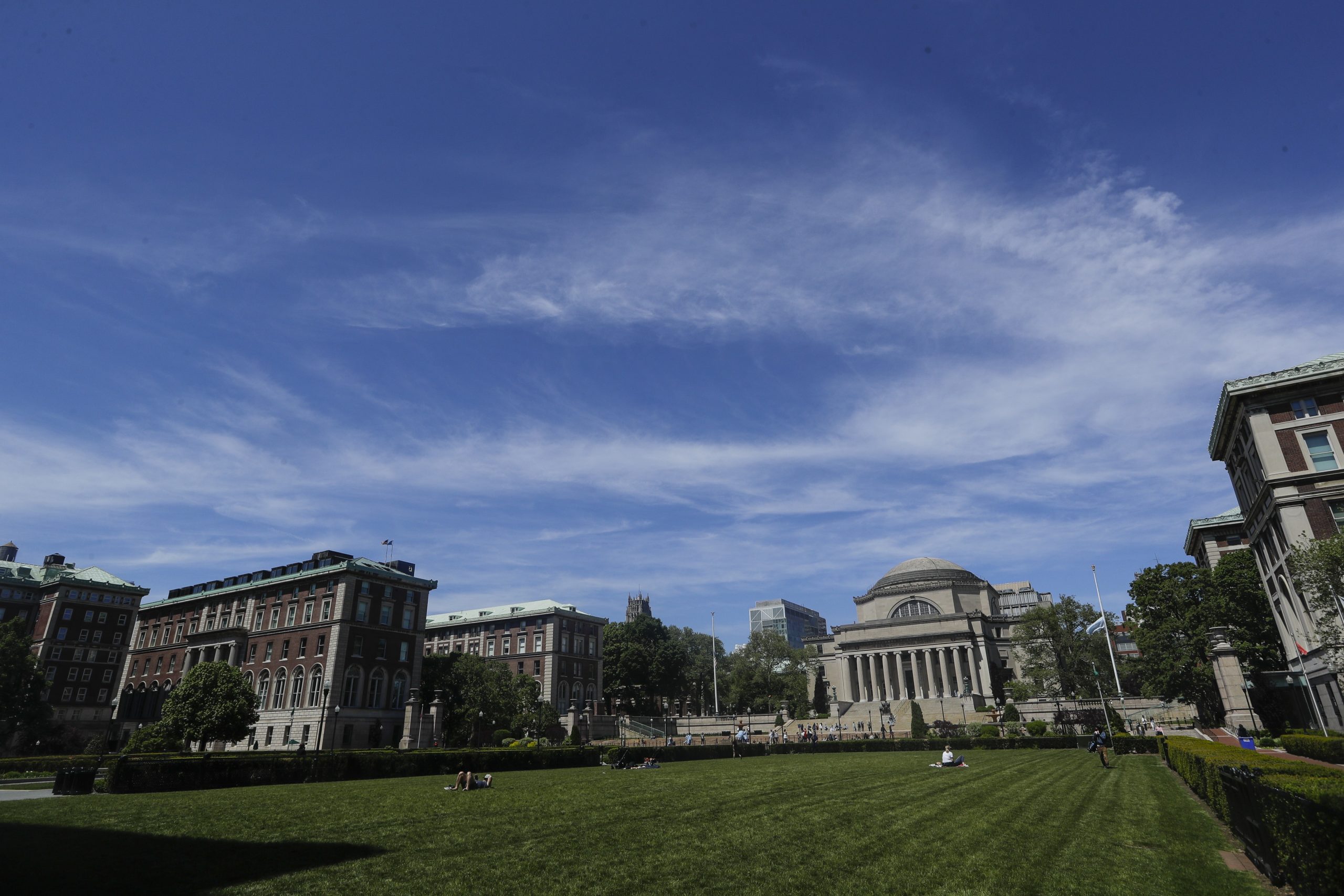
    ACE denounced the arbitrary cancellation of $400 million in federal grants and contracts with Columbia University. Administration officials claimed their action was a response to failures to adequately address antisemitism at Columbia, though it bypassed well-established procedures for investigating such allegations. (The Hechinger Report is an independent unit of Teachers College, Columbia University.)

    Ultimately, this action will eviscerate academic and research activities, to the detriment of students, faculty, medical patients and others.

    Make no mistake: Combating campus antisemitism is a matter of utmost priority for us. Our organization, along with Hillel International and the American Jewish Committee, organized two summits on this topic in 2022 and 2024, fostering important dialogue with dozens of college and university presidents.

    We also are deeply concerned about the letter the Trump administration sent to Columbia late last week that makes certain demands of the university, including a leadership change for one of its academic departments. To my mind, the letter obliterated the boundary between institutional autonomy and federal control. That boundary is essential. Without it, academic freedom is at risk.

    Meanwhile, layoffs and other measures slashing the Education Department’s workforce by as much as half will cause chaos and harm to financial aid and other programs that support millions of students from low- and middle-income families. We strongly urge the administration to change course and Congress to step in if it does not.

    Despite all that has happened in the past several weeks, we want President Trump and his administration to know this: Higher education is here for America, and ready to keep building. Colleges and universities have long worked with the government in countless ways to strengthen our economy, democracy, health and security. We cannot abandon that partnership. We must fortify it. 

    Ted Mitchell is president of the American Council of Education in Washington, D.C.

    Contact the opinion editor at [email protected].

    This story about academic freedom was produced by The Hechinger Report, a nonprofit, independent news organization focused on inequality and innovation in education. Sign up for Hechinger’s weekly newsletter.

    The Hechinger Report provides in-depth, fact-based, unbiased reporting on education that is free to all readers. But that doesn’t mean it’s free to produce. Our work keeps educators and the public informed about pressing issues at schools and on campuses throughout the country. We tell the whole story, even when the details are inconvenient. Help us keep doing that.

    Join us today.

    Source link

  • How Trump is disrupting efforts by schools and colleges to combat climate change

    How Trump is disrupting efforts by schools and colleges to combat climate change

    This week I dug into how the Trump administration’s anti-climate blitz is hampering schools’ and colleges’ ability to green their operations, plus a new report on the California wildfires’ impact on students. Thank you for reading, and reply to this email to be in touch. — Caroline Preston

    LeeAnn Kittle helps oversee the Denver public school district’s work to reduce carbon emissions by 90 percent by 2050.

    In January, her job got a lot tougher. 

    Denver expected to receive tax credits via the Inflation Reduction Act for an additional 25 electric school buses. President Donald Trump attempted to freeze clean energy funds through the IRA in his first days in office. Kittle, the district’s executive director of sustainability, also considered applying for tax credit-like payments for energy-efficient heat pumps for the district’s older buildings that lack air conditioning. And she’d intended to apply this spring for a nearly $12 million grant through Renew America’s Schools, a Department of Energy program to help schools become more energy efficient. Staff working on that program have left and its future is uncertain.  

    “I think we’re all in shock,” said Kittle. “It’s like someone put us in a snow globe and shook us up, and now we’re asked to stand straight. And it’s like I don’t know how to stand straight right now.”

    Since January, the Trump administration has launched a broadside against efforts to reduce gases that cause climate change, including by freezing clean energy spending, slashing environmental staff and research, scrubbing the words “climate change” from websites, and rethinking decades of science showing the harms of global warming to human health and the planet. Experts and education leaders say those actions — some of which have been challenged in court — are disrupting, but not extinguishing, efforts by schools and colleges to curtail their emissions and reduce their toll on the planet.

    Related: Want to read more about how climate change is shaping education? Subscribe to our free newsletter.

    At the start of the year, the State University of New York was awarded $15 million to buy 350 electric vehicle charging stations. “We have yet to see the dollars,” said its chancellor, John B. King Jr. A webinar on the Department of Transportation grant program, which is funded by the bipartisan infrastructure act, was canceled. “It’s been radio silence,” said Carter Strickland, the SUNY chief sustainability officer. 

    The SUNY system, which owns a staggering 40 percent of New York State’s public buildings, had also planned to apply for IRA payments for a variety of projects to electrify campuses, reduce pollution and improve energy efficiency. In November, it applied for approximately $1.45 million for an Oneonta campus project that uses geothermal wells to provide heating and cooling. It still expects to get that money since the project is complete and the IRA remains law, but it can no longer count on payments for newer projects, King said. 

    “What the IRA did was turbocharged everything and gave many more players the ability to see themselves as part of a clean energy economy,” said Timothy Carter, president of Second Nature, a group that supports climate work in higher education. But the confusion that the Trump administration has sowed — even though the IRA has not been repealed — means both K-12 and higher education institutions are reconsidering clean energy projects. 

    There’s no count of how many colleges have sought funding through the IRA and bipartisan infrastructure act-funded programs, said Carter, but the work is spread across red and blue states, and some education systems have dozens of projects under construction. The University of California system, for example, filed applications for more than 70 projects, including a $1 billion project to replace UC Davis’s leaky and inefficient heating and cooling system and a project at UC Berkeley to phase out an old power plant and replace it with a microgrid. 

    “We remain hopeful that funding will be provided per the program provisions,” David Phillips, associate vice president for capital programs at the University of California, wrote in an email. 

    Sara Ross, co-founder of Undaunted K12, which helps school districts green their operations, said her group tells school leaders that for now, “energy tax credits are still the law of the land.” 

    But she expects those credits could be eliminated in the new tax bill that Congress is negotiating this year. 

    In the past, entities that begin construction on projects before any changes in a new law go into effect have been grandfathered in and still received that money, she said. “No promises,” Ross said, but historically that’s how such tax credit scenarios have worked. She said some school districts are speeding up projects to beat that possible deadline, while others are abandoning them.

    There is some political movement to preserve clean energy tax credits. Roughly 85 percent of the private-sector dollars that have gone into clean energy projects are in GOP-led districts, according to a report last year. Some GOP lawmakers have advocated for maintaining that funding, which has contributed to a surge in renewable energy jobs.  

    Steven Bloom, assistant vice president of government relations with the American Council on Education, said that gives supporters of the IRA some hope. But he said that many higher education institutions are facing so much pain and uncertainty from other Trump administration actions, like the National Institutes of Health’s plan to slash overhead payments and investigations into alleged antisemitism, that unfortunately “climate investments may get pushed down the ladder of priorities in the near term.” 

    Related: How colleges can become ‘living labs’ for combating climate change

    Another important vehicle for greening schools, the Renew America’s Schools grant program, was started in 2022 with $500 million for school districts. Many of the Department of Energy staff working on that effort have left, Ross said, and some school districts have not heard back about the status of funding for their projects.    

    In Massachusetts, the Lowell school district won a prize through the Renew America program that could unlock up to $15 million to help the district improve its aged facilities. The district’s facilities for the most part lack air conditioning and schools have been closed on occasion due to high temperatures.

    Katherine Moses, the city of Lowell’s sustainability director, wrote in an email that the district had so far pocketed $300,000 that it is using for energy audits to identify inefficiencies and lay the groundwork for a larger investment. It’s unclear what could happen beyond that and if the district will receive more money. She said Lowell is proceeding according to the requirements of the grant “until we hear otherwise from DOE.” 

    More than 3,400 school districts have applied for money through programs created under the bipartisan infrastructure law and the IRA to electrify school buses. After a federal judge ruled against the administration’s freeze on clean energy spending, grants through those programs appear to have been unfrozen and districts have been able to access payments, said Sue Gander, director of the electric school bus initiative with the nonprofit World Resources Institute. 

    But rebates for electric buses are still stalled, she said. Districts are submitting forms to receive rebates, she said, “but there’s no communication coming back to them through the system about the status of their award or any indication that any payment that may have been requested is being provided.”  

    The Transportation and Energy departments and the Environmental Protection Agency, which runs the Clean School Bus Program, did not respond by deadline to requests for comment for this article.  

    King, of SUNY, noted that climate change is already negatively affecting young people and contributing to worsening disasters like floods and fires. For some faculty, staff and students, the backtracking from climate action at the federal level is stirring disappointment and fear, he said. “There is this very intense frustration that as a society we are stopping efforts to deal with what is truly an existential threat.” 

    Contact Caroline Preston at 212-870-8965, on Signal at CPreston.83 or via email at [email protected]

    This story about clean energy was produced by The Hechinger Report, a nonprofit, independent news organization focused on inequality and innovation in education. Sign up for our climate and education newsletter.

    What I’m reading:

    My colleague Neal Morton traveled to northwest Colorado for a story on how phasing out coal-powered plants affects school budgets and career prospects for graduates. School districts haven’t done enough to plan for those changes or prepare students for alternate careers, he writes, and renewable energy projects are not popping up fast enough to smooth the financial pain.  

    Some 725,000 students at more than 1,000 schools faced school closures during the California wildfires in January, according to a new report from Undaunted K12 and EdTrust. The fire had a disproportionate impact on students living in poverty and from underrepresented backgrounds, the report says: Three-quarters of the affected students came from low-income households, and 66 percent were Hispanic. 

    The U.S. Coast Guard Academy removed the words “climate change” from its curriculum, reports Inside Climate News. The academy falls under the purview of the Department of Homeland Security, whose new director, Kristi Noem, issued a directive in February to “eliminate all climate change activities and the use of climate change terminology in DHS policies and programs.”

    Schools with satisfactory heating systems reduce student absences by 3 percent and suspensions by 6 percent, and record a 5 percent increase in math scores, according to a study by researchers at the University at Albany, State University of New York. Schools with satisfactory cooling systems see an increase of 3 percent in reading scores. 

    Contact editor Caroline Preston at 212-870-8965, on Signal at CPreston.83 or via email at [email protected].

    This story about clean energy was produced by The Hechinger Report, a nonprofit, independent news organization focused on inequality and innovation in education. Sign up for our climate and education newsletter.

    The Hechinger Report provides in-depth, fact-based, unbiased reporting on education that is free to all readers. But that doesn’t mean it’s free to produce. Our work keeps educators and the public informed about pressing issues at schools and on campuses throughout the country. We tell the whole story, even when the details are inconvenient. Help us keep doing that.

    Join us today.

    Source link

  • Schools are surveilling kids to prevent gun violence or suicide. The lack of privacy comes at a cost

    Schools are surveilling kids to prevent gun violence or suicide. The lack of privacy comes at a cost

    The Education Reporting Collaborative, a coalition of eight newsrooms, is investigating the unintended consequences of AI-powered surveillance at schools. Members of the Collaborative are AL.com, The Associated Press, The Christian Science Monitor, The Dallas Morning News, The Hechinger Report, Idaho Education News, The Post and Courier in South Carolina, and The Seattle Times.

    One student asked a search engine, “Why does my boyfriend hit me?” Another threatened suicide in an email to an unrequited love. A gay teen opened up in an online diary about struggles with homophobic parents, writing they just wanted to be themselves.

    In each case and thousands of others, surveillance software powered by artificial intelligence immediately alerted Vancouver Public Schools staff in Washington state.

    Vancouver and many other districts around the country have turned to technology to monitor school-issued devices 24/7 for any signs of danger as they grapple with a student mental health crisis and the threat of shootings.

    The goal is to keep children safe, but these tools raise serious questions about privacy and security – as proven when Seattle Times and Associated Press reporters inadvertently received access to almost 3,500 sensitive, unredacted student documents through a records request about the district’s surveillance technology.

    The released documents show students use these laptops for more than just schoolwork; they are coping with angst in their personal lives.

    Tim Reiland, 42, center, the parent of daughter Zoe Reiland, 17, right, and Anakin Reiland, 15, photographed in Clinton, Miss., Monday, March 10, 2025, said he had no idea their previous schools, in Oklahoma, were using surveillance technology to monitor the students. (AP Photo/Rogelio V. Solis)

    Students wrote about depression, heartbreak, suicide, addiction, bullying and eating disorders. There are poems, college essays and excerpts from role-play sessions with AI chatbots.

    Vancouver school staff and anyone else with links to the files could read everything. Firewalls or passwords didn’t protect the documents, and student names were not redacted, which cybersecurity experts warned was a massive security risk.

    The monitoring tools often helped counselors reach out to students who might have otherwise struggled in silence. But the Vancouver case is a stark reminder of surveillance technology’s unintended consequences in American schools.

    In some cases, the technology has outed LGBTQ+ children and eroded trust between students and school staff, while failing to keep schools completely safe.

    Gaggle, the company that developed the software that tracks Vancouver schools students’ online activity, believes not monitoring children is like letting them loose on “a digital playground without fences or recess monitors,” CEO and founder Jeff Patterson said.

    Related: A lot goes on in classrooms from kindergarten to high school. Keep up with our free weekly newsletter on K-12 education.

    Roughly 1,500 school districts nationwide use Gaggle’s software to track the online activity of approximately 6 million students. It’s one of many companies, like GoGuardian and Securly, that promise to keep kids safe through AI-assisted web surveillance.

    The technology has been in high demand since the pandemic, when nearly every child received a school-issued tablet or laptop. According to a U.S. Senate investigation, over 7,000 schools or districts used GoGuardian’s surveillance products in 2021.

    Vancouver schools apologized for releasing the documents. Still, the district emphasizes Gaggle is necessary to protect students’ well-being.

    “I don’t think we could ever put a price on protecting students,” said Andy Meyer, principal of Vancouver’s Skyview High School. “Anytime we learn of something like that and we can intervene, we feel that is very positive.”

    Dacia Foster, a parent in the district, commended the efforts to keep students safe but worries about privacy violations.

    “That’s not good at all,” Foster said after learning the district inadvertently released the records. “But what are my options? What do I do? Pull my kid out of school?”

    Foster says she’d be upset if her daughter’s private information was compromised.

    “At the same time,” she said, “I would like to avoid a school shooting or suicide.”

    Related: Ed tech companies promise results, but their claims are often based on shoddy research

    Gaggle uses a machine learning algorithm to scan what students search or write online via a school-issued laptop or tablet 24 hours a day, or whenever they log into their school account on a personal device. The latest contract Vancouver signed, in summer 2024, shows a price of $328,036 for three school years – approximately the cost of employing one extra counselor.

    The algorithm detects potential indicators of problems like bullying, self-harm, suicide or school violence and then sends a screenshot to human reviewers. If Gaggle employees confirm the issue might be serious, the company alerts the school. In cases of imminent danger, Gaggle calls school officials directly. In rare instances where no one answers, Gaggle may contact law enforcement for a welfare check.

    A Vancouver school counselor who requested anonymity out of fear of retaliation said they receive three or four student Gaggle alerts per month. In about half the cases, the district contacts parents immediately.

    “A lot of times, families don’t know. We open that door for that help,” the counselor said. Gaggle is “good for catching suicide and self-harm, but students find a workaround once they know they are getting flagged.”

    Related: Have you had experience with school surveillance tech? Tell us about it

    Seattle Times and AP reporters saw what kind of writing set off Gaggle’s alerts after requesting information about the type of content flagged. Gaggle saved screenshots of activity that set off each alert, and school officials accidentally provided links to them, not realizing they weren’t protected by a password.

    After learning about the records inadvertently released to reporters, Gaggle updated its system. Now, after 72 hours, only those logged into a Gaggle account can view the screenshots. Gaggle said this feature was already in the works but had not yet been rolled out to every customer.

    The company says the links must be accessible without a login during those 72 hours so emergency contacts—who often receive these alerts late at night on their phones—can respond quickly.

    In Vancouver, the monitoring technology flagged more than 1,000 documents for suicide and nearly 800 for threats of violence. While many alerts were serious, many others turned out to be false alarms, like a student essay about the importance of consent or a goofy chat between friends.

    Foster’s daughter Bryn, a Vancouver School of Arts and Academics sophomore, was one such false alarm. She was called into the principal’s office after writing a short story featuring a scene with mildly violent imagery.

    “I’m glad they’re being safe about it, but I also think it can be a bit much,” Bryn said.

    School officials maintain alerts are warranted even in less severe cases or false alarms, ensuring potential issues are addressed promptly.

    “It allows me the opportunity to meet with a student I maybe haven’t met before and build that relationship,” said Chele Pierce, a Skyview High School counselor.

    Related: Students work harder when they think they are being watched

    Between October 2023 and October 2024, nearly 2,200 students, about 10% of the district’s enrollment, were the subject of a Gaggle alert. At the Vancouver School of Arts and Academics, where Bryn is a student, about 1 in 4 students had communications that triggered a Gaggle alert.

    While schools continue to use surveillance technology, its long-term effects on student safety are unclear. There’s no independent research showing it measurably lowers student suicide rates or reduces violence.

    A 2023 RAND study found only “scant evidence” of either benefits or risks from AI surveillance, concluding: “No research to date has comprehensively examined how these programs affect youth suicide prevention.”

    “If you don’t have the right number of mental health counselors, issuing more alerts is not actually going to improve suicide prevention,” said report co-author Benjamin Boudreaux, an AI ethics researcher.

    In the screenshots released by Vancouver schools, at least six students were potentially outed to school officials after writing about being gay, trans or struggling with gender dysphoria.

    LGBTQ+ students are more likely than their peers to suffer from depression and suicidal thoughts, and turn to the internet for support.

    “We know that gay youth, especially those in more isolated environments, absolutely use the internet as a life preserver,” said Katy Pearce, a University of Washington professor who researches technology in authoritarian states.

    In one screenshot, a Vancouver high schooler wrote in a Google survey form they’d been subject to trans slurs and racist bullying. Who created this survey is unclear, but the person behind it had falsely promised confidentiality: “I am not a mandated reporter, please tell me the whole truth.”

    When North Carolina’s Durham Public Schools piloted Gaggle in 2021, surveys showed most staff members found it helpful.

    But community members raised concerns. An LGBTQ+ advocate reported to the Board of Education that a Gaggle alert about self-harm had led to a student being outed to their family, who were not supportive.

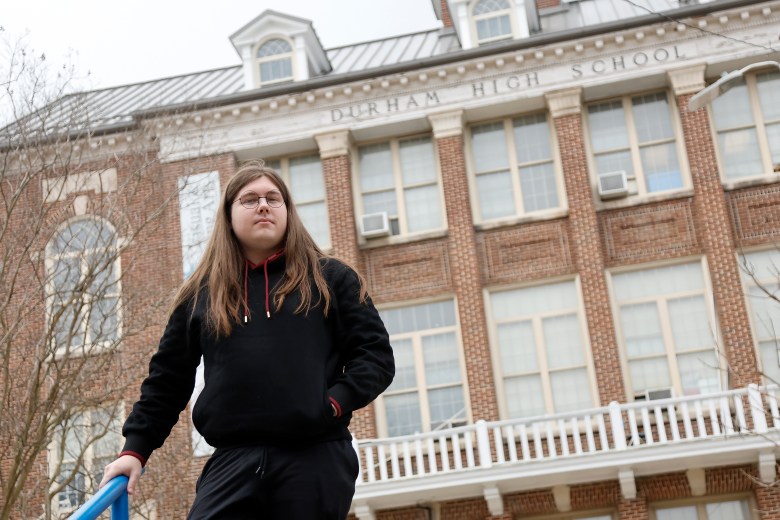
    Glenn Thompson, a Durham School of the Arts graduate, poses in front of the school in Durham, N.C., Monday, March 10, 2025. (AP Photo/Karl DeBlaker)

    Glenn Thompson, a Durham School of the Arts graduate, spoke up at a board meeting during his senior year. One of his teachers promised a student confidentiality for an assignment related to mental health. A classmate was then “blindsided” when Gaggle alerted school officials about something private they’d disclosed. Thompson said no one in the class, including the teacher, knew the school was piloting Gaggle.

    “You can’t just (surveil) people and not tell them. That’s a horrible breach of security and trust,” said Thompson, now a college student, in an interview.

    After hearing about these experiences, the Durham Board of Education voted to stop using Gaggle in 2023. The district ultimately decided it was not worth the risk of outing students or eroding relationships with adults.

    Related: School ed tech money mostly gets wasted. One state has a solution

    The debate over privacy and security is complicated, and parents are often unaware it’s even an issue. Pearce, the University of Washington professor, doesn’t remember reading about Securly, the surveillance software Seattle Public Schools uses, when she signed the district’s responsible use form before her son received a school laptop.

    Even when families learn about school surveillance, they may be unable to opt out. Owasso Public Schools in Oklahoma has used Gaggle since 2016 to monitor students outside of class.

    For years, Tim Reiland, the parent of two teenagers, had no idea the district was using Gaggle. He found out only after asking if his daughter could bring her personal laptop to school instead of being forced to use a district one because of privacy concerns.

    The district refused Reiland’s request.

    When his daughter, Zoe, found out about Gaggle, she says she felt so “freaked out” that she stopped Googling anything personal on her Chromebook, even questions about her menstrual period. She didn’t want to get called into the office for “searching up lady parts.”

    “I was too scared to be curious,” she said.

    School officials say they don’t track metrics measuring the technology’s efficacy but believe it has saved lives.

    Yet technology alone doesn’t create a safe space for all students. In 2024, a nonbinary teenager at Owasso High School named Nex Benedict died by suicide after relentless bullying from classmates. A subsequent U.S. Department of Education Office for Civil Rights investigation found the district responded with “deliberate indifference” to some families’ reports of sexual harassment, mainly in the form of homophobic bullying.

    During the 2023-24 school year, the Owasso schools received close to 1,000 Gaggle alerts, including 168 alerts for harassment and 281 for suicide.

    When asked why bullying remained a problem despite surveillance, Russell Thornton, the district’s executive director of technology responded: “This is one tool used by administrators. Obviously, one tool is not going to solve the world’s problems and bullying.”

    Related: Schools prove soft targets for hackers

    Despite the risks, surveillance technology can help teachers intervene before a tragedy.

    A middle school student in the Seattle-area Highline School District who was potentially being trafficked used Gaggle to communicate with campus staff, said former superintendent Susan Enfield.

    “They knew that the staff member was reading what they were writing,” Enfield said. “It was, in essence, that student’s way of asking for help.”

    Still, developmental psychology research shows it is vital for teens to have private spaces online to explore their thoughts and seek support.

    “The idea that kids are constantly under surveillance by adults — I think that would make it hard to develop a private life, a space to make mistakes, a space to go through hard feelings without adults jumping in,” said Boudreaux, the AI ethics researcher.

    Gaggle’s Patterson says school-issued devices are not the appropriate place for unlimited self-exploration. If that exploration takes a dark turn, such as making a threat, “the school’s going to be held liable,” he said. “If you’re looking for that open free expression, it really can’t happen on the school system’s computers.”

    Claire Bryan is an education reporter for The Seattle Times. Sharon Lurye is an education data reporter for The Associated Press.

    Contact Hechinger managing editor Caroline Preston at 212-870-8965, on Signal at CarolineP.83 or via email at [email protected].

    This story about AI-powered surveillance at schools was produced by the Education Reporting Collaborative, a coalition of eight newsrooms that includes AL.com, The Associated Press, The Christian Science Monitor, The Dallas Morning News, The Hechinger Report, Idaho Education News, The Post and Courier in South Carolina, and The Seattle Times.

    The Hechinger Report provides in-depth, fact-based, unbiased reporting on education that is free to all readers. But that doesn’t mean it’s free to produce. Our work keeps educators and the public informed about pressing issues at schools and on campuses throughout the country. We tell the whole story, even when the details are inconvenient. Help us keep doing that.

    Join us today.

    Source link

  • Math can be a path to success after prison

    Math can be a path to success after prison

    Hancy Maxis spent 17 years incarcerated in New York prisons. He knew that he needed to have a plan for when he got out.

    “Once I am back in New York City, once I am back in the economy, how will I be marketable?” he said. “For me, math was that pathway.”

    In 2015, Maxis completed a bachelor’s degree in math through the Bard Prison Initiative, an accredited college-in-prison program. He wrote his senior project about how to use game theory to advance health care equity, after observing the disjointed care his mom received when she was diagnosed with breast cancer. (She’s now recovered.)

    When he was released in 2018, Maxis immediately applied for a master’s program at Columbia University’s Mailman School of Public Health. He graduated and now works as the assistant director of operations at Montefiore Medical Center in the Bronx. He helped guide the hospital’s response to Covid.

    Maxis is one of many people I’ve spoken to in recent years while reporting on the role that learning math can play in the lives of those who are incarcerated. Math literacy often contributes to economic success: A 2021 study of more than 5,500 adults found that participants made $4,062 more per year for each correct answer on an eight-question math test.

    While there don’t appear to be any studies specifically on the effect of math education for people in prison, a pile of research shows that prison education programs lower recidivism rates among participants and increase their chances of employment after they’re released.

    Hancy Maxis spent 17 years incarcerated in New York prisons. He now works as the assistant director of operations at Montefiore Medical Center in the Bronx. Credit: Yunuen Bonaparte for The Hechinger Report

    Plus, math — and education in general — can be empowering. A 2022 study found that women in prison education programs reported higher self-esteem, a greater sense of belonging and more hope for the future than women who had never been incarcerated and had not completed post-secondary education.

    Yet many people who enter prison have limited math skills and have had poor relationships with math in school. More than half (52 percent) of those incarcerated in U.S. prisons lack basic numeracy skills, such as the ability to do multiplication with larger numbers, long division or interpret simple graphs, according to the most recent numbers from the National Center for Educational Statistics. The absence of these basic skills is even more pronounced among Black and Hispanic people in prison, who make up more than half of those incarcerated in federal prisons.

    In my reporting, I discovered that there are few programs offering math instruction in prison, and those that do exist typically include few participants. Bard’s highly competitive program, for example, is supported primarily through private donations, and is limited to seven of New York’s 42 prisons. The recent expansion of federal Pell Grants to individuals who are incarcerated presents an opportunity for more people in prison to get these basic skills and better their chances for employment after release.

    Alyssa Knight, executive director of the Freedom Education Project Puget Sound, which she co-founded while incarcerated, said that for years, educational opportunities in prison were created primarily by people who were incarcerated, who wrote to professors and educators to ask if they might send materials or teach inside the prison. But public recognition of the value of prison education, including math, is rising, and the Pell Grant expansion and state-level legislation have made it easier for colleges to set up programs for people serving time. Now, Knight said, “Colleges are seeking prisons.”

    Related: Interested in innovations in higher education? Subscribe to our free biweekly higher education newsletter.

    Jeffrey Abramowitz understands firsthand how math can help someone after prison. After completing a five-year stint in a federal prison, his first post-prison job was teaching math to adults who were preparing to take the GED exam.

    Fast forward nearly a decade, and Abramowitz is now the CEO of The Petey Greene Program, an organization that provides one-on-one tutoring, educational supports and programs in reading, writing and now math, to help people in prison and who have left prison receive the necessary education requirements for a high school diploma, college acceptance or career credentials.

    The average Petey Greene student’s math skills are at a fourth- or fifth-grade level, according to Abramowitz, which is in line with the average for “justice-impacted” learners; the students tend to struggle with basic math such as addition and multiplication.

    “You can’t be successful within most industries without being able to read, write and do basic math,” Abramowitz said. “We’re starting to see more blended programs that help people find a career pathway when they come home — and the center of all this is math and reading.”

    Abramowitz and his team noticed this lack of math skills particularly among students  in vocational training programs, such as carpentry, heating and cooling and commercial driving. To qualify to work in these fields, these students often need to pass a licensing test, requiring math and reading knowledge.

    The nonprofit offers “integrated education training” to help  students learn the relevant math for their professions. For instance, a carpentry teacher will teach students how to use a saw in or near a classroom where a math teacher explains fractions and how they relate to the measurements needed to cut a piece of wood.

    “They may be able to do the task fine, but they can’t pass the test because they don’t know the math,” Abramowitz said.

    Math helped Paul Morton after he left prison, he told me. When he began his 10.5 years in prison, he only could do GED-level math. After coming across an introductory physics book in the third year of his time in prison, he realized he didn’t have the math skills needed for the science described in it.

    He asked his family to send him math textbooks and, over the seven years until his release, taught himself algebra and calculus.

    The recent expansion of federal Pell Grants to individuals who are incarcerated presents an opportunity for more people in prison to get these basic skills and better their chances for employment after release. Credit: Helen H. Richardson/The Denver Post via Getty Images

    “I relentlessly spent six hours on one problem one day,” he said. “I was determined to do it, to get it right.”

    I met Morton through the organization the Prison Mathematics Project, which helped him develop his math knowledge inside prison by connecting him with an outside mathematician. After his release from a New York prison in 2023, he moved to Rochester, New York, and is hoping to take the actuarial exam, which requires a lot of math. He continues to study differential equations on his own.

    Related: It used to be a notoriously violent prison. Now it’s home to a first-of-its-kind higher education program

    The Prison Mathematics Project delivers math materials and programs to people in prison, and connects them with mathematicians as mentors. (It also brings math professors, educators and enthusiasts to meet program participants through “Pi Day” events; I attended one such event in 2023 when I produced a podcast episode about the program, and the organization paid for my travel and accommodations.)

    The organization was started in 2015 by Christopher Havens, who was then incarcerated at Washington State Penitentiary in Walla Walla. Havens’ interest in math puzzles, and then in algebra, calculus and other areas of mathematics, was ignited early in his 25-year- term when a prison volunteer slid some sudoku puzzles under his door.

    “I had noticed all these changes happening inside of me,” Havens told me. “My whole life, I was searching for that beauty through drugs and social acceptance … When I found real beauty [in math], it got me to practice introspection.”

    As he fell in love with math, he started corresponding with mathematicians to help him solve problems, and talking to other men at the prison to get them interested too. He created a network of math resources for people in prisons, which became the Prison Mathematics Project.

    The group’s website says it helps people in prison use math to help with “rebuilding their lives both during and after their incarceration.”

    Related: How Danielle Metz got an education after incarceration

    But Ben Jeffers, its executive director, has noticed that the message doesn’t connect with everyone in prison. Among the 299 Prison Mathematics Project participants on whom the program has data, the majority — 56 percent — are white, he told me, while 25 percent are Black, 10 percent are Hispanic, 2 percent are Asian and 6 percent are another race or identity. Ninety-three percent of project participants are male.

    Yet just 30 percent of the U.S. prison population is white, while 35 percent of those incarcerated are Black, 31 percent are Hispanic and 4 percent are of other races, according to the United State Sentencing Commission. (The racial makeup of the program’s 18 female participants at women’s facilities is much more in line with that of the prison population at large.)

    “[It’s] the same issues that you have like in any classroom in higher education,” said Jeffers, who is finishing his master’s in math in Italy. “At the university level and beyond, every single class is majority white male.”

    He noted that anxiety about math tends to be more acute among women and people of any gender who are Black, Hispanic, or from other underrepresented groups, and may keep them from signing up for the program. 

    Sherry Smith understands that kind of anxiety. She didn’t even want to step foot into a math class. When she arrived at Southern Maine Women’s Reentry Center in December 2021, she was 51, had left high school when she was 16, and had only attended two weeks of a ninth grade math class.

    “I was embarrassed that I had dropped out,” she said. “I hated to disclose that to people.”

    Related: ‘Revolutionary’ housing: How colleges aim to support a growing number of formerly incarcerated students 

    Smith decided to enroll in the prison’s GED program because she could do the classes one-on-one with a friendly and patient teacher. “It was my time,” she said. “Nobody else was listening, I could ask any question I needed.”

    In just five months, Smith completed her GED math class. She said she cried on her last day. Since 2022, she’s been pursuing an associate’s degree in human services — from prison — through a remote program with Washington County Community College.

    In Washington, Prison Mathematics Project founder Havens is finishing his sentence and continuing to study math. (Havens has been granted a clemency hearing and may be released as early as this year.) Since 2020, he has published four academic papers: three in math and one in sociology. He works remotely from prison as a staff research associate in cryptography at the University of California, Los Angeles, and wrote a math textbook about continued fractions.

    Havens is still involved in the Prison Mathematics Project, but handed leadership of the program over to Jeffers in October 2023. Now run from outside the prison, it is easier for the program to bring resources and mentorship to incarcerated students.

    “For 25 years of my life, I can learn something that I wouldn’t have the opportunity to learn in any other circumstances,” Havens said. “So I decided that I would, for the rest of my life, study mathematics.”

    Contact editor Caroline Preston at 212-870-8965 or [email protected].

    This story about math in prison was produced by The Hechinger Report, a nonprofit, independent news organization focused on inequality and innovation in education. Sign up for the Hechinger higher education newsletter.

    The Hechinger Report provides in-depth, fact-based, unbiased reporting on education that is free to all readers. But that doesn’t mean it’s free to produce. Our work keeps educators and the public informed about pressing issues at schools and on campuses throughout the country. We tell the whole story, even when the details are inconvenient. Help us keep doing that.

    Join us today.

    Source link

  • Una de cada cinco personas que proveen cuidado infantil es inmigrante.

    Una de cada cinco personas que proveen cuidado infantil es inmigrante.

    Nueve días después de que el presidente Donald Trump firmara órdenes ejecutivas con medidas enérgicas contra la inmigración ilegal, Damaris Alvarado-Rodríguez decidió cerrar un aula en una de sus guarderías en Filadelfia.

    A pesar de tener tarjetas de residencia, las maestras de ese salón de clases, en donde atienden a niños y niñas que tienen un año de edad, estaban demasiado nerviosas para ir a trabajar. Desde que Trump tomó posesión, sus funcionarios se han enfocado en Filadelfia y otras denominadas ciudades santuario donde se limita la cooperación en la aplicación de las leyes de inmigración. Los agentes de inmigración han estado presentes constantemente en los vecindarios donde están situados los tres centros de Alvarado-Rodríguez.

    “Tengo mucho miedo de cómo esto va a afectar a nuestros niños, familias y personal”, dijo.

    En un programa de cuidado infantil familiar en Albuquerque, Nuevo México, Maggie, de 47 años, quien fue abogada antes de emigrar desde México hace 10 años, también ha visto los rápidos efectos de las órdenes ejecutivas. Cinco de los 12 niños a su cuidado dejaron de presentarse. Maggie dijo a través de un intérprete que los padres deciden dejar a sus hijos pequeños con hermanos mayores o abuelos en lugar de con ella, es decir, que salen de casa solo para trabajar y así estar fuera del alcance de las autoridades lo más posible. (The Hechinger Report no utiliza los nombres completos de algunos de los entrevistados porque temen por su seguridad). 

    “Los padres dijeron: ‘Vamos a esperar a que las cosas se calmen’”, dijo Maggie.

    Relacionado: La educación es una labor de toda la vida. Suscríbete a nuestro boletín semanal gratuito, que incluye las noticias más importantes sobre el mundo de la educación.

    En Estados Unidos, 1 de cada 5 trabajadores de cuidado infantil es inmigrante. En ciudades grandes como Nueva York, los inmigrantes constituyen más del 40 % de la fuerza laboral de cuidado infantil. En Los Ángeles, es de casi el 50 %.

    “En la economía del cuidado infantil, los inmigrantes son la columna vertebral de este trabajo”, afirma Erica Phillips, directora ejecutiva de la Asociación Nacional de Cuidado Infantil Familiar. Estos educadores de la primera infancia se “dedican a prestar uno de los servicios más esenciales y con mayor impacto para los niños pequeños de todo el país”.

    Los expertos opinan que las órdenes ejecutivas de Trump amenazan dicha columna vertebral. Entre otros cambios, las órdenes amplían las normas sobre qué inmigrantes pueden ser deportados rápidamente, sin tener una audiencia; exigen que algunos no ciudadanos se registren y presenten huellas dactilares; y limitan los permisos de trabajo.

    Un patio de recreo en uno de los centros de cuidado infantil que Damaris Alvarado-Rodríguez dirige en Filadelfia. Alvarado-Rodríguez recientemente cerró una de las aulas porque varios maestros tenían miedo de ir a trabajar debido a posibles redadas de ICE. Credit: Image provided by Damaris Alvarado-Rodriguez

    Varios proveedores de cuidado infantil dijeron que la situación parece más grave que en años anteriores. La actual administración ha establecido cuotas diarias de aprehensiones de inmigrantes, lo que ha producido arrestos de más inmigrantes por día que el promedio bajo la administración anterior. Esto incluye a muchos sin antecedentes penales, que no eran el blanco de la ejecución de la ley bajo el expresidente Joe Biden. Asimismo, Trump ha impulsado medidas para terminar con el estatus legal de millones de personas pues propuso eliminar la ciudadanía por nacimiento.

    Estados Unidos no puede permitirse perder personal de cuidado infantil. Hay ya muchos programas que tienen problemas crónicos de rotación de trabajadores, lo que puede crear inestabilidad en las vidas de los niños y niñas a su cuidado. Las tasas de rotación en el sector de cuidado infantil son  65 % más altas que el promedio en otros sectores. Los salarios bajos (una trabajadora promedio de cuidado infantil gana 13,07 dólares la hora) dificultan la contratación de personal. A menudo, los cuidadores carecen de prestaciones y pueden ganar más al trabajar en restaurantes de comida rápida o en venta minorista. La pandemia debilitó la fuerza laboral, algo que se ha tardado en reponer. Para lidiar con la escasez de cuidadores infantiles, varios estados han intentado aprobar leyes que permitan a los adolescentes trabajar en dichas aulas. 

    “Ya estamos empezando desde un punto en el que no hay suficiente cuidado infantil, los programas están en apuros y la fuerza laboral ya está viviendo un estrés increíble”, dijo Lea Austin, directora ejecutiva del Centro para el Estudio del Empleo en el Cuidado Infantil de la Universidad de California en Berkeley. “Solo podemos esperar que esto vaya a devastar aún más todo el ecosistema de cuidado y educación temprana”.

    El país lleva mucho tiempo recurriendo a los inmigrantes para los trabajos de cuidado, incluido el cuidado infantil y otras labores como el cuidado de personas mayores. Los inmigrantes tienen mayor probabilidad de servir como cuidadores de “amistades, familiares y vecinos” al asumir acuerdos informales de atención donde hay flexibilidad y que son más populares entre padres de familia.

    Al desempeñar estas funciones de cuidado, los inmigrantes permiten que otros padres puedan trabajar. Se calcula que hay 142.000 inmigrantes indocumentados que trabajan como niñeras y asistentes de atención personal o de salud en el hogar en todo el país, lo que crea “un efecto multiplicador de productividad en toda la economía”, según una investigación del Center for American Progress. En la ciudad de Nueva York, la mayoría de las 14.000 niñeras de la ciudad son inmigrantes.

    Relacionado: ‘Hay una cultura de temor’: Estudiantes indocumentados agonizan ante comienzo del nuevo mandato de Trump

    En el norte de California, Adriana, una joven de 27 años que emigró de México hace dos años, dijo que quiere empezar a trabajar y que recientemente le ofrecieron un empleo en una compañía grande. No obstante, primero necesita encontrar una guardería para su bebé de 3 meses, y le preocupa que los funcionarios de inmigración la separen de su bebé. “Tengo miedo, sobre todo porque parece que podrán entrar en mi lugar de trabajo”, dijo a través de un intérprete. “Me preocupa dejar a mi bebé solo”.

    El Servicio de Inmigración y Control de Aduanas de EE. UU. (ICE, por sus siglas en inglés) no respondió a las múltiples solicitudes de comentarios. Una de las órdenes ejecutivas de Trump, firmada poco después de haber asumido el cargo, anuló las restricciones que impedían que ICE realice redadas en escuelas y programas de cuidado infantil.

     Las tarjetas rojas que ofrecen algunos programas de cuidado infantil y escuelas, como estas en un centro en Texas, tienen como objetivo ayudar a las familias a comprender sus derechos en caso de ser detenidas por agentes de inmigración. Credit: Jackie Mader/The Hechinger Report

    La política de inmigración puede tener un efecto paralizador en las comunidades, lo que hace que los inmigrantes eviten trabajos que podrían aumentar su visibilidad ante las autoridades, dijo Chris Herbst, profesor asociado de la Universidad Estatal de Arizona, que estudió el impacto de la política en el cuidado infantil entre 2008 y 2014. Debido a que el sistema de cuidado infantil de Estados Unidos depende tanto del trabajo de los inmigrantes, “los impactos son instantáneos”, añadió.

    En Albuquerque, Ana dirige un programa de cuidado infantil que atiende a 50 familias del área, la mayoría de las cuales son ciudadanas estadounidenses. Ana se fue de México en 2020 con su esposo y su hijo pequeño cuando la violencia aumentó en su estado natal de Sinaloa, y ahora le preocupa que la puedan deportar. Ese tipo de preocupación la comparte su personal: tres de sus 14 empleados han dejado de ir a trabajar por miedo a las redadas de inmigración.

    Recientemente, Ana y su esposo reunieron algunas pertenencias en caso de ser detenidos. Para prepararse, también han considerado certificar un documento de tutela encargando a su hijo de 3 años, que es ciudadano estadounidense, así como de su hijo de 8 años, que no es ciudadano, a un familiar. “Lo que nos motiva es mejorar la situación de nuestras familias, vivir en mejores lugares y aumentar las oportunidades para nuestros hijos”, dijo. “Esperamos que [los funcionarios de inmigración] persigan a los delincuentes y no intenten seguir o perseguir a personas que son buenas y trabajadoras”.

    Elida Cruz dirige un programa de cuidado infantil en el centro de California donde atiende a los hijos de trabajadores migrantes. Cruz opina que el miedo es palpable en algunos de los padres de familia; tanto ella como su esposo reparten víveres y transportan a los pequeños hacia y desde su programa de cuidado infantil para que los padres puedan limitar su tiempo fuera de casa. Su esposo escogió una palabra clave con una familia, la cual pronuncia tres veces para que los padres sepan que es seguro abrir la puerta.

    Relacionado: Las amenazas de deportación de Trump pesan sobre los grupos que ofrecen ayuda con la FAFSA

    Cruz, como muchas otras proveedoras de cuidado infantil, ha intentado educar a las familias inmigrantes sobre sus derechos al compartir con ellas recursos disponibles y entregarles “tarjetas rojas” que aconsejan a las personas sobre qué hacer si se les acercan agentes de inmigración. Además de preocuparse por los efectos en las familias y los niños, le preocupa qué sucederá si dichas familias se van. “Financieramente, sería la devastación de mi negocio”, dijo. “Tendría que cerrar. Me quedaría sin clientes, sin niños”, añadió. “Nuestros negocios se van a hundir porque todos dependemos de los trabajadores del campo”. 

    Puede que solo sea cuestión de tiempo: incluso los niños pequeños a su cargo parecen estar conscientes de que las cosas podrían cambiar en cualquier momento. “Es desgarrador ver las caritas de los niños, llenas de miedo”, dijo. Un niño preguntó si los agentes de inmigración vendrían a su centro.

    Cruz le dijo lo único que se le ocurrió, aunque sabía que era una mentira piadosa. 

    “Le dije: ‘¿Sabes por qué no van a venir aquí? … Porque ni siquiera tienen nuestra dirección, así que no saben que estamos aquí, mijo’”. 

    Camilla Forte contribuyó con el reportaje.

    Comunícate con Jackie Mader al 212-678-3562 o [email protected]

    Este artículo sobre el cuidado infantil fue producido por The Hechinger Report, una organización de noticias independiente sin fines de lucro centrada en la desigualdad y la innovación en la educación. Suscríbete a nuestro boletín de noticias.

    The Hechinger Report provides in-depth, fact-based, unbiased reporting on education that is free to all readers. But that doesn’t mean it’s free to produce. Our work keeps educators and the public informed about pressing issues at schools and on campuses throughout the country. We tell the whole story, even when the details are inconvenient. Help us keep doing that.

    Join us today.

    Source link

  • A new Utah law has caused the University of Utah to severely limit DEI initiatives on campus, in a case study of what might happen in other states

    A new Utah law has caused the University of Utah to severely limit DEI initiatives on campus, in a case study of what might happen in other states

    SALT LAKE CITY — Nineteen-year-old Nevaeh Parker spent the fall semester at the University of Utah trying to figure out how to lead a student group that had been undercut overnight by matters far beyond student control.

    Parker, the president of the Black Student Union, feared that a new Utah law banning diversity, equity and inclusion efforts at public colleges had sent a message to students from historically marginalized groups that they aren’t valued on campus. So this spring, while juggling 18 credit hours, an internship, a role in student government and waiting tables at a local cafe, she is doing everything in her power to change that message.

    Because the university cut off support for the BSU — as well as groups for Asian American and for Pacific Islander students — Parker is organizing the BSU’s monthly meetings on a bare-bones budget that comes from student government funding for hundreds of clubs. She often drives to pick up the meeting’s pizza to avoid wasting those precious dollars on delivery fees. And she’s helping organize large community events that can help Black, Asian and Latino students build relationships with each other and connect with people working in Salt Lake City for mentorship and professional networking opportunities.

    Nineteen-year-old University of Utah student Nevaeh Parker is working hard to keep the Black Student Union going after the organization lost financial support.  Credit: Image provided by Duncan Allen

    “Sometimes that means I’m sacrificing my grades, my personal time, my family,” Parker, a sophomore, said. “It makes it harder to succeed and achieve the things I want to achieve.”

    But she’s dedicated to keeping the BSU going because it means so much to her fellow Black students. She said several of her peers have told her they don’t feel they have a place on campus and are considering transferring or dropping out.

    Utah’s law arose from a conservative view that DEI initiatives promote different treatment of students based on race, ethnicity, gender or sexuality. House Bill 261, known as “Equal Opportunity Initiatives,” which took effect last July, broadly banished DEI efforts and prohibited institutions or their representatives speaking about related topics at public colleges and government agencies. Violators risk losing state funding.

    Now President Donald Trump has set out to squelch DEI work across the federal government and in schools, colleges and businesses everywhere, through DEI-related executive orders and a recent “Dear Colleague” letter. As more states decide to banish DEI, Utah’s campus may represent what’s to come nationwide.

    Related: Interested in more news about colleges and universities? Subscribe to our free biweekly higher education newsletter.

    Because of the new state law, the university last year closed the Black Cultural Center, the Center for Equity and Student Belonging, the LGBT Resource Center and the Women’s Resource Center – in addition to making funding cuts to the student affinity groups.

    In place of these centers, the university opened a new Center for Community and Cultural Engagement, to offer programming for education, celebration and awareness of different identity and cultural groups, and a new Center for Student Access and Resources, to offer practical support services like counseling to all students, regardless of identity.

    For many students, the changes may have gone unnoticed. Utah’s undergraduate population is about 63 percent white. Black students are about 1 percent, Asian students about 8 percent and Hispanic students about 14 percent of the student body. Gender identity and sexuality among students is not tracked.

    For others, however, the university’s racial composition makes the support of the centers that were eliminated that much more significant.

     In response to a new state law that broadly banned diversity, equity and inclusion efforts, the University of Utah closed its Center for Equity and Student Belonging, the Black Cultural Center, the Women’s Resource Center and the LGBT Resource Center. Credit: Olivia Sanchez/The Hechinger Report

    Some — like Parker — have worked to replace what was lost. For example, a group of queer and transgender students formed a student-run Pride Center, with support from the local Utah Pride Center. A few days a week, they set up camp in a study room in the library. They bring in pride flags, informational fliers and rainbow stickers to distribute around the room, and sit at a big table in case other students come looking for a space to study or spend time with friends.

    Lori McDonald, the university’s vice president of student affairs, said so far, her staff has not seen as many students spending time in the two new centers as they did when that space was the Women’s Resource Center and the LGBT Resource Center, for example.

    “I still hear from students who are grieving the loss of the centers that they felt such ownership of and comfort with,” McDonald said. “I expected that there would still be frustration with the situation, but yet still carrying on and finding new things.”

    One of the Utah bill’s co-sponsors was Katy Hall, a Republican state representative. In an email, she said she wanted to ensure that support services were available to all students and that barriers to academic success were removed.

    “My aim was to take the politics out of it and move forward with helping students and Utahns to focus on equal treatment under the law for all,” Hall said. “Long term, I hope that students who benefitted from these centers in the past know that the expectation is that they will still be able to receive services and support that they need.”

    The law allows Utah colleges to operate cultural centers, so long as they offer only “cultural education, celebration, engagement, and awareness to provide opportunities for all students to learn with and from one another,” according to guidance from the Utah System of Higher Education.

    Given the anti-DEI orders coming from the White House and the mandate from the Department of Education earlier this month calling for the elimination of any racial preferences, McDonald said, “This does seem to be a time that higher education will receive more direction on what can and cannot be done.”

    But because the University of Utah has already had to make so many changes, she thinks that the university will be able to carry on with the centers and programs it now offers for all students.

    Related: Facing legal threats, colleges back off race-based programs

    Research has shown that a sense of belonging at college contributes to improved engagement in class and campus activities and to retaining students until they graduate. 

    “When we take away critical supports that we know have been so instrumental in student engagement and retention, we are not delivering on our promise to ensure student success,” said Royel M. Johnson, director of the national assessment of collegiate campus climates at the University of Southern California Race and Equity Center.

    Creating an equitable and inclusive environment requires recognizing that there is no one-size-fits-all approach to supporting students, said Paulette Granberry Russell, president of the National Association of Diversity Officers in Higher Education. A student who grew up poor may not have had the same opportunities in preparing for college as a student from a wealthy or middle-class family. Students from some minority groups or those who are the first in their family to go to college may not understand how to get the support they need.

    “This should not be a situation where our students arrive on campus and are expected to sink or swim,” she said.

    Student Andy Whipple wears a beaded bracelet made at a “Fab Friday” event hosted by the LGBT Resource Center at the University of Utah. The LGBT Resource Center was closed recently to comply with a new state law that limits diversity, equity and inclusion work. Credit: Olivia Sanchez/The Hechinger Report

    Kirstin Maanum is the director of the new Center for Student Access and Resources; it administers scholarships and guidance previously offered by the now-closed centers. She formerly served as the director of the Women’s Resource Center.

    “Students have worked really hard to figure out where their place is and try to get connected,” Maanum said. “It’s on us to be telling students what we offer and even in some cases, what we don’t, and connecting them to places that do offer what they’re looking for.”

    That has been difficult, she said, because the changeover happened so quickly, even though some staffers from the closed centers were reassigned to the new centers. (Others were reassigned elsewhere.)

    “It was a heavy lift,” Maanum said. “We didn’t really get a chance to pause until this fall. We did a retreat at the end of October and it was the first time I felt like we were able to really reflect on how things were going and essentially do some grief work and team building.”

    Before the new state law, the cultural, social and political activities of various student affinity groups used to be financed by the university — up to $11,000 per group per year — but that money was eliminated because it came from the Center for Equity and Student Belonging, which closed. The groups could have retained some financial support from the university if they agreed to avoid speaking about certain topics considered political and to explicitly welcome all students, not just those who shared their race, ethnicity or other personal identity characteristics, according to McDonald. Otherwise, the student groups are left to fundraise and petition the student government for funding alongside hundreds of other clubs.

    Related: Tracking Trump — a week-by-week look at his actions on education

    Parker said the restrictions on speech felt impossible for the BSU, which often discusses racism and the way bias and discrimination affect students. She said, “Those things are not political, those things are real, and they impact the way students are able to perform on campus.”

    She added: “I feel as though me living in this black body automatically makes myself and my existence here political, I feel like it makes my existence here debatable and questioned. I feel like every single day I’m having to prove myself extra.”

    In October, she and other leaders of the Black Student Union decided to forgo being sponsored by the university, which had enabled traditional activities such as roller skating nights, a Jollof rice cook-off (which was a chance to engage with different cultures, students said) and speaker forums.

    Alex Tokita, a senior who is the president of the Asian American Student Association, said his group did the same. To maintain their relationship with the university by complying with the law, Tokita said, was “bonkers.”

     Alex Tokita, a senior at the University of Utah, is the president of the Asian American Student Association. The organization chose to forgo university sponsorship because it did not want to comply with a new state law that restricts speech on certain topics. Credit: Olivia Sanchez/The Hechinger Report

    Tokita said it doesn’t make sense for the university to host events in observation of historical figures and moments that represent the struggle of marginalized people without being able to discuss things like racial privilege or implicit bias.

    “It’s frustrating to me that we can have an MLK Jr. Day, but we can’t talk about implicit bias,” Tokita said. “We can’t talk about critical race theory, bias, implicit bias.” 

    As a student, Tokita can use these words and discuss these concepts. But he couldn’t if he were speaking on behalf of a university-sponsored organization.

    LeiLoni Allan-McLaughlin, of the new Center for Community and Cultural Engagement, said that some students believe they must comply with the law even if they are not representing the university or participating in sponsored groups.

    “We’ve been having to continually inform them, ‘Yes, you can use those words. We cannot,’” Allan-McLaughlin said. “That’s been a roadblock for our office and for the students, because these are things that they’re studying so they need to use those words in their research, but also to advocate for each other and themselves.”

    Related: Cutting race-based scholarships blocks path to college, students say

    Last fall, Allan-McLaughlin’s center hosted an event around the time of National Coming Out Day, in October, with a screening of “Paris Is Burning,” a film about trans women and drag queens in New York City in the 1980s. Afterward, two staff members led a discussion with the students who attended. They prefaced the discussion with a disclaimer, saying that they were not speaking on behalf of the university.

    Center staffers also set up an interactive exhibit in honor of National Coming Out Day, where students could write their experiences on colorful notecards and pin them on a bulletin board; created an altar for students to observe Día de los Muertos, in early November, and held an event to celebrate indigenous art. So far this semester, the center has hosted several events in observance of Martin Luther King Jr. Day and Black History Month, including an educational panel, a march and a pop-up library event.

    Such events may add value to the campus experience overall, but students from groups that aren’t well represented on campus argue that those events do not make up for the loss of dedicated spaces to spend time with other students of similar backgrounds.

     Sophomore Juniper Nilsson looks at a National Coming Out Day exhibit in the student union at the University of Utah. The exhibit was set up by the new Center for Community and Cultural Engagement. Credit: Olivia Sanchez/The Hechinger Report

    For Taylor White, a recent graduate with a degree in psychology, connecting with fellow Black students through BSU events was, “honestly, the biggest relief of my life.” At the Black Cultural Center, she said, students could talk about what it was like to be the only Black person in their classes or to be Black in other predominantly white spaces. She said without the support of other Black students, she’s not sure she would have been able to finish her degree. 

    Nnenna Eke-Ukoh, a 2024 graduate who is now pursuing a master’s in higher educational leadership at nearby Weber State University, said it feels like the new Center for Community and Cultural Engagement at her alma mater is “lumping all the people of color together.”

    “We’re not all the same,” Eke-Ukoh said, “and we have all different struggles, and so it’s not going to be helpful.”

    Contact staff writer Olivia Sanchez at 212-678-8402 or [email protected].

    This story about campus DEI initiatives was produced by The Hechinger Report, a nonprofit, independent news organization focused on inequality and innovation in education. Sign up for the Hechinger newsletter.

    The Hechinger Report provides in-depth, fact-based, unbiased reporting on education that is free to all readers. But that doesn’t mean it’s free to produce. Our work keeps educators and the public informed about pressing issues at schools and on campuses throughout the country. We tell the whole story, even when the details are inconvenient. Help us keep doing that.

    Join us today.

    Source link