This fundamental shift demands a re-evaluation of how we evaluate, measure, and evolve our SEO and website marketing efforts. For higher education institutions, staying ahead of this curve isn’t just about visibility; it’s about connecting with prospective students in new and impactful ways.
The world of Search Engine Optimization (SEO) is in constant flux, and never has this been more evident than in the current era of artificial intelligence. AI-driven search experiences are fundamentally shifting how prospective students search for schools and programs, and what worked yesterday won’t be enough to drive success going forward.
Gone are the days when organic traffic and keyword rankings were the sole arbiters of SEO success. While still important, the reasons for their diminishing effectiveness are becoming increasingly clear:
Traffic is no longer a perfect proxy for exposure: With the rise of AI-powered search features like Google’s AI Overviews, users are increasingly finding answers directly on the Search Engine Results Page (SERP) without needing to click through to a website. This “zero-click” phenomenon means your content can provide value and influence prospective students even if it doesn’t result in a website visit. A high ranking might lead to less traffic if the answer is provided directly on the SERP, skewing traditional traffic metrics.
Keyword rankings don’t capture semantic understanding: AI excels at understanding natural language and user intent. While a keyword ranking tells you if you’re visible for a specific phrase, it doesn’t tell you if your content is truly satisfying the underlying need or being recognized as authoritative for a broader topic. Users are asking more complex questions, and AI is providing more nuanced answers, making a simple keyword ranking less indicative of true search performance.
The Rise of AI Overviews and Our “AI Density” KPI Approach
Google’s AI Overviews (formerly Search Generative Experience) are transforming how information is consumed. These AI-generated summaries appear prominently at the top of the SERP, synthesizing information from multiple authoritative sources to provide immediate answers.
Google AI Overview example within a higher education SERP
For higher education marketers, this means that even if a user doesn’t click on your link, your institution’s content can still be featured, influencing their perception of your brand and their enrollment decision-making. With this, it is necessary to expand your measurement framework to encompass new KPIs; one such KPI is AI density.
AI density measures how often your institution’s content is cited or referenced within AI Overviews for relevant queries. This KPI goes beyond clicks, focusing on the ultimate visibility and attribution your brand receives within these AI-powered summaries. A high AI Density signifies that your content is considered a trusted and valuable source by AI models, driving more visibility among high-intent prospective students.
How to Influence Your Website’s AI Density:
Optimize for authority and trustworthiness: AI models prioritize content from credible and authoritative sources. Focus on building E-E-A-T (Experience, Expertise, Authoritativeness, and Trustworthiness) through high-quality, in-depth content, expert authors, and strong internal and external linking.
Structure your content for AI readability: Use clear headings, concise answers to common questions, and structured data (schema markup) to help AI models easily understand and extract information from your pages.
Analyze source citations: Pay attention to which websites Google’s AI Overviews are sourcing their information from. Are you among them?
Beyond the Click: Other Essential Modern SEO KPIs
While AI density is a powerful new addition, a holistic view of your SEO performance in the AI era requires tracking a broader set of KPIs. Here are some that will become increasingly vital:
Search Share of Voice: This metric moves beyond individual keyword rankings to assess your institution’s overall visibility for a set of relevant topics or queries compared to your competitors. In the modern search landscape, this encompasses your website, your social media presence, your external brand mentions, and more.
On-Platform Visibility: Students are searching on more platforms than ever before, from social platforms like Reddit, YouTube, and TikTok, to chatbots like ChatGPT, Gemini, and Claude. Your SEO strategy needs to consider visibility on these platforms, and your KPIs should reflect your presence and engagement there.
Brand Search Volume: As AI provides direct answers, users may be exposed to your brand without visiting your site. Monitor branded search queries in Google Search Console and Google Trends. An increase in branded searches indicates growing brand awareness and recall, even if the initial search didn’t lead to a click.
Engagement Quality (Beyond Bounce Rate): Instead of solely focusing on bounce rate, delve into metrics that indicate true engagement. Look at “engaged sessions” in GA4, video views, downloads of resources, and repeat visits. These metrics show that your content is truly resonating with users, even if the conversion isn’t immediate.
Conversion Influence (aka Assisted Conversions): SEO’s role in the user journey is becoming more complex. It might not always be the last click, but it often initiates or assists a conversion. Utilize GA4’s attribution models to understand how organic search influences conversions further down the funnel, even if other channels get the “last click” credit.
Adapting for the Future
The shift in the SEO landscape is not a threat but an opportunity for marketers to become more strategic and meet prospective student needs more effectively. By evolving our KPIs to reflect the realities of AI-powered search, higher education institutions can gain a deeper understanding of their online performance and adapt their strategies to thrive.
EducationDynamics is committed to helping institutions navigate this evolving digital terrain. By focusing on these modern KPIs, you can ensure your SEO efforts are not just about ranking for keywords, but about building genuine visibility, authority, and engagement in an increasingly intelligent search environment. Contact us to learn how we can support your strategy.
New Jersey students with disabilities are the least likely in the nation to spend their days surrounded by peers without disabilities.
One underlying reason: a sprawling network of separate schools that allows districts to outsource educating them.
New Jersey has more than a hundred private schools, plus eight county-run districts specifically for students with disabilities.
Districts spend hundreds of millions of dollars placing students in private schools rather than investing in their own staffing and programs — placements that cost New Jersey taxpayers $784 million in 2024, not including transportation. That’s up from about $725 million the year before. This can create a self-perpetuating cycle that increases reliance on separate schools and, experts say, may violate students’ federal right to spend as much time as possible learning alongside students without disabilities.
In many cases, parents say school administrators are too quick to send children out of district and pressure families to agree to those settings. Other times, parents choose to send their child to a separate school, sometimes feeling that they have no choice after repeatedly failing to get their kids the help they need in their local school.
“Whatever it is that their kids need within the district, they’re not getting,” said special education parent and advocate Amanda Villamar, who works with families throughout New Jersey. “The question becomes: Why are these services in private schools and not necessarily integrated into our public school system?”
In all, about 30,000 students with disabilities in New Jersey — or 13 percent— attend separate private or public schools, according to The Hechinger Report’s analysis of federal data. That’s the highest percentage in the country. Nationwide, 4 percent attend separate schools.
New Jersey’s history of failing to include children with disabilities in public school classrooms dates back to the 1910s. That’s when the state began promoting separate schools for students with disabilities as a more humane alternative to barring them from schools altogether.
Nationwide, only 1 in 5 students with disabilities were enrolled in the public school system in the 1970s, when Congress passed the Individuals with Disabilities in Education Act or IDEA. The law enshrines integration by saying students with disabilities have a right to learn alongside students without disabilities to the “maximum extent” possible and that they should be placed in the “least restrictive environment.”
Across the nation, parents and children fought state laws excluding students with disabilities from public schools — with fights in Washington D.C. and Pennsylvania fueling the passage of IDEA. It wasn’t until 1992 that New Jersey repealed its statutes allowing public schools to exclude “untrainable” children with disabilities. By then, separate schools were an integral part of the state’s highly decentralized education system, which today comprises roughly 600 districts.
New Jersey Department of Education officials said the state is committed to ensuring students with disabilities are in the most appropriate school setting based on individual needs, and that includes out-of-district programs.
“New Jersey is uniquely positioned in this regard, with a longstanding infrastructure of out-of-district options and many small local public school districts,” department spokesman Michael Yaple said in an email. “These and other factors have contributed to the state’s historical reliance on a wide array of specialized programs designed to offer diverse, individualized educational options for students with disabilities.”
The rate at which New Jersey school districts place students in separate schools has declined over the past two decades. In the same period, however, more parents chose to send their children to private schools, sometimes because they felt they had no other viable options.
Some parents say there are significant trade-offs when their child leaves their district school.
Ellen Woodcock’s son, a fifth grader, attends a county-run school for students with disabilities where she says teachers understand his autism much better than they did in her home district.* Despite her son’s fascination with geography, however, teachers spend little time on science or social studies. The school has no library, and the day ends an hour earlier than his district elementary school. School staff focus on teaching social skills, but he’s lost the chance to model the behavior of peers without disabilities.
Left out
New Jersey has the nation’s lowest inclusion rates for students with disabilities. The Hechinger Report investigated why — and visited places that show how it doesn’t need to be that way.
Do you have experiences with special education you’d like to share with our journalists?
“I feel like he’s not being challenged, like he’s kind of pigeonholed,” Woodcock said. “We just felt like we didn’t have a choice.”
Her son spent kindergarten through second grade learning in general education classrooms at his local neighborhood school in Haddonfield, New Jersey, and she was happy with the social and academic progress he was making. In third grade, however, things changed. The school shifted him into a separate classroom for significant parts of the day. Woodcock said school staff seemed unable, or unwilling, to address how his autism affected his learning and provide the right support to account for it. She felt he was unwanted.
In the middle of fourth grade, she said she reluctantly transferred him to a specialized school where he spent his day with other students with autism.
“It was almost out of desperation,” Woodcock said. “It was like, let’s get him out of the school district, because we feel like they can’t support him. It was a fight all the time to get him what he needed.”
Haddonfield district officials said privacy laws prevent them from commenting on individual students but noted that the percentage of students with disabilities who spend almost all of their time in general education classrooms is significantly higher than the state’s average. About 69 percent of Haddonfield students with disabilities spend at least 80 percent of the school day in general education classrooms, compared with 45 percent statewide, according to state Education Department data.
“We are proud of our inclusive practices and the strong sense of belonging we strive to create for all students,” district officials said in a statement. “The least restrictive environment can look different for each student.”
In Haddonfield, 19 percent of parents with students with disabilities choose to enroll their children in private schools, compared with 7 percent statewide.
Woodcock decided to move her son back to the district next year, where he’ll start sixth grade at the local middle school. She understands that her son may need to be pulled out of class to learn a subject like math in a special education resource room — but she believes he can, and should, learn in general education classrooms as well.
Under IDEA, students with disabilities should be placed in separate schools or classes only if their disability makes it too difficult for them to learn in a regular classroom, even with extra help and support. A team made up of a child’s parents, teachers, school district officials and, when appropriate, the child, decide on a placement together and must review it each year.
The federal Department of Education says those teams have to make this decision based on an individual child’s needs — not solely because of the kind of disability, how significant the child’s needs are or whether the school has the money or the staff. In New Jersey, however, some parents say schools too often determine placement on a child’s diagnosis alone.
Observers, including special education advocates and attorneys, say school districts and leaders of separate schools tend to argue it would be too difficult for all of New Jersey’s hundreds of public school districts to provide services for all types of disabilities. That’s fueled a reliance on private and county-run separate schools, many of which have classrooms or programs focused on a specific disability, such as autism or dyslexia, with specially trained teachers.
Districts sometimes launch specific special education programs — applied behavioral analysis classrooms for students with autism, for example — only to abandon them after challenges paying for them or finding qualified staff, said Paul Barger, a special education lawyer in Irvington, New Jersey.
“Instead of continuing to develop their own programs in the districts, they went ahead and just said they’re placing out into state-approved private school programs,” Barger said.
Returning some students with disabilities to in-district schools would require more money. Lawmakers in New Jersey are debating the governor’s proposal to boost funding for special education services in public schools by $400 million for the next school year. Advocates say that’s an opportunity to build stronger special education systems in public schools. The governor also proposed flat funding of $420 million for private school tuition payments for students with disabilities.
Some parents, unhappy with the services they see in public districts, prefer private schools: A growing number pay for their children to attend. That’s despite the fact that those parents who choose private schools lose federal protections, including the rights to raise formal complaints.
ASAH, the group representing New Jersey private schools for students with disabilities, which enroll more than 10,000 students, points out the lack of special education services in public districts. It tells parents that poorly trained paraprofessionals in public schools can be stigmatizing, and placing students in self-contained classrooms doesn’t make students feel valued or included. The group, formerly known as the Association of Schools and Agencies for the Handicapped, argues private schools may not be more costly to the state than public schools once pensions are factored in.
Students with disabilities have the right to options like private schools, the association’s executive director John Mulholland said in an interview.
“It really is an individualized determination, and merely just being a part of your home district isn’t always a least restrictive environment,” he said.
Unlike for public schools, the federal government doesn’t collect data from private schools about how often their students interact with peers without disabilities. According to the association’s recent study of 5,300 students served by ASAH schools, 262 students planned to leave their private schools in the 2022-23 school year to return to their home district. That report suggests such a move was less likely for children with autism and multiple disabilities.
Mulholland said private schools may offer some interaction with students without disabilities through community service or sporting events. His association’s analyses have found that students who start at a private school earlier are more likely to return to their public school district.
“If students come to us younger, they can get the intensive support they need or return to their school districts — many of our members pride themselves on that turnaround,” Mulholland said.
Nicole Lannutti, of Washington Township in Gloucester County, said her daughter Sophia, who is non-verbal and has multiple disabilities, attended a private preschool for one year at a cost to the district of roughly $90,000. (New Jersey requires school districts to provide preschool for students with disabilities.)
Lannutti pushed to get Sophia into the public school system for a second year of preschool and then elementary school, where she said her daughter thrived in a school that prioritized inclusion. But that changed in middle school, where her mom says she’s had to push to have her daughter included even in lunch, recess and extracurricular activities. Washington Township school district did not respond to requests for comment.
Lannutti said her local public school is still the most appropriate setting for her child, who will enter seventh grade in the fall and has made friends by participating in the school play. The school agrees, and said as much in her education plan. Lannutti said private schools play an important role, but public schools should work harder to serve more students and fulfill their civil right to an education. “When it comes to my kid, it’s not that she should go because this district can’t handle it,” Lannutti said. “They should learn how to do it.”
*Correction:This story has been updated to correct Ellen Woodcock’s son’s current grade level.
The Hechinger Report provides in-depth, fact-based, unbiased reporting on education that is free to all readers. But that doesn’t mean it’s free to produce. Our work keeps educators and the public informed about pressing issues at schools and on campuses throughout the country. We tell the whole story, even when the details are inconvenient. Help us keep doing that.
CINNAMINSON, N.J. — Terri Joyce believed that her son belonged in a kindergarten classroom that included students with and without disabilities.
The year before, as a 4-year-old, he happily spent afternoons in a child care program filled with typically developing children, without any extra support. Like other kids his age, her son, who has Down syndrome, was learning about shapes and loved sitting on the rug listening to the teacher read books aloud. His speech delay didn’t prevent him from making friends and playing with children of differing abilities and, during the summer, he attended the same program for full days and would greet her with big smiles at pick up time.
But when Joyce met with school district administrators ahead of her son’s kindergarten year, they told her that he would need to spend all day in a classroom that was only for students with significant disabilities.
“They absolutely refused to even consider it,” Joyce said. “They told us, ‘We move so fast in kindergarten, he needs specialized instruction, he’ll get frustrated.’”
It was the separate classroom that left him frustrated.
Terri Joyce said her son, who has Down syndrome, has thrived after she fought for him to be included in a general education classroom. Credit: Yunuen Bonaparte for The Hechinger Report
Under federal law, students with disabilities — who once faced widespread outright exclusion from public schools — have a right to learn alongside peers without disabilities “to the maximum extent” possible. That includes the right to get accommodations and help, like aides, to allow them to stay in the general education classroom. Schools must report crucial benchmarks, including how many students with disabilities are learning in the general education classroom over 80 percent of the time.
More than anywhere else in the country, New Jersey students with disabilities fail to reach this threshold, according to federal data. Instead, they spend significant portions of the school day in separate classrooms where parents say they have little to no access to the general curriculum — a practice that can violate their civil rights under federal law.
Just 49 percent of 6- and 7-year-olds with disabilities in the state spend the vast majority of their day in a general education classroom, compared with nearly three-quarters nationally. In some New Jersey districts, it was as low as 10 percent for young learners. Only 45 percent of students with disabilities of all ages are predominantly in a general education classroom, compared to 68 percent nationwide.
For over three decades, the state has faced lawsuits and federal monitoring for its continued pattern of unnecessarily segregating students with disabilities and regularly fails to meet the targets it sets for improving inclusion.
Surrounded mostly by children who had trouble communicating, Terri Joyce’s son’s speech development stalled. He wasn’t exposed to what his peers in the general education classroom were learning — like science and social studies.
For Terri Joyce, getting her son included in a general education classroom “was a part-time job” and meant staying on top of, and documenting, his academic and social progress. Credit: Yunuen Bonaparte for The Hechinger Report
Joyce tried mediation with the Cinnaminson district but they refused to budge. In the end, she hired a lawyer, filed a due process claim with the state and succeeded in having her son placed in a classroom that included students with and without disabilities the next year, repeating kindergarten to see if he could regain the skills he had lost. The process cost her family thousands of dollars.
Related: Become a lifelong learner. Subscribe to our freeweekly newsletter featuring the most important stories in education.
The Hechinger Report spoke with more than 80 parents, researchers, lawyers, advocates and school officials across the state who described a widespread failure to devote resources to integrating students with disabilities — and a decentralized system that gives enormous power to district leaders, who have long been able to refuse to prioritize inclusion without facing consequences from the state or federal government.
New Jersey is known nationally as a leader in public education, but the state’s governance system has led to inclusion rates that vary dramatically between districts. As a result, a child who is placed in a separate classroom for the entire day in one district could be included all day in a general education classroom in a neighboring one.
“Mindset is the biggest barrier,” said Michele Gardner, executive director of All In for Inclusive Education and previously an administrator for 15 years in the Berkeley Heights district. “There are educators, parents, administrators and physicians who truly believe that separate is better for children with and without disabilities. With more than 600 districts, local control makes change harder.”
Experts say integrating students with disabilities in general education should be easiest, and can be the most beneficial, in the early years. Researchers have found students with and without disabilities — particularly the youngest learners — can benefit when inclusion is done with enough staffing and commitment. Young children also learn from watching each other, and parents worry denying students with disabilities this chance can have lasting damage on them academically and emotionally. Worldwide, inclusion is considered a human right helping all children develop empathy and prepare for society after graduation.
Too often, New Jersey parents say, young learners are placed right away in separate classrooms based on a diagnosis — as Joyce’s son was — rather than an assessment of what support they actually need.
Just over a decade ago, New Jersey settled a class-action lawsuit filed by parents and advocacy groups over student placement, which required years of state monitoring, a new stakeholder committee, and training and technical assistance for districts with the lowest rates of inclusion.
But since then, the proportion of young students in the general education classroom the vast majority of the day actually decreased by about 5 percentage points, from 54 percent in the 2013-14 school year. Nationwide, there was no such drop.
“We are certainly seeing a trend that, even at younger ages, students are being shuttled into segregated schooling and never really starting in inclusive experiences,” Syracuse University inclusive special education professor Christine Ashby said of New Jersey and other states.
Ashby, who also runs the university’s Center on Disability and Inclusion, said students then tend to stay in separate — commonly called self-contained — classrooms, where they may receive individualized instruction alongside peers with disabilities but may be less prepared for life after high school.
For Terri Joyce, the opportunity she fought for her son to have proved worth it. It took him time to adjust, but with the help of an aide, he settled in and, now in first grade, is thriving alongside his general education peers once again.
“It was like night and day,” said Joyce. “His speech improved. He loves school. He has friends. He gets invited to birthday parties.”
Terri Joyce is happy with how her son’s writing skills have developed in first grade while learning in a general education classroom. Credit: Yunuen Bonaparte for The Hechinger Report
New Jersey Department of Education officials declined a request for an interview, but said in a statement that the agency is working with schools statewide to improve how often students with disabilities are placed in general education classrooms through training, technical assistance and programs promoting inclusion. A new website provides a detailed look at each district’s data, broken down by grade and type of disability.
“All placement decisions must be made on an individual basis and there is no one-size-fits all standard or outcome that should be applied to every district, school or student,” Laura Fredrick, the department’s communication director, said in the emailed statement.
Fredrick said districts that fail to meet state goals for increasing inclusion may face more intensive monitoring, but there are no direct financial penalties or automatic consequences for failing to improve. She also noted that the state pays for voluntary trainingto increase inclusion in K-12 schools.
That program has helped in some districts, but a limited number of schools have participated so far and space is limited — some that have applied for the training have been turned away.
In Cinnaminson, district officials said they could not comment on specific students but that school officials and parents work together on placement decisions.
“To the fullest extent possible, we strive to place students in general education classrooms for the most inclusive educational experience,” Superintendent Stephen Cappello said in a statement.
Some experts said the data suggests that, unlike other states, New Jersey districts do a good job providing individualized services that students need. Autism New Jersey clinical director Joe Novak said in contrast, “There are certain districts, or states, where the default may simply be to place the child in general education and say, ‘Well, best of luck.’”
Indeed a frequent complaint from some parents is the lack of specialized services in general education classrooms, especially because of staffing shortages or lack of expertise. In those cases a student may be counted as included in a general education classroom but without the support they need, which advocates on both sides of the debate say can be harmful.
“New Jersey is probably doing a lot of things right, because it means we’re probably really customizing what makes sense for the individual,” Novak said
Yet others say the state can improve inclusion rates that are sharply lower than the nation’s.
The federal government doesn’t say how many students should be included or for how much of the school day. States set targets for inclusion rates but typically don’t fine or sanction districts for not meeting them. States can also take other steps like requiring training or administrative changes for districts. Advocates say New Jersey districts have little to lose for repeatedly falling below the state’s own targets for including children with disabilities.
Left out
New Jersey has the nation’s lowest inclusion rates for students with disabilities. The Hechinger Report investigated why — and visited places that show how it doesn’t need to be that way.
Do you have experiences with special education you’d like to share with our journalists?
Oversight from the federal government could also diminish going forward. Although the Trump administration pledges to continue funding special education, advocates warn the planned dismantling of the Department of Education, including its civil rights enforcement arm, will harm students with disabilities.
“It’s sort of petrifying, from my end, for these families,” said Jessica Weinberg, a former New Jersey school district attorney who now runs a special education law firm.
“It could be completely disbanded,” she said of the Education Department. “The uncertainty is really unsettling.”
Federal law says students should be placed in separate classrooms “only if” they can’t learn in the general education classroom with services detailed in IEPs, or individualized education programs — the document that outlines a student’s needs, the services they should receive and where they’ll receive them. Teachers, school officials and parents sit on their child’s IEP team, which is supposed to review placement decisions each year.
And parents across New Jersey say it takes time and money to fight for access to general education classrooms — which means whether a child is included can reflect existing racial disparities and whether families can afford lawyers and advocates. Parents say when a school argues their child must be taught separately, their best way of fighting that decision is lawyers and experts — if they can afford it.
Districts with less poverty and a larger share of white students tend to have higher inclusion rates and test scores, according to The Hechinger Report’s analysis of state data. Overall, just 37 percent of Black students in kindergarten, first or second grade in New Jersey are included in the general education classroom for the vast majority of the school day, compared to half of white students.
It’s challenging to get special education services in urban and lower-income districts in the first place, said Nicole Whitfield, a mother of a child with a disability who founded an advocacy group in Trenton for families fighting for special education services.
Urban “districts are so overloaded with so many kids, they don’t do a good job in managing it,” she said.
In all districts, arguments against including more students often hinge on money. Administrators may say they can’t afford all the services every child needs, like an aide assigned to work with one child, and some parents worry providing comprehensive services could strain budgets or cut services for students without disabilities. As special education costs rise, the federal government has long failed to provide as much special education funding as it pledged.
The way New Jersey funds schools doesn’t consider how many students have disabilities. The governor’s proposed budget for the upcoming school year would take that into account and increase overall special education spending by about $400 million — though some districts will lose money. Lawmakers are debating the governor’s proposal, which has some support from the chair of the state Senate Education Committee, Sen. Vin Gopal.
Yet districts spend hundreds of millions of dollars a year to pay tuition at private schools ($784 million last year statewide) and fight legal battles — money advocates say could boost public special education.
It cost Washington Township school district about $90,000 to send Nicole Lannutti’s daughter, who is non-verbal and has a developmental delay, to a private preschool for a year rather than educate her in one of its schools.
“If you can come up with the money for lawsuits, why can’t you put it into the district right now?” Lannutti said. “That makes no sense.”
Washington Township school district did not respond requests for comment.
Whittier Elementary School in Teaneck, New Jersey, rearranged its classrooms to improve how many students with disabilities are included in classes with their peers. Credit: Meredith Kolodner/The Hechinger Report
In some districts, officials say inclusion doesn’t cost more in the long run, even if there are upfront costs. Administrators in Sparta Township, for example, said improving inclusion rates didn’t require more spending. Its schools got help from the New Jersey Inclusion Project — the state-funded training program that helps districts provide students with the least restrictive learning environment appropriate for them.
“[It] has really changed the way we educate our students,” said Adrienne Castorina, Sparta’s director of special services. Teachers found that they were able to provide specialized instruction in reading inside a general education classroom, for example, instead of pulling children out and teaching them in separate rooms.
In 2024, a special education parent advisory committee in Bernards Township School District asked administrators to apply to the New Jersey Inclusion Project. Parents thought the program would be a no-cost, collaborative path forward.
District officials refused.
Many parents in the wealthy district say Bernards’ classroom staff are committed and skilled, but they also say there’s an unwritten policy of separating children based on their diagnosis — close to three-quarters of children with autism, for example, spend the vast majority of their day without contact with their general education peers.
For years, Trish Sumida pleaded with staff at her daughter’s elementary school in Bernards to allow her to have contact with her non-disabled peers. But every day, starting in kindergarten, she learned only alongside other children with autism. Most years, she was the only girl in the room, and she longed for someone to play with who shared her interests.
“Those early years are so important,” said Sumida, whose daughter is now in fifth grade and still spends most of her time in a separate classroom. “I feel like we’ve missed our window.”
Many Bernards parents are particularly frustrated by the refusal to set up co-taught classrooms, a nationally used approach where a general education and special education teacher work together to educate students with and without disabilities.
Jean O’Connell, Bernards’ director of special services, rejected the idea of co-taught classes in elementary school, saying they made it harder to support individual students, particularly in reading. “We had this model in place for many years and found it ineffective,” she said in an email.
Research suggests even students with significant disabilities can learn alongside general education peers with help from co-teachers or paraprofessionals. And a large body of evidence suggests inclusion doesn’t harm learners with or without disabilities.
Some scholars say inclusion research is flawed because students who appear to benefit may need less support and have fewer academic struggles. Such experts point out that a separate classroom may be the appropriate setting for some children, who could languish without intensive support in a general education classroom. And schools with high inclusion rates on paper may place students with disabilities in general education without needed aides and accommodations — which federal data does not capture.
Even a prominent researcher who has questioned the benefits of inclusion, however, said most children don’t need to be taught separately all day.
“Most students with disabilities do not need very intensive forms of instruction,” said Vanderbilt University special education professor Douglas Fuchs.
O’Connell did not respond to questions about why Bernards refused to participate in the New Jersey Inclusion Project and said only that the district has participated in inclusion workshops. She added that the district has no “blanket district-wide policy on inclusion” and involves parents in all placement decisions.
Yet several Bernards parents said they met intense resistance from administrators. One mom said her child who has autism that requires limited support was in an inclusion classroom for pre-K without any problems, but Bernards administrators insisted he be placed in a self-contained classroom for kindergarten.
“He would cry to me every morning and say he didn’t want to go to school,” said the mom, who asked not to be named, afraid her child could experience discrimination because of his disability if identified. “I just felt heartbroken every day.”
She tried repeatedly to have him moved, eventually turning to mediation and filing a complaint with the state. Ultimately, she felt her child couldn’t wait for a resolution. She moved to another district last fall, where he learns alongside his general education peers all day. She said her child is now happy and doing well academically and socially.
Other districts that have struggled with low levels of inclusion have embraced outside help — including from the Inclusion Project. The program helped Whittier Elementary School in Teaneck create its first co-taught classrooms two years ago. Teachers there said the shift requires a lot of planning and they wish they had more staff to provide support, but they’ve seen their students develop academically and socially.
“When you think about the conversations that kids have — turn to your partner, talk to your table, those opportunities aren’t there in self-contained,” said Janine Lawler, who has been a special education teacher for 18 years, mostly in self-contained classrooms, and is now co-teaching in a first-grade class.
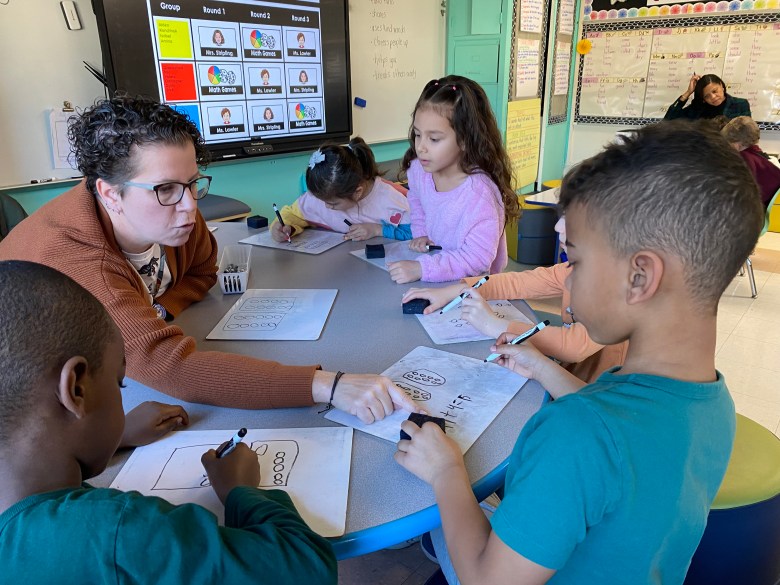
Janine Lawler teaches math to a group of first graders in Teaneck, New Jersey. Her classroom includes students with and without disabilities. Credit: Meredith Kolodner/The Hechinger Report
Educators say they can provide intensive instruction without having to separate children for large portions of the day.
“Do we have to isolate young people to give them a service, or can we include them and provide the same service or greater service?” said André Spencer, superintendent of Teaneck Public Schools. “We believe we can include them.”
For decades, New Jersey education officials have failed to support or pressure districts to improve their inclusion rates. A 2004 report found a lack of consequences — such as financial penalties — for New Jersey districts who repeatedly failed to increase inclusion of students with disabilities despite years of promises to improve.
“There’s a culture in New Jersey, which is that you teach kids with impairments in segregated classes,” said Carol Fleres, a long-time special education administrator in New Jersey who is now a special education professor and department co-chair at New Jersey City University.
A 2018 report by the National Council on Disability, an independent federal agency, found “serious contradictions” in New Jersey’s regulations that lay out how schools have to provide special education services. For example: The state categorizes students as having mild, moderate or severe disabilities and says that students with similar behavioral or academic needs should be grouped together.
Those issues make it easy for New Jersey schools to lump students with disabilities together in violation of federal requirements, according to the report.
A spokesman for New Jersey’s education department defended the regulations as doing the opposite. “This arrangement helps ensure that students who require more individualized instruction, especially those whose needs cannot be met in a general education setting, even with supplementary aids and services, are educated in smaller, more supportive environments,” Michael Yaple said in an email.
Despite settlements and scrutiny, advocates want more accountability: New Jersey’s State Special Education Advisory Council, which advises the state Education Department on special education issues, recommended required training for districts with low inclusion rates.
Special education parent and advocate Amanda Villamar, who works with families throughout New Jersey, said education officials try to educate the state’s over 600 school districts — but those efforts only go so far.
“We have a lot of districts that just say: ‘Well, it’s guidance. We don’t have to do it,’” Villamar said. “They literally just don’t even give it the time of day. Then you have other districts that put a lot of work and thought and effort into it.”
Lawyers representing families said young children with behavioral challenges or intellectual disabilities often wind up in separate classrooms for years, even if behaviors improve. Promises of inclusion in gym class or at lunch don’t always happen, they said.
Many parents said they felt forced to agree to separate classrooms, with the promise of inclusion, eventually. That day never came.
“Once you start restricting them, how are you going to get them back and get them increasingly more time within the classroom?” said Elizabeth Alves, a member of the State Special Education Advisory Council.
For Terri Joyce’s son, learning in the co-taught classroom meant accessing the general education curriculum, including social studies. The lessons on civil rights inspired him.
“He became obsessed with Martin Luther King,” she said. “He still will sit for hours and watch YouTube videos of his speeches.”
Like other students with disabilities, her son’s IEP is subject to an annual review, which means that inclusion in the general education classroom isn’t guaranteed in the years to come. Joyce says that means constant vigilance in a process that feels like a part-time job.
But her efforts to have her son included are about more than academics. He’s on the flag football team. He rides the school bus. Other kids recognize him and say hello in the grocery store.
“It’s much bigger than just his education and being included in the classroom,” she said. “Being included in school means he’s more included in life, and he’s more included in our community, and he’s more valued.”
The Hechinger Report provides in-depth, fact-based, unbiased reporting on education that is free to all readers. But that doesn’t mean it’s free to produce. Our work keeps educators and the public informed about pressing issues at schools and on campuses throughout the country. We tell the whole story, even when the details are inconvenient. Help us keep doing that.
When hackers hit a school district, they can expose Social Security numbers, home addresses, and even disability and disciplinary records. Now, cybersecurity advocates warn that the Trump administration’s budget and personnel cuts, along with rule changes, are stripping away key defenses that schools need.
“Cyberattacks on schools are escalating and just when we need federal support the most, it’s being pulled away,” said Keith Krueger, chief executive officer of the Consortium for School Networking, an association of technology officials in K-12 schools.
Related: Our free weekly newsletter alerts you to what research says about schools and classrooms.
The stakes are high. Schools are a top target in ransomware attacks, and cyber criminals have sometimes succeeded in shutting down whole school districts. The largest such incident occurred in December, when hackers stole personal student and teacher data from PowerSchool, a company that runs student information systems and stores report cards. The theft included data from more than 60 million students and almost 10 million teachers. PowerSchool paid an undisclosed ransom, but the criminals didn’t stop. Now, in a second round of extortion, the same cyber criminals are demanding ransoms from school districts.
Of chief concern is a cybersecurity service known as MS-ISAC, which stands for Multi-State Information Sharing and Analysis Center. It warns more than 5,700 schools around the country that have signed up for the service about malware and other threats and recommends security patches. This technical service is free to schools, but is funded by an annual congressional appropriation of $27 million through the Cybersecurity and Infrastructure Security Agency (CISA), an agency within the Department of Homeland Security.
On March 6, the Trump administration announced a $10 million funding cut as part of broader budget and staffing cuts throughout CISA. That was ultimately negotiated down to $8.3 million, but the service still lost more than half of its remaining $15.7 budget for the year. The non-profit organization that runs it, the Center for Internet Services, is digging into its reserves to keep it operating. But those funds are expected to run out in the coming weeks, and it is unclear how the service will continue operating without charging user fees to schools.
“Many districts don’t have the budget or resources to do this themselves, so not having access to the no cost services we offer is a big issue,” said Kelly Lynch Wyland, a spokeswoman for the Center for Internet Services.
Sharing threat information
Another concern is the effective disbanding of the Government Coordinating Council, which helps schools address ransomware attacks and other threats through policy advice, including how to respond to ransom requests, whom to inform when an attack happens and good practices for preventing attacks. This coordinating council was formed only a year ago by the Department of Education and CISA. It brings together 13 nonprofit school organizations representing superintendents, state education leaders, technology officers and others. The council met frequently after the PowerSchool data breach to share information.
Now, amid the second round of extortions, school leaders have not been able to meet because of a change in rules governing open meetings. The group was originally exempt from meeting publicly because it was discussing critical infrastructure threats. But the Department of Homeland Security, under the Trump administration, reinstated open meeting rules for certain advisory committees, including this one. That makes it difficult to speak frankly about efforts to thwart criminal activity.
Non-governmental organizations are working to resurrect the council, but it would be in a diminished form without government participation.
“The FBI really comes in when there’s been an incident to find out who did it, and they have advice on whether you should pay or not pay your ransom,” said Krueger of the school network consortium.
A federal role
A third concern is the elimination in March of the education Department’s Office of Educational Technology. This seven-person office dealt with education technology policies — including cybersecurity. It issued cybersecurity guidance to schools and held webinars and meetings to explain how schools could improve and shore up their defenses. It also ran a biweekly meeting to talk about K-12 cybersecurity across the Education Department, including offices that serve students with disabilities and English learners.
Eliminating this office has hampered efforts to decide which security controls, such as encryption or multi-factor authentication, should be in educational software and student information systems.
Many educators worry that without this federal coordination, student privacy is at risk. “My biggest concern is all the data that’s up in the cloud,” said Steve Smith, the founder of the Student Data Privacy Consortium and the former chief information officer for Cambridge Public Schools in Massachusetts. “Probably 80 to 90 percent of student data isn’t on school-district controlled services. It’s being shared with ed tech providers and hosted on their information systems.”
Security controls
“How do we ensure that those third-party providers are providing adequate security against breaches and cyber attacks?” said Smith. “The office of ed tech was trying to bring people together to move toward an agreed upon national standard. They weren’t going to mandate a data standard, but there were efforts to bring people together and start having conversations about the expected minimum controls.”
That federal effort ended, Smith said, with the new administration. But his consortium is still working on it.
In an era when policymakers are seeking to decrease the federal government’s involvement in education, arguing for a centralized, federal role may not be popular. But there’s long been a federal role for student data privacy, including making sure that school employees don’t mishandle and accidentally expose students’ personal information. The Family Educational Rights and Privacy Act, commonly known as FERPA, protects student data. The Education Department continues to provide technical assistance to schools to comply with this law. Advocates for school cybersecurity say that the same assistance is needed to help schools prevent and defend against cyber crimes.
“We don’t expect every town to stand up their own army to protect themselves against China or Russia,” said Michael Klein, senior director for preparedness and response at the Institute for Security and Technology, a nonpartisan think tank. Klein was a senior advisor for cybersecurity in the Education Department during the previous administration. “In the same way, I don’t think we should expect every school district to stand up their own cyber-defense army to protect themselves against ransomware attacks from major criminal groups.”
And it’s not financially practical. According to the school network consortium only a third of school districts have a full-time employee or the equivalent dedicated to cybersecurity.
Budget storms ahead
Some federal programs to help schools with cybersecurity are still running. The Federal Communications Commission launched a $200 million pilot program to support cybersecurity efforts by schools and libraries. FEMA funds cybersecurity for state and local governments, which includes public schools. Through these funds, schools can obtain phishing training and malware detection. But with budget battles ahead, many educators fear these programs could also be cut.
Perhaps the biggest risk is the end to the entire E-Rate program that helps schools pay for the internet access. The Supreme Court is slated to decide this term on whether the funding structure is an unconstitutional tax.
“If that money goes away, they’re going to have to pull money from somewhere,” said Smith of the Student Data Privacy Consortium. “They’re going to try to preserve teaching and learning, as they should. Cybersecurity budgets are things that are probably more likely to get cut.
“It’s taken a long time to get to the point where we see privacy and cybersecurity as critical pieces,” Smith said. “I would hate for us to go back a few years and not be giving them the attention they should.”
The Hechinger Report provides in-depth, fact-based, unbiased reporting on education that is free to all readers. But that doesn’t mean it’s free to produce. Our work keeps educators and the public informed about pressing issues at schools and on campuses throughout the country. We tell the whole story, even when the details are inconvenient. Help us keep doing that.
Why do so many students struggle to understand what they read, even after they learn how to read?
That’s a topic of hot debate among reading researchers. One camp has been arguing that schools have been going about it all wrong. These critics say that instead of drilling students on the main idea (similar to questions students will see on annual state exams), teachers should spend more time building students’ background knowledge of the world.
The theory is that the more familiar students are with science, history, geography and even art, the easier it will be for students to grasp new ideas when reading. Many educators are embracing this theory, and knowledge building lessons have been spreading rapidly across the country, from Baltimore to Mississippi to Colorado.
Related: Our free weekly newsletter alerts you to what research says about schools and classrooms.
But the evidence for this approach is still emerging, and some reading researchers urge caution. They worry that sometimes, too much time is being spent on background knowledge rather than actually reading and discussing texts. These skeptics argue students aren’t going to magically understand what they are reading just from knowing more about the world, and they need to be explicitly taught how to identify the main idea and how to summarize.
Debates like this are common in education as new research addresses unresolved issues, such as exactly how to teach reading once students have learned phonics and how to decode the words on the page.
“Early research showed that background knowledge plays a part,” said Kausalai Wijekumar, a professor of education at Texas A&M University, who has been studying reading instruction and recently produced a study that sheds more light on the debate. “People with good background knowledge seem to be able to read faster and understand quicker.”
For some children, particularly children from affluent families, she said, background knowledge is “enough” to unlock reading comprehension, but not for all. “If we want all the children to read, we have proven that they can be taught with the right strategies,” said Wijekumar. She has a body of research to back her position.
Wijekumar agrees that drilling students on the main point or the author’s purpose isn’t helpful because a struggling reader cannot come up with a point or a purpose from thin air. (She’s also not a fan of highlighting key words or graphic organizers, both common strategies for reading comprehension in schools.) Instead, Wijekumar advocates for a step-by-step process, conceived in the 1970s by her mentor and research partner, Bonnie J.F. Meyer, a professor emeritus at Penn State.
The first step is to guide students through a series of questions as they read, such as “Is there a problem?” “What caused it?” and “Is there a solution?” Based on their answers, students can then decide which structure the passage follows: cause and effect, problem and solution, comparisons or a sequence. Next, students fill in blanks — like in a Mad Libs worksheet — to help create a main idea statement. And finally, they practice expanding on that idea with relevant details to form a summary.
Wijekumar analyzed the story of Cinderella for me, using her approach. The problem? Cinderella is bullied by her stepmother and stepsisters. We learn this because she’s forced to do extra chores and isn’t allowed to attend the ball. The cause of the problem? They’re jealous of her. That’s why they take away her pretty clothes. Finally, the solution: A fairy godmother helps Cinderella go to the ball and meet Prince Charming. Students can then put all these elements together to come up with the main idea: Cinderella is bullied by her stepmother and stepsisters because they are jealous of her, but a fairy godmother saves her.
It’s a formulaic approach and there are certainly other ways of seeing or expressing the main idea. I wouldn’t have analyzed Cinderella that way. I would have guessed it’s a story about never giving up on your dreams even if your life is wretched now. But Wijekumar says it’s a helpful start for students who struggle the most.
“It’s very structured and systematic, and that provides a strong foundation,” Wijekumar said. “This is just the starting point. You can take it and layer on more things, but 99 percent of the children are having difficulty just starting.”
Wijekumar transformed Meyer’s strategy into a computerized tutor called ITSS, which stands for Intelligent Tutoring using the Structure Strategy. About 200,000 students around the world use ITSS. Wijekumar’s nonprofit, Literacy.IO, charges schools $40 a student plus teacher training, which can run $800 per teacher, depending on school size.
The tutor allows students to practice reading comprehension at their own pace. ITSS was one of only three online learning technologies that demonstrated clear evidence for improving student achievement, according to a February 2021 report by the Institute of Education Sciences, the research and development arm of the U.S. Department of Education.
Since then, Wijekumar has continued to refine her reading program and test it with more students. Her most recent study, a large-scale replication in high poverty schools, was highly successful according to one yardstick, but not so successful, according to another measure. It was published last year in the Journal of Educational Psychology.
A team of six researchers led by Wijekumar randomly assigned 17 of 33 schools in the Northeast and along the Texas border to teach reading with ITSS, while the remaining 16 schools taught reading as usual. More than 1,200 fifth graders practiced their reading comprehension using ITSS for 45 minutes a week over six months. Their teachers received 16 hours of training in how to teach reading comprehension this way and also delivered traditional analog reading lessons to their students.
After six months, students who received this reading instruction posted significantly higher scores on a researcher-designed assessment, which measured students’ ability to write main ideas, recall key information and understand text structures. However, there was no statistically significant difference between the two groups on a standardized test, the Gray Silent Reading Test (GSRT), which measured students’ general reading comprehension. The researchers did not report state test scores.
Earlier studies with wealthier students showed improvements on the standardized reading comprehension test. It’s hard to make sense of why this study showed giant benefits using one measure, but none using another.
Substantial changes in the instruction were needed for these high-poverty students. Some were such weak readers that Wijekumar’s team had to draft easier texts so that students could practice the method. But the biggest change was 14 hours of additional teacher training and the creation of instructional guides for the teachers. Wijekumar’s strategies directly contradicted what their schools’ textbooks told them to do. At first, the students were confused with the teachers teaching them one way and ITSS another. So Wijekumar worked with the teachers to scrap their textbook instructions and teach her way.
I consulted with Marissa Filderman,a respected reading expert who has reviewed the literature on comprehension instruction for children who struggle with reading and is an assistant professor at the University of Alabama. She said despite the imperfect evidence from this study, she sees Wijekumar’s body of research as evidence that explicit strategy instruction is important along with building background knowledge and vocabulary. But it’s still an evolving science, and the research isn’t yet clear enough to guide teachers on how much time to spend on each aspect.
Improving reading comprehension is critical, and I’ll be watching for new research to help answer these questions for teachers.
The Hechinger Report provides in-depth, fact-based, unbiased reporting on education that is free to all readers. But that doesn’t mean it’s free to produce. Our work keeps educators and the public informed about pressing issues at schools and on campuses throughout the country. We tell the whole story, even when the details are inconvenient. Help us keep doing that.
The internet has dramatically transformed and so has university website marketing. From basic online brochures relying on a “build it and they will come” approach, websites evolved into dynamic, interactive platforms driven by search engine optimization (SEO) and mobile optimization. Now, website marketing blends AI-driven insights with omnichannel experiences, as prospective students expect seamless, personalized interactions that clearly articulate an institution’s value.
With Google’s widespread release of AI-powered search to all users, your brand and reputation are more critical than ever. The internet’s collective opinion of your institution, interpreted by AI, now directly influences search results. Strong, positive brand reputations inherently signal authority and trustworthiness to AI, increasing visibility and recommendations.
This moment opens new doors for higher ed digital marketing. A website that simply exists today is a missed opportunity. If it doesn’t connect with the Modern Learner or clearly articulate your institution’s unique value, you’re not just losing their interest; you’re losing enrollments and damaging your reputation. For today’s Modern Learner, who expects seamless digital experiences and values authenticity and flexibility, your website is their first impression of your brand and reputation.
To transform your website into a reputation-building, revenue-generating asset, you need a holistic website marketing strategy that positions your EDU website as a strategic asset that continuously adapts to learner needs, builds authentic connections and signals authority to AI. Explore 10 essential website strategies to that will ensure your institution is found and chosen by the Modern Learner.
1. Optimize Content to Feed AI Robots
The Modern Learner’s journey now begins with AI. To stand out, your website needs to engage prospective students and be optimized for how AI tools find and present information. At EducationDynamics, we’ve anticipated the rise of AI in search and adapted our website marketing strategies to help institutions stay ahead and continue to outrank the competition.
To optimize content for both audiences, structure it clearly with descriptive headings, concise copy and consistent formatting so AI can accurately surface your programs. Highlight outcomes like career paths, program value and student success to connect your offerings to what students truly want.
Use natural, straightforward language that’s easy for humans and AI to interpret. Prioritize content types that AI favors, such as FAQs, career guides and student stories, to build trust and boost discoverability.
Your website is a pivotal opportunity to tell a compelling story that highlights your institution’s core values and unique strengths. That way, when students ask the search engines questions about the right institution for them, your website is positioned to be a top answer.
2. Ensure Your Website Provides a Seamless User Experience (UX) and Prioritizes Accessibility
Modern Learners expect fast, intuitive and accessible digital experiences. From the moment a prospective student lands on your site, navigation should feel natural. Clear headers, streamlined menus and a consistent experience across all devices ensure visitors can easily find the information they need without frustration.
First impressions matter, and your website’s speed and mobile responsiveness are non-negotiables. Slow load times or clunky mobile layouts can lose students before they even reach your message. A user-centric website builds trust and reflects your institution’s commitment to meeting students where they are.
Accessibility isn’t an add on—it must be built into your website’s infrastructure. Inclusive design ensures every user, regardless of ability, can engage with your content.
At EducationDynamics, we consistently stay ahead by adopting UX and CRO technologies early, allowing our team to rapidly launch A/B tests and uncover what truly resonates with students. Through continuous optimization and real-time insights, we help institutions create user experiences that reflect their brand, support enrollment goals and keep prospective students moving forward.
3. Optimize for Modern Search (SEO & GEO)
The Modern Learner demands more. As search evolves with AI, your institution’s digital visibility isn’t just important—it’s paramount. Traditional SEO, while foundational, falls short in today’s evolving search ecosystem where the rules of digital visibility are being rewritten.
With the widespread release of AI-powered search, prospective students are discovering their educational options without clicking on an actual link. As a result, institutions must embrace Generative Engine Optimization (GEO). GEO isn’t just about keywords; it’s about optimizing for how AI interprets, ranks and amplifies your institution’s content. A GEO-first strategy demands prioritizing well-structured content, rich media and authentic first-person perspectives from your students and faculty to command visibility in this new, AI-driven search reality.
EducationDynamics doesn’t just adapt to these shifts; we innovate by anticipating emerging trends, leveraging cutting-edge technology and leveraging data-driven insights. Our research-driven approach to SEO for higher education and GEO is continuously evolving, placing your institution at the forefront of how Modern Learners discover and engage. We ensure your visibility, credibility and competitive edge are undeniable, whether through traditional search or the power of AI.
4. Amplify Your Brand Voice Across All Digital Touchpoints
In a crowded digital landscape, fragmented messaging is a liability. For the Modern Learner, a unified brand voice across every digital touchpoint isn’t just a best practice; it’s the foundation of trust and the catalyst for lasting connection. When prospective students move between your website, social media, emails and ads, they should encounter consistent messaging that reaffirms your brand identity. Anything else risks confusion. Consistency, on the older hand, builds clarity and drives connection.
That alignment must be grounded in a strong brand narrative that communicates your institution’s values, mission and what sets you apart. In a market where students are inundated by options, your ability to clearly communicate your institution’s unique offerings is critical and helps students quickly understand why your institution is the right choice.
Real stories from students and alumni bring that narrative to life. These experiences do more than inspire; they create emotional ties that help prospective students see themselves in your community.
A clear, consistent brand voice, supported by a strong website content strategy, is more than a marketing asset. It is a strategic imperative, turning interest into action that builds lasting loyalty from enrollment to graduation and beyond.
5. Personalize the Digital Experience for Each Prospective Student
Personalization is no longer optional. It is essential for driving engagement, building trust and supporting students through the enrollment process.
By leveraging personalized content marketing, institutions can create a one-to-one experience that feels relevant and responsive. Customized email campaigns, dynamic landing pages and virtual campus tours foster connections with students. These experiences demonstrate your institution’s understanding of Modern Learners and help each individual develop a meaningful connection.
Personalization works best when guided by data. By monitoring behavioral cues such as pages viewed, time spent and programs researched, institutions can tailor content and messaging to align with each student’s needs. This enhances the user experience and makes students feel understood.
This is more than optimization. It’s relationship-building. Strategic personalization transforms passive interest into meaningful engagement and builds confidence in your institution’s ability to support each student’s journey.
Modern Learners don’t respond to static messages. They engage in dynamic conversations. Through data-driven personalization, institutions can build digital experiences that feel tailored and conversational, moving students from curiosity to commitment faster and with greater trust.
6. Build Your Advocate Community
he most powerful testimonials come from those who live your brand. By cultivating a vibrant advocate community, your institution doesn’t just enhance its reputation; it ignites a powerful, authentic narrative that deeply connects with prospective students, solidifying their confidence and accelerating their enrollment decision.
Student testimonials and reviews are among the most effective tools for building trust and credibility on your website. Authentic stories bring your brand to life, helping prospective students envision themselves thriving at your institution. Featuring a diverse range of testimonials across various website pages ensures these voices resonate with a wide audience and reflect the true student experience.
Provide opportunities for students and alumni to share their stories, then amplify their voices across your website and broader digital presence. This cohesive approach weaves authentic advocacy into all touchpoints, enhancing emotional connection and making your institution more relatable.
By rooting your brand in real experiences, you strengthen reputation and build lasting relationships. Authentic connection sets your institution apart and drives enrollment in a competitive market.
7. Facilitate Communication and Engagement
In today’s fast-moving digital world, access matters. Offering multiple communication channels on your website such as forms, live chat, text messaging, email and phone ensures prospective students can easily reach out in the way that suits them best. Making information and enrollment support readily accessible improves the overall student experience and fosters a sense of control during the decision-making process.
Incorporating AI-powered chatbots can further enhance engagement by providing instant answers and personalized guidance 24/7. These tools handle routine questions efficiently, allowing your team to focus on high-impact interactions that require a human touch.
When institutions prioritize fast, flexible communication across digital, they do more than offer convenience. They build trust, open the door to deeper engagement and provide the seamless support that moves students closer to enrollment.
8. Use Data and Analytics for Continuous Improvement
Website optimization isn’t a one-time task; it is a continuous process driven by data. Institutions should regularly track key metrics such as page engagement, bounce rates, conversions and time spent on site to understand how visitors interact with their content. Tools like heatmaps and A/B testing provide valuable insights into user behavior and help identify what elements resonate and where improvements are needed.
By leveraging data-driven insights from user search patterns, click paths and drop-off points, institutions can make informed decisions to enhance user engagement and increase conversion rates. Testing different headlines, layouts and calls to action allows for experimentation that drives measurable results. In addition, effective website management requires a robust Content Management System and a clear governance policy to ensure ongoing maintenance and optimization.
As leading market research experts in higher education, EducationDynamics knows what it takes to transform data into action. Our team’s relentless focus on analytics and optimization isn’t just about attracting students; it’s about continuously refining a digital experience that fortifies your institution’s reputation. We empower you to harness insights, ensuring your website is a dynamic asset that converts curiosity into committed enrollment and lasting brand loyalty.
9. Showcase Real Outcomes with Career-Focused Tools and Resources
Today’s students are looking for more than a degree. They want a clear path to a successful future. Your website must deliver on this expectation by showcasing tangible outcomes that prove your institution’s value. Highlighting real-world results is one of the most powerful ways to build credibility and elevate your brand.
Integrate features that demonstrate the long-term impact of your programs. Job placement stats and alumni success stories reinforce your institution’s influence and give students confidence in their future. Spotlight employer partnerships and accessible career services to position your school as career-connected and student-focused. Interactive tools like salary calculators, career pathway infographics and program-matching quizzes deepen engagement and help students make informed decisions.
By clearly communicating return on investment through your website, you do more than just inform prospective students — you build trust, strengthen your institution’s reputation and guide students closer to enrollment. This isn’t merely sharing information, it’s about demonstrating that your institution delivers on its promises. When you connect outcomes to the student experience, you create the kind of meaningful, value-driven journey that today’s Modern Learners actively seek.
10. Develop a Robust Content Hub That Positions Your Institution as a Thought Leader
In today’s competitive higher education environment, institutions must take every opportunity to showcase their unique brand proposition. Your website is a mission-critical touchpoint with power to either build or break institutional reputation. When used strategically, it becomes more than a source of information. Rather, it can be a content hub that reflects your institution’s unique offerings, while building trust and elevating your brand.
By highlighting content such as faculty research, student initiatives, alumni achievements and blogs on timely topics, your institution can build relevance and authority. Your website content strategy should ensure your website becomes a living representation of your institution’s values and vision. This makes your website a living representation of the institution’s values and vision, creating an integral link to your audience and ultimately leading to stronger brand credibility, increased organic engagement and a lasting reputation as a thought leader in higher education.
The Moment is Now: Elevating Reputation in the AI Era
Your website is more than a digital touchpoint; it is the heartbeat of your brand and foundation of your institution’s future. In an AI-driven world, standing still means falling behind.
At EducationDynamics, we’re here to help you navigate these changes with confidence. Transforming lives through higher education is at the core of our mission, and that means anticipating trends, understanding shifts and equipping our partners to thrive.
This is not merely an opportunity to adapt; it is an imperative to lead. Now is the decisive moment to fundamentally reimagine your website’s strategic role in driving unparalleled visibility, sustainable growth, and a strong reputation. Join John Weaver and Karina Kogan for “The New Rules of Website Marketing,” a live virtual masterclass that will show you how to turn your website into a high-impact tool for success in an AI-driven world. Secure your institution’s future advantage by reserving your spot today.
The College Board this month changed the criteria for its National Recognition Program awards in a move that could shift tens of thousands of scholarship dollars from Black and Latino students to white students.
Colleges used the awards to recruit and offer scholarships to high-performing students from groups underrepresented in higher education. The award previously recognized academic achievement by students in five categories — Black, Hispanic, Native American, first-generation and those living in rural areas or small towns.
The racial categories have been eliminated.
Now, students living in small towns and rural areas can still earn the award if they score in the top 10 percent among all small-town and rural students in their state on the PSAT — a precursor to the SAT that is administered in high schools around the country. The same is true for first-generation students but not for students in underrepresented racial categories.
Related: Interested in more news about colleges and universities? Subscribe to our free biweeklyhigher education newsletter.
Critics said they were disappointed by the College Board’s decision.
“They believed racial inequality was something important to address yesterday, and by changing that, they’re implying that it’s not something important to fight for now,” said Rachel Perera, a fellow in government studies at the liberal Brookings Institution. “That’s the heart of the question that’s being debated — although it’s not being debated in explicit terms — does racial discrimination exist?”
In a statement on its website, the College Board noted the 2023 Supreme Court ruling that prohibited the use of race in admissions, although the National Recognition Program awards were used for scholarships and recruitment, not admissions.
“Recent legal and regulatory actions have further limited the utility of these awards for students and colleges,” the statement says. Also, President Donald Trump has repeatedly made clear his disapproval of race-conscious policies in higher education, and some states have banned consideration of race in scholarship decisions.
In 2023-24, the College Board issued 115,000 recognition awards, and a little less than half were in the racial categories. The previous year there were more than 80,000 awards and the majority were for Black, Hispanic and Native American students. While the College Board doesn’t hand out money itself, universities use it to select students for scholarships. The Board has not maintained a list of which institutions used the racial categories, according to Holly Stepp, College Board’s director of communications.
The College Board started the program in 1983 to recognize high-performing Hispanic students. In 2020, the other two racial categories and the small town and rural designations were added. First-generation students could win the award starting last year. Small towns could include those with modest incomes or wealthy enclaves like Aspen, Colorado. All students must also have at least a B+ average.
While students of all races can now earn the awards, the removal of the racial categories will likely disproportionately affect Black and Hispanic students.
On average, Asian and white students score higher on PSATs. White students’ average score on the PSAT last year was 994 last year compared with 821 for Black students — a gap of 173 points. Asian students’ average was even higher at 1108 while Hispanic and Native American students averaged 852 and 828 respectively.
“It’s a move towards race-blind categories when we know that education and access to education isn’t race-blind,” said Wil Del Pilar, senior vice president at the left-leaning policy and advocacy group EdTrust.
Some conservatives praised the move, however, arguing that race-conscious scholarship and recruitment programs were ways to get around the Supreme Court’s rulings on affirmative action and that they were a form of reverse discrimination.
Jonathan Butcher, senior research fellow in education policy at the conservative Heritage Foundation, said he believes that racial discrimination does exist and should be addressed, but that race-conscious education policies were both illegal and ineffective.
“If you are using racial preferences, you are setting students up for a loss of confidence when they struggle in a situation they’re not prepared for,” Butcher said.
In place of the racial categories, a new designation has been added this year that recognizes students who score in the top 10 percent of their high school on the PSAT.
Experts say colleges are unlikely to offer scholarships to all students who score in the top 10 percent of every high school in the country, given the cost that would entail. Officials at the University of New Mexico, for example, said they would stop using the College Board designations beginning in the 2026-27 school year.
“We’re currently analyzing our scholarship strategy, but changes will be made across the board,” said Steve Carr, the university’s director of communications, in an email.
In 2023-24, the University of New Mexico awarded scholarships based on the College Board designations worth $15,000 each to 149 Black, Hispanic and Native American students.
The University of Arizona also offered scholarships to students who earned National Recognition Program awards in the racial designations last year.
“The university was already evaluating its scholarship strategy and will consider the College Board’s announcement as we determine how best to move forward and support our students,” said Mitch Zak, spokesman for the University of Arizona, in an email.
In addition to the PSAT scores, students are eligible for the College Board award if they score a 3 or higher out of 5 on two Advanced Placement exams taken during their ninth and/or 10th grade year, although many high schools don’t uniformly offer AP courses to freshmen and sophomores.
“We can’t really have a conversation around merit if we’re not all at the same starting point in terms of what we receive from our K-12 education,” said Del Pilar, “and how we’re able to navigate the test prep environment, or the lack of test prep that certain communities receive.”
Contact senior investigative reporter Meredith Kolodner at 212-870-1063 or [email protected] or on Signal at merkolodner.04
The Hechinger Report provides in-depth, fact-based, unbiased reporting on education that is free to all readers. But that doesn’t mean it’s free to produce. Our work keeps educators and the public informed about pressing issues at schools and on campuses throughout the country. We tell the whole story, even when the details are inconvenient. Help us keep doing that.
“Denver Public Schools to close 7 schools, cut grades at 3 others despite heavy resistance.”
“The list is out: These are the SFUSD schools facing closure.”
Such reports can leave the impression that districts are rapidly closing schools in response to declining enrollment and families leaving for charters, private schools and homeschooling.
But the data tells a different story.
School closures have actually declined over the past decade, a period of financial instability that only increased in the aftermath of the pandemic, according to research from the Brookings Institution.
The analysis, shared exclusively with The 74, shows that in 2014-15, the closure rate — the share of schools nationwide that were open one year and closed the next — was 1.3%. In 2023-24, the rate was just .8%, up from .7% the year before.
“I think it’s important for people to realize how rare school closures are,” said Sofoklis Goulas, a Brookings fellow and the study’s author.
Last fall, his research showed how schools that have lost at least 20% of their enrollment since the pandemic are more likely to be low-performing. The Clark County Public Schools, which includes Las Vegas, had the most schools on the list — 19 — but isn’t currently considering closures. In Philadelphia, with 12 schools in that category, district leaders are just beginning to discuss closures.
When it released Goulas’s initial report, leaders of the conservative Thomas B. Fordham Institute argued that low-performing schools should be the first to close. But efforts to do so are often met with pushback from families, teachers and advocacy groups who argue that shutting down schools unfairly harms poor and minority students and contributes to neighborhood blight. Their pleas often push district leaders to retreat. Working in advocates’ favor, experts say, is the fact that many big district leaders are untested and have never had to navigate the emotionally charged waters of closing schools.
“Closing a neighborhood school is probably one of the most difficult decisions a district’s board makes,” said Michael Fine, CEO of the Fiscal Crisis and Management Assistance Team, a California state agency that provides financial oversight to districts. “They are going to avoid that decision as long as they can and at all costs.”
Such examples aren’t hard to find:
Just weeks after announcing closures, the San Francisco district halted plans to shutter any schools this fall.
In September, outgoing Chicago Public Schools CEO Pedro Martinez pledged to put off school closures for another two years, even though state law allows the city to take action sooner. The district is in the process of absorbing five charter schools to keep them from closing.
In October, Pittsburgh Public Schools recommended closing 14 schools; several others were set to be relocated and reconfigured. About a month later, Superintendent Wayne Walters hit pause, saying the district needed more “thoughtful planning” and community input.
Last May, the Seattle Public Schools announced it would shutter 20 elementary schools next school year in response to a $100 million-plus budget deficit. They later increased the number to 21. By October, the list had dwindled to four schools. Just before Thanksgiving, Superintendent Brent Jones withdrew the plan entirely.
“This decision allows us to clarify the process, deepen our understanding of the potential impacts, and thoughtfully determine our next steps,” Jones wrote to families. While the plan would have saved the district $5.5 million, he said, “These savings should not come at the cost of dividing our community.”
Graham Hill Elementary in Seattle, which fifth grader Wren Alexander has attended since kindergarten, was initially on the list. The Title I school sits on top of a hill in a desirable area overlooking Lake Washington. But it also draws students from the lower-income, highly diverse Brighton Park neighborhood.
Among Wren’s neighbors are students from Ethiopia, Vietnam and Guatemala. Wren, who moves on to middle school this fall, said she looks forward to visiting her former teachers and cried when she heard Graham Hill might close. She wanted her younger brother and sister to develop the same warm connection she had.
“I don’t think I would be who I am if I didn’t go to the school,” she said.
Wren Alexander and her little sister Nico, outside Graham Hill. (Courtesy of Tricia Alexander)
Tricia Alexander, her mother, was among those who opposed the closures, participating in rallies outside the district’s administration building and before board meetings.
“We were really loud,” said Alexander, who’s also part of Billion Dollar Bake Sale, an effort to advocate for more state education funding. She said there was “no real evidence” that closing schools would have solved the district’s budget woes. “In no way would kids win.”
It’s a view shared by many school finance experts, who note that the bulk of school funding is tied up in salaries, not facility costs. Districts may save some money from closing schools, but unless coupled with staff reductions, it’s often not enough to make up for large budget shortfalls.
‘So bad at this’
If enrollment doesn’t pick up, experts say, leaders who delay closures will have to confront the same issues a year later or — perhaps even more likely — pass the problems on to their successors.
“If there continues to be fewer and fewer children …then that doesn’t get better,” said Brian Eschbacher, an enrollment consultant.
One Chicago high school, for example, had just 33 students last year. In Los Angeles, the nation’s second-largest district, 34 elementary schools have fewer than 200 students and 29 of those are using less than half of the building, according to a recent report. The share of U.S. students being educated outside of traditional schools also continues to increase, according to a forthcoming analysis Goulas conducted with researchers at Yale University.
“We don’t see a trajectory of enrollment recovery,” he said. “Things actually got worse in the most recently released data batch.”
But such conditions haven’t stopped advocacy groups from campaigning against closures. One of them, the left-leaning Advancement Project, has joined with local groups in Denver and Pittsburgh to make a case against closures nationally.
“All children deserve to have a local, neighborhood public school in which they and their families have a say,” said Jessica Alcantara, senior attorney for the group’s Opportunity to Learn program. “It’s not just that school closures are hard on families. They harm the full education ecosystem that makes up a school — students, families, school staff and whole communities.”
Last May, Alcantara and other Advancement Project staff urged the U.S. Department of Education to treat school closures as a civil rights issue. Nine of the 10 schools the Denver district planned to close in 2022 had a majority Black or Hispanic student population.
The advocates argued that in cases of enrollment loss, run-down facilities and empty classrooms, there are alternatives to closing schools. They encourage communities to push for renovations and urge district leaders to use vacant spaces for STEM, arts or other programs that might attract families. Opponents of closures also say that districts sometimes underestimate how much of a building is used for non-classroom purposes like special education services, early-childhood programs and mental health.
Eschbacher’s assessment of why districts often back down from closing schools is more blunt.
“Districts are so bad at this,” he said. “If you just do a few things wrong, it could sink the whole effort.”
For one, leaders often target schools with under 300 students for closure, appealing to parents that they can’t afford to staff them with arts programs, a school nurse or a librarian.
But those explanations sometimes fall flat.
“Parents always say, ‘I wanted a small school. I know my teachers and they know my kid. And it’s right down the street,’” Eschbacher said. If they didn’t like their school, he added, they would have likely would have chosen a charter or some other option.
District officials also run into trouble if they try to spin the data. When Seattle officials talked about “right-sizing” the district, they pointed to the loss of 4,900 students since 2019-20.
But Albert Wong, a parent in the district and a lifelong Seattle resident, knew there was more to the story. Not only is the current enrollment higher than it was from 2000 to 2011, the pandemic-related decline seems to have leveled off. In a commentary, he argued that officials presented misleading data “to make current enrollment look exceptionally bad.”
Graham Hill Elementary, fifth-grader Wren’s school, actually saw a slight increase in enrollment this year, including a new class for preschoolers with disabilities. And while Pittsburgh schools are projected to lose another 5,000 students over the next six years, enrollment this year held steady at about 18,400.
To Eschbacher, the “burden of proof is always on the district” to make an airtight case for why students would be better off in larger schools. He has applauded the Denver-area Jeffco Public Schools, which has closed 21 schools since 2021, for having state demographers, not just district officials, explain population trends to families at community meetings.
‘It wasn’t realistic’
Walters, Pittsburgh’s superintendent, can easily rattle off reasons why the district should rethink how it uses its buildings. Early last year, local news reports showed that almost half of the district’s schools were less than 50% full.
“We’ve lost about a fourth of our population, but we have not changed anything to our footprint,” he said.
Meanwhile, the average age of the district’s buildings is 90 years old, and many lack air-conditioning, forcing some schools to send students home in sweltering weather.
But a consulting group’s proposal showed that Black and low-income students and those with disabilities would be disproportionately affected by the changes. Several advocacy groups drew attention to those disparities, calling the effort “rushed.”
412 Justice, an advocacy group, is among the community organizations pushing for alternatives to school closures in Pittsburgh. (412 Justice)
Walters agreed and put the plan on hold last fall, saying he lacked “robust” responses to parents’ tough questions about how schools would change for their kids.
“It doesn’t mean that we don’t see a path forward,” he said. “But it wasn’t realistic that we would have those questions answered within the timeline that we’ve been given.”
In March, parents pushed for another delay, causing the school board to postpone a vote on the next phase in the closure process.
As the Jeffco district demonstrates, some school systems are following through with closures. The school board in nearby Denver unanimously voted in November to close seven schools and downsize three more.
But that’s after community protests pushed the district to put the brakes on a plan to close 19 schools in 2021. Advocates argued that families in low-income areas, who had been heavily impacted by the pandemic, would be most affected. Then the district only closed three in 2023, and now board members are considering a pause on closures for three years.
School boards closing a dozen or more schools are often catching up with work their predecessors let pile up, said Goulas of Brookings.
“Closing a single school allows for easier placement of students and minimizes the political cost and community stress,” he said. “When a district releases a long list of schools to close, it likely indicates that they waited for conditions to improve, but this didn’t happen.”
Angel Gober, executive director of 412 Justice — one of 16 organizations that called on the Pittsburgh district to drop its plan — acknowledged that their fight isn’t over.
“I think we got a temporary blessing from God,” she said. But she wants the district to explore a host of alternatives, like community schools and corporate support, before it shutters and sells off buildings. “We do have very old infrastructure, and that is an equity issue. But can we try five things before we make a drastic decision to close schools for forever?”
A fourth round of cutbacks took place on May 9. NSF observers were still trying to piece together the size and scope of this wave of destruction. A division focused on equity in education was eliminated and all its employees were fired. And the process for reviewing and approving future research grants was thrown into chaos with the elimination of division directors who were stripped of their powers.
Meanwhile, there was more clarity surrounding a third round of cuts that took place a week earlier on May 2. That round terminated more than 330 grants, raising the total number of terminated grants to at least 1,379, according to Grant Watch, a new project launched to track the Trump administration’s termination of grants at scientific research agencies. All but two of the terminated grants in early May were in the education division, and mostly targeted efforts to promote equity by increasing the participation of women and Black and Hispanic students in STEM fields. The number of activegrants by the Division of Equity for Excellence in STEM within the education directorate was slashed almost in half, from 902 research grants to 461.
Related: Our free weekly newsletter alerts you to what research says about schools and classrooms.
Combined with two earlier rounds of NSF cuts at in April, education now accounts for more than half of the nearly 1,400 terminated grants and almost three-quarters of their $1 billion value. Those dollars will no longer flow to universities and research organizations.
Cuts to STEM education dominate NSF grant terminations
… and nearly three-quarters of their $1 billion value are in education
Data source: Grant Watch, May 7, 2025. Charts by Jill Barshay/The Hechinger Report
The cuts are being felt across the nation. Grant Watch also created a map of the United States, showing that both red and blue states are losing federal research dollars.
Source: Grant Watch, May 7, 2025
It remains unclear exactly how NSF is choosing which grants to cancel and exactly who is making the decisions. Weekly waves of cuts began after the Department of Government Efficiency or DOGE entered NSF headquarters in mid April. Only 40 percent of the terminated grants were also in a database of 3,400 research grants compiled last year by Sen. Ted Cruz, a Texas Republican. Cruz characterized them as “questionable projects that promoted Diversity, Equity, and Inclusion (DEI) or advanced neo-Marxist class warfare propaganda.” Sixty percent were not on the Cruz list.
Source: Grant Watch, May 7, 2025
Other NSF cuts also affect education. Earlier this year, NSF cut in half the number of new students that it would support through graduate school from 2,000 to 1,000. Universities are bracing to hear this summer if NSF will continue to support graduate students who are already a part of its graduate research fellowship program.
NSF watchers were still compiling a list of the research grants that were terminated on May 9, the date of the most recent fourth round of research cuts. It was unclear if any research grants to promote equity in STEM education remained active.
The Division of Equity for Excellence in STEM, a unit of the Education Directorate, was “sunset,” according to a May 9 email sent to NSF employees and obtained by the Hechinger Report, and all of its employees were fired. According to the email, this “reduction in force” is slated to be completed by July 12. However, later on May 9, a federal judge in San Francisco temporarily blocked the Trump administration from implementing its “reduction in force” firings of federal employees at the NSF and 19 other agencies.
An initial hearing for a group of three legal cases by education researchers against the Department of Education is scheduled for May 16. At the hearing, a federal judge in Washington, D.C., will hear arguments over whether the court should temporarily restore terminated research studies and data collections and bring back fired Education Department employees while it considers whether the Trump administration exceeded its executive authority.
A first hearing scheduled for May 9 was postponed. At the May 16 hearing, the court will hear two similar motions from two different cases: one filed by the Association for Education Finance and Policy (AEFP) and the Institute for Higher Education Policy (IHEP), and the other filed by National Academy of Education (NAEd) and the National Council on Measurement in Education (NCME). A third suit by the American Educational Research Association (AERA) and the Society for Research on Educational Effectiveness (SREE) was filed in federal court in Maryland and will not be part of the May 16 hearing.
The Hechinger Report provides in-depth, fact-based, unbiased reporting on education that is free to all readers. But that doesn’t mean it’s free to produce. Our work keeps educators and the public informed about pressing issues at schools and on campuses throughout the country. We tell the whole story, even when the details are inconvenient. Help us keep doing that.
U.S. universities have long relied on international students, and the big tuition checks they bring, to hit enrollment goals and keep the lights on. But now, just as the number of American college-aged students begins to fall — the trend that higher education experts call the “demographic cliff”— global tensions are making international students think twice about coming to the United States for college.
In this episode, hosts Kirk Carapezza and Jon Marcus take you inside the world of international admissions. With student visa revocations on the rise and a growing number of detentions tied to student activism, some international families say they are rethinking their U.S. college plans. And that has college leaders sounding the alarm.
In fact, international student interest was already falling. Now, as the Trump administration ramps up immigration crackdowns on campuses across the country, many worry the U.S. could lose its status as the top destination for global talent. So what happens if international enrollment drops just as domestic numbers dry up?
The stakes are high, not just for international students and colleges but for what everybody else pays — and for the whole U.S. economy.
[Kirk] That’s Xiaofeng Wan, making his pitch in Mandarin to Chinese students and parents at a high school in Shanghai. Wan used to be an admissions officer at Amherst College in western Massachusetts. Now he’s a private college consultant, guiding Chinese students through the maze that is college admissions in the U.S.
[Xiaofeng Wan] So I’ll walk them through the initial high school years before they apply. And then by the time of their college applications, I’ll help them go through the process as well.
[Kirk] This is big business for colleges. Like most international students, Chinese families do not qualify for financial aid, and often they pay the full cost. Wan also trains guidance counselors across China, showing them how to support students heading abroad. So he’s got a front-row seat to what Chinese families are thinking right now.
[Xiaofeng Wan] They see the United States as a primary study-abroad destination.
[Kirk] But Wan says that might be starting to shift.
[Xiaofeng Wan] America has an image problem right now, so we will definitely start to see reluctance from families.
[Kirk] I caught up with him while he was in Ningbo, a port city known for manufacturing, on the same morning President Trump’s tariffs on Chinese goods took effect.
[sound of news anchor] Across the globe this weekend, world leaders are trying to figure out how to respond to President Trump’s attempt to reshape the global economy by imposing steep tariffs. …
[Kirk] Just hours later, the Chinese government warned the more than 270,000 Chinese students already studying in the U.S. to think twice about staying. Wan says that kind of message stokes fear that’s been building. House Republicans sent letters to six universities saying America’s student visa system has become a Trojan horse for Beijing, and a lot of Chinese parents worry the U S government doesn’t want their kids.
[Xiaofeng Wan] That’s what they’ve been hearing from President Trump, his rhetoric toward Chinese students. And now they’re seeing news about how international student visas are being revoked.
[Kirk] This is College Uncovered, a podcast pulling back the ivy to reveal how colleges really I’m Kirk Carapezza with GBH News …
[Jon] … and I’m Jon Marcus with The Hechinger Report. Colleges don’t want you to know how they operate, so GBH …
[Kirk] … in collaboration with The Hechinger Report, is here to show you.
This season, we’re staring down the demographic cliff.
[Jon] If you’re just joining us, a quick refresher here: The demographic cliff is a steep drop in the number of 18-year-olds. That’s because many Americans stopped having children after the Great Recession of 2008. And now, 18 years later, colleges are feeling the pinch.
[Kirk] Yeah, and just when many of them thought the situation couldn’t get any worse, international students are under threat. During President Donald Trump’s first term, we saw visa restrictions and travel bans contribute to a 12 percent drop in new international enrollment. So we’ll ask, could that happen again, just as schools are scrambling to fill empty seats?
[Jon] And we’ll explain what all of this means for you, whether you’re an international student or a domestic one, and why you should care.
Today on the show: The Student Trade Wars.
[Kirk] Since Trump’s return to power, his administration has yanked more than 1,000 student visas, often without explanation. Some students have been detained and faced deportation, fulfilling a pledge he often made on the campaign trail.
[Donald Trump] If you come here from another country and try to bring jihadism or anti-Americanism or antisemitism to our campuses, we will immediately deport you. You’ll be out of that school.
[Kirk] In just a few months, that hardline rhetoric has become policy, putting campuses on edge. ICE agents have detained pro-Palestinian student activists, including Mahmoud Khalil at Columbia and Rumeysa Ozturk at Tufts.
[sound from arrest of Rumeysa Ozturk]
[Kirk] This video of her arrest has shaken the international campus community and sparked protests across the country.
[sound of protesters] Free Rumeysa, free her now! We want justice, you say how? Free Rumeysa, free her now!
[Kirk] And now many international students won’t even go on the record, too scared the federal government will target them, or that they’ll be doxxed and ostracized online.
[Frank Zhao] The biggest difficulty for us is building trust.
[Kirk] At Harvard, student journalist Frank Zhao has seen that fear firsthand. He hosts the weekly news podcast for the student newspaper.
[sound of podcast] From The Harvard Crimson, I’m Frank Zhao. This is ‘News Talk.’
[Kirk] Zhao isn’t an international student himself, but the Chinese-American junior from Dallas is plugged into the campus, where a quarter of students are international.
How would you describe the current climate for international students?
[Frank Zhao] The overwhelming sentiment is anxiety. There are so many international student group chats where students were saying, ‘Oh my gosh, there are ICE agents on campus.’ And so it’s quite the Armageddon scenario.
[Kirk] The Trump administration has demanded Harvard turn over detailed records of all foreign students’ — quote — illegal and violent activities, or lose the right to enroll any international students. Harvard says it has complied but won’t publicly disclose details.
The university is suing the administration over this and other demands, but some faculty and students question how hard Harvard is really pushing back. Conservatives, though, defend increased immigration enforcement.
[Simon Hankinson] If a student is studying and minding their own business and obeying the rules of the college and of the United States and the state that they live in, they have nothing to worry about. This is a very small number of people that is being looked at for fraud.
[Kirk] Simon Hankinson is a senior fellow at the Heritage Foundation. He says visa vetting on and off campus is essential for national security after a year of disruptive campus protests.
[Simon Hankinson] Maybe your parents are shelling out a lot of money for you to go, or you’re getting a scholarship. Get your education. Make that the priority. Sure, go out and hold a placard if you want to, and do your thing, light a candle, but if your primary focus is protest and vandalism, I think you’re on the wrong type of visa, and we don’t have a visa for that.
[Jon] Higher education is now a global marketplace, and international students have emerged as a key part of the university funding equation. They’re fully baked into the business model as full-pay customers for colleges who subsidize the cost for domestic students.
[Kirk] And even before the demographic cliff, the competition for international students was fierce.
[Gerardo Blanco] It always has been and sometimes it is intended to be that way, but this is just making it like the Hunger Games
[Kirk] That’s Gerardo Blanco, director of the Center for International Higher Education at Boston College. He warns tht Trump’s America First approach, combined with federal funding cuts, is putting U.S. colleges at risk of losing a generation of global talent.
Is that hyperbole?
[Gerardo Blanco] I don’t think it’s hyperbole in any way.
[Kirk] Why not?
[Gerardo Blanco] The system has been built on the assumption that there wouldn’t be decreases in a dramatic scale to the funding dedicated to research. And therefore they have made some decisions that are somewhat risky.
[Kirk] What’s your biggest concern when it comes to international students?
[Gerardo Blanco] It’s just the generalized sense of uncertainty. I think there are so many balls up in the air and I think it’s really difficult to even focus our attention.
[Kirk] Take the reduction of research funding, for example. It’s affecting many graduate students, especially those who are international and can’t find work in labs. Some schools like Iowa State University, Penn, and West Virginia University are rescinding graduate admissions offers.
[Gerardo Blanco] So that’s one squeeze. We also are looking at just the general rhetoric that tends to be negative.
[Kirk] And Blanco says that rhetoric matters. One survey at the start of Trump’s second term found that nearly 60 percent of European students were less interested in coming to the U.S. Blanco said, considering the demographic cliff, the timing for all of this uncertainty couldn’t be worse for colleges.
[Gerardo Blanco] The clock is ticking and nobody really knows what’s happening.
[Kirk] Okay, so, Jon, why should American students and citizens care about all of this?
[Jon] Well, international students bring different perspectives and experiences to the classroom. And as we said earlier, they also tend to pay full tuition. So they subsidize tuition that American students pay.
But a drop in international student numbers isn’t just a college cash-flow problem. It’s a broader economic one. International students infuse $44 billion into the U.S. economy each year.
Here’s Barnet Sherman, a business professor at Boston University. It’s New England’s largest private university, and one in five students there are international.
[Barnet Sherman] Look, I just teach business and finance. So if one of my top 10 customers comes to me with $44 billion to spend and creates a lot of American jobs, over 375,000 American jobs, I don’t know about you, but I’m opening up the door and giving them the best treatment I possibly can.
[Jon] Here in Massachusetts alone, there are about 80,000 international students contributing $4 billion to the state’s economy each year. That puts the state fourth in the U.S., after California, Texas and New York. So, yeah, this matters.
But Sherman says the impact goes far beyond big cities like Boston, New York, and L.A. Take the tiny town of Mankato, Minnesota, for example — population, 45,000.
[Barnet Sherman] And they’ve got about 1,700 international students there contributing to the local economy. They’re bringing in literally over $25 million to, you know, a perfectly nice burg.
[Jon] In addition to tuition dollars, these students contribute to businesses and local communities that are losing population.
[Kirk] And, Jon, if fewer international and domestic students are coming through the pipeline to fill jobs that require college educations, it puts the U.S. at a serious disadvantage, just as other countries are actively recruiting talent and increasing the number of their citizens with degrees. More and more countries are recruiting international students, including Canada, France, Japan, South Korea and Spain, but also countries that hadn’t recruited before, like Poland and Kazakhstan.
Right before Trump’s first term, I went to Germany, where the government was offering free language classes to attract international students and scholars, including Americans. Because just like the U.S., Germany is losing population. A demographic cliff has already hit Europe, so it needs immigrants and international students, too. Think of it like this: It’s a global talent draft. All of these students, they’re the trading cards. The collectors are the countries. And the more talent you attract, the more ideas, innovation and business growth you get.
[Dorothea Ruland] If you look at Germany, the only resource we do have are human resources, actually.
[Kirk] Dorothea Ruland is the former secretary general of the German Academic Exchange Service, which is in charge of Germany’s international push. When I visited Bonn, we had coffee at her headquarters.
[Dorothea Ruland] We depend on innovation, on inventions, of course, and where do they come from? From institutions of higher education or from research institutions.
[Kirk] Ruland told me nearly half of foreign students earning degrees in Germany stick around. And not just for the short-term. About half of them stay for at least a decade. In the U.S., most international graduates leave and take their talent back home, often because of scarce visas available for skilled workers.
Do you see Germany competing with American universities?
[Dorothea Ruland] Yes, I would say so. You know, we are doing marketing worldwide because we are part of this world and we cannot neglect these trends going on. So of course we are competitors.
[Kirk] But she also made it clear the student trade war isn’t just about competition. It’s about collaboration.
[Dorothea Ruland] If you look at the global challenges everybody’s talking about, questions of climate change, energy, water, high tech, whatever, this cannot be solved by one institution or one country. So you have to have big international networks.
[Kirk] Since my visit, though, isolationism has been creeping in, not only in Germany, but Hungary and Russia, and obviously here in the U.S., too. Some professors and students have pointed to recent issues with visas and detainments without due process and accused the Trump administration of taking an authoritarian approach.
[sound of protest]
[Kirk] Outside Harvard’s Memorial Church in Cambridge, more than 100 students and faculty recently held signs and waved American flags, cheering the university for standing up to the White House and calling on Harvard to do more to protect their civil rights. Among other things, they spoke out about visa revocations. It is incredibly scary here.
Leo Gerdén is a senior from Sweden. He says the administration is trying to divide the campus community.
[Leo Gerdén] At first I was very anxious about speaking up. They want us to point fingers to each other and say, you know, deport them, don’t deport us. And you know, it’s classic authoritarian playbook.
[Jon] Trump supporters? Well, they see it very differently.
[Simon Hankinson] I would call that ridiculous. I mean, that’s an insane argument to make.
[Jon] Simon Hankinson is a senior fellow at the Heritage Foundation’s Center for Border Security and Immigration. We heard from him at the top of this episode, and we should also add he’s a career foreign service officer.
[Simon Hankinson] So I’ve certainly interviewed tens of thousands of these applicants, including thousands of students.
[Jon] Hankinson acknowledges the uptick in visa revocations lately, but says it’s still a tiny number compared to the one million international students in the U.S.
[Simon Hankinson] But just looking at the scale of it all, it is more than we’ve seen in the past, because, generally speaking, this wasn’t something that the government devoted a lot of resources to. But it was always a power that they had.
[Jon] And he’s not buying the narrative that these changes and the crackdowns on visas will scare off students from coming to the U.S.
[Simon Hankinson] Are people not going to go to Harvard because, you know, they’re afraid that they’re going to get hassled. No. Try going to Russia or China and speaking your mind. Good luck with that.
[Jon] Hankinson also argues some universities — especially ones with a high percentage of international students, like Columbia, NYU, Northeastern, and Boston University — they have a financial incentive for complaining.
[Simon Hankinson] It’s a strong constituency that they want to keep happy and they want to keep the money flowing. So they want to make this as big an issue as possible. They want to cry panic.
[Jon] So, Kirk, colleges signal all the time that they’re open to international students. Just listen to some of these welcome videos.
[sound of international recruiting videos]
[Jon] But parents like Claire from Beijing don’t feel like their kids are welcome.
[Claire] I think the government is really hostile right now.
[Jon] Claire asked us to withhold her full name, worried it could affect her son, who’s already studying here. She also has a daughter in high school who was thinking about college in the U.S., but now they’re rethinking her plans and looking at schools in the UK, Canada, Singapore and Hong Kong.
[Claire] You know, we have to consider all the possibilities, obviously in a trade war, you know, like, because next year, when my child has to go to college, you know, Trump is still the president.
[Kirk] Claire says she still believes in the power of an American education, so it’s really hard for her to just write it off completely.
[Jon] Okay. So, Kirk, we’ve tackled a lot in this episode. Bottom line, do you think American colleges will still be able to recruit and enroll enough international students to help offset this looming shortage we’ve been talking about in the number of 18-year-olds?
[Kirk] Well, it’s not looking great for colleges. International enrollment, as we said, dropped 12 percent during Trump’s first term, and now we’re heading toward a 15 percent drop in the number of 18-year-olds by 2039. That’s a big gap to fill, and the reality is the current climate would have to shift dramatically and quickly for the U.S. to stay competitive.
International students are essential for filling seats and making budgets, especially in regions like New England and the Midwest, where the demographic cliff isn’t coming — it’s already here. A college consultant once told me, if your campus isn’t near an international airport, the clock is ticking on your institution. And that was before America developed this reputation as an unwelcoming place.
[Jon] So what do you think you’ll be watching as we continue to cover this issue?
[Kirk] Yeah, for me, one of the biggest questions is how colleges handle what I see as a major communication and messaging problem. Administrators and faculty haven’t done a great job telling the full story of what U.S. universities actually do, or why international mobility benefits the country as a whole.
[Jon] This is College Uncovered. I’m Jon Marcus from The Hechinger Report …
[Kirk] … and I’m Kirk Carapezza from GBH News.
[Jon] This episode was produced and written by Kirk Carapezza …
[Kirk] … and Jon Marcus, and it was edited by Jonathan A. Davis.
Our executive editor is Jenifer McKim.
Our fact checker is Ryan Alderman.
GBH’s Robert Goulston contributed reporting to this episode.
[Jon] Mixing and sound design by David Goodman and Gary Mott.
All of our music is by college bands. Our theme song and original music is by Left Roman out of MIT.
Mei He is our project manager, and head of GBH podcasts is Devin Maverick Robins.
[Kirk] College Uncovered is made possible by Lumina Foundation. It’s a production of GBH News and The Hechinger Report and distributed by PRX.
Thanks so much for listening.
The Hechinger Report provides in-depth, fact-based, unbiased reporting on education that is free to all readers. But that doesn’t mean it’s free to produce. Our work keeps educators and the public informed about pressing issues at schools and on campuses throughout the country. We tell the whole story, even when the details are inconvenient. Help us keep doing that.