
Tag: federal funding

  • Beloved Texas School Programs Got Caught in the Middle of Federal Funding Cuts – The 74

    Beloved Texas School Programs Got Caught in the Middle of Federal Funding Cuts – The 74


    Get stories like this delivered straight to your inbox. Sign up for The 74 Newsletter

    From the start, Na’Siah Martin and H’Sanii Blankenship’s July trip to Washington, D.C., was destined to be a riveting stop on the teenagers’ passage to adulthood. There were the scheduled meetings with lawmakers, the monuments, the reflecting pool near where Martin Luther King Jr. broadcast his dream for racial equality 62 summers ago.

    For years, the pair have been involved in the Boys and Girls Clubs of the Austin Area, the revered summer and after-school program that was now making it possible for the two blossoming leaders to meet with Texans in Congress and present their game plan for tackling mental health challenges among student-athletes, a struggle both were deeply familiar with.

    But two weeks before their arrival on Capitol Hill, President Donald Trump’s administration threw one of many curveballs lobbed during the first months of his second term. The U.S. Department of Education notified state education officials on the last day of June that it would pause the disbursement of nearly $7 billion in funds for teacher development, support for students learning English, and before- and after-school programs predominantly serving low-income families, pending a review of how schools had put the money to use. That notice went out a day before states expected to begin receiving the money.

    For Texas, it meant a potential loss of nearly $670 million. For Martin and Blankenship, it potentially meant losing the Boys and Girls Club, a space that has aided their growth as both leaders and individuals. Martin, 18, graduated from Navarro Early College High School in June and has participated in the club since elementary school. Blankenship, a 17-year-old incoming senior at the same school, has participated in the club for about as long as Martin.

    The focus of their trip immediately broadened: They now wanted to convince federal lawmakers that cutting the funds would harm Texas kids.

    “These programs aren’t just for fun,” Blankenship said. “They actually give us resources, help us grow into adults instead of just coming here and just goofing around and stuff like that. These programs, they help us cope with things we need to cope with.”

    The education funding freeze was typical of the Trump administration. In recent months, it has also cut billions of dollars in food assistance and health care for families in poverty; frozen billions in grants and contracts financially supporting universities; canceled billions for foreign aid and public broadcasting stations; laid off thousands of employees working in critical federal agencies; and sought to overhaul the U.S. immigration landscape through actions like attempting to end birthright citizenship.

    Those cuts and changes have often been sweeping and abrupt, disrupting federally funded services and programs serving large swaths of people of color, people with disabilities, low-income families, LGBTQ+ Americans and immigrants. And they have come at the same time the administration has moved to lower taxes for some of America’s wealthiest households.

    “We can’t look at just the cuts to education in isolation,” said Weadé James, senior director of K-12 education policy at the Center for American Progress. “I think what we’re witnessing is really the undoing of a lot of progress, and also actions that are really going to keep a lot of families trapped in cyclical and generational poverty.”

    Boys and Girls Club director Jacob Hernandez watches club members play spades at Navarro Early College High School. Credit: Montinique Monroe for The Texas Tribune

    Ongoing changes to the country’s educational landscape are only one part of Trump’s larger goals to eliminate what the second-term president has deemed “wasteful” spending and crack down on anything he views as diversity, equity and inclusion initiatives. A large piece of his efforts involve closing the Department of Education and sending “education back to the states,” though most decisions about education and public school funding already happen at the state and local levels.

    “Teachers will be unshackled from burdensome regulations and paperwork, empowering them to get back to teaching basic subjects. Taxpayers will no longer be burdened with tens of billions of dollars of waste on progressive social experiments and obsolete programs,” Trump Secretary of Education Linda McMahon said in a statement earlier this year. “K-12 and college students will be relieved of the drudgery caused by administrative burdens—and positioned to achieve success in a future career they love.”

    The disarray has resulted in profound consequences for Texas, one of the largest and most diverse states in the nation, home to more than 9,000 school campuses and 5.5 million students — the majority of whom live in low-income households and come from Hispanic and Black families. Public schools serve as a safety net for many of them. They are one of the few places where some children have consistent access to meals, where working-class parents know their kids will be taken care of.

    The prospect of federal cuts to school programs triggered a wave of concern across the state. For 44-year-old Clarissa Mendez, it jeopardized the after-school program her two daughters attend while she works as a nurse in Laredo.

    “I’m on shaky grounds right now because I don’t know what I’m going to do,” Mendez said last month. “I understand there has to be cuts. I understand the government needs to find out how to save money. But why does it have to affect us and our kids?”

    For Gay Hibbitts, a 57-year-old trying to become a certified teacher in rural Throckmorton, the worries began months earlier.

    Earlier this year, the federal government cut roughly $400 million from a program that helps teaching candidates like her pay for their education as they gain hands-on classroom experience. That left participating rural districts with one of two options: cover the costs at a time when schools are financially struggling to make ends meet, or get rid of their preparation programs during a teacher shortage.

    In both scenarios, Hibbitts said, children would pay the price.

    “They’re the main ones that are going to suffer,” she said.

    For as long as Martin and Blankenship can remember, they have each helped raise their younger siblings, a responsibility that has been rewarding but stressful. On the one hand, Martin said, her siblings look up to her, and her academic success has motivated them to do well in school. On the other hand, Blankenship said, taking on adult responsibilities at an early age meant missing out on the type of exhilarating childhood experiences many kids desire.

    Since joining the Boys and Girls Club, the program has provided them the space to be kids.

    They receive tutoring and time to finish homework. They go to live sporting events, watch movies and listen to music — SZA some days, Lauryn Hill on others. They play sports, cards and board games. They can earn scholarships. They find mentorship.

    “We’re the future adults, so I feel like if you help us now with programs like this, that make us happy, that give us stress relief, that let us be kids, because we can’t be kids at home, I feel like that’ll equate to happier adults,” Martin said.

    Boys & Girls Club members Na’Siah Martin, 18, and H’Sanii Blankenship, 17, (left to right) at Navarro Early College High School in Austin, Texas on July 22, 2025. Photo by Montinique Monroe for the Texas Tribune
    Na’Siah Martin, left, and H’Sanii Blankenship traveled to Washington, D.C., in July and had a chance to discuss with lawmakers the Trump administration’s pause on roughly $7 billion in federal funding, which threatened to shutter the Boys and Girls Club. Credit: Montinique Monroe for The Texas Tribune

    Neither Martin nor Blankenship enjoys public speaking. Martin actually fears it. But with the Austin Boys and Girls Club’s future in jeopardy, they decided to lean into the discomfort and use the face time with lawmakers and their staffers to make a case for the after-school program.

    The pair and several other clubmates sat down with the staff of Texas Republican Sens. John Cornyn and Ted Cruz. They also met with Rep. Greg Casar, an Austin Democrat. The kids wore blue polo shirts with the words “America Needs Club Kids” etched in white. Martin, rocking a black one-button blazer, led the way.

    “​​I gotta let these people know,” she thought.

    Erica Peña is responsible for taking care of about 400 kids as she coordinates Hebbronville Elementary’s summer and after-school programs. Working with an assistant and about 25 paid volunteers, the 37-year-old often stays after hours — sometimes as late as 7 p.m. — depending on when parents can leave work to get there.

    Peña breaks the after-school schedule into blocks. The first hour is for tutorials and worksheets, the later hours are usually for more fun activities like arts and crafts, kickball and cooking.

    But shortly after the federal education funds were paused, the district notified Peña that it could no longer afford to keep her or the program.

    “I cried, to be honest,” Peña said. “I was very upset, because I love my job, I love my students, and a lot of it is about them.”

    Clarissa Méndez, 44, and her daughters Catiana Ester Méndez, 7, left, and Catalaya Avaneh Méndez, 8, pose for a photo at their home in Hebbronville, Texas on July 30, 2025. Méndez makes a daily one-hour commute to Laredo to work as a nurse. Currently she has her father or another person pick up her daughters from the daycare and take care of them for about an hour until she comes back from work. After picking up her daughters she cooks for them and spends some time with them before she starts working from home for an additional three to four hours. The family does not receive any government assistance and she does not have the support to take care of her daughters while she works. After school programs like ACE allow her to save some money in daycare costs in addition to her daughters learning entrepreneurial skills, get help with homework, etc.
Gabriel V. Cárdenas for The Texas Tribune
    Clarissa Mendez and her daughters Catiana Ester Mendez, left, and Catalaya Avaneh Mendez pose for a photo at their home in Hebbronville on July 30, 2025. Credit: Gabriel V. Cárdenas for The Texas Tribune

    Hebbronville, in far South Texas, is home to about 4,300 mostly Hispanic Texans, one-third of whom live below the poverty line. The town has no H-E-B or Walmart. The local health clinic is often busy. The town has a few day care centers, but they can get pricey.

    For the average Texas family, child care is financially out of reach. The median annual cost sits at $10,706 a year — or $892 each month. That’s more than one-fourth of the average cost for in-state tuition at a four-year public college, according to the Economic Policy Institute. Access to no-cost options, like the Hebbronville after-school program, has positive effects on student attendance, behavior and learning, multiple studies have found over the years. Such programs also keep families from having to choose between leaving their children unattended or taking time off work to stay home.

    “That has a direct impact on future economic prospects for that entire family,” said Jenna Courtney, CEO of the Texas Partnership for Out of School Time, a youth advocacy organization.

    Mendez, the 44-year-old Hebbronville mother with two daughters, commutes about an hour to and from Laredo every weekday to make it to her job as a nurse. She goes in at 9 a.m. and gets out at 5 p.m. Her husband operates heavy equipment and has an unpredictable work schedule.
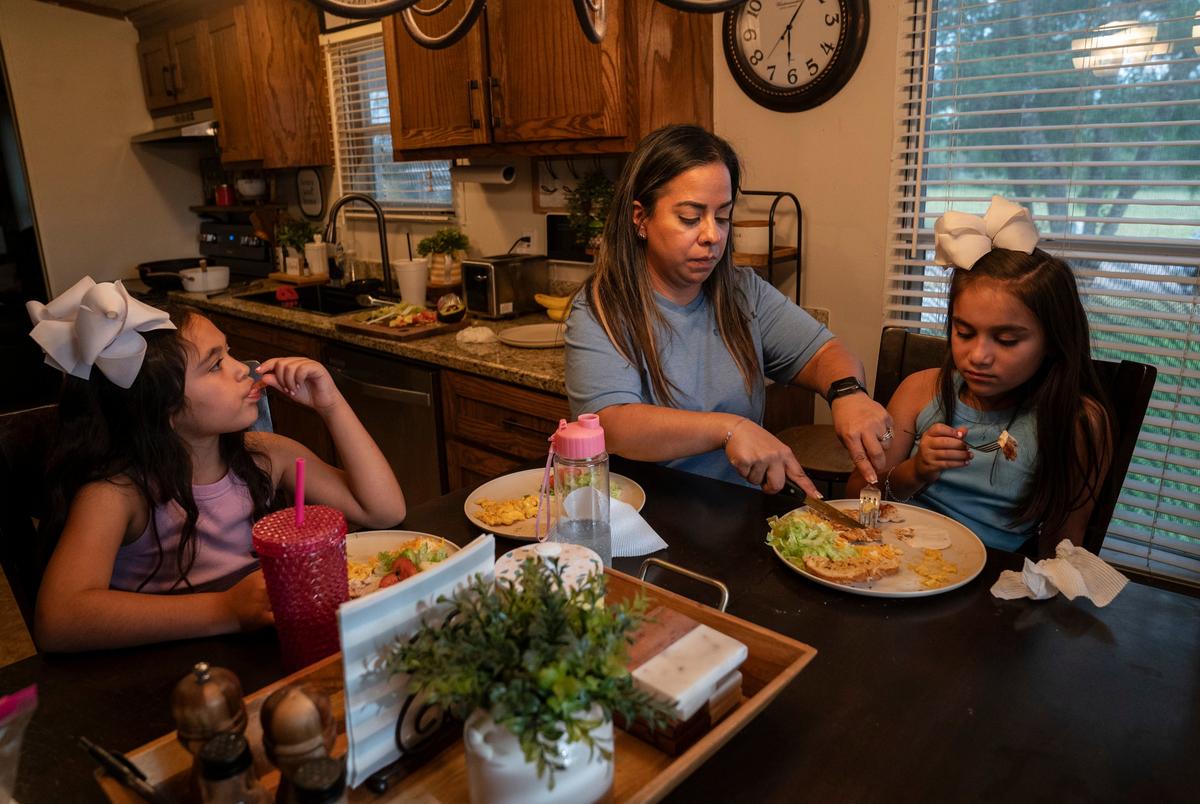
    Clarissa Méndez, 44, and her daughters Catiana Ester Méndez, 7, left, and Catalaya Avaneh Méndez, 8, have diner at their home in Hebbronville, Texas on July 30, 2025. Méndez makes a daily one-hour commute to Laredo to work as a nurse. Currently she has her father or another person pick up her daughters from the daycare and take care of them for about an hour until she comes back from work. After picking up her daughters she cooks for them and spends some time with them before she starts working from home for an additional three to four hours. The family does not receive any government assistance and she does not have the support to take care of her daughters while she works. After school programs like ACE allow her to save some money in daycare costs in addition to her daughters learning entrepreneurial skills, get help with homework, etc.
Gabriel V. Cárdenas for The Texas Tribune
    After picking up her daughters, Mendez cooks for them and spends some time with them before she starts working from home for an additional three to four hours. The after-school program Mendez’s daughters attend allows her to save some money on daycare costs. Credit: Gabriel V. Cárdenas for The Texas Tribune

    The after-school program “gives me enough time to get to town to pick them up,” she said. But with the district planning to shutter operations, Mendez needed to find care providers who could look after her children until 6-6:30 p.m., when she gets home. She pays about $1,000 a month for that service during the summer when the school program is out of session. It would likely cost her another $800 per month during the academic year.

    “That’s a big chunk of our money,” Mendez said.

    Without the program, she would need to find a second job.

    “We’ll do what we gotta do,” she added. “But I don’t understand.”

    Catalaya Avaneh Méndez, 8, in front, plays with her sister Catiana Ester Méndez, 7, as their mother watches them
at her home in Hebbronville, Texas on July 30, 2025. They attend an after school program that allows for their mother to save money on childcare while she works. The Trump administration recently froze the funds for these programs to shortly unfroze them. There is uncertainty whether they will continue to have consistent funding for the programs. Termination of the programs would put financial stress on parents such as the Méndez who receive no government assistance as they will have to pay for daycare for their children.
Gabriel V. Cárdenas for The Texas Tribune
    Catalaya Avaneh Mendez plays with her sister Catiana Ester Mendez as their mother watches them at her home. The Trump administration recently froze funding that benefits after-school programs, placing financial stress on parents such as the Mendez. They would have to find and pay for daycare for their children if those programs ended. Credit: Gabriel V. Cárdenas for The Texas Tribune

    Hibbitts, the 57-year-old from Throckmorton, recently joined a federally funded program that would allow her to support students in her rural hometown between Abilene and Wichita Falls. It places aspiring full-time teachers in classrooms under the supervision of more seasoned teachers and provides financial assistance for their education and living expenses.

    In exchange, the district gets to retain educators familiar with the community and eager to teach.

    Based on her own experience as a Throckmorton student in the 1970s, Hibbitts knows the monumental role teachers can play in a child’s life.

    “They were almost like your second mother,” she said.

    Texas has the largest rural population of any state in the country. Of its roughly 5.5 million students, 13% attend class on a rural campus. Those schools often have to educate their students with less: Less access to the internet and technology, less staffing, and less money to pay and retain teachers.

    THROCKMORTON, TEXAS — JULY 29, 2025: Gay Hibbitts, 57, educator, left, speaks with her mentor, Amy Dick, 34, secondary social studies teacher at Throckmorton Collegiate ISD,  inside a classroom at Throckmorton Collegiate ISD in Throckmorton, Texas, on Tuesday, July 29, 2025. Ms. Hibbitts was part of a federally funded educator preparation program serving about 30 participants across 11 rural Texas districts. The funding, which covered two years of college and training costs, was cut on April 25 under the Trump and Elon Musk DOGE initiative, leaving her uncertain about her future. She is pursuing a bachelor’s degree in general studies with an emphasis in education and a minor in psychology at West Texas A&M. CREDIT: Desiree Rios for The Texas Tribune
    Educator Gay Hibbitts, left, speaks with her mentor, Amy Dick, a secondary social studies teacher, inside a classroom at Throckmorton Collegiate ISD on July 29, 2025. Hibbitts was part of a federally funded educator preparation program serving about 30 participants across 11 rural Texas districts. Credit: Desiree Rios for The Texas Tribune

    Texas lawmakers have acknowledged that rural teachers often do not make as much as their urban and suburban counterparts, and that many have left the profession because of a lack of support. Public schools over time have also grown more reliant on hiring unlicensed educators, a trend playing out more profoundly in the rural parts of Texas.

    In response, state officials recently passed laws aimed at raising teacher pay, particularly in rural schools, and enhancing teacher preparation programs.

    During her first year in the Throckmorton program, Hibbitts learned how to incorporate state learning standards into lesson plans. She learned how to keep students engaged. She helped a child who struggled academically and acted out at the beginning of the school year become a “model student” who thrived in reading by the year’s end.

    Then, one Sunday afternoon in April, her superintendent called her.

    The Trump administration had abruptly cut the federal dollars that helped schools fund educator preparation initiatives like the one she was participating in. It would affect about 30 people across 11 rural districts in Texas.

    Hibbitts was one of them.

    THROCKMORTON, TEXAS — JULY 29, 2025: Gay Hibbitts, 57, educator, center, participates in a safety training at Throckmorton Collegiate ISD in Throckmorton, Texas, on Tuesday, July 29, 2025. Ms. Hibbitts was part of a federally funded educator preparation program serving about 30 participants across 11 rural Texas districts. The funding, which covered two years of college and training costs, was cut on April 25 under the Trump and Elon Musk DOGE initiative, leaving her uncertain about her future. She is pursuing a bachelor’s degree in general studies with an emphasis in education and a minor in psychology at West Texas A&M. CREDIT: Desiree Rios for The Texas Tribune
    Hibbitts participates in a safety training at Throckmorton Collegiate ISD. The funding for Hibbitts’ educator preparation program, which covered her two years of college and training costs, was cut on April 25 under the Trump administration, leaving her uncertain about her future. Credit: Desiree Rios for The Texas Tribune

    In Hebbronville, Mendez and Peña each had to confront their own harsh realities. Mendez would have to search for child care in a community with few affordable options. Peña, the after-school program coordinator, would have to find a new job.

    In Austin, Martin and Blankenship had trouble picturing life without the Boys and Girls Club.

    Club leaders began preparing a memo to notify parents about the funding uncertainty and what it could mean for their kids. Nothing had come of the Republican, Democratic and legal efforts seeking the release of the frozen funds. The Texas kids who spoke with congressional lawmakers and staff at the U.S. Capitol hadn’t heard anything either. When the administration would make a decision about the funds was anyone’s guess.

    Trump responded on a Friday.

    After weeks of uncertainty, his administration announced that it would release the funds.

    When Blankenship got the news, he sprinted out of his room in excitement and told his mom. The moment was just as surreal for Martin.

    “Knowing that it could have been me, my story, or any other club kids’ story,” Martin said, “it made me happy. But it was like, ‘Dang. I was a part — we were a part of that.’”

    Peña, the Hebbronville Elementary program coordinator, was relieved. The mood in her group chat with people from the district’s after-school programs was “pretty ecstatic.” They all cried. Getting the funds meant they no longer had to look for new jobs, and parents like Mendez wouldn’t have to go searching for a place to take care of their kids after school.
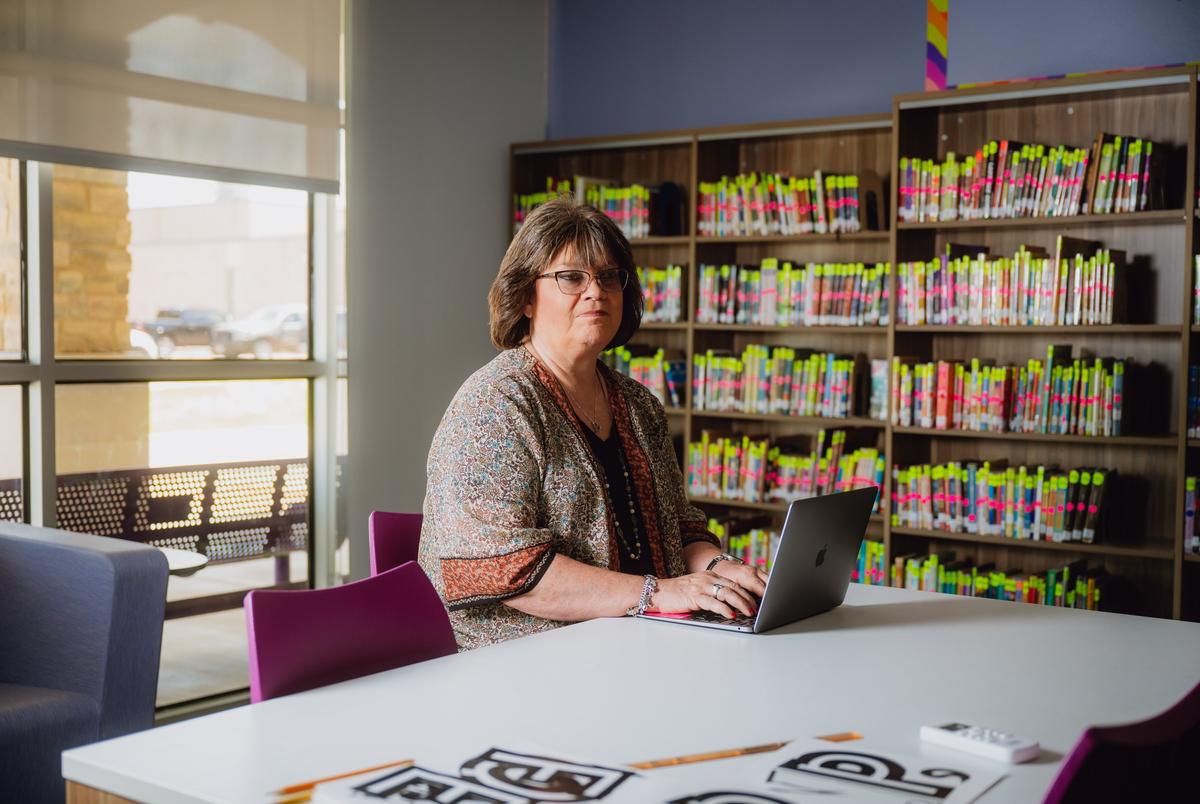
    THROCKMORTON, TEXAS — JULY 29, 2025: Gay Hibbitts, 57, educator, poses for a portrait at Throckmorton Collegiate ISD in Throckmorton, Texas, on Tuesday, July 29, 2025. Ms. Hibbitts was part of a federally funded educator preparation program serving about 30 participants across 11 rural Texas districts. The funding, which covered two years of college and training costs, was cut on April 25 under the Trump and Elon Musk DOGE initiative, leaving her uncertain about her future. She is pursuing a bachelor’s degree in general studies with an emphasis in education and a minor in psychology at West Texas A&M. CREDIT: Desiree Rios for The Texas Tribune
    Hibbitts is pursuing a bachelor’s degree in general studies with an emphasis in education and a minor in psychology at West Texas A&M. Credit: Desiree Rios for The Texas Tribune

    Hibbitts, meanwhile, wasn’t immediately able to bask in the good news, as it did not restore the federal funds for her district’s teacher preparation program. But in early August, her supervisor notified her that the program was officially back up and running for the 2025-26 school year. The news cleared the way for the 57-year-old to graduate at the end of the year and to start teaching full time by the next.

    “This has been life changing for somebody of my age, to be able to step up and to step into the world of education,” Hibbitts said. “I’m finishing my dream. And as my kids like to say, ‘Mom, you’re going to be 58 years old walking the stage.’”

    Still, she recognizes that so much uncertainty around federal funding means there is no guarantee others will get the same chance.

    Uncertainty is what Peña also keeps coming back to.

    “It just gets me upset with the administration, because, why? What was the purpose of the freeze? Why did you do that? You’re hurting people, not just adults, but children,” Peña said. “It’s like in a divorce, you don’t want to put the children in the middle. If something were to happen between parents, you never put children in the middle. And by doing that, you put children in the middle.”

    This article originally appeared in The Texas Tribune,  a member-supported, nonpartisan newsroom informing and engaging Texans on state politics and policy. Learn more at texastribune.org.


    Get stories like these delivered straight to your inbox. Sign up for The 74 Newsletter
    Source link

  • Welcome to Mississippi Child Care Crisis – The 74

    Welcome to Mississippi Child Care Crisis – The 74


    Get stories like this delivered straight to your inbox. Sign up for The 74 Newsletter

    Child care worries have been made worse this summer by federal cuts and depleting pandemic funds, and they aren’t expected to ease by the first day of school. While their kids might have gotten a rest, parents reported longer commutes and newfound stress.

    A dozen parents from across the state told Mississippi Today about summer child care plans for their toddlers and elementary school-aged children. They shared a mix of anxiety about finding care and frustration with existing options.

    Parents have had more reasons to be anxious about those options this summer than in previous ones. A loss of federally funded summer programming for youth, added fees for day care tuition and the loss of vouchers to subsidize tuition costs have changed the landscape of child care.

    Shequite Johnson poses with newborn Noah on a work trip in Jackson, Miss., on Feb. 12, 2025. (Shequite Johnson)

    For Shequite Johnson, a professor at Mississippi Valley State University, it has meant driving 45 minutes in the opposite direction of her job for day care.

    “I’ve had to leave my 13-year-old with my 4-year-old,” she said. “And you’re put in a situation where you have to make these decisions. Some are even leaving their babies at home by themselves for five hours and checking on them during lunch hour.”

    She had to pull her 4-year-old boy from a day care in her hometown because of excessive fees. She was charged a $20 late fee at pickup, a $100 registration fee for each of her two boys, and a $150 supplies fee that was announced in June on top of the $135 weekly fee.

    The Mississippi Department of Human Services recently announced a cutback on vouchers that subsidize child care costs. Without Johnson’s child care voucher, her nearby options were limited to a city-run program in an unsafe neighborhood and three programs in aging facilities.

    Delta Health Alliance runs free and reduced summer programming for elementary-aged children. But Johnson makes more than the income cut-off.

    “It’s a crisis right now in Mississippi,” said Carol Burnett, executive director of Mississippi Low-Income Child Care Initiative. “The lack of affordable child care prevents employers from keeping their workforce. And yet the state of Mississippi wants people to go back to work.”

    “Parents are having to make choices. And none of them are good,” she added.

    The Child Care Initiative operates a program that connects single moms with higher-paying jobs and covers the costs of child care during the transition. The organization is also advocating for the Mississippi Department of Human Services to spend some of the $156 million in unspent Temporary Assistance for Needy Families on Mississippi’s Child Care Payment Program.

    The Child Care Development Fund, which nationally supports these voucher state programs, relied on pandemic-era funding that ran out in September. The Department of Human Services asked the Legislature for $40 million to continue serving the same number of families – but received $15 million.

    In April, the department put a hold on renewals for child care vouchers except for deployed military parents, parents who are TANF recipients, foster children guardians, teen parents, parents of special needs children and homeless parents. As a result, 9,000 parents lost child care assistance.

    The department will keep the hold until the number of enrollees drops to 27,000 or its budget goes below $12 million in monthly costs. As of Friday, it had no further update but said it will have an announcement in the next couple of weeks.

    Using TANF funds unspent from past years regardless of whether they were allocated for child care assistance is prohibited, according to federal guidance. However, the TANF state office can use the leftover funds to form a direct payment program. Ohio and Texas enacted this policy.

    U.S. Department of Health and Human Services regional manager Eric Blanchette shared this idea with Mississippi Department of Human Services Early Childhood Director Chad Allgood, according to an email obtained as part of a records request filed by Mississippi Today into communication regarding TANF funds. As of Friday, there were no plans to enact a similar policy in Mississippi.

    A second rent

    Monica Ford pays nearly $1,600 in monthly child care costs for three kids. She works as a Shipt delivery driver in addition to her day job as a Magnolia Guaranty Life Insurance Co. auditor. She, her husband and their children recently had to move in with his parents.

    Monica Ford poses with children Tahir, 7, Kian, 4, Nuri, 1, at Freedom Ridge Park in Ridgeland, Miss., July 19, 2025. (Monica Ford)

    “It’s more than I’ve paid in rent,” she said. “It’s why I live with my family now.”

    She uses a Jackson day care that charges $10 per minute for late pickup. The fees must be paid by the next morning.

    Nearly all of the single mothers interviewed said they take on extra work to cover the rising costs of child care in their area. It’s extra work that sees them spending less time with their children.

    Ashley Wilson’s child care voucher wasn’t renewed in the spring. She works 55 hours a week at a bingo hall and at Sonic Drive-In.

    “We don’t get help. That’s what I don’t understand,” said Wilson, an Indianola parent.

    Her preferred day care option in Indianola charged $185 per week and $20 late fees, which Wilson could not afford. Her sister was able to afford monthly costs because of an arrangement with an Angel – a benefactor who helps local families with tuition at day care providers.

    Wilson tried other day cares in town. Several were in dangerous neighborhoods with staff that left milk bottles to spoil. Her toddler came home wet some afternoons and with cuts another. She gets help from family when she can.

    Whitney Harper lost her child care voucher in April. She is lucky when a relative is willing to watch her 2-year old. Lately, she has considered hiring a sitter off care.com, a website that connects parents with local babysitters. In Jackson, where she lives, the hourly rate is $14 per hour.

    Most of the day cares in the Jackson metro area charge between $150 and $250 per week, which is more than she can afford as a sales associate at Home Depot.

    “It has been harder this year. They won’t work around my schedule, but I need the job,” she said of her employer.

    ‘This is the worst I have seen it’

    Day care centers are left on the brink when families lose child care vouchers. Making up the lost revenue has meant higher tuition and fees for some centers and reaching out to private donors for others.

    “These are small businesses,” Burnette said. “The big story in child care is how much it costs to run it. It requires adequate public investment.”

    Level-Up Learning Center leadership team poses in front of their Greenville, Miss., location on July 26, 2024. Left to right are Chief Operating Officer Adrienne Walker, CEO Kaysie Burton and COO/Athletic Director Kwame Malik Barnes. (Level Up Learning Center)

    This week, Level Up Learning Center owner and CEO Kaysie Burton visited Greenville’s Walmart, seeking to persuade the manager to sponsor his employees’ child care tuition. She submitted two grant applications and is working on at least three others. Burton’s business survived flooding and relocation. But the latest voucher cutback could shut her banner-adorned doors to the community

    At Level Up Learning Center, 75% of parents rely on child care vouchers. In the last three months, 20 Learning Center parents have lost their child care vouchers yet most have stayed. Burton has a policy of not turning parents away if they are willing to contribute a portion of the weekly rate. She has not increased her tuition or instituted punishing fees.

    But making up the lost revenue can be a challenge. Since the cutback, she has let seven teachers go, or roughly a third of her staff.

    “We’re down to skin and bones right now,” Burton said. “I am willing to take anybody that is willing to come partner with us and help us help parents so that their kids can keep coming in.”

    When Burton started her business during the COVID-19 pandemic, she saw the need in the Mississippi Delta for affordable, quality child care. She remains committed to helping prepare a future generation of Greenville leadership.

    “We’re in the thick of it with our parents,” Burton said. “And we all just need help and we need prayer.”

    SunShine Daycare owner Barbara Thompson has greeted each parent at the door since she started babysitting neighbors’ kids in her living room. The former banker has long had a passion for raising neighborhood children regardless of their parents’ status or income. She raised her seven siblings when her mother died when Thompson was 12.

    But for the first time in 30 years of running a business in Greenville, Thompson is losing families by the dozen as well as longtime staff. She has leaned heavily on prayer and has reached out to state representatives for help. She fears more departures and the downsizing of her business.

    In the last two months, 12 parents pulled their kids from SunShine. She will have to let three teachers go as a result.

    “We won’t have any children if this continues,” Thompson said.

    She regularly informs parents of the child care voucher waitlist and of the process for renewals. Besides caring for children, Thompson advises many young parents in her community. She noticed that state agencies communicate primarily through email, which a lot of her parents don’t check regularly.

    Children who leave her stoop festooned with cartoon characters can face hours alone without parental supervision. Some children will sit and watch television with their grandparents. For Thompson, child care is about raising children to be “productive citizens.” The youngest years are some of the most important, she stressed.

    “They didn’t take it from us,” Thompson said. “They took from the children. That’s the world’s future.”

    Waitlisted

    Vennesha Price is waitlisted at nearly every day care in Cleveland, where she lives. She’s been on some of the lists for eight months.

    “If you haven’t been a resident for five years and you haven’t navigated the waiting list for five years, it’s harder to find a spot,” she said.

    She found it difficult to both have a productive work day and watch her elementary-aged children. Eventually, she found a day care that was 40 minutes away. She wakes up an hour earlier to make the commute in time before work.

    “I’m a single mother so it’s very difficult,” Price said. “After my grandmother went on to the Lord, it became a struggle trying to get to the day care in time.”

    She started factoring late fees into her monthly budget. She’s also including the gas money needed for the extra legs of her commute. Her child care costs doubled for June and July.

    “It’s almost like private school tuition now,” she said.

    This article first appeared on Mississippi Today and is republished here under a Creative Commons Attribution-NoDerivatives 4.0 International License.


    Get stories like these delivered straight to your inbox. Sign up for The 74 Newsletter

    Source link

  • Why should we care about cuts to funding for science education?

    Why should we care about cuts to funding for science education?

    Key points:

    The Trump administration is slashing the funding for new projects focused on STEM education and has terminated hundreds of grants focused on equitable STEM education. This will have enormous effects on education and science for decades to come.

    Meaningful science education is crucial for improving all of our lives, including the lives of children and youth. Who doesn’t want their child or grandchild or neighbor to experience curiosity and the joy of learning about the world around them? Who wouldn’t enjoy seeing their child making careful observations of the plants, animals, landforms, and water in their neighborhood or community? Who wouldn’t want a class of kindergartners to understand germ transmission and that washing their hands will help them keep their baby siblings and grandparents healthy? Who doesn’t want their daughters to believe that science is “for them,” just as it is for the boys in their classroom?

    Or, if those goals aren’t compelling for you, then who doesn’t want their child or grandchild or neighbor to be able to get a well-paying job in a STEM field when they grow up? Who doesn’t want science itself to advance in more creative and expansive ways?

    More equitable science teaching allows us to work toward all these goals and more.

    And yet, the Department of Government Efficiency has terminated hundreds of grants from the National Science Foundation that focused squarely on equity in STEM education. My team’s project was one of them.  

    At the same time, NSF’s funding of new projects and the budget for NSF’s Education directorate are also being slashed.

    These terminations and drastic reductions in new funding are decimating the work of science education.

    Why should you care?

    You might care because the termination of these projects wastes taxpayers’ hard-earned money. My project, for example, was 20 months into what was intended to be a 4-year project, following elementary teachers from their teacher education program into their third year of teaching in classrooms in my state of Michigan and across the country. With the termination, we barely got into the teachers’ first year–making it impossible to develop a model of what development looks like over time as teachers learn to engage in equitable science teaching.

    You might care because not funding new projects means we’ll be less able to improve education moving forward. We’re losing the evidence on which we can make sound educational decisions–what works, for whom, and under what circumstances. Earlier NSF-funded projects that I’ve been involved with have, for example, informed the design of curriculum materials and helped district leaders. Educators of future teachers like me build on findings of research to teach evidence-based approaches to facilitating science investigations and leading sense-making discussions. I help teachers learn how they can help children be change-makers who use science to work toward a more just and sustainable world.  Benefits like these will be eliminated.

    Finally, you might care because many of the terminated and unfunded projects are what’s called NSF Early Career Awards, and CAREER program funding is completely eliminated in the current proposed budget. CAREER grants provide crucial funding and mentoring for new researchers. A few of the terminated CAREER projects focus on Black girls and STEM identity, mathematics education in rural communities, and the experiences of LGBTQ+ STEM majors. Without these and other NSF CAREER grants, education within these fields–science, engineering, mathematics, data science, artificial intelligence, and more, from preschool through graduate school–will regress to what works best for white boys and men.

    To be sure, universities have some funds to support research internally. For the most part, though, those funds are minimal. And, it’s true that terminating existing projects like mine and not funding new ones will “save” the government some money. But toward what end? We’re losing crucial evidence and expertise.

    To support all children in experiencing the wonder and joy of understanding the natural world–or to help youth move into high-paying STEM jobs–we need to fight hard to reinstate federal funding for science and science education. We need to use every lever available to us–including contacting our representatives in Washington, D.C.–to make this happen. If we aren’t successful, we lose more than children’s enjoyment of and engagement with science. Ultimately we lose scientific advancement itself.

    Latest posts by eSchool Media Contributors (see all)

    Source link